Archive for the ‘Chrisitian Virtues’ Category

The Joyful Mysteries, Meditations with the Saints

October 28, 2010

The 1st Joyful Mystery: 
The Annunciation

The Blessed Virgin Mary may have been just 13 years old when the angel Gabriel announced to her that she would give birth to Jesus. She shows us that even if you are young, God can still do big things with you, if you say “Yes” to Him.

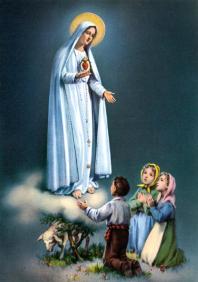
On May 13, 1917, three Portuguese children were praying the rosary after lunch in a field on a clear blue day.  The eldest was Lucia, age 10, and she was with her cousins, Francisco and Jacinta, ages eight and seven. Suddenly, they saw two bright flashes. They looked up and saw “a lady, clothed in white, brighter than the sun…” The Lady smiled and said, “Do not be afraid, I will not harm you.” Lucia asked her where she came from. The Lady pointed to the sky and said, “I come from heaven.” Lucia asked what she wanted. The Lady said, “I have come to ask you to come here for six months on the 13th day of the month, at this same hour.”

On July 13, the incredibly beautiful Lady appeared again. Lucia asked her who she was, and for a miracle so everyone would believe. The Lady answered, “Continue to come here every month. In October, I will tell you who I am and what I want, and I will perform a miracle for all to see and believe.” Then she taught them this prayer: “Oh my Jesus, forgive us our sins, save us from the fires of hell. Lead all souls to Heaven, especially those in most need of Thy Mercy.”

At noon, on October 13, 1917, some 70,000 people were gathered in the field. With a flash of light, the Lady appeared to the children and declared, “I am the Lady of the Rosary.” Some spectators cried out and the crowd turned their eyes upward to the cloudless sky, and they gazed on the sun without the least discomfort.  They saw it tremble and danced in a miraculous way.

Mary, Lucia, Francisco and Jacinta teach us this lesson: Even if you are young, God can do big things with you, if you say “Yes” to Him. Let us pray that we would be open to doing God’s will every day.

The 2nd Joyful Mystery:
The Visitation

“During those days Mary set out and traveled to the hill country in haste to a town of Judah, where she entered the house of Zechariah and greeted Elizabeth. When Elizabeth heard Mary’s greeting, the infant leaped in her womb, and Elizabeth, filled with the Holy Spirit, cried out in a loud voice and said, ‘Most blessed are you among women, and blessed is the fruit of your womb. And how does this happen to me, that the mother of my Lord should come to me? For at the moment the sound of your greeting reached my ears, the infant in my womb leaped for joy.’” (Luke 1)

Imagine how St. Elizabeth must have felt to have Mary, Mother of God, walk in through her door. Elizabeth could not see the tiny Jesus, a fetus in Mary’s womb, but she was convinced that He was hidden there. How would you treat someone if you knew that Jesus was hidden inside of them?

Blessed Mother Theresa cared for the poorest of the poor in the streets of Calcutta, India. Despite years of strenuous physical, emotional and spiritual work, Mother Teresa seemed unstoppable. Though frail and bent, with numerous health problems, she always returned to her work, to those who received her compassionate care for more than 50 years. How did she do it? She could do it because she encountered her beloved Christ both in times of prayer and in the people she cared for. Mother Teresa remembered Jesus’ words, “Amen, I say to you, whatever you did for one of these least brothers of mine, you did for me.” (Matthew 25:40) Mother Teresa loved others as if they were the Lord Himself.

Blessed Mother Teresa and St. Elizabeth teach us this lesson: Jesus is present in your classmates here at school, so you should always be welcoming and loving toward them. Let us pray for the grace to love others in this way.

The 3rd Joyful Mystery:
The Nativity

In his youth, Francis had been quite rich, the son of a wealthy merchant, yet he sensed that there was more to life. He put his former life behind him and devoted himself to following Christ. One day, at Mass, the Gospel told of how Christ’s disciples were to possess neither gold nor silver, nor traveling items, but were to exhort sinners to repentance and announce the Kingdom of God. Francis took these words as if spoken directly to himself, and as soon as Mass was over he threw away what little he had and went forth at once, exhorting the people of the country-side to penance, brotherly love, and peace. He was poor, but clearly happy, and others were attracted to join his movement. By the time of his death, hundreds had joined his religious order. On October 3, 1226, St. Francis died a penniless, but happy man. 

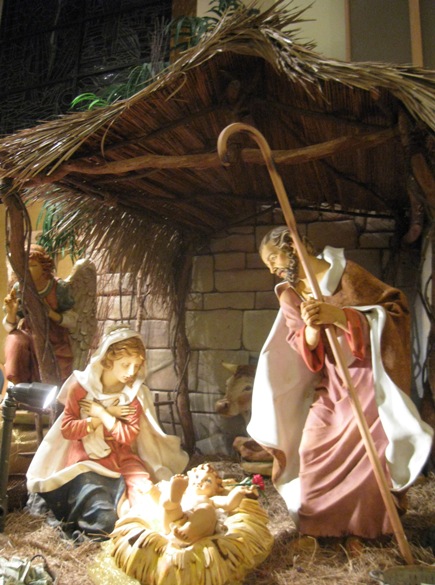
St. Francis of Assisi loved Christmas.  In fact, one story tells of how he petitioned the Holy Roman Emperor to make an edict that grain and bread should be provided to birds, beasts, and the poor this day, so that all God’s creatures would have occasion to rejoice in the Lord. St. Francis also invented the Christmas tradition of making a model of the nativity scene. These nativity scenes, called Crèches, remind us that even though Christ was rich in Heaven, he became poor when he was born on earth in a barn. Yet, Jesus was a happy man, despite his poverty.

Jesus and St. Francis teach us this lesson: You do not need to be wealthy in order to be happy. Let us pray that we may be content and happy with the riches that we have.
The 4th Joyful Mystery: 
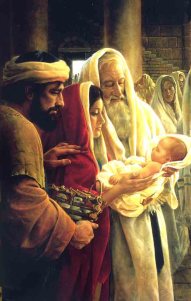
The Presentation of Jesus in the Temple

In the year that Jesus was born, “there was a man in Jerusalem whose name was Simeon. This man was righteous and devout” and he longed to see the Messiah who would save God people. It had been revealed to him by the Holy Spirit that he would indeed see the Christ before he died and Simeon trusted and hoped in that promise.

One day, the Spirit inspired him to come into the temple. When he say Mary and Joseph carrying in the baby Jesus to offer a sacrifice for Him, Simeon “took him into his arms and blessed God, saying: ‘Now, Master, you may let your servant go in peace, according to your word, for my eyes have seen your salvation, which you prepared in sight of all the peoples, a light for revelation to the Gentiles, and glory for your people Israel.’” (Luke 2)

What are the promises the Lord has made to us?  Do we trust and hope in these promises? Simeon teaches us this lesson: That we ought to trust and hope in the Lord’s promises, for all of them will be fulfilled in the sight of all someday.

The 5th Joyful Mystery:
The Finding of Jesus in the Temple

This is a true story, the story of a Catholic mother of three whose oldest son joined an anti-Catholic religious cult. It started him down a path of sinful pride and many sensual sins. It broke her heart and for years she prayed tearful prayers for his conversion.

She even asked the bishop to intervene in winning over her son. He counseled her to be patient, saying, “God’s time will come.” When she persisted in asking, the bishop (perhaps busy with many other things) famously reassured her: “Go now, I beg you; it is impossible that the son of so many tears should perish.”

That mother was St. Monica, and that son of hers, who was lost and found, was the great St. Augustine. Sts. Monica and Augustine teach us this lesson: that your persistent prayer can help people to find Christ. Let us pray for someone that we know, that he or she may be drawn closer to Jesus Christ.

Sources:
On Fatima
On St. Francis
On Blessed Mother Teresa

Catholic Medical Ethics—30th Sunday in Ordinary Time—Year C

October 27, 2010

In today’s second reading we hear from St. Paul, a prisoner in Rome on account of Christ and the Gospel.  Paul senses that the end of his life on earth is near. He writes:

“I am already being poured out like a libation,
and the time of my departure is at hand.”

The emperor will soon order Paul to be executed by beheading, sending him to Christ’s eternal reward. Yet this is not to the emperor’s glory, for the blood of St. Paul’s murder will be on his hands.

By God’s grace, Paul was not left all alone in this difficult, final season of his life. Elsewhere in this chapter from 2nd Timothy, he writes, “Luke is the only one with me.”  (This is St. Luke the evangelist, whose Gospel we are reading this liturgical year.) In another letter, Paul calls Luke his “beloved physician.”

Now what if Luke, seeing Paul’s burdens and what trials awaited him, were to procure some hemlock with which to end his friend’s life? Would Paul be pleased with him? Would he not rather be angry that Luke would presume to thwart God’s purposes for him on earth?

The Lord, the author of our lives, is the one to decide when someone’s life story is complete. God has joined our souls to our bodies and what God has joined together, no human being must separate; for it is always and everywhere wrong to intentionally kill the innocent. God sent Luke to Paul not to kill him, but to strengthen, console and support him in this last season of his life.

Healthcare and end of life issues touch all our lives, and people of good will have many questions in this area. Like, “What is wrong with euthanasia or assisted suicide?” “What does Christ’s Church teach about living wills, ventilators, feeding tubes, and palliative care?” And, “What kind medical care is morally required, and what sorts of care are optional?”

The Church calls care and treatments which are morally required “ordinary care.” Treatments which are optional called “extraordinary care.” Each of us has an obligation to respect our lives and bodies as precious gifts from God.  This means that we must always receive, and provide to others, “ordinary care.” However, circumstances can arise where various treatments become “extraordinary” and may be omitted. Treatments which involve great pain, or extreme cost, or little likelihood of doing much good can be deemed extraordinary care.  Burden, cost, and futility can make a treatment morally optional.

Yet, every treatment must be put into context. Sometimes the same procedure, which is ordinary in some cases, will be extraordinary in others. Sometimes a ventilator can be an extraordinary treatment, making it acceptable for people to refuse or discontinue its use. However, imagine if an otherwise healthy person should come to the hospital with a routinely curable lung condition which requires surgery and the short-term use of a ventilator.  In this case, the ventilator—which can be costly and burdensome—is not extraordinary because its benefits far outweigh its burdens.

This is a danger with living wills and advance directives.  Making medical decisions about treatments, in the abstract, in advance, and out of context, can easily lead to wrong decisions. Consider the use of feeding tubes. A person can check a box on a living will that says they never want one, but feeding tubes are quite often ordinary care; however, in some cases, they become extraordinary care.

Sometimes, in the process of dying, a person may no longer be able to digest food. In such an instance, use of a feeding tube would be futile, painful, extraordinary, and rightly omitted. But if someone is not dying, to deprive them of food or water is like preventing a diabetic from taking their insulin. That is not allowing nature to take its course—it is homicide. Pope John Paul II taught that ‘a sick person in a vegetative state, awaiting recovery or a natural end to their life, still has the right to basic health care (such as nutrition, hydration, cleanliness, warmth, and the like), and to the prevention of complications related to his or her confinement to bed. … Causing someone’s death by starvation or dehydration, if done knowingly and willingly, is truly euthanasia by omission.’

We condemn euthanasia and assisted suicide because they are about killing the person rather than killing the disease, and we can never intentionally kill the innocent. It is wrong to kill the sick, but it is good to alleviate their pain and discomfort while they live. This kind of treatment, aimed at increasing a person’s comfort, is called palliative care and it is a great good. The work of Hospice and others is to provide palliative care in the final stages of life.

Would it be wrong to overdose a person with morphine to end their life?  Yes, for it is wrong to intentionally kill the innocent. But what about a case where treating someone’s pain with pain-killers (in the normal doses) might have the unintended side-effect of shortening their remaining days? Would it be wrong to request or administer such a treatment?  No because the aim is not to kill the sick person, but to relieve their pains. Sometimes, people with cancer choose to forgo chemotherapy and its burdens even though treatment might help them live longer than they would without it. Are these people choosing death? No, they are choosing a different way to live. The burdens of chemotherapy can make it an extraordinary treatment, and we are free to forego extraordinary treatments, even if it may shorten our lives.

The three principles I have tried to present today are these: first, that it is always and everywhere wrong to intentionally kill the innocent.  Second, that we must receive, and provide to others, ordinary care. And third, that treatment which entails great pain, or extreme cost, or little likelihood of doing much good can be deemed extraordinary care, and is morally optional.

I hope you now have a clearer understanding of some points of Catholic medical ethics, but these can be complicated issues. If you are facing difficult treatment decisions, for yourself or someone you love, seek out counsel of those who know the Church’s teachings on this subject. Holy Mother Church’s wisdom on healthcare issues is the natural and logical extension of her dedication to human dignity. As Roman Catholics in a culture of death, we must we stand for the dignity of every human life, from conception to natural death, and we need to vote for it, too.

  • An article on “ordinary” and “extraordinary” care.

A Great Quote about St. Issac Jogues

October 20, 2010

August, 1642 AD. The Jesuit missionary St. Issac Jogues is canoeing to the land of the Herons in New France when he is captured by Mohawk Iroquois. They torture him and cut off several of his fingers. He later escapes them and returns home to France, but he laments no longer being able to preside at the Mass.  (Canon law prohibits him from offering the sacrifice with his maimed hands.)

An appeal is made to Pope Urban VIII in Rome for an unprecedented dispensation. The pope  responds with this famous reply:

“Can one deny the right to say Mass to a martyr of Christ?”

St. Issac Jogues returns to Canada and sheds his blood a second, final time at the hands of those he came to save.

The Great Marriage — The Nick and Laurel White Wedding

October 9, 2010

In the Gospel we just heard Jesus say that “from the beginning of creation, God made them male and female,” and “for this reason a man shall leave his father and mother and be joined to his wife, and the two shall become one flesh.” Jesus is quoting here from Genesis, but something about these words has always struck me as a little strange. Why did Jesus and Genesis mention that ‘a man shall leave his father and mother to be joined to his wife?”

We tend to think of the bride as leaving her family to join her husband. Traditionally, as we saw today, her father walks her down the aisle to give her away, and the bride changes her name to match her husband’s. Perhaps it was put this way (“a man shall leave his father and mother”) because for the man must go out in pursuit of his bride. If a woman in a relationship found out that her man was leaving it to her to pursue him she would be very disappointed.

There is, I think, another important reason for the choice of these words: these words speak of Christ. Jesus left His eternal Father’s house in Heaven to become a man, and then He departed His perfect mother’s house to begin His ministry, all in pursuit of winning a bride, His bride the Church. Jesus is the man who left His father and His mother to be joined to his wife.

From the beginning of creation, God had made us male and female. So when the Lord sought to be perfectly united with us, Christ became a human being. Jesus became one flesh with our humanity, so that we could become one with His divinity. He came as a man because a man, like God, pursues his beloved. He comes to us as a man in love, not out of lust, not to dominate us or for His own selfish pleasure, but for a noble purpose. Jesus comes to propose to us and to enter into a marriage between Heaven and Earth, between God and man, between Himself and His bride, the Church.

Nick and Laurel, the sacrament you are about to enter, the sacrament of marriage, connects you to this union between Christ and the Church. Don’t try to rely on you own resources alone, but connect to the power of your sacrament. Nick, ask Jesus to let you share the love He has for His bride. Then, empowered by this love, you will lay down your life for your bride, and cherish her and bless her as long as you both shall live. Laurel, ask Mary and the saints, to let you share the love they have for the Bridegroom. Then, empowered by this love, you will rejoice in your husband, and honor him and follow him as long as you both shall live. Remember, this sacrament you are about to enter is not merely a symbol the of love between Christ and His bride. It makes that love truly present in you.

Faith Enough — 27th Sunday in Ordinary Time—Year C

October 3, 2010

The apostles say to Jesus, “Increase our faith.” They have faith, but they feel like it’s not enough so they ask for more. Jesus replies, “If you have faith the size of a mustard seed, you would say to this mulberry tree, ‘Be uprooted and planted in the sea,’ and it would obey you.” In saying this, Jesus’ is not expressing disappointment in His disciples—He’s means to encourage them and us.

He wants us to understand that we have enough faith right now to be faithful in his service and to do incredible things. You have already enough faith to do what He asks you to do today. You need only to act upon it.

As we see with Habakkuk, we may need patience to see the fruits of our faithfulness. And as Paul reminds Timothy, we must put our faith into action. But the thing Jesus wants us to understand today is that we do not need to wait for more faith before we begin to be more faithful. We have already enough faith to do what He asks of us today.

If you had a perfect faith, what would you do? Try acting that way today, and you will find yourself living in faithfulness. Wouldn’t you like to see the difference that makes?

Jesus once called the mustard seed as the smallest of seeds. The mustard seed may be tiny, but its flavor is most powerful.  So it is with our faith.  The faith within us can be powerful despite its small size. A faith-filed Christian can transform the world. Think of Blessed Mother Teresa of Calcutta. Her faith helped and blessed so many people. Our faith can do great good too, but we do well to remember Mother Teresa words, “We are called upon not to be successful, but to be faithful.” Our job is to be faithful. If we do that, the Lord take care of the miracles. 

After teaching the apostles about the incredible power of their faith, Jesus reminds them of them of the importance of their being humble. We need to remember that the He is the master, and we are only His servants. Like the sorcerer’s apprentice, if we try to work great magic on our own we will only make a mess of things. Our efforts and projects must be from Him, with Him, and for Him if they are to do any lasting good.

We need not wait for God to increase our faith to begin to be more faithful. Christ has already given us enough faith to begin transforming our lives, our families, our communities, and our world. But our efforts must be those of humble servants of Christ our Lord, from whom all good things come.

The Little Flower — October 1 — St. Therese of Lisieux

October 1, 2010

Why do we call St. Therese of Lisieux “the Little Flower?” This imagery comes from Therese’s autobiography and she applies the name to herself.  She writes:

“[Jesus] showed me the book of nature, and I understood that every flower created by Him is beautiful, that the brilliance of the rose and the whiteness of the lily do not lessen the perfume of the violet or the sweet simplicity of the daisy. I understood that if all the lowly flowers wished to be roses, nature would lose its springtime beauty, and the fields would no longer be enameled with lovely hues. And so it is in the world of souls, which is the garden of Jesus.  He has been pleased to create great saints who may be compared to the lily and the rose, but He has also created lesser ones, who must be content to be daisies or simple violets flowering at His feet, and whose mission it is to gladden His divine eyes when he deigns to look down on them.”

She writes that her autobiography is “the story of the Little Flower gathered by Jesus.”

Therese thought she was only a little flower, yet she was greater than she realized. Just 27 years after her death she would be canonized a saint. John Paul the Great would name her a Doctor of the Church (the third, female Doctor, after Catherine of Sienna and Teresa of Avila.) Pope Pius XI even called her, “The greatest saint of modern times.” Such was the greatness of her life, her words, and her friendship with God.  And yet, Therese didn’t realize her greatness while she lived.

If St. Therese, the Doctor of the Church, could so misjudge her importance in the garden of the Lord, then how easy might it be for a humble, daily, Mass-goer to under-appraise his or her significance in the eyes of God too?

Job’s Desolation — Tuesday, 26th Week in Ordinary Time—Year II

September 28, 2010


The sadness of Job is like a heavy stone hanging from his neck.

In his pain, he seems to forget that he is surrounded by people who care about him very much. When Job’s friends learn of his misfortune they come to him. For days and nights they sit with Job, listening, not saying a word, yet saying a great deal by just being there. He is not alone.

In his despair, Job imagines that his life will never get better. Yet he cannot see the future. The Lord is going to bless Job and happiness will return to him.

In his darkness, Job wishes he were dead. He asks, “Why did I not perish at birth?” Yet death is not the way. When the Samaritans rejected Jesus, James and John asked to rain down fire, but Jesus rebuked them for it. As long as there is life, there is hope, for the Samaritans, and for us.

How wrong it is if we mistake death for the way of peace, for that is not Christ’s answer. How wrong it is if we imagine that we will never be happy again, for sun’s light shines beyond our horizon or behind the clouds, even if we cannot see it. And how wrong it is if we forget that people care about us, for each of us here is loved more than we know.

Rich Man’s Loss — 26th Sunday in Ordinary Time—Year C

September 26, 2010

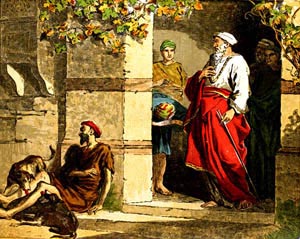
[The rich man] cried out, “Father Abraham, have pity on me. Send Lazarus to dip the tip of his finger in water and cool my tongue, for I am suffering torment in these flames.”

Why does the rich man suffer in flames? It’s not that Abraham is unaware of him, for when the rich man speaks Abraham answers him. And it’s not that Abraham no longer acknowledges him, for Abraham calls him “my child.” It’s not that Abraham lacks in mercy, for Abraham once intervened to spare a city of sinners. The rich man is not in the flames because of Abraham, or Moses, or the prophets of God, for if he had listened to them he would not be in torment.

So why does the rich man suffer in flames? He suffers because he feasted each day, while Lazarus starved. Because he dressed in fine linen, while Lazarus went naked. Because he was clothed in purple, while Lazarus was covered in purple sores. Yet the rich man is not in the flames because he is rich, for King David was far richer than he and is heralded as a man after God’s own heart. The rich man suffers because the dogs who licked Lazarus’ wounds showed the poor man more kindness than he ever did.

The rich man was not unaware of Lazarus lying at his door, for he had passed him enough times to recognize him when he saw him. The rich man even knew Lazarus by name, for he calls out, “Father Abraham… Send Lazarus…”  The rich man suffers in flames because he did not care about Lazarus. The rich man suffers because he did not love. If we wish to avoid the flames, we should ponder and act on this question: Who is Lazarus in your life?

Investments & Debts — 25th Sunday in Ordinary Time—Year C

September 19, 2010

Last week we heard Jesus’ parable of the Prodigal (or squandering) Son. Today He tells us about a debt-canceling steward. These stories offer similar lessons: the first lesson is about how to use our wealth profitably.

The prodigal son wastes his wealth on himself, on a life of self-indulgence, and he finds himself poor and alone. But hisgood father uses his wealth to generously cloth and feed him, and he thereby restores their relationship. Today’s steward gets reported for squandering the master’s property and is soon to be sent away destitute. But the prudent steward finds a way to always have a place to stay. He forgives others’ their debts and thereby wins their friendship. The first lesson is that we will lose whatever we hoard for ourselves, but whatever we invest in love will have an everlasting return.

The reason we exist, the reason we were created, is for personal relationships with God and each other. And when we die, we will take nothing with us, except these relationships. Our computers, cars and credit cards will be left behind, but personal love remains with us. A $100 bottle of wine can be enjoyed for an evening, but then it is lost forever. A donation to Catholic Relief Services can save a life, and a donation to Relevant Radio can save a soul, and someday, when all of our investments in love for family, neighbors and strangers are revealed, they will give us everlasting joy forever. So “I tell you, make friends for yourselves with dishonest wealth, so that when it fails, you will be welcomed into eternal dwellings.”
 
The second lesson of these parables is the importance of forgiveness. The good father wins back his dead and lost son, because he is willing to forgive him. The older son, however, is unwilling to forgive. He refuses to enter the house of his father and will not join the feast until his heart is changed. The good father symbolizes God, and the house is Heaven, and unless we forgive everyone one from the heart, we will refuse to join the feast. The second parable is also symbolic. God is the rich man and we are the squandering steward. Consider how much He has given you and how fruitlessly you have used it. At the end of our lives we will be called to give an account of our stewardship, and who can stand that judgment? This is what we must do: we must forgive our debtors their debts by forgiving their sins against us.

A sin forms a debt because it takes away from others what is owed to them by right. Every sin makes a debt, first and foremost to God, but also to the people trespassed against. It is speculated that the steward in the parable was forgiving his master’s debtors the part which was his own commission. If we are prudent like him, we will quickly take the opportunity to forgive our debtors the debt owed to us by forgiving the sins they have sinned against us. For we have it on Jesus’ word, “If you forgive others their transgressions, your heavenly Father will forgive you. But if you do not forgive others, neither will your Father forgive your transgressions.”
 
Now a lot of people refuse to forgive, or think that they can’t, because they think forgiveness means something its not. To forgive another’s sin is not to say that what they did wasn’t wrong—that would be a lie. And forgiveness doesn’t mean convincing yourself that the wrong doesn’t hurt—Jesus forgave his enemies amid excruciating pain. To forgive, all you need to do is to will the good of your trespasser. If you can pray for them, you are forgiving them. On the other hand, if there is anyone that you find that you are unable to pray for, then you have not forgiven them. That is the person whom you must pray for, for your own sake as well as theirs. So let your “supplications, prayers, petitions, and thanksgivings be offered for everyone… This is good and pleasing to God our savior, who wills everyone to be saved and to come to knowledge of the truth.”

Jesus’ parables teach us this: to use our wealth for lasting profit, and to forgive our debtors their debts. Let us be prudent to obtain true riches on earth and a everlasting home in Heaven.

The Scandalous Cross — September 14 — Exultation of the Holy Cross

September 14, 2010

Jesus died on a cross. But what if Jesus had died differently? Then, instead of crosses, Christians might wear little nooses. Under different circumstances, we might be celebrating the Feast of the Holy Electric Chair, or the Exultation of the Lethal-Injection Syringe. These images unsettle us, but we are comfortable with the idea of Jesus’ cross. However, whenever we find ourselves complaining, we are feeling the scandal of the cross.

We will naturally dislike it when life is hard on us, but “do not forget the works of the Lord.” Jesus’ crucifixion, despite its pain, injustice, and seeming futility, was the means for His glory and for our salvation. With Christ we become invincible, because even our suffering profits us. So when unavoidable crosses come, patiently bear them and use them as a powerful offering to God.

Unbending Conviction & Merciful Love

September 9, 2010

“The Church is intolerant in principle because she believes; she is tolerant in practice because she loves. The enemies of the Church are tolerant in principle because they do not believe; they are intolerant in practice because they do not love.”  

 —Fr. Reginald Garrigou-Lagrange, O.P.

The Child Mary — September 8 – Nativity of Mary

September 8, 2010

Nine months ago we celebrated Mary’s Immaculate Conception. Today we celebrate her birthday. By my estimation, Mary is now about two thousand, twenty-five years old, but if you saw her I’m sure she wouldn’t show her age. How old does Mary seem when you picture her in your mind? I’d bet that you think of her as fully-grown up; like your mom or your teachers. But today’s feast reminds us that she was once your age too.

Mary was little once too, and just because Mary lived a life without sin doesn’t mean that her childhood was a bed of roses. I think adults sometimes forget how hard and stressful things can be when you’re little, but Mary remembers everything perfectly well.

She remembers what it was like to be little like many of you. How she got scared when Nazareth’s big, neighborhood dogs would bark at her. How loud cracks of thunder frightened her at night and made her hide under the covers. She remembers how other girls made fun of her, for being different or weird, and she remembers how she cried. But even when she got sad or scared, Mary knew that she was loved and not alone. Not only did her parents love her, but she was convinced of God’s love, too, and understood that He was never far from her. This consoled Mary and reassured her that everything would be alright.

After our resurrection, when we get glorified bodies like Mary has now, we will have some new abilities. We will be able to go anywhere we want in an instant. And our glorified bodies should allow us to be more than one place at once. (It only makes sense that if saints on earth can bi-locate, then the  saints in Heaven should be able to as well.) And I also suspect that we will be able to change ourselves back and forth to whatever age we choose.

All this is to say that if at any moment you want Mary to be with you for consolation and support, you only need to ask her. Knowing her abundant love, I can’t imagine she would refuse. And when you think of her with you feel free to picture her at your age, even if you’re little. She understands you, loves you, and can relate to your situations more than you know. Like her Son, Mary is always with us, especially when we ask her be.

Be Catholic Americans — 23rd Sunday in Ordinary Time—Year C

September 5, 2010

I would like to begin by posing you a little riddle. Let’s see if you can get it:

What human possession do people always carry with them? Another clue: while we tend to hold on to these things dearly, we are also willing to share them with others, sometimes without them even asking. And the final clue: these things are something that we can always make more of, even out of thin air, if we want to.

The human possession I’m thinking of… is our own opinions. We always carry them with us. We tend to hold them dearly and share them with others, and we can form them out of nothing. Human opinions are abundant, but wisdom is scarce.

As our first reading reminds us, ‘rarely do human beings guess the things on earth; and what is within our intellectual grasp we only find with difficulty.’ The Book of Wisdom observes, ‘Who has ever known God’s counsel except when God has given the wisdom and sent His Holy Spirit from on high? Only in this way, with the help of God, are the paths of those on earth made straight.’

Whenever I stand here before you, I pray that I may never preach to you what is merely my own opinion. If I do that, I will do you no great or lasting good, and Jesus Christ will not be pleased with my efforts. The words that I speak must be His teachings, which come to us through the Scriptures and His Church, by the working of the Holy Spirit. Any personal views that I may have must be conformed to Jesus’ true perspective of things.

I feel this especially as a preacher, but the same goes for each of us here who claims to be Jesus’ student, or disciple. As Jesus says in the Gospel, ‘Anyone who would not renounce all of his or her possessions (including one’s own opinions) cannot be His disciple.’ We must conform our views to Jesus’ teaching; for human opinions are abundant, but wisdom (which comes from Christ) is scarce.

It’s important for us to live according to Christ’s view in all times, but I mention it this time of year because we are entering an important season for our country—election season. The Wisconsin primaries are the Tuesday after next, September 14th, and the general election nationwide is November 2nd , the first Tuesday in November.

There are more than sixty-eight million registered Roman Catholics in the United States. These elections will see them break into three different groups: some who will not vote, some who will vote as American Catholics, and some who will vote as Catholic Americans.

Some will choose to stay home from the polls, squandering the right to vote that other Americans died to give them and ignoring Christ’s call to be the salt of the earth, the light of the world, the transformers of culture. And some will vote as American Catholics, based upon mere opinions molded by the prevailing, secular culture.

But some will vote as Catholic Americans, as I urge you to do, with a worldview formed by Christ and His Spirit-led Church. As Catholic Christians, our first citizenship is in Heaven, but we are also called to be a leaven of goodness on earth. Be Catholic Americans, for our country’s sake.

As we see it over and again in the Scriptures, when a people turns away from God and His path of life their nation declines and falls. We have no guarantee that these United States will endure for a hundred, fifty, or even twenty-five more years, but we have it on Christ’s authority that His Church, history’s oldest institution, shall not perish from the earth. But if we love America and wish it to endure for generations to come, we need to live, speak, and vote as Catholic Christians.

If we conform ourselves to Christ’s teaching, and promote a republic and a culture of life, we can save this nation from becoming an abandoned, unfinished tower. As Catholic Americans, we can transform our country in Christ, and God will surely bless America.

Saintly Vigilance — Thursday, 21st Week in Ordinary Time—Year II

August 26, 2010

The usual reading of today’s Gospel sees Jesus warning His followers to be ever watchful and prepared for the coming of the Lord. When we hear his image of a mud-brick house being broken into (or literally, dug through) we think of the devil as that thief, robbing us of the treasure in our souls. This interpretation is good and true. We should be vigilant in the keeping of our own immortal souls. But let me suggest that He teaches us another lesson as well, for Jesus words are autobiographical.

Jesus is that “master of the house.” He is the husband in His household, the Church. And Jesus did know the pivotal hour of night to “stay awake” and “keep watch” in the garden of Gethsemane. When His enemies arrived, Jesus did not allow His household be broken into and robbed. He said, “…If you are looking for me, let these men go.” He did not lose any of His own which the Father had given to Him.

“Who then is the faithful and prudent servant, whom the master has put in charge of his household to distribute to them their food at the proper time?” Jesus is that faithful and prudent servant, who feeds us our needed food. And seeing His suffering servant’s love, God the Father, who the master of all, has placed Jesus over all His property.

Yes, we should be vigilant in the keeping of our own immortal souls, but Jesus’ example suggests something more, to be have concern for the care of others’ souls as well. Who has God entrusted to you? Perhaps family members come first to mind, but think of your friends, co-workers, and others as well. Ask yourself in what ways you can be of good to their souls as well. God rewards those who love like this with a greater glory than just salvation alone.

C.S. Lewis on Our Immortality & Potential Glory

August 14, 2010

From The Weight of Glory:

It is a serious thing to live in a society of possible gods and goddesses, to remember that the dullest and most uninteresting person you talk to may one day be a creature which, if you saw it now, you would be strongly tempted to worship, or else a horror and a corruption such as you now meet, if at all, only in a nightmare. All day long we are, in some degree, helping each other to one or other of these destinations.

It is in the light of these overwhelming possibilities, it is with the awe and the circumspection proper to them, that we should conduct all our dealings with one another, all friendships, all loves, all play, all politics. There are no ordinary people. You have never talked to a mere mortal. Nations, cultures, arts, civilization—these are mortal, and their life is to ours as the life of a gnat. But it is immortals whom we joke with, work with, marry, snub, and exploit—immortal horrors or everlasting splendours.

This does not mean that we are to be perpetually solemn. We must play. But our merriment must be of that kind (and it is, in fact, the merriest kind) which exists between people who have, from the outset, taken each other seriously—no flippancy, no superiority, no presumption. And our charity must be a real and costly love, with deep feeling for the sins in spite of which we love the sinner—no mere tolerance or indulgence which parodies love as flippancy parodies merriment.

Next to the Blessed Sacrament itself, your neighbour is the holiest object presented to your senses. If he is your Christian neighbour he is holy in almost the same way, for in him also Christ vere Latitat [Latin, “truly hides”]—the glorifier and the glorified, Glory Himself, is truly hidden.