Archive for the ‘Chrisitian Virtues’ Category

34th Sunday in Ordinary Time—Year B

November 23, 2009

Today we celebrate the Solemnity of Christ the King. Jesus Christ is our king, now and forever. Yet, the idea of monarchy doesn’t really resonate with us. And it’s not just because we don’t have an earthly king ruling our country. It’s that we’re not big fans of authority. We are wary of anyone having too much power. This is because power is often abused.

Those with any degree of power, be it over entire people or a single employee, can abuse that power. We can fall into thinking only of themselves and our own advantages and be blind and deaf to the legitimate concerns and genuine needs of others. Sometimes those with power hold on to it jealously and will stomp out any real or perceived threats to that power without regard to the truth. This is how the Roman Governor Pontius Pilate responds to Christ. When Pilate asks Jesus, “Are you the King of the Jews,” he is not searching for the Jewish messiah, or even the truth.  He is probing for a political threat to himself.

The true purpose of power and authority is for serving the good of others. This goes for the Church and for all government, for our workplaces and our homes. The reason that our all-powerful God shares some of His power and authority with us, His creatures, is not so that we may be self-serving. It is so that we may serve others, give them life and bless them, and in this way resemble God Himself. God has given of Himself, given us life, and blessed all creation.

As Jesus said to His apostles, “You know that the rulers of the Gentiles lord it over them, and the great ones make their authority over them felt. But it shall not be so among you. Rather, whoever wishes to be great among you shall be your servant; whoever wishes to be first among you shall be your slave.”

Jesus showed his perfect love for us by becoming a slave and dying for us on the cross. For this reason, we do not fear the idea of Him being the first among us, reigning as our king. The Church, His bride, welcomes its royal bridegroom. And as it is for the bride of Christ as a whole, so it is for every Christian soul in relationship with Christ.

Every bride yearns to be fought for, to be pursued and to be a priority to someone. Christ has made us His priority.  He came down from heaven in pursuit of us. He has fought for and died for us, and now in heaven He still fights for us.

Every bride also wants an adventure to share. She doesn’t want to be the adventure; she wants to be caught up in something greater than herself. When we are living for ourselves we are alone, without purpose, and empty. Each of us is meant to live a life about more than just ourselves.  A life in Christ. We each have a vocation, a calling from God, a unique part to play in an epic adventure, a significant part to play in His great story.

Every bride wants to have a beauty to unveil. And it’s not just an exterior beauty. It’s a deep desire to truly BE the beauty and to be delighted in by the bridegroom. Christ is the lover of our souls and all of us wish to have beautiful souls. Each person desires to be approved and uniquely enjoyed by Christ. For us males, this is a desire for his approval and regard.  To be one who He is unashamed to call us His brother, a member on his team; a man in His platoon

Why bring up how Christ our King is the perfect bridegroom for His bride, the Church? Gentlemen, take note. Imitate Christ for your brides with Christian chivalry, love your wives as Christ loves the Church, and you will be like our king for your queen. Fight battles on Christ’s side for your beautiful bride. Lay down your life for her each day. Be Christ the king’s shining knight for her—honor, serve, and defend your bride and lead her on an adventure. The power you have is for her and you family.

For any of us, with any power and authority comes responsibility. And the power each of us has gives us a great opportunity. For by serving Christ our King and by caring for those He has entrusted to our care, we win the only glory and happiness worth having, that of Christ our king—the glory and happiness with the power to last forever.

Tuesday, 33rd Week in Ordinary Time—Year I

November 17, 2009

Imagine if the United States of America, with all its freedoms and rights, were not the United States of America, and on your way to school today, you were stopped along roadside by the secret police. They ask you for your name. You cooperate give it. Then they order you to put your hands on the hood of the squad car. They handcuff you and place you under arrest.

You ask them, “What’s going on? What have I done?” They reply, “You’re under arrest for the charge that you are a believing Catholic Christian.” You didn’t realize it, but the police have had you under intense surveillance for the past several weeks, wire-tapping your phone, monitoring your computer, searching your personal belongs, and watching all your movements and activities.

Imagine yourself in this situation. This is the question I pose to you: At your trial, when all of the evidence they have gathered is presented against you, will there be enough to convict you? Would there be sufficient evidence to find you guilty of being a believing Catholic Christian? What would they have on you?

Would they have testimony from informants that you observe every Friday as a day of penance, that you keep every Sunday as a special, day of rest, and faithfully go to Mass and frequent the sacrament of reconciliation? Could anyone testify against you that they heard you saying positive things about Jesus Christ, or that you spoke up for the Catholic faith when it was mocked or criticized in your presence? Could they put into evidence a rosary, or a Bible, or some other Catholic book, marked with fresh traces of DNA from your fingertips? Would they have hidden camera footage of you praying before meals at school or at restaurants? Would they have grainy night-vision footage of you praying before going to bed, or praying the first thing in the morning, making the tell-tale sign of the cross.

A few hours after your arrest you find yourself in a courtroom (because the “people’s” authoritarian government believes in speedy trials.) The intimidating judge looks down at you from the bench, “It says here that you were picked up on your way to the Columbus school. We have evidence of illegal Christian propaganda being taught there and we also have reliable reports that various Catholic rituals are done there, superstitions which are offensive to reason and the spirit of our times. Now I imagine that you went to that school because that’s where your parents sent you. And I’m sure that your parents would be shocked to discover that such repugnant activities as these are happening at your school.”
The judge continues, “The punishment for being found guilty of being a believing Catholic Christian is a grave one. But… if you were simply mixed-up in these activities, unthinkingly, by accident—if you were just doing them because that’s what everyone else around you was doing—well then that would be a different story. Spies and traders may come to our government rallies, but that doesn’t make them loyal citizens now does it? So just going through the motions doesn’t make you a believing Catholic at all, am I right?”

“So I can completely understand how this regretable misunderstanding has occurred. You didn’t really understand what you were doing did you? Now if you would simply formally renounce any and all belief in these silly superstitions, you may go on your way. Just sign your name here on this piece of paper testifying to that effect, and you’re free to go.”

What would you do? What do you wish you would have the courage to do? Would we have the courage to refuse to sign, just as Eleazar refused to eat? The eating of a little meat, like the movement of a pen, is a small act, but Eleazar refused and accepted an unjust death because to do otherwise would mean a rejection of the Lord, the one true God, the King of all other kings.

Now it is very unlikely that you or I will ever have to lay down our lives as red, or bloody martyrs for our faith in Christ. But, like Zacchaeus, there will be certainly times when we will have to go out on a limb for Christ. The crowd laughed to see the rich man Zacchaeus up in that tree, but what did Zacchaeus care about? His focus was totally fixed upon his connection with Jesus Christ.

Be like Eleazar, and don’t swallow whatever the world sets before you, because a lot of it is not good and can alienate you from God. Be like Zacchaeus, with the courage to go out on a limb regardless of what other people might think or say, for the sake of your relationship with Christ.

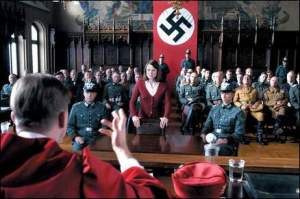
[The images for this post come from the movie Sophie Scholl–The Final Days. If you liked A Man for All Seasons, you’ll like this one too (but I’ll warn you up front that it ends the same way.)]

November 11 – Veterans Day

November 11, 2009

Pearl Merchant

In the Gospel today, Jesus describes the kingdom of heaven as being like a treasure buried in a dirt field, or like a ridiculously underpriced pearl in a market place. These are valuable things that take great personal sacrifice to obtain. Jesus’ lesson in this for us is that a wise person should be willing to trade away everything else they have, and do it joyfully, because of the desirability of what’s before them. So it is with the Kingdom of God.

But these parables are not only about us, and how we should go after God’s kingdom. They also tell about how God has sought after for us for His kingdom. The Lord saw us as the treasure buried in a field, the field being the world. He was like the pearl merchant, who saw us as a precious pearl whose great worth was unrealized by others. And out of love for us one could say that He joyfully sold everything that He had to possess us.

“For us men and for our salvation, He came down from heaven. By the power of the Holy Spirit He was born of the Virgin Mary and became man. For our sake He was crucified under Pontius Pilate.  He suffered, died, and was buried. On the third day he rose again,” ‘giving us a new birth to a living hope through His resurrection.’ Through Christ’s poverty, He made us rich, giving us “an inheritance that is imperishable, undefiled, and unfading, kept in heaven for [us].”

Whenever something is truly valuable, it is worth one’s great personal sacrifice to possess it and to protect it. Today we are honoring those men and women who have done just that; who have made great personal sacrifices to serve our country in the military. Today is Veterans’ Day. While we would be mistaken to identify our country as being the kingdom of God, it would also be a mistake to dismiss the good our country and its veterans have done around the world.

We can we be so proud of our country’s veterans because they are true soldiers. As G.K. Chesterton said, “The true soldier fights not because he hates what is in front of him, but because he loves what is behind him.” This is reflected in how we have treated those we have defeated. We forgive them, rebuild them, and let them have their freedom. We may need to fight some enemies, now and in the future, but we have no need to hate them. Our power is not in our hatred, but our love. In this we follow our model, Jesus Christ, who loved the world so much that sacrificed everything He had for it. And let us remember that He conquered the whole world for us without firing a single shot.

32nd Sunday in Ordinary Time—Year B

November 9, 2009

Widow's Mite

Imagine if you took two pennies and put them into a savings account, at 1.5 percent interest annually, and left it there for 2000 years. How much money would there be at the end? (2 cents, 2000 years, at 1.5% interest.) One hundred dollars?  No, higher.  A thousand dollars?  Still higher.  Ten thousand dollars?   Not even close. There would be one-hundred, seventy-one billion dollars.

[$0.02 * (1.015)^2000 = $171,046,619,000]

First of all, this reveals to us the power and the fury of compound interest.  But second, and relevant to today’s gospel, this shows us that small things can be more powerful and valuable than we would expect.

One day, almost two thousand years ago, a poor widow climbed the temple mount in Jerusalem and walked among the crowds in the temple courts to the treasury where she gave two small coins for the support of the temple.  Many rich people where there, were pouring much larger gifts into the treasury with great fanfare. Though her gift was tiny compared to theirs, that doesn’t mean that what she did was an easy thing to do. Being poor, it was hard for her, a real sacrifice.  She had to trust in the God of Israel; the God said to provide for the needs of orphans and widows like her. She could have dropped in just one coin, or given nothing at all, but she gave both coins, everything she had. She wasn’t trying to be seen, but the Lord was watching.

Jesus, sitting across from the treasury, called His disciples to Himself to draw their attention to her. “Look at what this poor widow has done.  Take this, all of you, as an image of myself.  Just as she has given everything as a gift of herself to God (even though it was hard and took great trust) so will I give myself up for you.”

The poor widow’s two coins, worth just a few cents, landed in the treasury with a quiet “tink, tink,” but her act has echoed through the centuries. Everywhere this gospel has been preached, the throughout the centuries and around the world, what she did has been remembered.  How many consciences have been pricked and how many hearts have been inspired to invest more completely into the kingdom of God? If the good her small deed has done throughout the ages could be quantified, it would far surpass one hundred, seventy-one billion dollars.

When we rise from the dead, at the general resurrection, I suspect that this poor widow will stand out.  She will be more glorious and enchantingly beautiful than most, and (even though the gospel does not give her name) everyone will know who see is and she will enjoy the love and gratitude of vast multitudes.

When we die, we will all die penniless, and when we rise we will all rise penniless, but some of us will be richer than others. The richest in heaven are those who receive and can give the greatest love, and this will depend upon how much we have invested ourselves into the kingdom of heaven.

You are already giving to your spouses and your children, your friends and your family, at home, at work, and at church, but we should ask ourselves from time to time how much we are giving from our surplus wealth and how much was are making a total gift of ourselves.  Such giving is hard, it takes trust in God, and it conforms us to Jesus Christ. When we give ourselves in this way, in the likeness of Jesus Christ, our gifts yields the greatest returns, here on earth and forever in heaven.

Now you have heard me put in my two cents.  I pray that it may result in great profit for your souls.

Thursday, 29th Week in Ordinary Time—Year I

October 28, 2009

G.K. Chesterton

G.K. Chesterton, the British Catholic writer, lived one hundred years ago, but his writings are still witty, insightful, and relevant today. Once he wrote in answer to the question, “Why I am a Catholic.”  Chesterton explained, “The difficulty of explaining ‘why I am a Catholic’ is that there are ten thousand reasons all amounting to one reason: that Catholicism is true. I could fill all my space with separate sentences each beginning with the words, ‘It is the only thing that…’”  One of the examples of this he gave was that Catholicism “is the only thing that frees a man from the degrading slavery of being a child of his age.”

Why is it that after so many centuries we remain divided, three against two and two against three, on so many important matters?  We may be far more technologically advanced than they were in Jesus’ time, but every generation seems to repeat falling into the same, or slightly differing, forms of foolishness.  While science and technology is cumulative, part of every generation thinks they have to rediscover wisdom from scratch.  That’s why we still have ethical debates about questions that Jesus has settled.

Can we do evil in the hopes that good will come of it? [This is Ethics 101.  St. Paul teaches about this to the Romans, “And why not say—as we are accused and as some claim we say—that we should do evil that good may come of it? Their penalty is what they deserve.”] What if we’re [almost] certain that really good things will come from the evil we do? [Even if the evil does result in some good, what does freely-choosing evil make us?] Should we let the progress of science be bogged down by questions of morality? Should morality and private conscience have a place in politics and public life? [If not, then what will science, public life and policy be guided by beyond base desires and power?] Is it really always wrong to intentionally kill the innocent? What if intentionally killing 100,000 civilians will end a war?

If this is how things are when the wood is green in our country, then what will it be like when the wood is brown, dry, and dead, as it may well be in years ahead? What is the Christian to do?  Remain closely rooted to Christ, the source of our wisdom and waters of life. To borrow the words from the psalmist today:

The Christian “is like a tree
planted near running water,
That yields its fruit in due season,
and whose leaves never fade.
Whatever he does, prospers.”

Even if he is martyred, whatever the faithful Christian does prospers; for he is not a child and a slave of his age, but a child of the age to come.

October 28 – Sts. Simon and Jude

October 28, 2009

Cowardly Lion

Today we celebrate the Sts. Simon and Jude, apostles and martyrs for Christ. Simon was known as “the Zealot,” and Jude, or Judas the son of James, was nicknamed “Thaddeus,” which means “Courageous” in Greek. In the Gospel today the apostles are listed, with Simon and Jude coming towards the end, right before Judas Iscariot, the one who betrayed Jesus.

When Jesus sent out His disciples with the power and authority to heal the sick, cast out demons, and preach the Gospel, He sent them out two-by-two.  One could infer (though this is by no means certain) that this Gospel passage lists the apostles according to those old missionary pairings: Simon Peter with his brother, Andrew; James with his brother, John; and so on, ending with the Judas called “Courageous” and the other Judas who became a traitor.

So here we would have two Judas’, side-by-side, in discipleship and ministry. Yet, only one of them earned a nickname for being courageous. To grow in holiness requires our courage, a virtue that Judas Iscariot tragically lacked.

John’s Gospel tells us that this Judas held the money purse, and sometimes stole from it for himself. That’s because he lacked the courage to acknowledge his faults and to grow in the virtues.

Judas may have betrayed Jesus because he thought this would kick-start Jesus, the weak messiah, into real, revolutionary action. Judas did not have the courage to trust that the providence of God working through Jesus Christ was really the best way to bring about the Kingdom on earth.

And after he had sinned, Judas lacked the courage to seek forgiveness, choosing suicide instead, which is called “the coward’s death.” Simon Peter denied Jesus, but he had the courage to confess his sin and to seek reconciliation. That was Peter’s salvation.

If we are going to grow in holiness to sainthood, it’s going to require our courage; the courage to acknowledge our faults and grow virtue, the courage to trust in God’s will and providential plan for our lives, and, when we fall, the courage to confess our sins and to seek reconciliation with Christ.

Monday, 30th Week in Ordinary Time—Year I

October 26, 2009

Christians Martyrs and the Lions

Remember Jesus’ story about the two men who went up to the temple area to pray, the self-righteous Pharisee and the repentant tax-collector? “The tax collector stood off at a distance and would not even raise his eyes to heaven…”

In today’s gospel, at the synagogue where Jesus is teaching, there is a hunched-over woman who has not raised her eyes to heaven for a very long time. Jesus calls her, lays His hands on her, and at once, she stands erect, for the first time eighteen years. I have to imagine that her very first act was to raise her eyes and hands up to heaven, to speak praises and to glorify God. Imagine how she must have felt to be deprived of such worship for so long, and then, how she must have felt for it to be so suddenly and wonderfully restored to her.

Seeing this, the authorities, the Pharisees, object that Jesus should not do healings during the Sabbath rest. But Jesus rebukes them, to their great humiliation. Who are they to say that this woman should not be free to worship God this day? Her freedom to worship comes from God Himself.

We, this morning, are free to gather here, free to raise our eyes up to heaven and offer worship. We are free from fears that authorities or angry crowds will storm through those doors and drag us off to our imprisonment or death. In the past, not all Christians have been so privileged. Still today, around the world, not all Christians are so privileged.

Let us celebrate this Mass, and every Mass, with a deeper reverence and gratitude, for the freedom we have to raise our eyes to heaven and to offer our worship to God. Let us pray for persecuted Christians around the world and celebrate this Mass, and every Mass, as if it were our first, our last and our only.

October 17 — St. Margret Mary Alacoque

October 18, 2009

Sacred Heart by Margherita. Vatican

Today we celebrate St. Margret Mary Alacoque of France who lived in the latter half of the 1600’s. Throughout her life, Jesus would appear to her and converse with her, but this did not surprise Margret or seem strange to her. She assumed that other people experienced the same sort of things all the time. After she become a nun, Jesus gave her a  mission: to establish devotion to His Sacred Heart.

You’ve seen images of the Sacred Heart before; a red heart, crowned with thorns, pierced along its side, with a cross and flames emerging from its top. If this devotion seems strange to us, its because we do not understand what it means.

Sacred Heart of Jesus

When I was in seminary I heard a story about the Sacred Heart that I not been able to confirm with the internet, but I share it with you as a great illustration, even if it might only be a legend. The story goes that after St. Margret Mary Alacoque died, devotion to Jesus’ Sacred Heart was spread by the Jesuits, a Catholic religious order, in their missionary work. In one mission territory (it might have been Papua New Guinea) the priests introduced this devotion to the people, but it wasn’t resonating with them.  The people just didn’t seem to get it. As they missionaries learned more about the native culture, they learned that these people did not look at the heart as the organ that symbolizes love and emotion.  For them, some other abdominal organ, the liver I think, was the seat of human love and emotions. In response, these missionaries replaced the Sacred Heart devotion with another, a devotion to the Sacred Liver. The natives people got it, and responded enthusiastically.

When we consider the Sacred Heart today, we can be a lot like the natives in this (possibly fictional) story. We today tend to be a people of science, materiality, and literal interpretations, who look at a heart and see an organ for pumping blood. But the Church in the 1600’s saw the world differently, in a much more poetic way—they saw the Sacred Heart and understood its message.

Jesus’ Heart is aflame with fire, because His love for you is intense and passionate. His Heart is pierced, crowned with thorns, and holding up a cross, because Jesus suffered for you out of love. Jesus presents this devotion to us, because He wants us to remember that He is a human being like us and that He loves us with a human heart. The Sacred Heart is a symbol of His love for us, that He loves us deeply, with a human heart.

Since modern-day Catholics understand and resonate with the Sacred Heart less easily than we used to, Jesus seems to have given the Catholic Church another sacred image to convey very similar message. In the 1930’s, Jesus appeared to another nun and gave a mission to promote a new devotional image. That nun was St. Faustina Kowalska of Poland, and the devotion she was to spread was the Divine Mercy. The two devotions are very much alike. For example, both devotions emphasize Jesus’ humanity.  Both are accompanied by popular prayers devotions.  And both show that Jesus’ abundant loves and mercy for all.  The question is not which devotion is better, the question is which devotion resonates or connects with you in communicating Jesus’ love for you.

Sacred Heart PaintingDivine Mercy

And now I come to my final, and most important point. I’m sure all of you know the right answer to the questions, “Does God love everyone,” and “Does Jesus love you?” None of you would get these wrong on a test. But I suspect that for most of you the concept that God loves you remains just an idea. Have you experienced this truth as a reality? Do you know that Jesus Christ likes you, that He enjoys you, that He is pleased with you? If you’re uncertain about this, then you have not yet experienced His love for you as profoundly as He desires. Personally knowing Christ’s love for you, rather than just knowing about it, makes all the difference in the world.

So here is your assignment… Ask Jesus Christ to reveal to you today, or in the very near future, some palpable sign of how, and how much, He loves you. Then, keep your eyes open. Jesus is clever and powerful, and knows how to reach you. He doesn’t want His love for you to be a secret.

Thursday, 28th Week in Ordinary Time—Year I

October 15, 2009

Have you ever noticed how unpopular the  prophets are? That’s because it’s usually the prophet’s job to point out peoples’ sins to them and to tell them they have to change. Some people, particularly the arrogant and the wicked, respond very badly to this, like the scribes and Pharisees in today’s Gospel.  When Jesus left the home of the Pharisee, after having criticized them strongly but in private, they

“began to act with hostility toward him and to interrogate him about many things, for they were plotting to catch him at something he might say.”

These scribes and Pharisees, whose fathers had hated and killed the prophets of old, would go on to bring all that blood upon themselves by killing the Wisdom of the prophets Himself.

The question I would like you to consider today is how you respond to criticism or correction directed at you.

The book of Proverbs teaches,

“Reprove not an arrogant man, lest he hate you; [but] reprove a wise man, and he will love you.”

And a translation of Psalm 141 says,

“If a good man strikes or reproves me it is kindness.”

 A wise man does not respond to correction angrily. He knows that “all have sinned and are deprived of the glory of God,” so he is not threatened by the suggestion that he is not perfect yet, that he still has areas for improvement.

The wise man evaluates correction with detachment. If the criticism is valid, or at least well intended, he receives it as a loving act and is grateful for it. And when the criticism is nonsense, the wise man doesn’t let it get to him. Why should the ungrounded opinions of foolish, fickle people have power over us, to rile us up, or provoke us to the sin of personal hatred?

Let us ask Jesus for the grace to receive valid criticism with humility, and for the grace to be merciful with those who criticize us unjustly.

28th Sunday in Ordinary Time—Year B

October 11, 2009

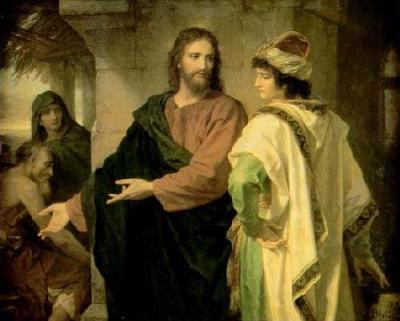
Christ and the Rich Young Ruler, by Heinrich Hofmann

This morning’s second reading from the Letter to the Hebrews speaks of the Word of God; as “living and effective, sharper than any two-edged sword, penetrating even between soul and spirit, joints and marrow, and able to discern reflections and thoughts of the heart.” The first thing that comes to our minds when we hear the phrase “the Word of God” is probably the Bible, but for the author of the Letter to the Hebrews, the Word of God is first and foremost a person. The author writes of the Word of God, “No creature is concealed from Him, but everything is naked and exposed to the eyes of Him to whom we must render an account.”

Jesus Christ is the Word of God, eternally spoken by the Father. Yet our Church’s Scriptures are also God’s inspired Word. Scripture is no dead letter, it is living and effective among us today. It can penetrate the soul, giving discernment to the thoughts and reflections of its readers’ hearts. The Word of God comes down to us from heaven. In Jesus’ incarnation, the Divine Word unites with humanity. Similarly, in the inspiration of Scripture, divinity unites with human words. In the Christian life, we neglect the Word of God to our detriment. We need Christ and His Scriptures. Merely following our consciences will not give us the fullness of life.

Living a moral life is good, but it is not the fullness of life that God wills for us and wants to lead us to through His Word. The man who came to Jesus in the Gospel realized this. He had listened to his conscience and observed the commandments of God’s from His youth, like a lot of cradle Catholics, but notice that the man didn’t walk up to Jesus, he ran to Him and knelt before Him, because he profoundly recognized that he did not yet have the fullness of life. The man goes to Jesus because he senses that this teacher holds the answer he’s searching for, and indeed Jesus does.

Jesus, looks at him, loves him and says to him, “You are lacking in one thing. Go, sell what you have, and give to the poor and you will have treasure in heaven; then come, follow me.”

What this man lacks, in his all-too-comfortable life, is a total commitment to God through a personal relationship with Jesus Christ. Jesus offers him the opportunity and the adventure of a lifetime, “Come, follow me,” but the man goes away sad, because he has many possessions which possess him.

This morning, I would like to teach you a way to personally encounter the Word of God yourself; a way to run up to Jesus, through praying with the Scriptures.

First, take your Bible, and go to someplace where you can pray. Perhaps a quiet room in your house or here at Church; someplace where you will be free from distractions. Then ask the Lord for His grace and wisdom, and the spirit of wisdom, which is greater than riches, will be freely given to you.

Open your Bible to the Gospels, and chose a single scene. Read the passage once or twice, to become familiar with it, and then read it once again, slowly.

Now use your imagination to enter that scene. See Jesus and the other characters there. You can be a bystander observing the scene, or put yourself in the place of one of the characters. What do you feel in their place? What would you say and what would you do in that situation? Then look to Jesus, to hear what He says and see what He does.

This can be a very fruitful way to personally relate with the Word of God, and for Jesus to relate with you through His Scriptures in your prayers.

Over the past few days, in preparation for this homily, I have prayed in this way with today’s Gospel. Just to provide one example of how this sort of thing goes, I’d like to share my meditations with you.

The Gospel begins by saying that the man ran up “as Jesus was setting out on a journey,” so I imagined myself standing there as one of the carrying a heavy sack on my back. When the man came up and knelt before Jesus the feeling that I felt was annoyance, that this guy was holding us up when we had a long journey ahead of us.  But then I remembered what I was witnessing before me an event worthy of the Gospels. This was a lesson for my life and my ministry, that I should not let anxious feelings cause me to neglect or rush past the things that are really important.

When I saw the man walk away sad, I ran after him and pleaded with Him to come back, not to live His life plagued with by question of what his life would be like if he had tried, even just once, a total commitment to Christ. But the rich man was afraid. He didn’t think he had it in Him to take that step. This motivated me to go back to Jesus and ask Him for the grace so that we would all be willing to follow Him outside our comfort zones.

I also I imagined myself in the position of the rich man, kneeling before Christ and asking what more I lacked. I expected Him to say, “Sell all that you have and follow me,” but Jesus put His hand on my shoulder, smiling, and expressed His pride at how far I had come in the areas of trust and generosity. It was a great personal consolation.

What consolations and what wisdom does the Word of God have waiting for you through this form of prayer? There’s only one way to find out.

Thursday, 27th Week in Ordinary Time—Year I

October 8, 2009

In the illustration used by Jesus in the Gospel, a person goes to their neighbor’s house and calls inside for a needed favor. The father inside is not immediately obliging. The door’s locked and his sons and daughters are already at rest. But Jesus says, ‘…If the father does not get up… because of their friendship, he will get up to give him whatever he needs because of the person’s persistence.’

Why will the father end up doing the favor in the end? Because of the father’s children. Imagine all the kids in there, in the dark and in their beds, with the neighbor at the door, knocking: *pounding* “Daaad.” *more pounding* “Dad, do whatever they want!”

The father in this story stands for our Father in heaven, who can sometimes seem reluctant in answering our prayers. The children in the story are the saints in heaven, the sons and daughters who rest in the Father’s house. 

What is it like for the souls in heaven to hear our prayers? Perhaps the experience St. Faustina of the Divine Mercy on earth gives us a glimpse into the experience of the saints in heaven. In the Diary of St. Faustina, a book which I highly recommend for spiritual reading, the Polish nun records this:St. Faustina of the Divine Mercy

“It has happened to me for some time now that I immediately sense in my soul when someone is praying for me; and I likewise sense it in my soul when some soul asks me for prayer, even though they do not speak to me about it. The feeling is one of certain disquiet, as if someone were calling me; and when I pray I obtain peace.”

This reaction makes perfect sense, for how could a good person hear of another’s heartfelt needs and not insist that our Father act? Or how could a saint remain at rest while someone knocks at the door of heaven? Knowing this, how then should we pray? Imagine what doors would open for us, if only we would persist in knocking? Or imagine what gifts would we receive, if only we would try asking? So knock, and ask, boldly.

October 1 – St. Therese of Lisieux

October 1, 2009

Today we celebrate the young woman Pope Pius XI called, “The greatest saint of modern times.” At the age of 15, she entered the Carmelite convent in Lisieux, France to give her whole life to God. There, she would take on a new religious name which would profoundly capture her identity: Sister Therese of the Child Jesus and the Holy Face.

St. Therese

How did her life resemble the Child Jesus? Early on, Therese saw her own weakness and littleness, and she believed that great and mighty deeds were beyond her, so she committed herself to a “little way of spiritual childhood.” She always tried to love and trust like a little child, modeling herself on the Child Jesus; not doing great things, but doing everything with great love.

The second title of St. Therese, that of the Holy Face, refers to the image Jesus’ bloodied face left upon St. Veronica’s veil during the Passion. How did Therese’s life resemble the Holy Face? Whatever she suffered, from small annoyances of daily life to the great pains of her final illness, Therese offered it all to God as a sacrifice for the good of souls. The image and likeness of Christ’s redemptive suffering was made present in her, like the image Christ’s face upon a clean, white cloth.

We can follow St. Therese’s example in our own lives, whenever we approach our Father in prayer with child’s fearless trust, whenever we do our daily tasks with a intention to do them with great love, and whenever we offer our sufferings as a sacrifice in Christ, for our good and the good of all His Church.

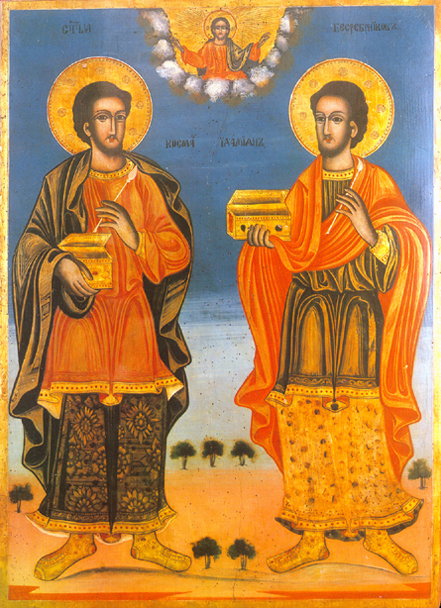
September 24 – Sts. Cosmas and Damien

September 25, 2009

A number of years back, there were two twin brothers, the eldest of a widowed single-mother’s five sons. From their youth, they had a profound love for their Catholic faith and they viewed God’s creations, especially the human body, with great wonder. The two brothers studied medicine and became general practitioners.

Two things made them stand out among other doctors in their profession: first, their willingness to share their Catholic faith with others; and second, their refusal to accept payment for their work.  The two worked for free, pro bono, for the good. They healed the sick, in both body and soul. And they were gratefully admired by many. But then it happened that their government instituted new laws which were contrary to the Catholic faith, offensive to human dignity, and universally binding without exception.

The two brothers might have said to each other, “Our work helps so many people.  If we don’t go along with this we won’t be able to practice medicine anymore. We should compromise, for the sake of the greater good.” However, these two doctors were adamant in their convictions. They understood that if they chose to forfeit their Catholic faith, then they would have nothing else of truly lasting value to offer to anyone. They did not yield, and it cost the two of them their careers, and much more, but the brothers preserved their faith, their clear consciences, and their heavenly rewards in Christ.

You’ve heard of the names of these brothers before, but you’ve probably never heard their story until today. The twin brothers, the two doctors who were unwilling to compromise on their Catholic faith when the Emperor Diocletian decreed in the year 303 that everyone worship idols or be killed, these men are the saints we celebrate today: Saints Cosmas and Damian.

May we learn from their example and benefit from their prayers.

Petitions:


Saints Cosmas and Damian are the patron saints of physicians, surgeons and pharmacists.  Let’s pray for those who care for the sick… We pray to the Lord.

Through the intercession of Saints Cosmas and Damian, may Catholic healthcare workers in our time never have to face a test of faith like theirs because of unjust laws… We pray to the Lord.

Through the intercession Saints Cosmas and Damian, may we have the courage to share our faith in the workplace, by both our silent deeds and our spoken words… We pray to the Lord. 

For my intention in this Mass, for Congress which is now considering amendments to the healthcare bill which would grant conscience exceptions and prohibit the federal government from subsidizing, reimbursing, and paying for abortions, and for your Mass intentions… We pray to the Lord.

25th Sunday in Ordinary Time—Year B

September 20, 2009

Somewhere, in an underground lair, a secret hideout, or a den of iniquity, we find a criminal mastermind, or a mad scientist, scheming a nefarious plot. “Mah-ha-ha-ha,” the villain manically laughs. “Once I unleash my evil plan, evil will conquer the world.”

This is the way of villains as we often find them in comic books. Comic book bad guys love doing evil for evil’s sake. But we should realize that this isn’t why people do bad things in our world. In the real world, nobody does evil for evils sake. Every single person acts to achieve some real or perceived good. Sinners simply go about the pursuit of happiness in wrong ways. Bad people are not bad because they’re trying to do bad things. Unrepentant sinners actually feel justified in what they do.

For instance, in Jesus’ day, influential people said, “That Jesus from Nazareth so obnoxious. Let’s have him condemned and see how he holds up then.  If he’s really holier-than-thou, a son of God, then God will come to his rescue—otherwise he gets what he deserves.” People still rationalize like this today. It’s easy to come up all sorts of reasons for doing bad things rather than what is right:

“Lying? What I said isn’t technically untrue. Besides, it’s only a little white lie.”

“Angry? Is it any wonder that I get so angry when I have to deal with stuff this.”

“Stealing? The way I see it, they make plenty of money, and I deserve more than what they pay me.”

Activities outside of marriage?  “What’s the big deal? It’s all consensual, and nobody’s getting hurt. Besides, we love each other.”

It’s not only “bad people” who say things like this. Each of us fall into embracing lies like these sometimes. But what is the antidote for rationalizing aside our sins? The cure for this is a prayer life with Jesus Christ.

When the apostles came face to face with Jesus inside the house, Jesus began to ask them, “What were you arguing about on the way?” But they remained silent, for they had been discussing among themselves on the way who was the greatest. Coming into Jesus’ presence, who is the embodiment of Truth, the reality of what they had been doing became clear for them. Their false illusions completely faded away, like the smoke from a blown out candle.

We should spend time in conversational prayer with Jesus Christ every day, allowing Him to form us, build us up, and console us. When you receive the encouragement, confidence, and consolation which Christ is eager to give you in prayer, when He acknowledges you as His own brother or sister, as His good friend, as a favored child of His Father, fears dissolve and you live in peace—a peace in which cleverly-devised excuses are no longer sought for and no longer necessary.

Thursday, 24th Week in Ordinary Time—Year I

September 17, 2009

In the Gospel, a notoriously sinful woman learns that Jesus is in town and comes to the place where He’s eating. In those days, Jews ate at table as they laid upon elevated beds, with cushions under their chest or side, and with their feet stretched out behind them. The woman came in, and stood behind Jesus, at his feet, weeping. She came to Jesus because she had heard His proclamation of mercy, that He came ‘not to call the righteous to repentance, but sinners.’

She bathes his feet with her tears. Why doesn’t she fetch water for this?

She wipes His feet with her hair. Why doesn’t she just use a towel?

She kisses His feet repeatedly. Why does she kiss his feet? 

The Gospel does not mention the exact nature of the sinful woman’s past, but perhaps her lips had kissed many, perhaps her beautiful hair had been shared with many, perhaps her eyes had shed many tears, from the great pain that follows impure romances. So the woman uses her own tears, and hair, and lips because she desires to honor God, through Jesus, with her body, in her body, and through her body. Her faith saved her, and gave her peace, a faith she expressed through her body. May our faith be like hers.