Archive for the ‘Reverence’ Category

Revere What Is Holy

March 2, 2024

3rd Sunday of Lent
By Fr. Victor Feltes

On a spring day before Passover, Jesus went up to the Jewish temple in Jerusalem. He found people there selling animals to be sacrificed; oxen, sheep, and doves. He also saw money changers doing business there, seated at their tables exchanging foreign currencies. Jesus Christ, the Prince of Peace, then made a whip out of cords and drove them all out of the temple area along with the sheep and oxen. He spilled the money changers’ coins and overturned their tables. The doves for sale were kept in cages, so Jesus told those vendors, “Take these out of here!” Jesus proclaims peacemakers blessed, yet we see that he is not a pacifist. His disciples who witnessed the event recalled a verse from Psalm 69, “Zeal for your house consumes me, and the insults of those who insult you fall on me.” So why was what was going on at the temple upsetting to Jesus and insulting to his Father?

Jesus said, “Stop making my Father’s house a marketplace!” He also quoted to them a verse from Isaiah, “My house will be called a house of prayer for all nations.” “But you,” Jesus said, “are making it ‘a den of thieves!’” Jesus was angered by how they were profaning the temple, exploiting the Jewish faithful, and being obstacles to foreign peoples’ coming to worship God. The Jews regarded marketplaces as impure places. St. Mark’s Gospel notes how “on coming from [marketplaces], they would not eat without purifying themselves.” Running a market at the temple was treating the holy place like somewhere base or ordinary. Jesus likened the vendors and temple officials to a den of thieves for charging the Jews who came for worship inflated animal prices and exploitive rates of exchange. And their marketplace was setup inside the Court of the Gentiles, the temple courtyard for all the nations, where God desired non-Jews to come and worship him. Consider how much harder it is to pray when surrounded by the noise of others. (This is why we encourage people after Mass to gather to chat in our vestibule or basement—to preserve the quiet of this holy place for the benefit of others at prayer.) Ultimately, Jesus cleanses the temple because the ways in which it was being profaned were creating obstacles to peoples’ deeper relationship with God.

A physical holy place can be profaned. Holy names can be treated profanely as well. God commands his people, “I, the Lord, am your God… You shall not take the name of the Lord, your God, in vain. For the Lord will not leave unpunished the one who takes his name in vain.” This second of the Ten Commandments forbids the misuse of God’s holy name. Swearing false oaths, invoking God to declare untruths, is taking his name in vain. Neglecting or spurning doing something that you have vowed to God, is taking his name in vain. And most commonly of all, using the Lord’s name without reverence and love (that is, blasphemy), is taking his name in vain. Using God’s name carelessly like a joke, employing the name of Christ like a word for excrement, treating holy things as base or ordinary creates a stumbling block for others as they see our Faith as foolishness. If we do not lovingly respect our holy friends in heaven and holy things on earth, then why should they? Only say “O my God” as an act of prayer. Only say “Bless your heart” if you sincerely mean it. And only say “I swear to God” about things which are gravely important and true.

The Second Commandment demands reverence for the Lord’s name for the same reason Jesus forcibly cleansed the temple; that people may come into deeper loving communion with God. Let us love God, and his holy ones, and everyone by word and deed, and respect his holy things and places. By our lived Christian example, may others come to do the same.


Our Greatest Moral Act

October 29, 2023

30th Sunday in Ordinary Time
Fr. Victor Feltes

Prior to his passing in 2011, the British author and journalist Christopher Hitchens was famously an atheist. In a June 2007 speech he said, “…I have a wager that I put to the religious… And you may be interested to know that I’ve tried it with everyone from the guy who founded Bush’s faith-based initiative… to various Baptist pastors, a Buddhist nun, a rabbi, a Charismatic Catholic, various pastors on radio and television, all up-and-down the country, no-not yet an answer from them. It’s simple: you have to name or cite a moral action performed or a moral statement made by a believer that could not have been made by an atheist. That’s all you have to do, and it cannot be done.” What moral thing can a Christian do that an atheist cannot?

Pastor Mike Winger is an Evangelical Christian in California who was watching footage of Christopher Hitchens and heard him pose this question in a debate, as he often would. Pastor Mike paused the video, sat and thought, “How would I answer that? …What is a moral thing a Christian could do that an atheist can’t do?” “And then,” he says, “it hit me—the most important moral thing that anybody can do: loving God. Like it doesn’t occur to the atheist, or even many Christians that were debating Christopher Hitchens, that loving God—the most important moral imperative of the universe—is something an atheist cannot do. So the atheist is deprived of the highest moral imperative that a Christian or a human is made for. That’s a big deal.

Indeed, Jesus cites this as the greatest commandment: “You shall love the Lord, your God, with all your heart, with all your soul, and with all your mind.” God is worthy and deserving of such love. He is our Creator, the source of our life and of every good thing we enjoy. And he not only deserves our gratitude but is worthy of our praise, for God is not merely good but the very essence of Goodness and Love. This divine love and goodness for us is best revealed to us through Jesus Christ.

The modern world neglects the love and worship of God. Many disregard the greatest commandment yet attempt to keep the second, which is, “You shall love your neighbor as yourself.” But what is authentic love and the genuine good? Many lust and call it love. Many steal and call it justice. Many murder and call it mercy. Not all loves are love, and without God love and goodness are harder to know and fulfill.

Many assume that God is unnecessary, that we can get on fine without him. Yet, in the words of the Vatican II document Gaudium et Spes on the Church in the modern world, “Without the Creator, the creature vanishes.” This is true in two ways. First it is literally true, because without God, whose essence is Existence (or Being), none of us creatures could continue existing. It is also true in another sense, since without our Good Creator who loves us, the objective value and importance of the human race vanishes.

The atheist scientist Carl Sagan once observed, “We’re made of star stuff.” Indeed, natural science indicates that the carbon atoms and all the other heavy elements inside our bodies were formed long ago inside of stars. It might at first feel inspiring to hear we are made from “stardust,” but Carl Sagan also said “there are maybe 100 billion galaxies and 10 billion trillion stars.” Does the material universe care when a trillion stars fizzle out? Natural science forecast the eventual, permanent death of every star. Apart from ourselves as a part of the universe, does the universe care what we do or what happens to us? Even if we are stardust, we are still dust which returns to dust through death. However, nature is not all there is.

Our supernatural God—who is above all, before all, behind and beyond all—loves and treasures each of us. Good and evil are not merely opinions from human preference, but objectively grounded eternally in him. And God would have us live with him forever, through the death and resurrection of Jesus Christ.

Much of the modern world enjoys the fruits of Christianity without acknowledging its Tree. But how is this sustainable? What becomes of human dignity if we are insignificant cosmic accidents? What becomes of human rights if nothing is really right or wrong? What becomes of human meaning and purpose if nothing survives death? Christianity’s blessed fruits, our dignity, rights, meaning and purpose, come from Christianity’s Holy Tree. This Tree is Christ and his Holy Cross.

Jesus Christ and his Cross are not mere myths but revealed in actual history. They bridge heaven and earth, east and west — uniting humanity with God and human beings with each other. They teach and enable us to love God with all our heart, soul, and mind, and to truly love our neighbors and ourselves. In Jesus Christ we have real hope and love which does not pass away. So let us worship God, for this is our highest calling, our greatest moral act, the source and the summit of our Christian life.

The Significance of Standing — Tuesday, 3rd Week of Easter

May 10, 2011

There’s a curious detail about Stephen’s vision of Heaven in our first reading today:

“Stephen, filled with the Holy Spirit, looked up intently to heaven and saw the glory of God and Jesus standing at the right hand of God, and Stephen said, ‘Behold, I see the heavens opened and the Son of Man standing at the right hand of God.’”

Stephen looks up to Heaven and sees Jesus standing at the Father’s right hand, but both the Apostles’ Creed and Nicene Creed (which we say each Sunday) describe Jesus as “seated at the right hand of the Father.” What are we to make of this?

In the ancient world, to be seated at someone’s right hand gave you the place of higher honor. At a meal, this favored seat granted a special closeness to the host. In a kingdom, the one seated at the right hand of the throne would share in the king’s authority and rule. Of course, describing Jesus as “seated at the right hand of the Father” is only an image (God the Father is unlimited, pure spirit and doesn’t have a right hand.) But this phrase from our creeds does describe a reality: that Jesus is now in the intimate presence of God the Father, sharing supremely in His glory and rule. In his vision, Stephen beholds Jesus in the place of honor, at the Father’s “right hand,” but Stephen sees Jesus standing. So why is Jesus standing?

Did you know that whenever the President of the United States enters a room, everybody stands up? It doesn’t matter if it is a room full of Democrats or Republicans, members of the press, or ordinary citizens, everyone stands up for the President. The same goes for a judge in his courtroom: “All rise, the Honorable Judge So-and-so presiding.” And a gentleman knows that he ought to stand up whenever he greets a lady. Why do they stand? Because it is a sign of respect. If you think about it, whenever we’re offering prayers in the Mass, provided we’re not kneeling, we’re standing up to pray. We stand to pray as a sign of respect to God.

Sometimes, people stand as a sign of respect not so much for the individual but for the greatness of the office they possess. Even a U.S. President’s most hostile critics in Congress, political opponents who couldn’t say one good thing about him, will stand up when he arrives to give his State of the Union address out of respect for the office he holds. It wasn’t for this reason that Jesus stood. No one on earth could have demanded Jesus’ respect by holding an office higher than his.

Jesus stood up because he wanted to show Stephen a sign of His respect. Jesus stood up because he was proud of Stephen. I think that we forget that Jesus is a real human being, with human feelings and emotions about the human events he sees. At the same time, He is also God; and therefore, He sees us all.

When you’re alone, and overcome temptation to do what you know is good, Jesus sees you and He’s proud of you. When you give an anonymous contribution or do a secret kindness, Jesus sees it and He’s proud of you. When you are opposed like Stephen, by people who hate you, or that just don’t understand you, when all the while you’re trying act with love, you do not stand alone. Remember that when you do what’s hard for Jesus, He sees it, and He sees you and He’s proud of you for it.

7 Superpowers — Tuesday, 1st Week of Advent

November 30, 2010

Back when I was in seminary, we would sometimes joke around with a game we called Superpower/Super-weakness. One of us would imagine a superpower for himself, and then we would try to come up with a super-weakness, or vulnerability, to go with it.

So let’s say that you’re able to fly; then, your super-weakness is that you can only fly to Iowa. Imagine you have the ability to change anything into food; however, that food is always celery and you don’t have any teeth. Or perhaps you can talk with animals, but they only want to talk to you about lawnmowers, trees, and how things smell.

Today, I have a challenge for you. I am going to describe to you seven superpowers, seven more-than-human abilities, though none of these will have built-in drawbacks. Your challenge is to choose which superpower you want for yourself. Here we go:

The first is the power to always recognize what is truly important. With this power, you always keep the big picture in mind. With this power, trifles never distract you and you always spend your time and money well. Let’s call this, Wisdom.

Or, would you rather have the ability to power to penetrate deeply into any topic and grasp it thoroughly. With this power, you could become an expert in any chosen field. If you were to study the dynamics of the stock market, or the weather, or even your female classmates, you would soon understand them thoroughly. Let’s call this power, Understanding.

Or, would you prefer the power to sense the best course of action to take in the middle of any situation? With this power, you would always get reliable hunches in uncertain moments. Let’s call this power, Counsel. (Possessing superhuman intuition would be useful, but even if you always knew the best choice to make, you wouldn’t necessarily always have the strength or courage to follow it through.)

Would you rather have the power to be free from all unreasonable fears and to be able to ignore any sufferings? With this ability, you are be perfectly brave and an overwhelming force. Let’s call this power, Fortitude.

Or, would you want the ability to detect when someone is speaking truth or a falsehood? With this power, you are more than a human lie-detector, you are able to see through subtle and false arguments which other people accept as true. Let’s call this power, Knowledge.

Or, would you prefer to have the innate ability that you would always intensely desire to do what you know to be right? People often know the right thing to do but they still don’t do it. With this power, you are irresistibly drawn to do what’s good. Let’s call this power, Piety.

Or, lastly, would you rather have total protection from ever doing anything stupid? With this ability, you are spared from making the mistakes and errors which are committed by many other people. Let’s call this power, Holy Fear.

So, how many here would choose Wisdom; the ability to always recognize what is truly important and to keep first things first in life?

Who here would choose Understanding; to penetrate deeply into great mysteries?

How many would choose Counsel; an uncanny intuition for choosing the best course of action?

How many here would choose Fortitude; the power to be freed from fears and endure all sufferings?

Who would choose Knowledge; the ability to recognize truth or falsehood whenever you hear it?

How many would choose Piety; the ability to intensely desire to do whatever you know to be right?

And how many would choose Holy Fear, or the Fear of the Lord, to be protected from doing foolish things?

These seven superpowers, these seven more-than-human abilities, are the seven gifts of the Holy Spirit. Their names come from today’s first reading, Isaiah 11:1-10. The good news for us is that God freely gives these gifts to the childlike who ask Him for them, and He does not limit us to just one. At this Mass, pray for all seven gifts of the Holy Spirit, but especially for the power which you desire the most.

C.S. Lewis on Our Immortality & Potential Glory

August 14, 2010

From The Weight of Glory:

It is a serious thing to live in a society of possible gods and goddesses, to remember that the dullest and most uninteresting person you talk to may one day be a creature which, if you saw it now, you would be strongly tempted to worship, or else a horror and a corruption such as you now meet, if at all, only in a nightmare. All day long we are, in some degree, helping each other to one or other of these destinations.

It is in the light of these overwhelming possibilities, it is with the awe and the circumspection proper to them, that we should conduct all our dealings with one another, all friendships, all loves, all play, all politics. There are no ordinary people. You have never talked to a mere mortal. Nations, cultures, arts, civilization—these are mortal, and their life is to ours as the life of a gnat. But it is immortals whom we joke with, work with, marry, snub, and exploit—immortal horrors or everlasting splendours.

This does not mean that we are to be perpetually solemn. We must play. But our merriment must be of that kind (and it is, in fact, the merriest kind) which exists between people who have, from the outset, taken each other seriously—no flippancy, no superiority, no presumption. And our charity must be a real and costly love, with deep feeling for the sins in spite of which we love the sinner—no mere tolerance or indulgence which parodies love as flippancy parodies merriment.

Next to the Blessed Sacrament itself, your neighbour is the holiest object presented to your senses. If he is your Christian neighbour he is holy in almost the same way, for in him also Christ vere Latitat [Latin, “truly hides”]—the glorifier and the glorified, Glory Himself, is truly hidden.

Christ in the Sacraments — 11th Sunday in Ordinary Time—Year C

June 15, 2010

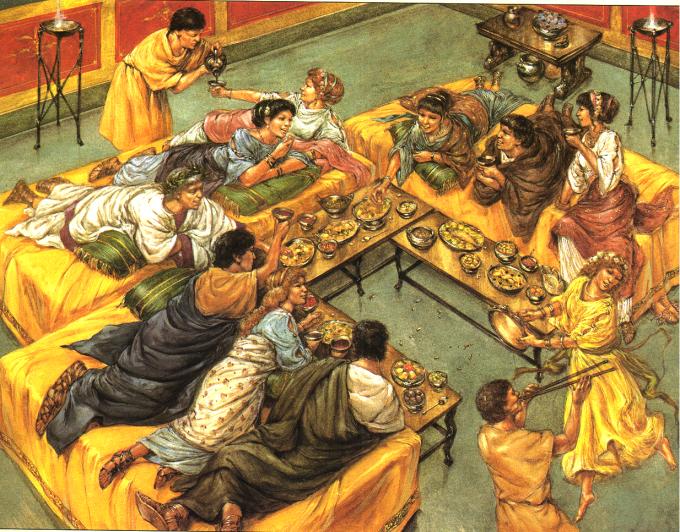
To understand today’s gospel, it helps to know a little about the Jewish culture of Jesus’ day.  For example, when the Jews would sit down to eat dinner they would not sit at all–they “reclined at table,” on beds that came up the edge of the table. You would have a cushion under your chest or under your side, as you ate with your free hand, with your legs laid out behind you. This clarifies how the beautiful, penitent woman was able to access to Jesus’ feet. This also explains how John was able to lay his head upon Jesus’ chest at the Last Supper to ask Him who would betray Him. The Beloved Disciple was not a contortionist–he was laying beside Jesus at table.

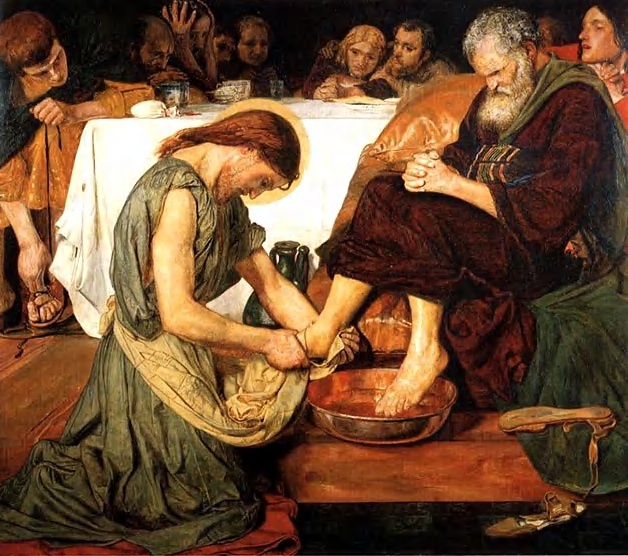
A second important thing to know about the Jewish culture of Jesus’ day to appreciate this gospel is to understand how they felt about feet. The Jews considered feet to be among the dirtiest, humblest, and lowliest parts of the human body. This is why our parish’s patron, St. John the Baptist, said, “[There is] one who is coming after me, whose sandal strap I am not worthy to untie.” In that Jewish culture, servants could not be commanded to wash the feet of others; it was considered even beneigth the dignity of a slave. Now we can understand the significance of the woman washing Jesus’ feet, and how much it means that Jesus later washed His disciples’ feet at the Last Supper.

But what was this woman thinking? Had she forgotten to bring a towel and a bowl of water at home? Was she so dumbstruck that her lips were unable to form the simple words, “I’m sorry and I want to return to God?” No, she knew what she was doing when she used her tears to cleanse, her hair to wipe, and her lips to kiss Jesus’ feet. When she heard that Jesus was going to be eating at the house of Simon the Pharisee I doubt she was holding that alabaster jar of ointment in her hands. No, she had to go and get it, and as she did she thought about exactly how she was going to approach Jesus.

What was Simon the Pharisee thinking? Had he forgotten about the customary curtesies in welcoming guests to one’s house in that culture: water for washing their own feet, oil for anointing one’s head against the harshness of the desert, a kiss in greeting at the door? Maybe he thought these were just optional, dispensible rituals. Regardless, Jesus put his finger on one major contributing factor: Simon the Pharisee loved Jesus little, while the beautiful penient woman loved Him greatly.

Simon gave Jesus an external gift, a meal in his home, but in addition to her ointment, the woman gave a gift of her very self; her tears, her hair, her kisses. As she had sinned with her body, she now sought to honor God though her body.

How does all of this apply to us? When we consider this beautiful, penitant woman and Simon the Pharisee relate to Jesus, we see two approaches the sacraments. For some, in the manner of Simon the Pharisee, the sacraments are just rituals, traditional customs, liturgical hoops the Church has us jump through. But for others, those with the heart of the woman who loved much, every sacrament is a personal encounter with Jesus Christ. If you onlt remember one thing from this homily, remember this: every sacrament is a personal encounter with Jesus Christ.

Consider the sacrament of marriage. Today, some people say, “As long as we love each other, what difference does a ceremony in a church and a piece of paper make?” But these people do not realize that the sacrament of marriage actually makes present the love between Christ and his Church. The love between husband and wife not only resembles the love between Christ and his Church–like all the sacraments, marriage actually makes present. If your marriage is sacramental, and you and your spouse do not put up obstacles in the way, you can experience firsthand to love with which Jesus loves His bride, the Church, and how the bride receives her Lord. You experience the intimacy between the two and you can tap and draw on their love and the power in your marriage. marriage is a personal encounter with Jesus Christ.

Today, some people say, “I don’t really have any sins, but if I did, why should I have to go tell my sins to a priest to have my sins forgiven? God can hears my prayers. Won’t he’ll forgive me anyway.” Imagine if the penitent woman had stayed away from Simon’s dinner party that night in the gospel and prayed to God at home. Would she have been forgiven? Perhaps, but she would not have had her life-transforming encounter with Jesus Christ. When you go to confession, you are personally encountering Jesus through the priest. If the priest does not put up obstacles in the way you will hear the words of Christ to you. And even if the priest does get in the way, you will hear that words that Jesus wants you to hear, just as He had said to the beautiful penitent woman: “Your sins are forgiven, go in peace.” The sacrament of reconciliation is a personal encounter with Jesus Christ.

These days some people say, “There’s a lot of Sundays in the summertime and a lot of things to enjoy on the weekend. Is it really that important that we come to Mass every Sunday?” To ask this about the most Blessed Sacrament is to be like Simon the Pharisee. Had Jesus not come as his guest that night, Simon would not have missed Him much; Simon would not have been that disappointed. And even after receiving Jesus under his roof, I can imagine Simon being left unchanged. But the beautiful penitent woman, who took Jesus’ flesh to her lips, was forgiven her sins and was filled with grace by the encounter.

In the celebration of this sacrament, and at every sacrament, let us appraoch Jesus with her humility, reverence, and love.

Real Presence — Corpus Christi

June 7, 2010

I once came across a story on the internet that went something like this: A Catholic man is giving his Muslim friend a tour of his Catholic Church. He shows him the holy water at the door and how we bless ourselves with it. He points out the stained glass windows and the stations of the cross, explaining how these present the majore events of Jesus’ life, death, and resurrection. He shows him the statues and the crucifix and finally the tabernacle.

“That’s the tabernacle. Inside that box is the Eucharist. It looks like flat, white bread, but it is truly the Body, Blood, Soul and Divinity of Jesus Christ, our Savior and God.”

The Muslim man looks at the tabernacle, pauses in thought, looks at his friend, and says, “If I believed that God was really present in that box, I wouldn’t let my face come off of the floor.”

Whose approach towards God is the right one: the Catholic’s or the Muslim’s? When we come up to receive communion we do not crawl up on our faces, but should we?

Christians relate to God as we do because of the way Jesus Christ related to us. With the incarnation, God came to us on our level, as one of us. Jesus did not want his disciples to regard him with terror. He invited them to be His friends, and to relate to Him as their Brother. He taught us to call His Father “our Father,” and he made us temples the Holy Spirit. Jesus gives us unprecedented intimacy with God and we are “free to worship Him without fear.”

Yet, there is some truth in the saying that familiarity breeds contempt. When we come to Mass and receive the Eucharist, how well do we prepare ourselves to receive Him? How much do we do to appreciate this priceless gift? This morning I would like to give some ways we can do this better.

Before we even leave home there is a way for us to prepare ourselves. Think of it this way: if you were going to be on TV and seen by a millions, what would you wear? If the president of the United States (whoever he happened to be) were coming to your town, and you were chosen to officially welcome him, how would you dress? At Mass we are not seen by millions, but by billions of angels and saints, and we more than just the president of the greatest country in the world, we meet the King of the universe. When we come to Mass we should wear our Sunday best.

When you arrive at church before Mass begins resist the temptation to just wait out the time until the priest comes out. Take the opportunity to prepare yourself with prayer. At the beginning of the liturgy there are some things we do to tune us into the liturgy, such as the penitential rite and the opening prayer, but if you have not prepared yourself before the Mass begins these will probably just flash by you.

When you get to your pew, say to Jesus, “Lord, I’m sorry for my sins. Please have mercy on me. Please help me to be as fully present as you are present. Help me to receive everything you want me give me in this Mass. I raise up my intention for this Mass you along with all I love and everything I am. Thank you for calling me to know you, and for everything.”

During the Mass, especially when Jesus is on the altar, his throne, we should give Him our full attention. Religious devotion is about more than mere appearances, but shouldn’t we expect a fervent devotion inside to be reflected on the outside?

When I was growing up and beginning to look at my faith more critically, I wondered if we really believed in the Real Presence. I mean, the symbolic understanding, that’s easy—like how the flag reminds us of America, but do we really, really think that’s Him? My CCD teachers insisted that’s what we believed and I found scriptural and historical evidence that Christians had always believed it.  Yet, when I looked around at other people at Mass it didn’t seem like they believed they were in the presence of God. Then an important thing happened. A new pastor came to our parish and when he celebrated the Mass you could tell that he believed he held something (Someone) precious in his hands. That priest was Father Paul Gitter, whom you know well.

During the Mass, give God your whole self. Express your devotion. Whenever you sing, don’t just do it because that’s what everyone else is doing—make it an offering, a gift, a prayer. When you are praying to the Father, raise you eyes to Him. When you are speaking to Jesus, turn you eyes to Him. Smile at Him in the cup and on the paten. Celebrate every Mass as if it were your first, your last, and your only.

After you receive Jesus in the Eucharist, open yourself to receive everything that He wants to offer you. In His private revelations to St. Faustina Kowaska (through whom we received the Divine Mercy devotion celebrated throughout the Church) Jesus said many people receive Him and then forget about Him. “My great delight is to unite Myself with souls,” He said. “When I come to a human heart in Holy Communion, My hands are full of all kinds of graces which I want to give to the soul. But souls do not even pay any attention to Me; they leave Me to Myself and busy themselves with other things. Oh, how sad I am that souls do not recognize Love! They treat Me as a dead object” (Diary of St. Faustina, #1385) After you receive Him, and kneel down in the pew, ask that you would receive from Him every grace He wants to give you with Himself. And remember to tell Him, “Thank you,” and, “I love you.” It’s the least that we can do.

When we leave church after Mass, let us not think that we have left Gift we have received behind us. Jesus also told St. Faustina that when we receive the Eucharist He remains in our souls until we receive Him again, provided that we do not cast Him out through serious, grave sin. He remains with us and provides what we need to serve Him.  We only have to remain open and mindful towards Him.

Jesus feeds us His Body and Blood because He wants us to be extensions of Himself. We the Body of Christ. We are His arms, His hands, and His eyes, ears, and mouth in the world. First, He transforms the bread and wine. Next, He transforms us. And then, He transforms the world. When ‘the Mass is ended,’ that’s just the beginning.

In a few moments we are going to receive the Body, Blood, Soul and Divinity of Jesus Christ in the Eucharist. Let us prepare ourselves and open ourselves to receive this most incredible Gift.

Approaching God — 5th Sunday in Ordinary Time—Year C

February 11, 2010

In today’s first reading the prophet Isaiah hears the angels praising God at the temple with words like those we proclaim at every Mass: “Holy, holy, holy is the LORD of hosts! All the earth is filled with his glory!”

What do these words mean?  First, the Jews did not have adverbs for “very,” “most,” or “infinitely” in Hebrew, so if they wanted to say something was very heavy they would call it “heavy, heavy.”  If they wanted to say something was most heavy or (if it were possible) infinitely heavy they would call it “heavy, heavy, heavy.”  So when Isaiah hears the angels call God “holy, holy, holy,” they are praising His perfection, transcendence, and goodness to the highest degree.

Why is God called “the LORD of hosts?” A host is an army, or a large group of persons. In this case, God’s army of angelic  persons is referred to. Our God is holy and wields unsurpassed power. The earth is filled with his glory.

Isaiah behold this sight and becomes very afraid. “Woe is me, I am doomed! For I am a man of unclean lips, living among a people of unclean lips; yet my eyes have seen the King, the Lord of hosts!” In the Old Testament people thought that no human being could look upon God and live.

Then an angel, one of the seraphim, fly down, takes an ember with tongs from the altar (for the Jews sacrificed animals as burnt-offerings at the temple) and touches Isaiah’s mouth. “See,” the angel says, “now that this has touched your lips, your wickedness is removed, your sin purged.” God asks whom He can send to be His prophet, and now Isaiah has the courage to say “Here I am, send me!”

Imagine if, at communion time, people would line up and come before the priest to have a red hot coal touched to their lips or tongue? Priest: “The holiness of God.” Communicant: “Amen… Ou!” I imagine the communion line would be much shorter.

This is the bread that we will be offering at this Mass to become the real body, blood, soul, and divinity of Jesus Christ. It’s flat because it unleavened, just like the bread at the Jewish Passover meal and as at Jesus’ Last Supper.  Leaven, or yeast, is bacteria which grows and makes our bread fluffy. The Jews were to keep leaven, which symbolized sin, out of their Passover bread.

Like all of the other sacraments, the Lord’s choice to use bread has symbolic meaning.  Take baptism, for example: water cleanses us and gives us life.  Similarly, bread gives us life and becomes one with us. No wonder Jesus chose it to be his symbol for the Eucharist. The very use of bread invites us to receive him.  The symbol of bread speaks, “Come, do not be afraid. I am here to be received by you and to become one with you.” We tend to forget what an unprecedented privilege this is.

In the Old Covenant, Jews could always pray to God, for ‘all the earth was filled with his glory,’ but they you wanted to go where the Lord was most present on earth they had to go to one place, the temple in Jerusalem.  And even when they got there they did not enter in where the Lord was most present, the Holy of Holies, where only the high priest would go, and only once a year at that. The faithful would worship in the courts outside the temple.  It would be like us coming to church today to stand and pray from the parking lot. Instead, we have the privilege to stand and worship the Lord here in His sanctuary, and not only do we see the Most Holy Lord with our own eyes, but we actually receive Him in the Most Holy Sacrament.

The wonder and the privilege and the awe of this new intimacy with God at the Eucharist could not have been lost upon the early Christians, who were converts from Judaism. Do we approach the Lord with a healthy fear of the Lord, which is called the beginning to wisdom? This fear is not terror, which would cause us to hide ourselves from the Lord. It is a reverence which honors the Giver who is the Gift.

We all sin from week to week, but if our sins are minor, or venial, then Jesus wants us to approach Him in the Eucharist. Receiving this sacrament with contrition forgives our venial sins. On the other hand, if we are aware of serious, or grave sins on our souls, then Jesus wants us to approach Him in another sacrament first, the sacrament of confession, or reconciliation.

In the second reading we heard St. Paul’s words to the church at Corinth, reminding them of what he ‘handed on to them as of first importance as he had also received it.’ Later in the letter he reminds them of something else in a similar way:

For I received from the Lord what I also handed on to you, that the Lord Jesus, on the night he was handed over, took bread, and, after he had given thanks, broke it and said, “This is my body that is for you. Do this in remembrance of me.” In the same way also the cup, after supper, saying, “This cup is the new covenant in my blood. Do this, as often as you drink it, in remembrance of me.” For as often as you eat this bread and drink the cup, you proclaim the death of the Lord until he comes. Therefore whoever eats the bread or drinks the cup of the Lord unworthily will have to answer for the body and blood of the Lord. A person should examine himself, and so eat the bread and drink the cup. For anyone who eats and drinks without discerning the body, eats and drinks judgment on himself. That is why many among you are ill and infirm, and a considerable number are dying. If we discerned ourselves, we would not be under judgment…”

Before we approach the Eucharist let us examine ourselves first, and if we have serious unconfessed sins, from even years ago, let us present ourselves for Jesus’ needed forgiveness in confession first. Ask yourself, do I care more about others’ opinions of me, or about the opinion of the Lord (who sees all things)?

Whenever we come to Christ in the Eucharist let us approach Him as the earliest Christians did, with wonder, awe, and holy fear. Let us have that reverence which honors the Giver who gives Himself as a Gift to us.