Archive for the ‘Trust’ Category

Instructions For Missionaries — Thursday, 14th Week in Ordinary Time—Year I

July 7, 2011

Today, Jesus teaches His Apostles how they are to behave as they proclaim the Gospel and do His works. Why does Jesus give them the instructions He does, and what do they mean for us?

Jesus said, “Do not take gold or silver or copper for your belts, no sack for the journey.”  He wants us to depend on God, so that we can learn that God is dependable. But if we depend on God for nothing, then how can our trust grow? The things in your life that you worry about are the places in your life where He wants you to depend on Him more.

Jesus said, “take no second tunic, nor sandals, nor walking stick.” He did not want the Apostles making long trips. They wouldn’t need gear for long-distance hikes, such as a second tunic to sleep in outside overnight. They were to witness in one small village after the next, so that, working separately for the same goal together, everyone in every place would be reached with the Gospel. Like the Apostles, your mission territory is not far away.

Jesus said, “Whatever town or village you enter, look for a worthy person in it, and stay there until you leave.” Of course a person has to stay somewhere until they leave, but a person who has been welcomed into one house could receive a tempting invitation to stay in the same town with someone “better.” We too must beware the temptation to alienate Christ’s “little ones” in order to ingratiate ourselves to others.

Jesus said, “As you enter a house, wish it peace. If the house is worthy, let your peace come upon it; if not, let your peace return to you.” Like the Apostles, we are sure to encounter people who would snub, ignore, insult, or be cold to us, but that should not rob us of our peace.

What Jesus said to the Apostles, He is saying to us as well. Let us do as He instructs us as we proclaim the Gospel and do His works.

Be Not Afraid — 8th Sunday in Ordinary Time—Year A

February 28, 2011

This morning, I would like to recall events from the life of a great man. When he is eight years old his mother dies. When he is twelve years old, his older brother (a physician) also dies, having contracted scarlet fever from a patient. At nineteen years old, the Nazis invade his homeland and inflict much suffering on those he loves. With his father’s death, he becomes the last survivor of his immediate family, at only twenty years of age. After five years of war and occupation, the Nazis are driven out, but the Soviet communists replace them. They will later try to murder him, but they will (just barely) not succeed. At age seventy-three, he is diagnosed with an incurable disease that will slowly weaken him and kill him, and eleven difficult years later, he dies.

These are events from the life of a great man, a man the Church will declare “blessed” this May 1st. He is Karol Wojtyla, better known as Pope John Paul II. Throughout his papacy, over and over again, he repeated this message: “Do not be afraid.” He is well-known for saying this, but these words were not originally his. They come from another man, also a man of suffering—accustomed to infirmity, who knew both poverty and exile, one who experienced the deaths of loved ones, a man who was also targeted for death himself. This man is Jesus Christ, who first said, “Do not be afraid. Be not afraid.” In fact, in the Gospels, Jesus says this more than just about anything else.

I recall the trials of John Paul the Great and the sufferings of Jesus Christ lest anyone think their words come from naivety about life and the world, or that their Gospel is not grounded in reality. Jesus knows what he is talking about when teaches us, when He commands us, “Do not worry about your life, what you will eat or drink, or about your body, what you will wear. …Seek first the kingdom of God and his righteousness, and all these things will be given you besides. Do not worry about tomorrow; tomorrow will take care of itself. Sufficient for a day is its own evil.” Jesus never denies that evils exist in this world, but tells us that none of them should make us fear. This is why the Church asks God the Father at every Mass, “Deliver us Lord from every evil and grant us peace in our day, in your mercy keep us free from sin and protect us from all anxiety….” We really mean it when we pray this, that we may be free from all anxiety. Christians should care about many things, but not one of these things should make us anxious.

Of what should we be afraid? Poverty? Jesus lived it. Suffering? He experienced that, too. Sin? Jesus has conquered it, and He offers us restoration. Death? Jesus has defeated it, and He promises us resurrection. With Jesus Christ, we can have the peace that, in the end, everything will be ok. Yet, many people feel crushed by their worries, about matters large and small. How are we to overcome these anxieties and experience the peace Christ wants for our lives? We conquer anxiety with these two things: prayer, and confidence in God’s love for us.

As Saint Paul wrote the Philippians, “The Lord is near. Have no anxiety at all, but in everything, by prayer and petition, with thanksgiving, make your requests known to God. Then the peace of God that surpasses all understanding will guard your hearts and minds in Christ Jesus.” Jesus will never forsake us, and He will never forget us. Even if a mother should forget her infant, or be without tenderness for the child of her womb, Jesus will never forget you. So, “Do not be afraid.” The next time you feel worry, the fruit of fear, remove it from your mind and place it on an altar before the Lord. Make a sacrifice of it, a burnt-offering before God, and say, “Jesus, I trust in you. I’ll show up and do my part, but I’m relying on you to take care of this. I sacrifice my fears to you.” It is a high compliment to Him when we trust in Him to be our God, and opens us up to receive His peace.

Always be confident in Jesus Christ’s love for you. The next time you feel worry coming on, this is your cue to pray. Do not be afraid. With Jesus Christ, we can have the peace that everything will be ok.

No Regrets — Tuesday, 2nd Week of Ordinary Time—Year I

January 21, 2011

When I was a kid, my Uncle Tom said to me, “I remember when I was young like you, when I felt invincible and thought that I’d live forever.” It struck me, because I have never felt that way. In fact, the idea that I would someday have to look back on my whole life was a consideration throughout my youth.

When I was about the age of most of you, I began to read the Gospels on my own and started to seriously consider Jesus’ teachings. What He said challenged me. Jesus said, “Give and gifts will be given to you; a good measure, packed together, shaken down, and overflowing, will be poured into your lap. For the measure with which you measure will in return be measured out to you.” I had always felt like whatever I gave away only made me that much more vulnerable to harm. But I thought to myself, “Do I want to have to look back from my deathbed and have to wonder how my life would have been blessed if I had been more generous?”

Jesus said, ‘Do not worry about your life, what you will eat or drink, or about your body, what you will wear.  If our heavenly Father feeds the birds and clothes the grass in flowers, will he not much more provide for you, O you of little faith? Are not you more important than they?’ Jesus was telling me not to worry when there seemed so much to worried about. But I thought to myself, “Do I want to have to look back at the end of an anxiety-filled life and wonder if I could have live in peace the whole time?”

When Jesus encountered the apostles and called them to follow Him, it seemed like He might be calling me, too, to serve Him as a priest. Though I had always respected our priests, priesthood had never been a personal dream of mine. But I knew that if I never went to seminary to seriously discern it, even if I went on to live an otherwise o.k. life, I would still wonder if I had missed out on God’s plan for me.

I wanted to live a regret-free life, so I tested whether God’s blesses a giver, I tried out what life was like when I trusted God to handle things, and I followed where I thought He was calling me. I’m glad I did.

There are two different views of religion reflected by the Pharisees and Jesus. For the Pharisees, religion is about keeping rules.  They say, “Look, why are [your disciples] doing what is unlawful on the sabbath?” Jesus answers, “The sabbath was made for man, not man for the sabbath.” For Jesus, religion is about freedom and fulfillment. So it is with Sundays, our Sabbath, the Lord’s Day.

When I was in college I wanted to try taking Jesus at His word by keeping the third commandment, so I resolved to make every Sunday a true day of rest. That meant no studying or homework, no matter what I had due on Monday. Now I had some pretty late Saturday nights, but I was faithful to my commitment. The funny thing I discovered was that when I gave my Sundays to God, He gave them back to me. Before, Sunday had been just another day; but after, I had a vacation day every week; to sleep, to have meals and fun with friends, to go to Mass and to pray.

Do you want to live a regret-free life, and not have to look back someday and wonder what your life would have been life if you had trusted Jesus more? Then take Jesus at His word, and put His words into practice.

The Sound of Heaven — Monday, 34th Week in Ordinary Time—Year II

November 22, 2010

What do you think Heaven sounds like? In the first reading, St. John describes it for us. “I heard a sound from Heaven like the sound of rushing water or a loud peal of thunder. The sound I heard was like that of harpists playing their harps.”

The sound of Heaven that John describes is powerful and beautiful. It is like the onslaught of a tidal wave or a thunder burst, yet it has the harmony, clarity, proportion and perfection of supreme beauty. What John is hearing is the sound of worship in Heaven.

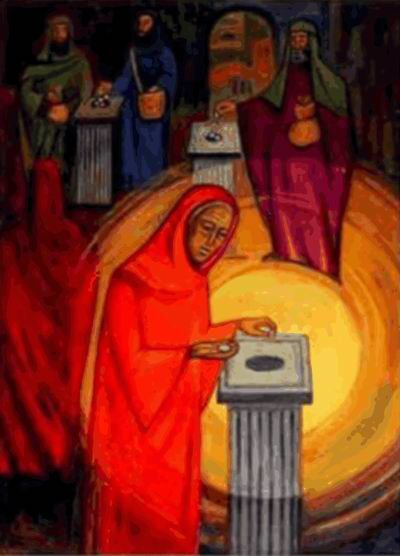
In the Gospel, we hear another sound, neither great nor gorgeous in itself: the quiet chinking of two small coins. Yet, this simple sound has echoed for two-thousand years and millions have been drawn to it. When Jesus Himself heard the sound of the faithful, poor widow’s generous gift, He was moved to speak words in praise. Despite its subtlety, it reminded Jesus of a sound He knew well; it reminded Him of the sound of Heaven.

In our own simple ways, with unending joy, let us echo on earth the song of the angels in Heaven as they praise God’s glory for ever.

The Sorrowful Mysteries, Meditations on Vocation with the Saints

October 29, 2010

The 1st Sorrowful Mystery:
The Agony in the Garden

Years before Jesus agonized in the Garden of Gethsemane, the Blessed Virgin Mary had an agony of her own, when the Archangel Gabriel came to announce to her that she would bear the Son of God. Mary was “greatly troubled,” and the angel sought to reassure her “Do not be afraid, Mary….” Even after the plan was presented to her, she must have been full of questions about her future, like “What will Joseph and my parents think?” But Mary answered, “Behold, I am the handmaid of the Lord. May it be done to me according to your word,” and because she said that, Jesus could say years later, “Father… not my will but yours be done.”

God has a plan for every life, and a calling, a “vocation,” meant for them. Accepting God’s plan for our lives can take great, trusting courage, but answering “Yes” to Him will do more good than we know. Let us pray for the grace, trust, and courage to say “Yes” to our own God-given callings.

The 2nd Sorrowful Mystery:
The Scourging at the Pillar

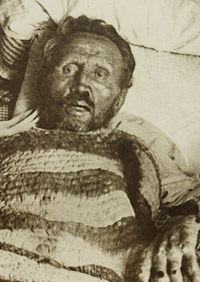
Father Damien went to the Hawaiian island of Molokai to minister the spiritual and bodily needs of lepers exiled there. Last year, in 2009, Father Damien was canonized a saint. But in 1889, six months after his death, the following letter was published in a Protestant Christian newspaper:

Dear Brother,

In answer to your inquires about Father Damien, I can only reply that we who knew the man are surprised at the extravagant newspaper laudations, as if he was a most saintly philanthropist. The simple truth is, he was a coarse, dirty man, headstrong and bigoted. He was not sent to Molokai, but went there without orders; did not stay at the leper settlement (before he became one himself), but circulated freely over the whole island (less than half the island is devoted to the lepers), and he came often to Honolulu. He had no hand in the reforms and improvements inaugurated, which were the work of our Board of Health, as occasion required and means were provided. He was not a pure man in his relations with women, and the leprosy of which he died should be attributed to his vices and carelessness. Other have done much for the lepers, our own ministers, the government physicians, and so forth, but never with the Catholic idea of meriting eternal life.

– Yours, etc., “C. M. Hyde”

Hyde’s comments are noted today only because they were so exquisitely answered in an open letter by Robert Louis Stevenson, the author of Treasure Island (1883) and The Strange Case of Dr. Jekyll and Mr. Hyde (1886). Stevenson quite rightly wrote, “[If the world will] at all remember you, on the day when Damien of Molokai shall be named a Saint, it will be in virtue of one work: your letter to the Reverend H. B. Gage.” The whole reply, assessing Damien and rebuking Hyde, is worth your reading, but I will give you the closing words: “[Father Damien] is my father… and the father of all who love goodness; and he was your father too, if God had given you grace to see it.”

In yesterday’s gospel, Jesus asked, “Do you think that I have come to establish peace on the earth? No, I tell you, but rather division.” This is because when someone set about to do God’s will, the world, which opposes God, will attack that person. Criticisms will land on the just man like lashes on the back. Jesus said, “Woe to you when all speak well of you,” for ‘the world loves its own.’ If there is nothing very counter-cultural about your life, then you are not yet living out the Gospel as Christ calls you to do. Let us pray for the grace to be faithful to the Gospel, even at personal cost.

The 3rd Sorrowful Mystery:
The Crowning with Thorns

Once, when St. Maximillian Kolbe was a boy, his behavior began trying his mother’s patience. She said in exasperation, “Maximillian, what will become of you?” As St. Maximillian writes, “Later, that night, I asked the Mother of God what was to become of me. Then she came to me holding two crowns, one white, the other red. She asked me if I was willing to accept either of these crowns. The white one meant that I should persevere in purity, and the red that I should become a martyr. I said that I would accept them both.” How bold of him to imagine, and how bolder still to ask, that he might receive them both. St. Maximillian would receive both crowns, as a holy Franciscan brother, and as a victim of the Nazis at Auschwitz, where he took the place of another innocent man who was condemned to die.

At yesterday’s Mass you heard that God, by His power, “is able to accomplish far more than all we ask or imagine.” Yet we will receive little if we are too timid to imagine or ask much of Him. Let us pray for the grace to imagine and ask to be crowned by Christ with a life with far greater than whatever we would merely drift into on our own.

The 4th Sorrowful Mystery:
The Carrying of the Cross

In 1961, Gianna Molla was expecting another child. During her second month of pregnancy, a tumor developed in her uterus. She could have chosen to have her uterus removed—preserving her own life, but resulting in her baby’s death.  Instead, she chose to try having the tumor surgery removed. After the operation, complications continued throughout her pregnancy. Gianna told her family, “This time it will be a difficult delivery, and they may have to save one or the other—I want them to save my baby.” On Good Friday, 1962, Gianna gave birth to her daughter, Gianna Emanuela, but it was too late for the mother. St. Gianna Molla died one week later.

Naturally, we all hate to suffering, but if you were to ask St. Gianna Molla what was the greatest thing she ever did, the thing she least regrets and of which she is most proud, I bet she point to this final trial, carrying the cross for the life of her child. I suspect, that on the other side of death, we shall see how much good an offered suffering can do, and we will regret not having offered more. We should ask ourselves, would I rather live a great life, or merely an easy one. Let us pray for the grace to be a lasting blessing to others though the crosses that come our way.

The 5th Sorrowful Mystery:
The Crucifixion

We think of Mexico as one of the most Catholic countries there are, but in 1920’s, it was illegal to celebrate Mass there.  That did not stop priests like Blessed Miguel Pro, S.J. from sneaking about to minister to people in their homes.  After many close calls, Fr. Pro was captured by police and condemned to death on false charges that he was somehow connected to a bombing assassination plot.

When he was led out for his execution by firing squad, Fr. Pro be blessed the soldiers, knelt and quietly prayed for a time. Declining a blindfold, he faced his executioners with a crucifix in one hand and a rosary in the other and held his arms out in imitation of the crucified Christ and shouted, “May God have mercy on you! May God bless you! Lord, you know that I am innocent! With all my heart I forgive my enemies!” Just before the firing squad was ordered to shoot, he proclaimed, “Viva Cristo Rey!” (“Long live Christ the King!”) When the first shots failed to kill him, a soldier shot him point-blank. The government had a photographer on hand, capturing these moments for propaganda purposes, but soon after the images were published their possession was made illegal—a Catholic priest dying faithfully and bravely was an inspiration giving new life to a people oppressed.

At the end of the Rosary we pray, “O God… grant, we beseech Thee, that, meditating upon these mysteries of the Most Holy Rosary of the Blessed Virgin Mary, we may imitate what they contain and obtain what they promise through the same Christ Our Lord. Amen.” If we are faithful to Christ, the mysteries of His life we be made manifest in our own. And if we are faithful to Christ, we will receive a glory similar to His own. Let us pray for the grace to live extraordinary lives in the likeness of Jesus Christ.

The Joyful Mysteries, Meditations with the Saints

October 28, 2010

The 1st Joyful Mystery: 
The Annunciation

The Blessed Virgin Mary may have been just 13 years old when the angel Gabriel announced to her that she would give birth to Jesus. She shows us that even if you are young, God can still do big things with you, if you say “Yes” to Him.

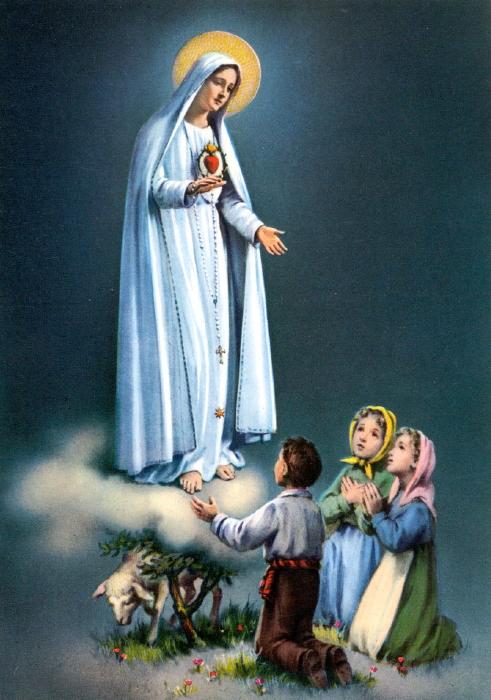
On May 13, 1917, three Portuguese children were praying the rosary after lunch in a field on a clear blue day.  The eldest was Lucia, age 10, and she was with her cousins, Francisco and Jacinta, ages eight and seven. Suddenly, they saw two bright flashes. They looked up and saw “a lady, clothed in white, brighter than the sun…” The Lady smiled and said, “Do not be afraid, I will not harm you.” Lucia asked her where she came from. The Lady pointed to the sky and said, “I come from heaven.” Lucia asked what she wanted. The Lady said, “I have come to ask you to come here for six months on the 13th day of the month, at this same hour.”

On July 13, the incredibly beautiful Lady appeared again. Lucia asked her who she was, and for a miracle so everyone would believe. The Lady answered, “Continue to come here every month. In October, I will tell you who I am and what I want, and I will perform a miracle for all to see and believe.” Then she taught them this prayer: “Oh my Jesus, forgive us our sins, save us from the fires of hell. Lead all souls to Heaven, especially those in most need of Thy Mercy.”

At noon, on October 13, 1917, some 70,000 people were gathered in the field. With a flash of light, the Lady appeared to the children and declared, “I am the Lady of the Rosary.” Some spectators cried out and the crowd turned their eyes upward to the cloudless sky, and they gazed on the sun without the least discomfort.  They saw it tremble and danced in a miraculous way.

Mary, Lucia, Francisco and Jacinta teach us this lesson: Even if you are young, God can do big things with you, if you say “Yes” to Him. Let us pray that we would be open to doing God’s will every day.

The 2nd Joyful Mystery:
The Visitation

“During those days Mary set out and traveled to the hill country in haste to a town of Judah, where she entered the house of Zechariah and greeted Elizabeth. When Elizabeth heard Mary’s greeting, the infant leaped in her womb, and Elizabeth, filled with the Holy Spirit, cried out in a loud voice and said, ‘Most blessed are you among women, and blessed is the fruit of your womb. And how does this happen to me, that the mother of my Lord should come to me? For at the moment the sound of your greeting reached my ears, the infant in my womb leaped for joy.’” (Luke 1)

Imagine how St. Elizabeth must have felt to have Mary, Mother of God, walk in through her door. Elizabeth could not see the tiny Jesus, a fetus in Mary’s womb, but she was convinced that He was hidden there. How would you treat someone if you knew that Jesus was hidden inside of them?

Blessed Mother Theresa cared for the poorest of the poor in the streets of Calcutta, India. Despite years of strenuous physical, emotional and spiritual work, Mother Teresa seemed unstoppable. Though frail and bent, with numerous health problems, she always returned to her work, to those who received her compassionate care for more than 50 years. How did she do it? She could do it because she encountered her beloved Christ both in times of prayer and in the people she cared for. Mother Teresa remembered Jesus’ words, “Amen, I say to you, whatever you did for one of these least brothers of mine, you did for me.” (Matthew 25:40) Mother Teresa loved others as if they were the Lord Himself.

Blessed Mother Teresa and St. Elizabeth teach us this lesson: Jesus is present in your classmates here at school, so you should always be welcoming and loving toward them. Let us pray for the grace to love others in this way.

The 3rd Joyful Mystery:
The Nativity

In his youth, Francis had been quite rich, the son of a wealthy merchant, yet he sensed that there was more to life. He put his former life behind him and devoted himself to following Christ. One day, at Mass, the Gospel told of how Christ’s disciples were to possess neither gold nor silver, nor traveling items, but were to exhort sinners to repentance and announce the Kingdom of God. Francis took these words as if spoken directly to himself, and as soon as Mass was over he threw away what little he had and went forth at once, exhorting the people of the country-side to penance, brotherly love, and peace. He was poor, but clearly happy, and others were attracted to join his movement. By the time of his death, hundreds had joined his religious order. On October 3, 1226, St. Francis died a penniless, but happy man. 

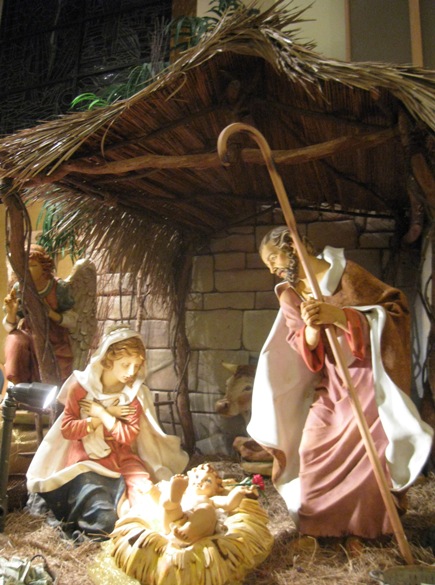
St. Francis of Assisi loved Christmas.  In fact, one story tells of how he petitioned the Holy Roman Emperor to make an edict that grain and bread should be provided to birds, beasts, and the poor this day, so that all God’s creatures would have occasion to rejoice in the Lord. St. Francis also invented the Christmas tradition of making a model of the nativity scene. These nativity scenes, called Crèches, remind us that even though Christ was rich in Heaven, he became poor when he was born on earth in a barn. Yet, Jesus was a happy man, despite his poverty.

Jesus and St. Francis teach us this lesson: You do not need to be wealthy in order to be happy. Let us pray that we may be content and happy with the riches that we have.

The 4th Joyful Mystery: 
The Presentation of Jesus in the Temple

In the year that Jesus was born, “there was a man in Jerusalem whose name was Simeon. This man was righteous and devout” and he longed to see the Messiah who would save God people. It had been revealed to him by the Holy Spirit that he would indeed see the Christ before he died and Simeon trusted and hoped in that promise.

One day, the Spirit inspired him to come into the temple. When he say Mary and Joseph carrying in the baby Jesus to offer a sacrifice for Him, Simeon “took him into his arms and blessed God, saying: ‘Now, Master, you may let your servant go in peace, according to your word, for my eyes have seen your salvation, which you prepared in sight of all the peoples, a light for revelation to the Gentiles, and glory for your people Israel.’” (Luke 2)

What are the promises the Lord has made to us?  Do we trust and hope in these promises? Simeon teaches us this lesson: That we ought to trust and hope in the Lord’s promises, for all of them will be fulfilled in the sight of all someday.

The 5th Joyful Mystery:
The Finding of Jesus in the Temple

This is a true story, the story of a Catholic mother of three whose oldest son joined an anti-Catholic religious cult. It started him down a path of sinful pride and many sensual sins. It broke her heart and for years she prayed tearful prayers for his conversion.

She even asked the bishop to intervene in winning over her son. He counseled her to be patient, saying, “God’s time will come.” When she persisted in asking, the bishop (perhaps busy with many other things) famously reassured her: “Go now, I beg you; it is impossible that the son of so many tears should perish.”

That mother was St. Monica, and that son of hers, who was lost and found, was the great St. Augustine. Sts. Monica and Augustine teach us this lesson: that your persistent prayer can help people to find Christ. Let us pray for someone that we know, that he or she may be drawn closer to Jesus Christ.

Sources:
On Fatima
On St. Francis
On Blessed Mother Teresa

The Child Mary — September 8 – Nativity of Mary

September 8, 2010

Nine months ago we celebrated Mary’s Immaculate Conception. Today we celebrate her birthday. By my estimation, Mary is now about two thousand, twenty-five years old, but if you saw her I’m sure she wouldn’t show her age. How old does Mary seem when you picture her in your mind? I’d bet that you think of her as fully-grown up; like your mom or your teachers. But today’s feast reminds us that she was once your age too.

Mary was little once too, and just because Mary lived a life without sin doesn’t mean that her childhood was a bed of roses. I think adults sometimes forget how hard and stressful things can be when you’re little, but Mary remembers everything perfectly well.

She remembers what it was like to be little like many of you. How she got scared when Nazareth’s big, neighborhood dogs would bark at her. How loud cracks of thunder frightened her at night and made her hide under the covers. She remembers how other girls made fun of her, for being different or weird, and she remembers how she cried. But even when she got sad or scared, Mary knew that she was loved and not alone. Not only did her parents love her, but she was convinced of God’s love, too, and understood that He was never far from her. This consoled Mary and reassured her that everything would be alright.

After our resurrection, when we get glorified bodies like Mary has now, we will have some new abilities. We will be able to go anywhere we want in an instant. And our glorified bodies should allow us to be more than one place at once. (It only makes sense that if saints on earth can bi-locate, then the  saints in Heaven should be able to as well.) And I also suspect that we will be able to change ourselves back and forth to whatever age we choose.

All this is to say that if at any moment you want Mary to be with you for consolation and support, you only need to ask her. Knowing her abundant love, I can’t imagine she would refuse. And when you think of her with you feel free to picture her at your age, even if you’re little. She understands you, loves you, and can relate to your situations more than you know. Like her Son, Mary is always with us, especially when we ask her be.

We’re in a Hurry — 16th Sunday in Ordinary Time—Year C

July 18, 2010

The other day I was thinking about this homily when I heard the words of some modern poets on my radio. They said:

I’m in a hurry to get things done,
Oh, I rush and rush until life’s no fun.
All I really gotta do is live and die,
But, I’m in a hurry and don’t know why.

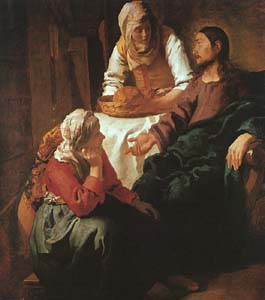
This goes to show that we still have a Martha problem today. The group Alabama said that they didn’t know why we get in a hurry, even though we’re not having fun, but I think I know the answer. The reason is that our loves and good desires are mixed with fears. If we would take that fear away, we would find peace.

Martha loved the Lord and wanted to serve Him well, but she had fears mixed in. She was the one who invited Him to the house and He probably had His apostles and other disciples with Him. She was busy serving them all, perhaps making the biggest meal she had ever made, and she was full of worries. “What if I’m a poor host and Jesus is disappointed with me? What if there’s not enough food for everyone to eat?”

We are often the same way. We fear that our lives are on the edge of disaster if our own plans and efforts should fail. We worry about bad things happening to ourselves and the people we love. We are anxiety about how Jesus feels about us.

Martha had a great desire to do good, but Martha’s fear tempted her to do harm. Her sister, Mary, was sitting at Jesus’ feet, listening to His words. (The Greek word for disciple actually means “one who sits at the feet of.”) Martha tries to take Jesus’ disciple away from Him.

Similiar thing can happen in our live on account of fear mixed with love. A husband and father can obsess about his work, out of a love for his family and a desire to provide, but his family can be left feeling like they come second in his life. A wife and mother can be so concerned that her loved ones will be safe and happy that she tries to control everything, making her family less happy because of it. Martha’s problem and ours is not that we work–work is a part of life–but in how we go about it.

Jesus says to Martha, and to us, “Martha, Martha, you are anxious and worried about many things. There is need of only one thing.” What is this one thing we need? We need the peace of Christ. What is the peace of Christ? It is several things.

It is the awareness that God is near and guiding us. In the first reading, three heavenly visitors approach outside of Abraham’s tent. Now, the Holy Spirit dwells within our tents, Jesus is at our side, and we have a Father above. We are never left on our own.

With the peace of Christ we recognize that whatever may happen to us or those we love, it is for our good. As St. Paul observes in the second reading, even his sufferings are a cause for rejoicing for they advance the salvation of the whole Church with Christ.

With the peace of Christ we recognize that misery is not just around the corner, nor is happiness out of reach. Happiness is at head, in the knowledge that Jesus loves us, likes us, cares about us, and cares for us. Living in the peace of Christ means there is no reason for us to be unhappy.

Let us continue to do works of love for God, ourselves, and others, but let us do them always in the peace of Christ.

Pushing Boulders — 13th Sunday in Ordinary Time—Year C

July 1, 2010

Once upon a time, there was a hermit who lived in a cabin in the woods.  Each day, he would spend a good deal of time in prayer. One day at prayer he quieted himself, opened himself receptively to God, and heard Jesus speak to him. It’s wasn’t that he heard Jesus externally, speaking from across the room, but within his own thoughts. The hermit knew from experience that the Lord sometimes sends us an image, a memory, a song, or words in times of prayer to communicate with us.

The Lord said, “Go outside to the large boulder in your yard.” The man got up and went. Then the Lord said, “I want you to push this boulder for at least 30 minutes every day.” The man went about pushing the boulder every day, exerting his body in every way, but even months later he could not discern having moved the stone a single inch.

The man thought to himself, “Am I doing something wrong? Am I failing because of my sins or my lack of faith? The Gospels say that if I had faith the size of a mustard seed I could move mountains, but I can’t even move this stupid boulder.  Am I failing because this isn’t really God’s will? Did the Lord really tell me to do this, or did I just imagine it myself? No I heard Him, as surely as the other times when I heard Him speak. But why does He give me a task that He knows I can’t do? Does He want me to fail?” At this the man became very angry and (wisely) took his frustration to God. 

The man heard the Lord speak to Him, “Do you have reason to be angry? I told you to push the boulder, but I never told you to move it. Look at your arms, look at your legs, you have become strong because of your faithfulness and now you are ready for my next mission for you. You thought you were failing, but you succeeded in doing my will.”

In today’s gospel, Jesus turns resolutely toward His final journey to Jerusalem. He sends out advance teams to visit the towns ahead of Him and prepare His way. One of these villages is a Samaritan town and when they learn that Jesus’ destination is Jerusalem they refuse to welcome Him. James and John see this and ask, “Lord, do you want us to call down fire from heaven to consume them, like Elijah did back in the day?” Jesus turns and rebukes them; the fire of the Holy Spirit is meant for the salvation of people, not their destruction.

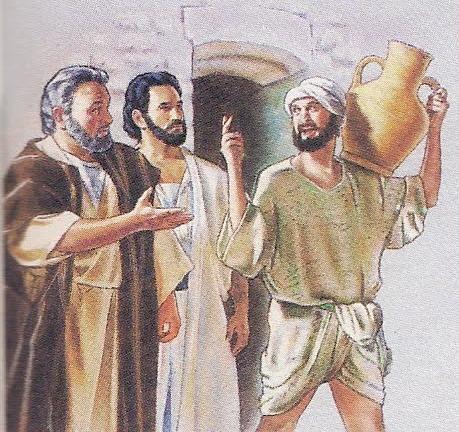
Why did Jesus send His disciples to that Samaritan town, instead of just instructing them to pass it by? Jesus knew what was going to happen when they went to that village–He knew by His divine insight that they wouldn’t accept Him. Remember when Jesus needed a donkey to ride on into Jerusalem? He sends two disciples to find and untie a donkey who had never been ridden before and He tells them what to say if anyone asks what they are doing. They go into the city and find everything as Jesus had described. Remember when Jesus needed a place to celebrate the Last Supper? He tells Peter and John to go into the city and to follow a man they will see carrying a jar of water, when they come to the house he leads them to, they are to ask if there is a place for the master to celebrate the Passover. They go and find everything a Jesus described, including an upper room already prepared for a Passover. Jesus knew that the Samaritan town would not welcome Him, so why did He send disciples there?

The mission may have seemed like a failure, but Jesus’ plan succeeded. Jesus knew that His Apostles would soon be preaching the Gospel to the whole world and He knew that not everyone would welcome them or their message. Jesus wanted to give them some experience in rejection to teach them how to respond; not with anger and violence, but with patience and peace. James and John learn a lesson about divine mercy. They may have thought their mission to the Samaritan town was a total failure, but the Lord was successfully achieving His goals in them.

So what does all this have to do with us? In our lives we often experience weakness, setbacks and apparent failures. In response, we often blame ourselves, even when we are innocent, or we conclude that we must not have been doing God’s will, or we get angry with God for frustrating or not helping our efforts. Yet, as long as we are faithfully following Christ, nothing we attempt is ever truly a failure.

The only true failure in the Christian life is sin, but if we repent of our past sins even these can be used to benefit God’s great plan. Scripture says, “God works all things for the good of those who love Him,” this even includes our repented sins. We are obsessed with success, but as Blessed Mother Teresa reminds us, “God does not ask us to be successful; He asks us to be faithful.”

Sometimes you will feel like you are failing, or that your efforts have been useless, but by your faithfulness you will be succeeding in doing God’s will. Let us remember that at the center of our faith is a man nailed to a cross; an appearent failure who was actually succeeding in saving the world. Jesus rolls away stones in ways we wouldn’t expect.

Hearing Him — Friday, 3rd Week of Easter

April 23, 2010

Jesus says, “Whoever eats my Flesh and drinks my Blood,” as we are about to do in at this Mass, “remains in me and I in him.” After we receive Him, He remains with us and we with Him.  And He stays with us, provided we do not cast Him out through committing serious sin, until we receive Him again.

Jesus remains close to us throughout our day. Wouldn’t it make sense, that time to time, He would occasionally have something to tell us? Maybe we don’t hear Him because He knows we would refuse to listen. Perhaps He knows we would dismiss hearing Him speak to us out of hand, or maybe He knows we don’t trust Him enough to go out on a limb. For example, if you got the feeling that the Lord wanted you to relay to a message, a message you didn’t really understand, to particular person what would you do?

In the first reading, the Lord speaks to Ananias and Ananias answers, “Here I am.” Then the Lord gives Him an entirely wholesome, but very counter-intuitive task: lay your hands on Saul and heal him. Ananias hesitates a little. Ananias might be wondering if this is really coming from the Lord, or maybe he’s not sure he wants to risk this much for the Lord. But in the end, Ananias listens, and because of it, Saul became St. Paul.

If we would like the Lord to do such things with us let us be faithful in little things, faithful to the commands of our consciences and to the gentle nudges of the Holy Spirit throughout our daily lives. If we are willing to trust Him, Jesus will ask us to be His chosen instrument in greater matters too. So let’s listen, let’s be docile, and see what He does with us.

Jesus’ Resurrected Body — Easter

April 7, 2010


On Holy Thursday, we meditated on the disciples’ feet. On Good Friday, our Saviour’s hands.  Today, let us consider Jesus’ resurrected body.

Jesus’ resurrected body is the very same that died and was buried, but it is a very different body, too. The tomb was empty on Easter morning, not because Jesus’ body was vaporized, but because it was raised.

Jesus’ resurrected body has wounds, in his hands and feet and side, showing that this is the same body that suffered on the cross. It seems that the cuts and bruises on Jesus’ face and the lashes on His back are healed, but these five wounds remain. Why? These wounds are trophies and jewels.  They no longer cause Him pain, but they testify to Jesus’ greatness and love and He will have them forever.

So Jesus’ resurrected body is the very same body that died on the cross and was buried in the tomb, but it is a very different body. For instance, Jesus in His glorified body can cause others to see but not recognize Him, as He did on Easter evening with two disciples on the road to Emmaus. Only later, in the breaking of the bread, did they recognize Him. Then Jesus displayed another new power, disappearing from their sight. In His glorified body Jesus can move at the speed of thought and the walls and locked doors of the upper room do not prevent Him from appearing in the midst of the apostles.

In this there is a sign for the future of humanity. People often speak of “the end of the world” and imagine Heaven in strictly spiritual terms, but just as Jesus’ body was not annihilated but transformed, so our bodies and this universe will be remade. A glimpse into the future of the righteous is reflected in the resurrection of Christ.

Jesus’ body is not discarded, but gloriously transformed. In this there is a lesson for us. In (just about) every  life, there is a line that we have drawn in our relationship with God. It is a self-imposed limit on our trust, commitment, and self-gift towards Christ. “Lord, I will walk with you that far, (but no farther.)”

Perhaps we are unwilling to cross that line with us because we are too attached to the sins and mediocrity we have settled for, maybe we are afraid that we will lose who we are and become something that we are not, or maybe we are afraid that a total self-gift to God won’t truly make us happy. The devil likes this arbitrary line. He would like you to reach the end of your life and have to wonder with regret, “What would my life been if I had gone all-in for God?” The devil would have you fearful and repulsed of “the cross, the cross!” but the cross is not the end of our story.  Remember, as in Christ, God does not want to destroy you, but to transform you into who you truly are.

Do you believe Jesus suffered and died for you? Then He surely loves you. If He loves you, then how could He not desire your greatest happiness? Do you believe Jesus is divine and all-knowing? The surely He knows what will lead to your greatest good. Do you believe Jesus is all-powerful? Then surely He has the power the lead you to that good. Then what is standing in His way? There is only one thing standing in the way of His omnipotent power, preventing Him from transforming us into who (deep down) we truly want to be. That obstacle is our own freewill, the arbitrary line we draw in our relationship with Christ.

This Easter, let us be resolved to follow Christ without compromise. Let us entrust our whole selves to Him who has given us everything. Jesus does not want to destroy you, but to gloriously transform you into who you truly are.

Mary and Pilate — 6th Sunday in Ordinary Time—Year C

February 14, 2010

In a few moments, after this homily, we will recite our creed, the summary of our faith. Every Sunday, we profess, in union with the Christians who came before us, our belief in these truths and our resolve to live our lives according to them. This morning we will look at just one rich aspect of our creed and consider its implications for our lives.

Have you ever noticed that in the entire creed, only two non-divine persons are mentioned by name? These are the Virgin Mary and Pontius Pilate.

“By the power of the Holy Spirit, He was born of the Virgin Mary and became man. For our sake He was crucified under Pontius Pilate; He suffered, died and was buried.”

Now many other figures from the Old and New Testaments could have justifiably been included in our creed; such as Adam and Eve, Abraham, Moses, David, Mary Magdalene, Peter, Paul, and many others. Yet, only Mary and Pilate get mentioned. So why is this? There seems to be two very good reasons. The first of these reasons I will give now—and the second I will save for the end.

The first reason why Mary and Pilate receive special mention is that they ground Jesus’ life, death, and resurrection in our real history. Jesus was ‘born of the Virgin Mary, suffered and died under Pontius Pilate, and on the third day, He rose again.’ Now other pre-Christian religions sometimes had stories about dying gods who came to life again, but those stories were always said to have happened ‘once upon a time,’ in some remote and mythic past. But with Jesus Christ, this ancient intuition and longing of humanity is actually realized. The inclusion of Mary and Pilate in the creed witness to this: that God became man, died, and rose for us, in this world and in real history.

Some people try to be too sophisticated by saying it doesn’t really matter if Jesus rose from the dead, or even if He lived at all, because His teachings are what’s important. But St. Paul blows this idea out of the water. “If Christ has not been raised, your faith is vain; you are still in your sins. Then those who have fallen asleep in Christ have perished” and “we are the most pitiable people of all.” Without Jesus Christ and His resurrection there is no Gospel, there is no Good News.

Just like Jesus Christ, Mary His Mother and Pontius Pilate His executioner are not fictional characters made up for some story. They are real people, from a time not that much different from our own. Our styles and technologies may have changed, but human beings themselves remain much the same. When we look at Mary and Pilate we can see ourselves in these two people whom Christ encountered twenty centuries ago.

Pilate is the secular Man of the World.
Mary is the devoted Disciple of Christ.

Pilate seeks the glory of men.
Mary seeks the glory of God.

Pilate knows worldly wisdom, he is clever and cunning.
But Mary knows God’s wisdom, and she is truly wise.

Pilate thinks he knows how the world works and the pragmatic way to get things done. For Pilate, our world is totally shaped by of power, money, and influence, with some blind luck thrown into the mix. When Jesus stands silent before him, Pilate says, “Do you not speak to me? Do you not know that I have the power to release you and I have the power to crucify you?” Jesus replies, “You would have no power over me if it had not been given you from above.”

Pilate is a very post-modern man.  He’s a moral relativist. When he asks Jesus, “What is truth,” he doesn’t bother to wait for an answer from Truth Himself. That’s because Pilate thinks that the ‘truth’ cannot be known except for the ‘truths’ which we choose for ourselves or impose upon others.

The Gospels show that Pilate knows Jesus is innocent, or at least that he poses no real threat to society, yet Pilate is willing to have this innocent man whipped and even crucified when that becomes the most expedient thing to do. The crowd threatens Pilate, “If you release him, you are not a friend of Caesar,” and he quickly caves and hands Jesus over.
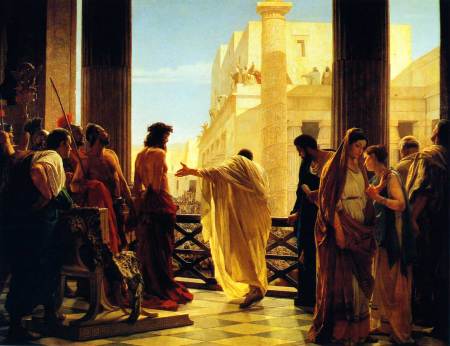
Pilate washes his hands of responsibility, and extends Christ’s arms on the cross. Mary had extended her arms declaring, “Let it be done to me according to your word,” and lovingly held the infant savior in her hands.

Pilate, despite all his power, is ruled by fear.
Mary, despite her weaknesses, is freed from it.

Governor Pilate is rich in wealth and power and yet he has no peace.
Mary, the poor widow, has peace and everything she needs from God.

Pilate has no faith in the God of Israel. He says, “I am not Jew, am I?” But for Mary, God is her rock and this makes all the difference in the world. Mary is defined by her faith, hope and love.

Mary never attends an academy, but she is profoundly wise because she reflects in her heart on the words and deeds of God and because she lives by her own advice: “Do whatever he tells you.” She knows that we do not manufacture the truth for ourselves, we receive it, ultimately from God. We love it, we defend it, and we share it with others. “Blessed [is she],” as Elizabeth said, “who believed that what was spoken to [her] by the Lord would be fulfilled.” Mary trusted and believed, for she saw the evidence through history that God “has mercy on those who fear Him in every generation,” that “He scatters the proud in their pride, and casts down the mighty from their throwns, but He lifts up the lowly.”

Mary’s life was full, but was not free from trials. When Mary consents to be found with child through the Holy Spirit she is uncertain of what will happen to her, but she trusts in God. She does not know how she and her husband will get by as poor immigrants in foreign country, but she continues to trust. Mary’s response to every trial in life, even to the death of her son, is to trust in God. Despite men’s sins, she trusts in God as the Lord of history, that He casts down the proud and mighty from their throwns and raises up the lowly.

Pilate is indifferent to Christ, and he consents to sending Him to the cross, but Mary is wholly devoted to Christ, and she consents to share in His Passion. Pilate’s heart is hardened despite Christ’s Passion, while Mary’s heart is pierced by it.

Governor Pilate was once the most powerful man in Judea, but where is he now? Mary, the poor widow, is now our glorious queen, the most beautiful and powerful woman in heaven or earth, and through her reign she draws millions to Christ our king.

She is the one who wept and now laughs.
He is the one who laughed and now weeps.

He was rich in the world and now he is poor.
She was poor in the world and now the kingdom is hers.

He took root in the desert, he was barren and uprooted.
But she was planted beside the flowing waters, she endured and bore much fruit.

So what do all of these reflections about Mary and Pilate have to do with us? I promised you at the beginning a second good reason why Mary and Pilate are mentioned in the creed; and here it is: Mary and Pilate represent us. They stand as archetypes, models or patterns, for every person.

The faithful one and the faithless one.

The one who serves God and the one who serves himself.

The one who gives Christ life and the one who puts him to death.

We live our daily lives as either Mary or Pilate, with shades of the other thrown in. As we come to the season of Lent, let us examine and discern who we are. “How am I Pilate, and how am I Mary?” And at this Eucharist, let us ask Jesus to exchange in us the ways of Pilate for the ways of Mary, for hers is the way of Christ.

Luke’s Source — January 1 — Mary the Mother of God

January 1, 2010

Have you ever wondered how it is that Luke the Gospel writer knows the stuff he’s telling us? For instance, he wasn’t present at the Annunciation to take down notes.  Only Mary and the Archangel Gabriel were there. And in today’s Gospel, after the shepherds visit, it says, “Mary kept all these things, reflecting on them in her heart.” Now how does Luke know what Mary was thinking? Who could know something like that besides Mary herself?

Now I suppose the Holy Spirit could have directly infused the knowledge of these things into him, but that’s probably not what has happened here. Luke probably learned of these details in the most natural and human way; by being told about them, first or second-hand, by people who knew. Luke begins his Gospel by saying that his narrative of events is composed from what “those who were eyewitnesses from the beginning and ministers of the word have handed … down to us.”

But there is only one person who could have been the original source for many of Luke’s details, and that is Mary herself. In fact, some call the beginning chapters of the Gospel of Luke “the Memoirs of Mary.” Perhaps Luke heard of these details from Mary’s very own lips and took them all to heart.  Then later, knowing these things by heart, committed them to writing.

And so we do know something today of what was going on inside of Mary in those early days, “Mary kept all these things, reflecting on them in her heart.” And some years later, upon finding Jesus in the temple, Luke reports that Mary and Joseph did not understand what their boy when said to them, but “his mother kept all these things in her heart.” In this there is a lesson for us to discover through Mary, a lesson that is particularly applicable for us this New Year’s [Eve/Day].

In her life, Mary knew some important aspects of God the Father’s plan, but there was always a great deal about which she did not know. She knew that her Son was messiah, savior, and Lord, but his future, and hers, remained largely a mystery. Perhaps Mary wondered, as we often wonder when faced with evils and obstacles, “How can this be, Lord?  How will your promises be fulfilled despite this?”  Yet through it all, Mary firmly trusted that the Lord was with her, and we should do the same.

What does the new year ahead hold for each of us? Like Mary, we do not know, yet Mary shows us that we do not have to know.  We do not have to fully know our future to be able to do great things for God and to be richly blessed by Him. We do not need to know our future for the Almighty to do great things for us.

In the year ahead, may the Lord bless you and keep you, as He did the Virgin Mary.

May the Lord let his face shine upon you, and be gracious to you, as He did for Mary through Jesus’ infant face.

And may the Lord look upon you kindly and give you peace, a peace like that which Mary always kept with her Son, Jesus the Christ.

3rd Sunday of Advent—Year C

December 14, 2009

Advent is a season for penance and conversion, for the confession of sins and the changing of lives, but this Sunday of Advent reminds us that it is also time for joy. Today we celebrate Gaudete Sunday, a name which comes from the Latin command “rejoice!” This command is heard from St. Paul in today’s second reading:

“Rejoice in the Lord always.
I shall say it again:  rejoice!”

But is it that why do we need to be reminded, even commanded, to rejoice? Why are we not a people of constant joy and peace, even though we have great reason to be? I think it is because our hearts and minds give in to fear.

God is near, but when we give in to fear we do not trust that He really cares about us and really provides for us. In fear we become anxious about our future. In our fear we feel too stressed-out to be thankful. And in fear we forget or refuse to pray. St. Paul seems to have realized all this, that may be why he followed his command to rejoice with these words, words that it would do a lifetime of good to know by heart:

“The Lord is near.
Have no anxiety at all,
but in everything,
by prayer and petition,
with thanksgiving,
make your requests known to God.
Then the peace of God
that surpasses all understanding
will guard your hearts and minds in Christ Jesus.”

Today I would like to share with you a true story about two friends of mine who had every seeming reason to afraid, but who kept God’s peace. Let’s call them Andrew and Christi. I have changed their names to conceal their identities, but I know they wouldn’t mind me sharing with you their story because it can teach us all a lot.

To say my friends had a difficult first year of marriage would be to understate it. Andrew, a hard-working man with rough hands and a good heart, became afraid that marrying Christi had been a mistake and he seriously considered getting a divorce. Christi, a beautiful woman inside and out, prayed fervently to God, for both Andrew and herself. She honestly did not know how God would provide for her, but God gave her a peace that surpassed her limited understanding of His plans. Then, as Andrew tells it, God intervened, giving him a sign that this marriage was indeed His will and that Andrew should not be afraid. This divine reassurance strengthened Andrew and he resolved to remain faithfully at Christi’s side no matter what.

A few months later, forces beyond their control forced Andrew and Christi to leave their hometown, away from all their family and friends, and to move down south to a town where Andrew had some distant relatives. But, once they got down there, all of these relatives proved to be too distant or too busy to care enough to lend this vulnerable couple a hand. Their first Advent season together, Andrew and Christi were jobless, homeless, and with child.

It would have been so easy for them to give in to despair that first Christmas Eve, for Andrew to feel like he had failed his wife as a husband, or for Christi to feel anxious and afraid about their future as a family. Yet, Andrew and Christi trusted that the Lord was near. They would pray together as a couple, and gain courage and strength, peace and even joy through their prayers.

Indeed the Lord was near them, through it all, and their first Christmas together turned out to be was the brightest and the most joyful that they, or the world, had ever seen. As I said, this is the true story of two friends of mine, but they’re also friends of yours and you knew their story even before I told it to you today. For Andrew’s real name is St. Joseph and Christi’s real name is St. Mary.

Today we rightly call them saints, not because they lived in a world free from difficulties, an imaginary world different from our own. Joseph and Mary are saints because they knew and practiced how to live in this world well; with joy, kindness, prayer, thanksgiving, and peace. And so brothers and sisters:

Rejoice in the Lord always.
I shall say it again:  rejoice!
Your kindness should be known to all.
The Lord is near.
Have no anxiety at all,
but in everything,
by prayer and petition,
with thanksgiving,
make your requests known to God.
Then the peace of God
that surpasses all understanding
will guard your hearts and minds in Christ Jesus.

32nd Sunday in Ordinary Time—Year B

November 9, 2009

Widow's Mite

Imagine if you took two pennies and put them into a savings account, at 1.5 percent interest annually, and left it there for 2000 years. How much money would there be at the end? (2 cents, 2000 years, at 1.5% interest.) One hundred dollars?  No, higher.  A thousand dollars?  Still higher.  Ten thousand dollars?   Not even close. There would be one-hundred, seventy-one billion dollars.

[$0.02 * (1.015)^2000 = $171,046,619,000]

First of all, this reveals to us the power and the fury of compound interest.  But second, and relevant to today’s gospel, this shows us that small things can be more powerful and valuable than we would expect.

One day, almost two thousand years ago, a poor widow climbed the temple mount in Jerusalem and walked among the crowds in the temple courts to the treasury where she gave two small coins for the support of the temple.  Many rich people where there, were pouring much larger gifts into the treasury with great fanfare. Though her gift was tiny compared to theirs, that doesn’t mean that what she did was an easy thing to do. Being poor, it was hard for her, a real sacrifice.  She had to trust in the God of Israel; the God said to provide for the needs of orphans and widows like her. She could have dropped in just one coin, or given nothing at all, but she gave both coins, everything she had. She wasn’t trying to be seen, but the Lord was watching.

Jesus, sitting across from the treasury, called His disciples to Himself to draw their attention to her. “Look at what this poor widow has done.  Take this, all of you, as an image of myself.  Just as she has given everything as a gift of herself to God (even though it was hard and took great trust) so will I give myself up for you.”

The poor widow’s two coins, worth just a few cents, landed in the treasury with a quiet “tink, tink,” but her act has echoed through the centuries. Everywhere this gospel has been preached, the throughout the centuries and around the world, what she did has been remembered.  How many consciences have been pricked and how many hearts have been inspired to invest more completely into the kingdom of God? If the good her small deed has done throughout the ages could be quantified, it would far surpass one hundred, seventy-one billion dollars.

When we rise from the dead, at the general resurrection, I suspect that this poor widow will stand out.  She will be more glorious and enchantingly beautiful than most, and (even though the gospel does not give her name) everyone will know who see is and she will enjoy the love and gratitude of vast multitudes.

When we die, we will all die penniless, and when we rise we will all rise penniless, but some of us will be richer than others. The richest in heaven are those who receive and can give the greatest love, and this will depend upon how much we have invested ourselves into the kingdom of heaven.

You are already giving to your spouses and your children, your friends and your family, at home, at work, and at church, but we should ask ourselves from time to time how much we are giving from our surplus wealth and how much was are making a total gift of ourselves.  Such giving is hard, it takes trust in God, and it conforms us to Jesus Christ. When we give ourselves in this way, in the likeness of Jesus Christ, our gifts yields the greatest returns, here on earth and forever in heaven.

Now you have heard me put in my two cents.  I pray that it may result in great profit for your souls.