Archive for the ‘Trust’ Category

October 28 – Sts. Simon and Jude

October 28, 2009

Cowardly Lion

Today we celebrate the Sts. Simon and Jude, apostles and martyrs for Christ. Simon was known as “the Zealot,” and Jude, or Judas the son of James, was nicknamed “Thaddeus,” which means “Courageous” in Greek. In the Gospel today the apostles are listed, with Simon and Jude coming towards the end, right before Judas Iscariot, the one who betrayed Jesus.

When Jesus sent out His disciples with the power and authority to heal the sick, cast out demons, and preach the Gospel, He sent them out two-by-two.  One could infer (though this is by no means certain) that this Gospel passage lists the apostles according to those old missionary pairings: Simon Peter with his brother, Andrew; James with his brother, John; and so on, ending with the Judas called “Courageous” and the other Judas who became a traitor.

So here we would have two Judas’, side-by-side, in discipleship and ministry. Yet, only one of them earned a nickname for being courageous. To grow in holiness requires our courage, a virtue that Judas Iscariot tragically lacked.

John’s Gospel tells us that this Judas held the money purse, and sometimes stole from it for himself. That’s because he lacked the courage to acknowledge his faults and to grow in the virtues.

Judas may have betrayed Jesus because he thought this would kick-start Jesus, the weak messiah, into real, revolutionary action. Judas did not have the courage to trust that the providence of God working through Jesus Christ was really the best way to bring about the Kingdom on earth.

And after he had sinned, Judas lacked the courage to seek forgiveness, choosing suicide instead, which is called “the coward’s death.” Simon Peter denied Jesus, but he had the courage to confess his sin and to seek reconciliation. That was Peter’s salvation.

If we are going to grow in holiness to sainthood, it’s going to require our courage; the courage to acknowledge our faults and grow virtue, the courage to trust in God’s will and providential plan for our lives, and, when we fall, the courage to confess our sins and to seek reconciliation with Christ.

28th Sunday in Ordinary Time—Year B

October 11, 2009

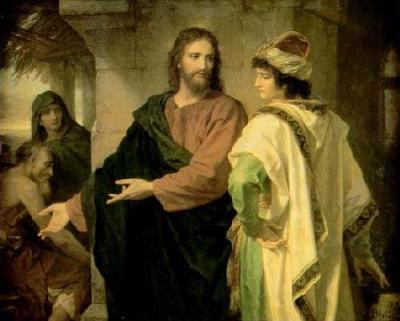
Christ and the Rich Young Ruler, by Heinrich Hofmann

This morning’s second reading from the Letter to the Hebrews speaks of the Word of God; as “living and effective, sharper than any two-edged sword, penetrating even between soul and spirit, joints and marrow, and able to discern reflections and thoughts of the heart.” The first thing that comes to our minds when we hear the phrase “the Word of God” is probably the Bible, but for the author of the Letter to the Hebrews, the Word of God is first and foremost a person. The author writes of the Word of God, “No creature is concealed from Him, but everything is naked and exposed to the eyes of Him to whom we must render an account.”

Jesus Christ is the Word of God, eternally spoken by the Father. Yet our Church’s Scriptures are also God’s inspired Word. Scripture is no dead letter, it is living and effective among us today. It can penetrate the soul, giving discernment to the thoughts and reflections of its readers’ hearts. The Word of God comes down to us from heaven. In Jesus’ incarnation, the Divine Word unites with humanity. Similarly, in the inspiration of Scripture, divinity unites with human words. In the Christian life, we neglect the Word of God to our detriment. We need Christ and His Scriptures. Merely following our consciences will not give us the fullness of life.

Living a moral life is good, but it is not the fullness of life that God wills for us and wants to lead us to through His Word. The man who came to Jesus in the Gospel realized this. He had listened to his conscience and observed the commandments of God’s from His youth, like a lot of cradle Catholics, but notice that the man didn’t walk up to Jesus, he ran to Him and knelt before Him, because he profoundly recognized that he did not yet have the fullness of life. The man goes to Jesus because he senses that this teacher holds the answer he’s searching for, and indeed Jesus does.

Jesus, looks at him, loves him and says to him, “You are lacking in one thing. Go, sell what you have, and give to the poor and you will have treasure in heaven; then come, follow me.”

What this man lacks, in his all-too-comfortable life, is a total commitment to God through a personal relationship with Jesus Christ. Jesus offers him the opportunity and the adventure of a lifetime, “Come, follow me,” but the man goes away sad, because he has many possessions which possess him.

This morning, I would like to teach you a way to personally encounter the Word of God yourself; a way to run up to Jesus, through praying with the Scriptures.

First, take your Bible, and go to someplace where you can pray. Perhaps a quiet room in your house or here at Church; someplace where you will be free from distractions. Then ask the Lord for His grace and wisdom, and the spirit of wisdom, which is greater than riches, will be freely given to you.

Open your Bible to the Gospels, and chose a single scene. Read the passage once or twice, to become familiar with it, and then read it once again, slowly.

Now use your imagination to enter that scene. See Jesus and the other characters there. You can be a bystander observing the scene, or put yourself in the place of one of the characters. What do you feel in their place? What would you say and what would you do in that situation? Then look to Jesus, to hear what He says and see what He does.

This can be a very fruitful way to personally relate with the Word of God, and for Jesus to relate with you through His Scriptures in your prayers.

Over the past few days, in preparation for this homily, I have prayed in this way with today’s Gospel. Just to provide one example of how this sort of thing goes, I’d like to share my meditations with you.

The Gospel begins by saying that the man ran up “as Jesus was setting out on a journey,” so I imagined myself standing there as one of the carrying a heavy sack on my back. When the man came up and knelt before Jesus the feeling that I felt was annoyance, that this guy was holding us up when we had a long journey ahead of us.  But then I remembered what I was witnessing before me an event worthy of the Gospels. This was a lesson for my life and my ministry, that I should not let anxious feelings cause me to neglect or rush past the things that are really important.

When I saw the man walk away sad, I ran after him and pleaded with Him to come back, not to live His life plagued with by question of what his life would be like if he had tried, even just once, a total commitment to Christ. But the rich man was afraid. He didn’t think he had it in Him to take that step. This motivated me to go back to Jesus and ask Him for the grace so that we would all be willing to follow Him outside our comfort zones.

I also I imagined myself in the position of the rich man, kneeling before Christ and asking what more I lacked. I expected Him to say, “Sell all that you have and follow me,” but Jesus put His hand on my shoulder, smiling, and expressed His pride at how far I had come in the areas of trust and generosity. It was a great personal consolation.

What consolations and what wisdom does the Word of God have waiting for you through this form of prayer? There’s only one way to find out.

October 1 – St. Therese of Lisieux

October 1, 2009

Today we celebrate the young woman Pope Pius XI called, “The greatest saint of modern times.” At the age of 15, she entered the Carmelite convent in Lisieux, France to give her whole life to God. There, she would take on a new religious name which would profoundly capture her identity: Sister Therese of the Child Jesus and the Holy Face.

St. Therese

How did her life resemble the Child Jesus? Early on, Therese saw her own weakness and littleness, and she believed that great and mighty deeds were beyond her, so she committed herself to a “little way of spiritual childhood.” She always tried to love and trust like a little child, modeling herself on the Child Jesus; not doing great things, but doing everything with great love.

The second title of St. Therese, that of the Holy Face, refers to the image Jesus’ bloodied face left upon St. Veronica’s veil during the Passion. How did Therese’s life resemble the Holy Face? Whatever she suffered, from small annoyances of daily life to the great pains of her final illness, Therese offered it all to God as a sacrifice for the good of souls. The image and likeness of Christ’s redemptive suffering was made present in her, like the image Christ’s face upon a clean, white cloth.

We can follow St. Therese’s example in our own lives, whenever we approach our Father in prayer with child’s fearless trust, whenever we do our daily tasks with a intention to do them with great love, and whenever we offer our sufferings as a sacrifice in Christ, for our good and the good of all His Church.

24th Sunday in Ordinary Time—Year B

September 13, 2009

Once upon a time, there was a kingdom,
filled with forests, and farms, and villages.
There lived near one town, a humble farmer.
He was simple, but wise, and loved the Lord.
He worked his small farm, with his wife and son.
They kept fields, a home, and a few livestock.

One day, the farmer’s work-horse, ran away.
“How unfortunate,” said the villagers,
“It will be harder, to plant your crops now.”
The wise farmer replied, “Our God works all things,
for the good, of those, who love Him.”

Two days later, the horse came back.
bringing along two wild-horses with him.
“How lucky you are,” the villagers said,
“you have free horses, walk right to your door!”
The wise farmer replied, “Our God works all things
for the good of those who love Him.”

There after, his son, training the wild horses,
got kicked off of one, and broke both his legs.
“That’s so unlucky,” the villagers said,
“What bad change of luck, for you and your son.”
The wise farmer replied, “Our God works all things
for the good of those who love Him.”

Two weeks later, the son still bedridden,
the king’s army came, to draft men for war.
They took every young man, but left him behind.
“You’re just lucky people,” the villagers said,
“Isn’t that so?”
And the farmer replied, as he did every time,
“Our God works all things for the good of those who love Him.”

In our daily lives, when things don’t go our way, we are confronted with the most ancient temptation. In the Garden of Eden, the serpent, who is Satan, said, “God is withholding this good fruit from you because He doesn’t really want you to be happy.” The temptation, here, is to mistrust and rebellion, the fear, that the Lord, does not really care for us, that we’re left to chance, and left all on our own.

At such moments, we should recognize the temptation and say, “Depart from me, Satan, in the Name of Christ. You are thinking not as God does, but as human beings do.” Our God sees the outcome of all things, and He will not cause, or allow, anything to happen that would go against our ultimate good.

Jesus knew that His Father willed His happiness that’s why He kept an open ear, did not rebel, and did not turn back. That’s how He could give His back to those who beat Him, and his face to abuse. He could set His face like flint, by remembering that He would not be put to shame in the end. And now, Christ, beyond death and every suffering, alive and supremely happy, says, “See, the Lord God is my help; who will prove me wrong?”

So whether we stub our toe, or show up late, or get short on money, or experience even the greatest of trials, we should turn and pray: “Lord, you know that I don’t like this, but I trust that you will work, even this, to my good. Jesus, I trust in you. You work all things, for the good, of those, who love You.”

5th Sunday of Easter—Year B

August 23, 2009

This Sunday our country celebrates our mothers—and rightly so.  For the care and love which our mothers have given us cannot be measured or given a price.  Of course, our earthly parents are not perfect. Sometimes they’re quite far from perfect.  But any love we’ve known from them is a likeness of the love God has for us. A religious icon is made of mere wood and paint, but it can be a window to heavenly realities. In the same way, we can see through our parents’ love a glimpse to God himself.

Most of us have more memories about our mothers than we could possibly count, but today I would like to go with you back to a time and place about which you have no clear memories—to the time in your mother’s womb. Just as the Hebrews were 40 years in the desert; just as Jesus prepared 40 days in the wilderness; and just as Christ rested 40 hours until his resurrection from the tomb; so you remained 40 weeks, more or less, within your mother’s womb, being prepared for a new life.

Through your mother’s vine you grew into the mature fruit of her womb. You were nourished and grew within her. You were never far from her heart or mind. You existed in within her, connected to her at the center of your being.      She fed you with her very self. She provided for all your needs. Apart from her, you could do nothing. You remained in her and found rest in her.

At the early stages of our life in the womb, our minds did not comprehend very much, but what if you could have understood everything that your mom was doing for you at the time? Certainly you would have directed your thoughts to her often.  And certainly, from time to time, you would have turned to her with the eyes of your heart to bask in her love for you.

And imagine further what if you could have talked with your mom from the womb? Would you not have taken the opportunity to speak with her every day? Would you not have thanked her daily out of a deep gratitude? Would you not have let her know each day how much you love her? Whoever would refuse or neglect to do so would continue to live, at least functionally or biologically, but the person would not be fully alive without this relationship .

As you and your mother would continue to talk as the days and months of pregnancy passed, she would eventually present you with a most-frightening prospect: She might say, “My child, soon, in a little while, you are going to begin an new stage of life. You will be departing from the life you know, and then you’ll experience a world of people and things you have never known before.” But you would say, “I’m scared, I don’t want to go, not now, not ever!” But she would say, “I realize this concept is scary for you, but trust me when I say that it is better that you go. In fact, someday soon you’ll look back and think it a silly thought to be again as you are now. This transition is going to hurt a little bit… trust me, I know… but when the appointed time comes, I’ll be right here with you. Do not be afraid.”

This morning we reflect on this time in the womb because our life in our mothers is like our life in Christ. As it was with our mothers, so it is, in this life, with Christ. You are nourished and grow within Him. You are never far from His heart or mind. You exist in within Him, connected to Him at the center of your being. He feeds you with His very self. He provides for all your needs. Apart from Him, you can do nothing. You remain in Him and find rest in Him.

Knowing and believing this, shouldn’t we direct our thoughts to Him often? Shouldn’t we, from time to time, turn to Him with the eyes of our hearts to bask in His love for us.

We have the ability to talk with Jesus Christ. Who would not take the opportunity to speak with Him every day? Who would not thank Him daily out of deepest gratitude? And who would not let Him know each day how much we love Him? Whoever would refuse or neglect to talk with Him, that is to pray, would continue to live, at least functionally or biologically, but the person would not be fully alive without this relationship with Jesus Christ. We need to pray every day if we want to remain in Him and to bear much fruit.

None of us want to die and that’s perfectly natural. But Jesus says to us, “Soon, in a little while, you are going to begin a new stage of life. You will be departing from the life you know, and then you’ll experience a world of people and things you have never known before. I realize this concept is scary for you, but trust me when I say that it is better that you go. In fact, someday soon you’ll look back and think it a silly thought to be as you are now again. This transition is going to hurt a little bit… trust me, I know… but when the appointed time comes, I’ll be right there with you. Be not afraid.”

Today, let us thank God for the gift of our mothers and the gift of Jesus Christ.  God bless our mothers, and praised be Jesus Christ.

2nd Sunday of Easter—Year B

August 23, 2009

Jesus said to “Doubting” Thomas, “Have you come to believe because you have seen me? Blessed are those who have not seen and believed.”

This gospel passage has a very fond and special place in my heart, because when I was younger it used to really tick me off. If I had had my choice between either seeing and believing, or not seeing and being blessed, I’d have picked the seeing option every time. But now looking back, I realize  that if Jesus had actually appeared to me in a vision that would have just raised more doubts and questions in me. I once shared my various frustrations about faith and doubt with a priest.  After he had patiently listened, He suggested that perhaps I was going through these kinds of trials so that I could help others through similar trials someday.  At the time, that also ticked me off… but he was right. I hope that six lessons I’ve learned in the years since will be of help for you today. Today the Church celebrates Divine Mercy Sunday, but on account of Doubting Thomas one might also call it Doubter’s Sunday. I feel a lot of mercy for the doubters out there, and Jesus does too.

Lesson One:  Jesus does not condemn the honest doubter, the sincere questioner, the genuine seeker.

When Jesus appears to doubting Thomas notice that he is not angry with him.  He says, “Peace be with you!”  Then he says, “Put your finger here and see my hands, and bring your hand and put it into my side, and do not be unbelieving but believe.” The Gospel does not say whether Thomas actually took Jesus up on touching his wounds, but Jesus was not patronizing him when he made the offer—it was an sincere invitation that met Thomas where he was at.

Still today, Jesus is not angered by our honest questions.  In fact, it is a compliment to him to ask tough questions of our faith because it shows that we believe there are good answers out there to be found. Honest questions make our faith stronger, not weaker. However, our questioning must be sincere. We must not build a comfortable home upon our doubts, doing nothing to answer or resolve them. This sort of questioning is not sincere, but often self-serving.  Jesus wants to give to those who ask, to reveal to those who seek, to open for those who knock, so that they will not be unbelieving, but believe.  But, when we refuse to ask, or to seek, or  to knock, we frustrate the Lord.  Jesus is pleased, however, by the genuine seeker because the genuine seeker will find him.

Lesson Two:  Having beliefs is unavoidable and our faith is reasonable.

Some people object to faith saying that “reason” or “science” is certain while “belief” is doubtful.  But in reality, all of our knowledge depends upon trusted beliefs. We cannot live, or even reason, without accepting beliefs. Before the scientist calmly walks across the street he assumes a thousand things without certain proof of them. We can learn many valuable things from science, but science itself cannot prove all of its own assumptions. There are even questions that science cannot answer, such as the transcendent goodness, worth, or purpose of things. Our faith answers such questions and our faith is not unreasonable. Our true faith is no more in conflict with reason than the truth could contradict the truth. Not everyone shares our faith, but you cannot live as fully alive without it.

Lesson Three:  If you ever worry about whether you really believe in God, you shouldn’t be worried.

Some people experience real spiritual anxiety when they ask themselves, “Do I really believe in God?” Realize this: people who don’t believe in God, don’t spend time worrying about whether they believe in God. Only a believer would do that. So if you ever worry about your belief in God, you shouldn’t be worried; you’re actually a believer and your mind should be at ease.

Lesson Four:  You already have enough faith to do what Jesus asks of you today.

Some people say, “I believe in Jesus Christ, but I just don’t have enough faith to do what he wants me to do.” These people experience a spiritual paralysis: they’re waiting for faith to show up, before they’ll take the next step in living the Gospel, whatever that might be. They’re actually psyching themselves out. They are like the apostles who once begged the Lord, “Increase our faith!” Jesus told them if they had faith the size of a mustard seed they could uproot trees or mountains with a word and plant them in the sea. At first this might seem like a word of discouragement, but it is actually a word of hope. Your tiny, microscopic speck of faith is already enough for you to accomplish everything Christ asks of you today. Your faith right now may be only a pinhole-sized trust in him, but the God who can fit a camel through the eye of a needle can pour a river through your pinhole-sized faith. You already have enough faith to do what Jesus asks of you today.

Lesson Five:  Faith grows through being exercised.

We often keep very low expectations of God.  Maybe we think that if we don’t expect too much from him he won’t expect too much from us. Or maybe we think we won’t be disappointed by him, if we never get our hopes up. In this way our faith stays small. Our faith, which is our openness to the Gospel and our trust in Jesus Christ, remains small and weak because our faith is so rarely exercised. Do we really want to come to the end of our lives and have to look back and wonder what our lives could have been if we had committed ourselves more completely to Jesus Christ and his Gospel?

Consider this question:  If you had all the faith in the world, how would you pray, what would you pray for, and what would you do? If you want to see you faith grow, if you want to see the power of Jesus Christ active in your life, then try doing these things today.

Now sometimes Christ comes out of nowhere and powerfully reveals himself to those who have never really striven for him, or even looked for him, but it is more often the case with Christ that the more we give him the more we get. Imagine you hold in your hand seeds which symbolize your life; your time, your talents, and your treasure. You received all these seeds from Christ as pure gift. As long as we cling to the seeds in our hand, they will never bear fruit. But once we begin letting Christ plant these seeds, and we see the good fruit they produce, we will eagerly give him more and more. In this way, our faith grows through being exercised.

And finally, the sixth lesson:  Faith is about trusting in Jesus Christ.

Faith is not so much about generating a certain feeling, or a feeling of certainty, about particular facts.  The demons know that Jesus is Lord—and shudder. Faith is more about trust, trusting in a person who is worthy of our trust, Jesus Christ. Living-out such trust requires a personal relationship of knowledge and love with him.

What might be holding us back in the life of faith could be that we have unresolved sins, past and present, impeding our relationship with Christ. This Divine Mercy Sunday we celebrate the infinite mercy God shows toward all those who ask for it. Through the sacrament of reconciliation, we can receive a fresh start, a clean slate, an infusion of grace, a healing of the heart and mind, a full restoration of personal relationship with Jesus Christ.

Whenever I go to confession, I encounter Christ through the priest, like Thomas encountered Jesus in the upper room. Jesus enters into the locked inner room of my heart, where I would otherwise hide out of fear on account of my sins. I see his wounds, I admit the ways that I helped to put them there, and I tell him I’m sorry. And his response is always the same: mercy. “Peace be with you. Your sins are forgiven.” Confession gives us pardon and peace, it increases our trust and love for Jesus Christ, and strengthens our faith in him.

This Divine Mercy Sunday, let us pray the prayer that he has given us for our uncertain times: “Jesus, I trust in you.”

29th Sunday in Ordinary Time—Year A

August 23, 2009

[Given before the 2008 presidential election]

I think it is by God’s providence that this Gospel about money, politics, and religious faith, is being read today in Catholic Churches throughout our country, and especially here in Ohio. We are now experiencing what people are calling a financial crisis, and we are on the verge of a pivotal election. First I would like to speak to you about the Gospel, then our financial fears, and then about this election.

In today’s Gospel, we see the Pharisees engaging in the politics of personal destruction against Jesus. They don’t like Jesus so they have launched a negative campaign to trap him in a damaging sound bite. The Pharisees’ dirty tricks squad comes to Jesus to set him up.  They begin with some flattery and then they ask Jesus about the religious lawfulness of paying the census tax. Notice that they don’t ask about the rightness or wrongness of paying taxes to the occupying Romans in general. They focus on one particular tax, the census tax, because census-taking was condemned in the Law of Moses.

God told Moses that the future leaders of His people should not make a count of the whole people. Knowing these figures, a king would know how to maximize his tax revenues. He would also know the size of the pool of men available to him to draft for his conquests. But with the king clearly knowing these things, knowing the great wealth and power at his disposal, he would be tempted to hubris. The king would be likely to fall to ambition and pride, to be forgetful of God and indifferent to God’s will. This would lead him, and all the people, towards disaster. The Law of Moses forbid the census-taking of the people, because a census-taking king is inclined to think that the people and everything belong to him, to do with as he wishes. But in truth, God’s people and everything else really belongs to God.

But isn’t this a lot like us? When we become overconfident in our position and wealth and power, when we live beyond our needs and live beyond our means, when our passions and pride are leading us, we are forgetful of God and indifferent to God’s will, and this leads us towards disaster. From time to time we should ask ourselves: is it in coins we trust, or is it in God we trust?

Now Back to Jesus, the Pharisees, and the Herodians. The disciples of the Pharisees hope that Jesus will answer this way: “The census tax is unlawful and no faithful Jew should pay it.” Because when he does that, the Herodians will step in and have Jesus arrested. You see the Herodians are the supporters of King Herod, the Roman-backed puppet king of Galilee. If the Herodians hear Jesus say that it is wrong to pay the Roman tax, they’ll have Jesus arrested for sedition, for preaching rebellion. Now you understand something of the difficult and dangerous spot in which the Pharisees and the Herodians have placed Jesus.

But Jesus answers with a phrase you already know well, “Repay to Caesar what belongs to Caesar and to God what belongs to God.”  This answer amazes Jesus’ hearers. All they can do is walk away. But what does this statement mean? I believe he is saying this to us: “Coins are of little consequence. Whose image and inscription is on this coin? Caesar’s? Then they belong to Caesar, let him have them. But as for you, whose image and inscription do you bear? The image and the likeness and the name that you bear is God’s.  So you belong to God. Give yourself to Him.”

[The fears raised by this financial crisis]

Jesus said, time and again, perhaps more than anything else, “Don’t be afraid.” So do not be afraid. It’s going to be ok. Worry is worthless, concern is enough. If you are doing the little that is in your power, be at peace with that.  Pray, and leave the rest to God. Because it’s going to be ok. Why? Because as much as Caesar loves his money, God loves you a thousand times more.  How great of a compliment is it to God when we choose not to worry, because this is an act of faith and trust in His goodness and His love for us.

Now please don’t dismiss me when I say “it’s going to be ok” because you think I’m Pollyannish, or that I’m youthful and overly optimistic about life. I say it because this is the good news our faith. The worst scenario that you can imagine happening in the future is very unlikely to occur, but let’s imagine for a moment that this financial crisis results in the very worst for you.  What if you’re stripped naked, left in complete poverty and humiliation? What if you experience pain like the palms of your hands and the soles of your feet nailed to beams of wood? What if you become so powerless that you can’t even wipe away blood and tears from your eyes? Even if this happens to you, even then, it’s going to be ok. Even if everyone else abandons you, you will not be alone. God our loving Father, who might seem distant, will never abandon you. He will be helping you. Mary our Mother, who always loves us, will never be far. She will be interceding for you. In your suffering, you will be with Christ, and you will rise again and be glorified with Him. So don’t be afraid, because no matter what, even if this happens to you, it’s going to be ok.

[What to consider in this pivotal election]

What makes America great? Is it our wealth and our military strength? I don’t think so, at least not in themselves, for a miser is wealthy, but he is hardly a great man. And a violent criminal may be very strong, but he is hardly a great man. If you judge greatness according to wealth and military strength, then Caesar was a great man and Jesus wasn’t. I believe America is great because it is founded upon human dignity.

“We hold certain truths to be self-evident, that all people are created equal, that they are endowed by God, their Creator, with certain rights that cannot be taken away, and that among these are the right to pursue happiness, the right to liberty, and the right to life.” We recognize that people do not have value or rights merely because the government says so, but because we are valued by God and invested with just rights by Him.

The greatest and proudest moments in American history have been when we defended human dignity. The WWII generation, which is called the Greatest Generation, defended the world from Nazism and liberated the concentration camps. In our time, we have given hundreds of millions of dollars in tsunami relief for people in Southeast Asia. We have never meet these people and will likely never meet them in this life, but when we saw them on TV we knew they were human beings just like us and we had to do something. I also believe we have good reason in our day to be proud of our armed forces because they are protecting the innocent from the kind of people who execute women in soccer stadiums and who strap bombs to the young and send them into market places. In as much as our troops are defending human dignity abroad, I believe that’s something to be very, very proud of.

On the other hand, the saddest and most regrettable moments in our history have been where we failed to defend human dignity. Such as the oppression of the Native Americans, the institution of slavery, or our history of racial prejudice. Remember learning about history when you were a kid?  Perhaps you remember saying things like this: “If I had lived in the South in those days, I wouldn’t have owned slaves,” or, “If I had lived in Nazi Germany, I wouldn’t have been silent.” But the truth is that when you are living in a particular time it can be frighteningly easy to accept things as just the way things are. In one hundred years, when American school children look back at our times, about what will they say, “How could they have been so blinded, so indifferent, to what was going on in their midst? Why didn’t they do more to defend human dignity from conception to natural death?”

In short, everything I have said today, about the Gospel, our financial fears and this pivotal election can be summed up in this: We belong to God, we bear His image and He values us, so give yourself to Him.

Tuesday, 20th Week in Ordinary Time—Year I

August 18, 2009

Jesus said, “For men [by themselves, salvation] is impossible, but for God all things are possible.” Evidence of this truth is seen in Gideon, whom the Lord this morning asks to save Israel.

Like Mary at the Annunciation, a messenger assures him, “The Lord is with you.”  But Gideon asks, “Please, my lord, how can I save Israel?” “I shall be with you,” the Lord says to him.

Gideon presents his strange visitor with a meal of unleavened bread and of young goat’s meat. He is directed to pour the broth of meat juices upon it. The juice flows over the bread and the meat and onto the ground, like Christ’s blood flowing over His flesh and down to the foot of the cross. Gideon sees the wondrous sacrifice and realizes that the presence and the power of God are in his midst.

After overcoming his hesitancies, Gideon listens to the Lord God as his military advisor, and using just 300 men, armed with lanterns in one hand and trumpet horns in the other, routs a hoard of Israel’s enemies.

God works no overwhelming miracles for Gideon. He never causes Gideon’s enemies to be swallowed up by earthquakes, or by balls of fire from heaven, or by tidal waves. Instead, God only uses little signs to reassure Gideon, to teach him to trust, and to listen to the still small voice of the Lord. In this way, Gideon becomes an effective instrument in fulfilling God’s plans. We can learn from Gideon, because the Lord prefers to work in the same way with us and through us: little signs, strengthen our trust, teach us to listen, and to fulfill God’s plans.

Gideon’s story is one of my favorites in the Old Testament. Unfortunately, you’re not going to hear any more of it after today because our lectionary skips beyond it. But the rest of Gideon’s fascinating story waits for you in the book of Judges, chapters 6 and 7.