Archive for the ‘Wisdom’ Category

The Fool’s Blindness — Tuesday, 5th Week in Ordinary Time—Year II

February 9, 2010

Some priests like to begin their homilies with jokes. Today I’m going begin by telling you a few jokes—some very, very old jokes. In fact, they come from the oldest joke book in the world, a collection of 265 jokes from the 4th century A.D. entitled The Philogelos, or (in English) The Laugh-Addict.

One day an intellectual bumped into a friend and said to him, “I heard you were dead.” “Well,” said the friend, “As you can see, I am very much alive.” “Yes,” [replied the other,] “but the person who told me you were dead is much more reliable than you.”

[On another occasion,] A doctor stole the lamp of a man whom he was treating for inflammation of the eyes. A few days later, the doctor asked the patient how his eyes were. “It’s a funny thing, [Doctor,] ever since you treated them I haven’t been able to see my lamp.”

[And finally,] An intellectual was [once] on a sea voyage when a big storm blew up, causing his slaves to weep in terror. ‘Don’t cry,’ he consoled them, ‘I have freed you all in my will.’”

Now these three jokes have something in common, besides being very old. They all share the have comedic device: a foolish person who focuses on the wrong thing, like the patient who mistrusts his eyes more than his doctor. This is called majoring in the minors, or as Jesus would say, “straining the gnat and swallowing the camel.” In the Gospel today, Jesus really takes it to the scribes and Pharisees for doing this sort of thing: “You disregard God’s commandment but cling to human tradition. … This people honors me with their lips, but their hearts are far from me…”

So do we focus on small details of our faith and neglect what’s really important? For instance, next Wednesday is Ash Wednesday, the beginning of Lent, and during Lent we usually give up something we enjoy as a form of penance until the joyful celebration of Easter. Now keeping a Lenten penance is a good tradition, because penance helps us to shed old sins and to grow in our ability to do good and to be happy. But… if we give up pop, cookies, candy, or ice cream, while we neglect to go to Sunday Mass, we are keeping a human tradition while we neglect God’s command: keep holy the Lord’s day. Instead of doing neither this Lent, please do both.  Take a penance and go to Mass every weekend for the love of God.

Maybe your family doesn’t go to Mass on weekends, but that doesn’t mean that you can’t. If you love God enough to ask your parents’ permission to go by yourself or with a friend this Sunday, I doubt you will need to go alone a second time. For you will provide your parents with a needed reminder about God’s important in our lives, and I bet you that at least one of them, if not the whole family, will come with you every week after.

So let us keep first things first, and not be stupid, like the man who was swimming when it started to rain; and dove to the bottom, to keep from getting wet. This Lent, let us keep the Lord’s Day, every Lord’s Day, holy. The reason the Lord calls you out is to call you to Himself.

Treasure the Gift — Christmas Mass at Midnight

December 26, 2009

It’s Christmas, and today we hear one of the most familiar passages in the Gospel, the nativity scene in Bethlehem.  Is there anything that we can learn out of such a familiar text?  Yes, very much indeed. For example, have you ever wondered: what are swaddling clothes anyways?  ‘Mary wrapped her Son in swaddling clothes and laid him in a manger.’

When I was young I thought swaddling clothes were just dirty pajamas, but in fact swaddling refers to an ancient custom. They would use tightly bound cloths to wrap-in an infants’ arms and legs to their bodies (they thought this was important for promoting proper posture.) This practice was called “swaddling.” Was it cruel to confine the babies like this? No, the babies liked this. It reminded them of their many months, warm and snug, within their mothers’ wombs. Another thing I’ve learned since the time I was a kid was what a manger really was.  A manger is not a stable. It’s a feeding trough.  Mary wrapped Jesus up in swaddling clothes and laid him in a feeding trough.

Even if you knew all that stuff before, there remains the question of why St. Luke included these details in his Gospel. Why is it important?  Not only does it show the poverty and humility of the Christ, it also points to Jesus’ future. This is not the last time that His mother would wrap Him in tight cloths and lay His body down. And baby Jesus is laid in a feeding trough because when He is grown He will say to His disciples, as you will her Him say to you here, “Take this, all of you, and eat it. This is my body which will be given up for you.” The swaddling cloths point to Jesus burial cloth, and laying in the manger points to His Eucharist, where which He offers us His whole self, His body, blood, soul, and divinity as food.

So you see, whether we are a talking about the Sacred Scriptures, prayer, the sacraments, the teachings of Christ’s Bride (our Mother, the Church,)  our Catholic faith is not a half-cut orange whose richness you can drain out with one or two squeezes and then toss away. A lifetime of discovery will not exhaust what all that our Catholic Faith contains.

When I was a kid I might have looked at this manger scene and though that some people were missing.  “Where are the Magi, the wise men (or astrologers) from the East?”  They’re over there, hiding among the poinsettias. Maybe they are journeying through the forests, or maybe they haven’t even left home yet, but one thing we do know is that they were not there on Christmas night.  When they arrive in Jerusalem they ask King Herod, “Where is the newborn king of the Jews?” Days, weeks, or even months have passed since Christmas, and when they do arrive in Bethlehem they do not find Jesus, Mary and Joseph living in a stable or a cave, but in a house.

So who was there that first Christmas night? The shepherds were there. The angel said to them in the fields, ‘I declare to you news of great joy! A savior who is Christ and Lord is born for you in Bethlehem.  You will find Him wrapped in swaddling clothes and lying in a manger.” The shepherds look at each other and say, “Hey, we’ve gotta check this out.” Who wouldn’t turn out for that first Christmas after an angelic invitation like that?

The shepherds came to the stable and find the infant Christ just as the angel described. From there, Luke’s Gospel says, they returned rejoicing and spread the word about what had happened to all. The shepherds probably knew everybody from Bethlehem, since they were locals (“from that region”) and within walking distance from the stable.

Yet there is a question which I would like us to consider, a question which the Gospels do not answer, and it is this: After that first Christmas, did the shepherds ever come back to visit the Holy Family again? I doubt you could find two people more friendly and welcoming than Joseph and Mary, so I sure that any guest was welcome in their home, but did the shepherds ever take the opportunity to visit them again? The Magi had to travel hundreds of miles just to see Jesus once, but the shepherds were only a short distance away. 

Did the shepherds ever get to know Mary and Joseph better, these two holy saints of God? Did they ever take time come back to adore Jesus, to consider what the birth of this Child meant for their lives, and to praise and thank God for all the blessings they had received? If they had merely spent a single hour each week in the Christ child’s presence, imagine what difference it would have made for their relationships, their work, and their lives in general? We don’t know whether the shepherds ever came back again after that first Christmas, but if they didn’t, then they were foolish and they really missed out.

This Christmas Jesus Christ invites you come back and see Him again, to visit this house of Joseph and Mary, where He is always present to be adored. He wants to bless you through His saints, His teachings, His sacraments, and His Real Presence here, the whole year round. You may be receiving many gifts this Christmas, but make sure that you do not return this one.

Thursday, 29th Week in Ordinary Time—Year I

October 28, 2009

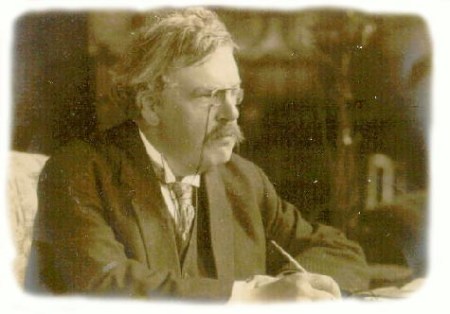
G.K. Chesterton

G.K. Chesterton, the British Catholic writer, lived one hundred years ago, but his writings are still witty, insightful, and relevant today. Once he wrote in answer to the question, “Why I am a Catholic.”  Chesterton explained, “The difficulty of explaining ‘why I am a Catholic’ is that there are ten thousand reasons all amounting to one reason: that Catholicism is true. I could fill all my space with separate sentences each beginning with the words, ‘It is the only thing that…’”  One of the examples of this he gave was that Catholicism “is the only thing that frees a man from the degrading slavery of being a child of his age.”

Why is it that after so many centuries we remain divided, three against two and two against three, on so many important matters?  We may be far more technologically advanced than they were in Jesus’ time, but every generation seems to repeat falling into the same, or slightly differing, forms of foolishness.  While science and technology is cumulative, part of every generation thinks they have to rediscover wisdom from scratch.  That’s why we still have ethical debates about questions that Jesus has settled.

Can we do evil in the hopes that good will come of it? [This is Ethics 101.  St. Paul teaches about this to the Romans, “And why not say—as we are accused and as some claim we say—that we should do evil that good may come of it? Their penalty is what they deserve.”] What if we’re [almost] certain that really good things will come from the evil we do? [Even if the evil does result in some good, what does freely-choosing evil make us?] Should we let the progress of science be bogged down by questions of morality? Should morality and private conscience have a place in politics and public life? [If not, then what will science, public life and policy be guided by beyond base desires and power?] Is it really always wrong to intentionally kill the innocent? What if intentionally killing 100,000 civilians will end a war?

If this is how things are when the wood is green in our country, then what will it be like when the wood is brown, dry, and dead, as it may well be in years ahead? What is the Christian to do?  Remain closely rooted to Christ, the source of our wisdom and waters of life. To borrow the words from the psalmist today:

The Christian “is like a tree
planted near running water,
That yields its fruit in due season,
and whose leaves never fade.
Whatever he does, prospers.”

Even if he is martyred, whatever the faithful Christian does prospers; for he is not a child and a slave of his age, but a child of the age to come.

Thursday, 28th Week in Ordinary Time—Year I

October 15, 2009

Have you ever noticed how unpopular the  prophets are? That’s because it’s usually the prophet’s job to point out peoples’ sins to them and to tell them they have to change. Some people, particularly the arrogant and the wicked, respond very badly to this, like the scribes and Pharisees in today’s Gospel.  When Jesus left the home of the Pharisee, after having criticized them strongly but in private, they

“began to act with hostility toward him and to interrogate him about many things, for they were plotting to catch him at something he might say.”

These scribes and Pharisees, whose fathers had hated and killed the prophets of old, would go on to bring all that blood upon themselves by killing the Wisdom of the prophets Himself.

The question I would like you to consider today is how you respond to criticism or correction directed at you.

The book of Proverbs teaches,

“Reprove not an arrogant man, lest he hate you; [but] reprove a wise man, and he will love you.”

And a translation of Psalm 141 says,

“If a good man strikes or reproves me it is kindness.”

 A wise man does not respond to correction angrily. He knows that “all have sinned and are deprived of the glory of God,” so he is not threatened by the suggestion that he is not perfect yet, that he still has areas for improvement.

The wise man evaluates correction with detachment. If the criticism is valid, or at least well intended, he receives it as a loving act and is grateful for it. And when the criticism is nonsense, the wise man doesn’t let it get to him. Why should the ungrounded opinions of foolish, fickle people have power over us, to rile us up, or provoke us to the sin of personal hatred?

Let us ask Jesus for the grace to receive valid criticism with humility, and for the grace to be merciful with those who criticize us unjustly.

Friday, 23rd Week in Ordinary Time—Year I

September 12, 2009

Jesus says, “No disciple is superior to the teacher;
but when fully trained, every disciple will be like his teacher.” And Saint Paul says, “I was once a blasphemer and a persecutor and an arrogant man…” So this raises the question, who was St. Paul’s teacher?

From the book of Acts we learn that Paul ‘was thoroughly trained in the law at the feet of the Master Teacher Gamaliel, a Pharisee in the Sanhedrin respected by all the people.’ (Acts 22:3, 5:34) In fact, some of Gamaliel’s wisdom even appears in Scripture.

In the early days of the Church, the apostles were arrested and interrogated by the Sanhedrin for the signs and wonders they were doing near the temple. When they spoke out boldly about Christ, some in the council wanted to put them to death, but Gamaliel ordered the apostles to be put outside for a short time.

“Fellow Israelites,” Gamaliel said to the council, “be careful what you are about to do to these men. …If this endeavor or this activity is of human origin, it will destroy itself. But if it comes from God, you will not be able to destroy them; you may even find yourselves fighting against God.”  The Council was persuaded by him to spare the apostles’ lives. (Notice that Gamaliel’s wisdom was in admitting the possibility that a wooden beam might be lodged in the Sanhedrin’s eyes, obscuring their vision toward the new religious movement.)

By all accounts, both Jewish and Christian, Gamaliel was a good and wise man. Some legends even say that he went on to become a Christian and a saint. So how can it be that St. Paul was “a blasphemer and a persecutor and an arrogant man” if he was this good man’s disciple?     The answer must be that St. Paul had not yet been fully trained by Gamaliel, for every disciple when fully trained is like his teacher.

The same could be said for us as the disciples of Christ. How can it be that we commit the acts of arrogance, the offences, and the blasphemies we do if we are Christ’s disciples? The answer must be that we have not yet been fully trained by Christ, for every disciple when fully trained is like his teacher.

So take comfort in the fact that we have not yet exhausted the wisdom which Christ has to teach us. If we do not abandon his training, the Master Teacher Christ will ‘show us the path to life, the fullness of joys in His presence, and happiness at His right hand forever.’

August 24 – St. Bartholomew (or Nathaniel), Mass for the Catholic School System

August 24, 2009

Before entering seminary, I had never attended, a single, full day, in any Catholic school. I had kindergarten and all 12 grades in public school, followed by four years at a Wisconsin state university. So, out of this poverty of first-hand experience regarding Catholic schools, I will not claim that I have a perfect vision of how our Marshfield area Catholic schools should be. I’m the definitely the new guy here, and I don’t know all the answers. But I do think I know the big question; the question that every Catholic school needs to answer: Why do we have Catholic schools?

It’s certainly not for the money. The bishops of Catholic dioceses are just happy to see the Catholic schools break even. And it’s not only so our kids can learn reading, writing and arithmetic, along with the humanities, sports, and all the rest. The public schools can provide all that without us. And it’s not only so we can give our kids religion classes. Catholic kids attending public school have CCD like I did, or after-school Religious Education classes. So… why do we have Catholic schools?

What is it that we have uniquely to offer that the public schools don’t? I think the answer to these questions may be discovered through another question: What is the difference between an American and a faithful Catholic American?

If we think the difference is merely one of Mass attendance, then simply incorporating a Mass and a religion class into our curriculum would be sufficient to make our schools “Catholic.” But if a Mass and a religion class are the only things more that our Catholic schools have to offer, then why not sell off our schools or close them down? We could hand over all the headaches and liabilities of education systems to others, and still have our kids go to Mass before school and to a religious class after. But, if the difference in being faithfully Catholic (or Christian) means more than just going to church, if it extends to all aspects of our lives, in a way that makes us stand-out in a crowd, then we as Catholic school educators have something unique to offer.

What do we have to offer? Catholic schools promote the highest ideals and moral excellence.  These are fruits of our faith that we can pass on, but these are not the heart or the root of our faith. As Pope Benedict says, “Being Christian is not the result of an ethical choice or a lofty idea, but the encounter with an event, a person, which gives life a new horizon and a decisive direction.” Having a friendship with Jesus Christ, a personal relationship with Him in His Church, uniquely transforms how we see the world and live our lives. If we are formed and empowered by our relationship with Christ, then we can share with our students what we have received. We begin with the love of Christ, which directs and touches everything, including Catholic education.

For example, alongside the study of history, our Catholic faith delivers us from the blind slavery of being a child of our age.

With the study of world cultures and languages, our faith takes us beyond our own particular nationality to identify ourselves as belonging to a worldwide family in Christ, made up of every race and nation.

In politics and current events, our Catholic faith enlightens us to be informed Christians who happen to be Americans, instead of Americans who only happen to be Christians.

In literature and writing, our faith teaches us that the truth is good, that the truth is richer than my own narrow experience, and that the truth is what is to be honored and shared, instead of my cherished prejudices.

In music and art, our Catholic faith affirms the conviction that to behold beauty is not an illusion, or merely a human fancy; beauty reflects what is most real.

In biology and ecology, our faith teaches us that living creatures, and all Creation, merit our reverence as God’s handiwork and gift.

With mathematics, physics and chemistry, our faith unmasks the Logos, the order and reason, within and behind our universe. Scientific knowledge leads to wonder; and with faith, wonder leads to praise.

We must not merely teach knowledge. All academic study yields knowledge, and knowledge is power, but power without wisdom can and will easily turn to selfish and harmful ends. Catholic schools must teach knowledge and wisdom, and not just knowledge alone.

What is our mission? One can say it other ways, but we, are in the work, of forming and educating, saints, for the lives that they will lead. Like St. Bartholomew (or Nathaniel) Christ is calling us to follow Him closely. He calls us to show others the City of God, in all its splendor.

20th Sunday in Ordinary Time—Year B

August 17, 2009

Fifteen years ago this summer, a movie hit theaters about a man with a below average intelligence who lives an above average life. Forrest Gump was the biggest movie of 1994, won the Oscar for Best Picture, and it is still entertaining to watch today.

When someone would ask Forrest, “Are you stupid or somethin’,” he would politely answer, “Stupid is as stupid does, sir.”

I have to admit that years passed before I mentioned to my dad that I really didn’t know what those words meant, which made me feel pretty stupid, but then my father taught me. “Stupid is as stupid does” means that even if you’re very intelligent, if you do foolish things, then you’re a fool. On the other hand, if you’re not that bright (like Forrest), but you act with wisdom (like Forrest did), then you are wise.

You can see this illustrated in the lives of Forrest’s friends: Jenny and Lt. Dan. They both have I.Q.’s well above Forrest’s, but they waste many years of their lives on foolishness. Lt. Dan isolates himself in the big city. He’s lost in bitter, alcoholic, self-indulgence. Jenny, goes out wandering far and wide to find happiness. She’s lost exploring all the romantic and chemical imposters of happiness. But, what eventually saves them both, what brings them both back, is Forrest’s steadfast love for them; his loving and generous gift of himself.

Forrest didn’t realize it, but his love was drawing his friends to wisdom and life. He’s like Lady Wisdom in the first reading. She joyfully calls and welcomes everyone to her feast:

“Let whoever is simple turn in here;
To the one who lacks understanding, she says,
Come, eat of my food, and drink of the wine I have mixed!
Forsake foolishness that you may live;
advance, in the way of understanding.”

Wisdom speaks to us today, but where is this meal prepared for us?

Before answering that, we first turn to today’s Gospel, where Jesus tells the people that they must eat his flesh and drink His blood. And He really means it too. In relating the teaching of Jesus today, John’s Gospel employs a Greek word over and over again, which is translated for us as “to eat” or “to feed.” However, the word’s meaning in the Greek is more literal than that; it means “to munch” or “to gnaw.” Therefore, more accurate translations of Jesus’ words would be this:

“Whoever ‘munches’ my flesh and drinks my blood remains in me and I in him,” and, “Whoever ‘gnaws’ my flesh and drinks my blood has eternal life, and I will raise him on the last day.”

The meal where we do this, is here, at the Mass. At Mass we truly receive, alive and whole, the body, blood, soul, and divinity of Jesus Christ.

Where is wisdom’s feast for us? It is here, at the Mass. At Mass we grow in wisdom whenever we worthily receive the Eucharistic Christ, because when we receive Him, we become more like Him. As Jesus says, “Whoever eats my flesh and drinks my blood remains in me and I in him.” We also grow in wisdom at Mass by hearing God’s teachings, through the Scriptures and the preaching we hear.

But something that you may never have ever realized, something you may never have been told, is that we can also grow in wisdom at Mass through witnessing the example of Jesus Christ set before us. At the Last Supper, Jesus offers up His body and blood, and tells His disciples, “Do this in remembrance of me.” He wants us to do what He is doing. This means that we are not only to continue celebrating the Mass until He comes again. We are to imitate, in our own lives, the sacrifice we see.

We are all called to steadfast love, for God and for other people, by making a loving, and generous gift of ourselves each day for them. Christ commands us to make a sacrificial offering of ourselves for those we work for, for those we care for, for those we love, for those we happen to be around, for Him and for all people. By this sacrifice, our sacrifice united with Christ’s own sacrifice, we will be saved, and we will help to save others, too, by drawing them to wisdom and life.

As Forrest Gump would say, “You don’t have to be a smart man to know what love is.” At Mass, Jesus teaches us wisdom; He shows us what love looks like.

16th Sunday in Ordinary Time—Year B

August 17, 2009

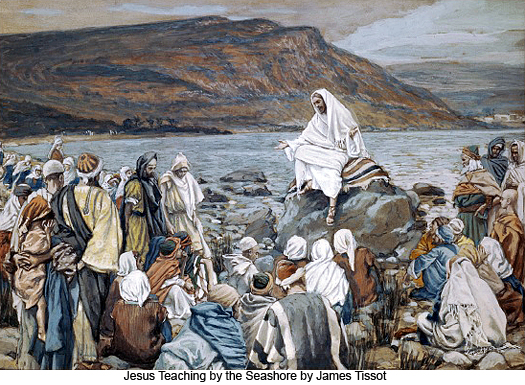
Their boat set out for a deserted place along the Sea of Galilee. But the word got out and lots of people “hastened” there, that is, they eagerly ran on foot, and arrived there faster than Jesus and the apostles could.

Why did those people run? They ran because they anticipated good things. They ran because they believed their desires would be fulfilled. In a word, they ran because Jesus and the Apostles had given them hope.

What can we hope for as Christians? Can we hope that if we stay close to Christ and to His Church that we’ll go to heaven someday?   Yes.  But is that all there is?  No. Our hope in Christ is not only for the time beginning once we’ve died.

Moments ago we heard Psalm 23, a psalm commonly heard at funerals. Though we tend to associate it with the holy dead, the blessings this psalm speaks of are for the living as well. For example, in the Gospel, Jesus leads the Apostles to a place beside restful waters to refresh their souls. He teaches the vast crowds that come many things, guiding them in right paths, and giving them courage. He has the people lay upon the green grass and, breaking bread, He spreads a meal before them.

We can confidently hope that Jesus will do these things for us.

Jesus wants to give you peace.  But what is peace? It means, in part, being liberated from worthless worry, having anxiety at all. As Christ inspired St. Paul to write the Philippians,

“Have no anxiety at all, but in everything, by prayer and petition, with thanksgiving, make your requests known to God.  Then the peace of God that surpasses all understanding will guard your hearts and minds in Christ Jesus.”

Jesus wants to teach you wisdom, and give you the courage you need to live it. Jesus Christ, teaching through our Church and its Scriptures, proclaims to you truths that the world doesn’t know and isn’t going to teach you. Jesus not only tells you how to live well but empowers you to do it too through the Holy Spirit alive within you.

Jesus wants to give you the bread you need. In a few moments, you will be receiving the body, blood, soul, and divinity of Jesus Christ in His Eucharist. And in addition to that, Jesus doesn’t only provide for you on this one day at Church. He provides for us all week long in the world out there. We pray for “daily bread”, and this is not just food, but whatever it is we need. Christ is rich, and wants to give you good things. If we a frugal and generous, He will provide us with whatever we need.

There is a lot of hopelessness about our times and the way things are headed, but we Christians should live with hope about our lives and about the world we live in. Now bad things are going to happen, but with Christ, a more glorious resurrection always follows the cross. With this truth in mind, we should be a people of hope.

At the same time, we should be wary of unchristian hopes, which are too worldly. Consider the crowds that eagerly flocked to Jesus. They held hope in this world because of Him. Unfortunately, their hope was often because they thought Jesus might become some militant, revolutionary messiah, who would ascend to the throne of David by slaying the Roman armies that occupied Israel. They were invested in hopes that he would establish a kingdom for Israel that would provide them with cheap food and easy money for the rest of their lives. John’s Gospel says that after the miracle of the loaves they wanted to carry Jesus off and make him king. The people wanted change, but Jesus wasn’t interested in their kind of change. Jesus knew that changing this world would be ultimately fruitless, unless we ourselves could first somehow be changed.

Our world is broken, but man is more broken more by sin. Give two sisters identical dolls, or give two brothers identical trucks, and a short time later you might come back to find them fighting over the exact same toy. Even if you handed everyone on earth everything they wanted, there would not be peace. The problem isn’t out there somewhere, the problems always in here. Money can do good things, but wealth in not our salvation. Good laws can help people, but politics are not our salvation. Christ is our salvation.

Christ is real and active with power in the world out there, but He tends to work from the inside-out.  That is to say, the kind of change that He is interested in usually begins within souls, like ours. Christ first changes Christians, and then through us, He transforms the world.

He wants to give us trusting peace inside, so we can live with freedom. He wants to give us contentment inside, as the antidote for our over-consumption. But first and foremost of all, He wants to give you prayer inside.

If you only hear one thing I say, this is the final and most important thing: A Christian has to pray, every single day. Daily prayer is the means to our conversion. Daily prayer is the first step to transforming our world. Daily prayer is the key to realizing our hopes, for this life and the next.

Christ has good things He wants to give you. So run to Him, with eager hope.