Archive for the ‘Christian Perfection’ Category

You Can Ask Jesus Your Questions

December 13, 2025

3rd Sunday of Advent
By Fr. Victor Feltes

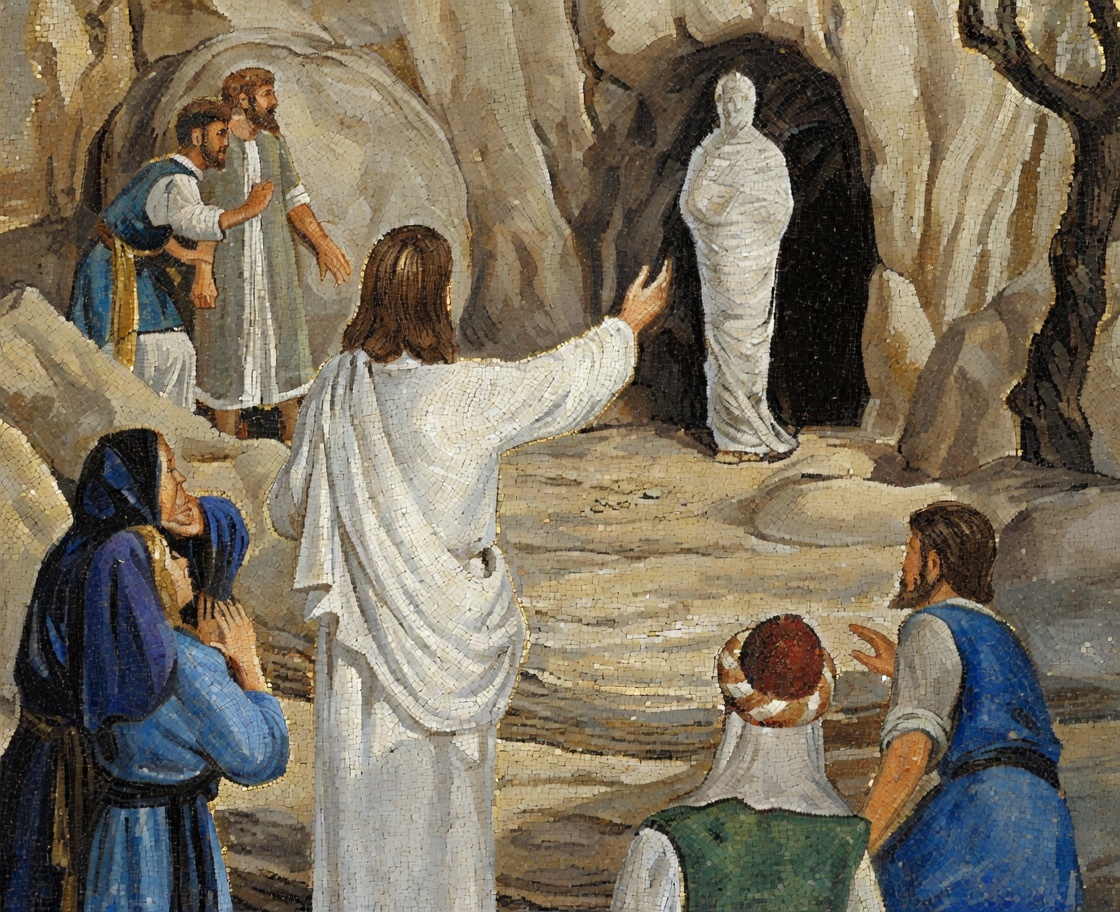
St. John the Baptist, despite his continued imprisonment, had heard about the works Jesus was doing and sent two of his disciples to ask him, “Are you the one who is to come, or should we look for another?” John was no pushover, not some reed swayed by the wind, but from this question we can gather that while John sat in Herod’s prison some doubt arose about whether Jesus was their long-awaited Messiah.

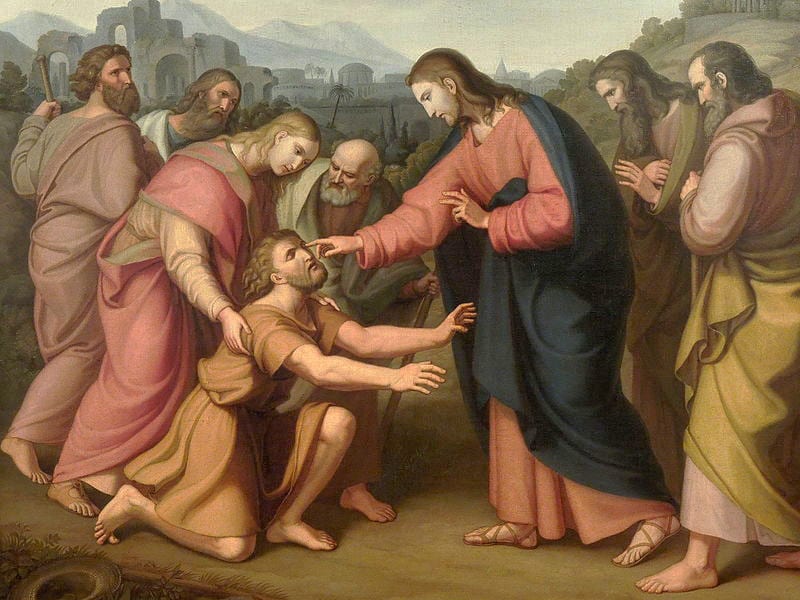
Notice how Jesus reacts to the question. He does not lose his temper or condemn them for asking. He gives them a helpful response: “Go and tell John what you hear and see: the blind regain their sight, the lame walk, lepers are cleansed, the deaf hear, the dead are raised, and the poor have the good news proclaimed to them. And blessed is the one who takes no offense at me.” In other words: “Report to John my mighty works for these show that I am the Messiah of whom Isaiah wrote (e.g., ‘Then will the eyes of the blind be opened, the ears of the deaf be cleared; then will the lame leap like a stag, then the tongue of the mute will sing.’) How I accomplish my purposes may appear strange, but remember that a person who takes no offense at me is blessed.” Jesus was patient with people who asked him questions in good faith.

Nicodemus did not want to be seen in public with Jesus. That’s why Nicodemus approached him at night. But Jesus still engaged with his questions. The Samaritan woman at the well may have first thought the man speaking to her was weird, but Jesus invited her probing questions. And the rich young man who asked Jesus about the way to eternal life wasn’t quite ready to fully commit to following Christ, but Jesus looked at him, loved him, and gave personalized responses. Despite their flaws, they asked Jesus questions in good faith and Jesus answered them. What Jesus does not like is questions asked in bad faith.

When the Pharisees would set traps for him, Jesus knew their ill intent, saying, “Why are you testing me, you hypocrites?” He knew they were just looking for ways to condemn and reject him. And when Jesus appeared before King Herod during his Passion, Herod questioned him at length because he had heard about him and hoped to see him perform some sign. But when Jesus gave him no replies, Herod treated him with contempt and mocked him and sent him away. Wicked Herod was merely curious about Jesus and uninterested in repenting of his sins. We should not test God like the Pharisees and Herod did. Jesus delights, however, in genuine seekers and is pleased to answer them.

Whoever asks, receives,” and “whoever seeks, finds,” though the answer might not be instantaneous. Job, while doing nothing wrong, questioned for some time before the Lord answered him. Sometimes our answer is already readily available through Christ’s Church, and we should listen to him through her. But sometimes God, who is supremely brilliant and creative, will answer us through different avenues (though without contradicting himself). Sometimes his answer will come during prayer, or maybe through something we providentially see or hear, or perhaps through a friend or a stranger.

What are your questions for the Lord? I encourage you to ask him and keep your eyes and ears and heart open. If you’re seeking the truth and not seeking excuses; if you’re looking to love and serve Jesus better, pay Christ the compliment of approaching him as the One who knows all things and loves you. Blessed is the one who does so.

Heralding the Best Path

December 7, 2025

2nd Sunday of Advent
By Fr. Victor Feltes

St. John the Baptist taught his hearers that the time had come for them to take action and change course. St. Matthew writes it was of John the Baptist the Prophet Isaiah spoke when he foretold of “a voice of one crying out in the desert,” saying, “Prepare the way of the Lord! Make straight in the wasteland a highway for our God! Every valley shall be filled in, every mountain and hill shall be made low; the rugged land shall be made a plain, the rough country, a broad valley. Then the glory of the Lord shall be revealed…” So what is this imagery about?

In ancient times, preceding a king’s journey somewhere, a messenger would be sent ahead to announce how people should get ready for the royal arrival. One practical task was to improve his road: removing rocks, filling potholes, and smoothing ruts. For the coming of the King of kings, Isaiah even envisions lowering mountains and raising valleys to form a straight and level highway. John the Baptist calls everyone to reevaluate our priorities to better prepare the way for encountering Christ.

An angel of the Lord had announced to the Baptist’s father, Zechariah, that John’s mission had an intergenerational component. John was to “turn the hearts of fathers toward children and the disobedient to the understanding of the righteous, to prepare a people fit for the Lord.” St. John, inspiring adults to seek the very best for children and to form them in godly ways, would “turn many of the children of Israel to the Lord their God.” Today, I wish to inspire you to do the same for children now through our St. Paul’s Catholic Grade School.

We have an excellent Catholic school. For our most recent reaccreditation, administrators from four other Catholic schools thoroughly evaluated us and told us: “You have a beautiful school.” “[It’s] welcoming, faith-filled, and charming!” “[It’s] filled with excellent educational instruction.” “[There are] high expectations.” “The students are so well-mannered.” “[And there are] great relationships between teachers and students.” And all of them agreed, “We wish we could work at your school.”

Our highly-qualified teachers can provide one-on-one attention in a wholesome environment more like a family than a factory. And we have great young people who positively influence each other. Our reinvigorating new principal, Mr. Brad Cody, has been struck by our students’ respectfulness and politeness, noting how in all his time here he has yet to hear any student swear. Our behavioral expectations, our academic expectations, and our moral expectations are not found in many other schools today. St. Paul’s devoted teachers and substitutes who have taught in both worlds can attest to the differences in our Catholic school.

God and Christ’s teachings are not excluded here. We have daily prayer, weekly Mass, Confession, and seasonal devotions. Our students get to know Catholic clergy beyond just at Sunday Mass, like when we eat our excellent school lunches with them at their tables. Our littlest ones enjoy the Catechesis of the Good Shepherd, which introduces Christianity to them in an engaging way on their level. And while people of all faiths are welcome at our school, the Catholic Faith is taught and lived.

Our 4K through 8th grade Catholic school prepares the way for the Lord without the rocks, ruts, and pitfalls found in other paths; a smooth and straight road for children to get to know Jesus Christ and walk forward with him together. So if you or your acquaintances have school-aged children, please work to get them enrolled here in 2026. Make a call, take a tour. School Choice makes tuition free at higher incomes than you would think. But even families who don’t qualify can receive grants and scholarships we offer, so do not imagine cost to be an obstacle. In addition to recruiting for our great school, I invite you to join our work in person. We could always use more playground supervisors, substitute teachers, or helpers in the library, office, or classrooms.

It’s not so much that our Catholic school has a mission, as our Catholic mission here in Bloomer has a school. Please help prepare the way for our Lord, make straight our children’s paths, by supporting our St. Paul’s Catholic School.

Our Crucified King

November 23, 2025

Solemnity of Christ the King
By Fr. Victor Feltes

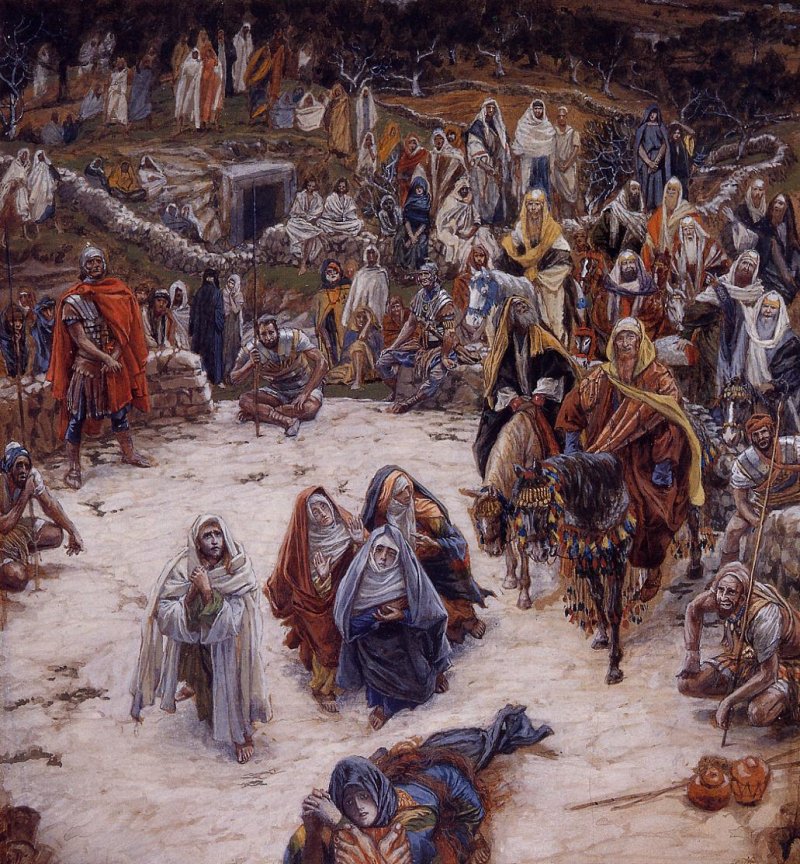
Our English word “Excruciating” comes from the Latin words for “Cross” and “Torment.” The Romans did not invent crucifixion, the Persians and the Greeks practiced it first, but the Romans more widely used the method. It was an easy way to execute people very visibly, horrifically, and slowly as a warning example to others. Typically, when the Romans crucified someone, they would place a sign above the condemned person’s head to indicate why they were being killed. St. John’s Gospel records that Governor Pilate put a sign on Jesus’ Cross written in Hebrew, Latin, and Greek. You sometimes see the initials “INRI” atop crucifixes. This represents the Latin phrase “Iesus Nazarenus Rex Iudaeorum,” the charge against our Lord. That is, “Jesus the Nazorean, the King of the Jews.” He was killed because of who he was and who he is: Jesus the Christ and the King of the universe.

Of course, the people who killed him did not believe this. They thought he was deluded or a fraud. Hence, the triple call for him to save himself and prove them wrong. The Jewish rulers sneered and said, “Let him save himself if he is the chosen one, the Christ of God.” The Roman soldiers jeered and called out, “If you are King of the Jews, save yourself.” And one of the criminals reviled him by saying, “Are you not the Christ? Save yourself and us.” Could Jesus have saved himself from his crucifixion?

St. John’s Gospel quotes Jesus before his Passion saying, “No one takes (my life) from me, but I lay it down on my own. I have power to lay it down, and power to take it up again. This command I have received from my Father.” And St. Matthew quotes Jesus later declaring in the Garden of Gethsemane, “Do you think that I cannot call upon my Father and he will not provide me at this moment with more than twelve legions of angels? But then how would the Scriptures be fulfilled which say that it must come to pass in this way?” So Jesus possessed the power to escape the Cross, but that was not the will or plan of God, which the Eternal Son was party to from the beginning. Jesus assumes “our bone and our flesh” to achieve our reconciliation as a descendant of David, “making peace by the blood of his Cross.” Perhaps the Holy Trinity could have inspired less painful prophecies to achieve our redemption and forgiveness of our sins, but Christ’s crucifixion is what they chose. They chose this path to win our love.

Matthew and Mark’s Gospels suggests that the Penitent Thief (traditionally known as St. Dismas) had derided Jesus, too, at first. But seeing the extraordinary way Jesus acted, hearing the things he said, all while crucified, won over that man’s mind and heart. ‘This man has done nothing criminal and this is how he dies? He truly knows my suffering and this is how he lives. This is the Christ I want to be allied with.’ St. And Luke quotes him saying, “Jesus, remember me when you come into your Kingdom.”

That movement saved the man’s soul, and we enjoy the benefit of understanding Jesus Christ even better than him. St. Paul writes that God “proves his love for us in that while we were still sinners Christ died for us.” Be moved by this manifestation of God’s great love. Submit to Jesus Christ as your King so that he may be your Savior and one day we may all be with him in Paradise.

A Vision of the Saints in Heaven

November 1, 2025

Solemnity of All Saints
By Fr. Victor Feltes

On this All Saints’ Day, let us consider what we can look forward to living as saints in heaven one day. But first, how does one get to heaven?

At the moment of death, our immortal souls will separate from our mortal bodies and go immediately to our particular judgment. There we will be judged according to our faith and deeds in Christ, based upon our connection to Christ and our love of God and neighbor. Then our personal punishment or reward will begin: either immediate and everlasting damnation, or entrance into the everlasting blessedness of heaven —either immediately or after the purifying process of purgatory. One day, the dead will arise and the saints will experience a new heavens and new earth in their glorified resurrected bodies. But for now, the saints only experience heaven through their souls (with the Blessed Virgin Mary being a notable exception). When someday, by the grace of God, we are saints in heaven, here are some things we will enjoy.

One thing to look forward to is probably having a perfect memory. A colleague of the genius mathematician and physicist John von Neumann writes “one of his remarkable abilities was his power of absolute recall. …Von Neumann was able on once reading a book or article to quote it back verbatim; moreover, he could do it years later without hesitation. …. On one occasion I tested his ability by asking him to tell me how A Tale of Two Cities started. Whereupon, without any pause, he immediately began to recite the first chapter and continued until asked to stop after about ten or fifteen minutes.” If this is possible with a frail human brain, how much more knowledge could our unhindered souls retain?

Another perk of being a saint in heaven is great ease in doing whatever is best. When in the unveiled presence of God, “we shall see him as he is,” and discerning God’s will should be easy. And our perfected virtues will make it easy to do what is good and right, for we shall be “pure, as he is pure.”

Another extraordinary blessing in heaven is having innumerable friends. In St. John’s vision of heaven he beholds “a great multitude which no one could count from every nation, race, people, and tongue.” Every saint in heaven has become an incredible person perfected in Christ’s beatitudes and love. There will be no lack of time to get to know people and with your perfect memory you’ll never forget anyone’s name or stories.

Yet the greatest joy in heaven is the beatific vision of God. Sometimes people worry the restful reward of seeing God and worshipping him forever will be dull. Don’t worry, heaven will never be boring. Every good and beautiful thing in Creation which you have ever delighted in has its origin in God who is supremely good, beautiful, and delightful. You have yet to fully exhaust the joys to be experienced in just one culture in one country in one century of human history, so do not imagine you will exhaust the joys to be found in our infinite God.

These are things to look forward to someday in heaven, but on this All Saints’ Day I wish to remind you that the saints in heaven know us and love us now. Yesterday, an online friend shared with me a beautiful story about the intercession of the saints and he has given me permission to share his story with you.

In January of 2018, his father suffered a massive heart attack at home. In the Emergency Room, they were able to restart his heart, but there was almost 100% arterial blockage and likely serious brain damage from the lack of oxygen. Some of the best doctors in the world could do nothing more to help. So the next day, all the family gathered to share final moments as they withdrew the mechanical life support. My friend writes:

I remember sitting in the room, in the cardiology unit there, praying my brains out for a miracle, as he lay dying. Just focused on nothing else but praying, praying, praying. Eyes closed, focused on nothing else. Praying, praying, praying for some miracle. And then I suddenly wasn’t in the hospital room anymore.

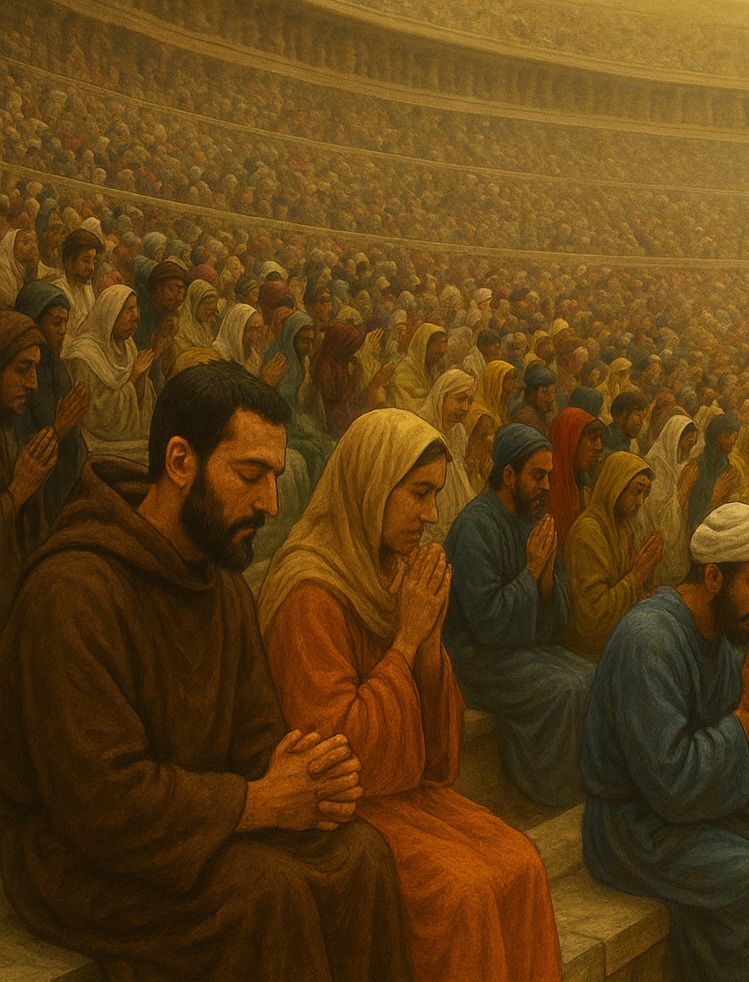
I was sitting on a bench in what to me appeared to be a huge football stadium, or more like a Roman circus (those long chariot tracks), stretching further in each direction than I could see (even the opposite side was so far away I couldn’t see it). And every seat was filled with people, all dressed differently (though most of them were in robes, in the section I was in), and all praying in different languages.

Their prayers collectively seemed like a buzzing, or the sound of a waterfall, because they were individually indistinct—countless voices all praying at once. But it was clear that each one of them were praying, non-stop, for me, my dad, and for everybody in the world.

And it was in that instant that it was told to me that I could stop praying—(“Look, all these Saints have the whole ‘praying for your dad’ thing covered for the moment…”)—and use the few moments my dad had left with us to just be with him, hold his hand, tell him that I love him and say goodbye to him. So that’s what I did. And I’m very grateful to this day that I did.

Why was my friend’s vision of the saints set in a long racetrack stadium? I recognize in this a reference to the Letter to Hebrews, which says, “since we are surrounded by so great a cloud of witnesses, let us rid ourselves of every burden and sin that clings to us and persevere in running the race that lies before us while keeping our eyes fixed on Jesus, the leader and perfecter of faith.” So be sure to befriend the saints and call upon them, because they know you, and they love you, and they eagerly want you to join their number.

How The Pharisee Fell Short

October 26, 2025

30th Sunday in Ordinary Time
By Fr. Victor Feltes

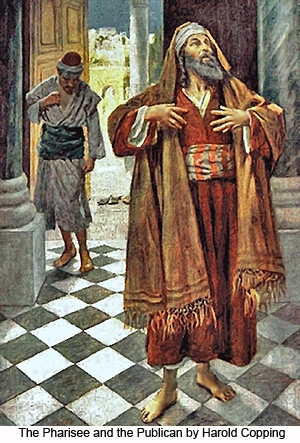
When the Pharisee in Jesus’ parable went up to the temple, he stood and spoke this prayer to himself: “O God, I thank you that I am not like the rest of humanity — greedy, dishonest, adulterous — or even like this tax collector.” And yet, Jesus tells us that this Pharisee did not go home justified, or righteous in God’s sight. Why is that?

When the Pharisee said ‘I am not like the rest of humanity — I am not greedy, dishonest, or adulterous…’ was it true that he had conquered sin? Very likely not. Psalm 130 rhetorically asks, “If you, O Lord, should mark our iniquities, who could stand?” And the Gospels record Jesus criticizing the Pharisees repeatedly, saying things like “Oh you Pharisees! Although you cleanse the outside of the cup and the dish, inside you are filled with plunder and evil.” But assuming this Pharisee quietly spoke his prayer to himself in a way which no one else could hear, why would he lie? Maybe he believed everything he said.

When we compare ourselves to others, like this Pharisee compared himself to the tax collector, we can imagine the great faults of others make our own faults unimportant. But just because somebody else is ten billion dollars in debt doesn’t mean that I am solvent. My own debts still remain. Some people accuse and make much of others’ sins because they are projecting at others what they dislike in themselves. It is much easier to condemn the faults in others than to change the faults in me.

Another phenomenon common to people and cultures is to condemn a person or group for the problems of the day. Sometimes, these are merely scapegoats for shifting blame. At other times, particular persons really are at fault and should be corrected or stopped. But we should not imagine that we can banish, purge, and kill our way to earthly paradise. Even after the Great Flood in Genesis, sinners disembarked from Noah’s ark. As the Christian Russian dissident and winner of the 1970 Nobel Peace Prize winner, Aleksandr Solzhenitsyn, famously wrote: “If only it were all so simple! If only there were evil people somewhere insidiously committing evil deeds, and it were necessary only to separate them from the rest of us and destroy them. But the line dividing good and evil cuts through the heart of every human being. And who is willing to destroy a piece of his own heart?

The Pharisee’s heart was probably not so pure of sin as he thought. He needed Jesus Christ to cleanse and heal and change it. But imagine if it really were true that the Pharisee was unlike the rest of humanity; not greedy, not dishonest, and not adulterous. Why then did this Pharisee not go home justified before God? What more did he lack?

Our Gospel tells us Jesus addressed today’s parable “to those who were convinced of their own righteousness and despised everyone else.” The Pharisee looked down on that tax collector and despised him with contempt. Greed, dishonesty, and adultery are hateful things, but Jesus forbids us from hating anyone. Jesus says you will be hated, you will have enemies, but he commands you to “love your enemies, and pray for those who persecute you, that you may be children of your heavenly Father.” If there is ever people you may be hating, be sure to pray for them (since you cannot pray for someone — willing their good — and hate them at the same time). Otherwise, when you die and you see someone whom you hate on the other side of the pearly gates, you might refuse to enter into Heaven.

Without ever denying right and wrong, without ceasing to share the truth, we must remain humble as sinners living among sinners. ‘For whoever exalts himself amongst others will be humbled, and the one who humbles himself will be exalted.’ That’s some food for prayerful thought today as we stand to pray in this temple and go back to our homes in the world.

Imitate What They Contain — Funeral Homily for Mary Jo Meuli, 83

October 14, 2025

By Fr. Victor Feltes

Mary Jo lived with a special devotion to our spiritual mother, the Blessed Virgin Mary, and she looked forward to journeying beyond death to be with our Lord and Savior, Jesus Christ. Besides coming to Holy Mass and helping bring Christ in Holy Communion to others, Mary Jo prayed the Holy Rosary daily, sometimes several times a day, growing her in her Christian likeness to Jesus and Mary. When a person picks up the practice of the Rosary for the first time, much of one’s attention is focused on tracking the beads and remembering the prayers. But with more experience, the words and the beads can drift to the background, clearing a place for meditation on its Holy Mysteries.

These twenty mysteries of the Rosary help us reflect upon joyful, luminous, sorrowful, and glorious episodes from salvation history. Mary is a firsthand witness to about three-fourths of these events. So for instance, we can contemplate Jesus with Mary at the Nativity and hold the Baby Jesus in our arms. We can consider how much Jesus loves us to become incarnate as one like us, and be moved to love him in return. We can stand with Mary at the Crucifixion, at the foot of Jesus’ Cross, and share in her compassion for her Beloved Son. We can behold Jesus’ heroic virtues in his sufferings for us, refusing to spare himself, and resolve to do hard things for him in return.

Prayerfully meditating upon the Rosary helps us to become more like Jesus and Mary. The same is true with the Beatitudes. Who is poor in spirit, relying completely on God? Who mourns and meekly, non-violently, hungers and thirsts for what is right? Who is merciful and clean of heart? Who promotes peace, yet is persecuted for the sake of righteousness? Jesus and Mary and the saints are like this, and we are called to be like them. As St. Paul our patron says, “Be imitators of me, as I am of Christ” so that we may “conquer overwhelmingly through him who loved us.” And God will help us do so, if we give him our “Yes.”

In her final season of living with illness, Mary Jo told every new doctor she met: “I’m ready.” And thirteen years to the day after her husband Allan’s death, she passed on as well. Pray for Mary Jo’s soul, in case any impurity remains within her gold, so that as a perfect offering God may take her to himself. And learn from her example, for blessed are those who grow in the likeness of Jesus and Mary and the saints, ‘for their reward will be great in Heaven.’

Two Lessons from the Ten Lepers

October 12, 2025

28th Sunday in Ordinary Time
By Fr. Victor Feltes

I want to highlight two lessons from this Sunday’s Gospel which could greatly bless your life and soul. When ten lepers meet Jesus at the edge of a village, they keep a respectful distance from him. (Their skin disease made them religiously unclean and people feared them as being contagious.) The lepers shout out: “Jesus, Master! Have pity on us!” Jesus sees them and tells them, “Go show yourselves to the priests.” (The Old Covenant had a ritual for declaring lepers clean involving a physical inspection by a priest and a sacrifice.)

So the ten depart as they are commanded to by Christ and as they are going their skin diseases are cleansed. Notice how the lepers were not cleansed right away—they were not healed the moment Jesus spoke to them. They were going when they were healed, maybe miles away from Jesus when it happened. In this miracle, they were healed while walking in obedience.

Many blessings in our faith are only experienced once we step out in obedience. First we do what Jesus asks of us, in response to his grace which goes before and follows after us, and then we see its fruits in our lives. As you read this list of examples, which one or two are meant for you to add into your life?

• Daily prayer
• Consistent Sunday Mass-going
• Keeping Sunday rest
• Generous tithing
• Forgiving enemies
• Staying sober
• Volunteering
• Practicing chastity
• Being open to life
• Living more simply
• Regular confession
• Eucharistic adoration
• Going on a spiritual retreat or pilgrimage
• Entering a seminary, convent, or monastery
• Attending weekday Mass
• Praying the Rosary

Embracing one or two of these according to God’s will shall bless you and your loved ones. This Sunday’s Gospel story also suggests another valuable lesson.

One of those ten lepers happens to be a Samaritan, and once he realizes he has been healed, he goes back to Jesus. Glorifying God in a loud voice, he falls at Jesus’ feet and thanks him. Jesus says in reply, “Ten were cleansed, were they not? Where are the other nine? Has none but this foreigner returned to give thanks to God?” Then he tells the newly cured man, “Stand up and go; your faith has saved you.”

Jesus informs us that all ten lepers were cured. But consider this: eventually, each of those lepers died. Even if it was many years later from some cause of death other than a skin disease, every one of them died. Their healings were a great thing, but not the most important thing. The Samaritan’s healing produced in him great gratitude toward Jesus Christ and God the Father. He eventually lost the gift of good health, but his relationship with God could endure forever.

Some people only pray to God when they need something. But for Christ to fix our problems without us engaging in deeper relationship and gratitude towards him profits us little. Do not be one of those who are locked outside the door to whom the Master of the House will say, “I never knew you. Depart from me, you evildoers.” It is good for us to say, “Jesus, Master! Have pity on us,” like the ten lepers did. But let us always remember gratitude and relationship with the Giver of all good gifts.

Stewardship Sunday & The Hug

September 22, 2025

25th Sunday in Ordinary Time
By Deacon Dick Kostner

Today Jesus gives to us a new parable to ponder and think about. God gives to his followers the responsibility of being the body of Christ, a visible flesh and blood team of his to carry out the 11th Commandment Jesus gave us to “love as he has loved us.” His parable story tells us that one of his stewards was cheating and was caught. He was called to account for his dealings and knowing that he would lose his job he gave gifts of his master’s assets to debtors owing the master in hopes that the debtors would give him a place to stay after he lost his job. He was in a sense providing for himself and his future.

The master, instead of condemning his actions, commended the steward for acting prudently and taking action to provide for his future welfare. Once again Jesus tells us to spend our life doing things that will gain us a place to stay with him in heaven after our earthly life ends. Things that will give us a high place in heaven and a room to be proud of at the Father’s house. The responsibility is great for all of us to be good and faithful stewards of God’s heavenly assets. But why does God ask for our help in building the Kingdom of God here on earth?

I am reminded of a story that Fr. John Heagle told our Parish during a talk on Stewardship many years ago. He is the brother of Larry Heagle the song writer of the Wood Tick Song we all enjoy listening to every spring. He told the story of attending a party at his Nieces house one evening. His Niece had a young daughter and had sent her to her upstairs room to go to bed before the party started. After the party got going, the child came downstairs and told her mother she could not get to sleep and that she was afraid. The mother took her upstairs but after the third time she came down, the mother was getting impatient with her and said, “Why are you afraid? Don’t you know that God will protect you?” The child looked at her and finally said, “I know Mama that God will protect me, but sometimes you just need to have someone with ‘skin on’ to feel safe.”

God knows that as humans we sometimes need to have someone to grab a hold of, someone with skin on to give us a hug and get us through our difficulties of life. The solution was to send his son, Jesus, a divine human being, to teach us and help us get through the crosses of life. And when Jesus went up to heaven to join the Father, Jesus gave us His Church, to be the Steward for His children who need someone to grab a hold of when the crosses of life get too heavy for us to carry it alone.

Recently I had one of our Parishioners stop to thank me while I was smoking pork roasts to serve people who work at the Pavilion. She knew that I had been praying for her to come back to our parish as her attendance at Mass has been missed by our Parish family. She said, “I just can’t believe that a Deacon, would be praying for me to come back to Church!” I told her that she was missed not only by me but by other Parish members, and that I pray for all people who have left and for one reason or another not come back to join us, to give thanks at Mass, for all the gifts we have received. She thanked me again and said, “Can I ask one more question? Can I have a hug?? I told her sure, but I probably smell like smoke.” We hugged and I told her that I hope to see her at Mass at St. Paul’s soon.

As humans, we all will encounter difficulties in life but one thing is for sure, we all need to seek help from a higher power to get through difficult times. We have all witnessed and seen how suicides have sky rocketed in the last few years. And I am sure that the Church Parishes in our world have seen a drop in church attendance especially in younger adults. People need their Church, and God, a higher power, to overcome depression. Priests continue to be in short supply for many communities. Many are saying that the answer for the priest shortage is caused by priests not being allowed to marry. If you want my opinion on that I believe that priests would not be able to take on any more responsibility than what they now have. They have more than enough people to care for without adding a spouse and children to the list of people they care for. Yes, a spouse can and is support for her husband. And yes I would miss my wife keeping me proper, like telling me I have holes in my tee-shirts or that my socks don’t match, or I am getting too “heady” with my homilies, but I also know that priests already have an army of gals in any parish they serve at, that will take care of any problems pastors run into trying to be successful in their chosen vocation. I believe that’s why God gifts women with what I call extra Holy Spirit to take care of our deficiencies.

Back to the rise in suicides. Young and old alike, my take is that cell phones and Zoom will never be able to compete with or replace a good hug from a steward mentor of Christ, in helping us get through and overcome all the challenges of life. And for that I say: “Amen!

Lifted Up & Exalted

September 13, 2025

Feast of the Exultation of the Holy Cross
By Fr. Victor Feltes

During their long Exodus journey, the Hebrews once again began rebelling, despising God and his servant Moses. They even sinfully complained about the Manna bread God was providing for their survival in the desert saying, “We are disgusted with this wretched food!” So God sent venomous serpents—or perhaps he merely lifted his shield of protection around their camp—resulting in many getting snakebitten and dying. So the people repented and pleaded with Moses, who prayed to the Lord. The Lord then commanded Moses to fashion a bronze serpent and affix it to a pole so that whoever looked at it would live. Moses and the Hebrews did not realize this at the time, but that bronze serpent on a wooden pole was a symbol pointing ahead to Jesus Christ who would die for our sins on his wooden Cross so that we may live.

In today’s Gospel, Jesus says: “Just as Moses lifted up the serpent in the desert, so must the Son of Man be lifted up, so that everyone who believes in him may have eternal life.” Later in John’s Gospel, Jesus uses the same Greek verb to declare, “When I am lifted up from the earth, I will draw everyone to myself.” And the inspired author notes, “[Jesus] said this indicating the kind of death he would die.” But this same Greek word for “lifted up” or “exulted” appears again later to recount Jesus’ Ascension and heavenly enthronement. The Book of Acts says, “God exulted/lifted up [Jesus] to his right hand as leader and savior to grant repentance to Israel and forgiveness of sins.” “Jesus, exulted/lifted up to God’s right hand, received the promise of the Holy Spirit from the Father and poured it forth….” This is what I want to highlight: how the first lifting up of Jesus leads to the second; his exultation on the Cross leads to his exultation in heaven.

Christ Jesus, though he was in the form of God, endured our human suffering and death, even death on a cross. And because of this, God greatly exalted him, and bestowed on him a heavenly glory above any other glory. The early Christians fully believed in Jesus’ death by crucifixion, but they did not depict Jesus on the Cross in sacred art for several centuries. This was partly due to persecution but also because crucifixion still remained so scandalous, horrific, and shameful in their culture. This Sunday, we celebrate the Exultation of the Holy Cross and I want you to behold Christ crucified. Too many are turned away from him—the God who suffered, died, and rose for them—and we see where their dark paths lead. But the message I feel moved to preach to you who have kept your eyes on Jesus and walked with him for years is to understand that our crosses lead to glory.

Each of us is going to suffer in this world and—unless Jesus Christ comes back first—each of us will taste death. But just because you suffer greatly does not necessarily mean you are being punished for doing something wrong like the Hebrews in the desert were. And suffering does not mean that you are not loved by God. (Jesus Christ was perfectly good yet God’s Beloved Son was murdered.) And when you suffer, no matter how incomprehensible or unjust the pain, realize where you are: on your Cross with Jesus Christ. Whatever you endure with him advances his mission of salvation in this world and increases your heavenly glory, for it conforms you to himself. St. Peter wrote, “Beloved, do not be surprised that a trial by fire is occurring among you, as if something strange were happening to you. But rejoice to the extent that you share in the sufferings of Christ, so that when his glory is revealed you may also rejoice exultantly.” Whatever may happen, let nothing deprive you of your Christian peace or purpose and never forget the incredible love that our God has for you and everyone.

Unconditional Alliance

September 7, 2025

23rd Sunday of Ordinary Time
By Fr. Victor Feltes

At the Last Supper, when Jesus told his disciples “one of you will betray me,” all of them replied “Surely, it is not I, Lord,” except for Judas. Judas answered, “Surely it is not I, rabbi (or teacher).” Jesus Christ must be more than merely our teacher. He insists on being our supremely-loved Lord. He told the crowds following him: “If anyone comes to me without hating his father and mother, wife and children, brothers and sisters, and even his own life, he cannot be my disciple.” Does Jesus really want us to be hating our loved ones? It would be strange for him to command that we love our enemies yet hate our families. Parallel Gospel passages prove Jesus is actually forbidding us from preferring anyone or anything to him, even our loved ones or our own lives. He must be our number one.

The Lord is like the conquering king in today’s parable; the King of kings and Lord of lords who has a rightful claim on everything. He made everything, sustains everything, and without him nothing finds true fulfillment, for he is Goodness itself. He marches toward our petty kingdoms with vastly greater forces. Can anyone successfully oppose him? No, only to our own destruction. So while his hosts of angels for the Day of Judgment are still far away, we should seek his peace terms, welcoming his offered covenant. The Lord seeks our unconditional surrender. He says “anyone of you who does not renounce all his possessions cannot be my disciple.” We must place everything we have and everything we are at his disposal. But his goal is not to destroy us like enemies or to dominate us like slaves but to have us as his siblings and friends. He says, “I came so that they might have life and have it more abundantly.” Ask yourself and seriously consider, “What am I holding back from him, keeping me from greater faithful love and fruitfulness?

Entering into Christ’s covenant is only the beginning. A tower (like the one in Jesus’ parable) is not finished by merely laying the foundation. Towers in Old Testament times symbolized security. They allowed you to see your enemies approaching and then to hole up behind high, thick walls safe and secure in an easily defended position. However, a half-finished tower was of little use, except as an object of mockery as onlookers remarked: “This one began to build but did not have the resources to finish!” Some Christian disciples begin following Jesus, laying a foundation, but then abandon the project, like the people mentioned in John 6:66. They say, “This saying is hard; who can accept it” and no longer accompany him, going off to do their own thing. After many of Jesus’ disciples left him after the Bread of Life Discourse at Capernaum, he asked his apostles, “Do you also want to leave?” And Peter answered, “Master, to whom shall we go? You have the words of eternal life.”

We must build brick-by-brick, floor-by-floor, day-by-day, even amidst construction setbacks, until our tower of faithfulness is finished at the end of our lives. But we must not labor all by ourselves, like the builders of the Tower of Babel did, failing to reach heaven. Of ourselves, we do not have enough resources to reach completion. We must receive the Lord’s support. As Psalm 127 says, “Unless the Lord builds the house, in vain do the workmen labor.” Our prayer should be that from Psalm 90 today: “May the gracious care of the Lord our God be ours. Prosper the work of our hands for us! Prosper the work of our hands!” This is your part: let the Lord Jesus Christ be your true Lord, and do not be too proud to call upon our Savior’s constant help.

God Was With Them

August 30, 2025

22nd Sunday in Ordinary Time
By Fr. Victor Feltes

Wednesday’s awful attack at Annunciation Catholic School in Minneapolis is terrible and heart-aching. Such an evil occurring in our region of the country, to a place of Catholic faith and learning like our own, hits extra close to home. And whatever prudent proposals should follow, we are moved to pray fervently for these victims and everyone impacted. This week we witnessed some combination of mental illness, demonic influence, and chosen evil at work. If demons had no role in this atrocity, then their bad fruits are indiscernible in this world. St. Paul wrote to the Ephesians that our true adversaries are not flesh and blood—fixation on the hatred of other humans is a snare for the soul. Our struggle is with “the evil spirits in the heavens” who prowl about the world seeking the ruin of souls.

The tactics of demons are various but perhaps their foremost temptation is a repetition of history’s first temptation. The lie behind Satan’s suggestion to Adam and Eve that they eat from the forbidden tree to become like gods was: “You can’t trust God because he doesn’t really love you.” This is the point I wish to speak to, for this week I saw reactions to the attack on these innocents like this one online: “They were literally praying when they got shot. Praying doesn’t work.” The shooting at the Annunciation School Mass reportedly began during the Responsorial Psalm, which (if they were reading the same psalm we were at our parish that morning) included these lines: “Where can I go from your spirit? From your presence where can I flee? If I go up to the heavens, you are there; if I sink to the nether world, you are present there.” Does their suffering such evil mean that the Lord was not with them and for them at that church?

On Wednesday, my thoughts went to chapter two of the Book of Wisdom. You might not be familiar with its passages, since this Old Testament book is found in Catholic and Orthodox canons of Scripture but not included in most Protestant bibles. I encourage you to read the entire second chapter yourself, but I will excerpt from the text here. It begins by observing how the Wicked, “not thinking rightly, said among themselves: ‘Brief and troubled is our lifetime; there is no remedy for our dying, nor is anyone known to have come back from the underworld. For by mere chance were we born, and hereafter we shall be as though we had not been…”

The Book of Wisdom says the Wicked who think life is pointlessness and hopeless resolve to enjoy pleasures to the fullest and to exploit whomever they wish. They say, “Come, therefore, let us enjoy the good things that are here, and make use of creation with youthful zest. Let us oppress the righteous poor; let us neither spare the widow nor revere the aged for hair grown white with time. But let our strength be our norm of righteousness; for weakness proves itself useless.” Then from here the text goes on, at much more length than I am sharing, describing the Wicked’s hatred towards a holy person:

“‘Let us lie in wait for the righteous one, because he is annoying to us; he opposes our actions, reproaches us for transgressions of the law… He professes to have knowledge of God and styles himself a child of God. Let us see whether his words be true… For if the righteous one is the son of God, God will help him and deliver him from the hand of his foes. With violence and torture let us put him to the test… Let us condemn him to a shameful death; for according to his own words, God will take care of him.’ These were their thoughts, but they erred; for their wickedness blinded them, and they did not know the hidden counsels of God;  neither did they count on a recompense for holiness nor discern the innocent souls’ reward.”

This Old Testament prophecy clearly applies to Jesus, but not merely to him but his martyrs as well. I cannot tell you what specific goods will come from Almighty God permitting particular evils to occur but we know, in the words of St. Paul to the Romans, “God works all things together for the good of those who love him.” On Good Friday, the murder of the Messiah was incomprehensible to his disciples and friends, but just forty hours later, with the resurrection of Jesus, they began to better understand that mystery at the center of our Christian Faith. Like in today’s Gospel parable, Jesus went to the lowest place, but the Lord of Hosts saw and said to him “My friend, move up to a higher position,” and now he enjoys a most-honored seat in heaven and the esteem of all his companions around the Eucharistic table.

Our waiting to behold God’s full reversal of this world’s evils will likely last much longer than just three days, but we will endure in faith, hope, and love, praying and working and worshipping and journeying with Jesus Christ. We approach God’s Kingdom and we will press on to join the countless angels in festal gathering; and God the judge of all; and the spirits of the Just, the saints made perfect; and Jesus, the mediator of our new covenant; and the sprinkled blood that speaks more eloquently than that of history’s first martyr, Abel. God was with them and he will be with us too.

The Smallest Psalm

August 24, 2025

21st Sunday in Ordinary Time
By Fr. Victor Feltes

In the 1993 comedy drama “Groundhog Day,” Bill Murray plays a cynical Pittsburg weatherman assigned to cover the Groundhog Day festivities held in Punxsutawney, Pennsylvania. There he becomes trapped inside a mysterious time loop, reliving the same day over and over. At first he indulges in sensible pleasures, then he darkly despairs, but eventually he starts growing in wisdom and virtue until he becomes a man worthy of his good and beautiful TV producer, played by Andie MacDowell. Each day was the same, but over time they began to change him for the better. The same thing can be true with the formal prayers we say.

Though it is a very good thing for us to speak to our heavenly friends in our own words, offering traditional memorized or pre-written prayers is valuable as well. How do we know? Because God inspired and gave his to people an entire collection of such prayers known as The Book of Psalms. He knew these 150 prayers would be prayed over and over, in both the Old Covenant and the New Covenant, teaching us and transforming us in our relationship with him. And it is important that we strive to learn and grow, so that we may enter through the narrow gate of Jesus Christ and be saved. Daily prayer and weekly Mass are among the God-given disciplines which yield (in the words of the Letter to the Hebrews) “the peaceful fruit of righteousness to those who are trained by [them].

Now imagine if you were Almighty God and you wished to compose a tiny psalm for the human race. What would you write about? Whom would you feature and what themes would you highlight? In the responsorial psalm for today’s Holy Mass we see how God answered. Short prayers can be great prayers. Psalm 117 is just two verses, only four lines long, the shortest psalm in the Bible:

Praise the Lord, all you nations;
glorify him, all you peoples!
For steadfast is his kindness toward us,
and the fidelity of the Lord endures forever. Hallelujah!

In this psalm’s original context, God’s chosen people are calling out to the Gentiles, the nations beyond Israel, urging them to praise the Lord. The psalm begins and ends with appeals to praise the Lord for Hallelujah (or Alleluia) are Hebrew for “Praise the Lord!” Why should the God of Israel be praised, honored, celebrated, and loved? The psalm’s second half provides an answer: “For steadfast is his kindness toward us, and the fidelity of the Lord endures forever.” And God’s goodness, his real and steadfast love, endures for us in this age of the Church. As St. John writes in his first New Testament letter: “We have come to know and to believe in the love God has for us. … We love because he first loved us.”

And here’s a final lesson from this small psalm: Psalm 117 is evangelistic. It calls all everyone from everywhere to enter into full communion with God’s people and himself. Has anyone outside of your household become Catholic through your influence? It helps if we try. If we are called to produce a harvest “a hundred or sixty or thirtyfold,” then we could expect to have at least a handful of such people in our lifetime. Catholics sometimes feel intimidated at making invitations, thinking they lack the right words. But Psalm 117 show that the message can be simple: “You should to worship with us here, because Christ’s mercy and blessings in his Catholic Church have changed my life.” The Sunday morning classes for becoming Catholic called OCIA (formerly known as RCIA) are starting soon. Who could you invite to come along with you? Please help them enter Christ’s house through the narrow gate.

True Christianity Cleaves

August 16, 2025

20th Sunday in Ordinary Time
By Fr. Victor Feltes

Jesus asked his disciples, “Do you think that I have come to establish peace on the earth? No, I tell you, but rather division.” Why does he say this? Is he not the one whom Isaiah called the “Prince of Peace”? The Prophet Zechariah foretold: “Behold: your king is coming to you… humble and riding on a donkey… He shall banish the chariot from Ephraim, and the warhorse from Jerusalem; the warrior’s bow will be banished, and he will proclaim peace to the nations.” But this Kingdom of unending worldwide peace has not yet fully come and will not arrive until Christ’s Second Coming.

Jesus told his apostles, “Peace I leave with you; my peace I give to you,” but he added, “because you do not belong to the world… the world hates you. … In the world you will have tribulation. But take heart; I have overcome the world.” Jesus wished to dispel his followers’ presumptions about immediate peace on earth and warned them of future conflicts. He said, “You will hear of wars and reports of wars; see that you are not alarmed, for these things must happen, but it will not yet be the end.” Jesus also warned his disciples of future religious persecutions because not everyone, even amongst his own people, would accept him as the Christ. “From now on,” Jesus said, “a household of five will be divided, three against two and two against three.” “Brother will hand over brother to death, and the father his child; children will rise up against parents and have them put to death.” “You will be hated by all because of my name,” Jesus said, “but whoever endures to the end will be saved.

You have probably heard both ancient and modern stories about people who suffered and sacrificed a great deal in order to be a Christian or to join his Catholic Church. We are surrounded by great a cloud of such witnesses: like St. Paul the Apostle, St. Edmund Campion St. Kateri Tekakwitha, St. Elizabeth Ann Seton, St. John Henry Newman, and many other saints. When we hear of a household divided—three against two or two against three—on account of Christ, we might imagine a family at odds due to some accepting Jesus and his Church while others remain atheists, pagans, Muslims, Jews, or non-Catholic Christians. This sometimes happens, yet Jesus absolutely insists that we love him most of all and follow him no matter what. He says, “Whoever loves father or mother more than me is not worthy of me, and whoever loves son or daughter more than me is not worthy of me; and whoever does not take up his cross and follow after me is not worthy of me.” If you have been considering becoming a Catholic Christian, I urge you to take the next step and learn more this fall by enrolling in parish OCIA classes (formerly known as RCIA).

Though we typically imagine persecution coming from people outside our faith, resistance can come from our co-religionists as well. The Prophet Jeremiah and those who were persecuting him in today’s first reading were all Old Testament Jews professing to follow the same God and same faith. Yet those who mistreated Jeremiah were opposing God’s will. This can happen inside of a Catholic household as well. What if some family members understand the necessity of worshipping and thanking God every Sunday at Mass while others in the family are unwilling to prioritize him? What if one spouse wants to live in accord with God’s will about the marital embrace, virtue, love, and human life, but the other spouse wants to contracept? What if children want to explore possible priestly or religious vocations but their parents resist what may be God’s will saying, “We want grandchildren”? What if some family members treat our religion like merely “fire insurance,” hoping the Lord won’t mind us doing whatever we prefer, while other members are on fire for the Lord?

Jesus said, “I have come to set the earth on fire, and how I wish it were already blazing!” He wants us to be on fire for him, aflame with the Holy Spirit, shining light with a warm inner peace which this troubled world cannot take away. If that uniquely describes you in your household, pray for your family members, love them, and keep modeling and advocating for what is right and good. If that does not describe you, then pray for a more fervent heart and obey the voice of Christ challenging your conscience. Realize you cannot clear a six foot charism using only three foot hops.

Life Eternal — Funeral Homily for Ronald “Ron” Woolever, 75

August 6, 2025

By Fr. Victor Feltes

We are courageous, and we would rather leave the body and go home to the Lord.” That is what St. Paul writes about himself and the Christians at Corinth in our second reading. But is this true for us today? Would we rather leave the body and go home to the Lord?

Imagine if you could have endless more years of this life on earth. Would you wish for that? Pondering such a wish you would be wise to reflect upon the burdens of bad health. The coming of such crosses in the later years of life makes many people more open to the next life. Ron endured poor health but he is freed from that burden now.

But suppose you could live an endless life on earth free from all illness and pain; the next thing you might consider is the prospect of outliving everybody you know now, as well as everyone you would ever know. Even with our well-founded hope for Heaven, where all friends of God will be reunited, the temporary separation between us and our dearly departed causes sadness in us who remain behind. It is okay to mourn at Ron’s passing, though we do ‘not grieve like those who have no hope,’ for we have hope in him who said “Do not let your hearts be troubled. You have faith in God; have faith also in me.”

But imagine if each person on earth were granted pain-free immortality; the next thing to consider is what life in that world would be like. After Adam and Eve sinned at the tree they were deprived of the fruit of another—the Tree of Life—lest they eat of it and live forever in their unhappy fallen state. Even if scientists were to develop a treatment to eradicate all pain and all death, moral sickness would remain untreated in many human souls. Endless life without Christian conversion would create a hell of moral evils on earth. Ron’s love for Jesus and our Catholic faith led to his deep devotion to the Holy Eucharist and St. Paul’s Parish. He hungered and thirsted for holiness, and our holy religion helped him to go deeper, change, and grow with God in his grace.

Now suppose if everyone on earth were forever freed from pain and death and sin, to live peacefully together on earth forever—what would life in that world be like? Ron delighted in many things in our world. Beyond family and friends, there were monster trucks and parade floats, old cars, new movies, and countless good things more. But after living in our world a few decades, which is far less time than millennia, we can think to ourselves, “These things are nice but is this really all there is?” Every heart contains a God-shaped hole which can only be fully satisfied by the infinite beauty, goodness, and love of the Holy Trinity. Understanding this changes how we see our lives in this world (which we must not cling to) and our future deaths (which we must not grasp at) until the Lord finally calls us home to be with him. Jesus tells his disciples, “I am going to prepare a place for you… [and] take you to myself, so that where I am you also may be.”

Therefore,” St. Paul writes, “we aspire to please him, whether we are at home or away. For we must all appear before the judgment seat of Christ, so that each may receive recompense, according to what he did in the body, whether good or evil.” Pray for Ron’s soul, that he may now enjoy the endless bliss of Heaven. And let Jesus Christ be the good and loving Lord of your life so that you may enter eternal life, for ‘no one comes to the Father except through him.’

Can One Man Save A City?

July 27, 2025

17th Sunday in Ordinary Time
By Fr. Victor Feltes

This morning, I believe I should preach to you about the City of Sodom and the City of God, about the importance of Christ and the importance of Confession. In today’s first reading, Abraham intercedes with the Lord concerning the possible destruction of Sodom. Abraham asks: ‘Will you sweep away the innocent with the guilty? Suppose there were fifty innocent people in the city; would you wipe out the place, rather than spare it for the sake of the fifty innocent people within it? What if there are five less than fifty innocent people? Will you destroy the whole city because of those five? What if only thirty are found there? What if there are no more than twenty? What if there are at least ten there?’ The Lord replies that if there are fifty, or forty-five, or thirty, or twenty, or even ten innocent people in the city of Sodom, for their sake “I will not destroy it.” But the city of Sodom was destroyed, and God does not lie, so we know that there was not ten innocent people in that city when it was destroyed. Abraham stopped at ten, but suppose if he had pressed on further? Imagine if Abraham had asked the Lord, ‘What if one innocent person is found there? Will you spare the city?’ Could one righteous man have saved the city?

In the fifth century A.D., St. Augustine wrote of two cities: the City of Man and the City of God. These cities exist side by side extending throughout the earth with every human person belonging to one city or the other. The City of Man embraces sin, with pride, ambition, greed, lust, hated and immorality reigning. But the City of God is led by the Lord, with Christian love and virtues lived in an alliance with Jesus Christ. To which city do we belong?

St. Paul told the Christians in Ephesus, “You are fellow citizens with the holy ones and members of the household of God.” This citizenship was bestowed to us through baptism, as St. Paul teaches in our second reading: “You were buried with [Christ] in baptism, in which you were also raised with him…. And even when you were dead in transgressions… he brought you to life along with him, having forgiven us all our transgressions….” In Jesus Christ, an innocent man is found among us at last. The Son of God became one of us so that on his account our city may be spared. Yet to benefit from his righteousness, we must continue living close to him.

Baptism forgave our past sins, but Jesus teaches us to seek that our new sins be forgiven. He told his disciples, “When you pray, say… Give us each day our daily bread and forgive us our sins…” Realize that all wrongdoing is sin but not all sin is mortal (or spiritually fatal) and know that forgiveness can require more than just a prayer. As St. John writes in his First Epistle: “If anyone sees his brother sinning, if the sin is not deadly, he should pray to God and he will give him life. This is only for those whose sin is not deadly. There is such a thing as deadly sin, about which I do not say that you should pray. All wrongdoing is sin, but there is sin that is not deadly.” If you have sinned, you should pray to God for mercy and grace. But if you have sinned gravely, you should also seek out Confession. This is a sacrament Jesus Christ has given us for the forgiveness of grave sins after baptism.

Your priests care deeply about this sacrament and we are at your service, at both announced times and upon request. Considering how many people are in our parishes, it concerns me that we are not busier with confessions than we are. You bathe every day. You probably take out garbage every week. The practice of monthly confession, even absent grave sins, is good spiritual hygiene for your soul and helps you live closer to Christ. If you wander away from the City of God into the City of Man, come to Confession for a rapid to return home. Please allow our Lord to show you his mercy.