Archive for the ‘Christian Perfection’ Category

Divine Callings & Accompanying Feasts

February 5, 2022

5th Sunday in Ordinary Time

The fishermen brothers, Simon and Andrew, along with their partners James and John, the sons of Zebedee, had their best ever day of fishing ever, and then decided to quit their jobs. After Jesus’ instruction to go deeper with him, their catch of fish was so great that their two boats were filled to the point of nearly sinking. How much fish are we talking about?
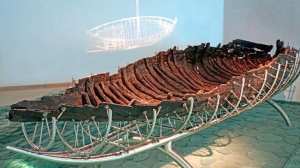
In 1986, during a severe drought in Israel, a remarkably well-preserved, 2,000-year-old, 27-foot-long fishing boat was discovered at the Sea of Galilee and rescued from the mud. There’s no proof this boat now on display at a museum in Israel belonged to any of the apostles, but because its wood has been carbon dated to the 1st century A.D. it is dubbed “The Jesus Boat.” If the boats in today’s gospel were like that example, then accounting for the weight of the men and fishing gear, the boats could hold an estimated 31,000 pounds of fish apiece. Even if the average fish they caught that day weighed, say, six pounds, this would be a catch of over 10,000 fish. (Notice the gospels do not say the fishermen cast their nets just once; they record that both boats were filled despite their nets tearing from wear.) Simon, Andrew, James, and John were stunned, but Jesus said, “Do not be afraid; from now on you will be catching men.” Upon returning to shore, they immediately left their boats to follow him. That day changed the lives of these future apostles. But no one ever asks, “What happened to all the fish?

Jesus calling the fishermen and that huge catch of fish reminds me of Elijah the Prophet calling the future prophet Elisha to follow him. Elijah finds Elisha plowing in a field behind twelve yoke of oxen. Upon being chosen, Elisha asks, “Please, let me kiss my father and mother goodbye and I will follow you.” Elijah pretty much replies, ‘Go ahead, I’m not stopping you.‘ So Elisha leaves, slaughters his oxen and boils their flesh using his plowing equipment for fuel. Then he gives the meat away to his relatives and neighbors and departs to follow Elijah.

If Simon, Andrew, James, and John “immediately” left their boats to follow Jesus (as Matthew’s Gospel says) then what did Mr. Zebedee and the hired men who were left behind do with 60,000 pounds of fish? The city of Capernaum reportedly had a population of about 1,500 back then and the nearby town of Chorazim, perhaps 500 to 1,000. So some of the fish could be sold at market. Some of the fish could be processed and preserved for later through drying and/or salting. But I imagine many of the fish were simply given away or sold for next to nothing. Like Elisha with his neighbors, Jesus calling of the fishermen brought a feast to their community. Answering your calling, embracing your God-given vocation, brings blessings for yourself and others.

For most Christians, God’s calling, their personal vocation, is to marriage. The bride and groom at the wedding feast of Cana were embracing their holy vocations and God abundantly blesses them. Jesus is invited to their wedding and he transforms the contents of six stone jars, roughly 150 gallons of water, into about 1,250 pounds worth of excellent wine, more than enough for their feast. The choice of the fishermen to become “fishers of men,” Elisha’s choice to become a prophet, and the Cana couple’s choice to become man and wife, each in answer to their callings, were marked by overwhelming feasts. These are signs to us about how doing God’s will by embracing our vocations brings joyful blessings for ourselves which overflow for others.

Preaching about vocations typically highlights priesthood and religious life because they are so important, but the vocation of marriage is also extremely important for the sanctification of those called to it and others. You are called to be a saint. If you are married, you are called to help your spouse, and any children you may have, to become saints as well. Your marriage, your family, is meant to sanctify one another and sanctify this world. So pray every single day. Pray for each other in your household. Pray as a couple and pray as a family. Help each other to be holy. Share conversations, books and films, and sacrificial acts with this goal in mind. Speak of your faith and what we believe, enjoy Catholic media which forms and inspires, offer penances and enable each other’s growth in holiness. I would love for all spouses to ask each other: “How can I help you be a saint?” Help each other to be holy and see what blessings flow.

Even if your children have educators elsewhere, you are their foremost teachers. Make your home a school for holiness. And bring your household, as God demands, to his house every weekend for Mass. Jesus calls us to follow and feast with him each week, and all-day Sunday is meant for joy. Make every Sunday’s rest and activities more enjoyable than any weekday, more special than any Saturday. Jesus wants to give you himself, along with a one-day vacation, a fun, full-day to enjoy each week.

Jesus says, “Let the children come to me.” Teach your children about vocations, facilitate their healthy discernment of Christ’s call, and never be an obstacle to God. A parent who resists their child pursuing a priestly or religious vocation by saying, “but I want grandchildren,” risks placing their own wishes ahead of God’s will. Imagine how much blessing might have been lost if James and John’s father or Elisha’s folks had tried convincing their sons not to go. Imagine if Elisha, James, or John had decided not to answer their callings.

Jesus says, “Do not be afraid.” No one will find a greater, fuller life than embracing their God-given vocation. A surgeon may save a thousand lives throughout a long career, and that is a wonderful thing, but all of those patients will eventually go on to die. The life’s work of a priest or religious sister or brother can save a thousand souls, bestowing eternal life in heaven. Saints and families of saints, are what our world needs and what we are all called to be. I challenge you to recognize and embrace your own God-given vocation. Answer Christ’s call, to follow him or to go deeper, and then behold his feast of blessings.

God Chooses People Like You

January 29, 2022

4th Sunday of Ordinary Time
By Fr. Chinnappan Pelavendran

“Isn’t this the son of a carpenter?” —Luke 4:22

God chooses and uses ordinary people to do extraordinary things. He doesn’t need our ability, but rather our availability. He uses ordinary people who have nothing of their own to offer except their faithfulness and willingness to say “Yes” to God. One important point to note is that God does not call anyone by accident. Instead, He carefully considered before calling us. He knew each one of us personally. He also knows what he wants us to do for him. He calls us by our own names, with a plan in His mind.

We see this in the First Reading, which speaks of the calling of Jeremiah to be a prophet who will communicate God’s Word to his people. It was a calling that went back to the time before he was born. “Before I formed you in the womb I knew you, before you were born I dedicated you, a prophet to the nations I appointed you.” All of us have actually been called in this way. But our reaction is often similar to Jeremiah’s: “‘Ah, Lord God!’ ‘I know not how to speak; I am too young.’” But the Lord responded, “Say not, ‘I am too young’. To whomever I send you, you shall go; whatever I command you, you shall speak…” Then the Lord extended his hand and touched his mouth, saying: “See, I place my words in your mouth.” An ordinary youth called by God to do His Mission.

Look at the Apostle Paul. Whose feast day we celebrated on January 25th. St. Paul was one of the most educated men of his day and yet God brought him down in Acts 9. God opened his eyes to the beauty and glory of Jesus. Once Paul knew Jesus, all of his education, gifts, and talents were directed towards the Gospel. The Lord uses those humbled by a vision of His greatness and glory to testify to the proud and religious. The Lord humbled the Apostle Paul and used him mightily to plant churches, preach the Gospel, write more than a dozen New Testament letters, and so much more. God used educated people for His glory but often humbled them because of their pride so they will rely on Him.

Peter was a fisherman by trade, along with his brother Andrew. He grew into a gifted preacher and bold leader. Jesus told Peter that he would deny Him three times, but Peter didn’t believe Him. Imagine Peter, the leader of the Apostles and a member of the inner circle of the Son of God, denied him three times. Peter felt devastation, shame, and guilt. He may have thought “I’m such a failure that God could never use me again,” but that isn’t true. God uses our failures, hardships and trials for His glory. He turns what was meant for bad to testify to His grace. You say that you are a failure and yet God says because of the finished work of Christ you are victorious. The Apostle Peter went on to be mightily used by God because He was broken. You may be broken right now but in due season God will build you up and use you for His glory. Don’t run from Him, run to Jesus. God uses ordinary people for His glory.

Jesus is a good manual worker from a small village. He is just another person in the town. But the rumors being spread about his actions in Capernaum and the words he has just spoken seem to indicate a special connection with God. On the one hand, his origins are well-known, but on the other hand his origin is completely unknown. Who is Jesus really? The ordinary carpenter, Jesus, is the Son of God who has become man in order to redeem us from our sins.

How could God use you? Look at your situation and your surroundings. Perhaps God has placed you in your school, your job, your family, or your neighborhood to do something special for the Lord Jesus Christ. God is calling you right now; all you have to do is say, “Yes, Lord!” Will you make yourself available to Him? Remember, God uses ordinary people to do extraordinary things for His glory!

Why They Rejected Christ

January 29, 2022

4th Sunday in Ordinary Time

When Jesus preached at Nazareth near the start of his public ministry, his own hometown neighbors rose up, filled with fury against him. They drove him out of their village intending to toss him head first off a cliff. Later, near the end of Jesus’ public ministry, one his own twelve apostles, after spending years in his close company, chose to betray Jesus to his enemies. And sometimes in our present day, lifelong Christians experience painful events and give up on their commitment to Christ. Why did Jesus’ neighbors in Nazareth reject him? Why did his apostle, Judas Iscariot, betray him? And why do Christians sometimes abandon him in hard times? All of these expected our Lord to do certain things for them but were disappointed. In each case, Jesus failed to do for them what they desired.

Part of the problem at Nazareth was that Jesus was too familiar to them. He grew up there as a little kid playing in their streets, he worked locally as a carpenter’s son, and he quietly attended their small-town synagogue for years. So when they heard him preaching they asked, “Where did this man get all this?” How could this guy be someone foretold of in the Scriptures? As Jesus acknowledges, “No prophet is accepted in his own native place.”

They wanted him to prove he was somebody special by working miracles before them. A sick doctor should be able to apply his talents for his own recovery and prove he is a real doctor; so the Nazoreans would say to Jesus, “Physician, cure yourself! Do here in your native place the things that we heard were done in Capernaum.” But God’s prophet does not owe them miracles. Jesus notes that neither Elijah nor Elisha, two of the Old Testament’s greatest prophets, worked miracles for Israel’s individual widows or lepers, respectively. St. Mark’s Gospel reports that Jesus did not perform many mighty deeds in Nazareth, apart from curing a few sick people by laying his hands on them. Their lack of faith and lack of openness seems to have limited the gifts of God they could receive. So Jesus failed to match their expectations, and they took great offense at him.

Why did Judas Iscariot betray our Lord for thirty silver pieces? St. John tells us in his gospel that Judas “was a thief and held [Jesus and the apostles’] moneybag and used to steal the contributions.” Those thirty coins represented thirty days’ wages back then, something akin to $3,000 today. Was Judas so greedy for that relatively-modest amount of money that he couldn’t resist? When Judas saw that Jesus had been condemned to death he felt deep regret at what he had done. He tried to return the money to the high priest and elders saying, “I have sinned in betraying innocent blood.” He wishes to undo his deed, but the Jewish leaders brush him off: “What is that to us? Look to it yourself.” Judas goes away in despair and foolishly kills himself. If Judas did not wish for Jesus to die, then why did he sell him out? It seems that this apostle was disappointed by Jesus’ public ministry.

Most Jews expected the Messiah to come as a warrior-king like David. They imagined the Christ would drive out their pagan overlords, conquer Jerusalem, and lead an earthly kingdom of vast power, prestige, privilege, and wealth. But Jesus was not pursuing that popular dream. He devoted his efforts instead to teaching and healing the lowly and poor. When, after feeding thousands with five loaves and two fish, Jesus perceived “they were going to come and carry him off to make him king,” he firmly sent that crowd away and withdrew up the mountain alone. Judas had run out of patience waiting for Jesus’ Kingdom to come. Maybe Judas had given up on Jesus, and took that money to start a new life without him. Or maybe he hoped that Jesus—with his back to the wall—would finally wield his mighty, miraculous power to claim his royal throne, with Judas at his side. Either way, Judas’ disappointed expectations led this disciple to betray Jesus Christ and lose everything.

In our own day, some Christians leave the Lord Jesus after following him for decades. Oftentimes, this happens after a painful tragedy: a terrible diagnosis, a failed marriage, a Church scandal, a child’s tragic death. It is not the Christian life they had envisioned. They likely asked God for a particular miracle but it was not given. I know a man from a previous parish who attends Mass with his wife every Sunday, but he stopped receiving Holy Communion many years ago after their teenage daughter died in a car crash. I know of another long-time Catholic who reportedly became embittered at losing his good health and refused a Catholic funeral. How should a follower of Jesus Christ respond to life’s profound and painful trials?

On the first Good Friday, when Jesus died on the Cross, the Gospel of St. Luke tells us “all his acquaintances stood at a distance, including the women who had followed him from Galilee and saw these events.” St. John’s Gospel highlights that the Blessed Virgin Mary was there at the Cross of Christ along with his beloved disciple. What did they feel like amid that horror? What miracles did they plead for that day? Their prayers to heaven seemed to go unheard. The next day, in shock and grieving on Holy Saturday, they may have questioned in their hearts, “Where was God? How could he let this happen? Does he not care? Where is his faithfulness to his faithful ones? How could this be part of a loving plan?” But the next day, on Easter Sunday, they witnessed the joyful resurrection Jesus had promised, and God’s loving, mysterious purposes became clearer.

Jesus told his disciples and says to us, “Whoever wishes to come after me must deny himself, take up his cross, and follow me.” Jesus does not promise us a life exactly as we would plan it for ourselves. Not every prayer for a miracle will be granted exactly as we would imagine. But remember, the Kingdom of Jesus Christ will come for his faithful ones.

Called to Seek & Save

January 22, 2022

3rd Sunday of Ordinary Time
By Fr. Chinnappan Pelavendran

“The Spirit of the Lord is upon me,
  because he has anointed me
  to bring glad tidings to the poor
  He has sent me to proclaim liberty to captives
  and recovery of sight to the blind,
  to let the oppressed go free
  and to proclaim a year acceptable to the Lord.”

—Luke 4:18-19

In the beginning, God created everything by His words. When God created the first human being, He created him out of the dust in His own image and likeness. God’s creation was perfect, yet Adam and Eve chose to disobey God. Instead of following his instructions, Adam and Eve ate from the Tree of the Knowledge of Good and Evil, bringing darkness and death into the world. But God did not abandon them. He gave them hope by sending them a savior who would be born from the seed of a woman and would crush the head of the serpent who tricked them. This Savior would save His people from sin and death. From that moment on, God’s mission started.

In our time we have a wonderful saint, Mother Teresa, who continued God’s mission to the poor, the orphan, the refugees and all those who are considered least in the society. Mother Teresa was born in 1910 in Yugoslavia in ordinary family. At the age of twelve she had a call from Jesus to serve the poor. When she was eighteen years old, she left her home to join a community of Irish nuns. One of Mother Teresa’s first assignments was to teach in the school, Later she discovered that God was calling her to do more. She received a second calling, “a call within a call.” She left the convent life and started to work with the poor in the streets. She started this mission with 5 rupees, which is Indian money worth less than a penny. People witness her nuns ministering to the suffering Jesus whom they encountered in the poor, especially those who were dying in the streets. She quickly attracted both financial support and volunteers. This is the way God continues His mission even today.

Today’s first reading is a beautiful scene of Nehemiah, who was a layman, not a priest, not a king. During the Babylonian exile, Nehemiah served under the Persian king as a cup bearer, a position of great importance and influence with the king’s court. Nehemiah was a man who was dependent on God, always praying, always seeking to be sensitive to God’s will in his life. One day he had a chance to speak to the king about helping the people of Israel to rebuild the wall of Jerusalem. Under Nehemiah’s leadership, the Jews came together to accomplish the goal of reconstructing the walls of Jerusalem, Judea’s capital city. Nehemiah and Ezra led the spiritual renewal of the people and directed the political and religious restoration of the Jews in their homeland after the Babylonian captivity. God shows us how He can take an ordinary layman like Nehemiah to continue His extraordinary mission to His people.

The mission begins in the heart of God. God sent his only Son to this world to save His people. Jesus’ mission was to save that which was lost. Jesus was convinced that he was able to fulfill his mission because God had anointed him with the Holy Spirit. When Jesus entered Zacchaeus’ house He said, “The Son of Man came to seek and to save the lost.” Jesus had just been criticized for going to the house of a sinner. Jesus responded by affirming His mission to save the lost; sinners whose reputation for sinfulness was not a reason avoid then, rather, it was a reason to seek them out. In Matthew chapter nine, when Jesus went to Matthew’s home for dinner, while he was at table, once again Jesus was criticized for “eating with the tax collector and sinners,” and once again Jesus responded by stating of His mission “I have not come to call the righteous but sinners.” Jesus’ mission was to save His people. Jesus did not passively wait for the lost to come to Him, but He went after them. He explained His mission in the Parable of the Lost Sheep (in Luke chapter fifteen). In this parable, Jesus talks about a shepherd who loses his sheep and leaves the rest of his herd to find that lost sheep. Jesus concludes this parable saying “there will be more joy in heaven over one sinner who repents than over ninety-nine righteous’ persons who need no repentance.”

The Church by its nature is missionary because her founder, Jesus Christ, was the first missionary. God the Father sent God the Son Incarnate in Jesus into the world with a message of God’s love and salvation. Thus, the evangelizing mission of the Church is essentially the announcement of God’s love, mercy, forgiveness, and salvation, as these are revealed to mankind through the life, death, and Resurrection of Jesus Christ our Lord. How should we evangelize? By exemplary and transparent Christian life. The most powerful means of preaching Christ is by living a truly Christian life — a life filled with love, mercy, kindness, compassion, and a spirit of forgiveness and service.

He is Baptized for Us

January 8, 2022

Baptism of the Lord
By Fr. Chinnappan Pelavendran

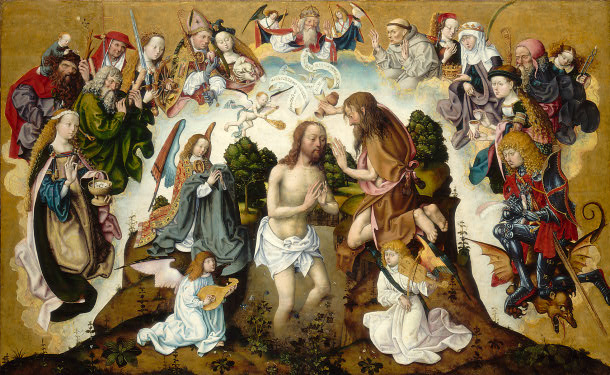
The Baptism of the Lord is a great event in the history of the Church because it is the first public manifestation of our Lord; the official revelation of Jesus as the Son of God to the world in the River Jordan by God the Father. John the Baptist was preaching and preparing in the wilderness and was baptizing all those who responded to his call of repentance. The purpose of his ministry of preaching and baptizing was to direct people towards Jesus who would baptize them with the Holy Spirit. Scripture tells us that Jesus came from Galilee to the River Jordan to be baptized by John the Baptist. Baptism is a call for the purification of sins, but Jesus is the Holy one of Trinity He does not need any purification. Though He is Son of God, He subjects himself to be baptized by another man to teach us the great virtue of humility.

The first reading taken from the Book of Isaiah tells us that the promised Messiah would be God’s chosen Servant in whom the divine soul would delight. The Messiah would have the Spirit of God upon Him bringing forth justice to all the nations, not just God’s chosen people. As the Servant of God, Jesus’ mission is modest and gentle in nature. He operates by His example and works. He brings a message of hope and consolation to all God’s people. Christ, the Anointed One of God is with us to bring us healing. Most importantly, He is here to restore our peace. Isaiah says in this way: “Console my people, console them…here is the Lord coming with power, his arm subduing all things to him, the prize of his victory is here with him…” This is exactly the ministry for which Christ was anointed and he empowered the human race for the entire salvation of God’s plan.

In the second reading, St. Paul invites us to recall our own Baptism — the gift of the Father, Son and the Spirit. He reminds us that the Lord has come to give us salvation and he gives us through the sacrament of baptism: “God saved us by the cleansing water of baptism and by renewing us with the Holy Spirit which he poured over us through Jesus Christ our Savior.” Through His own baptism, Christ sanctified and opened the fountain of baptism for us. He also initiated our redemptive process.

Today, the baptism of Jesus gives us our own identity. It reminds us who we are and to whom we are sent. By Baptism we become sons and daughters of God, brothers and sisters of Jesus, members of his Church, heirs of Heaven, and temples of the Holy Spirit. We are called to live as the children of God in thought, word and action. We are expected to lead a holy and transparent Christian life. The human body is the temple of the Holy Spirit and we belong to God who created us in his own image and likeness. Let us therefore grow and live in intimacy with God by personal and family prayers, by meditatively reading of the Word of God and fervently participating in the Holy Mass. Let us ask God to shower on us the divine graces to live out our baptismal life in a worthy manner. May the name of Jesus be glorified!

Bringing Christ to Others — Funeral Homily for Loretta Logslett, 89

December 30, 2021

Loretta has been a faithful St. John the Baptist parishioner for very many years. Meeting our Lord Jesus Christ at his churches like this one was Loretta’s priority. Her son, Dean, says that she would leave a party early to attend a Sunday Mass, to contemplate and gaze upon Christ’s loveliness in his house and temple as today’s psalm says, before returning to the party after. In 1955, she married Julian here, her loving husband for 55 years. Today, Loretta shall be buried from here, and entrusted to her loving Lord forever.

Since 1977 she has worked at the Colfax Health and Rehabilitation Center as a nutrition cook. Her coworkers say that she provided them with generous food portions. But Loretta always knew that we do not live on bread alone. Residents in nursing homes often have limited mobility. Health and transportation problems prevent them from coming to church for Mass like they used to, and they miss it. They miss visiting that holy place of contact, they miss that sacred encounter, and they may feel separated from the Lord. But as St. Paul asks, what can ever separate us from Christ’s love? He who died for us, who was raised for us, and who sits at God’s right hand and intercedes for us, sends us help and consolation. Jesus sent Loretta to that nursing home not only to feed bodies but also to feed souls.

Loretta brought to its residents Jesus in the Holy Eucharist – the Sacrament of Christ’s Body and Blood – the food which gives eternal life. On days when a priest could come for monthly Mass there, Loretta helped set up the room for the celebration, she brought residents to the altar in their wheelchairs, and proclaimed the scripture readings. And throughout the week, she was a pleasant, joyful presence. She would visit residents in their rooms, genuinely befriend them, and pray the Rosary with them. Loretta’s coworker, Robert Johnson, reflected and shared that Loretta may have personally inspired among them some conversions to Christ and his Church. They were not able to make the trip to Jesus, so Jesus came to them in, with, and through Loretta.

These are things we would expect to see in someone very close to the Lord: a consuming desire to see him and be with him, a longing wish that others would know and love him too, a living reflection of his goodness and love in everything one does. Here today, we offer the greatest prayer of Christ’s Church, the Holy Mass, to aid Loretta on her journey to God and to comfort and strengthen us who remain here. On this day of hope and mourning, on this day of reflecting on the past and of looking forward to tomorrow let us ask our Lord Jesus Christ to increase our Christian devotion, to purify our love for him, to make us truly grateful for his gifts, to make us faithful, like Loretta.

Squandered Gifts?

December 19, 2021

4th Sunday of Advent
By Deacon Matthew Bowe

This past week was finals week at the seminary. Many of my seminary brothers were busily writing papers and completing oral and written exams. Hours were spent with noses in the books and eyes staring at the screen. Stress and frantic work were abundant. I suffered.

Before you have any pity for me, I should confess the whole truth. After my one class Friday morning, which was only fifty minutes, I was mostly done. I only had a ten-minute oral exam to complete for the Eucharist class. I was on break mode since Friday at ten A.M., yet we were not allowed to depart from the seminary until after our final class on Tuesday. Some of my brothers went to class on Monday and Tuesday. I did not. I have not stressed about schoolwork for over a week, and I had plenty of time to work on my thesis and play fun activities with my friends. How, then, did I suffer?

Well, two of my closest friends, with whom I wanted to spend time, had a ton of work yet to do. They are procrastinators, poor planners, and undisciplined and unmotivated toward academic matters. Having an abundance of work left at the end of the semester is a common occurrence for them. Anyway, I suffered because they did not have time for me. I wanted to give them some of my time to be with them and to partake in shared activities. I understood that they had work to do. However, they mentioned that they were going to work on things sooner, yet they never did. They said that we could not watch a television show together because of the work that they had to do, yet I saw them sleep in, take naps, play video games, and watch television at other times. I was hurt because I felt left out. The message from this story is that our actions and our inactions can affect others in profound ways unbeknownst to us. We can be oblivious and passive to the passing moments in our lives. We can hurt others and not know it.

Please do not be hard on my friends, for I forgive them. Please do not have pity on me, for it was good spiritual growth. I tell this story to set up the message of my homily. In our humanness, we let many gifts and graces pass by in our lives. In our relationship with God, we are like my friends. I am like my friends to others and to God. How often do we squander the gifts that God gives us by casting them aside like pearls before swine? We look at God’s gifts and say, “Thanks, but no.” Then, we do our own thing not realizing that God had just given us the very thing that was necessary. It could have been an invitation to prayer, the grace that we needed to endure a hardship, a kind word to speak to another, or other good things. Why do we forsake heavenly things for the passing things of this world?

Yet, squandering gifts is not even my message, but it serves as a foil, as a contrast, for my main message. I want to talk about someone who never squandered one of God’s gifts. Glory to God that Mary, our Blessed Virgin Mother, never squandered a gift from God. In her immaculate and virginal heart, which magnifies the glory of the Lord, Mary perfectly received the angel Gabriel’s message. Her response and disposition were receptive – “Behold, the handmaid of the Lord, may it be done according to thy word.” Then, she received the Word Himself in her spotless womb. This gift of the Son was not for Mary alone, but the Savior came to redeem all nations back to God. Thanks be to God for Mary’s fiat, her “yes,” for the world gained the Savior of all Mankind.

Besides Mary’s disposition to receiving God and her freedom and openness to say yes to God’s will, Mary also exemplifies the love owed to a neighbor. She went into the hill country, around a ninety-mile journey from Nazareth, to rejoice with her cousin Elizabeth, who was once barren. Mary recognized that she had a duty to care for her cousin as her cousin progressed through her pregnancy. From this humble act of charity, another divine purpose would be served. Mary went to Elizabeth, and Jesus went to John. Jesus went to anoint John so that John would be ready to be the forerunner-prophet for the Christ. Whereas Mary and Elizabeth exchange greetings in a human way, Jesus and John exchange greetings in a spiritual way. Elizabeth heard the greeting first, but John experienced the grace from within Mary’s womb, leapt in Elizabeth’s womb, and filled Elizabeth with the Spirit. This prompts Elizabeth to praise Mary, who is “blessed among women” and is the “mother of my Lord.” Mary is first praised by an angel, and now she is praised by a woman. Even today, Mary is praised by the hosts of angels and by all the faithful in heaven and on earth.

Now, my brothers and sisters in Christ, we must continue to wait to hear more of the story. We must wait a little long to hear how the prophecy of Micah is fulfilled, when the “one who is to be ruler in Israel” comes forth. Mary will give birth to the One who shall stand firm and shepherd his flock, who will shepherd us. The King of Peace will come. Until that time, let us heed the words from the Letter to the Hebrews. The Lord wants us, and He wants the offering of our hearts. Jesus obeyed the Father’s will and offered His body once for all. Christmas does not stand apart from the Passion and Resurrection. Christmas points to Easter. The Son of God came to die for our sins. The old saying goes “from the wood of the manger to the wood of the Cross.” We hear in the opening prayer that we may “by His Passion and Cross be brought to the glory of His Resurrection.” But the Death is still awhile away, so let us prepare for His Birth.

There is one week left until Christmas. Let us intensify our spiritual sacrifices and penances to clear room in our hearts to receive the newborn King. Let us renew our vigilant waiting for the birth of our blessed Lord. Mary is very pregnant now; she is about to pop, as they say. We have seen mothers who are in their final days of pregnancy before the delivery. There is excitement in the eager and anxious anticipation of the newborn babe. St. John the Baptist announced the presence of Jesus by leaping in the womb of Elizabeth. Let us prepare our hearts to leap with joy with the presence of the newborn King on Christmas Day.

Christmas, Unlike We Envisioned It — Funeral Homily for Dr. S. Ann Hartlage-Feltes, 79

December 16, 2021

Ann and Larry realized something was gravely wrong during their recent vacation abroad. She was experiencing persistent and unexplained fatigue and shortness of breath. Just some forty days later, the cancer present and growing within her ended her earthly life. It’s stunning, it’s shocking, that a woman we know as being so energetically alive could pass away from us so quickly. As a good and faithful spouse to Larry after James’ passing, as a loving, caring mother to David, Kristin, and Ken, as a devoted, attentive grandma to her grandkids, as a dedicated psychologist to the clients and couples she served, as someone known and loved by us, her death creates a painful absence. How strange, how jarring, how incongruous it is, to be having her funeral now – so very close to Christmas. At a time for togetherness, we’re separated. In a season celebrating heavenly peace, we’re unsettled here on earth. Christmas joy, veiled by dismay. This is not how we imagine Christmas to be. And yet… the first Christmas was troubled too.

About fifteen months before the first Christmas, when Zachariah exited the temple sanctuary after having encountered an angel, he made excited, mute gestures to the people. Some concluded that he had seen vision but Zachariah was unable to speak or hear for many months. His wife, Elizabeth, may have worried whether her beloved suffered a stroke. Would he ever speak again? Then Elizabeth herself began to be unwell. She felt nauseous every day and noticed her abdomen expanding. Could she “who was called barren” somehow be pregnant, or was something gravely wrong?

Nine months before the first Christmas, the Blessed Virgin Mary gave her “Yes” to God’s plan at the Annunciation in Nazareth. An angel told Mary she would become the mother of the Messiah, but many details about her future remained hidden from her. Would her husband. Joseph, believe her when she told him? Would he become angry or afraid and decide to leave her? Joseph came very close to erroring and divorcing Mary, either because he judged her unworthy of him or because, believing her, he thought himself unworthy of her. After a torturous time of doubt and uncertainty, an angel visited Joseph in a dream and got him back on the right track.

Joseph resolved to be the very best protector and provider to Mary and her Holy Child that he could be. So imagine his great frustration that first Christmas night, consider his distress at being unable to find a proper place for Mary’s labor and Jesus’ birth; only an unclean cave with a feed trough for a crib. The first Christmas and the events leading up to it were not easy for the people who lived them. Their times were troubled, with hardships and fears. But in the end, now looking back, the accomplishment of God’s loving plan for them was more beautiful than any of them would have imagined.

See what God did for these saints of his who suffered: St. Elizabeth was not sick and dying but with child, carrying the forerunner of the Christ. St. Zachariah would regain his voice and rejoice in their firstborn son, St. John the Baptist. St. Mary would never be abandoned, but was lovingly cared for through it all. And St. Joseph succeeded in his mission to be the best father on earth. Jesus Christ’s birth in a stable was not an accident, not a divine oversight, but according to God’s plan. Their stories are a sign for us, a lesson for our lives. The Scriptures repeatedly tell us to hope in God and the good things to come.

The author of today’s first reading laments, “My soul is deprived of peace, I have forgotten what happiness is,” yet the prophet does not despair. “The favors of the Lord are not exhausted, his mercies are not spent. … Good is the Lord to one who waits for him, to the soul that seeks him. It is good to hope in silence for the saving help of the Lord.” St. John tells us in our second reading: “The way we came to know love was that [Jesus] laid down his life for us.” Our Lord faced dying so bravely because he knew not even death would end God the Father’s blessings toward him.

Today we gather in this famous and beautiful cathedral to offer the Church’s greatest prayer, the Holy Mass, for Ann’s soul and our consolation. She and Larry have been parishioners here at Holy Name for years, attending Sunday Mass and sometimes weekday Masses, too. From this altar, Ann received her Lord, his Body and Blood, his Soul and Divinity, his living and entire Self, in the Holy Eucharist. Jesus says in our Gospel, “My Flesh is true food and my Blood is true drink… Whoever eats my Flesh and drinks my Blood has eternal life, and I will raise him on the last day.” Today, we remember and are consoled by Jesus’ promise to Ann and us: “Whoever eats this bread will live forever.

Because of Ann’s parting, this Christmas will not be as we envisioned. But we are consoled by the truth that even amid these trials God is accomplishing his loving plan for us, a plan which is more beautiful than we can now imagine.

“What Should We Do?”

December 12, 2021

3rd Sunday of Advent

Despite the complications of the heavy storm, the family still decided to come. They came to St. Paul’s Friday evening to have their children baptized: a nearly three-year-old boy and a six-year-old girl. Afterwards, I asked the daughter what it was like to get baptized. She answered, “It felt like Jesus was in my heart.” Truly and beautifully, that’s what baptism does. Through simple water and simple words, new Christians are born with Christ living within them.

Large crowds came to St. John the Baptist to be baptized by him in the Jordan River as they confessed their sins. Now this was neither sacramental baptism nor sacramental confession but a preparation for what was next. John the Baptist preached that he was sent by God to prepare his people for the coming of the Messiah. Regular folks, and tax collectors, and soldiers all asked this forerunner of the Christ: “What should we do? Teacher, Rabbi, what should we do?” And what really strikes me about John the Baptist’s answers is what John the Baptist doesn’t say.

He does not say, “Give all your food and clothing away.” He says to the crowds, “Whoever has two cloaks should share with the person who has none. And whoever has food should do likewise.” He does not say to servants of King Herod and Caesar, “Abandon your posts and revolt against your rulers.” He says to the tax collectors, “Stop collecting more than what is prescribed,” and to the soldiers, “Do not practice extortion, do not falsely accuse anyone, and be satisfied with your wages.” The plan of God is to change the world by transforming individuals within the world.

John does not send people on a complicated, epic quest. They can begin doing what they need to do to prepare for Christ’s coming immediately where they’re at. John instructs them and us to do simple things: share with the needy as you are able, stop stealing, stop lying, and stop coveting what others have. These acts belong to basic justice: treating other people at least as well as you ought to be treated yourself.

Can Jesus Christ call us from this to more advanced discipleship? To sacrifice for the Kingdom of God? To suffer for the sake of righteousness? To embrace poverty, or celibacy, or radical obedience? To take solemn vows like the retired religious whose special collection is this weekend? Certainly! The Old Covenant teaches lessons for walking in justice while Christ’s New Covenant goes further, as with the Beatitudes. However, we must walk with the Lord before we can run with the Lord.

Do you grumble, discontent with what you have? Do you deceive, not always speaking what is true? Do you take what is not yours to take, or keep what is not yours to keep? Do you fail to share what is your surplus with others in need? Then you know what you should do this Advent to prepare for the Christmas coming of Christ. Convert more space in your heart for Jesus that he may fully live in you and you may fully live in him.

Jesus Chose Them for Each Other, for Himself, & for Us

December 8, 2021

Solemnity of the Immaculate Conception

This December 8th unites two of our greatest saints: the Blessed Virgin Mary and St. Joseph. Today we celebrate both the Immaculate Conception and the conclusion to the Year of St. Joseph. Our Lady, under the title of “The Immaculate Conception,” is the patroness of our country. And Joseph, under the title of “St. Joseph the Workman.” is the primary patron of our diocese. Last year, our Bishop William Callahan proclaimed a year dedicated to St. Joseph beginning May 1st. Then, last December 8th, Pope Francis unexpectedly announced a Year of St. Joseph for the entire Church worldwide. As a result of this, our diocesan celebration of this Year of St. Joseph is the longest in the world: 19 months and 8 days in full. And this is very fitting, since our diocesan patron’s name, “Joseph,” means “he will increase.”

How beautiful it is that this date brings together Mary and Joseph! He, the noble head of the Holy Family; and she, the Immaculate Heart of their home He, her chaste guardian; and she, his loving spouse. Both are absolutely faithful and obedient, courageous and righteous. And both of them were chosen by God, chosen for each other, and chosen for Christ. Mary became Jesus’ loving mother and Joseph became Jesus’ nurturing foster-father. God chose them “before the foundation of the world, to be holy and without blemish before him.” Our Lord Jesus Christ chose them for himself and he also chose them for us.

Does Jesus get jealous at the Church celebrating Mary and Joseph? Does our Catholic devotion to Mary or Joseph detract from devotion we ought to have for Christ? In his recent book, “Consecration to St. Joseph,” Fr. Donald Calloway answers: “What brother would be offended if his younger siblings expressed love towards their mother and father? What man would be upset if another person wrote a song about his mother or placed roses at her feet? Likewise, what son would be disturbed if someone praised the virtues of his father? A person who honored a father would not receive condemnation from the father’s son. On the contrary, such a person would receive praise and tremendous favors from the son.” I would add that love in a family is not a zero-sum game, but that healthy love makes love grow larger. Devotion to Mary and Joseph does not make us love Jesus less, but helps us love him more.

Jesus has not diminished these parents who cared for him on earth. He has exalted and shared them with us. He has made his mother the mother of all Christians. Like the first Eve who “became the mother of all the living,” Mary is the spiritual mother to all those alive in Christ. He has made his foster-father Joseph, who successfully safeguarded the Holy Family through its trials, spiritual protector of the universal Church And ‘never was it known that anyone who fled to their protection, implored their help, or sought their intercession was left unaided.’ So be sure to befriend St. Mary and St. Joseph. Jesus loves them dearly and they aided him on earth. He wills that you would know them, and love them, and be helped by them through this life, too, by their powerful, loving care.

Preparing His Way Within

December 5, 2021

2nd Sunday of Advent
By Fr. Chinnappan Pelavendran

This season of Advent is a time of grace for us. It is a time of grace given to us to prepare our hearts, soul and mind so that we are ready to receive Christ at Christmas. Advent is a time of grace to remind us that Jesus is the reason for Christmas. Advent is the time of waiting as we prepare ourselves to welcome God who became man and who by example showed us how we should be able to live like him for others. We wait for someone we love and we long to meet that person.

In the first reading, Prophet Baruch reminds the people of Israel that they have to share the gift of joy with others by calling them to put on the garment of integrity. God is asking them not to be part of the sad story of corruption. In this reading, God is assuring that he will flatten any high mountains and fill any deep valleys in order to make the ground level. This is an invitation to change their external behavior and reconcile them with the Lord. In this prophetic song, God promised to bring back His people from exile in Babylon.

The Prophet says by giving the people hope and confidence, inviting them to stop mourning for the past and prepare to celebrate the future. They should replace the robes of mourning with garments fashioned from the justice and glory of God. The garment of our sorrow and afflictions is the death and suffering that has come upon the Israelites because of their disobedience. The word glory appears repeatedly in the reading. The prophecy states that God would bring His people back to Jerusalem. Through sin, humankind has experienced spiritual death and the absence of the Divine Presence of God. Jerusalem is known as a mother about to receive back her exiled children.

In the second reading, we have the apostle Paul stating that he prays with joy for the Philippians, his loyal partners in the work of evangelization. He was praying for them to be blameless and pure. He prayed that they may have the grace to discern between right and wrong, good and evil. We too, like the Philippians, must be known to be men and women of goodwill. We can be witnesses to the world and to one another by maintaining our Christian morals and values. Because God the Father will begin and complete his good work in them

Today’s Gospel reading presents us with the words of John the Baptist, “Prepare the way of the Lord, and make his paths straight. Every valley shall be filled and every mountain and hill shall be made low, and the crooked shall be made straight, and the rough ways made smooth: and all flesh shall see the salvation of God.” He calls out, “Prepare a way for the Lord!” John the Baptist comes “proclaiming a baptism of repentance for the forgiveness of sins.

There are three words which are closely linked – baptism, repentance, and forgiveness. Baptism is the call to be initiated in the life of Jesus and be cleansed from all sins. It is a symbolic action through which people expressed their reconciliation with God by hoping that their sins were totally washed away. ‘Repentance’ is the forgiveness of sins and is understood as meaning change of Heart, not just sorrow for past sins but a total and radical change of outlook in our relationship with God and other people. It calls for radical and genuine renewal and conversion of heart. Forgiveness means letting go, liberation from the chains of sin and evil. Forgiveness is seen as the dropping off of heavy baggage or burdens.

During this Advent let us prepare our hearts for Christ by turning away from sin and evil and giving ourselves completely to God so that when Christ comes, or when we are called from this life, we are ready and prepared. What better way of doing this than making a very good confession receiving the Sacrament of Reconciliation?

A Martyr Preaches: “Banish the Fear of Death”

November 27, 2021

1st Sunday of Advent

This Sunday’s celebration comes in a moment of two overlapping times. This is a Sunday in November, the month in which we particularly remember, celebrate, and pray for the dead. This Sunday is also the beginning of Advent, a season in which we prepare for the coming of Christ. Through Advent we prepare not only for Christmas, the first coming of Christ, but also for Jesus’ Second Coming one day. Here and now at this Sunday Mass, our past and our future, the living and the dead, this world and the next, meet together.

When we hear Jesus’ words in today’s gospel about the Last Days we may feel apprehensive. Jesus tells us “people will die of fright in anticipation of what is coming upon the world.” And even if you or I do not belong to that final generation, we may fear to contemplate the coming sure reality of our own earthly deaths. But across time and space, an ancient saint and martyr urges us: “Let us shut out the fear of death and meditate upon immortality.

This is what St. Cyprian preached in the mid-third century A.D. as the bishop of Carthage, a North African city on the Mediterranean coast. God wills us to be good stewards of his gift of life, not recklessly pursuing self-harm or death, and yet not dreading the approach of death with mortal terror either. Listen to these words of St. Cyprian of Carthage as if he stood here before you preaching to you today:

“Our obligation is to do God’s will, and not our own. We must remember this if the prayer that our Lord commanded us to say daily (that is, the “Our Father”) is to have any meaning on our lips. How unreasonable it is to pray that God’s will be done, and then not promptly obey it when he calls us from this world! Instead we struggle and resist like self-willed (servants) and are brought into the Lord’s presence with sorrow and lamentation, not freely consenting to our departure, but constrained by necessity. And yet we expect to be rewarded with heavenly honors by him to whom we come against our will! Why then do we pray for the Kingdom of Heaven to come if this earthly bondage pleases us? What is the point of praying so often for its early arrival if we would rather serve the devil here than reign with Christ?

The world hates Christians, so why give your love to it instead of following Christ, who loves you and has redeemed you? John is most urgent in his (first New Testament letter) when he tells us not to love the world by yielding to sensual desires. Never give your love to the world, he warns, or to anything in it. A man cannot love the Father and love the world at the same time. All that the world offers is the lust of the flesh, the lust of the eyes and earthly ambition. The world and its allurements will pass away, but the man who has done the will of God shall live forever. Our part, my dear brethren, is to be single-minded, firm in faith, and steadfast in courage, ready for God’s will, whatever it may be. Banish the fear of death and think of the eternal life that follows it. That will show people that we really live our faith.

We ought never to forget, beloved, that we have renounced the world. We are living here now as aliens and only for a time. When the day of our homecoming puts an end to our exile, frees us from the bonds of the world, and restores us to paradise and to a kingdom, we should welcome it. What man, stationed in a foreign land, would not want to return to his own country as soon as possible? Well, we look upon paradise as our country, and a great crowd of our loved ones awaits us there, a countless throng of parents, (brothers and sisters), and children longs for us to join them. Assured though they are of their own salvation, they are still concerned about ours. What joy both for them and for us to see one another and embrace! O the delight of that heavenly kingdom where there is no fear of death! O the supreme and endless bliss of everlasting life!

There is the glorious band of apostles, there the exultant assembly of prophets, there the innumerable host of martyrs, crowned for their glorious victory in combat and in death. There in triumph are the virgins who subdued their passions by the strength of (chastity). There the merciful are rewarded, those who fulfilled the demands of justice by providing for the poor. In obedience to the Lord’s command, they turned their earthly inheritance into heavenly treasure.”

And so brothers and sisters, these are St. Cyprian’s lessons for us today. Love and obey Christ over and against this sinful world. Do not fear Jesus’ Second Coming. The Bible concludes with the prayer, “Come, Lord Jesus,” because his return is Good News for his friends. And do not dread your last days, but look forward to going to paradise. Jesus Christ and his holy saints, who love us, cheer us, and intercede for us, await the day we’ll join them in the fullness of joy.

Preparing for that Final Trip Back Home

November 13, 2021

33rd Sunday in Ordinary Time
By Deacon Dick Kostner

As we wind down on Cycle B our readings talk about the end of time. Our Gospel tells us that only the Father knows the exact date and time of this event but there will be warnings sent to help us prepare for the end. We know it will happen eventually but not the exact time. The point is we must prepare for the end of our earthly life.

Last month I left you with the mission to seek out wise mentors to keep you on the correct road to eternal life. I used one example I had received from one of my mentors who was preparing for his departure from this life, his name was Gabby Hassemer. I will use him again to steer us into planning for our own departure from this world. A couple of years before Gabby died he was given warnings that the end was coming. His feet and legs could not take much walking anymore, and his lungs were failing because of age. He continued to deer hunt with us but we kept an eye on him and we appointed him to stand close to our warming shack and keep the fire burning.

Deer hunting is just around the corner so I will share with you a true Gabby Hunting story. I remember one day while we were on the road to go hunting he blurted out that he was planning for his departure. Then he said: “ If I should go down while hunting promise me that you guys won’t stop hunting for the day. Just throw me in the box of your pickup until you are done for the day and then deliver me back home. I don’t want to ruin every ones day of hunting.” I started to laugh at his remark until I saw on his face that he was serious. I got rid of the smile and told him I would share his instructions with the other hunters. Gabby was planning his departure. Getting his bags packed so to speak.

As we get older we receive signs from above for us to start making travel plans. Age creeps up on us and then one day we realize that our bodies are breaking down and a red flag should go up that we need to start planning so as to have an easy transition to the next life. Let’s look also at our master mentor, Jesus. Look what he did before his death. He sat down with his friends, shared a meal and then gifted them and us with the gift of himself when he instituted the Sacraments which allow us to receive support and comfort from him as we prepare for our departure on the trip to eternity.

Several years ago our Parish was gifted to hear from a speaker from Lacrosse who talked to us about Stewardship. He told the story of how one evening he and his family went out for supper only to return to a yard full of firetrucks and people trying to put out a fire that destroyed his home and all contents including the family dog. He said it made him think about what is important in ones life which he concluded was God, family, and friends. If you think about it this is very true. Material objects we get to use during our lives and then they go to someone else to use and ultimately to help build the kingdom of God. As I reflected upon his observation I went on to conclude that God, family and friends are really talking about one entity and that is Members of the Holy Family of God. The Speaker went on to say that we need to include in our list of beneficiaries of our estate not only our blood or adopted children but also the people we have been celebrating with us and supporting us during our lifetime. We need to include those Holy Family Members who have supported us and been with us through all the struggles of life including illness and death, and who have been with us celebrating our Sunday Masses, marriages, birthday’s, and anniversaries.

It was because of two of our parishioners who died this year, that St. Paul’s is now debt free. It is because of gifts from parishioners that our Church is kept up. It is because of the wisdom and gifts of parishioners that we have a Pavilion which has been generating enough income so that our Parish Budget can stay in the Black. This folks is the Stewardship our visiting speaker was talking about.
What are ways this can happen. During your lives gifts can be given in kind or money to the Holy Family. In kind I would suggest treasures that have appreciated in value can be gifted and then sold by the Church. The result is that gross return equals net return because if you sell the asset 20%to 40% gets surrendered to pay the taxes, while if the Church sells the asset no taxes need be paid because its a charity, plus you get to deduct a charitable contribution equal to its present selling price not your cost. I did this with a collectors gun I owned. The Church acquired title and sold it and kept the proceeds with no expenses or taxes due. I received a personal deduction resulting in a savings of $9,000.00 as a reduction on my taxes by virtue of my gift.

Most of you who are 70 or older and have qualified retirement plans know that the tax laws require you to take a minimum withdrawal each year based on your life expectancy. Many don’t need the money to live on but are still required to take some out and pay taxes on it. What many do not know is that you can make your Parish contribution directly to the Parish if you are at least 70.5 years of age and not pay taxes on that contribution. The transfer must go directly from where you have the retirement account to the Church. I do this quarterly and am allowed to not pay taxes on that contribution. There is a limit of $100,000. per year that can be done but most don’t and won’t exceed that limitation. If you do this you need to let your tax person know as the 1099 that is sent to you and given to your tax person does not disclose it went directly to the Church or charity so it can be adjusted and bingo no tax due on that direct transfer. As to death transfers be sure that you give the Church assets from retirement accounts because they too will escape being taxed as the Church is exempt from paying taxes. It you give those accounts to your children they must pay tax on them.

There are many ways to make death transfers which you can discuss in detail with your lawyer or tax planner. Don’t kick the can down the road. Do as Gabby did and make financial and other plans for when you make that final trip back home. Bottom line is that you will be remembered as a quality member of the Holy Family who left the items they could not take with them to God, family and friends to use and benefit from.

Her Last Rites — Funeral Homily for Jeanette “Ginny” Kelly, 92

November 8, 2021

All of you who know Jeanette have a sense of the great woman she is. Perhaps you know her as a wonderful mother, who, when asked by any one of her eight children “Do you love me better than everybody else?” would honestly and beautifully reply, “I love you in a special way, just like all your siblings.” Or perhaps you know her as a faithful aunt, grandmother, great grandmother, or friend, whose joy and optimism always shone forth, and who, when she spoke to you, regarded you as if you were the most important person in the world.

She’s the kind of woman who some fifty years ago, when a petition went around her Connecticut neighborhood trying to run minority households out of town, refused to sign based upon firm Christian conviction, strongly rebuked the very idea, and befriended black families to help them feel more welcome there. She’s the kind of woman who felt very sad after her beloved husband Richard’s death in 1998 but, rather than turning-in on herself, intentionally looked around for others in need, volunteering and mentoring. I would bet that each of us here who knows Jeanette has a story about her, and I hope that you would recount them to one another. Today, I would like to share with you a story of mine about something God did for her less than twenty-four hours before she passed.

Ordinarily, on Tuesday afternoons, I visit Dove Nursing Home, where Jeanette has lived in recent years. But before last Tuesday, I had not been there for eight weeks. The facility had been on lockdown due to Covid and November 2nd was my first time back to celebrate Mass for the residents. After Mass, by providence, I was tipped off that Jeanette could use a room visit. I had previously given her the sacrament of the Anointing of the Sick, but I was informed her condition had declined since then. After seeing her, praying for her, and blessing her, I realized that it was now time for Jeanette to receive Last Rites. I fetched my ritual book and holy oil from my car and returned to her that hour. Jeanette knew that I was there because once I began she made a feeble Sign of the Cross and weakly said, “Amen.” The highlights of the Last Rites feature the Apostolic Pardon, the Anointing, the Litany of the Saints, and the Final Commendation.

First, I pronounced over Jeanette the Apostolic Pardon:

“Through the holy mysteries of our redemption may almighty God release you from all punishments in this life and in the life to come. May he open to you the gates of paradise and welcome you to everlasting joy. … By the authority which the Apostolic See has given me, I grant you a full pardon and the remission of all your sins in the name of the Father, and of the Son, and of the Holy Spirit.”

On the first Easter Sunday evening, the Risen Jesus appeared to his apostles in the Upper Room saying, “Peace be with you… Peace be with you.” Then he breathed on them and said, “Receive the holy Spirit. Whose sins you forgive are forgiven them, and whose sins you retain are retained.” Jesus did this that his apostles may be witnesses to the Resurrection and ministers of the forgiveness of sins after baptism.

Next, I anointed her head and hands with blessed olive oil, saying:

“Through this holy anointing, may the Lord in His love and mercy help you with the grace of the Holy Spirit. May the Lord who frees you from sin save you and raise you up.”

In our bodies we suffer and in our bodies, when connected with Christ, we are sanctified. Unless Jesus returns first, in these bodies we shall die and in these bodies we shall rise.

With the Litany of the Saints we call upon our holy friends in heaven, for the dead in Christ are not truly dead. As Jesus told Martha mourning at the death of her brother, Lazarus, “I am the resurrection and the life; whoever believes in me, even if he dies, will live and everyone who lives and believes in me will never die.” “He is not the God of the dead but of the living,” so they are ‘all are alive in him.’ With this hope, we pray for the purification, perfection, and peace of our dearly departed and ask the saints in heaven to pray for us.

And last of all, came Jeanette’s Final Commendation. I said:

“I commend you, my dear sister, to almighty God, and entrust you to your Creator. May you return to Him who formed you from the dust of the earth. May holy Mary, the angels, and all the saints come to meet you as you go forth from this life. May Christ who was crucified for you bring you freedom and peace. May Christ who died for you admit you into his garden of paradise. May Christ, the true Shepherd, acknowledge you as one of his flock. May He forgive all your sins, and set you among those He has chosen. May you see your Redeemer face to face, and enjoy the vision of God for ever. Amen.”

I hope that I am graced to hear these words and receive these holy rites myself someday. After these blessed sacraments, prayers, and benedictions, I suspect Jeanette was very grateful and felt ready and well-prepared to go to meet our Lord. She passed away the next morning.

On November 1st, we in the Church celebrated All Saints. On November 2nd, we celebrated All Souls. And on November 3rd, Jeanette followed after them. This is not the end of all stories about Jeanette, but the beginning of new stories; stories which she will joyfully share with us one day, if you and I faithfully follow Jesus Christ like her.

Widows’ Gifts

November 6, 2021

32nd Sunday in Ordinary Time

In today’s gospel, Jesus says, “Beware of the scribes… They devour the houses of widows and, as a pretext, recite lengthy prayers. They will receive a very severe condemnation.” Jesus denounced those scribes for their greedy hypocrisy. In recent decades, some televangelists and megachurches’ prosperity preachers have told believers ‘give your money to our ministry and God will bless you back with even more,‘ and then used the meager wealth of many widows to purchase mansions or private jets. This of course, gives scandal, leading many to think faith is just a grift and alienating people from Christ. Is it wrong for preachers to be paid? St. Paul defends the right of ministers to receive compensation, “for scripture says, ‘The laborer deserves his wages,’” but our holy work is not meant to be about getting rich.

The presence of unworthy motives among some Christian ministers is nothing new. St. Paul writes to the church at Corinth, “We are not like so many others who trade on the word of God for profit.” Such men were a problem in Paul’s day, too. So it might seem that poor widows should never be asked to give and that poor widows should never donate. That answer would be simple, yet God’s truth is not that simple.

In today’s first reading, the Prophet Elijah meets the widow of Zarephath during a time of great drought. He asks her for a cup of water and a bit of bread. She replies, “There is only a handful of flour in my jar and a little oil in my jug. Just now I was collecting a couple of sticks, to go in and prepare something for myself and my son; when we have eaten it, we shall die.” (She is preparing their last meal.) But Elijah says, “Do not be afraid. Go and do as you propose. But first make me a little cake and bring it to me. Then you can prepare something for yourself and your son. For the Lord, the God of Israel, says, ‘The jar of flour shall not go empty, nor the jug of oil run dry, until the day when the Lord sends rain upon the earth.’” She left and did as Elijah had said. And the poor widow, her fatherless child, and God’s prophet were all able to eat for a year. The jar of flour did not go empty, and the jug of oil did not run dry, as the Lord had foretold through Elijah. As today’s psalm tells, “The Lord keeps faith forever… The fatherless and the widow he sustains.

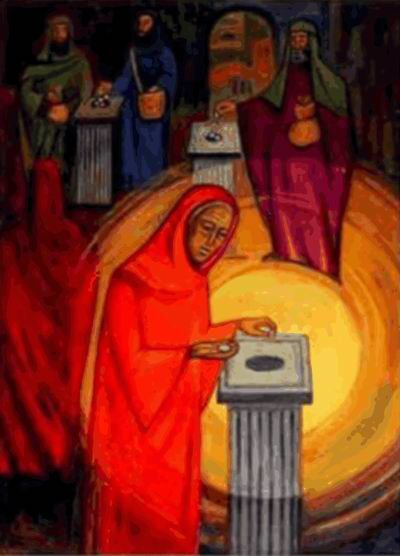
And in our gospel today, when Jesus sees a poor widow putting into the Temple treasury two small coins, which is all she has and her whole livelihood, what does he do? He does not try to stop her. He does not criticize her for being foolish. He calls his disciples to himself, he points her out to them, and he glorifies her trust in God in having given more than all the others. Her deed is still remembered to this day. Would it have been better if she had not given her gift?

I do not have a one-size-fits-all answer for how much poor widows should give. The Catechism teaches that the Church’s precept, “’You shall help to provide for the needs of the Church,’ means that the faithful are obliged to assist with the material needs of the Church, each according to his own ability,” so there’s recognition that some people have greater or lesser ability than others to materially assist the Church’s mission in this world. But if even poor widows are sometimes called to give, to trust in the Lord and give him the chance to prove himself their faithful provider, how much more so are the rest of us called to be generous?

We live in the wealthiest country in all of human history, and yet most of us only give a tiny fraction of our income to church and charity to support the good works they do. What accounts for this? Some of it is from the love of money and some of it is from fear. The Book of Ecclesiastes says, “He who loves money is never satisfied by money, and he who loves wealth is never satisfied by income.” Some are slaves to their greed, and some are shackled to their anxiety.

As an early teen, I felt reluctance at giving any money away for anything. I thought, “Who knows what my future holds? What if I need that money later? Every dollar I give away now is another dollar I’m exposed to future, unseen danger.” My mindset wasn’t informed by the Gospel, but when I finally read the Gospels myself I encountered Jesus’ teaching there. He says: “Do not worry and say, ‘What are we to eat?’ or ‘What are we to drink?’ or ‘What are we to wear?’ All these things the pagans seek. Your heavenly Father knows that you need them all. But seek first the Kingdom of God and his righteousness, and all these things will be given you besides. … Give and gifts will be given to you; a good measure, packed together, shaken down, and overflowing, will be poured into your lap.” The Lord was calling me beyond my comfort zone and into a deeper relationship with him.

I remember standing in St. Paul, Minnesota’s awe-inspiring cathedral. It was my first time there and I saw near the south exit a donation box labeled “For The Poor.” The largest bill in my wallet was a ten or a twenty, and I both wanted and very much did not want to give it, yet I knew what I should do. Once I had done it, I walked out smiling. It was a small donation, but even then I knew it was a big moment, and it changed the rest of my life.

I recall the story of one married couple. They used to pay their bills and then give to God if there was something left —and sometime there was nothing left. But God put it on their hearts to tithe consistently, so they began setting aside their gift to him first before paying their bills. And when they approached their giving in this way they discovered there was providentially always enough for both God and the bills.

God commands, “You shall not put the Lord, your God, to the test,” yet in his Old Testament Book of Malachi he says to test him in this: “Bring the whole tithe into the storehouse, that there may be food in my house. Put me to the test, says the Lord of hosts, and see if I do not open the floodgates of heaven for you, and pour down upon you blessing without measure!

And so, without embarrassment, I ask you to be generous in giving, not only so that our church may put your gifts to good use, but for the sake of deepening your personal relationship with our good and faithful God.