Archive for the ‘Christian Perfection’ Category

The Meaning of Ashes — Ash Wednesday

March 6, 2014

Both the atheist and the Christian will agree on this: we came from dust and to dust we shall return. Apart from God we have no hope, for we are dust and ashes.

The ashes on our forehead are not a beauty mark. They point to the ugliness of the sins within us. Yet they are also an appeal to God that he would wash us clean.

Fire, like sin, consumes all it touches. Our ashes are a sign of all we have lost or harmed by sin. However, Old Testament sacrifices were also offered up to God by fire. Our ashes are also a sign of our desire to sacrifice ourselves entirely to him.

We receive ashes on our forehead in the shape of a cross; ashes because we are sinners, and a cross because we are Christ’s.

One Is Enough — Tuesday, 8th Week of Ordinary Time—Year II

March 4, 2014

Gospel: Mark 10:28-31

Jesus said, “Amen, I say to you, there is no one who has given up house or brothers or sisters or mother or father or children or lands for my sake and for the sake of the Gospel who will not receive a hundred times more now in this present age: houses and brothers and sisters and mothers and children and lands, with persecutions, and eternal life in the age to come.

Jesus lists seven things people give up for him and his Gospel but only six things that we will receive a one hundred-fold more in this present age. A person might give up an earthly father for the Kingdom of God, but he or she receives in return the singular, infinite fullness of God the Father.

Questions & Answers for Lent

March 1, 2014

What Are the Lenten Fasts and Who Keeps Them?

Catholics who have celebrated their 14th birthday are to abstain from meat on Ash Wednesday, the Fridays in Lent, and Good Friday. In addition to not eating meat, Catholics who have celebrated their 18th birthday are to fast on both Ash Wednesday and Good Friday until at least their 59th birthday. Here, fasting is defined as eating just one full meal.  Two smaller meals are also allowed if necessary to maintain one’s strength, but eating solid foods between meals is not permitted. (The physically, mentally, or chronically ill, as well as pregnant or nursing women, are also excused from fasting and abstinence.)

Why the Ages 18 to 59?

Two reasons: because of the nutritional needs of the young and elderly, and because the number forty symbolizes penance and purification in the Bible.

Why Isn’t Fish Considered “Meat” on Meatless Fridays?

In times past, fish was considered a food of the poor. It took multiple pounds of grain to raise one pound of livestock, but fish were simply caught from the water. Eating fish conserved grain for others and was an act in solidarity with the poor. Today, Catholics are only obliged to abstain from (land-based) meats on certain days of Lent. However, Catholics remain obliged to offer penance on Fridays throughout the whole year; be it through fasting, abstinence, pious devotions, or loving service. Every Friday is to be a little remembrance of Good Friday.

Why is Lent Longer Than Forty Days?

There are actually 46 days from Ash Wednesday to Easter. However, every Sunday is a “little Easter” and, like all solemnities, Sundays are not considered days of penance.  As Jesus said, “Can you make the wedding guests fast while the bridegroom is with them?” (Matthew 9:15) All are free to keep Lenten penances on these days, but enjoying these respites can increase one’s devotion and joy in the Lord. Subtract the six Sundays in Lent from the total and you are left with forty days.

Cut It Out — Thursday, 7th Week of Ordinary Time—Year II

February 28, 2014

Gospel: Mark 9:41-50

Jesus said to his disciples: “Anyone who gives you a cup of water to drink because you belong to Christ, amen, I say to you, will surely not lose his reward.”

“Whoever causes one of these little ones who believe in me to sin, it would be better for him if a great millstone were put around his neck and he were thrown into the sea.”

In establishing his first covenant with Abraham, the Lord said, “I will bless those who bless you and curse those who curse you.” (Genesis 12:3) Likewise, Jesus declares that whoever does the least kindness to those in his covenant will be rewarded, while whoever leads one his own into sin faces dire consequences. Sin is a serious thing.

“If your hand causes you to sin, cut it off.”

“And if your foot causes you to sin, cut if off.”

“And if your eye causes you to sin, pluck it out.”

Of course, Jesus does not want us to mutilate ourselves because our bodily organs are not the real cause of our sins. But let us consider: what actions or material possessions do I take in hand, to what places do I go by foot, what sights do I perceive with my eyes, that are near occasions of sin for me? Let us firmly resolve with the help of God’s grace to cut these things out of our lives, so that we may be a blessing to all and a scandal to none, the salt of the earth and never cast out.

False Presumptions — Wednesday, 7th Week of Ordinary Time—Year II

February 28, 2014

Readings: James 4:13-17, Mark 9:38-40

We must be careful not to cling to false presumptions about God’s activity regarding the present or the future. It is prudent to make plans for tomorrow and also good to strive for the reunion of all Christians into Christ’s one, holy, catholic, and apostolic Church. However, James warns us not to be presumptuous about our plans (instead of remaining open to God’s will,) while Jesus reminds us that even those who “do not follow us” can ‘perform mighty deeds in his name.’ “Whoever is not against us is for us.” God is never against us, and (unusually) neither are our separated brethren.

Magnanimous, Not Petty — 7th Sunday in Ordinary Time—Year A

February 23, 2014

“Petty” comes from the French word for “small” (“petit.“) “Magnanimous” comes from the Latin words for “great” and “soul” (“magna” and “anima.“) We are not called to be small, but of great soul in our interactions with others.

Four Cheeks Turned — 7th Sunday in Ordinary Time—Year A

February 22, 2014

Gospel: Matthew 5:38-48

When attacked, our natural response is “fight or flight,” but Jesus suggests a  supernatural response: “When someone strikes you on your right cheek, turn the other one as well.” Since the Jews regarded the left hand as unclean, they would reflexively strike with the right hand. If the right cheek were hit, then one had been backhanded with contempt. Responding by turning the other cheek neither attacks not retreats, but insists on being regarded as an equal, whom one must strike (if at all) with an open hand. Jesus wants us to stand our ground in the face of injustice, assertively but lovingly, in hopes that the offender will reconsider his ways. Jesus modeled this response when he was struck during his trial before Annas:

The high priest questioned Jesus about his disciples and about his doctrine. Jesus answered him, “I have spoken publicly to the world. I have always taught in a synagogue or in the temple area where all the Jews gather, and in secret I have said nothing. Why ask me? Ask those who heard me what I said to them. They know what I said.” When he had said this, one of the temple guards standing there struck Jesus and said, “Is this the way you answer the high priest?” Jesus answered him, “If I have spoken wrongly, testify to the wrong; but if I have spoken rightly, why do you strike me?” (John 18:19-24)

Another saintly example was shown by Blessed Mother Teresa of Calcutta. Though reports vary, Mother Teresa was once begging bread from a baker for her orphanage. When the baker responded by spitting into her hand, she replied to effect, ‘I will keep this for me, but please give something for my children.’

In Victor Hugo’s Les Miserables, a bishop welcomes an impoverished convict to join his table and sleep at his home. However, that night, Jean Valjean steals his host’s silverware and goes away. The police catch him and take him to the bishop. Looking at Jean Valjean, the good bishop exclaims, “Ah! here you are! I am glad to see you. Well, but how is this? I gave you the candlesticks too, which are of silver like the rest, and for which you can certainly get two hundred francs. Why did you not carry them away with your forks and spoons?” Jean Valjean opens his eyes wide and stares at the venerable Bishop “with an expression which no human tongue can render any account of.” The bishop’s turn of the cheek spares the thief’s freedom and saves his soul.

And finally, a true story from a modern marriage: A woman’s husband had a terrible temper and every time it flared she would say, “That’s just like you to lose your temper!” But then, following a stroke of insight, she began responding differently. The next time he began to fly of the handle she told him, “That’s not like you to lose your temper,” and he nearly fell out of his chair. Even the kids looked at her funny, but she stuck with her new resolution. Months later, while at a restaurant together, he became irritated by the slow service. He started to fume about it, but then he suddenly stopped, turned to her, and said, “That’s not like me to lose my temper, is it?” This time, it is said, she nearly fell on the floor.

Was it true the first time the woman declared that it was not like her husband to lose his temper? The claim did not match his previous behavior, but perhaps he changed because she revealed to him that his uncontrolled anger was quite unlike the father, husband, and Christian man he truly and deeply wanted to be. This is the sort of realization and conversion we are to hope for in turning the other cheek.

Plus, a fifth story: “If a teen mugs you for your wallet…

Gradually Growing Trees — Wednesday, 6th Week of Ordinary Time—Year II

February 19, 2014

Readings: James 1:19-27, Mark 8:22-26

When Jesus and his disciples arrived at Bethsaida, people brought to him a blind man and begged Jesus to touch him.  He took the blind man by the hand and led him outside the village. Putting spittle on his eyes he laid his hands on the man and asked, “Do you see anything?” Looking up the man replied, “I see people looking like trees and walking.” Then he laid hands on the man’s eyes a second time and he saw clearly; his sight was restored and he could see everything distinctly.

Jesus healed the blind man gradually, and he sometimes does the same with us; transforming us over months, years, or a lifetime. The change is subtle and we fail to notice it, “like a man who looks at his own face in a mirror. He sees himself, then goes off and promptly forgets what he looked like.” If we’ve been following Jesus but doubt our own growth, let us reflect on how we used to look, months or years ago.

Halfway through his cure, the blind man beholds “people looking like trees and walking.” Perhaps this more than just a distorted perception, perhaps he sees a vision of a spiritual reality. Jesus walked and suffered with “a tree”: his cross. (Galatians 3:13) If we have the eyes to see, we recognize that every person walks with a cross of their own. So “everyone should be quick to hear, slow to speak, slow to anger,” remembering that people resemble gradually growing trees.

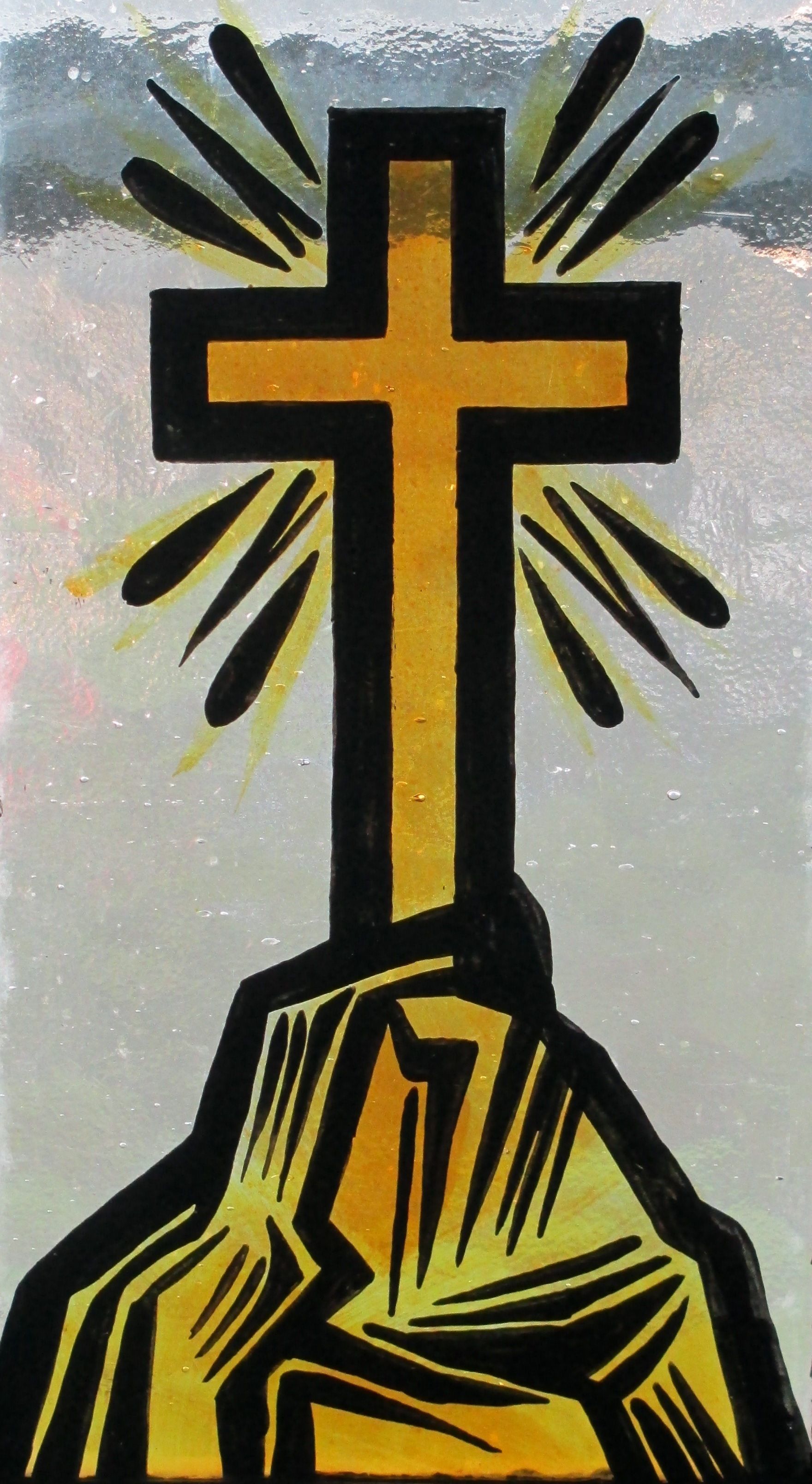
Stained Glass Symbols — Mount Calvary’s Cross

February 18, 2014

Mount Calvary's Cross - Sacred Heart Catholic Church -  Wauzeka WIA Symbol of the Source & Summit of the Christian Life

Jesus Christ’s sacrifice on Mount Calvary’s cross was offered in love of God and man. It is the source or fount for all saving grace, and the summit or pattern to which all Christians are called.

Refusing Signs — Monday, 6th Week of Ordinary Time—Year II

February 17, 2014

Readings: James 1:1-11, Mark 8:11-13

The Pharisees came forward and began to argue with Jesus, seeking from him a sign from heaven to test him. He sighed from the depth of his spirit and said, “Why does this generation seek a sign? Amen, I say to you, no sign will be given to this generation.

Yet, soon before this scene in Mark’s Gospel, Jesus took seven loaves and a few fish and miraculously fed about 4,000 people with them. That is a sign as surely as his resurrection will be, so how can Jesus say “no sign will be given to this generation”? Perhaps because there was no sign that his critics would accept.

The Pharisees sought “a sign from heaven.” If Jesus had performed some meteorological sign for them they may well have judged him as more evil than they had thought, in union with the demons of the air, just as they had condemned his manifest power to cast out demons. (Mark 3:21-30) They asked for proof but refused to accept evidence in his favor–they were of people of two minds, like St. James describes in the first reading:

But if any of you lacks wisdom, he should ask God who gives to all generously and ungrudgingly, and he will be given it. But he should ask in faith, not doubting, for the one who doubts is like a wave of the sea that is driven and tossed about by the wind. For that person must not suppose that he will receive anything from the Lord, since he is a man of two minds, unstable in all his ways.

Let us pray for those who do not believe; for the sincere, that they may be given sufficient evidence to change their minds, and for the obstinate, that their hardened hearts may be opened. And let us who believe in God (as even the Pharisees did) not cause Jesus to “[sigh] from the depth of his spirit.” Let us be trusting and docile in following him.

The Importance of Praise — Wednesday, 5th Week of Ordinary Time—Year II

February 12, 2014

Readings: 1 Kings 10:1-10, Mark 7:14-23

Solomon & the Queen of Sheba, Pleased to Meet Each Other.The Queen of Sheba was genuinely impressed by King Solomon and told him so: “The report I heard in my country about your deeds and your wisdom is true,” she told the king. “Though I did not believe the report until I came and saw with my own eyes, I have discovered that they were not telling me the half. Your wisdom and prosperity surpass the report I heard. Blessed are your men, blessed these servants of yours, who stand before you always and listen to your wisdom. Blessed be the LORD, your God, whom it has pleased to place you on the throne of Israel. In his enduring love for Israel, the LORD has made you king to carry out judgment and justice.” This was not flattery, lies told to manipulate him, but real praise. The praises the Queen spoke to the son of David equally apply to Jesus Christ.

When we perceive good things in another, we should note and compliment it. Not only does this encourage and help that person, but it benefits us as well; it increases our humility, gratitude, and joy. We should especially praise God, not because He needs it (though He appreciates it,) but because the praise which comes “from within the man, from his heart,” helps to sanctify him. As one Mass Preface says, “You have no need of our praise, yet our desire to thank You is itself Your gift. Our prayer of thanksgiving adds nothing to Your greatness, but makes us grow in Your grace, through Jesus Christ our Lord.”

Praying For Rain — February 10 — St. Scholastica

February 10, 2014

While some people only pray when they need or want something, others pray frequently but hesitate to ask anything for themselves. Like the Prodigal Son’s older brother, these think it more proper to never ask God for special gifts (not “even a young goat to feast on with” their friends.) However, the Office of Readings selection for St. Scholastica written by St. Pope Gregory the Great shows us that God is pleased to give His children the good gifts they request:

Scholastica, the sister of Saint Benedict, had been consecrated to God from her earliest years. She was accustomed to visiting her brother once a year. He would come down to meet her at a place on the monastery property, not far outside the gate. One day she came as usual and her saintly brother went with some of his disciples; they spent the whole day praising God and talking of sacred things. As night fell they had supper together.

Their spiritual conversation went on and the hour grew late. The holy nun said to her brother: “Please do not leave me tonight; let us go on until morning talking about the delights of the spiritual life.” “Sister,” he replied, “what are you saying? I simply cannot stay outside my cell.” When she heard her brother refuse her request, the holy woman joined her hands on the table, laid her head on them and began to pray. As she raised her head from the table, there were such brilliant flashes of lightning, such great peals of thunder and such a heavy downpour of rain that neither Benedict nor his brethren could stir across the threshold of the place where they had been seated. Sadly he began to complain: “May God forgive you, sister. What have you done?” “Well,” she answered, “I asked you and you would not listen; so I asked my God and he did listen. So now go off, if you can, leave me and return to your monastery.” Reluctant as he was to stay of his own will, he remained against his will. So it came about that they stayed awake the whole night, engrossed in their conversation about the spiritual life.

It is not surprising that she was more effective than he, since as John says, God is love, it was absolutely right that she could do more, as she loved more. Three days later, Benedict was in his cell. Looking up to the sky, he saw his sister’s soul leave her body in the form of a dove, and fly up to the secret places of heaven. Rejoicing in her great glory, he thanked almighty God with hymns and words of praise. He then sent his brethren to bring her body to the monastery and lay it in the tomb he had prepared for himself. Their minds had always been united in God; their bodies were to share a common grave.

Stained Glass Symbols — The Host & Chalice

February 8, 2014

Host and Chalice - Sacred Heart Catholic Church -  Wauzeka WIA Symbol of Christ’s Death

Jesus Christ is really and truly present in the Eucharist Host and chalice, yet the Host and chalice are symbolic as well. At the Last Supper, Jesus took bread, broke it, and said, “This is my body, which will be given up for you.” Then he took a chalice of wine and said, “This is the chalice of my blood… which will be poured out for you…” When a living creature’s blood is separated from its broken body, death naturally follows. Though Christ’s Body, Blood, Soul, and Divinity are fully present in every fragment of the Host and in every drop of the chalice, the symbolic separation of Jesus’ body and blood points to his sacrificial death.

Stained Glass Symbols — The Ten Commandments

February 7, 2014

Ten Commandments - Sacred Heart Catholic Church -  Wauzeka WIA Symbol of God’s Laws

The two stone tablets Moses brought down from Mount Sinai were not inscribed with Roman numerals, but this is how God’s Ten Commandments, the Decalogue, are often symbolized. Why are #1 through #3 (I, II, III) on one tablet, while #4 through #10 are depicted on the other? This is because the first three commandments relate primarily to God, while the latter seven relate to our neighbors.

Stained Glass Symbols — The Burning Incense

January 29, 2014

Burning Incense - Sacred Heart Catholic Church -  Wauzeka WIA Symbol of Prayer

The ancient Jews saw the burning of incense at the temple as a symbol of their prayer rising up to God. “Let my prayer be incense before you.” (Psalm 141:2) In Heaven, saints are seen in offering burning incense to the Lord. “Each of the elders held a harp and gold bowls filled with incense, which are the prayers of the holy ones.” (Revelation 5:8) In our churches, the temples of the New Covenant, where Earth joins Heaven in the Mass, we offer incense with our prayers before the Lord.