Archive for the ‘Christian Perfection’ Category

Instructions For Missionaries — Thursday, 14th Week in Ordinary Time—Year I

July 7, 2011

Today, Jesus teaches His Apostles how they are to behave as they proclaim the Gospel and do His works. Why does Jesus give them the instructions He does, and what do they mean for us?

Jesus said, “Do not take gold or silver or copper for your belts, no sack for the journey.”  He wants us to depend on God, so that we can learn that God is dependable. But if we depend on God for nothing, then how can our trust grow? The things in your life that you worry about are the places in your life where He wants you to depend on Him more.

Jesus said, “take no second tunic, nor sandals, nor walking stick.” He did not want the Apostles making long trips. They wouldn’t need gear for long-distance hikes, such as a second tunic to sleep in outside overnight. They were to witness in one small village after the next, so that, working separately for the same goal together, everyone in every place would be reached with the Gospel. Like the Apostles, your mission territory is not far away.

Jesus said, “Whatever town or village you enter, look for a worthy person in it, and stay there until you leave.” Of course a person has to stay somewhere until they leave, but a person who has been welcomed into one house could receive a tempting invitation to stay in the same town with someone “better.” We too must beware the temptation to alienate Christ’s “little ones” in order to ingratiate ourselves to others.

Jesus said, “As you enter a house, wish it peace. If the house is worthy, let your peace come upon it; if not, let your peace return to you.” Like the Apostles, we are sure to encounter people who would snub, ignore, insult, or be cold to us, but that should not rob us of our peace.

What Jesus said to the Apostles, He is saying to us as well. Let us do as He instructs us as we proclaim the Gospel and do His works.

The Age of the Donkey — 14th Sunday in Ordinary Time—Year A

July 4, 2011


Jesus tells us in today’s gospel, “All things have been handed over to me by my Father.” But if that is so, why do so many things in the world seem so out of hand? We see that many things are sinful, broken, and not as they should be. Zechariah foretold that the true king would proclaim establish peace among the nations. Yet, this Fourth of July weekend sees our country fighting in at least two wars abroad. If we take our faith seriously, and think seriously about our faith, we’re led to ask, “Where is the reign of Jesus and where is His promised peace?”

In our first reading, we heard Zechariah prophesy that the true king, the Messiah, the Christ, would come to Jerusalem riding on a donkey. You will recall, of course, how Jesus fulfilled this passage when he rode into Jerusalem on Palm Sunday to the people’s shouts of joy. So what is the significance of His riding in on a donkey? The significance of the donkey is that it points to the meekness of Jesus’ reign.

In the ancient world, when a general sieged and took a fortified city, he would most often ride through its city gates by means of horse power. That conqueror would either be saddled upon one of these magnificently fast and powerful animals, or else he would ride in a chariot pulled by them. Then, upon entering, one would expect him to ruthlessly establish the new order of things. Oftentimes, to secure the conqueror’s rule, new laws would be proclaimed and severely enforced, prominent enemies would be put to death, and all local resistance would be crushed.

Jesus, however, comes into Jerusalem in a different way; not on a warhorse or in a chariot, but on a slow and humble donkey. This signifies that His reign shall be different. Apart from the relatively tame activism of scattering livestock and tipping tables at the temple, Jesus introduces his reign without any sign of force. In fact, the only person who would be murdered in the course of Jesus’ rise to power… would be Jesus Himself.

When Jesus stood accused before the high priest and the Sanhedrin, when He was in chains before Pilate and his troops, do you not think that He could have called upon His Father to provide Him in an instant with more than twelve legions of angels? Jesus could have backed Himself up with the power of more than 60,000 angelic warriors, but then He would not have died, and His kingdom would have been very different.

Let me speak for a minutes about the angels. God’s angels, in the first instant of their created existence, had a clear knowledge into God’s goodness and preeminence. In that moment, some of them decided that they would rather live as their own gods. As the Book of Revelation tells us, a war broke out in heaven; St. Michael the Archangel and his angels battled against Satan. Satan and its angels fought back, but they did not prevail and there was no longer any place for them in heaven. Satan was thrown down to earth, and his angels were thrown down with him, where they have tempted us to share in their rebellion ever since. Sometimes people ask if Satan and the demons could be someday be saved. However, angels and demons are creatures that do not change their minds. Unlike human beings, they do not change over time. We human beings are a different sort of creatures. We learn through experience and (hopefully) grow in maturity. If one of us chooses to rebel through grave sin, hope remains for us, as long as we live, that we will repent and turn again to God, to love Him and others as we ought. Even after Caiaphas and Pilate condemned Jesus and handed Him over to for execution, hope remained for their conversion and salvation.

What if Jesus had called in His angelic reinforcements, unveiling before them the Heavenly armies in their terrifying fierceness? What if Christ had tolerated no resistance to the advent of His reign, to the coming of His Kingdom, in 33 AD?        In that case, all of humanity would be confronted with a sudden and inescapable choice, a choice either for Christ or against Him; a moment of choosing like that experienced by the angels and demons.

Some human beings, when confronted with Christ in this way, would sinfully refuse to follow Him, and that refusal would be a rebellion. And here we come to the heart of the problem: How can Christ allow these rebels to remain on the earth, in hopes that they may repent, unless He is willing to show some tolerance and patience toward their sinful resistance for a time? Jesus could wipe away all sin from the face of the earth in an instant, but He would have to wipe out all of the earth’s unrepentant sinners in the process. A sudden judgment would bring a quick and clean end to sin, but less of mankind would be saved. The approach Jesus has taken with us is more merciful, but is also messier. God hopes that all shall turn to Him freely, and not by force, because love cannot be forced. Jesus Christ hopes and works for the conversion and salvation of all. As St. Peter writes, “The Lord’s patience is directed towards salvation.” And though it can be difficult for us to see God’s providential purposes and plans in our lives, “we know that,” as St. Paul says, “all things work for good for those who love God.”

Where is the peace that was promised to the world? Its total reign, the fullness of the kingdom of God, is yet to come. For now, the spirit of the world and the Spirit of life do battle. But we can experience peace in our souls, peace in our families, and peace in our communities, if we live by the Spirit of Christ.

In this age, Jesus comes to us on a donkey, but in the age to come He shall ride a warhorse. As the Book of Revelation says:

“I saw the heavens opened, and there was a white horse; its rider was called ‘Faithful and True.’ He judges and wages war in righteousness.… He wore a cloak that had been dipped in blood, and his name was called the Word of God. The armies of heaven followed him, mounted on white horses and wearing clean white linen. Out of his mouth came a sharp sword to strike the nations. He will rule them with an iron rod, and he himself will tread out in the wine press the wine of the fury and wrath of God the almighty. He has a name written on his cloak and on his thigh, ‘King of kings and Lord of lords.’”

In this age, Jesus rides the donkey, for this is the time of patient mercy. But on the Last Day, Jesus shall ride the white warhorse, for that is the time of decisive and definitive judgment. Let sinners take note; we shall not be permitted to keep sinning forever. And let those who mourn the brokenness, the sin, the suffering and death in the world take courage, for these things shall pass away. ‘See, your king shall come to you; a just savior is he. He shall proclaim peace to the nations. And His rule shall be to the ends of the earth.’

United Hearts — The Kristopher and KayLee Schnitzler Wedding

July 4, 2011

Kristopher and KayLee, when you chose this day, July 2nd, to be your wedding day you were probably not aware that you were choosing an extra special date. We unite your hearts today in holy matrimony amidst Sacred Heart of Jesus and the Immaculate Heart of Mary. Yesterday was the Solemnity of His Sacred Heart and today is the Memorial of her Immaculate Heart. We celebrate these two feasts so closely on the calendar, one after the other, because no two human hearts are so intimately united in a perfect love. I present them to you as role models for your love

Mary and Jesus were mother and Son. They were never married in the way we think of marriage, so how can they be role models for your marriage? In Jesus and Mary, we see the perfect man with the perfect woman, we see the New Adam together with the New Eve, we see the King and Queen of Heaven and Earth. Jesus is the Bridegroom and Mary is the flawless image of the Church, which is His Bride. By seeing how Jesus loves her and how Mary loves Him we can learn much about how men and women are to serve and love each other.

How does Jesus love Mary? For one thing, he listens to her. He is receptive to her wants and needs. It was true at the wedding feast of Cana, He worked a miracle to provide wine at her request, and it is still true now in heaven, where she continues to ask for good things for us. A good husband must be receptive to his wife’s wants and needs. On the other hand, in what manner do you think Mary asks things of Jesus? Mary does not nag Jesus, asking Him in plaintive tones. She doesn’t sit next to Jesus in Heaven and sigh, “I see you still haven’t taken care of the garbage down there.” Instead, I imagine she says to Him, “It would make me very happy if you would do this for me.” A good wife must allow pleasing her to be her husband’s joy, not his burden.

A good husband must die to himself in many ways for his family, and a good wife must support him through his sacrifices. Look how Jesus goes to the cross and offers Himself for the good of Mary and her children. He suffers for her and lays down his life for her. And how does Mary support Him? She is right there, at the foot of the cross, faithful and consoling. God gave Eve to Adam as a partner, to support him in the garden. Mary continues to be a helpmate to Jesus in His work of harvesting the vineyard of this world. A good husband lays down his life for his wife and a good wife must support him through his sacrifices.

From the cross, Jesus make Mary the mother of all Christians. He desired Mary to be the mother of many children, and now, Mary’s motherhood is perhaps her greatest joy. A good husband and wife must be open to children. This is the will of God for you and He will bless you with joy for saying “Yes” to Him.

The worship of God and following His will was at the center of the relationship between Jesus and Mary. Every Sabbath they came to join the worship at the synagogue (the Church of their day) and every day they said prayers and remained close to God. So too, God must be at the center of every good marriage. You must come to Mass every Sunday and pray every day. Good husbands and wives share the same mission in life, to assist each other and their children in getting to Heaven.

From earth to Heaven, Jesus led Mary through life with love, and Mary faithfully followed Him. A good husband must have the integrity not to phone it in, but to lead, and a good wife must have the courage to follow that lead. Kristopher and KayLee, May the hearts of Jesus and Mary reign in your homes. May you model their virtues on earth. And may you draw each other, and your children, to share their heavenly joy forever.

Independence Day Homily

July 4, 2011


What is the most important and the most famous sentence ever coined in the English language? I believe it was a declarative sentence, of thirty-five words, published two hundred and thirty-five years ago today.

“We hold these truths to be self-evident, that all men are created equal, that they are endowed by their Creator with certain unalienable Rights, that among these are Life, Liberty and the pursuit of Happiness.”

Like a passage of Sacred Scripture, this sentence from the Declaration of Independence was more profound, and would effect more providential good, than its human authors ever imagined.

In their original context, these words from the Declaration of Independence were written to justify the American colonies’ separation from the English crown. At that time, many people believed in the divine right of kings, that a monarch had been invested by God with supreme authority to rule. There was precedent for this in the Old Testament, where God chose Saul, David, Solomon, and others to rule His people as anointed kings. In declaring that “all men are created equal,” the Founding Fathers were rejecting the idea that some men are born royal while others are born common. They further asserted that God Himself endows every man with certain rights, and that any government which deprives men of these rights may be justly replaced by its people. In this way, the signers justified the American Revolution.

How much did the Founding Father reflect on how their words about the equality of all men applied to men of color, such as those enduring intergenerational slavery? How much did they consider what these God-given rights required for the female segment of mankind? I would say that these words, like a passage of Sacred Scripture, carried truths more profound than their human authors knew.

These were providential words, for they have been, and continue to be, instrumental in the work of advancing and defending the rights and dignity of all people, from conception to natural death, in our country and around the world. Wherever our nation has failed to embody these words, we look back with shame; but wherever we have honored human dignity, these represent our proudest moments. Martin Luther King Jr. called these words our nation’s creed, and like him we have a dream that one day this nation will rise up and live out the true meaning of its creed: “We hold these truths to be self-evident, that all men are created equal, that they are endowed by their Creator with certain unalienable Rights….”

This Fourth of July, let us thank God for this great gift to our country. Let us praise God for endowing each one of us with dignity and rights which every person and every government must respect. And in the future, let us remember and remind our neighbors, that if our country allows government and men to become our gods, human dignity and human rights will be swiftly brushed aside. Like the Psalmist, may our country always say to the Lord, “My refuge and my fortress,my God, in whom I trust.”

Our Lady of Good Help Pilgrimage Homily

June 14, 2011

In the Garden of Eden, there were many fruit-bearing trees but Genesis mentions two by name: the Tree of Life, and the Tree of the Knowledge of Good and Evil. By partaking of the Tree of Life, the human race could keep living forever, but the Lord warned that to eat from the other tree would mean our certain death.

On October 9th, 1859, the Blessed Virgin Mary appeared here, to 28 year-old Belgian emigrant, named Adele Brise, as she was walking 11 miles home from Sunday Mass. Interestingly, Our Lady chose to appear to Adele not in a church setting such as this, but between two trees: a Maple tree and a Hemlock tree.

You’re all familiar with the beauty and goodness of the Maple. In the fall, its leaves turn the most striking colors; and in the spring, its sap yields sweet syrup. But do you know what distinguishes the Hemlock tree? The poison that Socrates was condemned to drink came from this plant. Ingesting just six or eight fresh Hemlock leaves can kill a healthy adult. [Post-Script: The Hemlock Tree found in Wisconsin is not poisonous, but merely shares the name.] The Maple is a tree of life, while the Hemlock is a tree of death. Mary, the New Eve, stands between the two. [Post-Script: The Hemlock Trees native to Wisconsin are a non-poisonous but share the name.]

She tells Adele, “I am the Queen of Heaven, who prays for the conversion of sinners, and I wish you to do the same. You received Holy Communion this morning, and that is well. But you must do more. Make a general confession, and offer Communion for the conversion of sinners. If they do not convert and do penance, my Son will be obliged to punish them.”

Our Lady’s message by the trees recalls the counsel of Moses, who told the Israelites: “I have set before you life and death, the blessing and the curse. Choose life, then, that you and your descendants may live, by loving the Lord, your God, heeding his voice, and holding fast to him. For that will mean life for you, a long life for you to live on the land….”

Apparently, Our Lady’s warnings were not sufficiently heeded. In October of 1871, The Great Peshtigo Fire erupted. In terms of both size and loss of human life, The Great Peshtigo Fire remains the worst recorded forest fire in North American history. Between 1,200 and 2,400 lives ended in that firestorm which saw, according to an eyewitness, “large wooden houses torn from their foundations and caught up like straws by two opposing currents of air which raised them till they came in contact with the stream of fire.” This seems to be the punishment due to sin that Mary spoke of, but this does not mean that everyone who perished in that fire was condemned. We should remember that at harvest time, the good wheat and the bad weeds are pulled up together in a moment, but their future fates are not the same. Once uprooted from the earth, the good are gathered and kept in the barn, while the bad are thrown away forever.

The Peshtigo firestorm came and surrounded this shrine, where hundreds had come with their families and herds, to beseech the intercession of Mary before God. As many as fled to her were saved. The morning of October 9th, 1871, twelve years to the day after Our Lady’s appearance, saw them delivered.  This consecrated earth was an emerald-green island in an ocean of smoldering ashes as far as eyes could see.

After witnessing this miraculous deliverance, and seeing the lifelong dedication and fruitfulness in Adele Brise’s efforts, many began to believe that she had indeed seen and heard Our Lady. Just last year, the Church formally agreed, approving the apparitions and locutions given to Adele Brise in October of 1859 as worthy of belief by the Christian faithful. Some people will think that this official recognition closes the book on the story of Our Lady of Champion. Some will come here like tourists, excited see where Mary once appeared and go home contented. They won’t think to imagine that Mary’s message was not only meant for Adele in the past, but directed toward us today

In 1859, Mary prayed for and sought the conversion of sinners. Have we gotten less sinful since then? In 1859, Mary lamented how the young did not know the faith. How much better do we live it now? In 1859, Mary warned that if people did not convert and do penance, her Son will be obliged to punish them.” Do we need to convert and do penance? Would you be surprised if a great natural or man-made disaster befell us? How spiritually well prepared do you think people would be to face that?

I don’t think it is a coincidence that the message of Our Lady of Champion is arising to new prominence in our day. Today we heard talks about Our Lady’s Fatima apparitions, which date from 1917. At that time, Mary asked for Russia to be consecrated to her Immaculate Heart to bring about its conversion and a period of peace in the world. On March 25th, 1984, Blessed John Paul the Great consecrated Russia and the whole world to the Immaculate Heart of Mary. It was on the feast of the Annunciation. On Christmas, seven years later, the miracle arrived. On the evening of December 25th, 1991, Mikhail Gorbachev peacefully resigned as the President of the Soviet Union and from atop the Kremlin, the Soviet flag was lowered forever. This was not a coincidence. Politics, economics, and the threat of nuclear war did no bring the Soviet Union to a stunning and peaceful end; it was the work of Jesus and Mary.

What moved Blessed John Paul the Great to consecrate Russia, so many years later after the apparitions, precisely when he did? What moved Bishop David Ricken to approve this apparition, so many years later, as our country’s first Marian apparition site, here and now in our day? In both cases, I suspect that there is more behind these events than the personal whims of men. I suspect that both acts are orchestrated for their role in God’s plan.

I don’t think that Mary’s message was meant for Adele alone, such that their relevance passed away with her death. I think Mary is asking similar things from us. But what exactly? Mary’s message focused upon interceding for sinners and teaching the faith.

Mary the Queen of Heaven, prays for the conversion of sinners, and she wishes you to do the same. You receive Holy Communion, and that is well. But you must do more. First, regularly receive the sacrament of reconciliation, for the sinner whose conversion you are most responsible for is you. I suggest going once a month, for it is effective for growing in holiness.

Next, in this state of grace, offer holy Communions for the conversion of sinners. At every Mass, the priest has an intention for which he is offering the sacrifice. This is a person or group that he asks to be graced, or a problem or need he asks to be helped, by this offering of Jesus’ sacrifice. At every Mass that you attend, you can also offer an intention of your own. Offer some of your holy Communions for the conversion of sinners. And, like the children of Fatima, you can offer your daily sacrifices, burdens borne or pleasures foregone to help those far from God. In doing this, you follow Jesus, who suffered what He endured in order to save others.

Mary also told Adele: “Gather the children in this wild country and teach them what they should know for salvation.” Anyone who faith is immature is still a child in the faith. You can help teach them. Mary told Adele to ‘teach children their catechism, how to sign themselves with the sign of the Cross, and how to approach the sacraments.’ For children you will do one way, for adults, another, but you have something to offer them all; your children and relatives, your coworkers and acquaintances. As Mary said, “Go and fear nothing. I will help you.”

And finally, if and when a new firestorm afflicts our land, or when personal firestorms erupt in the lives of those we love, lead them to take refuge in Jesus through Mary. Confession and holiness of life, holy offerings and penances for sinners, teaching the faith to all, and leading them all to Jesus with Mary—this was Adele’s mission, and it is our mission too.

The Way, Truth, & Life — 5th Sunday in Easter—Year A

May 22, 2011

Jesus said, “I am the way and the truth and the life. No one comes to the Father except through me.”

The Mass is an encounter with Jesus Christ, leading us to God the Father. Like Jesus Himself, the Mass contains the Way, the Truth, and the Life of Jesus. First, we journey on the Way to Jesus, then we come to the Truth of Jesus, finally we join in the Life of Jesus.

The Mass begins with the sign of the cross, for God is the beginning and end of everything. Next, we confess our unworthiness to approach the Lord, asking mercy for our sins, so that we may dare to take this journey to God. The, from the Holy Scriptures, we hear of God’s words and deeds among the Old Testament peoples and within the New Testament Church. In this, we learn of the providential way that God has prepared throughout time for us to encounter Jesus Christ today. Just as the journey on this Way through history leads to Jesus Christ, so the liturgy of the Word leads to the Gospel. Certainly, Jesus Christ the Word of God is present throughout the entire Word of God which is Sacred Scripture, but for the reading of the Gospel, we all stand up for Him and sing “Alleluia,” “Praise the Lord,” because we have come to Jesus Christ and He is more fully present among us in the proclamation of the Gospel.

The Gospel reading proclaims Jesus, who is the Truth. The homily that follows proclaims that the Truth matters for us here and now and demands our personal response. To this call, we answer with the Creed, proclaiming our faith in who God is and what He has done for us. In the Creed, we proclaim our acceptance of Jesus, the Truth. In the prayers of the faithful, we petition the Lord for our needs and concerns, saying in so many words, “Lord, let your kingdom come, on earth as it is in Heaven! Let us share you life! Give us your life!” At Mass, the Way leads to the Truth, and from the Truth we long for God’s Life. At Mass, the Liturgy of the Word leads to the Liturgy of the Eucharist.

The presentation of the gifts is not merely about moving around cash and bread and water and wine. The presentation of the gifts is about the presentation of everything that we have, and everything that we are, to God. We lift up our hearts to be one with our sacrifice. Amidst praises to the Father, the one life-giving sacrifice of the Last Supper, of the cross, and of Heaven becomes present here to us. We join in offering this sacrifice through Jesus, with Jesus, and in Jesus, in union with the Holy Spirit, to God the Father in Heaven.

Through this offered sacrifice, we join in God’s Life. We pray “Our Father,” because uniting with the paschal mystery, the great Easter deeds of Jesus, gives us life as the Father’s sons and daughters. Then we share with one another the sign of peace, the loving peace that is possessed by God’s holy ones. Finally, at the climax, we partake of Jesus Christ, Life Himself, most truly present in the Holy Eucharist.

Sometimes people say, “I just don’t get anything out of going to Mass. Father, I know that you say all this important and wonderful stuff is going on, but I don’t see it and I don’t feel it. The Mass is boring for me.” I understand. When I was a boy, I made a point of going to the bathroom (sometimes twice) during every Mass, just to break up the monotony. When I would see the priest cleaning the dishes at the altar—that was a good sign, because it meant that the Mass was almost done. I didn’t really know what was happening at Mass, so I really didn’t believe in what was happening at Mass. But as I grew older I began to learn what was happening, and as I grew in faith I began to believe in what was happening, and my experience of the Mass was transformed.

People who say that the Mass is boring resemble St. Phillip in something he said to Jesus at the first Eucharist, the Last Supper: “Master, (we don’t see or feel the presence of God the Father,) show us the Father, and that will be enough for us.” And Jesus said to him, “Have I been with you for so long a time and you still do not know me, Philip? Whoever has seen me has seen the Father. (Whoever has been to Mass has encountered my mysteries.) How can you say, ‘Show us the Father’? (How can you say, ‘The Mass is boring?’)” The awesome mystical realities of the Mass are true, and real, and present and active at every Mass we attend, whether we see them, or feel them, or believe in them, or not.

Jesus Christ and the Holy Mass contain the Way, the Truth, and the Life, and we shall receive from them according to our faith. Let us pray, that at this Mass and every Mass, we may be as fully present to Jesus Christ and His mysteries as they are to us at every Mass.

“Are You Saved?”

May 13, 2011

Catholics take a modest approach to the question, “Are you saved?” We hope to be saved in Jesus Christ, and we can have some measure of confidence that we will be, but Catholics consider it presumptuous to say that our salvation is assured. The Catholic attitude is like that expressed by Paul:

“It does not concern me in the least that I be judged by you or any human tribunal; I do not even pass judgment on myself; I am not conscious of anything against me, but I do not thereby stand acquitted; the one who judges me is the Lord. Therefore, do not make any judgment before the appointed time, until the Lord comes, for he will bring to light what is hidden in darkness and will manifest the motives of our hearts, and then everyone will receive praise from God.” (1st Corinthians 4:3-5)

After seeing the light on the road to Damascus, if anyone could be certain of their salvation one would imagine it would be Paul. However, in 1st Corinthians 9, Paul doesn’t speak as if he had Heaven already in the bag. He says:

“All this (becoming all things for all people) I do for the sake of the gospel, so that I too may have a share in it. … I drive my body and train it, for fear that, after having preached to others, I myself should be disqualified.” (1 Cor 9:23, 27)

Immediately following this, Paul warns the Corinthians about the necessity of remaining faithful lest they be condemned like God’s people during the Exodus:

“They were all under the cloud (like the Holy Spirit) and all passed through the sea (like baptism) and all of them were baptized into Moses (who imaged Christ) in the cloud and in the sea. All ate the same spiritual food, and all drank the same spiritual drink (like the Eucharist)… Yet God was not pleased with most of them, for they were struck down in the desert. These things happened as examples for us, so that we might not desire evil things, as they did. … Therefore, whoever thinks he is standing secure should take care not to fall.” (1 Cor 10:1-6, 12)

In Matthew’s Gospel, Jesus warns us that if we are to be saved, we must not be among those who acknowledge Him as “Lord, Lord” but fail to do God’s will:

“Not everyone who says to me, ‘Lord, Lord,’ will enter the kingdom of heaven, but only the one who does the will of my Father in heaven. Many will say to me on that day, ‘Lord, Lord, did we not prophesy in your name? Did we not drive out demons in your name? Did we not do mighty deeds in your name?’ Then I will declare to them solemnly, ‘I never knew you. Depart from me, you evildoers.'” (Matthew 7:21-23)

Those condemned seemed surprised that they are refused entry into Heaven. This is why Catholics do not rest in a self-assurance of Heaven (that judgment belongs to the Lord.) Our part is to ceaselessly strive to cooperate with the saving grace of Jesus Christ as we “work out [our] salvation with fear and trembling” as God does His work in us. (Philippians 2:12)

The Death of Bin Laden — May 3 — Sts. Philip and James

May 3, 2011

Osama Bin Laden has caused the deaths of countless people worldwide, he has spread hatred and division among peoples, and he has exploited religion for these purposes. He has done evil things, and now he is dead. How should we take this news? On Sunday night, some people celebrated in the streets of New York City and Washington, DC. Many people said with unrestrained delight that not a man, but a vermin, or a thing of pure evil, had been exterminated. But what is God’s opinion? What are His feelings on these events? God speaks to us in his words from Ezekiel 33:11: “Answer them: As I live, says the Lord God, I swear I take no pleasure in the death of the wicked man, but rather in the wicked man’s conversion, that he may live.” If God does not rejoice in the death of the wicked, then neither should we.

Our U.S. Special Forces’ successful mission in Abbottabad, Pakistan rightly pleases us in many ways, like in how this achievement may prevent future terrorist attacks or the fact that al-Qaeda is now deprived of their most charismatic leader, but a Christian should not rejoice in the death of a sinner. It should be noted here, that Jesus the Prince of Peace loves peace, but He is not a pacifist. (A pacifist is someone who condemns the use of force in all situations.) Recall that Jesus did not drive out the money-changers and animal-sellers from the temple solely by endlessly asking them nicely. “He made a whip out of cords and drove them all out of the temple area…” Force, even deadly force, is sometimes just and necessary, as I believe it was in Abbattabad this Sunday. And yet, even in wartime, we must not hate those who hate us, nor rejoice in the death of wrongdoers, not even when it’s Osama Bin Laden. The death of a sinner is a tragedy to the heart of Jesus, whose Divine Mercy and Love we celebrated on that same Sunday.

Perhaps someone might hear this and ask, “What difference does it make whether or not I hate Bin Laden or other people I’ve never met? Or what difference does it make whether or not I hate some of the people I actually know?” This is why it matters. You heard Jesus say to Thomas, “I am the way and the truth and the life. No one comes to the Father except through me.” No one comes to the Father, except through Him. Jesus is the way. He is our way to Heaven not just by our saying that He’s our Lord and Savior. Jesus is the way because He is the way we must become. No one comes to the Father in Heaven except they who conform themselves to the person of Jesus Christ. Therefore, if you die hating anyone in your heart, when you come to the gates of Heaven, whether the persons you hate are inside or not, you will not enter in; either you will be prevented from entering until your heart is cleaned to be like Christ’s, or you will never enter in, because you will have decided that you do not want Heaven’s ways, Heaven’s truths, or Heaven’s life.

You’re unlikely to hear the message of this homily said anywhere on TV. Imagine how the world would react if someone went on FOX News or CNN and suggested we shouldn’t hate Bin Laden. If you’ve heard anything like this homily since Sunday’s events, it was probably here at Columbus, through one of your teachers. What makes them different from the world is that they have been formed by the Gospel and a Catholic Christian worldview. Our Catholic Faith is the only thing that frees from the slavery of merely being a child of one’s time. It allows us to see the world more through Jesus’ eyes and to conform our hearts to His. This is important, because if you and I want to enter into Heaven someday, we must be converted into Him.

A Man In Jesus’ Image — Divine Mercy Sunday—Year A

May 1, 2011

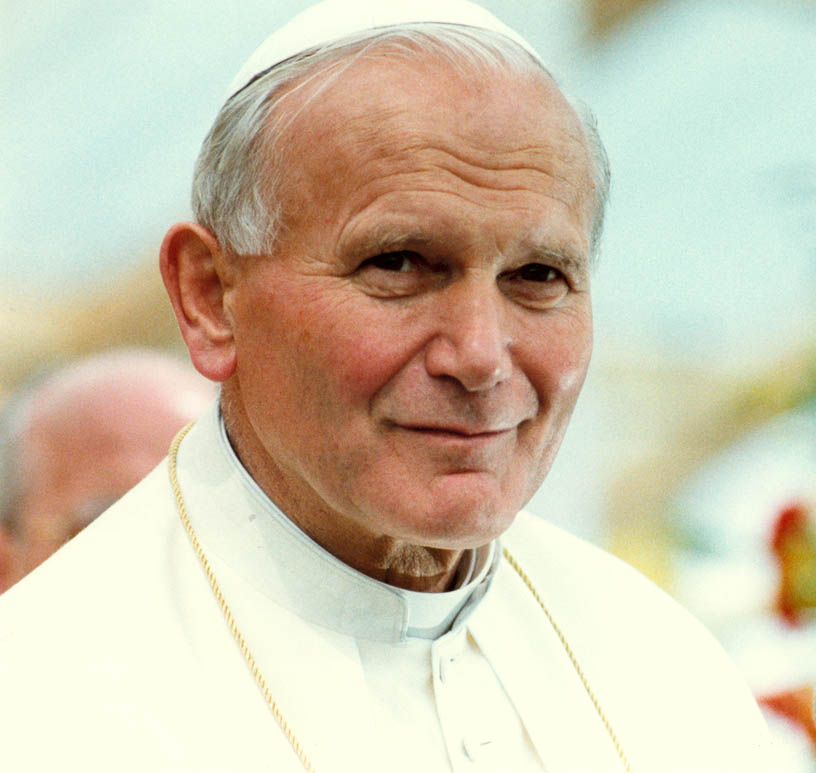
This Divine Mercy Sunday, our Catholic Church throughout the world celebrates and glorifies two men together in a special way. The first is our Savior, our Lord and our God, Jesus Christ; and the second is the great pope John Paul the Second, who is being beatified today in Rome. John Paul the Great, born Karol Wojtyla, is a man who lived in the image and likeness of Jesus Christ.

Both chose the Blessed Virgin Mary to be their mother. One chose her after the loss of his earthly mother as a boy. The other chose her from all eternity. Growing up, both of their beloved homelands were occupied and oppressed by foreign empires. For one it was the Romans. For the other it was the Nazis and then the Soviet Union. As young men, they both worked as manual laborers, in lives hidden from the world. When people encountered their ministries for the first time, many said, “Who is this man, and where does he come from?”

Both men transformed this world, not by leading violent revolutions, not by amassing incredible fortunes, but by speaking the truth, and living the truth, and leading others in doing the same for God. They preached God’s message, and their words gave hope and courage to many, but their words were not accepted by all. Both men had enemies who sought to destroy them, but they forgave, face to face, those who sought their lives.

At the end of their lives, both men were afflicted with great physical sufferings, but neither laid down their crosses. Some onlookers mocked or dismissed them in their afflictions, but those with spiritual insight beheld them to be offering a sacrifice to the Father for the salvation of the world.

St. John tells us that Jesus has done many other signs in the presence of his disciples that are not written in his Gospel. As St. John writes elsewhere, “There are many other things that Jesus did, but if these were to be described individually, I do not think the whole world would contain the books that would be written.”

Among these signs are the lives of the saints throughout the centuries, saints like Pope John Paul the Great. His life was a sign worked by Jesus Christ in our midst so that we would come to believe more deeply that Jesus is the Christ, the Son of God, and that through this belief we may have life in his name.

Why did people love Pope John Paul II so much? Catholics of every country and of all ages loved and flocked to him. Even non-Catholics and non-Christians were drawn to him. What explains this phenomenon? I think the answer is simple. People saw in him a reflection of Jesus Christ’s love for them. John Paul the Second was an icon of Christ and his love.

Every time you saw Pope John Paul, he was smiling. He traveled the nations, and embraced everyone warmly. When you encountered him, you felt loved, even if you were one person in a crowd of thousands. This was the Holy Spirit at work. Although you did not see Jesus you loved him in Pope John Paul; even though you did not see Jesus you believed in him all the more because of him, and rejoiced with an indescribable and glorious joy.

This morning we celebrate a feast day which Pope John Paul II established, Divine Mercy Sunday. What is divine mercy like? What does Jesus’ unfathomable love, which enfolds every one of us here and every person God has made, look like? Through the life of Pope John the Great we saw a partial glimpse of the divine mercy and love of Jesus Christ.

“Do This…” — Holy Thursday

April 21, 2011

At the Last Supper, the night before he suffered for us, Jesus took some bread. He thanks to God for it and He broke it. And He declared it to be His body which would be given up for others. Then He offered it to those He loved. When the supper was ended, Jesus took a cup of wine. Again He gave thanks and praise to the Father. And He declared it to contain His blood, blood to be shed for all. Then He offered the cup to His disciples and said, “Do this in remembrance of me.”

At the Last Supper, Jesus ordained His apostles the first priests of the New Covenant. They and their successors would do this in remembrance of Him, throughout the centuries, up to this very night, and until He comes again. When you and I celebrate the Mass we remember Him and what He did, and more than just recalling it, we re-encounter it as that same sacrifice is offered in front of us. But Jesus’ words, ‘to do this in memory of Him’ means more than just coming to Mass.

Jesus is calling and commanding us to do the thing that He is doing. We must give God thanks and praise for what He has given us. We must take our bodies and give them up. We must take our life’s blood and pour it out. And we can do this, for God and for each other, in as many ways as there is to love. The sacrifices of your daily life, at home, at work, and at prayer; the work of washing feet; may not seem significant to you now, but these sacrifices shall your glory in Heaven forever.

As Jesus washed His apostles’ feet He said, “What I am doing, you do not understand now, but you will understand later.” And when He had finished He said, “If I, … the master and teacher, have washed your feet, you ought to wash one another’s feet.  I have given you a model to follow, so that as I have done for you, you should also do.” At the Last Supper, Jesus said to His disciples, “Do this in remembrance of me.” Tonight, He says the same to us as well.

We Owe Him Big — Tuesday of Holy Week

April 20, 2011

When I was your age, there was a popular show on TV that I liked to watch that maybe you’ve heard of, the show was called The Simpsons. And though it was 20 years ago, I still remember my favorite episode: “Bart Gets an F.” This episode happens to be the most highly-rated Simpsons of all-time and Entertainment Weekly once picked it as the “31st Greatest Moment in Television [History].”

Bart Simpson was failing the fourth grade, and Mrs. Krabappel told him that if he failed his next exam he would forced to repeat the year. Bart tries to prepare by teaming up with Martin to study, but Martin abandons him. And so, the night before the exam, Bart has run out of time. Bart goes to his bedside, kneels down, and prays.

“I know I haven’t always been a good kid, but, if I have to go to school tomorrow, I’ll fail the test and be held back.  I just need one more day to study, Lord.  I need Your help! A teachers strike, a power failure, a blizzard… Anything that’ll cancel school tomorrow.  I know it’s asking a lot, but if anyone can do it, You can!  Thanking You in advance, Your pal, Bart Simpson.” Bart turns off the light, goes to bed, and outside, snowflakes begin to fall.

The next day, the whole world is white and deep. Kids are throwing snowballs, building forts, and riding sleds downhill. Even the adults are joining in the fun. Mayor Quimby solemnly proclaims, “I hereby declare this day to be Snow Day, the funnest day in the history of Springfield!” Bart grabs his sled and makes to rush out the front door, but when arrives at the door, Lisa’s ominous shadow blocks the way.

“I heard you last night, Bart.  You prayed for this.  Now your prayers have been answered.  I’m no theologian; I don’t know who or what God is exactly, all I know is He’s a force more powerful than Mom and Dad put together, and you owe Him big.”

Bart pauses and says, “You’re right.” He removes his goggles from his head and hands them to Lisa. “I asked for a miracle, and I got it.  I gotta study, man!” He goes up stairs and studies like he’s never studied before, or probably since. The next day Bart passes his exam, and the fourth grade, with a D—, and mother Marge puts his test proudly on the fridge.

This weekend, we are going to have a lot of days off from school. Let us remember whom we have to thank for that, what he did for us, and what this long weekend is for. I know you will all be in church on Easter. Everybody’s in church on Easter. But Holy Thursday evening, and Good Friday afternoon, Jesus would enjoy your company at church then, too. If you can’t come at least think of Him then, and of what He’s done for us. Let’s not be like Judas, who was without gratitude, and was the first one out the door. Let us be like Bart Simpson, at least in this much, in showing our thanks to the God who saved our butts, because we owe Him big.

Penance Service Rosary Meditations

April 20, 2011

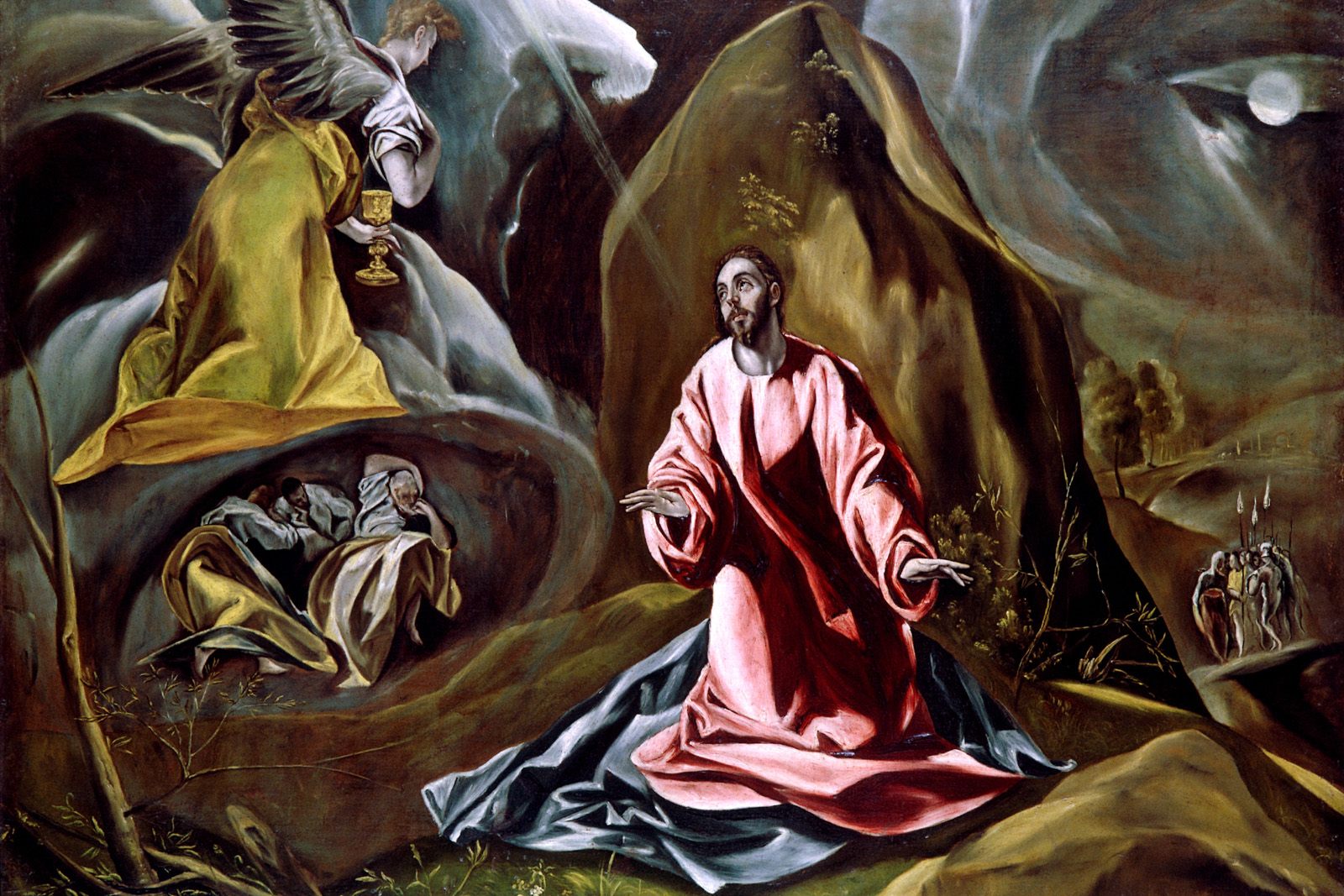
The First Sorrowful Mystery: The Agony in the Garden

Jesus went out with his disciples across the Kidron Valley. There was a garden there and he and his disciples entered it. He took along Peter and Zebedee’s two sons, and began to experience sorrow and distress. Then he said to them, “My heart is nearly broken with sorrow. Remain here and stay awake with me.” He advanced a little and fell prostrate in prayer. “Father, if it is possible, let this cup pass me by. Yet not my will, but yours be done.” In his anguish he prayed with all the more intensity, and his sweat became like drops of blood falling to the ground. Then he rose from prayer and came to his disciples, only to find them sleeping. He said to Peter, “Simon, are you asleep? Could you not keep watch for one hour? ”

When Peter, James and John fell asleep that hour in the garden, they let Jesus down, but Jesus still loved them. When we sin, we also let Jesus down, but Jesus still loves us, too. Let us all make good confessions, and pray attentively, in this hour with Jesus.

The Second Sorrowful Mystery: The Scourging at the Pillar

When it was morning, those who had arrested Jesus bound him, led him away, and handed him over to Pilate, the governor. Now for Passover, the governor was accustomed to release to the crowd one prisoner whom they wished. At that time they had a notorious prisoner, a revolutionary, a robber and a murderer, called Jesus Barabbas. (The name Barabbas means “son of the father.) When they had assembled, Pilate said to the crowd, “Which one do you want me to release to you, Jesus Barabbas, or Jesus called Christ?” They answered, “Barabbas!” Then he released Barabbas to them, but after he had Jesus scourged, he handed him over to be crucified.

Whenever we sin, we choose a Barabbas instead of Christ. Jesus promises us that choosing Him will make us the most happy, but when we choose to do what’s wrong, we disbelieve Him, and choose someone or something else to make us happy. With our confession and these prayers, let us recommit ourselves to always choosing Jesus Christ, who suffered whips for love of us.

The Third Sorrowful Mystery: The Crowning with Thorns

Then the soldiers of the governor took Jesus inside of their fortress and gathered the whole army around him. They stripped off his clothes and threw a scarlet military cloak about him. Weaving a crown out of thorns, they placed it on his head, and put a reed in his right hand. And kneeling before him, they mocked him, saying, “Hail, King of the Jews!” They spat upon him and took the reed and kept striking him on the head. And when they had mocked him, they stripped him of the cloak, dressed him in his own clothes, and led him off to crucify him.

For as much as those soldiers mocked Jesus, let us now honor Jesus sincerely through this decade of the Rosary, with our hearts full of sorrow and thanks.

The Fourth Sorrowful Mystery: The Carrying of the Cross

They took Jesus, and carrying the cross himself he went out to what is called the Place of the Skull, in Hebrew, Golgotha. As they led him away, they laid hold of a man named Simon who was coming in from the country. They put a crossbeam on Simon’s shoulder for him to carry behind Jesus. A great crowd of people followed him, including women who beat their breasts and lamented over him.

During this decade of the Rosary, let us imagine ourselves helping Jesus to carry His cross. By being with Him and knowing how He felt, this will help us to love Him more. And who knows, perhaps our prayer will travel through space and time to help lighten, even just a little, the burden that He carried.

The Fifth Sorrowful Mystery: The Crucifixion

They brought Jesus to the place of Golgotha (which is translated Place of the Skull) and crucified Him there. At noon, darkness came over the whole land until three in the afternoon. And at three o’clock Jesus cried out in a loud voice, “My God, my God, why have you forsaken me?” Finally, Jesus cried out in a loud voice, “Father, into your hands I commend my spirit”; and when he had said this he breathed his last.

The forgiveness of our sins is so easy for us. When we go to confession and it is brief and painless. But let us always remember this: the forgiveness of our sins is so easy for us in the confessional because Jesus let the forgiveness of our sins be so hard on Him on the cross. Let us thank Him and honor Him for this great gift.

Lenten Penance Service Homily

April 15, 2011

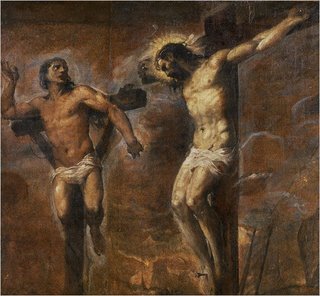
When they came to the place called the Skull, they crucified him and the criminals there, one on his right, the other on his left. Now one of the criminals hanging there reviled Jesus, saying, “Are you not the Messiah? Save yourself and us.” The other, however, rebuking him, said in reply, “Have you no fear of God, for you are subject to the same condemnation?  And indeed, we have been condemned justly, for the sentence we received corresponds to our crimes, but this man has done nothing criminal.” Then he said, “Jesus, remember me when you come into your kingdom.” He replied to him, “Amen, I say to you, today you will be with me in Paradise.”

Sadly, all of us have sinned. Each of us is guilty. Now a sin is more than just an innocent mistake or a misunderstanding. (There is in guilt in those things.) The truth is that each of us at times have sinned by knowingly choosing to do what is wrong instead of doing what is right. With every sin, we hurt each other. We also hurt our relationship with Jesus, who is entirely good, and the most deserving of our love. All of us are guilty. We have all committed crimes against God and our neighbors. So what shall we do?

Like the two criminals in the gospel we just heard, this morning we have the opportunity to encounter Jesus Christ, in the sacrament He gives us. But like which of those two criminals will we be in His presence? The first criminal didn’t acknowledge or care about his own sins. He tried to ignore his terrible situation and treated Jesus on the cross like a joke. However, the second criminal, who tradition calls the Good Thief, acted wisely and well. He recognized in Jesus Christ the one person in the whole world who could really help him. This guilty man praised Jesus for his goodness and asked for Him for His mercy. And Jesus forgave him and promised him great things.

On behalf of Jesus Christ, I beg you this morning to make a good confession, heartfelt confession of your all sins. Jesus said to the Good Thief, “Amen, I say to you, today you will be with me in Paradise.” Like the Good Thief, Jesus wants you to know the blessings of His complete forgiveness today.

3 Mountains / 3 Montañas — 2nd Sunday in Lent—Year A

March 20, 2011
In the life of Jesus, he climbs three significant mountains; The mountain of the sermon on the mount, the mountain of Transfiguration (in today’s reading) and the mountain of the crucifixion. In the Christian life, we must also visit these three mountains. 
 
The three mountains are united. The wisdom of the sermon on the mount, on the first mountain, brings the pleasures and pains of the other mountains. The life of the Gospel brings the joys of the light and the suffering of the cross. Wisdom, glory and sacrifice; the three are a trio here on this earth. Our glories without sacrifice pass quickly. Our sacrifices without wisdom we regret quickly. And our wisdom will be without glory forever if we do not follow Christ in sacrifice. Which mountain should visit more this season of Lent?
 
Do you lack wisdom? Do you not know well that Jesus and his Church teaches? Go to the first mountain to learn, like the disciples at the Sermon on the Mount, with the Bible, or the Catechism or many popular resources available in audio or visual forms.
 
Do you need consolation? Do you not feel well that Jesus is your beloved friend? Go to the second mountain, to feel like Jesus and his disciples at the Transfiguration, through time in a quiet place with God.
 
Do you need perfection in your love? Do you not carry the cross well? Go to the last mountain to practice it, like Jesus at the crucifixion, through good works for others.
 
Jesus climbed the mountains of wisdom, glory and sacrifice. To be with him, we must climb these also.
 

En la vida de Jesús, él sube tres montañas notables. La montaña del sermón del monte, la montaña de la transfiguración (en la lectura de hoy) y la montaña de la crucifixión. En la vida cristiana, debemos visitar estas tres montañas también.

Las tres montañas están unidas. La sabiduría del sermón del monte, de la primera montaña, trae los placeres y dolores de las otras montañas. La vida del Evangelio trae las alegrías de la luz y los sufrimientos de la cruz.  Sabiduría, gloria y sacrificio; los tres son un trío unido en esta tierra.

Nuestras glorias sin sacrificio pasan rápidamente. Nuestros sacrificios sin sabiduría lamentamos rápidamente. Y nuestra sabiduría será sin gloria para siempre si no nos siga a Cristo en sacrificio. ¿Qué montaña deben visitar más esta temporada de Cuaresma?

¿Faltas de sabiduría? ¿No sabes bien lo que Jesús y su Iglesia enseñan? Vaya a la primera montaña para aprender como los discípulos al sermón del monte, con la Biblia, o el catecismo o muchos recursos populares disponibles en formularios visuales o de audio.

¿Necesitas consuelo? ¿No te sientes bien que Jesús es tu amigo amado? Vaya a la segunda montaña para sentirlo como Jesús y sus discípulos a la transfiguración, con tiempo con Dios en un lugar tranquilo.

¿Necesitas perfección en tu amor? ¿No llevas bien la cruz? Vaya a la última montaña para practicarlo como Jesús a la crucifixión, con buenas obras para otros.

Jesús subió las montañas de sabiduría, de gloria y de sacrificio. Para estar con él, debemos subir estas también.

The Dons That Would Have Been

March 18, 2011

The first meeting of the Columbus Pro-Life Society produced this poster, which was hung and well-received in the school cafeteria today.