Archive for the ‘Christian Perfection’ Category

The Little Flower — October 1 — St. Therese of Lisieux

October 1, 2010

Why do we call St. Therese of Lisieux “the Little Flower?” This imagery comes from Therese’s autobiography and she applies the name to herself.  She writes:

“[Jesus] showed me the book of nature, and I understood that every flower created by Him is beautiful, that the brilliance of the rose and the whiteness of the lily do not lessen the perfume of the violet or the sweet simplicity of the daisy. I understood that if all the lowly flowers wished to be roses, nature would lose its springtime beauty, and the fields would no longer be enameled with lovely hues. And so it is in the world of souls, which is the garden of Jesus.  He has been pleased to create great saints who may be compared to the lily and the rose, but He has also created lesser ones, who must be content to be daisies or simple violets flowering at His feet, and whose mission it is to gladden His divine eyes when he deigns to look down on them.”

She writes that her autobiography is “the story of the Little Flower gathered by Jesus.”

Therese thought she was only a little flower, yet she was greater than she realized. Just 27 years after her death she would be canonized a saint. John Paul the Great would name her a Doctor of the Church (the third, female Doctor, after Catherine of Sienna and Teresa of Avila.) Pope Pius XI even called her, “The greatest saint of modern times.” Such was the greatness of her life, her words, and her friendship with God.  And yet, Therese didn’t realize her greatness while she lived.

If St. Therese, the Doctor of the Church, could so misjudge her importance in the garden of the Lord, then how easy might it be for a humble, daily, Mass-goer to under-appraise his or her significance in the eyes of God too?

Pray for Politicians

September 19, 2010

Do you recall St. Paul’s words from this Sunday’s second reading?

First of all, I ask that supplications, prayers, petitions, and thanksgivings be offered for everyone, for kings and for all in authority, that we may lead a quiet and tranquil life in all devotion and dignity. This is good and pleasing to God our savior, who wills everyone to be saved and to come to knowledge of the truth.  (1st Timothy 2:1-4)

With faith in prayer’s power to turn hearts and do good, and recognizing the Catholic duty to act for the transformation of culture, I invite you to join in a new spiritual effort, to earnestly pray for our political leaders.

My new blog, Pray for Politicians, will highlight a different federal elected official each day. Pray for them and leave a note of your spiritual offering in the comments.  (If you prefer, you can click the subscribe button to receive the daily posts by email.)

I invite and encourage you to be a part of this effort.

Pray for Politicians Blog
http://prayforpoliticians.wordpress.com

The Scandalous Cross — September 14 — Exultation of the Holy Cross

September 14, 2010

Jesus died on a cross. But what if Jesus had died differently? Then, instead of crosses, Christians might wear little nooses. Under different circumstances, we might be celebrating the Feast of the Holy Electric Chair, or the Exultation of the Lethal-Injection Syringe. These images unsettle us, but we are comfortable with the idea of Jesus’ cross. However, whenever we find ourselves complaining, we are feeling the scandal of the cross.

We will naturally dislike it when life is hard on us, but “do not forget the works of the Lord.” Jesus’ crucifixion, despite its pain, injustice, and seeming futility, was the means for His glory and for our salvation. With Christ we become invincible, because even our suffering profits us. So when unavoidable crosses come, patiently bear them and use them as a powerful offering to God.

Pray for Peace — 24th Sunday in Ordinary Time—Year C

September 12, 2010

I have a friend… let’s call her Kelly. Kelly works for a private company that does high-tech, scientific analysis for its clients. Most of this work is connected to criminal cases, examining and testing physical evidence on behalf of the prosecution or defense, but sometimes they also do sensitive work for the federal government, work about which Kelly shares no details. Kelly also wants to enter into religious life and become a nun. It’s a vocation she has considered for many years, and her job has only intensified her certainty of that calling.

You see, her work has shown her that if people want to do great evil in our world they would not seem to lack the opportunity. The technology and resources are out there; all that is needed is the malevolent will to use them. Kelly sees that our world is not preserved from self-annihilation by law enforcement, militaries, or government agencies alone. Just as important as these is the work of the spiritual battle which is invisibly waged amongst angels and demons and souls and whose primary battlefield is humanities’ hearts and minds. All of the peacekeepers and diplomats in the world cannot achieve peace, unless peace first wins its victory within the human soul. This peace is won through prayer.

In July of 1917, the Blessed Virgin Mary appeared to three shepherd children near a Portuguese town called Fatima. While the First World War was still raging, Mary told them, “The war is going to end. But if people do not stop offending God, another, even worse one will begin in the reign of Pius XI.” (At that time, the pope was Benedict XV.) “To prevent it,” Mary said, “I shall come to ask for the consecration of Russia to my Immaculate Heart and the Communion of reparation on the first Saturdays. If people attend to my requests, Russia will be converted and the world will have peace. If not, she will scatter her errors throughout the world, provoking wars and persecutions of the Church. The good will be martyred, the Holy Father will have much to suffer, and various nations will be destroyed.” Russia at that time was a war-devastated nation, poor and militarily weak. It was unclear what sort of “errors” they could spread. Four months later, the Communists came to power in the November Revolution. Mary’s call for prayer and conversion was not heeded and the worse war Mary which spoke of did come to pass; this was the Second World War.

Mary told the children, “In the end, my Immaculate Heart will triumph. The Holy Father will consecrate Russia to me; it will be converted, and a certain period of peace will be granted to the world.” I think many people here of a certain generation will remember having prayed for the conversion of Russia, and it came to pass. The Cold War ended not with the explosions of a thousand suns, nor with a thousand years of darkness, but peacefully with a new dawn of freedom. It was a miracle which no one saw coming, but a miracle for the whole world to see.

Despite the present conflicts around the world, we seem to be now living in that “certain period of peace” of which Mary spoke, but for how long will it last? That depends, in part, on us. We must offer prayers of intercession for the world, even for our present enemies, for there to be lasting peace.

In our first reading, did God really want to annihilate His people for their sins before Moses interceded for them? God said to Moses “Let me alone… that my wrath may blaze up against them to consume them.” But what was really holding the Lord back from punishing them instantly? Nothing really. In saying, “Let me alone,” the Lord prompts and gives Moses the opportunity to be their intercessor. In this, Moses prefigures Christ, who intercedes to save all sinners. God calls us to pray for sinners, too.

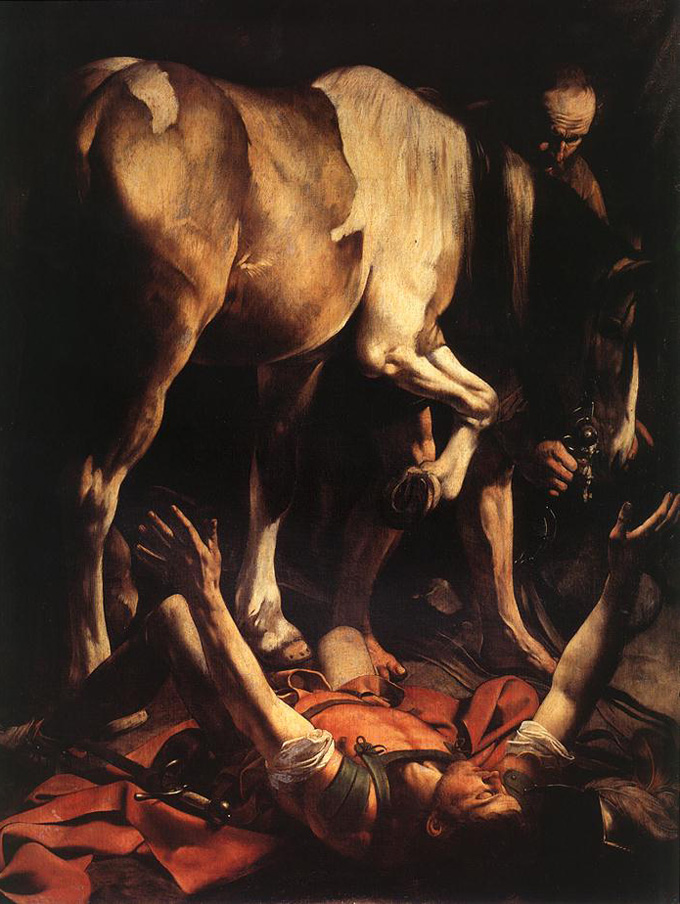
In the second reading St. Paul tells us, “This saying is trustworthy and deserves full acceptance: Christ Jesus came into the world to save sinners.  Of these I am the foremost.” He says, “I was once a blasphemer and a persecutor and arrogant, but I have been mercifully treated…” Paul was shown mercy, saw the light and converted to Christ. This happened in part because the Church was praying for him. He was one of the most feared and notorious persecutors of the early Christians. He was their enemy, but the Church had not forgotten Jesus’ words, “Love your enemies and pray for those who persecute you.”

The early Church’s prayers converted one of their greatest enemies. Moses’ intercession preserved the welfare of his nation. And the prayers of Mary and her children converted a misled people, and saved the world from destruction. The power of prayer has not diminished with time. It can still win our enemies for Christ, safeguard and bless our nation, and convert distant and misled peoples. The Lord calls us to pray for our enemies, for our nation and for our world, because as much as anything else, lasting peace depends on our prayers.

 [See the image I had to resist using to illustrate this post.]

Enduring Injustices — Tuesday, 23rd Week in Ordinary Time—Year II

September 7, 2010

St. Paul rebukes the Corinthians today, saying, “[It is] a failure on your part that you have lawsuits against one another.” Then he says something that rubs us the wrong way: Paul asks, “Why not rather put up with injustice? Why not rather let yourselves be cheated?” We resist, saying, “It’s just common sense that we shouldn’t let ourselves be cheated.” But sometimes common sense falls short. That’s why we need the teachings Jesus Christ revealed. Jesus said:

“When someone strikes you on your right cheek, turn the other one to him as well. If anyone wants to go to law with you over your tunic, hand him your cloak as well. Should anyone press you into service for one mile, go with him for two miles. Give to the one who asks of you, and do not turn your back on one who wants to borrow.”

Now this does not mean that we should be indifferent to injustices done to others, nor that we should seek out opportunities to be wronged by others ourselves. But when we are personally wronged, Paul suggests that we try imitating Jesus. St. Peter would agree, for he wrote:

“If you are patient when you suffer for doing what is good, this is a grace before God. For to this you have been called, because Christ also suffered for you, leaving you an example that you should follow in his footsteps. ‘He committed no sin, and no deceit was found in his mouth.’ When he was insulted, he returned no insult; when he suffered, he did not threaten; instead, he handed himself over to the one who judges justly. He himself bore our sins in his body upon the cross, so that, free from sin, we might live for righteousness. By his wounds you have been healed.”

The next time you find yourself wronged, try imitating Christ. Jesus trusted that the Father would provide for Him, and He was provided for. Jesus accepted His unjust suffering, and it changed the world. Jesus invites you to accept a cross and to follow Him into this mystery.

Outstreched Hands — Monday, 23rd Week in Ordinary Time—Year II

September 6, 2010

The Lord said to Moses in Egypt, “Stretch out your hand toward the sky, that hail may fall upon the entire land…” Moses stretched out his hand, and the Lord rained down hail upon their enemies.

Then the Lord said to Moses, “Stretch out your hand over the land of Egypt, that locusts may swarm over it and eat up all the vegetation and whatever the hail has left.” Moses stretched out his hand, and the Lord sent locusts upon their enemies.

Finally, the Lord said to Moses, “Stretch out your hand, over the sea, that the water may flow back upon the Egyptians, upon their chariots and their charioteers.” Moses stretched out his hand, and the Lord hurled their enemies into the sea.

Centuries later, the Lord Jesus Christ said to a man in the synagogue, “Stretch out your hand.” The man stretched out his withered hand and it was healed, but the scribes and the Pharisees were enraged and plotted against Jesus. This time, it was not the Lord’s enemies who were to bear the terrible onslaught, but the Lord Jesus Himself. Jesus realized this, and freely accepted it, for the sake of you and me.

Be Catholic Americans — 23rd Sunday in Ordinary Time—Year C

September 5, 2010

I would like to begin by posing you a little riddle. Let’s see if you can get it:

What human possession do people always carry with them? Another clue: while we tend to hold on to these things dearly, we are also willing to share them with others, sometimes without them even asking. And the final clue: these things are something that we can always make more of, even out of thin air, if we want to.

The human possession I’m thinking of… is our own opinions. We always carry them with us. We tend to hold them dearly and share them with others, and we can form them out of nothing. Human opinions are abundant, but wisdom is scarce.

As our first reading reminds us, ‘rarely do human beings guess the things on earth; and what is within our intellectual grasp we only find with difficulty.’ The Book of Wisdom observes, ‘Who has ever known God’s counsel except when God has given the wisdom and sent His Holy Spirit from on high? Only in this way, with the help of God, are the paths of those on earth made straight.’

Whenever I stand here before you, I pray that I may never preach to you what is merely my own opinion. If I do that, I will do you no great or lasting good, and Jesus Christ will not be pleased with my efforts. The words that I speak must be His teachings, which come to us through the Scriptures and His Church, by the working of the Holy Spirit. Any personal views that I may have must be conformed to Jesus’ true perspective of things.

I feel this especially as a preacher, but the same goes for each of us here who claims to be Jesus’ student, or disciple. As Jesus says in the Gospel, ‘Anyone who would not renounce all of his or her possessions (including one’s own opinions) cannot be His disciple.’ We must conform our views to Jesus’ teaching; for human opinions are abundant, but wisdom (which comes from Christ) is scarce.

It’s important for us to live according to Christ’s view in all times, but I mention it this time of year because we are entering an important season for our country—election season. The Wisconsin primaries are the Tuesday after next, September 14th, and the general election nationwide is November 2nd , the first Tuesday in November.

There are more than sixty-eight million registered Roman Catholics in the United States. These elections will see them break into three different groups: some who will not vote, some who will vote as American Catholics, and some who will vote as Catholic Americans.

Some will choose to stay home from the polls, squandering the right to vote that other Americans died to give them and ignoring Christ’s call to be the salt of the earth, the light of the world, the transformers of culture. And some will vote as American Catholics, based upon mere opinions molded by the prevailing, secular culture.

But some will vote as Catholic Americans, as I urge you to do, with a worldview formed by Christ and His Spirit-led Church. As Catholic Christians, our first citizenship is in Heaven, but we are also called to be a leaven of goodness on earth. Be Catholic Americans, for our country’s sake.

As we see it over and again in the Scriptures, when a people turns away from God and His path of life their nation declines and falls. We have no guarantee that these United States will endure for a hundred, fifty, or even twenty-five more years, but we have it on Christ’s authority that His Church, history’s oldest institution, shall not perish from the earth. But if we love America and wish it to endure for generations to come, we need to live, speak, and vote as Catholic Christians.

If we conform ourselves to Christ’s teaching, and promote a republic and a culture of life, we can save this nation from becoming an abandoned, unfinished tower. As Catholic Americans, we can transform our country in Christ, and God will surely bless America.

Strive to Enter — 21st Sunday in Ordinary Time—Year C

September 2, 2010

The Emmy-winning Servant of God, Bishop Fulton J. Sheen, once said that in Heaven we will have three surprises: 

  1) We’ll see people there that we didn’t expect to see…

  2) We won’t see people there that we did expect to see, and…

  3) We’ll be surprised to see ourselves there!
 
 
In today’s gospel, someone shouts out from the crowd, “Lord, will only a few people be saved?” Jesus answers Him, “Strive to enter through the narrow gate, for many, I tell you, will attempt to enter but will not be strong enough.” Instead of giving the man a figure, Jesus gives him more valuable counsel, “Strive to enter through the narrow gate, for whether or not you will be saved depends (in part) on you.” Yet we are still left wondering, “Will the number saved be many, or only a few?”

On the one hand we have John’s eyewitness testimony from the Book of Revelation. When he say the worship of the saints in heaven he saw  “a vision of a great multitude, which no one could count, from every nation, race, people, and tongue.” (Note that this ‘countless multitude’ is much larger than 144,000 which had just been counted.) It is as the Lord said through the prophet Isaiah in our first reading, “I come to gather nations of every language; they shall come and see my glory.” Based on this we can say that many will be saved.
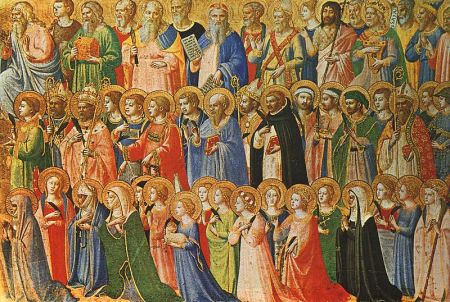
On the other hand, in the Gospel of Matthew, in the parallel passage to today’s gospel, Jesus says, “Enter through the narrow gate; for the gate is wide and the road broad that leads to destruction, and those who enter through it are many. How narrow the gate and constricted the road that leads to life. And those who find it are few.” The ‘few’ who find the narrow gate certainly sounds like less than the ‘many’ who don’t. Based on this we can say that many will not be saved.

My purpose in raising this topic is not to frighten you, for Jesus said, over and again, “Do not be afraid.” But I believe it is with Jesus’ heart that I urge you not to be complacent. To be complacent is to be self-satisfied and unaware of possible dangers. Jesus urges us to, “Strive to enter through the narrow gate” for many will not be able.

There is no way to know, but something in me suspects that the man who called out to Jesus assumed his own salvation to be a certainty; he was merely curious if many others would be joining him.  Jesus warned him not to be presumptuous, and this gospel has come down to us today because it’s a message meant for us too.

All of us come to church, and that’s a very good thing, but coming to church every Sunday does not guarantee our salvation. In the parable that Jesus told, the master of the house arises like the judge of our world at the end of time. People knock on the locked door and say, “Lord, we ate and drank in your company and you taught in our streets.” We eat and drink in Jesus’ company too, and he teaches in our streets. We eat and drink with Him here, at the Eucharist, and whenever the Scriptures are proclaimed, Christ speaks. Being a disciple of Christ, a true friend of Christ, means more than just coming to church.

We must strive to enter the narrow gate. We must pursue and embrace holy discipline for our lives, as we heard from the Letter to the Hebrews: “…Do not disdain the discipline of the Lord or lose heart when reproved by him; for whom the Lord loves, he disciplines…. At the time, all discipline seems a cause not for joy but for pain, yet later it brings the peaceful fruit of righteousness to those who are trained by it.  So strengthen your drooping hands and your weak knees. Make straight paths for your feet, that what is lame may not be disjointed but healed.”

What in your life needs holy discipline? Do you pray every day, or is God only a bedtime afterthought? Do you pray with your spouse and your children, besides at mealtimes? Do you read and watch things that feed your soul? Do you fast and give alms? Do you treat every Friday as a day of penance and every Sunday as a day of joyful rest? What good habit do you need to begin? And what persistent sin do you need to fight, like a life-threatening cancer, for indeed it is. If you were to look back on your life someday from your deathbed, what would you most regret having left undone?
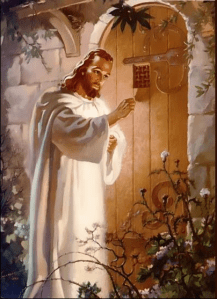
Jesus says to us in this present age, “Ask and it will be given to you; seek and you will find; knock and the door will be opened to you. For everyone who asks, receives; and the one who seeks, finds; and to the one who knocks, the door will be opened.” Are you asking, are you seeking, are you knocking? Strive for holiness while the door remains unlooked, and be encouraged, for Jesus is also striving after you. In Revelation He says, “Those whom I love, I reprove and chastise. Be earnest, therefore, and repent. Behold, I stand at the door and knock. If anyone hears my voice and opens the door, (then) I will enter his house and dine with him, and he with me.”

Jesus knocks on the door of our hearts, minds, and souls; in our feelings, thoughts, and deepest desires. If we open our doors and welcome Him now, and strive with Him for holiness, Jesus will open for us the door to Heaven and welcome us inside.

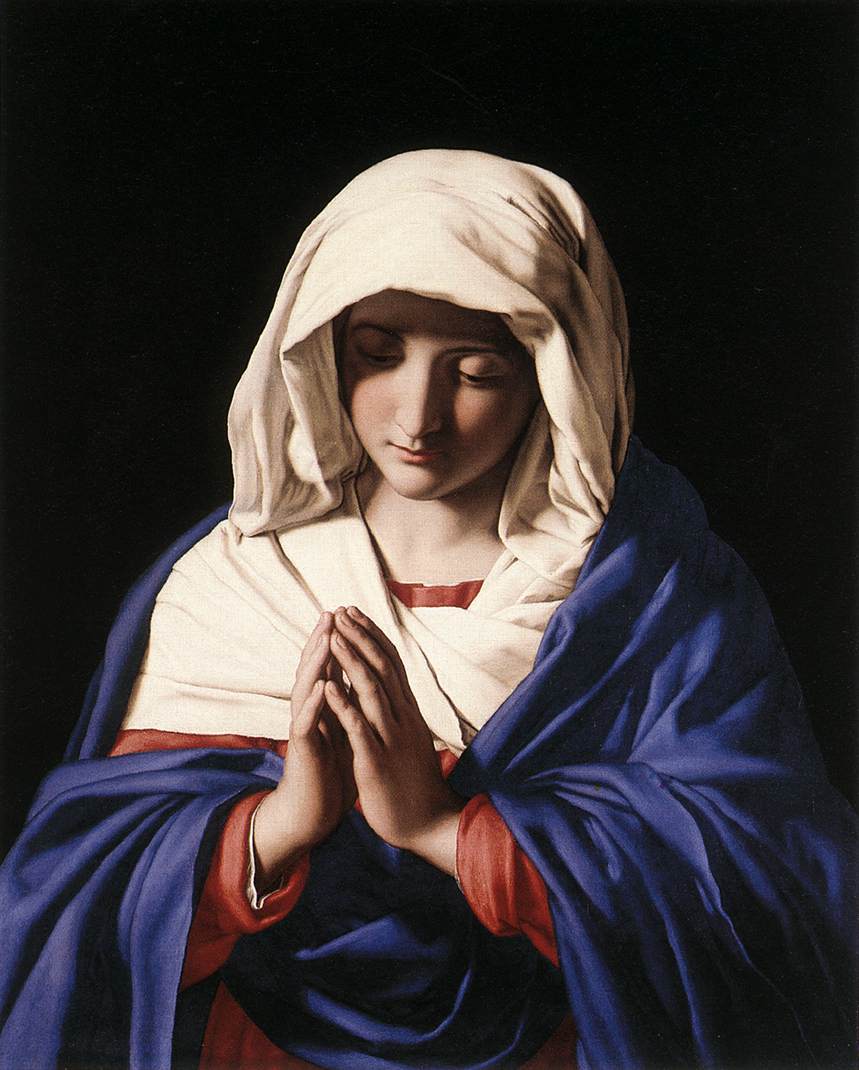
A Veiled Beauty — The Assumption

September 2, 2010

Consider this reflection by the servant of God, Bishop Fulton Sheen:

“Just suppose that you could have pre-existed your own mother, in much the same way that an artist pre-exists his painting. Furthermore, suppose that you had the infinite power to make your mother anything that you pleased, just as a great artist like Raphael has the power of realizing his artistic ideas. Suppose you had this double power, what kind of mother would you have made for yourself?

Would you have made her of such a type that would make you blush because of her unwomanly and un-mother-like actions? Would you have made her exteriorly and interiorly of such a character as to make you ashamed of her? Or would you have made her, so far as human beauty goes; the most beautiful woman in the world; and so far as beauty of the soul goes, one who would radiate every virtue, every manner of kindness and charity and loveliness; one who by the purity of her life and her mind and her heart would be an inspiration not only to you but even to your fellow men, so that all would look up to her as the very incarnation of what is best in motherhood?”

Now if you who are an imperfect being and who have not the most delicate conception of all that is fine in life would have wished for the loveliest of mothers, do you think that our Blessed Lord, who not only pre-existed His own mother but who had an infinite power to make her just what He chose, would in virtue of all the infinite delicacy of His spirit make her any less pure and loving and beautiful than you would have made your own mother? If you who hate selfishness would have made her selfless and you who hate ugliness would have made her beautiful, do you not think that the Son of God, who hates sin, would have made His own mother sinless and He who hates moral ugliness would have made her immaculately beautiful?”

Fulton Sheen thought that Mary was, in every respect, the most beautiful woman who had ever lived. However, if we had been travelers walking through the small town of Nazareth during the reign of Emperor Tiberius, I’m not sure that we would have recognized God’s greatest creature as we passed by her. I imagine that her face may have looked quite ordinary, apart from her beautifully, loving smile. Her Son, was the all-beautiful God become man, yet it seems that Jesus was not the most handsome man alive. As the prophet Isaiah says of Him, “There was in him no stately bearing to make us look at him, nor appearance that would attract us to him.” (Is 53) Perhaps Jesus and Mary had ordinary physical features on earth because having extraordinary appearances would have impeded their missions.

Yet now, invested with heavenly glory, Jesus and Mary possess a beauty greater than anyone in history. The perfection of love, goodness, purity and virtue within them shines through their exterior in a way that captivates those who behold them. Jesus told St. Faustina to commission a painting of how He appeared to her. When Faustina saw the artist’s quality work she dissappointedly lamented, “[Jesus,] Who will paint You as beautiful as You are?” The young visionaries at Fatima and Lourdes we struck by how very beautiful the mysterious lady was. And when St. Bernadette visited the grotto for the last time she remarked, “I have never seen her so beautiful before.” There is more to a beauty of this kind than natural appearance.

Why does the Church celebrate Mary’s Assumption? Because this solemnity not only celebrates her, but points to Church’s future. Virgin Mary is the icon, the image, of our Church. Jesus Christ’s Church is Marian. What she did, we are called to do; and where she has gone, we are called to follow. What Christ has done for Mary, He shall do for His Church on the last day. My previous reflections on the ordinary, appearances of Jesus and Mary probably had on earth only goes to show that external appearances can veil the true reality of things. 

Men judge by appearances, and they often misjudge. Many will drive past this building this hour without realizing the wondrous beauty of what is happening here inside. Many fail to see the beauty of Christ’s one, Catholic Church, for which this world was made and through which this world is saved. Many people see the beauty of exterior flesh, but not the beauty of the soul. Yet after the Last Judgment, everyone will see the most homely saint become radiant with beauty, and the most attractive sinner become repellant.

Mary is the first and greatest member of Jesus Christ’s Church. At the end of her unassuming life on earth Jesus lifted up her up body and soul into Heaven and gave her a beauty unmatched in history. He will do the same thing for His Church someday, and He desires to do the same for each of us. You and I are called to follow Mary in following Christ; to imitate their love, goodness, purity and virtue. Despite any appearances to the contrary, in this veiling and deceptive world, we are called to share in a beauty and glory like theirs.

Saintly Vigilance — Thursday, 21st Week in Ordinary Time—Year II

August 26, 2010

The usual reading of today’s Gospel sees Jesus warning His followers to be ever watchful and prepared for the coming of the Lord. When we hear his image of a mud-brick house being broken into (or literally, dug through) we think of the devil as that thief, robbing us of the treasure in our souls. This interpretation is good and true. We should be vigilant in the keeping of our own immortal souls. But let me suggest that He teaches us another lesson as well, for Jesus words are autobiographical.

Jesus is that “master of the house.” He is the husband in His household, the Church. And Jesus did know the pivotal hour of night to “stay awake” and “keep watch” in the garden of Gethsemane. When His enemies arrived, Jesus did not allow His household be broken into and robbed. He said, “…If you are looking for me, let these men go.” He did not lose any of His own which the Father had given to Him.

“Who then is the faithful and prudent servant, whom the master has put in charge of his household to distribute to them their food at the proper time?” Jesus is that faithful and prudent servant, who feeds us our needed food. And seeing His suffering servant’s love, God the Father, who the master of all, has placed Jesus over all His property.

Yes, we should be vigilant in the keeping of our own immortal souls, but Jesus’ example suggests something more, to be have concern for the care of others’ souls as well. Who has God entrusted to you? Perhaps family members come first to mind, but think of your friends, co-workers, and others as well. Ask yourself in what ways you can be of good to their souls as well. God rewards those who love like this with a greater glory than just salvation alone.

C.S. Lewis on Our Immortality & Potential Glory

August 14, 2010

From The Weight of Glory:

It is a serious thing to live in a society of possible gods and goddesses, to remember that the dullest and most uninteresting person you talk to may one day be a creature which, if you saw it now, you would be strongly tempted to worship, or else a horror and a corruption such as you now meet, if at all, only in a nightmare. All day long we are, in some degree, helping each other to one or other of these destinations.

It is in the light of these overwhelming possibilities, it is with the awe and the circumspection proper to them, that we should conduct all our dealings with one another, all friendships, all loves, all play, all politics. There are no ordinary people. You have never talked to a mere mortal. Nations, cultures, arts, civilization—these are mortal, and their life is to ours as the life of a gnat. But it is immortals whom we joke with, work with, marry, snub, and exploit—immortal horrors or everlasting splendours.

This does not mean that we are to be perpetually solemn. We must play. But our merriment must be of that kind (and it is, in fact, the merriest kind) which exists between people who have, from the outset, taken each other seriously—no flippancy, no superiority, no presumption. And our charity must be a real and costly love, with deep feeling for the sins in spite of which we love the sinner—no mere tolerance or indulgence which parodies love as flippancy parodies merriment.

Next to the Blessed Sacrament itself, your neighbour is the holiest object presented to your senses. If he is your Christian neighbour he is holy in almost the same way, for in him also Christ vere Latitat [Latin, “truly hides”]—the glorifier and the glorified, Glory Himself, is truly hidden.

The Rich Fool — 18th Sunday in Ordinary Time—Year C

August 12, 2010

I regret to inform you that you are going to die. Perhaps not today, but someday, and it could be very soon. We should ask ourselves, “Am I ready? How can I prepare?”

The Gospel relates the story of a man who was not ready, a man God calls a “fool.” Jesus offers Him as an anti-role model; a person whose example we should learn from, but not imitate. Yes, he is a fool for hoarding his possessions. The old saying is true, “You can’t take it with you.” But there are more subtle lessons we can learn from his bad example. This morning I would like to present three things this rich man has to teach us:

The first lesson comes from what he does when his land produces a bountiful harvest. He asks himself, “What shall I do?” There is nothing wrong with this question in itself, but he is a fool in the way he asks it. The rich man asks himself, and only himself, “What shall I do?” He does not consult with God, in either his conscience or in prayer, to learn what His will is.

What is the lesson here for us?  Let us remember to listen to the Lord as He speaks in our conscience, through prayer, the Scriptures, and the people He has placed in our lives. We should listen for God’s direction every day, and throughout each day.

A second cautionary lesson is found in the rich man’s plan for solving his storage problem. He says, “This is what I shall do: I shall tear down my barns and build larger ones.” What was wrong with the older barns? They were not large enough to hold everything, but why tear them down? The rich man has plenty of land. Why did he want to replace his perfectly good barns?

Vanity of vanities, he wanted his storehouses to be the newest, the biggest, and the best. Though the rich man was not very concerned about other people, he was very concerned about their high opinion of him. Even in those days, people were tempted to consumerism.

Consumerism seems to consist in two phantom promises: that having just a little more will truly give me lasting happiness, and that others will regard, accept, and love me when they notice the things that I have. These are phantom promises, for as soon as one reaches to grasp them they prove empty, illusory, receding further out of reach.

The fact is that the people who are happiest in life are not the wealthiest. (By that measure, pretty much every American should be among the happiest people in the world.) The happiest people tend to be those who share the most or give the most away. The person who recognizes they have enough, that life does not consist in possessions, is content and secure enough to share. Some people try to get the most out of life as possible, but what we appreciate most in our lives is the ways in which we have given of ourselves for others.

Our third cautionary lesson is heard in God’s rebuke of the man: “You fool, this night your life will be demanded of you; and the things you have prepared, to whom will they belong?” When we think of the things the rich man has prepared, we think of his harvest and goods.  One of the things he has ill-prepared… is his soul, which this night will be demanded of him. And now, to whom will it belong?

The lesson here for us?  As focused as we are upon our possessions, we must be more attentive to our souls. Someday, we are going to die. In the meantime, then, let us put to death, the parts of you that are earthly, as St. Paul said: immorality, impurity, passion, evil desire, and the greed that is idolatry.

What lessons does the rich man teach us? Reject the false promises of the consumer cult, for life does not consist in possessions. (Self-gift is the meaning of life) Turn your heart to your spiritual well-being, for your life and this world shall pass away.  And to frequently ask Jesus, everyday, “What shall I do?” Let us begin today, before it is too late for us to begin living wisely.

Anointing Mass — Wednesday, 17th Week in Ordinary Time—Year II

July 28, 2010

Today we listen to the prophet Jeremiah complain to the Lord,

Under the weight of your hand I sat alone because you filled me with indignation. Why is my pain continuous, my wound incurable, refusing to be healed?

Sometimes our trials tempt us to indignantly complain like Jeremiah, but every trial permitted by God is permitted for our good. Trials, patiently borne, sanctify us and help to save others.

It is right for us to pray for cures, as we do in the anointing of the sick. But if our trials are to continue this sacrament offers the grace to bear the weight of our trials, not alone, but with Christ.

Praise is Fireproof — Tuesday, 17th Week in Ordinary Time—Year II

July 27, 2010

St. Therese of Lisieux, one of the greatest and most beloved saints in modern time, once remarked that she almost wished that she could go to Hell.  That way, she said, at least her small, solitary voice would lovingly praise Him from there. Of course, this is impossible. Those in Hell ‘wail’ in sadness, and ‘grind their teeth’ in anger, but they never praise God. No one praising Him would remain in Hell. Let us take comfort in the knowledge that if we persevere in our praise of God we shall not join their number.

The Kingdom is Like… — Monday, 17th Week in Ordinary Time—Year II

July 26, 2010

Jesus says the Kingdom of heaven is like a mustard seed sown in a field, or like some yeast worked into three measures of dough. These passages are usually taken to describe how the Church, or the Christian faith, despite small beginnings, has spread and transformed the entire world for the better. This is a valid interpretation, but the Kingdom of heaven is not only an external reality; it is internally and personally experienced. Since the Scriptures are written not only by human authors, but by the Holy Spirit as well, every passage contains more than one true interpretation. Jesus’ similies also describe faith in the life of individual Christians.

At the beginning of one’s discipleship, the seed of faith is small and vulnerable. Any challenge or trial, any passing bird, can potentially come along and consume it. This seed of faith must be guarded, watered, and given light. This means vigilence, education, and contact with Christ in prayer and the sacraments. In time, faith grows to the point that trials and challenges are no longer a grave threat, but calmly accepted.

The faith of the Christian is also like yeast which is not meant to be merely kept in a jar in on the shelf, segregated to Church or private life. It is meant to be mixed into the whole of life; at home, at work, and everywhere, so that the entire batch of life will be transformed and raised.

If your faith is young and fledging, or a confined and isolated part of your life, be encouraged by the hope these passages promise. The Kingdom of God is at hand for you.