Archive for the ‘Christian Perfection’ Category

30th Sunday in Ordinary Time—Year B

October 25, 2009

Return of Vampire. 1944.

Next Saturday, as the children here may know, is Halloween, the evening celebration involving crazy costumes, yummy candy, and scary stuff. But this evening was formerly popularly known as All Hollows’ Eve, for it is the vigil of All Saints Day, November 1, the Solemnity of God’s hallowed ones. oday, I would like to talk to you about vampires, that’s right, vampires. Now vampires are not real, but we can learn a lot from their mythology and bad example, for vampires are embodiments of the anti-Gospel.

For example, Christians are children of the light and of life, but vampires are creatures of the night, of darkness and of death. Vampires fear the daytime and they sleep in coffins. Vampires tempt, seduce, and exploit others. They manipulate persons as things to be used. Vampires steal others’ blood and take their lives. This is the opposite of Christ, who tempts, seduces, and exploits no one. Rather, Jesus calls, invites, persuades, and challenges with the truth, with goodness, and with love. He treats everyone as a person to be loved. Rather than taking, Jesus gives us His blood and His life, His entire living person in the Eucharist, so that we can share His life.

How do you defeat an otherwise immortal vampire? Traditionally, there are two ways: either drag him into the sunlight, or put a wooden steak through the heart. Why do these tactics work against them?      These things work because vampires are personified evil, and evil cannot overcome either the light of Christ or the wood of His cross.

There’s one more element of vampire mythology with something to teach us. Vampires can only enter a house, if they are invited inside by the people who live there. In vampire stories, the peasants don’t realize that the attractive, charming, intriguing person at their door is really a vampire, so they invite him in without realizing the threat he poses, or their own vulnerability.

Now comes the scary part of the homily, where we apply the lesson to ourselves. What have we unguardedly welcomed into the heart of our homes? What in our lives most resembles the vampire? It is, I suggest, the television and the internet.

Now granted, television and the internet are not digitized evil, like the vampires are personified evil. There is real good to be gained through these forms of technology, but we are kidding ourselves if we think that they can’t seduce us. More often than not, it seems that television and the internet suck our lives out of us. They are up to our necks, but we are too infatuated with, or hypnotized by, them to realize that something is wrong.

Ask yourself, when was the last time that you watched TV and came away thinking, “Wow, that was great.  You know, I really think watching television made me a better person”? Now consider this question: when was the last time you watched TV and came away from it feeling unmoved and unsatisfied? That dissatisfaction should tell us something. Television sucks our life from us, and the internet can be just as bad, or even worse. Not only do these forms of media tend to disappoint us, numb us, and give near occasions to sin, they can harm our families too.

TV Children

Imagine if there was going to be a public execution in Marshfield tonight and your son wanted to go and watch, would you let him go? Yet how much death, simulated and real, is there to be seen on TV? Would you allow a complete stranger into your daughter’s bedroom unsupervised? Yet how many of our children have a TV or the internet right in their rooms? If TV or the internet were a person, would you welcome that person into your home?

Again, I am not saying that everything on television or the internet is evil, or that every good Catholic should discontinue their cable and internet subscriptions. But I am convinced that we need to be more careful and discerning about their roles in our lives, and that our habits with them probably need to change.

It could be that the single greatest thing you could do today to strengthen your family life and to improve your life of prayer would be to simply unplug. Imagine how much more opportunity and motivation you would have every day for family bonding and quiet times with God, if you put all your TVs in the basement and hid the internet cables along with them. Why not try it for a week? Or, if you’re really serious, why not make this your Advent penance and see how much your life is changed?

Like the psalmist said,

‘Although you may go forth weeping,
you’ll be carrying the seed to be sown,
And you shall come back at the end rejoicing,
carrying the sheaves you’ve harvested.’

After your unplugged period is over, you can bring the TV and the internet back if you want, but you will be freed from any addictions to them and they will be less likely to seduce you in the future, into the life of the living dead.

In the Gospel, the blind man, Bartimaeus, threw aside his cloak, sprang up, and ran to Jesus. Jesus said to him, “What do you want me to do for you?” The blind man replied, “Master, I want to see.”

Like vampires, change in our lives can be scary, but we should have the courage to see how much our lives could be better by following Christ in this way.

29th Sunday in Ordinary Time—Year B

October 18, 2009

The Three Crosses by Rembrandt. 1653

Today, the Apostles James and John make their big pitch in order to move up the ladder in Jesus’ organization. “[Jesus,] grant that in your glory we may sit, one at your right, and the other at your left.” Jesus says to them, “You do not know what you are asking.”

They jump at the chance to drink of Jesus’ cup and to be baptized in His baptism, whatever that means, because they have no idea that these are allusions to Christ’s suffering. Jesus tells them, ‘You will drink my cup and experience my baptism, but to sit at my right and my left is for those for whom it has been prepared.’ Where are the seats beside Christ in His glory?  The Gospel of Mark later tells us: “With [Jesus] they crucified two revolutionaries, one on his right and one on his left.” Indeed, James and John don’t know what they’re really asking.

They want spots beside Jesus’ throne because they think this will put their lives on Easy Street. They think that being enthroned at Christ’s side in glory means they will be served by everyone, and that they will never have to serve anyone else, ever again, besides Jesus of course. James and John want to live like as princes, like the billionaires, the bosses, and the big shots in the world. But true greatness is very different.

Whoever wishes to be great, Jesus says, must be a servant.  And whoever wishes to be the greatest of all, must be the servant to everyone. But we might ask why anyone would want this sort of greatness? Who wants to be a slave or to be crucified with Christ? And yet, Jesus offers such self-offering as the only greatness truly worth seeking? Why? Because true love equals self-gift, and in heaven love lasts forever.

In the world out there, there is a hierarchy according to wealth and power. For the Church on earth, Christ establishes a hierarchy according to orders. But for the Church in heaven, the hierarchy is established according to love. There is no money to be had in heaven. Greatness there is measured according to the love you can give and the love you receive from others.

Consider, who is more beloved on earth, Blessed Mother Teresa or the richest person in the world? And who is more likely to have a higher place in heaven? When Mother Teresa died a million people turned out for her funeral. She, like all the saints, is rich in love.

If you desire true and lasting greatness, imitate Christ on earth, who became a slave for us. Jesus did not come to be served but to serve. And through His trials and self-sacrifice, He offered his life as a ransom for us and won our hearts for Himself.

Though it is worthwhile, it isn’t easy to follow Christ. If we serve Him, we should expect temptations, trials and sufferings, too, just like Him.  Trials are normal for the Christian life and we should expect them.

As Saint Peter writes, “Beloved, do not be surprised that a trial by fire is occurring among you, as if something strange were happening to you. But rejoice to the extent that you share in the sufferings of Christ, so that when his glory is revealed you may also rejoice exultantly. If you are insulted for the name of Christ, blessed are you, for the Spirit of glory and of God rests upon you.”

Temptations are normal for the Christian life, too.  Jesus Himself was tempted in the desert and in the garden. As the second reading says, “…We do not have a high priest who is unable to sympathize with our weaknesses, but one who has similarly been tested in every way, yet without sin.” Understand and remember that human weakness and temptations are not the same thing as sin. It is not a sin to be tempted. Jesus was weak and tempted like us, but he never sinned. We only sin when we give in to temptation, when heart says “yes” to them.

Catherine of Siena by Giovanni[1]

Believe it or not, the saints know more about fierce temptation than unrepentant sinners do. The saints do battle against strong temptations, with the sacraments and prayer, with penance and self-disciple.  Many hardened sinners, on the other hand, don’t even know they are being tempted. One time, St. Catherine of Sienna, after she had made great progress in holiness, was subjected to the most violent temptations. Impure images filled her imagination and darkness attacked her heart. She called on God but He seemed to be absent. After these temptations had ceased, Jesus visited her, filling her with heavenly consolation. “Ah, my Divine Spouse,” she cried out, “where were you when I laid in such an abandoned and frightful condition?” “I was in your heart,” he replied, “fortifying you by grace.” “What, in the midst of the filthy abominations with which my soul was filled?” “Yes,” Jesus said, “for these temptations were most displeasing and painful to you. By fighting against them, you have gained immense merit, and the victory was because of my presence.”

When Jesus asked James and John if they could drink His cup and be baptized in His baptism, they eagerly responded, “We can!” Did they entirely know what this meant? No. Do we entirely know what it will mean for us to give our yes to Christ and to follow in His footsteps? No.  But with that little seed from James and John, Jesus was able to grow them into great saints.

Jesus Christ is the greatest person who has ever lived.  No one has been greater and no one has done greater things.  No one has loved better and no one is better loved. Let’s follow in his footsteps, even if that means the cross, for to be remade in His image means sharing in His greatness, His glory and His joy.

October 17 — St. Margret Mary Alacoque

October 18, 2009

Sacred Heart by Margherita. Vatican

Today we celebrate St. Margret Mary Alacoque of France who lived in the latter half of the 1600’s. Throughout her life, Jesus would appear to her and converse with her, but this did not surprise Margret or seem strange to her. She assumed that other people experienced the same sort of things all the time. After she become a nun, Jesus gave her a  mission: to establish devotion to His Sacred Heart.

You’ve seen images of the Sacred Heart before; a red heart, crowned with thorns, pierced along its side, with a cross and flames emerging from its top. If this devotion seems strange to us, its because we do not understand what it means.

Sacred Heart of Jesus

When I was in seminary I heard a story about the Sacred Heart that I not been able to confirm with the internet, but I share it with you as a great illustration, even if it might only be a legend. The story goes that after St. Margret Mary Alacoque died, devotion to Jesus’ Sacred Heart was spread by the Jesuits, a Catholic religious order, in their missionary work. In one mission territory (it might have been Papua New Guinea) the priests introduced this devotion to the people, but it wasn’t resonating with them.  The people just didn’t seem to get it. As they missionaries learned more about the native culture, they learned that these people did not look at the heart as the organ that symbolizes love and emotion.  For them, some other abdominal organ, the liver I think, was the seat of human love and emotions. In response, these missionaries replaced the Sacred Heart devotion with another, a devotion to the Sacred Liver. The natives people got it, and responded enthusiastically.

When we consider the Sacred Heart today, we can be a lot like the natives in this (possibly fictional) story. We today tend to be a people of science, materiality, and literal interpretations, who look at a heart and see an organ for pumping blood. But the Church in the 1600’s saw the world differently, in a much more poetic way—they saw the Sacred Heart and understood its message.

Jesus’ Heart is aflame with fire, because His love for you is intense and passionate. His Heart is pierced, crowned with thorns, and holding up a cross, because Jesus suffered for you out of love. Jesus presents this devotion to us, because He wants us to remember that He is a human being like us and that He loves us with a human heart. The Sacred Heart is a symbol of His love for us, that He loves us deeply, with a human heart.

Since modern-day Catholics understand and resonate with the Sacred Heart less easily than we used to, Jesus seems to have given the Catholic Church another sacred image to convey very similar message. In the 1930’s, Jesus appeared to another nun and gave a mission to promote a new devotional image. That nun was St. Faustina Kowalska of Poland, and the devotion she was to spread was the Divine Mercy. The two devotions are very much alike. For example, both devotions emphasize Jesus’ humanity.  Both are accompanied by popular prayers devotions.  And both show that Jesus’ abundant loves and mercy for all.  The question is not which devotion is better, the question is which devotion resonates or connects with you in communicating Jesus’ love for you.

Sacred Heart PaintingDivine Mercy

And now I come to my final, and most important point. I’m sure all of you know the right answer to the questions, “Does God love everyone,” and “Does Jesus love you?” None of you would get these wrong on a test. But I suspect that for most of you the concept that God loves you remains just an idea. Have you experienced this truth as a reality? Do you know that Jesus Christ likes you, that He enjoys you, that He is pleased with you? If you’re uncertain about this, then you have not yet experienced His love for you as profoundly as He desires. Personally knowing Christ’s love for you, rather than just knowing about it, makes all the difference in the world.

So here is your assignment… Ask Jesus Christ to reveal to you today, or in the very near future, some palpable sign of how, and how much, He loves you. Then, keep your eyes open. Jesus is clever and powerful, and knows how to reach you. He doesn’t want His love for you to be a secret.

28th Sunday in Ordinary Time—Year B

October 11, 2009

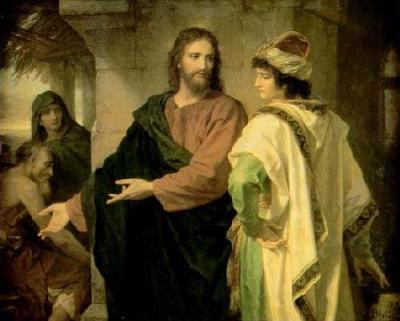
Christ and the Rich Young Ruler, by Heinrich Hofmann

This morning’s second reading from the Letter to the Hebrews speaks of the Word of God; as “living and effective, sharper than any two-edged sword, penetrating even between soul and spirit, joints and marrow, and able to discern reflections and thoughts of the heart.” The first thing that comes to our minds when we hear the phrase “the Word of God” is probably the Bible, but for the author of the Letter to the Hebrews, the Word of God is first and foremost a person. The author writes of the Word of God, “No creature is concealed from Him, but everything is naked and exposed to the eyes of Him to whom we must render an account.”

Jesus Christ is the Word of God, eternally spoken by the Father. Yet our Church’s Scriptures are also God’s inspired Word. Scripture is no dead letter, it is living and effective among us today. It can penetrate the soul, giving discernment to the thoughts and reflections of its readers’ hearts. The Word of God comes down to us from heaven. In Jesus’ incarnation, the Divine Word unites with humanity. Similarly, in the inspiration of Scripture, divinity unites with human words. In the Christian life, we neglect the Word of God to our detriment. We need Christ and His Scriptures. Merely following our consciences will not give us the fullness of life.

Living a moral life is good, but it is not the fullness of life that God wills for us and wants to lead us to through His Word. The man who came to Jesus in the Gospel realized this. He had listened to his conscience and observed the commandments of God’s from His youth, like a lot of cradle Catholics, but notice that the man didn’t walk up to Jesus, he ran to Him and knelt before Him, because he profoundly recognized that he did not yet have the fullness of life. The man goes to Jesus because he senses that this teacher holds the answer he’s searching for, and indeed Jesus does.

Jesus, looks at him, loves him and says to him, “You are lacking in one thing. Go, sell what you have, and give to the poor and you will have treasure in heaven; then come, follow me.”

What this man lacks, in his all-too-comfortable life, is a total commitment to God through a personal relationship with Jesus Christ. Jesus offers him the opportunity and the adventure of a lifetime, “Come, follow me,” but the man goes away sad, because he has many possessions which possess him.

This morning, I would like to teach you a way to personally encounter the Word of God yourself; a way to run up to Jesus, through praying with the Scriptures.

First, take your Bible, and go to someplace where you can pray. Perhaps a quiet room in your house or here at Church; someplace where you will be free from distractions. Then ask the Lord for His grace and wisdom, and the spirit of wisdom, which is greater than riches, will be freely given to you.

Open your Bible to the Gospels, and chose a single scene. Read the passage once or twice, to become familiar with it, and then read it once again, slowly.

Now use your imagination to enter that scene. See Jesus and the other characters there. You can be a bystander observing the scene, or put yourself in the place of one of the characters. What do you feel in their place? What would you say and what would you do in that situation? Then look to Jesus, to hear what He says and see what He does.

This can be a very fruitful way to personally relate with the Word of God, and for Jesus to relate with you through His Scriptures in your prayers.

Over the past few days, in preparation for this homily, I have prayed in this way with today’s Gospel. Just to provide one example of how this sort of thing goes, I’d like to share my meditations with you.

The Gospel begins by saying that the man ran up “as Jesus was setting out on a journey,” so I imagined myself standing there as one of the carrying a heavy sack on my back. When the man came up and knelt before Jesus the feeling that I felt was annoyance, that this guy was holding us up when we had a long journey ahead of us.  But then I remembered what I was witnessing before me an event worthy of the Gospels. This was a lesson for my life and my ministry, that I should not let anxious feelings cause me to neglect or rush past the things that are really important.

When I saw the man walk away sad, I ran after him and pleaded with Him to come back, not to live His life plagued with by question of what his life would be like if he had tried, even just once, a total commitment to Christ. But the rich man was afraid. He didn’t think he had it in Him to take that step. This motivated me to go back to Jesus and ask Him for the grace so that we would all be willing to follow Him outside our comfort zones.

I also I imagined myself in the position of the rich man, kneeling before Christ and asking what more I lacked. I expected Him to say, “Sell all that you have and follow me,” but Jesus put His hand on my shoulder, smiling, and expressed His pride at how far I had come in the areas of trust and generosity. It was a great personal consolation.

What consolations and what wisdom does the Word of God have waiting for you through this form of prayer? There’s only one way to find out.

Thursday, 27th Week in Ordinary Time—Year I

October 8, 2009

In the illustration used by Jesus in the Gospel, a person goes to their neighbor’s house and calls inside for a needed favor. The father inside is not immediately obliging. The door’s locked and his sons and daughters are already at rest. But Jesus says, ‘…If the father does not get up… because of their friendship, he will get up to give him whatever he needs because of the person’s persistence.’

Why will the father end up doing the favor in the end? Because of the father’s children. Imagine all the kids in there, in the dark and in their beds, with the neighbor at the door, knocking: *pounding* “Daaad.” *more pounding* “Dad, do whatever they want!”

The father in this story stands for our Father in heaven, who can sometimes seem reluctant in answering our prayers. The children in the story are the saints in heaven, the sons and daughters who rest in the Father’s house. 

What is it like for the souls in heaven to hear our prayers? Perhaps the experience St. Faustina of the Divine Mercy on earth gives us a glimpse into the experience of the saints in heaven. In the Diary of St. Faustina, a book which I highly recommend for spiritual reading, the Polish nun records this:St. Faustina of the Divine Mercy

“It has happened to me for some time now that I immediately sense in my soul when someone is praying for me; and I likewise sense it in my soul when some soul asks me for prayer, even though they do not speak to me about it. The feeling is one of certain disquiet, as if someone were calling me; and when I pray I obtain peace.”

This reaction makes perfect sense, for how could a good person hear of another’s heartfelt needs and not insist that our Father act? Or how could a saint remain at rest while someone knocks at the door of heaven? Knowing this, how then should we pray? Imagine what doors would open for us, if only we would persist in knocking? Or imagine what gifts would we receive, if only we would try asking? So knock, and ask, boldly.

Tuesday, 27th Week in Ordinary Time—Year I

October 6, 2009

Velazquez, Christ in the House of Martha and Mary. 1618

Today you heard two familiar Bible stories. In the first reading, Jonah reluctantly preaches and the Ninevites, who wholeheartedly convert. In the Gospel, Martha serves while Mary listens at Jesus’ feet. The characters in these two stories would seem to have nothing in common with each other… but that is not so.

What do Martha and Jonah have in common? Both Martha and Jonah are doing work for the Lord, work which they found to be unpleasant. What do Mary and the Ninevites share? What do they have in common? Both Mary and the Ninevites are doing the one thing that is needed, they have turned themselves towards the Lord. Now let’s apply their lesson to ourselves as students.

Ever since I was five years old, up to this very year, I have been in school as a student every year of my life. So I’ve sat through a lot of classes; some which I really enjoyed, and others that I didn’t. Now it’s easy to work on a subject we enjoy, but in other classes we’re like Martha and Jonah, it’s God’s will for us that we be there, doing what we’re doing, but we’re certainly not thrilled about it.

So the next time you feel bummed-out in one of your classes (hopefully not in one of my classes) try doing this: Turn your eyes and your heart to the Lord, like Mary and the Ninevites, and offer yourself and that hour’s work to Jesus.   You already have your cross, so use it for a spiritual sacrifice. What difference will it make when you redirect yourself and your work like this to the Lord? There’s only one way to find out.

October 2 – Guardian Angels

October 2, 2009

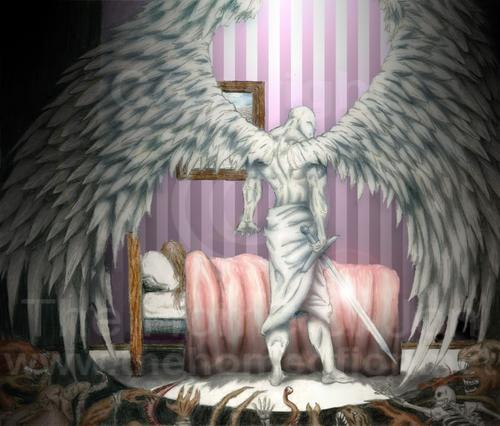
There are members of our Church gathered here today, who are always with us, but whom we all-to-easily overlook. It is to this group of persons that I wish to speak to today: our holy guardian angels. I invite you to share in my thoughts and sentiments of my words to them.

Holy Guardian Angels,
First, I want to apologize for our tendency to forget about you and the important part you play in our lives. Though we do not say it enough, thank you Holy Ones, for everything you do for us and we ask you for your continued help.

May we be always docile to your promptings. Please accept this invitation to enter our thoughts and emotions as through an open door. You are Christ’s perfectly sinless creatures, and you discern His will with far more clarity than we do. Please make His will clear for us and make it easy for us to follow it.

Holy Angels, you know the hearts and minds of men with penetrating insight. Please help us through your mediation to communicate graciously with the people in our lives. Please help mediate good resolutions to the conflicts and tensions we have with others. Please help us to know how to best communicate Christ’s love to others in ways that are tailored for them.

Holy Guardians, just as some of your angelic peers ministered to Jesus Christ amidst His sufferings, please bring us support and consolation in our difficult moments. And please defend us against spiritual attacks, for you understand these threats far better than we do.

Please join us in our prayers. Perfect in them and add to them whatever may be lacking. Please pray with us for our loved ones and for the intentions which are dear to us. You are blessed to see God face-to-face and you worship Him day and night. Please lead us to perfect worship.

Holy Guardian Angels, thank you, for everything you do for us. Know that we will someday thank you even more profusely when it is revealed to us in detail all that you’ve done to light, to guard, to rule and to guide our lives.

October 1 – St. Therese of Lisieux

October 1, 2009

Today we celebrate the young woman Pope Pius XI called, “The greatest saint of modern times.” At the age of 15, she entered the Carmelite convent in Lisieux, France to give her whole life to God. There, she would take on a new religious name which would profoundly capture her identity: Sister Therese of the Child Jesus and the Holy Face.

St. Therese

How did her life resemble the Child Jesus? Early on, Therese saw her own weakness and littleness, and she believed that great and mighty deeds were beyond her, so she committed herself to a “little way of spiritual childhood.” She always tried to love and trust like a little child, modeling herself on the Child Jesus; not doing great things, but doing everything with great love.

The second title of St. Therese, that of the Holy Face, refers to the image Jesus’ bloodied face left upon St. Veronica’s veil during the Passion. How did Therese’s life resemble the Holy Face? Whatever she suffered, from small annoyances of daily life to the great pains of her final illness, Therese offered it all to God as a sacrifice for the good of souls. The image and likeness of Christ’s redemptive suffering was made present in her, like the image Christ’s face upon a clean, white cloth.

We can follow St. Therese’s example in our own lives, whenever we approach our Father in prayer with child’s fearless trust, whenever we do our daily tasks with a intention to do them with great love, and whenever we offer our sufferings as a sacrifice in Christ, for our good and the good of all His Church.

September 29 – The Archangels

September 29, 2009

Today we celebrate Saints Michael, Gabriel, and Raphael. God created lots of angels, so that they might enjoy, share and manifest His glory. Within this multitude, Michael, Gabriel, and Raphael hold special rank as archangels. The angels and archangels are like us in important ways, but in other ways they’re very different.

Just like us, God did not create the angels to fulfill some need He had. God needs nothing to be happy and complete. God made heaven and earth, all that is seen and unseen, out of sheer love, overflowing. God created us because love likes to share.

Just like us, God created the angels as persons. We are persons because we both have intellect and will, the capacity to know and the ability to freely choose. Just like us, angels are persons, having souls which will never die. But unlike us, angels don’t have a physical body united to their soul. Instead of body and spirit, angels are spirit alone.

Like us, angels know things and choose things. Like us, they’re made for interpersonal-communion. They interact with God, with each other, with us, and our world. But like God, and unlike us, angels live outside of time. We humans grow, and change, and mature, day by day. We’re incomplete and we develop over time. We can choose holiness one day, choose to sin the next, and on the day after that, think better of it, repent, go to confession, and return to God. But in the case of angels, their natures are complete and finished. And the free choices they’ve made once are made for all time. That is why the angels are forever sinless creatures, and why the demons, who are the angels who chose to rebel and were cast down from heaven, will never turn back to God.

We do not know exactly why Satan and the many demons fell, but it is clear that they did not, in their sinful pride, want the roles in God’s kingdom which God had prepared for them. Some speculate that when the angels where created, God gave them some knowledge of His plans for the human race. God wished the angels to share in this plan, but, for some reason, some refused to serve.

Perhaps it was the scandal of the Incarnation, the idea that the eternal Second Person of the Trinity, would take on material flesh. Maybe they refused to worship the Eternal Word, Jesus Christ, in such a state as that. Perhaps, filled with pride about their own glory, which was entirely God’s gift, they refused to be Christ-like and serve creatures they deemed to be inferior to themselves.

Whatever the reason for it, a war broke out in heaven. Michael and his angels battled against Satan. Satan and his angels fought back, but they did not prevail. The demons wanted to be like God, but without God. Perhaps Michael challenged them with the meaning of his name, “Who is like God?” They wanted to be God, but without God, and there was no longer any place for them in heaven.

And now we arrive at the lesson we learn from the demons’ Fall that I want you to take to heart…

When the demons refused to be what they were made and called by God to be, they became something far less than what they were meant to be. By turning away from God, the source of their life, they became stupid, ugly, and weak compared to what they should have been.

Compared to what God makes us, calls us, and longs for us to be, sin makes us stupid, ugly, and weak too.

Do you have any sins?

Every Tuesday I sit in my office as much time as can, from the end of morning Mass until 3:00 PM, when prayers are offered in the Columbus chapel that God the Father would have mercy on us. I’ve spent hours at my desk, behind my confessional screen, catching up various work. And in all that time, not a single student has come for the sacrament that reconciles sinners with our Lord Jesus Christ. Now don’t think that I’m angry about this. Tuesdays for me as they are now are very productive days. I get a lot done behind my desk. But I would very much prefer, that so many of you would come, to the healing forgiveness, and strengthening graces, that Jesus is waiting to give you in this sacrament, that I would get nothing else done.

I want you to come to the sacrament that cleans your slate and lightens your heart. I want you to come to the sacrament that makes you wiser, stronger, and more attractive as a person than you are when you’re in sin. I want you to come to the sacrament of reconciliation, not for my sake, but for your sake.

Through the intercession of St. Raphael, whose name means “God’s healing,” may we believe in God’s power to heal our wounds. Through the intercession of St. Gabriel, whose name means “God’s power,” may we believe in God’s power to recreate the repentant sinner. And through the intercession of St. Michael, may we consider “who is like God,” who shows mercy to all who come to Him.

26th Sunday in Ordinary Time—Year B

September 27, 2009

There are many things wrong with our society and the world, but how are we to go about changing them? One approach was presented by a fellow named Saul Alinsky. He, and his highly-influential 1971 book entitled Rules for Radicals: A Practical Primer for Realistic Radicals, have been popping up a lot lately. Reading his list of 11 rules you can see how they are widely used in politics & culture today.

The dedication of the book reads like this: “Lest we forget at least an over-the-shoulder acknowledgment to the very first radical: from all our legends, mythology, and history (and who is to know where mythology leaves off and history begins — or which is which), the first radical known to man who rebelled against the establishment and did it so effectively that he at least won his own kingdom — Lucifer.”

I doubt Alinsky believed in the devil at all.  He probably wrote that because it was a clever and effective attention-grabber for his book. But the book’s dedication was truer than he realized.  The book recalls the first rebel’s rejection of the kingdom of God and then goes on to explicate rules which often reject the approaches embodied and advocated by Christ, whose approaches the world often considers too impotent to defeat evil in the world.

The tactics this book advocates are often the same used by demons in spiritual warfare against us—a war fought on the battlefields of our hearts and minds, for the defense or the capture our souls.

Consider, for example, “Rules for Radicals #1: Power is not only what you have, but what an opponent thinks you have. If your organization is small, hide your numbers in the dark and raise a din that will make everyone think you have many more people than you do.” And, “Rule 9: The threat is more terrifying than the thing itself.” Demons fight us most effectively when they deceive us into imagining they are more powerful than they are. In fact, the only real weapon they have against us is to play on our fears, for we protected against demons in Christ.

Rules for Radicals # 4: “Make opponents live up to their own book of rules.” Alinsky writes, “You can kill them with this, for they can no more obey their own rules than the Christian church can live up to Christianity.” In following this rule, one follows the example of the Great accuser, the devil, who (as the book of Revelation says) night and day accuses us before God for sins. Alinsky’s charge against Christians, that the Christian Church cannot live up to Christianity, blends the truth and lies, just like the words of the demons when they speak to our thoughts.

The truth is that we are God’s servants, that we care deeply about Christ’s teachings, and that all of us commit sins, sins that we would say we truly oppose. But, like the psalmist, we pray for God to cleanse us from even our unknown faults. And from wanton sin especially, we sincerely ask the Lord to restrain us; to not let it rule us, so that we may be blameless and innocent of serious sin. Even though we do not yet follow Christ perfectly, we are truly made better people, more Christ-like, through our relationship with Him.

Yet demons want us to convince us we’re all hypocrites. They want to make us silent, out of shame for our sins, about what is right and what is wrong. They would even cause us to give up on trying to live-out lives of perfect love. Though we are sinners, we trust in God’s mercy and love. Jesus was always merciful toward sinners who acknowledged their guilt and He enabled them to become more perfect through a relationship with Himself.

Rules for Radicals #11: “Pick the target, freeze it, personalize it, polarize it. Don’t try to attack abstract corporations or bureaucracies. Identify a responsible individual. Ignore attempts to shift or spread the blame.” Alinsky writes, “One acts decisively only in the conviction that all the angels are on one side and all the devils on the other.” You’ve seen this polarizing tactic employed through the media, and you see it all the time. It’s called the politics of personal destruction.

It is the demonizing of individuals who we don’t agree with. Christians must not be indifferent to wrongs wherever they are committed, but when it comes to persons, what Christians seek and pray for is the conversion of sinners, not their destruction. “For God did not send his Son into the world to condemn the world, but that the world might be saved through him.”

Do tactics like those which Saul Alinsky laid out actually work at effecting change?  The answer is both Yes and No. Lots of influential people use them because they make lots of noise and heat and angry waves; they can end people’s careers, and they can extort institutions into making concessions. The power of these tactics makes them a strong temptation. But temptations they remain, for they do not have the power to bring about the kingdom of God.

Is the Church interested in social change? The Church is very much interested in social change, just like Jesus was, but we follow the way of His example. Allow me to present another influential writer of the 20th century, as an example, someone who was interested in radical social change of the Christian sort: Pope John Paul the Great. He is rightly called “the Great” for he must be counted among the greatest men of the last century.

Consider how he opposed the great evils and injustices of the communist empire. John Paul did not deal in deceptions. He spoke the truth, because he believed that the truth is powerful enough to set us free. He cared deeply and passionately about the grave injustices being committed, but he never seemed hateful because he was driven by true Christian love. He taught that some actions are wrong, even unspeakably wrong, but that all persons are worthy of love, and he radiated this love of God for all to see through his smile. His focus was not in personal attacks, but in speaking the truth to the human consciences. He insisted that all people should be given the recognition of the dignity and the rights they have from God: to live, and live freely, to speak the truth, and live the truth.

This is what he did, and the communist dictators literally trembled before him. When the communist leader of Poland welcomed the pope to his homeland in a speech at the airport broadcast on state-controlled TV, the dictator’s voice, and the paper he held in his hand, both quivered. The pope was so powerful against them, simply with the message and example of Christ, that the communists tried to kill him in St. Peter’s square, but the Pope miraculously survived the bullets, and forgave his would-be assassin.

By the mercy and the power of God, and in no small part through the words, deeds, and prayers of Pope John Paul the Great, the Soviet empire, which did so many evils for the sake of a utopia that never came to be, that empire ended; not with the fire of a thousand nuclear blasts, but with a harmless dying gasp. It was miracle, a peaceful victory for Christ and the Kingdom of God.

There are many things wrong with our society and the world, but how are we to go about changing them? Pope Paul VI said, “If you want peace, work for justice.” It’s good to work for justice, and we must work for justice, but we must remember this: true justice comes through the way of peace, the way embodied by our Lord, Jesus Christ. So whose example will we be dedicated to as we work for change in the world; that of Lucifer or that of Jesus Christ?

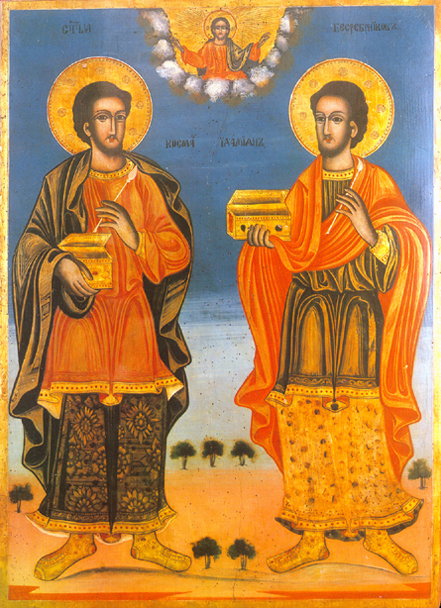
September 24 – Sts. Cosmas and Damien

September 25, 2009

A number of years back, there were two twin brothers, the eldest of a widowed single-mother’s five sons. From their youth, they had a profound love for their Catholic faith and they viewed God’s creations, especially the human body, with great wonder. The two brothers studied medicine and became general practitioners.

Two things made them stand out among other doctors in their profession: first, their willingness to share their Catholic faith with others; and second, their refusal to accept payment for their work.  The two worked for free, pro bono, for the good. They healed the sick, in both body and soul. And they were gratefully admired by many. But then it happened that their government instituted new laws which were contrary to the Catholic faith, offensive to human dignity, and universally binding without exception.

The two brothers might have said to each other, “Our work helps so many people.  If we don’t go along with this we won’t be able to practice medicine anymore. We should compromise, for the sake of the greater good.” However, these two doctors were adamant in their convictions. They understood that if they chose to forfeit their Catholic faith, then they would have nothing else of truly lasting value to offer to anyone. They did not yield, and it cost the two of them their careers, and much more, but the brothers preserved their faith, their clear consciences, and their heavenly rewards in Christ.

You’ve heard of the names of these brothers before, but you’ve probably never heard their story until today. The twin brothers, the two doctors who were unwilling to compromise on their Catholic faith when the Emperor Diocletian decreed in the year 303 that everyone worship idols or be killed, these men are the saints we celebrate today: Saints Cosmas and Damian.

May we learn from their example and benefit from their prayers.

Petitions:


Saints Cosmas and Damian are the patron saints of physicians, surgeons and pharmacists.  Let’s pray for those who care for the sick… We pray to the Lord.

Through the intercession of Saints Cosmas and Damian, may Catholic healthcare workers in our time never have to face a test of faith like theirs because of unjust laws… We pray to the Lord.

Through the intercession Saints Cosmas and Damian, may we have the courage to share our faith in the workplace, by both our silent deeds and our spoken words… We pray to the Lord. 

For my intention in this Mass, for Congress which is now considering amendments to the healthcare bill which would grant conscience exceptions and prohibit the federal government from subsidizing, reimbursing, and paying for abortions, and for your Mass intentions… We pray to the Lord.

Tuesday, 25th Week in Ordinary Time—Year I

September 22, 2009

I rejoiced because they said to me,
“We will go up to the house of the LORD.”
And now we have set foot
within your gates, O Jerusalem.

The Jews would joyfully sing these words as they came into Jerusalem, to worship the Lord in His temple. They understood why they should lift up their hearts and give Him their thanks and praise. The Lord was always with them, but He was most especially with them at the temple. It should be the same for us today, whenever we come to Mass. Jesus Christ is always with us, but He is most fully with us at the Mass.

What if your guardian angel appeared to you and carried you through space and time, and gave you a place at the table of the Last Supper? How closely would you listen to Jesus’ every word and prayer?

What if your angel then brought you to the foot of the cross, to witness Jesus’ sacrifice for you? How faithfully would you attend to Him there?

What if your angel then brought you into heaven, among all the saints and angels, into the presence of the Father, Son, and Holy Spirit? What would you feel? How would you pray?

The truth is that you can encounter the Last Supper, the cross, and heaven at every Mass. The power of Christ brings these realities, through space and time, to you. Jesus’ one sacrifice is really made present to us and we join in the combined worship of heaven with earth.

Granted, all of this is not undeniably-obvious, These realities are veiled to our senses, but encountered through our faith. Just because something is unseen, doesn’t mean that it’s not real. If we never had radios how easily would you believe in radio waves? They’re invisible, intangible, and span time and space, but they’re real indeed, and you can experience them if you are tuned-in to receiving them. How can you be tuned-in at Mass? I offer four suggestions:

First, before Mass, pray for the grace to worship well. I fear that often we do not receive because we never ask.

Second, bring a personal intention to every Mass; that is, a person or a cause that you want Christ to grace through His one sacrifice today. For example, my intention for this Mass is for the Marshfield Area Catholic Schools. Always bring an intention to Mass, because the Mass has more power in the world than we realize.

Third, pray with your whole voice, your whole mind, and your whole heart. Just because you are not always speaking during Mass, doesn’t mean one should ever stop praying. As you hear me pray the Eucharistic prayers make them your own. And when you sing, sing as if you were singing for the Lord, because you really are.

Fourth and finally, direct your eyes, your body, and your thoughts toward the one to whom you are speaking. Most of the prayers of the Mass are directed to our Father in heaven, though some are directed to Jesus Christ. Know the one to whom you are speaking to, and follow through with your eyes and your body accordingly.

As we saw in the Gospel, merely showing up at the house where Jesus is, isn’t enough for a person to achieve the greatest intimacy with Him. Likewise, merely showing up at the Mass where Jesus is, isn’t enough for a person to achieve the greatest intimacy with Him. Those who hear the word of God and act on it in faith and worship, they become the closest to Christ. So let us go rejoicing, to encounter Christ at the Last Supper, at the cross, and in heaven, at this Mass, in the house of the Lord.

25th Sunday in Ordinary Time—Year B

September 20, 2009

Somewhere, in an underground lair, a secret hideout, or a den of iniquity, we find a criminal mastermind, or a mad scientist, scheming a nefarious plot. “Mah-ha-ha-ha,” the villain manically laughs. “Once I unleash my evil plan, evil will conquer the world.”

This is the way of villains as we often find them in comic books. Comic book bad guys love doing evil for evil’s sake. But we should realize that this isn’t why people do bad things in our world. In the real world, nobody does evil for evils sake. Every single person acts to achieve some real or perceived good. Sinners simply go about the pursuit of happiness in wrong ways. Bad people are not bad because they’re trying to do bad things. Unrepentant sinners actually feel justified in what they do.

For instance, in Jesus’ day, influential people said, “That Jesus from Nazareth so obnoxious. Let’s have him condemned and see how he holds up then.  If he’s really holier-than-thou, a son of God, then God will come to his rescue—otherwise he gets what he deserves.” People still rationalize like this today. It’s easy to come up all sorts of reasons for doing bad things rather than what is right:

“Lying? What I said isn’t technically untrue. Besides, it’s only a little white lie.”

“Angry? Is it any wonder that I get so angry when I have to deal with stuff this.”

“Stealing? The way I see it, they make plenty of money, and I deserve more than what they pay me.”

Activities outside of marriage?  “What’s the big deal? It’s all consensual, and nobody’s getting hurt. Besides, we love each other.”

It’s not only “bad people” who say things like this. Each of us fall into embracing lies like these sometimes. But what is the antidote for rationalizing aside our sins? The cure for this is a prayer life with Jesus Christ.

When the apostles came face to face with Jesus inside the house, Jesus began to ask them, “What were you arguing about on the way?” But they remained silent, for they had been discussing among themselves on the way who was the greatest. Coming into Jesus’ presence, who is the embodiment of Truth, the reality of what they had been doing became clear for them. Their false illusions completely faded away, like the smoke from a blown out candle.

We should spend time in conversational prayer with Jesus Christ every day, allowing Him to form us, build us up, and console us. When you receive the encouragement, confidence, and consolation which Christ is eager to give you in prayer, when He acknowledges you as His own brother or sister, as His good friend, as a favored child of His Father, fears dissolve and you live in peace—a peace in which cleverly-devised excuses are no longer sought for and no longer necessary.

Thursday, 24th Week in Ordinary Time—Year I

September 17, 2009

In the Gospel, a notoriously sinful woman learns that Jesus is in town and comes to the place where He’s eating. In those days, Jews ate at table as they laid upon elevated beds, with cushions under their chest or side, and with their feet stretched out behind them. The woman came in, and stood behind Jesus, at his feet, weeping. She came to Jesus because she had heard His proclamation of mercy, that He came ‘not to call the righteous to repentance, but sinners.’

She bathes his feet with her tears. Why doesn’t she fetch water for this?

She wipes His feet with her hair. Why doesn’t she just use a towel?

She kisses His feet repeatedly. Why does she kiss his feet? 

The Gospel does not mention the exact nature of the sinful woman’s past, but perhaps her lips had kissed many, perhaps her beautiful hair had been shared with many, perhaps her eyes had shed many tears, from the great pain that follows impure romances. So the woman uses her own tears, and hair, and lips because she desires to honor God, through Jesus, with her body, in her body, and through her body. Her faith saved her, and gave her peace, a faith she expressed through her body. May our faith be like hers.

24th Sunday in Ordinary Time—Year B

September 13, 2009

Once upon a time, there was a kingdom,
filled with forests, and farms, and villages.
There lived near one town, a humble farmer.
He was simple, but wise, and loved the Lord.
He worked his small farm, with his wife and son.
They kept fields, a home, and a few livestock.

One day, the farmer’s work-horse, ran away.
“How unfortunate,” said the villagers,
“It will be harder, to plant your crops now.”
The wise farmer replied, “Our God works all things,
for the good, of those, who love Him.”

Two days later, the horse came back.
bringing along two wild-horses with him.
“How lucky you are,” the villagers said,
“you have free horses, walk right to your door!”
The wise farmer replied, “Our God works all things
for the good of those who love Him.”

There after, his son, training the wild horses,
got kicked off of one, and broke both his legs.
“That’s so unlucky,” the villagers said,
“What bad change of luck, for you and your son.”
The wise farmer replied, “Our God works all things
for the good of those who love Him.”

Two weeks later, the son still bedridden,
the king’s army came, to draft men for war.
They took every young man, but left him behind.
“You’re just lucky people,” the villagers said,
“Isn’t that so?”
And the farmer replied, as he did every time,
“Our God works all things for the good of those who love Him.”

In our daily lives, when things don’t go our way, we are confronted with the most ancient temptation. In the Garden of Eden, the serpent, who is Satan, said, “God is withholding this good fruit from you because He doesn’t really want you to be happy.” The temptation, here, is to mistrust and rebellion, the fear, that the Lord, does not really care for us, that we’re left to chance, and left all on our own.

At such moments, we should recognize the temptation and say, “Depart from me, Satan, in the Name of Christ. You are thinking not as God does, but as human beings do.” Our God sees the outcome of all things, and He will not cause, or allow, anything to happen that would go against our ultimate good.

Jesus knew that His Father willed His happiness that’s why He kept an open ear, did not rebel, and did not turn back. That’s how He could give His back to those who beat Him, and his face to abuse. He could set His face like flint, by remembering that He would not be put to shame in the end. And now, Christ, beyond death and every suffering, alive and supremely happy, says, “See, the Lord God is my help; who will prove me wrong?”

So whether we stub our toe, or show up late, or get short on money, or experience even the greatest of trials, we should turn and pray: “Lord, you know that I don’t like this, but I trust that you will work, even this, to my good. Jesus, I trust in you. You work all things, for the good, of those, who love You.”