Archive for the ‘Christian Perfection’ Category

Thursday, 20th Week in Ordinary Time—Year I

August 20, 2009

It can be important to remember that not every person and deed in the Bible is meant to be emulated as a model for us. Oftentimes the Scriptures are just recording the facts; the misdeeds and sinfulness of humans in need a savior. This is frequently true in the Old Testament where today we see Jephthah vowing to do an evil thing. There is a lot wrong with what Jephthah did.

First of all, human sacrifice was loved by the false gods surrounding and often infecting Israel, but it was absolutely forbidden under the Law of the Lord. Jephthah was disobeying that Law. He vowed to do something evil for the Lord, which is a self-contradiction. Finally, why did Jephthah promise to sacrifice the first person he saw—why did he not offer himself for the sacrifice?

Perhaps it was easy for Jephthah to vow a human sacrifice when he thought it would only cost him a stranger or one of his servants. But to offer his firstborn, or he himself, that was beyond his imagination. In this context, let us ponder and grapple with this strange mystery at the center of our faith:

Jesus Christ, God’s only and unique Son, allowed Himself to be sacrificed by sinners for His Father’s victory; for the salvation of God’s people.

What makes this divine sacrifice so different from Jephthah’s? Why is the one glorious and the other abominable?

Jephthah’s sacrifice was pointless and unnecessary, it was not needed to save God’s people. God fully planned to lead Israel to victory over the Ammonites even before, and without, Jephthah’s evil vow. On the other hand, the divine self-offering was necessary to save God’s people. (For His part, Jesus’ total self-offering, even to the point to death, was not a “necessary evil,” but a necessary good.) Theologians speculate and debate about whether our redemption could have come about under different circumstances, but Jesus spoke more than once during His life of the necessity that He go up to Jerusalem, to suffer and die, for our salvation.

Another importance difference is that Jephthah intentionally killed his innocent daughter (which is the definition of murder) by his own hand. The Father did not murder His Son, nor did the Son commit suicide. Jesus was killed by sinners.  The Father and Son permitted this, endured this, and made of this the perfect sacrifice for the salvation of the world.

We can imagine these words of the psalm as coming from Christ, but not as coming from Jephthah:

“Sacrifice or oblation you wished not,
but ears open to obedience you gave me.
Burnt offerings and sin-offerings you sought not;
then I said, ‘Behold, I come.’”

While Jephthah transgressed the Law by his sacrifice, Jesus uniquely and perfectly fulfilled it, at great personal cost to Himself. Christ is the model we should emmulate.

Wednesday, 20th Week in Ordinary Time—Year I

August 19, 2009

Today’s readings give us two lessons about service:

In the first reading we hear an allegory of the forest trees coming to their most prominent members, asking each one to lead them. But every tree declines, asking “why would I want to give up my comfortable glory to serve like that?” As a last resort, they ask the buckthorn tree. This last tree is something of a large bush, and not good for very much. The buckthorn agrees and rules as a tyrant over them.

What is the lesson for us here? If we Catholics are not willing to sacrifice our some of our comfortable glory for the social needs of others, we should expect bad things to come. As Pope Paul VI said, “If you want peace, work for justice.”

The second lesson is from the Gospel, where we hear the parable most likely to offend an American’s sense of justice. We hear that the last laborers work a little and receive the same pay as the first. But the landowner is right to say that he has robbed no one. The first laborers receive the full wage which they agreed was fair and just at the beginning of the day.

What is the lesson here for us in our service? Serving Christ is work, but it should not make us feel deprived.  It should make us feel enriched. If we come to the end of the day’s labors feeling bitterness at our Landlord we are in need of an open and honest conversation with Him.

Funeral for Robert J. Wallig, 89

August 18, 2009

In late 1942, at the young age of twenty-two, Robert Wallig went off to war. He bravely answered his call and helped in winning the Second World War. He served as an army medic, in the European theater, earning a Bronze Star. Bob was going to go on to become a medic after the war, but the coming of the first of his five beloved children and changed his and Donna’s plans. I am told that Robert never liked to talk very much about his wartime abroad—which is a strong indication that he witnessed and experienced some very difficult things back then.

There are not many World War II veterans still around, but I tell you, there is still a world war being fought today, and you and I are in its combat theater. I am not speaking so much about the War on Terror or any other particular war between peoples or nations.  Such wars among flesh and blood are just the manifestations of a broader, less visible war.  The World War I’m speaking of is a spiritual war being waged between Christ and the principalities and powers who oppose Him.  We cannot see this spiritual conflict directly, but we can see in our world the consequences of its victories and losses.  We can feel and recognize its skirmishes being fought inside of us.  The battle is for our souls. This is why the Church here on earth is called the Church militant, and why St. Paul so often uses military language—because we are in a war.

 Our demonic adversaries in this campaign are more evil than the Nazis and manipulated by a leader far more dark than Hitler. Yet we should not be afraid.

For “What will separate us from the love of Christ? Will anguish, or distress, or persecution, or famine, or nakedness, or peril, or the sword? No, in all these things we conquer overwhelmingly through him who loved us. For I am convinced that neither death, nor life, nor angels, nor principalities, nor present things, nor future things, nor powers, nor height, nor depth, nor any other creature will be able to separate us from the love of God in Christ Jesus our Lord.”

Fear is the only real weapon our enemy has. Their strategy is to make us mistrust our Lord and to choose another, renegade path of our own, to divide us, apart from God and apart from one another. But we fight together as a band of brothers on the side of Christ, who has already won the greater part of the battle. Jesus says, “Do not let your hearts be troubled.” The only way a Christian can be lost in this war is through surrendering to the enemy.

Occasionally, we may be wounded by sin during this cosmic battle, but these wounds can be healed, through the sacraments which Christ, our field medic, has provided for our care. Yet even after the gapping wounds of our sins are closed through the sacraments, scars can often still remain; scars of fear, guilt, sadness, bitterness, resentment, regret, and the like. After we have fought the good fight by the grace, and are honorably discharged from this life, such scars can still remain an can delay our entry into the Church triumphant in heaven; where the saints now fully enjoy their victory won. Instead, our scars may keep us just outside heaven, in what is called the Church suffering, or rather, the Church healing, for the path to our healing can be painful. This is a place of hope called purgatory, where souls are being healed, completed and made perfect for heaven.

Like the general of Israel, Judas Maccabeus, whom  we heard about of in the first reading, let us offer sacrifice and prayers for our fallen brother.  Our prayers, united to the one and perfect sacrifice of Jesus Christ, which we really encounter here at the Mass, can help to heal Robert of any and all of the scars he might have.

I’m sure that all of you know Robert far better than I, you know what sort of man he is, and from what I have been told that is very good, so you have the well-founded hope that he is well on his way in Christ. But I ask of you, a favor for him, the same favor that I would ask for myself if it were possible for me to preach at my own funeral:  to please pray for him. It can only do him good, and perhaps very great deal of good.

In the decades after the war, Robert did many, many things. Among these, Robert worked as a custodian for one of God’s own homes, a church in Kenosha.  He also worked as a manager for others’ residences, including apartments here in Marshfield. He repaired the boilers, emptied the trash, painted the walls, cleaned what was dirty, and did whatever else was necessary for the place to be ready and just right. Jesus tells us, in our Father’s house there are many dwelling places. Christ has been at work, busy preparing a perfect place for Robert. So let us help Robert to get moved in, and to become completely settled, in this new home.

Tuesday, 20th Week in Ordinary Time—Year I

August 18, 2009

Jesus said, “For men [by themselves, salvation] is impossible, but for God all things are possible.” Evidence of this truth is seen in Gideon, whom the Lord this morning asks to save Israel.

Like Mary at the Annunciation, a messenger assures him, “The Lord is with you.”  But Gideon asks, “Please, my lord, how can I save Israel?” “I shall be with you,” the Lord says to him.

Gideon presents his strange visitor with a meal of unleavened bread and of young goat’s meat. He is directed to pour the broth of meat juices upon it. The juice flows over the bread and the meat and onto the ground, like Christ’s blood flowing over His flesh and down to the foot of the cross. Gideon sees the wondrous sacrifice and realizes that the presence and the power of God are in his midst.

After overcoming his hesitancies, Gideon listens to the Lord God as his military advisor, and using just 300 men, armed with lanterns in one hand and trumpet horns in the other, routs a hoard of Israel’s enemies.

God works no overwhelming miracles for Gideon. He never causes Gideon’s enemies to be swallowed up by earthquakes, or by balls of fire from heaven, or by tidal waves. Instead, God only uses little signs to reassure Gideon, to teach him to trust, and to listen to the still small voice of the Lord. In this way, Gideon becomes an effective instrument in fulfilling God’s plans. We can learn from Gideon, because the Lord prefers to work in the same way with us and through us: little signs, strengthen our trust, teach us to listen, and to fulfill God’s plans.

Gideon’s story is one of my favorites in the Old Testament. Unfortunately, you’re not going to hear any more of it after today because our lectionary skips beyond it. But the rest of Gideon’s fascinating story waits for you in the book of Judges, chapters 6 and 7.

August 6 – The Transfiguration

August 17, 2009

Today, Peter, James and John see Jesus in a new light. The light they see does not shine on their teacher from another source. This light originates from within the person of Jesus Himself. At the Transfiguration, these apostles come closer to realizing Jesus’ full glory and dignity; that He is more than a teacher, more than a miracle worker, and more than the messiah. He is divine, the Son of the Ancient One.

We are human, not divine, but Christ wants to divinize us. He wants to make us more like God. Coming to appreciate who Jesus really was changed how the apostles related to Him. In the same way, knowing that everyone you meet will someday be transformed should influence how you relate to them.

My closing words come from C.S. Lewis and his book, The Weight of Glory:

“It is a serious thing to live in a society of possible gods and goddesses, to remember that the dullest and most uninteresting person you can talk to may one day be a creature which, if you saw it now, you would be strongly tempted to worship, or else a horror and a corruption such as you now meet, if at all, only in a nightmare.

All day long we are, in some degree, helping each other to one or other of these destinations. It is in the light of these overwhelming possibilities, it is with the awe and the circumspection proper to them, that we should conduct all our dealings with one another, all friendships, all loves, all play, all politics.

There are no ordinary people. You have never talked to a mere mortal. Nations, cultures, arts, civilization—these are mortal, and their life is to ours as the life of a gnat. But it is immortals whom we joke with, work with, marry, snub, and exploit—immortal horrors or everlasting splendors.”

August 8 – St. John Marie Vianney

August 17, 2009

For many years, around 300 people would travel by train each day to a small town of 230 people. Why did they come? They came because they sought the mercy and counsel of Christ in the confessional of John Marie Vianney. Why did Father John 12 to 17 hours a day sitting in his confessional? He was there because he believed that this sacrament was that important.

Today we often hear people say, “Why do I have to confess my sins to a priest when I can just pray to God directly? It’s like the complaint of Aaron and Miriam in the first reading,  “Is it though Moses alone that the Lord speaks?”

Jesus, in the upper room, breathed on his apostles and said to them, “Receive the holy Spirit.  Whose sins you forgive are forgiven them, and whose sins you retain are retained.” Did Jesus give them this authority and power for no purpose at all?

Jesus gave us the sacrament of reconciliation because we need it. Confession prevents my sins from just being between me and myself. It prevents me from making mountains into molehills, and molehills into mountains. It allows me to know with absolute confidence that this sin of mine is forgiven forever. When we go to confession we acknowledge the Incarnation, that Christ redeemed us in His flesh, not merely by composing a prayer to the Father.

If you are too shy to admit your sins to a priest, who won’t know who you are, and couldn’t tell another soul even if he did, then what makes you think you will have the poise to stand face to face with Christ at the judgment?

When Miriam and Aaron sinned, they turned for mercy to the Lord’s servant, Moses, and their sin was healed. If you have neglected confession, please come. There is mercy, peace, and God’s help awaiting you.

If you already go to confession with some frequency, then please offer a penance today for the conversion of sinners. St. John Vianney did penances for conversions because he was convinced that it made a difference.

In the Gospel we heard that every sick person who came and touched Jesus’ cloak was healed, but those sick people first had to be brought to Jesus. Help carry them.

20th Sunday in Ordinary Time—Year B

August 17, 2009

Fifteen years ago this summer, a movie hit theaters about a man with a below average intelligence who lives an above average life. Forrest Gump was the biggest movie of 1994, won the Oscar for Best Picture, and it is still entertaining to watch today.

When someone would ask Forrest, “Are you stupid or somethin’,” he would politely answer, “Stupid is as stupid does, sir.”

I have to admit that years passed before I mentioned to my dad that I really didn’t know what those words meant, which made me feel pretty stupid, but then my father taught me. “Stupid is as stupid does” means that even if you’re very intelligent, if you do foolish things, then you’re a fool. On the other hand, if you’re not that bright (like Forrest), but you act with wisdom (like Forrest did), then you are wise.

You can see this illustrated in the lives of Forrest’s friends: Jenny and Lt. Dan. They both have I.Q.’s well above Forrest’s, but they waste many years of their lives on foolishness. Lt. Dan isolates himself in the big city. He’s lost in bitter, alcoholic, self-indulgence. Jenny, goes out wandering far and wide to find happiness. She’s lost exploring all the romantic and chemical imposters of happiness. But, what eventually saves them both, what brings them both back, is Forrest’s steadfast love for them; his loving and generous gift of himself.

Forrest didn’t realize it, but his love was drawing his friends to wisdom and life. He’s like Lady Wisdom in the first reading. She joyfully calls and welcomes everyone to her feast:

“Let whoever is simple turn in here;
To the one who lacks understanding, she says,
Come, eat of my food, and drink of the wine I have mixed!
Forsake foolishness that you may live;
advance, in the way of understanding.”

Wisdom speaks to us today, but where is this meal prepared for us?

Before answering that, we first turn to today’s Gospel, where Jesus tells the people that they must eat his flesh and drink His blood. And He really means it too. In relating the teaching of Jesus today, John’s Gospel employs a Greek word over and over again, which is translated for us as “to eat” or “to feed.” However, the word’s meaning in the Greek is more literal than that; it means “to munch” or “to gnaw.” Therefore, more accurate translations of Jesus’ words would be this:

“Whoever ‘munches’ my flesh and drinks my blood remains in me and I in him,” and, “Whoever ‘gnaws’ my flesh and drinks my blood has eternal life, and I will raise him on the last day.”

The meal where we do this, is here, at the Mass. At Mass we truly receive, alive and whole, the body, blood, soul, and divinity of Jesus Christ.

Where is wisdom’s feast for us? It is here, at the Mass. At Mass we grow in wisdom whenever we worthily receive the Eucharistic Christ, because when we receive Him, we become more like Him. As Jesus says, “Whoever eats my flesh and drinks my blood remains in me and I in him.” We also grow in wisdom at Mass by hearing God’s teachings, through the Scriptures and the preaching we hear.

But something that you may never have ever realized, something you may never have been told, is that we can also grow in wisdom at Mass through witnessing the example of Jesus Christ set before us. At the Last Supper, Jesus offers up His body and blood, and tells His disciples, “Do this in remembrance of me.” He wants us to do what He is doing. This means that we are not only to continue celebrating the Mass until He comes again. We are to imitate, in our own lives, the sacrifice we see.

We are all called to steadfast love, for God and for other people, by making a loving, and generous gift of ourselves each day for them. Christ commands us to make a sacrificial offering of ourselves for those we work for, for those we care for, for those we love, for those we happen to be around, for Him and for all people. By this sacrifice, our sacrifice united with Christ’s own sacrifice, we will be saved, and we will help to save others, too, by drawing them to wisdom and life.

As Forrest Gump would say, “You don’t have to be a smart man to know what love is.” At Mass, Jesus teaches us wisdom; He shows us what love looks like.

18th Sunday in Ordinary Time—Year B

August 17, 2009

We humans are forgetful creatures. Look at the Hebrews, running short on food and patience in the first reading. It’s only one month since they’ve walked freely out of Egypt; after ten miraculous plagues, after the parting of a sea before them, after the total destruction of their enemies behind them. It’s just one month later and they’ve already forgotten God’s desire and creative ability to care for them. They’ve forgotten, and their hope is gone.

In the Gospel there’s more forgetfulness.  The people come to Jesus and they ask Him, “What sign can you do, that we may see and believe in you?  What can you do?” Have they already forgotten about His recent miraculous sign, how just the other day he multiplied loaves and fish for them?  Recalling that miracle to mind would have strengthened their faith and hope.

We’re forgetful too. I, for example, often have a problem remembering how the responsorial psalm goes.  I hear it, I repeat it, and then it’s gone. We’re forgetful people. For instance, can you remember what I preached about the last Sunday I was here? I wouldn’t expect you to.

I spoke about how we should be hopeful because of Jesus Christ. I also strongly emphasized the importance of each of us to pray every day. This morning I want to teach you how we can be strengthened in faith and hope by recalling in prayer our most grace-filled memories.

Maybe you pray as the first thing when you wake up. Maybe you pray before you go to bed each night. Maybe you pray while you’re driving, perhaps imagining Jesus or Mary in the seat beside you. Maybe you make a daily visit to Jesus here really present in our tabernacle. When and where you pray each day is not as important as the prayers you offer and the connection and consolation that Christ wants to give you.

Anyone who prays frequently will have times when they sometimes seem to wander about in a desert of unfocused thoughts. By an act of will, we can try digging a hole here or there, looking for new, fresh, spiritual water. But there is an easier way to go about things when our prayer time feels hard and dry.

If we search our memories we can find places and times when God was obviously close and active. Perhaps a time when He silently but clearly spoke to you, or a time when He provided for you in answer to your prayers. Perhaps the births of your children or day you got married are moments that perceivably touched the eternal.

These memories can be wellsprings of grace and consolation for you. Just because we have left a well behind in your past doesn’t mean that well is run dry. What was true then, is still true now and you can go back their in your memories and draw graces from it again. Our grace-filled memories can serve as an anchor of hope, our ever-accessible source for faith and hope in prayer.

There is one more thing I on which I want to speak.  Our psalm said today:

“What we have heard and know, and what our fathers have declared to us, We will declare to the generation to come the glorious deeds of the LORD and his strength and the wonders that he wrought.”

This psalm is not only written for the Old Testament Jews, its meant for us as well. And when it mentions “fathers” here, priests like me are not the fathers it has foremost in mind. Fathers, if your children only hear about God from me, your silence will speak a message to them. It is important that you be a spiritual leader for your family and tell the stories of our faith and of your faith.

Parents, have you ever told your children of “the glorious deeds” that the Lord has done for you? If not, why not? Do you feel reluctant to tell? Or do you think that there is nothing to tell? Either way, a change needs to happen.

So remember, whether you are dry at prayer, or raising children for the Lord, remember to remember.

16th Sunday in Ordinary Time—Year B

August 17, 2009

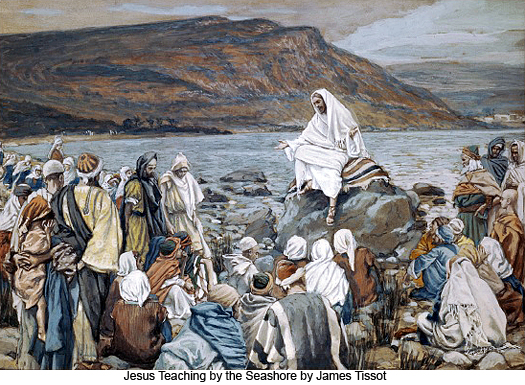
Their boat set out for a deserted place along the Sea of Galilee. But the word got out and lots of people “hastened” there, that is, they eagerly ran on foot, and arrived there faster than Jesus and the apostles could.

Why did those people run? They ran because they anticipated good things. They ran because they believed their desires would be fulfilled. In a word, they ran because Jesus and the Apostles had given them hope.

What can we hope for as Christians? Can we hope that if we stay close to Christ and to His Church that we’ll go to heaven someday?   Yes.  But is that all there is?  No. Our hope in Christ is not only for the time beginning once we’ve died.

Moments ago we heard Psalm 23, a psalm commonly heard at funerals. Though we tend to associate it with the holy dead, the blessings this psalm speaks of are for the living as well. For example, in the Gospel, Jesus leads the Apostles to a place beside restful waters to refresh their souls. He teaches the vast crowds that come many things, guiding them in right paths, and giving them courage. He has the people lay upon the green grass and, breaking bread, He spreads a meal before them.

We can confidently hope that Jesus will do these things for us.

Jesus wants to give you peace.  But what is peace? It means, in part, being liberated from worthless worry, having anxiety at all. As Christ inspired St. Paul to write the Philippians,

“Have no anxiety at all, but in everything, by prayer and petition, with thanksgiving, make your requests known to God.  Then the peace of God that surpasses all understanding will guard your hearts and minds in Christ Jesus.”

Jesus wants to teach you wisdom, and give you the courage you need to live it. Jesus Christ, teaching through our Church and its Scriptures, proclaims to you truths that the world doesn’t know and isn’t going to teach you. Jesus not only tells you how to live well but empowers you to do it too through the Holy Spirit alive within you.

Jesus wants to give you the bread you need. In a few moments, you will be receiving the body, blood, soul, and divinity of Jesus Christ in His Eucharist. And in addition to that, Jesus doesn’t only provide for you on this one day at Church. He provides for us all week long in the world out there. We pray for “daily bread”, and this is not just food, but whatever it is we need. Christ is rich, and wants to give you good things. If we a frugal and generous, He will provide us with whatever we need.

There is a lot of hopelessness about our times and the way things are headed, but we Christians should live with hope about our lives and about the world we live in. Now bad things are going to happen, but with Christ, a more glorious resurrection always follows the cross. With this truth in mind, we should be a people of hope.

At the same time, we should be wary of unchristian hopes, which are too worldly. Consider the crowds that eagerly flocked to Jesus. They held hope in this world because of Him. Unfortunately, their hope was often because they thought Jesus might become some militant, revolutionary messiah, who would ascend to the throne of David by slaying the Roman armies that occupied Israel. They were invested in hopes that he would establish a kingdom for Israel that would provide them with cheap food and easy money for the rest of their lives. John’s Gospel says that after the miracle of the loaves they wanted to carry Jesus off and make him king. The people wanted change, but Jesus wasn’t interested in their kind of change. Jesus knew that changing this world would be ultimately fruitless, unless we ourselves could first somehow be changed.

Our world is broken, but man is more broken more by sin. Give two sisters identical dolls, or give two brothers identical trucks, and a short time later you might come back to find them fighting over the exact same toy. Even if you handed everyone on earth everything they wanted, there would not be peace. The problem isn’t out there somewhere, the problems always in here. Money can do good things, but wealth in not our salvation. Good laws can help people, but politics are not our salvation. Christ is our salvation.

Christ is real and active with power in the world out there, but He tends to work from the inside-out.  That is to say, the kind of change that He is interested in usually begins within souls, like ours. Christ first changes Christians, and then through us, He transforms the world.

He wants to give us trusting peace inside, so we can live with freedom. He wants to give us contentment inside, as the antidote for our over-consumption. But first and foremost of all, He wants to give you prayer inside.

If you only hear one thing I say, this is the final and most important thing: A Christian has to pray, every single day. Daily prayer is the means to our conversion. Daily prayer is the first step to transforming our world. Daily prayer is the key to realizing our hopes, for this life and the next.

Christ has good things He wants to give you. So run to Him, with eager hope.

Tuesday, 19th Week in Ordinary Time—Year I

August 17, 2009

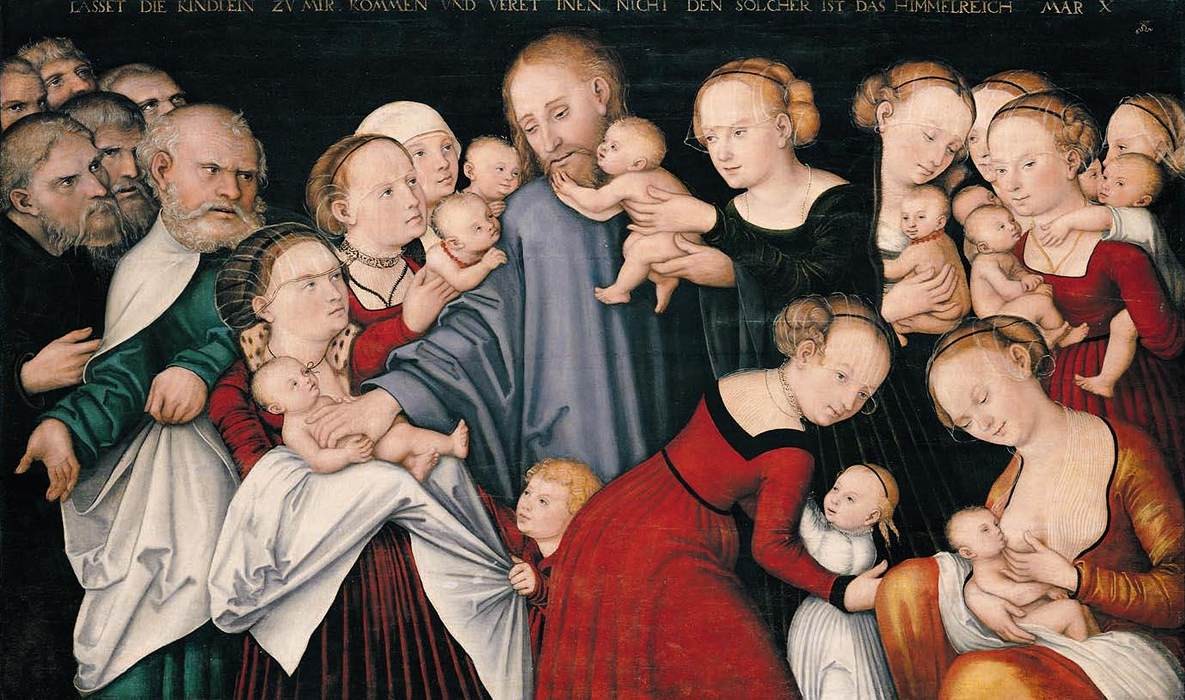
The disciples ask, “Who is the greatest in the kingdom of heaven?” Jesus says, “Whoever becomes humble like this child is the greatest in the Kingdom of heaven.” In fact, Jesus teaches us, becoming humble is essential to entering into His kingdom.

So what is humility?

“Now humility is nothing but truth,” says St. Vincent de Paul, “while pride is nothing but lying.” He says, “The reason why God is so great a lover of humility,  is because he is the great lover of truth.”

Now humility is not about believing we are garbage. It’s a lie to say we’re of little worth. Even the seemingly least person among us is attended to by angels and bears a likeness to the God whom those angels ceaselessly worship. We are of great worth, but to be humble we need to know where our true treasure is.

We must abandon over-confidence in our own faulty and limited powers and trust in our reliable Rock—“how faultless are his deeds, how right all his ways.” In Christ, our Rock, we are secure; and as G.K. Chesterton notes, “It is always the secure who are humble.”

To strip away our illusions and to know our true treasure let’s pray today for the two gifts which it is said God always promptly gives whenever we prayer for them: Humility and Faith.

We can be leery of praying for humility, because when you pray for humility, humility shows up. I myself cannot recall a time when my prayer for humility was not answered by the end of the next day. But let’s have courage, and not allow our entry into Christ’s Kingdom be delayed by our disordered self-love or timidity.

What Moses said before the Israelites on the edge of the Promised Land is just as true for us: “It is the Lord who marches before you; he will be with you and will never fail you.  So do not fear or be dismayed.”