Archive for the ‘Prayer’ Category

The Rich Fool — 18th Sunday in Ordinary Time—Year C

August 12, 2010

I regret to inform you that you are going to die. Perhaps not today, but someday, and it could be very soon. We should ask ourselves, “Am I ready? How can I prepare?”

The Gospel relates the story of a man who was not ready, a man God calls a “fool.” Jesus offers Him as an anti-role model; a person whose example we should learn from, but not imitate. Yes, he is a fool for hoarding his possessions. The old saying is true, “You can’t take it with you.” But there are more subtle lessons we can learn from his bad example. This morning I would like to present three things this rich man has to teach us:

The first lesson comes from what he does when his land produces a bountiful harvest. He asks himself, “What shall I do?” There is nothing wrong with this question in itself, but he is a fool in the way he asks it. The rich man asks himself, and only himself, “What shall I do?” He does not consult with God, in either his conscience or in prayer, to learn what His will is.

What is the lesson here for us?  Let us remember to listen to the Lord as He speaks in our conscience, through prayer, the Scriptures, and the people He has placed in our lives. We should listen for God’s direction every day, and throughout each day.

A second cautionary lesson is found in the rich man’s plan for solving his storage problem. He says, “This is what I shall do: I shall tear down my barns and build larger ones.” What was wrong with the older barns? They were not large enough to hold everything, but why tear them down? The rich man has plenty of land. Why did he want to replace his perfectly good barns?

Vanity of vanities, he wanted his storehouses to be the newest, the biggest, and the best. Though the rich man was not very concerned about other people, he was very concerned about their high opinion of him. Even in those days, people were tempted to consumerism.

Consumerism seems to consist in two phantom promises: that having just a little more will truly give me lasting happiness, and that others will regard, accept, and love me when they notice the things that I have. These are phantom promises, for as soon as one reaches to grasp them they prove empty, illusory, receding further out of reach.

The fact is that the people who are happiest in life are not the wealthiest. (By that measure, pretty much every American should be among the happiest people in the world.) The happiest people tend to be those who share the most or give the most away. The person who recognizes they have enough, that life does not consist in possessions, is content and secure enough to share. Some people try to get the most out of life as possible, but what we appreciate most in our lives is the ways in which we have given of ourselves for others.

Our third cautionary lesson is heard in God’s rebuke of the man: “You fool, this night your life will be demanded of you; and the things you have prepared, to whom will they belong?” When we think of the things the rich man has prepared, we think of his harvest and goods.  One of the things he has ill-prepared… is his soul, which this night will be demanded of him. And now, to whom will it belong?

The lesson here for us?  As focused as we are upon our possessions, we must be more attentive to our souls. Someday, we are going to die. In the meantime, then, let us put to death, the parts of you that are earthly, as St. Paul said: immorality, impurity, passion, evil desire, and the greed that is idolatry.

What lessons does the rich man teach us? Reject the false promises of the consumer cult, for life does not consist in possessions. (Self-gift is the meaning of life) Turn your heart to your spiritual well-being, for your life and this world shall pass away.  And to frequently ask Jesus, everyday, “What shall I do?” Let us begin today, before it is too late for us to begin living wisely.

Pushing Boulders — 13th Sunday in Ordinary Time—Year C

July 1, 2010

Once upon a time, there was a hermit who lived in a cabin in the woods.  Each day, he would spend a good deal of time in prayer. One day at prayer he quieted himself, opened himself receptively to God, and heard Jesus speak to him. It’s wasn’t that he heard Jesus externally, speaking from across the room, but within his own thoughts. The hermit knew from experience that the Lord sometimes sends us an image, a memory, a song, or words in times of prayer to communicate with us.

The Lord said, “Go outside to the large boulder in your yard.” The man got up and went. Then the Lord said, “I want you to push this boulder for at least 30 minutes every day.” The man went about pushing the boulder every day, exerting his body in every way, but even months later he could not discern having moved the stone a single inch.

The man thought to himself, “Am I doing something wrong? Am I failing because of my sins or my lack of faith? The Gospels say that if I had faith the size of a mustard seed I could move mountains, but I can’t even move this stupid boulder.  Am I failing because this isn’t really God’s will? Did the Lord really tell me to do this, or did I just imagine it myself? No I heard Him, as surely as the other times when I heard Him speak. But why does He give me a task that He knows I can’t do? Does He want me to fail?” At this the man became very angry and (wisely) took his frustration to God. 

The man heard the Lord speak to Him, “Do you have reason to be angry? I told you to push the boulder, but I never told you to move it. Look at your arms, look at your legs, you have become strong because of your faithfulness and now you are ready for my next mission for you. You thought you were failing, but you succeeded in doing my will.”

In today’s gospel, Jesus turns resolutely toward His final journey to Jerusalem. He sends out advance teams to visit the towns ahead of Him and prepare His way. One of these villages is a Samaritan town and when they learn that Jesus’ destination is Jerusalem they refuse to welcome Him. James and John see this and ask, “Lord, do you want us to call down fire from heaven to consume them, like Elijah did back in the day?” Jesus turns and rebukes them; the fire of the Holy Spirit is meant for the salvation of people, not their destruction.

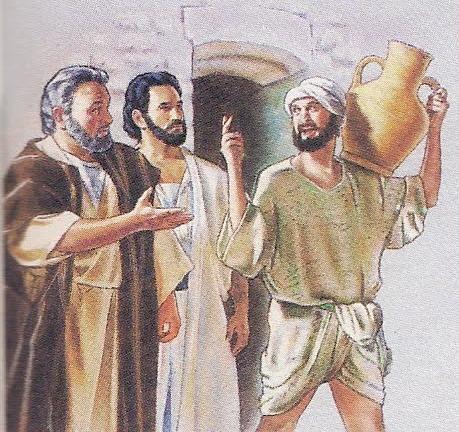
Why did Jesus send His disciples to that Samaritan town, instead of just instructing them to pass it by? Jesus knew what was going to happen when they went to that village–He knew by His divine insight that they wouldn’t accept Him. Remember when Jesus needed a donkey to ride on into Jerusalem? He sends two disciples to find and untie a donkey who had never been ridden before and He tells them what to say if anyone asks what they are doing. They go into the city and find everything as Jesus had described. Remember when Jesus needed a place to celebrate the Last Supper? He tells Peter and John to go into the city and to follow a man they will see carrying a jar of water, when they come to the house he leads them to, they are to ask if there is a place for the master to celebrate the Passover. They go and find everything a Jesus described, including an upper room already prepared for a Passover. Jesus knew that the Samaritan town would not welcome Him, so why did He send disciples there?

The mission may have seemed like a failure, but Jesus’ plan succeeded. Jesus knew that His Apostles would soon be preaching the Gospel to the whole world and He knew that not everyone would welcome them or their message. Jesus wanted to give them some experience in rejection to teach them how to respond; not with anger and violence, but with patience and peace. James and John learn a lesson about divine mercy. They may have thought their mission to the Samaritan town was a total failure, but the Lord was successfully achieving His goals in them.

So what does all this have to do with us? In our lives we often experience weakness, setbacks and apparent failures. In response, we often blame ourselves, even when we are innocent, or we conclude that we must not have been doing God’s will, or we get angry with God for frustrating or not helping our efforts. Yet, as long as we are faithfully following Christ, nothing we attempt is ever truly a failure.

The only true failure in the Christian life is sin, but if we repent of our past sins even these can be used to benefit God’s great plan. Scripture says, “God works all things for the good of those who love Him,” this even includes our repented sins. We are obsessed with success, but as Blessed Mother Teresa reminds us, “God does not ask us to be successful; He asks us to be faithful.”

Sometimes you will feel like you are failing, or that your efforts have been useless, but by your faithfulness you will be succeeding in doing God’s will. Let us remember that at the center of our faith is a man nailed to a cross; an appearent failure who was actually succeeding in saving the world. Jesus rolls away stones in ways we wouldn’t expect.

Catechetical Mass Reflections — Nativity of St. John the Baptist

June 30, 2010

Before Mass

If you just sit around before Mass waiting, you are wasting your time. Prepare for Mass with prayer.

Ask Jesus to help you to be a fully present as He is present at this Mass.

Ask Him to help you be open to receiving everything He wants to give you at this Mass.

Form a Mass intention; that is, choose a person, group, or need you would like the graces of your participation in this sacrifice to be applied to.

After the Openning Prayer / Before the Readings

Shouldn’t we expect to find the incarnate the Word of God in the Word of God we proclaim at Mass? Look for Jesus shinng brilliantly in today’s first reading from Isaiah.

Millions of people purchased and “studied” the DaVinci Code even though it gave no real insights into Christ. Imagine if there were a book out which reputable archeologists claimed contained the actual prayers of Jesus and Mary? Would you read this book? Would you incorporate its prayers into your own devotions? This book really does exist… it is the Book of Psalms, which pious Jews in the time of Jesus and Mary knew by heart. Today we will be praying one of these psalms of Jesus and Mary and I invite you to unite your prayer to theirs.

In the second reading we will hear the preaching of St. Paul and in today’s gospel, the words written by St. Luke. Let us not think that they words are merely adressed to ancient Christians.  When the quill was put to papyrus to pen these words, the Holy Spirit saw you here. If you listen and are open to the Spirit, He will speak to you through these words.

After the Gospel / Before the Creed

Have you ever written or received a love letter? I believe it was St. Catherine of Siena (one of the three female doctors of the Church) who taught that we should say the creed like a love letter, as either one we are sending or one we have received. A love letter reflects the feeling of the lover and contains truths about the beloved. Let us call this to mind when we say the Gloria, too.

After the Presentation of the Gifts / Before the Eucharistic Prayer

During the Eucharistic prayer, don’t spectate, actively participate. You have not come to watch the priest pray for you, but to unite your prayer to His. When he prays for the Church, pray for the Church within yourself. When he prayes for the dead, pray for the dead, too.  The priest is the head and you are the body. Every member of the body should make the prayers of the mouth their own.

During Mass, look at the person you are praying to. Most of the prayers at Mass are addressed to the Father, while a few are addressed to the Son. When we are praying to the Father, raise your eyes up to Him in Heaven or close your eyes to address the He who cannot be seen. When Jesus is on the altar, look at Him with attentive love.

Put yourself and those you care for in the chalice, to be transformed like the wine and offered with Christ.

After Communion / Before the Closing Prayer

Take this moment to tell Jesus “thank you” for giving you so awesome a gift. It’s the least we can do.

4 Truths of Human Nature

June 18, 2010

Who We Are Before God

In relating to God (especially in prayer) it is important to know who and what we are. In short, each one of us is Loved, Limited, Sinful, and Good. These are four truths of  our human nature.


1st Truth:  You are Loved

The Denial:  “God doesn’t love me.”
This Denial’s Consequences:  Sadness, Anxiety, Resentment
The Truth:  God created you in love and holds you in love. Jesus loves you, and Mary, angels, and saints (on earth and in heaven) love you, too.
The Fruit of Living in this Truth:  Peace, Trust, Love

[Lord,] you love all things that are and loathe nothing that you have made; for what you hated, you would not have fashioned. And how could a thing remain, unless you willed it; or be preserved, had it not been called forth by you? But you spare all things, because they are yours, O LORD and lover of souls, for your imperishable spirit is in all things! (Wisdom 11:24-12:1)

God proves his love for us in that while we were still sinners Christ died for us. (Romans 5:9)

This is my commandment: love one another as I love you. (John 15:12)


2nd Truth:  You are Limited

The Denial:  “I don’t need God. I can do anything, if I just believe in myself.”
This Denial’s Consequences:  Pride, Frustration, Folly
The Truth:  You are, and will always be, God’s limited, finite, and dependent creature.
The Fruit of Living in this Truth:  Humility, Patience, Communion

When I see the heavens, the work of your hands, the moon and the stars which you arranged, what are we that you should keep us in mind, mortal man that you care for him? (Psalm 8:4-5)

If the Lord does not build the house, in vain do its builders labor; if the Lord does not watch over the city, in vain does the watchman keep vigil. In vain is your earlier rising, your going later to rest, you who toil for the bread you eat: when he pours gifts on his beloved while they slumber. (Psalm 127:1-2)

I am the vine, you are the branches. Whoever remains in me and I in him will bear much fruit, because without me you can do nothing. (John 15:5)


3rd Truth:  You are Sinful

The Denial:  “I don’t have any real sins.”
This Denial’s Consequences:  Impenitence, Corruption, Sin
The Truth:  Even after baptism,
concupiscence remains, inclining you to sin.
The Fruit of Living in this Truth:  Contrition, Conversion, Sanctification

No one is good but God alone. (Mark 10:18)

…All have sinned and are deprived of the glory of God. (Romans 3:23)

If we say, “We are without sin,” we deceive ourselves, and the truth is not in us. If we acknowledge our sins, he is faithful and just and will forgive our sins and cleanse us from every wrongdoing. If we say, “We have not sinned,” we make him a liar, and his word is not in us. (1 John 5:8-10)  


4th Truth:  
You are Good

The Denial:  “I’m worthless.”
This Consequence:  Sadness, Shame, Despair
The Truth:  Your human nature remains good, despite wounds and weakness.
The Fruit of Living in this Truth:  Joy, Hope, Fruitfulness

Then God said: “Let us make man in our image, after our likeness. … God looked at everything he had made, and he found it very good.” (Genesis 1:26,31)

[The Gentiles] show that the demands of the law are written in their hearts, while their conscience also bears witness and their conflicting thoughts accuse or even defend them on the day when, according to my gospel, God will judge people’s hidden works through Christ Jesus. (Romans 2:14-16)


Finally,
some true and helpful things to remember about God’s attitude towards you: 

  • God not only loves you, He likes you, too.
  • God works all things for the good of those who love him (Romans 8:28); including every evil that befalls you and your own past sins.
  • God is easily pleased, and hard to satisfy.  

An Incomplete Lord’s Prayer — Thursday, 11th Week in Ordinary Time—Year II

June 18, 2010

Sometime in the past, I realized that I didn’t pray the Lord’s Prayer right.  It’s not that I was actually changing the words Jesus taught us to say, but I realized my focus was not fully what Jesus had in mind. My subjective, firsthand experience of praying the prayer went something like this: 

God, who art in heaven…
     [<Here I get distracted for several seconds>]
…give me this day my daily bread,
and forgive me my trespasses,
as I forgive those who trespass against me,
and lead me not into temptation,
but deliver me from evil.

Did you notice anything different?

First, Jesus taught us to pray to “Our Father” because we are not praying to anonymous force, but a person, a divine person who is imaged in a special way by natural and spiritual fathers on earth. Earthly fatherhood is a diminished image of Him. Biological fatherhood teaches us about our heavenly Father’s transcendence, while devoted fathers teach us about His love. (“The respective ‘perfections’ of [both] man and woman reflect something of the infinite perfection of God,” as the Catechism teaches, but “Our Father” is significant.)

Second, the prayer’s early petitions, “hallowed be thy name. Thy kingdom come. Thy will be done on earth as it is in heaven,” are every bit as important as the later petitions ‘about us.’ God is justly entitled to glory, His kingdom and reign.  Remember that all these are essential and conducive to our own greatest happiness.

Third, the Lord’s Prayer is not meant to be prayed just for yourself or myself, but for all of our Father’s family, for the whole Church, for even the whole world. The Our Father is not only a petitionary prayer, but an intercessory prayer.

So when we prayer the Our Father, the perfect prayer which Jesus taught us, let us pray it in its completeness, with a presence of mind and fullness of heart.

Not If, But When — Wednesday, 11th Week in Ordinary Time—Year II

June 16, 2010

Notice that in today’s gospel, Jesus does not teach saying, “If you give alms…” or “If you pray…” or “If you fast….”

Jesus says, “When you give alms… when you pray…. [and] when you fast….”

Prayer, fasting, and alms giving are assumed for the follower of Christ. If we do not have all three of these as a regular part of our lives, we need to put them there. And when we do, our Father, who sees all, will repay us.

Real Presence — Corpus Christi

June 7, 2010

I once came across a story on the internet that went something like this: A Catholic man is giving his Muslim friend a tour of his Catholic Church. He shows him the holy water at the door and how we bless ourselves with it. He points out the stained glass windows and the stations of the cross, explaining how these present the majore events of Jesus’ life, death, and resurrection. He shows him the statues and the crucifix and finally the tabernacle.

“That’s the tabernacle. Inside that box is the Eucharist. It looks like flat, white bread, but it is truly the Body, Blood, Soul and Divinity of Jesus Christ, our Savior and God.”

The Muslim man looks at the tabernacle, pauses in thought, looks at his friend, and says, “If I believed that God was really present in that box, I wouldn’t let my face come off of the floor.”

Whose approach towards God is the right one: the Catholic’s or the Muslim’s? When we come up to receive communion we do not crawl up on our faces, but should we?

Christians relate to God as we do because of the way Jesus Christ related to us. With the incarnation, God came to us on our level, as one of us. Jesus did not want his disciples to regard him with terror. He invited them to be His friends, and to relate to Him as their Brother. He taught us to call His Father “our Father,” and he made us temples the Holy Spirit. Jesus gives us unprecedented intimacy with God and we are “free to worship Him without fear.”

Yet, there is some truth in the saying that familiarity breeds contempt. When we come to Mass and receive the Eucharist, how well do we prepare ourselves to receive Him? How much do we do to appreciate this priceless gift? This morning I would like to give some ways we can do this better.

Before we even leave home there is a way for us to prepare ourselves. Think of it this way: if you were going to be on TV and seen by a millions, what would you wear? If the president of the United States (whoever he happened to be) were coming to your town, and you were chosen to officially welcome him, how would you dress? At Mass we are not seen by millions, but by billions of angels and saints, and we more than just the president of the greatest country in the world, we meet the King of the universe. When we come to Mass we should wear our Sunday best.

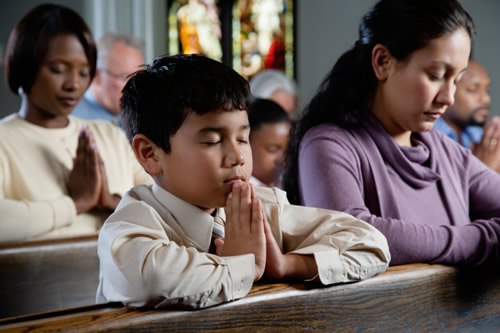
When you arrive at church before Mass begins resist the temptation to just wait out the time until the priest comes out. Take the opportunity to prepare yourself with prayer. At the beginning of the liturgy there are some things we do to tune us into the liturgy, such as the penitential rite and the opening prayer, but if you have not prepared yourself before the Mass begins these will probably just flash by you.

When you get to your pew, say to Jesus, “Lord, I’m sorry for my sins. Please have mercy on me. Please help me to be as fully present as you are present. Help me to receive everything you want me give me in this Mass. I raise up my intention for this Mass you along with all I love and everything I am. Thank you for calling me to know you, and for everything.”

During the Mass, especially when Jesus is on the altar, his throne, we should give Him our full attention. Religious devotion is about more than mere appearances, but shouldn’t we expect a fervent devotion inside to be reflected on the outside?

When I was growing up and beginning to look at my faith more critically, I wondered if we really believed in the Real Presence. I mean, the symbolic understanding, that’s easy—like how the flag reminds us of America, but do we really, really think that’s Him? My CCD teachers insisted that’s what we believed and I found scriptural and historical evidence that Christians had always believed it.  Yet, when I looked around at other people at Mass it didn’t seem like they believed they were in the presence of God. Then an important thing happened. A new pastor came to our parish and when he celebrated the Mass you could tell that he believed he held something (Someone) precious in his hands. That priest was Father Paul Gitter, whom you know well.

During the Mass, give God your whole self. Express your devotion. Whenever you sing, don’t just do it because that’s what everyone else is doing—make it an offering, a gift, a prayer. When you are praying to the Father, raise you eyes to Him. When you are speaking to Jesus, turn you eyes to Him. Smile at Him in the cup and on the paten. Celebrate every Mass as if it were your first, your last, and your only.

After you receive Jesus in the Eucharist, open yourself to receive everything that He wants to offer you. In His private revelations to St. Faustina Kowaska (through whom we received the Divine Mercy devotion celebrated throughout the Church) Jesus said many people receive Him and then forget about Him. “My great delight is to unite Myself with souls,” He said. “When I come to a human heart in Holy Communion, My hands are full of all kinds of graces which I want to give to the soul. But souls do not even pay any attention to Me; they leave Me to Myself and busy themselves with other things. Oh, how sad I am that souls do not recognize Love! They treat Me as a dead object” (Diary of St. Faustina, #1385) After you receive Him, and kneel down in the pew, ask that you would receive from Him every grace He wants to give you with Himself. And remember to tell Him, “Thank you,” and, “I love you.” It’s the least that we can do.

When we leave church after Mass, let us not think that we have left Gift we have received behind us. Jesus also told St. Faustina that when we receive the Eucharist He remains in our souls until we receive Him again, provided that we do not cast Him out through serious, grave sin. He remains with us and provides what we need to serve Him.  We only have to remain open and mindful towards Him.

Jesus feeds us His Body and Blood because He wants us to be extensions of Himself. We the Body of Christ. We are His arms, His hands, and His eyes, ears, and mouth in the world. First, He transforms the bread and wine. Next, He transforms us. And then, He transforms the world. When ‘the Mass is ended,’ that’s just the beginning.

In a few moments we are going to receive the Body, Blood, Soul and Divinity of Jesus Christ in the Eucharist. Let us prepare ourselves and open ourselves to receive this most incredible Gift.

Mother’s Day Homily

May 9, 2010

This Sunday our country celebrates our mothers—and rightly so. For the care and love which our mothers have given us is beyond price or measure. Of course, our earthly parents are not perfect. Sometimes they’re quite far from perfect. But any love we’ve known from them is a likeness of the love God has for us.  A religious icon is made of mere wood and paint, but it can be a window to heavenly realities.  In the same way, we can see through our parents’ love a glimpse to God Himself.

Most of us have more memories about our mothers than we could possibly count, but today I would like to take you back to a time and place about which you have no clear memories—to the time in your mother’s womb.

In the Bible, the number forty denotes times of waiting and preparation: For instance, Noah spent 40 days and nights in the ark. The Hebrews wandered with Moses for 40 years in the desert. Before His ministry, Jesus fasted 40 days in the wilderness, and after His death, He rested 40 hours in the tomb. Similarly, you remained 40 weeks, more or less, within your mother’s womb, being prepared for a new life.

Attached to your mother’s vine you grew into the mature fruit of her womb. You were nourished and matured within her. You were never far from her heart or mind. You existed in within her, connected to her at the center of your being. She fed you with her very self. She provided for all your needs. Apart from her, you could do nothing. You remained in her and found rest within her.

In the womb, at the earliest stages of our lives, our minds did not comprehend very much, but what if you could have understood everything that your mother was doing for you at the time? Surely you would have directed your thoughts to her often.  And certainly, from time to time, you would have turned to her with the eyes of your heart to bask in her love for you.

What if you could have talked with your mom from the womb? Would you not have taken the opportunity to speak with her every day? Would you not have thanked her daily out of a deep gratitude? Would you not have let her know each day how much you love her? Whoever would refuse or neglect to express such love and thanks would continue to live, at least functionally or biologically, but they would not be fully alive without this relationship with their mother.

As you and your mother would continue to talk, as the days and months of pregnancy passed by, she would eventually present you with a most-frightening prospect: She might put it this way, “My child, soon, in a little while, you are going to begin a new stage of your life. You will be departing from the life you know, and then you’ll experience a whole world of people and things you have never known before.”

You might say, “I’m scared! I don’t want to go—not now, not ever!” But she would answer, “I realize this concept is scary for you, but trust me when I say that it is better that you go. In fact, someday soon you’ll look back and think it a silly thought to be again as you are now. This transition is going to hurt a little bit… trust me, I know… but when the appointed time comes, I’ll be right here with you. Don’t be afraid. It’s going to be O.K.”

This morning we reflect on this time in the womb because our life in our mothers is like our life in Christ. As it was with our mothers, so it is, in our life with Christ. You are attached to Him as to a vine you mature as a child of God. You are nourished and grow within Him. You are never far from His heart or mind. You exist within Him, connected to Him at the center of your being. He feeds you with His very self. He provides for all your needs. Apart from Him, you can do nothing. You remain in Him and find rest in Him.

Knowing and believing this, shouldn’t we direct our thoughts to Him often? Shouldn’t we, from time to time, turn to Him with the eyes of our hearts to bask in His love for us. We have the ability to talk with Jesus Christ, in prayer, whenever we wish. Who would not take the opportunity to speak with Him every day? Who would not thank Him daily out of deepest gratitude? And who would not let Him know each day how much we love Him? Whoever would refuse or neglect to speak with Him, would continue to live, at least functionally or biologically, but they will not be fully alive without this relationship with Christ. We need to pray every day if we want to remain in Him and bear much fruit.

We don’t want to die and that’s perfectly natural. But Jesus says to us, “Soon, in a little while, you are going to begin a new stage of life. You will be departing from the life you know, and then you’ll experience a whole world of people and things you have never known before. I realize this concept is scary for you, but trust me when I say that it is better that you go. In fact, someday soon you’ll look back and think it a silly thought to be as you are now again. This transition is going to hurt a little bit… trust me, I know… but when the appointed time comes, I’ll be right there with you. Don’t be afraid. It’s going to be O.K.”

Today, let us thank God for the life, love, and tender care we have received from our mothers and through Jesus Christ. God bless our mothers and praised be Jesus Christ.

The Savior’s Hands — Good Friday

April 7, 2010

This Good Friday, let us meditate on our Savior’s hands.

These hands held the scrolls of the Jewish Scriptures, from which He learned the Word of God. These hands held the hand of Joseph, and reassured him for his happy death. These hands fashioned the products of a carpenter to support His mother and Himself in their needs.

When the time came for His public ministry, these hands touched the ears and toungue of a deaf and mute man, allowing him to hear and speak. They smeared mud in the eyes of a blind man, who then washed and was able to see. They touched a leperous man and cured him of his affliction.

These hands formed a whip out of cords and drove out the moneychangers and salesmen out of the court of the Gentiles so that the temple could be a place for all peoples to worship the True God. These hands blessed and broke a few loaves of bread and multiplied them to feed thousands.

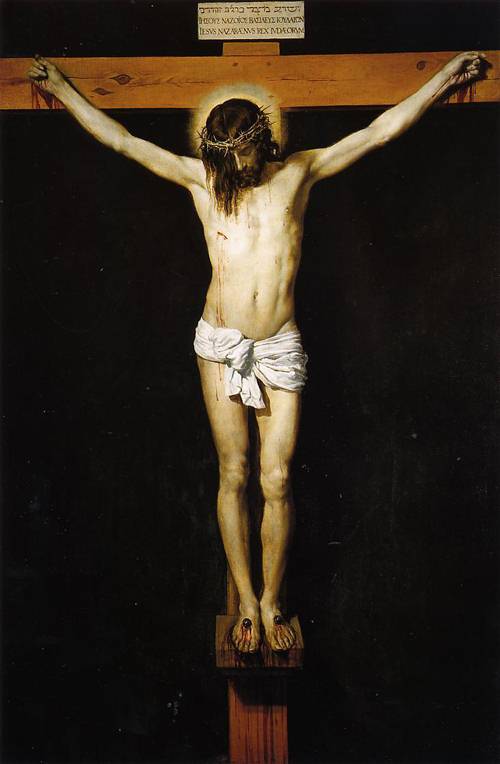
Today, these hands are nailed to the cross. Jesus’ crucified hands can do nothing, apart from perhaps twitching a couple fingers with excruciating pain. Yet of all the wonderful things that Jesus did with His hands, this was the greatest.

I offer two obeservations for us today.

First, that when Jesus could do nothing, He could still speak and pray. We can do the same we when faced with the things beyond our power (which is really nearly all things.)  We can bind our hands in prayer, a symbol and  acknowledgement of our own limitations, and pray.

Second, it was when Jesus was powerless he performed his greatest good. We worship a crucified God; who suffered, died, and rose from it triumphant. We should expect and understand that this mystery will be replayed within our own Christian lives. As St. Paul observed when he considered his own life, “when I am weak, it is then that I am strong.” The same applies for us.

Sometimes we suffer because of loved ones we cannot seem to help, or serious illnesses that befall ourselves or others. Our crosses take different forms, and can feel powerless with them. But we do more good through our crosses than we know.  Remember, that of all the things that Jesus did with His hands, the greatest was when He suffered them to be nailed to the cross for us today.

The Prodigal Son — 4th Sunday in Lent—Year C

March 14, 2010

If today happens to be your first time coming back to church in a long time, then take today’s gospel as a sign. God our Father is incredibly merciful and He welcomes you home with a loving embrace.

But most of us here, I suspect, came to Mass last week, and the week before that, because you always come every week. If so, then you probably hear this familiar parable of the Prodigal (that is, squandering) Son and wonder where you fit into the story. When you look at yourself I bet you can honestly say that you’re not living a life of great dissipation like the younger son, and the idea of a sinner being reconciled with God makes you genuinely happy, not bitter, like the older son or the Pharisees. So what does this story have to teach those of us who are doing a lot more right than we’re doing wrong?

First, let’s look at the younger, prodigal son. He goes to his father and says, “Father, give me the share of your estate that should come to me.” Here, he is asking for his inheritance while his father is still alive. He is basically saying, “I don’t want to share my life with you,” and then he demonstrates it a few days later by setting off to a distant country. There he squanders his inheritance on a life of dissipation, but after he has freely spent everything, he finds himself in dire need. What he thought would make him happy left him disappointed in the end.

Sure, we’re not professional, all-star sinners like the prodigal son, but we act like him in many little ways in our daily lives. The prodigal son asked his father for something which was not his and which he had no right to take (while his father is still alive.) Whenever we live as if our lives were our own, as if our lives did not come from God and do not belong to God, our Father, we say to Him, “I don’t want to share my life with you.”

Though our small and venial sins only hinder or wound our relationship with God, in every sin we turn our backs and set off for awhile to a distant country. Whenever we insist upon it, God permits us to freely spend our lives in squandering ways, in ways which we think will make us happy but which disappointing us in the end. When we return to our Father, He forgives our sins and welcomes us back, but you and I must learn to stop trying to live our lives without sharing them completely with God.

Why are we afraid of the idea of doing what God wants us to do every moment of our day? I think we are afraid that doing God’s will won’t really make us happy. Maybe we imagine that doing God’s will means we will have to pray ten hours a day at church or walk around wearing a burlap outfit. Of course that’s crazy. God probably wants you to live the same life you are living now, but with some minor adjustments, and more closely to Him.

Maybe we are afraid to give ourselves completely to God because we are a lot like the other, older, more faithful son in the parable. We have served our Father for years without ever asking or expecting much for ourselves. But working hard for God without ever experiencing His good gifts and joys does not make us holy; over time it makes us angry and embittered, like the older son who never asked for anything. We start to think of our Father, not as our father, but as a slave master. But our Father says to us today, “My child, you are here with me always; everything I have is yours.”

“Taste and see the goodness of the Lord,” as our psalm said. Do not let your face blush with shame at asking for good things for you and your friends to enjoy. When we are poor and call out the Lord hears us, and He will save us from all our distress. So look to God, and be radiant with joy.

We’ve learned important lessons from both of the sons in this parable, and I hope we will put them into practice.

From the faithful but disgruntled son, we learned the importance of asking for good things from God. So today, at this Mass, ask our Father to surprise you today with some good gift that you’ll enjoy. Then watch to see what He does for you.

From the prodigal son we learned the importance of living with and for God every day of our lives. So tomorrow morning, when you wake up and you’re lying in bed, make the sign of the cross and entrust yourself to God for that day, that you may live your life that day always with Him and for Him. Ask you guardian angel to remind you and I bet you will remember.  Try it, and I think you’ll be pleasantly surprised by the difference it makes in your day.

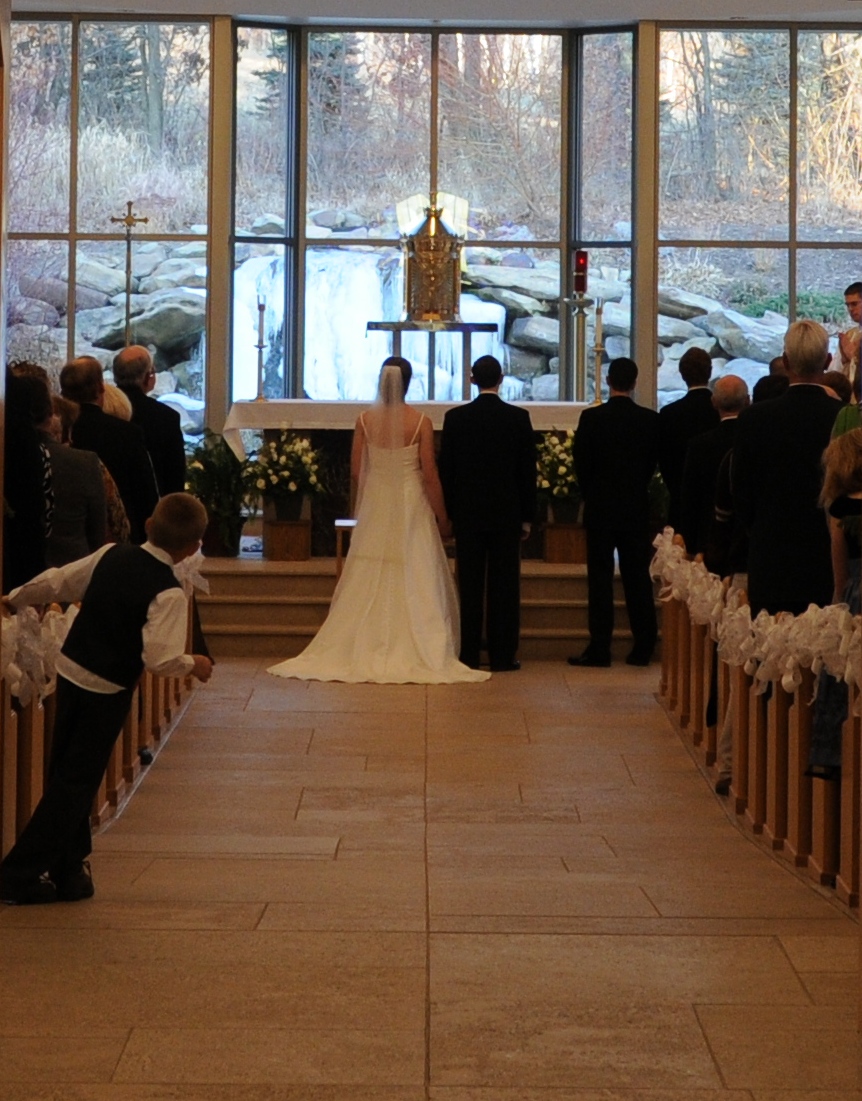
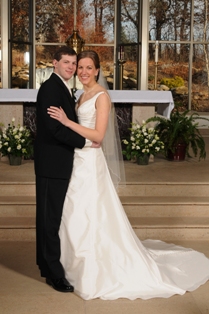
For an Extraordinary Marriage — Wedding of Andrew and Laura Foreki

March 3, 2010

I would like to begin this homily today by sharing with you the extraordinary story of how this boy, Andrew, met this girl, Laura. Picture Andrew, walking one morning across the University of Wisconsin campus in the deep cold of winter. He is on his way to Chadborn Hall where a prayer group is meeting for their twice-weekly 7:30 rosary. 

He walks into the room where the group is meeting and casts his eyes, for the very first time, upon a drowsy-eyed coed named Laura. And can you guess what Andrew said to himself when his eyes saw Laura for the very first time? That’s right. He said to himself, “Oh, I don’t know who that is.” This reaction, of course, is to be expected, since Andrew and Laura didn’t know each other prior to being introduced a few moments later.

Now Andrew’s first impression is not what makes this an extraordinary story. Did you notice what was the extra-ordinary part? Here it is: Here we have two college students, getting up, out of warm beds, on a cold day, to pray a rosary, at 7:30 in the morning! Now, you have to understand, in College Student Time, this is like getting up at 4:30 AM. Your typical college student doesn’t get up any earlier than he has to, but these two got up… to pray. For this and a thousand other reasons, I think you will all agree with me, that we have here two extra-ordinary people, from whom we good reason to expect an extraordinary marriage.
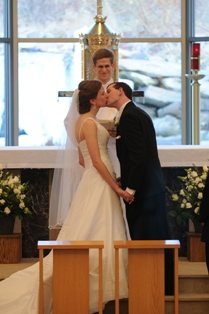
Do you two want to ensure you share an extraordinary marriage together? Then there are three things that I, as an ordained servant of Jesus Christ, believe that you should do.

First, like Tobit and his wife Sarah in our first reading, you should pray together. Of course you must pray individually. And of course you must pray with your children once they come. But you also need to pray together. It doesn’t need to be anything complicated.  Just hold each others’ hands a few moments before you part for work, or stand, or kneel, at your bedside, like Tobit and Sarah did, and speak aloud from your hearts to God. Ask blessings for each other, and give thanks for all the blessing you have received, and close you prayer by saying, “Amen, amen.”

Some couples find this kind of prayer too intimidating, or too personal, to be attempted; for our prayers express our most intimate selves, our fears, our hopes, our pains, our joys, our deepest longings. If you pray honestly in this way, nothing will be hidden between you. Today you will vow to give yourselves completely to each other. Do you want to be truly and totally one? Then pray together. Through marriage you will share of one flesh, if but pray together and you will also share of one spirit. Pray together and you will share an extraordinary marriage as one flesh with one soul. So please, pray together.

The second thing you should do for an extraordinary marriage is to come to Mass. Come to Mass every Sunday and every holy day of obligation. Come, and be moved by the beauty of architecture and songs. Come, and be strengthened by the experience of Christian fellowship. Come, and be inspired by the eloquence of Gospel preaching.

No doubt some people hear this and think to themselves, “That sounds great… But our church is ugly and the songs are dumb and hard to sing. And our community is little more than a gathering of strangers. And our priest always gives the same boring homilies.” Which all boils down to saying, I just don’t get anything out of going to Mass. Then hear this, even if everything else is lacking at Mass, Jesus Christ is always here for us, Body, Blood, Soul, and Divinity in the Eucharist. At Mass, the one sacrifice of Calvary and the Last Supper are made truly present to us for us to receive their power.

At Mass Jesus Christ shows us the perfect spousal love that He calls each of us to imitate. Jesus never called himself “the bachelor.” No, He joyfully called himself “the bridegroom” and eagerly seeks to unite himself to His bride. On the cross, naked without shame, He consummates this union with her, giving himself freely, fully, fruitfully, and forever… freely, fully, fruitfully, and forever. Do you want your union with each other to be free, fully, fruitful, and forever? Then come to Mass to learn the pattern of how Christ loves us and draw from the power He offers us through communion with Him. His is the pattern and the power for an extraordinary marriage. So please, come to Mass.

The third and final thing you should do for an extraordinary marriage is to be salt and light in the world. What does this mean? Being salt and light means that your Christianity should show. As Jesus says, “Your light must shine before others, that they may see your good deeds and glorify your heavenly Father.”

Your good deeds should stand out in the world. As St. Paul says in the second reading, “Do not conform yourselves to this age, but be transformed by the renewal of your mind” If the world never judges you to be radical in any aspect of your Christian life, then you’re not doing it right. Then you’re not yet living as salt and light–you’re not yet living like the saints. For example, everyone loves their friends, but who loves their enemies and prayers for them? Most people pray, but who spends a long time to be with God every day. Many people can give when times are prosperous, but who gives generously when times are tight? Such things as this are what it means to be the light and the salt of the world. Light is different than the darkness, and salt makes the ordinary flavorful.

Clearly, you two are salt and light already, for who goes on weekend retreats to know God better? Or who drives to Washington D.C. to march for life? Or who goes down to Louisiana to volunteer for Hurricane relief? Or who get up at 7:30 in the morning to pray the Rosary? So, please keep on being salt and light, and your marriage will be extraordinary.
Years from now, I don’t expect that you will remember much from this homily, but I hope you remember these three things: Pray together, come to Mass, and be salt and light and you will have an extraordinary marriage.

[Preached as a deacon for my sister’s wedding,  November 22, 2008]

The Our Father — Tuesday, 1st Week of Lent

February 23, 2010

When the apostles asked Jesus how they should pray, Jesus taught them what is called the perfect prayer, the “Our Father.” It is a concise prayer, with just seven petitions (a perfect number for the Scriptures,) yet there is great depth beneath its simplicity.  This morning I show you three insights into this prayer which I hope will come to your mind from time to time as you pray this prayer for the rest of your lives.

First, Jesus teaches us that we are to pray to “Our Father.”  This is a far more wonderful thing than we realize.  To see its greatness, just imagine if the prayer were different. We do not pray, “Our tyrant, who art our ruler, before thee we grovel.” Nor, “Our master, we art thy slaves, for thee we must toil.” And we do not say, “Unknowable one, whom none can name, unapproachable be thy being.” We pray, “Our Father who art in heaven,” hallowed be His name.  We have the privilege to call God our Father on account of our faith in His Son, Jesus Christ. Jesus is God’s Son by His nature, (God from God, light from light,) but we are made God’s children by adoption through Christ. One way to see why this is such a big deal is to imagine if God were everyone’s heavenly Father, except for you. Whatever applies to a good father’s relationship with his natural children, also goes (with limited exceptions) for the perfect Father’s relationship towards us, His spiritual children. Keep in mind how privileged we are when you pray to “Our Father.”

The second insight this prayer yields is the proper attitude we should have towards prayer. Perhaps you’ve heard some people say, “Well, if you like to pray that’s fine—I mean, if that helps you to motivate yourself that’s great,” as if the only power of prayer was to change one’s personal attitude. This is something said by people who don’t pray, and if we thought as they did then we wouldn’t pray either, for who would bother to ask someone else to receive what is already in one’s own hands (i.e., the choice of one’s own attitude.) A second motivation among people who do not pray is more faithful, but also misguided. These say, “I can’t change God’s mind, so why should I bother to pray? Whatever He wills will be, whether I pray to Him or not.”

The first three petitions of the “Our Father” are worded carefully. They do not say, “Our Father, who art in heaven, make your name holy among us, make your kingdom come upon us, and make your will be done among us.” This would put everything on God. Nor do the opening lines read, “Our Father, who art in heaven, we will glorify your name, we will make your kingdom come, and we will make your will be done, on earth as it is in heaven.” This would put everything in our own hands.

The prayer which Jesus gives us does not put everything on God, or put everything on us. Jesus presents the middle and true way of faith. We are not called to an independent activism, nor to a vacant passivity, but to an active receptivity in relationship with God. Like the Virgin Mary, we are to stand before our Father, with a spirit of active receptivity, and pray, “Behold, I am yours, may your will be done, in and through me, and on earth as it is in heaven.”

There are some things which are simply beyond my human ability.  For instance, I can no more forgive my own sins than I can pull up on my belt loops and hold myself up in midair. However, that does not mean I can do nothing to help my situation. I can first forgive others as I wish to be forgiven. I can pray, go to confession, and tell God that I’m sorry. God calls us to do our part and to cooperate in His work.

Maybe this explains why Jesus could not work great miracles where people were lacking faith. It was not that such things were beyond God’s omnipotent power, it is that God insists upon doing His works in relationship with us, rather than entirely apart from us. (This is His purpose in establishing the Church—to do His saving work with and through us.) Like St. Augustine said, ‘The God who created us without us, will not save us without us.’

The third and final insight into the Lord’s Prayer regards the meaning of the petition for “our daily bread.” We say, “Give us this day our daily bread.” We can pray for this “bread” in three senses; literal, spiritual, and Eucharistic.

First, there is the literal sense, praying that God would provide for our material needs in life; such as housing, clothing, and food. We take these things for granted—your daily bread already waits for you in the cafeteria or in your kitchen at home—but there are many people around the world, who are much less well-off than we are, who pray these words from their hearts every day. Occasionally we should call these brothers and sisters of ours to mind and pray these words as intercession on their behalf before our Father.

Second, there is the spiritual sense, asking for the graces and helps that money can’t buy; such as peace and virtue, faith, hope, and love. Without these things, even a rich man remains impoverished, for man is not meant to live on material bread alone.

Third and finally, there is the Eucharistic sense, which asks for the bread from this altar which is God’s Son. Whenever we receive Jesus in the Eucharist He remains with us and in us until we receive Him again (unless we should disinvite and evict Him by committing grave sin.) In this way, Jesus persists as our “Daily Bread.”

So when you pray the “Our Father” realize your privilege in being His child through Jesus Christ. Consider that the coming of the Kingdom is a joint effort of God with man, in which our prayers play an important part. And pray for all your daily bread; literal, spiritual, and Eucharistic. May you remember these insights for all of your life and may the words of Christ’s perfect prayer make you a fruitful child of our Father.

Christian and Unashamed — Ash Wednesday at the Parish

February 17, 2010

In today’s Gospel, Jesus warns us against giving so that others see us giving, against praying so that others see us praying, and against fasting so that others see us fasting. Yet, I don’t think that showy religiosity is where the danger lies for us.

In Jesus’ day, the popular culture proudly believed in God and respected religious piety. Hence, those people were tempted to publically flaunt their acts of prayer, fasting, and almsgiving and thereby gain the respect and praise of others. But today, in our secularized culture, the temptation is to do the opposite, and to do something far worse. We are tempted to deny our faith in Jesus and teachings before others because we’re afraid of what they might think of us.

The hypocrites Jesus spoke of, who pray to be seen by others, merely limit their prayers’ reward, but if we deny Christ before others we lose our rewards entirely. For Jesus tells us:

“Whoever is ashamed of me and of my words, the Son of Man will be ashamed of when he comes in his glory and in the glory of the Father and of the holy angels.” “Everyone who acknowledges me before others I will acknowledge before my heavenly Father. But whoever denies me before others, I will deny before my heavenly Father.”

This is why the early Christians went to the lions rather than to deny Christ, and it was their courageous witness to Him that conquered the pagan culture which surrounded them.

This Lent, let us begin to practice putting the Lord before men. For instance, are you someone who will be so embarrassed by having an smudge of ash on your forehead that you’ll want to wash it off the first chance you get? If so, then you should leave it there until it wipes away on its own.

Are you are someone who sees good deeds that just call out to be done but pass them by because of your peers would see you doing them? Then you need to bite the bullet and start doing those hard-good-deeds anyways.

Are you someone who is self-conscious about other people seeing you pray, here at Church, at work, or when your family goes out to a restaurant? Then you need to make it a point to pray, and when you do, do not ask that God would make you invisible; ask Him that other people would become invisible to you and then pray to Him as from your heart.

Now, these are not examples of performing righteous deeds so that others may see you. This is about doing the right thing even if others might happen to see you do it. This Lent, let us begin to love and serve our eternal Lord amidst a world which is destined to become dust.

You are called to be the light of the world. People do not light a candle and then put a bucket over it; it is set it high up, where it can give light for everyone. Just so, your light must shine before others, that they may see your good deeds and glorify your heavenly Father. This Lent, let’s begin to shine.

Unashamably Christian — Ash Wednesday at the School

February 17, 2010

In today’s Gospel, Jesus warns us against giving so that others see us giving, against praying so that others see us praying, and against fasting so that others see us fasting. Yet, I don’t think that showy religiosity is where the danger lies for us.

In Jesus’ day, the popular culture proudly believed in God and respected religious piety. Hence, those people were tempted to publically flaunt their acts of prayer, fasting, and almsgiving and thereby gain the respect and praise of others. But today, in our secularized culture, the temptation is to do the opposite, and to do something far worse. We are tempted to deny our faith in Jesus Christ and His teachings before others because we’re afraid of what they might think of us.

The hypocrites who pray to be seen by others limit their rewards, but if we deny Christ lose our rewards entirely. I’ve touched on this topic twice before from this ambo, as recently as three weeks ago, but I feel that it is important for me to emphasize it, and that it’s important for you to hear it. For Jesus tells us:

“Whoever is ashamed of me and of my words, the Son of Man will be ashamed of when he comes in his glory and in the glory of the Father and of the holy angels.” “Everyone who acknowledges me before others I will acknowledge before my heavenly Father. But whoever denies me before others, I will deny before my heavenly Father.”

This Lent, let us begin to put God first; in our prayers, in our penances, and in our personal relationships.

Are you someone who will be so embarrassed by having an smudge of ash on your forehead that you’ll want to wash it off the first chance you get? Well then, you’re someone who needs to leave it there until it wipes away on its own.

Are you are someone who sees good deeds that call out to be done but pass them by because of the people who would see you doing it?  Then you need to bite the bullet and start doing those hard-good-deeds anyways.

Are you someone who will have more to say in gratitude to God after Mass this morning than is allowed by the eight seconds before your pew starts clearing-out? Well, then you need to stay in your pew to say what your heart wants to say as long as you need to say it (without, of course, being late to class.)

Now, these are not examples of performing righteous deeds so that others may see you.  This is doing the right thing even if others might happen to see you doing it.

If you’re self-conscious about other people seeing your devotion to the Lord (for instance at Mass) do not pray that you would be invisible to them; ask that they would invisible to you and continue as you would.

You are called to be the light of the world. People do not light a candle and then put a bucket over it; it is set on a lampstand, where it gives light for everyone. Just so, your light must shine before others, that they may see your good deeds and glorify your heavenly Father.

This Lent let us begin to love and serve the Lord in the world. This Lent, let’s begin to shine.

Asking and Receiving — Friday, 4th Week in Ordinary Time—Year II

February 5, 2010

King Herod said to his daughter, “Ask of me whatever you wish and I will grant it to you.” He even swore many things to her, “I will grant you whatever you ask of me, even to half of my kingdom.” If Herod, who was wicked, could be moved to give his daughter gifts, how much more will our heavenly Father give us good things if we ask Him. Praying for good things is something Jesus commands us to do.

While many Christians fall into the mistake of only praying when they want something from God, there are other Christians, who pray every day, who make an opposite mistake. These Christians pray for good things for others, but they never ask anything for themselves, fearing that this would be a selfish prayer. But the danger in this, in never requesting and never expecting God’s gifts and consolations, is that we’ll become discouraged and gradually embittered.

If we never ask for a share in the Father’s gifts we risk becoming like the older brother in Luke’s parable of the prodigal son. Eventually we’ll say to God, “Look, all these years I served you and not once did I disobey your orders; yet you never even gave me something to feast on with my friends.” But our generous and forgiving Father would say to us, “My child, you are here with me always; everything I have is yours for the asking.”

Jesus said, “Whatever you ask in my name, I will do, so that the Father may be glorified in the Son.” So ask God to give you gifts—this is not a selfish prayer, for it will strengthen you in holiness and glorify God. I suggest that you try out a little experiment. Pray, “Lord, please treat me to something special today,” and then watch for his gift to come.