Archive for the ‘Prayer’ Category

Speaking Up — January 26 — Sts. Timothy and Titus

January 26, 2010

Think back.  When was the last time that the name of Jesus passed your lips? For comparison, do you speak about Jesus Christ less often than, say, Brett Favre, or President Obama? But isn’t Jesus Christ far more important than professional athletes or politicians? Our culture teaches us to keep our faith in Jesus unspoken and hidden, but this is a habit we need to unlearn. Our Christian faith is supposed to be personal, but it’s not supposed to be secret.

Today’s first reading comes from a letter from St. Paul to a young Christian named Timothy. Timothy grew up in a Christian family, but as we see in the Gospel, family ties are not what make a person close to Christ. What makes one close to Christ is the choice to do God’s will. Paul understood that Timothy’s youth might cause him to be too timid about expressing his faith in Jesus Christ. So Paul told Timothy, as I say to you, “stir into flame the gift of God that you have…. For God did not give us a spirit of cowardice but rather of power and love and self-control. So do not be ashamed of your testimony to our Lord….”

Never deny or be ashamed of Jesus because of the people who happen to be around you. Often, people are more receptive about Christ than you might think, and witnessing to your faith can change lives. Besides, if the people you’re with would mock our savior then the opinion they have about you doesn’t matter much anyways. Still, they may well may mock you one day, and respect you for your convictions the next.

Don’t be too timid lead prayers out loud to Jesus. Nobody expects you to be a poet. Just speak simply from your heart and your words will have a powerful effect. Listening to another’s struggle can help, but sharing prayer to Christ with them can really heal.

Be unafraid to talk about Jesus. Everyone needs Him and what He has to teach us, even if we’ve been Christians all of our lives. John Paul the Great said that Jesus Christ reveals humanity to itself. Jesus provides the answer; to why we’re here, where we’re going, how we should live, and how we are loved. He is the most worthy of topics for conversation.

As our psalm says,

“Announce [Christ’s] salvation, day after day.
Tell his glory among the nations;
[and] among all peoples, his wondrous deeds.”

So be unashamed of Jesus no matter who happens to be around you. Lead prayers aloud to Jesus for the benefit of your neighbors. And be not afraid to let the name of Jesus past your lips.

Strengthening Your Family — Holy Family

December 29, 2009

Today we are going to try something unique. Close your eyes and let the Holy Spirit guide your imagination to show you what family life was like in the home of Joseph, Mary, and the boy Jesus…

Theirs is a small dwelling and you can see all of them there…

How old is Jesus as you see Him? What is He doing?

What are His parents up to? What are Joseph and Mary like as you see them interact with each other?

It comes to time to eat. What do you see the Holy Family doing?

As they relate to one other, what do you see expressed in their faces? It is now later in the evening and time for prayer. What do you see the members of the Holy Family doing?

You can return in your imagination to visit this house any time you wish, but now, let’s open our eyes and review our mediation.

What did you see as Joseph and Mary interacted with each other? Were they not tender and reverent towards each other? I bet you could see their great mutual love reflected in their smiles.

What happened in their house when it was time to eat? Who would imagine them not coming together to share their meal in each others’ company?

And later, when it was time for prayer, did the Holy Family do? Did you see them go off to their own corners, or did they come together, to pray as one family?

Did you see the Holy Family’s intimacy, their happiness, and their love for each other? Do you want your family to share a bond like theirs? Then take the Holy Family as your model: share your love, share your meals, and share your prayers.

First, on sharing your love. Let your spouse and children know every day that you love them. You can say it, you can show it, or you can do both. For instance, kids never tire of being hugged and told their loved each day.

As for married couples, don’t make the mistake of thinking that intimacy and love are only expressed physically. For St. Joseph had all sorts of simple, little ways to let Mary know that she was loved, and vice-versa. Be like the Holy Family in sharing your love.

A second way to model the Holy Family is to share your meals. The research of social scientists indicates that having frequent family meals together contributes many goods for one’s family: For starters, everyone eats healthier meals, and so kids are less likely to become overweight or obese. And kids who eat family meals are less likely to start smoking, to drink alcohol, or to try or to be addicted to drugs. These kids’ grades are better at school, and there is less stress in their homes. These things probably stem from the fact that families which eat together are bound to talk more, provided the TV is off.

These parents are more likely to know about their children’s lives and struggles and, just as importantly, their kids are more likely to know that their parents are proud of them and love them.

Jesus Christ thinks that the shared family meal is so important for us that He has instituted one for His Church and expects His entire family to be there; for to share in the Eucharist is to share in the life and communion of His family.

A third way to make your family more like the Holy Family is to share your prayers. Apart from dinner prayers or going to Church, most Catholic families do not pray together. I think that maybe we see the priest praying the Church’s prayers and think that we are not equipped to lead prayers of our own at home.

But it’s not true.  As fathers and mothers you have a spiritual authority within your families, what John Paul the Great called “the domestic Church.” Your spouse and your children need you to pray, not only for them, but with them. Right after the family meal might be the perfect time for this ritual of family prayer.

Now you may be thinking to yourself, “But we’ve never done this as a family before.” Remember this: as parents, you create what’s normal for you children. If you want it to be normal for your children to eat meals with you, then make it normal for them.

If you want it to be normal for your children to pray to God with you, then do it normally. As parents, you create what is normal for your children and through your gift of these traditions to them you can bless them for a lifetime.

Finally, husbands and wives, if you do not pray one-on-one with each other, then you do not yet share a perfect intimacy together.  It is in prayer that our most intimate selves are laid bare and we ask another person to help us with our heartfelt needs and concerns.

Maybe you’ve never prayed with your spouse before. Then perhaps you can begin like this:  hold each others’ hands, close you eyes, and pray to God for each other, for a little while, even if for just ten seconds, say, before you go out the door. 

Once this becomes comfortable you can begin to telling each other what you want to be prayed for. And, after this is comfortable, you can begin to pray for each other aloud.  Begin the process of praying like this and it will transform your intimacy together.

Perhaps you gave many gifts to your family members yesterday for Christmas, but the greatest gift you can give to each other is yourselves. So follow the way of the Holy Family: share your love, share your meals, and share your prayers.

4th Sunday of Advent—Year C

December 20, 2009

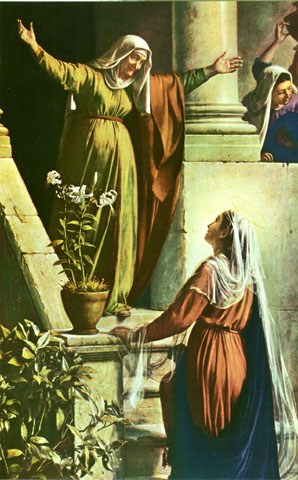
When Elizabeth heard Mary’s greeting, she cried out in a loud voice and said, “How does this happen to me, that the mother of my Lord should come to me?” Who am I that the Lord would come to me? Who are we that the Lord God would become one of us?

Lord, in the words of the psalm, when we see the heavens, the work of your hands, the moon and the stars which you arranged, what is mankind that you should keep us in mind, mortal man that you care for us? Yet you have made us little less than gods; with glory and honor you crowned us when, for us men and for our salvation, your Son came down from heaven, and by the power of the Holy Spirit He was born of the Virgin Mary and became man.

We tend to think of the idea of God becoming a human being as the most natural thing in the world, but the event of the divine and eternal Second Person of the Trinity taking on human flesh (what we call the Incarnation) is probably the most remarkable thing that has ever happened; even more remarkable than our creation or redemption. That is why we bow profoundly when we recall the wonder of the Incarnation in our profession of faith each Sunday. “For us men and for our salvation, He came down from heaven. By the power of the Holy Spirit, He was born of the Virgin Mary, and became man.”

Who are we that the Lord God would become one of us? Who am I that the Lord would come to me? Who we are and why Christ came to us can be summed up in this: we are sinful, limited, loved and good. This sums up human nature in four words. We are sinful, we are limited, we are loved by Him and we are good.

We need Christ as our savior because we are sinful. Even though we know what is right we freely and frequently choose what is wrong. Our sin hurts us, one another, and our relationship with God. He has come for us because we cannot save ourselves.

We are limited, finite creatures. We can forget this or deny this, but it only leads to our own frustration and failure. We are not God, and God doesn’t expect us to be—that’s His job. We must remember that we are limited, in need of His help and help from one another.

When are we are human beings most fully alive?  Not as isolated loaners, but in communion with others. Even the hermit in his desert hut needs spiritual communion with the Lord and His Church if he is to be a complete and happy person. Remember the Unabomber? He lived in a remote shack too, but without this essential communion with God and neighbor.

Though we are sinful and limited, we are also loved and good; for God has lovingly made us good, in own His image and likeness. When we prefer ourselves to God, denying our dependence on Him and scorning Him by our sins, this goodness may be wounded and obscured, but it is never abolished. Jesus Christ always sees this good in us, and He always loves us for it. He loves you for who you are now and for the person He knows that you can become with His help. You are sinful and limited, but never forget, that no matter what, you are loved by Him and good.

We are sinful, limited, loved and good. Knowing this makes us Christians the salt of the earth and shows us how to pray. In fact, the word “salt,” S-A-L-T, sums up the four varieties of Christian prayer: Sorrow, Asking, Loving, and Thanks

We pray in sorrow for our sins.
We pray in asking for our needs.
We pray in love for God loves us.
And we pray in thanks for all He gives us.

I am sinful, so I say “I’m sorry”
I am limited, so I say, “Please.”
I am loved, so I say, “I love you.”
And I am good, and richly blessed, so I say, “Thank you.” 

Who are we that the Lord God would become one of us? Who am I that the Lord would come to me? We are sinful, limited, loved and good. So let us prayerfully prepare for the imminent coming of the Lord, Jesus Christ, our God made flesh this Christmas, with sorrow, asking, love, and thanks.

Tuesday, 3rd Week of Advent

December 16, 2009

Is it more important to say the right thing, or to do the right thing? As people like to say “Talk is cheap,” but “Actions speak louder than words.”

Some Christians say that if we merely confess Jesus Christ as our personal Lord and Savior then we are assuredly saved. But Jesus Himself says that ‘not everyone who says to me, ‘Lord, Lord,’ will enter the kingdom of heaven, but only the one who does the will of my Father in heaven.

It is easy to feel righteous like the chief priests and the elders if we subscribe to the right and enlightened opinions, but we should be humbled by the fact that scandalous sinners have turned to Christ and today harvest more fruit in the vineyard than we do.

We have to do more than talk a good game, we have to show up on the court. For example, you say you oppose the killing of the unborn? Good! But what are you doing to end it? Do you pray for mothers and their babies? Do you march for life?

You say that hatred between peoples should end. Absolutely! But is there someone here that you cannot bring yourself to pray for, or say “hello” to in the hallway?

You say that we must care for people in need. Indeed, and Jesus says the same. But do you give of your time, talent and spending cash until it hurts a bit, like an actual sacrifice?

If I were to end this homily here and now with an exhortation that you should go out into your world and to work hard for good in that vineyard, you might decide to listen and your life might change a little bit for a little while. But I would not expect your life change a great deal, unless you also respond to another calling; the calling from our Father that you work in another vineyard first. This vineyard is within you, it is an inner-vineyard. You work it alongside Christ in prayer and what you harvest from it is intimacy with God.  Of this encounter, St. Augustine wrote:

“Late have I loved you, O Beauty ever ancient, ever new, late have I loved you!  You were within me, but I was outside, and it was there that I searched for you.  In my unloveliness I plunged into the lovely things which you created.  You were with me, but I was not with you.  Created things kept me from you; yet if they had not been in you they would not have been at all. You called, you shouted, and you broke through my deafness.  You flashed, you shone, and you dispelled my blindness.  You breathed your fragrance on me; I drew in breath and now I pant for you.  I have tasted you, now I hunger and thirst for more.  You touched me, and I burned for your peace.”

In the labor of prayer (and it does take a daily effort) you encounter God. He surprises you with gifts of consolation and peace, and you overflow with His love. This overflow is what makes the saints the saints. It is what makes their holy lives possible. The saints are not self-made men and women. Their cups runneth over within them, and it is from out of this abundance that they love the vineyard of the world and work in it for the better.

You say that you believe in God, and in Jesus Christ as your Lord and Savior. So come to the work of prayer each day, or your devotion and service to God will remain forever little more than lip-service.

3rd Sunday of Advent—Year C

December 14, 2009

Advent is a season for penance and conversion, for the confession of sins and the changing of lives, but this Sunday of Advent reminds us that it is also time for joy. Today we celebrate Gaudete Sunday, a name which comes from the Latin command “rejoice!” This command is heard from St. Paul in today’s second reading:

“Rejoice in the Lord always.
I shall say it again:  rejoice!”

But is it that why do we need to be reminded, even commanded, to rejoice? Why are we not a people of constant joy and peace, even though we have great reason to be? I think it is because our hearts and minds give in to fear.

God is near, but when we give in to fear we do not trust that He really cares about us and really provides for us. In fear we become anxious about our future. In our fear we feel too stressed-out to be thankful. And in fear we forget or refuse to pray. St. Paul seems to have realized all this, that may be why he followed his command to rejoice with these words, words that it would do a lifetime of good to know by heart:

“The Lord is near.
Have no anxiety at all,
but in everything,
by prayer and petition,
with thanksgiving,
make your requests known to God.
Then the peace of God
that surpasses all understanding
will guard your hearts and minds in Christ Jesus.”

Today I would like to share with you a true story about two friends of mine who had every seeming reason to afraid, but who kept God’s peace. Let’s call them Andrew and Christi. I have changed their names to conceal their identities, but I know they wouldn’t mind me sharing with you their story because it can teach us all a lot.

To say my friends had a difficult first year of marriage would be to understate it. Andrew, a hard-working man with rough hands and a good heart, became afraid that marrying Christi had been a mistake and he seriously considered getting a divorce. Christi, a beautiful woman inside and out, prayed fervently to God, for both Andrew and herself. She honestly did not know how God would provide for her, but God gave her a peace that surpassed her limited understanding of His plans. Then, as Andrew tells it, God intervened, giving him a sign that this marriage was indeed His will and that Andrew should not be afraid. This divine reassurance strengthened Andrew and he resolved to remain faithfully at Christi’s side no matter what.

A few months later, forces beyond their control forced Andrew and Christi to leave their hometown, away from all their family and friends, and to move down south to a town where Andrew had some distant relatives. But, once they got down there, all of these relatives proved to be too distant or too busy to care enough to lend this vulnerable couple a hand. Their first Advent season together, Andrew and Christi were jobless, homeless, and with child.

It would have been so easy for them to give in to despair that first Christmas Eve, for Andrew to feel like he had failed his wife as a husband, or for Christi to feel anxious and afraid about their future as a family. Yet, Andrew and Christi trusted that the Lord was near. They would pray together as a couple, and gain courage and strength, peace and even joy through their prayers.

Indeed the Lord was near them, through it all, and their first Christmas together turned out to be was the brightest and the most joyful that they, or the world, had ever seen. As I said, this is the true story of two friends of mine, but they’re also friends of yours and you knew their story even before I told it to you today. For Andrew’s real name is St. Joseph and Christi’s real name is St. Mary.

Today we rightly call them saints, not because they lived in a world free from difficulties, an imaginary world different from our own. Joseph and Mary are saints because they knew and practiced how to live in this world well; with joy, kindness, prayer, thanksgiving, and peace. And so brothers and sisters:

Rejoice in the Lord always.
I shall say it again:  rejoice!
Your kindness should be known to all.
The Lord is near.
Have no anxiety at all,
but in everything,
by prayer and petition,
with thanksgiving,
make your requests known to God.
Then the peace of God
that surpasses all understanding
will guard your hearts and minds in Christ Jesus.

2nd Sunday of Advent—Year C

December 10, 2009

In the first year of the presidency of Barack Obama,
when Jim Doyle was governor of Wisconsin,
and Kohl and Feingold were its senators,
and Obey was the seventh district congressman,
and Favre was the quarterback in Minnesota,
when Benedict was pontiff and Jerome was bishop,
the word of God came here,
to Christ the King parish in Spencer:

“Prepare the way of the Lord,
make straight his paths.
Every valley shall be filled
and every mountain and hill shall be made low.
The winding roads shall be made straight,
and the rough ways made smooth,
and all flesh shall see the salvation of God.”

It isn’t a new word… It was the message of John the Baptist, and Isaiah wrote it long before that. Yet the word of God is not old in the sense that it has passed some kind of expiration date. When the Holy Spirit inspired the writing of these words, their human author who put the pen to parchment did not know the great audience and the impact they were to have. But the Holy Spirit saw us here and had these words written to us and for as well. These words were not meant only for Old Testament peoples, or for the time when Christ walked on the earth. These words are proclaimed to us, and meant for us, here today. Remember this every time you encounter the Scriptures, here at church or in your private prayer.

So what is God’s word saying to us today? In the Gospel, did you notice that of all the rulers and governors and leaders at that time, the word of God did not come to any one of them? “The word of God came to John the son of Zechariah in the desert.” The lesson is that God prefers to lead souls to salvation by working through common people. People who think that they have no power.

What politicians do is important, since good laws can help people and bad laws can hurt them, but what saves souls rarely comes through them. And though our Holy Father and our bishop strive to do important work for Christ, there is only so much they can do. The way of the Lord is prepared by the daily efforts of ordinary Christians, who sometimes have children and sometimes work jobs. Your family, friends, and co-workers probably don’t read papal encyclicals, but they always witness your words and example. And so, Jesus depends upon you to prepare His way for others, to make winding and rough roads straight and smooth, and so that all people see the salvation of God.

This is the Christian’s calling and important mission, yet we cannot share what we do not have. If were are going to prepare the way of the Lord and make straight his paths for others we must first fill the valleys and level the mountains for Christ within ourselves. To this end, I urge you to make the most of two gifts God gives us: the sacrament of confession and daily prayer. There is simply nothing that more quickly and effectively strengthens the average Catholic’s moral and spiritual life than frequent and regular confession. And daily prayer is indispensible for growing in relationship with Christ and for living a wonderful life.

Each year, many of our homes are visited a familiar and beloved character whom we associate with Christmas… I speak George Bailey from the movie “It’s a Wonderful Life.” This film, despite its flawed angelology, teaches the truth about how much difference one person can make for others. George Bailey’s an ordinary man who lives an extraordinary life without even realizing himself. By the end of the film, we see the impact for good that his life has had and we see George surrounded by his family and his many friends who all love and admire him.

Why does George Bailey live such a wonderful life?  Sure, he’s a nice guy, but he’s more than a nice guy. Time and again, he sacrifices what he wants to do what’s loving and best for the people God has placed in his life. I hope we can all see a little bit of George Bailey in ourselves. Because we can see a great deal of Christ in George Bailey.

This Advent season, let us prepare the way of the Lord within us, so that through us, all people may see the salvation of God.  This is the calling, the mission, and the privilege of the Christian.  In this or any age, it’s a wonderful life.

1st Sunday of Advent—Year C

December 1, 2009

Each year, people search for the perfect Christmas gifts for the most important people in their lives. We rack our brains and brave the mobs so that we may give our spouses, children, parents and siblings something extra special. But, in all our years, have we ever given Jesus Christ a special gift for Christmas? I encourage you to join with me in putting Him on the top of your Christmas list this year. But what can you get the God-man who has everything? There’s one thing that He cannot receive from anyone else but you—that is the perfect gift of yourself.

How do you make a perfect gift of yourself? First ask yourself this… If this day, death should take you by surprise and you find yourself standing before the Son of Man, as you looked at yourself, what part of your soul would remain unfinished? What would you wish you had another month’s time to set right in your life?

Jesus said, “Beware that your hearts do not become drowsy from carousing and drunkenness and the anxieties of daily life…” Is your life mixed-up with addictions to lust, to intoxicants, or to other empty pleasures?  Are you oppressed the daily worries which come from a lack of trust in God? Or maybe it is something else which is not quite right in your life. Whatever it is, identify where your life needs conversion the most, resolve to begin taking the path of life, and choose to make a gift of yourself for Christ this Christmas.

If you want to make a gift of yourself for Christ this Christmas there is something else you must do. You must set time aside to pray each day. If you neglect this, you will not go far in your conversion or holiness. But, if you lift up your soul to the Lord each day, telling Him about your needs and gratitude, and opening yourself to receive His gifts, then this could be the greatest Christmas of your life. St. Alphonsus Liguori says this about the importance of prayer:

 “Whoever prays is certainly saved. He who does not is certainly damned. All the blessed (except infants) have been saved by prayer. All the damned have been lost through not praying. If they had prayed they would not have been lost. And this is, and will be their greatest torment in hell: to think how easily they might have been saved, just by asking God for His grace, but [for] that now it is too late – their time of prayer is gone.”

There are twenty-five days ‘til Christmas.  Make the most of this opportunity and give Jesus Christ the gift He’s asking for this year.

Friday, 33rd Week in Ordinary Time—Year I

November 23, 2009

In the year 167 before Christ, the empire dominating the Jews, in attempt to unify their peoples, forbid the Jewish sacrifices, banned observance of the Sabbath and feasts, and outlawed circumcision. Altars to Zeus and other Greek gods were set up in the temple, and unclean animals, like pigs, were sacrificed upon them. In response, Mattathias Maccabeus and his sons led a Jewish revolt against their oppressors. Two years later, they had crushed their enemies and went up to purify the temple and to rededicate it for proper worship.

Two hundred years later, another zealous lover of God’s law went up to the temple to cleanse it and rededicate for true worship. Jesus entered the temple area and proceeded to drive out those who were selling things, saying to them, “It is written, My house shall be a house of prayer, but you have made it a den of thieves.”

After the Maccabees had rededicated the temple they celebrated for eight days.  When they relit the seven wicks of the menorah in the sanctuary they only had enough olive oil on hand to keep it burning for one day.  But, by a miracle, it is said that the lamp kept burning for eight days, long enough to press, prepare and consecrate more fresh oil. The rededication of the temple and this miracle are still commemorated in our time as a Jewish holy day.  From the Hebrew word for “dedication” or “consecration”, the Jews call this celebration “Hanukkah.”

Christ has dedicated and consecrated us as the new temple and house of God. How are we to keep our temple lamps lit? How are we to obtain oil for our souls? We are not to do it by grasping, by stealing things from the world, in a vain effort to fill ourselves. The Lord’s house is not to be a den of thieves. Instead, we must pray, asking for the grace we need to remain burning brightly. As Jesus said, “My house shall be a house of prayer.”

Monday, 30th Week in Ordinary Time—Year I

October 26, 2009

Christians Martyrs and the Lions

Remember Jesus’ story about the two men who went up to the temple area to pray, the self-righteous Pharisee and the repentant tax-collector? “The tax collector stood off at a distance and would not even raise his eyes to heaven…”

In today’s gospel, at the synagogue where Jesus is teaching, there is a hunched-over woman who has not raised her eyes to heaven for a very long time. Jesus calls her, lays His hands on her, and at once, she stands erect, for the first time eighteen years. I have to imagine that her very first act was to raise her eyes and hands up to heaven, to speak praises and to glorify God. Imagine how she must have felt to be deprived of such worship for so long, and then, how she must have felt for it to be so suddenly and wonderfully restored to her.

Seeing this, the authorities, the Pharisees, object that Jesus should not do healings during the Sabbath rest. But Jesus rebukes them, to their great humiliation. Who are they to say that this woman should not be free to worship God this day? Her freedom to worship comes from God Himself.

We, this morning, are free to gather here, free to raise our eyes up to heaven and offer worship. We are free from fears that authorities or angry crowds will storm through those doors and drag us off to our imprisonment or death. In the past, not all Christians have been so privileged. Still today, around the world, not all Christians are so privileged.

Let us celebrate this Mass, and every Mass, with a deeper reverence and gratitude, for the freedom we have to raise our eyes to heaven and to offer our worship to God. Let us pray for persecuted Christians around the world and celebrate this Mass, and every Mass, as if it were our first, our last and our only.

28th Sunday in Ordinary Time—Year B

October 11, 2009

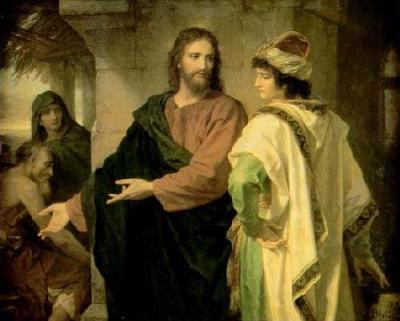
Christ and the Rich Young Ruler, by Heinrich Hofmann

This morning’s second reading from the Letter to the Hebrews speaks of the Word of God; as “living and effective, sharper than any two-edged sword, penetrating even between soul and spirit, joints and marrow, and able to discern reflections and thoughts of the heart.” The first thing that comes to our minds when we hear the phrase “the Word of God” is probably the Bible, but for the author of the Letter to the Hebrews, the Word of God is first and foremost a person. The author writes of the Word of God, “No creature is concealed from Him, but everything is naked and exposed to the eyes of Him to whom we must render an account.”

Jesus Christ is the Word of God, eternally spoken by the Father. Yet our Church’s Scriptures are also God’s inspired Word. Scripture is no dead letter, it is living and effective among us today. It can penetrate the soul, giving discernment to the thoughts and reflections of its readers’ hearts. The Word of God comes down to us from heaven. In Jesus’ incarnation, the Divine Word unites with humanity. Similarly, in the inspiration of Scripture, divinity unites with human words. In the Christian life, we neglect the Word of God to our detriment. We need Christ and His Scriptures. Merely following our consciences will not give us the fullness of life.

Living a moral life is good, but it is not the fullness of life that God wills for us and wants to lead us to through His Word. The man who came to Jesus in the Gospel realized this. He had listened to his conscience and observed the commandments of God’s from His youth, like a lot of cradle Catholics, but notice that the man didn’t walk up to Jesus, he ran to Him and knelt before Him, because he profoundly recognized that he did not yet have the fullness of life. The man goes to Jesus because he senses that this teacher holds the answer he’s searching for, and indeed Jesus does.

Jesus, looks at him, loves him and says to him, “You are lacking in one thing. Go, sell what you have, and give to the poor and you will have treasure in heaven; then come, follow me.”

What this man lacks, in his all-too-comfortable life, is a total commitment to God through a personal relationship with Jesus Christ. Jesus offers him the opportunity and the adventure of a lifetime, “Come, follow me,” but the man goes away sad, because he has many possessions which possess him.

This morning, I would like to teach you a way to personally encounter the Word of God yourself; a way to run up to Jesus, through praying with the Scriptures.

First, take your Bible, and go to someplace where you can pray. Perhaps a quiet room in your house or here at Church; someplace where you will be free from distractions. Then ask the Lord for His grace and wisdom, and the spirit of wisdom, which is greater than riches, will be freely given to you.

Open your Bible to the Gospels, and chose a single scene. Read the passage once or twice, to become familiar with it, and then read it once again, slowly.

Now use your imagination to enter that scene. See Jesus and the other characters there. You can be a bystander observing the scene, or put yourself in the place of one of the characters. What do you feel in their place? What would you say and what would you do in that situation? Then look to Jesus, to hear what He says and see what He does.

This can be a very fruitful way to personally relate with the Word of God, and for Jesus to relate with you through His Scriptures in your prayers.

Over the past few days, in preparation for this homily, I have prayed in this way with today’s Gospel. Just to provide one example of how this sort of thing goes, I’d like to share my meditations with you.

The Gospel begins by saying that the man ran up “as Jesus was setting out on a journey,” so I imagined myself standing there as one of the carrying a heavy sack on my back. When the man came up and knelt before Jesus the feeling that I felt was annoyance, that this guy was holding us up when we had a long journey ahead of us.  But then I remembered what I was witnessing before me an event worthy of the Gospels. This was a lesson for my life and my ministry, that I should not let anxious feelings cause me to neglect or rush past the things that are really important.

When I saw the man walk away sad, I ran after him and pleaded with Him to come back, not to live His life plagued with by question of what his life would be like if he had tried, even just once, a total commitment to Christ. But the rich man was afraid. He didn’t think he had it in Him to take that step. This motivated me to go back to Jesus and ask Him for the grace so that we would all be willing to follow Him outside our comfort zones.

I also I imagined myself in the position of the rich man, kneeling before Christ and asking what more I lacked. I expected Him to say, “Sell all that you have and follow me,” but Jesus put His hand on my shoulder, smiling, and expressed His pride at how far I had come in the areas of trust and generosity. It was a great personal consolation.

What consolations and what wisdom does the Word of God have waiting for you through this form of prayer? There’s only one way to find out.

Thursday, 27th Week in Ordinary Time—Year I

October 8, 2009

In the illustration used by Jesus in the Gospel, a person goes to their neighbor’s house and calls inside for a needed favor. The father inside is not immediately obliging. The door’s locked and his sons and daughters are already at rest. But Jesus says, ‘…If the father does not get up… because of their friendship, he will get up to give him whatever he needs because of the person’s persistence.’

Why will the father end up doing the favor in the end? Because of the father’s children. Imagine all the kids in there, in the dark and in their beds, with the neighbor at the door, knocking: *pounding* “Daaad.” *more pounding* “Dad, do whatever they want!”

The father in this story stands for our Father in heaven, who can sometimes seem reluctant in answering our prayers. The children in the story are the saints in heaven, the sons and daughters who rest in the Father’s house. 

What is it like for the souls in heaven to hear our prayers? Perhaps the experience St. Faustina of the Divine Mercy on earth gives us a glimpse into the experience of the saints in heaven. In the Diary of St. Faustina, a book which I highly recommend for spiritual reading, the Polish nun records this:St. Faustina of the Divine Mercy

“It has happened to me for some time now that I immediately sense in my soul when someone is praying for me; and I likewise sense it in my soul when some soul asks me for prayer, even though they do not speak to me about it. The feeling is one of certain disquiet, as if someone were calling me; and when I pray I obtain peace.”

This reaction makes perfect sense, for how could a good person hear of another’s heartfelt needs and not insist that our Father act? Or how could a saint remain at rest while someone knocks at the door of heaven? Knowing this, how then should we pray? Imagine what doors would open for us, if only we would persist in knocking? Or imagine what gifts would we receive, if only we would try asking? So knock, and ask, boldly.

Tuesday, 27th Week in Ordinary Time—Year I

October 6, 2009

Velazquez, Christ in the House of Martha and Mary. 1618

Today you heard two familiar Bible stories. In the first reading, Jonah reluctantly preaches and the Ninevites, who wholeheartedly convert. In the Gospel, Martha serves while Mary listens at Jesus’ feet. The characters in these two stories would seem to have nothing in common with each other… but that is not so.

What do Martha and Jonah have in common? Both Martha and Jonah are doing work for the Lord, work which they found to be unpleasant. What do Mary and the Ninevites share? What do they have in common? Both Mary and the Ninevites are doing the one thing that is needed, they have turned themselves towards the Lord. Now let’s apply their lesson to ourselves as students.

Ever since I was five years old, up to this very year, I have been in school as a student every year of my life. So I’ve sat through a lot of classes; some which I really enjoyed, and others that I didn’t. Now it’s easy to work on a subject we enjoy, but in other classes we’re like Martha and Jonah, it’s God’s will for us that we be there, doing what we’re doing, but we’re certainly not thrilled about it.

So the next time you feel bummed-out in one of your classes (hopefully not in one of my classes) try doing this: Turn your eyes and your heart to the Lord, like Mary and the Ninevites, and offer yourself and that hour’s work to Jesus.   You already have your cross, so use it for a spiritual sacrifice. What difference will it make when you redirect yourself and your work like this to the Lord? There’s only one way to find out.

Tuesday, 25th Week in Ordinary Time—Year I

September 22, 2009

I rejoiced because they said to me,
“We will go up to the house of the LORD.”
And now we have set foot
within your gates, O Jerusalem.

The Jews would joyfully sing these words as they came into Jerusalem, to worship the Lord in His temple. They understood why they should lift up their hearts and give Him their thanks and praise. The Lord was always with them, but He was most especially with them at the temple. It should be the same for us today, whenever we come to Mass. Jesus Christ is always with us, but He is most fully with us at the Mass.

What if your guardian angel appeared to you and carried you through space and time, and gave you a place at the table of the Last Supper? How closely would you listen to Jesus’ every word and prayer?

What if your angel then brought you to the foot of the cross, to witness Jesus’ sacrifice for you? How faithfully would you attend to Him there?

What if your angel then brought you into heaven, among all the saints and angels, into the presence of the Father, Son, and Holy Spirit? What would you feel? How would you pray?

The truth is that you can encounter the Last Supper, the cross, and heaven at every Mass. The power of Christ brings these realities, through space and time, to you. Jesus’ one sacrifice is really made present to us and we join in the combined worship of heaven with earth.

Granted, all of this is not undeniably-obvious, These realities are veiled to our senses, but encountered through our faith. Just because something is unseen, doesn’t mean that it’s not real. If we never had radios how easily would you believe in radio waves? They’re invisible, intangible, and span time and space, but they’re real indeed, and you can experience them if you are tuned-in to receiving them. How can you be tuned-in at Mass? I offer four suggestions:

First, before Mass, pray for the grace to worship well. I fear that often we do not receive because we never ask.

Second, bring a personal intention to every Mass; that is, a person or a cause that you want Christ to grace through His one sacrifice today. For example, my intention for this Mass is for the Marshfield Area Catholic Schools. Always bring an intention to Mass, because the Mass has more power in the world than we realize.

Third, pray with your whole voice, your whole mind, and your whole heart. Just because you are not always speaking during Mass, doesn’t mean one should ever stop praying. As you hear me pray the Eucharistic prayers make them your own. And when you sing, sing as if you were singing for the Lord, because you really are.

Fourth and finally, direct your eyes, your body, and your thoughts toward the one to whom you are speaking. Most of the prayers of the Mass are directed to our Father in heaven, though some are directed to Jesus Christ. Know the one to whom you are speaking to, and follow through with your eyes and your body accordingly.

As we saw in the Gospel, merely showing up at the house where Jesus is, isn’t enough for a person to achieve the greatest intimacy with Him. Likewise, merely showing up at the Mass where Jesus is, isn’t enough for a person to achieve the greatest intimacy with Him. Those who hear the word of God and act on it in faith and worship, they become the closest to Christ. So let us go rejoicing, to encounter Christ at the Last Supper, at the cross, and in heaven, at this Mass, in the house of the Lord.

25th Sunday in Ordinary Time—Year B

September 20, 2009

Somewhere, in an underground lair, a secret hideout, or a den of iniquity, we find a criminal mastermind, or a mad scientist, scheming a nefarious plot. “Mah-ha-ha-ha,” the villain manically laughs. “Once I unleash my evil plan, evil will conquer the world.”

This is the way of villains as we often find them in comic books. Comic book bad guys love doing evil for evil’s sake. But we should realize that this isn’t why people do bad things in our world. In the real world, nobody does evil for evils sake. Every single person acts to achieve some real or perceived good. Sinners simply go about the pursuit of happiness in wrong ways. Bad people are not bad because they’re trying to do bad things. Unrepentant sinners actually feel justified in what they do.

For instance, in Jesus’ day, influential people said, “That Jesus from Nazareth so obnoxious. Let’s have him condemned and see how he holds up then.  If he’s really holier-than-thou, a son of God, then God will come to his rescue—otherwise he gets what he deserves.” People still rationalize like this today. It’s easy to come up all sorts of reasons for doing bad things rather than what is right:

“Lying? What I said isn’t technically untrue. Besides, it’s only a little white lie.”

“Angry? Is it any wonder that I get so angry when I have to deal with stuff this.”

“Stealing? The way I see it, they make plenty of money, and I deserve more than what they pay me.”

Activities outside of marriage?  “What’s the big deal? It’s all consensual, and nobody’s getting hurt. Besides, we love each other.”

It’s not only “bad people” who say things like this. Each of us fall into embracing lies like these sometimes. But what is the antidote for rationalizing aside our sins? The cure for this is a prayer life with Jesus Christ.

When the apostles came face to face with Jesus inside the house, Jesus began to ask them, “What were you arguing about on the way?” But they remained silent, for they had been discussing among themselves on the way who was the greatest. Coming into Jesus’ presence, who is the embodiment of Truth, the reality of what they had been doing became clear for them. Their false illusions completely faded away, like the smoke from a blown out candle.

We should spend time in conversational prayer with Jesus Christ every day, allowing Him to form us, build us up, and console us. When you receive the encouragement, confidence, and consolation which Christ is eager to give you in prayer, when He acknowledges you as His own brother or sister, as His good friend, as a favored child of His Father, fears dissolve and you live in peace—a peace in which cleverly-devised excuses are no longer sought for and no longer necessary.

August 27 – St. Monica

August 27, 2009

Today I would like to tell you a true story, the story of a Catholic woman in a very difficult marriage to a non-Christian husband. Her husband was a man with a hot temper and hostility towards Christianity. He was unfaithful in their marriage, but she remained faithful to him—not out of weakness, but out of an inner-strength.

She bore his faults with patience and persistently sought after his conversion. The daily example of her gentleness and kindness finally had its victory. Her husband became a Christian one year before his death. However, the year after that, she had to face a new burden alone.

The oldest of her three children joined an anti-Catholic religious cult. It started him down a path of sinful pride and many sensual sins. It broke her heart. Then one night, she had a dream.

She was standing on top of a wooden ruler, and she saw a young man coming towards her, surrounded by a glorious halo. Although she felt sad and full of grief, the young man smiled at her joyfully. He asked her for the reason for her sadness and daily tears. (This wasn’t because he didn’t know, but because he had something to tell her—this is the way things happen in visions.) When she answered that her tears were for the lost soul of her son he told her to take heart for, if she looked carefully, she would see that where she was, there also was he. And when she looked, she saw her son standing beside her on the same ruler. Reassured by this dream she continued, for years to come, praying tearful prayers for his conversion.

She even asked the bishop to intervene in winning over her son. He counseled her to be patient, saying, “God’s time will come.” When she persisted in asking, the bishop (perhaps busy with many other things) famously reassured her: “Go now, I beg you; it is impossible that the son of so many tears should perish.”

That son, as you may have guessed by now, was the great St. Augustine. And his mother is St. Monica. May her story encourage us to pray and strive for the conversion of our loved ones to the Catholic faith. Remember and take hope: God loves us with a human heart and He cares about your loved ones even more than you do.