Archive for the ‘Providence’ Category

Rabbi Gamaliel’s Wisdom — Friday, 2nd Week of Easter

April 16, 2010

The apostles were brought before the Sanhedrin, the Jewish High Council, to be questioned for why they continued to teach in “that name.” At hearing the apostles’ answers, the Jewish leaders “became infuriated and wanted to put them to death,” but a Pharisee in the Sanhedrin stood up and had the apostles put outside. This was Gamaliel, a great teacher of the law who was respected by all the people. (It was at this rabbi’s feet that St. Paul received his Pharisaical training.)

Gamaliel said, “Fellow children of Israel, be careful what you are about to do to these men.” Now his form of address here is interesting and revealing. He could have addressed his peers in the Sanhedrin in many different ways, but by calling them “fellow children of Israel” he recalls Jacob (whose name God changed to Israel) and his twelve sons.

Now of all those sons, Joseph was Jacob’s favorite. This made the others so jealous that they sold Joseph into slavery. But through suffering this dishonor Joseph would go on to become the instrument of their salvation. Even though they meant to destroy him, they failed. God intended this for good, to achieve the salvation of many.

Gamaliel concluded his speech to the Sanhedrin wisely observing, “If this endeavor or this activity is of human origin, it will destroy itself. But if it comes from God, you will not be able to destroy them…”

Evil endeavors or activities are destroyed in time. But what is of God endures, even if it is sometimes setback by evil and sins. In these beleaguering times, for our country, for our Church, and for our pope, this lesson from Rabbi Gamaliel gives us good reason for hope.

The Prodigal Son — 4th Sunday in Lent—Year C

March 14, 2010

If today happens to be your first time coming back to church in a long time, then take today’s gospel as a sign. God our Father is incredibly merciful and He welcomes you home with a loving embrace.

But most of us here, I suspect, came to Mass last week, and the week before that, because you always come every week. If so, then you probably hear this familiar parable of the Prodigal (that is, squandering) Son and wonder where you fit into the story. When you look at yourself I bet you can honestly say that you’re not living a life of great dissipation like the younger son, and the idea of a sinner being reconciled with God makes you genuinely happy, not bitter, like the older son or the Pharisees. So what does this story have to teach those of us who are doing a lot more right than we’re doing wrong?

First, let’s look at the younger, prodigal son. He goes to his father and says, “Father, give me the share of your estate that should come to me.” Here, he is asking for his inheritance while his father is still alive. He is basically saying, “I don’t want to share my life with you,” and then he demonstrates it a few days later by setting off to a distant country. There he squanders his inheritance on a life of dissipation, but after he has freely spent everything, he finds himself in dire need. What he thought would make him happy left him disappointed in the end.

Sure, we’re not professional, all-star sinners like the prodigal son, but we act like him in many little ways in our daily lives. The prodigal son asked his father for something which was not his and which he had no right to take (while his father is still alive.) Whenever we live as if our lives were our own, as if our lives did not come from God and do not belong to God, our Father, we say to Him, “I don’t want to share my life with you.”

Though our small and venial sins only hinder or wound our relationship with God, in every sin we turn our backs and set off for awhile to a distant country. Whenever we insist upon it, God permits us to freely spend our lives in squandering ways, in ways which we think will make us happy but which disappointing us in the end. When we return to our Father, He forgives our sins and welcomes us back, but you and I must learn to stop trying to live our lives without sharing them completely with God.

Why are we afraid of the idea of doing what God wants us to do every moment of our day? I think we are afraid that doing God’s will won’t really make us happy. Maybe we imagine that doing God’s will means we will have to pray ten hours a day at church or walk around wearing a burlap outfit. Of course that’s crazy. God probably wants you to live the same life you are living now, but with some minor adjustments, and more closely to Him.

Maybe we are afraid to give ourselves completely to God because we are a lot like the other, older, more faithful son in the parable. We have served our Father for years without ever asking or expecting much for ourselves. But working hard for God without ever experiencing His good gifts and joys does not make us holy; over time it makes us angry and embittered, like the older son who never asked for anything. We start to think of our Father, not as our father, but as a slave master. But our Father says to us today, “My child, you are here with me always; everything I have is yours.”

“Taste and see the goodness of the Lord,” as our psalm said. Do not let your face blush with shame at asking for good things for you and your friends to enjoy. When we are poor and call out the Lord hears us, and He will save us from all our distress. So look to God, and be radiant with joy.

We’ve learned important lessons from both of the sons in this parable, and I hope we will put them into practice.

From the faithful but disgruntled son, we learned the importance of asking for good things from God. So today, at this Mass, ask our Father to surprise you today with some good gift that you’ll enjoy. Then watch to see what He does for you.

From the prodigal son we learned the importance of living with and for God every day of our lives. So tomorrow morning, when you wake up and you’re lying in bed, make the sign of the cross and entrust yourself to God for that day, that you may live your life that day always with Him and for Him. Ask you guardian angel to remind you and I bet you will remember.  Try it, and I think you’ll be pleasantly surprised by the difference it makes in your day.

When Towers Fall — 3rd Sunday in Lent—Year C

March 7, 2010

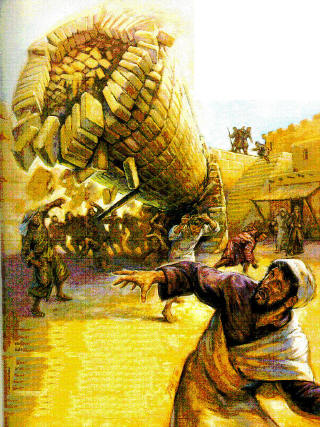
When disasters happen, like the recent earthquakes in Haiti and Chile, some Christian observers respond according to two opposite extremes. One reaction says that a truly just God would never let the innocent die along side the guilty; therefore, all of the victims must have been punished for their sins and got what they had coming to them. The opposite reaction says that a truly loving God would never punish our sins; therefore, all of the victims must have been innocent.

The truth is more complicated than either of these simple and pat explanations. Our God is both perfectly loving and perfectly just. In this world the wheat grows side by side with the weeds. At harvest time, the two are uprooted together, but their eternal fates are not the same. We see that the truth is more complex than some assume by looking at the gospels.

One day Jesus and His disciples observed a man blind from birth. The disciples asked Jesus, “Rabbi, who sinned, this man or his parents, that he was born blind?” Jesus answered, “Neither he nor his parents sinned; it is so that the works of God might be made visible through him.” Jesus smeared clay in man’s eyes and told him to wash in the Pool of Siloam. The innocent man washed and returned able to see.

Yet, on another occasion (in the same Gospel of John) Jesus saw a man lying on the ground who had been ill for thirty-eight years. Jesus miraculously cured this man too, but finding him later Jesus said to the man, “Look, you are well; do not sin any more, so that nothing worse may happen to you.” In this case, it appears that the man’s sin was connected to the cause of his sufferings.

We need to remember that people who suffer and die are not always guilty. On the other hand, people are not always innocent either. Discerning the truth behind why this or that evil befell this or that person or place usually lies well beyond our own limited vision.

For instance, the friends of Job insisted with all confidence that Job’s sufferings must be due to some great sin he had committed.  However, Job stood firm on his innocence, and he truly was as righteousness he claimed. Great sufferings and even violent death are no certain indication of a person’s sinfulness, that “they had it coming.” Just look at our holy and beloved saints:

  • St. John the Baptist was murdered in his 30’s, and St. Paul in his 60’s—they were both beheaded.
  • St. Peter was murdered too, crucified upside down, and of all the apostles, only St. John died of old age.
  • St. Joan of Arc, age 19, was murdered with fire.
  • St. Therese of Lisieux and St. Faustina Kowalska both died of tuberculosis, at ages 24 and 33.
  • St. Maximilian Kolbe and St. Edith Stein were murdered by the Nazi’s in the Auschwitz concentration camp.
  • More recently, before our eyes, John Paul the Great suffered greatly and died of Parkinson’s disease.
  • Even the Blessed Virgin Mary, as perfectly innocent as she was, shared as a mystic and a mother in suffering the passion and death of her Son.

The innocent who suffer live and die in the likeness of Jesus Christ are promised a heavenly reward like His.

So from where do earthquakes and other natural disasters come? In the beginning of time, some of the angels and all of humanity rebelled against God and we rejected our proper places within His creation. This Fall introduced disharmony into our (now) mortal bodies and into the entire natural world. Since that time, Christ has come and in perfect obedience to our Father, died, rose, and has enabled us to be reconciled with God. However, the disharmony of nature remains and we remain free to choose to rebel against our God.

If rebel in sin, we should not be surprised if bad things happen as a result. Usually in this world, we are punished through our sins, more so than for them. For example, someone who neglects prayer and Sunday worship should expect that they will feel disconnected from God. Someone who abuses drugs or alcohol, will see the harmful consequences it brings to their relationships and at school or at work. Someone who covets their neighbors’ spouse and possessions will become sickly green with lust and envy. Add up the sum total of an entire peoples’ sins and you can easily see how an empire or a great nation can decline and decay over time.

God hates our sins, but not merely because they “break His rules.” God hates our sins in proportion to how harmful they are to us. If sins were not bad for us, then God would not command us not to do these things. God hates our sins because He loves us; these are two sides of the same coin.

So what should we do when we witness disaster strike half a world away or in our own community? We should pray for the dead and give our aid to those who live on. Christ calls us to give our compassion, love, spiritual support, and material aid to those who need it. And as for ourselves, such disasters should lead us to convert and reform our lives. Death can come suddenly to any of us. A car crash or a heart attack could take any of us tomorrow placing us unexpected before the judgment seat of God. Let us take such opportunities to prepare ourselves for that day which will come to us all.

What if is not instant death, but a more prolonged evil that comes to me? For instance, what if I go to the doctor and receive a terrible diagnosis?  When such a day comes for me, I hope that I may remember the tree from today’s Gospel, which the gardener worked and fertilized in hopes that it would bear much fruit. If I, like that tree, will humbly accept the manure that comes to me, then it will be a source of great fruitfulness to me.

Could an evil such as this be a correction or a chastisement from God on account of my sins? Possibly, but if I’m not aware of any serious unconfessed sins on my conscience, then probably not. More likely, Jesus is giving me the opportunity to following in His footsteps, to have a share in His cross like the holy saints who came before me. If we accept our crosses with humility, then they can become the means of our sanctification in the likeness of Christ and a source for spiritual fruitfulness for ourselves and the entire world.

Asking and Receiving — Friday, 4th Week in Ordinary Time—Year II

February 5, 2010

King Herod said to his daughter, “Ask of me whatever you wish and I will grant it to you.” He even swore many things to her, “I will grant you whatever you ask of me, even to half of my kingdom.” If Herod, who was wicked, could be moved to give his daughter gifts, how much more will our heavenly Father give us good things if we ask Him. Praying for good things is something Jesus commands us to do.

While many Christians fall into the mistake of only praying when they want something from God, there are other Christians, who pray every day, who make an opposite mistake. These Christians pray for good things for others, but they never ask anything for themselves, fearing that this would be a selfish prayer. But the danger in this, in never requesting and never expecting God’s gifts and consolations, is that we’ll become discouraged and gradually embittered.

If we never ask for a share in the Father’s gifts we risk becoming like the older brother in Luke’s parable of the prodigal son. Eventually we’ll say to God, “Look, all these years I served you and not once did I disobey your orders; yet you never even gave me something to feast on with my friends.” But our generous and forgiving Father would say to us, “My child, you are here with me always; everything I have is yours for the asking.”

Jesus said, “Whatever you ask in my name, I will do, so that the Father may be glorified in the Son.” So ask God to give you gifts—this is not a selfish prayer, for it will strengthen you in holiness and glorify God. I suggest that you try out a little experiment. Pray, “Lord, please treat me to something special today,” and then watch for his gift to come.

Luke’s Source — January 1 — Mary the Mother of God

January 1, 2010

Have you ever wondered how it is that Luke the Gospel writer knows the stuff he’s telling us? For instance, he wasn’t present at the Annunciation to take down notes.  Only Mary and the Archangel Gabriel were there. And in today’s Gospel, after the shepherds visit, it says, “Mary kept all these things, reflecting on them in her heart.” Now how does Luke know what Mary was thinking? Who could know something like that besides Mary herself?

Now I suppose the Holy Spirit could have directly infused the knowledge of these things into him, but that’s probably not what has happened here. Luke probably learned of these details in the most natural and human way; by being told about them, first or second-hand, by people who knew. Luke begins his Gospel by saying that his narrative of events is composed from what “those who were eyewitnesses from the beginning and ministers of the word have handed … down to us.”

But there is only one person who could have been the original source for many of Luke’s details, and that is Mary herself. In fact, some call the beginning chapters of the Gospel of Luke “the Memoirs of Mary.” Perhaps Luke heard of these details from Mary’s very own lips and took them all to heart.  Then later, knowing these things by heart, committed them to writing.

And so we do know something today of what was going on inside of Mary in those early days, “Mary kept all these things, reflecting on them in her heart.” And some years later, upon finding Jesus in the temple, Luke reports that Mary and Joseph did not understand what their boy when said to them, but “his mother kept all these things in her heart.” In this there is a lesson for us to discover through Mary, a lesson that is particularly applicable for us this New Year’s [Eve/Day].

In her life, Mary knew some important aspects of God the Father’s plan, but there was always a great deal about which she did not know. She knew that her Son was messiah, savior, and Lord, but his future, and hers, remained largely a mystery. Perhaps Mary wondered, as we often wonder when faced with evils and obstacles, “How can this be, Lord?  How will your promises be fulfilled despite this?”  Yet through it all, Mary firmly trusted that the Lord was with her, and we should do the same.

What does the new year ahead hold for each of us? Like Mary, we do not know, yet Mary shows us that we do not have to know.  We do not have to fully know our future to be able to do great things for God and to be richly blessed by Him. We do not need to know our future for the Almighty to do great things for us.

In the year ahead, may the Lord bless you and keep you, as He did the Virgin Mary.

May the Lord let his face shine upon you, and be gracious to you, as He did for Mary through Jesus’ infant face.

And may the Lord look upon you kindly and give you peace, a peace like that which Mary always kept with her Son, Jesus the Christ.

3rd Sunday of Advent—Year C

December 14, 2009

Advent is a season for penance and conversion, for the confession of sins and the changing of lives, but this Sunday of Advent reminds us that it is also time for joy. Today we celebrate Gaudete Sunday, a name which comes from the Latin command “rejoice!” This command is heard from St. Paul in today’s second reading:

“Rejoice in the Lord always.
I shall say it again:  rejoice!”

But is it that why do we need to be reminded, even commanded, to rejoice? Why are we not a people of constant joy and peace, even though we have great reason to be? I think it is because our hearts and minds give in to fear.

God is near, but when we give in to fear we do not trust that He really cares about us and really provides for us. In fear we become anxious about our future. In our fear we feel too stressed-out to be thankful. And in fear we forget or refuse to pray. St. Paul seems to have realized all this, that may be why he followed his command to rejoice with these words, words that it would do a lifetime of good to know by heart:

“The Lord is near.
Have no anxiety at all,
but in everything,
by prayer and petition,
with thanksgiving,
make your requests known to God.
Then the peace of God
that surpasses all understanding
will guard your hearts and minds in Christ Jesus.”

Today I would like to share with you a true story about two friends of mine who had every seeming reason to afraid, but who kept God’s peace. Let’s call them Andrew and Christi. I have changed their names to conceal their identities, but I know they wouldn’t mind me sharing with you their story because it can teach us all a lot.

To say my friends had a difficult first year of marriage would be to understate it. Andrew, a hard-working man with rough hands and a good heart, became afraid that marrying Christi had been a mistake and he seriously considered getting a divorce. Christi, a beautiful woman inside and out, prayed fervently to God, for both Andrew and herself. She honestly did not know how God would provide for her, but God gave her a peace that surpassed her limited understanding of His plans. Then, as Andrew tells it, God intervened, giving him a sign that this marriage was indeed His will and that Andrew should not be afraid. This divine reassurance strengthened Andrew and he resolved to remain faithfully at Christi’s side no matter what.

A few months later, forces beyond their control forced Andrew and Christi to leave their hometown, away from all their family and friends, and to move down south to a town where Andrew had some distant relatives. But, once they got down there, all of these relatives proved to be too distant or too busy to care enough to lend this vulnerable couple a hand. Their first Advent season together, Andrew and Christi were jobless, homeless, and with child.

It would have been so easy for them to give in to despair that first Christmas Eve, for Andrew to feel like he had failed his wife as a husband, or for Christi to feel anxious and afraid about their future as a family. Yet, Andrew and Christi trusted that the Lord was near. They would pray together as a couple, and gain courage and strength, peace and even joy through their prayers.

Indeed the Lord was near them, through it all, and their first Christmas together turned out to be was the brightest and the most joyful that they, or the world, had ever seen. As I said, this is the true story of two friends of mine, but they’re also friends of yours and you knew their story even before I told it to you today. For Andrew’s real name is St. Joseph and Christi’s real name is St. Mary.

Today we rightly call them saints, not because they lived in a world free from difficulties, an imaginary world different from our own. Joseph and Mary are saints because they knew and practiced how to live in this world well; with joy, kindness, prayer, thanksgiving, and peace. And so brothers and sisters:

Rejoice in the Lord always.
I shall say it again:  rejoice!
Your kindness should be known to all.
The Lord is near.
Have no anxiety at all,
but in everything,
by prayer and petition,
with thanksgiving,
make your requests known to God.
Then the peace of God
that surpasses all understanding
will guard your hearts and minds in Christ Jesus.

October 28 – Sts. Simon and Jude

October 28, 2009

Cowardly Lion

Today we celebrate the Sts. Simon and Jude, apostles and martyrs for Christ. Simon was known as “the Zealot,” and Jude, or Judas the son of James, was nicknamed “Thaddeus,” which means “Courageous” in Greek. In the Gospel today the apostles are listed, with Simon and Jude coming towards the end, right before Judas Iscariot, the one who betrayed Jesus.

When Jesus sent out His disciples with the power and authority to heal the sick, cast out demons, and preach the Gospel, He sent them out two-by-two.  One could infer (though this is by no means certain) that this Gospel passage lists the apostles according to those old missionary pairings: Simon Peter with his brother, Andrew; James with his brother, John; and so on, ending with the Judas called “Courageous” and the other Judas who became a traitor.

So here we would have two Judas’, side-by-side, in discipleship and ministry. Yet, only one of them earned a nickname for being courageous. To grow in holiness requires our courage, a virtue that Judas Iscariot tragically lacked.

John’s Gospel tells us that this Judas held the money purse, and sometimes stole from it for himself. That’s because he lacked the courage to acknowledge his faults and to grow in the virtues.

Judas may have betrayed Jesus because he thought this would kick-start Jesus, the weak messiah, into real, revolutionary action. Judas did not have the courage to trust that the providence of God working through Jesus Christ was really the best way to bring about the Kingdom on earth.

And after he had sinned, Judas lacked the courage to seek forgiveness, choosing suicide instead, which is called “the coward’s death.” Simon Peter denied Jesus, but he had the courage to confess his sin and to seek reconciliation. That was Peter’s salvation.

If we are going to grow in holiness to sainthood, it’s going to require our courage; the courage to acknowledge our faults and grow virtue, the courage to trust in God’s will and providential plan for our lives, and, when we fall, the courage to confess our sins and to seek reconciliation with Christ.

24th Sunday in Ordinary Time—Year B

September 13, 2009

Once upon a time, there was a kingdom,
filled with forests, and farms, and villages.
There lived near one town, a humble farmer.
He was simple, but wise, and loved the Lord.
He worked his small farm, with his wife and son.
They kept fields, a home, and a few livestock.

One day, the farmer’s work-horse, ran away.
“How unfortunate,” said the villagers,
“It will be harder, to plant your crops now.”
The wise farmer replied, “Our God works all things,
for the good, of those, who love Him.”

Two days later, the horse came back.
bringing along two wild-horses with him.
“How lucky you are,” the villagers said,
“you have free horses, walk right to your door!”
The wise farmer replied, “Our God works all things
for the good of those who love Him.”

There after, his son, training the wild horses,
got kicked off of one, and broke both his legs.
“That’s so unlucky,” the villagers said,
“What bad change of luck, for you and your son.”
The wise farmer replied, “Our God works all things
for the good of those who love Him.”

Two weeks later, the son still bedridden,
the king’s army came, to draft men for war.
They took every young man, but left him behind.
“You’re just lucky people,” the villagers said,
“Isn’t that so?”
And the farmer replied, as he did every time,
“Our God works all things for the good of those who love Him.”

In our daily lives, when things don’t go our way, we are confronted with the most ancient temptation. In the Garden of Eden, the serpent, who is Satan, said, “God is withholding this good fruit from you because He doesn’t really want you to be happy.” The temptation, here, is to mistrust and rebellion, the fear, that the Lord, does not really care for us, that we’re left to chance, and left all on our own.

At such moments, we should recognize the temptation and say, “Depart from me, Satan, in the Name of Christ. You are thinking not as God does, but as human beings do.” Our God sees the outcome of all things, and He will not cause, or allow, anything to happen that would go against our ultimate good.

Jesus knew that His Father willed His happiness that’s why He kept an open ear, did not rebel, and did not turn back. That’s how He could give His back to those who beat Him, and his face to abuse. He could set His face like flint, by remembering that He would not be put to shame in the end. And now, Christ, beyond death and every suffering, alive and supremely happy, says, “See, the Lord God is my help; who will prove me wrong?”

So whether we stub our toe, or show up late, or get short on money, or experience even the greatest of trials, we should turn and pray: “Lord, you know that I don’t like this, but I trust that you will work, even this, to my good. Jesus, I trust in you. You work all things, for the good, of those, who love You.”

23rd Sunday in Ordinary Time—Year B

September 6, 2009

Remember what it was like before the dot-com bubble burst? Maybe you heard about tiny internet start-ups having total stock values in the billions and you just knew that that wouldn’t last. Remember the time before the recent housing bubble popped? I remember watching a show on TV called “Flip this House” in which a couple bought a building, put two weeks of work and a few thousand dollars into cleaning it up, and then quickly sold it for several tens of thousands of dollars more than what they bought it. I remember saying to myself then, “This just can’t go on. This isn’t sustainable.”

The thing about economic bubbles is that while you can often read the signs of the times and see that the bubble’s there, you’re never quite sure when it will pop.

For years now, our country has been riding on a similar bubble with the unsustainable spending and borrowing by the federal government. We’re not quite sure when it will finally pop, but you can see that the bubble’s there.  Most of us here will witness firsthand the consequences of its bursting.

The Congressional Budget Office is a non-partisan, independent government agency that provides economic data to Congress. And for years, regardless of whether the Democrats or Republicans were in power, the CBO has consistently reported the unfortunate facts and grim forecasts of our present course. This summer, the CBO published its “Long-Term Budget Outlook.” And they tell us, quote…

“Under current law, the federal budget is on an unsustainable path—meaning that federal debt will continue to grow much faster than the economy over the long run.

Although great uncertainty surrounds longterm fiscal projections, rising costs for health care and the aging of the U.S. population will cause federal spending to increase rapidly under any plausible scenario for current law. […]

Keeping deficits and debt from reaching levels that would cause substantial harm to the economy would require increasing revenues significantly…, decreasing projected spending sharply, or some combination of the two.”

Some or all of the following things will inevitably happen: an increased federal retirement age, decreased retirement benefits from Social Security, decreased health benefits from Medicare and/or Medicaid, increased federal taxes, or (and this seems the most likely) a dramatically increased national debt.

Now understand that an endlessly ballooning national debt is no solution.  It has economic consequences for us. What happens when foreign countries finally decide they are no longer interested in holding any more of our debt (in the form of low-interest yielding U.S. government bonds?) One result will be hyper-inflation, which will negatively impact anyone who uses U.S. Dollars. Unpleasant changes are coming. And they will have real consequences our lives. We will feel their effects.

Maybe hearing me speak about these grim realities feels as if I’ve just spit on your tongue.  It’s unpleasant and a bit repulsive. But my hope and prayer is that you will “be opened” by it, that you will be motivated to prepare yourself for what is coming, to begin living now as we should have already been living as Chrisitians all along.

In the past we have lived beyond our means, just like crowd, just like the government made in our own image. We spent more than we had and we often spent wastefully. But we are called to live differently, to live out Christian stewardship, Christian poverty, or simplicity of life in our own lives. Let’s not wait to hit economic rock bottom before we begin living as we ought to.

We are called to live simply and within our means, free from debt-slavery. We are called to be both frugal and generous, generous and frugal. If we are frugal without generosity, we’re simply being misers. If we are generous without frugality, we are being irresponsible. But if you are both frugal and generous won’t God, who (as the psalmist says) keeps faith forever, who secures justice for the oppressed, who gives food to the hungry, who supports the fatherless and the widow, won’t He provide you with what you need? On the other hand, if we are not frugal and generous, if we do not lovingly support our poor neighbors, those in our parish, throughout the diocese, and abroad, then how can we ask God to support us?

To quote St. James, “Act on this word.  If all you do is listen to it, you are deceiving yourselves.” “Fear not, be strong.” “Be not afraid,” but prepare yourself. Prepare for the days when our accounts will come due.  For a day coming soon in our country, and for the Last Day, when we shall all appear before God.

22nd Sunday in Ordinary Time—Year B

August 30, 2009

For your entire life, you’ve been the beneficiary of a mysterious patron. You’ve never seen your wise and wealthy benefactor, but he has subtly helped you throughout your whole life.

For instance, when you were just a little baby, you were born with a serious and deadly illness. On their own, your parents couldn’t provide a doctor or medicine to treat your condition. But your benefactor learned of your plight. He had pity for you. He sent his own doctor to you, who healed you at his own cost.

Maybe your parents were too proud to tell you, but their hard-work alone was never enough to keep your family happy and healthy, with food, clothing, and a roof over your heads. But your family was never destitute, because your family received over the years all sorts of needed gifts through your benefactor.

Even into adulthood, your generous patron continued to give you good things. He was even behind the scenes orchestrating the meeting of you and your future spouse. Your benefactor was convinced that the two of you would be good for each other. 

This generous patron continues to help you in countless and subtle ways, even to this day. And now, I’ll reveal this benefactor to you:

“All good giving and every perfect gift is from above, coming down from the Father of lights…”

God the Father is our great benefactor. Every good thing comes from Him. He is the source of the Son and the Spirit, of the angels and the universe, of our lives and of every good thing in them. God the Father deserves our thanks and praise.

From what congenital illness did the Father heal you? Original sin, the deadly condition of rebellion against God. The Father had pity on you, and sent His Son, the divine physician, to treat you. You’re healed through the power of Christ’s sacrifice which is comes to us through His sacraments.

How has the Father provided for you and your family? Although we work hard for the good things we need, we never achieve anything good “all by ourselves.” very good thing we have, and every good thing we do, comes through cooperation with God. We do indeed work hard in the fields of life, but God grows the crops for us, and gives us the power to harvest them. That is why when we sit down to eat, we thank God the Father for ‘the gifts we are about to receive, from His bounty, through Christ our Lord, Amen.’

Did the Father arrange for you to meet you spouse?  Yes. Your relatives, your friends, your spouse, your children, all came to you from Him. He orchestrated this through wise and loving designs which do not steamroll our freedom and freewill. Every person in your life is placed there by the Father for a reason.

All good things come from the Father, through the Son, and in union with the Holy Spirit. And every good deed and prayer from us goes to the Father by the same means. Whether we worship here at Mass or out in the world the pathway of our worship is always the same. Our deeds and prayers worship God the Father, through the Son, empowered by the Holy Spirit.

All good things come from the Father. That is why it is good and right, always and everywhere, for us to give Him thanks. So, at this Mass, lift up your hearts to the Father. Praise and thank your great and loving benefactor. Offer Him today an all-encompassing thanksgiving. Offer Him a deeper gratitude than you have ever had before.

16th Sunday in Ordinary Time—Year B

August 17, 2009

Their boat set out for a deserted place along the Sea of Galilee. But the word got out and lots of people “hastened” there, that is, they eagerly ran on foot, and arrived there faster than Jesus and the apostles could.

Why did those people run? They ran because they anticipated good things. They ran because they believed their desires would be fulfilled. In a word, they ran because Jesus and the Apostles had given them hope.

What can we hope for as Christians? Can we hope that if we stay close to Christ and to His Church that we’ll go to heaven someday?   Yes.  But is that all there is?  No. Our hope in Christ is not only for the time beginning once we’ve died.

Moments ago we heard Psalm 23, a psalm commonly heard at funerals. Though we tend to associate it with the holy dead, the blessings this psalm speaks of are for the living as well. For example, in the Gospel, Jesus leads the Apostles to a place beside restful waters to refresh their souls. He teaches the vast crowds that come many things, guiding them in right paths, and giving them courage. He has the people lay upon the green grass and, breaking bread, He spreads a meal before them.

We can confidently hope that Jesus will do these things for us.

Jesus wants to give you peace.  But what is peace? It means, in part, being liberated from worthless worry, having anxiety at all. As Christ inspired St. Paul to write the Philippians,

“Have no anxiety at all, but in everything, by prayer and petition, with thanksgiving, make your requests known to God.  Then the peace of God that surpasses all understanding will guard your hearts and minds in Christ Jesus.”

Jesus wants to teach you wisdom, and give you the courage you need to live it. Jesus Christ, teaching through our Church and its Scriptures, proclaims to you truths that the world doesn’t know and isn’t going to teach you. Jesus not only tells you how to live well but empowers you to do it too through the Holy Spirit alive within you.

Jesus wants to give you the bread you need. In a few moments, you will be receiving the body, blood, soul, and divinity of Jesus Christ in His Eucharist. And in addition to that, Jesus doesn’t only provide for you on this one day at Church. He provides for us all week long in the world out there. We pray for “daily bread”, and this is not just food, but whatever it is we need. Christ is rich, and wants to give you good things. If we a frugal and generous, He will provide us with whatever we need.

There is a lot of hopelessness about our times and the way things are headed, but we Christians should live with hope about our lives and about the world we live in. Now bad things are going to happen, but with Christ, a more glorious resurrection always follows the cross. With this truth in mind, we should be a people of hope.

At the same time, we should be wary of unchristian hopes, which are too worldly. Consider the crowds that eagerly flocked to Jesus. They held hope in this world because of Him. Unfortunately, their hope was often because they thought Jesus might become some militant, revolutionary messiah, who would ascend to the throne of David by slaying the Roman armies that occupied Israel. They were invested in hopes that he would establish a kingdom for Israel that would provide them with cheap food and easy money for the rest of their lives. John’s Gospel says that after the miracle of the loaves they wanted to carry Jesus off and make him king. The people wanted change, but Jesus wasn’t interested in their kind of change. Jesus knew that changing this world would be ultimately fruitless, unless we ourselves could first somehow be changed.

Our world is broken, but man is more broken more by sin. Give two sisters identical dolls, or give two brothers identical trucks, and a short time later you might come back to find them fighting over the exact same toy. Even if you handed everyone on earth everything they wanted, there would not be peace. The problem isn’t out there somewhere, the problems always in here. Money can do good things, but wealth in not our salvation. Good laws can help people, but politics are not our salvation. Christ is our salvation.

Christ is real and active with power in the world out there, but He tends to work from the inside-out.  That is to say, the kind of change that He is interested in usually begins within souls, like ours. Christ first changes Christians, and then through us, He transforms the world.

He wants to give us trusting peace inside, so we can live with freedom. He wants to give us contentment inside, as the antidote for our over-consumption. But first and foremost of all, He wants to give you prayer inside.

If you only hear one thing I say, this is the final and most important thing: A Christian has to pray, every single day. Daily prayer is the means to our conversion. Daily prayer is the first step to transforming our world. Daily prayer is the key to realizing our hopes, for this life and the next.

Christ has good things He wants to give you. So run to Him, with eager hope.