Archive for the ‘Repentance’ Category

Christ in the Sacraments — 11th Sunday in Ordinary Time—Year C

June 15, 2010

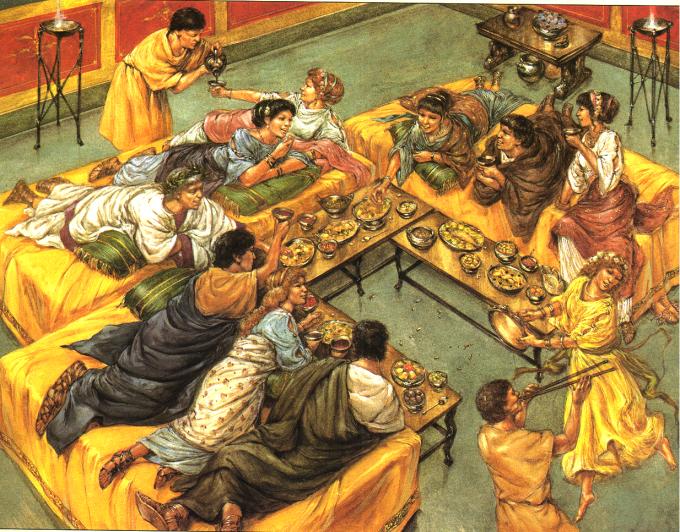
To understand today’s gospel, it helps to know a little about the Jewish culture of Jesus’ day.  For example, when the Jews would sit down to eat dinner they would not sit at all–they “reclined at table,” on beds that came up the edge of the table. You would have a cushion under your chest or under your side, as you ate with your free hand, with your legs laid out behind you. This clarifies how the beautiful, penitent woman was able to access to Jesus’ feet. This also explains how John was able to lay his head upon Jesus’ chest at the Last Supper to ask Him who would betray Him. The Beloved Disciple was not a contortionist–he was laying beside Jesus at table.

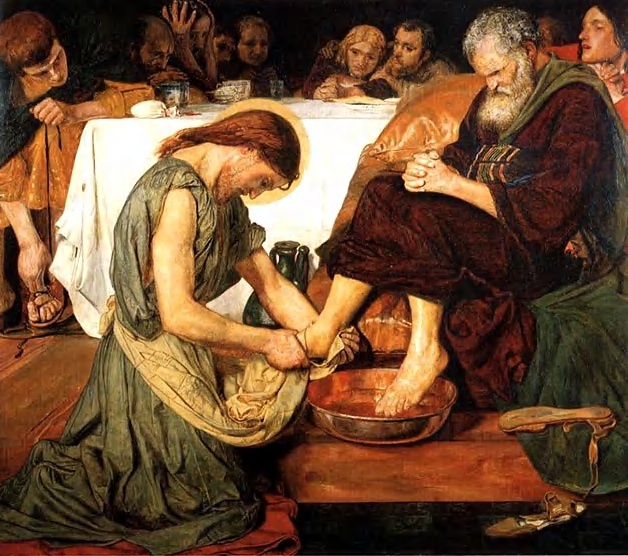
A second important thing to know about the Jewish culture of Jesus’ day to appreciate this gospel is to understand how they felt about feet. The Jews considered feet to be among the dirtiest, humblest, and lowliest parts of the human body. This is why our parish’s patron, St. John the Baptist, said, “[There is] one who is coming after me, whose sandal strap I am not worthy to untie.” In that Jewish culture, servants could not be commanded to wash the feet of others; it was considered even beneigth the dignity of a slave. Now we can understand the significance of the woman washing Jesus’ feet, and how much it means that Jesus later washed His disciples’ feet at the Last Supper.

But what was this woman thinking? Had she forgotten to bring a towel and a bowl of water at home? Was she so dumbstruck that her lips were unable to form the simple words, “I’m sorry and I want to return to God?” No, she knew what she was doing when she used her tears to cleanse, her hair to wipe, and her lips to kiss Jesus’ feet. When she heard that Jesus was going to be eating at the house of Simon the Pharisee I doubt she was holding that alabaster jar of ointment in her hands. No, she had to go and get it, and as she did she thought about exactly how she was going to approach Jesus.

What was Simon the Pharisee thinking? Had he forgotten about the customary curtesies in welcoming guests to one’s house in that culture: water for washing their own feet, oil for anointing one’s head against the harshness of the desert, a kiss in greeting at the door? Maybe he thought these were just optional, dispensible rituals. Regardless, Jesus put his finger on one major contributing factor: Simon the Pharisee loved Jesus little, while the beautiful penient woman loved Him greatly.

Simon gave Jesus an external gift, a meal in his home, but in addition to her ointment, the woman gave a gift of her very self; her tears, her hair, her kisses. As she had sinned with her body, she now sought to honor God though her body.

How does all of this apply to us? When we consider this beautiful, penitant woman and Simon the Pharisee relate to Jesus, we see two approaches the sacraments. For some, in the manner of Simon the Pharisee, the sacraments are just rituals, traditional customs, liturgical hoops the Church has us jump through. But for others, those with the heart of the woman who loved much, every sacrament is a personal encounter with Jesus Christ. If you onlt remember one thing from this homily, remember this: every sacrament is a personal encounter with Jesus Christ.

Consider the sacrament of marriage. Today, some people say, “As long as we love each other, what difference does a ceremony in a church and a piece of paper make?” But these people do not realize that the sacrament of marriage actually makes present the love between Christ and his Church. The love between husband and wife not only resembles the love between Christ and his Church–like all the sacraments, marriage actually makes present. If your marriage is sacramental, and you and your spouse do not put up obstacles in the way, you can experience firsthand to love with which Jesus loves His bride, the Church, and how the bride receives her Lord. You experience the intimacy between the two and you can tap and draw on their love and the power in your marriage. marriage is a personal encounter with Jesus Christ.

Today, some people say, “I don’t really have any sins, but if I did, why should I have to go tell my sins to a priest to have my sins forgiven? God can hears my prayers. Won’t he’ll forgive me anyway.” Imagine if the penitent woman had stayed away from Simon’s dinner party that night in the gospel and prayed to God at home. Would she have been forgiven? Perhaps, but she would not have had her life-transforming encounter with Jesus Christ. When you go to confession, you are personally encountering Jesus through the priest. If the priest does not put up obstacles in the way you will hear the words of Christ to you. And even if the priest does get in the way, you will hear that words that Jesus wants you to hear, just as He had said to the beautiful penitent woman: “Your sins are forgiven, go in peace.” The sacrament of reconciliation is a personal encounter with Jesus Christ.

These days some people say, “There’s a lot of Sundays in the summertime and a lot of things to enjoy on the weekend. Is it really that important that we come to Mass every Sunday?” To ask this about the most Blessed Sacrament is to be like Simon the Pharisee. Had Jesus not come as his guest that night, Simon would not have missed Him much; Simon would not have been that disappointed. And even after receiving Jesus under his roof, I can imagine Simon being left unchanged. But the beautiful penitent woman, who took Jesus’ flesh to her lips, was forgiven her sins and was filled with grace by the encounter.

In the celebration of this sacrament, and at every sacrament, let us appraoch Jesus with her humility, reverence, and love.

Gift of Self — 5th Sunday in Easter—Year C

May 2, 2010

I would like to begin today by telling the beautiful story of a gorgeous young woman named Leah Darrow. Leah grew up in a strong Catholic family in Oklahoma, but when she was in high school she says that her Catholicism started to get “fuzzy.”  By the time she was in college Leah says she had become a “Catholic But.” She would say, “I’m Catholic, but I don’t agree with the Church’s teaching on cohabitation,” or, “I’m Catholic but I don’t see the problem with a couple who love each sleeping together before their marriage… I think the Church is behind the times.”

One evening at college she saw a reality TV show called “Americas’s Next Top Model,” with Tyra Banks and thought to herself, “I’m pretty cute, maybe I could be on that show.” She tried out and got on, but lost the competition, yet she was resolved not to let her TV elimination mean the end of her modeling career. And she was rather successful.  She still recalls her excitement at receiving her first paycheck with a comma (a comma!) in it.

Leah eventually found herself at a photo-shoot high above 5th Avenue in New York that would change her life forever. She came to pose for an international magazine which wanted to help her develop a more risque image. They brought out a number of itsy-bitzy outfits for her to wear.  She picked one out and shooting began. Now Leah says that every model knows not to look at the flash when the photos are being taken (and she insists that she didn’t look at the flash) yet while she was posing, a vision flashed in her mind, three images in the span of perhaps a second or two. This is what she saw:

She saw herself standing in a large white space in the immodest outfit she was wearing. In this scene she wasn’t in pain, but she had the sense that she had died. In the second image Leah was looking up, holding out her open hands at her waist, with the knowledge that she was in the presence of God. In the third and final image, another white flash hit her eyes and Leah saw herself holding her hands all the way up, offering to God all that she had, but in that moment she realized that she was offering Him nothing. For her entire life up to that point, with all of the blessings, talents, and gifts that God had given her, she had wasted them all on herself. If she had died at that moment, Leah knew that she would have nothing to offer Christ.

She came back to reality when the photographer said, “Leah, Leah, are you OK?” She shook her head and said, “No, I can’t.” He said, “Ok, we can go over here.” And she said, “No, I can’t .”  She ran back to the makeup counter, changed back into her own clothes, and ran down 5th Avenue, balling her eyes out, afraid that she might be losing her mind.

She called her dad and said, “Dad, if you don’t come get me I am going to lose my soul.” Dad drove across the country to New York, and when he arrived she wanted to leave town, but he said he couldn’t wait to see the sights; Central Park, the Empire State Building, the Carnegie Deli, “But first we go to confession.” She made a good, tearful confession spanning the ten commandments like she was ordering off the dollar menu: ‘Two number ones, four number twos…’ She came out like a new woman, healed.  Today she goes around telling her story and supporting an organization that promotes modesty in young lades’ dress.

Leah says she was living a very selfish life before her conversion. Perhaps she was confused, as many in our culture, about the nature of true love. In English we use the word love in a broad and ambiguous way.  We say, “I love that TV show. I love the Packers. I love my children. I love my wife. I love God. I love my dog.” But all of these loves are different in kind and degree. When we say, “I love pizza,” or, “I love wine,” it is not really pizza and wine that we love so much as  ourselves.  I love myself, and that’s why I consume pizza or wine. Yet, not all love is easy, warm, and fuzzy. True love is a sacrifice, and often feels that way.

As St. Paul tells us in the first reading, “It is necessary for us to undergo many hardships to enter the kingdom of God.” And Jesus says in the gospel, “I give you a new commandment: love one another.” Love how? “As I have loved you, so you also should love one another.” How did Jesus love us? Through a total gift of self.

Now we know from the Gospels that Jesus’ self-giving wasn’t always a ordeal. It was often joyful. Jesus enjoyed going to weddings, dinner parties, and spending time with His friends. But Jesus’ acts of love were the most powerful and manifest when they were hard, as when He was on the cross.

Self-gifting love powerfully good. Someone can live a life of great fame and wealth, but without self-gift their life will account for nothing.  This is the world of difference we see between George Bailey and Mr. Potter in It’s a Wonderful Life.

Difficult self-gifting love is also the most powerful witness. Some theologians have speculated that Jesus could have redeemed in other ways besides the cross. (Perhaps a single cry from the infant God-Man would have been enough if that had been the divine plan.) But Jesus dying for us on the cross communicates a powerful message about His love for us. Jesus said, “This is how all will know that you are my disciples, if you have love for one another.” The way we love should be a witness, it should make us stand out.

Earth is a training ground. Our life here on Earth is training for Heaven. In Heaven, self-gifting is the rule and the norm. If that’s not the sort of thing we are interested in, there will be no place for us to be at home in heaven–and there is only one other place for us to go forever. In today’s second reading, Heaven is seen “coming down out of heaven from God, prepared as a bride adorned for her husband.” It is a revealing description, for spousal relationship prepares us for the life of Heaven.

We are all called to marriage and parenthood, either natural or spiritual. Some are called to live single lives, to enter religious life, or be ordained, in a fruitful spousal relationship with Christ and/or His Church. Others are called to natural marriage and to fruitfulness seen in their spousal love and its natural or spirital children.

Self-gift is the life of marriage. What if there is a priest who does not pray, who does not serve, but who seeks only his own comfort? Such a priest will eventually leave his priesthood. So it is with a natural marriage. If one spouse seeks just their own pleasure, their marriage will seem empty. But if both spouses seek to make a self-gift to the other, they will both be satisfied. Jesus said, “Seek first the kingdom of God, and His righteousness, and all thing will be added on to you.” If we go for self-gratification, even that escapes us, but if we focus on self-gift, satisfaction comes as well. This is the reason for the Catholic tradition of a crucifix hanging over a husband and wife’s bed.

Jesus has given us a new commandment: love one another. As He has loved us we should love one another. Such love is powerful. It should make us stand out as disciples of Christ. And it prepares us for the life of Heaven, where self-gift is rule.

Leah Darrow Interview on the Drew Mariani Catholic radio show (4/30/10)

Leah Darrow Talk to a Boston Catholic Women’s Conference (2/27/10)

Sin Means Death — 5th Sunday in Lent—Year C

March 21, 2010

The scribes and the Pharisees were jealous of Jesus. When He came to the temple all the people gathered round Him to listen to Him teach. His words were compelling; the truths of God taught with gentle mercy. All the people were flocking to Jesus and this made the scribes and the Pharisees deeply jealous. We ourselves must beware of jealousy, for it can lead us to hate the good and condemn the innocent.

The scribes and the Pharisees bring before Jesus an adulterous woman and say to him, “Teacher, this woman was caught in the very act of committing adultery. Now in the law, Moses commanded us to stone such women. So what do you say?”

This scene raises some questions. For instance, how did Jesus’ enemies know where to find an adulteress when they needed one? It’s unlikely this affair was discovered just that morning. It must have been known from days, weeks, months, or even years before.

This prompts another question: if this affair had occurred much earlier, then why had the Jews not executed judgment on this woman before now. There seems to be two reasons for this. First of all, under Roman rule, the Jews had no authority to impose the death penalty on anyone. We will see this come into play in the Passion, where the Jewish leaders must convince Pilate that Jesus is an enemy of the state if they are going to do away with this “blasphemer.”

But there is another reason, too. Even though the Law of Moses had commanded death for certain sins, based upon what I’ve read the actual use of capital punishment for sins was very, very rare among the people of Israel, even before the Romans came along. And, as we can see in this scene, not even the scribes and the Pharisees are really serious about applying the law in strict and absolute terms. If they had been, they would have brought along the adulterous man for judgment too. Where is he? He was just as guilty as her, if not more (considering their culture.)

So the penalty of death was very rarely employed for punishing sinners, but then why were these severe punishments in the Old Covenant at all?  It seems that the point of those rarely applied laws was to teach an important lesson, a lesson repeated over and over again in countless ways throughout the Old Testament, a lesson for the Jews and a lesson for us today:

Sin is serious stuff, because sin leads to death.
Sin brings us death in our bodies and our souls.
Sin means death.

The scribes and the Pharisees round up a known adulteress and set their trap against Jesus (which is the only thing this is really about for them.) Jesus’ enemies will try pitting justice against Jesus’ mercy. They’re thinking to themselves, “Surely he’s not going to tell us to stone her, that’s not his way. He says he ‘has come not to destroy, but to seek and to save what is lost.’ So when he tells us not to stone her, then we’ve got him. He’ll be telling us to disobey the Law of Moses, and then we’ll have a charge to bring against him.”

“So Jesus… what do you say?” Jesus says nothing. He stoops down and writes with His finger on the ground the only thing we have record of Him writing in the entire Gospels. What did Jesus write? We don’t know. The Greek verb used indicates that Jesus was writing letters or words, and not drawing disinterested doodles or drawing a line between the accused and her accusers.

A common explanation is that Jesus’ finger was writing on the ground the names of sins, sins which those in the crowd had committed, sins which the finger of God had written of long before, on the stones of the commandments atop Mount Sinai. Perhaps Jesus wrote the words: “Sacrilege, Rebellion, Adultery, Theft, Deception, Coveting.”

The accusers continue harassing Jesus, but He rises again, and gives his well-known reply. The crowd of evil doers slowly scatters, and Jesus is left there alone with the woman. The threatening mob is gone, and you think that the woman would flee, but the woman does not run away. She knows she has sinned. She knows that she cannot run away from her sins or from God. She stays there before Jesus.

Jesus rises again and says to her, “Woman, where are they? Has no one condemned you?”
She replies, “No one, sir.”
Jesus says, “Neither do I condemn you. Go, and from now on do not sin any more.”

Jesus condemns the sin, but not the sinner. Jesus is merciful, but He is not indifferent to the prospect of her continuing in sin, nor is he indifferent to us continuing in our old sins. He does not say, “Go, and live as you will: presume on my deliverance: for however great your sins may be, it doesn’t really matter one way or the other.”

Jesus does not say this, for sin means death, and Jesus died to free us from sin and death. So let us come before Jesus to receive His pardon, but then let us go forth seriously and, from now on, sin no more.

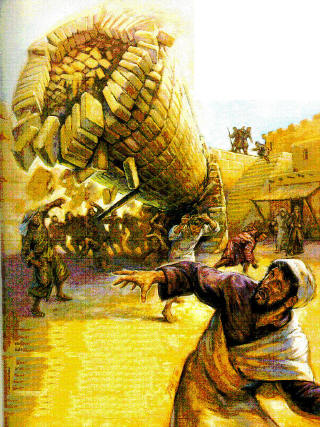
When Towers Fall — 3rd Sunday in Lent—Year C

March 7, 2010

When disasters happen, like the recent earthquakes in Haiti and Chile, some Christian observers respond according to two opposite extremes. One reaction says that a truly just God would never let the innocent die along side the guilty; therefore, all of the victims must have been punished for their sins and got what they had coming to them. The opposite reaction says that a truly loving God would never punish our sins; therefore, all of the victims must have been innocent.

The truth is more complicated than either of these simple and pat explanations. Our God is both perfectly loving and perfectly just. In this world the wheat grows side by side with the weeds. At harvest time, the two are uprooted together, but their eternal fates are not the same. We see that the truth is more complex than some assume by looking at the gospels.

One day Jesus and His disciples observed a man blind from birth. The disciples asked Jesus, “Rabbi, who sinned, this man or his parents, that he was born blind?” Jesus answered, “Neither he nor his parents sinned; it is so that the works of God might be made visible through him.” Jesus smeared clay in man’s eyes and told him to wash in the Pool of Siloam. The innocent man washed and returned able to see.

Yet, on another occasion (in the same Gospel of John) Jesus saw a man lying on the ground who had been ill for thirty-eight years. Jesus miraculously cured this man too, but finding him later Jesus said to the man, “Look, you are well; do not sin any more, so that nothing worse may happen to you.” In this case, it appears that the man’s sin was connected to the cause of his sufferings.

We need to remember that people who suffer and die are not always guilty. On the other hand, people are not always innocent either. Discerning the truth behind why this or that evil befell this or that person or place usually lies well beyond our own limited vision.

For instance, the friends of Job insisted with all confidence that Job’s sufferings must be due to some great sin he had committed.  However, Job stood firm on his innocence, and he truly was as righteousness he claimed. Great sufferings and even violent death are no certain indication of a person’s sinfulness, that “they had it coming.” Just look at our holy and beloved saints:

  • St. John the Baptist was murdered in his 30’s, and St. Paul in his 60’s—they were both beheaded.
  • St. Peter was murdered too, crucified upside down, and of all the apostles, only St. John died of old age.
  • St. Joan of Arc, age 19, was murdered with fire.
  • St. Therese of Lisieux and St. Faustina Kowalska both died of tuberculosis, at ages 24 and 33.
  • St. Maximilian Kolbe and St. Edith Stein were murdered by the Nazi’s in the Auschwitz concentration camp.
  • More recently, before our eyes, John Paul the Great suffered greatly and died of Parkinson’s disease.
  • Even the Blessed Virgin Mary, as perfectly innocent as she was, shared as a mystic and a mother in suffering the passion and death of her Son.

The innocent who suffer live and die in the likeness of Jesus Christ are promised a heavenly reward like His.

So from where do earthquakes and other natural disasters come? In the beginning of time, some of the angels and all of humanity rebelled against God and we rejected our proper places within His creation. This Fall introduced disharmony into our (now) mortal bodies and into the entire natural world. Since that time, Christ has come and in perfect obedience to our Father, died, rose, and has enabled us to be reconciled with God. However, the disharmony of nature remains and we remain free to choose to rebel against our God.

If rebel in sin, we should not be surprised if bad things happen as a result. Usually in this world, we are punished through our sins, more so than for them. For example, someone who neglects prayer and Sunday worship should expect that they will feel disconnected from God. Someone who abuses drugs or alcohol, will see the harmful consequences it brings to their relationships and at school or at work. Someone who covets their neighbors’ spouse and possessions will become sickly green with lust and envy. Add up the sum total of an entire peoples’ sins and you can easily see how an empire or a great nation can decline and decay over time.

God hates our sins, but not merely because they “break His rules.” God hates our sins in proportion to how harmful they are to us. If sins were not bad for us, then God would not command us not to do these things. God hates our sins because He loves us; these are two sides of the same coin.

So what should we do when we witness disaster strike half a world away or in our own community? We should pray for the dead and give our aid to those who live on. Christ calls us to give our compassion, love, spiritual support, and material aid to those who need it. And as for ourselves, such disasters should lead us to convert and reform our lives. Death can come suddenly to any of us. A car crash or a heart attack could take any of us tomorrow placing us unexpected before the judgment seat of God. Let us take such opportunities to prepare ourselves for that day which will come to us all.

What if is not instant death, but a more prolonged evil that comes to me? For instance, what if I go to the doctor and receive a terrible diagnosis?  When such a day comes for me, I hope that I may remember the tree from today’s Gospel, which the gardener worked and fertilized in hopes that it would bear much fruit. If I, like that tree, will humbly accept the manure that comes to me, then it will be a source of great fruitfulness to me.

Could an evil such as this be a correction or a chastisement from God on account of my sins? Possibly, but if I’m not aware of any serious unconfessed sins on my conscience, then probably not. More likely, Jesus is giving me the opportunity to following in His footsteps, to have a share in His cross like the holy saints who came before me. If we accept our crosses with humility, then they can become the means of our sanctification in the likeness of Christ and a source for spiritual fruitfulness for ourselves and the entire world.

The Scales Myth — Friday, 1st Week of Lent

February 26, 2010

In ancient myths and modern imagination, the judgement of our lives will be done with a pair of scales, with our good deeds one one side and our bad on the other.  If our good deeds outwiegh the bad ones (so the story goes) then we’re in good shape.  If not, we’re toast. However, our first reading from the prophet Ezekiel shows that this not how God judges things.

If the wicked man turns away from all the sins he committed, if he keeps all my statutes and does what is right and just, he shall surely live, he shall not die. None of the crimes he committed shall be remembered against him; he shall live because of the virtue he has practiced.

And if the virtuous man turns from the path of virtue to do evil, the same kind of abominable things that the wicked man does, can he do this and still live? None of his virtuous deeds shall be remembered, because he has broken faith and committed sin; because of this, he shall die.

God is more interested in where we’re headed than where we’ve been. This is encouraging good news for the long-time sinner who needs to repent and it is a warning to us who have done well in the past.  It’s not what we’ve done in the past that matters, because each of us can make a definitive turn toward or away from the Lord today.

What advantage then do we who are faithful to the Lord have over those who have deathbed conversions, over those steal heaven like the good thief on his cross next to Jesus? Very much indeed, for our lives’ holiness and good deeds will be weighed and our personal degree of heavenly glory and reward will be measured out accordingly. In heaven we shall all be filled and satisfied, but those who love most in this life shall enjoy the most love in the next.

So whether you are far from God or serving Him faithfully, heed these holy words: “If today you hear His voice, harden not your hearts.”

Advent Penance Service

December 1, 2009

 The psalm says, ‘On the holy mountain is [Jerusalem], his city, cherished by the Lord. The Lord prefers the gates of Zion to all Israel’s dwellings. Of you are told glorious things, O city of God, [Jerusalem].’  (Psalm 87) The Lord God loved Jerusalem and lived within its walls. God dwelt there in a special way in His temple on Mount Zion.

The people of Jerusalem felt pretty special about having such close access to God, but this pride was often their greatest weakness. You see the people of Jerusalem imagined they had this holiness thing in the bag, being so close to the Lord and all. Imagine their shock when a prophet would come along to tell them that they were not so perfect as they thought. When God sent them the prophet Jeremiah, he told them:

“Thus says the Lord of hosts, the God of Israel: Reform your ways and your deeds, so that I may remain with you in this place. Put not your trust in the deceitful words: “This is the temple of the LORD! The temple of the LORD! The temple of the LORD!” Only if you thoroughly reform your ways and your deeds; if each of you deals justly with his neighbor; if you no longer oppress the stranger, the orphan, and the widow; if you no longer shed innocent blood in this place, or follow strange gods to your own harm, will I remain with you in this place…”

Time and again, God sent prophets to Jerusalem to call them to conversion, but Jerusalem would persecute, imprison and kill them. But they did not convert.  And, in the lifetime of Jeremiah, their enemies (the Babylonians) conquered  the city of Jerusalem and destroyed the temple of God within it. We hear God’s feelings about all this through words of Jesus:

“Jerusalem… Jerusalem… you who kill the prophets and stone those sent to you, how many times I yearned to gather your children together, as a hen gathers her young under her wings, but you were unwilling! Behold, your house will be abandoned, desolate. I tell you, you will not see me again until you say, ‘Blessed is he who comes in the name of the Lord.’”

Jesus’ words matter for us today too, because Jerusalem symbolizes our souls. At our baptism, God began to dwell in our souls as His temple, as His new Jerusalem. The psalm is speaking about your soul and mine when it says:

O praise the Lord, Jerusalem! 
Zion, praise your God!
He has strengthened the bars of your gates,
He has blessed the children within you.
He established peace on your borders,
He feeds you with finest wheat.   (Psalm 147)

Indeed, God has strengthened the bars of our gates, our defenses against evil. He has blessed the children, everything that is good and loveable, within us. He establishes peace on our borders, in our relationships with others. And He feeds us with the finest of wheat in the Eucharist. We should feel pretty special about having such close access to God, but we should not make the same mistakes as the old Jerusalem.

You and I can persecute God’s prophets too. We do it whenever we choose to rebel and sin against the good God wills for us. We do it whenever we kill the voice of conscience within us. We do it whenever we imprison the Holy Spirit’s movements within us to the confines of a tiny cell. We do it whenever ignore or refuse to listen to the teachers Christ has given for His Church.

When we are persecuting God’s prophets, we can even evict God’s presence from our souls through freely and knowingly committing a grave or serious sin. We are conquered by our enemy and the temple inside us is destroyed. And ‘behold, our house is abandoned, desolate; and we do not see Him again until we say, ‘Blessed is he who comes in the name of the Lord.’ What can do to help prevent this horrible estrangement from occurring?  And if it does occur, how can we ask the Lord God to return?

In the sacrament of reconciliation, we acknowledge that Jesus Christ is the Blessed One who comes in the name of the Lord. When we acknowledge this, He forgives our sins, and God joyfully dwells in His cherished city. Today, Jesus Christ calls your city to repentance and the conversion of your soul.

1st Sunday of Advent—Year C

December 1, 2009

Each year, people search for the perfect Christmas gifts for the most important people in their lives. We rack our brains and brave the mobs so that we may give our spouses, children, parents and siblings something extra special. But, in all our years, have we ever given Jesus Christ a special gift for Christmas? I encourage you to join with me in putting Him on the top of your Christmas list this year. But what can you get the God-man who has everything? There’s one thing that He cannot receive from anyone else but you—that is the perfect gift of yourself.

How do you make a perfect gift of yourself? First ask yourself this… If this day, death should take you by surprise and you find yourself standing before the Son of Man, as you looked at yourself, what part of your soul would remain unfinished? What would you wish you had another month’s time to set right in your life?

Jesus said, “Beware that your hearts do not become drowsy from carousing and drunkenness and the anxieties of daily life…” Is your life mixed-up with addictions to lust, to intoxicants, or to other empty pleasures?  Are you oppressed the daily worries which come from a lack of trust in God? Or maybe it is something else which is not quite right in your life. Whatever it is, identify where your life needs conversion the most, resolve to begin taking the path of life, and choose to make a gift of yourself for Christ this Christmas.

If you want to make a gift of yourself for Christ this Christmas there is something else you must do. You must set time aside to pray each day. If you neglect this, you will not go far in your conversion or holiness. But, if you lift up your soul to the Lord each day, telling Him about your needs and gratitude, and opening yourself to receive His gifts, then this could be the greatest Christmas of your life. St. Alphonsus Liguori says this about the importance of prayer:

 “Whoever prays is certainly saved. He who does not is certainly damned. All the blessed (except infants) have been saved by prayer. All the damned have been lost through not praying. If they had prayed they would not have been lost. And this is, and will be their greatest torment in hell: to think how easily they might have been saved, just by asking God for His grace, but [for] that now it is too late – their time of prayer is gone.”

There are twenty-five days ‘til Christmas.  Make the most of this opportunity and give Jesus Christ the gift He’s asking for this year.

Tuesday, 34th Week in Ordinary Time—Year I

November 25, 2009

The prophets go beyond what is seen, to reveal what is hidden. Their purpose is to lead people to God.

In the first reading, Daniel reveals what was seen in the king’s dream. In the Gospel, Jesus reveals what will be seen in Jerusalem and at the end of this world as it no stands. In this homily, I will reveal to you three prayers hidden within the Mass which are always present there, but which you may have never heard before.

The first of these hidden prayers comes after the presentation of the gifts. A few of the faithful bring forth the bread and wine to the altar. It is no empty chore. This symbolizes the offering of all your gifts and of your whole lives to God.

I receive the gifts and then I say a prayer of praise to the God of all creation for this bread which we have to offer. Yet before I go on to a similar prayer with the cup of wine you may have noticed something unusual. The priest takes the water and pours a little into the cup of wine. It’s only a few drops, and the wine appears unchanged, but the water and wine have become inseparably one. As he pours, the priests silently prays this:

“By the mystery of this water and wine may we come to share in the divinity of Christ, who humbled himself to share in our humanity.”

You and I will always be God’s finite creatures, but, by the Incarnation, Jesus has made Himself inseparably one with our humanity. It is Jesus’ desire to make us more and more like His divine self through our personal union with Him.

What is the lesson for us here at Mass? We should come to each Mass with high expectations. Do you believe that your whole-hearted participation in this sacrament can make you a better, more beautiful, or more admirable person, and do powerful things for our world? Approach this sacrifice with high expectations. On this point St. John of the Cross and St. Therese of Lisieux agree: “We receive from God as much as we hope for.”

After these prayers for the bread and wine, you will see me bow at the altar. At this moment comes the second hidden prayer. The priest prays:

“Lord God, we ask you to receive us and be pleased with the sacrifice we offer you with humble and contrite hearts.”

What is the lesson for us here at Mass? We should strive to be fully-present at every Mass. Pray the Mass and sing the songs with your whole heart. Offer God this sacrifice with humility, contrition, gratitude and love.

After this comes the washing of the hands and a third silent prayer. The priest prays:

“Lord, wash me of my iniquity; cleanse me from my sin.”

I pray this prayer from particularly from the heart because I do not want my offering and partaking of this most holy sacrament to be the cause of my condemnation and death on account of my sins. (If you think of it, pray for your priest as he washes his hands, that He may offer this sacrifice well for you.) Approaching our all-holy God is serious stuff.

What is the lesson for us here at Mass? If you are aware of serious sins on your soul, come to  confession, the sacrament of reconciliation. Come and be cleansed. Lighten your burden. Do it today.

The prophets go beyond what is seen, to reveal what is hidden. Their purpose is to lead people to God. Through the revealing of these holy prayers I pray you be led to closer to our Lord Jesus Christ at this very Mass.

October 28 – Sts. Simon and Jude

October 28, 2009

Cowardly Lion

Today we celebrate the Sts. Simon and Jude, apostles and martyrs for Christ. Simon was known as “the Zealot,” and Jude, or Judas the son of James, was nicknamed “Thaddeus,” which means “Courageous” in Greek. In the Gospel today the apostles are listed, with Simon and Jude coming towards the end, right before Judas Iscariot, the one who betrayed Jesus.

When Jesus sent out His disciples with the power and authority to heal the sick, cast out demons, and preach the Gospel, He sent them out two-by-two.  One could infer (though this is by no means certain) that this Gospel passage lists the apostles according to those old missionary pairings: Simon Peter with his brother, Andrew; James with his brother, John; and so on, ending with the Judas called “Courageous” and the other Judas who became a traitor.

So here we would have two Judas’, side-by-side, in discipleship and ministry. Yet, only one of them earned a nickname for being courageous. To grow in holiness requires our courage, a virtue that Judas Iscariot tragically lacked.

John’s Gospel tells us that this Judas held the money purse, and sometimes stole from it for himself. That’s because he lacked the courage to acknowledge his faults and to grow in the virtues.

Judas may have betrayed Jesus because he thought this would kick-start Jesus, the weak messiah, into real, revolutionary action. Judas did not have the courage to trust that the providence of God working through Jesus Christ was really the best way to bring about the Kingdom on earth.

And after he had sinned, Judas lacked the courage to seek forgiveness, choosing suicide instead, which is called “the coward’s death.” Simon Peter denied Jesus, but he had the courage to confess his sin and to seek reconciliation. That was Peter’s salvation.

If we are going to grow in holiness to sainthood, it’s going to require our courage; the courage to acknowledge our faults and grow virtue, the courage to trust in God’s will and providential plan for our lives, and, when we fall, the courage to confess our sins and to seek reconciliation with Christ.

September 29 – The Archangels

September 29, 2009

Today we celebrate Saints Michael, Gabriel, and Raphael. God created lots of angels, so that they might enjoy, share and manifest His glory. Within this multitude, Michael, Gabriel, and Raphael hold special rank as archangels. The angels and archangels are like us in important ways, but in other ways they’re very different.

Just like us, God did not create the angels to fulfill some need He had. God needs nothing to be happy and complete. God made heaven and earth, all that is seen and unseen, out of sheer love, overflowing. God created us because love likes to share.

Just like us, God created the angels as persons. We are persons because we both have intellect and will, the capacity to know and the ability to freely choose. Just like us, angels are persons, having souls which will never die. But unlike us, angels don’t have a physical body united to their soul. Instead of body and spirit, angels are spirit alone.

Like us, angels know things and choose things. Like us, they’re made for interpersonal-communion. They interact with God, with each other, with us, and our world. But like God, and unlike us, angels live outside of time. We humans grow, and change, and mature, day by day. We’re incomplete and we develop over time. We can choose holiness one day, choose to sin the next, and on the day after that, think better of it, repent, go to confession, and return to God. But in the case of angels, their natures are complete and finished. And the free choices they’ve made once are made for all time. That is why the angels are forever sinless creatures, and why the demons, who are the angels who chose to rebel and were cast down from heaven, will never turn back to God.

We do not know exactly why Satan and the many demons fell, but it is clear that they did not, in their sinful pride, want the roles in God’s kingdom which God had prepared for them. Some speculate that when the angels where created, God gave them some knowledge of His plans for the human race. God wished the angels to share in this plan, but, for some reason, some refused to serve.

Perhaps it was the scandal of the Incarnation, the idea that the eternal Second Person of the Trinity, would take on material flesh. Maybe they refused to worship the Eternal Word, Jesus Christ, in such a state as that. Perhaps, filled with pride about their own glory, which was entirely God’s gift, they refused to be Christ-like and serve creatures they deemed to be inferior to themselves.

Whatever the reason for it, a war broke out in heaven. Michael and his angels battled against Satan. Satan and his angels fought back, but they did not prevail. The demons wanted to be like God, but without God. Perhaps Michael challenged them with the meaning of his name, “Who is like God?” They wanted to be God, but without God, and there was no longer any place for them in heaven.

And now we arrive at the lesson we learn from the demons’ Fall that I want you to take to heart…

When the demons refused to be what they were made and called by God to be, they became something far less than what they were meant to be. By turning away from God, the source of their life, they became stupid, ugly, and weak compared to what they should have been.

Compared to what God makes us, calls us, and longs for us to be, sin makes us stupid, ugly, and weak too.

Do you have any sins?

Every Tuesday I sit in my office as much time as can, from the end of morning Mass until 3:00 PM, when prayers are offered in the Columbus chapel that God the Father would have mercy on us. I’ve spent hours at my desk, behind my confessional screen, catching up various work. And in all that time, not a single student has come for the sacrament that reconciles sinners with our Lord Jesus Christ. Now don’t think that I’m angry about this. Tuesdays for me as they are now are very productive days. I get a lot done behind my desk. But I would very much prefer, that so many of you would come, to the healing forgiveness, and strengthening graces, that Jesus is waiting to give you in this sacrament, that I would get nothing else done.

I want you to come to the sacrament that cleans your slate and lightens your heart. I want you to come to the sacrament that makes you wiser, stronger, and more attractive as a person than you are when you’re in sin. I want you to come to the sacrament of reconciliation, not for my sake, but for your sake.

Through the intercession of St. Raphael, whose name means “God’s healing,” may we believe in God’s power to heal our wounds. Through the intercession of St. Gabriel, whose name means “God’s power,” may we believe in God’s power to recreate the repentant sinner. And through the intercession of St. Michael, may we consider “who is like God,” who shows mercy to all who come to Him.

26th Sunday in Ordinary Time—Year B

September 27, 2009

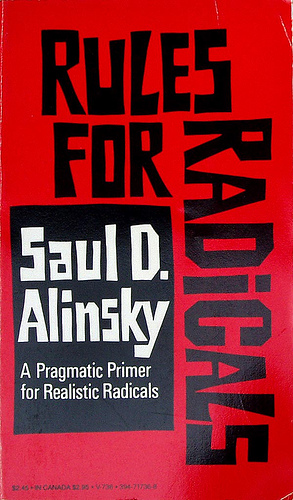
There are many things wrong with our society and the world, but how are we to go about changing them? One approach was presented by a fellow named Saul Alinsky. He, and his highly-influential 1971 book entitled Rules for Radicals: A Practical Primer for Realistic Radicals, have been popping up a lot lately. Reading his list of 11 rules you can see how they are widely used in politics & culture today.

The dedication of the book reads like this: “Lest we forget at least an over-the-shoulder acknowledgment to the very first radical: from all our legends, mythology, and history (and who is to know where mythology leaves off and history begins — or which is which), the first radical known to man who rebelled against the establishment and did it so effectively that he at least won his own kingdom — Lucifer.”

I doubt Alinsky believed in the devil at all.  He probably wrote that because it was a clever and effective attention-grabber for his book. But the book’s dedication was truer than he realized.  The book recalls the first rebel’s rejection of the kingdom of God and then goes on to explicate rules which often reject the approaches embodied and advocated by Christ, whose approaches the world often considers too impotent to defeat evil in the world.

The tactics this book advocates are often the same used by demons in spiritual warfare against us—a war fought on the battlefields of our hearts and minds, for the defense or the capture our souls.

Consider, for example, “Rules for Radicals #1: Power is not only what you have, but what an opponent thinks you have. If your organization is small, hide your numbers in the dark and raise a din that will make everyone think you have many more people than you do.” And, “Rule 9: The threat is more terrifying than the thing itself.” Demons fight us most effectively when they deceive us into imagining they are more powerful than they are. In fact, the only real weapon they have against us is to play on our fears, for we protected against demons in Christ.

Rules for Radicals # 4: “Make opponents live up to their own book of rules.” Alinsky writes, “You can kill them with this, for they can no more obey their own rules than the Christian church can live up to Christianity.” In following this rule, one follows the example of the Great accuser, the devil, who (as the book of Revelation says) night and day accuses us before God for sins. Alinsky’s charge against Christians, that the Christian Church cannot live up to Christianity, blends the truth and lies, just like the words of the demons when they speak to our thoughts.

The truth is that we are God’s servants, that we care deeply about Christ’s teachings, and that all of us commit sins, sins that we would say we truly oppose. But, like the psalmist, we pray for God to cleanse us from even our unknown faults. And from wanton sin especially, we sincerely ask the Lord to restrain us; to not let it rule us, so that we may be blameless and innocent of serious sin. Even though we do not yet follow Christ perfectly, we are truly made better people, more Christ-like, through our relationship with Him.

Yet demons want us to convince us we’re all hypocrites. They want to make us silent, out of shame for our sins, about what is right and what is wrong. They would even cause us to give up on trying to live-out lives of perfect love. Though we are sinners, we trust in God’s mercy and love. Jesus was always merciful toward sinners who acknowledged their guilt and He enabled them to become more perfect through a relationship with Himself.

Rules for Radicals #11: “Pick the target, freeze it, personalize it, polarize it. Don’t try to attack abstract corporations or bureaucracies. Identify a responsible individual. Ignore attempts to shift or spread the blame.” Alinsky writes, “One acts decisively only in the conviction that all the angels are on one side and all the devils on the other.” You’ve seen this polarizing tactic employed through the media, and you see it all the time. It’s called the politics of personal destruction.

It is the demonizing of individuals who we don’t agree with. Christians must not be indifferent to wrongs wherever they are committed, but when it comes to persons, what Christians seek and pray for is the conversion of sinners, not their destruction. “For God did not send his Son into the world to condemn the world, but that the world might be saved through him.”

Do tactics like those which Saul Alinsky laid out actually work at effecting change?  The answer is both Yes and No. Lots of influential people use them because they make lots of noise and heat and angry waves; they can end people’s careers, and they can extort institutions into making concessions. The power of these tactics makes them a strong temptation. But temptations they remain, for they do not have the power to bring about the kingdom of God.

Is the Church interested in social change? The Church is very much interested in social change, just like Jesus was, but we follow the way of His example. Allow me to present another influential writer of the 20th century, as an example, someone who was interested in radical social change of the Christian sort: Pope John Paul the Great. He is rightly called “the Great” for he must be counted among the greatest men of the last century.

Consider how he opposed the great evils and injustices of the communist empire. John Paul did not deal in deceptions. He spoke the truth, because he believed that the truth is powerful enough to set us free. He cared deeply and passionately about the grave injustices being committed, but he never seemed hateful because he was driven by true Christian love. He taught that some actions are wrong, even unspeakably wrong, but that all persons are worthy of love, and he radiated this love of God for all to see through his smile. His focus was not in personal attacks, but in speaking the truth to the human consciences. He insisted that all people should be given the recognition of the dignity and the rights they have from God: to live, and live freely, to speak the truth, and live the truth.

This is what he did, and the communist dictators literally trembled before him. When the communist leader of Poland welcomed the pope to his homeland in a speech at the airport broadcast on state-controlled TV, the dictator’s voice, and the paper he held in his hand, both quivered. The pope was so powerful against them, simply with the message and example of Christ, that the communists tried to kill him in St. Peter’s square, but the Pope miraculously survived the bullets, and forgave his would-be assassin.

By the mercy and the power of God, and in no small part through the words, deeds, and prayers of Pope John Paul the Great, the Soviet empire, which did so many evils for the sake of a utopia that never came to be, that empire ended; not with the fire of a thousand nuclear blasts, but with a harmless dying gasp. It was miracle, a peaceful victory for Christ and the Kingdom of God.

There are many things wrong with our society and the world, but how are we to go about changing them? Pope Paul VI said, “If you want peace, work for justice.” It’s good to work for justice, and we must work for justice, but we must remember this: true justice comes through the way of peace, the way embodied by our Lord, Jesus Christ. So whose example will we be dedicated to as we work for change in the world; that of Lucifer or that of Jesus Christ?

25th Sunday in Ordinary Time—Year B

September 20, 2009

Somewhere, in an underground lair, a secret hideout, or a den of iniquity, we find a criminal mastermind, or a mad scientist, scheming a nefarious plot. “Mah-ha-ha-ha,” the villain manically laughs. “Once I unleash my evil plan, evil will conquer the world.”

This is the way of villains as we often find them in comic books. Comic book bad guys love doing evil for evil’s sake. But we should realize that this isn’t why people do bad things in our world. In the real world, nobody does evil for evils sake. Every single person acts to achieve some real or perceived good. Sinners simply go about the pursuit of happiness in wrong ways. Bad people are not bad because they’re trying to do bad things. Unrepentant sinners actually feel justified in what they do.

For instance, in Jesus’ day, influential people said, “That Jesus from Nazareth so obnoxious. Let’s have him condemned and see how he holds up then.  If he’s really holier-than-thou, a son of God, then God will come to his rescue—otherwise he gets what he deserves.” People still rationalize like this today. It’s easy to come up all sorts of reasons for doing bad things rather than what is right:

“Lying? What I said isn’t technically untrue. Besides, it’s only a little white lie.”

“Angry? Is it any wonder that I get so angry when I have to deal with stuff this.”

“Stealing? The way I see it, they make plenty of money, and I deserve more than what they pay me.”

Activities outside of marriage?  “What’s the big deal? It’s all consensual, and nobody’s getting hurt. Besides, we love each other.”

It’s not only “bad people” who say things like this. Each of us fall into embracing lies like these sometimes. But what is the antidote for rationalizing aside our sins? The cure for this is a prayer life with Jesus Christ.

When the apostles came face to face with Jesus inside the house, Jesus began to ask them, “What were you arguing about on the way?” But they remained silent, for they had been discussing among themselves on the way who was the greatest. Coming into Jesus’ presence, who is the embodiment of Truth, the reality of what they had been doing became clear for them. Their false illusions completely faded away, like the smoke from a blown out candle.

We should spend time in conversational prayer with Jesus Christ every day, allowing Him to form us, build us up, and console us. When you receive the encouragement, confidence, and consolation which Christ is eager to give you in prayer, when He acknowledges you as His own brother or sister, as His good friend, as a favored child of His Father, fears dissolve and you live in peace—a peace in which cleverly-devised excuses are no longer sought for and no longer necessary.

Thursday, 24th Week in Ordinary Time—Year I

September 17, 2009

In the Gospel, a notoriously sinful woman learns that Jesus is in town and comes to the place where He’s eating. In those days, Jews ate at table as they laid upon elevated beds, with cushions under their chest or side, and with their feet stretched out behind them. The woman came in, and stood behind Jesus, at his feet, weeping. She came to Jesus because she had heard His proclamation of mercy, that He came ‘not to call the righteous to repentance, but sinners.’

She bathes his feet with her tears. Why doesn’t she fetch water for this?

She wipes His feet with her hair. Why doesn’t she just use a towel?

She kisses His feet repeatedly. Why does she kiss his feet? 

The Gospel does not mention the exact nature of the sinful woman’s past, but perhaps her lips had kissed many, perhaps her beautiful hair had been shared with many, perhaps her eyes had shed many tears, from the great pain that follows impure romances. So the woman uses her own tears, and hair, and lips because she desires to honor God, through Jesus, with her body, in her body, and through her body. Her faith saved her, and gave her peace, a faith she expressed through her body. May our faith be like hers.

Thursday, 22nd Week in Ordinary Time—Year I

September 3, 2009

Peter has worked hard all night and has nothing to show for it. He’s frustrated and tired. Then Jesus comes along. The two men had met before. Peter met Jesus through his brother. Apparently, Peter had been impressed by this man whom Andrew insisted was the messiah; for when Jesus asks Peter to take the boat from the shore, to give some space for speaking to the crowds, Peter obliges.

How long do you think Jesus spoke out there, sitting in the boat? It probably wasn’t a short while. And when Jesus finishes talking, he turns again to Peter and wants him to go out further, to cast his nets into the deeper waters. Peter thinks it’s pointless, and he says so, but He continues showing a willingness to oblige Jesus.

Peter casts the nets and brings in his biggest catch ever. And here, seeing himself richly blessed, by a great and holy man, Peter hits the limit of his capacity to serve. It’s not that Peter’s too tired or hungry, too busy or lazy. It’s his shame for his sins. Peter’s shame would prevent him from serving Jesus any farther.

Peter turns to Jesus and says, “Depart from me, Lord, for I am a sinful man.” It’s the opposite from what we should ask of Jesus when we acknowledge our sinfulness. Jesus tells him, “Do not be afraid. (I will do great things with you.)”

We are not worthy to receive Him, but we are called to His supper and to serve Him all the same. And even with recovering sinners like us, He can do great things.