Archive for the ‘Sacrifice’ Category

Why Bread & Wine

February 17, 2025

6th Sunday in Ordinary Time
By Fr. Victor Feltes

This Sunday, our seven week exploration of the sacraments culminates and concludes with the Most Holy Sacrament, the Most Blessed Sacrament, the Source and Summit of the Christian life. It is called the Breaking of the Bread, the Lord’s Supper, our King’s Heavenly Banquet, the Marriage Supper of the Lamb. It is the Bread from Heaven, the Bread of Angels, the Bread of Life; the antidote for death and the medicine of immortality. This sacrament is the Holy Sacrifice, our Holy Communion, the Most Holy Eucharist. After this homily, following our profession of the Creed and our prayers of the faithful, gift-bearers will carry up bread and wine along with water and our Sunday collection. Why did our Lord in his divine wisdom choose bread and wine for use in a sacrament, for this greatest sacrament? There are many reasons.

One reason is that the Last Supper was a Passover meal, and Passover meals featured unleavened bread and wine with a sacrificed lamb. The Passover celebrated how the angel of death harmlessly passed over the homes marked with the blood of the lamb, freeing God’s people from Egyptian slavery to Pharaoh, and enabling them to journey toward the Promised Land. The Eucharist frees us from slavery to Satan, sin, and death, enabling us to enter heaven and the new Creation, passing over unharmed into freedom and new life.

During the exodus, God’s people ate flakes of Manna in the desert. This Manna resembled and was called bread from heaven strengthening and preserving them on their journey. Jesus proclaims himself the new Bread from Heaven: “I am the living bread that came down from heaven; whoever eats this bread will live forever; and the bread that I will give is my flesh for the life of the world.”

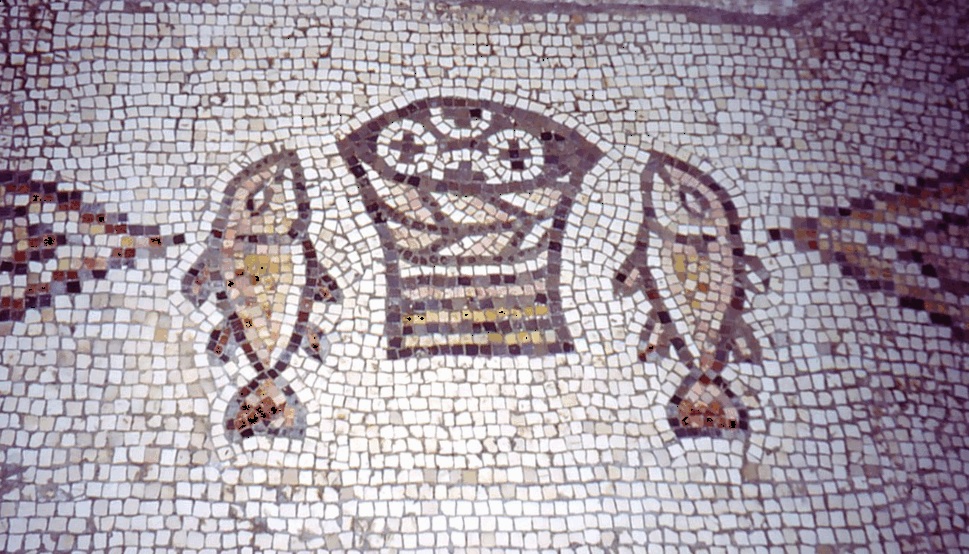
Jesus changing water into wine at Cana reveals Christ can transform one thing into another. And Jesus’ multiplication of loaves shows that he can multiply something so that a multitude can partake of it. These miracles foreshadow how Jesus changes bread and wine into himself so that all of us can receive him in the Eucharist.

Daily bread” and wine were staple foods for Gentiles and Jews in the ancient world. Psalm 104 says God gave “wine to gladden the heart of man,” and “bread to strengthen man’s heart.” Though wine was more commonplace in those days, it was a symbol of special rejoicing as well. Jeremiah noted how people typically tread grapes with “shouts of joy,” and Ecclesiastes observed “wine gives joy to the living.” A feast of bread and wine combines the humblest of common foods with the peak of luxurious royal drinks. Likewise, the Eucharist unites the ordinary and extraordinary, our earthly everyday combines with the height of heavenly celebration.

Wheat and grapes grow on every continent on earth besides Antarctica, making these sacramental ingredients available to people throughout the world. God provides the raw materials, fruits of the earth and vine, to be worked by human hands into the bread and wine we offer the Lord God of all Creation. We are called to serve as his faithful stewards. Christ then takes our works and makes them still more bountiful. He does this in this sacrament and also throughout our lives.

The processes for making bread and wine reflects the Passion of Christ. Wheat is beaten, ground, and pummeled. Grapes are crushed, drained, and outpoured. They suffer along their way to God-honoring sacrificial glory.

The baked bread resembles human skin and red wine resembles human blood. And at the words of Consecration these things really become Jesus Christ through and through—his Body, Blood, Soul, and Divinity; living, whole, and undivided—with only the outward appearances of bread and wine remaining. To symbolically separate the Body of Christ from his Precious Blood is a symbol of death. And their reunion within us is a symbol of resurrection. Christ is truly risen in history and risen in us. As Jesus says, “Whoever eats my flesh and drinks my blood remains in me and I in him.”

This sacred sacrifice is also a communal meal. The Eucharist which unites us to Jesus Christ unites us to one another in him. As St. Paul writes to the Corinthians, “The cup of blessing which we bless, is it not a participation in the blood of Christ? The bread which we break, is it not a participation in the body of Christ? Because there is one bread, we who are many are one body, for we all partake of the one bread.”

Finally, consider how instead of coming to us as a frightening fire, Jesus Christ comes as non-threatening food. He says, “Take this, all of you, and eat of it, for this is my Body… Take this, all of you, and drink from it, for this is the chalice of my Blood…” It is very important that we approach him lovingly and reverently, in a state of grace, but Jesus urges us to partake of him. Christ’s desire is for us and him to live as one, to become the Body of Christ you receive in this Most Blessed Sacrament.

Faithful Efforts & Divine Increase

July 27, 2024

17th Sunday of Ordinary Time
By Fr. Victor Feltes

In our first reading from the 2nd Book of Kings, the Prophet Elisha uses twenty barley loaves to feed a hundred people. That suggests a miraculous multiplication of five times. In our Gospel reading, Jesus Christ uses five loaves to feed about 5,000 men – a multiplication of 1,000 times. So Jesus’ miracle was 200 hundred times greater than Elisha’s. That 200 figure is interesting because of something Philip the Apostle says.

When Jesus asked him, “Where can we buy enough food for them to eat,” to see what he would say, Philip remarked, “200 days’ wages worth of food would not be enough for each of them to have a little!” What good could 200 days of work do for so many? One might ask what good are any of our labors or efforts in the face of such great problems in our world today?

Many days passed between the events of the 2nd Book of Kings and the events of the Gospels. Why did the Old Testament people of God have to work and wait, suffer and endure, for days and years, for generations and centuries, before the coming of Christ? Because it was not yet the fullness of time; things were not yet fully prepared for those greater wonders. Our redemption in Christ is preeminently the work of God but God wills that the faithful efforts of faithful people help prepare the way.

While the disciples were still wondering what to do about the problem of the hungry crowd, Andrew the Apostle told Jesus, “There is a boy here who has five barley loaves and two fish, but what good are these for so many?” Jesus would take those loaves, give thanks to God the Father, and distribute the loaves and fishes to the reclining crowd as much as they wanted, and they all ate and had their fill.

Consider this: in the beginning, all things were created through God the Son out of nothing, ex nihilo. Yet Jesus did not conjure food to feed that crowd out of nothing. Like at the Wedding Feast of Cana, he received what was offered to him and transformed it for both our good and God’s glory.

That boy and those five loaves and two fish are remembered to this day, in our Gospel stories on earth and even more gloriously in heaven. Jesus used that entire gift, he multiplied all the loaves and fishes offered, just like how at Cana he transformed the contents of all six of the large stone water jars which the servants had filled for him. And Jesus directed his disciples to “gather the fragments left over, so that nothing will be wasted,” filling a dozen wicker baskets with fragments from the five barley loaves which had been more than they could eat.

Even as Christians we may get discouraged, feel overwhelmed and wonder, “What good are any of my labors or efforts? What good is this for few or many?” Today’s Gospel reading reminds us that Jesus will use everything which we offer him. He will bless it, transform it, multiply it, grow it. He will use it for both our good and God’s glory, and nothing will be wasted. Remember that Jesus promises “whoever gives but a cup of cold water… to drink… [for me] will surely not lose his reward.” (Matthew 10:42)

Lessons from the Magi

January 7, 2024

Feast of the Epiphany
By Fr. Victor Feltes

The city of Bethlehem was the birthplace and hometown of King David, the place where the sheep offered at the Temple were raised, a place whose name means “House of Bread.” There is where the Magi found Jesus Christ, the Son of David, the Lamb of God, and the Bread that came down from heaven. The Magi came from the east, perhaps responding to some sign the Prophet Daniel had foretold centuries before during his Babylonian Captivity. They arrived in Jerusalem saying, “Where is the newborn king of the Jews? We saw his star at its rising and have come to do him homage.”

King Herod and all of Jerusalem heard about this and Herod took the rumor seriously. He asked the chief priests and the scribes where the Christ (or Messiah) would be born. They answered with the prophesy of Micah: “in Bethlehem of Judea.” So King Herod sent the Magi to search there, using them as his unwitting spies. The Magi found the home of the Holy Family and showed homage to Jesus with his mother Mary, presenting gifts of gold, frankincense, and myrrh; gold for our King, frankincense for our Priest and God, and myrrh, an ancient-world embalming resin, for him who would die and rise again.

Now the town of Bethlehem is only a two hour walk from Jerusalem, but there is no record of any others who heard the rumor going there in search of the infant Christ. If they had gone and asked around, some locals would likely know the shepherds who had joyfully proclaimed the birth of the Messiah on Christmas night. “All who heard it were amazed by what had been told them by the shepherds,” so it would have left an impression. With a little grace, an encounter with Jesus and his Holy Family would have been found by anyone who had bothered to look. The Magi traveled hundreds of miles to find him yet many priests and scribes neglected to go a mere six miles. In your life, beware of practicing your Christian faith so feebly that you forego making the simplest sacrifices in service of Christ. Consider what simple steps—in prayer or with the sacraments, in penance or in study—you could take in this new year to draw closer to Jesus Christ.

Matthew’s gospel tells us that “having been warned in a dream not to return to Herod, [the Magi] departed for their country by another way.” Recall again how Bethlehem was not far at all from Jerusalem or from Herod’s nearby palaces, so it seems the Magi had this dream before departing from the Holy Family. If the Magi had sensed that the Holy Family were in danger they would have warned them before embarking for home. The Magi either informed them, or — not sensing danger — did not.

Maybe they did warn the Holy Family of possible danger but Joseph and Mary simply did not know what to do next. Sometimes, even when trying our best, we won’t know what to do. Trust the Lord to guide your way. If the path you choose is important in God’s plan he will help you go in the right direction. Previously, when Joseph had been about to make a mistake by separating himself from Mary, God sent him an angelic message in a dream. Here again, “when [the Magi] had departed, behold, the angel of the Lord appeared to Joseph in a dream and said, ‘Rise, take the child and his mother, [and] flee to Egypt…’” God is supremely brilliant and resourceful. He can send you signs if you need them but, to receive God’s promptings, cultivating a heart which is open to God’s will (like St. Joseph’s was) is essential.

What if the Magi were told in the dream not to return to Herod, and perhaps even mentioned this to the Holy Family, without anyone perceiving the active threat which Herod posed? That too would contain a valuable lesson for us. If the Magi obeyed God before fully understanding his purposes, through trusting him and following his instructions their lives were saved from Herod’s sword and the Holy Family had time to escape.

Jesus Christ and his Church teach us many things about what we must or must not do, or what we should or should not do. People can be challenged by and may not yet fully understand Catholic teachings about the Sacraments, human sexuality, the beginning and end of human life, social justice, or other topics. There are good reasons behind all these teachings and it is good to explore them by researching and asking questions to understand them better, but there will be times in your life when you are called to be faithfully obedient even before you fully understand. The obedience of the Magi served Christ and likely saved their lives. Your obedience to God will bless you as well, and more than you may realize.

Invest Yourself in Heaven’s Reward

November 19, 2023

33rd Sunday in Ordinary Time
By Fr. Victor Feltes

As Jesus traveled from place to place he preached parables to different people. He told stories, for instance, featuring fields, fish, and flocks to teach farmers, fishermen, and shepherds about the Kingdom of God. It makes sense that Jesus would tell the same stories more than once, for different crowds to hear them for the first time and for his apostles to hear them repeatedly. But the gospels suggest Jesus sometimes changed his parables’ details to highlight different truths. What Jesus says in his Sermon on the Plain is similar but not identical to his Sermon on the Mount. As the Church journeys through our three-year cycle of Sunday readings we hear some parables retold by more than one gospel. And each fall, as we near the end of the Church year, our readings reflect upon the Four Last Things. Today, we have another such parable, about death and judgment, Heaven and Hell, Jesus Christ and us.

Christ is our Lord, our journeying master who shall return. We are his servants to whom he has entrusted our fortunes. And each of us one day will stand before him to give an account of our faithful or unfaithful service, with generous rewards or just punishments to follow. In Jesus’ telling through St. Matthew’s Gospel, the master entrusts weighty slabs of precious metal (called talents) in varying numbers to his servants, each according to their abilities. Upon his return, his faithful servants have doubled what they were given and receive the same words of praise: “Well done, my good and faithful servant! Since you were faithful in small matters, I will give you great responsibilities. Come, share your master’s joy!” One servant, however, who buried his talent and returned it ungrown, receives his master’s condemnation and is tossed into the darkness outside.

When Jesus retells his parable in St. Luke’s Gospel, the master is a nobleman who goes off to claim his kingdom, entrusting to ten servants one gold coin each. Upon his return, his faithful servants reveal their various positive returns on his investment. One has earned ten more gold coins and his king declares, “Well done, good servant! You have been faithful in this very small matter; take charge of ten cities.” Another servant has earned five more coins and the king decrees, “You, take charge of five cities.” One servant, however, hid his coin in a napkin and returned it unmultiplied. The king condemns that servant and orders all of his enemies who did not want him as their king to be slain.

The differences between these two parables highlight different truths about Heaven. In the first parable, the master speaks the same blessing to each faithful one: “Well done, good servant! … Come, share your master’s joy!” But in the other parable, the king gives his servant with ten additional coins ten cities and gives his servant with five additional coins five cities. So is Heaven’s reward the same for all the saints or can one’s reward be greater than another’s? One parable suggests their reward is the same, while the other suggests their rewards vary. On one hand, the reward of every saint is the same: they experience God’s unveiled glory forever in happy, loving communion with him and all who are in Christ. On the other hand, a great saint’s capacity for love and joy and glory may be greater than another’s.

Doctor of the Church St. Therese of Lisieux recounts in her great autobiography (“Story of a Soul”) how this idea once troubled her as a child: “One day, I expressed surprise that God does not give an equal amount of glory to all the elect in Heaven—I was afraid that they would not all be quite happy. [My older sister Pauline] sent me to fetch Papa’s big tumbler and put it beside my tiny thimble, then, filling both with water, she asked me which seemed the fuller. I replied that one was as full as the other—it was impossible to pour more water into either of them, for they could not hold it. In this way [she] made it clear to me that in Heaven the least of the Blessed does not envy the happiness of the greatest…

Notice how in both forms of Jesus’ parable all the faithful servants are entrusted with greater responsibilities. The saints in Heaven are likewise given higher roles as our intercessors now and in the family and household of God forever. Consider how many churches, religious communities, and cities around the world are dedicated to St. Paul. They are blessed to have him as a loving patron praying for them. And consider how the Blessed Virgin Mary shall always hold a privileged place in Heaven as the spiritual mother of every Christian.

St. Paul says, “Consider this: whoever sows sparingly will also reap sparingly, and whoever sows bountifully will also reap bountifully.” The generosity of our loving gifts to Christ, the additional sacrifices we make and good deeds we do, will surely not go unrewarded. Jesus tells us, “Give, and it will be given to you. Good measure, pressed down, shaken together, running over, will be put into your lap. For the measure with which you measure will be measured out to you.” Our individual hustle, cooperating with Christ’s grace, can win us greater glory, therefore “run so as to win!

We should not fear that we lack sufficient talents or gifts to produce good fruits for glory. In the first parable, every faithful servant was able to double his money and won his master’s praise. The issue with that unfruitful, condemned servant is that he never tried. His master calls him “wicked” and “lazy” because that servant did not make even the most minimal effort to grow his gift. “Should you not then have put my money in the bank so that I could have got it back with interest on my return?” That servant did not love his lord but rather resented his lordship over him. Which is easier: to digging a hole or visiting the bank? He did not want to be his master’s servant, he did not want him as his king, and so he finds himself condemned and cast out forever. But if we love our Lord we will produce fruit, just as “every good tree bears good fruit.” As Jesus declares, “Whoever remains in me and I in him will bear much fruit.”

What is something more that you will do with the talents and gifts our Lord has lent you? It could be something large or small, in private or with others. You could be a more-focused prayer warrior, or offer secret penances for the salvation of souls. You could start a Catholic book or movie club at your home, or organize a regular Bible study that discusses the upcoming Sunday readings. You could visit shut-ins as an extraordinary Eucharistic minister, or invite somebody new each week to come with you to Mass. There are many good things you could do and I urge you to consider and answer this call, for Jesus Christ will honor your faithful, loving efforts with glorious rewards.

“Deny Yourself, Take Up Your Cross, & Follow Me”

September 2, 2023

22nd Sunday in Ordinary Time
By Fr. Chinnappan Pelavendran

In the lives of each one of us, there is a cross. The cross can be caused by someone else or brought upon ourselves due to our own decisions. Sometimes the cross is neither the fault of others nor ourselves. We are human and are not perfect like God? Whatever the cause, Jesus said, “Whoever wishes to come after me, must deny himself, take up his cross, and follow me.” To be the true disciple of Christ we must take up our own cross and follow Him. Today’s readings encourage us to overcome all obstacles and to surrender ourselves completely to God.

In the first reading, the prophet Jeremiah lamented, “Lord you have seduced me, and you have overpowered me.” He complained about his mission. “Lord God, you did not tell me it was this difficult.” Of course, at the beginning of his call, he resisted God, saying, “Lord truly I do not know how to speak, I am only a boy.” However, God chose him even from his mother’s womb. (Jer 1: 4) Faithfulness to God sometimes brings us pain, trials, and disappointment. Despite all this suffering, God shields and blesses us.

In the second reading, St. Paul invites us to “offer yourselves as a living sacrifice, holy and acceptable to God.” Submit yourself to God without resistance; this total submission is essential to a life of righteousness, joy, peace, and victory in Christ. We have to live as true Christians. Our daily lives must conform to the will of God. All our actions must be for the honor and glory of God.

In today’s gospel, we see the irony of life. Last week, St. Peter proclaimed that Christ was the Messiah but today Jesus said, “Get behind me, Satan.” Christ rebuked Peter for being an obstacle to His mission. Jesus explained to his apostles, that even though he is the Messiah, He has to undergo humiliation, suffering, and violent death at the hands of the Jewish authorities in Jerusalem. After correcting Peter, Jesus announces the three conditions of Christian discipleship: (1) deny yourself, (2) take up your cross, and (3) follow me.

First, denying oneself means, at every moment of our life, we must say no to self and yes to God. We must give first place to God whatever we do or say. Secondly, Jesus tells the disciples to take up their cross; this means our Christian life is a sacrificial service. We must abandon our personal ambition in order to serve God. We have to sacrifice our time and talent for Him. We must be constantly aware of the demands of God and the needs of others. We must accept the pains and difficulties of Christ and others. Finally, Our Christian life is a constant following of our Lord. Constant obedience in thought, word, and action to Jesus.

As true disciples of Christ, we need to ask ourselves every day, “Did I sacrifice a part of my time, and talents for Christ and others? Did I practice self-control over my thoughts, words, deeds, and use of mass media? Did I train my children in the faith?” Encourage them to spend some time together as a family praying and reading the Bible. Try to teach your children and others by your example of forgiving others and asking pardon for your own sins and failures. We must follow Christ by denying ourselves, taking up our crosses, and following Him in this way.

Being a True Disciple Requires Total Commitment

August 1, 2023

17th Sunday in Ordinary Time
By Fr. Chinnappan Pelavendran

A few months ago, I came across a student who was training himself to make the school’s football team. He got up every morning at 5:00 AM to train himself. He would run and lift weights for two hours. Then he would go back to shower, eat breakfast and go to school. After his classes, he would go back to the athletic facility and work for three more hours with his teammates. The next morning at 5:00 AM, he will start the same routine again. He had very little time for his parents, social life, and other work.

Today we have the pearl merchant who sacrificed everything to buy the pearl of great price. We hear of a treasure hunter who sold everything he owned to buy a field with treasure in it. So, what is the connection between a pearl merchant, a treasure hunter, and this young football player? What do they have in common? They have a total commitment to their dream. All of them are willing to sacrifice everything for the goal that they have set for themselves.

This is what Jesus points out in today’s gospel. To be a true follower of God requires total commitment on our part. Citizenship in God’s Kingdom requires us to give 100% all of the time, not just when we feel like it. God’s Kingdom must be the top priority of our life. We cannot be true followers of Jesus only part-time. Being a true disciple of Jesus is like being a pearl merchant. Being a true disciple of Jesus is like being a treasure hunter. Being a true disciple of Jesus is like being a football player. It involves total dedication and commitment.

There is a big difference between a true disciple of Jesus, and our pearl merchant, treasure hunter, and football player. Those three people are striving for earthly rewards, while followers of Jesus are striving for eternal and permanent rewards.

When the pearl merchant dies, his pearl will no longer be of any value to him. When the treasure hunter dies, his treasure will be just as useless to him. When the football player dies, his trophies will only be a keepsake for his family. However, when the true disciple of Jesus dies, the whole kingdom of God rejoices because it will now shine brighter and brighter. All of God’s people will be edified eternally.

Money is good when it is used to help others, not when it is only spent on ourselves. Influence and power can be great when used to lift up those who are down. Think about this. If our pearl merchant and treasure hunter and football player were willing to sacrifice so much for a prize that will never last, how much more should we be willing to sacrifice for a prize that will last forever? Earthly prizes can be good and even satisfying for a time, but eternal prizes are the best.

As true disciples of Jesus, we need to keep our greatest treasure safe, which is our personal relationship with Jesus. We do this by accepting him every day as our God and Savior. By allowing God to have total control over our lives through our loving obedience to His will, by asking for the guidance of the Holy Spirit, by talking to Him daily in prayer, and by listening to Him in our meditative reading of the Holy Scripture. By getting reconciled to Him and others, asking for pardon and forgiveness for our sins, by offering Him our lives on the altar during the Holy Mass, and by receiving Jesus in Holy Communion.

3 Mysteries Remembered

April 6, 2023

Holy Thursday
By Fr. Victor Feltes

[Our] Lord Jesus, on the night he was handed over, took bread, and, after he had given thanks, broke it and said, ‘This is my body that is for you. Do this in remembrance of me.’” At this same Supper, Jesus washed his apostles’ feet, drying them with a towel. Then, when he reclined at the table again, Jesus told them, “If I, therefore, the master and teacher, have washed your feet, you ought to wash one another’s feet. I have given you a model to follow, so that as I have done for you, you should also do.”

For this Mass of Holy Thursday, the Church directs me to preach “a homily in which light is shed on the principal mysteries that are commemorated in this Mass, namely, the institution of the Holy Eucharist and of the priestly Order, and the commandment of the Lord concerning fraternal charity.” This no heavy burden. Jesus makes it easy by his actions that night. At the Last Supper, Christ gives us these precious gifts: his Holy Eucharist, his Holy Priesthood, and his holy model of loving service which he commands us all to follow.

Our Bishop William Callahan noted at this week’s Chrism Mass that without priests there would be no Eucharist, and without the Eucharist there would be no Church. The priesthood is essential to the Eucharist, and the priesthood and the Eucharist are essential to Christ’s Church. The Catechism of the Catholic Church echoes the words of the first century bishop and martyr St. Ignatius of Antioch in teaching “that without the bishop, presbyters, and deacons, one cannot speak of the Church.” (CCC #1593) And the Second Vatican Council famously teaches that the Eucharist is “the source and summit of the Christian life.” For in the Most Blessed Sacrament is contained the whole spiritual good of the Church, for it is Jesus himself. All the Church’s other sacraments, ministries, and good works flow from this one sacrifice, are united to it, and united to Christ.

Perhaps there are young men here tonight with a vocation to the priesthood. If you think you may have this divine calling, I urge you to actively pursue it. If you pursue this path and discover you are not called, you will be no worse off but blessed from the experience, and for the rest of your life you will never have to wonder or worry whether you might have had this calling. But if priesthood is your vocation, you will not find anywhere a greater life.

When Jesus commands at the Last Supper, “Do this in remembrance of me,” and declares, “I have given you a model to follow, so that as I have done for you, you should also do,” he was not only ordaining priests of the New Covenant and showing how them how to serve. Christ’s words are addressed to all disciples; not only that we should faithfully attend Holy Mass, but that we should live the way of love we see from him. The night before offering his Body and Blood on the Cross, Jesus gives these sacramentally in the Eucharist. Before offering up his death on the Cross, we see Jesus humbly provide loving service at table. Do you realize what he has done for you? Jesus has given us a model to follow, so that as he has done for us, we should also do. Do this in memory of him.

Re-Presenting His Mysteries — Funeral Homily for Sara Caron, 59

November 19, 2022

By Fr. Victor Feltes

When Sara was first diagnosed with breast cancer, her two boys (Mick and Jake) were just twelve and seven years old. She thought of how hard it could be for them to have to grow up as children without her. She did not know how much time she had left, but one of her goals was to be around for them, to raise them throughout their high school years. Today, thirteen years later, her sons are twenty and twenty-five years old. She successfully brought them both to adulthood.

Her family tells me Sara has worked at fifteen different places over the course of her career, and even with cancer, she never stopped working. They say she went “above and beyond” at work and would never take time-off for herself, but she would take days away from work to care for her family; for instance, keeping vigil with Mick in the hospital. Sara also kept on working for another reason: to preserve her continued health insurance coverage. You can imagine how much out-of-pocket cancer treatments would have cost. Sara did not wish to burden her beloved husband, John, and their household with terrible medical debts.

To echo the words of St. Paul in his Letter to the Romans, only with difficulty does a person give their life for others, though a good person might have the courage to lay down their life for those they love. St. Paul speaks of how “God proves his love for us, in that while we were still sinners Christ died for us.” When we witness someone, despite their flaws, give their life not just once but year after year for those they love, it is that much easier to believe that our perfect, holy, loving Lord has lived, and died, and risen for us.

Recall Christ’s words from the Book of Revelation: “Behold, I make all things new.” Our Lord, to whom Sara prayed every day, dwells within his faithful Christians, re-presenting his mysteries in their lives. “Behold, God’s dwelling is with the human race. He will dwell with them and they will be his people and God himself will always be with them as their God.”

Jesus prays in St. John’s Gospel, “Father, those whom you gave me are your gift to me. I wish that where I am they also may be with me.” Christ’s longing within us makes the psalmist’s words resonate with us: “There is one thing I ask of the Lord; this I seek: To dwell in the house of the Lord all the days of my life. That I may gaze on the loveliness of the Lord and contemplate his temple.

Christ who has called us, who dwells in us, who re-presents his mysteries in our lives, who inspires eternal longings within us, desires us to be with him forever where “he will wipe every tear from [our] eyes, and there shall be no more death or mourning, wailing or pain, for the old order [will have] passed away.” This is our cause for our firm and happy hope, for Sara and for every Christian.

Who is the Fig Tree? Three Interpretations

March 19, 2022

3rd Sunday of Lent
By Fr. Victor Feltes

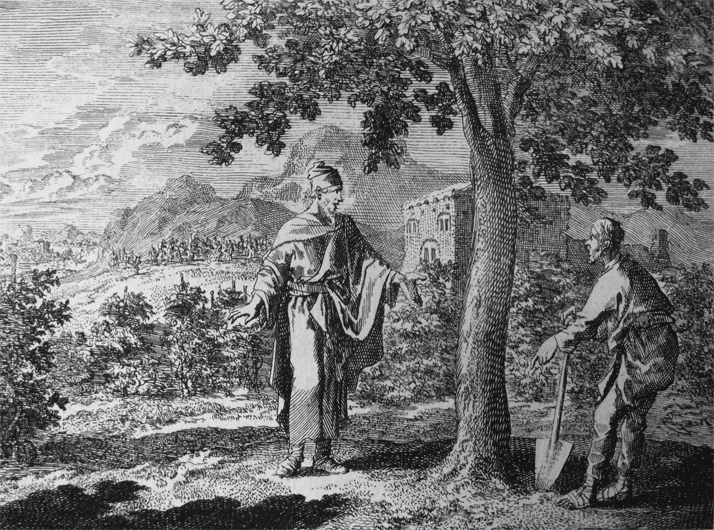
“There once was a person who had a fig tree planted in his vineyard, and when he came in search of fruit on it but found none, he said to the gardener, ‘For three years now I have come in search of fruit on this fig tree but have found none. So cut it down. Why should it exhaust the soil?’ He said to him in reply, ‘Sir, leave it for this year also, and I shall dig around around it and fertilize it; it may bear fruit in the future. If not you can cut it down.’”

The fig tree in Jesus’ parable was fruitless for three years and in danger of being chopped down. Who does this fig tree represent? The prophets Jeremiah and Hosea likened Old Covenant Israel to a fig tree, and the early Church Fathers commonly identified the barrenness of the parable’s fig tree with Israel’s refusal to accept their Messiah. Israel experienced three years of Christ’s public ministry and had still another season of opportunity to become fruitful by embracing Christ’s Church thereafter. But Jerusalem, its Temple, and all its towers were cut down, put to the sword and destroyed by the Romans in 70 A.D.. Parables, however, can have more than one valid and inspired interpretation. Beyond symbolizing an era of history now passed, what meaning does the barren fig tree hold for us today?

In today’s second reading, St. Paul warns the Christians at Corinth against presumption. The Hebrews during the Exodus all shared in a baptism with Moses when they passed through the Red Sea. In the desert, they all ate bread from heaven and drank a miraculously-given drink on their journey. “Yet God was not pleased with most of them, for they were struck down in the desert.” St. Paul says “these things happened as examples for us… as a warning to us,” lest we who are baptized into Christ and regularly consuming his Holy Eucharist think we do not need to reject all grave sins. Do not grumble or rebel like the Hebrews in the desert. Stop following your desires for evil things, or you will perish as they did. Instead, repent and follow our good and loving Lord. He will help and guide you to his Promised Land.

A fig tree may be lush with leaves, giving off a splendid appearance, and yet be barren within. A Christian may appear complete to others, and yet have a sickly soul. To help the barren fig tree, the gardener in our parable pleads to dig around it and add fertilizer. This describes root pruning and the application of manure. Root pruning as a method to make fig trees more fruitful is still recommended today. One article suggests this technique: at the end of winter before new growth begins, go about two feet away from the tree trunk and plunge a spade or shovel down, severing the roots. Skip over one shovel’s-width to the side and then repeat this pattern in a circle once around the tree. Cutting off some of its roots spurs the fig tree to divert its energies from growing foliage to creating fruit. The manure, for its part, provides nutrients (especially nitrogen) which plants require and benefit from. So, if you are a barren fig tree, Jesus the Gardener wishes to radically sever your connections to vices and distractions, in order to productively redirect your energies. He wants to introduce you to stuff which you may now find repellant (including regular confession and daily prayer) but which you need and will benefit from. You do not know how many seasons you have left. Jesus offers you this opportunity to change and become fruitful. Please let Christ the Gardener work with you.

But what if you already follow Christ closely and are aware of no grave sins? What if you have mature self-knowledge, a well-formed conscience, and cannot detect any mortal sins in yourself? Then praise God for that, and consider how our Lord wishes to glorify you through still greater fruitfulness. In the Old Testament Book of Leviticus, God commanded his people not to eat from any tree they planted in Israel throughout its first three growing years. In the fourth year, all of the tree’s fruit was to be dedicated to God as an offering of praise to the Lord. Only in the fifth year, and any years after that, could they eat its fruit. (Leviticus 19:23-25) So how would God dedicate your fruit as an offering to himself and grant you a greater enjoyment of his blessings ever after? A third interpretation of today’s parable suggests how.

Jesus’ parable begins: “A man had a fig tree planted in his vineyard…” (Our New American Bible translates that line’s last word as “orchard” but the Greek word St. Luke uses means “vineyard.”) A vineyard is for growing grapevines. This raises a question I found answered online: why would someone plant a fig tree in a vineyard? A “consulting viticulturist” from New Zealand who has worked fifty years in the vineyard and wine industry says some vineyards plant fig trees because “in some regions figs ripen at about the same time as grapes – birds seem to prefer pecking figs [and] so leave the grapes alone (more-or-less).” Another online commenter, a “cook for over sixty years,” adds that “some vineyards have a problem with small birds who peck at the grapes looking for the seeds and causing the grapes to rot. One solution is to plant fig trees around the vineyard. The birds prefer the figs because they have more seeds and the seeds are more accessible, they then leave the grapes alone.”

The reason a fig tree is planted by a vineyard is to offer up its fruits as a sacrifice for the good of the vineyard, to the delight of the vineyard owner. Who or what is this vineyard in the parable? Jesus teaches, “I am the true vine, and my Father is the vine grower,” and tells his Church, “I am the vine, you are the branches.” (In another parable, The Parable of the Wicked Tenants, Jesus identifies a vineyard as “the Kingdom of God.”) So the fig tree is called to self-sacrifice for the good of God’s vineyard, which is the Church, the Body of Christ, the Kingdom of God. But what does this look like?

In the midst of the French Revolution, a community of Carmelite nuns in Compiègne felt moved to make an offering themselves to God as a sacrifice for their troubled nation and the Catholic Church in France. Almost two years later, after the state had closed and seized all the convents and outlawed the wearing of habits, the sisters were found, arrested, and condemned to death. On July 17th, 1794, sixteen chanting nuns ascended the scaffold one-by-one and were guillotined before a silenced crowd. Ten days after the Blessed Martyrs of Compiègne’s sacrifice the evil “Reign of Terror” ended.

More recently, Fr. John Hollowell, a diocesan priest about my age of the Archdiocese of Indianapolis, was diagnosed in February of 2020 as having a brain tumor. Though grave news, Fr. John saw in his illness an answer to his own prayer. He wrote on his blog at the time, “When the scandals of 2018 broke out, most of you know that they [] affected me deeply, as they have most of the Church. I prayed in 2018 that if there was some suffering I could undertake on behalf of all the victims, some cross I could carry, I would welcome that. I feel like this is that cross, and I embrace it willingly.” Following surgery and treatment, he continues serving today as a pastor in Indiana.

Now it’s natural to hesitate at making such a self-offering. Who wants to suffer – to have our roots cut or be surrounded by dung? Even Jesus prayed before his own self-sacrifice, “My Father, if it is possible, let this cup pass from me; yet, not as I will, but as you will.” Yet Jesus loved his Father and loved us, trusting that whatever his Father willed would be best for us all. The hour had come for the Son of Man to be glorified. Was not this most-difficult thing the greatest thing that Jesus did? Jesus tells us, “Whoever serves me must follow me, and where I am, there also will my servant be. The Father will honor whoever serves me.”

In its first years, a fig tree grows only for itself. A fig tree typically begins bearing fruit when it is three to five years old. So after three years of barrenness, it remains unknown whether the fourth year will witness the tree producing pleasing fruits. Jesus now offers you an opportunity to be fruitful and be glorified like himself. Please love and trust him enough to offer him your fruitful sacrifice.

Trusting & Relying on God

March 6, 2022

1st Sunday of Lent
By Fr. Chinnappan Pelavendran

Trusting God is simply a belief in His Love and His Goodness. He has the power to help you, and He wants to help you. Christians are called believers, but many times we are more like unbelieving believers. We trust our friends, the bank, the stock market, or the government more than we trust God and His Word. Lot of people go to church, hear what they should do and then go home and try to do it on their own. They usually end up desperately telling God how hard they’re trying to do what they need to do, and they’re leaving Him out! God wants us to put Him first in our lives. He wants us to put our confidence and trust in Him, all the time, in everything.

In the first reading, the Prophet Jeremiah explains the benefits of placing one’s trust in God rather than himself. Then he compares the wicked to a barren bush in a desert and the just to a well-watered tree growing near a running stream.  In essence, this “beatitude” teaches us that if we choose God as our hope, our security, and our happiness we will be blessed, truly happy. On the other hand, if we choose human standards for our guidance, self-sufficiency and the meeting of our own needs and desires as our happiness, we will find ourselves living in increasing misery and confusion, in other words, in woe. Jeremiah tells us that the only source of lasting happiness is trust in God and hope in His promises.

Today’s second reading, St. Paul writes that trusting hope in the Resurrection of Jesus is the basis of our Faith, through Jesus’ death and Resurrection, believers are now welcomed into a new relationship with God as His sons and daughters, and with each other as dear brothers and sisters who have Jesus as our Elder Brother and Redeemer. This means that all the blessings of the Beatitudes are now available to us, provided we choose to follow Him.

In our Gospel today, Jesus did not say that poverty, or hunger, or sadness, or hatred is a blessing but these conditions of need and dependence make us rely on God. When we rely on God humans in relationship with God our creator. So the poverty, hunger, sadness, hatred, or whatever the cross can be an instrument to draw us closer to God. Whatever cross we have in our lives is there for a purpose, to bring us closer God. In that sense, our cross is also our blessing.

We have a long way to go to make it a reality. It is not God who is to be blamed; rather it is for all of us to hang our heads in shame. Jesus expects us to perform the same acts of goodness that he did for the poor, the alienated, the sick, the deprived, and the oppressed. Our trust should be in the Crucified and Risen Christ, the Savior and hope of the world. May we trust in God, not in human power, to lead us all into His kingdom and to keep us on His path.

Associated Priests

October 30, 2021

31st Sunday in Ordinary Time

For the past four weeks, our second reading has come from the Letter to the Hebrews. This New Testament book shows Jesus Christ as our great, faithful, and merciful high priest: holy, innocent, and undefiled, yet patient and compassionate. He is able to personally sympathize with us in our weaknesses because, though sinless, he shares in our humanity and struggle. Jesus Christ is a priest forever offering his one perfect sacrifice to God the Father in a priesthood which does not pass away.

As the Catechism teaches, the redemptive sacrifice of Christ is unique, accomplished once for all; but this sacrifice is made present for us at Mass. The same is true of the one priesthood of Christ; Jesus’ priesthood is unique, but it is made present for us through the ministerial priesthood which he founded at the Last Supper. Jesus commands his apostles, “Do this in memory of me,” ordaining them priests of his New Covenant. Yet only Christ is the true priest, while they are merely his ministers.

Besides the unique priesthood of Jesus Christ and the ministerial priesthood of his ordained bishops and priests, there is the common priesthood (that is to say, an equally-shared priesthood) of all the faithful, which is ours through baptism. Sharing in Christ’s identity as priest, prophet, and king, each of us have holy sacrifices to offer, each of us have holy truth to proclaim, and each of us have holy power to wield. The Second Vatican Council noted, pastors “know that they themselves were not meant by Christ to shoulder alone the entire saving mission of the Church toward the world.” The ministerial priesthood is at the service of your priesthood, so that you — sanctified, strengthened, enlightened, and formed — can be as Jesus Christ and his saints for this place and time.

The scribe in today’s gospel approaches Jesus and asks: “Which is the first of all the commandments?” Jesus answers that the first in importance is this: “You shall love the Lord your God with all your heart, with all your soul, with all your mind, and with all your strength.” And the second is this: “‘You shall love your neighbor as yourself.’ There is no other commandment greater than these.” We must be entirely devoted to God, lovingly serving his kingdom according to our personal gifts and callings. And yet, even when we’re giving our all, we remain limited creatures. For instance, time spent doing one thing cannot be spent doing something else. And we are not pure, angelic spirits but physically embodied creatures, beset by weakness and fatigue.

I have experienced this these past four years as your pastor, having two parishes and a school, celebrating thirteen or fourteen Masses a week, with usually five Masses to offer on the weekends. Plus there’s confessions, funerals, anointings, and weddings; school activities and CCD; answering correspondence and completing paperwork; writing for the bulletins and the Sunday homily; and meetings or appointments on most weeknights. I mention this not to brag or complain, but to show why this is grinding and draining and why I do not do more — there is only one of me. I would like to do more than these things I do, but I feel I can’t – not without some help or relief. That’s why I have been working with our parish councils for several months seeking a good solution.

Today, I can announce good news: St. Paul’s and St. John the Baptist’s parishes will soon have an additional priest. This associate priest will assist me, your pastor, in serving you. His name is Fr. Chinnappan, a priest from India, who presently happens to be Fr. John Potaczek’s associate in Mauston. Fr. Potaczek will have a new associate, but Fr. Chinnappan will officially begin ministry here with us, with lodging at St. John’s rectory, on December 1st of this year.

This means that our current weekend Mass schedule will not need to change next year. We’ll have more flexibility in scheduling funerals and more opportunities for confession. Weekday Masses will become Communion Services much less often than before. And visiting priests will no longer be needed for helpouts. Fr. Chinnappan is excited to teach a religion class at St. Paul’s School next semester, and now there will typically be at least one priest around at both parishes for each night of CCD.

I look forward to the unique gifts and perspective Fr. Chinnappan will bring to St. Paul’s and St. John the Baptist’s. I trust that you will make him welcome, and be patient with us who serve you. For myself, I am most excited to have more opportunities to engage, teach, and evangelize, drawing souls more closely and profoundly to Christ here at our church and school. I have some new ideas in mind, and I want to hear your ideas and any offers to help. Jesus wills for you and I to be one hundred percent devoted, with all our heart and mind, soul and strength. Let us serve Jesus Christ, our priest and king, as saints for this parish according to our own unique gifts and callings.

Valuable Lessons for Life — The Craig & Debbie Zwiefelhofer Wedding

June 22, 2021

Ring Heart Shadow on Bible

Craig and Debbie, today you are here in this beautiful church to freely give yourselves to each other in marriage. Christ’s Church has discerned and affirms that you are both free to marry, and we gather together to celebrate this day with you. The excellent Scripture readings that you selected, and which we all just heard, contain valuable lessons for life. May their inspired insights bless your marriage and every household which takes them to heart.

In our first reading, on their wedding night, Tobiah arises from bed and says to his wife, “Sister, get up. Let’s pray…” Sarah gets up and they start to pray, praising and thanking God, and asking for his help and blessings. And they conclude, saying together, “Amen, amen.” There are couples who have shared a bed for decades who have never shared their prayers like this. They may go to church on Sunday or pray before meals—and that’s great—but sharing prayer as a couple like this is a greater intimacy. You do not need to be eloquent. You can even pray together silently. On a regular basis, offer two or three personal things for your spouse to pray about for you, and ask your spouse to share two or three things you can pray about to God for them. You can pray silently for each other for even just a minute or two and simply wrap up with an Our Father and Hail Mary.

A couple that prays together, and for each other, will be more perfectly one. A life of prayer is also a cure for our anxieties and fears. St. Paul reminds us in our second reading, “The Lord is near.” Therefore, he writes:

“Have no anxiety at all, but in everything,
  by prayer and petition, with thanksgiving,
  make your requests known to God.
  Then the peace of God
  that surpasses all understanding
  will guard your hearts and minds in Christ Jesus.”

The world and my problems may be bigger than me, but God is bigger than them both. Pray often and God’s peace, even without your fully understanding what he is doing, will secure and calm your hearts and minds. St. Paul then goes on to teach the Philippians and us another lesson:

“[B]rothers and sisters,
  whatever is true, whatever is honorable,
  whatever is just, whatever is pure,
  whatever is lovely, whatever is gracious,
  if there is any excellence
  and if there is anything worthy of praise,
  think about these things.”

If you ask someone, “How you doing?” and they say, “I can’t complain,” they don’t mean it literally. Everybody can complain. Things to complain about are all around us. Even good things can be complained about for not being better. Anybody can complain because complaining is easy. But to focus on what is lovely, excellent, and praiseworthy is a choice. Highlighting the good in your everyday life will nurture peace within you, peace between you, and peace around you. Finally, we come to Jesus’ words in our Gospel. Jesus tells his disciples:

“This is my commandment:
  love one another as I love you.
  No one has greater love than this,
  to lay down one’s life for one’s friends.”

Ahead of you are good times and trials, both joys and sufferings, Mount Tabors and Mount Calvarys. Choose to love through them all and your Good Fridays will lead to Easter Sundays. In conclusion, pray together, focus on what is good, and choose to love like Jesus loves you and you will be blessed.

Christ Was Lifted Up

March 7, 2021

3rd Sunday of Lent

People would pilgrimage to the Temple in Jerusalem from across the known world to worship, often bringing money to purchase oxen, sheep, or doves for sacrifices to God. So vendors had set up shop in the Temple’s outermost court exchanging foreign currencies into Hebrew coins for a percentage fee and selling animals for a healthy profit. God, however, had designated that large, marble-paved court as the Court of the Gentiles where non-Jews (that is, the Gentiles) could come to worship him at his Temple. The Father willed his Temple to be “a house of prayer for all the nations,” but the moneychangers and animal sellers were making it a noisy, smelly “marketplace.” And by charging unlawful interest and demanding excessive prices even of the poor, they were also “making it a den of thieves.

A place intended to be free for holy worship and communion with God had become unclean, profaned by sin. So Jesus personally comes to Jerusalem at the time of Passover and does something dramatic. He zealously cleanses the Temple, conquering evil, achieving justice, restoring relationship between God and man, drawing people to himself, and indeed sacrificing himself; for when the chief priests and scribes heard of this incident they began seeking a way to put him to death. Their plotting would lead to the Pascal Mystery at the heart of The Apostles’ Creed:

He suffered under Pontius Pilate,
was crucified, died and was buried,
he descended into hell,
on the third day he rose again from the dead,
he ascended into heaven,
and is seated at the right hand of God the Father Almighty.

Why does Jesus Christ do these things? Because sin had caused the human race to fall far from God and paradise. Suffering, dying, and being barred from Heaven were our human lot. We had become slaves to sin and the Evil One, held hostage against our will. Our offenses against the All-Holy One required an incalculable repayment. And our separation from God had made us doubtful of his goodness and love for us. It was a slavery we could not escape, a debt of justice we could not repay, and a broken relationship we could not heal. But God had a plan to save us. He would aid humanity with his divinity by fashioning a remedy for us out of our weakness and suffering and mortality, that from fallout of our downfall would come the means to our salvation. By his Incarnation, the Son of God enters our sinful world as one of us and by his Pascal Mystery sets us free, cleansing us, for holy worship and communion with God. First, Jesus assumes our nature, and then he offers a perfect sacrifice.

As the Letter to the Hebrews says, since we “share in blood and Flesh, Jesus likewise shared in them, that through death he might destroy the one who has the power of death, that is, the Devil, and free those who through fear of death had been subject to slavery all their life.” Jesus said that he came “to give his life as a ransom for many.” And lest it be unclear, St. Paul proclaims that the Lord “gave himself as a ransom for all.” Christ’s death frees the slaves and ransoms the captives, and now saints and angels sing to Jesus, the Lamb of God, in Heaven: “Worthy are you… for you were slain and with your blood you purchased for God those from every tribe and tongue, people and nation.

To some, the idea of Almighty God dying on a cross seems impossible, unbecoming foolishness. Yet Christ crucified is the power and wisdom of God. “The foolishness of God is wiser than human wisdom, and the weakness of God is stronger than human strength.” This mysterious, hidden, wisdom, planned by God before the ages for our glory, was not understood by the devil and his demons; “for if they had known it, they would not have crucified the Lord of glory.” In sinning God, Adam had handed himself and his descendants into the devil’s clutches, but in crucifying Christ (the sinless New Adam) the serpent overplays his hand and loses big. St. Augustine uses the image of a mousetrap in which Jesus is the bait. The devil takes this bait in putting Jesus on the Cross, but by shedding Christ’s innocent blood the devil is forced to release his claims on those who are joined to Christ. The trap snapped down and crushed the serpent.

Jesus’ sacrifice was also able to pay the incredible debt of human sins before God. All sin is wrong, but consider which sin is worse: to lie to a stranger or to betray a friend; to slap your enemy or to slap your mother? The greater the generous goodness and love that a person has shown us, the greater is the offense of our trespasses against them. So how great a crime then are our sins against God, whose love created us and from whom all good things come? How very great a debt of justice must then be satisfied? Our sins caused a debt no sinner could repay. God had commanded his Old Covenant people to offer animal sacrifices for their sins, the idea being that the creature was dying in the place of the sinner whose sins had merited death. However, as the Letter to the Hebrews says, “it is impossible that the blood of bulls and goats take away sins. For this reason, when [Jesus] came into the world, he said: ‘Sacrifice and offering you did not desire, but a body you prepared for me; holocausts and sin offerings you took no delight in. Then I said, as is written of me in the scroll, “Behold, I come to do your will, O God.”’

Jesus Christ, God become man, perfectly fulfills the Law, keeping the commandments and doing his Father’s will. He lives for God without sin, honoring his Father and mother, proclaiming the Kingdom of God without idolatry or blasphemy, without murder or adultery, without thievery or lying or coveting, but with abundant love. And in his death, Christ obediently offers the perfect, acceptable sacrifice we were incapable of on our own; a divinely-perfected offering of humanity to God. By his Incarnation, Jesus has in a certain way united himself with every human person, inviting them to become one with him. Through his sacraments, we are more perfectly joined to Jesus to share in his life and enjoy the benefits of what he has accomplished. Christ is the Victor over sin and death, over the tomb and the underworld, over the world and the devil, and he invites us to partake in his victory.

In the beginning, though the Holy Trinity did not desire humanity to sin and fall, our freely-chosen rebellion did not come as a surprise. Before Creation, the eternal, all-knowing Trinity foreknew what it would cost to save us. And God still said Yes, “Let there be light.” Jesus Christ was freely delivered up crucifixion by lawless men according to the set plan and foreknowledge of God, as foreshadowed by the Old Testament Scriptures. But could God, if he had wished, before Creation or in the course of time, have ordained a manner for the Son’s saving sacrifice other than dying upon a Roman Cross? If so, if there were other unchosen options, then the Cross of Christ was chosen as a most effective and compelling sign for us. A less painful, less ignoble, less public, less striking death — if such a death could have saved us — would not speak to us so clearly as a powerful sign of God’s love for us as this. Jesus makes himself so vulnerable and so lowly so as to awaken a response of love in our hearts. He extends his arms on the Cross in hopes that the whole world will be drawn to his embrace. As Jesus said, “When I am lifted up from the earth, I will draw all people to myself.”

After Jesus died, the Apostles’ Creed says, “he descended into hell.” What are we to make of this? Death is the separation of one’s soul from one’s body. On Holy Saturday, while Jesus’ dead body laid in his sealed tomb keeping a perfect Sabbath rest, Jesus’ soul visited the souls of those in the realm of the dead. Our creed translates this abode of the dead (called “Sheol” in Hebrew or “Hades” in Greek) as “hell” because all souls there, whether righteous or unrighteous, were deprived of the vision of God. But this does not mean that the situations of the Just and Unjust there were identical. Jesus’ Parable of the Rich Man and Lazarus describes the afterlife before the gates of Heaven had opened, showing Lazarus comforted in the bosom of Father Abraham while the uncaring, anonymous rich man (whose name is not written in the Book of Life) suffers torment in the flames.

Jesus descends to hell as Savior, proclaiming the Good News to the souls imprisoned there. He does not descend into hell to deliver the damned, nor to destroy the hell of damnation, but to free the souls of the Just. Jesus had said, “Amen, amen, I say to you, the hour is coming and is now here when the dead will hear the voice of the Son of God, and those who hear will live.” By proclaiming the Gospel in the underworld and inviting souls to Heaven, Jesus extends his saving victory to all the faithful people who had preceded him in death.

On the third day he rose again from the dead,
he ascended into heaven,
and is seated at the right hand of God the Father Almighty.

I do not have the time to speak much about these lines this Sunday, but in closing, note what St. Paul beautifully observes about Christ in his Letter to the Philippians:

Though he was in the form of God, Jesus did not deem equality with God something to be grasped at. Rather, he emptied himself and took the form of a slave, Being born in the likeness of men, …it was thus that he humbled himself, obediently accepting even death, death on a cross!

Because of this, God highly exalted him and bestowed on him the name that is above every other name, so that at Jesus’ name every knee must bend in the heavens, on the earth, and under the earth, and every tongue proclaim to the glory of God the Father: Jesus Christ is Lord!

Jesus empties himself in his Incarnation, humbles himself in his holy obedience, submits himself to his Passion and death, descends to the depths of the underworld, lower and lower and then Jesus is raised up from there, higher and higher, to life and rewards, glory and honor and power, enthroned at the favored righthand of God the Father. St. Paul says to “have among yourselves the same attitude” as this in your Christian life, for as Jesus teaches, “Whoever exalts himself will be humbled; but whoever humbles himself will be exalted.

This is His Body Given up to Save Many

March 21, 2020

Laetare Sunday — 4th Sunday of Lent—Year A

This past Wednesday evening, I saw this image online with the caption: “Darkness has fallen: every single U.S. diocese has suspended public celebrations of the Mass.”

Our Laetare Sunday rejoicing is more subdued this Lent. The sad but necessary suspension of public Masses by our nation’s bishops is a painful loss. And for many of the faithful, the greater their love for the Lord the greater the pain they feel. They are like the woman at Simon the Pharisee’s house who could bathe Jesus’ feet with dripping tears ‘because she loved much.’ (Luke 7:47) However, darkness has not overcome us.

Brothers and sisters,” today’s second reading tells us, “you were once darkness, but now you are light in the Lord.” God is still God, Christ is still Lord, and we are still His. Though public liturgies have ended the Holy Mass continues to be privately offered in most every Catholic church. The graces of Jesus’ sacrifice pour forth from these altars into Christian souls throughout the world, for our good and the good of all his holy Church. Priests are celebrating these Masses in obedience to the command of Christ recalled at every Consecration, “Do this in memory of me.” Yet each of us, ordained and lay people alike, is called to keep this commandment of Christ in a deeper way; by personally imitating Jesus in his loving self-sacrifice for others.

Today, and in the critical weeks and months ahead, all of us are called to sacrifice in ways that will seriously limit our activities and impact our finances. Why are we doing this? To stop the spread of a deadly disease not merely to ourselves but to our many neighbors around us. From my research into this grave topic, it appears that hundreds of thousands—potentially millions—of American lives depend upon the extent of our collective and individual actions now. So please respond with a firm resolve from a Christian love for others.

When you ache today because you can neither gather for Mass nor physically receive our Lord, take heart in the reason for your sacrifice. This is his Body given up to save many; we do this in memory of Him. And soon, when you are asked to help people in the community meet their material needs, sacrifice for them knowing whom you are also serving. For whatever you do for the least of your brethren, you do it for Him. Invite Jesus now to enter into your heart and be with you, to console and strengthen you, today and in the trials ahead of us.

Satan’s Old Tricks — 1st Sunday of Lent—Year A

March 3, 2020

After his baptism in the Jordan, but before the start of his public ministry, Jesus was led by the Holy Spirit into the desert to be tempted by the devil. Did Satan realize at that time that Jesus was God? He says, “If you are the son of God… If you are the son of God.” But if Satan knew, it’s strange that he would attempt the impossible: to try tempting the all-holy God into sinning and doing evil. Old Testament prophesies allude to the promised Messiah, the awaited Anointed One, as being “Son of God.” God says in the 2nd Psalm:

“I myself have installed my king
on Zion, my holy mountain….
You are my son;
today I have begotten you.”

And in Psalm 89, God says:

“He shall cry to me, ‘You are my father,
my God, the Rock of my salvation!’
I myself make him the firstborn,
Most High over the kings of the earth.”

Old Testament Jews had been told their Messiah would at least figuratively be the Son of God; so, whether or not Satan knew Jesus was divine, he at very least suspected that this man from Nazareth was the Christ.

Jesus evidently went on to tell his apostles of the devil’s temptations in the desert—for how else would anyone know to write about them in the Gospels? There may have been additional temptations, but three are retold in Matthew and Luke’s Gospels. Jesus is on the verge of beginning his public ministry. What kind of Messiah will he be? The devil’s three temptations seek to corrupt his mission from the start. Satan seeks to lead the Christ off track so as to derail the plan of God. He did this first in the lush Garden of Eden, and here he seeks to do it again in the desert.

If you are the Son of God,” Satan says, “command that these stones become loaves of bread.” Jesus was hungry, but if he does this miracle the next question may be, “So you feed yourself, do you? How now can you refuse to give bread to everyone?” Satan wants Jesus to be a materialistic Messiah who must focus on nourishing bodies to the neglect of their souls. Jesus calls his disciples to practice material charity; today the Catholic Church is the largest charitable organization in the world; teaching, healing, clothing, housing, feeding, but this is all of secondary importance to its spiritual work. For what would it profit us to have all of our material needs fulfilled if our spiritual needs went unaddressed and we ultimately died separated from God? How do these things personally apply to us? Well, did the recent stock market drops ruin your week? Or are you too afraid or possessive to share, to tithe, to give to good causes? Or are you too busy working to pray? Jesus answers, “One does not live on bread alone, but on every word that comes forth from the mouth of God.

Next we hear how the devil takes Jesus to the roof edge atop the temple in Jerusalem and challenges him: “If you are the Son of God, throw yourself down. For it is written: ‘He will command his angels concerning you’ and ‘with their hands they will support you, lest you dash your foot against a stone.’” Satan is quoting Psalm 91. This goes to show—and serves as a warning—that not every Bible quote teaches what some people claim it does. True Scripture interpretation must be in union with the mind of Christ, and one with the Body of Christ, that is his Church.

God does not want Jesus to jump off buildings, but the devil wants the Messiah to demand that God protect him from all harm or hardship. Satan wants Jesus to be a Christ who is unwilling to suffer, who will refuse to drink any bitter chalice. The devil knows doing God’s will in this broken world will necessarily entail some sufferings for his faithful ones. If Jesus is unwilling to sacrifice then God’s people will never be saved. Are you trying to force your plans upon God? Are you pleased to serve God only so long as you experience no pain? Are you demanding that your salvation come without embracing your cross? Jesus answers, “You shall not put the Lord, your God, to the test.

Lastly, we hear the devil takes him up to a very high mountain, and shows him all the kingdoms of the world in their magnificence, and says, “All these I shall give to you, if you will prostrate yourself and worship me.” Satan wants Jesus to be a compromised Messiah who will pursue good things by doing, by serving, evil. The tempter says, “It’s only a little thing, just lay down, just say the words, just take a small bite, everything will be so much easier and better if you do.” Or else the tempter lies in the opposite extreme direction, “You have no choice – it’s a sin but there’s no other way – this must be done!” What sins do you still commit in hopes that good will result? Where do you bow down and side with Satan against the will of God? Jesus answers, “The Lord, your God, shall you worship and him alone shall you serve.

By God’s providence, the temptations of Jesus in the desert foreshadow Christ’s Passion to come. Jesus is not a materialist Messiah, changing stones to loaves of bread. But, beginning at the Last Supper, he feeds the world by changing bread into himself “for the life of the world.” Jesus is not a Christ who refuses to sacrifice. At the Temple he endures trail and condemnation by the Sanhedrin and accepts the bitter chalice of his Passion according to his Father’s saving will. And Jesus is not a compromised Messiah, committing sins for false and illusory gains. Christ becomes the magnificent, sinless king of all nations, atop Mount Calvary enthroned upon the Cross.

In this season of Lent, in these forty days of penance, we are in the desert with Jesus, learning from him, and being strengthened by him, so that we can stand straight and strong and not fall for the temptations and traps of the enemy, the same tricks he used against of Adam and Eve, that he attempted with Jesus Christ, and that he still uses in our day. This Lent, instead of falling for Satan’s same old tricks, let us grow closer to Jesus Christ in relationship and resemblance, closer in his friendship and closer to his holy likeness.