Archive for the ‘Sacrifice’ Category

A Life for Christ — 2nd Sunday of Advent—Year C

December 8, 2019


This weekend the Catholic Church Jesus Christ established joyfully celebrates and remembers one of her martyrs. Moved by the Holy Spirit, he answered God’s calling. He renounced his possessions, left his home and family behind, and lived in a different land. He lived differently, he dressed differently, and lived a celibate life for the love of God and the service of God’s people. His life was a prophetic sign for others, pointing them to Christ and his Kingdom. He was humble but brave in doing what was right. And for this faithfulness, the wicked had him killed. Today we celebrate him as one of those blessed in the Kingdom of Heaven. This description sounds a lot like St. John the Baptist, featured in today’s Gospel, but I speak of another: Brother James Miller, born in our diocese, a native son of Stevens Point, who became a Christian Brother and a missionary. He was martyred in Guatemala and, in a Mass celebrated there yesterday (December 7, 2019) was beatified by the Catholic Church, that is, declared one of the blessed in Heaven.

James Miller was born in Stevens Point in 1944, grew up on a dairy farm, and graduated from Pacelli High School. Discerning his religious vocation, he entered the novitiate of the Christian Brothers in 1962, and taught for them in St. Paul, Minnesota. In addition to teaching religion, Brother James taught English and Spanish, coached football, and worked in the maintenance of the school building. In fact, his skill and pleasure in doing such repairs would win him the nickname “Brother Fix-it.” After taking final vows in 1969, Brother James was sent abroad. He worked as a teacher, an administrator, and even a builder of schools in both Nicaragua and Guatemala, serving the poor with Christ’s love.

It was a time of great violence in Latin America, of war and terrorism between the region’s dictatorial governments and communist rebels. In these conflicts, Catholic priests and religious could be marked for death by either side. The Sandinista rebels put Brother James on a list of people to be “dealt with,” viewing him as an ally of the Nicaraguan government, but it may have been his religious community’s resistance to the Guatemalan government’s wrongdoing which led to his martyrdom.

Despite the students at Brother James’ school in Guatemala being exempt from being drafted, four men abducted a local youth from the city marketplace and forced him into military service. The Christian Brothers went to the authorities objecting to this breach and demanding their young man’s release. Soon after, on February 13, 1982, the 37-years-old Brother James Miller was up on a ladder outside, repairing a wall of the school building. There, he was shot, point-blank, multiple times, by three still-unknown gunmen. It is suggested that Brother James died before his body hit the ground.

When I read the story of St. John the Baptist’s martyrdom — of how his objection to the king’s sin landed him in a prison, of how the dancing of Herod’s daughter, the rash vows of the king, and the scheming of his vengeful queen, resulted in an executioner being dispatched to the dungeon with orders to bring back John’s head on a platter — I wonder if John the Baptist knew what was coming. Did he have any awareness of the events at the party leading to his death? I think quite likely not. I can easily imagine the sword-bearing henchman entering John’s dark cell, giving a curt command for him to bend down, and ending his holy life without any warning or explanation.

This reflection comes to mind because when Brother James was getting into the car to depart for dangerous Guatemala and, though they did not know it, he would never return, his biological brother Ralph told him to “be careful.” Brother James replied, “I’m no martyr.” And yet Brother James Miller and John the Baptist did become martyrs. They may not have expected the day or hour, but they had already made the decision to live for Christ and even die for Christ years before. Whether to love and serve Christ the King is a decision, a resolution, we each have to make and constantly renew. There is no hedging – not making the choice is making a choice; and everything follows from the choice we make.

St. Ignatius of Loyola, in his Spiritual Exercises, has a famous prayer reflection: “The Meditation on Two Standards.” (The word “Standard” in this case means a military or ceremonial flag carried on a pole.) St. Ignatius asks us to imagine a great field near Jerusalem, the holy city, where the supreme commander-in-chief of the good is Christ our Lord; and another field in the region of Babylon, the city of sin, where the chief of the enemy is Lucifer.

Imagine that chief of all the enemy seated in that field of Babylon in a great throne of fire and smoke, horrible and terrifying in shape. Consider how he issues a summons to innumerable demons and how he scatters them, some to one city and others to another, and so through all the world not one province, place, state, nor particular person is omitted. Consider how he instructs them to cast out nets and chains; to tempt human beings to a longing for riches, to a desire for the vain honor of this world, and to vast pride, thereby leading them to all other sins besides.

And then, on the contrary, imagine the supreme and true captain, who is Christ our Lord. Consider how Christ our Lord puts himself in a great field near Jerusalem, in a humble place, beautiful and welcoming. Consider how the Lord of all the world chooses so many persons – apostles, disciples, and others – and sends them through all the world spreading his holy teaching to people of all conditions and states of life. Consider the discourse which Christ our Lord gives to all His servants and friends whom He sends on this expedition, counseling them to poverty rather than riches; to contempt for worldly honor, and to humility against pride, leading them to all other virtues besides.

Whose side, whose standard will you rally to today? John the Baptist appears in our Gospel crying out to us: “Repent, for the Kingdom of Heaven is at hand!” Blessed James Miller and St. John the Baptist gloriously rejoice today with their Lord, Jesus Christ the King. Now, which side do you choose? With whom and for whom will you live and die?

Loving & Serving Jesus Foremost — 23rd Sunday of Ordinary Time—Year C

September 11, 2019

Jesus says, “If anyone comes to me without hating his father and mother, wife and children, brothers and sisters, and even his own life, he cannot be my disciple.” That teaching certainly demands one’s attention. But how does it mesh with our Lord saying: “I give you a new commandment: love one another”? This teaching, like Jesus’ parables, invites us to question and wrestle a little for our Lord’s meaning, so that, through the struggle, we will understand him more deeply and his words will go more deeply in us.

Loving our family members is not the problem that Jesus is warning us against—the problem comes from loving someone or something more than him. We are called to universal Christian love. We are commanded to love our neighbors as ourselves, and therefore, by extension, commanded to love ourselves as well. (Because if I did not love myself, then what good would it be to love my neighbor as myself?) We should love our neighbors and love ourselves. However, if I am seeking to always please myself or seeking to please everyone around me, that will not lead me to Heaven.

Whatever Jesus asks of me, ultimately will, sooner or later, yield happiness for me. Jesus says, “Seek first the Kingdom of God and his righteousness, and all these (good) things will be given you besides,” and “I came so that they might have life and have it more abundantly.” Doing what Jesus asks us leads to happiness, but that doesn’t mean that I, or the people around me, will always be thrilled about what we’re called to do.

Suppose someone is called to be more healthy (which is a good goal) and begins to eat better, exercise more, drink less, and/or quit smoking. This person is loving their body by acting in healthy ways, but at the same time their flesh may, at first, hate these changes. In time, these healthy habits will bear happy fruits, but at the beginning you may have to love your body while displeasing your flesh. Healthy choices can face resistance from other people as well. Family members might object when there’s less junk food snacks in the kitchen cabinets, or when you don’t go out so often for fast food. Drinking or smoking-break buddies may complain that you’re never around, or somehow no fun, anymore. Ultimately, you have to decide whom you are going to serve, listen to, and follow. Jesus Christ insists that we serve him first.

My dad told me that when he was a kid he thought bad people did bad things because they wanted to be bad, like dastardly villains in cartoons and comic books. But in reality, nobody does evil solely for evil’s sake. Every single person, every angel and demon, acts in pursuit some real or perceived good. Sinners are simply pursuing happiness in wrong ways. The unrepentant usually feel justified in what sins they commit; and human beings can create justifications for anything they want.

In the Genesis story of the Tower of Babel, the people said, “Let us build ourselves a city and a tower with its top in the sky…” They sought, in other words, to build a city and a tower into Heaven. But they attempted to do this without God, and they never got close. Genesis says ‘the Lord had to come down to see the city and the tower that the people had built.’ They fell far short. Today Jesus asks, “Which of you wishing to construct a tower does not first sit down and calculate the cost to see if there is enough for its completion? Otherwise, after laying the foundation and finding himself unable to finish the work the onlookers should laugh at him and say, ‘This one began to build but did not have the resources to finish.’”

Who, of themselves, has the knowledge or resources to construct paradise, to build an earthly tower into Heaven? No one. We see many people try to build their own foundations for their lives and fail in every sort of sinful way. ‘For human beings this is impossible, but with God all things are possible.’ If we follow Jesus he leads us into the City of God and his Heavenly Kingdom, the Church, the Church here below and above in glory. Following Jesus means being his disciple, and to be a good disciple is to listen, to learn, and to apply the teachings you are taught.

On earth, Jesus never penned a book, but he did establish a Church, a Church with a Great Commission to “make disciples of all nations”. Make disciples how? Through the sacraments, beginning with baptism, and by “teaching them to observe all that I have commanded you.” In this, the inspired, Sacred Scriptures of the Church play an important part. “And behold,” Jesus says “I am with you always, until the end of the age.” Jesus is present in our Church today. Jesus still teaches through his Holy Catholic Church throughout the world.

Is there a part of your life where you’re not listening to Jesus? Perhaps you’re not listening as he speaks in your conscience, in your prayer, or through his Bride, our Mother, the Church? It could be about money, or sexuality, or your life’s vocation, about something you’re doing, or something you’re refusing or afraid to do. Whatever it is, the Lord knows what it is, and you probably do, too.

I’d like to share with you a technique or approach I’ve used to help me take the next step when the Lord was calling me somewhere I wasn’t eager to go; like when I was in middle school and the Lord was calling me to take my faith more seriously, when it would have been easier to ignore him. Or later, when I was called to be more generous with my wealth, but I was frightened of risk. Or when he started calling me to become a priest, and that wasn’t necessarily what I wanted to do with my life. Picture yourself on your death bed someday, having not taken the Lord’s path now. Imagine looking back and having to wonder, “What would my life have looked like if I had trusted and dared more for the Gospel? How much better, how much more fruitful, would my life have been?” Or think of yourself standing before God’s judgment seat and him asking you, “Why didn’t you live your life like I wanted you to live it? I desired so much more for you.” Avoid having to look back someday with regret, at the end of this life or in the next. Bravely take the path that God is calling you to choose. Jesus desires abundant life for you, so carry your cross and follow him.

Christ and the Rich Young Ruler” by Heinrich Hofmann, 1888

Asking for a Gift to Give — 17th Sunday of Ordinary Time—Year C

July 28, 2019

Remember last Sunday, when Abraham hosted three mysterious visitors from Heaven. Once they had agreed to Abraham’s offer to serve them a meal can you recall the first thing Abraham did? “Abraham hastened into the tent and told Sarah, ‘Quick, three measures of fine flour! Knead it and make rolls.'” How much were “three measures of flour” back then? Through a scripture commentary, I learned that this was about half a bushel, or like twenty pounds of flour. That’s enough to make about twelve of the loaves of bread we buy at the grocery store these days. So, Abraham served about a dozen loaves of bread to three guests. Now I’m as much a fan of unlimited breadstick deals as anybody, but when was the last time you ate four loaves-worth of bread in one sitting? Abraham knew these were extraordinary guests, so he set an extraordinary meal before them. And perhaps he intended to give them all the leftover loaves as a further gift to God.

I wondered about those “three measures of flour” because of Jesus’ parable today: Suppose you have a friend to whom you go at midnight and say, “Friend, lend me three loaves of bread, for a friend of mine has arrived at my house…” So we have a meal with three measures and a parable with three loaves. Three measures of flour for the Lord, and three loaves of bread for a friend. I perceive that these things are connected, but more on that later.

Immediately preceding this parable, Jesus teaches his disciples how to pray. You surely noticed that the Our Father prayer in Luke differs from Matthew’s more familiar version. This is providential. If the two texts were exactly the same, some Christians might mistake Jesus’ example as being our only permissible prayer. But Jesus does not give the Our Father as a magic formula or incantation, but as a model for our approach and attitude to prayer. In Matthew’s version, the prayer begins with “Our Father.” He is not mine, but ours, because he calls us to salvation together. Luke’s version simply begins with “Father”; not “Master,” as though we were merely his slaves; not “Ruler,” as though we were merely his subjects; but “Father,” because we are his children. The prayer’s petitions are direct requests, simple requests, profound requests. For example, consider: “Give us each day our daily bread.” It’s straight-forward, basic, yet deep when you contemplate “our daily bread” as a symbol for all of our constant bodily and spiritual needs. And notice something else that these petitions have in common: “hallowed be your name,” “your kingdom come,” “forgive us our sins.” Each is asking God for something that God already desires for us. They are each a part of his plan already.

Who are we supposed to be like in Jesus’ parable? Surely it’s the persistently asking and seeking door-knocker. Because Jesus says, immediately after this parable, “And I tell you, ask and you will receive; seek and you will find; knock and the door will be opened to you.”

And who is God represented by in this parable? Naturally, the man in the house whose gifts can be gained through asking. Indeed, God is on the other side of Heaven’s door. And even at midnight, in the darkest hour, we can call on him for help. His children inside, the saints and angels who rest peacefully in his house, join their voices to ours when we persistently ask for good things on earth. But God is surely not like this annoyed neighbor in saying, “Do not bother me… I cannot get up to give you anything.” Jesus’ mode of teaching here is from the lesser to the greater. If this annoyed neighbor can be persuaded to give, how much more can God who already desires to give. Likewise, Jesus says, “If you, who are wicked, know how to give good gifts to your children, how much more will the Father in heaven give the Holy Spirit to those who ask him?

The request for three loaves and Abraham’s request for three measures suggests another character like the Lord in this parable: “Lend me three loaves of bread, for a friend of mine has arrived at my house from a journey and I have nothing to offer him.” Mystically speaking, this visiting friend is the Lord. For Jesus says, “Amen, I say to you, whatever you did for one of these least brothers of mine, you did for me.” Jesus says, “Whoever receives one child such as this in my name receives me.” And Jesus says to the early Church’s persecutor, “Saul, Saul, why are you persecuting me?” Jesus is mystically present in every Christian and within in his Church. Thinking of God as represented in this parable by both the homeowner and the visiting friend reveals a dynamic that could change how you relate to prayer.

When you pray for some good thing, when you ask some worthy blessing for yourself, someone else, or even billions of people at once, are you not praying for the greater glory of God among us? What prayer would he, could he, possibly grant you that would not also glory him? Furthermore, what can we offer him that is entirely of ourselves? The man in the parable asks his neighbor for loaves for his friend because “I have nothing to offer him.” As St. Paul asked the Corinthians, “What do you possess that you have not received?” It’s been said that to truly make an apple pie from scratch, you have to recreate the universe. Like Abraham asking Sarah for loaves for his holy guests, like the man in the parable asking for a loan of bread, every good prayer—whatever it may be—is asking for a gift to be gifted to the Lord. It’s like asking your dad for money to buy him a gift for Father’s Day. It’s for his own glory, so you don’t have to persuade or coerce him, he loves you and already wants to give. Which raises a question: if God already wants to give, then why doesn’t God always give immediately in answer to our prayers?

Sometimes God waits for the right time to grant our requests. If you bought your mom the perfect Christmas gift, you might desperately want to give it to her right now, but you would realize that the very best time for her to open it comes later. Would you rather have you prayer answered right now or at the best and perfect moment?

Sometimes God is storing up the accumulated reservoir of your prayers so that once the floodgates are opened a torrent will be unleashed. St. Monica prayed for her sinful, wayward son for years, and when he finally converted he was not merely saved but went on to become the priest, bishop, and great doctor and father of the Church we know as St. Augustine of Hippo. Would you rather have your prayer answered in a small way now or in an overwhelmingly incredible way later?

Sometimes it we must pray persistently, rather than just asking once and setting the request aside, for the powerful influence of that continued offering. On one occasion in the gospels, there was a demon afflicting a boy that the disciples could not exorcise. After Jesus cast out the demon his disciples asked why they were unable. Jesus is written to have answered them, “This kind can only come out through prayer and fasting.” Last week we heard St. Paul tell the Colossians, “I rejoice in my sufferings for your sake, and in my flesh I am filling up what is lacking in the afflictions of Christ on behalf of his body, which is the Church”. It’s not that Jesus’ Passion is insufficient, but that God allows our offered sufferings and sacrifices to have a vital role in Christ’s work of saving souls. Patient, persistent prayer is a sacrifice we offer with him.

In conclusion, the Father, our Father, already wants to give, for the praise and glory of his name, for our good and the good of all his holy Church. So let us not hesitate, but let us persist, in asking good things from Him who loves us.

“Being Childlike Towards Jesus and Our Mother” — 14th Sunday of Ordinary Time—Year A

July 9, 2017

In the 1944 Best Picture Winning film, “Going My Way,” Bing Crosby’s character, Fr. Chuck O’Malley, shares this quip: “You know, when I was 18, I thought my father was pretty dumb. After a while, when I got to be 21, I was amazed to find out how much he’d learned in three years.” Of course, the joke is that the dad didn’t get much wiser in three years. The son’s lived experience revealed to him, “You know, my dad actually does know what he’s talking about.” What if your mother were about thirty lifespans old, alive with the same beauty, liveliness, and fruitfulness that she possessed in her youth? Would you listen to her, learn from her, and heed your wise mother’s words? God our Father has given us such a mother in the Holy Catholic Church.

In our first reading from the Old Testament, the prophet Zechariah writes: “Shout for joy, O daughter Jerusalem! See, your king shall come to you;a just savior is he, meek, and riding on an ass.” This is a prophesy about the coming of the Messiah, the Christ. It was fulfilled about five centuries later with Jesus’ entry into Jerusalem on Palm Sunday. Jesus does not enter in as a conqueror, upon a warhorse with sword; but meekly, humbly, on a donkey. All the people are free to welcome him and follow him, and everyone is also free to ignore him and reject him. Jesus is not forcing them to do anything in response to him, much like his Church, which for a quite long time now hasn’t forced anyone anywhere to do anything. In this life, our personal response to Jesus Christ and his Church is completely voluntary, but that decision is not at all trivial.

In our second reading from the Letter to the Romans, St. Paul says: “Brothers and sisters, we are not debtors to the flesh, to live according to the flesh. For if you live according to the flesh, you will die, but if by the Spirit you put to death the deeds of the body, you will live.” Now when St. Paul opposes “the Flesh” and “the Spirit” he is not saying that the material world and our bodies are evil or bad. At Creation, God saw that these were good, and as Christians we profess that “the Word became flesh and dwelt among us.” St. Paul is using “the Flesh” as shorthand for those aspects of ourselves that are not properly ordered to “the Spirit” of God. Jesus has raised up a fallen world but aspects of our brokenness still remain. This brokenness is seen in both our bodies and minds: in our appetites desiring what is bad for us, and in our intellects rationalizing our wrong ideas. Imagine how much better this world would be if everyone knew and practiced what the Catholic Church teaches. To echo G.K. Chesterton: “The Catholic Faith has not been tried and found wanting; it has been found challenging and left untried.

Someone might raise the objection: “What about all the bad things Catholic clergy have done? How can sinners be guardians of God’s truth?” There have certainly been bad priests, bad bishops, and even bad popes whose personal sins have done great harm to many. They are a scandal and a sacrilege. But amazingly, even when the most unworthy men have been pope, none of them formally promulgated heresies over the Church. Jesus told his apostles: “Whoever hears you hears me,” knowing fully that Judas Iscariot, his betrayer, was among their number. None of the apostles were sinless men, but Jesus chose them and their successors to preach his message, cast out demons, cure the sick, and administer his sacraments. How tragic it would be if an innocent harmed or scandalized by Judas the Betrayer wanted nothing more to do with Jesus Christ’s Church. Jesus loves his little ones and does not want any to be hurt or estranged from his Church.

In today’s Gospel, Jesus praises his Father saying “you have hidden these things from the wise and the learned but revealed them to little ones,”  In saying this, Jesus is not rejecting higher education or those who possess it. However, even if you have some degrees on your wall and initials after your name, these are not enough in themselves to receive the teaching of Christ and his Church. We all must be childlike. Childlike, not childish. A childish person is selfish, immature, willful, rebellious, and you can’t teach them anything.  But a childlike person is open, humble, loyal, devoted, and teachable. As Jesus declares on another occasion: “Amen, I say to you, whoever does not accept the kingdom of God like a child will not enter it.”

Pope Paul VI observed, “Modern man listens more willingly to witnesses than to teachers, and if he does listen to teachers, it is because they are witnesses.” With than in mind I’d like to witness to a time when, despite my initial hesitancy, responding to Jesus’ teaching blessed me in surprising ways.

When I was in college, my schoolwork was a grind. I always looked forward to our vacations, but they were always weeks or months away, on the other side of my papers’ due dates and final exams. At that time, I realized that although I had always gone to Mass I had never kept Sunday as a special day of rest. The Catechism of the Catholic Church says: “On Sundays and other holy days of obligation, the faithful are to refrain from engaging in work or activities that hinder the worship owed to God, (that hinder) the joy proper to the Lord’s Day, (that hinder) the performance of the works of mercy, (or that hinder) the appropriate relaxation of mind and body.” It then adds, “Family needs or important social service can legitimately excuse from the obligation of Sunday rest. (However,) the faithful should see to it that legitimate excuses do not lead to habits prejudicial to religion, family life, and health.

I didn’t want to reach the end of my days wondering what would have happened if I had been faithful to Christ in this area, so decided to stop doing my homework or studies on Sundays. There were some very late Saturday nights, but I kept faithfully to this rule. And, after a while, I noticed two surprising things. First, my Sunday rest never burned me. I don’t recall ever bombing a test, failing to meet a deadline, or doing worse on any of my assignments because of not having worked on Sunday. The second surprise was that I began to look forward to every Sunday as a one-day vacation. In addition to going to church, it was a day for taking a map, going out to eat, watching a movie, or just hanging out with my friends. I gave a gift of myself to the Lord and he gave me an even greater gift in return.

Perhaps you are afraid to let the teachings of Jesus Christ in his Church to impact your time or your money, your sexuality or your marriage, your politics or your addictions, but I urge you to be brave and wise. Just last week, we heard Jesus tell his apostles: “Whoever receives you receives me, and whoever receives me receives the one who sent me.” Jesus was not merely referring to receiving the apostles in their persons but the message that they preached.

We resist change because we fear the limitation of our freedom. We fear what the change might cost us. We fear a heavy yoke being locked around our neck and weighing upon our shoulders. But do not be afraid. Jesus offers you a better way. He says: “Come to me, all you who labor and are burdened, and I will give you rest. Take my yoke upon you and learn from me, for I am meek and humble of heart; and you will find rest for yourselves. For my yoke is easy, and my burden light.” Please trust in Jesus, learn from him, and sacrifice your will to his. And do not be afraid, for God will not be outdone in generosity.

Our Holy Conspiracy & the End of the World — 33rd Sunday of Ordinary Time—Year B

November 16, 2015

C.S. Lewis, 1898-1963A new liturgical Church year will begin in a couple of weeks with the first Sunday of Advent. As this Church year ends, our Mass readings (like today’s Sunday readings) focus on the Last Things and the end of the world as we know it. This weekend’s news reports, especially the terrible events in France, remind us that though the Kingdom of God is among us, we pray “thy Kingdom come” because it is not yet fully here in total, unveiled power. This weekend’s readings and news events remind me of passages from C.S. Lewis in excellent book Mere Christianity:

“Enemy-occupied territory—that is what this world is. Christianity is the story of how the rightful king has landed, you might say landed in disguise, and is calling us all to take part in a great campaign of sabotage. When you go to church you are really listening-in to the secret wireless [radio] from our friends: that is why the enemy is so anxious to prevent us from going.”

Why does Lewis say that our king has landed “in disguise?” Well, where would you expect a king to be born? The Magi sought the newborn king of the Jews in the palace at Jerusalem, but Jesus was born in a barn—a cave in Bethlehem—to a pair of poor parents. How would one expect the Jewish Messiah to enter into Jerusalem to claim his throne? Probably riding on a warhorse, but Jesus came meekly riding on a donkey, just as had been prophesied about him. Who would have thought that God would become a man, and then suffer and die as he did? After the vindication of the resurrection, one would have thought he would appear to the high priest and Governor Pilate, or to the Emperor Tiberius in Rome, to declare that he was indeed who he claimed to be. Instead, Jesus appeared discretely, to his disciples.

Lewis writes that God has landed in this enemy-occupied world in disguise and has started “a sort of secret society” to undermine the devil. This secret society he speaks of is the Church. But what is so secret about the Church? We have a sign in front with our Mass times. We don’t check ID’s at the door. And if anyone wants to know about what we do or what we believe, we will gladly inform them. But, in a sense, the Church is a secret society—for the world and even many Catholics do not recognize who and what we really are. We are a holy conspiracy. We are fighting the propaganda of the world and the devil with the truth of God. We are recruiting others to the side of the Lord. We are his special forces sabotaging evil with the weapons of love in preparation for the king’s arrival.

From where do we receive our power for this mission? The source of our power is the Holy Mass. Today’s second reading says that the Old Testament’s priests offered many sacrifices because those  could not truly achieve their purpose, but Jesus our High Priest offers his sacrifice once for all. At Mass we transcend space and time to personally encounter that sacrifice, and it’s power is applied to us here and now, providing all the graces we need to fulfill his will.

Lewis asks, “Why is [God] not [yet] landing in [total unveiled] force, invading [our world]? Is it that He is not strong enough? Well, Christians think He is going to land in force; [but] we do not know when.”

Indeed, as Jesus says in today’s Gospel, “of that day or hour, no one knows… but only the Father.”

We do not know when the Lord is going to land in force. “But,” Lewis continues, “we can guess why He is delaying. He wants to give us the chance of joining His side freely. I do not suppose you and I would have thought much of a Frenchman [during World War II] who waited till the Allies were marching into Germany and then announced he was on our side. God will invade.”

Why has God not yet invaded our world with his full, unveiled force? Why does he allow the wicked to use their freedom for evil, like the terrorism we saw in Paris?

Lewis writes, “I wonder whether people who ask God to interfere openly and directly in our world quite realize what it will be like when He does. When that happens, it is the end of the world. When the author walks on to the stage the play is over. God is going to invade, all right: but what is the good of saying you are on His side then, when you see the whole natural universe melting away like a dream and something else—something it never entered your head to conceive—comes crashing in; something so beautiful to some of us and so terrible to others that none of us will have any choice left?”

I think “the whole natural universe melting away” is an excellent reflection on today’s gospel. Jesus tells us that at the end:

“the sun will be darkened,
and the moon will not give its light,
and the stars will be falling from the sky,
and the powers in the heavens will be shaken…”

In the ancient world, the sun and moon, stars and planets, were considered the most stable and eternal things in the cosmos (and you can understand why.) But when even these things are passing, you know the universe as we know it is melting away. After this, the Lord Jesus comes with judgment. “And then they will see ‘the Son of Man coming in the clouds’ with great power and glory… (and his angels, like St. Michael from our first reading, along with him…)”

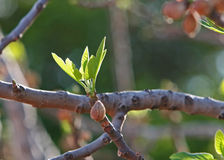
Sprouting Fig Tree in SpringtimePerhaps we may find it surprising that Jesus describes these events as a good thing to his disciples. He says:
“Learn a lesson from the fig tree. When its branch becomes tender and sprouts leaves, you know that summer is near. In the same way, when you see these things happening, know that [the Son of Man] is near, at the gates.”

We usually associate the end of things with the fall. Youth is called the springtime of life, while old age is the fall. In the Northern Hemisphere, every Church year ends in the fall. Yet Jesus presents an analogy for the end of the world as one of spring becoming summer: ‘When the tender branch sprouts leaves, you know that summer is near.’ A small thing, the branch, points to the arrival of a much greater reality, the summer. Why would we cling to the branch when the whole world is being renewed in glory? For friends of God, what is to come is better than what we see. The life we live now in this world is the winter. What is still to come for us is the spring and summer. Let us not hesitate to hope for it, envision it, and rejoice in it.

When the last day comes, “it will be God without disguise; something so overwhelming that it will strike either irresistible love or irresistible horror into every creature. It will be too late then to choose your side. … That will not be the time for choosing: it will be the time when we discover which side we really have chosen, whether we realized it before or not. Now, today, this moment, is our chance to choose the right side. God is holding back to give [people] that chance. [But it] will not last forever. We must take it or leave it.”

How long will it be until the Lord comes again? Jesus says in today’s gospel that, “This generation will not pass away until all these things have taken place.” But he said this a long time ago. Was Jesus wrong? No, for when you read these passages from Mark in full context, Jesus is responding to his disciples questions about two things side-by-side: the fall of Jerusalem and the end of the world. The Romans destroyed the great city and its temple in 70 A.D., during the lifespan of some of Jesus’ hearers, and to many Jews it felt like the end of the world. This event prefigured the passing away of all things. Like other prophesies in the Bible, Jesus’ prophesy has a near and distant fulfillment, one after a forty-year opportunity for conversion, and another at the end of time.

So when will the Lord come again? The answer for every generation before us has been “not yet.” If this world endures to the year 10,000 A.D., the Christians of that time will probably regard us as the early Christians. I personally think it will still be awhile before he comes, for it is still legal to be a Christian in too many places on earth. Yet, in a sense, it doesn’t matter when Jesus is coming, for the end of our individual lives is equivalent to the end of the world for us. If you’re ready for one, you’re ready for the other. But if you, or people that you know, are not ready for either, then now is the time for conversion.

The Lord our King has recruited us into his holy conspiracy, arming us with the weapons of truth and love. You and I are his advanced forces and, among other tasks, he is sending us on rescue missions to bring others to himself. Who do you know that is far from Christ? We are to draw on the power of this Mass for them. We are called to pray, fast, and sacrifice for them, and even to be so bold as to talk with them—inviting them to come to Jesus Christ and his Church. Seize this opportunity and do not let it pass away, for whether the Lord first comes to us or we go forth to him, each and all will encounter him soon, face-to-face, in his full, unveiled glory.

Enduring Deprivation — Monday, 20th Week of Ordinary Time—Year II

August 18, 2014

Readings: Ezekiel 24:15-23, Matthew 19:16-22

The word of the LORD came to me: “Son of man, by a sudden blow I am taking away from you the delight of your eyes, but do not mourn or weep or shed any tears. Groan in silence, make no lament for the dead, bind on your turban, put your sandals on your feet, do not cover your beard, and do not eat the customary bread.” That evening my wife died, and the next morning I did as I had been commanded.

Then the people asked me, “Will you not tell us what all these things that you are doing mean for us?” I therefore spoke to the people that morning, saying to them: “Thus the word of the LORD came to me: ‘Say to the house of Israel: Thus says the Lord GOD: I will now desecrate my sanctuary, the stronghold of your pride, the delight of your eyes, the desire of your soul. …  Your turbans shall remain on your heads, your sandals on your feet. You shall not mourn or weep, but you shall rot away because of your sins and groan one to another.”

Christ and the Rich Young Ruler, by Heinrich HofmannWhat does Ezekiel in the first reading have in common with the young man in today’s gospel?

A young man approached Jesus and said, “Teacher, what good must I do to gain eternal life?” … Jesus said to him, “If you wish to be perfect, go, sell what you have and give to the poor, and you will have treasure in heaven. Then come, follow me.” When the young man heard this statement, he went away sad, for he had many possessions.

The Lord asked the rich young man to give up something precious to him, and the Lord took away something precious from Ezekiel. What if Ezekiel had rebelled after his loss, refusing to do anything further in the Lord’s service? People sometimes react to tragic loss in this way. What if that rich young man who went away sad never changed his mind? Divine callings often entail hardship, but consider the greater loss of never fulfilling the purpose of one’s life.

Every good thing, every person or possession, has come to us from God, and his desire for us is our supreme good. Therefore, the Lord is worthy of trust, even if we are stripped of what is dearly precious to us. As the suffering Job observed,

“Naked I came forth from my mother’s womb,
and naked shall I go back there.
The LORD gave and the LORD has taken away;
blessed be the name of the LORD!”

Stained Glass Symbols — Mount Calvary’s Cross

February 18, 2014

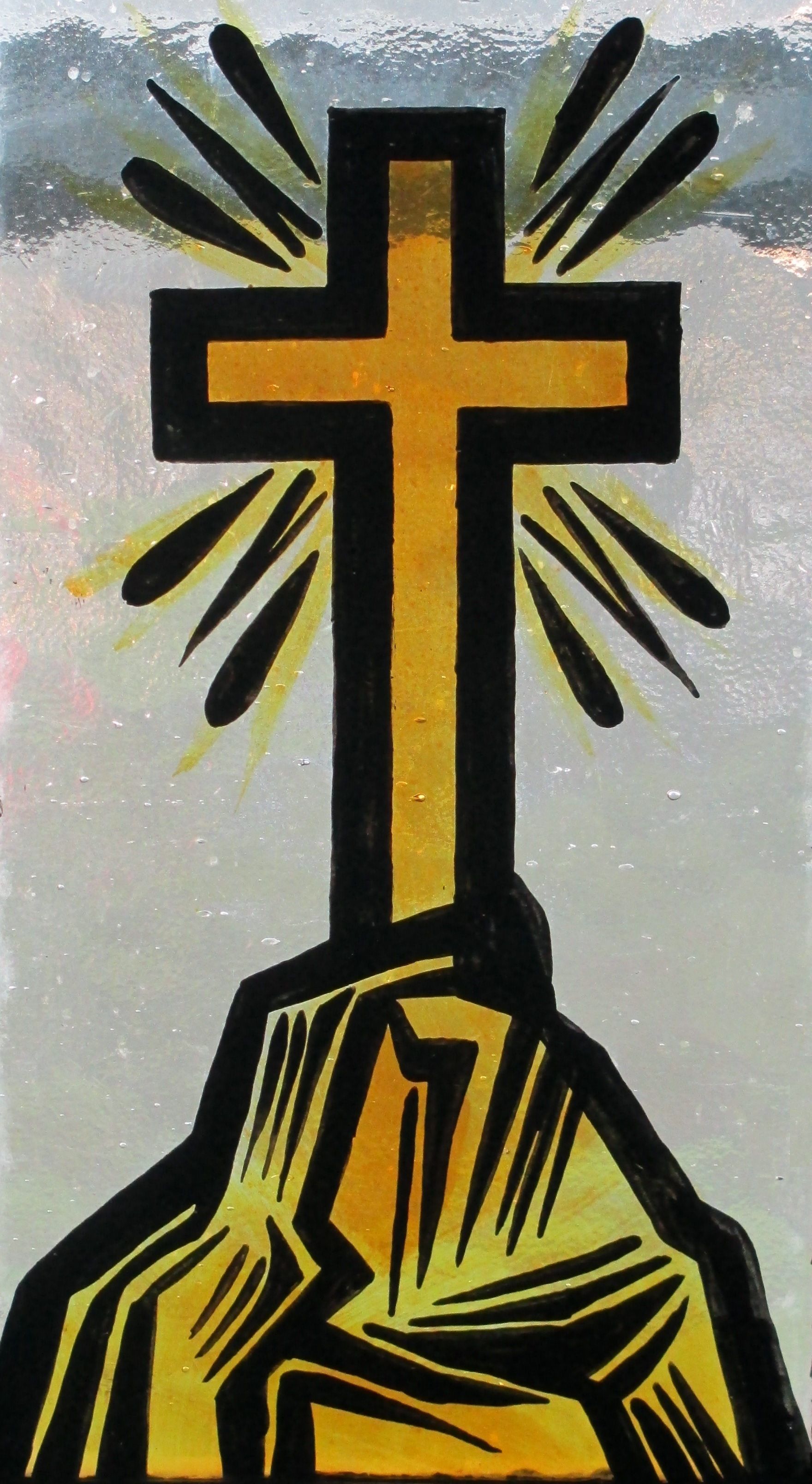
Mount Calvary's Cross - Sacred Heart Catholic Church -  Wauzeka WIA Symbol of the Source & Summit of the Christian Life

Jesus Christ’s sacrifice on Mount Calvary’s cross was offered in love of God and man. It is the source or fount for all saving grace, and the summit or pattern to which all Christians are called.

Stained Glass Symbols — The Host & Chalice

February 8, 2014

Host and Chalice - Sacred Heart Catholic Church -  Wauzeka WIA Symbol of Christ’s Death

Jesus Christ is really and truly present in the Eucharist Host and chalice, yet the Host and chalice are symbolic as well. At the Last Supper, Jesus took bread, broke it, and said, “This is my body, which will be given up for you.” Then he took a chalice of wine and said, “This is the chalice of my blood… which will be poured out for you…” When a living creature’s blood is separated from its broken body, death naturally follows. Though Christ’s Body, Blood, Soul, and Divinity are fully present in every fragment of the Host and in every drop of the chalice, the symbolic separation of Jesus’ body and blood points to his sacrificial death.

The Way, Truth, & Life — 5th Sunday in Easter—Year A

May 22, 2011

Jesus said, “I am the way and the truth and the life. No one comes to the Father except through me.”

The Mass is an encounter with Jesus Christ, leading us to God the Father. Like Jesus Himself, the Mass contains the Way, the Truth, and the Life of Jesus. First, we journey on the Way to Jesus, then we come to the Truth of Jesus, finally we join in the Life of Jesus.

The Mass begins with the sign of the cross, for God is the beginning and end of everything. Next, we confess our unworthiness to approach the Lord, asking mercy for our sins, so that we may dare to take this journey to God. The, from the Holy Scriptures, we hear of God’s words and deeds among the Old Testament peoples and within the New Testament Church. In this, we learn of the providential way that God has prepared throughout time for us to encounter Jesus Christ today. Just as the journey on this Way through history leads to Jesus Christ, so the liturgy of the Word leads to the Gospel. Certainly, Jesus Christ the Word of God is present throughout the entire Word of God which is Sacred Scripture, but for the reading of the Gospel, we all stand up for Him and sing “Alleluia,” “Praise the Lord,” because we have come to Jesus Christ and He is more fully present among us in the proclamation of the Gospel.

The Gospel reading proclaims Jesus, who is the Truth. The homily that follows proclaims that the Truth matters for us here and now and demands our personal response. To this call, we answer with the Creed, proclaiming our faith in who God is and what He has done for us. In the Creed, we proclaim our acceptance of Jesus, the Truth. In the prayers of the faithful, we petition the Lord for our needs and concerns, saying in so many words, “Lord, let your kingdom come, on earth as it is in Heaven! Let us share you life! Give us your life!” At Mass, the Way leads to the Truth, and from the Truth we long for God’s Life. At Mass, the Liturgy of the Word leads to the Liturgy of the Eucharist.

The presentation of the gifts is not merely about moving around cash and bread and water and wine. The presentation of the gifts is about the presentation of everything that we have, and everything that we are, to God. We lift up our hearts to be one with our sacrifice. Amidst praises to the Father, the one life-giving sacrifice of the Last Supper, of the cross, and of Heaven becomes present here to us. We join in offering this sacrifice through Jesus, with Jesus, and in Jesus, in union with the Holy Spirit, to God the Father in Heaven.

Through this offered sacrifice, we join in God’s Life. We pray “Our Father,” because uniting with the paschal mystery, the great Easter deeds of Jesus, gives us life as the Father’s sons and daughters. Then we share with one another the sign of peace, the loving peace that is possessed by God’s holy ones. Finally, at the climax, we partake of Jesus Christ, Life Himself, most truly present in the Holy Eucharist.

Sometimes people say, “I just don’t get anything out of going to Mass. Father, I know that you say all this important and wonderful stuff is going on, but I don’t see it and I don’t feel it. The Mass is boring for me.” I understand. When I was a boy, I made a point of going to the bathroom (sometimes twice) during every Mass, just to break up the monotony. When I would see the priest cleaning the dishes at the altar—that was a good sign, because it meant that the Mass was almost done. I didn’t really know what was happening at Mass, so I really didn’t believe in what was happening at Mass. But as I grew older I began to learn what was happening, and as I grew in faith I began to believe in what was happening, and my experience of the Mass was transformed.

People who say that the Mass is boring resemble St. Phillip in something he said to Jesus at the first Eucharist, the Last Supper: “Master, (we don’t see or feel the presence of God the Father,) show us the Father, and that will be enough for us.” And Jesus said to him, “Have I been with you for so long a time and you still do not know me, Philip? Whoever has seen me has seen the Father. (Whoever has been to Mass has encountered my mysteries.) How can you say, ‘Show us the Father’? (How can you say, ‘The Mass is boring?’)” The awesome mystical realities of the Mass are true, and real, and present and active at every Mass we attend, whether we see them, or feel them, or believe in them, or not.

Jesus Christ and the Holy Mass contain the Way, the Truth, and the Life, and we shall receive from them according to our faith. Let us pray, that at this Mass and every Mass, we may be as fully present to Jesus Christ and His mysteries as they are to us at every Mass.

A Man In Jesus’ Image — Divine Mercy Sunday—Year A

May 1, 2011

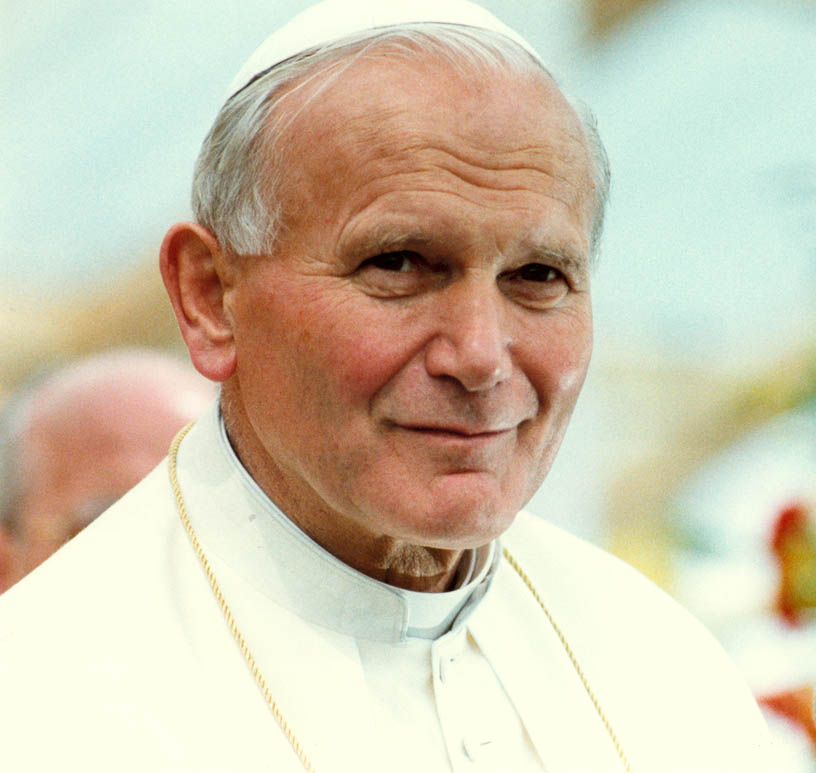
This Divine Mercy Sunday, our Catholic Church throughout the world celebrates and glorifies two men together in a special way. The first is our Savior, our Lord and our God, Jesus Christ; and the second is the great pope John Paul the Second, who is being beatified today in Rome. John Paul the Great, born Karol Wojtyla, is a man who lived in the image and likeness of Jesus Christ.

Both chose the Blessed Virgin Mary to be their mother. One chose her after the loss of his earthly mother as a boy. The other chose her from all eternity. Growing up, both of their beloved homelands were occupied and oppressed by foreign empires. For one it was the Romans. For the other it was the Nazis and then the Soviet Union. As young men, they both worked as manual laborers, in lives hidden from the world. When people encountered their ministries for the first time, many said, “Who is this man, and where does he come from?”

Both men transformed this world, not by leading violent revolutions, not by amassing incredible fortunes, but by speaking the truth, and living the truth, and leading others in doing the same for God. They preached God’s message, and their words gave hope and courage to many, but their words were not accepted by all. Both men had enemies who sought to destroy them, but they forgave, face to face, those who sought their lives.

At the end of their lives, both men were afflicted with great physical sufferings, but neither laid down their crosses. Some onlookers mocked or dismissed them in their afflictions, but those with spiritual insight beheld them to be offering a sacrifice to the Father for the salvation of the world.

St. John tells us that Jesus has done many other signs in the presence of his disciples that are not written in his Gospel. As St. John writes elsewhere, “There are many other things that Jesus did, but if these were to be described individually, I do not think the whole world would contain the books that would be written.”

Among these signs are the lives of the saints throughout the centuries, saints like Pope John Paul the Great. His life was a sign worked by Jesus Christ in our midst so that we would come to believe more deeply that Jesus is the Christ, the Son of God, and that through this belief we may have life in his name.

Why did people love Pope John Paul II so much? Catholics of every country and of all ages loved and flocked to him. Even non-Catholics and non-Christians were drawn to him. What explains this phenomenon? I think the answer is simple. People saw in him a reflection of Jesus Christ’s love for them. John Paul the Second was an icon of Christ and his love.

Every time you saw Pope John Paul, he was smiling. He traveled the nations, and embraced everyone warmly. When you encountered him, you felt loved, even if you were one person in a crowd of thousands. This was the Holy Spirit at work. Although you did not see Jesus you loved him in Pope John Paul; even though you did not see Jesus you believed in him all the more because of him, and rejoiced with an indescribable and glorious joy.

This morning we celebrate a feast day which Pope John Paul II established, Divine Mercy Sunday. What is divine mercy like? What does Jesus’ unfathomable love, which enfolds every one of us here and every person God has made, look like? Through the life of Pope John the Great we saw a partial glimpse of the divine mercy and love of Jesus Christ.

“Do This…” — Holy Thursday

April 21, 2011

At the Last Supper, the night before he suffered for us, Jesus took some bread. He thanks to God for it and He broke it. And He declared it to be His body which would be given up for others. Then He offered it to those He loved. When the supper was ended, Jesus took a cup of wine. Again He gave thanks and praise to the Father. And He declared it to contain His blood, blood to be shed for all. Then He offered the cup to His disciples and said, “Do this in remembrance of me.”

At the Last Supper, Jesus ordained His apostles the first priests of the New Covenant. They and their successors would do this in remembrance of Him, throughout the centuries, up to this very night, and until He comes again. When you and I celebrate the Mass we remember Him and what He did, and more than just recalling it, we re-encounter it as that same sacrifice is offered in front of us. But Jesus’ words, ‘to do this in memory of Him’ means more than just coming to Mass.

Jesus is calling and commanding us to do the thing that He is doing. We must give God thanks and praise for what He has given us. We must take our bodies and give them up. We must take our life’s blood and pour it out. And we can do this, for God and for each other, in as many ways as there is to love. The sacrifices of your daily life, at home, at work, and at prayer; the work of washing feet; may not seem significant to you now, but these sacrifices shall your glory in Heaven forever.

As Jesus washed His apostles’ feet He said, “What I am doing, you do not understand now, but you will understand later.” And when He had finished He said, “If I, … the master and teacher, have washed your feet, you ought to wash one another’s feet.  I have given you a model to follow, so that as I have done for you, you should also do.” At the Last Supper, Jesus said to His disciples, “Do this in remembrance of me.” Tonight, He says the same to us as well.

3 Mountains / 3 Montañas — 2nd Sunday in Lent—Year A

March 20, 2011
In the life of Jesus, he climbs three significant mountains; The mountain of the sermon on the mount, the mountain of Transfiguration (in today’s reading) and the mountain of the crucifixion. In the Christian life, we must also visit these three mountains. 
 
The three mountains are united. The wisdom of the sermon on the mount, on the first mountain, brings the pleasures and pains of the other mountains. The life of the Gospel brings the joys of the light and the suffering of the cross. Wisdom, glory and sacrifice; the three are a trio here on this earth. Our glories without sacrifice pass quickly. Our sacrifices without wisdom we regret quickly. And our wisdom will be without glory forever if we do not follow Christ in sacrifice. Which mountain should visit more this season of Lent?
 
Do you lack wisdom? Do you not know well that Jesus and his Church teaches? Go to the first mountain to learn, like the disciples at the Sermon on the Mount, with the Bible, or the Catechism or many popular resources available in audio or visual forms.
 
Do you need consolation? Do you not feel well that Jesus is your beloved friend? Go to the second mountain, to feel like Jesus and his disciples at the Transfiguration, through time in a quiet place with God.
 
Do you need perfection in your love? Do you not carry the cross well? Go to the last mountain to practice it, like Jesus at the crucifixion, through good works for others.
 
Jesus climbed the mountains of wisdom, glory and sacrifice. To be with him, we must climb these also.
 

En la vida de Jesús, él sube tres montañas notables. La montaña del sermón del monte, la montaña de la transfiguración (en la lectura de hoy) y la montaña de la crucifixión. En la vida cristiana, debemos visitar estas tres montañas también.

Las tres montañas están unidas. La sabiduría del sermón del monte, de la primera montaña, trae los placeres y dolores de las otras montañas. La vida del Evangelio trae las alegrías de la luz y los sufrimientos de la cruz.  Sabiduría, gloria y sacrificio; los tres son un trío unido en esta tierra.

Nuestras glorias sin sacrificio pasan rápidamente. Nuestros sacrificios sin sabiduría lamentamos rápidamente. Y nuestra sabiduría será sin gloria para siempre si no nos siga a Cristo en sacrificio. ¿Qué montaña deben visitar más esta temporada de Cuaresma?

¿Faltas de sabiduría? ¿No sabes bien lo que Jesús y su Iglesia enseñan? Vaya a la primera montaña para aprender como los discípulos al sermón del monte, con la Biblia, o el catecismo o muchos recursos populares disponibles en formularios visuales o de audio.

¿Necesitas consuelo? ¿No te sientes bien que Jesús es tu amigo amado? Vaya a la segunda montaña para sentirlo como Jesús y sus discípulos a la transfiguración, con tiempo con Dios en un lugar tranquilo.

¿Necesitas perfección en tu amor? ¿No llevas bien la cruz? Vaya a la última montaña para practicarlo como Jesús a la crucifixión, con buenas obras para otros.

Jesús subió las montañas de sabiduría, de gloria y de sacrificio. Para estar con él, debemos subir estas también.

The Passion of Lent — 1st Sunday in Lent—Year A

March 14, 2011


Today Satan approaches Jesus in the desert at the end of His forty days of prayer and fasting and attempts to divert Him from the Father’s plan.   The ancient serpent employs the same tactics he used on Eve in the garden, twisting God’s words and playing on human desires. So how much did Satan know about what Jesus intended to do in the years ahead? St. Matthew suggests the Devil knew something of this, because the three temptations Satan puts to Jesus foreshadow His future Passion.

First, Satan comes and says to Jesus, “If you are the Son of God, command that these stones become loaves of bread.” Is it a coincidence that at the Last Supper Jesus will command bread to transformation into His very Self? It is as if the Devil were saying, “Why not simply give everyone bread. Why give yourself into their hands?” Jesus answers, “Man does not live on bread alone, but on every word that comes forth from the mouth of God.”

Jesus knows that a lifetime supply of bread would not save us. To live forever the Bread of Life must nourish us. Jesus is the Bread of Life. We do not live by bread alone, with whatever this world can offer, but by the Word that comes forth from the mouth of God. The Word of God is Jesus Christ.

This first temptation and Jesus’ answer point to the importance of prayer and the Eucharist. Prayer lifts our minds above having worldly thoughts alone. The Eucharist empowers our hearts to live for God. Do you pray every day? Prayer must be a top priority in Lent. Do you frequently receive Jesus in the Eucharist? In Lent, try coming to weekday Masses. Those who do so find it so powerful and precious that they often wonder how they ever used to make it a full seven days without receiving Jesus in between.

For his next temptation, Satan takes Jesus to the very top of the temple in Jerusalem. About three years later, not far from that place, the hostile Sanhedrin will gather and put Jesus on trial, questioning Him, demanding to know, ‘Are you the Son of God?’ and they’re not going to like His answer. The Devil says, “If you are the Son of God, throw yourself down.  [God’s angels will protect you.]” It is as if the Devil were saying, “Since you are a child of God He will be with you to save you no matter what, so why not do your own will and decline to give difficult witness?” But Jesus answers, “You shall not put the Lord, your God, to the test.”

You and I are also children of God and He is always with us,  but this must not lead us to presumption. We need to seek His will and give witness in the world by our words and deeds. If we sin, God always offers forgiveness, but we must take Him up on the offer. God always welcomes sinners, but we must turn to Him. To keep sinning without any words or actions of repentance is to put God to the test.

This second temptation and Jesus’ response point to the importance of confession and conversion. This Lent, turn from sin, come to confession at least once, and put some serious thought into planning how you will “sin no more and to avoid the near occasions of sin.”

For the third temptation, the Devil takes Jesus up to a very high mountain and shows him all the kingdoms of the world in their magnificence. He says, “All these I shall give to you, if you will prostrate yourself and worship me.” Jesus plans to claim His universal kingdom by climbing another mountain by Himself, Mount Calvary, and by taking his throne on the cross. (This is why Jesus tells James and John that they do not know that they are asking when they request to sit ‘one at His right hand and one at His left when He enters His kingdom and glory.’) Here it is as if the Devil were saying, “If you simply give up you won’t have to sacrifice, you won’t have to suffer. Lay down your cross and lay down before me.” But Jesus rebukes the devil, (much like he will later rebuke St. Peter for saying, ‘God forbid such a thing should ever happen to you): “Get away, Satan! The Lord, your God, shall you worship and him alone shall you serve.”

This third temptation and Jesus’ answer point to the importance spiritual sacrifices and patiently bearing our burdens. We have taken on Lenten penances, let us not give them up; and when unforeseen trials come to us, let us trust that Jesus knows what He’s doing; for it is through crosses like these that God makes us holy.

Prayer and the Eucharist, confession and conversion, spiritual sacrifices and patiently bearing our burdens. Let these things be in your response as you are tested these forty days.

The Giving Tree — Tuesday, 8th Week in Ordinary Time—Year I

March 1, 2011

Do you remember The Giving Tree, that very green childrens book by Shel Silverstein? It’s a story about a boy and the tree that loved him. When he is a boy, the tree gives him her leaves to play with and her apples to eat. However, when the boy becomes a young man he comes asking for money, so that he can buy things and have fun. Since money doesn’t grow on trees, she gives him her apples for him to sell. Time passes, and he comes back, this time asking for a house. The tree lets him cut off her branches so that he may build one. Later, much later, the boy returns again, but he is now a much older and sadder man.”I want a boat that will take me far away from here,” he says. “Can you give me a boat?” The tree offers her trunk and he takes it. He fashions a boat, and sails far away. After a long time, the boy returns, now a very tried and very old man. The tree is now just an old stump. He has taken everything, but she still gives. The story closes with these words: “‘Come, Boy, sit down. Sit down and rest.’ And the boy did. And the tree was happy.”

Now if The Giving Tree has always been one of your favorite books, that’s ok. If it has a special place in your heart, don’t let me or anybody take that from you. But, as for me, this book has always bothered the heck out of me. Even when I was a kid, the story filled me with indignation. Do you know what I’m taking about?

It’s the boy! The selfish, ungrateful boy, who never gives anything back. He receives everything the tree has to give and he never says, “Thank you.” He takes everything she has to give, uses all of it up on himself, and he never says, “I’m sorry.” This book would have been so much better if he just said “thank you” at the end. Does this kid’s behavior in the story of The Giving Tree bother you like it bothers me? If so, then you and I should make sure that we’re not doing the same in our own lives.

So who would be the “giving tree” we take for granted in our lives? Our moms and dads come first to mind. They’ve given us life, food, shelter, clothing, and love our entire lives. What have we given back to them? They probably don’t need your material support right now, but they would appreciate signs of your love. (It’s probably no coincidence that Shel Silverstein dedicated The Giving Tree to his own mom.) But there is another “Giving Tree” we can take for granted, who is even greater and more generous than our parents. I speak of God, and of Jesus Christ, “from whom all good things come.” What should we do for our parents and for God? We should honor them with our words. We should obey them in our actions. We should be grateful for everything and show it.

For God, we do this by way of sacrifices. (This Eucharist is a thanksgiving sacrifice. The name itself means thanksgiving in Greek.) Yet our sacrifice is not merely what happens here at church, but the offering of our whole lives. Those who make no sacrifices for God in their daily lives bring nothing to His altar. What do we have to offer Him today? What will we have to offer him tomorrow?

Jesus Christ is The Giving Tree. At this sacrifice, let us say to Him, “I’m sorry, for misusing your gifts.” Let us say, “Thank you, for your generosity to us.” And let us say, “I love you,” because that will make Him happy.

The Sorrowful Mysteries, Meditations on Vocation with the Saints

October 29, 2010

The 1st Sorrowful Mystery:
The Agony in the Garden

Years before Jesus agonized in the Garden of Gethsemane, the Blessed Virgin Mary had an agony of her own, when the Archangel Gabriel came to announce to her that she would bear the Son of God. Mary was “greatly troubled,” and the angel sought to reassure her “Do not be afraid, Mary….” Even after the plan was presented to her, she must have been full of questions about her future, like “What will Joseph and my parents think?” But Mary answered, “Behold, I am the handmaid of the Lord. May it be done to me according to your word,” and because she said that, Jesus could say years later, “Father… not my will but yours be done.”

God has a plan for every life, and a calling, a “vocation,” meant for them. Accepting God’s plan for our lives can take great, trusting courage, but answering “Yes” to Him will do more good than we know. Let us pray for the grace, trust, and courage to say “Yes” to our own God-given callings.

The 2nd Sorrowful Mystery:
The Scourging at the Pillar

Father Damien went to the Hawaiian island of Molokai to minister the spiritual and bodily needs of lepers exiled there. Last year, in 2009, Father Damien was canonized a saint. But in 1889, six months after his death, the following letter was published in a Protestant Christian newspaper:

Dear Brother,

In answer to your inquires about Father Damien, I can only reply that we who knew the man are surprised at the extravagant newspaper laudations, as if he was a most saintly philanthropist. The simple truth is, he was a coarse, dirty man, headstrong and bigoted. He was not sent to Molokai, but went there without orders; did not stay at the leper settlement (before he became one himself), but circulated freely over the whole island (less than half the island is devoted to the lepers), and he came often to Honolulu. He had no hand in the reforms and improvements inaugurated, which were the work of our Board of Health, as occasion required and means were provided. He was not a pure man in his relations with women, and the leprosy of which he died should be attributed to his vices and carelessness. Other have done much for the lepers, our own ministers, the government physicians, and so forth, but never with the Catholic idea of meriting eternal life.

– Yours, etc., “C. M. Hyde”

Hyde’s comments are noted today only because they were so exquisitely answered in an open letter by Robert Louis Stevenson, the author of Treasure Island (1883) and The Strange Case of Dr. Jekyll and Mr. Hyde (1886). Stevenson quite rightly wrote, “[If the world will] at all remember you, on the day when Damien of Molokai shall be named a Saint, it will be in virtue of one work: your letter to the Reverend H. B. Gage.” The whole reply, assessing Damien and rebuking Hyde, is worth your reading, but I will give you the closing words: “[Father Damien] is my father… and the father of all who love goodness; and he was your father too, if God had given you grace to see it.”

In yesterday’s gospel, Jesus asked, “Do you think that I have come to establish peace on the earth? No, I tell you, but rather division.” This is because when someone set about to do God’s will, the world, which opposes God, will attack that person. Criticisms will land on the just man like lashes on the back. Jesus said, “Woe to you when all speak well of you,” for ‘the world loves its own.’ If there is nothing very counter-cultural about your life, then you are not yet living out the Gospel as Christ calls you to do. Let us pray for the grace to be faithful to the Gospel, even at personal cost.

The 3rd Sorrowful Mystery:
The Crowning with Thorns

Once, when St. Maximillian Kolbe was a boy, his behavior began trying his mother’s patience. She said in exasperation, “Maximillian, what will become of you?” As St. Maximillian writes, “Later, that night, I asked the Mother of God what was to become of me. Then she came to me holding two crowns, one white, the other red. She asked me if I was willing to accept either of these crowns. The white one meant that I should persevere in purity, and the red that I should become a martyr. I said that I would accept them both.” How bold of him to imagine, and how bolder still to ask, that he might receive them both. St. Maximillian would receive both crowns, as a holy Franciscan brother, and as a victim of the Nazis at Auschwitz, where he took the place of another innocent man who was condemned to die.

At yesterday’s Mass you heard that God, by His power, “is able to accomplish far more than all we ask or imagine.” Yet we will receive little if we are too timid to imagine or ask much of Him. Let us pray for the grace to imagine and ask to be crowned by Christ with a life with far greater than whatever we would merely drift into on our own.

The 4th Sorrowful Mystery:
The Carrying of the Cross

In 1961, Gianna Molla was expecting another child. During her second month of pregnancy, a tumor developed in her uterus. She could have chosen to have her uterus removed—preserving her own life, but resulting in her baby’s death.  Instead, she chose to try having the tumor surgery removed. After the operation, complications continued throughout her pregnancy. Gianna told her family, “This time it will be a difficult delivery, and they may have to save one or the other—I want them to save my baby.” On Good Friday, 1962, Gianna gave birth to her daughter, Gianna Emanuela, but it was too late for the mother. St. Gianna Molla died one week later.

Naturally, we all hate to suffering, but if you were to ask St. Gianna Molla what was the greatest thing she ever did, the thing she least regrets and of which she is most proud, I bet she point to this final trial, carrying the cross for the life of her child. I suspect, that on the other side of death, we shall see how much good an offered suffering can do, and we will regret not having offered more. We should ask ourselves, would I rather live a great life, or merely an easy one. Let us pray for the grace to be a lasting blessing to others though the crosses that come our way.

The 5th Sorrowful Mystery:
The Crucifixion

We think of Mexico as one of the most Catholic countries there are, but in 1920’s, it was illegal to celebrate Mass there.  That did not stop priests like Blessed Miguel Pro, S.J. from sneaking about to minister to people in their homes.  After many close calls, Fr. Pro was captured by police and condemned to death on false charges that he was somehow connected to a bombing assassination plot.

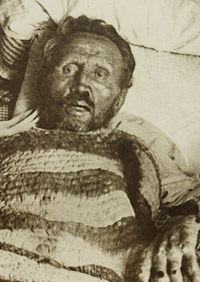
When he was led out for his execution by firing squad, Fr. Pro be blessed the soldiers, knelt and quietly prayed for a time. Declining a blindfold, he faced his executioners with a crucifix in one hand and a rosary in the other and held his arms out in imitation of the crucified Christ and shouted, “May God have mercy on you! May God bless you! Lord, you know that I am innocent! With all my heart I forgive my enemies!” Just before the firing squad was ordered to shoot, he proclaimed, “Viva Cristo Rey!” (“Long live Christ the King!”) When the first shots failed to kill him, a soldier shot him point-blank. The government had a photographer on hand, capturing these moments for propaganda purposes, but soon after the images were published their possession was made illegal—a Catholic priest dying faithfully and bravely was an inspiration giving new life to a people oppressed.

At the end of the Rosary we pray, “O God… grant, we beseech Thee, that, meditating upon these mysteries of the Most Holy Rosary of the Blessed Virgin Mary, we may imitate what they contain and obtain what they promise through the same Christ Our Lord. Amen.” If we are faithful to Christ, the mysteries of His life we be made manifest in our own. And if we are faithful to Christ, we will receive a glory similar to His own. Let us pray for the grace to live extraordinary lives in the likeness of Jesus Christ.