Archive for the ‘Service’ Category

The Last Shall Be First

October 19, 2024

29th Sunday in Ordinary Time
By Fr. Victor Feltes

In today’s Gospel, James and John shoot their shot to move higher up in Christ’s Kingdom. They say, “Teacher, we want you to do for us whatever we ask of you. … Grant that in your glory we may sit, one at your right and the other at your left.” Jesus replies, “You do not know what you are asking.” The two brothers jump at the chance to drink from Jesus’ cup and be baptized in his baptism because they don’t realize these things mean sharing in Christ’s suffering. Jesus assures them, ‘You will drink of my cup and experience my baptism, but to sit at my right and my left is for those for whom it has been prepared.’ Where were the places at Christ’s sides at his glorious royal enthronement? St. Mark’s Gospel tells us: “With him they crucified two revolutionaries, one on his right and one on his left. … [And] the inscription of the charge against him read, ‘The King of the Jews.’”

James and John did not realize what they were asking. They sought places closer to Jesus in order to live earthly lives in a palace on Easy Street. They imagined reigning over a kingdom with Christ where they would be served like the rulers of the nations who made their dominance over other people felt. But Jesus gathered his disciples and said, “It shall not be so among you. Rather, whoever wishes to be great among you will be your servant; whoever wishes to be first among you will be the slave of all. For the Son of Man did not come to be served but to serve and to give his life as a ransom for many.”

Hierarchies are normal and natural, though some are better than others. The secular world has hierarchies according to power, wealth, or status. Christ establishes a hierarchy for his Church on earth according to sacramental holy orders. But amongst the Church in heaven, a hierarchy exists according to love. In heaven, God reigns supreme and God is love—pouring out for all. There is no money to be had, the sacraments are no longer needed, and there is perfect, perpetual peace. Greatness above is according to one’s capacity to give and receive love. So whoever wishes to be great in God’s Kingdom must practice the self-gifting, servant love modeled for us by Jesus Christ.

We can expect to see many surprises after this life. Reality will look very differently in the light of eternity. Some things which we once thought were valuable—even necessary—will be seen as nothing. And things once rejected as useless will be recognized for their true value—especially in people. Many unknown people will become recognized as great, while many rich, powerful, and popular people will be humbled. “Thus,” Jesus says, “the last shall be first, and the first shall be last.” So let us begin living life with more of that eternal vision now: by seeing with the eyes of Christ, by thinking with the mind of Christ, and by loving with the heart of Christ.

The Importance of Obedience

August 24, 2024

21st Sunday in Ordinary Time
By Fr. Victor Feltes

Jesus agreed to come and cure the servant of a Roman centurion, but the centurion replied, “Lord, I am not worthy to have you enter under my roof; only say the word and my servant will be healed. For I too am a person subject to authority, with soldiers subject to me. And I say to one, ‘Go,’ and he goes; and to another, ‘Come here,’ and he comes; and to my slave, ‘Do this,’ and he does it.” This Roman centurion had commanding officers above him and soldiers and servants under his own command. He had carried out others’ orders and with authority he had given orders to others. This Roman centurion had faith that Jesus of Nazareth, this Jewish rabbi, was God’s servant and prophet — perhaps even the Christ — with authority over angels or the elements of creation. Jesus is under authority and possesses authority, through which God’s will is done. He told his Father, “Not my will but yours be done.” And he tells us, “You are my friends, if you do what I command.” We are called to obedience to legitimate authority and Jesus speaks to us in and through his Church.

During my ordination as a diocesan priest, I placed my wrapped hands inside the hands of my bishop in accordance with the rite. Bishop Listecki asked me, “Do you promise respect and obedience to me and my successors?” I responded, “I do.” I hold this obedience very seriously. In the areas of our bishop’s proper authority, what the bishop wants me to do is what Jesus wants me to do. Of course, I should share with the bishop my input and feedback because consultation helps him to make better decisions. And if the bishop were ever to command me to sin, that command would be unlawful and should be ignored. But I believe what the Church, or canon law, or our bishop commands me to do, that is what Jesus wants me to do.

The saints strongly advocate for holy obedience. Pope St. Gregory the Great taught, “Obedience is rightly placed before all other sacrifices, for in offering a victim as sacrifice one offers a life that is not one’s own; but when one obeys one is immolating one’s own will.” The Diary of St. Faustina Kowalska records Jesus telling her, “My daughter, know that you give me greater glory by a single act of obedience than by long prayers and mortifications.” And St. Francis de Sales said, “The Devil doesn’t fear austerity but holy obedience.” And there are many other quotes from the saints which commend holy obedience.

This brings us to our second reading from St. Paul’s Letter to the Ephesians. I have never been married, but as a priest and a pastor ‘I too am a person subject to authority, with persons subject to me,’ and I know that without obedience no house can function well. St. Paul writes, “Be subordinate to one another out of reverence for Christ. Wives should be subordinate to their husbands as to the Lord. For the husband is head of his wife just as Christ is head of the Church, he himself the Savior of the Body. As the Church is subordinate to Christ, so wives should be subordinate to their husbands in everything.” In other words, allow your husband to lead you and your family. Your input and feedback are very important in forming good decisions, and your husband has no authority to practice or command sin, but he does possess legitimate authority to lead. And “husbands, love your wives, even as Christ loved the Church and handed himself over for her to sanctify her… that she might be holy and without blemish.” In other words, you are commanded to love and serve, sacrificing for your wife and family, as Christ does for his Church.

Many of Jesus’ disciples listening in today’s Gospel said, “This saying is hard; who can accept it?” Jesus asked the Twelve, “Do you also want to leave?” And Simon Peter answered him, “Master, to whom shall we go? You have the words of eternal life.” And so it is for us. Sometimes what we are told may be difficult to hear, sometimes obedience or service will be hard, but to whom else shall we go if we are unwilling to trust and obey our Lord? He has the words of eternal life.

“Where I Am, There Also Will My Servant Be”

March 17, 2024

5th Sunday of Lent
By Fr. Victor Feltes

Whoever serves me must follow me, and where I am, there also will my servant be. The Father will honor whoever serves me.” Jesus says, “Where I am, there also will my servant be.” His statement is descriptive, prescriptive, and predictive. He describes what is the case, he prescribes how we should act, and he predicts what will be. His servants can be found where Jesus has been before. They should serve him where Jesus is now on earth. And one day his servants shall be where Jesus is in heaven.

So where has Jesus been? Next Sunday is Palm Sunday when we will remember the way of his sorrowful Passion; how he mentally agonized in the Garden of Gethsemane, how he faced religious and secular trials, criticism and mockery, how he carried and painfully endured his Cross. Jesus notes, “Unless a grain of wheat falls to the ground and dies, it remains just a grain of wheat; but if it dies, it produces much fruit.” Christ’s glory was made complete through his offering-up of his physical and emotional sufferings; and where he has been, his servant will also be. Jesus says, “No servant is greater than his master,” adding that if people persecuted him, they will persecute us also. St. Peter writes, “Beloved, do not be surprised that a trial by fire is occurring among you, as if something strange were happening to you. But rejoice to the extent that you share in the sufferings of Christ, so that when his glory is revealed you may also rejoice exultantly.” It will not always be an extreme burden, like martyrdom, but each of us has a cross to carry. Jesus says, “If anyone would come after me, let him deny himself and take up his cross daily and follow me.”

Jesus Christ has been on Calvary. Where is he present on earth today? He is present in his Church, for he says, “Where two or three are gathered together in my name, I am there among them.” He is present in his Sacraments, most blessedly in the Eucharist, of which he says, “This is my Body” and “This is…my Blood.” He is present in little ones and the least of his brethren, for Jesus says, “Whoever receives one of these little ones in my name receives me,” and declares, “Amen, I say to you, whatever you did for one of these least brethren of mine, you did for me.” Therefore we should not neglect to gather and adore him in his Church, to approach and honor him in his Sacraments, and to love and help him in the small and vulnerable. The servants of Jesus should serve him where he is.

Where else is Christ now, following his Ascension? Jesus declared during his religious trial before the high priest, “From now on the Son of Man shall be seated at the right hand of the power of God.” So St. Paul urges us to “seek the things that are above, where Christ is, seated at the right hand of God.” More than a mere description of Christian life, more than just a call to serve him, Jesus’ words contain a promise of heaven. The Letter to the Hebrews calls Jesus Christ “the source of eternal salvation for all who obey him.” And Jesus says, “Where I am, there also will my servant be. The Father will honor whoever serves me.”

Jesus Christ is present at Calvary, in his Church and in his Sacraments, with the lowly on earth and with the saints in heaven. Remember this, for Jesus says, “Where I am, there also will my servant be.”

Invest Yourself in Heaven’s Reward

November 19, 2023

33rd Sunday in Ordinary Time
By Fr. Victor Feltes

As Jesus traveled from place to place he preached parables to different people. He told stories, for instance, featuring fields, fish, and flocks to teach farmers, fishermen, and shepherds about the Kingdom of God. It makes sense that Jesus would tell the same stories more than once, for different crowds to hear them for the first time and for his apostles to hear them repeatedly. But the gospels suggest Jesus sometimes changed his parables’ details to highlight different truths. What Jesus says in his Sermon on the Plain is similar but not identical to his Sermon on the Mount. As the Church journeys through our three-year cycle of Sunday readings we hear some parables retold by more than one gospel. And each fall, as we near the end of the Church year, our readings reflect upon the Four Last Things. Today, we have another such parable, about death and judgment, Heaven and Hell, Jesus Christ and us.

Christ is our Lord, our journeying master who shall return. We are his servants to whom he has entrusted our fortunes. And each of us one day will stand before him to give an account of our faithful or unfaithful service, with generous rewards or just punishments to follow. In Jesus’ telling through St. Matthew’s Gospel, the master entrusts weighty slabs of precious metal (called talents) in varying numbers to his servants, each according to their abilities. Upon his return, his faithful servants have doubled what they were given and receive the same words of praise: “Well done, my good and faithful servant! Since you were faithful in small matters, I will give you great responsibilities. Come, share your master’s joy!” One servant, however, who buried his talent and returned it ungrown, receives his master’s condemnation and is tossed into the darkness outside.

When Jesus retells his parable in St. Luke’s Gospel, the master is a nobleman who goes off to claim his kingdom, entrusting to ten servants one gold coin each. Upon his return, his faithful servants reveal their various positive returns on his investment. One has earned ten more gold coins and his king declares, “Well done, good servant! You have been faithful in this very small matter; take charge of ten cities.” Another servant has earned five more coins and the king decrees, “You, take charge of five cities.” One servant, however, hid his coin in a napkin and returned it unmultiplied. The king condemns that servant and orders all of his enemies who did not want him as their king to be slain.

The differences between these two parables highlight different truths about Heaven. In the first parable, the master speaks the same blessing to each faithful one: “Well done, good servant! … Come, share your master’s joy!” But in the other parable, the king gives his servant with ten additional coins ten cities and gives his servant with five additional coins five cities. So is Heaven’s reward the same for all the saints or can one’s reward be greater than another’s? One parable suggests their reward is the same, while the other suggests their rewards vary. On one hand, the reward of every saint is the same: they experience God’s unveiled glory forever in happy, loving communion with him and all who are in Christ. On the other hand, a great saint’s capacity for love and joy and glory may be greater than another’s.

Doctor of the Church St. Therese of Lisieux recounts in her great autobiography (“Story of a Soul”) how this idea once troubled her as a child: “One day, I expressed surprise that God does not give an equal amount of glory to all the elect in Heaven—I was afraid that they would not all be quite happy. [My older sister Pauline] sent me to fetch Papa’s big tumbler and put it beside my tiny thimble, then, filling both with water, she asked me which seemed the fuller. I replied that one was as full as the other—it was impossible to pour more water into either of them, for they could not hold it. In this way [she] made it clear to me that in Heaven the least of the Blessed does not envy the happiness of the greatest…

Notice how in both forms of Jesus’ parable all the faithful servants are entrusted with greater responsibilities. The saints in Heaven are likewise given higher roles as our intercessors now and in the family and household of God forever. Consider how many churches, religious communities, and cities around the world are dedicated to St. Paul. They are blessed to have him as a loving patron praying for them. And consider how the Blessed Virgin Mary shall always hold a privileged place in Heaven as the spiritual mother of every Christian.

St. Paul says, “Consider this: whoever sows sparingly will also reap sparingly, and whoever sows bountifully will also reap bountifully.” The generosity of our loving gifts to Christ, the additional sacrifices we make and good deeds we do, will surely not go unrewarded. Jesus tells us, “Give, and it will be given to you. Good measure, pressed down, shaken together, running over, will be put into your lap. For the measure with which you measure will be measured out to you.” Our individual hustle, cooperating with Christ’s grace, can win us greater glory, therefore “run so as to win!

We should not fear that we lack sufficient talents or gifts to produce good fruits for glory. In the first parable, every faithful servant was able to double his money and won his master’s praise. The issue with that unfruitful, condemned servant is that he never tried. His master calls him “wicked” and “lazy” because that servant did not make even the most minimal effort to grow his gift. “Should you not then have put my money in the bank so that I could have got it back with interest on my return?” That servant did not love his lord but rather resented his lordship over him. Which is easier: to digging a hole or visiting the bank? He did not want to be his master’s servant, he did not want him as his king, and so he finds himself condemned and cast out forever. But if we love our Lord we will produce fruit, just as “every good tree bears good fruit.” As Jesus declares, “Whoever remains in me and I in him will bear much fruit.”

What is something more that you will do with the talents and gifts our Lord has lent you? It could be something large or small, in private or with others. You could be a more-focused prayer warrior, or offer secret penances for the salvation of souls. You could start a Catholic book or movie club at your home, or organize a regular Bible study that discusses the upcoming Sunday readings. You could visit shut-ins as an extraordinary Eucharistic minister, or invite somebody new each week to come with you to Mass. There are many good things you could do and I urge you to consider and answer this call, for Jesus Christ will honor your faithful, loving efforts with glorious rewards.

Humility & Service

November 5, 2023

31st Sunday in Ordinary Time
By Fr. Chinnappan Pelavendran

This week’s readings offer a clear invitation to all of us to be humble and give loving service to God and others. To help us reflect on the readings and understand their context, let us recall some of the history of Israel. God the Father gave the Law through Moses and appointed him the Law’s official teacher. Moses handed his responsibility to Joshua, Joshua transmitted it to the elders, and the elders passed it down to the next generation. From them, the scribes and Pharisees received the Law, and the authority to teach and interpret it to His people. Their duty is to interpret the true meaning of the Law to his people.

In the first reading, then, God expresses his personal love towards Israel. However, the people of Israel did not respond to his divine love. Both the people and the priests had become prideful. For this reason, God was angry with the people of Israel at the same time, they had also become sinful in their lives, walking away from the righteousness of the Lord.

We have a different example in St. Paul, who, in our second reading today tells us his description of his humility among the Thessalonians, that he was a caring and dedicated leader. He tells them that he worked day and night while preaching the gospel. He was not trying to impress them or gain anything from them. Thus, he was giving to people not simply human words but the words of God. St. Paul is truly a great example, putting into practice what Jesus teaches today: “The greatest among you must be your servant.

In today’s gospel, Jesus affirms the leadership of Pharisees and Scribes. He tells His disciples to obey and respect them but not to follow their example. What they say is true so follow them, but in practice, they are misusing their authority for the sake of their selfish advantage. So, do not imitate their example. Authority is entrusted to us by God not to dominate or exploit others but for humble service to others. The Scribes and Pharisees had lost sight of this.

On the other hand, Jesus and Mother Mary are two great examples of humility and service. Mary said to the angel Gabriel, “Behold the handmaid of the Lord. Be it done unto me according to your word.” (Luke 1:38) When Mary consented to become the mother of Jesus, she ran the risk of being stoned to death because that was the penalty for an unmarried mother. Therefore, Mary, in her humility and desire to serve God. Mary is a model of humility and service for us. She is a model of giving and not counting the cost.

Jesus is our other greatest model of humility and service. In Gethsemane, in prayer, Jesus let go of his human will and submitted to the will of his Father. “Not my will but yours be done.” (Luke 22:42) Crucifixion was the form of the death penalty for common criminals at that time in the Roman Empire. Jesus was executed as a common criminal. He knew that this was the sort of death that awaited Him. However, through his death, he won life for us all. The Son of Man came to serve, not to be served.

Humble people are happy because they accept themselves for who they are – children of God. They are willing to learn and willing to serve. Are you a humble person?

Call No Man “Father”?

November 5, 2023

31st Sunday in Ordinary Time
By Fr. Victor Feltes

Today’s gospel understandably prompts a question. Jesus says, “Call no one on earth your father; you have but one Father in Heaven.” So why are Catholic priests called “Father”? Some non-Catholic Christians object to calling Catholic priests “Father” and abstain from doing so. However, I have never witnessed anyone similarly object to using the title “father” for their own beloved, male, biological parent. Jesus also says, “Do not be called ‘Rabbi,‘” and “Rabbi” means “Teacher,” yet every Christian school is staffed by “teachers.” Does Jesus intend us to take his words here literally or is he teaching us something deeper?

It is good to use Sacred Scripture to interpret Sacred Scripture, since the Holy Spirit inspired every passage and, rightly understood, God’s Word will not contradict itself. When we read the New Testament we see many men referred to as fathers. The 1st Letter of St. John says, “I write to you, children, because you know the Father. I write to you, fathers, because you know him who is from the beginning.” St. Paul writes in his Letter to the Romans about “our father Abraham” and “our father Isaac.” The Holy Spirit also inspired St. Paul in his 1st Letter to the Corinthians to call himself a spiritual father to those Christians. He writes, “Even if you should have countless guides to Christ, you do not have many fathers, for I became your father in Christ Jesus through the gospel.” St. Paul similarly says in his Letter to Philemon, “I urge you on behalf of my child Onesimus, whose father I have become…” So we see that it can be fine to call some living or deceased men fathers. It can even be good to call yourself someone else’s father. So what does Jesus mean to warn us about by teaching, “Call no one on earth your father”?

Today’s gospel says Jesus was speaking to the crowds and his disciples about the authority and the flaws of the scribes and the Pharisees. In the ancient world, teachers would teach seated. For instance, Jesus sat down to give his Sermon on the Mount and sat in Simon Peter’s boat to preach to people gathered onshore. Ancient rulers reigned from chairs called thrones, so Christ is now “seated at the right hand of the Father.” Jesus said the Jewish scribes and the Pharisees had “taken their seat on the chair of Moses.” Before the establishment of the Church they apparently possessed legitimate authority to teach. “Therefore,” Jesus said, “do and observe all things whatsoever they tell you, but do not follow their example. For they preach but they do not practice.

Jesus noted these teachers’ lack of concern for others: “They tie up heavy burdens hard to carry and lay them on people’s shoulders, but they will not lift a finger to move them.” He noted their vain egotism: “All their works are performed to be seen. … They love places of honor at banquets, seats of honor in synagogues, greetings in marketplaces, and the salutation ‘Rabbi.’” Instead of this, Jesus teaches us: “The greatest among you must be your servant.”

We who are fathers, or teachers, or who have any role of authority must remain humble. We are not flawless or perfect. We are not the Lord, our God. We are not given authority over others in order to serve ourselves. Jesus says, “Whoever exalts himself will be humbled; but whoever humbles himself will be exalted.” Resemble Jesus Christ in this and your reward will resemble his. Christians must also remember that our fathers, our teachers, and all people in roles of authority on earth are not perfect. Even if they are trying their best, they are not the Lord, our God. Even popes, preserved by the Holy Spirit from teaching errors “ex cathedra,” can still misstep as shepherds in their words and actions.

A faithful leader is a great blessing; promoting truth, and love, and righteousness within their sphere of influence. That is why it is so important for each of us to be good servant-leaders. But we must not make idols of ourselves or others, as if we were perfect, this world’s savior, or the source of every good. We have only one such Good Teacher. We have only one such Father, in Heaven. And we have only one such Master, Jesus Christ our Lord, who is worthy of our absolute trust and devotion.

“Jesus Loves Me” — Funeral Homily for Mabel Klingbeil, 93

January 23, 2023

By Fr. Victor Feltes

Great love is powerfully expressed through great trials. When Mabel was only eleven years old, she experienced a shocking personal loss. Her ten-year-old sister Betty passed away from an appendicitis. And for the rest of Mabel’s life it seems she wanted to help make sure others were safe and well. Mabel would live to be the last-surviving member of the family of her birth. She served as a caregiver to her parents and her adult siblings as they passed on before her.

She was married in this church to her husband George in 1958. They gave life to four sons together, including two, John and Tim, who passed away in infancy. After fourteen years of marriage, Mabel became a widow at age forty-three. She raised her two boys, Michael and George, on her own; doing her best to fill the role of two parents, for instance, taking them out to go fishing. Then, after her retirement, Mabel began raising children anew at age seventy-two. She cared for her grandkids, Katie and Sarah, concerned for both their bodies and souls, for instance often saying, “Remember to pray and brush your teeth!” How did Mabel say she liked raising children? “I had a ball.”

Kindly but firm, Mabel was not swayed by the increasingly straying views of popular culture. She has been a well-known St. Paul’s parishioner for many years volunteering at our school and singing in our church choir. She would take the girls with her up to the balcony for funerals. The other choir members and widowed school teachers were often recipients of Mabel’s care.

I remember Mabel telling me in her room at Dove nursing home, that she had been a teacher for a total of thirty-three years (seven years elsewhere and then twenty-six years here in Bloomer). She loved teaching her students and said she would still like to teach—if she were not ninety-three years old. I saw her Tuesday afternoons when I brought her our Lord Jesus in the Holy Eucharist and she always received him with devotion.

Because of circumstances of her upbringing, Mabel had a hard time accepting God’s amazing love for us. She once remarked, “When I [was growing] up, I never knew that God loved me.” At times, she wondered, “How could Christ die just for me?” Yet Jesus Christ has powerfully revealed his great love for us, especially through his trials.

Why else would God become man in Jesus Christ if not from great concern that we would be safe and well? Jesus comes to us as a teacher in a visible life on earth thought to have numbered thirty-three years. Kindly but firm, he possesses and imparts truth in an errant world. He formed young disciples in his charge; sometimes he even took them fishing. He comes as our Good Shepherd, laying down his life for his sheep, desiring none of us to be lost.

Jesus worshiped at his Father’s house and offered himself in sacrifice on the Cross. Now he calls us to worship in his Church and receive the great gift of himself offered in the Holy Eucharist. Jesus, now risen, is the first-surviving member of his family. Raised from the dead, he lives forever to help us through this life into the next. He is the faithful, loving caregiver of his spouse and his brothers and sisters; that is, of his Church as a whole and each of us individually.

So you see, Jesus Christ forms faithful Christians to be more and more like himself, and shepherds them to be with him in paradise. “What will separate us from the love of Christ? Will anguish or distress, or persecution or famine, or nakedness, or peril, or the sword?” Despite all these things, we can conquer overwhelmingly through him who loves us. Mabel, in her final recent trial, found comfort in this truth, as she often sang that sweet children’s song: “Jesus Loves Me, This I Know.” Let us be faithful to Christ, so that together with Mabel we may “behold our God, to whom we looked to save us!

Plant Using Your Tiny Seed of Faith

October 1, 2022

27th Sunday in Ordinary Time
By Fr. Victor Feltes

Today the apostles beg our Lord, “Increase our faith.” They feel apprehension at Jesus’ teachings. Christ asks extraordinary things of his disciples, and they fear their faith is insufficient. The Lord replies, “If you have faith the size of a mustard seed, you would say to this mulberry tree, ‘Be uprooted and planted in the sea,’ and it would obey you.” Realize that faith (like courage or love) is not necessarily a feeling. You can be courageous, even while feeling fear, by doing the right thing anyway. You can be loving, even while feeling strong dislike for your enemies, by willing their good anyway. And you can be faithful, even when you feel apprehensive like the apostles, by acting on your trust in God anyway.

Perhaps you feel nervous when you fly on an airplane, yet you buy your ticket and board the flight because you believe commercial jet is a very safe way to travel—and it is. If you were a business traveler, taking dozens of flights each year, your anxious feelings would calm and come to better resemble your sincere conviction about the safety of flying. Faith is like this, too. You may or may not have feelings of great faith, but when you choose to trust God and do the faithful thing you are acting in faith. Exercise your faith and your faith will strengthen, because you will see that God is faithful, and then your emotions touching on faith will naturally follow.

Jesus says, “If you have faith the size of a mustard seed,” you could miraculously transplant a tree with your command. When I was younger, the first time I read Jesus’ answer, I was discouraged by it—“I’ve never performed a miracle like that. How microscopic must my faith be!” But I had misunderstood him. Jesus’ reply is meant as an encouragement. Our Lord is saying, “Even if your faith is tiny, it is more than enough for you to fulfill my will.” What is God’s will for you? What does he want you to do? If you do not know this already ask him to reveal it to you. And “if today you hear his voice, harden not your hearts.”

On another occasion, Jesus said “the Kingdom of Heaven is like a mustard seed that a person took and sowed in a field. It is the smallest of all the seeds, yet when full-grown it is the largest of plants. It becomes a large bush, and the ‘birds of the sky come and dwell in its branches.’” So using your tiny seed of faith, plant in the field of your life as the Lord commands you. It may take awhile for the results to sprout but be patient. As the Lord said to Habakkuk, “The vision still has its time, presses on to fulfillment, and will not disappoint; if it delays, wait for it, it will surely come, it will not be late. The rash one has no integrity; but the just one, because of his faith, shall live.

Mustard bushes grow very large and the mustard it produces has a very potent taste. Given time, what you plant in faith will change the landscape and the flavor of our world. When you go on to see the incredible transforming results which faith allows you may become inflated and vulnerable to pride. People through whom God has accomplished great things may be tempted to think their serious sins are therefore no big deal, or may abandon serving the Lord before their days on earth are done. For this reason, Jesus follows his parable about faith and the mustard bush with another parable about a servant and his master.

Jesus asked his apostles, “Who among you would say to your servant who has just come in from plowing or tending sheep in the field, ‘Come here immediately and take your place at table’? Would he not rather say to him, ‘Prepare something for me to eat. Put on your apron and wait on me while I eat and drink. You may eat and drink when I am finished’? Is he grateful to that servant because he did what was commanded?” Jesus here is not describing how the world ought to be, but describing how their familiar, ancient world actually operated; where the stronger dominated the weaker. It is like when Jesus told them, “You know that the rulers of the Gentiles lord it over them, and their great ones make their authority over them felt. But it shall not be so among you. Rather, whoever wishes to be great among you shall be your servant.”

The apostles would not expect a slave’s master to be much grateful to his slave, and they would judge a slave to be most prudent in his position to remain humble and obey his master. “So should it be with you,” Jesus says, “When you have done all you have been commanded, say, ‘We are unprofitable servants; we have done what we were obliged to do.’” Indeed, apart from God we can do nothing, and keeping a humble servant’s attitude protects us from dangerous pride and presumption and helps us to fulfill what Christ commands. But the Master who is our Lord differs from other masters of the earth.

At the Last Supper, after he had washed his apostles’ feet, Jesus asked them, “Do you realize what I have done for you? You call me ‘teacher’ and ‘master,’ and rightly so, for indeed I am. If I, therefore, the master and teacher, have washed your feet, you ought to wash one another’s feet. I have given you a model to follow, so that as I have done for you, you should also do.” Although our Lord, being God, is rightfully entitled to all we have and are, he is grateful for our labors. If we do not let up our efforts, when our hard days on this earth are complete we can look forward to hearing him say: “Well done, my good and faithful servant… Come, share your master’s joy!

So while your faith may feel small, it is more than enough to do Christ’s will. If you do not know God’s will already, seek and ask to know it. Then plant your seed of faith in action and patiently watch it grow. And when you see the great things our Lord achieves through you do not let up your efforts slip, knowing that his reward for you is eternal joy in Heaven.
In the Boss’s Shoes

August 7, 2022

19th Sunday in Ordinary Time
By Fr. Victor Feltes

Once upon a time, you had an idea, an idea to bless the entire world by starting a new business from scratch. You fully invested yourself into the project – your time and talent and treasure – to make this enterprise successful, and it was very successful. After leading your business for many years without a single vacation, you announced you would be taking some time away. You reassured your employees the company would continue and that you would be back, perhaps in a few weeks or maybe several months.

You gave careful instructions to all of your managers for what they were to do in your absence, and then you left on a journey which was out of this world. You celebrated a beautiful, destination wedding which you had long-looked forward to and enjoyed many other things. Then one Friday afternoon around 3:00 PM, you returned to your workplace, your creation.

Driving into the parking lot, you’re surprised by how few cars there are. Your confusion turns into shock when you discover the building’s front doors are locked, despite it being business hours. Fishing out your keys from your pocket you unlock the door and walk into an empty lobby. First, you go to your office and find your dear secretary, Mary, at her desk.

Thank God you’re here,” she says and she begins to tear up. “After you left, everything became horrible. Despite what you told them, people started doing their own thing. When I tried to correct them, they wouldn’t listen and were cruel.” “Where are they now?” you ask. “Most of the salaried employees have simply stopped showing up, and the rest are skipping work today to make it another ‘long weekend.’” “Mary, I thank you for your faithfulness. I’m sorry this happened to you, and I will make it up to you.

As you walk throughout the building you notice many empty beer bottles and pizza boxes laying around. The cubicles and warehouse are nearly deserted, except for Jennifer helping customers over the phone at her computer and Michael moving shipping crates on his forklift. Then you find several of the junior employees goofing-off in the break room. They become very quiet when you enter.

Why aren’t you working?” “Because… no one has told us what to do.” “Fine! Start by clearing these tables and picking up the floor. Clean these workspaces and take out the trash. Then report back to me.

Returning to your office, you immediately dictate two memos: the first, firing all of your current managers for cause, and a second memo giving large raises and promotions to Mary, Jennifer, and Michael, appointing them as the new leaders of their departments. I trust this tale sounds familiar; it is similar to Jesus’ parables but dressed in modern clothes.

In today’s Gospel, Jesus urges us to be prepared “like servants who await their master’s return from a wedding, ready to open immediately when he comes and knocks.” Blessed will such servants be upon his arrival, especially if he finds them vigilant in nighttime’s “second or third watch,” that is, during this world’s darkest hours. Their joyfully returning lord and master will be so grateful for their proven faithfulness. “Amen, I say to you, he will gird himself, have them recline at table, and proceed to wait on them,” just like Jesus washes his disciples’ feet, dries their feet with a towel wrapped around his waist, and gives them his Eucharist at the Last Supper. Our Lord and Master, who shall come knocking on an unknown future day – either on the day we die or on the Last Day – is Jesus Christ himself.

As for those who say “the master is delayed in coming” or imagine he is never coming back, who mistreat other people (the menservants and the maidservants) and serve their own selfish desires (eating and drinking and getting drunk), our Lord will come at an unknown hour and punish them severely, condemning them to where the unfaithful go.

In the beginning, God had an idea, an idea to bless our entire world, creating this universe from scratch. Jesus Christ, through whom all things were made, has fully invested himself into his enterprise’s success. Yet Jesus has given us all freewill. Though never far, Christ leaves us free to choose to be his good co-workers or to do our own wicked thing. Today I hope that, having imagined yourself in the Boss’s shoes, you may better personally feel and appreciate how much our Lord treasures your faithfulness and how eager he is to reward it.

Our Mother Needs Help

May 8, 2022

4th Sunday of Easter
By Deacon Dick Kostner

Happy Mother’s Day! Jesus refers to his Church as his mother and his bride. While God does not need us he requests that we be a part of his mystical body. The vocation he gives to his Church is to preach and live the gospel message of happiness and love not only in this life but also in the next with him, in heaven. The problem that this brings to us is that this vocation can only be accomplished in this life, by and through the carrying of crosses during this life.

At the beginning of Lent we walked through a trailer movie of our life here on Earth displayed to us by reflecting upon the “Way of the Cross,” displayed here on our Church Mother’s walls. We discovered that while completing his vocation, which was opening the door to heaven for his Church, he got tired of carrying the cross and fell three times. Three times he felt he could not go on. Ordinary people like you and me, together with his heavenly Father, gave him help and the courage to go on. Jesus relied on faithful friends and the Father for help and moral support.

As you know since I was ordained a Deacon some twenty plus years ago, I have been involved with the RCIA program which invites adults to become members of our faith and the Mother Church. In the early Church it was directed to people who did not know Jesus or the Christian faith. Now, that program has also been available to Christians of other faiths, who are interested in becoming members of the Catholic Church. In the twenty some years I have been involved in the program I believe there has only been three or four individuals who joined the Catholic Church who were not previously involved in and educated in the Christian faith. Times have changed and the Mother Church is now involved in what it calls the New Evangelization. It’s our new challenge which is trying to get Christian educated individuals back into being active members of the body of Christ. People know about Jesus but are finding it difficult to witness his presence and help within their busy lives.

Our RCIA team is determined to help RCIA Candidates to recognize just how involved God is within our lives. The best way to teach this is by sharing our encounters with God in ordinary experiences of life. At every class we share what we call our “Spirit Stories” with each other to show just how important a part we play in God’s plan for us to be active participants in His plan for our happiness and salvation goal for us and our friends and neighbors, to be with him for all eternity. We are blessed in this Community with many active members of the body of Christ but the Covid has weakened our mission to be example setters for making everyone’s life happier and more faith filled by supporting our Mother Church. Attendance has not returned to pre-Covid numbers for many of our parishioners at Sunday Mass. Those who are still active in Church ministry are not only getting older but also are being overwhelmed with the responsibilities of keeping our Parish healthy in mind and spirit.

Liturgy is the generator, the battery charger for the Faithful to continue to be example setters for the faith community. The Liturgy cross our parish is carrying is getting too heavy for it to handle without the help of the Simon’s and Veronica’s. There are many members in our Parish still attending our Liturgies who used to be active Liturgy ministers of the word; greeters; and Ministers of Holy Communion, that no longer wish to be active for a variety of reasons. All of us will fall down numerous times on our trip to eternity but with a little help from the Simon and Veronica’s our St. Paul’s and St. John’s Body of Christ will continue on as Jesus did to fulfill our vocation to preach and teach by example, the gospel message of love of God and neighbor.

You will find forms and pencils in your pews to sign up and help carry our Parish crosses on our “Way of the Cross.” Not ready to sign today? When my wife asks people to help with ministries and they are reluctant, I will quote her by saying to you. “Pray over it.” and return your sign up sheet next week. I would also suggest you request St. Joseph to “sleep over” your requests for help in making a decision. I have acquired for our Parish a Sleeping Joseph Statute which is located on our Sacred Heart of Jesus Altar. Saint Joseph had many communications from God in the form of dreams and he always obeyed these communications. You may ask St. Joseph to ask God to help you make important decisions in life by placing your written requests in the box on which the Statute rests. We will have the Sleeping St. Joseph statute available for your help requests for a couple of weeks. Pope Frances does this on a regular basis and he encourages the faithful to do the same.

The Church realizes that some of you are physically or mentally unable to help carry this ministry cross. Veronica was unable to help carry the cross for Jesus but she did what she could do to help him. To people who can’t help carry this vocation anymore, you can still be a “Veronica” to those who need help, wipe their face, tell them thanks, and tell them they are needed. As Jesus told us in today’s Gospel, “My sheep hear my voice; I know them, and they follow me. I give them eternal life, and they shall never perish. No one can take them out of my hand. My Father who has given them to me, is greater than all, and no one can take them out of the Father’s hand.”

I will close with a Psalm Prayer for our Parish “Mother”: “Lord, God, your only Son wept over ancient Jerusalem, soon to be destroyed for its lack of faith. He established the new Jerusalem firmly upon rock and made it the mother of the faithful. Make us rejoice in your Church and grant that all people may be reborn into the freedom of your Spirit. Amen!“ On behalf of Fr. Victor and all our Parish Ministers, Happy Mother’s Day to all the moms out there and to our Mother Church!

Associated Priests

October 30, 2021

31st Sunday in Ordinary Time

For the past four weeks, our second reading has come from the Letter to the Hebrews. This New Testament book shows Jesus Christ as our great, faithful, and merciful high priest: holy, innocent, and undefiled, yet patient and compassionate. He is able to personally sympathize with us in our weaknesses because, though sinless, he shares in our humanity and struggle. Jesus Christ is a priest forever offering his one perfect sacrifice to God the Father in a priesthood which does not pass away.

As the Catechism teaches, the redemptive sacrifice of Christ is unique, accomplished once for all; but this sacrifice is made present for us at Mass. The same is true of the one priesthood of Christ; Jesus’ priesthood is unique, but it is made present for us through the ministerial priesthood which he founded at the Last Supper. Jesus commands his apostles, “Do this in memory of me,” ordaining them priests of his New Covenant. Yet only Christ is the true priest, while they are merely his ministers.

Besides the unique priesthood of Jesus Christ and the ministerial priesthood of his ordained bishops and priests, there is the common priesthood (that is to say, an equally-shared priesthood) of all the faithful, which is ours through baptism. Sharing in Christ’s identity as priest, prophet, and king, each of us have holy sacrifices to offer, each of us have holy truth to proclaim, and each of us have holy power to wield. The Second Vatican Council noted, pastors “know that they themselves were not meant by Christ to shoulder alone the entire saving mission of the Church toward the world.” The ministerial priesthood is at the service of your priesthood, so that you — sanctified, strengthened, enlightened, and formed — can be as Jesus Christ and his saints for this place and time.

The scribe in today’s gospel approaches Jesus and asks: “Which is the first of all the commandments?” Jesus answers that the first in importance is this: “You shall love the Lord your God with all your heart, with all your soul, with all your mind, and with all your strength.” And the second is this: “‘You shall love your neighbor as yourself.’ There is no other commandment greater than these.” We must be entirely devoted to God, lovingly serving his kingdom according to our personal gifts and callings. And yet, even when we’re giving our all, we remain limited creatures. For instance, time spent doing one thing cannot be spent doing something else. And we are not pure, angelic spirits but physically embodied creatures, beset by weakness and fatigue.

I have experienced this these past four years as your pastor, having two parishes and a school, celebrating thirteen or fourteen Masses a week, with usually five Masses to offer on the weekends. Plus there’s confessions, funerals, anointings, and weddings; school activities and CCD; answering correspondence and completing paperwork; writing for the bulletins and the Sunday homily; and meetings or appointments on most weeknights. I mention this not to brag or complain, but to show why this is grinding and draining and why I do not do more — there is only one of me. I would like to do more than these things I do, but I feel I can’t – not without some help or relief. That’s why I have been working with our parish councils for several months seeking a good solution.

Today, I can announce good news: St. Paul’s and St. John the Baptist’s parishes will soon have an additional priest. This associate priest will assist me, your pastor, in serving you. His name is Fr. Chinnappan, a priest from India, who presently happens to be Fr. John Potaczek’s associate in Mauston. Fr. Potaczek will have a new associate, but Fr. Chinnappan will officially begin ministry here with us, with lodging at St. John’s rectory, on December 1st of this year.

This means that our current weekend Mass schedule will not need to change next year. We’ll have more flexibility in scheduling funerals and more opportunities for confession. Weekday Masses will become Communion Services much less often than before. And visiting priests will no longer be needed for helpouts. Fr. Chinnappan is excited to teach a religion class at St. Paul’s School next semester, and now there will typically be at least one priest around at both parishes for each night of CCD.

I look forward to the unique gifts and perspective Fr. Chinnappan will bring to St. Paul’s and St. John the Baptist’s. I trust that you will make him welcome, and be patient with us who serve you. For myself, I am most excited to have more opportunities to engage, teach, and evangelize, drawing souls more closely and profoundly to Christ here at our church and school. I have some new ideas in mind, and I want to hear your ideas and any offers to help. Jesus wills for you and I to be one hundred percent devoted, with all our heart and mind, soul and strength. Let us serve Jesus Christ, our priest and king, as saints for this parish according to our own unique gifts and callings.

God’s Confirmation Gift to You

September 19, 2020

25th Sunday in Ordinary Time
By Deacon Dick Kostner

From our first reading from Isaiah we hear from God our lesson for today: “For my thoughts are not your thoughts, nor are your ways my ways, says the Lord.” God is telling us to think above what the world teaches and we will find the Kingdom of God with all its treasures.

As we continue on in Ordinary Time, Jesus continues to educate us about experiencing the Kingdom of God here and now through parables. Remember parables are stories Jesus uses to move a preconceived thought we hold to the flip side so as to move our thoughts and life to a higher level; to the level all experience in the Kingdom of God. The story we are told is about a landowner who needs help harvesting his crops. So he goes out and asks for help and agrees with others the wage that will be paid for their help. He does this in the morning, noon, three o’clock, and at five. When evening comes he directs his foreman to pay the laborers starting with those who came to help last. The wage was the same for all the workers but the ones who came to help first thought they would receive a greater wage and when they received the same they grumbled and complained to the landowner because they had worked more and so they felt they should get more.

In our ordinary way of thinking we are taught that the more we work the more we should get paid, right? That’s the way things work in our world, right? We should be paid according to how much time we spend working for others because that’s only fair, right? Jesus is saying to us that although this is the way of the world it is not the way found in the Kingdom of God. God thinks differently. God rewards those who respond to his call for help when he asks for help. The workers were thinking only about themselves and what is in it for them. They failed to see their call from another for help and the joy that can be found in helping others not to better ourselves but to better the life of another.

This higher level of service is done not for ourselves but rather to elevate and help others who need our help. Our Catechism tells us that we were created to know, love, and serve God. To serve God is to serve others. The body of Christ consists of human bodies who consent to the call from God to help him serve other people by and through our actions. The reward is the same for all who answers God’s request for help it is not governed by the amount of time we spend accomplishing the call, or even if we are successful, but rather it is paid because we consenting to answering God’s call for help.

These last few months we have people who have answered God’s call for help. These people have or will be receiving the last of the three Sacraments of Initiation, that being Confirmation. It is their final great gift of the presence of God’s Holy Spirit through the Sacraments of Initiation. The first was Baptism; the second is Holy Communion; the third, Confirmation. This is the final Sacrament which makes them full-fledged members of the Church of Jesus. It is the Church’s way of recognizing their importance and having reached the maturity level necessary to become active members of the Body of Christ. It is this maturity that allows them to speak to God and say, “Lord, I am ready and willing to help in any way I can to further the Kingdom of God in ways that I will be personally requested by you to accomplish.

But you may ask, “But how will I know what God wants me to do?” The answer is that God has given each and every one of His chosen people what I will call a personal pager powered by the Holy Spirit. That pager will go off and you will hear the call in your mind, when God desires your help. It will only go off when God has picked you personally to help. I will give you an example. A few years ago, I received a call from my best friend who told me that his dad was dying. I told him I was sorry to hear this and that I would pray for him and his family. In my mind I wondered whether I needed to do anything other than pray. One part of me said the family is going to want to be alone with their dad during this trying time. This made good sense to me and besides I felt uncomfortable experiencing death. And then the pager went off. And a voice screamed out to me and said, “Deacon, your friend was calling for support, if you can’t go to the aid of your best friend how will you ever go and help someone on my behalf that you might not even know?

Boy, how could I ever respond in a negative way to that kind of call? I grabbed my prayer book and took off for the hospital. When I entered the room and began praying with the family I witnessed the peace that came and I knew that I was indeed the Agent of Jesus to this family. I was to them the physical body of Christ present during this time of suffering.

Jesus tells us that the pay for helping him will be the same whether he calls once a month for help or once a year. The pay is not based on the number of calls he makes but the number of times we willingly agree to respond to the landowners request for help. The Kingdom of God exists now and forever for those who are willing to answer God’s call for assistance to those he loves. May you receive the peace of Christ today and every day and never refuse to answer His page to you for help!

Jesus Washed Their Feet

March 10, 2016

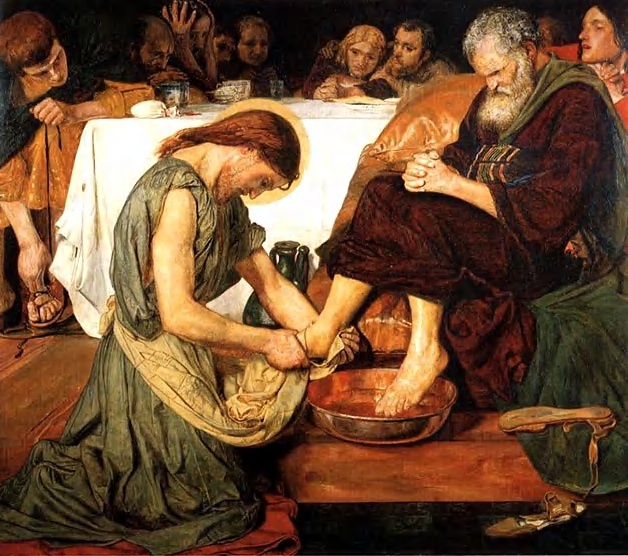
Jesus Washing Peter's Feet by Ford Maddox Brown, 1852-6.[Jesus] loved his own in the world and he loved them to the end. … So, [during the Last Supper,] he rose from supper and took off his outer garments. He took a towel and tied it around his waist. Then he poured water into a basin and began to wash the disciples’ feet and dry them with the towel around his waist. … So when he had washed their feet and put his garments back on and reclined at table again, he said to them, “Do you realize what I have done for you? You call me ‘teacher’ and ‘master,’ and rightly so, for indeed I am. If I, therefore, the master and teacher, have washed your feet, you ought to wash one another’s feet. I have given you a model to follow, so that as I have done for you, you should also do. Amen, amen, I say to you, no slave is greater than his master nor any messenger greater than the one who sent him. If you understand this, blessed are you if you do it.

—The Gospel of John, chapter 13

In 1955, Pope Pius XII inserted an optional washing of the feet rite into the Mass of Holy Thursday, the liturgy which commemorates the events of the night before Jesus died. This foot-washing rite is called the Mandatum (from the Latin for “the Mandate”) for Jesus said, “as I have done for you, you should also do.

Though the rubrics (that is, the rules for the liturgy) required no specific number of persons to have their feet washed in this optional rite, they indicated that the participants were to be men. This year, this rite which recalls Christ’s humble gesture of service and charity has been revised by a decree promulgated by Pope Francis. Where this rite is celebrated, pastors are to “select a small group of the faithful to represent the variety and the unity of each part of the people of God. Such small groups can be made up of men and women, and it is appropriate that they consist of people young and old, healthy and sick, clerics, consecrated men and women and laity.”

In past years, it has often been difficult to find people to humbly “bear their soles” on Holy Thursday but perhaps it may be a little easier this year. If you would volunteer to take a seat in this year’s washing of the feet, please contact Father so that he may create a representative group of our faithful.

Simon’s Missed Opportunity — Thursday, 24th Week in Ordinary Time—Year I

September 19, 2013

Simon the Pharisee missed his opportunity. He invited Jesus to his house, but neglected to provide him water for his feet, oil for his head, or a kiss of greeting. Maybe Simon was preoccupied and the oversight was accidental, or maybe the discourtesy was intended, but in any case Simon failed to minister to Jesus from head to toe, he missed this chance to show him love.

We, however, are offered Simon’s opportunity every day, for the members of Christ’s body are in our midst. When we serve and greet them, his high and his lowly, we are serving  and loving him. Whatever you do for one of the least brothers of his, you do for him. (Matthew 25:40)

We’re in a Hurry — 16th Sunday in Ordinary Time—Year C

July 18, 2010

The other day I was thinking about this homily when I heard the words of some modern poets on my radio. They said:

I’m in a hurry to get things done,
Oh, I rush and rush until life’s no fun.
All I really gotta do is live and die,
But, I’m in a hurry and don’t know why.

This goes to show that we still have a Martha problem today. The group Alabama said that they didn’t know why we get in a hurry, even though we’re not having fun, but I think I know the answer. The reason is that our loves and good desires are mixed with fears. If we would take that fear away, we would find peace.

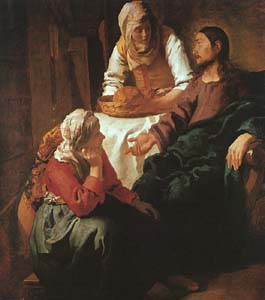
Martha loved the Lord and wanted to serve Him well, but she had fears mixed in. She was the one who invited Him to the house and He probably had His apostles and other disciples with Him. She was busy serving them all, perhaps making the biggest meal she had ever made, and she was full of worries. “What if I’m a poor host and Jesus is disappointed with me? What if there’s not enough food for everyone to eat?”

We are often the same way. We fear that our lives are on the edge of disaster if our own plans and efforts should fail. We worry about bad things happening to ourselves and the people we love. We are anxiety about how Jesus feels about us.

Martha had a great desire to do good, but Martha’s fear tempted her to do harm. Her sister, Mary, was sitting at Jesus’ feet, listening to His words. (The Greek word for disciple actually means “one who sits at the feet of.”) Martha tries to take Jesus’ disciple away from Him.

Similiar thing can happen in our live on account of fear mixed with love. A husband and father can obsess about his work, out of a love for his family and a desire to provide, but his family can be left feeling like they come second in his life. A wife and mother can be so concerned that her loved ones will be safe and happy that she tries to control everything, making her family less happy because of it. Martha’s problem and ours is not that we work–work is a part of life–but in how we go about it.

Jesus says to Martha, and to us, “Martha, Martha, you are anxious and worried about many things. There is need of only one thing.” What is this one thing we need? We need the peace of Christ. What is the peace of Christ? It is several things.

It is the awareness that God is near and guiding us. In the first reading, three heavenly visitors approach outside of Abraham’s tent. Now, the Holy Spirit dwells within our tents, Jesus is at our side, and we have a Father above. We are never left on our own.

With the peace of Christ we recognize that whatever may happen to us or those we love, it is for our good. As St. Paul observes in the second reading, even his sufferings are a cause for rejoicing for they advance the salvation of the whole Church with Christ.

With the peace of Christ we recognize that misery is not just around the corner, nor is happiness out of reach. Happiness is at head, in the knowledge that Jesus loves us, likes us, cares about us, and cares for us. Living in the peace of Christ means there is no reason for us to be unhappy.

Let us continue to do works of love for God, ourselves, and others, but let us do them always in the peace of Christ.