Archive for the ‘Stewardship’ Category

Stewardship Sunday & The Hug

September 22, 2025

25th Sunday in Ordinary Time
By Deacon Dick Kostner

Today Jesus gives to us a new parable to ponder and think about. God gives to his followers the responsibility of being the body of Christ, a visible flesh and blood team of his to carry out the 11th Commandment Jesus gave us to “love as he has loved us.” His parable story tells us that one of his stewards was cheating and was caught. He was called to account for his dealings and knowing that he would lose his job he gave gifts of his master’s assets to debtors owing the master in hopes that the debtors would give him a place to stay after he lost his job. He was in a sense providing for himself and his future.

The master, instead of condemning his actions, commended the steward for acting prudently and taking action to provide for his future welfare. Once again Jesus tells us to spend our life doing things that will gain us a place to stay with him in heaven after our earthly life ends. Things that will give us a high place in heaven and a room to be proud of at the Father’s house. The responsibility is great for all of us to be good and faithful stewards of God’s heavenly assets. But why does God ask for our help in building the Kingdom of God here on earth?

I am reminded of a story that Fr. John Heagle told our Parish during a talk on Stewardship many years ago. He is the brother of Larry Heagle the song writer of the Wood Tick Song we all enjoy listening to every spring. He told the story of attending a party at his Nieces house one evening. His Niece had a young daughter and had sent her to her upstairs room to go to bed before the party started. After the party got going, the child came downstairs and told her mother she could not get to sleep and that she was afraid. The mother took her upstairs but after the third time she came down, the mother was getting impatient with her and said, “Why are you afraid? Don’t you know that God will protect you?” The child looked at her and finally said, “I know Mama that God will protect me, but sometimes you just need to have someone with ‘skin on’ to feel safe.”

God knows that as humans we sometimes need to have someone to grab a hold of, someone with skin on to give us a hug and get us through our difficulties of life. The solution was to send his son, Jesus, a divine human being, to teach us and help us get through the crosses of life. And when Jesus went up to heaven to join the Father, Jesus gave us His Church, to be the Steward for His children who need someone to grab a hold of when the crosses of life get too heavy for us to carry it alone.

Recently I had one of our Parishioners stop to thank me while I was smoking pork roasts to serve people who work at the Pavilion. She knew that I had been praying for her to come back to our parish as her attendance at Mass has been missed by our Parish family. She said, “I just can’t believe that a Deacon, would be praying for me to come back to Church!” I told her that she was missed not only by me but by other Parish members, and that I pray for all people who have left and for one reason or another not come back to join us, to give thanks at Mass, for all the gifts we have received. She thanked me again and said, “Can I ask one more question? Can I have a hug?? I told her sure, but I probably smell like smoke.” We hugged and I told her that I hope to see her at Mass at St. Paul’s soon.

As humans, we all will encounter difficulties in life but one thing is for sure, we all need to seek help from a higher power to get through difficult times. We have all witnessed and seen how suicides have sky rocketed in the last few years. And I am sure that the Church Parishes in our world have seen a drop in church attendance especially in younger adults. People need their Church, and God, a higher power, to overcome depression. Priests continue to be in short supply for many communities. Many are saying that the answer for the priest shortage is caused by priests not being allowed to marry. If you want my opinion on that I believe that priests would not be able to take on any more responsibility than what they now have. They have more than enough people to care for without adding a spouse and children to the list of people they care for. Yes, a spouse can and is support for her husband. And yes I would miss my wife keeping me proper, like telling me I have holes in my tee-shirts or that my socks don’t match, or I am getting too “heady” with my homilies, but I also know that priests already have an army of gals in any parish they serve at, that will take care of any problems pastors run into trying to be successful in their chosen vocation. I believe that’s why God gifts women with what I call extra Holy Spirit to take care of our deficiencies.

Back to the rise in suicides. Young and old alike, my take is that cell phones and Zoom will never be able to compete with or replace a good hug from a steward mentor of Christ, in helping us get through and overcome all the challenges of life. And for that I say: “Amen!

What Must We Do?

October 13, 2024

28th Sunday in Ordinary Time
By Fr. Victor Feltes

A man runs up to Jesus, kneels down, and earnestly asks him, “What must I do to inherit eternal life?” Jesus quotes to him commandments about loving our neighbors: “You shall not kill; you shall not commit adultery; you shall not steal; you shall not bear false witness; you shall not defraud; honor your father and your mother.” Why did Jesus add “you shall not defraud” after saying “you shall not steal [and] you shall not bear false witness?” What distinction is being made? In the Greek, “steal” here denotes taking, while “defraud” suggests withholding or keeping back what belongs to another. Both the street mugger (by unjustly taking) and the business owner (by unjustly holding back) can deprive someone of what is rightfully theirs. It is possible to sin by clinging on to what we should give.

Upon hearing Jesus’ list of commandments, the man replies, “Teacher, all of these I have observed from my youth.” The man is seeking something more from Jesus. Jesus had just cited several of the Ten Commandments but notice which commandments Jesus left out. The first three commandments are conspicuously absent, the ones specifically about our relationship with God. Jesus, looking at the man and loving him, desires to reveal how he is to love the Lord. He tells him, “You are lacking in one thing. Go, sell what you have, and give to the poor and you will have treasure in heaven; then come, follow me.” But at hearing these words, the man’s face fell because he had many possessions, and he went away sad. Did that man ever go on to have a change of heart before the end? We don’t know. Matthew, Mark, and Luke all record this encounter in their Gospels but none of them mention his name. Perhaps (unlike with Jairus, Zacchaeus, or Bartimaeus) the early Christians were unfamiliar with this man because he never joined their community.

The Book of Acts describes Jerusalem’s earliest Christian community as being “of one heart and mind” and generous towards one another. “There was no needy person among them, for those who owned property or houses would sell them, bring the proceeds of the sale, and put them at the feet of the apostles, and they were distributed to each according to need.” However, that sharing was not obligatory. Christians still owned property, they were free to decide whether to sell it or not, and they were free to share the sale proceeds or not. So it is not necessarily wrong to own things, but wealth can be an obstacle to heaven.

Jesus remarked to his disciples, “How hard it is for those who have wealth to enter the Kingdom of God!” The disciples were amazed at his words, because they held the idea that having great wealth was a strong sign of God’s approval. So Jesus again said to them in reply, “Children, how hard it is to enter the Kingdom of God! It is easier for a camel to pass through the eye of a needle than for one who is rich to enter the Kingdom of God.” So who among us qualifies as rich?

Compared to our immediate neighbors, our wealth is probably pretty average. Or at least most of us have less money than the richest folks in town. But how materially wealthy are we compared to those in other countries? Compared to the world, everyone here is rich. For instance, a two person household with an annual after-tax income of $40,000 makes more than about nine-out-of-ten people on earth. Even someone who lives alone with a post-tax income of $10,000 a year makes more than eight-tenths of the world. We are rich. So what must we do?

Again, not all Christians must give away all of their wealth, but our Lord insisted upon it for that man who came to him because Jesus knew he loved his riches more than God. The things we own are not absolutely ours to do with however we please, for we and what we have belong to God. We are his trusted servants, the stewards of his goods. That is why Jesus says that anyone “who does not renounce all of his possessions cannot be my disciple.” Even when it is his will for us to have possessions, we must do so with a healthy detachment, by being frugal and generous and truly open to doing God’s will.

One of the most memorable scenes from the 1993’s Best Picture winning film “Schindler’s List” comes at the end. Oscar Schindler, a German industrialist, has protected the lives of more than 1,100 Jews during the Second World War by listing them as his “essential workers” while producing defective ammunition for the Nazis. He looks at the people he has saved and reflects: ‘If only I’d made more money. I threw away so much money, you have no idea. … I didn’t do enough. This car. Why did I keep the car? Ten people right there, ten more people. This gold pin… two more people. At least one. One more person, for this. I could have got one more person, and I didn’t.’ It is Ok to have what we need and it can be Ok to buy things we want, but someday we all will have to stand before the Lord “to whom we must render an account” of our Christian stewardship.

There is a world of needs around us, needs abroad and needs nearby, material needs and spiritual needs. Though they all have importance, our local spiritual mission has a special claim on our care. To aid the success of Christ’s mission for the salvation of souls among us, in the words of St. Paul, “Each person must give as he has decided in his heart, not reluctantly or under compulsion [but freely], for God loves a cheerful giver.” And our Lord promises rewards for our sacrifices for him. Jesus declares, “Amen, I say to you, there is no one who has given up house or brothers or sisters or mother or father or children or lands for my sake and for the sake of the Gospel who will not receive a hundred times more now in this present age… and eternal life in the age to come.” So let us be generous, for God will not be outdone in generosity.

Faithful Efforts & Divine Increase

July 27, 2024

17th Sunday of Ordinary Time
By Fr. Victor Feltes

In our first reading from the 2nd Book of Kings, the Prophet Elisha uses twenty barley loaves to feed a hundred people. That suggests a miraculous multiplication of five times. In our Gospel reading, Jesus Christ uses five loaves to feed about 5,000 men – a multiplication of 1,000 times. So Jesus’ miracle was 200 hundred times greater than Elisha’s. That 200 figure is interesting because of something Philip the Apostle says.

When Jesus asked him, “Where can we buy enough food for them to eat,” to see what he would say, Philip remarked, “200 days’ wages worth of food would not be enough for each of them to have a little!” What good could 200 days of work do for so many? One might ask what good are any of our labors or efforts in the face of such great problems in our world today?

Many days passed between the events of the 2nd Book of Kings and the events of the Gospels. Why did the Old Testament people of God have to work and wait, suffer and endure, for days and years, for generations and centuries, before the coming of Christ? Because it was not yet the fullness of time; things were not yet fully prepared for those greater wonders. Our redemption in Christ is preeminently the work of God but God wills that the faithful efforts of faithful people help prepare the way.

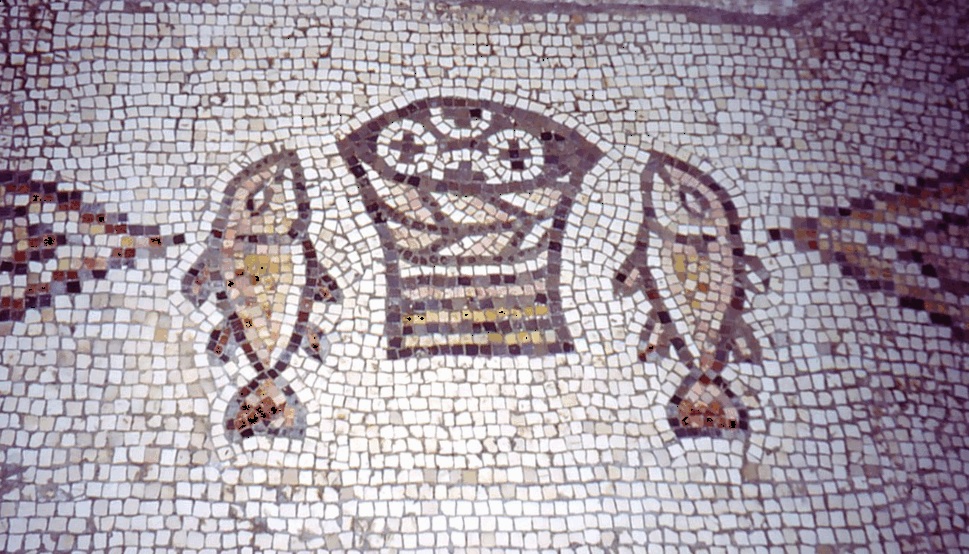
While the disciples were still wondering what to do about the problem of the hungry crowd, Andrew the Apostle told Jesus, “There is a boy here who has five barley loaves and two fish, but what good are these for so many?” Jesus would take those loaves, give thanks to God the Father, and distribute the loaves and fishes to the reclining crowd as much as they wanted, and they all ate and had their fill.

Consider this: in the beginning, all things were created through God the Son out of nothing, ex nihilo. Yet Jesus did not conjure food to feed that crowd out of nothing. Like at the Wedding Feast of Cana, he received what was offered to him and transformed it for both our good and God’s glory.

That boy and those five loaves and two fish are remembered to this day, in our Gospel stories on earth and even more gloriously in heaven. Jesus used that entire gift, he multiplied all the loaves and fishes offered, just like how at Cana he transformed the contents of all six of the large stone water jars which the servants had filled for him. And Jesus directed his disciples to “gather the fragments left over, so that nothing will be wasted,” filling a dozen wicker baskets with fragments from the five barley loaves which had been more than they could eat.

Even as Christians we may get discouraged, feel overwhelmed and wonder, “What good are any of my labors or efforts? What good is this for few or many?” Today’s Gospel reading reminds us that Jesus will use everything which we offer him. He will bless it, transform it, multiply it, grow it. He will use it for both our good and God’s glory, and nothing will be wasted. Remember that Jesus promises “whoever gives but a cup of cold water… to drink… [for me] will surely not lose his reward.” (Matthew 10:42)

Preparing for that Final Trip Back Home

November 13, 2021

33rd Sunday in Ordinary Time
By Deacon Dick Kostner

As we wind down on Cycle B our readings talk about the end of time. Our Gospel tells us that only the Father knows the exact date and time of this event but there will be warnings sent to help us prepare for the end. We know it will happen eventually but not the exact time. The point is we must prepare for the end of our earthly life.

Last month I left you with the mission to seek out wise mentors to keep you on the correct road to eternal life. I used one example I had received from one of my mentors who was preparing for his departure from this life, his name was Gabby Hassemer. I will use him again to steer us into planning for our own departure from this world. A couple of years before Gabby died he was given warnings that the end was coming. His feet and legs could not take much walking anymore, and his lungs were failing because of age. He continued to deer hunt with us but we kept an eye on him and we appointed him to stand close to our warming shack and keep the fire burning.

Deer hunting is just around the corner so I will share with you a true Gabby Hunting story. I remember one day while we were on the road to go hunting he blurted out that he was planning for his departure. Then he said: “ If I should go down while hunting promise me that you guys won’t stop hunting for the day. Just throw me in the box of your pickup until you are done for the day and then deliver me back home. I don’t want to ruin every ones day of hunting.” I started to laugh at his remark until I saw on his face that he was serious. I got rid of the smile and told him I would share his instructions with the other hunters. Gabby was planning his departure. Getting his bags packed so to speak.

As we get older we receive signs from above for us to start making travel plans. Age creeps up on us and then one day we realize that our bodies are breaking down and a red flag should go up that we need to start planning so as to have an easy transition to the next life. Let’s look also at our master mentor, Jesus. Look what he did before his death. He sat down with his friends, shared a meal and then gifted them and us with the gift of himself when he instituted the Sacraments which allow us to receive support and comfort from him as we prepare for our departure on the trip to eternity.

Several years ago our Parish was gifted to hear from a speaker from Lacrosse who talked to us about Stewardship. He told the story of how one evening he and his family went out for supper only to return to a yard full of firetrucks and people trying to put out a fire that destroyed his home and all contents including the family dog. He said it made him think about what is important in ones life which he concluded was God, family, and friends. If you think about it this is very true. Material objects we get to use during our lives and then they go to someone else to use and ultimately to help build the kingdom of God. As I reflected upon his observation I went on to conclude that God, family and friends are really talking about one entity and that is Members of the Holy Family of God. The Speaker went on to say that we need to include in our list of beneficiaries of our estate not only our blood or adopted children but also the people we have been celebrating with us and supporting us during our lifetime. We need to include those Holy Family Members who have supported us and been with us through all the struggles of life including illness and death, and who have been with us celebrating our Sunday Masses, marriages, birthday’s, and anniversaries.

It was because of two of our parishioners who died this year, that St. Paul’s is now debt free. It is because of gifts from parishioners that our Church is kept up. It is because of the wisdom and gifts of parishioners that we have a Pavilion which has been generating enough income so that our Parish Budget can stay in the Black. This folks is the Stewardship our visiting speaker was talking about.
What are ways this can happen. During your lives gifts can be given in kind or money to the Holy Family. In kind I would suggest treasures that have appreciated in value can be gifted and then sold by the Church. The result is that gross return equals net return because if you sell the asset 20%to 40% gets surrendered to pay the taxes, while if the Church sells the asset no taxes need be paid because its a charity, plus you get to deduct a charitable contribution equal to its present selling price not your cost. I did this with a collectors gun I owned. The Church acquired title and sold it and kept the proceeds with no expenses or taxes due. I received a personal deduction resulting in a savings of $9,000.00 as a reduction on my taxes by virtue of my gift.

Most of you who are 70 or older and have qualified retirement plans know that the tax laws require you to take a minimum withdrawal each year based on your life expectancy. Many don’t need the money to live on but are still required to take some out and pay taxes on it. What many do not know is that you can make your Parish contribution directly to the Parish if you are at least 70.5 years of age and not pay taxes on that contribution. The transfer must go directly from where you have the retirement account to the Church. I do this quarterly and am allowed to not pay taxes on that contribution. There is a limit of $100,000. per year that can be done but most don’t and won’t exceed that limitation. If you do this you need to let your tax person know as the 1099 that is sent to you and given to your tax person does not disclose it went directly to the Church or charity so it can be adjusted and bingo no tax due on that direct transfer. As to death transfers be sure that you give the Church assets from retirement accounts because they too will escape being taxed as the Church is exempt from paying taxes. It you give those accounts to your children they must pay tax on them.

There are many ways to make death transfers which you can discuss in detail with your lawyer or tax planner. Don’t kick the can down the road. Do as Gabby did and make financial and other plans for when you make that final trip back home. Bottom line is that you will be remembered as a quality member of the Holy Family who left the items they could not take with them to God, family and friends to use and benefit from.

Widows’ Gifts

November 6, 2021

32nd Sunday in Ordinary Time

In today’s gospel, Jesus says, “Beware of the scribes… They devour the houses of widows and, as a pretext, recite lengthy prayers. They will receive a very severe condemnation.” Jesus denounced those scribes for their greedy hypocrisy. In recent decades, some televangelists and megachurches’ prosperity preachers have told believers ‘give your money to our ministry and God will bless you back with even more,‘ and then used the meager wealth of many widows to purchase mansions or private jets. This of course, gives scandal, leading many to think faith is just a grift and alienating people from Christ. Is it wrong for preachers to be paid? St. Paul defends the right of ministers to receive compensation, “for scripture says, ‘The laborer deserves his wages,’” but our holy work is not meant to be about getting rich.

The presence of unworthy motives among some Christian ministers is nothing new. St. Paul writes to the church at Corinth, “We are not like so many others who trade on the word of God for profit.” Such men were a problem in Paul’s day, too. So it might seem that poor widows should never be asked to give and that poor widows should never donate. That answer would be simple, yet God’s truth is not that simple.

In today’s first reading, the Prophet Elijah meets the widow of Zarephath during a time of great drought. He asks her for a cup of water and a bit of bread. She replies, “There is only a handful of flour in my jar and a little oil in my jug. Just now I was collecting a couple of sticks, to go in and prepare something for myself and my son; when we have eaten it, we shall die.” (She is preparing their last meal.) But Elijah says, “Do not be afraid. Go and do as you propose. But first make me a little cake and bring it to me. Then you can prepare something for yourself and your son. For the Lord, the God of Israel, says, ‘The jar of flour shall not go empty, nor the jug of oil run dry, until the day when the Lord sends rain upon the earth.’” She left and did as Elijah had said. And the poor widow, her fatherless child, and God’s prophet were all able to eat for a year. The jar of flour did not go empty, and the jug of oil did not run dry, as the Lord had foretold through Elijah. As today’s psalm tells, “The Lord keeps faith forever… The fatherless and the widow he sustains.

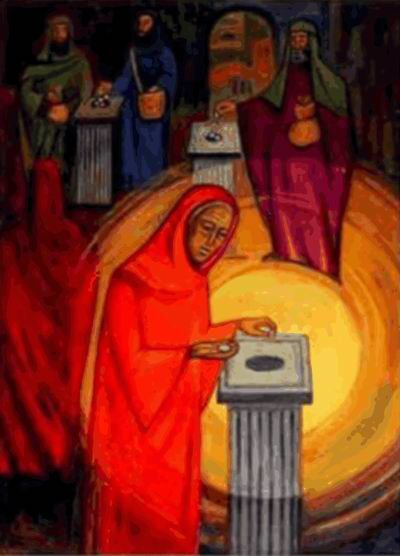
And in our gospel today, when Jesus sees a poor widow putting into the Temple treasury two small coins, which is all she has and her whole livelihood, what does he do? He does not try to stop her. He does not criticize her for being foolish. He calls his disciples to himself, he points her out to them, and he glorifies her trust in God in having given more than all the others. Her deed is still remembered to this day. Would it have been better if she had not given her gift?

I do not have a one-size-fits-all answer for how much poor widows should give. The Catechism teaches that the Church’s precept, “’You shall help to provide for the needs of the Church,’ means that the faithful are obliged to assist with the material needs of the Church, each according to his own ability,” so there’s recognition that some people have greater or lesser ability than others to materially assist the Church’s mission in this world. But if even poor widows are sometimes called to give, to trust in the Lord and give him the chance to prove himself their faithful provider, how much more so are the rest of us called to be generous?

We live in the wealthiest country in all of human history, and yet most of us only give a tiny fraction of our income to church and charity to support the good works they do. What accounts for this? Some of it is from the love of money and some of it is from fear. The Book of Ecclesiastes says, “He who loves money is never satisfied by money, and he who loves wealth is never satisfied by income.” Some are slaves to their greed, and some are shackled to their anxiety.

As an early teen, I felt reluctance at giving any money away for anything. I thought, “Who knows what my future holds? What if I need that money later? Every dollar I give away now is another dollar I’m exposed to future, unseen danger.” My mindset wasn’t informed by the Gospel, but when I finally read the Gospels myself I encountered Jesus’ teaching there. He says: “Do not worry and say, ‘What are we to eat?’ or ‘What are we to drink?’ or ‘What are we to wear?’ All these things the pagans seek. Your heavenly Father knows that you need them all. But seek first the Kingdom of God and his righteousness, and all these things will be given you besides. … Give and gifts will be given to you; a good measure, packed together, shaken down, and overflowing, will be poured into your lap.” The Lord was calling me beyond my comfort zone and into a deeper relationship with him.

I remember standing in St. Paul, Minnesota’s awe-inspiring cathedral. It was my first time there and I saw near the south exit a donation box labeled “For The Poor.” The largest bill in my wallet was a ten or a twenty, and I both wanted and very much did not want to give it, yet I knew what I should do. Once I had done it, I walked out smiling. It was a small donation, but even then I knew it was a big moment, and it changed the rest of my life.

I recall the story of one married couple. They used to pay their bills and then give to God if there was something left —and sometime there was nothing left. But God put it on their hearts to tithe consistently, so they began setting aside their gift to him first before paying their bills. And when they approached their giving in this way they discovered there was providentially always enough for both God and the bills.

God commands, “You shall not put the Lord, your God, to the test,” yet in his Old Testament Book of Malachi he says to test him in this: “Bring the whole tithe into the storehouse, that there may be food in my house. Put me to the test, says the Lord of hosts, and see if I do not open the floodgates of heaven for you, and pour down upon you blessing without measure!

And so, without embarrassment, I ask you to be generous in giving, not only so that our church may put your gifts to good use, but for the sake of deepening your personal relationship with our good and faithful God.

“The Prince” or the Christ? — 18th Sunday of Ordinary Time—Year C

August 3, 2019

In the 6th century B.C., the Romans had a king named Tarquin the Proud who declared war on a city eleven miles east of Rome called Gabii. When the king was unable to take the city by force, he plotted to take it by deception. His son, Sextus, pretending to be ill-treated by his father and bearing fresh wounds from being flogged, fled to Gabii. The infatuated inhabitants entrusted him with the command of their troops, and when he had obtained the full confidence of the citizens, he sent a messenger to his father to learn what he should do next. The king, who was walking in his garden when the messenger arrived, spoke no words, but kept striking off the heads of the tallest poppy plants with his stick. His son understood the unspoken reply, and put to death or banished on false charges all the leading men of Gabii, after which he had no difficulty in compelling the city to submit to his father.

I was reminded of this story of political power and deceitful scheming this week while listening to Niccolò Machiavelli’s 16th century Italian book, “The Prince.” In this pragmatic, cynical treatise, Machiavelli discusses how a ruler can most effectively rule his realm. For example, upon conquering another king or noble’s territories, Machiavelli recommends exterminating that ruler’s family members to prevent future revolts. Machiavelli also encourages leaders to always appear merciful, faithful, humane, sincere, and religious to appear so but not always be so, because he holds that no ruler can be successful without, at times, deliberately doing evil as circumstances require.

Machiavelli provides numerous historical illustrations, like the story of an Italian ruler whose newly acquired territory was full of corruption, robbery, and violence. He appointed a cruel and efficient man as their governor, entrusting him with full authority to act. This governor quickly restored order with his iron fist, but then his lord had less use for him and saw him as a possible threat. Machiavelli writes that the ruler, “to clear himself [of guilt] in the minds of the people and make them entirely loyal to him, … desired to show that if any cruelty had been practiced it had not originated from him but came from the personal cruelty of the governor. Under this pretense [he arrested the governor] and one morning had him killed and left in [the city square] with the block and a bloody knife at his side. This terrible sight,” writes Machiavelli, “caused the people to be at the same time satisfied and worried.”

Listening to his stories, hearing his advice, I wondered what sort of person would ever want to be such a prince or ruler. Besides the iniquity, Machiavelli himself acknowledges that the prudent leader, when not fighting wars, should constantly focus on preparing for wars. But like King Solomon asks in our first reading, ‘what profit comes to [a ruler] from all the toil and anxiety of heart with which he has labored under the sun? Even at night his mind is not at rest. This is vanity.’ And furthermore, like Jesus says, ‘What does it profit a man to gain the whole world and lose his soul?’

Machiavelli’s advice and methods for maintaining power by any means might work in one sense here in this world, but in the long term all these things are futile. The rich fool says to himself, “Now as for you, you have so many good things stored up for many years, rest, eat, drink, be merry!” But God says to him, “You fool, this night your life will be demanded of you; and the things you have prepared, to whom will they belong?” Thus will it be for all who store up treasure for themselves but are not rich in what matters to God.

Jesus once asked, “What king marching into battle would not first sit down and decide whether with 10,000 troops he can successfully oppose another king advancing upon him with 20,000 troops? But if not, while he is still far away, he will send a delegation to ask for peace terms.” That’s simply basic strategy, yet how many people march towards the inevitable end of their lives — when they will approach the all-powerful King of kings and the Lord of hosts — without consideration of how ill-prepared they are to face him?

Who and what are we loving? And are we loving them as we should?

St. Paul is often quoted from his 1st Letter to Timothy as saying, “The love of money is the root of all evils, and some people in their desire for it have strayed from the faith and have pierced themselves with many pains.” But something about this passage never made sense to me. Does the root of all evil really reside in the love of money? For instance, does every act of adultery stem from a love of money? I don’t think so. But while studying Greek in seminary I discovered that this passage can be justifiably translated a different way: “The love of money is a root of all evils,” and that is very true.

Money, wealth, is a tool, like fire. It’s a neutral thing; good when used rightly but potentially destructive and deadly when mishandled. The love of money, that is to say greed, is rightly called “idolatry” by St. Paul in our second reading, because the greedy person serves and trusts in wealth as their god, their savior and source of blessings. While urging us never to worry, our Lord does call us work, to make material provision for ourselves and our households. St. Paul taught the Thessalonians that “if anyone was unwilling to work neither should that one eat.” And on another occasion he wrote, “whoever does not provide for relatives and especially family members [of his household] has denied the faith and is worse than an unbeliever.” Yet Jesus does not wish us to make work and wealth our idol: “Take care to guard against all greed, for though one may be rich, one’s life does not consist of possessions.”

One day, perhaps sooner than we imagine, our lives will be demanded of us and all the property and possessions we leave behind will be left to others. It is a good thing for us to have a will prepared for this foreseeable event, and I would ask you to remember St. Paul’s Parish and our endowment in your estate. But as praiseworthy as it is to prepare inheritances for that day, it is not as meritorious as giving during your lifetime. How much generosity is there in giving away what you cannot possibly take with you or keep? How generous is it to give away what is no longer of any use to you? Unavoidable giving is a small sacrifice and exercises small trust in God.

And so I recommend to you the practice of tithing, to the Church and to charities. Chose some percentage to tithe to the mission of Jesus Christ in our parish, for needs in our community, and to help people far beyond. In the Old Testament, God commanded his people to tithe 10% of everything, and they were much poorer than us. I urge you to prayerfully discern a number for yourself. Giving in this way practices trusting in the Lord and allows him to show you his providence and his power to provide. Though we do not believe in a “prosperity gospel” which claims believers will never experience trials, Jesus does promise a prize for our every given gift: “Give and gifts will be given to you; a good measure, packed together, shaken down, and overflowing, will be poured into your lap. For the measure with which you measure will in return be measured out to you. … And whoever gives only a cup of cold water to one of these little ones to drink because he is a disciple—amen, I say to you, he will surely not lose his reward.”

Our short life here on earth is an audition and a training ground for life in the Kingdom of Heaven. Through his gracious, saving work, Jesus Christ has extended an invitation to everyone to become a citizen of his Kingdom, now and in the age to come. Presently here on earth, his Kingdom, the City of God and her citizens, exist alongside and amidst the City of Man with its Machiavellian-minded members. But in the coming age, there will be no place for those sinners who live for themselves, and the virtuous meek who are generous to God and their neighbor shall inherit the earth. The choice before us all is for “The Prince” or for the Christ.

History’s Ten Wealthiest People and the Vanity of Riches

July 27, 2016

In estimated billions of present-day dollars

  1. Cornelius Vanderbilt ($185, died 1877)
    This railroad tycoon’s only large philanthropic gift gave about 1% of his fortune to build Vanderbilt University.
  1. Henry Ford ($199, died 1947)
    This deceased automaker’s name survives on vehicles seen upon every road and junkyard.
  1. Muammar Gaddafi ($200, died 2011)
    This dictator of Libya, after being discovered hiding in a desert culvert, was killed by his people.
  1. Jakob Fugger “the Rich ($221, died 1525)
    While he lived, this German merchant-financier declared, “The king reigns, but the bank rules!
  1. William The Conqueror ($229, died 1087)
    After killing many to capture England, this Duke of Normandy, France joined the dead.
  1. Mir Osman Ali Khan ($230, died 1967)
    As head of the state of Hyderabad, India, he used a 185-carat diamond as a paperweight.
  1. Czar Nikolas II ($300, died 1918)
    This Russian ruler was assassinated along with his family by communist revolutionaries.
  1. Andrew Carnegie ($310, died 1919)
    This steel magnate and philanthropist said, “The man who dies rich dies disgraced.”
  1. John D. Rockefeller ($340, died 1937)
    He sold oil drawn from Ohio’s earth and now lays buried in the same.
  1. Mansa Musa I ($400, died 1337)
    This African king of Mali was the richest man to ever live. But have you ever heard of him?

Psalm 49:7-12 :

“No man can buy his own ransom, or pay a price to God for his life. The ransom of his soul is beyond him. He cannot buy life without end, nor avoid coming to the grave. He knows that wise men and fools must both perish and must leave their wealth to others. Their graves are their homes for ever, their dwelling place from age to age, though their names spread wide through the land. In his riches, man lacks wisdom; he is like the beasts that are destroyed.”


The First Principle and Foundation

July 31, 2014

Man is created to praise, reverence, and serve God our Lord, and by this means to save his soul.

And the other things on the face of the earth are created for man and that they may help him in prosecuting the end for which he is created.

From this it follows that man is to use them as much as they help him on to his end, and ought to rid himself of them so far as they hinder him as to it.

For this it is necessary to make ourselves indifferent to all created things in all that is allowed to the choice of our free will and is not prohibited to it; so that, on our part, we want not health rather than sickness, riches rather than poverty, honor rather than dishonor, long rather than short life, and so in all the rest; desiring and choosing only what is most conducive for us to the end for which we are created.

-St. Ignatius of Loyola, Spiritual Exercises #23

Giving Our Best — 11th Sunday in Ordinary Time—Year C

June 15, 2013

After the great sins of David, regarding Bathsheba and Uriah, God told King David, “I anointed you king of Israel. I rescued you from the hand of Saul. I gave you your lord’s house and your lord’s wives for your own. I gave you the house of Israel and of Judah. And if this were not enough, I could count up for you still more.” God says this to reveal the ingratitude of David and to prompt a change in the way that David lives. We’ve all been richly blessed also, therefore, we must also live properly.

All good things in life come from God: every beauty you behold with your senses, every useful possession you own, every kind person you know, every good personal characteristic you have, all of these are gifts from God to you. We are not the masters of the things we have or are. We are stewards of these gifts and our Lord is God.

Between God and us there is an immeasurable inequality, for we have received everything from him, our Creator. Our service is not about repaying to God for his loans and our debts. But God has freely chosen to associate man with the work of his grace. ‘By works of the law alone no one will be justified.’ But when we do good works out of love for Christ, by his grace working in us, Jesus rewards us.

“Do you see this woman?” Jesus asks Simon the Pharisee. From her wealth, she gave fine perfume. In her heart, she gave sad tears. From her strength, she gave humble service. From her beauty, she gave her hair soft. From her body, she gave affectionate kisses. The woman gave their best gifts to Jesus because she was forgiven and loved much. She is an example for us. Jesus Christ, who has given you the good things you have, deserves your best gifts of love. And every time you do, he will reward you for our gifts.

Después de los grandes pecados de David, con respecto a Betsabé y Urías, Dios dijo al rey David, “Yo te consagré rey de Israel y te libré de las manos de Saúl, te confié la casa de tu Señor y puse sus mujeres en tus brazos; te di poder sobre Judá e Israel, y si todo esto te parece poco, estoy dispuesto a darte todavía más.” Dios dice esto a revelar la ingratitud de David, y fomentar un cambio en la forma de como David vive. Todos hemos sido ricamente bendecidos también, por lo tanto, debemos vivir apropiadamente también.

Todas las cosas buenas de su vida vienen de Dios: cada belleza que contemplas con tus sentidos, cada posesión útil que posees, cada persona amable que conoces, cada buena característica de la persona que tienes, todos de estos son dones de Dios para ti. No somos los amos de las cosas que tenemos o somos. Somos mayordomos de estos dones y nuestro Señor es Dios.

Entre Dios y nosotros, la desigualdad no tiene medida, porque nosotros lo hemos recibido todo de Él, nuestro Creador. Nuestro servicio no es sobre pagar a Dios por sus créditos y nuestras deudas. Pero Dios ha dispuesto libremente asociar al hombre a la obra de su gracia. ‘Nadie queda justificado por el cumplimiento de la ley sólo.’ Pero cuando hacemos buenas obras por amor a Cristo, por su gracia que obrando en nosotros, Jesús nos recompensa.

“¿Ves a esta mujer?” Jesús pregunta a Simón el fariseo. De su riqueza, ella dio fina perfume. De su corazón, ella dio tristes lágrimas. De su fuerza, ella dio servicio humilde. De su belleza, ella dio su cabello suave. De su cuerpo, ella dio besos cariñosos. La mujer dio sus mejores regalos a Jesús porque ella fue perdonado y amado mucho. Ella es un ejemplo para nosotros. Jesucristo, quien nos ha dado las cosas buenas que tenemos, merece recibir nuestras mejores regalos de amor. Y, cada vez que lo hacemos, él nos recompensará nuestros dones.

‘Tis Better to Give — Tuesday After Epiphany

January 5, 2010

(The Micro Machines Aircraft Carrier – Not the Summum Bonum)

When I was a kid, in preparation for Christmas, I remember how my sisters and I would explore those big Sears and J.C. Pennies catalogues and circle the things we really wanted. I also remember the intensity of my excitement when I would open my presents to discover the toys that I had dreamed about. But over the years, I saw a pattern develop that maybe you’ve begun to start noticing for yourself.

Christmas after Christmas, I would play with all my toys, but I discovered that I would never get as much happiness from as I had imagined they would give me when they were still in their boxes. No Christmas toy ever delivered the supreme happiness I had hoped for from them. I was blessed through these experiences to learn a very valuable lesson. I learned that that getting stuff would not and could not complete me—it couldn’t make me truly happy.

Stuff won’t make you truly happy, but there are lots of people who don’t know this. Why do you think it is that TV and advertisers are always going after that “target demographic” of 18 to 34 year-olds, especially that younger segment of 18 to 24 year-olds? It’s because these consumers have significant amounts of disposable income, perhaps for the first time in their lives. And, since they do not have the wisdom of years, many of them can still be fooled into thinking that this or that product will really make them as happy as advertised.

Don’t let yourself be fooled into taking that bait. Keep in mind the words Jesus who said, “It is more blessed to give than to receive” (Acts 2:35). It’s really about giving that I want to speak to you today. There are many ways that we can give of ourselves, of our time, talent and treasure, but this morning I want to address the importance and blessedness of giving from our incredible wealth.

Now I doubt that you would describe yourself as a rich person. In terms of our society, you’re probably not. But realize, that when compared to the rest of the world, you are a very wealthy individual. Did you know that about half of the people in the world live on less than $2.50 a day?

From our great material blessedness comes the great responsibility to share. Yet, the fact that we are far richer than many other people is really beside the point. Even if we were poor compared to everyone else, Jesus would still ask us to share of what we have. For whenever we give out of love, and a desire to spread and advance God’s kingdom, we imitate Jesus Himself, who gave of Himself to us first.

Maybe you feel like you have nothing much to give. The disciples thought they had next to nothing to give too, and they were right. They had just five loaves of bread and two fishes, but Jesus said to them, ‘Give the crowd some food yourselves.’ The disciples wondered what good so little could do for so many, but in Jesus’ hands their small gifts multiplied.  Their deed first feed thousands, and then, through its retelling in the Gospel, it feed untold millions.

It would be hubris, or foolish pride, for us to think that if only we had a million dollars, a billion dollars, a trillion dollars, or any sum, that we by ourselves could save the world. Yet, when we place what little we have into Christ’s hands, giving where and when the Holy Spirit prompts us, Jesus blesses it and our deed does more good within His kingdom than we realize.

Though you never fully see all of the good your giving causes on earth, you can immediately feel some of its goodness inside yourself. Part of the blessedness of charitable giving is in the joy you feel in always knowing that you have done a good deed. When you consume something you may enjoy it for a moment, but when you give something away in love you can enjoy that act forever. If fact, when we get to heaven, we should find ourselves made the instant friends of many strangers when it is revealed to us how our lives were profoundly connected through the smallest gifts.

To help in put our faith into practice, to love our neighbors and advance the Kingdom, we are going to begin taking more regular collections at our weekly school Masses in support various causes. We will be starting by helping a number of area organizations suggested by the Student Senate. And, once our Liturgy & Campus Ministry Committee is up and running, about which Mr. Zimmerman will be speaking to you about at the end of Mass, the selection of worthy charitable causes will one of the important tasks that will fall to them.

Today our collection will be going, in its entirety, to support the Hope Lodge here in Marshfield. The Hope Lodge provides temporary accommodations for patients and their family members while they are receiving cancer treatments at the Marshfield Clinic. Please give as generously as the Holy Spirit may prompt you and know that you will certainly be blessed.

32nd Sunday in Ordinary Time—Year B

November 9, 2009

Widow's Mite

Imagine if you took two pennies and put them into a savings account, at 1.5 percent interest annually, and left it there for 2000 years. How much money would there be at the end? (2 cents, 2000 years, at 1.5% interest.) One hundred dollars?  No, higher.  A thousand dollars?  Still higher.  Ten thousand dollars?   Not even close. There would be one-hundred, seventy-one billion dollars.

[$0.02 * (1.015)^2000 = $171,046,619,000]

First of all, this reveals to us the power and the fury of compound interest.  But second, and relevant to today’s gospel, this shows us that small things can be more powerful and valuable than we would expect.

One day, almost two thousand years ago, a poor widow climbed the temple mount in Jerusalem and walked among the crowds in the temple courts to the treasury where she gave two small coins for the support of the temple.  Many rich people where there, were pouring much larger gifts into the treasury with great fanfare. Though her gift was tiny compared to theirs, that doesn’t mean that what she did was an easy thing to do. Being poor, it was hard for her, a real sacrifice.  She had to trust in the God of Israel; the God said to provide for the needs of orphans and widows like her. She could have dropped in just one coin, or given nothing at all, but she gave both coins, everything she had. She wasn’t trying to be seen, but the Lord was watching.

Jesus, sitting across from the treasury, called His disciples to Himself to draw their attention to her. “Look at what this poor widow has done.  Take this, all of you, as an image of myself.  Just as she has given everything as a gift of herself to God (even though it was hard and took great trust) so will I give myself up for you.”

The poor widow’s two coins, worth just a few cents, landed in the treasury with a quiet “tink, tink,” but her act has echoed through the centuries. Everywhere this gospel has been preached, the throughout the centuries and around the world, what she did has been remembered.  How many consciences have been pricked and how many hearts have been inspired to invest more completely into the kingdom of God? If the good her small deed has done throughout the ages could be quantified, it would far surpass one hundred, seventy-one billion dollars.

When we rise from the dead, at the general resurrection, I suspect that this poor widow will stand out.  She will be more glorious and enchantingly beautiful than most, and (even though the gospel does not give her name) everyone will know who see is and she will enjoy the love and gratitude of vast multitudes.

When we die, we will all die penniless, and when we rise we will all rise penniless, but some of us will be richer than others. The richest in heaven are those who receive and can give the greatest love, and this will depend upon how much we have invested ourselves into the kingdom of heaven.

You are already giving to your spouses and your children, your friends and your family, at home, at work, and at church, but we should ask ourselves from time to time how much we are giving from our surplus wealth and how much was are making a total gift of ourselves.  Such giving is hard, it takes trust in God, and it conforms us to Jesus Christ. When we give ourselves in this way, in the likeness of Jesus Christ, our gifts yields the greatest returns, here on earth and forever in heaven.

Now you have heard me put in my two cents.  I pray that it may result in great profit for your souls.

23rd Sunday in Ordinary Time—Year B

September 6, 2009

Remember what it was like before the dot-com bubble burst? Maybe you heard about tiny internet start-ups having total stock values in the billions and you just knew that that wouldn’t last. Remember the time before the recent housing bubble popped? I remember watching a show on TV called “Flip this House” in which a couple bought a building, put two weeks of work and a few thousand dollars into cleaning it up, and then quickly sold it for several tens of thousands of dollars more than what they bought it. I remember saying to myself then, “This just can’t go on. This isn’t sustainable.”

The thing about economic bubbles is that while you can often read the signs of the times and see that the bubble’s there, you’re never quite sure when it will pop.

For years now, our country has been riding on a similar bubble with the unsustainable spending and borrowing by the federal government. We’re not quite sure when it will finally pop, but you can see that the bubble’s there.  Most of us here will witness firsthand the consequences of its bursting.

The Congressional Budget Office is a non-partisan, independent government agency that provides economic data to Congress. And for years, regardless of whether the Democrats or Republicans were in power, the CBO has consistently reported the unfortunate facts and grim forecasts of our present course. This summer, the CBO published its “Long-Term Budget Outlook.” And they tell us, quote…

“Under current law, the federal budget is on an unsustainable path—meaning that federal debt will continue to grow much faster than the economy over the long run.

Although great uncertainty surrounds longterm fiscal projections, rising costs for health care and the aging of the U.S. population will cause federal spending to increase rapidly under any plausible scenario for current law. […]

Keeping deficits and debt from reaching levels that would cause substantial harm to the economy would require increasing revenues significantly…, decreasing projected spending sharply, or some combination of the two.”

Some or all of the following things will inevitably happen: an increased federal retirement age, decreased retirement benefits from Social Security, decreased health benefits from Medicare and/or Medicaid, increased federal taxes, or (and this seems the most likely) a dramatically increased national debt.

Now understand that an endlessly ballooning national debt is no solution.  It has economic consequences for us. What happens when foreign countries finally decide they are no longer interested in holding any more of our debt (in the form of low-interest yielding U.S. government bonds?) One result will be hyper-inflation, which will negatively impact anyone who uses U.S. Dollars. Unpleasant changes are coming. And they will have real consequences our lives. We will feel their effects.

Maybe hearing me speak about these grim realities feels as if I’ve just spit on your tongue.  It’s unpleasant and a bit repulsive. But my hope and prayer is that you will “be opened” by it, that you will be motivated to prepare yourself for what is coming, to begin living now as we should have already been living as Chrisitians all along.

In the past we have lived beyond our means, just like crowd, just like the government made in our own image. We spent more than we had and we often spent wastefully. But we are called to live differently, to live out Christian stewardship, Christian poverty, or simplicity of life in our own lives. Let’s not wait to hit economic rock bottom before we begin living as we ought to.

We are called to live simply and within our means, free from debt-slavery. We are called to be both frugal and generous, generous and frugal. If we are frugal without generosity, we’re simply being misers. If we are generous without frugality, we are being irresponsible. But if you are both frugal and generous won’t God, who (as the psalmist says) keeps faith forever, who secures justice for the oppressed, who gives food to the hungry, who supports the fatherless and the widow, won’t He provide you with what you need? On the other hand, if we are not frugal and generous, if we do not lovingly support our poor neighbors, those in our parish, throughout the diocese, and abroad, then how can we ask God to support us?

To quote St. James, “Act on this word.  If all you do is listen to it, you are deceiving yourselves.” “Fear not, be strong.” “Be not afraid,” but prepare yourself. Prepare for the days when our accounts will come due.  For a day coming soon in our country, and for the Last Day, when we shall all appear before God.