Archive for the ‘Witness’ Category

Our Holy Conspiracy & the End of the World — 33rd Sunday of Ordinary Time—Year B

November 16, 2015

C.S. Lewis, 1898-1963A new liturgical Church year will begin in a couple of weeks with the first Sunday of Advent. As this Church year ends, our Mass readings (like today’s Sunday readings) focus on the Last Things and the end of the world as we know it. This weekend’s news reports, especially the terrible events in France, remind us that though the Kingdom of God is among us, we pray “thy Kingdom come” because it is not yet fully here in total, unveiled power. This weekend’s readings and news events remind me of passages from C.S. Lewis in excellent book Mere Christianity:

“Enemy-occupied territory—that is what this world is. Christianity is the story of how the rightful king has landed, you might say landed in disguise, and is calling us all to take part in a great campaign of sabotage. When you go to church you are really listening-in to the secret wireless [radio] from our friends: that is why the enemy is so anxious to prevent us from going.”

Why does Lewis say that our king has landed “in disguise?” Well, where would you expect a king to be born? The Magi sought the newborn king of the Jews in the palace at Jerusalem, but Jesus was born in a barn—a cave in Bethlehem—to a pair of poor parents. How would one expect the Jewish Messiah to enter into Jerusalem to claim his throne? Probably riding on a warhorse, but Jesus came meekly riding on a donkey, just as had been prophesied about him. Who would have thought that God would become a man, and then suffer and die as he did? After the vindication of the resurrection, one would have thought he would appear to the high priest and Governor Pilate, or to the Emperor Tiberius in Rome, to declare that he was indeed who he claimed to be. Instead, Jesus appeared discretely, to his disciples.

Lewis writes that God has landed in this enemy-occupied world in disguise and has started “a sort of secret society” to undermine the devil. This secret society he speaks of is the Church. But what is so secret about the Church? We have a sign in front with our Mass times. We don’t check ID’s at the door. And if anyone wants to know about what we do or what we believe, we will gladly inform them. But, in a sense, the Church is a secret society—for the world and even many Catholics do not recognize who and what we really are. We are a holy conspiracy. We are fighting the propaganda of the world and the devil with the truth of God. We are recruiting others to the side of the Lord. We are his special forces sabotaging evil with the weapons of love in preparation for the king’s arrival.

From where do we receive our power for this mission? The source of our power is the Holy Mass. Today’s second reading says that the Old Testament’s priests offered many sacrifices because those  could not truly achieve their purpose, but Jesus our High Priest offers his sacrifice once for all. At Mass we transcend space and time to personally encounter that sacrifice, and it’s power is applied to us here and now, providing all the graces we need to fulfill his will.

Lewis asks, “Why is [God] not [yet] landing in [total unveiled] force, invading [our world]? Is it that He is not strong enough? Well, Christians think He is going to land in force; [but] we do not know when.”

Indeed, as Jesus says in today’s Gospel, “of that day or hour, no one knows… but only the Father.”

We do not know when the Lord is going to land in force. “But,” Lewis continues, “we can guess why He is delaying. He wants to give us the chance of joining His side freely. I do not suppose you and I would have thought much of a Frenchman [during World War II] who waited till the Allies were marching into Germany and then announced he was on our side. God will invade.”

Why has God not yet invaded our world with his full, unveiled force? Why does he allow the wicked to use their freedom for evil, like the terrorism we saw in Paris?

Lewis writes, “I wonder whether people who ask God to interfere openly and directly in our world quite realize what it will be like when He does. When that happens, it is the end of the world. When the author walks on to the stage the play is over. God is going to invade, all right: but what is the good of saying you are on His side then, when you see the whole natural universe melting away like a dream and something else—something it never entered your head to conceive—comes crashing in; something so beautiful to some of us and so terrible to others that none of us will have any choice left?”

I think “the whole natural universe melting away” is an excellent reflection on today’s gospel. Jesus tells us that at the end:

“the sun will be darkened,
and the moon will not give its light,
and the stars will be falling from the sky,
and the powers in the heavens will be shaken…”

In the ancient world, the sun and moon, stars and planets, were considered the most stable and eternal things in the cosmos (and you can understand why.) But when even these things are passing, you know the universe as we know it is melting away. After this, the Lord Jesus comes with judgment. “And then they will see ‘the Son of Man coming in the clouds’ with great power and glory… (and his angels, like St. Michael from our first reading, along with him…)”
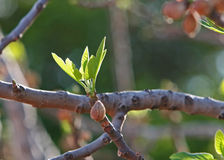
Sprouting Fig Tree in SpringtimePerhaps we may find it surprising that Jesus describes these events as a good thing to his disciples. He says:

“Learn a lesson from the fig tree. When its branch becomes tender and sprouts leaves, you know that summer is near. In the same way, when you see these things happening, know that [the Son of Man] is near, at the gates.”

We usually associate the end of things with the fall. Youth is called the springtime of life, while old age is the fall. In the Northern Hemisphere, every Church year ends in the fall. Yet Jesus presents an analogy for the end of the world as one of spring becoming summer: ‘When the tender branch sprouts leaves, you know that summer is near.’ A small thing, the branch, points to the arrival of a much greater reality, the summer. Why would we cling to the branch when the whole world is being renewed in glory? For friends of God, what is to come is better than what we see. The life we live now in this world is the winter. What is still to come for us is the spring and summer. Let us not hesitate to hope for it, envision it, and rejoice in it.

When the last day comes, “it will be God without disguise; something so overwhelming that it will strike either irresistible love or irresistible horror into every creature. It will be too late then to choose your side. … That will not be the time for choosing: it will be the time when we discover which side we really have chosen, whether we realized it before or not. Now, today, this moment, is our chance to choose the right side. God is holding back to give [people] that chance. [But it] will not last forever. We must take it or leave it.”

How long will it be until the Lord comes again? Jesus says in today’s gospel that, “This generation will not pass away until all these things have taken place.” But he said this a long time ago. Was Jesus wrong? No, for when you read these passages from Mark in full context, Jesus is responding to his disciples questions about two things side-by-side: the fall of Jerusalem and the end of the world. The Romans destroyed the great city and its temple in 70 A.D., during the lifespan of some of Jesus’ hearers, and to many Jews it felt like the end of the world. This event prefigured the passing away of all things. Like other prophesies in the Bible, Jesus’ prophesy has a near and distant fulfillment, one after a forty-year opportunity for conversion, and another at the end of time.

So when will the Lord come again? The answer for every generation before us has been “not yet.” If this world endures to the year 10,000 A.D., the Christians of that time will probably regard us as the early Christians. I personally think it will still be awhile before he comes, for it is still legal to be a Christian in too many places on earth. Yet, in a sense, it doesn’t matter when Jesus is coming, for the end of our individual lives is equivalent to the end of the world for us. If you’re ready for one, you’re ready for the other. But if you, or people that you know, are not ready for either, then now is the time for conversion.

The Lord our King has recruited us into his holy conspiracy, arming us with the weapons of truth and love. You and I are his advanced forces and, among other tasks, he is sending us on rescue missions to bring others to himself. Who do you know that is far from Christ? We are to draw on the power of this Mass for them. We are called to pray, fast, and sacrifice for them, and even to be so bold as to talk with them—inviting them to come to Jesus Christ and his Church. Seize this opportunity and do not let it pass away, for whether the Lord first comes to us or we go forth to him, each and all will encounter him soon, face-to-face, in his full, unveiled glory.

What the Scribes Did Right — 32nd Sunday of Easter—Year B

November 8, 2015

Let me open with a joke:

The pastor of a big-city parish answered his rectory door to find a man wearing a face of great anxiety and concern. “Father, there’s a local family in dire need that could really use the church’s help.” The priest invited him inside and listened to the details. “The mother is a young widow with ten kids who lost her job last month. She’s been looking for work, but they’re barely keeping food on the table. Worst of all, unless they can scrape together $300 for rent by this Friday, they’ll be evicted and thrown out into the street.” The priest replied, “That’s a terrible and difficult situation. By the way, how do you know the family?” The man wiped a tear from the corner of his eye and said, “Oh… well, I happen to be their landlord.”

Hypocrisy is the pretense of holding beliefs, standards, behaviors, or virtues that one does not truly hold. Not many good things are usually said about hypocrisy, but I can say one. Usually, hypocrisy acknowledges (however insincerely) what is really true and truly good. Even a corrupt politician speaks the truth when he or she says that government should be transparent, politicians should be honest, and campaign promises should be kept. A wedding ring is a visible sign that proclaims marriage to be a sacred and lifelong bond even on the hand of an adulterer. Hypocrisy  is the homage, the respect, that vice shows to virtue.

The Widow's MitesIn today’s gospel, Jesus talks about the scribes and a poor widow. He praises her, but criticizes them. Jesus saw her at one of the Temple’s thirteen contribution trumpets in the court of the women. These were donation chests topped as with tall road cones, but made of metal, with an opening at the top for dropping in coins. The coins of large contributions would make a large racket, like how a slot machine pays out in a casino. But the poor widow’s two coins fell in with quiet: *click* *click*

Jesus called his disciples to himself to point her out to them. (Perhaps he saw in her an image of himself, the one who trusts in God and is willing to give everything  to him.) After criticizing scribes who “devour the houses of widows” as those who “will receive a very severe condemnation,” he praises this poor widow’s gift.

Most homilies preached around the world today will be about the poor widow’s trusting generosity. (You may have noticed that our lectionary gives the option of omitting the scribes from this reading entirely, making a brief gospel reading even shorter.) But today I will be preaching about the scribes and from an angle that I would bet you’ve never heard before: what we have to learn from what the scribes were doing right.

Woe unto You Scribes and Pharisees by James Tissot

Jesus condemns the scribes for their hypocrisy, and rightly so, but at least they acted like God and true religion were the most important things in their lives. Do our acquaintances at work or school have reason to think that God comes first in our lives? If it were illegal in this country to be a Catholic Christian, would there be enough public evidence to convict you? Our words and actions should reflect our faith in Jesus and his Church.

The scribes took seats of honor in synagogues, but at least they were faithfully there each week. God commands us to keep his days holy—every Sunday and Holy Day of Obligation. He commands this because he deserves our praise and thanks, but also because he knows how much we need this.

The scribes liked to go around in long robes, but at least they dressed up in a God-honoring way. Our clothing should always be modest and dignified, but especially at church. How would you dress for your boss at work, for an meeting with the president, or an audience with the pope? How much more then should we dress well to come before God at Mass.

The scribes accepted greetings in marketplaces and places of honor at banquets, but at least they were active and known in their community. We should not be mere homebodies, but involved in our own community.

The scribes recited lengthy prayers for show, but at least they were not afraid to acknowledge God before others. Do you pray before meals at restaurants? Do you talk about Jesus or your faith with anyone? When someone shares their burdens with you, do you offer to pray with them? (Try it sometime. They will probably be more receptive than you think.) We should not be afraid.

Why did Jesus say the scribes deserved a severe condemnation? Because they focused on externals and disregarded what was within. They cared about fancy clothes, and prayers and deeds that others would notice, but did not care whether widows became destitute. It’s fine to desire friendship—it’s one of life’s great blessings—but we must desire God’s friendship more. We naturally care what others think of us—no one wants to be hated—but we should care more about what God thinks about us. The scribes were attentive to appearances, but neglected the truth and love.

After the poor widow put her coins into the treasury, the gospel says that Jesus called his disciples to himself. He summoned his followers to physically draw nearer in order to teach them and highlight her deed. But in a deeper sense, Jesus was calling them to his very self, that they would come to resemble him like the widow did. Jesus is the man of integrity whose exterior words and actions perfectly align with his inner-self. He wants all of us to be like himself. Jesus wills that our secret selves would be as noble and admirable as our public personas, and that our interior faith would be reflected through all of our external words and actions. Like the landlord in the opening joke, whether or not Jesus is welcome to dwell and live with us as he desires, increasing our likeness to his, is entirely up to us.

The Pentecost Project — Pentecost—Year C

May 18, 2013

Before Pentecost was a Christian celebration, it was an ancient Jewish observance. In the Old Covenant, in the Law of Moses, God commanded his people to bring some of the first grain harvested from their fields to Jerusalem be sacrificed as a burnt offering. This is the reason why Jews from so many distant countries were gathered in Jerusalem on this fiftieth day after Passover. Each Pentecost, the world’s first fruits were gathered and consecrated to the Lord. On one unique Pentecost, the Pentecost seven weeks after Jesus’ resurrection, Jews from every land were gathered by the Holy Spirit, and consecrated to God the Father, through Jesus Christ. By the end of Old Testament era, God had scattered the seeds of his chosen people across the world. On this Pentecost, the first fruits of his harvest are brought into his barn, the Church.

Pentecost can be seen as the beginning of the end of God’s project of salvation because we are now living in the world’s final era. And yet, Pentecost can also be seen as the start of a new divine project that will perdure forever. At the Tower of Babel, mankind endeavors to build a city reaching all the way to heaven. In other words, they attempt to become as gods while rejecting God. The Lord knows that this recurring human tendency leads to self-destruction, for both individuals and societies, so he thwarts their project by confusing their language. On Pentecost, God undoes Babel by allowing all peoples to understand the Apostles’ words, uniting and ennobling them. On this day, God begins in earnest to build up the Church, a new great city in communion with God that reaches all the way to heaven. Though heaven and earth pass away, this city of God, the Church, shall continue forever.

Why did the Holy Spirit come down in the form of fire? God the Holy Spirit, like the angels, is pure spirit and has no physical body. To be seen by human beings they must assume an appearance. Why did the Holy Spirit appear in the likeness of flames? Consider a different question: How many matches does it take to burn down a forest? The fire from just one small match is enough. As the small fire spreads, while remaining itself, it transforms everything around it. The holy fire that descended on Pentecost did not harm or destroy like natural fire would. The apostles may have been alarmed to see flames sailing towards their heads, but they were not burnt. The fire of the Holy Spirit is like the fire of the burning bush that Moses beheld in Exodus. Divine fire does not consume, but glorifies its hosts. Jesus once declared, “I have come to set the earth on fire, and how I wish it were already blazing!” (Luke 12:49) On Pentecost, a fire is lit in Jerusalem that spreads and transforms the world. This fire is the Holy Spirit at work.

All of salvation history was a preparation for Jesus Christ and Pentecost. Now we live in the last age of the world, the age of the Church, the city of God which shall last forever. Each of us is called to play an active part in this project of the Holy Spirit. On Pentecost, just as important as the gift of tongues given to the apostles was the Holy Spirit’s gift of fearless joy. Even after they had seen Jesus resurrected, the apostles timidly hid behind locked doors “for fear of the Jews.” But the reception of the Holy Spirit gave them a happy courage that allowed them to talk about Jesus in public to anyone who would listen. We have received the Holy Spirit also. Then why are we so timid? Why are we shy to introduce others to Jesus, our friend?  Why are we hesitant to welcome others to the Church, our community?  It seems that the Holy Spirit declines to act with power within us until we give him our free consent. Like he waited upon Mary’s response at the Annunciation, so the Holy Spirit awaits our invitation. Open yourself to the Holy Spirit’s will.  Ask him to give you new, powerful gifts. Give him permission to utilize you in the great project of salvation. And then, let us watch what he does through us.

Antes de Pentecostés era una fiesta cristiana, fue una celebración judía antigua. En el Antiguo Testamento, en la Ley de Moisés, Dios ordenó a su pueblo para llevar a algunos de los primeros granos cosechados de sus campos a Jerusalén ser sacrificado como ofrenda quemada. Esta es la razón Judios de muchos países lejanos se reunieron en Jerusalén en este quincuagésimo día después de la Pascua. Cada Pentecostés, las primicias del mundo se reunieron y se consagraron al Señor. Por un Pentecostés especial, siete semanas después de la resurrección de Jesús, Judios de todos los países se reunieron por el Espíritu Santo, y se consagraron a Dios Padre por medio de Jesucristo. Para el final de la época de del Antiguo Testamento, Dios había esparcido las semillas de su pueblo elegido a través del mundo. En este Pentecostés, los primeros frutos de su mies se llevan a su granero, la Iglesia.

Pentecostés se puede considerar como el comienzo del fin del proyecto de salvación de Dios porque estamos ahora viviendo en la época final del mundo. Y, sin embargo, Pentecostés se puede también ser visto como el comienzo de un nuevo divino proyecto que va a perdurar para siempre. A la Torre de Babel, la humanidad se esfuerza por construir una ciudad llegar al cielo. En otras palabras, ellos intentan convertirse en dioses mientras que rechazando a Dios. El Señor sabe que esta tendencia humana recurrente conduce a la auto-destrucción, tanto para los individuos y las sociedades. Por lo tanto, Dios frustra su proyecto a través de confundir su idioma. En Pentecostés, Dios deshace Babel a través de permitir que todos los pueblos a comprender las palabras de los apóstoles. Dios une a las gente y les ennoblece. En este día, Dios comienza en serio la edificación de la Iglesia, una nueva gran ciudad en comunión con Dios, que llega a todo el camino al cielo. Aunque el cielo y la tierra pueden pasar, esta ciudad de Dios, la Iglesia, continuará para siempre.

¿Por qué el Espíritu Santo descendió en forma de fuego? Dios el Espíritu Santo, como los ángeles, es espíritu puro y no tiene cuerpo físico. Para ser visto por los seres humanos deben asumir una apariencia. ¿Por qué el Espíritu Santo aparece en la imagen de las llamas? Considere una pregunta diferente: ¿Cuántas fósforos se necesitan para quemar un bosque? El fuego de un solo fósforo es suficiente. Como los pequeños fuego se extiende, sin dejar de ser ella misma, se transforma todo a su alrededor. El fuego sagrado que descendió en Pentecostés no dañar o destruir como el fuego natural. Los apóstoles pueden haber sentido la ansiedad a ver las llamas que vuelan hacia sus cabezas, pero no fueron quemados. El fuego del Espíritu Santo es como el fuego de la zarza ardiente que vio Moisés en Éxodo. Fuego divino no consume, pero glorifica a su moradas. Jesús una vez declaró: “Yo he venido a traer fuego sobre la tierra y ¡cuánto desearía que ya estuviera ardiendo!” (Lucas 12:49) En el día de Pentecostés, el fuego se enciende en Jerusalén, se extiende y transforma el mundo. Este fuego es el Espíritu Santo en el trabajo.

Toda la historia de la salvación fue una preparación para Cristo y Pentecostés. Ahora vivimos en la última época del mundo, la era de la Iglesia, la ciudad de Dios que durará para siempre. Cada uno de nosotros está llamado a desempeñar un papel activo en este proyecto delEspíritu Santo. En el día de Pentecostés, tan importante como el don de lenguas dadas a los apóstoles fue el don del Espíritu Santo de la alegría sin miedo. Aun después de que habían visto a Jesús resucitado, los apóstoles se escondían tímidamente detrás de puertas cerradas “por miedo de los Judios”. Sin embargo, la recepción delEspíritu Santo les dio un coraje feliz que les permitió hablar de Jesús en público a cualquier persona que escucharía. Hemos recibido el Espíritu Santo también. Entonces ¿por qué estamos tan tímido? ¿Por qué evitamos introducir a otros a Jesús, nuestro amigo? ¿Por qué estamos renuentes a dar la bienvenida a otros a nuestra Iglesia, nuestra comunidad? Parece que el Espíritu Santo se niega a actuar con el poder dentro de nosotros hasta que le demos nuestro consentimiento libre. Como él esperó a la respuesta de María en la Anunciación, del mismo modo el Espíritu Santo espera nuestra invitación. Ábrase a la voluntad delEspíritu Santo. Pídele que le dará nuevos, poderosos dones. Dará el Espíritu Santo permiso usarte más en su gran proyecto de salvación. Y luego, velemos lo que hace a través de nosotros.

Love Against Indifference — 5th Sunday of Lent—Year C

March 22, 2013

The scribes and Pharisees do not care about the woman caught in adultery. They do not care about her sin. If they actually cared about the adultery, the man she sinned with would be there too. They do not really care whether this woman gets punished or forgiven. They only want to trap Jesus. They want Jesus to say something against the Law of Moses that they can use to attack him. When it becomes clear that their scheme will not work, they leave Jesus and the woman. She has merely been their tool for a failed task.  Now she is left alone with Jesus.  Jesus neither denies the woman’s sin nor withholds his mercy. He says, “Neither do I condemn you. Go, and from now on sin no more.”

Jesus does not deny the truth. What the woman has done is wrong and it needs to end. But Jesus encounters her with love. We need to be the same way with the persons in our lives. Sharing the truth without love is repulsive. Who can embrace the truth when served with a sour taste? On the other hand, loving someone without sharing important truths is an imperfect love. We each have the duty to share the truth seasoned with love.

Like many of you, I am very happy concerning our new Holy Father. Pope Francis is a pleasant gift. He is an interesting and refreshing character who seems very holy. He comes to us from Argentina and is the first pope from Latin America, where more than forty-one percent of world’s Catholics live. One of my hopes is that Pope Francis will renew the Catholic faith there and here. Sometimes Catholicism can be widely present but not deeply held. Many claim our Faith but neglect to live lives moved by it.

I am honored to come here to celebrate Mass for few or for many and I am happy to do it. But how many people do you know that are absent from Mass? Invite them lovingly to come to the Mass here in the special weeks ahead. Next Sunday is Palm Sunday, which includes the reading of the Passion. And in two weeks is Easter Sunday, the most important of all Christian celebrations.

The scribes and Pharisees did not care about the sinning woman. Let’s be unlike them. Let us help the people in our lives with love, truth, and the invitation of Jesus Christ to the sacraments in his Church.

Broadcasting Our Faith — Thursday, 15th Week in Ordinary Time—Year I

July 14, 2011

At Easter time, my sister, Laura, and I used to watch documentaries about Christianity on TV. On the one hand, it was cool to see Jesus Christ talked about on channels like CNN and the History Channel. On the other hand, they couldn’t seem to present on the Christian faith without giving at least equal airtime to doubt. Laura and I enjoyed mocking their seemingly unrelenting skepticism:

“Jesus of Nazareth died nailed to a cross… or did He?”
“Every Easter, Christians around the world celebrate their belief that Jesus rose from the dead… or do they?”
“We’ll be right back after these words from our sponsors… or will we?”

Last night, ABC’s Nightline had an episode about the Virgin Mary and various apparition sites.  As I expected, the show both pleased me and annoyed me. I was pleased they had almost seven minutes about the shrine of Our Lady of Champion, near Green Bay—the first Church-approved Marian apparition site in our country. This was great, because the better the shrine is known the more good it shall do. On the other hand, I was annoyed by the show in various ways; for starters, by the Nightline episode’s title: “Beyond Belief.”  I was also annoyed by some of the things they included people saying.

I know that being interviewed isn’t easy. Expressing yourself like you want to can be hard, and video editing can take your words out of context, but here are some things they had people saying.  The doctor of a boy who was found to be free of leukemia the day after they visited the Green Bay shrine, was asked whether it was a miracle. He said, “The medicine did its job.… No matter what, God can’t work in the care of this child unless he works through somebody.” The narrator then referred to this metaphysical assertion, regarding what God can and can’t do, as “science.”

Later, the opinions of two, so-called experts were given. The first had written a book entitled From Jesus to Christ. (The book title was itself a red flag because it implies that the real historical Jesus of Nazareth got mythologized into the Christ of faith by later Christians. The Jesus of history and the Christ of our faith are one in the same.) She said, “When I think of the historical Mary, I think, first of all, of a very tired mom. Jesus could have been her fourth or fifth child for all we know. There’s absolutely no data in the New Testament itself to even tell us that.” (Actually, the Gospels of Matthew and Luke describe Mary as a virgin and Jesus as her firstborn Son.) A second expert said, “I’m not really big on the virgin birth as being scientifically viable.” (I wonder if he considers Jesus’ Resurrection, or any other miracle, to be scientifically viable.)

Then the show’s host, who seemed to me more ill-informed than malicious, went on to say, “After her death, early Christians hungry for information on the mother of their Messiah, began filling in Mary’s biography, with more stories like this; that she too was Immaculately Conceived, that her body was assumed to heaven like her Son’s, but the truth is that there’s no evidence to support any of these traditions.” First, he conflates the miracle of Jesus’ virgin birth with Mary’s Immaculate Conception. That’s a common error. Second, it’s just not true that there’s no evidence of Mary’s Assumption. For instance, the mere fact that Christians claim to have bones from all of the Holy Apostles, while no one at anytime anywhere has claimed to have hers, points to something. That’s not an incontrovertible proof for Mary’s Assumption, but it is some evidence for what all Christians were convinced about from the earliest times. The fact that people keep seeing her in compelling apparitions is some evidence too.

On the whole, I thought the show was a net plus; it did more good than harm, but it goes to show that we can’t rely upon the secular media to proclaim the Gospel for us. A person whose only source is secular television is not likely to come to faith. We need to step up as individuals and give witness to others about who God is and what He has done for us. As the psalmist says:

“Give thanks to the LORD, invoke his name;
make known among the nations his deeds.
Recall the wondrous deeds that he has wrought,
his signs, and the judgments he has uttered.”

Moses hesitated to speak to others about God. He said, “When I go to the children of Israel… what am I to tell them?” The Lord said, ‘Tell them, ‘I am who am.’ You shall tell them that I-Am-Who-Am sent you to them.’ Likewise, the one true God is asking you to witness to Him before others. Ask the Holy Spirit for the grace and you will soon receive the opportunity to witness to Jesus Christ and the good things He has done.

Instructions For Missionaries — Thursday, 14th Week in Ordinary Time—Year I

July 7, 2011

Today, Jesus teaches His Apostles how they are to behave as they proclaim the Gospel and do His works. Why does Jesus give them the instructions He does, and what do they mean for us?

Jesus said, “Do not take gold or silver or copper for your belts, no sack for the journey.”  He wants us to depend on God, so that we can learn that God is dependable. But if we depend on God for nothing, then how can our trust grow? The things in your life that you worry about are the places in your life where He wants you to depend on Him more.

Jesus said, “take no second tunic, nor sandals, nor walking stick.” He did not want the Apostles making long trips. They wouldn’t need gear for long-distance hikes, such as a second tunic to sleep in outside overnight. They were to witness in one small village after the next, so that, working separately for the same goal together, everyone in every place would be reached with the Gospel. Like the Apostles, your mission territory is not far away.

Jesus said, “Whatever town or village you enter, look for a worthy person in it, and stay there until you leave.” Of course a person has to stay somewhere until they leave, but a person who has been welcomed into one house could receive a tempting invitation to stay in the same town with someone “better.” We too must beware the temptation to alienate Christ’s “little ones” in order to ingratiate ourselves to others.

Jesus said, “As you enter a house, wish it peace. If the house is worthy, let your peace come upon it; if not, let your peace return to you.” Like the Apostles, we are sure to encounter people who would snub, ignore, insult, or be cold to us, but that should not rob us of our peace.

What Jesus said to the Apostles, He is saying to us as well. Let us do as He instructs us as we proclaim the Gospel and do His works.

Our Lady of Good Help Pilgrimage Homily

June 14, 2011

In the Garden of Eden, there were many fruit-bearing trees but Genesis mentions two by name: the Tree of Life, and the Tree of the Knowledge of Good and Evil. By partaking of the Tree of Life, the human race could keep living forever, but the Lord warned that to eat from the other tree would mean our certain death.

On October 9th, 1859, the Blessed Virgin Mary appeared here, to 28 year-old Belgian emigrant, named Adele Brise, as she was walking 11 miles home from Sunday Mass. Interestingly, Our Lady chose to appear to Adele not in a church setting such as this, but between two trees: a Maple tree and a Hemlock tree.

You’re all familiar with the beauty and goodness of the Maple. In the fall, its leaves turn the most striking colors; and in the spring, its sap yields sweet syrup. But do you know what distinguishes the Hemlock tree? The poison that Socrates was condemned to drink came from this plant. Ingesting just six or eight fresh Hemlock leaves can kill a healthy adult. [Post-Script: The Hemlock Tree found in Wisconsin is not poisonous, but merely shares the name.] The Maple is a tree of life, while the Hemlock is a tree of death. Mary, the New Eve, stands between the two. [Post-Script: The Hemlock Trees native to Wisconsin are a non-poisonous but share the name.]

She tells Adele, “I am the Queen of Heaven, who prays for the conversion of sinners, and I wish you to do the same. You received Holy Communion this morning, and that is well. But you must do more. Make a general confession, and offer Communion for the conversion of sinners. If they do not convert and do penance, my Son will be obliged to punish them.”

Our Lady’s message by the trees recalls the counsel of Moses, who told the Israelites: “I have set before you life and death, the blessing and the curse. Choose life, then, that you and your descendants may live, by loving the Lord, your God, heeding his voice, and holding fast to him. For that will mean life for you, a long life for you to live on the land….”

Apparently, Our Lady’s warnings were not sufficiently heeded. In October of 1871, The Great Peshtigo Fire erupted. In terms of both size and loss of human life, The Great Peshtigo Fire remains the worst recorded forest fire in North American history. Between 1,200 and 2,400 lives ended in that firestorm which saw, according to an eyewitness, “large wooden houses torn from their foundations and caught up like straws by two opposing currents of air which raised them till they came in contact with the stream of fire.” This seems to be the punishment due to sin that Mary spoke of, but this does not mean that everyone who perished in that fire was condemned. We should remember that at harvest time, the good wheat and the bad weeds are pulled up together in a moment, but their future fates are not the same. Once uprooted from the earth, the good are gathered and kept in the barn, while the bad are thrown away forever.

The Peshtigo firestorm came and surrounded this shrine, where hundreds had come with their families and herds, to beseech the intercession of Mary before God. As many as fled to her were saved. The morning of October 9th, 1871, twelve years to the day after Our Lady’s appearance, saw them delivered.  This consecrated earth was an emerald-green island in an ocean of smoldering ashes as far as eyes could see.

After witnessing this miraculous deliverance, and seeing the lifelong dedication and fruitfulness in Adele Brise’s efforts, many began to believe that she had indeed seen and heard Our Lady. Just last year, the Church formally agreed, approving the apparitions and locutions given to Adele Brise in October of 1859 as worthy of belief by the Christian faithful. Some people will think that this official recognition closes the book on the story of Our Lady of Champion. Some will come here like tourists, excited see where Mary once appeared and go home contented. They won’t think to imagine that Mary’s message was not only meant for Adele in the past, but directed toward us today

In 1859, Mary prayed for and sought the conversion of sinners. Have we gotten less sinful since then? In 1859, Mary lamented how the young did not know the faith. How much better do we live it now? In 1859, Mary warned that if people did not convert and do penance, her Son will be obliged to punish them.” Do we need to convert and do penance? Would you be surprised if a great natural or man-made disaster befell us? How spiritually well prepared do you think people would be to face that?

I don’t think it is a coincidence that the message of Our Lady of Champion is arising to new prominence in our day. Today we heard talks about Our Lady’s Fatima apparitions, which date from 1917. At that time, Mary asked for Russia to be consecrated to her Immaculate Heart to bring about its conversion and a period of peace in the world. On March 25th, 1984, Blessed John Paul the Great consecrated Russia and the whole world to the Immaculate Heart of Mary. It was on the feast of the Annunciation. On Christmas, seven years later, the miracle arrived. On the evening of December 25th, 1991, Mikhail Gorbachev peacefully resigned as the President of the Soviet Union and from atop the Kremlin, the Soviet flag was lowered forever. This was not a coincidence. Politics, economics, and the threat of nuclear war did no bring the Soviet Union to a stunning and peaceful end; it was the work of Jesus and Mary.

What moved Blessed John Paul the Great to consecrate Russia, so many years later after the apparitions, precisely when he did? What moved Bishop David Ricken to approve this apparition, so many years later, as our country’s first Marian apparition site, here and now in our day? In both cases, I suspect that there is more behind these events than the personal whims of men. I suspect that both acts are orchestrated for their role in God’s plan.

I don’t think that Mary’s message was meant for Adele alone, such that their relevance passed away with her death. I think Mary is asking similar things from us. But what exactly? Mary’s message focused upon interceding for sinners and teaching the faith.

Mary the Queen of Heaven, prays for the conversion of sinners, and she wishes you to do the same. You receive Holy Communion, and that is well. But you must do more. First, regularly receive the sacrament of reconciliation, for the sinner whose conversion you are most responsible for is you. I suggest going once a month, for it is effective for growing in holiness.

Next, in this state of grace, offer holy Communions for the conversion of sinners. At every Mass, the priest has an intention for which he is offering the sacrifice. This is a person or group that he asks to be graced, or a problem or need he asks to be helped, by this offering of Jesus’ sacrifice. At every Mass that you attend, you can also offer an intention of your own. Offer some of your holy Communions for the conversion of sinners. And, like the children of Fatima, you can offer your daily sacrifices, burdens borne or pleasures foregone to help those far from God. In doing this, you follow Jesus, who suffered what He endured in order to save others.

Mary also told Adele: “Gather the children in this wild country and teach them what they should know for salvation.” Anyone who faith is immature is still a child in the faith. You can help teach them. Mary told Adele to ‘teach children their catechism, how to sign themselves with the sign of the Cross, and how to approach the sacraments.’ For children you will do one way, for adults, another, but you have something to offer them all; your children and relatives, your coworkers and acquaintances. As Mary said, “Go and fear nothing. I will help you.”

And finally, if and when a new firestorm afflicts our land, or when personal firestorms erupt in the lives of those we love, lead them to take refuge in Jesus through Mary. Confession and holiness of life, holy offerings and penances for sinners, teaching the faith to all, and leading them all to Jesus with Mary—this was Adele’s mission, and it is our mission too.

A Man In Jesus’ Image — Divine Mercy Sunday—Year A

May 1, 2011

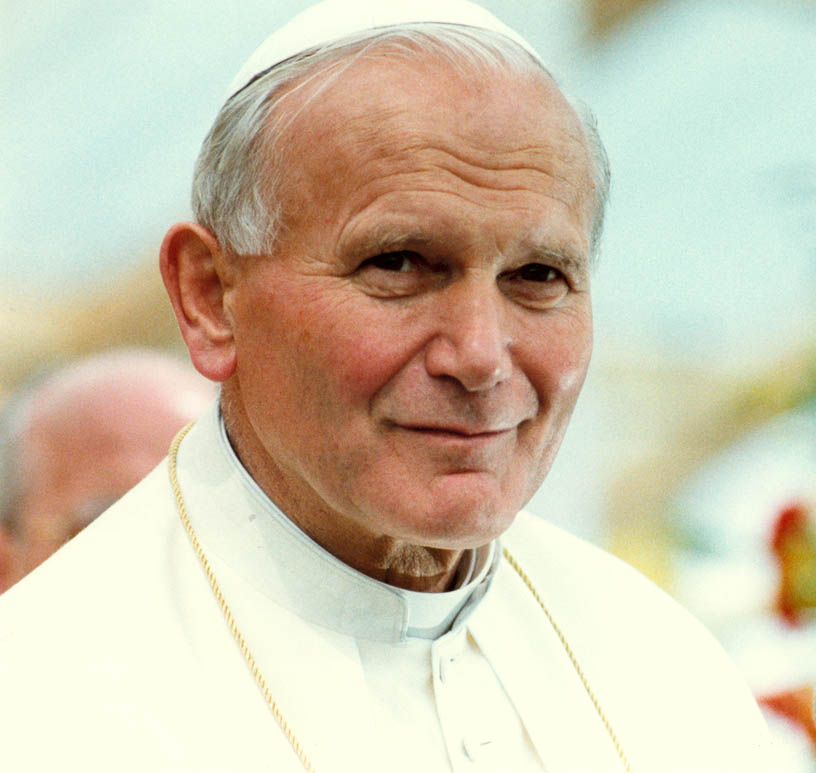
This Divine Mercy Sunday, our Catholic Church throughout the world celebrates and glorifies two men together in a special way. The first is our Savior, our Lord and our God, Jesus Christ; and the second is the great pope John Paul the Second, who is being beatified today in Rome. John Paul the Great, born Karol Wojtyla, is a man who lived in the image and likeness of Jesus Christ.

Both chose the Blessed Virgin Mary to be their mother. One chose her after the loss of his earthly mother as a boy. The other chose her from all eternity. Growing up, both of their beloved homelands were occupied and oppressed by foreign empires. For one it was the Romans. For the other it was the Nazis and then the Soviet Union. As young men, they both worked as manual laborers, in lives hidden from the world. When people encountered their ministries for the first time, many said, “Who is this man, and where does he come from?”

Both men transformed this world, not by leading violent revolutions, not by amassing incredible fortunes, but by speaking the truth, and living the truth, and leading others in doing the same for God. They preached God’s message, and their words gave hope and courage to many, but their words were not accepted by all. Both men had enemies who sought to destroy them, but they forgave, face to face, those who sought their lives.

At the end of their lives, both men were afflicted with great physical sufferings, but neither laid down their crosses. Some onlookers mocked or dismissed them in their afflictions, but those with spiritual insight beheld them to be offering a sacrifice to the Father for the salvation of the world.

St. John tells us that Jesus has done many other signs in the presence of his disciples that are not written in his Gospel. As St. John writes elsewhere, “There are many other things that Jesus did, but if these were to be described individually, I do not think the whole world would contain the books that would be written.”

Among these signs are the lives of the saints throughout the centuries, saints like Pope John Paul the Great. His life was a sign worked by Jesus Christ in our midst so that we would come to believe more deeply that Jesus is the Christ, the Son of God, and that through this belief we may have life in his name.

Why did people love Pope John Paul II so much? Catholics of every country and of all ages loved and flocked to him. Even non-Catholics and non-Christians were drawn to him. What explains this phenomenon? I think the answer is simple. People saw in him a reflection of Jesus Christ’s love for them. John Paul the Second was an icon of Christ and his love.

Every time you saw Pope John Paul, he was smiling. He traveled the nations, and embraced everyone warmly. When you encountered him, you felt loved, even if you were one person in a crowd of thousands. This was the Holy Spirit at work. Although you did not see Jesus you loved him in Pope John Paul; even though you did not see Jesus you believed in him all the more because of him, and rejoiced with an indescribable and glorious joy.

This morning we celebrate a feast day which Pope John Paul II established, Divine Mercy Sunday. What is divine mercy like? What does Jesus’ unfathomable love, which enfolds every one of us here and every person God has made, look like? Through the life of Pope John the Great we saw a partial glimpse of the divine mercy and love of Jesus Christ.

The Dons That Would Have Been

March 18, 2011

The first meeting of the Columbus Pro-Life Society produced this poster, which was hung and well-received in the school cafeteria today.

The Passion of Lent — 1st Sunday in Lent—Year A

March 14, 2011


Today Satan approaches Jesus in the desert at the end of His forty days of prayer and fasting and attempts to divert Him from the Father’s plan.   The ancient serpent employs the same tactics he used on Eve in the garden, twisting God’s words and playing on human desires. So how much did Satan know about what Jesus intended to do in the years ahead? St. Matthew suggests the Devil knew something of this, because the three temptations Satan puts to Jesus foreshadow His future Passion.

First, Satan comes and says to Jesus, “If you are the Son of God, command that these stones become loaves of bread.” Is it a coincidence that at the Last Supper Jesus will command bread to transformation into His very Self? It is as if the Devil were saying, “Why not simply give everyone bread. Why give yourself into their hands?” Jesus answers, “Man does not live on bread alone, but on every word that comes forth from the mouth of God.”

Jesus knows that a lifetime supply of bread would not save us. To live forever the Bread of Life must nourish us. Jesus is the Bread of Life. We do not live by bread alone, with whatever this world can offer, but by the Word that comes forth from the mouth of God. The Word of God is Jesus Christ.

This first temptation and Jesus’ answer point to the importance of prayer and the Eucharist. Prayer lifts our minds above having worldly thoughts alone. The Eucharist empowers our hearts to live for God. Do you pray every day? Prayer must be a top priority in Lent. Do you frequently receive Jesus in the Eucharist? In Lent, try coming to weekday Masses. Those who do so find it so powerful and precious that they often wonder how they ever used to make it a full seven days without receiving Jesus in between.

For his next temptation, Satan takes Jesus to the very top of the temple in Jerusalem. About three years later, not far from that place, the hostile Sanhedrin will gather and put Jesus on trial, questioning Him, demanding to know, ‘Are you the Son of God?’ and they’re not going to like His answer. The Devil says, “If you are the Son of God, throw yourself down.  [God’s angels will protect you.]” It is as if the Devil were saying, “Since you are a child of God He will be with you to save you no matter what, so why not do your own will and decline to give difficult witness?” But Jesus answers, “You shall not put the Lord, your God, to the test.”

You and I are also children of God and He is always with us,  but this must not lead us to presumption. We need to seek His will and give witness in the world by our words and deeds. If we sin, God always offers forgiveness, but we must take Him up on the offer. God always welcomes sinners, but we must turn to Him. To keep sinning without any words or actions of repentance is to put God to the test.

This second temptation and Jesus’ response point to the importance of confession and conversion. This Lent, turn from sin, come to confession at least once, and put some serious thought into planning how you will “sin no more and to avoid the near occasions of sin.”

For the third temptation, the Devil takes Jesus up to a very high mountain and shows him all the kingdoms of the world in their magnificence. He says, “All these I shall give to you, if you will prostrate yourself and worship me.” Jesus plans to claim His universal kingdom by climbing another mountain by Himself, Mount Calvary, and by taking his throne on the cross. (This is why Jesus tells James and John that they do not know that they are asking when they request to sit ‘one at His right hand and one at His left when He enters His kingdom and glory.’) Here it is as if the Devil were saying, “If you simply give up you won’t have to sacrifice, you won’t have to suffer. Lay down your cross and lay down before me.” But Jesus rebukes the devil, (much like he will later rebuke St. Peter for saying, ‘God forbid such a thing should ever happen to you): “Get away, Satan! The Lord, your God, shall you worship and him alone shall you serve.”

This third temptation and Jesus’ answer point to the importance spiritual sacrifices and patiently bearing our burdens. We have taken on Lenten penances, let us not give them up; and when unforeseen trials come to us, let us trust that Jesus knows what He’s doing; for it is through crosses like these that God makes us holy.

Prayer and the Eucharist, confession and conversion, spiritual sacrifices and patiently bearing our burdens. Let these things be in your response as you are tested these forty days.

Christ’s Boat — Tuesday, 6th Week in Ordinary Time—Year I

February 15, 2011

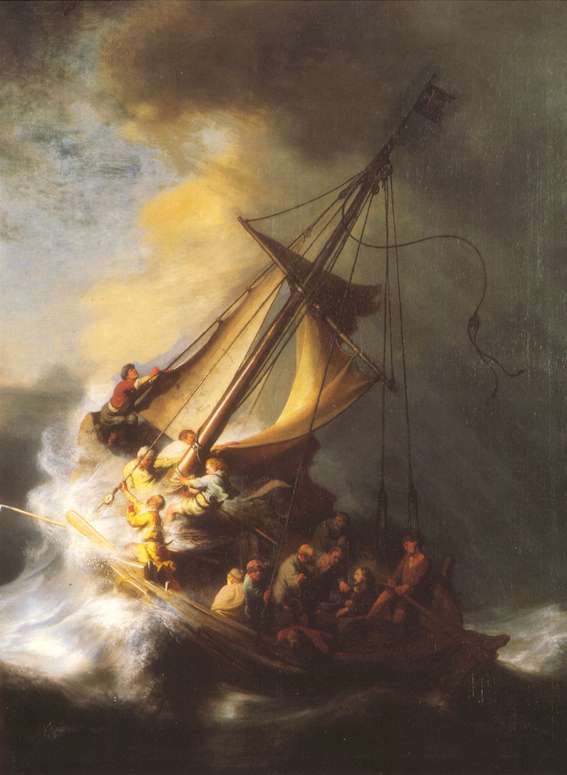
Perhaps you’ve noticed at Mass that most of our prayers are directed to God the Father. That is why you see me looking up so often. I’m looking up to our Father in Heaven as I speak to Him. From time to time, while I’m looking up, I can’t help but notice the ceiling. Take a look for yourself. It often reminds me of a boat’s wooden hull. That is really quite appropriate, because the Church is a boat and it is an important boat to be in.

The old ark was a boat built by Noah in which a few persons, eight in all, were saved through the waters of the flood. The new ark is our Church, the boat built by Christ, in which many are saved through the waters of baptism. Jesus’ boat has the cross for its mast and its sails are filled by the winds of the Holy Spirit. The Catholic Church, the bark of Peter, is the only vessel that navigates safely through the dangerous waters of this world.

As the Church Fathers frequently said, “Outside the Church there is no salvation.” But how should we understand this teaching? Restated positively it means this: that all salvation comes from Christ the Head through the Church, which is his Body. Basing Herself on Scripture and Tradition, Bride of Christ teaches that she, the Church, is necessary for salvation. As the Second Vatican Council repeated in modern times, Jesus “himself explicitly asserted the necessity of faith and Baptism, and thereby affirmed at the same time the necessity of the Church which men enter through Baptism as through a door. Hence they could not be saved who, knowing that the Catholic Church was founded as necessary by God through Christ, would refuse either to enter it or to remain in it.”

It must be noted that this teaching is not aimed at those who do not know Christ and his Church through no fault of their own. “Those who, through no fault of their own, do not know the Gospel of Christ or his Church, but who nevertheless seek God with a sincere heart, and, moved by grace, try in their actions to do His will as they know it through the dictates of their conscience – those too may achieve eternal salvation.”

“Although in ways known to Himself God can lead those who, through no fault of their own, are ignorant of the Gospel, to that faith without which it is impossible to please Him, the Church still has the obligation and also the sacred right to evangelize all men.” If we love all men, we will naturally desire to share the truth and blessings of the Church’s Gospel with everyone. Think of it this way: while it is theoretically possible for anyone to swim the English Channel, it is a far easier crossing if we take the ferry. In the same way, it is not a matter of indifference if people come into the Church or not. The journey is much safer and easier if you’re in the boat.

Remember not underestimate the importance of the Church. In the end, all those who will be saved will be saved through their relationship, known or unknown, with the one, holy, catholic and apostolic Church Jesus founded.

And do not underestimate the importance of the Mass. All the graces that flow into souls pours forth from the Catholic Church through this sacrifice we celebrate. The Mass takes the sacrifice of Calvary from then and there, through space and time, to here and now, and applies its power and effects to our world today. (What we’re doing here is a very important thing.)

And finally, do not underestimate the importance of remaining in the Church. May we never forsake it. We have to stay in the boat with Jesus Christ, because without Him, none of us can walk on water.

Sodium Chloride Reaction — 5th Sunday in Ordinary Time—Year A

February 8, 2011

Let me tell you two stories about chemicals that produced quite a reaction in me. In summers when I was a kid, I liked to go to the Osseo city pool. They had there a brown door with red letters warning something to the effect of: “Danger, Deadly Chlorine Gas, Staff Only!” I needed no further persuading. Years later, my high school science teacher put a bucket in the snow, and in the bucket he put some water, and in the water he put in a chunk of pure sodium, using tongs. The water steamed and bubbled and exploded a couple of time. It was awesome, but also rather threatening.

What do you get if you put these two dangerous elements together? You get sodium chloride. I warn you that this compound is now found in our environment and in our homes. The oceans are full of it. It’s on our city streets. It’s even in the food we eat and feed to our children. Sodium chloride sounds rather threatening, but you know this benign compound by another name: Salt.

Like salt, Christianity is pervasive, it’s everywhere. Like salt, people can fear and oppose Christianity, thinking it’s harmful for people and bad for our world. But in truth, Christianity, like salt, is necessary for life. Christians, to the extent that they are truly Christians, are the salt of the earth.

The world’s irrational fear and opposition to our faith is nothing new. Listen to this anonymous letter written to a man named Diognetus that dates from the second century. Listen for how Christians resemble the salt of the world, ubiquitous, helpful and good, and feared and opposed:

“Christians are indistinguishable from other men either by nationality, language or customs. They do not inhabit separate cities of their own, or speak a strange dialect, or follow some outlandish way of life. … With regard to dress, food and manner of life in general, they follow the customs of whatever city they happen to be living in, whether it is Greek or foreign. And yet there is something extraordinary about their lives. They live in their own countries as though they were only passing through. They play their full role as citizens, but labor under all the disabilities of aliens. Any country can be their homeland, but for them their homeland, wherever it may be, is a foreign country. Like others, they marry and have children, but they do not expose them. They share their meals, but not their wives.  They live in the flesh, but they are not governed by the desires of the flesh.

They pass their days upon earth, but they are citizens of heaven. Obedient to the laws, they yet live on a level that transcends the law. Christians love all men, but all men persecute them. Condemned because they are not understood, they are put to death, but raised to life again. They live in poverty, but enrich many; they are totally destitute, but possess an abundance of everything. They suffer dishonor, but that is their glory. They are defamed, but vindicated. A blessing is their answer to abuse, deference their response to insult. For the good they do they receive the punishment of malefactors, but even then they, rejoice, as though receiving the gift of life. They are attacked by the Jews as aliens, they are persecuted by the Greeks, yet no one can explain the reason for this hatred.

Why does the world oppose devout Christianity, now as then? One reason is that the Christian dedicates himself exclusively to Jesus Christ, in a way that worldly people think is disproportionate and dangerous. They imagine the believing Christian behaves like sodium in water, hot with intolerance and hatred, violent in their reactions. In fact, a Christian’s total commitment to Jesus Christ is what leads Him to have mercy for all and extend love toward all. Who is more responsible for ‘sharing bread with the hungry, sheltering the oppressed and the homeless, and clothing the naked’ in history of the world than Christians in general and the Catholic Church in particular?

Another reason why the world hates Christianity is that worldly people think it lethal to the joys of life. Like inhaling chlorine gas, they fear that Christianity stands to afixiate their happiness. This too is nothing new. In Roman times Christians were charged with “hatred of humanity” for it was thought, “whoever loves man will love what man loves.” As the writer to Diognetus observed in the second century, “The world hates the Christians, not because they have done it any wrong, but because [Chritians] are opposed to its enjoyments.” It is still so today. It is as Jesus said: He calls us the light of the world, and elsewhere notes, “Everyone who does wicked things hates the light and does not come toward the light, so that his works might not be exposed.” We tell the world that some things that it loves are false roads to happiness, and it hates us for it.

So what are we to do? First, realize that the modern world’s hostility to Christianity is nothing new. Don’t wait for the world’s hostility to pass, it won’t. And don’t think your faith is a shameful thing, it’s not. Instead, do as Jesus teaches, “your light must shine before others, that they may see your good deeds and glorify your heavenly Father.” If you are a Christian, people who know you should see something different in you and ask, “What’s your secret.” And when they do you should say, “It’s because of my relationship to Jesus Christ and His Church.” Pray for this grace. Pray that you may be a witness to Christ in both your words and deeds. Then, as the psalmist said, you will be “a light in darkness” and you will help to save many souls in the world.

History Ryhmes — Solemnity of Christ the King—Year C

December 22, 2010

As Mark Twain said, “History doesn’t repeat itself, but it does rhyme.” Throughout the story of our salvation, we see history rhyming time and again.

In the beginning, when God created the first man He saw that it would be good for him to have a partner, a mate, a bride. So the Lord put the man into a deep sleep, removed his rib (perhaps because it was the bone closest to his heart,) and fashioned from it the first woman. When Adam awoke and saw, he happily exclaimed, “This one, at last, is bone of my bones and flesh of my flesh!” In our first reading today, the people of Israel come to David and declare, “Here we are, your bone and your flesh. [Be our king!]” Here we see God’s people, Israel the bride, coming in joy to greet her husband, the king.

In days past, Saul had been Israel’s king, the one anointed by God’s prophet Samuel. But as time passed, King Saul became proud and loved himself to the contempt of God. After many transgressions, Samuel announced to Saul God’s judgment, “The Lord has torn the kingdom of Israel from you this day, and has given it to a neighbor of yours, who is better than you.” Saul rightly guessed that his replacement would be the young man, David, and he set about to have him killed. When David wisely fled for his life, Saul gathered a posse to hunt him down.

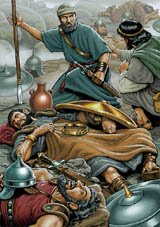
One night, David and his right-hand man, Abishai, snuck into the camp of Saul and his men. They came right up to where Saul laid, but the men “remained asleep, because the Lord had put them into a deep slumber.” Abishai begged in hushed tones, “Let me nail him to the ground with one thrust of the spear; I will not need a second thrust!” David replied, “the Lord forbid that I touch his anointed!” David would not thrusting a spear through the side of God’s anointed. Instead, David took the spear and water jug which lay at Saul’s head and went to a remote hilltop. From there, David cried out: “Why does my lord pursue his servant? What have I done? What evil do I plan? [I could have killed you!] Here is the king’s spear! Let an attendant come over to get it!” After that Saul acknowledged that he had betrayed David’s innocent blood and went away. Later, Saul committed suicide in a battle lost to the Philistines and God’s people came to David to ask him to be their king. David had refused to take the kingship by force, and God graciously bestowed the kingdom upon him.

About 1,000 years later, another Christ or Messiah came, the true Anointed One of God. Like David, Jesus also refused to slay his opponents and take His kingdom by force. This confused and disturbed many who believed in Him. Some speculate that Judas betrayed Jesus into the hands of the Jewish leaders so that Jesus, His back pinned to the wall, would be forced to show his power. When Judas realized that he had betrayed innocent blood he did not seek out Jesus’ forgiveness, but despaired and killed himself.

As Jesus hung on His cross, making it the new tree of life, He was the New Adam, naked without shame. Jesus was surrounded there by all sorts of people. Some of them where disciples who had believed in Him, but they stood there fearful of their allegiance becoming known. Scribes, Pharisees, and religious rulers stood there who should have acknowledged Jesus as their Christ, but they disregarded His words. The Roman soldiers there were doing their duty, and perhaps didn’t feel much about Jesus one way or the other. However, one person there on Calvary was unafraid to speak out in truth and faith. He was a condemned man crucified beside Jesus. This man said, “We have been condemned justly… but this man has done nothing criminal. Jesus, remember me when you come into your kingdom.” Jesus replied to him, “Amen, I say to you, today you will be with me in Paradise.” We call this man “the good thief,” and indeed he was, for in the last hours of his life he managed to steal Heaven.

What would we have done if we had been there? What sort of witness would we have given? It is impossible for us to go back to that time—history doesn’t repeat itself, yet our present does rhyme with the past. A senior at Columbus recently told me that he always tries to get other students to come to Mr. Kitzhaber’s youth events because, in his words, “they’re really fun!” But most students decline, replying “that’s a Jesus thing.” Are we ashamed or afraid to be identified as Christ’s followers? How many people today are like the scribes and Pharisees of the past by ignoring Christ teachings as they are taught through his bride, the Church? And how many Catholics fulfill their duty, by saying their prayers and going to Mass, but do it without much joy? What would we make of a bride who appeared indifferent and bored with her groom on their wedding day?

History doesn’t repeat itself, but salvation history does rhyme. In our day, will we resemble the timid disciples, Jesus’ religious opponents, the indifferent guards, or the faithful and courageous, good thief? Without fear, let acknowledge Jesus as our God. With obedience, let us heed the words our King speaks to us through His Church. With joy, let us approach Christ as our Bridegroom, like a bride on her wedding day.

Close At Hand — 3rd Sunday of Advent—Year A

December 14, 2010

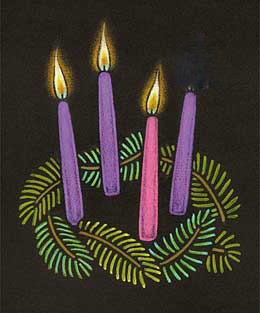
Today, the third Sunday of Advent, we light the pink or rose-colored candle because today is Gaudete Sunday. “Gaudete” means “rejoice” in Latin and we hear this call in the opening antiphon: “Rejoice in the Lord always; again I say, rejoice! The Lord is near.” Now that we are about halfway through this purple, penitential season, the Church is reminding us that Advent is also a time for joy. Though we await Him, “the Lord is near.”

This Guadete Sunday, we have extra cause for joy. As you may have heard, this week, a shrine in Champion, Wisconsin, 10 miles northeast of Green Bay, is now our country’s first Church-approved Marian apparition site. On the Feast of the Immaculate Conception, this happy news was announced by Bishop David Ricken of Green Bay:

“I declare with moral certainty and in accord with the norms of the Church that the events, apparitions and locutions given to Adele Brise in October of 1859 do exhibit the substance of supernatural character, and I do hereby approve these apparitions as worthy of belief (although not obligatory) by the Christian faithful.”

151 years ago, a lady clothed in dazzling white, with a yellow sash around her waist and a crown of stars around her head appeared to a 28-year-old lay woman named Adele. Adele asked the lady who she was and what she wanted, and the lady answered, “I am the Queen of Heaven who prays for the conversion of sinners, and I wish you to do the same. You received Holy Communion this morning and that is well. But you must do more. Make a general confession and offer Communion for the conversion of sinners… Gather the children in this wild country and teach them what they should know for salvation….”

That was the core of Mary’s message: the need for sinners to be converted and for children to be taught the faith. But Adele hesitated, and asked Mary how she was to teach the young when she knew so little herself. Mary replied, “Teach them their catechism, how to sign themselves with the sign of the Cross, and how to approach the sacraments; that is what I wish you to do. Go and fear nothing, I will help you.” After that encounter, Adele’s father built a small chapel on the site and Adele went about fulfilling her mission from Mary for the rest of her life.

The Bride of Christ, the Church, teaches that parents are the primary educators of their children. This means that even if your children go to Catholic or public school, you are their first and foremost teacher in the important lessons of life. But how often do our parents talk to their children about Jesus or Mary, or teach their children about what they should know for salvation? I suspect that many parents are intimidated because, like Adele Brise, they feel like they know too little. But Mary reassures us that we can all teach our children simple but important lessons in the faith that will remain with them and bless them forever.

Like Mary said, teach them the sign of the cross and how to approach the sacraments. At Mass, whisper in their ears, “Look, Father is holding up Jesus,” and on the way home in the car, ask them what they learned from the homily. Have interesting conversations with your children about the faith. Ask them, for example, if they think that Jesus likes sports, ask them what they think Mary’s favorite prayer is, or ask them what they think Heaven is like, and then share your answers with each other. And, perhaps most importantly, teach your children how to pray, by praying with them daily.

Though you know enough already to teach your children a great deal, you must always keep learning yourself. As your children mature in age, you must also mature in your understanding of the faith. Explore why we as Catholics do what we do, and learn why the Bride of Christ, our Mother, teaches as she does. For example, why do we make the sign of the cross? We do it at the open and close of our prayers and you’ve done it since you were little, but now consider more deeply what it means.

Its words and gestures encapsulate our faith’s most central mysteries. It confesses the Trinity and trances our redemption through the cross of Jesus Christ. We pray not “in the names,” but the “in the name of the Father, and of the Son, and of the Holy Spirit,” for God is three persons who are one in nature. [†] From the Father descends the Son, and the Holy Spirit proceeds from the love between them. Tracing the cross on ourselves, [†] we recall how the Father sent the Son to save us, and how the Holy Spirit now acts through our lives with power.

To pray this prayer, for it is a prayer, calls upon God to be powerfully with us. It is to say: “Father, Son and Holy Spirit, I ask you to be near me, here and now.” In the face of temptation or evil, this sign declares, “I belong to neither to the Devil nor the world, I belong to Jesus Christ.” So much is contained in this simple prayer and gesture. It can be taught to a child, yet meditated upon for a lifetime. And this is just one element of our faith. There is always more to explore.

Let us rejoice today, for the apparition of Our Lady of Champion reminds us, that even in Wisconsin, the Lord is near,  and [†] we can call upon Him at any time. Let us teach the faith to our children, so that they will remain near to Him and call upon His name.

Let Advent Be Advent — 2nd Sunday of Advent—Year A

December 5, 2010

John the Baptist was living quite differently compared to people in his day. What he wore was different, what he ate was different, and what came from his lips was also different. Yet, John shared something in common with us today. Like Christians in this season of Advent, John knew that the Christ, or Messiah, had already been born, years before in the past. Like us, what John was preparing for was the coming of Christ anew.

That’s the reason why in Advent, in this season of awaiting the Messiah’s arrival, John the Baptist is so prominently featured in our Sunday Gospel readings, like today’s. By looking at John we can learn how to prepare ourselves for Christ’s arrival. As I mentioned before, John was rather different from his neighbors in his day. Today I suggest that we in the Church need to be a bit more different from everybody else if we want to prepare better for Christ’s coming this year.

What did John do with all that time alone in the desert, when he wasn’t out preaching or baptizing? Surely, John was praying, asking for grace and contemplating the one who was coming. The desert is a quiet place, free of distractions, and conducive to prayer. The world can make this month before Christmas a very stressful time. This Advent, you must find a desert, a quiet place, free from distractions, where you can pray each day. Create a daily desert space for your own family as well and prayer together as one. You cannot prepare well for Christ’s coming without daily prayer and the peace it gives.

What did John eat in the desert? He ate locusts, or grasshoppers, and wild honey. The wild honey may sound pretty sweet, until you realize that it was guarded by wild bees. John ate simply. Our meals in Advent should be simple too. You know how it is at Easter, when you enjoy what you gave up for Lent again for the first time? You find yourself enjoying what you denied yourself more than ever before. Then just think of how much greater your Christmas feasting will be if you eat more simply in Advent. (Besides, if you fast or diet now, there will less pounds to lose next year.)

John dressed differently than other people in his day. He wore a garment made of camel’s hair and tied a leather belt around his waist. He dressed like the Old Testament prophet Elijah because he wanted people to know that these were special days. You can also dress in ways that witness to the world that these are special days. One way to do this is to dress liturgically. As you can see, the main color of Advent is purple. If you have purple outfits or ties, now is their season.

By the way, this Wednesday, December 8th, is a holy day of obligation and Christ is asking you to attend the worldwide feast in honor of His immaculately conceived mother. On such a day, intentionally wearing blue or white would honor her. Try dressing liturgically and you’ll find that it reminds you and others of what makes these days special.

What came from the lips of John was different, and despite the large crowds, whatever he spoke was not for himself but for Christ. This year, wish people “merry Christmas” instead of “seasons greetings,” and instead of “happy holidays,” say “happy holy days,” for by this you give witness to the true reason for the season.

John knew that he must decrease and that Christ must increase, for John himself was not the light but had come to give testimony to the light. In the world, the Christmas songs have already begun on the radio and the Christmas trees are all up and lit in the malls, but the day after Christmas their songs will stop and their decorations will be taken down. But as the world is packing Christ away for another year, the Church is just beginning its celebration. You know the “twelve days of Christmas?” On Christmas day, the twelve day begin, not end. Like Easter, the Church celebrates not just one day, but for weeks after.

This year, let Advent be Advent, and save Christmas for Christmas. Sing Advent songs for Advent, and (as much as possible) save Christmas carols for their time. I suggest leaving your Christmas lights, on your tree and on your house, unlit during Advent. Then, when you plug-in at last on Christmas Eve, you shall enjoy a joyful sign that the light of the world has come.

St. John the Baptist calls to you through the Scriptures. I encourage you here, before you. And I hope the Holy Spirit is now prompting you, in your hearts and minds, to keep Advent as Advent this year, and to prayerfully prepare for the coming of Christ at Christmas more profoundly than you ever have before.