Archive for the ‘Witness’ Category

Laodicean Christians — Tuesday, 33rd Week in Ordinary Time—Year II

November 16, 2010

The Christians of Laodicea lived in what is now southwestern Turkey. Today, their city is merely ruins, but in those days it was a modern, rich, commercial center of banking, industry, and entertainment. The Christians there were well-off and contented, but Jesus knew them and their city well and he was not content with them. In the Book of Revelation He rebukes them, “You say, ‘I am rich and affluent and have no need of anything,’ and yet do not realize that you are wretched, pitiable, poor, blind, and naked.”

A few decades before, in 60 AD, an earthquake ravaged their city and the Roman emperor offered to send them money to aid in their recovery, but within a year, the wealthy Laodiceans had finished rebuilding using only their own resources. To a people too rich and proud to accept a king’s aid, Jesus says, ‘I advise you to buy from me gold, (good works) refined by fire, so that you may be (truly) rich.’

Laodicea was home to the Marshfield Clinic of its day in the field of eye medicine. There they produced of an ointment for the eye which was used throughout the Roman empire. But Jesus urges the Chrisitians, ‘buy (true) ointment to smear on your eyes so that you may see (the truth).’

Laodicea was also known for its fine, soft, black cloth, made from the wool of the region’s excellent dark sheep. But Jesus sees the Christians’ immorality and warns, ‘put on white garments, so that your shameful nakedness may not be exposed.’

Laodicea had an aqueduct which carried water to the city from hot springs some five miles away, but by the time this water would get to them, it would be merely lukewarm; neither cold enough to cool in hot weather, nor hot enough to warm-up in cold weather. Jesus likens the Laodicean Christians to their water supply. “I know that you are neither cold nor hot. I wish you were either cold or hot. So, because you are lukewarm, neither hot nor cold, I will spit you out of my mouth.”

Jesus Christ, being divine, knows the Christians of Laodicea perfectly well. By their values, words, and actions, He sees them living not much different than any other Laodiceans. And because He loves them, he corrects them, and warns them that they need to repent and to start getting serious about living true, Christian lives.

Do we live in a Christian nation? Compared to the secularized countries of Europe, or to the Asian or African countries where Christianity is the minority religion, the United States is a very Christian nation. On the other hand, only about one in four Americans went to Church last weekend. [source] Only one in four Americans offered up an hour to God, to thank Him, worship Him, and to fulfill the commandment, “You shall keep holy the Lord’s day.” Of course, being a Christian is about more than just going to Church, but this gives us some indication of our society’s commitment to Christ.

To think of our country as a Christian nation at a 25% level, or to a 25% degree, is both discouraging and encouraging. It is discouraging that our devotion is not greater, but there is encouragement to be found in this: if our society’s half-hearted, or even quarter-hearted commitment to Christ and His Gospel can do as much good as we see now, imagine what things would be like if we were whole-heartedly His disciples.

As G.K. Chesterton said, “Christianity has not been tried and found wanting; it has been found difficult and not tried.” The Gospel is supposed to be radical. It’s supposed to change the world. If there is nothing very counter-cultural about your life as a Christian, then you are not yet living out the Gospel like Christ calls you to do. If you are living the same way as everyone else in our present-day Laodicea, then Jesus Christ’s wake-up call from the Book of Revelation through the centuries is addressed to you.

Jesus is looking for people who will go out on a limb for Him, people like Zacchaeus, people who will risk the mockery and judgment of others, people who would give half of their possessions to the poor if that is what Christ wills, people who will rise and open the door for Christ when they hear Him knocking. Jesus is looking for disciples who seek the riches of being a true and whole-hearted Christian. With a person like that, Jesus can change the world.

Go to church every weekend, pray every day, and do not merely learn about our faith but act on it in your life. Jesus Christ pleads to you, through me and your teachers who have witnessed their faith to you, please: go out on the limb for Him.

The Sorrowful Mysteries, Meditations on Vocation with the Saints

October 29, 2010

The 1st Sorrowful Mystery:
The Agony in the Garden

Years before Jesus agonized in the Garden of Gethsemane, the Blessed Virgin Mary had an agony of her own, when the Archangel Gabriel came to announce to her that she would bear the Son of God. Mary was “greatly troubled,” and the angel sought to reassure her “Do not be afraid, Mary….” Even after the plan was presented to her, she must have been full of questions about her future, like “What will Joseph and my parents think?” But Mary answered, “Behold, I am the handmaid of the Lord. May it be done to me according to your word,” and because she said that, Jesus could say years later, “Father… not my will but yours be done.”

God has a plan for every life, and a calling, a “vocation,” meant for them. Accepting God’s plan for our lives can take great, trusting courage, but answering “Yes” to Him will do more good than we know. Let us pray for the grace, trust, and courage to say “Yes” to our own God-given callings.

The 2nd Sorrowful Mystery:
The Scourging at the Pillar

Father Damien went to the Hawaiian island of Molokai to minister the spiritual and bodily needs of lepers exiled there. Last year, in 2009, Father Damien was canonized a saint. But in 1889, six months after his death, the following letter was published in a Protestant Christian newspaper:

Dear Brother,

In answer to your inquires about Father Damien, I can only reply that we who knew the man are surprised at the extravagant newspaper laudations, as if he was a most saintly philanthropist. The simple truth is, he was a coarse, dirty man, headstrong and bigoted. He was not sent to Molokai, but went there without orders; did not stay at the leper settlement (before he became one himself), but circulated freely over the whole island (less than half the island is devoted to the lepers), and he came often to Honolulu. He had no hand in the reforms and improvements inaugurated, which were the work of our Board of Health, as occasion required and means were provided. He was not a pure man in his relations with women, and the leprosy of which he died should be attributed to his vices and carelessness. Other have done much for the lepers, our own ministers, the government physicians, and so forth, but never with the Catholic idea of meriting eternal life.

– Yours, etc., “C. M. Hyde”

Hyde’s comments are noted today only because they were so exquisitely answered in an open letter by Robert Louis Stevenson, the author of Treasure Island (1883) and The Strange Case of Dr. Jekyll and Mr. Hyde (1886). Stevenson quite rightly wrote, “[If the world will] at all remember you, on the day when Damien of Molokai shall be named a Saint, it will be in virtue of one work: your letter to the Reverend H. B. Gage.” The whole reply, assessing Damien and rebuking Hyde, is worth your reading, but I will give you the closing words: “[Father Damien] is my father… and the father of all who love goodness; and he was your father too, if God had given you grace to see it.”

In yesterday’s gospel, Jesus asked, “Do you think that I have come to establish peace on the earth? No, I tell you, but rather division.” This is because when someone set about to do God’s will, the world, which opposes God, will attack that person. Criticisms will land on the just man like lashes on the back. Jesus said, “Woe to you when all speak well of you,” for ‘the world loves its own.’ If there is nothing very counter-cultural about your life, then you are not yet living out the Gospel as Christ calls you to do. Let us pray for the grace to be faithful to the Gospel, even at personal cost.

The 3rd Sorrowful Mystery:
The Crowning with Thorns

Once, when St. Maximillian Kolbe was a boy, his behavior began trying his mother’s patience. She said in exasperation, “Maximillian, what will become of you?” As St. Maximillian writes, “Later, that night, I asked the Mother of God what was to become of me. Then she came to me holding two crowns, one white, the other red. She asked me if I was willing to accept either of these crowns. The white one meant that I should persevere in purity, and the red that I should become a martyr. I said that I would accept them both.” How bold of him to imagine, and how bolder still to ask, that he might receive them both. St. Maximillian would receive both crowns, as a holy Franciscan brother, and as a victim of the Nazis at Auschwitz, where he took the place of another innocent man who was condemned to die.

At yesterday’s Mass you heard that God, by His power, “is able to accomplish far more than all we ask or imagine.” Yet we will receive little if we are too timid to imagine or ask much of Him. Let us pray for the grace to imagine and ask to be crowned by Christ with a life with far greater than whatever we would merely drift into on our own.

The 4th Sorrowful Mystery:
The Carrying of the Cross

In 1961, Gianna Molla was expecting another child. During her second month of pregnancy, a tumor developed in her uterus. She could have chosen to have her uterus removed—preserving her own life, but resulting in her baby’s death.  Instead, she chose to try having the tumor surgery removed. After the operation, complications continued throughout her pregnancy. Gianna told her family, “This time it will be a difficult delivery, and they may have to save one or the other—I want them to save my baby.” On Good Friday, 1962, Gianna gave birth to her daughter, Gianna Emanuela, but it was too late for the mother. St. Gianna Molla died one week later.

Naturally, we all hate to suffering, but if you were to ask St. Gianna Molla what was the greatest thing she ever did, the thing she least regrets and of which she is most proud, I bet she point to this final trial, carrying the cross for the life of her child. I suspect, that on the other side of death, we shall see how much good an offered suffering can do, and we will regret not having offered more. We should ask ourselves, would I rather live a great life, or merely an easy one. Let us pray for the grace to be a lasting blessing to others though the crosses that come our way.

The 5th Sorrowful Mystery:
The Crucifixion

We think of Mexico as one of the most Catholic countries there are, but in 1920’s, it was illegal to celebrate Mass there.  That did not stop priests like Blessed Miguel Pro, S.J. from sneaking about to minister to people in their homes.  After many close calls, Fr. Pro was captured by police and condemned to death on false charges that he was somehow connected to a bombing assassination plot.

When he was led out for his execution by firing squad, Fr. Pro be blessed the soldiers, knelt and quietly prayed for a time. Declining a blindfold, he faced his executioners with a crucifix in one hand and a rosary in the other and held his arms out in imitation of the crucified Christ and shouted, “May God have mercy on you! May God bless you! Lord, you know that I am innocent! With all my heart I forgive my enemies!” Just before the firing squad was ordered to shoot, he proclaimed, “Viva Cristo Rey!” (“Long live Christ the King!”) When the first shots failed to kill him, a soldier shot him point-blank. The government had a photographer on hand, capturing these moments for propaganda purposes, but soon after the images were published their possession was made illegal—a Catholic priest dying faithfully and bravely was an inspiration giving new life to a people oppressed.

At the end of the Rosary we pray, “O God… grant, we beseech Thee, that, meditating upon these mysteries of the Most Holy Rosary of the Blessed Virgin Mary, we may imitate what they contain and obtain what they promise through the same Christ Our Lord. Amen.” If we are faithful to Christ, the mysteries of His life we be made manifest in our own. And if we are faithful to Christ, we will receive a glory similar to His own. Let us pray for the grace to live extraordinary lives in the likeness of Jesus Christ.

Be Catholic Americans — 23rd Sunday in Ordinary Time—Year C

September 5, 2010

I would like to begin by posing you a little riddle. Let’s see if you can get it:

What human possession do people always carry with them? Another clue: while we tend to hold on to these things dearly, we are also willing to share them with others, sometimes without them even asking. And the final clue: these things are something that we can always make more of, even out of thin air, if we want to.

The human possession I’m thinking of… is our own opinions. We always carry them with us. We tend to hold them dearly and share them with others, and we can form them out of nothing. Human opinions are abundant, but wisdom is scarce.

As our first reading reminds us, ‘rarely do human beings guess the things on earth; and what is within our intellectual grasp we only find with difficulty.’ The Book of Wisdom observes, ‘Who has ever known God’s counsel except when God has given the wisdom and sent His Holy Spirit from on high? Only in this way, with the help of God, are the paths of those on earth made straight.’

Whenever I stand here before you, I pray that I may never preach to you what is merely my own opinion. If I do that, I will do you no great or lasting good, and Jesus Christ will not be pleased with my efforts. The words that I speak must be His teachings, which come to us through the Scriptures and His Church, by the working of the Holy Spirit. Any personal views that I may have must be conformed to Jesus’ true perspective of things.

I feel this especially as a preacher, but the same goes for each of us here who claims to be Jesus’ student, or disciple. As Jesus says in the Gospel, ‘Anyone who would not renounce all of his or her possessions (including one’s own opinions) cannot be His disciple.’ We must conform our views to Jesus’ teaching; for human opinions are abundant, but wisdom (which comes from Christ) is scarce.

It’s important for us to live according to Christ’s view in all times, but I mention it this time of year because we are entering an important season for our country—election season. The Wisconsin primaries are the Tuesday after next, September 14th, and the general election nationwide is November 2nd , the first Tuesday in November.

There are more than sixty-eight million registered Roman Catholics in the United States. These elections will see them break into three different groups: some who will not vote, some who will vote as American Catholics, and some who will vote as Catholic Americans.

Some will choose to stay home from the polls, squandering the right to vote that other Americans died to give them and ignoring Christ’s call to be the salt of the earth, the light of the world, the transformers of culture. And some will vote as American Catholics, based upon mere opinions molded by the prevailing, secular culture.

But some will vote as Catholic Americans, as I urge you to do, with a worldview formed by Christ and His Spirit-led Church. As Catholic Christians, our first citizenship is in Heaven, but we are also called to be a leaven of goodness on earth. Be Catholic Americans, for our country’s sake.

As we see it over and again in the Scriptures, when a people turns away from God and His path of life their nation declines and falls. We have no guarantee that these United States will endure for a hundred, fifty, or even twenty-five more years, but we have it on Christ’s authority that His Church, history’s oldest institution, shall not perish from the earth. But if we love America and wish it to endure for generations to come, we need to live, speak, and vote as Catholic Christians.

If we conform ourselves to Christ’s teaching, and promote a republic and a culture of life, we can save this nation from becoming an abandoned, unfinished tower. As Catholic Americans, we can transform our country in Christ, and God will surely bless America.

St. John the Baptist Parish Patronal Feast Vespers

July 1, 2010

John answered and said… “You yourselves can testify that I said (that) I am not the Messiah, but that I was sent before him. The one who has the bride is the bridegroom; the best man, who stands and listens for him, rejoices greatly at the bridegroom’s voice. So this joy of mine has been made complete. He must increase; I must decrease.” (John 3:27-30)

Have you ever realized that Jesus could have done His saving work without involving anybody else, but didn’t? He included others, like John the Baptist, to prepare His way. John taught the Gospel, ministered in love, and suffered with Christ. Of him Jesus said, “…Among those born of women there has been none greater than John the Baptist; yet,” He added,”the least in the kingdom of heaven is greater than he.” (Matthew 11:11)

John was priviledged to share in the saving work of Christ, and so are we.

Our parish can be ranked among the greatest in our diocese.  It is both one of the largest and most beautiful. Yet, like our namesake, this Church’s greatness is not for the sake of our own glory, but for Christ’s, the Bridegroom, who loves us as His bride.

As St. John the Baptist’s parish, let us live up to our name. Let us rejoice greatly not in ourselves, but that the Bridegroom is among us, in the Eucharist and in our souls. We hear His voice, in the Scriptures and in our prayers. Let us rejoice in His increase and that He has given us the priviledge to share in His work of salvation.

Hearing Him — Friday, 3rd Week of Easter

April 23, 2010

Jesus says, “Whoever eats my Flesh and drinks my Blood,” as we are about to do in at this Mass, “remains in me and I in him.” After we receive Him, He remains with us and we with Him.  And He stays with us, provided we do not cast Him out through committing serious sin, until we receive Him again.

Jesus remains close to us throughout our day. Wouldn’t it make sense, that time to time, He would occasionally have something to tell us? Maybe we don’t hear Him because He knows we would refuse to listen. Perhaps He knows we would dismiss hearing Him speak to us out of hand, or maybe He knows we don’t trust Him enough to go out on a limb. For example, if you got the feeling that the Lord wanted you to relay to a message, a message you didn’t really understand, to particular person what would you do?

In the first reading, the Lord speaks to Ananias and Ananias answers, “Here I am.” Then the Lord gives Him an entirely wholesome, but very counter-intuitive task: lay your hands on Saul and heal him. Ananias hesitates a little. Ananias might be wondering if this is really coming from the Lord, or maybe he’s not sure he wants to risk this much for the Lord. But in the end, Ananias listens, and because of it, Saul became St. Paul.

If we would like the Lord to do such things with us let us be faithful in little things, faithful to the commands of our consciences and to the gentle nudges of the Holy Spirit throughout our daily lives. If we are willing to trust Him, Jesus will ask us to be His chosen instrument in greater matters too. So let’s listen, let’s be docile, and see what He does with us.

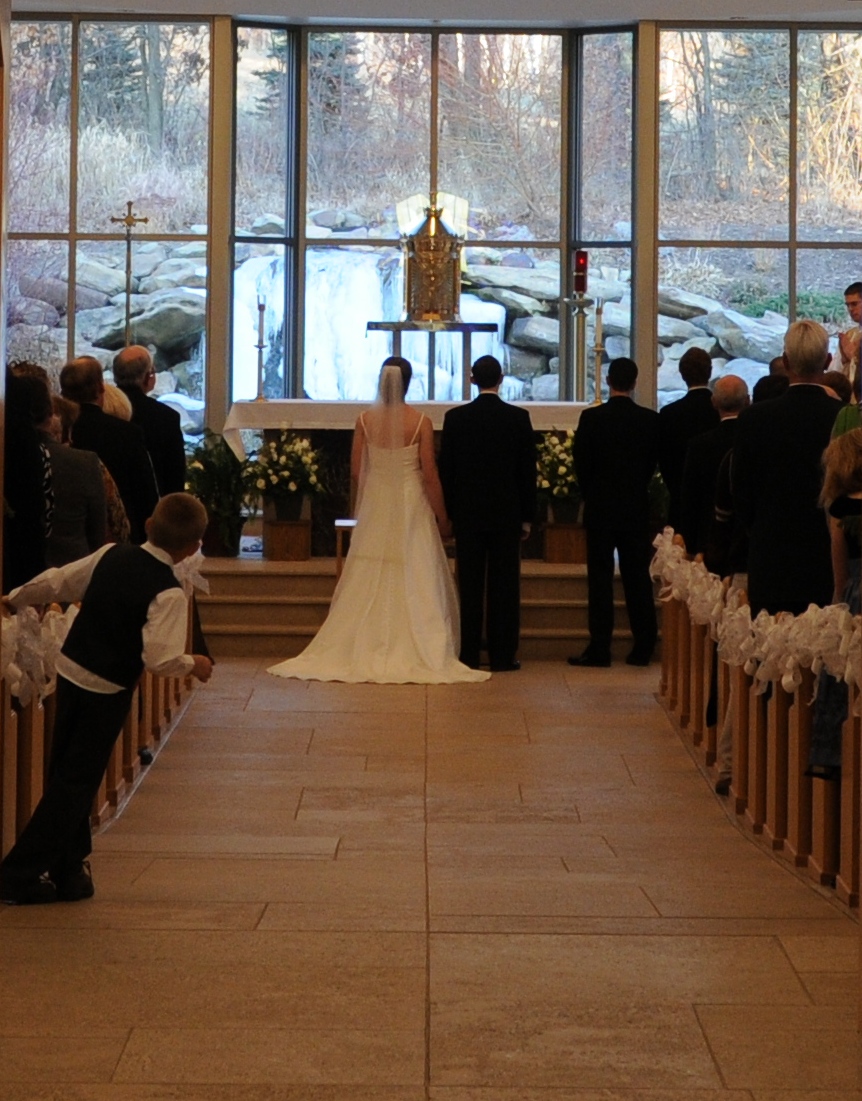
For an Extraordinary Marriage — Wedding of Andrew and Laura Foreki

March 3, 2010

I would like to begin this homily today by sharing with you the extraordinary story of how this boy, Andrew, met this girl, Laura. Picture Andrew, walking one morning across the University of Wisconsin campus in the deep cold of winter. He is on his way to Chadborn Hall where a prayer group is meeting for their twice-weekly 7:30 rosary. 

He walks into the room where the group is meeting and casts his eyes, for the very first time, upon a drowsy-eyed coed named Laura. And can you guess what Andrew said to himself when his eyes saw Laura for the very first time? That’s right. He said to himself, “Oh, I don’t know who that is.” This reaction, of course, is to be expected, since Andrew and Laura didn’t know each other prior to being introduced a few moments later.

Now Andrew’s first impression is not what makes this an extraordinary story. Did you notice what was the extra-ordinary part? Here it is: Here we have two college students, getting up, out of warm beds, on a cold day, to pray a rosary, at 7:30 in the morning! Now, you have to understand, in College Student Time, this is like getting up at 4:30 AM. Your typical college student doesn’t get up any earlier than he has to, but these two got up… to pray. For this and a thousand other reasons, I think you will all agree with me, that we have here two extra-ordinary people, from whom we good reason to expect an extraordinary marriage.

Do you two want to ensure you share an extraordinary marriage together? Then there are three things that I, as an ordained servant of Jesus Christ, believe that you should do.

First, like Tobit and his wife Sarah in our first reading, you should pray together. Of course you must pray individually. And of course you must pray with your children once they come. But you also need to pray together. It doesn’t need to be anything complicated.  Just hold each others’ hands a few moments before you part for work, or stand, or kneel, at your bedside, like Tobit and Sarah did, and speak aloud from your hearts to God. Ask blessings for each other, and give thanks for all the blessing you have received, and close you prayer by saying, “Amen, amen.”

Some couples find this kind of prayer too intimidating, or too personal, to be attempted; for our prayers express our most intimate selves, our fears, our hopes, our pains, our joys, our deepest longings. If you pray honestly in this way, nothing will be hidden between you. Today you will vow to give yourselves completely to each other. Do you want to be truly and totally one? Then pray together. Through marriage you will share of one flesh, if but pray together and you will also share of one spirit. Pray together and you will share an extraordinary marriage as one flesh with one soul. So please, pray together.

The second thing you should do for an extraordinary marriage is to come to Mass. Come to Mass every Sunday and every holy day of obligation. Come, and be moved by the beauty of architecture and songs. Come, and be strengthened by the experience of Christian fellowship. Come, and be inspired by the eloquence of Gospel preaching.

No doubt some people hear this and think to themselves, “That sounds great… But our church is ugly and the songs are dumb and hard to sing. And our community is little more than a gathering of strangers. And our priest always gives the same boring homilies.” Which all boils down to saying, I just don’t get anything out of going to Mass. Then hear this, even if everything else is lacking at Mass, Jesus Christ is always here for us, Body, Blood, Soul, and Divinity in the Eucharist. At Mass, the one sacrifice of Calvary and the Last Supper are made truly present to us for us to receive their power.

At Mass Jesus Christ shows us the perfect spousal love that He calls each of us to imitate. Jesus never called himself “the bachelor.” No, He joyfully called himself “the bridegroom” and eagerly seeks to unite himself to His bride. On the cross, naked without shame, He consummates this union with her, giving himself freely, fully, fruitfully, and forever… freely, fully, fruitfully, and forever. Do you want your union with each other to be free, fully, fruitful, and forever? Then come to Mass to learn the pattern of how Christ loves us and draw from the power He offers us through communion with Him. His is the pattern and the power for an extraordinary marriage. So please, come to Mass.

The third and final thing you should do for an extraordinary marriage is to be salt and light in the world. What does this mean? Being salt and light means that your Christianity should show. As Jesus says, “Your light must shine before others, that they may see your good deeds and glorify your heavenly Father.”

Your good deeds should stand out in the world. As St. Paul says in the second reading, “Do not conform yourselves to this age, but be transformed by the renewal of your mind” If the world never judges you to be radical in any aspect of your Christian life, then you’re not doing it right. Then you’re not yet living as salt and light–you’re not yet living like the saints. For example, everyone loves their friends, but who loves their enemies and prayers for them? Most people pray, but who spends a long time to be with God every day. Many people can give when times are prosperous, but who gives generously when times are tight? Such things as this are what it means to be the light and the salt of the world. Light is different than the darkness, and salt makes the ordinary flavorful.

Clearly, you two are salt and light already, for who goes on weekend retreats to know God better? Or who drives to Washington D.C. to march for life? Or who goes down to Louisiana to volunteer for Hurricane relief? Or who get up at 7:30 in the morning to pray the Rosary? So, please keep on being salt and light, and your marriage will be extraordinary.

Years from now, I don’t expect that you will remember much from this homily, but I hope you remember these three things: Pray together, come to Mass, and be salt and light and you will have an extraordinary marriage.

[Preached as a deacon for my sister’s wedding,  November 22, 2008]

Christian and Unashamed — Ash Wednesday at the Parish

February 17, 2010

In today’s Gospel, Jesus warns us against giving so that others see us giving, against praying so that others see us praying, and against fasting so that others see us fasting. Yet, I don’t think that showy religiosity is where the danger lies for us.

In Jesus’ day, the popular culture proudly believed in God and respected religious piety. Hence, those people were tempted to publically flaunt their acts of prayer, fasting, and almsgiving and thereby gain the respect and praise of others. But today, in our secularized culture, the temptation is to do the opposite, and to do something far worse. We are tempted to deny our faith in Jesus and teachings before others because we’re afraid of what they might think of us.

The hypocrites Jesus spoke of, who pray to be seen by others, merely limit their prayers’ reward, but if we deny Christ before others we lose our rewards entirely. For Jesus tells us:

“Whoever is ashamed of me and of my words, the Son of Man will be ashamed of when he comes in his glory and in the glory of the Father and of the holy angels.” “Everyone who acknowledges me before others I will acknowledge before my heavenly Father. But whoever denies me before others, I will deny before my heavenly Father.”

This is why the early Christians went to the lions rather than to deny Christ, and it was their courageous witness to Him that conquered the pagan culture which surrounded them.

This Lent, let us begin to practice putting the Lord before men. For instance, are you someone who will be so embarrassed by having an smudge of ash on your forehead that you’ll want to wash it off the first chance you get? If so, then you should leave it there until it wipes away on its own.

Are you are someone who sees good deeds that just call out to be done but pass them by because of your peers would see you doing them? Then you need to bite the bullet and start doing those hard-good-deeds anyways.

Are you someone who is self-conscious about other people seeing you pray, here at Church, at work, or when your family goes out to a restaurant? Then you need to make it a point to pray, and when you do, do not ask that God would make you invisible; ask Him that other people would become invisible to you and then pray to Him as from your heart.

Now, these are not examples of performing righteous deeds so that others may see you. This is about doing the right thing even if others might happen to see you do it. This Lent, let us begin to love and serve our eternal Lord amidst a world which is destined to become dust.

You are called to be the light of the world. People do not light a candle and then put a bucket over it; it is set it high up, where it can give light for everyone. Just so, your light must shine before others, that they may see your good deeds and glorify your heavenly Father. This Lent, let’s begin to shine.

Unashamably Christian — Ash Wednesday at the School

February 17, 2010

In today’s Gospel, Jesus warns us against giving so that others see us giving, against praying so that others see us praying, and against fasting so that others see us fasting. Yet, I don’t think that showy religiosity is where the danger lies for us.

In Jesus’ day, the popular culture proudly believed in God and respected religious piety. Hence, those people were tempted to publically flaunt their acts of prayer, fasting, and almsgiving and thereby gain the respect and praise of others. But today, in our secularized culture, the temptation is to do the opposite, and to do something far worse. We are tempted to deny our faith in Jesus Christ and His teachings before others because we’re afraid of what they might think of us.

The hypocrites who pray to be seen by others limit their rewards, but if we deny Christ lose our rewards entirely. I’ve touched on this topic twice before from this ambo, as recently as three weeks ago, but I feel that it is important for me to emphasize it, and that it’s important for you to hear it. For Jesus tells us:

“Whoever is ashamed of me and of my words, the Son of Man will be ashamed of when he comes in his glory and in the glory of the Father and of the holy angels.” “Everyone who acknowledges me before others I will acknowledge before my heavenly Father. But whoever denies me before others, I will deny before my heavenly Father.”

This Lent, let us begin to put God first; in our prayers, in our penances, and in our personal relationships.

Are you someone who will be so embarrassed by having an smudge of ash on your forehead that you’ll want to wash it off the first chance you get? Well then, you’re someone who needs to leave it there until it wipes away on its own.

Are you are someone who sees good deeds that call out to be done but pass them by because of the people who would see you doing it?  Then you need to bite the bullet and start doing those hard-good-deeds anyways.

Are you someone who will have more to say in gratitude to God after Mass this morning than is allowed by the eight seconds before your pew starts clearing-out? Well, then you need to stay in your pew to say what your heart wants to say as long as you need to say it (without, of course, being late to class.)

Now, these are not examples of performing righteous deeds so that others may see you.  This is doing the right thing even if others might happen to see you doing it.

If you’re self-conscious about other people seeing your devotion to the Lord (for instance at Mass) do not pray that you would be invisible to them; ask that they would invisible to you and continue as you would.

You are called to be the light of the world. People do not light a candle and then put a bucket over it; it is set on a lampstand, where it gives light for everyone. Just so, your light must shine before others, that they may see your good deeds and glorify your heavenly Father.

This Lent let us begin to love and serve the Lord in the world. This Lent, let’s begin to shine.

Speaking Up — January 26 — Sts. Timothy and Titus

January 26, 2010

Think back.  When was the last time that the name of Jesus passed your lips? For comparison, do you speak about Jesus Christ less often than, say, Brett Favre, or President Obama? But isn’t Jesus Christ far more important than professional athletes or politicians? Our culture teaches us to keep our faith in Jesus unspoken and hidden, but this is a habit we need to unlearn. Our Christian faith is supposed to be personal, but it’s not supposed to be secret.

Today’s first reading comes from a letter from St. Paul to a young Christian named Timothy. Timothy grew up in a Christian family, but as we see in the Gospel, family ties are not what make a person close to Christ. What makes one close to Christ is the choice to do God’s will. Paul understood that Timothy’s youth might cause him to be too timid about expressing his faith in Jesus Christ. So Paul told Timothy, as I say to you, “stir into flame the gift of God that you have…. For God did not give us a spirit of cowardice but rather of power and love and self-control. So do not be ashamed of your testimony to our Lord….”

Never deny or be ashamed of Jesus because of the people who happen to be around you. Often, people are more receptive about Christ than you might think, and witnessing to your faith can change lives. Besides, if the people you’re with would mock our savior then the opinion they have about you doesn’t matter much anyways. Still, they may well may mock you one day, and respect you for your convictions the next.

Don’t be too timid lead prayers out loud to Jesus. Nobody expects you to be a poet. Just speak simply from your heart and your words will have a powerful effect. Listening to another’s struggle can help, but sharing prayer to Christ with them can really heal.

Be unafraid to talk about Jesus. Everyone needs Him and what He has to teach us, even if we’ve been Christians all of our lives. John Paul the Great said that Jesus Christ reveals humanity to itself. Jesus provides the answer; to why we’re here, where we’re going, how we should live, and how we are loved. He is the most worthy of topics for conversation.

As our psalm says,

“Announce [Christ’s] salvation, day after day.
Tell his glory among the nations;
[and] among all peoples, his wondrous deeds.”

So be unashamed of Jesus no matter who happens to be around you. Lead prayers aloud to Jesus for the benefit of your neighbors. And be not afraid to let the name of Jesus past your lips.

Holy Reminders — Friday, 1st Week in Ordinary Time—Year II

January 16, 2010

Jesus said to the paralytic, “I say to you, rise, pick up your mat, and go home.”But why did Jesus send the man home with his mat? Why say anything more than, “I say to you, be healed and rise”? Why send the man home and have him take his mat with him?

Was it that Jesus was annoyed with the intrusion of this man and his amateur skylight instillation crew? That’s not it, for throughout the Gospels Jesus is always pleased by seeing displays of faith, and it says here that Jesus “saw their faith.” Rather, it is those who obstinately hold on to their faithlessness against all positive evidence who elicit Jesus’ annoyance in the Gospels. Recall when He said elsewhere:

“Woe to you, Chorazin! Woe to you, Bethsaida! For if the mighty deeds done in your midst had been done in Tyre and Sidon, they would long ago have repented in sackcloth and ashes.”

So why did Jesus send the cured man away with his mat? In setting the scene, the Gospel says that when “it became known that [Jesus] was at home… many gathered together so that there was no longer room for them, not even around the door, and [Jesus] preached the word to them.” Jesus preaches the word to the crowd so that they may be prepared to receive the Gospel about Himself. It seems that Jesus sends the cured man home because in his short time with Jesus he has been brought fully up to speed. Jesus sends the man home because, for now, the man knows everything he needs to know. Jesus forgives the man’s sins and cures him. From this the man understands why Jesus has come: for the forgiveness of sins and the healing of persons.

And why does Jesus send him home with his mat? I bet that the man would have gladly left it behind, happy to be rid of it, without a second thought. I think there are two reasons he’s told to take the mat: First, so that he may preach to others about Jesus. The mat will be conversation starter (“Hey, what’s with the mat?”) and it will also serve as “exhibit A” when the man gives his testimony about Jesus. The second reason for having him keep the mat is so that the man will always remember what Jesus did for him and what it meant. What good would it be for Jesus to teach the man everything he needed to know, if he were to quickly forget everything he had learned?

Perhaps we have need for such concrete reminders for ourselves in our life of faith. Maybe we don’t have souvenirs laying around from times that Jesus helped you, but I bet we all have access to Post-It Notes. If you think you would benefit from being reminded of Jesus’ past goodness shown to you, then write down titles for a few of these great moments.  Post them up on your wall, your mirror, your computer monitor, or wherever you will see them. This will help keep you mindful of Christ, what He did for you and what it means. And maybe, someday, someone will ask you, “Hey, what’s with the Post-it Note?”

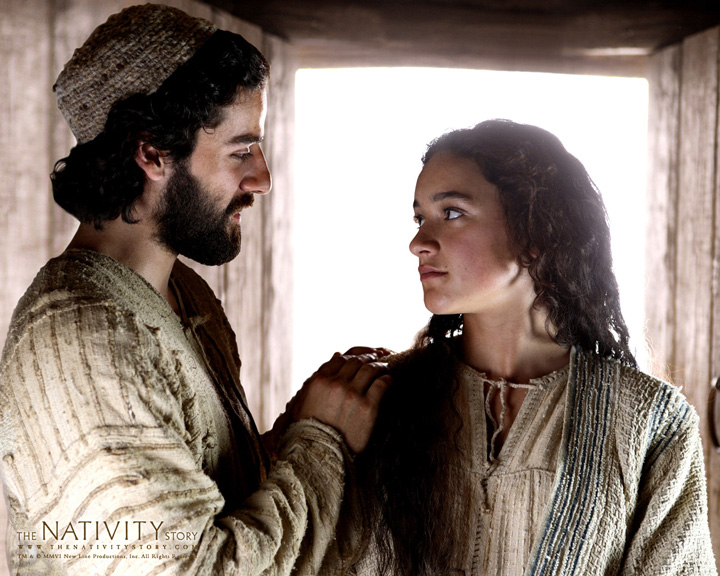
Strengthening Your Family — Holy Family

December 29, 2009

Today we are going to try something unique. Close your eyes and let the Holy Spirit guide your imagination to show you what family life was like in the home of Joseph, Mary, and the boy Jesus…

Theirs is a small dwelling and you can see all of them there…

How old is Jesus as you see Him? What is He doing?

What are His parents up to? What are Joseph and Mary like as you see them interact with each other?

It comes to time to eat. What do you see the Holy Family doing?

As they relate to one other, what do you see expressed in their faces? It is now later in the evening and time for prayer. What do you see the members of the Holy Family doing?

You can return in your imagination to visit this house any time you wish, but now, let’s open our eyes and review our mediation.

What did you see as Joseph and Mary interacted with each other? Were they not tender and reverent towards each other? I bet you could see their great mutual love reflected in their smiles.

What happened in their house when it was time to eat? Who would imagine them not coming together to share their meal in each others’ company?

And later, when it was time for prayer, did the Holy Family do? Did you see them go off to their own corners, or did they come together, to pray as one family?

Did you see the Holy Family’s intimacy, their happiness, and their love for each other? Do you want your family to share a bond like theirs? Then take the Holy Family as your model: share your love, share your meals, and share your prayers.

First, on sharing your love. Let your spouse and children know every day that you love them. You can say it, you can show it, or you can do both. For instance, kids never tire of being hugged and told their loved each day.

As for married couples, don’t make the mistake of thinking that intimacy and love are only expressed physically. For St. Joseph had all sorts of simple, little ways to let Mary know that she was loved, and vice-versa. Be like the Holy Family in sharing your love.

A second way to model the Holy Family is to share your meals. The research of social scientists indicates that having frequent family meals together contributes many goods for one’s family: For starters, everyone eats healthier meals, and so kids are less likely to become overweight or obese. And kids who eat family meals are less likely to start smoking, to drink alcohol, or to try or to be addicted to drugs. These kids’ grades are better at school, and there is less stress in their homes. These things probably stem from the fact that families which eat together are bound to talk more, provided the TV is off.

These parents are more likely to know about their children’s lives and struggles and, just as importantly, their kids are more likely to know that their parents are proud of them and love them.

Jesus Christ thinks that the shared family meal is so important for us that He has instituted one for His Church and expects His entire family to be there; for to share in the Eucharist is to share in the life and communion of His family.

A third way to make your family more like the Holy Family is to share your prayers. Apart from dinner prayers or going to Church, most Catholic families do not pray together. I think that maybe we see the priest praying the Church’s prayers and think that we are not equipped to lead prayers of our own at home.

But it’s not true.  As fathers and mothers you have a spiritual authority within your families, what John Paul the Great called “the domestic Church.” Your spouse and your children need you to pray, not only for them, but with them. Right after the family meal might be the perfect time for this ritual of family prayer.

Now you may be thinking to yourself, “But we’ve never done this as a family before.” Remember this: as parents, you create what’s normal for you children. If you want it to be normal for your children to eat meals with you, then make it normal for them.

If you want it to be normal for your children to pray to God with you, then do it normally. As parents, you create what is normal for your children and through your gift of these traditions to them you can bless them for a lifetime.

Finally, husbands and wives, if you do not pray one-on-one with each other, then you do not yet share a perfect intimacy together.  It is in prayer that our most intimate selves are laid bare and we ask another person to help us with our heartfelt needs and concerns.

Maybe you’ve never prayed with your spouse before. Then perhaps you can begin like this:  hold each others’ hands, close you eyes, and pray to God for each other, for a little while, even if for just ten seconds, say, before you go out the door. 

Once this becomes comfortable you can begin to telling each other what you want to be prayed for. And, after this is comfortable, you can begin to pray for each other aloud.  Begin the process of praying like this and it will transform your intimacy together.

Perhaps you gave many gifts to your family members yesterday for Christmas, but the greatest gift you can give to each other is yourselves. So follow the way of the Holy Family: share your love, share your meals, and share your prayers.

2nd Sunday of Advent—Year C

December 10, 2009

In the first year of the presidency of Barack Obama,
when Jim Doyle was governor of Wisconsin,
and Kohl and Feingold were its senators,
and Obey was the seventh district congressman,
and Favre was the quarterback in Minnesota,
when Benedict was pontiff and Jerome was bishop,
the word of God came here,
to Christ the King parish in Spencer:

“Prepare the way of the Lord,
make straight his paths.
Every valley shall be filled
and every mountain and hill shall be made low.
The winding roads shall be made straight,
and the rough ways made smooth,
and all flesh shall see the salvation of God.”

It isn’t a new word… It was the message of John the Baptist, and Isaiah wrote it long before that. Yet the word of God is not old in the sense that it has passed some kind of expiration date. When the Holy Spirit inspired the writing of these words, their human author who put the pen to parchment did not know the great audience and the impact they were to have. But the Holy Spirit saw us here and had these words written to us and for as well. These words were not meant only for Old Testament peoples, or for the time when Christ walked on the earth. These words are proclaimed to us, and meant for us, here today. Remember this every time you encounter the Scriptures, here at church or in your private prayer.

So what is God’s word saying to us today? In the Gospel, did you notice that of all the rulers and governors and leaders at that time, the word of God did not come to any one of them? “The word of God came to John the son of Zechariah in the desert.” The lesson is that God prefers to lead souls to salvation by working through common people. People who think that they have no power.

What politicians do is important, since good laws can help people and bad laws can hurt them, but what saves souls rarely comes through them. And though our Holy Father and our bishop strive to do important work for Christ, there is only so much they can do. The way of the Lord is prepared by the daily efforts of ordinary Christians, who sometimes have children and sometimes work jobs. Your family, friends, and co-workers probably don’t read papal encyclicals, but they always witness your words and example. And so, Jesus depends upon you to prepare His way for others, to make winding and rough roads straight and smooth, and so that all people see the salvation of God.

This is the Christian’s calling and important mission, yet we cannot share what we do not have. If were are going to prepare the way of the Lord and make straight his paths for others we must first fill the valleys and level the mountains for Christ within ourselves. To this end, I urge you to make the most of two gifts God gives us: the sacrament of confession and daily prayer. There is simply nothing that more quickly and effectively strengthens the average Catholic’s moral and spiritual life than frequent and regular confession. And daily prayer is indispensible for growing in relationship with Christ and for living a wonderful life.

Each year, many of our homes are visited a familiar and beloved character whom we associate with Christmas… I speak George Bailey from the movie “It’s a Wonderful Life.” This film, despite its flawed angelology, teaches the truth about how much difference one person can make for others. George Bailey’s an ordinary man who lives an extraordinary life without even realizing himself. By the end of the film, we see the impact for good that his life has had and we see George surrounded by his family and his many friends who all love and admire him.

Why does George Bailey live such a wonderful life?  Sure, he’s a nice guy, but he’s more than a nice guy. Time and again, he sacrifices what he wants to do what’s loving and best for the people God has placed in his life. I hope we can all see a little bit of George Bailey in ourselves. Because we can see a great deal of Christ in George Bailey.

This Advent season, let us prepare the way of the Lord within us, so that through us, all people may see the salvation of God.  This is the calling, the mission, and the privilege of the Christian.  In this or any age, it’s a wonderful life.

Tuesday, 33rd Week in Ordinary Time—Year I

November 17, 2009

Imagine if the United States of America, with all its freedoms and rights, were not the United States of America, and on your way to school today, you were stopped along roadside by the secret police. They ask you for your name. You cooperate give it. Then they order you to put your hands on the hood of the squad car. They handcuff you and place you under arrest.

You ask them, “What’s going on? What have I done?” They reply, “You’re under arrest for the charge that you are a believing Catholic Christian.” You didn’t realize it, but the police have had you under intense surveillance for the past several weeks, wire-tapping your phone, monitoring your computer, searching your personal belongs, and watching all your movements and activities.

Imagine yourself in this situation. This is the question I pose to you: At your trial, when all of the evidence they have gathered is presented against you, will there be enough to convict you? Would there be sufficient evidence to find you guilty of being a believing Catholic Christian? What would they have on you?

Would they have testimony from informants that you observe every Friday as a day of penance, that you keep every Sunday as a special, day of rest, and faithfully go to Mass and frequent the sacrament of reconciliation? Could anyone testify against you that they heard you saying positive things about Jesus Christ, or that you spoke up for the Catholic faith when it was mocked or criticized in your presence? Could they put into evidence a rosary, or a Bible, or some other Catholic book, marked with fresh traces of DNA from your fingertips? Would they have hidden camera footage of you praying before meals at school or at restaurants? Would they have grainy night-vision footage of you praying before going to bed, or praying the first thing in the morning, making the tell-tale sign of the cross.

A few hours after your arrest you find yourself in a courtroom (because the “people’s” authoritarian government believes in speedy trials.) The intimidating judge looks down at you from the bench, “It says here that you were picked up on your way to the Columbus school. We have evidence of illegal Christian propaganda being taught there and we also have reliable reports that various Catholic rituals are done there, superstitions which are offensive to reason and the spirit of our times. Now I imagine that you went to that school because that’s where your parents sent you. And I’m sure that your parents would be shocked to discover that such repugnant activities as these are happening at your school.”

The judge continues, “The punishment for being found guilty of being a believing Catholic Christian is a grave one. But… if you were simply mixed-up in these activities, unthinkingly, by accident—if you were just doing them because that’s what everyone else around you was doing—well then that would be a different story. Spies and traders may come to our government rallies, but that doesn’t make them loyal citizens now does it? So just going through the motions doesn’t make you a believing Catholic at all, am I right?”

“So I can completely understand how this regretable misunderstanding has occurred. You didn’t really understand what you were doing did you? Now if you would simply formally renounce any and all belief in these silly superstitions, you may go on your way. Just sign your name here on this piece of paper testifying to that effect, and you’re free to go.”

What would you do? What do you wish you would have the courage to do? Would we have the courage to refuse to sign, just as Eleazar refused to eat? The eating of a little meat, like the movement of a pen, is a small act, but Eleazar refused and accepted an unjust death because to do otherwise would mean a rejection of the Lord, the one true God, the King of all other kings.

Now it is very unlikely that you or I will ever have to lay down our lives as red, or bloody martyrs for our faith in Christ. But, like Zacchaeus, there will be certainly times when we will have to go out on a limb for Christ. The crowd laughed to see the rich man Zacchaeus up in that tree, but what did Zacchaeus care about? His focus was totally fixed upon his connection with Jesus Christ.

Be like Eleazar, and don’t swallow whatever the world sets before you, because a lot of it is not good and can alienate you from God. Be like Zacchaeus, with the courage to go out on a limb regardless of what other people might think or say, for the sake of your relationship with Christ.

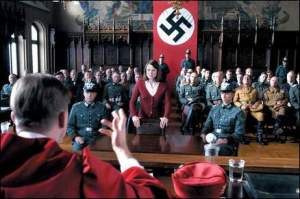
[The images for this post come from the movie Sophie Scholl–The Final Days. If you liked A Man for All Seasons, you’ll like this one too (but I’ll warn you up front that it ends the same way.)]