28th Sunday in Ordinary Time
By Fr. Victor Feltes

A man runs up to Jesus, kneels down, and earnestly asks him, “What must I do to inherit eternal life?” Jesus quotes to him commandments about loving our neighbors: “You shall not kill; you shall not commit adultery; you shall not steal; you shall not bear false witness; you shall not defraud; honor your father and your mother.” Why did Jesus add “you shall not defraud” after saying “you shall not steal [and] you shall not bear false witness?” What distinction is being made? In the Greek, “steal” here denotes taking, while “defraud” suggests withholding or keeping back what belongs to another. Both the street mugger (by unjustly taking) and the business owner (by unjustly holding back) can deprive someone of what is rightfully theirs. It is possible to sin by clinging on to what we should give.
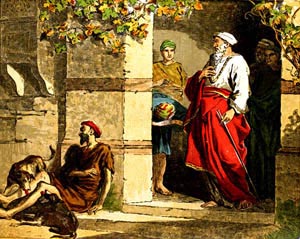
Upon hearing Jesus’ list of commandments, the man replies, “Teacher, all of these I have observed from my youth.” The man is seeking something more from Jesus. Jesus had just cited several of the Ten Commandments but notice which commandments Jesus left out. The first three commandments are conspicuously absent, the ones specifically about our relationship with God. Jesus, looking at the man and loving him, desires to reveal how he is to love the Lord. He tells him, “You are lacking in one thing. Go, sell what you have, and give to the poor and you will have treasure in heaven; then come, follow me.” But at hearing these words, the man’s face fell because he had many possessions, and he went away sad. Did that man ever go on to have a change of heart before the end? We don’t know. Matthew, Mark, and Luke all record this encounter in their Gospels but none of them mention his name. Perhaps (unlike with Jairus, Zacchaeus, or Bartimaeus) the early Christians were unfamiliar with this man because he never joined their community.
The Book of Acts describes Jerusalem’s earliest Christian community as being “of one heart and mind” and generous towards one another. “There was no needy person among them, for those who owned property or houses would sell them, bring the proceeds of the sale, and put them at the feet of the apostles, and they were distributed to each according to need.” However, that sharing was not obligatory. Christians still owned property, they were free to decide whether to sell it or not, and they were free to share the sale proceeds or not. So it is not necessarily wrong to own things, but wealth can be an obstacle to heaven.
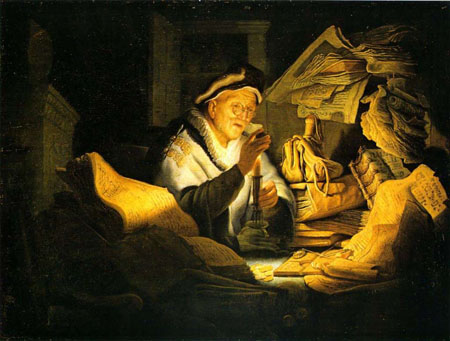
Jesus remarked to his disciples, “How hard it is for those who have wealth to enter the Kingdom of God!” The disciples were amazed at his words, because they held the idea that having great wealth was a strong sign of God’s approval. So Jesus again said to them in reply, “Children, how hard it is to enter the Kingdom of God! It is easier for a camel to pass through the eye of a needle than for one who is rich to enter the Kingdom of God.” So who among us qualifies as rich?
Compared to our immediate neighbors, our wealth is probably pretty average. Or at least most of us have less money than the richest folks in town. But how materially wealthy are we compared to those in other countries? Compared to the world, everyone here is rich. For instance, a two person household with an annual after-tax income of $40,000 makes more than about nine-out-of-ten people on earth. Even someone who lives alone with a post-tax income of $10,000 a year makes more than eight-tenths of the world. We are rich. So what must we do?
Again, not all Christians must give away all of their wealth, but our Lord insisted upon it for that man who came to him because Jesus knew he loved his riches more than God. The things we own are not absolutely ours to do with however we please, for we and what we have belong to God. We are his trusted servants, the stewards of his goods. That is why Jesus says that anyone “who does not renounce all of his possessions cannot be my disciple.” Even when it is his will for us to have possessions, we must do so with a healthy detachment, by being frugal and generous and truly open to doing God’s will.
One of the most memorable scenes from the 1993’s Best Picture winning film “Schindler’s List” comes at the end. Oscar Schindler, a German industrialist, has protected the lives of more than 1,100 Jews during the Second World War by listing them as his “essential workers” while producing defective ammunition for the Nazis. He looks at the people he has saved and reflects: ‘If only I’d made more money. I threw away so much money, you have no idea. … I didn’t do enough. This car. Why did I keep the car? Ten people right there, ten more people. This gold pin… two more people. At least one. One more person, for this. I could have got one more person, and I didn’t.’ It is Ok to have what we need and it can be Ok to buy things we want, but someday we all will have to stand before the Lord “to whom we must render an account” of our Christian stewardship.
There is a world of needs around us, needs abroad and needs nearby, material needs and spiritual needs. Though they all have importance, our local spiritual mission has a special claim on our care. To aid the success of Christ’s mission for the salvation of souls among us, in the words of St. Paul, “Each person must give as he has decided in his heart, not reluctantly or under compulsion [but freely], for God loves a cheerful giver.” And our Lord promises rewards for our sacrifices for him. Jesus declares, “Amen, I say to you, there is no one who has given up house or brothers or sisters or mother or father or children or lands for my sake and for the sake of the Gospel who will not receive a hundred times more now in this present age… and eternal life in the age to come.” So let us be generous, for God will not be outdone in generosity.









 Parishable Items