A 32-year-old Ronald Reagan plays a (fictional) Catholic priest army chaplain in this 1943 short film. “Chaplain Michael O’Keefe” is depicted celebratingMass, working alongside his Protestant and Jewish chaplain friends, visiting a prisoner, and being mourned among the fallen in New Guinea.
The film was made to give army personnel “a better understanding of the chaplain’s place, work, and accomplishments in the army.” It was produced by the U.S. Signal Corps and filmed at MGM Studios. [source]
Contemporary politics make a brief appearance in the dialogue: Vermont is referenced as being a Republican state and Georgia as a Democratic one. (Today, those political alignments are reversed, though Ronald Reagan did win Vermont while losing Georgia in 1980.)
The pastor of a big-city parish answered his rectory door to find a man wearing a face of great anxiety and concern. “Father, there’s a local family in dire need that could really use the church’s help.” The priest invited him inside and listened to the details. “The mother is a young widow with ten kids who lost her job last month. She’s been looking for work, but they’re barely keeping food on the table. Worst of all, unless they can scrape together $300 for rent by this Friday, they’ll be evicted and thrown out into the street.” The priest replied, “That’s a terrible and difficult situation. By the way, how do you know the family?” The man wiped a tear from the corner of his eye and said, “Oh… well, I happen to be their landlord.”
Hypocrisy is the pretense of holding beliefs, standards, behaviors, or virtues that one does not truly hold. Not many good things are usually said about hypocrisy, but I can say one. Usually, hypocrisy acknowledges (however insincerely) what is really true and truly good. Even a corrupt politician speaks the truth when he or she says that government should be transparent, politicians should be honest, and campaign promises should be kept. A wedding ring is a visible sign that proclaims marriage to be a sacred and lifelong bond even on the hand of an adulterer. Hypocrisy is the homage, the respect, that vice shows to virtue.
In today’s gospel, Jesus talks about the scribes and a poor widow. He praises her, but criticizes them. Jesus saw her at one of the Temple’s thirteen contribution trumpets in the court of the women. These were donation chests topped as with tall road cones, but made of metal, with an opening at the top for dropping in coins. The coins of large contributions would make a large racket, like how a slot machine pays out in a casino. But the poor widow’s two coins fell in with quiet: *click* *click*
Jesus called his disciples to himself to point her out to them. (Perhaps he saw in her an image of himself, the one who trusts in God and is willing to give everything to him.) After criticizing scribes who “devour the houses of widows” as those who “will receive a very severe condemnation,” he praises this poor widow’s gift.
Most homilies preached around the world today will be about the poor widow’s trusting generosity. (You may have noticed that our lectionary gives the option of omitting the scribes from this reading entirely, making a brief gospel reading even shorter.) But today I will be preaching about the scribes and from an angle that I would bet you’ve never heard before: what we have to learn from what the scribes were doing right.
Jesus condemns the scribes for their hypocrisy, and rightly so, but at least they acted like God and true religion were the most important things in their lives. Do our acquaintances at work or school have reason to think that God comes first in our lives? If it were illegal in this country to be a Catholic Christian, would there be enough public evidence to convict you? Our words and actions should reflect our faith in Jesus and his Church.
The scribes took seats of honor in synagogues, but at least they were faithfully there each week. God commands us to keep his days holy—every Sunday and Holy Day of Obligation. He commands this because he deserves our praise and thanks, but also because he knows how much we need this.
The scribes liked to go around in long robes, but at least they dressed up in a God-honoring way. Our clothing should always be modest and dignified, but especially at church. How would you dress for your boss at work, for an meeting with the president, or an audience with the pope? How much more then should we dress well to come before God at Mass.
The scribes accepted greetings in marketplaces and places of honor at banquets, but at least they were active and known in their community. We should not be mere homebodies, but involved in our own community.
The scribes recited lengthy prayers for show, but at least they were not afraid to acknowledge God before others. Do you pray before meals at restaurants? Do you talk about Jesus or your faith with anyone? When someone shares their burdens with you, do you offer to pray with them? (Try it sometime. They will probably be more receptive than you think.) We should not be afraid.
Why did Jesus say the scribes deserved a severe condemnation? Because they focused on externals and disregarded what was within. They cared about fancy clothes, and prayers and deeds that others would notice, but did not care whether widows became destitute. It’s fine to desire friendship—it’s one of life’s great blessings—but we must desire God’s friendship more. We naturally care what others think of us—no one wants to be hated—but we should care more about what God thinks about us. The scribes were attentive to appearances, but neglected the truth and love.
After the poor widow put her coins into the treasury, the gospel says that Jesus called his disciples to himself. He summoned his followers to physically draw nearer in order to teach them and highlight her deed. But in a deeper sense, Jesus was calling them to his very self, that they would come to resemble him like the widow did. Jesus is the man of integrity whose exterior words and actions perfectly align with his inner-self. He wants all of us to be like himself. Jesus wills that our secret selves would be as noble and admirable as our public personas, and that our interior faith would be reflected through all of our external words and actions. Like the landlord in the opening joke, whether or not Jesus is welcome to dwell and live with us as he desires, increasing our likeness to his, is entirely up to us.
The more prosperous nations are obliged, to the extent they are able, to welcome the foreigner in search of the security and the means of livelihood which he cannot find in his country of origin. Public authorities should see to it that the natural right is respected that places a guest under the protection of those who receive him.
Political authorities, for the sake of the common good for which they are responsible, may make the exercise of the right to immigrate subject to various juridical conditions, especially with regard to the immigrants’ duties toward their country of adoption. Immigrants are obliged to respect with gratitude the material and spiritual heritage of the country that receives them, to obey its laws and to assist in carrying civic burdens.
My hometown friend, pro-life speaker Katie Stelter, spoke at our parish’s youth group this evening. Her story was made into this powerful docudrama, Metamorphosis:
So the FOX network plans to launch this new show in 2016:
They say you can’t judge a book by its cover, but previews for movies and TV shows these days tell us plenty about what to expect. Based on this trailer and its synopsis, I’d like to share my first thoughts about FOX’s Lucifer.
What “Lucifer” Gets Right Giving Their Devil His Due
Our first encounter with FOX’s Lucifer is in a form such as we should expect him to appear. No horns, tail, or pitchfork. Nothing in his appearance to make us flee from him in horror. He’s attractive, wealthy, well dressed, and speaks with sophistication. He drives through the night self-satisfied, solitary, and yet pleased to have others serve him and line up eagerly at his door. His popular club is named “Lux” (Latin for “Light.”) “And no wonder, for even Satan masquerades as an angel of light.” (2 Corinthians 11:14) He draws many to himself by means of human sensuality.
His name, “Lucifer Morningstar,” is drawn from Isaiah 14:12.
Church Fathers wrote that “Lucifer” was never the devil’s proper (or “God-given”) name but that it signifies the glorious state from which he fell. However, I give the show creators credit for a pretty good name choice.
FOX’s Lucifer is a denouncer, reviling “this human stain” and “your corrupt little organization.” This is in keeping with him being ‘the accuser of the brethren, who night and day accuses them before God’ (Revelation 12:10) as he did with righteous Job. (Job 1:9-11, 2:4-5) In fact, his most well-known titles highlight this trait: “Devil” comes from the Greek word for “Slanderer,” while “Satan” is Hebrew for “Adversary” or “Accuser.”
Lucifer is willing to transgress laws whenever it benefits him. Perhaps this is why FOX’s Lucifer will premiere in 2016 driving with expired tags on his license plate (but it’s more likely just a production mistake.)
What “Lucifer” Gets Wrong The Devil They Know is Better
Than the Devil They Don’t
If there were people in the entertainment world who didn’t believe that Adolf Hitler really existed, I could imagine someone reenvisioning him to be some TV drama’s charismatic hero. Many people would be understandably offended and concerned about what evils could flow from presenting the leader of the Third Reich — a spreader of hate and murderer of millions — as primetime television’s next charming protagonist. Ordinarily, aware of Godwin’s Law, I would avoid drawing comparisons to Hitler. Yet as bad as Hitler was, the devil is much worse. The worst thing the show’s creators will get wrong about the devil is that he is certainly not, and will never be, ‘a demon with a heart of gold.’
When a young, dispirited pop star returns to Lucifer he counsels her, “Pull yourself together,” and comforts her. Following her sudden death, he looks on her lifeless body with shock and concern. He asks of the LAPD homicide detective, “What is your corrupt little organization going to do about this?” Later, he tells a female confidante, “Someone out there needs to be punished!” She replies, “Stop caring, you’re the devil.” Indeed, this does not fit with his true character. Unable to strike out at the Almighty, the devil attacks the human race God loves. The devil would not mourn the death of a young woman lost in her sins, he would desire her unhappy end and encourage it, as he did the suicide of Judas Iscariot. The devil hates us all.
Lucifer meets the police detective again and offers his assistance: “We should be out there punishing those responsible. Come on, I’ll help you.” However, the real devil does not accuse sinners and will their damnation out of a devotion to truth or justice. He tempts and condemns out of envy, to prove that others are no better than himself. “[B]y the envy of the devil, death entered the world…” (Wisdom 2:24) Jesus said of him, “He was a murderer from the beginning and does not stand in truth, because there is no truth in him. When he tells a lie, he speaks in character, because he is a liar and the father of lies.” (John 8:44)
If you want to see something of what the devil is like, I suggest Heath Ledger’s Oscar-winning performance as the Joker in The Dark Knight. (*) Heath Ledger described the Joker as “an absolute sociopath, a cold-blooded, mass-murdering clown,” and his portrayal of evil will be long remembered. However, I doubt the same will be true for FOX’s Lucifer.
Why I Doubt “Lucifer” Will Last The Devil Has No New Tricks
What type of show is Lucifer? It’s a sometimes light-hearted police procedural with supernatural themes and a “will-they-or-won’t-they” romantic subplot. FOX’s Lucifer isbasically like The X-Files with angels instead of aliens. However, I’ll be surprised if it survives beyond its first season. I am dubious about how original and well-written the show will be since it borrows so much from previous works:
— We saw charming, talented eccentrics tagging along with cops to solve crimes in The Mentalist, Castle, and Monk.
— We saw a fallen angel embracing human life and love in Los Angeles in Nicholas Cage’s City of Angels.
— We saw a brazen angel in human form magically attracting women in John Travolta’s Michael.
— We saw a female love interest be uniquely impervious to a dangerous hunk’s powers with Bella and Edward in Twilight.
— We even saw a demonic vanity license plate (“BAD 1″) in Brendan Fraser and Elizabeth Hurley’s Bedazzled.
— At least FOX’s Lucifer plays piano instead of a mean fiddle.
Will these recycled elements gel into a successful hit? Will solving crimes, landing insults, exposing hypocrites, titillating women, and facing-down CGI angels and demons be a long-winning formula? I’m skeptical, but either way, I don’t plan to be watching.
How We Should Respond Resist the Devil and He Will Flee
In the preface to his spiritually insightful and quite funny book about demonic temptation, The Screwtape Letters, C.S. Lewis wrote:
“There are two equal and opposite errors into which our race can fall about the devils. One is to disbelieve in their existence. The other is to believe, and to feel an excessive and unhealthy interest in them. They themselves are equally pleased by both errors and hail a materialist or a magician with the same delight.”
As it is with devils, so I think for this show. In the coming year, I expect it to attract more heat and noise of controversy, and I suspect the show’s creators will welcome the free publicity. We may be told that everyone must watch the series in order to form an opinion — as if forms of entertainment were somehow entitled to our time and focus. On one hand, we do not want to lend this show inordinate attention. On the other hand, ignoring its existence would be a mistake. We should respond to FOX’s Lucifer with both true teaching and prayer.
Just like with the inaccurate history of Dan Brown’s The Da Vinci Code, this regrettable new TV show will bring with it
opportunities for catechesis; to teach about angels and demons, temptation and discernment, and the war that is fought for every human soul. (Teaching can be as easy as sharing an article like this one.) We can discourage others from tuning-in but, whether we like it or not, questions will come our way and we should be well-prepared to answer with the truth.
We must also pray. In 2012, an 24-year-old gunman with red-dyed hair, reportedly self-identifying as “the Joker,” killed 12 people and injured 70 in an Aurora, Colorado movie theater showing the third film of the Batman trilogy. On the human level, the responsibility for this crime lies with its perpetrator, but just as a movie can inspire an unstable person to imitate a villain, so a show about the devil can both lead the unwary into exploring the occult or subtly persuade others that the devil’s just a myth. Against such evils we should pray; not only for the impressionable viewers among the audience of millions, but for the creators of such art itself.
Spiritual connections are mysterious and rarely certain, but dabbling with satanic things can open doors to evil and burn us. Six months after the release of The Dark Knight, Heath Ledger, the actor who had immersed himself into the persona of the demonic Joker, was dead from a drug overdose. At one infamous concert in 1969, during which an audience member was later killed by “Hell’s Angels” working security, The Rolling Stones’ performance of “Sympathy for the Devil” was interrupted by a fight and the song had to be restarted. At the time, Mick Jagger remarked onstage, “We’re always having—something very funny happens when we start that number.”
For the good of everyone involved, I will be praying that the cast and crew of FOX’s Lucifer may soon find themselves safely employed in other work and, if Lucifer ever comes to air, that its harm may be minimal and a better show may quickly take its place. I invite you to join me in praying for the same by invoking the help of St. Michael, who fought the devil and the demons out of Heaven. (Revelation 12:7-9)
Saint Michael the Archangel, defend us
in battle, be our protection against the wickedness and snares of the devil. May God rebuke him we humbly pray; and may you, O Prince of the Heavenly host, by the power of God, thrust into hell Satan and all evil spirits who wander through the world seeking the ruin of souls. Amen.
(*) — Like the devil, the Joker in The Dark Knight is a liar, telling incompatible tales about his scars. He loves fire, chaos, violence, and death. Alfred the butler says of him, “Some men aren’t looking for anything logical, like money. They can’t be bought, bullied, reasoned or negotiated with. Some men just want to watch the world burn.” The Joker is an accuser of all: “See, their morals, their ‘code’…it’s a bad joke, dropped at the first sign of trouble. They’re only as good as the world allows them to be. I’ll show you, when the chips are down, these — ah — ‘civilized people?’ They’ll eat each other. See, I’m not a monster. I’m just ahead of the curve.” In the Joker’s climactic final scene, he is angered that those on neither ferry have blown the other up. Batman asks him, “What were you trying to prove? That deep down, everyone’s as ugly as you?!” The Joker tells Batman that they have been locked in “a battle for Gotham’s soul” while the camera films him, from an inverted perspective, having the likeness of one in an everlasting fall.
“[W]hy not say — as we are accused and as some claim we say — that we should do evil that good may come of it? Their penalty is what they deserve.” (Romans 3:8)
In this passage, the Holy Spirit led St. Paul to denounce the idea that having a good goal in mind can ever justify using immoral means to achieve it. God’s most basic commandment is heard in every human conscience: “Do good, avoid evil.” We must never do evil in hopes that good may result. If we do, there is no guarantee that our hoped for goal will come to pass, but we will have surely allied ourselves (in some measure) with evil by opposing God’s will.
A second moral principle (which frees us as it binds) is this: we must never intentionally kill the innocent, for this is murder. All human life is sacred and precious, which makes any decision to wage war a most serious one. Catholic Just War doctrine teaches that all of the following conditions must hold for a war to be morally just:
The damage inflicted by the aggressor on the nation or community of nations must be lasting, grave, and certain.
All other means of putting an end to it must have been shown to be impractical or ineffective.
There must be serious prospects of success.
The use of arms must not produce evils and disorders graver than the evil to be eliminated.
(See The Catechism of the Catholic Church,#2309)
Even if all of these conditions are met and a country goes justly off to battle, enemy civilians must not be targeted. It is inevitable that some innocents will die in the chaos of war; sometimes bombs dropped over a military target will accidentally hit homes nearby. But it is something very different to intentionally aim for the civilians in hopes of killing as many as possible. This is a war crime. It is murder. “But what if murdering civilians will end the war faster and save more lives in the end?” (*) This is the tempter’s promise, but God’s commandment remains without exception: ‘You shall not become a murderer.’
I do not share these moral principles to condemn any previous wartime generation. God knows it is hard do what is right in times of stress and fear; and only He can judge hearts. I share these teachings because history shows that even in peacetime we stand between wars. When the next conflict threatens we must judge aright whether it must be fought, and if so, guard that the war does not make casualties our souls.
( * – Some may claim that if enemy civilians are working, paying taxes, and not in rebellion against their government, then they are legitimate military targets, since they are aiding the enemy. Such thinking abandons the distinctions between combatants and non-combatants, condoning all sorts of evils. A similar case could be made for summarily-executing enemy prisoners of war, since their captivity aids the enemy by diverting our wartime resources. )
According to 2nd Vote, a consumer research app, the following corporations have all made direct contributions to Planned Parenthood—the group which sold and performed more than 327,000 abortions in our country last year:
It is not a sin for a person to use the products or services of these Planned Parenthood supporting companies (since the customer’s connection to abortions is so very indirect and remote.) However, it might do good for many of us to cease, wherever possible, giving these companies our business and to let them know our reason why. For example:
Dear Sir or Madam,
It has come to my attention that your company has given direct contributions to Planned Parenthood, a group that has killed millions of innocent human beings. Because of this, as far as possible, I will no longer be your customer and I will encourage others to do likewise. I urge your company to reconsider its support of Planned Parenthood.
Sincerely,
{Signed}
[Links to each company’s feedback page are provided above.]
Finally, it should be noted that the largest single contributor to Planned Parenthood is not any of these companies, but our own government. In the 2013-2014 fiscal year, Planned Parenthood received $528.4 million in taxpayer-funded health service grants and reimbursements. Efforts to end this public funding of Planned Parenthood are also worthy of our support.
Abe Lincoln reportedly said, “How many legs does a dog have if you call the tail a leg? Four. Calling a tail a leg doesn’t make it a leg.”
Someone today might ask, “Why do you hate dogs, Mr. President? Don’t you want them to be happy?”
I can imagine Abe honestly replying, “I do not hate them (while I personally prefer felines*, I also like canines) but declaring their tails a leg won’t help them run any faster. And if some poor creature attempts to run on it, it just won’t work. He’ll hurt himself and he won’t be happier. God’s creatures, in order to be happy, must walk in proper ways.”
(*– When asked if her husband had a hobby, Mary Todd Lincoln replied, “Cats.” )
Homer: God, I’ve gotta ask you something.
What’s the meaning of life? God: Homer, I can’t tell you that. Homer: C’mon! God: You’ll find out when you die. Homer: I can’t wait that long! God: You can’t wait six months? Homer: No, tell me now! God: Well, OK. The meaning of life is…
[The theme song and ending credits interrupt before we hear the answer.]
So what is the meaning of life? Why are we here, for what purpose do we exist?
Philosophers and TV writers may balk at the answer, but for Christians this is not an unanswerable riddle. Jesus Christ tells us what we are meant to do on earth (and likewise, in Heaven): first, to “love the Lord, your God, with all your heart, with all your soul, with all your strength, and with all your mind,” and second, to “love your neighbor as yourself.” (Matthew 22:37-40, Mark 12:30-31, & Luke 10:27-28)
Nothing is more important than this. This is what the Law, the Gospels, the prophets, and the saints are all about. Loving relationship with God and each other is the meaning of our lives. Of what enduring value is anything else if separated from this?
Blessed with knowing this precious knowledge, how are you going to live?
In the garden, the first married couple was approached by the tempter. He sowed distrust of God and His teaching within their minds and hearts. He told them to decide for themselves what was good for them. So they ate the fruit that God had warned them about, and they tasted its consequences. Yet God did not abandon them.
The early Church was not unaware of contraceptive means and methods. She insisted that acts of marital union must not be cut off from an openness to life. Before 1930, all Protestant denominations agreed, but one by one their positions changed. By 1968, some were surprised that Pope Paul VI upheld the Church’s teaching in Humanae Vitae. The pope warned that contraception would lead to increased fornication, marital infidelity, disrespect toward women, and government coercion. The world did not listen.
What has come from our culture intentionally severing an openness to life from its lovemaking? It has led to millions of children having single mothers because fathers considered themselves under no obligation. It has led to the death of millions of “mistakes” before they could be born. Contraceptives promised to make families stronger, but broken marriages are widespread.
The contraceptive mentality has progressed so far that many no longer see physical complimentarily as essential to marriage at all. How will children be impacted if new forms of marriage become the law of the land? If marriage is merely an emotional bond between persons, why should it be limited to pairs? Marital union between one man and one wife is a gift from God for love and life. And what God has joined, we human beings separate to our own harm.
We see the Sexual Revolution becoming an open war against the Bride of Christ and her sons and daughters. As Chicago’s Cardinal Francis George, who passed away last month, once said, “I expect to die in bed, my successor will die in prison, and his successor will die a martyr in the public square. His successor will pick up the shards of a ruined society and slowly help rebuild civilization, as the church has done so often in human history.” Trials await us. Yet, anchored in the truth, our hope always remains, for God will not abandon us.
A UC-Berkley psychology professor sets two people down for an experiment: the pair will play a game of Monopoly with modified rules. One player will get the Rolls Royce while the other will be the old shoe. The player with the car will start with $2,000 and play by standard Monopoly rules, while the old shoe’s player gets $1,000, rolls just one die (making doubles impossible,) and collects only $100 for passing “Go.” Who gets which is decided by a fateful coin-flip. At the end of the game, the professor asks the winner (invariably the Rolls Royce player) whether they feel like they deserved to win the game. And the winner always says ‘yes.’
I can understand the winner’s perspective. At the beginning of the game both players had a fair chance of winning (for either could have ended up with the car,) but the winner won that coin flip, played by the rules, and did what was necessary to arrive at victory. If the winner had cheated the loser, stealing cash or refusing rents, then that victory would feel undeserved.
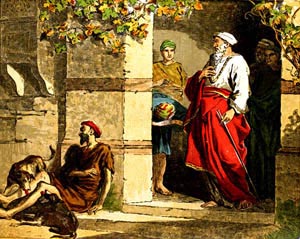
The Rich Man who showed no concern for poor Lazarus may have felt like one of those Rolls Royce players. He “dressed in purple garments and fine linen and dined sumptuously each day,” but nothing in the text indicates that he had defrauded or exploited anyone to obtain his wealth. Maybe he looked at poor people like Lazarus and shrugged, “Some receive what is good in their lifetimes while others receive what is bad,” words that Father Abraham would throw back in his face. Perhaps the Rich Man had not so much perpetrated evils, but rather (ignoring the Scriptures) felt no responsibility to help the less fortunate outside his door.
May the one who reads this—a winner in the coin-toss of life—not be condemned for failing to give alms.
The 2004 film begins quoting Isaiah 53, “He was wounded for our transgressions, crushed for our iniquities; by his wounds we are healed.” Isaiah foretold Christ’s sufferings seven centuries before they came to pass.
We see a full moon, for Passover was always celebrated upon a full moon (similar to how Easter is always the Sunday after the first full moon following spring equinox on March 20th.)
We find Jesus in the garden, praying the psalms to his Father: “Rise up, defend me” (Ps 94) “Save me from the traps they set for me” (Ps 141) “Shelter me, O Lord, I trust in you. In you I take my refuge.” (Ps 16)
Satan appears in the garden; androgynous, attractive, and deathly pale. He speaks doubts to Jesus: “Do you really believe that one man can bear the full burden of sin? No one can carry this burden… No one. Ever. No. Never. … Who is your Father? Who are you?” Jesus never speaks to the devil throughout the film, but here he stands, locks eyes with Satan, and crushes the snake’s head underfoot. This recalls God’s words to the ancient serpent in Genesis 3:15, “I will put enmity between you and the woman, and between your seed and hers; He will strike at your head, while you strike at his heel.”
Awoken from her sleep, the Virgin Mother senses something is awry. She asks Mary Magdalene, “Why is this night different from every other night?” She answers, “Because once we were slaves and we are slaves no longer.” This quotes the traditional dialogue of the Jewish Passover meal ritual.
Given the choice, the crowd calls for the unsavory prisoner Barabbas, a violent revolutionary, to be freed instead of Jesus. “Barabbas” means “Son of the Father.”
At the pillar, Jesus quotes Psalm 108: “My heart is ready, Father. My heart is ready.” In Hebrew, to say “very,” you repeat a word twice. To say something is so in the greatest measure, it is said thrice (e.g. “Holy, Holy, Holy.”) The Romans directing the flogging of Jesus say “Satis / Enough” three times.
Pilate presents the lacerated Jesus saying, “Ecce Homo / Behold (the) man!” The shot is from behind, emphasizing the angry, riotous mob in the background, for these words are a critique of fallen man/mankind.
Pilate asks, “Shall I crucify your king?” The high priest replies, “We have no king but Caesar,” denying the kingship of God.
The 14 Stations of the Cross make appearances throughout the film, including the three times Jesus falls.
Embracing his cross, Jesus alludes to Psalm 116: “I am your servant Father. Your servant and the son of your handmaid.
Mary, recalling when Jesus once fell as a child, rushes to his side. Jesus tells her, “See, Mother, I make all things new,” foreshadowing Revelation 21:5, “Behold, I make all things new.”
Veronica, who gives Jesus her veil to wipe his face, has a name which means “true image.”
Jesus’ experiences at Golgotha are paralleled with flashbacks to the Last Supper. Jesus is stripped, the bread is uncovered. The Host is lifted, his cross is raised.
The Virgin Mary at the foot of the cross calls Jesus, “Flesh of my flesh, heart of my heart…” echoing the words of Adam toward Eve.
On the cross, Jesus quotes Psalm 22: “My God, my God, why have you forsaken me?”
 In today’s gospel, Jesus talks about the scribes and a poor widow. He praises her, but criticizes them. Jesus saw her at one of the Temple’s thirteen contribution trumpets in the court of the women. These were donation chests topped as with tall road cones, but made of metal, with an opening at the top for dropping in coins. The coins of large contributions would make a large racket, like how a slot machine pays out in a casino. But the poor widow’s two coins fell in with quiet: *click* *click*
 The more prosperous nations are obliged, to the extent they are able, to welcome the foreigner in search of the security and the means of livelihood which he cannot find in his country of origin. Public authorities should see to it that the natural right is respected that places a guest under the protection of those who receive him.






 Parishable Items