Archive for the ‘Culture’ Category

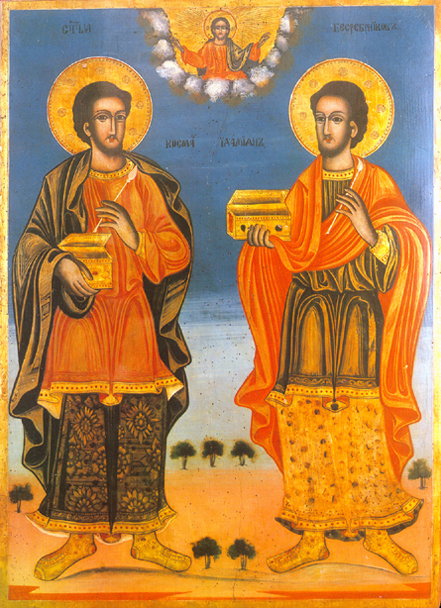
September 24 – Sts. Cosmas and Damien

September 25, 2009

A number of years back, there were two twin brothers, the eldest of a widowed single-mother’s five sons. From their youth, they had a profound love for their Catholic faith and they viewed God’s creations, especially the human body, with great wonder. The two brothers studied medicine and became general practitioners.

Two things made them stand out among other doctors in their profession: first, their willingness to share their Catholic faith with others; and second, their refusal to accept payment for their work.  The two worked for free, pro bono, for the good. They healed the sick, in both body and soul. And they were gratefully admired by many. But then it happened that their government instituted new laws which were contrary to the Catholic faith, offensive to human dignity, and universally binding without exception.

The two brothers might have said to each other, “Our work helps so many people.  If we don’t go along with this we won’t be able to practice medicine anymore. We should compromise, for the sake of the greater good.” However, these two doctors were adamant in their convictions. They understood that if they chose to forfeit their Catholic faith, then they would have nothing else of truly lasting value to offer to anyone. They did not yield, and it cost the two of them their careers, and much more, but the brothers preserved their faith, their clear consciences, and their heavenly rewards in Christ.

You’ve heard of the names of these brothers before, but you’ve probably never heard their story until today. The twin brothers, the two doctors who were unwilling to compromise on their Catholic faith when the Emperor Diocletian decreed in the year 303 that everyone worship idols or be killed, these men are the saints we celebrate today: Saints Cosmas and Damian.

May we learn from their example and benefit from their prayers.

Petitions:


Saints Cosmas and Damian are the patron saints of physicians, surgeons and pharmacists.  Let’s pray for those who care for the sick… We pray to the Lord.

Through the intercession of Saints Cosmas and Damian, may Catholic healthcare workers in our time never have to face a test of faith like theirs because of unjust laws… We pray to the Lord.

Through the intercession Saints Cosmas and Damian, may we have the courage to share our faith in the workplace, by both our silent deeds and our spoken words… We pray to the Lord. 

For my intention in this Mass, for Congress which is now considering amendments to the healthcare bill which would grant conscience exceptions and prohibit the federal government from subsidizing, reimbursing, and paying for abortions, and for your Mass intentions… We pray to the Lord.

25th Sunday in Ordinary Time—Year B

September 20, 2009

Somewhere, in an underground lair, a secret hideout, or a den of iniquity, we find a criminal mastermind, or a mad scientist, scheming a nefarious plot. “Mah-ha-ha-ha,” the villain manically laughs. “Once I unleash my evil plan, evil will conquer the world.”

This is the way of villains as we often find them in comic books. Comic book bad guys love doing evil for evil’s sake. But we should realize that this isn’t why people do bad things in our world. In the real world, nobody does evil for evils sake. Every single person acts to achieve some real or perceived good. Sinners simply go about the pursuit of happiness in wrong ways. Bad people are not bad because they’re trying to do bad things. Unrepentant sinners actually feel justified in what they do.

For instance, in Jesus’ day, influential people said, “That Jesus from Nazareth so obnoxious. Let’s have him condemned and see how he holds up then.  If he’s really holier-than-thou, a son of God, then God will come to his rescue—otherwise he gets what he deserves.” People still rationalize like this today. It’s easy to come up all sorts of reasons for doing bad things rather than what is right:

“Lying? What I said isn’t technically untrue. Besides, it’s only a little white lie.”

“Angry? Is it any wonder that I get so angry when I have to deal with stuff this.”

“Stealing? The way I see it, they make plenty of money, and I deserve more than what they pay me.”

Activities outside of marriage?  “What’s the big deal? It’s all consensual, and nobody’s getting hurt. Besides, we love each other.”

It’s not only “bad people” who say things like this. Each of us fall into embracing lies like these sometimes. But what is the antidote for rationalizing aside our sins? The cure for this is a prayer life with Jesus Christ.

When the apostles came face to face with Jesus inside the house, Jesus began to ask them, “What were you arguing about on the way?” But they remained silent, for they had been discussing among themselves on the way who was the greatest. Coming into Jesus’ presence, who is the embodiment of Truth, the reality of what they had been doing became clear for them. Their false illusions completely faded away, like the smoke from a blown out candle.

We should spend time in conversational prayer with Jesus Christ every day, allowing Him to form us, build us up, and console us. When you receive the encouragement, confidence, and consolation which Christ is eager to give you in prayer, when He acknowledges you as His own brother or sister, as His good friend, as a favored child of His Father, fears dissolve and you live in peace—a peace in which cleverly-devised excuses are no longer sought for and no longer necessary.

Wednesday, 23rd Week in Ordinary Time—Year I

September 10, 2009

In the Gospel Jesus speaks of how great reversals are coming. The poor will become rich, and the rich will be poor. The hungry will be satisfied, and the stomachs of those now feasting will ache. The weeping will find joy, while those joyful will be sad. And those who are persecuted for Christ’s sake will have great rewards.

Does any of this apply to you? Yes, for example, life in the world out there will be very different from these years you’ve spent in school. If you feel like you are among the poor, the hungry, and the weeping at school, take encouragement, because great reversals are coming.

Blessed are you who are poor at sports,
for you perfect more-valuable talents.

Sports are fun, and they are good for building health and character, but ten years from now no one will remember who won at state last year. And it is extremely unlikely that anyone here has a future in professional sports ahead of them. Maybe nobody buys a ticket to come and watch and cheer you using your God-given talents, when you write a paper well, or solve a math problem efficiently. But in the world out there, there are people who will pay tens of thousands of dollars a year to people who have perfected skills like these.

Blessed are you who are poor at sports,
for you perfect more-valuable talents.

Blessed are you who hunger for romantic relationship, but who date little,
for God is preparing a spouse for you.

Realize that it is very unlikely that you ever marry any significant other whom you might have now. Young dating relationships begin and break all the time, but the sometimes wounds they can leave to one’s spirit and to one’s emotions often linger long. You may hunger for romantic relationship now, but if you feast on love before its time your stomach will ache painfully tomorrow. Somewhere out there, God has a future spouse in mind as a gift meant just for you. So preserve your purity and the unwounded integrity of your heart as a gift for your spouse, and you will feast on love together with great satisfaction.

Blessed are you who hunger for romantic relationships, but who date little,
for God is preparing a spouse for you.

Blessed are you who are unpopular,
for you discover how to be a true friend.

It’s true that after high school graduation, you won’t see most of these classmates very much anymore. You might keep in close touch with one or two of them, but most of them will move away from here, or you will move away from them. Don’t mourn thinking that you have too few friends. Christ wills that you would learn how to be a great friend, someone like Himself, rather than someone with great popularity who never knows true friendship. A person with few friends realizes the importance of always showing kindness, respect, and genuineness towards everyone, the popular and the unpopular alike.

Blessed are you who are unpopular,
for you discover how to be a true friend.

 And finally, take consolation in this…

 Blessed are you when peers dislike you,
and when they exclude and insult you,
and denounce you as un-cool or lame
on account of your faithfulness to Christ
for Christ’s opinion is the only one that really matters
and he will reward your faithfulness with happiness.

23rd Sunday in Ordinary Time—Year B

September 6, 2009

Remember what it was like before the dot-com bubble burst? Maybe you heard about tiny internet start-ups having total stock values in the billions and you just knew that that wouldn’t last. Remember the time before the recent housing bubble popped? I remember watching a show on TV called “Flip this House” in which a couple bought a building, put two weeks of work and a few thousand dollars into cleaning it up, and then quickly sold it for several tens of thousands of dollars more than what they bought it. I remember saying to myself then, “This just can’t go on. This isn’t sustainable.”

The thing about economic bubbles is that while you can often read the signs of the times and see that the bubble’s there, you’re never quite sure when it will pop.

For years now, our country has been riding on a similar bubble with the unsustainable spending and borrowing by the federal government. We’re not quite sure when it will finally pop, but you can see that the bubble’s there.  Most of us here will witness firsthand the consequences of its bursting.

The Congressional Budget Office is a non-partisan, independent government agency that provides economic data to Congress. And for years, regardless of whether the Democrats or Republicans were in power, the CBO has consistently reported the unfortunate facts and grim forecasts of our present course. This summer, the CBO published its “Long-Term Budget Outlook.” And they tell us, quote…

“Under current law, the federal budget is on an unsustainable path—meaning that federal debt will continue to grow much faster than the economy over the long run.

Although great uncertainty surrounds longterm fiscal projections, rising costs for health care and the aging of the U.S. population will cause federal spending to increase rapidly under any plausible scenario for current law. […]

Keeping deficits and debt from reaching levels that would cause substantial harm to the economy would require increasing revenues significantly…, decreasing projected spending sharply, or some combination of the two.”

Some or all of the following things will inevitably happen: an increased federal retirement age, decreased retirement benefits from Social Security, decreased health benefits from Medicare and/or Medicaid, increased federal taxes, or (and this seems the most likely) a dramatically increased national debt.

Now understand that an endlessly ballooning national debt is no solution.  It has economic consequences for us. What happens when foreign countries finally decide they are no longer interested in holding any more of our debt (in the form of low-interest yielding U.S. government bonds?) One result will be hyper-inflation, which will negatively impact anyone who uses U.S. Dollars. Unpleasant changes are coming. And they will have real consequences our lives. We will feel their effects.

Maybe hearing me speak about these grim realities feels as if I’ve just spit on your tongue.  It’s unpleasant and a bit repulsive. But my hope and prayer is that you will “be opened” by it, that you will be motivated to prepare yourself for what is coming, to begin living now as we should have already been living as Chrisitians all along.

In the past we have lived beyond our means, just like crowd, just like the government made in our own image. We spent more than we had and we often spent wastefully. But we are called to live differently, to live out Christian stewardship, Christian poverty, or simplicity of life in our own lives. Let’s not wait to hit economic rock bottom before we begin living as we ought to.

We are called to live simply and within our means, free from debt-slavery. We are called to be both frugal and generous, generous and frugal. If we are frugal without generosity, we’re simply being misers. If we are generous without frugality, we are being irresponsible. But if you are both frugal and generous won’t God, who (as the psalmist says) keeps faith forever, who secures justice for the oppressed, who gives food to the hungry, who supports the fatherless and the widow, won’t He provide you with what you need? On the other hand, if we are not frugal and generous, if we do not lovingly support our poor neighbors, those in our parish, throughout the diocese, and abroad, then how can we ask God to support us?

To quote St. James, “Act on this word.  If all you do is listen to it, you are deceiving yourselves.” “Fear not, be strong.” “Be not afraid,” but prepare yourself. Prepare for the days when our accounts will come due.  For a day coming soon in our country, and for the Last Day, when we shall all appear before God.

Tuesday, 21st Week in Ordinary Time—Year I

August 25, 2009

Jesus said,

“Woe to you, scribes and Pharisees, you hypocrites. You pay tithes of mint and dill and cumin, and have neglected the weightier things of the law: judgment and mercy and fidelity. (But) these you should have done, without neglecting the others.”

The Mosaic Law commanded that one tenth of the produce of the land, of the new animals and the harvest, to be given (or tithed) to the priests and the temple. The scribal tradition had apparently extended this law to even the smallest herbs.

Jesus is not criticizing tithing, but rather the focusing on little externals for others to see, rather than on the important things. He is criticizing the practice religion with more interest in appearing holy than in actually and thoroughly being holy.

Have you ever been quietly praying, realized that someone might be seeing you, and then toned down your outward signs of piety? Maybe you wished that you could be invisible, so that nobody could see you, so that you could keep praying as before. We try not to look too holy. It’s good to be humble, and to not be a distraction to another’s prayer, and not to be after the empty praise of men, but how much of our experience, of subduing our outward signs of devotion, is actually really due to fear?

The Pharisees were concerned about other people seeing their acts of devotion so that others would think better of them. But I think our problem is different; we don’t want people to see our devotion, so they won’t think worse of us.

In Jesus’ setting, religious dedication was likely to be admired. Seeing the Pharisees carefully measure out their gifts at the temple an observer might say, “Wow, he even tithes his herbs and spices!  What a righteous son of Abraham!” But in our culture, the opposite of admiration, or contempt, often comes from Christian devotion.  “I heard that he and his wife give 10% to their church every year! Talk about brainwashed, religious kooks!”

If Jesus’ time was disposed to the fault of showy religiosity, ours seems inclined to religious timidity, or cowardice. Consider, how often does the name of Jesus, or the mention of God, leave our lips when we’re outside of Church? Do we pray at home before meals? Good! But what about when we go out to eat at restaurants?

I don’t think that most of us here are in danger of the Pharisees’ sin, of flaunting our piety before others, so much as we are in danger of being ashamed of Christ before men. As Jesus says, “Whoever is ashamed of me and of my words, the Son of Man will be ashamed of when he comes in his glory and in the glory of the Father and of the holy angels.”

We should pray when we eat out at restaurants, just like we do at home. And we would all benefit from more frequent, thoughtful conversations about God and Jesus in our lives. And perhaps, instead of wishing that no one else would see you when you pray, maybe next time we should pray as if we didn’t know that there were people around us at all.

These are just little things, little acts of fidelity, but fidelity is one of the weightier things of the Law.

2nd Sunday of Easter—Year B

August 23, 2009

Jesus said to “Doubting” Thomas, “Have you come to believe because you have seen me? Blessed are those who have not seen and believed.”

This gospel passage has a very fond and special place in my heart, because when I was younger it used to really tick me off. If I had had my choice between either seeing and believing, or not seeing and being blessed, I’d have picked the seeing option every time. But now looking back, I realize  that if Jesus had actually appeared to me in a vision that would have just raised more doubts and questions in me. I once shared my various frustrations about faith and doubt with a priest.  After he had patiently listened, He suggested that perhaps I was going through these kinds of trials so that I could help others through similar trials someday.  At the time, that also ticked me off… but he was right. I hope that six lessons I’ve learned in the years since will be of help for you today. Today the Church celebrates Divine Mercy Sunday, but on account of Doubting Thomas one might also call it Doubter’s Sunday. I feel a lot of mercy for the doubters out there, and Jesus does too.

Lesson One:  Jesus does not condemn the honest doubter, the sincere questioner, the genuine seeker.

When Jesus appears to doubting Thomas notice that he is not angry with him.  He says, “Peace be with you!”  Then he says, “Put your finger here and see my hands, and bring your hand and put it into my side, and do not be unbelieving but believe.” The Gospel does not say whether Thomas actually took Jesus up on touching his wounds, but Jesus was not patronizing him when he made the offer—it was an sincere invitation that met Thomas where he was at.

Still today, Jesus is not angered by our honest questions.  In fact, it is a compliment to him to ask tough questions of our faith because it shows that we believe there are good answers out there to be found. Honest questions make our faith stronger, not weaker. However, our questioning must be sincere. We must not build a comfortable home upon our doubts, doing nothing to answer or resolve them. This sort of questioning is not sincere, but often self-serving.  Jesus wants to give to those who ask, to reveal to those who seek, to open for those who knock, so that they will not be unbelieving, but believe.  But, when we refuse to ask, or to seek, or  to knock, we frustrate the Lord.  Jesus is pleased, however, by the genuine seeker because the genuine seeker will find him.

Lesson Two:  Having beliefs is unavoidable and our faith is reasonable.

Some people object to faith saying that “reason” or “science” is certain while “belief” is doubtful.  But in reality, all of our knowledge depends upon trusted beliefs. We cannot live, or even reason, without accepting beliefs. Before the scientist calmly walks across the street he assumes a thousand things without certain proof of them. We can learn many valuable things from science, but science itself cannot prove all of its own assumptions. There are even questions that science cannot answer, such as the transcendent goodness, worth, or purpose of things. Our faith answers such questions and our faith is not unreasonable. Our true faith is no more in conflict with reason than the truth could contradict the truth. Not everyone shares our faith, but you cannot live as fully alive without it.

Lesson Three:  If you ever worry about whether you really believe in God, you shouldn’t be worried.

Some people experience real spiritual anxiety when they ask themselves, “Do I really believe in God?” Realize this: people who don’t believe in God, don’t spend time worrying about whether they believe in God. Only a believer would do that. So if you ever worry about your belief in God, you shouldn’t be worried; you’re actually a believer and your mind should be at ease.

Lesson Four:  You already have enough faith to do what Jesus asks of you today.

Some people say, “I believe in Jesus Christ, but I just don’t have enough faith to do what he wants me to do.” These people experience a spiritual paralysis: they’re waiting for faith to show up, before they’ll take the next step in living the Gospel, whatever that might be. They’re actually psyching themselves out. They are like the apostles who once begged the Lord, “Increase our faith!” Jesus told them if they had faith the size of a mustard seed they could uproot trees or mountains with a word and plant them in the sea. At first this might seem like a word of discouragement, but it is actually a word of hope. Your tiny, microscopic speck of faith is already enough for you to accomplish everything Christ asks of you today. Your faith right now may be only a pinhole-sized trust in him, but the God who can fit a camel through the eye of a needle can pour a river through your pinhole-sized faith. You already have enough faith to do what Jesus asks of you today.

Lesson Five:  Faith grows through being exercised.

We often keep very low expectations of God.  Maybe we think that if we don’t expect too much from him he won’t expect too much from us. Or maybe we think we won’t be disappointed by him, if we never get our hopes up. In this way our faith stays small. Our faith, which is our openness to the Gospel and our trust in Jesus Christ, remains small and weak because our faith is so rarely exercised. Do we really want to come to the end of our lives and have to look back and wonder what our lives could have been if we had committed ourselves more completely to Jesus Christ and his Gospel?

Consider this question:  If you had all the faith in the world, how would you pray, what would you pray for, and what would you do? If you want to see you faith grow, if you want to see the power of Jesus Christ active in your life, then try doing these things today.

Now sometimes Christ comes out of nowhere and powerfully reveals himself to those who have never really striven for him, or even looked for him, but it is more often the case with Christ that the more we give him the more we get. Imagine you hold in your hand seeds which symbolize your life; your time, your talents, and your treasure. You received all these seeds from Christ as pure gift. As long as we cling to the seeds in our hand, they will never bear fruit. But once we begin letting Christ plant these seeds, and we see the good fruit they produce, we will eagerly give him more and more. In this way, our faith grows through being exercised.

And finally, the sixth lesson:  Faith is about trusting in Jesus Christ.

Faith is not so much about generating a certain feeling, or a feeling of certainty, about particular facts.  The demons know that Jesus is Lord—and shudder. Faith is more about trust, trusting in a person who is worthy of our trust, Jesus Christ. Living-out such trust requires a personal relationship of knowledge and love with him.

What might be holding us back in the life of faith could be that we have unresolved sins, past and present, impeding our relationship with Christ. This Divine Mercy Sunday we celebrate the infinite mercy God shows toward all those who ask for it. Through the sacrament of reconciliation, we can receive a fresh start, a clean slate, an infusion of grace, a healing of the heart and mind, a full restoration of personal relationship with Jesus Christ.

Whenever I go to confession, I encounter Christ through the priest, like Thomas encountered Jesus in the upper room. Jesus enters into the locked inner room of my heart, where I would otherwise hide out of fear on account of my sins. I see his wounds, I admit the ways that I helped to put them there, and I tell him I’m sorry. And his response is always the same: mercy. “Peace be with you. Your sins are forgiven.” Confession gives us pardon and peace, it increases our trust and love for Jesus Christ, and strengthens our faith in him.

This Divine Mercy Sunday, let us pray the prayer that he has given us for our uncertain times: “Jesus, I trust in you.”
August 14 – Vigil of the Assumption of Mary

August 17, 2009

When I was younger, I used to wonder why Mary was such a big deal. It wasn’t that I was against her or anything. I prayed Hail Mary’s to her, and I wasn’t out to deny anything our Church said about her. I just didn’t understand why we, as Catholics, honored her so much.

Some people say that Mary is no big deal, that she’s just another Christian.  They might point to today’s Gospel as evidence, where a woman from the crowd calls out to Jesus, “Blessed is the womb that carried you, and the breasts at which you nursed.”  And Jesus replies, “Rather, blessed are those who hear the word of God and observe it.” “So you see,” they would say, “it’s nothing special to be the mother of Jesus.” But in this Gospel Jesus is not denying Mary’s greatness, He is rather affirming it.

If Mary had merely been the biological mother of Jesus, delivering Him, and nursing Him, she might have been just another Christian. But Mary is most blessed among the disciples of Christ, of which she is the first, because she heard the word of God and observed it. She heard the word of God from the angel Gabriel and answered,

“Behold, I am the handmaid of the Lord. Let it be done to me according to your word.”

The overwhelming evidence for Mary’s exceptional glory, and her unique loveliness, is to be found throughout the Bible. The two Testaments, the Old, together with the New, show us why Mary is worthy of our great admiration and deserving of our special affection.

In the first reading we heard of the ark, the ark of the covenant, which you may remember seeing in Indiana Jones and the Raiders of the Lost Ark.  The ark was a wooden box, plated with gold inside and out, with two gold statues of winged angels on its lid.  This box, the ark, was carried about using two long polls, since men would be struck down if they touched the holy ark. The ark bore the presence of the Lord, it was His throne amidst His people.

The Lord had told Moses, who constructed the ark, according to the Lord’s precise specifications, to have some interesting things placed inside of it.  First, the wooden staff of Aaron, which had miraculously grown shoots and blossoms. Second, the two stone tablets inscribed with the Ten Commandments which were written by God’s own hand. And third, an urn full of manna, the food which the Lord had given his people to eat during the Exodus.

That was the ark of the Old Testament.
Mary is the ark of the New Testament.

As the ark was a box of wood, plated with precious gold, inside and out, so Mary was a human being, surrounded and filled with divine grace. Like the dead wood of Aaron’s staff, which (naturally speaking) should not have borne life, the Virgin Mary miraculously blossomed life within her. Unlike the written word of God in stone, Mary carried within her the eternal Word of God in flesh. Mary borne within herself the true bread from heaven, Our Lord Jesus Christ.

In the first reading we heard how David led the ark of God’s presence into Jerusalem.  The ark’s coming to Jerusalem is also commemorated in the psalm we heard.  Jerusalem is sometimes poetically referred to as Zion, since Mt. Zion was the place of the temple in Jerusalem.

Just as the Lord’s presence came into Zion, the presence of the Lord came to dwell in Mary. Nine times out of ten, whatever Scripture says of Zion or Jerusalem, also goes for Mary. Mary is Jerusalem.  She is Zion.

“For the Lord has chosen Zion;”
says the Psalm
He prefers her for his dwelling.
Zion is my resting place forever;
In her will I dwell, for I prefer her.”

And, nine times out of ten, whatever can be said of Mary, also applies to Christ’s Church. Mary is the icon of the Church.

So, as you can see, Mary is a big deal. And none of us is more admirable, praiseworthy, and sweetly loveable than her.

‘Therefore her heart is glad and her soul rejoices,
her body, too, abides in confidence;
because God did not abandon her soul to the netherworld,
nor would He suffer His faithful one to undergo corruption.’

He assumed His beloved into heaven. Thanks be to God, who gave Mary this victory over death, through her Lord and ours, Jesus Christ.

August 6 – The Transfiguration

August 17, 2009

Today, Peter, James and John see Jesus in a new light. The light they see does not shine on their teacher from another source. This light originates from within the person of Jesus Himself. At the Transfiguration, these apostles come closer to realizing Jesus’ full glory and dignity; that He is more than a teacher, more than a miracle worker, and more than the messiah. He is divine, the Son of the Ancient One.

We are human, not divine, but Christ wants to divinize us. He wants to make us more like God. Coming to appreciate who Jesus really was changed how the apostles related to Him. In the same way, knowing that everyone you meet will someday be transformed should influence how you relate to them.

My closing words come from C.S. Lewis and his book, The Weight of Glory:

“It is a serious thing to live in a society of possible gods and goddesses, to remember that the dullest and most uninteresting person you can talk to may one day be a creature which, if you saw it now, you would be strongly tempted to worship, or else a horror and a corruption such as you now meet, if at all, only in a nightmare.

All day long we are, in some degree, helping each other to one or other of these destinations. It is in the light of these overwhelming possibilities, it is with the awe and the circumspection proper to them, that we should conduct all our dealings with one another, all friendships, all loves, all play, all politics.

There are no ordinary people. You have never talked to a mere mortal. Nations, cultures, arts, civilization—these are mortal, and their life is to ours as the life of a gnat. But it is immortals whom we joke with, work with, marry, snub, and exploit—immortal horrors or everlasting splendors.”

20th Sunday in Ordinary Time—Year B

August 17, 2009

Fifteen years ago this summer, a movie hit theaters about a man with a below average intelligence who lives an above average life. Forrest Gump was the biggest movie of 1994, won the Oscar for Best Picture, and it is still entertaining to watch today.

When someone would ask Forrest, “Are you stupid or somethin’,” he would politely answer, “Stupid is as stupid does, sir.”

I have to admit that years passed before I mentioned to my dad that I really didn’t know what those words meant, which made me feel pretty stupid, but then my father taught me. “Stupid is as stupid does” means that even if you’re very intelligent, if you do foolish things, then you’re a fool. On the other hand, if you’re not that bright (like Forrest), but you act with wisdom (like Forrest did), then you are wise.

You can see this illustrated in the lives of Forrest’s friends: Jenny and Lt. Dan. They both have I.Q.’s well above Forrest’s, but they waste many years of their lives on foolishness. Lt. Dan isolates himself in the big city. He’s lost in bitter, alcoholic, self-indulgence. Jenny, goes out wandering far and wide to find happiness. She’s lost exploring all the romantic and chemical imposters of happiness. But, what eventually saves them both, what brings them both back, is Forrest’s steadfast love for them; his loving and generous gift of himself.

Forrest didn’t realize it, but his love was drawing his friends to wisdom and life. He’s like Lady Wisdom in the first reading. She joyfully calls and welcomes everyone to her feast:

“Let whoever is simple turn in here;
To the one who lacks understanding, she says,
Come, eat of my food, and drink of the wine I have mixed!
Forsake foolishness that you may live;
advance, in the way of understanding.”

Wisdom speaks to us today, but where is this meal prepared for us?

Before answering that, we first turn to today’s Gospel, where Jesus tells the people that they must eat his flesh and drink His blood. And He really means it too. In relating the teaching of Jesus today, John’s Gospel employs a Greek word over and over again, which is translated for us as “to eat” or “to feed.” However, the word’s meaning in the Greek is more literal than that; it means “to munch” or “to gnaw.” Therefore, more accurate translations of Jesus’ words would be this:

“Whoever ‘munches’ my flesh and drinks my blood remains in me and I in him,” and, “Whoever ‘gnaws’ my flesh and drinks my blood has eternal life, and I will raise him on the last day.”

The meal where we do this, is here, at the Mass. At Mass we truly receive, alive and whole, the body, blood, soul, and divinity of Jesus Christ.

Where is wisdom’s feast for us? It is here, at the Mass. At Mass we grow in wisdom whenever we worthily receive the Eucharistic Christ, because when we receive Him, we become more like Him. As Jesus says, “Whoever eats my flesh and drinks my blood remains in me and I in him.” We also grow in wisdom at Mass by hearing God’s teachings, through the Scriptures and the preaching we hear.

But something that you may never have ever realized, something you may never have been told, is that we can also grow in wisdom at Mass through witnessing the example of Jesus Christ set before us. At the Last Supper, Jesus offers up His body and blood, and tells His disciples, “Do this in remembrance of me.” He wants us to do what He is doing. This means that we are not only to continue celebrating the Mass until He comes again. We are to imitate, in our own lives, the sacrifice we see.

We are all called to steadfast love, for God and for other people, by making a loving, and generous gift of ourselves each day for them. Christ commands us to make a sacrificial offering of ourselves for those we work for, for those we care for, for those we love, for those we happen to be around, for Him and for all people. By this sacrifice, our sacrifice united with Christ’s own sacrifice, we will be saved, and we will help to save others, too, by drawing them to wisdom and life.

As Forrest Gump would say, “You don’t have to be a smart man to know what love is.” At Mass, Jesus teaches us wisdom; He shows us what love looks like.