Archive for the ‘Politics’ Category

False Paths to Paradise

July 9, 2020

Early in the Book of Genesis we read about a great flood wiping out humanity (sparing only Noah, his three sons, and their wives) and then about people building a great city and high tower until God confounds their efforts. These two inspired tales hold important lessons for every society in history, including our’s today.

When God saw how wicked the human race was he decided to pour down judgment on the earth and start over. So he told Noah, the best of men, to build an ark for his family to survive. Once the floodwaters had receded, “God blessed Noah and his sons and said to them: Be fertile and multiply and fill the earth.” This was to be Eden anew. But when Noah drank wine to excess and became drunk he was somehow violated by his son while laying naked inside his tent. The flood was meant to cleanse the earth of sin, but sin stowed away upon the ark.

Then, after detailing Noah’s descendants, Genesis tells how people said, “Come, let us build ourselves a city and a tower with its top in the sky, and so make a name for ourselves!” The Lord said, “If now, while they are one people and all have the same language, they have started to do this, nothing they presume to do will be out of their reach.” God confused their language so that they stopped building the city and scattered across the earth. Why did God react this way? That city is called Babel because God made them babblers but also likely in reference to ancient Babylon, the enemies of God’s people who had high towers called zigguratts on which they worshiped false gods and offered human sacrifices. God thwarts Babel to limit the evils they can accomplish.

The tales of the Great Flood and the Tower of Babel reflect two ineffective strategies for eradicating evil: purging all the wicked and uniting everyone apart from God. Our world seeks scapegoats, persons and groups to blame for our problems. “If only it were all so simple,” writes Aleksandr Solzhenitsyn. “If only there were evil people somewhere insidiously committing evil deeds, and it were necessary only to separate them from the rest of us and destroy them. But the line dividing good and evil cuts through the heart of every human being. And who is willing to destroy a piece of his own heart?” Our world also clamors for greater unity in one leader or party, nation or race, economic system or secular ideology. We must not ignore politics, realizing that a movement detached from God and sufficiently empowered will lead people to physical and spiritual deaths.

God’s desire is to unite all peoples in Christ, undoing Babel with Pentecost. The Church, Christ in his members, is sent to save our world through conversion rather than destruction “for God did not send his Son into the world to condemn the world but that the world might be saved through him.” Sin and sinners must be opposed but not without the love which we ourselves have received as sinners reconciled to God. Take courage today by recalling the conversions of Saul and the Romans Empire, Christianity’s early enemies – by grace and virtue the Church can win over even her worst persecutors.

“The Prince” or the Christ? — 18th Sunday of Ordinary Time—Year C

August 3, 2019

In the 6th century B.C., the Romans had a king named Tarquin the Proud who declared war on a city eleven miles east of Rome called Gabii. When the king was unable to take the city by force, he plotted to take it by deception. His son, Sextus, pretending to be ill-treated by his father and bearing fresh wounds from being flogged, fled to Gabii. The infatuated inhabitants entrusted him with the command of their troops, and when he had obtained the full confidence of the citizens, he sent a messenger to his father to learn what he should do next. The king, who was walking in his garden when the messenger arrived, spoke no words, but kept striking off the heads of the tallest poppy plants with his stick. His son understood the unspoken reply, and put to death or banished on false charges all the leading men of Gabii, after which he had no difficulty in compelling the city to submit to his father.

I was reminded of this story of political power and deceitful scheming this week while listening to Niccolò Machiavelli’s 16th century Italian book, “The Prince.” In this pragmatic, cynical treatise, Machiavelli discusses how a ruler can most effectively rule his realm. For example, upon conquering another king or noble’s territories, Machiavelli recommends exterminating that ruler’s family members to prevent future revolts. Machiavelli also encourages leaders to always appear merciful, faithful, humane, sincere, and religious to appear so but not always be so, because he holds that no ruler can be successful without, at times, deliberately doing evil as circumstances require.

Machiavelli provides numerous historical illustrations, like the story of an Italian ruler whose newly acquired territory was full of corruption, robbery, and violence. He appointed a cruel and efficient man as their governor, entrusting him with full authority to act. This governor quickly restored order with his iron fist, but then his lord had less use for him and saw him as a possible threat. Machiavelli writes that the ruler, “to clear himself [of guilt] in the minds of the people and make them entirely loyal to him, … desired to show that if any cruelty had been practiced it had not originated from him but came from the personal cruelty of the governor. Under this pretense [he arrested the governor] and one morning had him killed and left in [the city square] with the block and a bloody knife at his side. This terrible sight,” writes Machiavelli, “caused the people to be at the same time satisfied and worried.”

Listening to his stories, hearing his advice, I wondered what sort of person would ever want to be such a prince or ruler. Besides the iniquity, Machiavelli himself acknowledges that the prudent leader, when not fighting wars, should constantly focus on preparing for wars. But like King Solomon asks in our first reading, ‘what profit comes to [a ruler] from all the toil and anxiety of heart with which he has labored under the sun? Even at night his mind is not at rest. This is vanity.’ And furthermore, like Jesus says, ‘What does it profit a man to gain the whole world and lose his soul?’

Machiavelli’s advice and methods for maintaining power by any means might work in one sense here in this world, but in the long term all these things are futile. The rich fool says to himself, “Now as for you, you have so many good things stored up for many years, rest, eat, drink, be merry!” But God says to him, “You fool, this night your life will be demanded of you; and the things you have prepared, to whom will they belong?” Thus will it be for all who store up treasure for themselves but are not rich in what matters to God.

Jesus once asked, “What king marching into battle would not first sit down and decide whether with 10,000 troops he can successfully oppose another king advancing upon him with 20,000 troops? But if not, while he is still far away, he will send a delegation to ask for peace terms.” That’s simply basic strategy, yet how many people march towards the inevitable end of their lives — when they will approach the all-powerful King of kings and the Lord of hosts — without consideration of how ill-prepared they are to face him?

Who and what are we loving? And are we loving them as we should?

St. Paul is often quoted from his 1st Letter to Timothy as saying, “The love of money is the root of all evils, and some people in their desire for it have strayed from the faith and have pierced themselves with many pains.” But something about this passage never made sense to me. Does the root of all evil really reside in the love of money? For instance, does every act of adultery stem from a love of money? I don’t think so. But while studying Greek in seminary I discovered that this passage can be justifiably translated a different way: “The love of money is a root of all evils,” and that is very true.

Money, wealth, is a tool, like fire. It’s a neutral thing; good when used rightly but potentially destructive and deadly when mishandled. The love of money, that is to say greed, is rightly called “idolatry” by St. Paul in our second reading, because the greedy person serves and trusts in wealth as their god, their savior and source of blessings. While urging us never to worry, our Lord does call us work, to make material provision for ourselves and our households. St. Paul taught the Thessalonians that “if anyone was unwilling to work neither should that one eat.” And on another occasion he wrote, “whoever does not provide for relatives and especially family members [of his household] has denied the faith and is worse than an unbeliever.” Yet Jesus does not wish us to make work and wealth our idol: “Take care to guard against all greed, for though one may be rich, one’s life does not consist of possessions.”

One day, perhaps sooner than we imagine, our lives will be demanded of us and all the property and possessions we leave behind will be left to others. It is a good thing for us to have a will prepared for this foreseeable event, and I would ask you to remember St. Paul’s Parish and our endowment in your estate. But as praiseworthy as it is to prepare inheritances for that day, it is not as meritorious as giving during your lifetime. How much generosity is there in giving away what you cannot possibly take with you or keep? How generous is it to give away what is no longer of any use to you? Unavoidable giving is a small sacrifice and exercises small trust in God.

And so I recommend to you the practice of tithing, to the Church and to charities. Chose some percentage to tithe to the mission of Jesus Christ in our parish, for needs in our community, and to help people far beyond. In the Old Testament, God commanded his people to tithe 10% of everything, and they were much poorer than us. I urge you to prayerfully discern a number for yourself. Giving in this way practices trusting in the Lord and allows him to show you his providence and his power to provide. Though we do not believe in a “prosperity gospel” which claims believers will never experience trials, Jesus does promise a prize for our every given gift: “Give and gifts will be given to you; a good measure, packed together, shaken down, and overflowing, will be poured into your lap. For the measure with which you measure will in return be measured out to you. … And whoever gives only a cup of cold water to one of these little ones to drink because he is a disciple—amen, I say to you, he will surely not lose his reward.”

Our short life here on earth is an audition and a training ground for life in the Kingdom of Heaven. Through his gracious, saving work, Jesus Christ has extended an invitation to everyone to become a citizen of his Kingdom, now and in the age to come. Presently here on earth, his Kingdom, the City of God and her citizens, exist alongside and amidst the City of Man with its Machiavellian-minded members. But in the coming age, there will be no place for those sinners who live for themselves, and the virtuous meek who are generous to God and their neighbor shall inherit the earth. The choice before us all is for “The Prince” or for the Christ.

Faithful Citizenship

October 31, 2018

This Tuesday, November 6th, we can promote the good for our society by voting in the midterm elections. Not only is voting our great right as Americans, it is also our duty as Catholics. As the Catechism teaches, “co-responsibility for the common good make[s] it morally obligatory… to exercise the right to vote…” (CCC #2240)

Though the Catholic Church participates in the political process as a moral voice in the public square, she does not institutionally endorse candidates or political parties. Within the Church, clergy and laity have different but complementary roles. The calling of the clergy is to preach the Gospel message so that all may properly form their consciences. The mission of lay people is to transform politics and culture.

As Pope Benedict XVI once said, “The Church is not a political power, it’s not a party, but it’s a moral power. Since politics fundamentally should be a moral enterprise, the Church in this sense has something to say about politics.” In their recent document on “Forming Consciences for Faithful Citizenship” the U.S. bishops highlight these nine fundamental moral issues particularly pressing at this time:

■ The ongoing destruction of over one million innocent human lives each year by abortion.

■ Physician-assisted suicide.

■ The redefinition of marriage – the vital cell of society – by the courts, political bodies, and increasingly by American culture itself.

■ The excessive consumption of material goods and the destruction of natural resources, which harm both the environment and the poor.

■ The deadly attacks on fellow Christians and religious minorities throughout the world.

■ The narrowing redefinition of religious freedom, which threatens both individual conscience and the freedom of the Church to serve.

■ Economic policies that fail to prioritize the poor, at home and abroad.

■ A broken immigration system and a worldwide refugee crisis.

■ Wars, terror, and violence that threaten every aspect of human life and dignity.

As a mighty wave is made of many single drops, please cast a vote this week for the common good.

Call No Man Father?

June 19, 2018

Was it unchristian for our country to celebrate Father’s Day last Sunday? That’s one implication of a common criticism raised against the Catholic Church. Sometimes Protestants chide us, “Jesus said, ‘Call no one on earth your father; you have but one Father in Heaven,’ so why do you Catholics call priests and popes ‘Father?’” Yet this charge could also be raised against St. Paul who writes in his Letter to the Romans of “our father Abraham” and “our father Isaac.” What’s more, St. Paul is moved by the Holy Spirit in his First Letter to the Corinthians to assert himself as their spiritual father: “Even if you should have countless guides to Christ, yet you do not have many fathers, for I became your father in Christ Jesus through the gospel.”

So what is Jesus saying in his teaching on titles (father, master, rabbi/teacher) in Matthew 23? Judging from the whole of the New Testament, our Lord’s concern is not with labels or hierarchy in themselves (for “he called his disciples to himself, and from them he chose Twelve, whom he also named Apostles.”) Jesus is warning us against the fallen, human attitudes that we can attach to positions and titles of authority and honor. Jesus says, “You have one teacher… you have but one Father in Heaven… you have but one master, the Messiah.” We must not allow anyone (be they a noted thinker, politician, celebrity, employer, or parent) to displace or compromise God’s primacy in our lives. Embracing a teaching or custom against our Faith is to worship an idol instead of God. And Jesus says “you are all brothers…. The greatest among you must be your servant.” So whenever we are called into a position of influence (be it as a parent, pastor, politician, or what have you) we must remain humble and glorify God while serving him and our neighbors.

The Venerable Servant of God Bishop Fulton Sheen once observed, “There are not a hundred people in America who hate the Catholic Church. There are millions of people who hate what they wrongly believe to be the Catholic Church — which is, of course, quite a different thing.” Our Faith has good answers to offer anyone who cares enough about the truth to simply look or listen. So do not fear religious conversations with your family, friends, or peers. You’ll both learn more along the way and you could very well help them into the fullness of Jesus’ Catholic Church.

Our Light Amid the Darkness

March 3, 2018

America, shaken and grieving unprecedented violence; divided by animosity and racial tensions; politicians seeking to remove the president through impeachment; these are descriptions of the United States 150 years ago.

While still reeling and mourning from the deaths of more than 600,000 Civil War combatants, there was fierce contention over how harshly the North should treat the vanquished South and what rights should be accorded to former slaves. The political polarization was so great that, this week in 1868, the president was impeached by the U.S. House of Representatives. (Pres. Andrew Johnson would go on to remain in office, being acquitted in the U.S. Senate by a single-vote margin.) They were dark, troubled times in our country. Meanwhile, a new source of light was being lit among us from across the ocean.

On March 3, 1868, a decree of Pope Pius IX established two dioceses within the twenty-year-old state of Wisconsin: La Crosse and Green Bay. For the fifteen decades since, under the stewardship of ten bishops, our diocese has been advancing the Kingdom of Christ. We established churches, schools, and institutions. We proclaimed the Gospel and celebrated our living Faith. Great good was done and many souls were saved.

We can easily get discouraged by the evil we see in current events. But even amid tragedy and trials our great, fruitful, saving work goes on — often quietly and unnoticed. It has always been so. “For behold, the Kingdom of God is among you.” (Luke 17:21)

The Diocese of La Crosse — Founded March 3, 1868

Jesus Christ, the Center of History

December 25, 2017

If you had walked through the streets Bethlehem or Rome asking people on the first Christmas Eve, “What year is this,” the answers you’d hear might vary. The Sun numbers our days, the Moon tracks our months, and the seasons indicate the passage of years, but answering what year it is requires people to make reference to some shared historical event.

If you had bumped into one of the ancient world’s many sports fans on the first Christmas Eve, they might have told you that it was 3rd year of the 194th Olympiad. Once every four years, famous athletic competitions were held in Olympia, Greece. Freeborn Greek men would compete in footraces, chariot races, wrestling matches, javelin tosses, discus throws, and other events; for the honor of the Greek god Zeus, for the pride of their home city-states, and for their own personal glory. The winners received crowns or wreaths made of green olive leaves that would fade. All that remains of some of those ancient sports superstars today are their names in texts read less often today than last month’s newspapers.

If you had run into a merchant on the first Christmas Eve who used the Roman coins and roads to trade goods, he might have said that it was 752nd year since the founding of the City of Rome. Considering the wealth and influence of Rome at that time, it might have seemed like that empire would live and reign in the world without end. However, from decay within and barbarian attacks from without, much of what that empire built remains today, if at all, only as ruins for tourists.

If you had encountered someone enamored with power and celebrity on the first Christmas Eve, they might have answered that it was 42nd year of the reign of Emperor Caesar Augustus. It was a census he decreed that sent Joseph and Mary to Bethlehem. Early in his reign, Caesar Augustus claimed that the passage of Halley’s Comet over Rome was the spirit of his predecessor, Julius Caesar, rising into heaven. And so, since Julius Caesar had been a god, Caesar Augustus, as his heir, presumed to call himself “the son of a god.” Caesar Augustus would go on to die at age seventy-five and never be heard from again.

If you had spoken on the first Christmas Eve to someone focused on the politics and current events of the land of Israel, they might have replied that it was 38th year of the reign King Herod the Great, the King of Judea under the Romans. Herod the Great was a very controversial figure, with some Jews praising him and still more despising him: he expanded and gloriously refurbished the Temple in Jerusalem but was also a murderous tyrant, like when he ordered the deaths of the innocent baby boys in Bethlehem. Because the Roman Senate had appointed him as “the King of the Jews,” and since he was not descended from King David, nobody mistook Herod for being the Christ.

On the first Christmas Eve, some two thousand and eighteen years ago, only a handful of people on earth had any clue of the world-changing significance of what was about to occur. The baby born that night was the source of the universe and the center of human history.

In the year we call 525, a new way of numbering years was introduced by a monk named Dionysius the Humble. Dionysius numbered years using this baby’s birth as the starting point, naming it “1 A.D.” A.D. stands for the Latin phrase “anno Domini / in the year of our Lord.” 1 A.D. was dubbed the first year of our Lord on earth, and this is currently the 2,017th year of our Lord, Jesus Christ. Now I should mention that Dionysius has reason to be humble here as well. He estimated the time of Jesus’ birth as best as he could, but he seems to have been a little bit off. The best evidence today points to Jesus being born in 2 or 3 B.C. But regardless, it is most fitting that we mark and celebrate the birth of Jesus Christ as the center of human history and the most important person who has ever lived.

  • Christ is the undefeated champion whose glory does not fade. Even when he seems to be down, he triumphs in overtime. (And, unlike Aaron Rodgers, “not one of his bones shall be broken.”)
  • Christ’s holy kingdom has outlasted the Romans. In fact, he conquered them peacefully by converting their hearts. And today, his kingdom extends to all lands and people through his Holy Catholic Church.
  • Christ is greater than Caesar, he is stronger than death. When Jesus died, he rose again. And now he reigns, because he is truly the Son of God.
  • Christ is the King of Kings and Lord of Lords. He is our leader untainted by sin, who is truly wise, and cares about me and you.

Even those without any Christian faith must acknowledge Jesus’ positive influence on the world: in children treasured; in women respected; in slaves freed; in strangers welcomed; in millions and millions fed, clothed, treated, or taught, around the world and across centuries, all because of the baby born on Christmas.

A.D. does not stand for an “Arbitrary Date.” Anno Domini is no accidental demarcation of before and after. Jesus Christ merits more than our apathetic dismissal. Jesus deserves to be at the center of our years and the center of our lives. As he, this Christmas night, so humbly gives himself to you, please give yourself to him anew. He is the Christ, yesterday and today, the beginning and the end, the Alpha and Omega, all time belongs to him and all the ages; to him be glory and power, through every age and forever, in you and in me. Amen.

America’s Greatness

July 5, 2017

In 1956, Peter W. Schramm’s family fled communist oppression in Hungary. The 10-year-old Peter asked his father, “But where are we going?” His father said, “We are going to America.” “Why America,” Peter prodded. His father replied, “Because, Son, we were born Americans, but in the wrong place.”

Other nations have been self-defined by their ancestral blood, but America has united people from all around the world. Other nations have self-identified by their ancient soil, but our country could fully incorporate other lands that desired to join our states. America is unique because America is founded upon an idea: “We hold these truths to be self-evident, that all men are created equal, that they are endowed by their Creator with certain unalienable Rights, that among these are Life, Liberty and the pursuit of Happiness.” These providential words echo the great Christian doctrine of universal human dignity.

Where America has failed to embody these words, those are our greatest shames; such as our past crimes against Native and African Americans, and against unborn Americans today. Yet wherever we have honored and defended human dignity, those represent our proudest accomplishments; including our abolition of slavery, our liberty and legal equality at home, and our defense and liberation of peoples abroad.

When some people are asked what makes America great they cite our wealth and military power. But if these alone were our criteria for greatness, then the Roman Governor Pontius Pilate would be a great man and Jesus the Nazarene would not. The true measure of our greatness, like all true greatness, comes from our likeness to the Lord. May God bless America to be a greater, fuller blessing to all, until Jesus Christ returns and his kingdom is perfectly established on earth.

Frequently Asked Questions About Religious Liberty

June 28, 2017

Excerpted from the U.S. Conference of Catholic Bishops

What do we mean by religious liberty?

In Catholic teaching, the Second Vatican Council “declare[d] that the human person has a right to religious freedom. This freedom means that all men are to be immune from coercion on the part of individuals or of social groups and of any human power, in such wise that no one is to be forced to act in a manner contrary to his own beliefs, whether privately or publicly, whether alone or in association with others, within due limits.” Religious liberty is protected in the First Amendment to the U.S. Constitution and in federal and state laws. Religious liberty includes more than our ability to go to Mass on Sunday or pray the Rosary at home; it also encompasses our ability to contribute freely to the common good of all Americans.

What is the First Amendment?

The First Amendment to the U.S. Constitution states the following: “Congress shall make no law respecting an establishment of religion, or prohibiting the free exercise thereof; or abridging the freedom of speech, or of the press; or the right of the people peaceably to assemble, and to petition the Government for a redress of grievances.”

What does “shall make no law respecting an establishment of religion” mean?

This phrase, known as the “Establishment Clause,” began as a ban on Congress’ either establishing a national religion or interfering with the established religions of the states. It has since been interpreted to forbid state establishments of religion, governmental preference (at any level) of one religion over another, and direct government funding of religion.

What does “prohibiting the free exercise thereof” mean?

This phrase, known as the “Free Exercise Clause,” generally protects citizens and institutions from government interference with the exercise of their religious beliefs. It sometimes mandates the accommodation of religious practices when such practices conflict with federal, state, or local laws.

What did our early American leaders say about religious freedom?

George Washington, 1789: “The conscientious scruples of all men should be treated with great delicacy and tenderness; and it is my wish and desire, that the laws may always be extensively accommodated to them…

Thomas Jefferson, 1809: “No provision in our Constitution ought to be dearer to man than that which protects the rights of conscience against the enterprises of the civil authority.”

James Madison, 1785: “[W]e hold it for a fundamental and undeniable truth that religion, or the duty which we owe our Creator, and the manner of discharging it, can be directed only by reason and conviction, not by force or violence. The Religion then of every man must be left to the conviction and conscience of every man; and it is the right of every man to exercise it as these may dictate.”

 What have recent popes said about religious liberty?

Pope St. John Paul the Great, 1996: “[T]he most fundamental human freedom [is] that of practicing one’s faith openly, which for human beings is their reason for living.”

Pope Benedict XVI, 2011: “[Religious freedom] is indeed the first of human rights, not only because it was historically the first to be recognized but also because it touches the constitutive dimension of man, his relation with his Creator.”

Pope Francis, 2015: “American Catholics are committed to building a society which is truly tolerant and inclusive, to safeguarding the rights of individuals and communities, and to rejecting every form of unjust discrimination. With countless other people of good will, they are likewise concerned that efforts to build a just and wisely ordered society respect their deepest concerns and their right to religious liberty. That freedom remains one of America’s most precious possessions. And, as my brothers, the United States Bishops, have reminded us, all are called to be vigilant, precisely as good citizens, to preserve and defend that freedom from everything that would threaten or compromise it.

 Where are the roots of religious liberty?

Religious liberty is inherent in our very humanity, hard-wired into each and every one of us by our Creator. Religious liberty is also prior to the state itself. It is not merely a privilege that the government grants us and that can be taken away at will.

How are marriage and religious liberty connected?

Marriage (the union of one man and one woman as husband and wife) and religious liberty are two distinct goods that are also related to each other. The protection of each good follows from the duty to protect the inviolable dignity of the human person. But even more directly, the legal protection of marriage as the union of one man and one woman also protects the religious freedom of those who adhere to that vision of marriage.

How does changing the legal definition of marriage have any effect on religious liberty?

Changing the legal term “marriage” is not one change in the law but amounts to thousands of changes at once. The term “marriage” can be found in family law, employment law, trusts and estates, healthcare law, tax law, property law, and many others. These laws affect and pervasively regulate religious institutions, such as churches, religiously-affiliated schools, hospitals, and families. When Church and State agree on what the legal term “marriage” means (the union of one man and one woman), there is harmony between the law and religious institutions. When Church and State disagree on what the term “marriage” means (e.g., when the State redefines marriage to include so-called same-sex “marriage”), conflict results on a massive scale between the law and religious institutions and families. Religious liberty is then threatened.

Presidential Oath Bible Verses

January 19, 2017

The U.S. Constitution establishes that the president, “Before he enter on the Execution of his Office, he shall take the following Oath or Affirmation:“I do solemnly swear (or affirm) that I will faithfully execute the Office of President of the United States, and will to the best of my Ability, preserve, protect and defend the Constitution of the United States.”

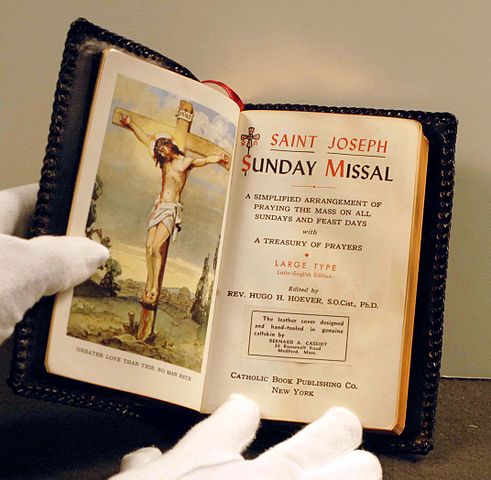
jfks-missal-used-for-lbjs-inauguration-in-1963

The Kennedy Catholic missal used for Johnson’s inauguration on November 22, 1963.

Typically, presidents-elect take their oaths upon open or closed Bibles — sometimes two or three stacked one atop another under the oath-taker’s hand — but  there have been exceptions to this custom. John Quincy Adams (1825) and Franklin Pierce (1853) used law books, while John F. Kennedy’s Catholic missal was found on a side table in Air Force One’s presidential bedroom for the mid-flight swearing-in of Lyndon Johnson in 1963.

History has often recorded the verses to which the presidents’ Bibles were opened. In 1789, George Washington’s Bible was opened “at random, due to haste” to Genesis 49:13. (“Zebulun shall dwell at the haven of the sea; and he shall be for an haven of ships; and his border shall be unto Zidon.”) However, most presidents have intentionally selected their passages.

William McKinley (1897) and William Taft (1909) chose separate accounts of one Old Testament quote. Young King Solomon, invited by the Lord to request a wish, asks for wisdom to lead God’s vast people and it is abundantly granted him. (2nd Chronicles 1:10, 1st Kings 3:9-11)

Hebert Hoover’s (1929) verse, Proverbs 29:18, notes the importance of right purpose: “Where there is no vision, the people perish: but he that keepeth the law, happy is he.”

Franklin Delano Roosevelt selected 1st Corinthians 13’s teaching on love for all four of his inaugurals (1933, ’37, ’41, ‘45): “And now abideth faith, hope, charity, these three; but the greatest of these is charity.”

Dwight Eisenhower’s (1957)  verse, Psalm 33:12, acknowledges our shared dependence on God for our blessedness,  “Blessed is the nation whose God is the Lord; and the people whom he hath chosen for his own inheritance.”

Jimmy Carter (1977) and Warren Harding (1921) chose  Micah 6:8: “…What doth the Lord require of thee, but to do justly, and to love mercy, and to walk humbly with thy God?

Ronald Reagan (1981 & 1985) twice-chose 2nd Chronicles 7:14, where the Lord invites conversion to gain His blessings: “If my people… shall humble themselves, and pray, and seek my face, and turn from their wicked ways then will I hear from heaven, and will forgive their sin, and will heal their land.

We, like all people, must beware of idolizing our presidents and other earthly leaders. (Even among popes only around 30%  have been canonized and none of them have been sinless.) But we do well always to ask God’s grace for our leaders and for his blessings on the times in which we live.

For other presidential inaugural oaths’ Scripture passages, check out this list.


second-teddy-roosevelt-inauguration-1905

Loving Mercy Overcomes Error

January 10, 2017

Reflections on John 1:43-51

philip-and-nathanael     In the early days of his public ministry, Jesus decided to go to Galilee. There he found his future apostle Philip and says to him, “Follow me.” Philip, from the same town along the northern coast of Galilee as Peter and Andrew, was so awed at encountering Jesus that he tracked down his friend Nathanael (also known as Bartholomew.) Philip told him, “We have found the one about whom Moses wrote in the law, and also the prophets, Jesus, son of Joseph, from Nazareth!” (Philip is sharing happy news, “We’ve found the promised Messiah, the Christ, and he’s not too far from here!”) But Nathanael is unimpressed and unconvinced, saying, “Can anything good come from Nazareth?” Philip winsomely replies, “Come and see.

When Jesus sees Nathanael coming toward him he says of him, “Here is a true child of Israel. There is no duplicity in him.” Nathanael asks, “How do you know me?” Jesus answers, “Before Philip called you, I saw you under the fig tree.” Nathanael declares, “Rabbi, you are the Son of God; you are the King of Israel!” Jesus replies to him, “Do you believe because I told you that I saw you under the fig tree? You will see greater things than this.” Jesus tells him, “Amen, amen, I say to you, you will see the sky opened and the angels of God ascending and descending on the Son of Man.”

Why did Nathanael’s opinion about Jesus, that man from Nazareth, change so suddenly? Perhaps Nathanael was sitting under a particular fig tree when Philip found him and Nathanael, believing that there was no natural way Jesus could have known or guessed this, was instantly persuaded. Another explanation is that Jesus is referring to a memorable dream Nathanael has recently had. It’s strange that Jesus would describe an honest man as a son of Israel—that is, as a son of Jacob—whose duplicitous deeds are detailed in Genesis. But recall how Jacob once had a dream in which he saw the angels of God ascending and descending a stairway to Heaven while the Lord God stood beside him. (Genesis 28:10-19) Jesus alludes to that event in this encounter. Now if a stranger were to tell me about a conversation I thought no one else had witnessed, I’d be intrigued; but if someone were to accurately describe my dream from the night before, that person would have my full attention. Whatever the reason behind Nathanael’s change of heart it was the style of Philip and Jesus’ approaches that made it possible.

The Gospels show us through numerous episodes how the apostles started off as far from perfect. When told that Jesus was from Nazareth, Nathanael replies, “Can anything good come from Nazareth?” This story presents Nathanael’s prejudice and how that bias nearly made him reject the Christ out of hand. What did Nathanael hold against those Nazarenes living some thirty miles away? Did he think them unfriendly, lazy, unrefined, impious, unscrupulous? Whatever the reason, he looked down on them and it showed.

Nathanael’s rash dismissal of the Nazarene maligns someone Philip regards as a great and holy man. Yet Philip does respond in anger. Instead, he urges Nathanael to learn more. “Come and see.” Nathanael is persuaded by his friend to give this Jesus guy a chance—a fair hearing—and this modest openness eventually leads to him being won over. Still today, one of the best means for dissolving prejudices of every sort is through experiencing “the Other” firsthand.

As Jesus sees Nathanael approaching he demonstrates a penetrating supernatural knowledge of him. Jesus probably knew what Nathanael had previously remarked in secret but Jesus does not reproach or condemn him for it. Instead, Jesus compliments what is good in Nathanael: “Here is a true child of Israel. There is no duplicity in him.” Though they do not yet see eye-to-eye, Jesus affirms his sincerity. This opens a door to dialogue that not only changes Nathanael’s mind but his entire life, as he goes on to become an apostle for Christ.

We could imagine a pricklier Philip or a different Jesus rejecting and condemning Nathanael for his initial disrespect toward the Christ of God; however, we see both practice tolerance toward him. Christians are commonly caricatured as easily offended but I have found that the more faithful variety show extensive mercy—which is very different than indifference. We are called to loathe error, but to love everyone. True tolerance does not hate others for holding wrong beliefs but loves them while trying to lead them to the truth.

It would be an oversimplification to say that forceful confrontation is never called for. Jesus occasionally denounced others, like “that fox” King Herod, the hypocritical Pharisees, and the evil spirits. Sometimes Jesus manifested his displeasure through bold prophetic acts, like flipping money-tables at the Temple or cursing the fig tree. Yet Jesus possessed perfect wisdom and a clear vision into others’ hearts. “Jesus knew their thoughts” and “did not need anyone to testify about human nature.” (Luke 5:22, John 2:25) We, however, must guard ourselves to be “slow to wrath,” for apart from the Holy Spirit’s prompting, “the wrath of a man does not accomplish the righteousness of God.” (James 1:19-20)

In this era of division, let us promote unity in advocating for the truth. In our disagreements with friends or strangers, online or face to face, let us shun anger, sarcasm, and revilement and presume the other’s good faith and sincerity. This manner of winsome mercy won Nathanael’s mind and heart for Christ and it can be just as powerful today.

Thy Kingdom Come — Tuesday, 1st Week of Advent

December 1, 2016

Readings: Isaiah 11, Luke 10

While recently visiting the Sea of Galilee in Israel I saw something in the skies I had never seen before. There were miles-wide concentric cloud rings with the occasional sound of long, rolling, man-made thunder. Though these things were interesting to behold, I hated the reason behind why they needed to be there. Northern Israel borders Syria and these high-altitude contrails and jet-engine sounds were from the Israeli Air Force’s U.S.-made F-15’s or F-16’s on defensive air patrols to ensure their neighbor’s civil war did not spill over into their own country.

The coastline of the Sea of Galilee is beautiful, peaceful, and prosperous. We were able to celebrate a Mass in an outside chapel near the site where Jesus appeared to his disciples after his resurrection and had breakfast with his disciples (as recorded in John 21.) But while we were free to tour and worship without threat or fear, the people of Aleppo, Syria were under siege just 250 miles north. There the Russian bear and the Syrian wolf are allied against the ISIS serpent in a battle for the right to rule over the suffering lambs and little children caught in the middle. The prophet Isaiah’s poetic vision of the radical peace the Messiah (or Christ) would someday establish has not yet fully come:

       “Then the wolf shall be a guest of the lamb,
and the leopard shall lie down with the kid;
       The calf and the young lion shall browse together, with a little child to guide them.
       The cow and the bear shall be neighbors,
together their young shall rest;
the lion shall eat hay like the ox.
       The baby shall play by the cobra’s den,
and the child lay his hand on the adder’s lair.
       There shall be no harm or ruin on all my holy mountain; for the earth shall be filled with knowledge of the LORD, as water covers the sea.”  (Isaiah 11:4-9)

The Infant Child of PragueOn one occasion, turning to the disciples in private, Jesus said, “Blessed are the eyes that see what you see. For I say to you, many prophets and kings desired to see what you see, but did not see it, and to hear what you hear, but did not hear it.” (Luke 10:23-24) Many great Old Testament figures longed for the promised Messiah but died before his coming. We are blessed to live in an age which has seen his arrival and blessed to have heard his message. Yet further blessed are we if we pray and prepare the path for the New Creation Christ promises to bring.

Along the sea of Galilee, it is possible to give no thought to the suffering and death happening not so far away. Likewise, in our beautiful, peaceful, prosperous country it is possible to ignore that there are grave evils in our midst, happening just out of sight. But blessed are we if we choose to long and labor for the life of the New Heavens and New Earth.

        “Blessed are they who mourn,
    for they will be comforted.
        …Blessed are they who hunger and thirst
for righteousness, for they will be satisfied.
        …Blessed are the peacemakers,
    for they will be called children of God.
        …Blessed are they who are persecuted for
    the sake of righteousness, for theirs is the
    kingdom of heaven.”  (Matthew 5)

Catholic Teachings About The End Times

November 10, 2016

Catechism of the Catholic Church #668-679

I.  HE WILL COME AGAIN IN GLORY
Christ already reigns through the Church…

The Resurrection by Piero della Francesca, 1450-1463.        “Christ died and lived again, that he might be Lord both of the dead and of the living.”
Christ’s Ascension into heaven signifies his participation, in his humanity, in God’s power and authority. Jesus Christ is Lord: he possesses all power in heaven and on earth. He is “far above all rule and authority and power and dominion,” for the Father “has put all things under his feet.” Christ is Lord of the cosmos and of history. In him human history and indeed all creation are “set forth” and transcendently fulfilled.

        As Lord, Christ is also head of the Church, which is his Body. Taken up to heaven and glorified after he had thus fully accomplished his mission, Christ dwells on earth in his Church. The redemption is the source of the authority that Christ, by virtue of the Holy Spirit, exercises over the Church. “The kingdom of Christ [is] already present in mystery,” “on earth, the seed and the beginning of the kingdom.”

        Since the Ascension God’s plan has entered into its fulfillment. We are already at “the last hour.” “Already the final age of the world is with us, and the renewal of the world is irrevocably under way; it is even now anticipated in a certain real way, for the Church on earth is endowed already with a sanctity that is real but imperfect.” Christ’s kingdom already manifests its presence through the miraculous signs that attend its proclamation by the Church.

…until all things are subjected to him.

      Though already present in his Church, Christ’s reign is nevertheless yet to be fulfilled “with power and great glory” by the king’s return to earth. This reign is still under attack by the evil powers, even though they have been defeated definitively by Christ’s Passover. Until everything is subject to him, “until there be realized new heavens and a new earth in which justice dwells, the pilgrim Church, in her sacraments and institutions, which belong to this present age, carries the mark of this world which will pass, and she herself takes her place among the creatures which groan and travail yet and await the revelation of the sons of God.” That is why Christians pray, above all in the Eucharist, to hasten Christ’s return by saying to him: Marana tha! “Our Lord, come!”

        Before his Ascension Christ affirmed that the hour had not yet come for the glorious establishment of the messianic kingdom awaited by Israel which, according to the prophets, was to bring all men the definitive order of justice, love, & peace. According to the Lord, the present time is the time of the Spirit and of witness, but also a time still marked by “distress” and the trial of evil which does not spare the Church and ushers in the struggles of the last days. It is a time of waiting and watching.

The glorious advent of Christ, Israel’s hope

        Since the Ascension Christ’s coming in glory has been imminent, even though “it is not for you to know times or seasons which the Father has fixed by his own authority.” This eschatological coming could be accomplished at any moment, even if both it and the final trial that will precede it are “delayed.”

        The glorious Messiah’s coming is suspended at every moment of history until his recognition by “all Israel,” for “a hardening has come upon part of Israel” in their “unbelief” toward Jesus. St. Peter says to the Jews of Jerusalem after Pentecost: “Repent therefore, and turn again, that your sins may be blotted out, that times of refreshing may come from the presence of the Lord, and that he may send the Christ appointed for you, Jesus, whom heaven must receive until the time for establishing all that God spoke by the mouth of his holy prophets from of old.” St. Paul echoes him: “For if their rejection means the reconciliation of the world, what will their acceptance mean but life from the dead?” The “full inclusion” of the Jews in the Messiah’s salvation, in the wake of “the full number of the Gentiles,” will enable the People of God to achieve “the measure of the stature of the fullness of Christ,” in which “God may be all in all.” 

The Church’s ultimate trial

The Devil Tempting a Young Woman by André Jacques Victor Orsel, 1832.

        Before Christ’s second coming the Church must pass through a final trial that will shake the faith of many believers. The persecution that accompanies her pilgrimage on earth will unveil the “mystery of iniquity” in the form of a religious deception offering men an apparent solution to their problems at the price of apostasy from the truth. The supreme religious deception is that of the Antichrist, a pseudo-messianism by which man glorifies himself in place of God and of his Messiah come in the flesh.

      The Antichrist’s deception already begins to take shape in the world every time the claim is made to realize within history that messianic hope which can only be realized beyond history through the eschatological judgment. The Church has rejected even modified forms of this falsification of the kingdom to come under the name of millenarianism, especially the “intrinsically perverse” political form of a secular messianism.

        The Church will enter the glory of the kingdom only through this final Passover, when she will follow her Lord in his death and Resurrection. The kingdom will be fulfilled, then, not by a historic triumph of the Church through a progressive ascendancy, but only by God’s victory over the final unleashing of evil, which will cause his Bride to come down from heaven. God’s triumph over the revolt of evil will take the form of the Last Judgment after the final cosmic upheaval of this passing world.

II. TO JUDGE THE LIVING AND THE DEAD

The Resurrection by El Greco, Madrid, 1596-1600.      Following in the steps of the prophets and John the Baptist, Jesus announced the judgment of the Last Day in his preaching. Then will the conduct of each one and the secrets of hearts be brought to light. Then will the culpable unbelief that counted the offer of God’s grace as nothing be condemned. Our attitude about our neighbor will disclose acceptance or refusal of grace and divine love. On the last day Jesus will say: “Truly I say to you, as you did it to one of the least of these my brethren, you did it to me.”

        Christ is Lord of eternal life. Full right to pass definitive judgment on the works and hearts of men belongs to him as redeemer of the world. He “acquired” this right by his cross. The Father has given “all judgment to the Son.” Yet the Son did not come to judge, but to save and to give the life he has in himself. By rejecting grace in this life, one already judges oneself, receives according to one’s works, and can even condemn oneself for all eternity by rejecting the Spirit of love.

The Common Good & Our Duty to Vote

November 6, 2016

CCC #1906-1909, 2239-2240

By “common good” is to be understood the sum total of social conditions which allow people, either as groups or as individuals, to reach their fulfillment more fully and more easily. The Catechism of the Catholic Church lists these “essential elements” as comprising the common good:

  1. The fundamental and inalienable natural rights of human persons.
  2. The basic common goods of society (food, clothing, health, work, education and culture, suitable information, the right to establish a family, etc.)
  3. The stability and security that comes with a just social order.

Catholic AmericanThe Church teaches it is the duty of citizens to contribute along with the civil authorities to the good of society in a spirit of truth, justice, solidarity, and freedom. The love and service of one’s country follow from the duty of gratitude and belong to the order of charity. Submission to legitimate authorities and service of the common good require citizens to fulfill their roles in the life of the political community. Submission to authority and co-responsibility for the common good make it morally obligatory to pay taxes, to exercise the right to vote, and to defend one’s country.

Election Day is this Tuesday, November 8th.

Catholics Who Moved Mountains

September 29, 2016

        Jesus said his apostles, “If you have faith the size of a mustard seed, you would say to this mulberry tree, ‘Be uprooted and planted in the sea,’ and it would obey you.” On another occasion, he told his disciples, “Amen, I say to you, if you have faith the size of a mustard seed, you will say to this mountain, ‘Move from here to there,’ and it will move. Nothing will be impossible for you.”

        Though I have yet to come across any historical accounts of saints transplanting foliage or excavating stones by faith-powered miracles, there are many historically-documented incidents of Catholics achieving the seemingly-impossible on earth through their faith.

St. John Paul II and the Soviet Union’s Fall

        Karol Wojtyła barely survived the Nazi’s occupation of Poland, but once that evil was defeated the Soviet Union replaced them. As parish priest and later as an archbishop, Wojtyła championed the Catholic Faith against the atheistic communists’ religious persecution. Upon his election as pope in 1978, John Paul II’s first papal journey abroad was to go back to his homeland.

        While there, he celebrated an outdoor Mass before millions, proclaiming Jesus’ words, “Be not afraid!” The crowd shouted in reply, “We want God! We want God! We want God!” Speaking in defense of human dignity, he encouraged all people to peacefully pursue true freedom. The threat posed by this Polish pope (armed merely with his words, example, and prayers) was so potent that the Soviets may have ordered his nearly successful assassination in 1981.

        On the 1984 Feast of the Annunciation, Pope John Paul consecrated Russia (along with the whole world) to the Immaculate Heart of Mary, just as she had requested in her appearances at Fatima, Portugal in 1917. On Christmas Day, seven years later, a miracle was realized. Mikhail Gorbachev peacefully resigned as the President of the Soviet Union and from atop the Kremlin, the Soviet flag was lowered forever. The ‘Evil Empire‘ ended not by a thousand Sun-bright nuclear blasts, but through the peaceful power of God and the faithfulness of his holy, humble servant.

St. Joan of Arc’s Liberation of France

 joan-of-arc-at-the-coronation-of-charles-vii       In the 15th century, France was delivered from English domination by history’s most-unlikely military commander; a teenage peasant girl. Joan had no military training, but she was compelled by visions and the voices of Sts. Michael, Catherine, and Margaret to lead the French forces, drive out the English, and see prince Charles VII crowned king at Reims. With divine help, she achieved all these feats before her martyrdom at the hand of the English at the age of nineteen. Mark Twain (though not generally a fan of historic Christianity) wrote of her:

Whatever thing men call great, look for it in Joan of Arc, and there you will find it. …It took six thousand years to produce her; her like will not be seen in the earth again in fifty thousand. …  She is easily and by far the most extraordinary person the human race has ever produced.

        St. Joan of Arc was indeed great, but her glory was but the mere reflection of God’s infinite splendor.

Fleming’s Discovery of Penicillin

        History has seen many great Catholic scientists, including Copernicus (Sun-centrism), Bacon (the scientific method), Descartes (modern geometry), Mendel (genetics), Pasteur (microbiology), and Lemaître (the Big Bang Theory) just to name a handful. But one Catholic scientist’s search for effective antibiotics in the early 20th century saved an estimated two hundred million lives. Through insights occasioned by providential occurrences, Alexander Fleming discovered penicillin. In this, he saw himself employed as an instrument by God:

I can only suppose that God wanted penicillin, and that this was his reason for creating Alexander Fleming.”

St. Patrick’s Conversion of Ireland

        In the 5th century, a 16-year-old boy was kidnapped from Britain and sold into slavery on a distant, pagan isle. There he experienced a spiritual awakening. He tells us:

I used to stay out in the forests and on the mountain and I would wake up before daylight to pray in the snow, in icy coldness, in rain, and I used to feel neither ill nor any slothfulness, because, as I now see, the Spirit was burning in me at that time. And it was there of course that one night in my sleep I heard a voice saying to me: ‘You do well to fast: soon you will depart for your home country.’ And again, a very short time later, there was a voice prophesying: ‘Behold, your ship is ready.’ And it was not close by, but, as it happened, two hundred miles away, where I had never been nor knew any person. And shortly thereafter I turned about and fled from the man with whom I had been for six years, and I came, by the power of God who directed my route to advantage (and I was afraid of nothing), until I reached that ship.”

        Lead on by this faith, he went on to become a priest, a bishop, and a missionary to the land of his former bondage. Today we think of Ireland as a very Catholic country, but it only became so through the courageous faith of St. Patrick.

Our Lord’s Redemption of the World

        In the 1st century, by his short three-year ministry in a backwater of the Roman Empire, this poor man from Nazareth transformed the world forever. Jesus Christ is the pattern for all fruitful disciples who have followed him since, achieving the impossible through faith and the power of God. One anonymous author describes Christ in these words:

Greatest man in history, named Jesus.
Had no servants, yet they called Him Master.
Had no degree, yet they called Him Teacher.
Had no medicines, yet they called Him Healer.
He had no army, yet kings feared Him.
He won no military battles, yet He conquered the world.
He committed no crime, yet they crucified Him.
He was buried in a tomb, yet He lives today.


Jesus on the Cross

Pray for Our Religious Freedom — 25th Sunday of Ordinary Time—Year C

August 24, 2016

Sunday Readings

Christians Martyrs and the Lions

St. Paul asked “that supplications, prayers, petitions, and thanksgivings be offered for everyone, for kings and for all in authority.” To what purpose? “That we may lead a quiet and tranquil life in all devotion and dignity.” The Roman ruler at that time was the Emperor Nero and his later persecutions of the Church proved the timeliness of Paul’s request.

When I was in seminary, some of my peers predicted bloody persecutions against the Church in America, but I have always thought that our trials would be more subtle; not martyrdoms, but diminishments, exclusions, and humiliations. No law will explicitly forbid Catholics from being public officials, business owners, doctors, nurses, pharmacists, therapists, teachers or any other occupation; but laws could demand that all these professions act in ways contrary to our Faith. People increasingly-dubious that our churches and religious institutions serve society’s good could cripple them by stripping their tax-exempt status, and they would do so with the approval of their own consciences. Some people, like those the Lord denounces through Amos the prophet, care most about their pocketbooks, but we are called to always keep our Faith first in our lives, and we will, no matter what.

Jesus says “the person who is dishonest in very small matters is also dishonest in great ones,” and Psalm 146 says, “Put no trust in princes, in mortal men in whom there is not help… [but] blessed is the one whose help is the God of Jacob, whose hope is in the LORD, his God.” So no matter who wins election this fall, let us pray to the Lord that religious freedom may be preserved in our time so that we may lead quiet and tranquil lives in all devotion and dignity.