Archive for the ‘Politics’ Category

Tuesday, 33rd Week in Ordinary Time—Year I

November 17, 2009

Imagine if the United States of America, with all its freedoms and rights, were not the United States of America, and on your way to school today, you were stopped along roadside by the secret police. They ask you for your name. You cooperate give it. Then they order you to put your hands on the hood of the squad car. They handcuff you and place you under arrest.

You ask them, “What’s going on? What have I done?” They reply, “You’re under arrest for the charge that you are a believing Catholic Christian.” You didn’t realize it, but the police have had you under intense surveillance for the past several weeks, wire-tapping your phone, monitoring your computer, searching your personal belongs, and watching all your movements and activities.

Imagine yourself in this situation. This is the question I pose to you: At your trial, when all of the evidence they have gathered is presented against you, will there be enough to convict you? Would there be sufficient evidence to find you guilty of being a believing Catholic Christian? What would they have on you?

Would they have testimony from informants that you observe every Friday as a day of penance, that you keep every Sunday as a special, day of rest, and faithfully go to Mass and frequent the sacrament of reconciliation? Could anyone testify against you that they heard you saying positive things about Jesus Christ, or that you spoke up for the Catholic faith when it was mocked or criticized in your presence? Could they put into evidence a rosary, or a Bible, or some other Catholic book, marked with fresh traces of DNA from your fingertips? Would they have hidden camera footage of you praying before meals at school or at restaurants? Would they have grainy night-vision footage of you praying before going to bed, or praying the first thing in the morning, making the tell-tale sign of the cross.
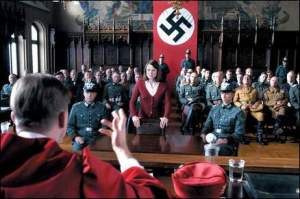
A few hours after your arrest you find yourself in a courtroom (because the “people’s” authoritarian government believes in speedy trials.) The intimidating judge looks down at you from the bench, “It says here that you were picked up on your way to the Columbus school. We have evidence of illegal Christian propaganda being taught there and we also have reliable reports that various Catholic rituals are done there, superstitions which are offensive to reason and the spirit of our times. Now I imagine that you went to that school because that’s where your parents sent you. And I’m sure that your parents would be shocked to discover that such repugnant activities as these are happening at your school.”

The judge continues, “The punishment for being found guilty of being a believing Catholic Christian is a grave one. But… if you were simply mixed-up in these activities, unthinkingly, by accident—if you were just doing them because that’s what everyone else around you was doing—well then that would be a different story. Spies and traders may come to our government rallies, but that doesn’t make them loyal citizens now does it? So just going through the motions doesn’t make you a believing Catholic at all, am I right?”

“So I can completely understand how this regretable misunderstanding has occurred. You didn’t really understand what you were doing did you? Now if you would simply formally renounce any and all belief in these silly superstitions, you may go on your way. Just sign your name here on this piece of paper testifying to that effect, and you’re free to go.”

What would you do? What do you wish you would have the courage to do? Would we have the courage to refuse to sign, just as Eleazar refused to eat? The eating of a little meat, like the movement of a pen, is a small act, but Eleazar refused and accepted an unjust death because to do otherwise would mean a rejection of the Lord, the one true God, the King of all other kings.

Now it is very unlikely that you or I will ever have to lay down our lives as red, or bloody martyrs for our faith in Christ. But, like Zacchaeus, there will be certainly times when we will have to go out on a limb for Christ. The crowd laughed to see the rich man Zacchaeus up in that tree, but what did Zacchaeus care about? His focus was totally fixed upon his connection with Jesus Christ.

Be like Eleazar, and don’t swallow whatever the world sets before you, because a lot of it is not good and can alienate you from God. Be like Zacchaeus, with the courage to go out on a limb regardless of what other people might think or say, for the sake of your relationship with Christ.

[The images for this post come from the movie Sophie Scholl–The Final Days. If you liked A Man for All Seasons, you’ll like this one too (but I’ll warn you up front that it ends the same way.)]
33rd Sunday in Ordinary Time—Year B

November 15, 2009

Should we ask challenging questions about our faith? Is asking tough questions about what we believe a sign of doubt and mistrust toward God? No, it shows just the opposite. Sincerely searching out for the answers to challenging questions is a sign of faith for it shows our confidence that there are good answers out there just waiting to be found.

If we Catholics decide to plug their ears and close-tight their eyes when challenging questions arise, our faith will never grow.  Our faith will never develop, in sophistication or strength, beyond what we knew when they were kids. We should ask tough questions about our faith because if we sincerely seek we will find, and our faith will be made all the stronger because of it.

Today’s readings raise two challenging questions. The first came up in the second reading, from the Letter to the Hebrews. It describes how the Old Testament priests once offered sacrifices, day-after-day, in an attempt to take away sins.  But Jesus Christ, our new high-priest, has offered a single sacrifice for the forgiveness of sins. This raises a challenging question: Why do we have the sacrifice of the Mass, Sunday after Sunday? Sometimes people ask us, “Why do you Catholics do that? We are you trying to sacrifice Jesus over and over again? Are you saying that Jesus’ one sacrifice wasn’t enough?” No, that’s not what we believe.

At the Mass, the one sacrifice of Jesus Christ is not repeated, it is presented again, in its full reality, for us.  If the Mass actually repeated Christ’s sacrifice, then Jesus would be dying over and over again.  No, rather the Mass re—presents His sacrifice.  The Mass really brings to us, the one passion, death, resurrection, and ascension into glory of our savior.

Jesus’ sacrifice was accomplished once, but it is applied many times. Jesus’ sacrifice was accomplished only once in history, two thousand years ago and half a world away, but the graces of that sacrifice have been applied many places and many times. How do these graces come from His cross to us today? They come to us through the sacraments which Jesus gave to His one bride, His Church, to wash her, to nourish her, to make her perfectly beautiful, and to make her one with Himself. Jesus’ sacrifice was accomplished once, but its graces are applied to us many times, most especially here in the Eucharist.

The second challenging question from today’s readings comes out of the Gospel.  Here’s the context for the scene we heard in the Gospel:

As Jesus was making his way out of the temple area one of his disciples said to him, “Look, teacher, what stones and what buildings!”  Jesus said to him, “Do you see these great buildings? There will not be one stone left upon another that will not be thrown down.” As he was sitting on the Mount of Olives opposite the temple area, Peter, James, John, and Andrew asked him privately, “Tell us, when will this happen, and what sign will there be when all these things are about to come to an end?”

Jesus then proceeds to prophesize about the fall of Jerusalem and the end of the world, when He says (as we heard,) “Amen, I say to you, this generation will not pass away until all these things have taken place.”

Well, the generation of the apostles is long gone and we’re still here, so the world hasn’t ended.  This raises the challenging question: are Jesus and the Gospel wrong? Jesus said, “Amen, I say to you, this generation will not pass away until all these things have taken place.”

Notice how the apostles asked two questions.  First, “when will this happen,” and “what sign will there be when all these things are about to come to an end?” The first question is a local one, about when the stones of the temple and Jerusalem will be thrown down.  The second is a cosmic one, about the end of the world. The apostles witnessed the first—the fall of Jerusalem—historically, but they experienced the second—mystically—in their own time.

Let me share you something written by present-day the Catholic author, Mark Shea.  (The internet is, by the way, a great place to discover good Catholic answers to tough Catholic questions.) Mr. Shea writes, “The prophecies of Jesus concerning the destruction of Jerusalem by the Romans in 70 AD and his prophecies concerning his coming at the end of time are almost seamlessly intermingled (something that has caused endless puzzlement for Bible students as well as guaranteeing job security for biblical scholars all over the world.) Why do the gospel writers mix these prophecies together? Because, in a very real sense, the gospel writers see them as referring to nearly the same thing. This does not mean the gospel writers fancy that the world came to an end in 70 AD with the sack of Jerusalem. Rather, it means that the ‘death’ Jerusalem suffered when the Temple was destroyed is an image of the death Jesus suffered in the temple of his body, and an image of the death the Body of Christ [the Church] will one day undergo in the final climactic battle between light and darkness before the return of Christ.”

I would add that when Jesus says in the Gospel that ‘this generation will not pass away until all these things have taken place’ He is not just speaking to the apostles Peter, John, James and Andrew for their time.  He is speaking to us and to every Christian generation.  From the fall of Jerusalem to the Second Coming, every Christian shares in the trials of the Church against the mystery of evil.

Again, from Mark Shea, “Disciples of Christ suffer and even die for Christ all over the world to this day. And, in our daily lives, all Christians experience various trials and tribulations ranging from illness to divorce to family difficulties to the inevitable death that we all must sooner or later endure. However, what some people are starting to forget is that what is true of Christ and of his individual followers is also true of the Church as a whole. Some people dream of a happy earthly destiny for the Church of Christ. They hope that, as the Church spreads out across the world, then perhaps little by little and bit by bit, every day in every way, the world will get better until the Kingdom of Heaven comes in the Great Rosy Dawn. Others, most notably in [the last] century, have tried to tinker together a man-made heavenly kingdom and have given it names like National Socialism, [Soviet] Communism, Maoism, Hedonism, Materialism, the Playboy Philosophy, the Triumph of Reason, etc. All these schemes share in the common hope of achieving the happiness of the resurrection without having to go to the trouble of dying. Several of the more energetic forms have, however, taken great trouble to kill on a massive scale. This “counterfeit messianism” is precisely what the Church warns us against. Indeed, the unbroken tradition of the Church holds precisely that [as the catechism says] “before Christ’s second coming the Church must pass through a final trial that will shake the faith of many believers. The persecution that accompanies her pilgrimage on earth will unveil the ‘mystery of iniquity’ in the form of a religious deception offering men an apparent solution to their problems at the price of apostasy from the truth. The supreme religious deception is that of the Antichrist, the pseudo-messianism by which man glorifies himself in place of God and of his Messiah come in the flesh” (CCC #675). The Church as a whole, like her members and like her Lord, will not get to take a shortcut. She too must pass through death to resurrection.”

Again, I would add to this that the great deception and trial are not limited to the final generation of Christians, these confront every age, including our own. This is partly why Pope Pius XI established the feast of Christ the King in 1925, which you will celebrate in a special way next Sunday.  Christ is our king, and His is our Way.  We will not accept pretenders to the thrown, for only by Christ’s reign will we be saved.

He, the Lord, is our inheritance!
He will show us the path to life,
the fullness of joys in His presence,
the delights at His right hand forever,
now, here at the sacrifice of the Mass
and later, forever in heaven.

November 11 – Veterans Day

November 11, 2009

Pearl Merchant

In the Gospel today, Jesus describes the kingdom of heaven as being like a treasure buried in a dirt field, or like a ridiculously underpriced pearl in a market place. These are valuable things that take great personal sacrifice to obtain. Jesus’ lesson in this for us is that a wise person should be willing to trade away everything else they have, and do it joyfully, because of the desirability of what’s before them. So it is with the Kingdom of God.

But these parables are not only about us, and how we should go after God’s kingdom. They also tell about how God has sought after for us for His kingdom. The Lord saw us as the treasure buried in a field, the field being the world. He was like the pearl merchant, who saw us as a precious pearl whose great worth was unrealized by others. And out of love for us one could say that He joyfully sold everything that He had to possess us.

“For us men and for our salvation, He came down from heaven. By the power of the Holy Spirit He was born of the Virgin Mary and became man. For our sake He was crucified under Pontius Pilate.  He suffered, died, and was buried. On the third day he rose again,” ‘giving us a new birth to a living hope through His resurrection.’ Through Christ’s poverty, He made us rich, giving us “an inheritance that is imperishable, undefiled, and unfading, kept in heaven for [us].”

Whenever something is truly valuable, it is worth one’s great personal sacrifice to possess it and to protect it. Today we are honoring those men and women who have done just that; who have made great personal sacrifices to serve our country in the military. Today is Veterans’ Day. While we would be mistaken to identify our country as being the kingdom of God, it would also be a mistake to dismiss the good our country and its veterans have done around the world.

We can we be so proud of our country’s veterans because they are true soldiers. As G.K. Chesterton said, “The true soldier fights not because he hates what is in front of him, but because he loves what is behind him.” This is reflected in how we have treated those we have defeated. We forgive them, rebuild them, and let them have their freedom. We may need to fight some enemies, now and in the future, but we have no need to hate them. Our power is not in our hatred, but our love. In this we follow our model, Jesus Christ, who loved the world so much that sacrificed everything He had for it. And let us remember that He conquered the whole world for us without firing a single shot.

Thursday, 29th Week in Ordinary Time—Year I

October 28, 2009

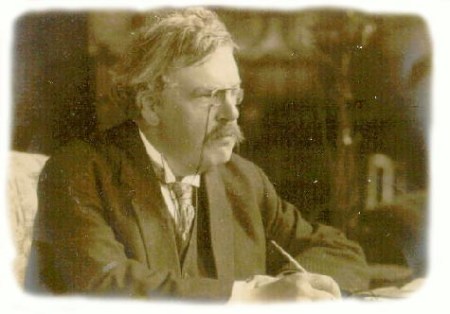
G.K. Chesterton

G.K. Chesterton, the British Catholic writer, lived one hundred years ago, but his writings are still witty, insightful, and relevant today. Once he wrote in answer to the question, “Why I am a Catholic.”  Chesterton explained, “The difficulty of explaining ‘why I am a Catholic’ is that there are ten thousand reasons all amounting to one reason: that Catholicism is true. I could fill all my space with separate sentences each beginning with the words, ‘It is the only thing that…’”  One of the examples of this he gave was that Catholicism “is the only thing that frees a man from the degrading slavery of being a child of his age.”

Why is it that after so many centuries we remain divided, three against two and two against three, on so many important matters?  We may be far more technologically advanced than they were in Jesus’ time, but every generation seems to repeat falling into the same, or slightly differing, forms of foolishness.  While science and technology is cumulative, part of every generation thinks they have to rediscover wisdom from scratch.  That’s why we still have ethical debates about questions that Jesus has settled.

Can we do evil in the hopes that good will come of it? [This is Ethics 101.  St. Paul teaches about this to the Romans, “And why not say—as we are accused and as some claim we say—that we should do evil that good may come of it? Their penalty is what they deserve.”] What if we’re [almost] certain that really good things will come from the evil we do? [Even if the evil does result in some good, what does freely-choosing evil make us?] Should we let the progress of science be bogged down by questions of morality? Should morality and private conscience have a place in politics and public life? [If not, then what will science, public life and policy be guided by beyond base desires and power?] Is it really always wrong to intentionally kill the innocent? What if intentionally killing 100,000 civilians will end a war?

If this is how things are when the wood is green in our country, then what will it be like when the wood is brown, dry, and dead, as it may well be in years ahead? What is the Christian to do?  Remain closely rooted to Christ, the source of our wisdom and waters of life. To borrow the words from the psalmist today:

The Christian “is like a tree
planted near running water,
That yields its fruit in due season,
and whose leaves never fade.
Whatever he does, prospers.”

Even if he is martyred, whatever the faithful Christian does prospers; for he is not a child and a slave of his age, but a child of the age to come.

Monday, 30th Week in Ordinary Time—Year I

October 26, 2009

Christians Martyrs and the Lions

Remember Jesus’ story about the two men who went up to the temple area to pray, the self-righteous Pharisee and the repentant tax-collector? “The tax collector stood off at a distance and would not even raise his eyes to heaven…”

In today’s gospel, at the synagogue where Jesus is teaching, there is a hunched-over woman who has not raised her eyes to heaven for a very long time. Jesus calls her, lays His hands on her, and at once, she stands erect, for the first time eighteen years. I have to imagine that her very first act was to raise her eyes and hands up to heaven, to speak praises and to glorify God. Imagine how she must have felt to be deprived of such worship for so long, and then, how she must have felt for it to be so suddenly and wonderfully restored to her.

Seeing this, the authorities, the Pharisees, object that Jesus should not do healings during the Sabbath rest. But Jesus rebukes them, to their great humiliation. Who are they to say that this woman should not be free to worship God this day? Her freedom to worship comes from God Himself.

We, this morning, are free to gather here, free to raise our eyes up to heaven and offer worship. We are free from fears that authorities or angry crowds will storm through those doors and drag us off to our imprisonment or death. In the past, not all Christians have been so privileged. Still today, around the world, not all Christians are so privileged.

Let us celebrate this Mass, and every Mass, with a deeper reverence and gratitude, for the freedom we have to raise our eyes to heaven and to offer our worship to God. Let us pray for persecuted Christians around the world and celebrate this Mass, and every Mass, as if it were our first, our last and our only.

26th Sunday in Ordinary Time—Year B

September 27, 2009

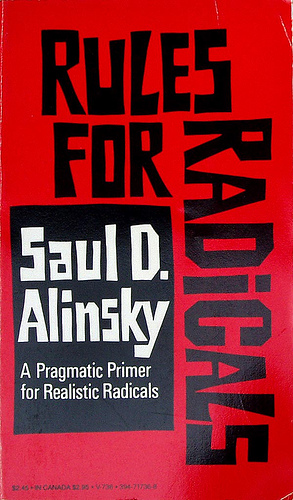
There are many things wrong with our society and the world, but how are we to go about changing them? One approach was presented by a fellow named Saul Alinsky. He, and his highly-influential 1971 book entitled Rules for Radicals: A Practical Primer for Realistic Radicals, have been popping up a lot lately. Reading his list of 11 rules you can see how they are widely used in politics & culture today.

The dedication of the book reads like this: “Lest we forget at least an over-the-shoulder acknowledgment to the very first radical: from all our legends, mythology, and history (and who is to know where mythology leaves off and history begins — or which is which), the first radical known to man who rebelled against the establishment and did it so effectively that he at least won his own kingdom — Lucifer.”

I doubt Alinsky believed in the devil at all.  He probably wrote that because it was a clever and effective attention-grabber for his book. But the book’s dedication was truer than he realized.  The book recalls the first rebel’s rejection of the kingdom of God and then goes on to explicate rules which often reject the approaches embodied and advocated by Christ, whose approaches the world often considers too impotent to defeat evil in the world.

The tactics this book advocates are often the same used by demons in spiritual warfare against us—a war fought on the battlefields of our hearts and minds, for the defense or the capture our souls.

Consider, for example, “Rules for Radicals #1: Power is not only what you have, but what an opponent thinks you have. If your organization is small, hide your numbers in the dark and raise a din that will make everyone think you have many more people than you do.” And, “Rule 9: The threat is more terrifying than the thing itself.” Demons fight us most effectively when they deceive us into imagining they are more powerful than they are. In fact, the only real weapon they have against us is to play on our fears, for we protected against demons in Christ.

Rules for Radicals # 4: “Make opponents live up to their own book of rules.” Alinsky writes, “You can kill them with this, for they can no more obey their own rules than the Christian church can live up to Christianity.” In following this rule, one follows the example of the Great accuser, the devil, who (as the book of Revelation says) night and day accuses us before God for sins. Alinsky’s charge against Christians, that the Christian Church cannot live up to Christianity, blends the truth and lies, just like the words of the demons when they speak to our thoughts.

The truth is that we are God’s servants, that we care deeply about Christ’s teachings, and that all of us commit sins, sins that we would say we truly oppose. But, like the psalmist, we pray for God to cleanse us from even our unknown faults. And from wanton sin especially, we sincerely ask the Lord to restrain us; to not let it rule us, so that we may be blameless and innocent of serious sin. Even though we do not yet follow Christ perfectly, we are truly made better people, more Christ-like, through our relationship with Him.

Yet demons want us to convince us we’re all hypocrites. They want to make us silent, out of shame for our sins, about what is right and what is wrong. They would even cause us to give up on trying to live-out lives of perfect love. Though we are sinners, we trust in God’s mercy and love. Jesus was always merciful toward sinners who acknowledged their guilt and He enabled them to become more perfect through a relationship with Himself.

Rules for Radicals #11: “Pick the target, freeze it, personalize it, polarize it. Don’t try to attack abstract corporations or bureaucracies. Identify a responsible individual. Ignore attempts to shift or spread the blame.” Alinsky writes, “One acts decisively only in the conviction that all the angels are on one side and all the devils on the other.” You’ve seen this polarizing tactic employed through the media, and you see it all the time. It’s called the politics of personal destruction.

It is the demonizing of individuals who we don’t agree with. Christians must not be indifferent to wrongs wherever they are committed, but when it comes to persons, what Christians seek and pray for is the conversion of sinners, not their destruction. “For God did not send his Son into the world to condemn the world, but that the world might be saved through him.”

Do tactics like those which Saul Alinsky laid out actually work at effecting change?  The answer is both Yes and No. Lots of influential people use them because they make lots of noise and heat and angry waves; they can end people’s careers, and they can extort institutions into making concessions. The power of these tactics makes them a strong temptation. But temptations they remain, for they do not have the power to bring about the kingdom of God.

Is the Church interested in social change? The Church is very much interested in social change, just like Jesus was, but we follow the way of His example. Allow me to present another influential writer of the 20th century, as an example, someone who was interested in radical social change of the Christian sort: Pope John Paul the Great. He is rightly called “the Great” for he must be counted among the greatest men of the last century.

Consider how he opposed the great evils and injustices of the communist empire. John Paul did not deal in deceptions. He spoke the truth, because he believed that the truth is powerful enough to set us free. He cared deeply and passionately about the grave injustices being committed, but he never seemed hateful because he was driven by true Christian love. He taught that some actions are wrong, even unspeakably wrong, but that all persons are worthy of love, and he radiated this love of God for all to see through his smile. His focus was not in personal attacks, but in speaking the truth to the human consciences. He insisted that all people should be given the recognition of the dignity and the rights they have from God: to live, and live freely, to speak the truth, and live the truth.

This is what he did, and the communist dictators literally trembled before him. When the communist leader of Poland welcomed the pope to his homeland in a speech at the airport broadcast on state-controlled TV, the dictator’s voice, and the paper he held in his hand, both quivered. The pope was so powerful against them, simply with the message and example of Christ, that the communists tried to kill him in St. Peter’s square, but the Pope miraculously survived the bullets, and forgave his would-be assassin.

By the mercy and the power of God, and in no small part through the words, deeds, and prayers of Pope John Paul the Great, the Soviet empire, which did so many evils for the sake of a utopia that never came to be, that empire ended; not with the fire of a thousand nuclear blasts, but with a harmless dying gasp. It was miracle, a peaceful victory for Christ and the Kingdom of God.

There are many things wrong with our society and the world, but how are we to go about changing them? Pope Paul VI said, “If you want peace, work for justice.” It’s good to work for justice, and we must work for justice, but we must remember this: true justice comes through the way of peace, the way embodied by our Lord, Jesus Christ. So whose example will we be dedicated to as we work for change in the world; that of Lucifer or that of Jesus Christ?

September 24 – Sts. Cosmas and Damien

September 25, 2009

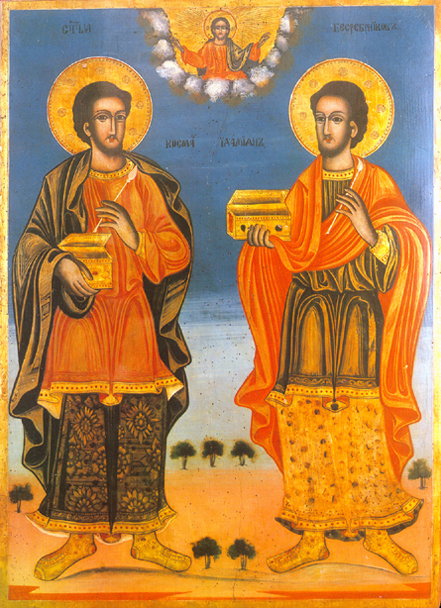
A number of years back, there were two twin brothers, the eldest of a widowed single-mother’s five sons. From their youth, they had a profound love for their Catholic faith and they viewed God’s creations, especially the human body, with great wonder. The two brothers studied medicine and became general practitioners.

Two things made them stand out among other doctors in their profession: first, their willingness to share their Catholic faith with others; and second, their refusal to accept payment for their work.  The two worked for free, pro bono, for the good. They healed the sick, in both body and soul. And they were gratefully admired by many. But then it happened that their government instituted new laws which were contrary to the Catholic faith, offensive to human dignity, and universally binding without exception.

The two brothers might have said to each other, “Our work helps so many people.  If we don’t go along with this we won’t be able to practice medicine anymore. We should compromise, for the sake of the greater good.” However, these two doctors were adamant in their convictions. They understood that if they chose to forfeit their Catholic faith, then they would have nothing else of truly lasting value to offer to anyone. They did not yield, and it cost the two of them their careers, and much more, but the brothers preserved their faith, their clear consciences, and their heavenly rewards in Christ.

You’ve heard of the names of these brothers before, but you’ve probably never heard their story until today. The twin brothers, the two doctors who were unwilling to compromise on their Catholic faith when the Emperor Diocletian decreed in the year 303 that everyone worship idols or be killed, these men are the saints we celebrate today: Saints Cosmas and Damian.

May we learn from their example and benefit from their prayers.

Petitions:


Saints Cosmas and Damian are the patron saints of physicians, surgeons and pharmacists.  Let’s pray for those who care for the sick… We pray to the Lord.

Through the intercession of Saints Cosmas and Damian, may Catholic healthcare workers in our time never have to face a test of faith like theirs because of unjust laws… We pray to the Lord.

Through the intercession Saints Cosmas and Damian, may we have the courage to share our faith in the workplace, by both our silent deeds and our spoken words… We pray to the Lord. 

For my intention in this Mass, for Congress which is now considering amendments to the healthcare bill which would grant conscience exceptions and prohibit the federal government from subsidizing, reimbursing, and paying for abortions, and for your Mass intentions… We pray to the Lord.

23rd Sunday in Ordinary Time—Year B

September 6, 2009

Remember what it was like before the dot-com bubble burst? Maybe you heard about tiny internet start-ups having total stock values in the billions and you just knew that that wouldn’t last. Remember the time before the recent housing bubble popped? I remember watching a show on TV called “Flip this House” in which a couple bought a building, put two weeks of work and a few thousand dollars into cleaning it up, and then quickly sold it for several tens of thousands of dollars more than what they bought it. I remember saying to myself then, “This just can’t go on. This isn’t sustainable.”

The thing about economic bubbles is that while you can often read the signs of the times and see that the bubble’s there, you’re never quite sure when it will pop.

For years now, our country has been riding on a similar bubble with the unsustainable spending and borrowing by the federal government. We’re not quite sure when it will finally pop, but you can see that the bubble’s there.  Most of us here will witness firsthand the consequences of its bursting.

The Congressional Budget Office is a non-partisan, independent government agency that provides economic data to Congress. And for years, regardless of whether the Democrats or Republicans were in power, the CBO has consistently reported the unfortunate facts and grim forecasts of our present course. This summer, the CBO published its “Long-Term Budget Outlook.” And they tell us, quote…

“Under current law, the federal budget is on an unsustainable path—meaning that federal debt will continue to grow much faster than the economy over the long run.

Although great uncertainty surrounds longterm fiscal projections, rising costs for health care and the aging of the U.S. population will cause federal spending to increase rapidly under any plausible scenario for current law. […]

Keeping deficits and debt from reaching levels that would cause substantial harm to the economy would require increasing revenues significantly…, decreasing projected spending sharply, or some combination of the two.”

Some or all of the following things will inevitably happen: an increased federal retirement age, decreased retirement benefits from Social Security, decreased health benefits from Medicare and/or Medicaid, increased federal taxes, or (and this seems the most likely) a dramatically increased national debt.

Now understand that an endlessly ballooning national debt is no solution.  It has economic consequences for us. What happens when foreign countries finally decide they are no longer interested in holding any more of our debt (in the form of low-interest yielding U.S. government bonds?) One result will be hyper-inflation, which will negatively impact anyone who uses U.S. Dollars. Unpleasant changes are coming. And they will have real consequences our lives. We will feel their effects.

Maybe hearing me speak about these grim realities feels as if I’ve just spit on your tongue.  It’s unpleasant and a bit repulsive. But my hope and prayer is that you will “be opened” by it, that you will be motivated to prepare yourself for what is coming, to begin living now as we should have already been living as Chrisitians all along.

In the past we have lived beyond our means, just like crowd, just like the government made in our own image. We spent more than we had and we often spent wastefully. But we are called to live differently, to live out Christian stewardship, Christian poverty, or simplicity of life in our own lives. Let’s not wait to hit economic rock bottom before we begin living as we ought to.

We are called to live simply and within our means, free from debt-slavery. We are called to be both frugal and generous, generous and frugal. If we are frugal without generosity, we’re simply being misers. If we are generous without frugality, we are being irresponsible. But if you are both frugal and generous won’t God, who (as the psalmist says) keeps faith forever, who secures justice for the oppressed, who gives food to the hungry, who supports the fatherless and the widow, won’t He provide you with what you need? On the other hand, if we are not frugal and generous, if we do not lovingly support our poor neighbors, those in our parish, throughout the diocese, and abroad, then how can we ask God to support us?

To quote St. James, “Act on this word.  If all you do is listen to it, you are deceiving yourselves.” “Fear not, be strong.” “Be not afraid,” but prepare yourself. Prepare for the days when our accounts will come due.  For a day coming soon in our country, and for the Last Day, when we shall all appear before God.