Archive for the ‘Holy Spirit’ Category

The Living Water Jesus Gives

March 23, 2025

3rd Sunday of Lent
By Fr. Victor Feltes

Jesus tells the woman at the well, “Everyone who drinks this water will be thirsty again; but whoever drinks the water I shall give will never thirst; the water I shall give will become in him a spring of water welling up to eternal life.” What is this water he speaks of? The Samaritan woman, initially either humoring him, mocking him, or believing him, replies to Jesus, “Sir, give me this water, so that I may not be thirsty or have to keep coming here to draw water.” She seems to be imagining literal, physical water. The disciples likewise thought Jesus spoke of literal food when they returned from town and heard him say, “I have food to eat of which you do not know.” They asked one another, “Could someone have brought him something to eat?” But Jesus clarified, “My food is to do the will of the one who sent me and to finish his work.” So what is the “living water” Jesus wants to give?

Later in John’s Gospel, he gives us another clue. Jesus stands up in the temple area and exclaims, “Let anyone who thirsts come to me and drink. Whoever believes in me, as scripture says: ‘Rivers of living water will flow from within him.’” Jesus announces this during the last and greatest day of the Jewish Feast of Tabernacles, a celebration of God’s forty years of care for his people during the Exodus. And that context is significant. When the Hebrews entered the Sinai Desert, they were thirsty and cried out for water. So the Lord commanded Moses to strike a rock with his staff, miraculously causing water to flow for the people to drink and live. St. Paul the Apostle would later reflect that the Hebrews “all drank the same spiritual drink, for they drank from a spiritual rock that followed them, and the rock was the Christ.” Jesus Christ is our source of life. He pours out his living water so we may spiritually survive our pilgrimage through the desert of this world and happily enter the Promised Land of the life to come. Where do we find this living water with Jesus? Three places come to mind and the three are intertwined.

Christ’s water of life first comes to us in baptism. The Catechism of the Catholic Church teaches that “Holy Baptism is the basis of the whole Christian life, the gateway to life in the Spirit, and the door which gives access to the other sacraments. Through Baptism we are freed from sin and reborn as sons of God; we become members of Christ, are incorporated into the Church and made sharers in her mission….” This sacrament is called “‘the washing of regeneration and renewal by the Holy Spirit,’ for it signifies and actually brings about the birth of water and the Spirit without which no one can enter the Kingdom of God.” St. Paul teaches that we who were baptized into Jesus Christ were baptized into his death. He writes, “We were indeed buried with him through baptism into death, so that, just as Christ was raised from the dead by the glory of the Father, we too might live in newness of life.” Baptism connects us to Jesus’ Passion, Death, and Resurrection. We also encounter the water of Christ from the Cross.

On Good Friday, when the Roman soldiers “came to Jesus and saw that he was already dead, they did not break his legs, but one soldier thrust his spear into his side, and immediately blood and water flowed out.” Jesus nourishes us with himself in his Eucharist so that he remains in us and we remain in him as constant companions. Knowing of his sacrifice nourishes our souls as well when we consider how Jesus does these things for love of us; both dying for us once on the Cross and then giving us himself from this altar today. We encounter the living water of Christ in baptism and from the Cross, but John’s Gospel tells us of a third way.

When Jesus stood up in the temple area and exclaimed, “Let anyone who thirsts come to me and drink,” St. John’s Gospel notes Christ “said this in reference to the Spirit that those who came to believe in him were to receive,” adding “There was, of course, no Spirit yet, because Jesus had not yet been glorified.” To be clear, the Holy Spirit is an eternally existing divine Person and St. Luke’s Gospel shows us that the Holy Spirit was active in the world even before the birth of Christ, yet through Jesus’ victory every Christian is now made into a temple—an enduring dwelling place—for the Holy Spirit within them. Jesus said, “Whoever believes in me, as scripture says: ‘Rivers of living water will flow from within him.’” He said this in reference to the life-giving and refreshing Holy Spirit that those who came to believe in him were to receive.

Sharing in Christian Baptism, Confirmation, Holy Eucharist, and the Holy Spirit who guided Jesus, we drink of the living waters of Christ. A person who drinks natural water will be thirsty again, but Jesus says whoever drinks the water he gives will never thirst. With Jesus, on our pilgrimage through the deserts and trials of this world, our hearts can be refreshed and satisfied through the gift of God.

The Gift of Confirmation

February 2, 2025

Feast of the Presentation
By Fr. Victor Feltes

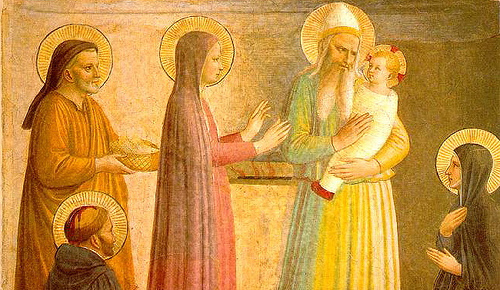
Forty days after Jesus’ birth, Joseph and Mary took him up to Jerusalem to offer the sacrifice required for a firstborn son. Jesus had been conceived through the Holy Spirit, but that was not the Spirit’s only activity in the world. The Holy Spirit revealed to a devout and righteous man named Simeon that he would encounter the Christ during his lifetime. On the day of the Presentation, the Spirit moved Simeon to come into the temple and enabled him to recognize the Christ when he saw him. Then Simeon took Baby Jesus into his arms and spoke words of prophecy which the Spirit inspired in him. There was also a prophetess there, an 84-year-old widow named Anna who never left the temple but worshiped night and day with fasting and prayer. The Spirit enlightened her too, to draw near and meet the Christ, and she spoke about the child to all. Through the Holy Spirit these servants of God, St. Simeon and St. Anna, were witnesses to Christ and filled with knowledge, courage, and joy. The plan of God was not to keep this gift of the Spirit limited to a few, but to grant him to many.

When the Spirit came down on Pentecost Sunday, St. Peter recalled the Old Testament prophesy of Joel: “‘It will come to pass in the last days,’ God says, ‘that I will pour out a portion of my Spirit upon all flesh. … Indeed, upon my servants and my handmaids I will pour out a portion of my Spirit in those days…” The Holy Spirit is poured out in the Sacrament of Confirmation which, together with Baptism and Eucharist, is necessary for the completion of our baptismal grace.

At Jesus’ baptism, the Holy Spirit descended upon him in the form of a dove, and “drove” and “led” him out into the desert for forty days before commencing his public ministry. The Old Testament had foretold that the Spirit of the Lord would rest upon the Christ or Messiah, titles which both mean “Anointed One.” Jesus was quoting the Prophet Isaiah when he declared in the synagogue at Nazareth, “The Spirit of the Lord God is upon me, because the Lord has anointed me.” Old Covenant priests, prophets, and kings were inaugurated through anointing with oil. Jesus was anointed with the Holy Spirit as our New Covenant Priest, Prophet, and King. And Christians are anointed with that same Spirit through Baptism and Confirmation to participate in Christ’s identity and mission.

In our Latin rite, a person celebrates Confirmation typically sometime after the age of reason, but in danger of death it is even given to newborns. The ordinary minister of Confirmation is the bishop, our successor to the apostles, though Catholic priests can be granted the authority to validly confirm when needed. A person is confirmed when the minister laying his hand on his or her head and anoints the forehead with a blessed oil called chrism while saying, “Be sealed with the Gift of the Holy Spirit.” Chrism is made of olive oil plus a fragrant sap called balsam. This gives chrism its perfumed scent, such that the anointed Christian — to use the words of St. Paul — bears “the aroma of Christ.”

One of my memories from the evening following my Confirmation by Bishop Burke in Eau Claire’s Zorn Arena was feeling great joy. When I wondered at its source I thought, “Oh yeah, the Holy Spirit.” Joy, love, peace, patience, kindness, goodness, generosity, gentleness, faithfulness, modesty, self-control, and chastity are among the Spirit’s fruits. And wisdom, understanding, counsel, fortitude, knowledge, piety, and fear of the Lord are numbered among his gifts.

In the ancient world, oil was a sign of abundance and joy, as at harvest time. It was used for cleansing both before and after baths. The injured used oil to heal wounds and soothe bruises Track and field athletes and wrestlers used it to limber their limbs. And it gave radiant beauty to both men and women’s skin. The Holy Spirit, in addition to the generous gifts he gives and fruits he brings, purifies us from sin and vice toward perfection, heals our past wounds and soothes our daily bruises empowers us to prevail over temptation and opponents, and gives us the beautiful glory of a more than natural goodness.

By the sacrament of Confirmation, you are more perfectly bound to the Church and enriched with a special strength. This sacrament is not an ending but a new beginning. After Confirmation you are, as true witnesses of Christ, more obliged to bravely spread and defend our Faith by word and deed in the world. If you were never confirmed within the Catholic Church, do not neglect this sacrament. Ask me about how you can receive this gift. And if you have already received the Holy Spirit in Confirmation, sincerely and lovingly ask him for his greater gifts and fruits. Like the fire passing atop candles, one to the next, God the Holy Spirit is not diminished by being more widely shared and spread. The child Jesus grew and became strong, filled with wisdom, and the favor of God was upon him. By the Holy Spirit, God desires to do greater things with you.

The Subtle Spirit

December 9, 2024

Solemnity of the Immaculate Conception
By Fr. Victor Feltes

I would like to highlight certain stories about three people: Mary, Paul, and Caiaphas. First, consider the Blessed Virgin Mary. We celebrate how she was created by God, conceived entirely free from the wounds of original sin. Throughout her existence, she has been filled with God’s grace. She is the holiest woman who has ever lived. And yet, she was shocked that an angel would ever visit her. “Hail, full of grace,” announced the Archangel Gabriel, “The Lord is with you,” but she was greatly troubled at wondered at his greeting.

Next, consider St. Paul the Apostle. No human being has written more books of Sacred Scripture than he. These Pauline texts are usually letters written to particular Christian communities and they contain the particularities one finds in personal letters. For example, in the final chapter of his Letter to the Romans, Paul greets at least twenty-three persons by name. Now St. Paul believed that he was doing the Lord’s work, but if Paul had known the letters he was writing would go on to be as venerated and as widely read as the Old Testament’s books, I doubt he would have written, ‘Say Hi to Prisca and Aquila for me.’

Finally, consider Caiaphas. So many Jews were coming to believe in Jesus that the chief priests and the Pharisees convened and said, “If we leave him alone all will believe in him and the Romans will come and take away both our land and our nation!” Caiaphas, who was the high priest that year, said to them, “You know nothing, nor do you consider that it is better for you that one man should die instead of the people, so that the whole nation may not perish.” John’s Gospel notes, “He did not say this on his own, but since he was high priest for that year, he prophesied that Jesus was going to die for the nation….”

The High Priest Caiaphas was speaking prophesy but did not realize it. St. Paul the Apostle was writing inspired scripture but did not realize it. The Blessed Virgin Mary was living as the holiest of all women but did not realize it. They show us that the Holy Spirit is so agile, intelligent, and subtle that he can act through us without our realizing it.

Now, it is essential for us to remain in Christ, devoted to prayer and his Sacraments. Otherwise, the Holy Spirit will achieve his purposes in spite of us, as with the High Priest Caiaphas. But if you love our Lord, if you strive to please Jesus Christ, if you are open to doing the will of God, be encouraged and take heart. The Holy Spirit is working through you more profoundly than you realize.

Are You Sinning Against The Holy Spirit?

June 9, 2024

10th Sunday in Ordinary Time
By Fr. Victor Feltes

Jesus says, “Whoever blasphemes against the Holy Spirit will never have forgiveness but is guilty of an everlasting sin.” This teaching makes some people mistakenly believe they are beyond forgiveness from somehow sinning against the Holy Spirit. What then is blasphemy against the Holy Spirit? It is good for us to know, lest we fall into despair.

Let’s look at the gospel context. Having heard of his miraculous healings, many people came to Jesus. The crowds were so great that Jesus and his disciples could not even eat, and Jesus soon needed to preach from a boat so as not to be crushed. Jesus was curing the sick and casting out demons, but the scribes who had come from Jerusalem said, “He is possessed by Beelzebul,” and “By the prince of demons he drives out demons!

Jesus dismantles their accusations as nonsense. “How can Satan drive out Satan,” he asks. “If I drive out demons by Beelzebul, by whom do your own people [your exorcists] drive them out?” Then, since they had said “he has an unclean spirit,” Jesus declares, “Amen, I say to you, all sins and all blasphemies that people utter will be forgiven them. But whoever blasphemes against the Holy Spirit will never have forgiveness, but is guilty of an everlasting sin.”

St. Athanasius observes that when the scribes and Pharisees credit “the works of God to the Devil… they have judged God to be the Devil, and the true God to have nothing more in His works than the evil spirits. … When the Savior manifested the works of the Father, raising the dead, giving sight to the blind, and other such deeds, they said that these were the works of Beelzebub. They might as well say,” Athanasius concludes, “that the world was created by Beelzebub.”

Blasphemy against the Holy Spirit is so deadly because it professes goodness and its Source to be evil. And if I declare Goodness “evil” how will I come to be reconciled to God? St. Thomas Aquinas wrote that “the sin against the Holy Ghost is said to be unpardonable by reason of its nature, in so far as it removes those things which are a means towards the pardon of sins.” A blasphemer against the Holy Spirit is blinding himself to the Light, yet St. Augustine encourages us “we should despair of no man, so long as Our Lord’s patience brings him back to repentance.”

It is spiritually deadly to denounce goodness as “evil.” Christians, however, profess faith in God as good and in Jesus Christ as our Savior. This makes a Christian unlikely to blaspheme the Holy Spirit. The dangerous error which we Christians are more likely to commit is in calling sinful evils “good.” Even while Christians claim Christ as Savior they sometimes deny his Lordship.

Jesus’ enemies did not want what he preached to be true. What he taught was challenging each of them to change. So they sought reasons to reject what he was teaching. Still today, we can rationalize sinfulness too, devising excuses to do what we want, refusing to repent, sometimes even reaching the point of celebrating shameful deeds as our pride. Willfully remaining in sin is a very serious thing so Jesus—who loves us—calls us to conversion.

In the gospels, we often see Jesus being gentle with sinners but hard on hypocrites. The Pharisees criticized him for being “a friend of sinners.” Jesus, in turn, denounced the Pharisees, saying, “You hypocrites! Isaiah was right when he prophesied about you: ‘These people honor me with their lips, but their hearts are far from me.’” So what is the difference between mere sinners and hypocrites?

Hypocrisy is more than just failing to live up to your professed morals, as all of us have done. The Greek word for “hypocrite” meant “actor” or “stage performer.” Hypocrites are farther off the narrow path than struggling sinners because hypocrites are only pretending to care about sin while ignoring the sins they have.

How can I distinguish whether I am a hypocrite versus a sinner striving to be faithful? One good sign is whether or not I am going to the Sacrament of Reconciliation. If I am complacent with my sins, if I have given up on spiritual growth, if I am refusing to convert for Christ, I won’t go to Confession. Adam hid after he sinned in the Garden of Eden. When the Lord called to him and asked “Where are you,” God was not ignorant of behind which trees the man was hiding. He calls out to us too, hoping we will come out to him.

What if you’re unaware of your sins? Then review a good, thorough examination of conscience to enlighten you. Are you well aware of your sins? Then come to Christ with a contrite heart to start a new beginning in the confessional. I hope that you will choose to meet our Lord Jesus there, for the only sinners he cannot forgive are those who refuse to repent.

Welcoming the Holy Spirit

May 18, 2024

Pentecost Sunday
By Fr. Victor Feltes

On Pentecost, about one hundred and twenty people, including the Blessed Virgin Mary and the apostles were together in the upper room. There on this day, the third Person of the Trinity “appeared to them as tongues as of fire, which parted and came to rest on each one of them,” and “they were all filled with the Holy Spirit.” Yet this was not actually the first time Mary or the apostles had encountered the Spirit.

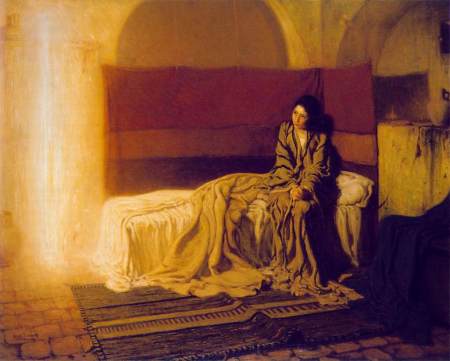
In response to Mary’s fiat, to her saying “Let it be done to me according to your word” at the Annunciation, the Holy Spirit descended to conceive the Christ Child within her. And we hear in today’s gospel how on Easter Sunday evening Jesus visited the apostles in the upper room, exhaled on them, and said, “Receive the Holy Spirit. Whose sins you forgive are forgiven them, and whose sins you retain are retained.” So Mary and the apostles had each received the Holy Spirit before, sort of like us on this Pentecost Sunday.

We received the Holy Spirit at our baptisms, and received him again at our confirmations, and we can always encounter him anew. Since the Holy Spirit is an infinite Divine Person we can always receive more from him. So how can we receive the Spirit and his gifts more abundantly? Here are three ways:

First, ask for the Holy Spirit and his gifts in prayer. Prior to Pentecost, Jesus’ disciples had been praying for nine days—the Church’s first novena. They prayed to receive the promised Gift of the Father of which Jesus had spoken, to be “clothed with power from on high.” The disciples’ Pentecost joy and courage, the manifested miracle of speaking many languages, and that day’s three thousand conversions won were all fruits of the Holy Spirit in answer to their prayers.

A second way to welcome the Holy Spirit is to prepare a place for him. At Jesus’ baptism, the Spirit descended upon him in the likeness of a dove. Offer the Holy Spirit a hospitable place to land with you. If we are combative towards a dove or simply being too noisy, the bird will not approach us or stick around for long. So renounce all hostility towards God and cultivate peace within your house that his peace may rest on you. In other words, renounce your sins and go confession, and focus more on quieting your soul and dedicating time to daily prayer.

A third way to be touched and changed by the Holy Spirit is to expect and watch for his influence. The Holy Spirit descended on Pentecost in the likeness of fire. Fire transforms everything it touches. It causes other objects to radiate heat like itself, to shine like itself, to become fire like itself. If you ask for the Holy Spirit and his gifts and you are open to his influence, watch with eager expectation for him to inspire, empower, and transform you.

Back in my college days, one afternoon I was lying on my bed praying rather apologetically to the Holy Spirit. I said, ‘Holy Spirit, you’re like the most neglected Person of the Trinity. You’re just as much God as the Father or the Son but we direct much more prayer and worship to them than you. And when we do pray to you it’s because we want something, but you’re not just some divine vending machine. I’m sorry.’ Then I heard in my mind these words: “I am gift.” Now whenever you possibly receive a heavenly message, it is wise to check its truth in light of true Catholic teaching, since God will not contradict himself. So I considered that statement seemingly from the Holy Spirit: “I am gift.”

From all eternity, God the Father gives all that he is to his Son and the Son gives himself back as a total gift to the Father. And from this mutual exchange of self-gifting love, the Holy Spirit eternally proceeds. The Father and the Son send the Holy Spirit to earth as a gift to sanctify and transform us so that we may participate in the life of the Trinity. The Holy Spirit rejoices to be gifted. He is gift. And when we ask for his gifts we are inviting his presence—for how could his gifts be manifested someplace where he is not? So from this I concluded the Holy Spirit does not begrudge us asking him for his great and holy gifts.

On this Pentecost Sunday, what gifts do you desire of the Holy Spirit? Pray for his powerful presence, like Mary and the apostles did. Turn away from sin and cultivate quiet peace, offering a welcoming place for the Holy Spirit to land. And watch with eager expectation for the transforming effects of the Spirit’s fiery influence.

Why Five & Five? What Is Our Oil?

November 11, 2023

32nd Sunday in Ordinary Time
By Fr. Victor Feltes

Jesus tells us, “The Kingdom of Heaven will be like ten virgins who took their lamps and went out to meet the bridegroom.” In those days, the Jewish custom was for a man and woman to get betrothed. This marked the start of their marriage covenant, yet the husband and wife would live separately for the first year. In the meantime, the bridegroom would return to his father’s house and prepare a dwelling place for their life together. Once all was ready, he would joyfully return to bring her to himself. She would be expecting him, but would not know the hour, so she awaited his arrival with her bridesmaids. The bridegroom and his groomsmen would come and escort the bride and her bridesmaids to his father’s house for the consummation of their marriage and seven days of feasting.

This is the cultural context for what Jesus tells us at the Last Supper, as recorded in St. John’s Gospel: “In my Father’s house there are many dwelling places. If there were not, would I have told you that I am going to prepare a place for you? And if I go and prepare a place for you, I will come back again and take you to myself, so that where I am you also may be.” These Jewish marriage customs also provide the setting for today’s gospel parable about ten virgins awaiting the bridegroom.

Five of them were wise and five of them were foolish, with the foolish ones foregoing flasks of extra oil and, as a result, being shut out of the wedding feast. Jesus Christ called himself the Bridegroom and the Book of Revelation says his saints will enjoy “the wedding feast of the Lamb.” Before unpacking how we can avoid the foolish ones’ fate, consider this question: why five foolish ones and five wise?

Like other storytellers, our Lord theoretically could have crafted his parable’s details differently. Given ten female characters, instead of five foolish and five wise, Jesus could have told a tale about one foolish virgin and nine wise ones, or preached a parable about nine foolish virgins and one wise one, or shaped his story as one of the six other mixtures where some were foolish and some were wise. So why did he say five and five?

Jesus knew that if his parable had featured just one fool beside nine wise virgins, we might presumptuously assume this story’s warning does not apply to us. On the other hand, if Jesus’ parable had featured nine fools and only one wise virgin, we might despair of being among those who enter the feast. Instead, Jesus speaks of five and five so that we will take this parable seriously yet also have confidence that we can take prudent steps to follow the Bridegroom.

What do the five wise and five foolish virgins teach us? What sort of persons were they, and what oil do we require? For an answer, recall another parable of Jesus.

In the Parable of the Rich Man and Lazarus, after a life in which he callously neglected to care for poor Lazarus at his doorstep, a rich man suffers punishment in flames. He calls out to Abraham above: “I beg you, father, send [Lazarus] to my father’s house, for I have five brothers, so that he may warn them, lest they too come to this place of torment!” St. Jerome, the fourth-century Church Father and Doctor of the Church, saw symbolism in this rich man’s five brothers. Jerome sees them as the wicked man’s five bodily senses which were not ordered and dedicated to God. St. Jerome declares to that rich man:

[Y]ou have five brothers: sight, smell, taste, hearing, and touch. These are the brothers to whom formerly you were enslaved. Since they were the brothers you loved, you could not love your brother Lazarus. Naturally you could not love him as brother, because you loved them. Those brothers have no love for poverty. Your sight, your sense of smell, your taste, and your sense of touch were your brothers. These brothers of yours loved wealth and they had no eye for poverty. … They are the brothers who sent you into these torments.

God created and bestowed us our bodily senses, and they are good. Through them we sustain our lives, experience one another and this world, and delight in God’s good creations. The goodness of these material things reflect the goodness of their Maker. But it is easy for sinful humanity to become fixated on these delightful things resulting in the distracted neglect or sinful contempt of our Creator.

What is to keep our flame of faith from going out, plunging us into darkness, stopping us from following the Bridegroom? How can we properly order our five senses, and be like the wise virgins rather than the foolish, lest the Lord declare, “Amen, I say to you, I do not know you”? We need oil to keep our lamps faithfully burning and follow Christ in the light. But what is that oil?

In the Old Testament, priests, prophets, and kings were anointed with holy olive oil. Jesus was revealed to be the Christ, the Messiah – titles which mean “Anointed One.” At Jesus’ baptism, St. John the Baptist knew Jesus was the “Anointed One” when he saw the Holy Spirit descend upon him. And then at Nazareth, Jesus proclaimed, “The Spirit of the Lord is upon me, because he has anointed me…” So the Holy Spirit, who descended upon Jesus, our priest, prophet, and king, is like anointing oil. The Holy Spirit is the oil we need for our burning lamps. If we are wise we will invite and welcome this third divine Person to pour out upon us, fill us, and fuel us. He will keep our faith burning and direct our bodily senses so that we may wisely follow Christ our Bridegroom into joy.

Come Holy Spirit,
fill the hearts of your faithful
& kindle in them the fire of your love
.”

The Holy Spirit Outpoured

May 28, 2023

Vigil of Pentecost
By Fr. Victor Feltes

All plants and animals depend upon water to live. Water comes down to us freely from the sky. Though its appearance may vary (as rain, or hail, or snow, or dew) once it rests upon the earth it produces many different effects throughout creation. Water, while ever remaining itself, adapts to the need of every creature that receives it, growing apples on an apple tree, creating sweet sap in a maple tree, or generating many-kernelled cobs on a cornstalk. In this way, water is similar to the Holy Spirit. The Holy Spirit descends as a free gift from heaven. He comes in different appearances (as fire, as a dove, as wind, or invisibly) while always remaining his same divine self. He is the Lord, the giver of life, and in each person who receives him through Christ he produces fruits through gifts which he imparts as he pleases.

On the last and greatest day of a Jewish feast, Jesus stood up and exclaimed, “Let anyone who thirsts come to me and drink. As Scripture says, rivers of living water will flow from within him who believes in me!” John’s Gospel tells us “he said this in reference to the Spirit that those who came to believe in him were to receive,” adding, “There was, of course, no Spirit yet, because Jesus had not yet been glorified.” How are we to understand this verse which says, ‘There was no Spirit yet’?

Is it teaching that the Holy Spirit did not yet exist? No, the third Person of the Trinity is co-eternal with the Father and the Son. There was never a time when he was not.

Is the passage saying the Holy Spirit was not yet present and active in the world? No, Luke’s Gospel describes several actions of the Holy Spirit on earth long before Easter or Pentecost. He overshadowed Mary at Jesus’ conception and inspired Elizabeth at the Visitation. He enlightened Simeon and Anna to recognize the Christ Child at the Presentation in the Temple, and our Nicene Creed proclaims that he has spoken through the Old Testament prophets.

Is Pentecost of note because that is when the apostles received the Holy Spirit for the first time? No, for John’s Gospel records how Jesus appeared in the Upper Room on Easter Sunday evening and breathed on them saying, “Receive the holy Spirit. Whose sins you forgive are forgiven them, and whose sins you retain are retained.” Seeing as how they had already received the Holy Spirit on Easter, what is special and new about the descent of the Holy Spirit fifty days later on Pentecost such that previous eras can be likened to there be “no Spirit yet“?

We remember and celebrate Pentecost because it is a broader and more manifest outpouring of the Holy Spirit than ever before. The Acts of the Apostles recounts how “there was a group of about 120 persons in the one place,” and “when the time for Pentecost was fulfilled, they were all in one place together. … Then there appeared to them tongues as of fire, which parted and came to rest on each one of them.

He does not descend and rest upon a few of them, but on all of them, and the power he manifests through them is not subtle nor secret. They fearlessly go into the streets proclaiming Jesus Christ in languages they do not even know. The Holy Spirit would no longer to be an occasional, temporary visitor for a special select few, but the enduring animating Spirit of the Body of Christ, the Church in the world.

Surely, the Holy Spirit would like to do more among us, but we must be open to receiving more from him. How can we receive more of his gifts and inspirations? First, we should desire them, and ask for them, and praise and thank him for all the graces we have already received. Next, we should resolve to be open to him, choose to be available for him, and decide to be generous with him, trusting that God is good and wills our greatest good. Finally, we should practice daily prayer, pursue silence and peace in this noisy and anxious world, and be attentive to the subtle movements in our minds and hearts which are the Holy Spirit’s quiet words and gentle nudges. If we ask, are open, and then listen to him, we will receive more of the Holy Spirit’s good gifts and inspirations.

Just as from the heavens the rain and snow come down and do not return there till they have watered the earth, making it fertile and fruitful, giving seed to the one who sows and bread to the one who eats,” as the Prophet Isaiah wrote, so the Holy Spirit would come to us like water from heaven anew, more powerfully fruitful throughout our world today.

God Is With His People

May 13, 2023

6th Sunday of Easter
By Fr. Chinnappan Pelavendran

We are approaching the end of the Easter season. Next Sunday, we will celebrate the Ascension of the Lord into heaven. At today’s point in Easter time, Jesus is about to leave the world and return to His Father, as he promises to send the Holy Spirit to his disciples. He tells them that he will not leave them orphaned but his Spirit will be with the church and his people till the end of time.

Today’s first reading from the Acts of the Apostles was a historical event in the church. Deacon Philip was on a mission to Samaritans, who were non-Jewish. While he was preaching to them, they accepted Jesus as their promised Messiah and received the Holy Spirit in their lives through the laying of the hands of Peter and John. The laying of hands is used in the church even today at baptism, confirmation, and ordination.

Today’s Gospel is once again in the context of the Last Supper. Jesus is preparing His disciples for his coming suffering and death but also for his resurrection and Ascension. Jesus promises them that even after his ascension he will remain with them in a very different way from now. He tells them clearly that he is the way, truth, and life. Jesus promises His Holy Spirit, the “Advocate”. The Advocate will come upon the Apostles and continue the work of Jesus.

Advocate” means an intercessor, defender, and witness for the accused, best friend, comforter in distress, counselor, and Helper. The Advocate is always by our side to instruct and correct us when we make mistakes. The Advocate encourages and motivates us when we fall down, and fights for our rights when judges are unfair.

God is with us neither judging us nor rejecting us but patiently waiting and calling us to change. God is with us in our suffering. When sickness and death surround us, God is with us affirming us and calling us to patience and to courage. There is a beautiful line in today’s second reading. It says, “Always be prepared to give your defense to anyone who wants an explanation of the hope that is within you.” Always be ready to explain why we are people of hope. We are people of hope because God is with us. God is with us now and always. God is with us forever. We are not alone. In good times and in bad, God’s presence will always be with us. No matter how hard life is, He will stay with us and will never leave us. God, the Holy Spirit, is always our Advocate.

Pay special attention to the Holy Spirit who is present in your thoughts, words, and deeds. Give thanks for all the gifts you have received. Ask the Holy Spirit to take over your life, and allow Him to fill you with His gifts of love, joy, peace, patience, kindness, generosity, faithfulness, gentleness, and self–control.

Lessons for the Raising of Lazarus

March 25, 2023

5th Sunday of Lent
By Fr. Chinnappan Pelavendran

Eternal life begins now for those in a relationship with Jesus. Jesus is telling us that eternal life begins now for those who believe in Him. He tells us, “I am the resurrection and the life; whoever believes in me, even if he dies, will live, and everyone who lives and believes in me will never die.” (John 11:25–26)

The first reading today is from the book of Ezekiel, which tells us of God’s promise to put his Spirit within the people so they may live. Before this promise, the prophet Ezekiel, led by the Spirit, was taken into the plain where his mission was revealed to him. The passage is a prediction of the renewed life of the people of Israel after their exile from Jerusalem. The people seemed dead, their temple was destroyed, their land wasted, and their leaders gone. Ezekiel was told that through his gift of prophesying, God’s chosen people that had been exiled in Babylon for some time would receive a new Spirit that would give them new hope. They would be led to a new life in the land of Israel. God promises to put a new spirit in His people, which is a promise to give new life to them.

In the second reading of today, St. Paul continues talking about the resurrection. The life of the flesh is dominated by our human way of thinking, which has no future, it is the way to death. People who are living according to the Spirit have a life of grace. They have God as their center and are spiritually alive. Their faith gives them a future and a new life path. Therefore, St. Paul says that those who live according to the flesh set their minds on things of the flesh, but those who live according to the spirit set their minds on the things of the spirit.

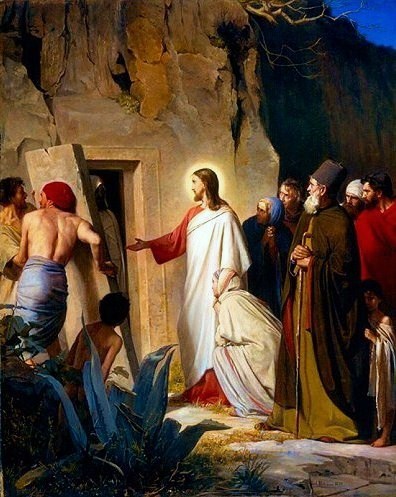
Today’s gospel reading gives us two messages. First, it tells us that our living faith in Jesus will raise all our bodies in the final resurrection. Secondly, with the approach of Easter Sunday, we are called symbolically to resurrect ourselves from sin to grace by partaking in the sacrament of reconciliation. In raising Lazarus, Jesus showed His authority as the Son and showed His divine power. By raising him on the fourth day, Jesus proved that He is master over life and death, and he is able to bring all the dead back to life, the holy Patriarchs, the Jews, and even the righteous Gentiles from centuries before. To be raised from the dead means to be in a living, loving relationship with Jesus, who teaches us that resurrection and life are a call to be united with Him

There are a few lessons we can learn from today’s gospel. First, this miracle is an expression of love. Second, our faith is very important in any miracle God does for us. The third lesson is that everything is possible with Christ through the power of the Holy Spirit. Finally, Jesus is willing to help us no matter what it will cost Him. It does not matter how long we have been spiritually dead or away from Him. If we hear and obey His voice, He will restore life to our weak and mortal bodies through the power of the Holy Spirit. This is because Jesus has authority over life and death.

“Receive the Holy Spirit”

June 5, 2022

Pentecost Sunday
By Fr. Chinnappan Pelavendran

On the day of Pentecost, the Holy Spirit descended with power upon the Apostles in the image of tongues of fire and thus began the mission of the Church in the world. Once they received the Spirit, they went out boldly and preached to all in Jerusalem and elsewhere. Jesus himself prepared the Eleven for this mission, appearing to them on many occasions after his Resurrection.

Jesus asked them to stay together to prepare themselves to receive the gift of the Holy Spirit. The disciples followed the command of Jesus. They as a community gathered together in prayer along with Mary in the Upper Room, awaiting the promised event. It is here they all received the Holy Spirit. This feast of Pentecost is the culmination of the Paschal mystery which tells us of the sending of the Spirit of the Father and the Son on the disciples.

During his apparitions Jesus gives two gifts to his followers, the gift of his abiding peace and the power to forgive sins. He commissions them to carry on his work, empowered by the gift of the Holy Spirit and peace. The Holy Spirit will continue to teach them the message of Jesus. Today is also the birthday of the Church. This Sunday is a commemoration and celebration of the receiving of the Holy Spirit by the early church.

We celebrate this day to recognize the gift of the Holy Spirit, realizing that God’s very life, breath, and energy lives in believers. The celebration reminds us of the reality that we are all having the unifying Spirit that was poured out upon the first disciples. It tells us that the same Spirit is given to each one of us, that we are all baptized by one Spirit into one body, and that the Spirit which raised Jesus from the dead will raise us too. So he said to them, “Receive the Holy Spirit.” With the giving of the Spirit came also the authority to speak and act in the name of Jesus.

If you forgive sins, they are forgiven; if you retain the sins of any, they are retained.” Forgiving sin, reconciling people with God has been the very core of the work of Christ and the Christian mission. The Holy Spirit will teach them the divine knowledge and wisdom of the Father that belongs to Jesus, both the Father and the Son is one in the Blessed Trinity

Being filled with the Holy Spirit, they were given the power of preaching and healing and they spoke in tongues. Thus having received the Holy Spirit, the disciples went out and preached the message of Jesus. Jesus greets his disciples with the gift of peace. “Peace be with you,” he says. Jesus then commissions his disciples to continue the work that he has begun “As the Father has sent me, so I send you.” He breathes the Holy Spirit upon the disciples and sends them to continue his work of reconciliation through the forgiveness of sins.

As we celebrate this great feast of the Church’s fifty days after the resurrection of Jesus, how have we been a sign of reconciliation in our families, in our world, and among people of faith everywhere? Have we been an instrument of God’s peace to everyone we meet? With the faith and trust modeled by Mary, the Mother of God, let us offer our prayers to God this day. Heavenly Father, in your wisdom, please hear and answer our prayers this day. We ask through Jesus Christ, your Son.

Why Did Jesus Go?

May 29, 2022

The Ascension
By Fr. Victor Feltes

This week, our Catholic school celebrated our eighth graders’ graduation with a Mass and an awards ceremony. Afterwards, while the graduates were having their pictures taken, a teacher and I stood off to the side, looking on. He remarked, “It’s sad to see them go.” I replied, “Yeah, but it would be even sadder if they stayed.

Just whimsically imagine remaining an eighth grader well into your twenties. You don’t have a full-time job because you’re a full-time student without a high school degree. Of course you’re unmarried and have no kids—you’re still in middle school! And sure, after a decade of eighth grade, having had the same lessons over and over, you could ace all of your homework and tests (if you still had any motivation left to do so) but you would not be learning very much. It is bittersweet to see our graduates go forth from us, but it is better that they go. Though in one sense they are leaving us, they are not really gone. Yet this departure is necessary for them to reach their full human maturity and to fulfill God’s plans for their glory.

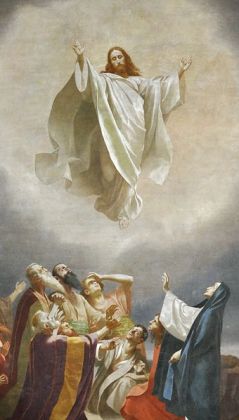
Today we celebrate Jesus’ bodily ascension into Heaven. The traditional day for celebrating the Ascension is forty days after Easter, which was last Thursday, or “Ascension Thursday.” Our diocese, like most dioceses in our country, transfers this celebration to this Sunday. I guess we like keeping Jesus around longer. But seriously, the ascension of Jesus into heaven raises this question: “Why did he go? Why didn’t Jesus stay?

Now Jesus does tell us, “Wherever two or three are gathered in my name I am there in their midst.” He says, “Behold, I am with you always until the end of the age.” And he is truly present for us in the Holy Eucharist. But Jesus’ presence now remains invisible or veiled to our eyes. By bodily ascending and disappearing into the clouds Jesus is visibly departing from us until he comes again with a glory manifested to all. “But I tell you the truth,” he says, “it is better for you that I go.” Why is this better? What would it be like if Jesus dwelt among us throughout the centuries like he did with his disciples those forty days, walking with them and talking with them, following his Resurrection?

There is no physical reason why Jesus could not have done this. His risen body is a glorified body no longer subject to injury or death, so that’s not the reason he did not remain. Did he go because on earth he’s reduced to being in one particular place, or limited in how much he can see, know, or do? Remember, Jesus is not merely human but divine, all-knowing and all-powerful, and his bi-locating saints (such as Venerable Mary of Ágreda or St. Padre Pio) who have manifested the miracle of being more than one place at once surely do not possess any supernatural ability which Jesus lacks.

So God the Father could have chosen “by his own authority” for his Son to remain visibly active here with us, in one, or thousands, or millions of locations at once, throughout the centuries up to our day. Jesus could be the pastor in every parish, the teacher in every classroom, the doctor in every hospital, and the leader in every country. He is the perfect priest, the best teacher, the greatest healer, and the rightful ruler of all. Who is better-qualified than Jesus to do any of these things? Nobody. People would demand this of him and resent him for not doing it. But if Jesus were visibly present and doing everything, then we would be left doing very little.

Would it be a better world if Jesus personally did everything? In some ways, yes. Earth would be closer to paradise in many respects. But would this lead to more souls being saved? I’m not so sure. Adam and Eve lived in an earthly paradise, too, before they fell. And the glory of Christ being manifested to the world in an undeniable way might gain peoples’ submission, but not necessarily their conversion or love. The demons who fell had no doubts about God’s existence and yet they chose to disobey him as far as they were able.

If Jesus did everything of importance on earth without us, one result which seems evident to me is that we would remain in an unending adolescence, like someone attending the eighth grade well into their adulthood. This is why it was better for us that Jesus ascended. We are children of God called to what St. Paul calls “the stature of the fullness of Christ.” If everything which matters were just Jesus’ job to handle, how would we grow from our immaturity into the full maturity of Christ?

Jesus says, “I tell you the truth, it is better for you that I go. For if I do not go, the (Holy Spirit) will not come to you. But if I go, I will send him to you.” By the Holy Spirit, the Church (which is Christ’s Body) is animated in this world. As members of his body we are moved by the Holy Spirit to love and to work united with Christ, growing more into his likeness and glory along the way. Would Jesus not ascending into heaven, remaining constantly here on earth and doing everything without us, have been easier than this present Christian life of ours? Perhaps, but Jesus desires that we would graduate with him to higher things and ascend to a greater glory with himself.

You are Called to Service

May 22, 2021

Pentecost Sunday


You have hands and arms, feet and legs, ears and eyes, a mouth and a nose. They are all valuable parts of your body. But without the presence of your animating soul extending throughout them, these parts would just lie around, inactive, achieving nothing. God has likewise fashioned his Church as the Body of Christ with an animating Spirit. The Holy Spirit is like the soul of the Church, extending through all its members. St. Paul teaches the Corinthians in our first reading:

As a body is one though it has many parts, and all the parts of the body, though many, are one body, so also Christ. For in one Spirit we were all baptized into one body… and we were all given to drink of one Spirit.”

As your soul moves your body to achieve your works and purposes, so the Holy Spirit moves God’s Church to achieve his good works and purposes with us. St. Paul also tells us:

There are different kinds of spiritual gifts – but the same Spirit; there are different forms of service – but the same Lord; there are different workings – but the same God who produces all of them in everyone. To each individual the manifestation of the Spirit is given for some benefit.”

So each baptized person in communion with Christ has the Holy Spirit, and has gifts of the Spirit, and important works to do, and is called to Christian service.

I’ve heard people remark recently that their lives now feel like a clean and open slate. So many routines were cancelled by the pandemic that we now get to decide what worthwhile things to refill our lives and schedules with. I believe this is a important time and an opportunity for our parish. This season must begin a new springtime for the Church, otherwise our “new normal” could be an unchecked decline into decades of winter. How we respond will impact the salvation of souls for generations.

A week ago, I urged you to ask, “Lord, what do you want me to do?” What gifts are you being called to use? What new works are you being called to do? What service are you being called to begin? Let’s contemplate the gifts and desires the Holy Spirit has given you, and consider different works of service you may be called to in our parish.

► Are you a friendly person who knows our community and can make strangers feel welcome? You might be called to be an usher-greeter at our church.

► Can you appreciate the sense and mood of a sacred text, and read it well for others? You might be called to be a lector/reader.

► Are you a good singer or musician? You might be called to sing or play your instrument at Mass.

► Do you want to be close to God at his altar? You might be called to be an altar server, deacon, or priest.

► Do you have a heart for the homebound or those in nursing homes and desire to bring Jesus Christ to them? You might be called to be an Extraordinary Minister of the Holy Eucharist for them.

► Do you desire to be closer to Christ and appreciate that without prayer the Church’s efforts will not be fruitful? You might be called to be an adorer at St. John’s 24-hour Eucharistic Adoration (which precedes the 1st Fridays of each month), or called to join our parish prayer chain, or called to begin attending weekday Masses.

► Do you desire fellowship with other Catholic men or women and want to support charitable works? You might be called to join our Parish Council of Catholic Women or the Knights of Columbus.

► Do you enjoy reading great books and discussing them with friends? You might be called to start a parish book club here.

► Do you love a Catholic video series, like Jeff Cavins’ “The Great Adventure Bible Series,” or Bishop Barron’s “Catholicism” series, or Steve Ray’s “The Footprints of God”? You might be called to host a parish viewing and discussion group for it.

► Do you want to help the poor, the environment, and our church and school while having a fun time? You might be called to join our Thrift Sale volunteers, who do great work.

► Are you good with numbers and a person of integrity? You might be called to be collection counter or to help selling Scrip.

► Are you good with social media or data entry? You might be called to create posts for our parish Facebook page, or called to update our parishioner and school alumni databases.

► Do you care deeply about children, their education and well-being? You might be called to be a mentor, or a tutor, or a playground supervisor, or a school librarian, or even a teacher’s aide at St. Paul’s Catholic School.

► Do you want to help hand-on our Catholic faith to young people? You might be called to be a CCD teacher. After years of good and faithful service, Jenny Hoecherl is stepping down this summer as St. Paul’s CCD and youth ministry coordinator. You may be called to take this important, salaried position.

That’s about two dozen different roles and missions to which you may be called, and I’m sure the Holy Spirit could show you others. So what does the Lord want you to do? To what holy service are you being called? Before Pentecost, the disciples were uncertain and hesitant, hiding behind locked doors. But on Pentecost the Holy Spirit showed them what to do and gave them the courage to do it. Jesus says in today’s Gospel: “When he comes, the Spirit of truth, he will guide you to all truth.” So ask him what you are called to do. Sometimes God uses other people to show us his will. Tell your friends and family members what gifts of God you see in them and encourage them to put them to good use. Jesus sent his disciples on mission in pairs, two-by-two. Perhaps ask a friend or relative to join you in some holy endeavor so that neither of you need go alone. Who could you invite to what? As members of Christ’s Body you, are called to faithful service. So allow the Holy Spirit to enlighten and empower you to achieve God’s works and purposes in this important time.

The Spirit’s Blessings Through God’s Church

March 20, 2021

5th Sunday of Lent

Right before ascending into heaven to sit at his Father’s right hand, Jesus gave his disciples these final instructions: “I am sending the promise of my Father upon you; but stay in the city until you are clothed with power from on high. …You will receive power when the Holy Spirit comes upon you.” After seeing Jesus ascend, the disciples returned to Jerusalem rejoicing. There in the Upper Room, the apostles, the Blessed Virgin Mary, and other Christians (a group of about one hundred twenty persons) devoted themselves with one accord to prayer. After nine days of prayer—the first Christian novena—the Holy Spirit descended upon them on Pentecost.

The apostles had received this eternal, divine Person before. On Easter Sunday evening, Jesus appeared in the Upper Room and breathed upon them saying, “Receive the Holy Spirit. Whose sins you forgive are forgiven them, and whose sins you retain are retained.” You and I first received the Holy Spirit at our baptisms, when we were “born again / born from above…of water and Spirit,” and made temples of the Holy Spirit. But just as the Spirit came down on Pentecost and filled the disciples in a new way, inspiring and empowering them to announce, make present, and spread Christ’s Church in the world, so we receive the Holy Spirit anew for mission in the Sacrament of Confirmation.

When God the Father sends his Word he also sends his Breath, and the mission of the Holy Spirit is united to the Son’s. Our faith in Jesus leads to our belief in the Spirit and in the good things which flow from both. These blessings are brought to completion through God’s Holy Catholic Church. As the Apostles’ Creed proclaims:

I believe in the Holy Spirit,
the Holy Catholic Church,
the communion of Saints,
the forgiveness of sins,
the resurrection of the body,
and life everlasting. Amen.

As Jesus Christ is the Church’s body, we being his members, so the Holy Spirit is the Church’s soul, our animating Spirit. The Holy Spirit inspires the Church’s Sacred Scriptures, he safeguards her Sacred Tradition and Magisterium from error, he is the Spirit of her liturgies, he empowers her sacraments, he intercedes in her prayers, he builds her up by charisms and ministries, and he manifests holiness in her by each vocation and every saint. As the early Church Fathers said, the Church is the place “where the Spirit flourishes.” The Holy Spirit gives his people gifts of wisdom, understanding, counsel, fortitude, knowledge, piety, and fear of the Lord; and his fruits of love, joy, peace, patience, kindness, goodness, faithfulness, gentleness, and self-control are seen in us. Jesus Christ and the Holy Spirit form the Church and make her holy. At the Last Supper, Jesus prayed for the holy unity of his Church. He said, “Holy Father, I pray not only for [these apostles of mine,] but also for those who will believe in me through their word, so that they may all be one, as you, Father, are in me and I in you, that they also may be in us, that the world may believe that you sent me.” This loving unity is reflected in the communion of the Saints.

In today’s Gospel, some Greeks who had come to worship at the Passover Feast approach the Philip the Apostle and ask him, “Sir, we would like to see Jesus.” Philip goes and tells Andrew the Apostle; then Andrew and Philip go and tell Jesus. Jesus answers them, “The hour has come for the Son of Man to be glorified.” Jesus’ salvific mission is catholic (that is, “universal”). He has come to unite every people and nation in himself. and he sees in this overture from the visiting Greeks a sign that his moment has come. Jesus says, “When I am lifted up from the earth, I will draw everyone to myself.” Jesus gathers them into communion with the one Church he founded, a hierarchical Church (with Christ its Head ordaining that apostles and priests to be her servant leaders) but a Church which is first and foremost interpersonal, communal. No one can baptize themselves; it requires another person. And not even a priest can absolve his own sins. Just so, we are not saved alone, but in communion with others. In the words of Pope St. Paul VI, “We believe in the communion of all the faithful of Christ, those who are pilgrims on earth, the dead who are being purified, and the blessed in heaven, all together forming one Church; and we believe that in this communion, the merciful love of God and his saints is always attentive to our prayer.” As Sts. Andrew and Philip helped those Greeks in reaching out to Jesus, so we lovingly aid one another, by our prayers, penances, and sacrifices, by sharing our material and spiritual goods, helping each other on the way to heaven. But entry into heaven is impossible without the forgiveness of sins.

We believe in the forgiveness of sins. Through Jesus Christ, God’s promises spoken through the Prophet Jeremiah in our first reading are fulfilled: “I will make a new covenant with the house of Israel… I will forgive their evildoing and remember their sin no more.” What was the Risen Christ’s first order of business for his Church when he appeared to his apostles in the Upper Room on Easter? After assuring them that it was really him and that he wished them peace, he gave his apostles the power and authority to forgive sins (as we noted before). Baptism into Christ washes away our past sins, but what if we grievously sin after baptism? We cannot be baptized twice. Since Christ has given his Church the power to forgive sins, then baptism cannot be her only means of forgiveness. The Sacrament of Penance is necessary for salvation for those who have fallen after Baptism, just as Baptism is necessary for salvation for those who have not yet been reborn in Christ.

There is no offense, however serious, that the Church cannot forgive. There is no one, however wicked or guilty, who may not confidently hope for forgiveness, provided their repentance is sincere. Christ, who died for all men, desires that the gates of forgiveness in his Church should be open to anyone who turns away from sin. If you could use a good Confession, mark your calendars to come here to St. Paul’s next Sunday, on Palm Sunday afternoon. Apart from making another appointment, it might be your last chance for a Lenten Reconciliation with God.

But what good would God’s forgiveness be if death were the end of us? We believe in the resurrection of the body. Jesus tells Philip and Andrew, “Amen, amen, I say to you, unless a grain of wheat falls to the ground and dies, it remains just a grain of wheat; but if it dies, it produces much fruit.” Here, as elsewhere, Jesus foretells of his resurrection, for the buried seed which dies then rises from the earth. Jesus then goes on to say, “Whoever serves me must follow me, and where I am, there also will my servant be.” This is not only a call to discipleship but a promise of resurrection: ‘Whoever serves me must follow after me, from the tomb of death to the resurrection of life, and where I am (whether in heaven or in the New Creation to come) there also will my servant be with me.’ Jesus says, “Whoever loves his life loses it, and whoever hates his life in this world will preserve it for eternal life.

We believe in life everlasting. And this new life doesn’t begin only once we die, or after God raises up our bodies “on the last day.” We can already taste eternal life now. From your worst sins you have had small glimpses of hell, and in Jesus Christ you have already experienced small glimpses of heaven. But our eyes have not seen, and our ears have not heard, and our hearts have not conceived the fullness of what God has prepared for those who love him. Scripture speaks of it in images: of life, light, peace, wine, a wedding feast, the Father’s house, the heavenly Jerusalem, paradise. God will wipe away every tear from our eyes and death will be no more, neither will there be any more mourning or crying or pain, for these things will have passed away. And when we enter this perfect, unending life with the Most Holy Trinity and all the saints, it will be the ultimate fulfillment of our deepest human longings; supreme and definitive happiness.

In conclusion, The Apostles’ Creed ends with the same final word as the last book of the Bible, the word at the end of the Church’s many prayers: “Amen.” In Hebrew, “amen” comes from the same root as the word “believe,” expressing solidity, trustworthiness, and faithfulness. In saying “Amen” we are professing both God’s faithfulness towards us and our trust in him. The Creed’s last word “Amen” repeats and confirms its first words, “I believe,” and everything in between. As St. Augustine preached, “May your Creed be for you as a mirror. Look at yourself in it, to see if you believe everything you say you believe, and rejoice in your faith each day.” This is our Faith. This is the Faith of the Church. We are proud to profess it in Christ Jesus our Lord. Amen

Living Christ’s Mysteries — Funeral Homily for Deacon Ed Feltes, 65

February 23, 2021

On the day Victor and Ramona brought their eighth son to be baptized, while his little head was still damp from holy water, Edward Joseph was draped with white linen. And the priest said (in Latin), “Receive this white garment, which mayest thou carry without stain before the judgment seat of our Lord Jesus Christ, that thou mayest have life everlasting.” Today, we bring Ed’s body before the Lord, draping him in white cloth once more. My uncle Ed told me that as a deacon he would always say yes to doing baptisms. It was, he said, “the introduction of a new life into the Church. By baptizing them you are basically installing them into a Catholic environment and hopefully they will grow in it and not back away from it.” Ed has been a Catholic Christian for more than sixty-five years, ever since he was baptized into Christ’s death and resurrection. And throughout his nearly twenty-four thousand days Jesus Christ accompanied him through life. The life of a Christian is found in Jesus Christ. And the mysteries of Christ’s life are reflected in, shared with, the faithful Christian. We see this throughout Ed’s life.

At his First Communion, young Edward approached and saw the Real Presence of his Lord held before his eyes: “The Body of Christ / Corpus Christi.” Ed received Jesus and Jesus received Ed into a more profound union, a more intimate relationship, between them. In receiving Christ’s Body, Ed was called to be the Body of Christ for this world. When Jesus tells us at the Last Supper, “Do this in memory of me,” he not only commands that we would receive him at the Holy Sacrifice of the Mass, but that we would imitate him in his self-gift: “This is my body, which will be given up for you. Do this in memory of me.” When Ed was sealed with the gift of the Holy Spirit at his Confirmation, he entered a more powerful relationship with that same Spirit of inspiration, grace, and power who led Jesus in his works on earth. The Holy Spirit’s gifts manifested through Ed not merely for himself, for his own salvation, but to serve the wider mission of Christ’s Church, that every person in this wayward world might be saved.

The main vehicle of Ed life’s work and witness would be through his first vocation: marriage. Ed and Jessica met during his studies at Notre Dame University and the year he graduated they entered a new covenant together. Almost forty years ago, they freely committed without reservation to give themselves to each other in marriage, to love and honor each other for as long as they both would live, and to accept children lovingly from God—raising them up according to the law of Christ and his Church. Recall that Jesus Christ called himself the Bridegroom and that in Sacred Scripture his Church is called his Bride. Every Christian is called to imitate Christ, and every Christian soul is spiritually his Bride. But just as the Holy Eucharist we celebrate is not merely a symbol or a memory but Jesus’ Real Presence among us so the Sacrament of Marriage makes present the mystical marriage of Jesus and his Church, within and between a husband and a wife. In beholding a holy, Christian marriage, in its loving, mutual, and lasting fidelity, we see a sign for us and for the world. That love is real, that love is foundational, that love is fruitful. That we were made in love, made to love, made for a holy communion of love, a family. We saw this in Ed and Jessica’s strong marriage which bore fruit, not least of all in their children: in their living son, Christopher, of whom they are so proud, and four other loved children who passed away very, very young; Francis, Steven, Elizabeth, and Meagan. Ed said he looked forward to meeting them and now has that opportunity.

In his marriage, together with Jessica, Ed discerned and pursued a call within his call, a second vocation. Relying on the help of the Lord God and our Savior Jesus Christ, Ed was chosen and ordained for the Order of the Diaconate. After the laying of the bishop’s hands and being dressed with stole and vestment, he was handed a Book of the Gospels with this admonition: “Believe what you read, teach what you believe, and practice what you teach.” Deacon Ed then ministered here at St. Catherine’s, celebrating in this sanctuary and serving throughout this parish. Teaching and preaching, even though he often found preaching difficult. Ed told me that he primarily sought to advance the Kingdom by sharing his life, showing how he lived. He said, “Always live your life such that people want the same that you do.” Looking back at the end of his quiet life, Ed had few regrets, but he did wonder if he was “maybe quiet too long.” Deacon Ed understood well that we need not enter into every pointless, unhelpful argument, but the Spirit does call and help us to speak the important words people need to hear alongside seeing our deeds.

In these last years, these final years, Ed reflected Christ and became configured to him in a new way, by joining him in suffering. Ed had at least six different strokes—twice nearly dying yet surviving—and endured strokes’ debilitating effects. Ed and Jessica described these past several years to me as an experience of continuous loses and grief, but also of continuous mercy and grace. Reportedly, the devastating impact of strokes often breaks up families, but this family grew closer through the trials. I think Ed also became bolder in Christ. While under hospice care at home he never stopped offering good things to his guests; blessings, prayers, holy water and blessed salt, to anyone who visited, wherever they might be in their faith walk.

When I last spoke with my uncle Ed I asked him what he was looking forward to. He simply said, “Heaven. I poured a lot of my life into experiencing, into living life on earth with a heavenly approach.” Asked as to what his near future held, he said, “It’s really up to God. I accept everything he has for me.” Ed and Jessica related to me that it was last March, almost a year ago, over a lunch at Panera Bread, that he told her, “I’m going to go to the Lord in six months to a year.” And he was right. Ed knew he was in God’s hands, being led and offered like an oblation for his glory and as a blessing for many. Knowing that this day was not in the far-distant future, I asked Ed about his wish for all of you on this day of his funeral. He answered, “Pray that they seek God more closely and live a more Christian life. I wish they would seek God for the answers and not just rely on themselves.” So if you have seen Jesus Christ in the life of Deacon Ed Feltes, please listen and heed his words.

And now, in conclusion, like Edward heard in his Last Rites:

I commend you, our dear brother, to almighty God and entrust you to your Creator. May you return to God who formed you from the dust of the earth. May holy Mary, the angels, and all the saints come to meet you as you go forth from this life.

May Christ who was crucified for you bring you freedom and peace. May Christ who died for you admit you into his garden of paradise. May Christ, the true Shepherd, acknowledge you as one of his flock.

May the Lord forgive all your sins and set you among those he has chosen. May you see your Redeemer face to face and enjoy the vision of God for ever.

The Oil for our Lamps

November 7, 2020

32nd Sunday in Ordinary Time

“The kingdom of heaven will be like ten virgins who took their lamps and went out to meet the bridegroom. Five of them were foolish and five were wise.”

What are we to make of Jesus’ parable today? Who is this bridegroom and who are these virgins? What are these lamps and the oil that fuels them? How can we be like those wise virgins who enter the wedding feast, and unlike the foolish who are unhappily locked outside? We will better understand the meaning of this parable through a familiarity with Jewish marriage customs.

In the culture of Jesus’ day, when a young man betrothed a woman they would remain apart, typically for twelve months, manifesting the propriety of their union. Once this time of separation was over, the groom would return to his bride with his groomsmen, usually with a nighttime torchlight procession. The bride and her bridesmaids would be expecting him but without knowing the exact hour of his arrival. This is why the bridegroom’s second coming would be preceded by his friend and forerunner’s announcing cry: “Behold, the bridegroom! Come out to meet him!” Then the bride and her virgin attendants would go up with the groom to his father’s house for a great wedding feast. There the marriage would be consummated and days of feasting and merriment would commence. So whose marriage is being symbolized in Jesus’ parable? Who is the bridegroom and who is his bride? The Scriptures point to Jesus Christ as the bridegroom and his Church as his bride.

The Old Testament prophet Isaiah spoke of God’s promise: “As a young man marries a virgin, your Builder shall marry you; and as a bridegroom rejoices in his bride so shall your God rejoice in you.” In the Gospels, St. John the Baptist testifies, “I am not the Christ but I have been sent ahead of Him. He who has the bride is the bridegroom…” Then later, when Jesus is questioned as to why his disciples do not fast, he replies, “Can the wedding guests fast while the bridegroom is with them? As long as they have the bridegroom with them they cannot fast.” Later in the New Testament, St. Paul tells the Church at Corinth, “I betrothed you to one husband, so that to Christ I might present you as a pure virgin.” And finally, the Book of Revelation peers into Heaven declaring, “The marriage of the Lamb has come and His bride has made herself ready. … Blessed are those who are invited to the marriage supper of the Lamb.” Heaven is the fullness of the marriage supper of the Lamb to which his Bride, the Church, is called.

While the Church is one, its members are many. The one Bride of Christ exists as a collection of persons. This is why there are multiple bridesmaids in this parable. Each of us is called individually and together to join the Bridegroom in Heaven. Each virgin in the parable awaits the coming of the Bridegroom and each holds a lamp which could provide light to lead her to the joyful wedding feast. Yet not all have oil for their lamps and, due to their foolishness, some go on to find themselves locked outside.

What is this lamp that leads to Heaven and what is the oil that fuels it? We can look to other Bible passages for answers. The Second Book of Samuel quotes David rejoicing in God: “You are my lamp, O Lord; and the Lord illumines my darkness.” While Psalm 119 calls God’s word a lamp: “Your word is a lamp for my feet, a light for my path.” But how could both God and God’s word be the lamp? “In the beginning was the Word, and the Word was with God, and the Word was God.” Jesus Christ is the Word of God. Later John’s Gospel, Jesus says: “I am the light of the world. (Which can also be translated as, “I am the lamp of the world.”) Whoever follows me will not walk in darkness, but will have the light of life.” So we are individually the bridesmaids, and Jesus is our lamp that would lead us to Heaven. But we must not neglect the oil which fuels this lamp.

What or who is this oil? Oil (which was used to anoint biblical priests, prophets, and kings) is a symbol for the Holy Spirit and grace. After the Holy Spirit descended upon Jesus at his baptism, revealing him to be the promised Messiah and Christ (two words which both mean “Anointed One”) Jesus likens the Holy Spirit to anointing oil. “In the power of the Spirit” Jesus declares at Nazareth; “The Spirit of the Lord is upon me, because he has anointed me…” And the Book of Acts recalls how, “God anointed Jesus of Nazareth with the Holy Spirit and power…” The Holy Spirit is a gift of God, and Jesus teaches that “the Father in Heaven [will] give the Holy Spirit to those who ask him.” This Spirit connects us to Jesus, to know him and be like him. As the Holy Spirit inspired and strengthened Jesus throughout his ministry, like the oil of a lamp fueling its light, so the Holy Spirit enables the Christian to shine. “You are the light [the lamp] of the world,” Jesus tells us, “Your light must shine before others…

In Jesus’ parable, all of the virgins believed in the bridegroom and expected his arrival. All of them had lamps but not all had oil. Similarly, all Christians have heard of Jesus and of his Second Coming, yet not all of them are prepared for him, to burn with his holy light. As the Book of Proverbs says, “The light of the just gives joy, but the lamp of the wicked goes out.” When the foolish virgins’ need for oil becomes clear, why don’t the wise virgins give to those without? This seems very strange to us because sharing would seem to be the kind and generous Christian thing to do. But the oil the wise virgins possess is not something they can hand over. “No… Go instead to the merchants,” they say, “and buy some for yourselves.” This oil is the gift of the Holy Spirit and grace that God the Father provides; but then what is meant by this detail of dealing with the merchants?

In our world, whenever we make a purchase or trade, we exchange a thing we possess for something else we desire more. For instance, when I fill up my tank at Kwik Trip, I’m exchanging $25 I have for gasoline instead. I can have either the money or the gas but I can’t have both. I must to decide which I value more — though without the gas I won’t get very far. The wise virgins brought flasks of oil with their lamps but the foolish ones did not. They carried extra coins of the world instead. The Holy Spirit is not of this world. St. Paul wrote the Corinthians, “We have not received the spirit of the world but the Spirit that is from God.” But to possess the Holy Spirit we must sacrifice — hand back to the world — what is taking up the space for the Spirit and his graces.

For example, for some Christians, TV prime time crowds out quiet prayer time. For too many, Sunday various entertainments and excursions take the place of Sunday Mass. A smartphone can distract us from noticing God is calling. And if we are possessed by our possessions, our fearful clinging excludes a generous spirit. Are you restrained in your devotion to Jesus because of what worldly people might think of you? Chose either God or the world, take the oil or the coins, you can’t have both. Sacrifice in your life what makes the Holy Spirit and his grace unwelcome.

Just as Lady Wisdom (poetically described in our first reading) is met by those who seek, desire, and watch for her, so the Holy Spirit more readily comes not to those who are indifferent or resistant, but to those who are intentional, receptive, and docile for him. Know that the Holy Spirit is given not merely so that your labors can be more fruitful — though you will be more fruitful. Something else is more important than all good works. Elsewhere in Matthew’s Gospel, Jesus teaches, “Not everyone who says to me, ‘Lord, Lord,’ will enter the kingdom of Heaven… Many will say to me on that day, ‘Lord, Lord, did we not prophesy in your name? Did we not drive out demons in your name? Did we not do mighty deeds in your name?’ Then I will declare to them solemnly, ‘I never knew you. Depart from me, you evildoers.’” Note that this is just like what the Bridegroom says to the foolish virgins after the door to the feast has been locked. They say, “Lord, Lord, open the door for us!” But he says in reply, “Amen, I say to you, I do not know you.”

The most important mission of the Holy Spirit is not to make us fruitful laborers, but to grow our relationship with the Holy Trinity, so that we will approach God’s door as friends and not as strangers. The Holy Spirit leads us to the Father. St. Paul writes to the Romans, “you received a Spirit of adoption, through which we cry, ‘Abba, Father!’ The Spirit himself bears witness with our spirit that we are children of God.” And the Holy Spirit reveals to us the person of Jesus Christ. St. Paul tells the Corinthians, “the natural [worldly] person does not accept what pertains to the Spirit of God, for to him it is foolishness, and he cannot understand it, because it is judged spiritually. The spiritual person, however, can judge everything… [Because] we have the mind of Christ.

However, we know neither the day nor the hour of Christ the Bridegroom’s Second Coming. He does not reveal this knowledge to us for our own good, but Jesus urges us to always be ready for him. Like all ten virgins in the parable,  it is quite possible that all of us here will fall asleep, will experience the sleep of death, before Jesus returns. But when the cry goes up at his coming and the dead are raised, will we be prepared to follow him into his joyful wedding feast? That will all depend upon what we do now in this present life. Will we have already traded away the coins of this world to have the precious oil, the Holy Spirit, fueling the lamp of our relationship with Jesus Christ? This is what the wise will do, and what the foolish will neglect until it is too late to their great regret. So let us be wise and welcome the Holy Spirit and his graces.