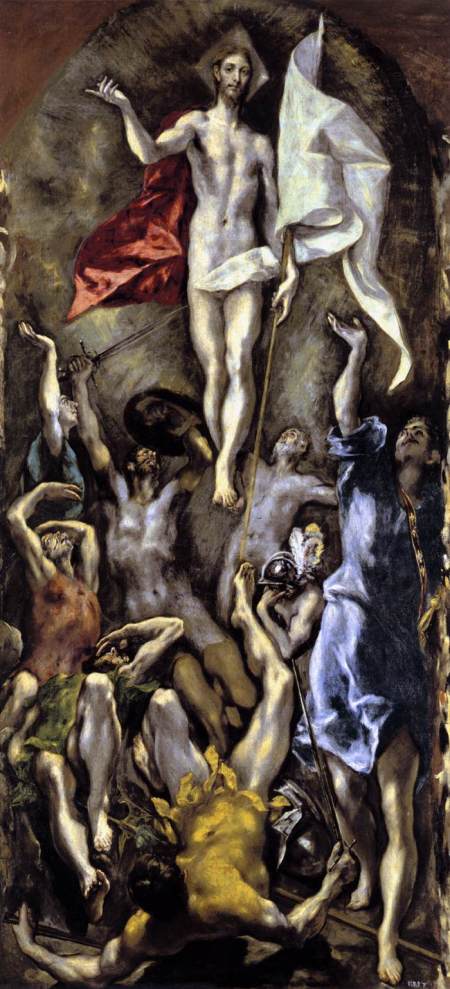
Archive for the ‘Holy Trinity’ Category

Sending Another Advocate — 6th Sunday in Easter—Year A

May 29, 2011

At the Last Supper, Jesus told His apostles that He would soon be departing from them. His disciples found this news distressful. Jesus had been their spiritual leader and intimate friend. For the better of three years, they spent almost all day, every day, with Him; sharing breakfasts in the morning, walking down the roads and conversing with Him, watching Him preach and heal n villages, spending evenings with Him around the fire. Not only had he taught them about God, he had also made them more godly men. And so, understandably, word of their Good Shepherd’s departure saddened them.

But Jesus told them, “Do not let your hearts be troubled. You have faith in God, have faith also in me.” In obedience to His Father, Jesus was going away, but He told the disciples that they would not be left orphans. God would send them another person to lead and sanctify them. Jesus told them God the Father would send them another Advocate, another Helper, another Guide, to be with them always. Jesus spoke of the Holy Spirit, who would continue the same work which Jesus had begun in them. The Father had blessed them before by sending them Jesus. Now, at Jesus’ departure, the Lord wanted them to trust and remember this: that they would be blessed again.

Today, this Gospel is fulfilled in our hearing. Father Stoetzel has asked me to read you this letter from him:

Dear parishioners,

Bishop Callahan has asked me to take a new parish assignment beginning July 1st. I will be the next rector of St. Joseph the Workman Cathedral in La Crosse. Also, I am very happy to announce your new pastor here and St. John the Baptist in Marshfield. He is Fr. Samuel Martin who is presently the director of the Holy Cross House of Formation and teacher at Aquinas High School in La Crosse. Please welcome him graciously as he is being sent by the bishop to be your pastor.

I want to thank you very much for the privilege of being your pastor for the past 15 years. My gratitude goes to you for the prayers and many acts of kindness you have shown. Let us continue to pray for one another. Be assured that you will be in my fondest thoughts.

Sincerely,
Fr. Stoetzel

The fact that our bishop has appointed Fr. Stoetzel to be the rector of the cathedral (the bishop’s own parish) says much about Father’s quality as a pastor. We will miss him in many ways. I don’t know Fr. Martin too well, but every encounter I have had with Him has been a positive one. I predict that we will all be very pleased with him when he comes in July and will be blessed by getting to know him better. In the meantime, let’s remember pray for Fr. Stoetzel, as he prepares for his new assignment in La Crosse. Let us also pray for our pastor-to-be, Fr. Sam Martin, as he prepares for us.

Jesus says, “Do not let your hearts be troubled. You have faith in God, have faith also in me.” The Lord wants us to trust and remember this: that He has blessed us before and that He we will be blessed again.

The Way, Truth, & Life — 5th Sunday in Easter—Year A

May 22, 2011

Jesus said, “I am the way and the truth and the life. No one comes to the Father except through me.”

The Mass is an encounter with Jesus Christ, leading us to God the Father. Like Jesus Himself, the Mass contains the Way, the Truth, and the Life of Jesus. First, we journey on the Way to Jesus, then we come to the Truth of Jesus, finally we join in the Life of Jesus.

The Mass begins with the sign of the cross, for God is the beginning and end of everything. Next, we confess our unworthiness to approach the Lord, asking mercy for our sins, so that we may dare to take this journey to God. The, from the Holy Scriptures, we hear of God’s words and deeds among the Old Testament peoples and within the New Testament Church. In this, we learn of the providential way that God has prepared throughout time for us to encounter Jesus Christ today. Just as the journey on this Way through history leads to Jesus Christ, so the liturgy of the Word leads to the Gospel. Certainly, Jesus Christ the Word of God is present throughout the entire Word of God which is Sacred Scripture, but for the reading of the Gospel, we all stand up for Him and sing “Alleluia,” “Praise the Lord,” because we have come to Jesus Christ and He is more fully present among us in the proclamation of the Gospel.

The Gospel reading proclaims Jesus, who is the Truth. The homily that follows proclaims that the Truth matters for us here and now and demands our personal response. To this call, we answer with the Creed, proclaiming our faith in who God is and what He has done for us. In the Creed, we proclaim our acceptance of Jesus, the Truth. In the prayers of the faithful, we petition the Lord for our needs and concerns, saying in so many words, “Lord, let your kingdom come, on earth as it is in Heaven! Let us share you life! Give us your life!” At Mass, the Way leads to the Truth, and from the Truth we long for God’s Life. At Mass, the Liturgy of the Word leads to the Liturgy of the Eucharist.

The presentation of the gifts is not merely about moving around cash and bread and water and wine. The presentation of the gifts is about the presentation of everything that we have, and everything that we are, to God. We lift up our hearts to be one with our sacrifice. Amidst praises to the Father, the one life-giving sacrifice of the Last Supper, of the cross, and of Heaven becomes present here to us. We join in offering this sacrifice through Jesus, with Jesus, and in Jesus, in union with the Holy Spirit, to God the Father in Heaven.

Through this offered sacrifice, we join in God’s Life. We pray “Our Father,” because uniting with the paschal mystery, the great Easter deeds of Jesus, gives us life as the Father’s sons and daughters. Then we share with one another the sign of peace, the loving peace that is possessed by God’s holy ones. Finally, at the climax, we partake of Jesus Christ, Life Himself, most truly present in the Holy Eucharist.

Sometimes people say, “I just don’t get anything out of going to Mass. Father, I know that you say all this important and wonderful stuff is going on, but I don’t see it and I don’t feel it. The Mass is boring for me.” I understand. When I was a boy, I made a point of going to the bathroom (sometimes twice) during every Mass, just to break up the monotony. When I would see the priest cleaning the dishes at the altar—that was a good sign, because it meant that the Mass was almost done. I didn’t really know what was happening at Mass, so I really didn’t believe in what was happening at Mass. But as I grew older I began to learn what was happening, and as I grew in faith I began to believe in what was happening, and my experience of the Mass was transformed.

People who say that the Mass is boring resemble St. Phillip in something he said to Jesus at the first Eucharist, the Last Supper: “Master, (we don’t see or feel the presence of God the Father,) show us the Father, and that will be enough for us.” And Jesus said to him, “Have I been with you for so long a time and you still do not know me, Philip? Whoever has seen me has seen the Father. (Whoever has been to Mass has encountered my mysteries.) How can you say, ‘Show us the Father’? (How can you say, ‘The Mass is boring?’)” The awesome mystical realities of the Mass are true, and real, and present and active at every Mass we attend, whether we see them, or feel them, or believe in them, or not.

Jesus Christ and the Holy Mass contain the Way, the Truth, and the Life, and we shall receive from them according to our faith. Let us pray, that at this Mass and every Mass, we may be as fully present to Jesus Christ and His mysteries as they are to us at every Mass.

Child of God Homily

February 9, 2011

 
Do you know who Bill Gates is? He started a computer software company called Microsoft and is one of the richest men in the world.  If Bill Gates were your dad do you think that he would be willing to buy you things you could never have otherwise? Imagine if President Obama were your uncle.  Do you think he would invite you to the White House sometime?  Do you think that you would have the opportunity to talk to him about your concerns and ideas for the world? Hold that in mind…

When I was younger, something about how we professed the Nicene Creed on Sundays struck me as strange: “For us men and for our salvation He came down from heaven. *Profound Bow* By the power of the Holy Spirit, He was born of the Virgin Mary, and became man. *Straighten* He was crucified under Pontius Pilate. He suffered, died, and was buried.” I wondered, “Why do we bow for Jesus being born? Heck, even I was even born. Why don’t we bow for His suffering instead?” 

We tend to think of God becoming man as a perfectly normal thing for God to do, we take it for granted, but it is actually the most surprising thing that has ever happened in history. The divine Son became one of us so that He could be our brother, and so that His Father could be ours. “See what love the Father has bestowed on us that we may be called the children of God. Yet so we are.”

Our heavenly Father is unimaginably rich, and He wants to provide for you and bless you. Our Father is all-powerful, and He is always open to hearing your prayers. Our Father in heaven has a house far greater than the White House, and He is preparing a place for you to stay. Remember this: you are a child of God the Father, and that’s a big deal.

God’s Icon, The Family — Feast of the Holy Family

January 5, 2011

Our Catholic Faith is full of mysteries, but what is a “mystery?” In the world, or in a novel, a mystery can be completely solved once important clues are found. “It was Cornel Mustard, in the Library, with the Candle Stick”–case closed. But in the Church, a mystery is something rather different. Is not something that one more clue could solve, nor something so dark and impenitrable that we can know nothing for certain about it. We can know many things with certainty about Christian mysteries, but they are parts of our Faith which are so rich that we will never completely exhaust them. The Trinity is perhaps the greatest of these mysteries, but by God’s revelation (through words and deeds and created things) truths about the Trinity have been revealed to us. Invisible realities can be known through the things that God has made. One great window into the mystery of the Trinity is the human family.

In the beginning, the Lord God said: “It is not good for the man to be alone. I will make a suitable partner for him.” So the Lord God cast a deep sleep on the man, took out one of his ribs, and built it into a woman.  When he brought her to the man, the man said: “This one, at last, is bone of my bones and flesh of my flesh” The two came together, and brought forth new life.

In the Trinity, the Son is of the Father; “God from God, light from light, true God from true God.” The Son is “begotten, not made,” He is a person from a person; not a lesser, created thing. From the everlasting, mutual self-gift of love shared between the Father and the Son, God the Holy Spirit proceeds.

The human family is an icon of the Trinity, like the icon of Mary and Jesus on our Marian altar. An icon can teach us about, and actually connect us to, the events and holy people they depict; however, it is also possible to misunderstand their metaphor. Gazing and meditating upon the Holy Mother and Child can help us to know them and relate to them better, but it would be foolish to think that they are made of wood and paint like the icon. Not everything found in a human family applies equally to the Trinity, but the family is perhaps the greatest icon of the Trinity, sharing many of its realities.

The Trinity is one; three persons sharing the same divine nature. Jesus said, “The Father and I are one,” and, “Whoever has seen me has seen the Father.” Likewise, in the family, husband and wife are one flesh and their children are their very flesh and blood. No matter what, your biological parents and siblings will be related forever, for there is a special oneness to your nature.

There is equality in the Trinity. Jesus accepted peoples’ worship, something only God can justly receive, and the Holy Spirit does the same: “With the Father and the Son, He is worshiped and glorified.” Likewise, there is equality (or at least there should be) between husband and wife in marriage. Though there are natural differences between them, the two are equal in dignity.

Though there is equality among the persons of the Trinity, there is also an order among them. Jesus said, “I do nothing on my own, but I say only what the Father taught me…. The Father who sent me commanded me what to say and speak.” Though equal in dignity, the Son follows the Father’s lead.

Notice in the Gospel how three angelic messages come to Joseph in three separate dreams: first, to flee to Egypt; second, to return to Israel; and third, to settle in Nazareth. Now God could have chosen to send His angel to Mary. He had done it before, Mary would have certainly obeyed God’s command, and Joseph (following her miraculous pregnancy) would have believed her, but that’s not what God did. God wanted Joseph to lead his family, and when Joseph woke his wife up in the middle of the night and said, “Mary, I had a dream–we need to leave, right now.” Mary said, “Ok,” because she knew that he loved her and trusted him. As Mary was to be the heart of their home, Joseph was to be the head of their family.

Mothers and fathers, in sometimes different but complementary ways,  reflect the divine attributes of God. Our moms and dads were distant likenesses of God, but through them we first came to conceptualize about God. Through them we first experience beauty and strength, the firmness of justice and the tenderness of mercy, the immanent love that braces what we are and the transcendent love that calls us to be more.  Parents are icons of God. That is why bad parents can be such a scandal to a life of faith. If our own parents were poor, let us recognize that it is the ideal they failed to live up to, not their behavior, which is the actual likeness of God.

We are all called to marriage, either natural or spiritual. We are all called to raise up biological or spiritual children for God. We are all called to be icons of God. Let us pray for the grace for our own married and parental love to be a worthy icon of the Trinity. That may seem intimidating, but don’t be afraid. You were made for this.

Close At Hand — 3rd Sunday of Advent—Year A

December 14, 2010

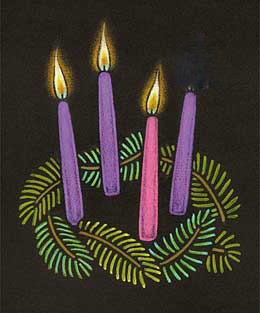
Today, the third Sunday of Advent, we light the pink or rose-colored candle because today is Gaudete Sunday. “Gaudete” means “rejoice” in Latin and we hear this call in the opening antiphon: “Rejoice in the Lord always; again I say, rejoice! The Lord is near.” Now that we are about halfway through this purple, penitential season, the Church is reminding us that Advent is also a time for joy. Though we await Him, “the Lord is near.”

This Guadete Sunday, we have extra cause for joy. As you may have heard, this week, a shrine in Champion, Wisconsin, 10 miles northeast of Green Bay, is now our country’s first Church-approved Marian apparition site. On the Feast of the Immaculate Conception, this happy news was announced by Bishop David Ricken of Green Bay:

“I declare with moral certainty and in accord with the norms of the Church that the events, apparitions and locutions given to Adele Brise in October of 1859 do exhibit the substance of supernatural character, and I do hereby approve these apparitions as worthy of belief (although not obligatory) by the Christian faithful.”

151 years ago, a lady clothed in dazzling white, with a yellow sash around her waist and a crown of stars around her head appeared to a 28-year-old lay woman named Adele. Adele asked the lady who she was and what she wanted, and the lady answered, “I am the Queen of Heaven who prays for the conversion of sinners, and I wish you to do the same. You received Holy Communion this morning and that is well. But you must do more. Make a general confession and offer Communion for the conversion of sinners… Gather the children in this wild country and teach them what they should know for salvation….”

That was the core of Mary’s message: the need for sinners to be converted and for children to be taught the faith. But Adele hesitated, and asked Mary how she was to teach the young when she knew so little herself. Mary replied, “Teach them their catechism, how to sign themselves with the sign of the Cross, and how to approach the sacraments; that is what I wish you to do. Go and fear nothing, I will help you.” After that encounter, Adele’s father built a small chapel on the site and Adele went about fulfilling her mission from Mary for the rest of her life.

The Bride of Christ, the Church, teaches that parents are the primary educators of their children. This means that even if your children go to Catholic or public school, you are their first and foremost teacher in the important lessons of life. But how often do our parents talk to their children about Jesus or Mary, or teach their children about what they should know for salvation? I suspect that many parents are intimidated because, like Adele Brise, they feel like they know too little. But Mary reassures us that we can all teach our children simple but important lessons in the faith that will remain with them and bless them forever.

Like Mary said, teach them the sign of the cross and how to approach the sacraments. At Mass, whisper in their ears, “Look, Father is holding up Jesus,” and on the way home in the car, ask them what they learned from the homily. Have interesting conversations with your children about the faith. Ask them, for example, if they think that Jesus likes sports, ask them what they think Mary’s favorite prayer is, or ask them what they think Heaven is like, and then share your answers with each other. And, perhaps most importantly, teach your children how to pray, by praying with them daily.

Though you know enough already to teach your children a great deal, you must always keep learning yourself. As your children mature in age, you must also mature in your understanding of the faith. Explore why we as Catholics do what we do, and learn why the Bride of Christ, our Mother, teaches as she does. For example, why do we make the sign of the cross? We do it at the open and close of our prayers and you’ve done it since you were little, but now consider more deeply what it means.

Its words and gestures encapsulate our faith’s most central mysteries. It confesses the Trinity and trances our redemption through the cross of Jesus Christ. We pray not “in the names,” but the “in the name of the Father, and of the Son, and of the Holy Spirit,” for God is three persons who are one in nature. [†] From the Father descends the Son, and the Holy Spirit proceeds from the love between them. Tracing the cross on ourselves, [†] we recall how the Father sent the Son to save us, and how the Holy Spirit now acts through our lives with power.

To pray this prayer, for it is a prayer, calls upon God to be powerfully with us. It is to say: “Father, Son and Holy Spirit, I ask you to be near me, here and now.” In the face of temptation or evil, this sign declares, “I belong to neither to the Devil nor the world, I belong to Jesus Christ.” So much is contained in this simple prayer and gesture. It can be taught to a child, yet meditated upon for a lifetime. And this is just one element of our faith. There is always more to explore.

Let us rejoice today, for the apparition of Our Lady of Champion reminds us, that even in Wisconsin, the Lord is near,  and [†] we can call upon Him at any time. Let us teach the faith to our children, so that they will remain near to Him and call upon His name.

7 Superpowers — Tuesday, 1st Week of Advent

November 30, 2010

Back when I was in seminary, we would sometimes joke around with a game we called Superpower/Super-weakness. One of us would imagine a superpower for himself, and then we would try to come up with a super-weakness, or vulnerability, to go with it.

So let’s say that you’re able to fly; then, your super-weakness is that you can only fly to Iowa. Imagine you have the ability to change anything into food; however, that food is always celery and you don’t have any teeth. Or perhaps you can talk with animals, but they only want to talk to you about lawnmowers, trees, and how things smell.

Today, I have a challenge for you. I am going to describe to you seven superpowers, seven more-than-human abilities, though none of these will have built-in drawbacks. Your challenge is to choose which superpower you want for yourself. Here we go:

The first is the power to always recognize what is truly important. With this power, you always keep the big picture in mind. With this power, trifles never distract you and you always spend your time and money well. Let’s call this, Wisdom.

Or, would you rather have the ability to power to penetrate deeply into any topic and grasp it thoroughly. With this power, you could become an expert in any chosen field. If you were to study the dynamics of the stock market, or the weather, or even your female classmates, you would soon understand them thoroughly. Let’s call this power, Understanding.

Or, would you prefer the power to sense the best course of action to take in the middle of any situation? With this power, you would always get reliable hunches in uncertain moments. Let’s call this power, Counsel. (Possessing superhuman intuition would be useful, but even if you always knew the best choice to make, you wouldn’t necessarily always have the strength or courage to follow it through.)

Would you rather have the power to be free from all unreasonable fears and to be able to ignore any sufferings? With this ability, you are be perfectly brave and an overwhelming force. Let’s call this power, Fortitude.

Or, would you want the ability to detect when someone is speaking truth or a falsehood? With this power, you are more than a human lie-detector, you are able to see through subtle and false arguments which other people accept as true. Let’s call this power, Knowledge.

Or, would you prefer to have the innate ability that you would always intensely desire to do what you know to be right? People often know the right thing to do but they still don’t do it. With this power, you are irresistibly drawn to do what’s good. Let’s call this power, Piety.

Or, lastly, would you rather have total protection from ever doing anything stupid? With this ability, you are spared from making the mistakes and errors which are committed by many other people. Let’s call this power, Holy Fear.

So, how many here would choose Wisdom; the ability to always recognize what is truly important and to keep first things first in life?

Who here would choose Understanding; to penetrate deeply into great mysteries?

How many would choose Counsel; an uncanny intuition for choosing the best course of action?

How many here would choose Fortitude; the power to be freed from fears and endure all sufferings?

Who would choose Knowledge; the ability to recognize truth or falsehood whenever you hear it?

How many would choose Piety; the ability to intensely desire to do whatever you know to be right?

And how many would choose Holy Fear, or the Fear of the Lord, to be protected from doing foolish things?

These seven superpowers, these seven more-than-human abilities, are the seven gifts of the Holy Spirit. Their names come from today’s first reading, Isaiah 11:1-10. The good news for us is that God freely gives these gifts to the childlike who ask Him for them, and He does not limit us to just one. At this Mass, pray for all seven gifts of the Holy Spirit, but especially for the power which you desire the most.

The Glorious Mysteries, Meditations with the Saints

October 27, 2010

The 1st Glorious Mystery:
The Resurrection of Jesus from the Dead

St. John Bosco, an Italian priest, founded a famous school for boys in the mid-1800’s and is the patron saint of students. He is known to have worked many miracles, but one from 1849 stands out. Returning from a journey, he learned that Charles, a 15 year old student, had died. He went immediately to the teenager’s home where the family informed him that Charles had been dead for over 10 hours. The body was laid out in the living room, already dressed for burial.

Fr. Bosco asked everyone to leave except the mother and the aunt. After some time in silent prayer, he cried out: “Charles, rise!” Charles emitted a long sigh, stirred, opened his eyes, stared at his mother and asked, “Why did you dress me like this?” Then, realizing Fr. Bosco was present, he told him how he had cried out for him and how he had been waiting for him. He exclaimed, “Father, I should be in hell!” He told of how a few weeks before he had fallen into serious sin. Then he said he had a “dream” of being on the edge of a huge fiery furnace, and as he was about to be thrown into the flames, a beautiful lady appeared and prevented it. She said, “There is still hope for you, Charles. You have not yet been judged.” Then he heard the voice of Fr. Bosco calling him back.

Charles asked Fr. Bosco to hear his confession. After his confession, the mourners filled the room again, and Fr. Bosco said, “Charles, now that the gates of heaven lie wide open for you, would you rather go there or stay here with us?” A profound silence filled the room. Charles, with tears in his eyes said, “I’d rather go to heaven.” Then he leaned back on the pillows, closed his eyes and breathed his last.

Unless Jesus’ Second Coming happens first, each of us here will die, and rise. As we meditate on Jesus’ resurrection, let us consider how ready we are to meet Him.

The 2nd Glorious Mystery:
The Ascension of Jesus into Heaven.

St. Padre Pio is another Italian priest from not so long ago who also worked remarkable miracles. During WWII, Allied planes flew bombing raids over Italy. Almost all of the centers of the region were subjected to repeated bombardment, but no bombs ravaged the town of San Giovanni Rotondo. Every time the aviators approached that place, they saw a monk flying in the air who prevented them from dropping their bombs. Understandably, reports of this flying friar did not amuse the superior offices.

Bernardo Rosini, a general of the Italian Air Force, recounts this story: “One day, an American commander wanted to lead a squadron of bombers himself to destroy the German arms depository of war material that was located at San Giovanni Rotondo. The commander related that as he approached the target, he and his pilots saw rising in the sky the figure of a friar with his hands held outward. The bombs released of their own accord, falling in the woods, and the planes completely reversed course without any intervention by the pilots.”  

Someone told the commanding general that in a convent at this town, there lived a saintly man. At war’s end, the general wanted to go meet this person. “He was accompanied by several pilots… He went to the convent of the Capuchins. As soon as he crossed the threshold of the sacristy, he found himself in front of several friars, among whom he immediately recognized the one who had ‘stopped’ his planes. Padre Pio went forward to meet him, and putting his hand on his shoulder, he said, `So, you’re the one who wanted to get rid of us all!’”

As we meditate on the Ascension of Jesus, to the right hand of the Father in Heaven, let us pray that He would establish justice and peace, in this country and the whole world, in our time.

The 3rd Glorious Mystery:
The Descent of the Holy Spirit at Pentecost

We usually don’t associate India with Christianity, but that nation has over 24 million Christians.  That’s about as many people as live in Texas, our second largest state. If you were to ask them how the faith reached their land they would point to St. Thomas the Apostle.

What led St. Thomas, who at first refused to even believe in the Good News, to travel over 2,500 miles to bring them the Gospel? It was not merely seeing the risen Christ. Jesus knew His disciples would need more to strengthen them then merely their memories of Him. St. Thomas journeyed because the Lord had sent the Holy Spirit at Pentecost, to fill them with gifts, like wisdom, courage, and zeal.

If we are in the state of grace, God the Holy Spirit dwells in us too, and He wants to empower us with His gifts. As we meditate on the descent of the Holy Spirit at Pentecost, let us pray for whatever spiritual gift that we need the most.
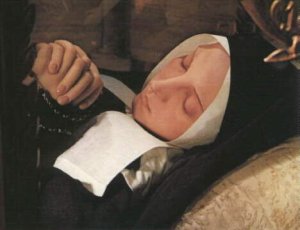
The 4th Glorious Mystery:
The Assumption of the Virgin Mary.

No Church, in the East or the West, claims to contain the body of St. Mary. This is because “the Immaculate Mother of God, the ever Virgin Mary, having completed the course of her earthly life, was assumed body and soul into heavenly glory.” This is because Jesus would not suffer Mary, His sinless, faithful beloved, to undergo corruption.

Death is a consequence of human sin, and without human intervention, as in embalming or mummification, our dead bodies will ordinarily experience its corruption. But, sometimes, the Lord preserves the dead bodies of his saints, to give a sign of their holiness, and to show that death is not all that awaits us.

Among the numerous saints whose incorrupt bodies you can still see today are:  St. John Bosco, St. John Vianney, St. Catherine Laboure (the visionary of the Miraculous Medal), St. Bernadette Soubirous (the visionary of Lourdes), and St. Maria Goretti.

As we meditate on the Assumption of the Virgin Mary, let us pray for purity in our lives.

The 5th Glorious Mystery:
The Coronation of Mary as the Queen of Heaven and Earth

Once, when St. Maximillian Kolbe was a boy, his behavior began trying his mother’s patience. She said in exasperation, “Maximillian, what will become of you?” As St. Maximillian writes, “Later, that night, I asked the Mother of God what was to become of me. Then she came to me holding two crowns, one white, the other red. She asked me if I was willing to accept either of these crowns. The white one meant that I should persevere in purity, and the red that I should become a martyr. I said that I would accept them both.” St. Maximillian would receive both crowns, as a holy Franciscan brother, and as a victim of the Nazis at Auschwitz, were he took the place of another innocent man who was condemned to die.

Jesus crowns his holy ones. He wills that those who share in His sacrifice should also share in His glory. As we meditate on the Coronation of Mary, let us pray to accept whatever crowns of burden and glory the Lord wants to give to us.

The Author of Life — Tuesday, 27th Week in Ordinary Time—Year II

October 5, 2010

If you took our Catholic faith and boiled it down to its most central and fundamental truths what would you have? I think you would end up with these four foundations:

First, that God is three divine persons who are one in being, a union we call the Trinity. Second, that Jesus Christ is both God and Man, a reality we call the Incarnation. Third, that Jesus Christ, to save us from sin and death, suffered, died, resurrected and ascended, an event we call the Pascal Mystery, and from which Jesus empowers His Church’s sacraments. And fourth, that every, single, human being has inherent worth and surpassing value, a truth we call the dignity of the human person. It is this fourth fundamental truth of our Catholic Faith that I will focus upon today.

The psalmist says to God:

“Truly you have formed my inmost being;
you knit me in my mother’s womb.
I give you thanks that I am fearfully, wonderfully made”

From the womb, God fashioned your inmost being, giving you an intellect to know, a freewill to act, and a desire for loving communion with others. Made in God’s own image and likeness, made for a purpose and made for love, every human life is precious from conception to natural death.

Sadly, laws sometimes disregard this dignity, and even Christians can forget it too. Martha looked down on her sister because she thought Mary was not being useful enough or productive enough. Martha only saw Mary as causing a burden to herself, yet Mary was exactly where the Lord willed her to be.

As Mrs. Eichstadt said before, God has a providential plan for each one of you. Like St. Paul, the Lord has set you apart from your mother’s womb for a great story which He has in mind. But anyone who would presume to cut short an innocent life would deprive God of a masterpiece.

Assisted suicide or euthanasia rips out the crucial final chapters. Suicide, murder, or neglect of our neighbor unto death, would end a story halfway. And abortion prevents the story from ever being told. Jesus is the author of our lives and He is to be the one who decides when our lives end. Maybe you will always remember the homily when Father tore up a book, but remember this too: every human life is precious and worth more than many, many books.

Father’s Day Homily

June 19, 2010

“See what love the Father has bestowed on us that we may be called the children of God. Yet so we are.” (1 John 3:1) As St. Paul says in the second reading, “Through faith [and baptism] you are all children of God in Christ Jesus.” (Galatians 3:26-27) God is our Father who lives and reigns in Heaven. What is the fatherhood of God the Father like? What can we say about His fatherhood. I offer these insights:

The Father’s love begets life.
We see this in His Son, who is eternally begotten from the Father. And begetting is not a merely an action which the Father had done and then walked away from. The Son is eternally begotten from the Father in love.  And, as the Prologue of John’s Gospel says, “All things came to be through [this Son], and …. what came to be through him was life…” The Father’s love begets life.

The Father labors in love.
God the Father labors to fashion and sustain creation; heaven and earth and every creature, seen and unseen. He makes them in love and preserves them in love. As the prophet in the book of Wisdom observes, “[Lord,] you love all things that are and loathe nothing that you have made; for what you hated, you would not have fashioned. And how could a thing remain, unless you willed it; or be preserved, had it not been called forth by you? But you spare all things, because they are yours, O LORD and lover of souls, for your imperishable spirit is in all things!” (Wisdom 11:24-12:1)  The Father labors in love.

The Father guides His family.
The world became dark though sin, so the Father enlightened it. The people became lost without Him, so the Father guided them. The Father enlightens and guides His children by speaking His word to them. Jesus Christ is the Father’s word. The Father guides His family.

The Father is easily pleased by those who are His own, yet He calls them ever higher.
At Jesus’ baptism, the Father spoke from the heavens, “You are my beloved Son; with you I am well pleased.” Yet, as today’s gospel recalls, the Father also called His beloved Son to take up the cross. Four days before His Passion, Jesus said, “I am troubled now. Yet what should I say? ‘Father, save me from this hour’? But it was for this purpose that I came to this hour. Father, glorify your name.” Then a voice came from heaven, “I have glorified it and will glorify it again.” (John 12:27-28) On the cross, Jesus was not just lifted up, but exalted. The Father is easily pleased by those who are His own, yet He calls them ever higher.

The Father is just like the Son.
Some people find it difficult to relate to the Father, but the Father is just like His Son. At the Last Supper, Philip said to Jesus, “Master, show us the Father, and that will be enough for us.” Jesus said to him, “Have I been with you for so long a time and you still do not know me, Philip? Whoever has seen me has seen the Father. How can you say, ‘Show us the Father’?  Do you not believe that I am in the Father and the Father is in me? The words that I speak to you I do not speak on my own. The Father who dwells in me is doing his works.” (John 14:8-10)  The Father is just like the Son.

The Father transcends human fatherhood, but He is the origin and standard of all fatherhood.
God transcends the human distinction between the sexes. The Father is neither man nor woman: He is God. Although the Father is the origin of all fatherhood, He transcends human fatherhood. No one is father as God is Father. Yet, we who are earthly fathers, who have natural or spiritual families and children of our own, must take our Father in Heaven as our standard and model. Each of the insights I have given for God the Father have application for our fatherhood.

Your fatherhood should beget life.
Now the begetting of life is not merely biological, if it were then priests would not be fathers. There are some biological fathers who beget life and leave. These men fall very far short being true fathers. True fathers give life and nurture that life forever, like God the Father who begets His Son eternally. If you are a mother or father, even if even if your children should die, even if you should die, you are a mother or father forever.

Your natural fatherhood should be fruitful. More than just biologically, but biologically, too. What would you think of a priest who was both capable and called to work to beget more spiritual children by sharing the gospel, but who refused to do so for self-centered reasons. What if he were to say, “I’m happy with the number of parishioners I have already.” Your fatherhood should beget life.

Your fatherhood should be a labor in love.
Always remember whom you are working for and work for love of them. Beware of an ambitious careerism, which is all about you. What would you think of a priest whose primary ambition was to become a cardinal, instead of those entrusted to him. 

At home or at the workplace, labor in love for your family. And take time to rest and enjoy them. Even God the Father rested after His labors to enjoy how “very good” it was.

Your fatherhood should guide your family.
You are called to be a leader, guide, and teacher for your family. Your wife will not begrudge your lead if you love her and lead her as Jesus loves and leads the Church. Remember, Jesus died for His family and bride.

As parents, you are the primary educators of your children. Sometimes we think of education as only what happens at school. But the most important lessons in life are not taught in the schools, but in the home. The home is the domestic Church and the school of love.

In your fatherhood, let your children know your pleasure in them and always call them ever higher, to all they can be.
Always show them your pleasure, that with them you are well-pleased. But like God, love them too much to let us remain as we are.  Grow them to their full potential.

In your fatherhood, take the Father in heaven as your standard and model.
If you’re ever unsure of how to image the Father, look at His son, for Jesus is the perfect image of the Father. The Father is just like the Son.

May God bless all our Fathers, living or dead, and may help we who are fathers to be better ones.

An Incomplete Lord’s Prayer — Thursday, 11th Week in Ordinary Time—Year II

June 18, 2010

Sometime in the past, I realized that I didn’t pray the Lord’s Prayer right.  It’s not that I was actually changing the words Jesus taught us to say, but I realized my focus was not fully what Jesus had in mind. My subjective, firsthand experience of praying the prayer went something like this: 

God, who art in heaven…
     [<Here I get distracted for several seconds>]
…give me this day my daily bread,
and forgive me my trespasses,
as I forgive those who trespass against me,
and lead me not into temptation,
but deliver me from evil.

Did you notice anything different?

First, Jesus taught us to pray to “Our Father” because we are not praying to anonymous force, but a person, a divine person who is imaged in a special way by natural and spiritual fathers on earth. Earthly fatherhood is a diminished image of Him. Biological fatherhood teaches us about our heavenly Father’s transcendence, while devoted fathers teach us about His love. (“The respective ‘perfections’ of [both] man and woman reflect something of the infinite perfection of God,” as the Catechism teaches, but “Our Father” is significant.)

Second, the prayer’s early petitions, “hallowed be thy name. Thy kingdom come. Thy will be done on earth as it is in heaven,” are every bit as important as the later petitions ‘about us.’ God is justly entitled to glory, His kingdom and reign.  Remember that all these are essential and conducive to our own greatest happiness.

Third, the Lord’s Prayer is not meant to be prayed just for yourself or myself, but for all of our Father’s family, for the whole Church, for even the whole world. The Our Father is not only a petitionary prayer, but an intercessory prayer.

So when we prayer the Our Father, the perfect prayer which Jesus taught us, let us pray it in its completeness, with a presence of mind and fullness of heart.

A Mystery Revealed — Trinity Sunday

June 2, 2010

You may recall my mention of one of my favorite professors at seminary, Dr.  Perry Cahall. And I remember him telling us one day in class, “If, someday when you’re a priest, I hear that you got into the pulpit on Trinity Sunday and tell the people, ‘You know, the Trinity is a mystery, and so there’s really nothing we can know or say about it…’ I will hunt you down like the dogs you are.” This is my first homily on Trinity Sunday, and I’m going to make sure I give Dr. Cahall no reason to come after me.

The Trinity is a mystery, but that doesn’t men we know nothing or can say nothing about this central mystery of our Faith. In Catholic theology, a “mystery” is not something which is unknowable to us, it is just something which our human reason could not have discovered on its own.

Imagine if you came upon a sophisticated and well-written mystery novel. It’s so good that you can’t put it down. But as you get towards the end, you discover that the last couple chapters of the book are missing. You noticed some clues as the story unfolded, but without those last pages you can’t figure out the identity of the one “who did it.” You might try to find the ending in another copy of the book, but what if no other copies existed and no one had ever read the ending before? Your only hope would be to speak with the author. The author could tell you the rest of the story. The author could unveil the mystery for you and reveal the identity of the one “who did it.” Like that in sophisticated mystery novel, our God has placed clues throughout creation and His Old Testament interactions with His People. Yet, it was not until the coming of Jesus that the “who done it” was plainly revealed: God, the Author of the universe, is Father, Son and Holy Spirit.

Today I would like to talk about some common questions people have about the Trinity. For instance, how is God both one and three, and then what difference does the Trinity make?

Some people have trouble with the concept of the Trinity because they think it is the claim that “one equals three” in God. However, this is not what we believe about the Trinity. The number one does not equal the number three, not in God or anywhere else, and not even the omnipotent power of God can make a logical contradiction true.

We believe one God, comprised of three divine persons: the Father, the Son, and the Holy Spirit. God is one What, as three Who’s. There is one divine nature, but three divine knowers, three divine willers, and three divine actors. We do not believe in three anonymous forces, but three loving persons. There is no God apart from or beyond these three persons.

Now the Father is not Jesus Christ. Jesus is not the Holy Spirit. And the Spirit is not our Father. They are distinct persons. Yet, at the same time, each possesses the fullness of the divinity: perfect goodness, infinite beauty, perfect knowledge, infinite power, perfect mercy, and infinite love. We do not worship three gods, but three eternal persons who comprise one God.

The belief in the oneness of God was firmly instilled into the Jewish people. This conviction helped to keep Israel from falling into the worship of false gods and experiencing all of the evils that brings. For instance, Israel’s Canaanite neighbors were idolaters, who worshiped mere objects as gods that could make them happy. They practiced child sacrifice, killing their own children in hopes of receiving greater blessings in this life from the gods. And they had temple prostitution, in which promiscuous sexuality was as hailed as sacred.

Notice how our society has become more and more like those pagans as it has drifted from belief in the one true God. Our worship of objects which we think can make us happy is called materialism, or consumerism. Our human sacrifice, done in hopes of greater blessings in this life, is called abortion. And some have raised up sexual promiscuity as the way of greatest freedom and happiness.

The Jews were spared all of these evils so long as they clung to their conviction that “All gods are not the same, and we are to worship only one.” The God of Abraham, Isaac, and Jacob. Even to this day, observant Jews pray a prayer twice daily called the “Shema Yisrael,” from a passage in Deuteronomy:

“Hear, O Israel! The LORD is our God, the LORD is one!  Therefore, you shall love the LORD, your God, with all your heart, and with all your soul, and with all your strength.”

Jews remain Jews today because they do not believe that Jesus is the promised messiah, or the Christ, the one for whom they have been waiting. Sometimes they criticize Christians saying we are not really monotheists, but polytheists, who believe in three gods: “The LORD is our God, the LORD is one!”

Yet, revealingly, the word that God inspired in this Old Testament passage (“The Lord is one”) is not one of the words in Hebrew which always means numerical and solitary oneness (such as “yachid” or “bad”.)  Instead, the Holy Spirit selected a word which usually means a unified oneness: “echad.” This word (“echad”) is the same word used in Genesis, where God says of man and woman, “the two shall become one flesh.” In their union, the persons are as one being. And recall, God had said, “Let us make man in our image , after our likeness. …[And] God created man in his image; in the divine image he created him; male and female he created them.” When husband and wife become a unified one, as one couple, in time, they are in the image and likeness of the Father, Son, and Spirit, who have are a unified one, as one God, eternally.

So what difference does the reality of the Trinity make for our lives? The Trinity shows us that God is not a solitary individual, isolated and alone. God is a loving communion of persons. This is the reality we come from, and this is the reality we are called to, in this life and the next.

In our post-modern age, some people talk about “the meaning of life” as if it were some kind of joke, or an unsolvable mystery beyond our capacity to discover or know. But we Christians believe we know the meaning of life, for it has been revealed to us. The meaning of life is the loving communion of persons. The loving communion of persons is what gives our lives meaning and it will be our primary delight forever in Heaven. Love is the reality we come from, and the reality we are called to.

‘Hear, O Church of God! The LORD is our God, the LORD is a unified one!  Therefore, you shall love the LORD, your God, with all your heart, and with all your soul, and with all your strength.’ Love the Lord your God, who is Father, Son, and Spirit, and become like the God you love.

Relating to God Personally — Pentecost Sunday

May 23, 2010

In the Old Testament, the truth that God is a unity of three persons, that God is triune, that God is a Trinity, was only obscurely presented. The knowledge that God consists Father, Son, and Holy Spirit, only became clear to us through Jesus Christ. Our one true God has always been three persons: the Father, the Son, and the Holy Spirit.

Now the Father is not Jesus Christ. Jesus is not the Holy Spirit. And the Spirit is not our Father. They are distinct persons. Yet, at the same time, each possesses the fullness of divinity: perfect goodness, perfect beauty, perfect knowledge, and perfect power, perfect mercy, and perfect love. We do not worship three gods, but three eternal persons who comprise one God. There is no God apart from these divine persons.

Sometimes we say we are “praying to God,” and that is well and good. But when we are “praying to God” we should not imagine that we are speaking to some fourth person, to some divine abstraction above or beyond the three. If you don’t know which divine person you have been praying to at such times, you have been praying to the Father, through the Son, in the Holy Spirit. (Notice how the prayers in the Mass are always addressed to particular divine persons; usually the Father, but sometimes the Son.)

If you have been a Christian who has always directed your prayers some abstract Christian divinity, who is neither Father, Son, nor Spirit, I trust that your prayers have still been heard within the Trinity. And if you have never related to the Holy Spirit as a real person who knows and wills and loves, but only as some abstract force, I am confident that He has blessed you with His gifts and produced His fruits in you even without your asking. But Christianity is all about loving communion with  persons. Not forces, not abstractions, but persons: persons human, angelic, and divine.

Do you have a personal relationship with each of the persons of the Trinity; with Jesus Christ, with our heavenly Father, and with the Holy Spirit? If not, then it’s important that you begin to cultivate these relationships in prayer, for we are called to love God, and only persons can be truly loved.

On this Pentecost Sunday, we recall the gift of the person of the Holy Spirit to the Church. The Holy Spirit does not begrudge it when we ask Him for good things, for ourselves and for others; no, He is pleased when we ask and pleased to give. Gift is who the Holy Spirit is. But today and henceforth let us always speak to Him and the other divine persons in a personal way with a great personal love.

The Our Father — Tuesday, 1st Week of Lent

February 23, 2010

When the apostles asked Jesus how they should pray, Jesus taught them what is called the perfect prayer, the “Our Father.” It is a concise prayer, with just seven petitions (a perfect number for the Scriptures,) yet there is great depth beneath its simplicity.  This morning I show you three insights into this prayer which I hope will come to your mind from time to time as you pray this prayer for the rest of your lives.

First, Jesus teaches us that we are to pray to “Our Father.”  This is a far more wonderful thing than we realize.  To see its greatness, just imagine if the prayer were different. We do not pray, “Our tyrant, who art our ruler, before thee we grovel.” Nor, “Our master, we art thy slaves, for thee we must toil.” And we do not say, “Unknowable one, whom none can name, unapproachable be thy being.” We pray, “Our Father who art in heaven,” hallowed be His name.  We have the privilege to call God our Father on account of our faith in His Son, Jesus Christ. Jesus is God’s Son by His nature, (God from God, light from light,) but we are made God’s children by adoption through Christ. One way to see why this is such a big deal is to imagine if God were everyone’s heavenly Father, except for you. Whatever applies to a good father’s relationship with his natural children, also goes (with limited exceptions) for the perfect Father’s relationship towards us, His spiritual children. Keep in mind how privileged we are when you pray to “Our Father.”

The second insight this prayer yields is the proper attitude we should have towards prayer. Perhaps you’ve heard some people say, “Well, if you like to pray that’s fine—I mean, if that helps you to motivate yourself that’s great,” as if the only power of prayer was to change one’s personal attitude. This is something said by people who don’t pray, and if we thought as they did then we wouldn’t pray either, for who would bother to ask someone else to receive what is already in one’s own hands (i.e., the choice of one’s own attitude.) A second motivation among people who do not pray is more faithful, but also misguided. These say, “I can’t change God’s mind, so why should I bother to pray? Whatever He wills will be, whether I pray to Him or not.”

The first three petitions of the “Our Father” are worded carefully. They do not say, “Our Father, who art in heaven, make your name holy among us, make your kingdom come upon us, and make your will be done among us.” This would put everything on God. Nor do the opening lines read, “Our Father, who art in heaven, we will glorify your name, we will make your kingdom come, and we will make your will be done, on earth as it is in heaven.” This would put everything in our own hands.

The prayer which Jesus gives us does not put everything on God, or put everything on us. Jesus presents the middle and true way of faith. We are not called to an independent activism, nor to a vacant passivity, but to an active receptivity in relationship with God. Like the Virgin Mary, we are to stand before our Father, with a spirit of active receptivity, and pray, “Behold, I am yours, may your will be done, in and through me, and on earth as it is in heaven.”

There are some things which are simply beyond my human ability.  For instance, I can no more forgive my own sins than I can pull up on my belt loops and hold myself up in midair. However, that does not mean I can do nothing to help my situation. I can first forgive others as I wish to be forgiven. I can pray, go to confession, and tell God that I’m sorry. God calls us to do our part and to cooperate in His work.

Maybe this explains why Jesus could not work great miracles where people were lacking faith. It was not that such things were beyond God’s omnipotent power, it is that God insists upon doing His works in relationship with us, rather than entirely apart from us. (This is His purpose in establishing the Church—to do His saving work with and through us.) Like St. Augustine said, ‘The God who created us without us, will not save us without us.’

The third and final insight into the Lord’s Prayer regards the meaning of the petition for “our daily bread.” We say, “Give us this day our daily bread.” We can pray for this “bread” in three senses; literal, spiritual, and Eucharistic.

First, there is the literal sense, praying that God would provide for our material needs in life; such as housing, clothing, and food. We take these things for granted—your daily bread already waits for you in the cafeteria or in your kitchen at home—but there are many people around the world, who are much less well-off than we are, who pray these words from their hearts every day. Occasionally we should call these brothers and sisters of ours to mind and pray these words as intercession on their behalf before our Father.

Second, there is the spiritual sense, asking for the graces and helps that money can’t buy; such as peace and virtue, faith, hope, and love. Without these things, even a rich man remains impoverished, for man is not meant to live on material bread alone.

Third and finally, there is the Eucharistic sense, which asks for the bread from this altar which is God’s Son. Whenever we receive Jesus in the Eucharist He remains with us and in us until we receive Him again (unless we should disinvite and evict Him by committing grave sin.) In this way, Jesus persists as our “Daily Bread.”

So when you pray the “Our Father” realize your privilege in being His child through Jesus Christ. Consider that the coming of the Kingdom is a joint effort of God with man, in which our prayers play an important part. And pray for all your daily bread; literal, spiritual, and Eucharistic. May you remember these insights for all of your life and may the words of Christ’s perfect prayer make you a fruitful child of our Father.

Friday, 27th Week in Ordinary Time—Year I

October 9, 2009

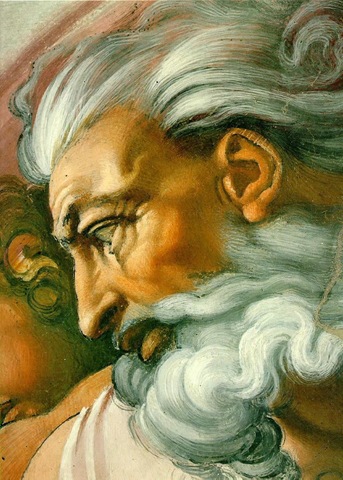
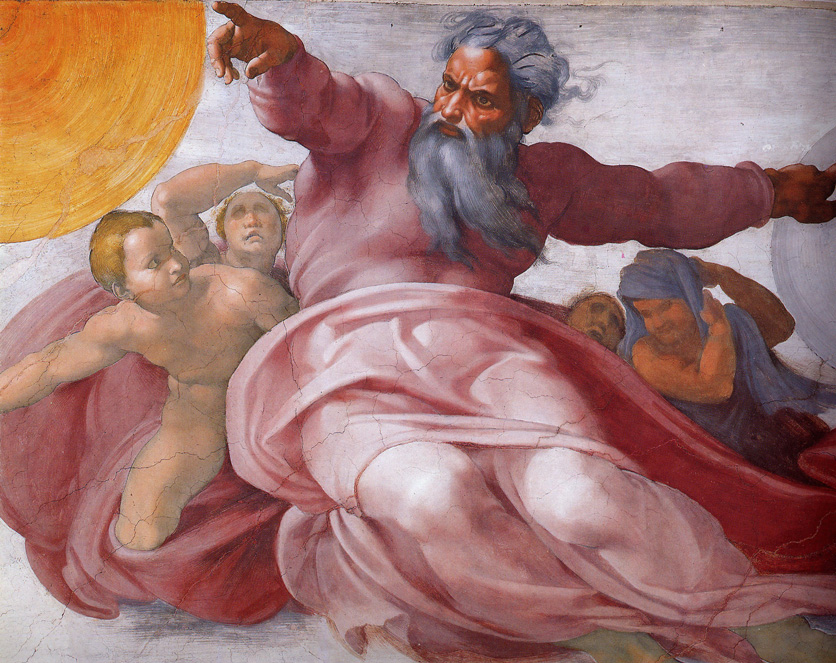
God the Father, Sistine Chapel

In New Testament times, the Second Person of the Trinity, Jesus Christ, has been revealed to us plainly, but He has always been in the presence of the Father. That’s why we should expect to see signs pointing to God the Father’s eternal Son throughout the Old Testament. For example, when the psalmists speak of God’s ‘strong right hand,’ or His ‘holy arm,’ we are seeing references to Christ. Christ sits at the right hand of the Father in heaven, the place of honor. Thus, He is God’s right hand.

To call Christ the God’s holy arm evokes another truth. Consider your own arm.  It is one with you, and yet it is distinct from you.  It obeys whatever you tell it to do, and it works for you in the world. So it is with the Father and His holy arm.  Jesus is one with the Father, and yet distinct from Him.  Jesus obeys His Father in everything and does His work in the world.

So how does the Holy Spirit, the Third Person of the Holy Trinity, fit into this divine metaphor? Jesus says in today’s Gospel, “…If it is by the finger of God that I drive out demons, then the Kingdom of God has come upon you.” The finger of God is the Holy Spirit, who proceeds from the Father and through the Son.

The will and work of God in our world is done in this way: by the Head, through the Arm, and the finger; which is another way of saying, everything is accomplished by the Father, through His Son, and their Holy Spirit.

Let us pray that we shall never oppose the hand of God acting in our lives. For, Jesus as tells us, ‘whoever is not with Him is against Him, and whoever does not gather with Him scatters.’