Archive for the ‘Feast Day Homilies’ Category

They Ran For Him — Easter Morning

April 24, 2011

When Mary Magdalene came to the tomb early Easter morning, she found the stone removed and the body of Jesus gone. She ran to Peter and John, because her love demanded that something must be done. “They have taken the Lord from the tomb,” she said, “and we don’t know where they put him!” So Peter and John went out and ran to the tomb. They both ran, but John ran faster and arrived at the tomb first; not because he loved Jesus more, but because he was younger than Peter.

Some adults run for exercise, but they are the odd exception. Generally, grown-ups just don’t run; except under special circumstances. For instance, my mother doesn’t jog, but she’ll sprint to answer a ringing phone. She loves her friends and doesn’t want to leave them hanging on the line. So, love can make a grown person run.

One time, when I was a boy, I saw my mother run outside in her nightgown and dive into our swimming pool. My mother saved the life of my younger sister, who was floating there facedown.

In all my life, I can only remember ever seeing my father run once. A few years later, during a family walk around a camping resort in my hometown, where we had never walked before, we came upon a tragic emergency. While Mom did CPR, Dad and I ran for the phone at the front office to call for an ambulance. I ran as hard as I could, but Dad was much faster than my ten-year-old legs. I remember seeing his back, his arms rapidly pumping, and thinking to myself, ‘I had no idea he could move that fast.’ And so, from my youth, I’ve known that for the love of another, or in matters of life and death, adults will run. If something is important to them, they’ll run for it.

Mary Magdalene, Peter and John ran to and from an empty tomb out of concern for a dead man’s corpse. So great was their love for Jesus, so great was their admiration for Him, that they ran for Him, even though they thought He had nothing more to offer them. But we are here this morning because Jesus wasn’t dead. He is risen and still active in peoples’ lives today. (To the latter, I am an eyewitness.) He has much to offer to us, our families, our children. But do we run to Him? Do we run to His Church, His sacraments, worship and teachings; or do we run from them? Whether we run is a question of love, and in a world subverted by sin and temptation in so many ways, it’s a matter of life and death. Jesus is risen. So let’s run to Him.

“He Is Not Here” — Easter Vigil

April 23, 2011

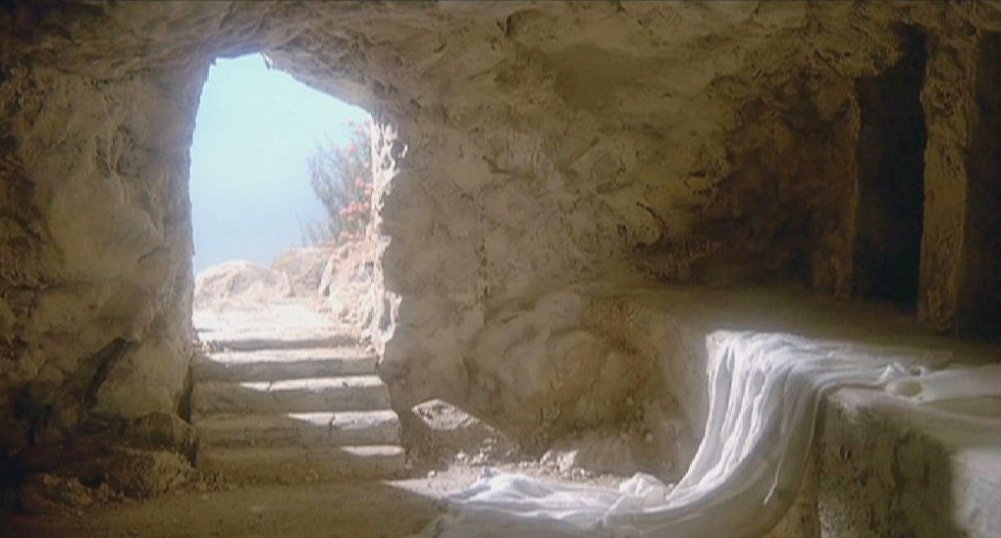
When the women came to the tomb they did not find Jesus, but a radiant messenger. He told them, “Do not be afraid! I know that you are seeking Jesus the crucified. He is not here.…” The tomb was empty, Jesus was not there.

Jesus was present at the beginning of creation, for through Him all things were made. Going forth from the Father’s mouth, He was at hand on earth throughout the ages, achieving His purposes.

He was mystically with Noah, who saved his family from death by building a ship, just as Jesus built the Church to save us.

He was mystically with Isaac, who, though bound and led to sacrifice, was not to be lost forever.

He was mystically with Moses, who freed God’s people from Pharaoh’s demonic slavery by leading them through miraculous waters.

He was mystically with all the prophets, in proclaiming a law to be written on hearts instead of stones, in promising the gift of a Holy Spirit from Heaven, in suffering at the hands of those who refused to hear wisdom.

He has been in His saints, from the least to the greatest, throughout the centuries to this very night. He is present here in all of us who are ‘living for God in Christ Jesus.’

By the all foreshadowings that proceeded His coming, and by the fruitful witness of all His saints ever since, we can confirm the angel’s words, “he has been raised just as he said.”

Jesus is not there in the empty tomb. He is here,  tonight, with us.

“I Thirst” — Good Friday

April 22, 2011

Shortly before He died on the cross, Jesus said, “I thirst.” Why did He say, “I thirst”? He was certainly physically dehydrated. As Psalm 22 foretells, His throat was as dry as broken pottery and His tongue stuck to His palate, but there was more reason for His words than just this.

Last night, at the Last Supper, Jesus had postponed drinking the traditional fourth and final cup of Passover. He said “I thirst” so that they would bring Him wine, so that He could drink, and unite the Last Supper and His Passion as one event. However, there is even more reason for His words than this.

Beside the crucifixes, in all of the chapels, in all of her religious houses around the world, Blessed Mother Teresa had written the words, “I thirst.” She understood that what Jesus thirsts for on the cross is us. Mother Teresa wrote, “Jesus is God, therefore His love, His Thirst, is infinite. He the Creator of the universe, asked for the love of His creatures. He thirsts for our love…” 

As we come to Him on the cross today, let us satisfy His thirst with the refreshment we can give to Him.

“Do This…” — Holy Thursday

April 21, 2011

At the Last Supper, the night before he suffered for us, Jesus took some bread. He thanks to God for it and He broke it. And He declared it to be His body which would be given up for others. Then He offered it to those He loved. When the supper was ended, Jesus took a cup of wine. Again He gave thanks and praise to the Father. And He declared it to contain His blood, blood to be shed for all. Then He offered the cup to His disciples and said, “Do this in remembrance of me.”

At the Last Supper, Jesus ordained His apostles the first priests of the New Covenant. They and their successors would do this in remembrance of Him, throughout the centuries, up to this very night, and until He comes again. When you and I celebrate the Mass we remember Him and what He did, and more than just recalling it, we re-encounter it as that same sacrifice is offered in front of us. But Jesus’ words, ‘to do this in memory of Him’ means more than just coming to Mass.

Jesus is calling and commanding us to do the thing that He is doing. We must give God thanks and praise for what He has given us. We must take our bodies and give them up. We must take our life’s blood and pour it out. And we can do this, for God and for each other, in as many ways as there is to love. The sacrifices of your daily life, at home, at work, and at prayer; the work of washing feet; may not seem significant to you now, but these sacrifices shall your glory in Heaven forever.

As Jesus washed His apostles’ feet He said, “What I am doing, you do not understand now, but you will understand later.” And when He had finished He said, “If I, … the master and teacher, have washed your feet, you ought to wash one another’s feet.  I have given you a model to follow, so that as I have done for you, you should also do.” At the Last Supper, Jesus said to His disciples, “Do this in remembrance of me.” Tonight, He says the same to us as well.

Peter Our Rock — February 22 — Chair of St. Peter

February 22, 2011

If you claim Jesus Christ as your Lord, then listen to His words. To those He sent to preach for Him, Jesus said this, “Whoever listens to you listens to me. Whoever rejects you rejects me.” (Luke 10:16) Today there are many people preaching many different things about what they think Jesus would have us believe and do. These varying opinions are well-intentioned and shared in good faith, by ministers from pulpits and in conversations between friends, but they cannot all be right. Unless it doesn’t matter what we believe or what we do, then this is a big problem. To whom should we listen? Is there anyone today for whom Jesus’ words are still true, “Whoever listens to you listens to me”?     Does anyone teach with authority, such that ‘whoever rejects their teaching rejects Christ?’ If not, we are lost; but if there is, where do we find this person?

On another occasion, Jesus spoke to the crowds and to his disciples, saying, “The scribes and the Pharisees have taken their seat on the chair of Moses. Therefore, do and observe all things whatsoever they tell you, but do not follow their example. For they preach but they do not practice.” (Matthew 23:1-3) Today teachers usually stand in front of their classes to teach them, but teachers in the ancient world would teach sitting down. Their chairs symbolized their authority, like the “chairman of the board” or the “chair of the English department.” Jesus spoke of the Chair of Moses, the position of the authoritative teaching for old Israel. For His new Church, Jesus establishes a new chair, the chair that we celebrate today, the chair of St. Peter and of his successors the Popes.

St. Peter, like every Pope after him, was only a man. He wasn’t perfect and he was weak in many ways. But Jesus has built His Church upon this rock. When the Pope, as the supreme pastor and teacher of all the faithful, proclaims by a definitive act a doctrine pertaining to faith or morals, he teaches it infallibly. For the good of the Church, the Pope is empowered by the Holy Spirit to teach the faith of Christ without error. Can popes sin? Yes, infallible does not mean impeccable, as various popes in history have shown, yet even these bad popes prove the faithfulness of God in preserving them from teaching errors. Of them Jesus would have said, “Do as they teach, but do not follow their example.”

Jesus knew that living the fullness of Christianity on earth required that He provide us with an infallible guide. Some Christians have held that the Bible alone is this guide, but the Scriptures do not interpret themselves, nor did the Bible books put themselves in the canon. Even the infallible Scriptures require an infallible Church, and an infallible Church requires an infallible voice.

Mark Twain is believed to have remarked, “When I was a boy of fourteen, my father was so ignorant I could hardly stand to have the old man around. But when I got to be twenty-one, I was astonished at how much the old man had learned in seven years.” Of course, it was not the father but the child who had changed, when he finally recognizing the wisdom of his father. Some people reject or ignore Catholic teachings as stupid, like those on the sacred dignity of all human life, or the teachings on human sexuality. Some people neglect the sacraments of the Church for years of their lives. Then, after gaining painful experience, they return with a new love and respect for our Holy Father’s wisdom, and the ways of our Mother, the Church. As wonderful as it is whenever people to come back to the Catholic faith, I would much prefer that you would know the greater joy and peace of remaining ever united to the rock of truth found only in our Church.

Novo Anno Domini — Januray 1 — Mary, Mother of God / Epiphany

January 16, 2011

This new year begins us an interesting conjunction of dates. Today, a day typically thought of as a secular holiday comes right alongside an acknowledged Christian holy day. I speak of New Year’s and the Feast of the Epiphany.

People tend to celebrate New Year’s in a rather worldly way. They drink, usually more than they should, and frequently gather to watch something drop at midnight: in New York it’s a ball; in Miami it’s an Orange; in Bangor, Maine it’s a sardine. There are many such examples. When the new year arrives people traditionally look for someone to kiss, while others propose marriage.  The new year is felt to offer new hope and people make resolutions to change their lives. We tend to think of New Year’s as a secular holiday, but it actually marks a Christian milestone.

On the eighth day from His birth, Mary and Joseph had Jesus circumcised according to the law God had given His people through Moses. On this day, Jesus entered into the covenant of the Jews. One could argue that this eighth day from December 25th, January 1st, is the day that Jesus became the king of the Jews.

In the ancient world, events were often dated according to the reigns of the kings in power. For instance, the Romans would have once referred to 20 B.C. as “the eighth year of the reign of Emperor Augustus.” [One Gospel records that John the Baptist’s preaching began “in the fifteenth year of the reign of Tiberius Caesar.” – Luke 3:1] Today, we date our years according to the reign of our king, Jesus Christ, the King of kings.

The abbreviation “B.C.” means Before Christ.  “A.D.” doesn’t mean After Death, as some people suppose. (If it did, where would be the other 30 years of Jesus’ life?) “A.D.” is a Latin phrase, Anno Domini, which means In the Year of Our Lord. We call this new year of ours 2011 A.D., or the 2011th year of our Lord’s reign.

Whether they know it or not, when the world celebrates New Year’s they are really anticipating and celebrating the reign of a King who has already come. They raise their eyes up to see something descend — they look for the One who descended from Heaven. They long for an passionate love and an unending intoxication — the Bridegroom has come with the Holy Spirit of joy. They resolve to change into better people — the Christ who calls us to change and empowers us to do it has already come.

Two thousand years ago, the world did not realize that the Christ had been born, but the Magi, the “Great Ones,” knew. With devotion like the Magi, let us journey and draw near to Jesus. In your prayer, let the infant Jesus grab your finger and watch Him smile at you. In finding Jesus’ parents, the Magi found the Lord. Draw closer to Mary and Joseph, for they are already your friends and they lead whoever comes closer to them to their Son. In this 2011th year of his reign, let us rejoice in our King, Jesus Christ, and resolve to love Him more deeply.

Seen and Unseen — December 28 — St. John the Evangelist

December 27, 2010

Today’s Gospel says that when John the Apostle went into the tomb on Easter morning “he saw and believed.” What did he see that led him to believe? Was it how the burial cloth which had wrapped Jesus’ body wasn’t taken away or tossed in a mess on the floor,  but left behind (perhaps deflated) in its place? Or was the cloth which had covered the Lord’s head rolled up in a familiar way, such that John recognized Jesus’ hand behind it. Or perhaps, if the Shroud of Turin is truly the burial shroud of Christ, John believed through beholding its testimony to the resurrection.

On the other hand, maybe it wasn’t something John saw that led him to believe, but something he didn’t see. Perhaps it was from the fact that Jesus wasn’t there that he infered the truth. “Dead bodies don’t just disappear for no reason at all. I didn’t do this. None of us did this. And what motive would our enemies have to take Him? This is the work of God.”

Just as John may have inferred the resurrection of Jesus from the empty tomb, so we can infer the truth of God from the presence of the universe: “Things don’t just appear for no reason at all. I didn’t make this. None of us made this. And how could an enemy have to create beauty, life, and love? This is the work of God.”

Tradition says that after Jesus entrusted the care of His mother into the care of John the Apostle, they went to live in what is modern-day Turkey.  What if we had gone to visit them in their home at Ephesus and asked them how someone can believe in the God of the universe, or the Lord Jesus Christ, when their reality can sometimes seem so distant.

I can imagine Mary or John replying, “Beloved, the One who was from the beginning, whom we have heard, whom we have seen with our eyes, whom we looked upon and touched with our hands, the Word of God, the Word of Life, the Lord Jesus Christ——we have seen Him, and testify to Him, and proclaim to you His eternal life.” The Christian faith is firmly founded, upon the unseen things we can infer and the things which we  have seen.

Their First Christmas — Christmas Mass at Midnight

December 27, 2010

Christmas can be a hard time of year for a lot of people. Despite the pious, peaceful, and nostalgic scenes we see on the Christmas cards (like the one on the right,) many peoples’ Christmases are less than picture perfect. Today I would like to tell you the true story of two friends of mine, newlyweds whose first Christmas together was far from idyllic. (I’ll call them Chuck and Sue, though that’s not their real names.)  

In fact, Chuck and Sue’s first year together had been a rocky road. Chuck has always been a good and faithful man, but at one point in the beginning, he seriously thought about getting a divorce. He says that it was only by the grace of God that the serious tensions and misunderstandings between them were resolved and their marriage was saved.

After they tied the knot, the two picked-up and moved away from their closest family and friends to a small town down south where they had some distant relatives. Chuck worked hard as a blue-collar laborer, but after this transition, he found himself unemployed. And unfortunately, all of those distant relatives proved too distant to care about helping-out a struggling young couple in need. Their first Christmas together, Chuck and Sue were out of work, pregnant, and homeless.

How do you think Sue must have felt? Do you think she felt concerned about their circumstances and their family’s future? And how do you think Chuck must have felt when through no fault of his own he wasn’t able to provide better for his wife and child on the way? Had it not been for their deep faith in God and the consolation of their prayers, they would have been overcome by darkness, resentment, fear, and despair. But instead, their first Christmas together was the brightest and most joyful in history. You know Chuck and Sue’s story well, for theirs is the Christmas story. Chuck’s real name is Joseph and Sue’s real name is Mary.

Remember, the Christmas story is not a fairy tale from far, far away. It’s a real story in the real world, and for the real world. Our lives still have difficulties, but Jesus Christ has come, and that makes all the difference in the world. No matter what we’re going through, because of Christmas, we all have good reason to be merry.

And in closing, let me say one final word: I’m always pleased by how full the church is at Christmas. Please come back. Jesus Christ calls you back. He knows our world well and He knows how much you and those you love need His grace to get through it. The shepherds were called to find Jesus in a feed trough. Jesus invites you to find Him here.

Close At Hand — 3rd Sunday of Advent—Year A

December 14, 2010

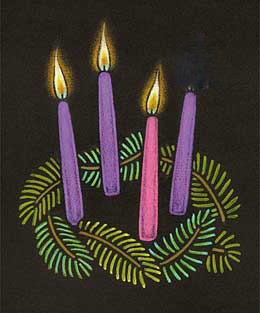
Today, the third Sunday of Advent, we light the pink or rose-colored candle because today is Gaudete Sunday. “Gaudete” means “rejoice” in Latin and we hear this call in the opening antiphon: “Rejoice in the Lord always; again I say, rejoice! The Lord is near.” Now that we are about halfway through this purple, penitential season, the Church is reminding us that Advent is also a time for joy. Though we await Him, “the Lord is near.”

This Guadete Sunday, we have extra cause for joy. As you may have heard, this week, a shrine in Champion, Wisconsin, 10 miles northeast of Green Bay, is now our country’s first Church-approved Marian apparition site. On the Feast of the Immaculate Conception, this happy news was announced by Bishop David Ricken of Green Bay:

“I declare with moral certainty and in accord with the norms of the Church that the events, apparitions and locutions given to Adele Brise in October of 1859 do exhibit the substance of supernatural character, and I do hereby approve these apparitions as worthy of belief (although not obligatory) by the Christian faithful.”

151 years ago, a lady clothed in dazzling white, with a yellow sash around her waist and a crown of stars around her head appeared to a 28-year-old lay woman named Adele. Adele asked the lady who she was and what she wanted, and the lady answered, “I am the Queen of Heaven who prays for the conversion of sinners, and I wish you to do the same. You received Holy Communion this morning and that is well. But you must do more. Make a general confession and offer Communion for the conversion of sinners… Gather the children in this wild country and teach them what they should know for salvation….”

That was the core of Mary’s message: the need for sinners to be converted and for children to be taught the faith. But Adele hesitated, and asked Mary how she was to teach the young when she knew so little herself. Mary replied, “Teach them their catechism, how to sign themselves with the sign of the Cross, and how to approach the sacraments; that is what I wish you to do. Go and fear nothing, I will help you.” After that encounter, Adele’s father built a small chapel on the site and Adele went about fulfilling her mission from Mary for the rest of her life.

The Bride of Christ, the Church, teaches that parents are the primary educators of their children. This means that even if your children go to Catholic or public school, you are their first and foremost teacher in the important lessons of life. But how often do our parents talk to their children about Jesus or Mary, or teach their children about what they should know for salvation? I suspect that many parents are intimidated because, like Adele Brise, they feel like they know too little. But Mary reassures us that we can all teach our children simple but important lessons in the faith that will remain with them and bless them forever.

Like Mary said, teach them the sign of the cross and how to approach the sacraments. At Mass, whisper in their ears, “Look, Father is holding up Jesus,” and on the way home in the car, ask them what they learned from the homily. Have interesting conversations with your children about the faith. Ask them, for example, if they think that Jesus likes sports, ask them what they think Mary’s favorite prayer is, or ask them what they think Heaven is like, and then share your answers with each other. And, perhaps most importantly, teach your children how to pray, by praying with them daily.

Though you know enough already to teach your children a great deal, you must always keep learning yourself. As your children mature in age, you must also mature in your understanding of the faith. Explore why we as Catholics do what we do, and learn why the Bride of Christ, our Mother, teaches as she does. For example, why do we make the sign of the cross? We do it at the open and close of our prayers and you’ve done it since you were little, but now consider more deeply what it means.

Its words and gestures encapsulate our faith’s most central mysteries. It confesses the Trinity and trances our redemption through the cross of Jesus Christ. We pray not “in the names,” but the “in the name of the Father, and of the Son, and of the Holy Spirit,” for God is three persons who are one in nature. [†] From the Father descends the Son, and the Holy Spirit proceeds from the love between them. Tracing the cross on ourselves, [†] we recall how the Father sent the Son to save us, and how the Holy Spirit now acts through our lives with power.

To pray this prayer, for it is a prayer, calls upon God to be powerfully with us. It is to say: “Father, Son and Holy Spirit, I ask you to be near me, here and now.” In the face of temptation or evil, this sign declares, “I belong to neither to the Devil nor the world, I belong to Jesus Christ.” So much is contained in this simple prayer and gesture. It can be taught to a child, yet meditated upon for a lifetime. And this is just one element of our faith. There is always more to explore.

Let us rejoice today, for the apparition of Our Lady of Champion reminds us, that even in Wisconsin, the Lord is near,  and [†] we can call upon Him at any time. Let us teach the faith to our children, so that they will remain near to Him and call upon His name.

The New Eve — December 8 — Immaculate Conception

December 8, 2010

In the beginning, when our first parents fell, they lost a great deal, but they were not deprived of hope, for God spoke in their hearing a prophesy to the deceiving serpent, the devil. God said, “I will put enmity between you and the woman, and between your offspring and hers; he will strike at your head, while you strike at his heel.” Who is this offspring, who strikes back at the devil? He is Jesus the Christ, the New Adam, the Son of God. And who is this woman, who is Satan’s enemy? She is Mary of Nazareth, the New Eve, the Immaculate Conception.

After their Fall, when Adam and Eve heard God approaching in the garden, they became afraid, they fled and hid, so God called out, “Where are you?” When God drew near to Mary, she also was afraid, but she did not hide or flee. She declared, “Behold, I am the handmaid of the Lord. May it be done to me according to your word.” And, because she did, her Holy Offspring could go on to say in His garden of testing, “Father… not my will but yours be done.”

The first man, Adam, called the first woman Eve, because she became the mother of all the living. Now, Mary is the New and Second Eve, for she is the mother of all the living, and she loves each one of us personally as her very own children.

She is the icon of the Church, and as she is, we are called to be: holy and without blemish before God, as the second reading from Ephesians says. But how can we do this? Unlike Mary, at times we have been allies of Satan by our sins. To cleanse us, God gives us the sacrament of reconciliation, and to strengthen us He gives us the fruit from the new tree of life; that tree is the cross, and its fruit is the Eucharistic Christ.

If it has been a long time since you have been to confession, come that you may be purified as pure as Mary. And if you receive our Lord in the Eucharist tonight, consider that the Son of God Incarnate has come to dwell in you, just as truly as He dwelt in Mary.

True Christian Soldiers — November 11 — St. Martin of Tours — Veterans Day

November 11, 2010

This morning I would like to tell you two stories. The first is the story of a cavalry officer who was sent to serve in France. He grew up in a military family and got enlisted when he was still only a teenager. Interestingly, his parents were not Christians, but this young man was studying in preparation to become a one himself. He was what we call a catechumen.

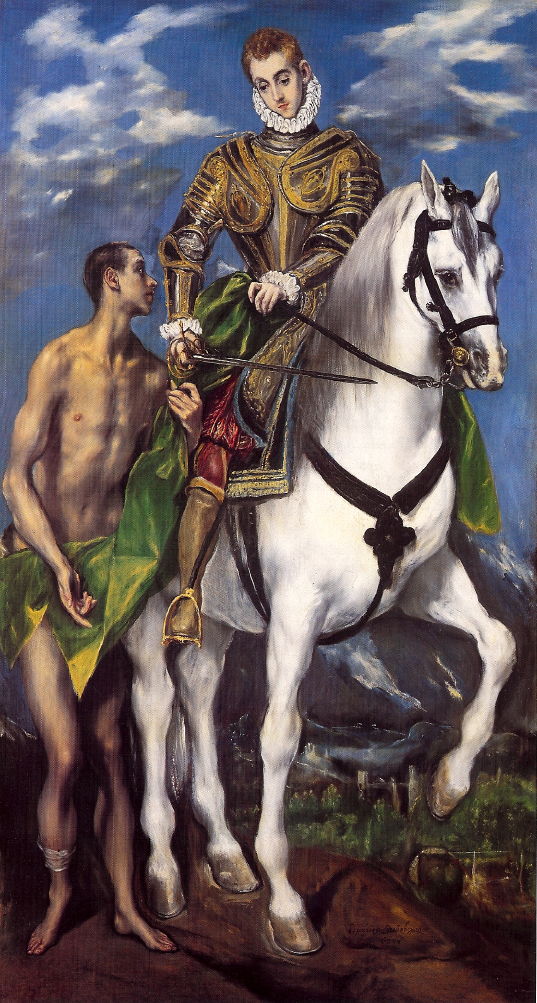
One cold winter day, at the gates of the French city of Amiens (A-mi-en), he encountered a shivering, half-naked beggar. This miserable sight disturbed the young soldier and he drew his sword from its scabbard. Because he had nothing else to give the poor man, the soldier took his own cloak, cut it in two pieces, and reaching down from his horse handed one half to the beggar. Giving away half of his cloak was no small gift, considering that the soldier himself needed to keep warm, too. In this act, he had loved his neighbor, the beggar, as himself.

That night, the soldier had a dream in which he saw Jesus Christ, surrounded by angels, and dressed in half a cloak. He heard a voice say to look at the garment and say whether he recognized it. He then heard Jesus say to the angels, “Martin, as yet only a catechumen, has covered me with his cloak.” Very soon after that dream, Martin, the 18-year-old Roman soldier, was baptized. He would go on to become a monk, a priest, and a bishop. Today we call him as St. Martin of Tours, and celebrate him as the patron saint of soldiers.

My second story comes from more recent times. A great and horrible war was raging, as it had for more than four years, killing every day. Many people could see no end in sight. But then, ninety-two years ago today, the wonderful order came announcing an end to all armed conflict at the 11th hour, of the 11th day, of the 11th month, of the year 1918. This was the end of the First World War and it came to pass on the ancient feast day of St. Martin of Tours, the 11th of November.

Do you think that St. Martin in Heaven may have prayed for his beloved France and for their enemies, too? Do you think that he interceded before God for peace on Earth? Of course he did, for he was a true Christian soldier. No true Christian soldier loves war, or even hates his enemy. He fights not because he hates who is in front of him, but because he so loves what is behind him. The Christian soldier trains for war because he loves peace.

Today we thank and honor our veterans for they have served to defend our nation and freedom-loving people around the world. Through the intercession of St. Martin of Tours, let us pray that our country, history’s most benevolent superpower, may be served by Christian soldiers like them for many peaceful generations to come.

The Scandalous Cross — September 14 — Exultation of the Holy Cross

September 14, 2010

Jesus died on a cross. But what if Jesus had died differently? Then, instead of crosses, Christians might wear little nooses. Under different circumstances, we might be celebrating the Feast of the Holy Electric Chair, or the Exultation of the Lethal-Injection Syringe. These images unsettle us, but we are comfortable with the idea of Jesus’ cross. However, whenever we find ourselves complaining, we are feeling the scandal of the cross.

We will naturally dislike it when life is hard on us, but “do not forget the works of the Lord.” Jesus’ crucifixion, despite its pain, injustice, and seeming futility, was the means for His glory and for our salvation. With Christ we become invincible, because even our suffering profits us. So when unavoidable crosses come, patiently bear them and use them as a powerful offering to God.

The Child Mary — September 8 – Nativity of Mary

September 8, 2010

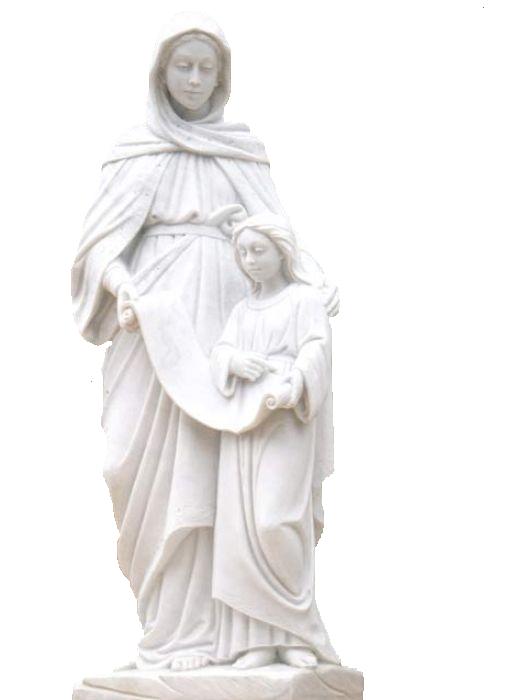
Nine months ago we celebrated Mary’s Immaculate Conception. Today we celebrate her birthday. By my estimation, Mary is now about two thousand, twenty-five years old, but if you saw her I’m sure she wouldn’t show her age. How old does Mary seem when you picture her in your mind? I’d bet that you think of her as fully-grown up; like your mom or your teachers. But today’s feast reminds us that she was once your age too.

Mary was little once too, and just because Mary lived a life without sin doesn’t mean that her childhood was a bed of roses. I think adults sometimes forget how hard and stressful things can be when you’re little, but Mary remembers everything perfectly well.

She remembers what it was like to be little like many of you. How she got scared when Nazareth’s big, neighborhood dogs would bark at her. How loud cracks of thunder frightened her at night and made her hide under the covers. She remembers how other girls made fun of her, for being different or weird, and she remembers how she cried. But even when she got sad or scared, Mary knew that she was loved and not alone. Not only did her parents love her, but she was convinced of God’s love, too, and understood that He was never far from her. This consoled Mary and reassured her that everything would be alright.

After our resurrection, when we get glorified bodies like Mary has now, we will have some new abilities. We will be able to go anywhere we want in an instant. And our glorified bodies should allow us to be more than one place at once. (It only makes sense that if saints on earth can bi-locate, then the  saints in Heaven should be able to as well.) And I also suspect that we will be able to change ourselves back and forth to whatever age we choose.

All this is to say that if at any moment you want Mary to be with you for consolation and support, you only need to ask her. Knowing her abundant love, I can’t imagine she would refuse. And when you think of her with you feel free to picture her at your age, even if you’re little. She understands you, loves you, and can relate to your situations more than you know. Like her Son, Mary is always with us, especially when we ask her be.

A Veiled Beauty — The Assumption

September 2, 2010

Consider this reflection by the servant of God, Bishop Fulton Sheen:

“Just suppose that you could have pre-existed your own mother, in much the same way that an artist pre-exists his painting. Furthermore, suppose that you had the infinite power to make your mother anything that you pleased, just as a great artist like Raphael has the power of realizing his artistic ideas. Suppose you had this double power, what kind of mother would you have made for yourself?

Would you have made her of such a type that would make you blush because of her unwomanly and un-mother-like actions? Would you have made her exteriorly and interiorly of such a character as to make you ashamed of her? Or would you have made her, so far as human beauty goes; the most beautiful woman in the world; and so far as beauty of the soul goes, one who would radiate every virtue, every manner of kindness and charity and loveliness; one who by the purity of her life and her mind and her heart would be an inspiration not only to you but even to your fellow men, so that all would look up to her as the very incarnation of what is best in motherhood?”

Now if you who are an imperfect being and who have not the most delicate conception of all that is fine in life would have wished for the loveliest of mothers, do you think that our Blessed Lord, who not only pre-existed His own mother but who had an infinite power to make her just what He chose, would in virtue of all the infinite delicacy of His spirit make her any less pure and loving and beautiful than you would have made your own mother? If you who hate selfishness would have made her selfless and you who hate ugliness would have made her beautiful, do you not think that the Son of God, who hates sin, would have made His own mother sinless and He who hates moral ugliness would have made her immaculately beautiful?”

Fulton Sheen thought that Mary was, in every respect, the most beautiful woman who had ever lived. However, if we had been travelers walking through the small town of Nazareth during the reign of Emperor Tiberius, I’m not sure that we would have recognized God’s greatest creature as we passed by her. I imagine that her face may have looked quite ordinary, apart from her beautifully, loving smile. Her Son, was the all-beautiful God become man, yet it seems that Jesus was not the most handsome man alive. As the prophet Isaiah says of Him, “There was in him no stately bearing to make us look at him, nor appearance that would attract us to him.” (Is 53) Perhaps Jesus and Mary had ordinary physical features on earth because having extraordinary appearances would have impeded their missions.

Yet now, invested with heavenly glory, Jesus and Mary possess a beauty greater than anyone in history. The perfection of love, goodness, purity and virtue within them shines through their exterior in a way that captivates those who behold them. Jesus told St. Faustina to commission a painting of how He appeared to her. When Faustina saw the artist’s quality work she dissappointedly lamented, “[Jesus,] Who will paint You as beautiful as You are?” The young visionaries at Fatima and Lourdes we struck by how very beautiful the mysterious lady was. And when St. Bernadette visited the grotto for the last time she remarked, “I have never seen her so beautiful before.” There is more to a beauty of this kind than natural appearance.

Why does the Church celebrate Mary’s Assumption? Because this solemnity not only celebrates her, but points to Church’s future. Virgin Mary is the icon, the image, of our Church. Jesus Christ’s Church is Marian. What she did, we are called to do; and where she has gone, we are called to follow. What Christ has done for Mary, He shall do for His Church on the last day. My previous reflections on the ordinary, appearances of Jesus and Mary probably had on earth only goes to show that external appearances can veil the true reality of things. 

Men judge by appearances, and they often misjudge. Many will drive past this building this hour without realizing the wondrous beauty of what is happening here inside. Many fail to see the beauty of Christ’s one, Catholic Church, for which this world was made and through which this world is saved. Many people see the beauty of exterior flesh, but not the beauty of the soul. Yet after the Last Judgment, everyone will see the most homely saint become radiant with beauty, and the most attractive sinner become repellant.

Mary is the first and greatest member of Jesus Christ’s Church. At the end of her unassuming life on earth Jesus lifted up her up body and soul into Heaven and gave her a beauty unmatched in history. He will do the same thing for His Church someday, and He desires to do the same for each of us. You and I are called to follow Mary in following Christ; to imitate their love, goodness, purity and virtue. Despite any appearances to the contrary, in this veiling and deceptive world, we are called to share in a beauty and glory like theirs.

Humbly Rising High — July 15 — St. Bonaventure

July 18, 2010

St. Bonaventure became the master-general of the Franciscans 31 years after St. Francis of Assisi himself. He was renowned for his learning and later named a Doctor (or great teacher) of the Church, yet he was also humble. When the pope sent his representatives to inform Bonaventure that he had been named a bishop and cardinal they found Bonaventure washing the dishes. The saint told them to hang the red hat on a tree and to wait in the garden until he had finished the task.

St. Bonaventure reassures us, that whatever our gifts, holiness is within our daily reach. “A constant fidelity in small things,” he once wrote, “is a great and heroic virtue.”

In today’s gospel, Jesus invites us to take his yoke. This burden is restful, easy and light, yet we must be humble; we cannot carry it without Christ by our side. Beatitude (true happiness) is within everyone’s reach, but we cannot possess it without God.

As St. Bonaventure says:

No one can be made happy unless he rise above himself, not by an assent of the body, but of the heart. But we cannot rise above ourselves unless a higher power lifts us up. And divine aid is available to those who seek it from their hearts, humbly and devoutly.