Archive for the ‘Feast Day Homilies’ Category

Luke’s Source — January 1 — Mary the Mother of God

January 1, 2010

Have you ever wondered how it is that Luke the Gospel writer knows the stuff he’s telling us? For instance, he wasn’t present at the Annunciation to take down notes.  Only Mary and the Archangel Gabriel were there. And in today’s Gospel, after the shepherds visit, it says, “Mary kept all these things, reflecting on them in her heart.” Now how does Luke know what Mary was thinking? Who could know something like that besides Mary herself?

Now I suppose the Holy Spirit could have directly infused the knowledge of these things into him, but that’s probably not what has happened here. Luke probably learned of these details in the most natural and human way; by being told about them, first or second-hand, by people who knew. Luke begins his Gospel by saying that his narrative of events is composed from what “those who were eyewitnesses from the beginning and ministers of the word have handed … down to us.”

But there is only one person who could have been the original source for many of Luke’s details, and that is Mary herself. In fact, some call the beginning chapters of the Gospel of Luke “the Memoirs of Mary.” Perhaps Luke heard of these details from Mary’s very own lips and took them all to heart.  Then later, knowing these things by heart, committed them to writing.

And so we do know something today of what was going on inside of Mary in those early days, “Mary kept all these things, reflecting on them in her heart.” And some years later, upon finding Jesus in the temple, Luke reports that Mary and Joseph did not understand what their boy when said to them, but “his mother kept all these things in her heart.” In this there is a lesson for us to discover through Mary, a lesson that is particularly applicable for us this New Year’s [Eve/Day].

In her life, Mary knew some important aspects of God the Father’s plan, but there was always a great deal about which she did not know. She knew that her Son was messiah, savior, and Lord, but his future, and hers, remained largely a mystery. Perhaps Mary wondered, as we often wonder when faced with evils and obstacles, “How can this be, Lord?  How will your promises be fulfilled despite this?”  Yet through it all, Mary firmly trusted that the Lord was with her, and we should do the same.

What does the new year ahead hold for each of us? Like Mary, we do not know, yet Mary shows us that we do not have to know.  We do not have to fully know our future to be able to do great things for God and to be richly blessed by Him. We do not need to know our future for the Almighty to do great things for us.

In the year ahead, may the Lord bless you and keep you, as He did the Virgin Mary.

May the Lord let his face shine upon you, and be gracious to you, as He did for Mary through Jesus’ infant face.

And may the Lord look upon you kindly and give you peace, a peace like that which Mary always kept with her Son, Jesus the Christ.
Strengthening Your Family — Holy Family

December 29, 2009

Today we are going to try something unique. Close your eyes and let the Holy Spirit guide your imagination to show you what family life was like in the home of Joseph, Mary, and the boy Jesus…

Theirs is a small dwelling and you can see all of them there…

How old is Jesus as you see Him? What is He doing?

What are His parents up to? What are Joseph and Mary like as you see them interact with each other?

It comes to time to eat. What do you see the Holy Family doing?

As they relate to one other, what do you see expressed in their faces? It is now later in the evening and time for prayer. What do you see the members of the Holy Family doing?

You can return in your imagination to visit this house any time you wish, but now, let’s open our eyes and review our mediation.

What did you see as Joseph and Mary interacted with each other? Were they not tender and reverent towards each other? I bet you could see their great mutual love reflected in their smiles.

What happened in their house when it was time to eat? Who would imagine them not coming together to share their meal in each others’ company?

And later, when it was time for prayer, did the Holy Family do? Did you see them go off to their own corners, or did they come together, to pray as one family?

Did you see the Holy Family’s intimacy, their happiness, and their love for each other? Do you want your family to share a bond like theirs? Then take the Holy Family as your model: share your love, share your meals, and share your prayers.

First, on sharing your love. Let your spouse and children know every day that you love them. You can say it, you can show it, or you can do both. For instance, kids never tire of being hugged and told their loved each day.

As for married couples, don’t make the mistake of thinking that intimacy and love are only expressed physically. For St. Joseph had all sorts of simple, little ways to let Mary know that she was loved, and vice-versa. Be like the Holy Family in sharing your love.

A second way to model the Holy Family is to share your meals. The research of social scientists indicates that having frequent family meals together contributes many goods for one’s family: For starters, everyone eats healthier meals, and so kids are less likely to become overweight or obese. And kids who eat family meals are less likely to start smoking, to drink alcohol, or to try or to be addicted to drugs. These kids’ grades are better at school, and there is less stress in their homes. These things probably stem from the fact that families which eat together are bound to talk more, provided the TV is off.

These parents are more likely to know about their children’s lives and struggles and, just as importantly, their kids are more likely to know that their parents are proud of them and love them.

Jesus Christ thinks that the shared family meal is so important for us that He has instituted one for His Church and expects His entire family to be there; for to share in the Eucharist is to share in the life and communion of His family.

A third way to make your family more like the Holy Family is to share your prayers. Apart from dinner prayers or going to Church, most Catholic families do not pray together. I think that maybe we see the priest praying the Church’s prayers and think that we are not equipped to lead prayers of our own at home.

But it’s not true.  As fathers and mothers you have a spiritual authority within your families, what John Paul the Great called “the domestic Church.” Your spouse and your children need you to pray, not only for them, but with them. Right after the family meal might be the perfect time for this ritual of family prayer.

Now you may be thinking to yourself, “But we’ve never done this as a family before.” Remember this: as parents, you create what’s normal for you children. If you want it to be normal for your children to eat meals with you, then make it normal for them.

If you want it to be normal for your children to pray to God with you, then do it normally. As parents, you create what is normal for your children and through your gift of these traditions to them you can bless them for a lifetime.

Finally, husbands and wives, if you do not pray one-on-one with each other, then you do not yet share a perfect intimacy together.  It is in prayer that our most intimate selves are laid bare and we ask another person to help us with our heartfelt needs and concerns.

Maybe you’ve never prayed with your spouse before. Then perhaps you can begin like this:  hold each others’ hands, close you eyes, and pray to God for each other, for a little while, even if for just ten seconds, say, before you go out the door. 

Once this becomes comfortable you can begin to telling each other what you want to be prayed for. And, after this is comfortable, you can begin to pray for each other aloud.  Begin the process of praying like this and it will transform your intimacy together.

Perhaps you gave many gifts to your family members yesterday for Christmas, but the greatest gift you can give to each other is yourselves. So follow the way of the Holy Family: share your love, share your meals, and share your prayers.

Treasure the Gift — Christmas Mass at Midnight

December 26, 2009

It’s Christmas, and today we hear one of the most familiar passages in the Gospel, the nativity scene in Bethlehem.  Is there anything that we can learn out of such a familiar text?  Yes, very much indeed. For example, have you ever wondered: what are swaddling clothes anyways?  ‘Mary wrapped her Son in swaddling clothes and laid him in a manger.’

When I was young I thought swaddling clothes were just dirty pajamas, but in fact swaddling refers to an ancient custom. They would use tightly bound cloths to wrap-in an infants’ arms and legs to their bodies (they thought this was important for promoting proper posture.) This practice was called “swaddling.” Was it cruel to confine the babies like this? No, the babies liked this. It reminded them of their many months, warm and snug, within their mothers’ wombs. Another thing I’ve learned since the time I was a kid was what a manger really was.  A manger is not a stable. It’s a feeding trough.  Mary wrapped Jesus up in swaddling clothes and laid him in a feeding trough.

Even if you knew all that stuff before, there remains the question of why St. Luke included these details in his Gospel. Why is it important?  Not only does it show the poverty and humility of the Christ, it also points to Jesus’ future. This is not the last time that His mother would wrap Him in tight cloths and lay His body down. And baby Jesus is laid in a feeding trough because when He is grown He will say to His disciples, as you will her Him say to you here, “Take this, all of you, and eat it. This is my body which will be given up for you.” The swaddling cloths point to Jesus burial cloth, and laying in the manger points to His Eucharist, where which He offers us His whole self, His body, blood, soul, and divinity as food.

So you see, whether we are a talking about the Sacred Scriptures, prayer, the sacraments, the teachings of Christ’s Bride (our Mother, the Church,)  our Catholic faith is not a half-cut orange whose richness you can drain out with one or two squeezes and then toss away. A lifetime of discovery will not exhaust what all that our Catholic Faith contains.

When I was a kid I might have looked at this manger scene and though that some people were missing.  “Where are the Magi, the wise men (or astrologers) from the East?”  They’re over there, hiding among the poinsettias. Maybe they are journeying through the forests, or maybe they haven’t even left home yet, but one thing we do know is that they were not there on Christmas night.  When they arrive in Jerusalem they ask King Herod, “Where is the newborn king of the Jews?” Days, weeks, or even months have passed since Christmas, and when they do arrive in Bethlehem they do not find Jesus, Mary and Joseph living in a stable or a cave, but in a house.

So who was there that first Christmas night? The shepherds were there. The angel said to them in the fields, ‘I declare to you news of great joy! A savior who is Christ and Lord is born for you in Bethlehem.  You will find Him wrapped in swaddling clothes and lying in a manger.” The shepherds look at each other and say, “Hey, we’ve gotta check this out.” Who wouldn’t turn out for that first Christmas after an angelic invitation like that?

The shepherds came to the stable and find the infant Christ just as the angel described. From there, Luke’s Gospel says, they returned rejoicing and spread the word about what had happened to all. The shepherds probably knew everybody from Bethlehem, since they were locals (“from that region”) and within walking distance from the stable.

Yet there is a question which I would like us to consider, a question which the Gospels do not answer, and it is this: After that first Christmas, did the shepherds ever come back to visit the Holy Family again? I doubt you could find two people more friendly and welcoming than Joseph and Mary, so I sure that any guest was welcome in their home, but did the shepherds ever take the opportunity to visit them again? The Magi had to travel hundreds of miles just to see Jesus once, but the shepherds were only a short distance away. 

Did the shepherds ever get to know Mary and Joseph better, these two holy saints of God? Did they ever take time come back to adore Jesus, to consider what the birth of this Child meant for their lives, and to praise and thank God for all the blessings they had received? If they had merely spent a single hour each week in the Christ child’s presence, imagine what difference it would have made for their relationships, their work, and their lives in general? We don’t know whether the shepherds ever came back again after that first Christmas, but if they didn’t, then they were foolish and they really missed out.

This Christmas Jesus Christ invites you come back and see Him again, to visit this house of Joseph and Mary, where He is always present to be adored. He wants to bless you through His saints, His teachings, His sacraments, and His Real Presence here, the whole year round. You may be receiving many gifts this Christmas, but make sure that you do not return this one.

Saying Amen — Golden Mass

December 26, 2009

Can you guess what word I’m thinking of? It’s a Hebrew word… it’s four letters long… and you’ll say it seven times in this (weekday) Mass. Have you got it?  I’ll give you one more hint… It starts with “A” and ends with “Men.” That’s right… “Amen.”

What do we mean when we say “amen”? Sometimes we say “amen” as a declaration of our faith. In this case our “amen” translates to us saying, “I believe it; this is true.” The sign of the cross, the Gloria, and the Creed all end with “amen’s” by which we declare, “This is true.”

At other times, we say “amen” to entrust our prayers (and ourselves) to God. Whenever we come to the end of our prayers, whether we’re alone or in a group, we always conclude by saying “amen.” With this “amen” we are saying, “Please, Lord, let this be done for us.”

What do we mean when we say “amen”? We’re saying “This is true,” as a confident profession of our faith, or we’re entrusting our prayers to God, saying, “Let this be done for us, Lord, according to your will.” That is what we’re saying when we say “Amen.”

Now here’s another riddle… Who was the first Christian, by which I mean, the first person to believe in Jesus Christ? You might be thinking it was John the Baptist, or one of Jesus’ apostles, but it wasn’t. Mary was the first Christian; she was the first person to believe in Jesus Christ. (Adam and Eve believed in the Redeemer, but they did not know His name.)

The angel announced to Mary, ‘Behold, you will conceive in your womb and bear a son, and you shall name him Jesus. …and He will be called the Son of the Most High.’ And Mary said, “Behold, I am the handmaid of the Lord. May it be done to me according to your word.”

In a word, Mary said “Amen,” in both senses, to the angel’s message: “I believe it, Lord; let this be done.” With this word, the Second Person of the Trinity took on flesh within her. Jesus the Christ was small within her, but truly present as God and man. Imagine the joy Mary must have experienced as she thought of His presence within her.

Just minutes from now, you will stand before a Eucharistic minister who will say to you, “The Body of Christ.” And you will answer “Amen,” like Mary answered the angel. “Amen, Lord, I believe you that are truly present in the Eucharist,” and, “Amen, Lord, let this be done to me, let me become your body; your presence in the world.”

With this word, you will receive the Christ; small within you, but truly present as God and man. When you return to your pew today consider Jesus’ presence within you and ask Mary that you be given a taste of her joy from the day the Lord first dwelt in her.

34th Sunday in Ordinary Time—Year B

November 23, 2009

Today we celebrate the Solemnity of Christ the King. Jesus Christ is our king, now and forever. Yet, the idea of monarchy doesn’t really resonate with us. And it’s not just because we don’t have an earthly king ruling our country. It’s that we’re not big fans of authority. We are wary of anyone having too much power. This is because power is often abused.

Those with any degree of power, be it over entire people or a single employee, can abuse that power. We can fall into thinking only of themselves and our own advantages and be blind and deaf to the legitimate concerns and genuine needs of others. Sometimes those with power hold on to it jealously and will stomp out any real or perceived threats to that power without regard to the truth. This is how the Roman Governor Pontius Pilate responds to Christ. When Pilate asks Jesus, “Are you the King of the Jews,” he is not searching for the Jewish messiah, or even the truth.  He is probing for a political threat to himself.

The true purpose of power and authority is for serving the good of others. This goes for the Church and for all government, for our workplaces and our homes. The reason that our all-powerful God shares some of His power and authority with us, His creatures, is not so that we may be self-serving. It is so that we may serve others, give them life and bless them, and in this way resemble God Himself. God has given of Himself, given us life, and blessed all creation.

As Jesus said to His apostles, “You know that the rulers of the Gentiles lord it over them, and the great ones make their authority over them felt. But it shall not be so among you. Rather, whoever wishes to be great among you shall be your servant; whoever wishes to be first among you shall be your slave.”

Jesus showed his perfect love for us by becoming a slave and dying for us on the cross. For this reason, we do not fear the idea of Him being the first among us, reigning as our king. The Church, His bride, welcomes its royal bridegroom. And as it is for the bride of Christ as a whole, so it is for every Christian soul in relationship with Christ.

Every bride yearns to be fought for, to be pursued and to be a priority to someone. Christ has made us His priority.  He came down from heaven in pursuit of us. He has fought for and died for us, and now in heaven He still fights for us.

Every bride also wants an adventure to share. She doesn’t want to be the adventure; she wants to be caught up in something greater than herself. When we are living for ourselves we are alone, without purpose, and empty. Each of us is meant to live a life about more than just ourselves.  A life in Christ. We each have a vocation, a calling from God, a unique part to play in an epic adventure, a significant part to play in His great story.

Every bride wants to have a beauty to unveil. And it’s not just an exterior beauty. It’s a deep desire to truly BE the beauty and to be delighted in by the bridegroom. Christ is the lover of our souls and all of us wish to have beautiful souls. Each person desires to be approved and uniquely enjoyed by Christ. For us males, this is a desire for his approval and regard.  To be one who He is unashamed to call us His brother, a member on his team; a man in His platoon

Why bring up how Christ our King is the perfect bridegroom for His bride, the Church? Gentlemen, take note. Imitate Christ for your brides with Christian chivalry, love your wives as Christ loves the Church, and you will be like our king for your queen. Fight battles on Christ’s side for your beautiful bride. Lay down your life for her each day. Be Christ the king’s shining knight for her—honor, serve, and defend your bride and lead her on an adventure. The power you have is for her and you family.

For any of us, with any power and authority comes responsibility. And the power each of us has gives us a great opportunity. For by serving Christ our King and by caring for those He has entrusted to our care, we win the only glory and happiness worth having, that of Christ our king—the glory and happiness with the power to last forever.

November 11 – Veterans Day

November 11, 2009

Pearl Merchant

In the Gospel today, Jesus describes the kingdom of heaven as being like a treasure buried in a dirt field, or like a ridiculously underpriced pearl in a market place. These are valuable things that take great personal sacrifice to obtain. Jesus’ lesson in this for us is that a wise person should be willing to trade away everything else they have, and do it joyfully, because of the desirability of what’s before them. So it is with the Kingdom of God.

But these parables are not only about us, and how we should go after God’s kingdom. They also tell about how God has sought after for us for His kingdom. The Lord saw us as the treasure buried in a field, the field being the world. He was like the pearl merchant, who saw us as a precious pearl whose great worth was unrealized by others. And out of love for us one could say that He joyfully sold everything that He had to possess us.

“For us men and for our salvation, He came down from heaven. By the power of the Holy Spirit He was born of the Virgin Mary and became man. For our sake He was crucified under Pontius Pilate.  He suffered, died, and was buried. On the third day he rose again,” ‘giving us a new birth to a living hope through His resurrection.’ Through Christ’s poverty, He made us rich, giving us “an inheritance that is imperishable, undefiled, and unfading, kept in heaven for [us].”

Whenever something is truly valuable, it is worth one’s great personal sacrifice to possess it and to protect it. Today we are honoring those men and women who have done just that; who have made great personal sacrifices to serve our country in the military. Today is Veterans’ Day. While we would be mistaken to identify our country as being the kingdom of God, it would also be a mistake to dismiss the good our country and its veterans have done around the world.

We can we be so proud of our country’s veterans because they are true soldiers. As G.K. Chesterton said, “The true soldier fights not because he hates what is in front of him, but because he loves what is behind him.” This is reflected in how we have treated those we have defeated. We forgive them, rebuild them, and let them have their freedom. We may need to fight some enemies, now and in the future, but we have no need to hate them. Our power is not in our hatred, but our love. In this we follow our model, Jesus Christ, who loved the world so much that sacrificed everything He had for it. And let us remember that He conquered the whole world for us without firing a single shot.

October 28 – Sts. Simon and Jude

October 28, 2009

Cowardly Lion

Today we celebrate the Sts. Simon and Jude, apostles and martyrs for Christ. Simon was known as “the Zealot,” and Jude, or Judas the son of James, was nicknamed “Thaddeus,” which means “Courageous” in Greek. In the Gospel today the apostles are listed, with Simon and Jude coming towards the end, right before Judas Iscariot, the one who betrayed Jesus.

When Jesus sent out His disciples with the power and authority to heal the sick, cast out demons, and preach the Gospel, He sent them out two-by-two.  One could infer (though this is by no means certain) that this Gospel passage lists the apostles according to those old missionary pairings: Simon Peter with his brother, Andrew; James with his brother, John; and so on, ending with the Judas called “Courageous” and the other Judas who became a traitor.

So here we would have two Judas’, side-by-side, in discipleship and ministry. Yet, only one of them earned a nickname for being courageous. To grow in holiness requires our courage, a virtue that Judas Iscariot tragically lacked.

John’s Gospel tells us that this Judas held the money purse, and sometimes stole from it for himself. That’s because he lacked the courage to acknowledge his faults and to grow in the virtues.

Judas may have betrayed Jesus because he thought this would kick-start Jesus, the weak messiah, into real, revolutionary action. Judas did not have the courage to trust that the providence of God working through Jesus Christ was really the best way to bring about the Kingdom on earth.

And after he had sinned, Judas lacked the courage to seek forgiveness, choosing suicide instead, which is called “the coward’s death.” Simon Peter denied Jesus, but he had the courage to confess his sin and to seek reconciliation. That was Peter’s salvation.

If we are going to grow in holiness to sainthood, it’s going to require our courage; the courage to acknowledge our faults and grow virtue, the courage to trust in God’s will and providential plan for our lives, and, when we fall, the courage to confess our sins and to seek reconciliation with Christ.

October 17 — St. Margret Mary Alacoque

October 18, 2009

Sacred Heart by Margherita. Vatican

Today we celebrate St. Margret Mary Alacoque of France who lived in the latter half of the 1600’s. Throughout her life, Jesus would appear to her and converse with her, but this did not surprise Margret or seem strange to her. She assumed that other people experienced the same sort of things all the time. After she become a nun, Jesus gave her a  mission: to establish devotion to His Sacred Heart.

You’ve seen images of the Sacred Heart before; a red heart, crowned with thorns, pierced along its side, with a cross and flames emerging from its top. If this devotion seems strange to us, its because we do not understand what it means.

Sacred Heart of Jesus

When I was in seminary I heard a story about the Sacred Heart that I not been able to confirm with the internet, but I share it with you as a great illustration, even if it might only be a legend. The story goes that after St. Margret Mary Alacoque died, devotion to Jesus’ Sacred Heart was spread by the Jesuits, a Catholic religious order, in their missionary work. In one mission territory (it might have been Papua New Guinea) the priests introduced this devotion to the people, but it wasn’t resonating with them.  The people just didn’t seem to get it. As they missionaries learned more about the native culture, they learned that these people did not look at the heart as the organ that symbolizes love and emotion.  For them, some other abdominal organ, the liver I think, was the seat of human love and emotions. In response, these missionaries replaced the Sacred Heart devotion with another, a devotion to the Sacred Liver. The natives people got it, and responded enthusiastically.

When we consider the Sacred Heart today, we can be a lot like the natives in this (possibly fictional) story. We today tend to be a people of science, materiality, and literal interpretations, who look at a heart and see an organ for pumping blood. But the Church in the 1600’s saw the world differently, in a much more poetic way—they saw the Sacred Heart and understood its message.

Jesus’ Heart is aflame with fire, because His love for you is intense and passionate. His Heart is pierced, crowned with thorns, and holding up a cross, because Jesus suffered for you out of love. Jesus presents this devotion to us, because He wants us to remember that He is a human being like us and that He loves us with a human heart. The Sacred Heart is a symbol of His love for us, that He loves us deeply, with a human heart.

Since modern-day Catholics understand and resonate with the Sacred Heart less easily than we used to, Jesus seems to have given the Catholic Church another sacred image to convey very similar message. In the 1930’s, Jesus appeared to another nun and gave a mission to promote a new devotional image. That nun was St. Faustina Kowalska of Poland, and the devotion she was to spread was the Divine Mercy. The two devotions are very much alike. For example, both devotions emphasize Jesus’ humanity.  Both are accompanied by popular prayers devotions.  And both show that Jesus’ abundant loves and mercy for all.  The question is not which devotion is better, the question is which devotion resonates or connects with you in communicating Jesus’ love for you.

Sacred Heart PaintingDivine Mercy

And now I come to my final, and most important point. I’m sure all of you know the right answer to the questions, “Does God love everyone,” and “Does Jesus love you?” None of you would get these wrong on a test. But I suspect that for most of you the concept that God loves you remains just an idea. Have you experienced this truth as a reality? Do you know that Jesus Christ likes you, that He enjoys you, that He is pleased with you? If you’re uncertain about this, then you have not yet experienced His love for you as profoundly as He desires. Personally knowing Christ’s love for you, rather than just knowing about it, makes all the difference in the world.

So here is your assignment… Ask Jesus Christ to reveal to you today, or in the very near future, some palpable sign of how, and how much, He loves you. Then, keep your eyes open. Jesus is clever and powerful, and knows how to reach you. He doesn’t want His love for you to be a secret.

October 2 – Guardian Angels

October 2, 2009

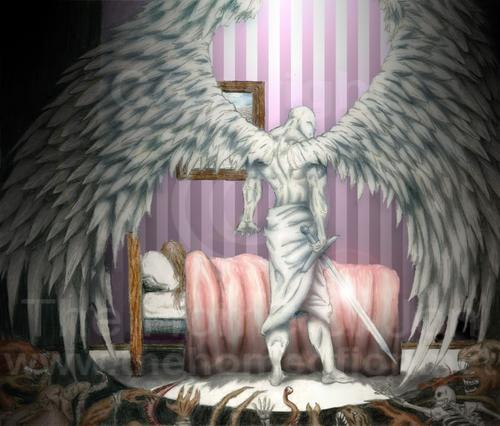
There are members of our Church gathered here today, who are always with us, but whom we all-to-easily overlook. It is to this group of persons that I wish to speak to today: our holy guardian angels. I invite you to share in my thoughts and sentiments of my words to them.

Holy Guardian Angels,
First, I want to apologize for our tendency to forget about you and the important part you play in our lives. Though we do not say it enough, thank you Holy Ones, for everything you do for us and we ask you for your continued help.

May we be always docile to your promptings. Please accept this invitation to enter our thoughts and emotions as through an open door. You are Christ’s perfectly sinless creatures, and you discern His will with far more clarity than we do. Please make His will clear for us and make it easy for us to follow it.

Holy Angels, you know the hearts and minds of men with penetrating insight. Please help us through your mediation to communicate graciously with the people in our lives. Please help mediate good resolutions to the conflicts and tensions we have with others. Please help us to know how to best communicate Christ’s love to others in ways that are tailored for them.

Holy Guardians, just as some of your angelic peers ministered to Jesus Christ amidst His sufferings, please bring us support and consolation in our difficult moments. And please defend us against spiritual attacks, for you understand these threats far better than we do.

Please join us in our prayers. Perfect in them and add to them whatever may be lacking. Please pray with us for our loved ones and for the intentions which are dear to us. You are blessed to see God face-to-face and you worship Him day and night. Please lead us to perfect worship.

Holy Guardian Angels, thank you, for everything you do for us. Know that we will someday thank you even more profusely when it is revealed to us in detail all that you’ve done to light, to guard, to rule and to guide our lives.

October 1 – St. Therese of Lisieux

October 1, 2009

Today we celebrate the young woman Pope Pius XI called, “The greatest saint of modern times.” At the age of 15, she entered the Carmelite convent in Lisieux, France to give her whole life to God. There, she would take on a new religious name which would profoundly capture her identity: Sister Therese of the Child Jesus and the Holy Face.

St. Therese

How did her life resemble the Child Jesus? Early on, Therese saw her own weakness and littleness, and she believed that great and mighty deeds were beyond her, so she committed herself to a “little way of spiritual childhood.” She always tried to love and trust like a little child, modeling herself on the Child Jesus; not doing great things, but doing everything with great love.

The second title of St. Therese, that of the Holy Face, refers to the image Jesus’ bloodied face left upon St. Veronica’s veil during the Passion. How did Therese’s life resemble the Holy Face? Whatever she suffered, from small annoyances of daily life to the great pains of her final illness, Therese offered it all to God as a sacrifice for the good of souls. The image and likeness of Christ’s redemptive suffering was made present in her, like the image Christ’s face upon a clean, white cloth.

We can follow St. Therese’s example in our own lives, whenever we approach our Father in prayer with child’s fearless trust, whenever we do our daily tasks with a intention to do them with great love, and whenever we offer our sufferings as a sacrifice in Christ, for our good and the good of all His Church.

September 29 – The Archangels

September 29, 2009

Today we celebrate Saints Michael, Gabriel, and Raphael. God created lots of angels, so that they might enjoy, share and manifest His glory. Within this multitude, Michael, Gabriel, and Raphael hold special rank as archangels. The angels and archangels are like us in important ways, but in other ways they’re very different.

Just like us, God did not create the angels to fulfill some need He had. God needs nothing to be happy and complete. God made heaven and earth, all that is seen and unseen, out of sheer love, overflowing. God created us because love likes to share.

Just like us, God created the angels as persons. We are persons because we both have intellect and will, the capacity to know and the ability to freely choose. Just like us, angels are persons, having souls which will never die. But unlike us, angels don’t have a physical body united to their soul. Instead of body and spirit, angels are spirit alone.

Like us, angels know things and choose things. Like us, they’re made for interpersonal-communion. They interact with God, with each other, with us, and our world. But like God, and unlike us, angels live outside of time. We humans grow, and change, and mature, day by day. We’re incomplete and we develop over time. We can choose holiness one day, choose to sin the next, and on the day after that, think better of it, repent, go to confession, and return to God. But in the case of angels, their natures are complete and finished. And the free choices they’ve made once are made for all time. That is why the angels are forever sinless creatures, and why the demons, who are the angels who chose to rebel and were cast down from heaven, will never turn back to God.

We do not know exactly why Satan and the many demons fell, but it is clear that they did not, in their sinful pride, want the roles in God’s kingdom which God had prepared for them. Some speculate that when the angels where created, God gave them some knowledge of His plans for the human race. God wished the angels to share in this plan, but, for some reason, some refused to serve.

Perhaps it was the scandal of the Incarnation, the idea that the eternal Second Person of the Trinity, would take on material flesh. Maybe they refused to worship the Eternal Word, Jesus Christ, in such a state as that. Perhaps, filled with pride about their own glory, which was entirely God’s gift, they refused to be Christ-like and serve creatures they deemed to be inferior to themselves.

Whatever the reason for it, a war broke out in heaven. Michael and his angels battled against Satan. Satan and his angels fought back, but they did not prevail. The demons wanted to be like God, but without God. Perhaps Michael challenged them with the meaning of his name, “Who is like God?” They wanted to be God, but without God, and there was no longer any place for them in heaven.

And now we arrive at the lesson we learn from the demons’ Fall that I want you to take to heart…

When the demons refused to be what they were made and called by God to be, they became something far less than what they were meant to be. By turning away from God, the source of their life, they became stupid, ugly, and weak compared to what they should have been.

Compared to what God makes us, calls us, and longs for us to be, sin makes us stupid, ugly, and weak too.

Do you have any sins?

Every Tuesday I sit in my office as much time as can, from the end of morning Mass until 3:00 PM, when prayers are offered in the Columbus chapel that God the Father would have mercy on us. I’ve spent hours at my desk, behind my confessional screen, catching up various work. And in all that time, not a single student has come for the sacrament that reconciles sinners with our Lord Jesus Christ. Now don’t think that I’m angry about this. Tuesdays for me as they are now are very productive days. I get a lot done behind my desk. But I would very much prefer, that so many of you would come, to the healing forgiveness, and strengthening graces, that Jesus is waiting to give you in this sacrament, that I would get nothing else done.

I want you to come to the sacrament that cleans your slate and lightens your heart. I want you to come to the sacrament that makes you wiser, stronger, and more attractive as a person than you are when you’re in sin. I want you to come to the sacrament of reconciliation, not for my sake, but for your sake.

Through the intercession of St. Raphael, whose name means “God’s healing,” may we believe in God’s power to heal our wounds. Through the intercession of St. Gabriel, whose name means “God’s power,” may we believe in God’s power to recreate the repentant sinner. And through the intercession of St. Michael, may we consider “who is like God,” who shows mercy to all who come to Him.

September 24 – Sts. Cosmas and Damien

September 25, 2009

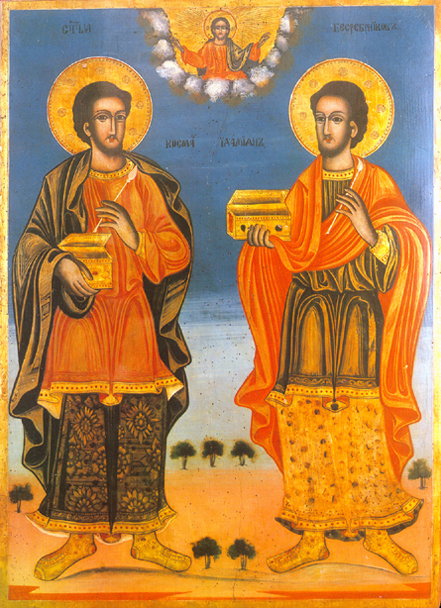
A number of years back, there were two twin brothers, the eldest of a widowed single-mother’s five sons. From their youth, they had a profound love for their Catholic faith and they viewed God’s creations, especially the human body, with great wonder. The two brothers studied medicine and became general practitioners.

Two things made them stand out among other doctors in their profession: first, their willingness to share their Catholic faith with others; and second, their refusal to accept payment for their work.  The two worked for free, pro bono, for the good. They healed the sick, in both body and soul. And they were gratefully admired by many. But then it happened that their government instituted new laws which were contrary to the Catholic faith, offensive to human dignity, and universally binding without exception.

The two brothers might have said to each other, “Our work helps so many people.  If we don’t go along with this we won’t be able to practice medicine anymore. We should compromise, for the sake of the greater good.” However, these two doctors were adamant in their convictions. They understood that if they chose to forfeit their Catholic faith, then they would have nothing else of truly lasting value to offer to anyone. They did not yield, and it cost the two of them their careers, and much more, but the brothers preserved their faith, their clear consciences, and their heavenly rewards in Christ.

You’ve heard of the names of these brothers before, but you’ve probably never heard their story until today. The twin brothers, the two doctors who were unwilling to compromise on their Catholic faith when the Emperor Diocletian decreed in the year 303 that everyone worship idols or be killed, these men are the saints we celebrate today: Saints Cosmas and Damian.

May we learn from their example and benefit from their prayers.

Petitions:


Saints Cosmas and Damian are the patron saints of physicians, surgeons and pharmacists.  Let’s pray for those who care for the sick… We pray to the Lord.

Through the intercession of Saints Cosmas and Damian, may Catholic healthcare workers in our time never have to face a test of faith like theirs because of unjust laws… We pray to the Lord.

Through the intercession Saints Cosmas and Damian, may we have the courage to share our faith in the workplace, by both our silent deeds and our spoken words… We pray to the Lord. 

For my intention in this Mass, for Congress which is now considering amendments to the healthcare bill which would grant conscience exceptions and prohibit the federal government from subsidizing, reimbursing, and paying for abortions, and for your Mass intentions… We pray to the Lord.

September 15 – Our Lady of Sorrows

September 16, 2009

Imagine if you had to start a whole new life. I don’t mean just changing schools, or moving away from home, or even entering the federal witness protection program. Imagine if you had to start a whole new life from the very beginning, as a tiny little embryo. And imagine that this reincarnation of yours required you to choose a new mother for yourself, from among all the women in all the world. What qualities would you look for in choosing a new mom?

You would want her to be beautiful, not only on the outside, but on the inside too, for what we desire most of all from our mothers, is a great and beautiful love.

You would want her to be wise and full of goodness, someone who could introduce you to the world and show you how to live in it well.

You would want her to be the perfection of femininity, so you girls could see how to grow into excellent women, and to show you boys what to look for in an excellent wife someday.

You would want a mother with patience, and tenderness, and compassion, who would be at your side if you were sick or in pain, and who would comfort you just by her presence.

As fantastic as this sounds, Jesus faced a scenario a lot like this one. He had to choose from among all the women in all the history of all the world, the one woman who would become His mother. For his incarnation, Jesus chose Mary to be His own mother.

She was beautiful, inside and out. She introduced Him to life in our world. She loved Jesus with a great and beautiful love. And when Jesus looked at Mary, he saw the likeness of His future bride, because Mary is the icon of the Church perfected. She stood at His cross with compassionate strength and her presence helped Him amidst his suffering.

Mary was so great a mother, that Jesus wanted to share her with us. He wanted her to be our mother, too. Jesus looked down from the cross, on her and the beloved disciple, and said, “Woman, behold, your son,” and to the beloved disciple, “Behold, your mother.” You and I are the beloved disciple. Jesus gives us Mary to be a mother for us. He created her perfectly, to be His own mother and our mother, too.

From that hour, at the cross, the beloved disciple took Mary into the heart of his life. From this hour, at this Eucharist, take Mary deeper into the heart of your life; because she loves you more than you know.

September 8 – Nativity of Mary

September 9, 2009

I once heard a man express why he believed that of all the causes for celebration, birthdays were among the stupidest. I don’t remember his arguments word for word, but they went along these lines…

“Why celebrate a birthday? I mean it’s not as if you’ve done anything to reach that ‘special day,’ besides living for another 365 days and riding the earth another lap around the sun. Your mom was the one who actually did something on the day you were born. All you did was show up. How does merely showing up for another year merit a party?”

He had an interesting argument, but he was entirely missing the point when it comes to why we celebrate birthdays.  It’s not that the person has done any one, big, special thing that makes us celebrate that day.  It is for the countless little things, for all the things which make them who they are for us, this is why we rejoice over them just being around for another year of life. The reason we celebrate birthdays is to celebrate the very fact of a person’s existence, to celebrate who they are, in their own unique and unrepeatable goodness, to celebrate the gift of their presence in our lives.

Today, we celebrate Mary’s birthday. We celebrate the fact that God created her and has given her to us. We celebrate who she is, in her own unique and unrepeatable goodness. We celebrate the gift of her presence in our lives. Today we rejoice over Mary, our mother, our sister, and our close friend, and we wish her a very happy birthday, just for being who she is.

August 27 – St. Monica

August 27, 2009

Today I would like to tell you a true story, the story of a Catholic woman in a very difficult marriage to a non-Christian husband. Her husband was a man with a hot temper and hostility towards Christianity. He was unfaithful in their marriage, but she remained faithful to him—not out of weakness, but out of an inner-strength.

She bore his faults with patience and persistently sought after his conversion. The daily example of her gentleness and kindness finally had its victory. Her husband became a Christian one year before his death. However, the year after that, she had to face a new burden alone.

The oldest of her three children joined an anti-Catholic religious cult. It started him down a path of sinful pride and many sensual sins. It broke her heart. Then one night, she had a dream.

She was standing on top of a wooden ruler, and she saw a young man coming towards her, surrounded by a glorious halo. Although she felt sad and full of grief, the young man smiled at her joyfully. He asked her for the reason for her sadness and daily tears. (This wasn’t because he didn’t know, but because he had something to tell her—this is the way things happen in visions.) When she answered that her tears were for the lost soul of her son he told her to take heart for, if she looked carefully, she would see that where she was, there also was he. And when she looked, she saw her son standing beside her on the same ruler. Reassured by this dream she continued, for years to come, praying tearful prayers for his conversion.

She even asked the bishop to intervene in winning over her son. He counseled her to be patient, saying, “God’s time will come.” When she persisted in asking, the bishop (perhaps busy with many other things) famously reassured her: “Go now, I beg you; it is impossible that the son of so many tears should perish.”

That son, as you may have guessed by now, was the great St. Augustine. And his mother is St. Monica. May her story encourage us to pray and strive for the conversion of our loved ones to the Catholic faith. Remember and take hope: God loves us with a human heart and He cares about your loved ones even more than you do.