Archive for the ‘Funeral Homilies’ Category

Something New Under the Sun — Funeral Homily for Marvin Weber, 94

December 30, 2022

By Fr. Victor Feltes

Ancient people thought about time differently than us. They did not picture time to be like a flying arrow, moving forward toward some end and purpose. They imagined time to be like a flat circle, going round and round. They saw history, in its broad strokes, repeating itself. The same four seasons, cycling over and over. Every empire eventually being replaced by another. This attitude is reflected in the Old Testament book of Ecclesiastes, whose author wrote:

“What has been, that will be; what has been done, that will be done. Nothing is new under the sun! Even the thing of which we say, ‘See, this is new!’ has already existed in the ages that preceded us.”

That author adds:

“There is no remembrance of past generations; nor will future generations be remembered by those who come after them.”

Indeed, very few people’s names are remembered by this world after just a handful of generations. To keep track of time in the ancient world, the custom was to refer to the years of the ruler’s reign (such as “the 15th year of the reign of Tiberius Caesar”). Yet those earthly rulers came and went, as history spun round and round with no apparent purpose.

But then, unexpectedly, something truly new happened under the sun. It is an event that we always celebrate during the present time of year. At the center of history, God entered history, becoming a human being like us. “Behold, God’s dwelling is with the human race.” We now number all the years of time as before or after the Christmas birth of Christ our King (“B.C.” or “A.D.”). Jesus says, “I am the Alpha and the Omega, the beginning and the end.” His life reveals that our lives, this world, and all human history are not merely random accidents but exist with purpose in God’s plan. As Pope Emeritus Benedict XVI said, “Each of us is the result of a thought of God. Each of us is willed, each of us is loved, each of us is necessary.”

We are gathered here for Marvin’s funeral at a meaningful time. He passed away two weeks ago, before the celebration of Christmas. Today, we offer his funeral Mass during the week between Christmas Day and a new year. His peaceful passing comes, in a sense, both before and after Christmas. Year after year, Marvin already knew and looked forward to the joy of Christ’s coming. He had already experienced great joy in Jesus but had not yet experienced its fullness in the time to come. The life of Jesus Christ causes us to see a Christian’s death through eyes which are different than the world’s. For a Christian, dying, “this momentary light affliction, is producing for us an eternal weight of glory beyond all comparison.” So Marvin’s passing is more than just a sad parting; it is a cause for joy in us as well.

Marvin married Betty inside this church 65 years ago. She told me many stories about her husband’s life, and there is no way I could retell them as thoroughly or as well as she. But I would like to highlight three anecdotes: First, Betty told me about Marvin’s dad who, when Marvin was about seven years old abandoned his family. Thirty years later, he appeared at his son’s doorstep and said, “I’m here.” He offered no apology, he gave no explanation, and Marvin was not happy about that, but Marvin valued forgiveness and forgave him. Marvin said he wanted his children to have a grandfather; he wanted them to know his father. Second, Betty tells me regarding Marvin, “If he found two pieces of wood he would make something.” Marvin has loved woodworking. He delights to repair or remake things into something greater. And third, at an age of 94, Marvin died relatively young. Because of the longevity of many of his ancestors who lived to be more than 100, Marvin died at a younger age than he had expected. For this reason, according to Betty he often put projects off for later saying, “I’ve got time.”

In our Gospel, Jesus tells us, “Where I am going you know the way. … I am the way and the truth and the life. No one comes to the Father except through me.” Christians’ lives throughout the centuries will reflect the One whom they have followed. For instance, despite our past unfaithfulness, our abandonment of God, Jesus forgave us, because he desired that we would come to know his Father. Christ took two pieces of wood for his Cross and used them to repair us and make us into something greater. And though our Lord died relatively young, with the resurrection he’s got time—everlasting life—to share with us forever.

The world will not remember us a few generations from now, but though the world may forget us, Jesus never will. Christ our King has come; entered time, our world, and our humanity to save us. So on this day of Marvin’s funeral, we are consoled by Jesus’ words: “Do not let your hearts be troubled. You have faith in God; have faith also in me. … Behold, I make all things new.”
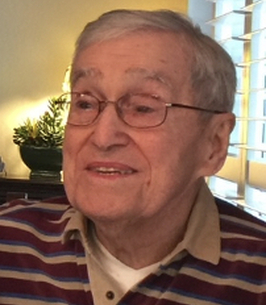
“They Rest in You” — Funeral Homily for Dr. John Eberle, 97

December 11, 2022

By Fr. Chinnappan Pelavendran

On behalf of the parish of St. Paul’s, I would like to extend our sympathy to the members of Dr. John’s family. He will be remembered in our thoughts, prayers, and Masses. Whenever we gather together as a community of faith to celebrate the Eucharist, we always remember our faithfully departed and their families.

Dr. John reached the age of 97 and was still able to live in his own home. He was married to Frances for almost 72 years. His son, John, and two daughters Marcia and Michele survive him. He also has five grandchildren and one great–grandchild. During his life, Dr. John was self–employed for many years as an optometrist. He enjoyed many hobbies, such as working in his yard, golfing, flying his own airplane, and tinkering with old cars.

As we heard from the book of the Prophet Daniel we are reminded that many of those who sleep in the dust of the earth shall awake; some shall live forever, but the wise shall shine brightly like the splendor of the firmament, and those who lead the many to justice shall be like stars forever. St. Paul reminded us, through death we shall be united with him in the Resurrection; our old self was crucified with him so that our sinful body might be done away with. The Gospel of St. Matthew tells us about the Sermon on the Mount. Jesus tells us that good people will be blessed, such as those who mourn will be comforted, those who are merciful will be shown mercy and those who are clean of heart will see God. We believe that Dr. John is one of the good people.

When someone dies, we experience many emotions. Sadness is one of those. We are going to miss Dr. John. As Catholics, we know that we will see him again. His life has changed not ended. Near the end of Jesus’s life on earth, He spoke to his disciples these very comforting words; “Do not let your hearts be troubled. Have faith in God and have faith in me also. In my Father’s house, there are many dwelling places…” Our houses here are only temporary. Heaven is our permanent home. Death reminds us that there is no final resting place in this world. Even the grave is temporary. We live in the hope that when our earthly journey is done, we will be at home with God forever. Only God can satisfy the deepest longings of the human heart. St. Augustine’s understanding of this truth led him to write, “You have made us for Yourself, O Lord, and our hearts are restless until they rest in you.”

While we are truly saddened over the passing from this life of Dr. John, our faith reassures us that the sadness we are experiencing, will be transformed into joy because Dr. John, like Jesus, has died, but he died in the Resurrection. Even now as we continue to celebrate his funeral liturgy, he is enjoying the fullness of God’s presence and will continue forever.

“My Portion is the Lord” — Funeral Homily for Audrey Schillinger, 87

December 5, 2022

By Fr. Victor Feltes

When her husband, Marvin, passed away in 2013, Audrey became a widow. In these recent years, she has endured breast cancer, Parkinson’s disease, and other bodily ailments. We all walk through dark valleys in this life. Who strengthened Audrey to endure all of this with unconquered joy? She was not alone through her trials. She had her dear friends, siblings, sons, and granddaughters, but most importantly of all, Audrey had the Lord Jesus. With him, as we heard from St. Paul’s Second Letter to the Corinthians, “although our outer self is wasting away, our inner self is being renewed day by day.”

Her Lord, the Good Shepherd, was near. The 23rd Psalm says of him: “You spread the table before me… and I shall dwell in the house of the Lord for years to come.” For many years, Audrey faithfully approached the Lord, at his table in this, his house. She came here to St. Paul’s Church for Mass every Sunday until the arrival of the pandemic. Thereafter, concern for her vulnerable health kept her at home but she continued to watch the Mass on TV. Yet the Lord Jesus still came to her and she eagerly welcomed him to her home.

Rod Ramlow (the lector for today’s funeral) and his wife Betsy have lived next door to Audrey since 2016. In the final seasons of her life, each Sunday morning, Rod brought Jesus Christ to Audrey in the Holy Eucharist. Rod tells me that when he would arrive at her door, he would have barely rung the doorbell when Audrey would quickly answer. He says it was as if she were practically waiting at the door. Like we heard from the Book of Lamentations: “My portion is the Lord… Good is the Lord to one who waits for him, to the soul that seeks him.”

As an aside, are you or someone you know homebound or greatly hindered from coming to Mass? Please contact the parish office so we can organize Holy Communion to be regularly taken to you or them. Others have simply neglected to come back to church without good reason, or else they have never known that Jesus is really here in the Holy Eucharist. Whatever the case, the Lord awaits to encounter them.

Who does Jesus tell us is blessed, or blest? We just heard from St. Matthew’s Gospel the Beatitudes of Jesus’ Sermon on the Mount. Jesus says, “Blessed are the poor in spirit, for theirs is the Kingdom of Heaven.” Someone who knows the poverty in their spirit or soul, will seek out and rely on the Lord’s fullness and strength. Jesus says, “Blessed are they who hunger and thirst for righteousness, for they will be satisfied.” Someone who hungers and thirsts for righteousness, will hunger and thirst for the Righteous One. Jesus says, “Blessed are the clean of heart, for they will see God.” Someone whose heart is clean or pure — uncluttered by lesser things — will intensely desire God. Audrey sought out and relied upon Jesus Christ in the Eucharist. She hungered and thirsted for him, saw him and received him, the one who drew her to himself. So today, as we pray for her soul, we have well-founded hope that the desire of Audrey’s heart will be satisfied by entering the Kingdom of Heaven to be with her Lord.

The Kingdom in his Garage — Funeral Homily for John Schwartz, 81

December 2, 2022

By Fr. Victor Feltes

Many stories could be shared about John; as a friend or neighbor, as a father to six children, or as a husband to Vernetta, whom he married sixty-one years ago today. He did interesting work for both multinational businesses and local organizations throughout the years. And even after his final job concluded, his kids tell me “he never retired.” I wish to tell you today about one of the ways John kept himself busy.

Whenever he drove a load to the Bloomer Recycling Center he might return home with more stuff than he had left with. In what others had rejected as trash, John saw value. He often said, “Everything is fixable.” John took his found-treasures back to a four-car garage in the backyard of his home. His kids tell me, “When he wasn’t working, he was there…” working.

The interior of John’s garage featured cupboard cabinets; each one painted to match and labeled to indicate the tools, parts, or materials stocked inside. John’s garage was a warm place—in both senses of the word. Throughout the colder months, John used his wood stove to keep the inside temperatures around 75 or 80 degrees. And once hotter weather came, John would open up his garage doors, sit in the doorway with a toothpick between his teeth, drinking coffee and waiting for people to stop-by to visit.

He was happy to share his time and talents with them, generous in sharing his tools or efforts whenever asked. His children tell me John loved that garage, saying, “His garage is his kingdom.” All good things in this world reflect the goodness of our Creator and our Redeemer. The beautiful realities we see are icons of invisible realities. And so, John’s garage is a partial glimpse of the Kingdom of God.

Because of humanity’s sins and corruption, we were rightly condemned. But we were not to be rejected, left to be abandoned, forever. God continued to value us. He saw treasure in our trash. And Jesus came down to redeem us, intending to take us home. Christ is always working, and everything is fixable, because “all things are possible for God.”

Jesus prepares a special place for each of us. Enthroned in heaven, he opens the doors to receive us. His Father’s house is a very warm place—in both senses of the word. We must be prepared to stand in the intense fire of God’s all-holy presence and infinite love for us. Thankfully, Christ is generous in sharing with us his tools and helping graces, so that we may become perfect (truly “good enough”) through faith in him. Through Jesus Christ, our Lord, about whom countless stories could be told, John and you and I can all be together in the Kingdom of Heaven.

Re-Presenting His Mysteries — Funeral Homily for Sara Caron, 59

November 19, 2022

By Fr. Victor Feltes

When Sara was first diagnosed with breast cancer, her two boys (Mick and Jake) were just twelve and seven years old. She thought of how hard it could be for them to have to grow up as children without her. She did not know how much time she had left, but one of her goals was to be around for them, to raise them throughout their high school years. Today, thirteen years later, her sons are twenty and twenty-five years old. She successfully brought them both to adulthood.

Her family tells me Sara has worked at fifteen different places over the course of her career, and even with cancer, she never stopped working. They say she went “above and beyond” at work and would never take time-off for herself, but she would take days away from work to care for her family; for instance, keeping vigil with Mick in the hospital. Sara also kept on working for another reason: to preserve her continued health insurance coverage. You can imagine how much out-of-pocket cancer treatments would have cost. Sara did not wish to burden her beloved husband, John, and their household with terrible medical debts.

To echo the words of St. Paul in his Letter to the Romans, only with difficulty does a person give their life for others, though a good person might have the courage to lay down their life for those they love. St. Paul speaks of how “God proves his love for us, in that while we were still sinners Christ died for us.” When we witness someone, despite their flaws, give their life not just once but year after year for those they love, it is that much easier to believe that our perfect, holy, loving Lord has lived, and died, and risen for us.

Recall Christ’s words from the Book of Revelation: “Behold, I make all things new.” Our Lord, to whom Sara prayed every day, dwells within his faithful Christians, re-presenting his mysteries in their lives. “Behold, God’s dwelling is with the human race. He will dwell with them and they will be his people and God himself will always be with them as their God.”

Jesus prays in St. John’s Gospel, “Father, those whom you gave me are your gift to me. I wish that where I am they also may be with me.” Christ’s longing within us makes the psalmist’s words resonate with us: “There is one thing I ask of the Lord; this I seek: To dwell in the house of the Lord all the days of my life. That I may gaze on the loveliness of the Lord and contemplate his temple.”

Christ who has called us, who dwells in us, who re-presents his mysteries in our lives, who inspires eternal longings within us, desires us to be with him forever where “he will wipe every tear from [our] eyes, and there shall be no more death or mourning, wailing or pain, for the old order [will have] passed away.” This is our cause for our firm and happy hope, for Sara and for every Christian.

A Trimmer of Trees — Funeral Homily for Gordon “Gordy” Weyers, 90

October 27, 2022

By Fr. Victor Feltes

For several decades, Gordy has loved trimming trees. Of course, there is much more to the man as a Catholic, a husband, a father, and a friend, but this is one of his curious quirks. Whenever Gordy saw outside his house a tree branch which was not right, he was highly-motivated to intervene. He would pull out his ladder and tree-cutting tool to go take care of that errant branch. Dot (that is, Dorothy) his wife of sixty-seven years would tell him, “Don’t climb the ladder,” but he would do it anyway.

Gordy began saying he wanted a new ladder but his kids kept trying to talk him out of this desire, hoping he would stop climbing at his age entirely. Yet by all accounts, his old ladder was very rickety, so eventually Dot said, “Get him a new ladder, because he’ll fall off the old one.” Dot would periodically look out the window to check on Gordy tree trimming on his ladder. Years later, she told him, “Good thing you never fell off!” He replied, “Oh, I fell off a few times, I just didn’t tell you.”

But here’s the thing: after Gordy’s trimming—however daring or reckless it may have been—his trees looked really good. Dot reports that “he never did anything that made them look bad.” Those trees became more perfect, more healthy and strong, more handsome and beautiful, by having been cared for and pruned by Gordy.

We often recall “the Lord is my shepherd,” but we less often reflect on how our God is a gardener. In the beginning, God created a perfect garden. And when St. Mary Magdalene first encountered Christ resurrected on Easter Sunday she thought he was the gardener. Jesus teaches, “I am the vine, you are the branches… and my Father is the vine grower. He takes away every branch in me that does not bear fruit, and every one that does he prunes so that it bears more fruit.” And the Letter to the Galatians tells us that the fruits which the Holy Spirit grows in us include love, joy, peace, patience, kindness, generosity, faithfulness, gentleness, and self-control. We are like trees which God prunes to make us more perfect.

Now I imagine if gold were alive and aware it may not feel eager be purified in a furnace’s fire, and the pruning process might not be a lot fun for a tree. But the Book of Wisdom tells us, ‘as gold in the furnace, God proves us… before taking us to himself.’ And though parts of our trees (of ourselves) must die and some of our unsightly branches must be trimmed away, the Lord makes our souls more perfect, more healthy and strong, more handsome and beautiful, through his care and pruning.

Like Gordy with his trees, Jesus saw us outside of his Father’s house. He saw our branches were not right. And he was highly-motivated to intervene. Call it daring or reckless, but our Lord put his life on the line. Christ went up the tree of the Cross to trim our flaws and perfect us. And after death felled him, Jesus rose again.

He declares, “I am the way and the truth and the life. No one comes to the Father except through me.” To enter into heaven, we must be perfected in Christ’s love. So if any imperfections still remain in Gordy’s soul, we ask Jesus today to prune them away. And we welcome our Lord to continue trimming any errant branches within our souls as well.

Death is not the End — Funeral Homily for Robert “Bob” Sarauer, 84

October 16, 2022

By Fr. Chinnappan Pelavendran

Robert “Bob” P. Sarauer’s death is not the end. We can still be united with him. We are gathered here around the table of Eucharist, around Jesus, and Bob too is gathered around the Lord. He is now closer to the Lord, enjoying a closer union with the Lord which we also hope to share in the future.

We have heard in the first reading the souls of the just are in the hands of God. What better place could we go after death than into the hands of God? What a beautiful way to describe God’s care for us. Do you remember when you were small and your parents took you up in their arms? You were in the arms of your parents. When we die, God takes us up in his hands. We are in the hands of God. We believe that God has taken Bob up into his hands.

The readings end beautifully, expressing the faith of someone who believes in God’s goodness and who therefore is not afraid to die.

They who trust in him will understand the truth,
those who are faithful will live with him in love.
For grace and mercy await those he has chosen.
(Wisdom 3:9)

Those who trust in him will understand the truth. Those who are faithful will live with him in love. When we die, we go to God’s love.

Robert “Bob” P. Sarauer, 84, passed away on Monday, October 10th, 2022, at his home surrounded by his loving wife Marlene, and family members. He was born September 2nd, 1938, in the Town of Cooks Valley and graduated from Bloomer High School in 1956. On September 8th, 1959, he married Marlene Bowe at St. Peter’s Catholic Church in Tilden.

Bob was a kind and gentle man who was loved by all, he loved spending time with family and friends. He always thanked everyone and had a big smile that everyone will remember. Bob enjoyed playing cards and getting together with his former classmates. He loved to travel whenever he could, especially the Alaska trip and all his hunting trips, and was a lover of the Packers football team.

Bob was a farmer all his life and liked milking cows, raising pigs, and cutting wood. In the year 2000, he sold the farm to his son and continued helping with farm work until his health slowed him down. He was survived by his loving wife Marlene for sixty-three years, had three children, four grandchildren, six step-grandchildren, one great-grandchild, and ten step-great-grandchildren.

So we ask God to take Bob up in his arms, to pour his love, grace, and mercy upon him.

Suffering & Joy — Funeral Homily for Rodger Falkenberg, 75

October 11, 2022

By Fr. Victor Feltes

Rodger has experienced years of suffering and years of joy. After being born into a large, poor family and serving in the Vietnam War, he returned home and joyfully joined a new household. Facing life’s struggles, what a man could do is be bitter and glum, but Rodger loved making people laugh; sometimes with his Donald Duck voice or an intentional stumble. Even after enduring four, painful back surgeries, he still would roll down a hill to amuse his nieces and nephews.

Rodger knew that just because something is broken doesn’t mean that it’s without value. At what he dubbed his “Polish Shopping Center” (or what others call the city dump) Rodger would take things which others had despised. He would tinker with them as necessary, restoring them and prizing them as treasures to keep for himself or to share with others.

One thing I learned about Rodger and his beloved Donna is that they share a great, personal love for ice cream. Giving up ice cream for Lent was a great personal sacrifice in their house because they could eat an entire pail of it for a meal. In recent years, with his memory declining, they would often go to a particular restaurant. When the friendly staff would ask him, “Is it your birthday?” He would sincerely reply, “I think so,” and be treated to ice cream.

September 2nd of this year marked the 50th anniversary of Rodger and Donna’s wedding day here at St. Paul’s Church, and the family celebrated this occasion simply and sweetly together. Their daughters were getting Dad and Mom an ice cream cake and the employee was making a mess of squeezing-out the inscription on top, but Kelly or Lisa said, ‘It’s fine, really, just put sprinkles on it.‘ The party was a happy, intimate family gathering at home. And despite what had seemed to go wrong the cake still tasted very delicious in the end.

In today’s psalm the psalmist speaks of his suffering, praying for deliverance: “Relieve the troubles of my heart and bring me out of my distress. Put an end to my affliction and my suffering and take away all my sins. To you, O Lord, I lift my soul.” It’s not wrong to pray for relief, like Jesus himself did in the Garden of Gethsemane, but in Christ we see that our sufferings play a role in our glory. Jesus says, “unless a grain of wheat falls to the ground and dies, it remains just a grain of wheat; but if it dies, it produces much fruit. …Whoever serves me must follow me… [to the Cross].”

When Jesus suffered and died, “people saw and did not understand,” but in light of his resurrection Christians know death is not the end of the world. As St. Paul says, “We know that if our earthly dwelling, a tent, should be destroyed, we have a building from God, a dwelling not made with hands, eternal in heaven. [So] we are courageous, and we would rather leave the body and go home to the Lord. …We must all appear before the judgment seat of Christ, so that each may receive recompense, according to what he did in the body, whether good or evil.”

For the faithful and righteous the sufferings this world sees as worthless are taken up by Jesus to rework our souls. Our Lord will claim us from this junk yard, he will fully restore us and prize us as treasures for himself and to share with others. The messed-up cake of this world will be salvaged. Once God’s family is gathered together again, we will simply and sweetly agree that everything turned-out fine in the end. Can this day of Rodger’s funeral be his birthday to new life? I think so. In heaven, our Lord “will wipe every tear from their eyes,” and convert the sufferings of his people to joy. “Behold,” he says, “I make all things new.”

A New, Joyful Day — Funeral Homily for Robert “Bob” Sobotta, 77

September 26, 2022

By Fr. Victor Feltes

It was the day after Bob’s nineteenth birthday and the day before he would marry Joann. Bob and Joann had met at a Pines Ballroom dance and now they were at The Pines Ballroom again, together with family preparing food for the next day’s festivities. They listened to the radio as they labored, and that’s how they learned what had happened at 12:30 PM that day in Texas. A short time later that same afternoon, the first report of grim news was followed by another: President John F. Kennedy was dead. It was Friday, November 22nd, 1963.

Presidential assassinations had happened before, first and most famously with President Lincoln. But it had been sixty-two years since the last murder of a president, when President McKinley was shot and died in Buffalo, NY in 1901, and few were still alive who remembered living through it. So Joann recalls how shocked everyone was that a president, America’s first Catholic president, was killed. They were all discussing it, stunned. They just couldn’t believe it, it seemed so unbelievable — and yet it was real, as real as death.

I asked Joann whether that mournful news, whether this national tragedy, soured their “Big Day”? No, she said, it was “just as joyful.” Bob and Joann awoke the next day and were married in the morning (as was the custom then) in a 9:30 AM Saturday wedding Mass at St. Peter’s in Tilden in the company of many loved ones, their family and friends. This was followed by a dinner at the Sundial Club and then a reception back at The Pines, a feast and a dance for them all. Bob loved to dance, polkas and waltzes in particular, and he enjoyed dancing with his new bride. Bob and Joann would happily share their next fifty-eight years together loving God, each other, and their family, friends, and neighbors, until Bob’s recent passing.

Death is sad and unsettling. Though common to history, it still remains shocking for us. But suffering and death are not the end of our stories. Though we mourn now, we will be comforted. We expect a new dawn, a new day, when the blessed friends of Christ – our King who dies no more – will awaken to celebrate his wedding feast with him. Jesus our Good Shepherd will spread the table before us, and the just shall dance with delight, and every tongue shall give praise to God. Though today we walk in the dark valley, the day we prepare for, the day we look forward to, the day that awaits us, will be full of joy.

The Gift of Eternal Life ― Funeral Homily for Leonard & Jean Halfman

August 26, 2022

By Fr. Victor Feltes

Imagine if, one night in a dream, an archangel visited you. His incredible glory fills your vision and you are convinced he comes from heaven. He bears a message for you. “Behold,” he announces, “the Lord God has decreed that you shall never die.” Then the angel departs from you and you awake in the morning wondering what this means.

A few years pass and you notice nothing unusual. You wonder if you might have imagined it. But a few more years pass and you realize that you’re not aging. A decade passes, and then another, but your age remains the same. If anything, you seem a little bit younger, while you see your friends and relatives grow older. You delight to be healthy and able to join them for their good times and you are grateful you can be there for them in their hard times. Eventually, you attend all of their funerals. You mourn their passing, but your life still contains joy.

Through the years, you make new friends. Perhaps you marry, or remarry, and have many children. You collect new hobbies, go back to school to earn degrees, and start careers in various fields. Eventually, you explore other regions of the world, learn new languages, and experience the best of other cultures. Your unending lifetimes would fill centuries, and your centuries might span millennia, but the longing within you would remain unfulfilled.

Your eyes may be filled by beautiful sights, your mouth may be filled with delicious tastes, and your ears may be filled with lovely sounds, but you would become envious of those who die because this world’s good things cannot fully satisfy. God places within us a natural wariness of death, and this is healthy and good. (If human beings failed to take proper care of themselves—if we were naturally apathetic towards survival—how could God’s purposes be accomplished in our lives?) But after having lived for multiple lifetimes, the blessing of earthly immortality would feel like being left out, left behind, like a curse. You would envy those who get to experience what’s next, while you continue to wait, with great impatience, for the Second Coming of Jesus Christ.

This funeral is unique in all my years of priesthood. Never before have I celebrated a Mass of Christian Burial for more than one person at once. And thankfully, today’s double funeral does not follow a horrific tragedy, such as a family’s fatal car crash or a double murder. Leonard and Jean lived longer lives than most people: eighty years and seventy-seven years respectively. And they lived fuller lives than most people, with strong Catholic Faith which they imparted to their children through fifty-six years of marriage.

Though a quiet, introverted pessimist was paired with a talkative, extroverted optimist, together they reflected Christian excellence to the world – feeding others through an extraordinary dairy herd, and supporting and caring for the sick and dying. Both endured physical sufferings, realizing along the way that the brain is a bodily organ which can require a physician’s help as much as any other. And finally, after sharing a lifetime together, their earthly lives came to natural ends less than ten weeks apart from each other. Despite living only one lifespan each, Leonard and Jean did not see their coming deaths as tragedies. I am told by their children, “In their own way, each experienced joy when they realized that they were nearing the end of this life and entering eternal life, and they were ready to go.”

Jesus says, “Come, you who are blessed by my Father. Inherit the kingdom prepared for you from the foundation of the world. For I was hungry and you gave me food, I was thirsty and you gave me drink… ill and you cared for me…” The Book of Wisdom says, “Chastised a little, they shall be greatly blessed, because God tried them and found them worthy of himself. As gold in the furnace, he proved them, and as sacrificial offerings he took them to himself. In the time of their visitation they shall shine, and shall dart about as sparks through stubble…” So while there is naturally some sadness today, we do not mourn a tragedy but rejoice in a triumph. As St. Paul said: “Where, O death, is your victory? Where, O death, is your sting? … Thanks be to God who gives us the victory through our Lord Jesus Christ!”

Invited Home ― Funeral Homily for Kathleen Zwiefelhofer, 82

August 12, 2022

By Fr. Victor Feltes

In my priesthood, I have visited many dying people and heard many stories told by family members about them. In this, I have found patterns among Christians dying. For instance, as I have spoken about before, the dying person may or may not know they are in their final week of life, yet he or she is often blessed to have “a last good day.” A happy day shared with loved ones or enjoying a dearly-loved activity is gifted to them by God, from whom all good things come.

Another providential pattern I often see when visiting the dying is how people come to for the Anointing of the Sick. Though wavering in consciousness when I call their names and they open their eyes and they realize a priest has come to share God’s grace. When I came Kathleen’s side in the emergency room to give her the sacrament for those in danger of death, I called her name and she opened her eyes, and knowingly received this consolation from God. Kathleen’s journey from this life features two more elements dying Christians commonly experience. The first was her desire “to go home.”

As we grow old, our bodies are beset with infirmities. This reminds us that all of us must “appear before the judgment seat of Christ, so that each may receive recompense, according to what [we] did in the body, whether good or evil.” Our physical frailty helps to detach us from this world so that we are open to something greater. Our weakness leads us pray like the psalm: “Put an end to my affliction and my suffering; and take all my sins away. … To you, O Lord, I lift my soul.”

Throughout this year, burdened in her mind and body, Kathleen has expressed a desire “to go home.” She said this while still living at home, in the house she grew up in, next-door to St. Paul’s Church. So what “home” did she mean? Kathleen, in faith, was expressing her longing for heaven. St. Paul writes, “We know that if our earthly dwelling, a tent, should be destroyed, we have a building from God, a dwelling not made with hands, eternal in heaven. [And so] we are courageous, and we would rather leave the body and go home to the Lord.”

The second detail from Kathleen’s story which I have encountered before in others is visions of visitors. Kathleen’s parents, George and Catherine, and her husband, Leon, each died many years ago. Yet Kathleen reported being in dialogue with them. She said they discussed with her whether or not it was “time for her to go.” We are surrounded by a great cloud of witnesses, by saints and angels who desire us to dwell with them in God’s holy city, the new and heavenly Jerusalem. They pray for us and help us. On the morning before Kathleen was taken to the hospital, she had another vision. She extended her palm before her saying, “He’s right here. He’s right here,” though she did not clarify whom.

Jesus says, “I am the resurrection and the life; whoever believes in me, even if he dies, will live, and everyone who lives and believes in me will never die.” “Behold, I make all things new,” Jesus declares, “I am the Alpha and the Omega, the beginning and the end.” Jesus is the reason we are here. He is why Kathleen did not fear to die. And he is the cause we have for hope in unending life and a greater home. Let us pray for Kathleen’s soul, entrusting her to our loving Lord.

The Third-Day Surprise — Funeral Homily for Greg Seidling, 60

July 23, 2022

By Fr. Victor Feltes

Greg often said, “If you don’t get up in the morning, you won’t get anything done in the morning.” And I imagine he would say you’d have to wake up pretty early before “the shank of the day” if you were going to successfully pull his leg. Earlier this year, one scheme which took three days to prepare gave him a great surprise.

His son Mike began calling him daily pretending he had begun renovating his house. As a self-employed contractor and Jack-of-all-trades, Greg was interested in his son’s project. But on the third day, Mike called his dad and said, “I cut a supporting wall! The roof is falling down! Come and help me!” “What were you doing!?” Greg exclaimed. (The great outdoorsman had swallowed the bait.)

Greg could fix anything, from picnic tables to chicken coops, and he sprang into action. He and Valeria started driving to Mike’s home and Greg got on the horn to call for others’ help – to bring their tools and add their muscle. It was Saturday, March 26th, 2022, Greg’s 60th birthday, and the people Greg was calling were already at his surprise party.

Greg had his suspicions. On the way, he asked his high school sweetheart, his wife of nearly forty years, if there was some kind party planned. Valeria did not lie to her husband, she denied having anything to do with planning a surprise party, and it was true – she hadn’t done any of the organizing. But her spouse finally knew what was up when they reached Mike’s house and saw the driveway full of cars.

Greg found Mike and said, “It doesn’t look like you need anymore help, you’ve got plenty of help here! … I don’t know if I should be upset that I fell for this or happy that my son was not as dumb as I thought.” Greg, always ready to find a reason to party, greeted his gathered family and friends and started enjoying his party with them.

The Gospel we heard today featured the Beatitudes of Jesus from his Sermon on the Mount. It is a list of character traits suited for the Kingdom of God. These traits belong to Jesus Christ, and he calls us to believe in him and become like him.

It took three days to prepare Greg’s great surprise, and it took three days for Jesus to accomplish his great plan. Christ suffered, died, and was buried, rested and rose again, and when he appeared to his disciples they were very surprised and overjoyed.

Like Greg, Jesus is also a skilled repairman and builder, through whom “we have a building from God, a dwelling not made with hands, eternal in heaven.” So even in the face of death “we are courageous” and have peace in the thought of going “home to the Lord.” Death can seem like a disaster, like our walls are failing, our roof is falling, and all might be lost. “Come and help me, Lord!” And Jesus comes to us, because he loves us.

Like Valeria on Greg’s birthday, Christ the bridegroom, the Holy Spouse of his Holy Church, did not lie to us. In life, we won’t always know exactly what Jesus Christ is up to, but if you follow him as your Good Shepherd you will be joyfully welcomed at his house. There is a party prepared for us where Jesus would gather all of us together, with Greg and one another.

The Cardinal, the Angel, and Us — Funeral Homily for Joan Johnson, 88

July 12, 2022

By Fr. Victor Feltes

A Christian life like Joan’s contains many good memories. No funeral homily could recount them all. Today, I would like highlight two family stories from Joan’s life which connect the past and the present and point to our shared future. Did you know that a cardinal has visited St. Paul’s and that an angel been seen in this church? Their appearances were as characters in Christmas pageants when Joan’s beloved grandchildren were both students attending our grade school.

One year, little’s Casie role in the Christmas play was a bird, specifically a cardinal. Hers was a minor role, but grandma made her a major costume. Joan’s daughters, Debra and Terri, recall Casie in that great, red plumage, molting feathers as she walked down this aisle. At another Christmas pageant, McKenzie’s role was to be a little angel. Her mother had prepared a fine costume (which would prove to be only a first draft). When Joan saw it, she didn’t say anything. Joan has a sweet disposition, she is quiet, patient, and no complainer, but Joan desired greater glory for her beloved and set to work. The next day, McKenzie’s angel wings were significantly bigger than they were before.

Those stories connect the past to the present. Joan’s family still has that big, little angel costume, and Joan’s granddaughters, Casie and McKenzie, have grown up to be the lectors reading at her funeral at St. Paul’s Church today. These stories also point to our shared future as well. Our first reading from the Prophet Daniels foretells, “At that time… those who sleep in the dust of the earth shall awake; some shall live forever, others shall be an everlasting horror and disgrace. But the wise shall shine brightly like the splendor of the firmament, and those who lead the many to justice shall be like the stars forever.” In our Gospel, Jesus reechoes his plan: “The hour is coming in which all who are in the tombs will hear his voice and will come out, those who have done good deeds to the resurrection of life, but those who have done wicked deeds to the resurrection of condemnation.”

Joan loves her family with a likeness to how Jesus Christ loves his. He is patient, he is kind. He is slow to anger and not a grumbler. But his intense desire is for our greater glory and he has set to work. Christ’s will is not to merely change our clothes but to transform us, not to make us birds or angels (for we shall always be human creatures) but to make us godlike, saints sharing in his resurrected glory.

“It is a serious thing to live in a society of possible gods and goddesses,” C.S. Lewis wrote, “to remember that the dullest most uninteresting person you can talk to may one day be a creature which, if you saw it now, you would be strongly tempted to worship, or else a horror and a corruption such as you now meet, if at all, only in a nightmare. All day long we are, in some degree helping each other to one or the other of these destinations. It is in the light of these overwhelming possibilities… that we should conduct all of our dealings with one another, all friendships, all loves, all play, all politics. There are no ordinary people. You have never talked to a mere mortal. Nations, cultures, arts, civilizations – these are mortal, and their life is to ours as the life of a gnat. But it is immortals whom we joke with, work with, marry, snub, and exploit – immortal horrors or everlasting splendors.”

Today we pray for Joan, that her fully-purified soul may enter God’s unveiled presence, and — seeing him as he is — she shall be like him, a glorious saint, dwelling in the house of the Lord forever. Never forget and do not doubt that the Lord desires the same for you. Christ calls you to possess his holiness. Jesus calls you to share his glory.

Essential Conversation — Funeral Homily for Marcel Sobotta, 86

July 11, 2022

By Fr. Victor Feltes

Marcel’s family moved here to Bloomer when he was just three years old. And back then, starting out, the only language he knew was Polish. Marcel had to learn how to speak English here, partly from his friends, who reportedly taught him how to say useful words like “potato.” Consider how essential practicing this new language was for his life. How isolated would his more than eighty years of life on earth have been, if Marcel had never practiced such conversation?

About Marcel, Beverly and their children have shared many memories. Of his love for his wife and kids, grandkids and great grandkids. Of his delight in farming and gardening. Of his work ethic at the dairy and driving school bus. Of his raising the beagles and rabbits. Of his joy in fishing and hunting in God’s creation. Of his frustration with The Green Bay Packers. But the particular aspect which stood out to me most is what his family shared about Marcel’s life of prayer.

Marcel prayed at every meal time and prayed every single night. He would kneel down by his bedside and was not ashamed to let his children see it. In fact, he taught his children to do the same. They tell me he was very faithful to God. Prayer, it seems, was a constant throughout Marcel’s life. When I visited him with Beverly, just days before he died, to give him the Holy Eucharist and the anointing for the sick, he joined us in the prayers as he was able, and he was happy. Marcel had learned and practiced the language of prayer.

Prayer is simply a conversation with our friends in heaven. Prayer is how we talk to God. And through the important practice of prayer, a Christian becomes more and more conformed to Christ and shares in his blessedness. The Christian who prays recognizes their poverty in spirit, that they need God. The Christian who prays will mourn the evils of this world, for Jesus will share with them his heart, and there is much to mourn. The Christian who prays meekly asks the Lord to intervene with his wise solutions, for “man’s wrath does not accomplish the righteousness of God” and “his ways are above our ways.” The Christian who prays increasingly hungers and thirsts for righteousness, within themselves and others, for Christ calls us all to be holy saints. The Christian who prays grows merciful, because they know they have received great mercy. The Christian who prays is clean of heart, desiring one thing, God, above all. And the Christian who prays is a peacemaker, nurturing peace within themselves and for all around them.

Connected to Christ in daily prayer, we no longer live an isolated human life, cut off from deeper meaning and purpose, settling for small potatoes. Our Lord has a purpose for you and has prepared a feast for you. Jesus says in the Book of Revelation, “Behold, I stand at the door and knock. If anyone hears my voice and opens the door, I will come to him and dine with him and he with me.” Behold, he stands at your door and knocks. He knocks at the door of your soul, and prayer is how you open the door to him. Blessed is he who opens that door, for consolation, the Kingdom, and the vision of God await. May we learn this valuable lesson from Marcel’s lived example.

Patterns in Christian Dying — Funeral Homily for Ione Seibel, 84

June 6, 2022

By Fr. Victor Feltes

As a priest, I encounter many people in their dying days. And though every life is different, I have noticed often-repeated patterns. Three of these gracious elements are seen in Ione’s story.

Something I often find is the phenomenon of “a last good day.” The dying persons may or may not know they are in their final week of life, yet they are blessed to have a last good day. Sometimes they love being outside, and there’s a rare day in their final week when they feel well enough to go on a walk or do gardening. Sometimes it’s the day of a family reunion, where they delight to see their family and to say goodbye. Ione, despite her Alzheimer’s condition, had a last good day the Wednesday of her final week. Vernie, her husband of nearly 65 years, who was visiting her at her nursing home with a pair of their daughters, says Ione was “grinning, smiling, shining.” He and the staff described it as Ione’s “best day in two years.”

Jesus also had a good day before he died. When he took his place at table for the Last Supper he told his friends, the apostles, “I have eagerly desired to eat this Passover with you before I suffer, for, I tell you, I shall not eat it again until there is fulfillment in the Kingdom of God.” Such blessings are bestowed upon us in this life as signs to us of God’s goodness before we enter into the next life.

A second phenomenon I often see is an alertness for the anointing of the sick and last rites. Vernie let me know Ione was dying and I was soon able to visit her on Saturday. When I arrived, he and their children were gathered around her. Now the sacrament of anointing is like the sacrament of baptism in that a receptive person may receive this sacrament even in an unconscious state. Some babies, for instance, sleep through their baptism yet receive the graces of baptism nonetheless. Her family tells me Ione had been unresponsive, but when I greeted her, as I told her who I was and why I had come, she opened her eyes at me. Ione’s family was struck by this but it’s something I commonly see—a providential alertness to receive this sacrament. The Lord often wills for his beloved to consciously experience this gift.

Jesus himself was anointed upon his head with precious perfumed oil in his final days and said, “She has done a good thing for me. … She has anticipated anointing my body for burial.” He was consoled and strengthened by this gift of love, and Jesus desires to console and strengthen us as we enter into his Passion and death.

A third thing I commonly encounter in my ministry is the bittersweetness of a beautiful death. Suffering and death are painful signs of this world’s brokenness from sin. Yet the circumstances which accompany many Christians’ passings are poetic signs to us that death is not our end. As we heard in our gospel reading, on the first Good Friday, a darkness came over the whole land until three in the afternoon. Then our Lord breathed his last, near those who loved him most. The centurion who beheld how Jesus breathed his last said, “Truly this man was the Son of God!” And the curtain in the Temple, which veiled its holiest place, was torn in two from top to bottom, from heaven down to earth.

Ione died on a Sunday, Christ’s day of Resurrection. And she died during Easter, the season of Jesus’ victory over death. Like him, she breathed her last in the afternoon’s third hour. And Ione passed away from us on the Feast Day of Jesus’ Ascension, when he passed through the veil from this world into heaven.

A Christian is never truly alone because the Lord Jesus is always with us through life and death. He makes our life story a part of his story, and makes our story like his own. Today is a day of grieving and joy, because we can see this truth anew in the life and death of Jesus’ servant and sister and friend, Ione.