Archive for the ‘Funeral Homilies’ Category

Living Christ’s Mysteries — Funeral Homily for Deacon Ed Feltes, 65

February 23, 2021

On the day Victor and Ramona brought their eighth son to be baptized, while his little head was still damp from holy water, Edward Joseph was draped with white linen. And the priest said (in Latin), “Receive this white garment, which mayest thou carry without stain before the judgment seat of our Lord Jesus Christ, that thou mayest have life everlasting.” Today, we bring Ed’s body before the Lord, draping him in white cloth once more. My uncle Ed told me that as a deacon he would always say yes to doing baptisms. It was, he said, “the introduction of a new life into the Church. By baptizing them you are basically installing them into a Catholic environment and hopefully they will grow in it and not back away from it.” Ed has been a Catholic Christian for more than sixty-five years, ever since he was baptized into Christ’s death and resurrection. And throughout his nearly twenty-four thousand days Jesus Christ accompanied him through life. The life of a Christian is found in Jesus Christ. And the mysteries of Christ’s life are reflected in, shared with, the faithful Christian. We see this throughout Ed’s life.

At his First Communion, young Edward approached and saw the Real Presence of his Lord held before his eyes: “The Body of Christ / Corpus Christi.” Ed received Jesus and Jesus received Ed into a more profound union, a more intimate relationship, between them. In receiving Christ’s Body, Ed was called to be the Body of Christ for this world. When Jesus tells us at the Last Supper, “Do this in memory of me,” he not only commands that we would receive him at the Holy Sacrifice of the Mass, but that we would imitate him in his self-gift: “This is my body, which will be given up for you. Do this in memory of me.” When Ed was sealed with the gift of the Holy Spirit at his Confirmation, he entered a more powerful relationship with that same Spirit of inspiration, grace, and power who led Jesus in his works on earth. The Holy Spirit’s gifts manifested through Ed not merely for himself, for his own salvation, but to serve the wider mission of Christ’s Church, that every person in this wayward world might be saved.

The main vehicle of Ed life’s work and witness would be through his first vocation: marriage. Ed and Jessica met during his studies at Notre Dame University and the year he graduated they entered a new covenant together. Almost forty years ago, they freely committed without reservation to give themselves to each other in marriage, to love and honor each other for as long as they both would live, and to accept children lovingly from God—raising them up according to the law of Christ and his Church. Recall that Jesus Christ called himself the Bridegroom and that in Sacred Scripture his Church is called his Bride. Every Christian is called to imitate Christ, and every Christian soul is spiritually his Bride. But just as the Holy Eucharist we celebrate is not merely a symbol or a memory but Jesus’ Real Presence among us so the Sacrament of Marriage makes present the mystical marriage of Jesus and his Church, within and between a husband and a wife. In beholding a holy, Christian marriage, in its loving, mutual, and lasting fidelity, we see a sign for us and for the world. That love is real, that love is foundational, that love is fruitful. That we were made in love, made to love, made for a holy communion of love, a family. We saw this in Ed and Jessica’s strong marriage which bore fruit, not least of all in their children: in their living son, Christopher, of whom they are so proud, and four other loved children who passed away very, very young; Francis, Steven, Elizabeth, and Meagan. Ed said he looked forward to meeting them and now has that opportunity.

In his marriage, together with Jessica, Ed discerned and pursued a call within his call, a second vocation. Relying on the help of the Lord God and our Savior Jesus Christ, Ed was chosen and ordained for the Order of the Diaconate. After the laying of the bishop’s hands and being dressed with stole and vestment, he was handed a Book of the Gospels with this admonition: “Believe what you read, teach what you believe, and practice what you teach.” Deacon Ed then ministered here at St. Catherine’s, celebrating in this sanctuary and serving throughout this parish. Teaching and preaching, even though he often found preaching difficult. Ed told me that he primarily sought to advance the Kingdom by sharing his life, showing how he lived. He said, “Always live your life such that people want the same that you do.” Looking back at the end of his quiet life, Ed had few regrets, but he did wonder if he was “maybe quiet too long.” Deacon Ed understood well that we need not enter into every pointless, unhelpful argument, but the Spirit does call and help us to speak the important words people need to hear alongside seeing our deeds.

In these last years, these final years, Ed reflected Christ and became configured to him in a new way, by joining him in suffering. Ed had at least six different strokes—twice nearly dying yet surviving—and endured strokes’ debilitating effects. Ed and Jessica described these past several years to me as an experience of continuous loses and grief, but also of continuous mercy and grace. Reportedly, the devastating impact of strokes often breaks up families, but this family grew closer through the trials. I think Ed also became bolder in Christ. While under hospice care at home he never stopped offering good things to his guests; blessings, prayers, holy water and blessed salt, to anyone who visited, wherever they might be in their faith walk.

When I last spoke with my uncle Ed I asked him what he was looking forward to. He simply said, “Heaven. I poured a lot of my life into experiencing, into living life on earth with a heavenly approach.” Asked as to what his near future held, he said, “It’s really up to God. I accept everything he has for me.” Ed and Jessica related to me that it was last March, almost a year ago, over a lunch at Panera Bread, that he told her, “I’m going to go to the Lord in six months to a year.” And he was right. Ed knew he was in God’s hands, being led and offered like an oblation for his glory and as a blessing for many. Knowing that this day was not in the far-distant future, I asked Ed about his wish for all of you on this day of his funeral. He answered, “Pray that they seek God more closely and live a more Christian life. I wish they would seek God for the answers and not just rely on themselves.” So if you have seen Jesus Christ in the life of Deacon Ed Feltes, please listen and heed his words.

And now, in conclusion, like Edward heard in his Last Rites:

I commend you, our dear brother, to almighty God and entrust you to your Creator. May you return to God who formed you from the dust of the earth. May holy Mary, the angels, and all the saints come to meet you as you go forth from this life.

May Christ who was crucified for you bring you freedom and peace. May Christ who died for you admit you into his garden of paradise. May Christ, the true Shepherd, acknowledge you as one of his flock.

May the Lord forgive all your sins and set you among those he has chosen. May you see your Redeemer face to face and enjoy the vision of God for ever.

The Holy Family — Funeral Homily for Cecilia Paulus, 95

December 26, 2020

By Deacon Dick Kostner

Today we gather not to be sad because we will no longer see one of St. Paul’s and St. Jude’s “elders”, one of St. Paul’s and St. Jude’s parish family members, but rather that we will have sent a very special person from our community to be personally present as our representative for Jesus’ birthday party tomorrow night. It is there that Cecilia will be present with all Holy Family members to celebrate God’s gift to all Children of our heavenly Father who created us to proclaim to the world His love for us shown through the birth of His son Jesus, our Savior and our mentor.

Having known both Cecilia and Toni for my whole life I can only imagine what that party will be like with all three “Lang girls” sharing their life stories with Jesus at one time. My mom and dad were good friends of the Erickson family. My mom golfed with Cecelia and my dad was on the Bank Board of Directors for many years with both Jim and Arndt. After Arndt died my dad retired from the Board and I replaced him as a Director for the Bank in 1977 and after Jim sold the Bank I was asked to stay on as a Director with the Ogrin Family and I still serve on that Board to this day. Cecilia stayed connected with that Bank for many years after Arndt’s death and would attend the Banks Annual meeting to be sure the new owners would continue to serve her “family” in the New Auburn area.

Our First Reading today from the Book of Wisdom identifies the importance of “Family” in God’s plan of Salvation for all of God’s children. It talks of God’s “elect” those born into the Holy Family of God through their Baptism. It proclaims that Cecilia is safe and sound for it says “The souls of the just are in the hand of God and no torment shall touch them.” It goes on to say:…because God tried them and found them worthy of himself, he proved them, and he took them to himself. In the time of their visitation they shall shine.” One thing is known for sure about the “Lang girls”, they are not bashful and they will want answers from God as to why there is need for so much suffering in this world, and why does it take so long sometimes for God to answer our calls for help.

Cecilia was a person of great faith and she cherished and loved not only her blood relatives and family but also her extended Parish Family and Friends. She acknowledged that she did not understand everything that God wanted of her but through Faith said yes to those challenges. She was one of St. Paul’s daily Mass people. She would join her “family” every day for Mass arriving early enough to participate in Mark leading her Parish family in praying the Rosary and then celebrating Eucharist with that family followed by going to Main Street after Mass for breakfast to get caught up on the lives of she loved. She was the community historian. She knew the blood lines of most everyone in the Bloomer Area. If someone wondered why so and so was at a person’s funeral or wedding, one only needed to call Cecelia to find out their family tree and relationship to that family.

And yes she could be stubborn. When I would be doing a Communion Service for Father some mornings I would always see her walking from her apartment to the Church. While I would always ask if she wanted a ride when the weather was bad she would say: “No thanks, I need the exercise.” I think this was her time to have some one on one talks with Jesus. I finally would not even bother to ask if she wanted a ride so I would just blow the horn at her. She would just give me a big smile and wave me bye. One day I asked her why she always had a big smile for me when I honked the horn at her and she gave me the answer. She said: “I may be in my eighties but the boys still honk their horns at me!” That was our Cecilia, loving and as honest as the day is long. We were all blessed to have known the Lang Girls in this life and all of us will await the day when we can join our Holy Family in person at a party with Jesus without any fears or struggles. Jesus instructed us of the two great Commandments Love of God and Love of neighbor. He also instructed us of who is Blessed by giving us the Beatitudes. Cecilia showed us how to fulfill those Commandments and how to be blessed. Cecilia will always be our community Holy Family Mentor. Remember her in your prayers and Mass celebrations, and ask for her prayers for us during these very trying times in our world.

Merry Christmas Cecilia and please continue to stay in touch with this faith family through our celebrations of the Mass.

Her Great Renovation — Funeral Homily for Linda Boehm, 69

December 21, 2020

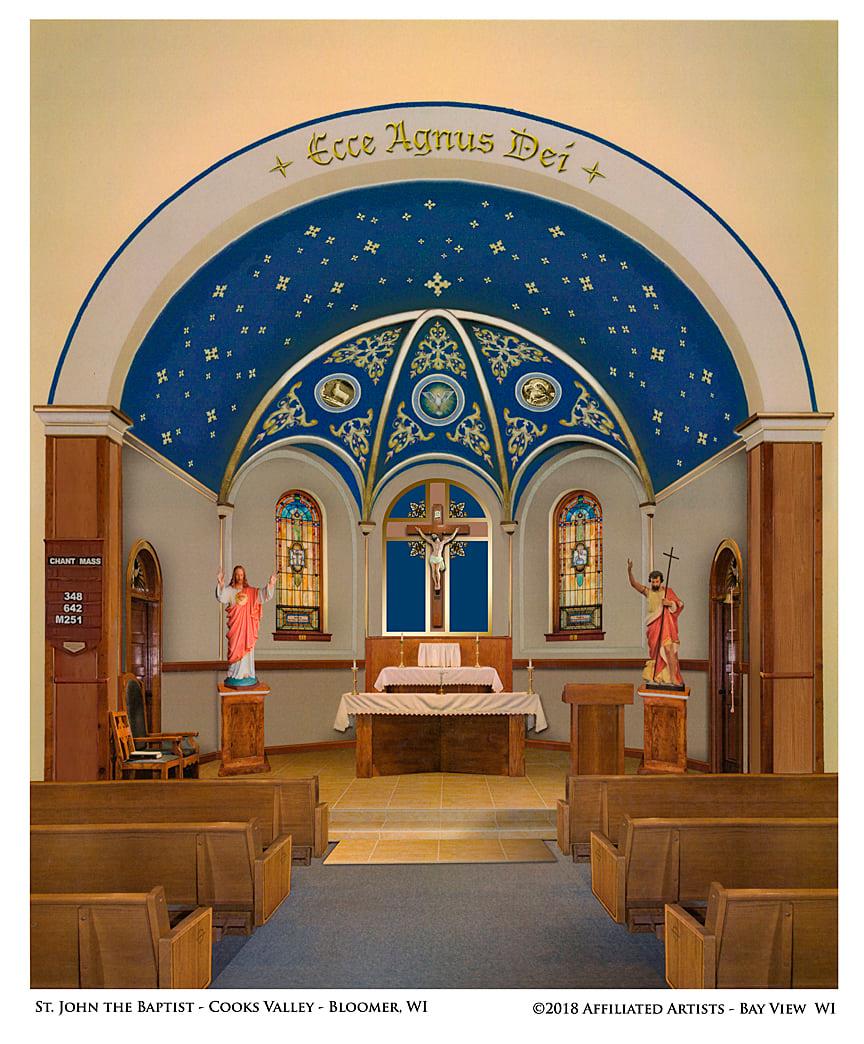
I wish to offer you my sympathy and condolences at the passing of Linda, a beloved member of your family and of this parish family as well. It providentially happens that Linda’s funeral today will be the last St. John’s funeral for this year 2020 and our last funeral here before St. John’s renovation, beginning after Christmas. What awaits for this church in its renovation bears a poetic likeness to Linda.

This transition to a new phase of our parish life was expected. We’ve been preparing for this project for a long time. But the news of exactly when our Masses are ending and the hard work begins may have come as a surprise to some. Next week, these pews will be removed, this altar and this ambo will be withdrawn, and our tabernacle will be empty. Eventually these walls will be stripped, this carpet will be torn up, and apart from the workers this church will be vacated, vacant, and desolate. The sacramental life inside this church will cease. But even if the sacrament of Jesus Christ are no longer offered in this building the parish will still survive. St. John the Baptist Parish is more than this brick, plaster, and paint. And even if this building were ground to dust and had to be entirely rebuilt this parish would still be alive through it all.

After Mass in our lobby you can see renderings of what this church will look like once the work is complete. Our church is not ugly now, though you can see her blemishes, but what she will become is more beautiful and glorious. And once she is completed she will play host to her many family members and friends and many new acquaintances, too, who come to see her for the first time. On that day, any sadness experienced during the time of separation will give way to great joy. This church will be resurrected for the worship of God and the holy peace and happiness of his people.

As I said, what awaits for St. John the Baptist Church bears a poetic resemblance to Linda. Though not entirely unexpected, and Linda was well prepared for it, her passing may still feel shocking; this separation, unsettling; Linda’s death, quite saddening. But there is more to Linda than this dust. Her soul lives on. Today we pray that any flaw in her may be removed so that with a perfect soul she may enter Heaven and go on to experience the Resurrection in a more beautiful and glorious renovated body. Someday in Heaven and on the Last Day, through Jesus Christ our Savior, may we all be happily reunited with Linda’s happily outgoing self to rejoice in the worship of God and the holy peace of his people. When you next see this church in her remade glory, may you be reminded of Linda and of these truths.

Wreaths of Flowers — Funeral Homily for Janice Bleskacek, 87

December 16, 2020

While Janice lived at her home she kept two notable items on the night table beside her bed, both reflective of her deep faith: a wooden cross and a particular book. At first glance this small, black book might be taken for a Bible, but its cover bore the title “The Catholic Girl’s Guide.” A hand-written inscription within indicates that this book was given to her as a gift way back in 1947 when she was fourteen years old. I suspect that Janice regularly turned to the latter parts of this book, with its compendium of Catholic prayers and devotions, but she would have been familiar with the earlier parts of the book as well. Its author, Fr. Francis Lasance, writes about nine virtues a young lady must cultivate, likening each one to a flower which form together “the Maiden’s Wreath.” (This book was written for girls but in a book written for boys these same essential virtues would have their places, perhaps within a holy young man’s toolbox.)

The nine flowers of the wreath include:

The Sunflower of Faith, which is turned upward towards the glorious Sun.
The Ivy of Hope, which clings and climbs despite adversity.
The Peony of Love of God, which lifts up its heart as an offering.
The Rose of Love of Our Neighbor, which is a kindly gift to others.
The Carnation of Obedience, which is how Christ incarnate came as a noble servant.
The Forget-me-not of Piety, which remembers and keeps the practice of religion.
The Violet of Humility, which thrives and blossoms most beautifully in the shade.
The Daffodil of Industry, which hastens to blossom as soon as possible.
And the Narcissus of Truthfulness, which holds truth as a golden treasure never to be betrayed.

In addition to this “Maiden’s Wreath,” the book’s author next speaks of a second crown, “The Wreath of Lilies,” comprised of The Lily of Purity, which is untarnished in its splendor. The lily has long symbolized the Blessed Virgin Mary, whose own femininity is fulfilled to its fullest, holy perfection.

Young Janice gathered and cultivated the nine flowers of her maiden’s wreath into her adulthood. She carried her virtues into her marriages, first with husband Kenneth and then, after being widowed at age thirty-eight, with her husband Gerald. And through these unions, Janice gathered and nurtured eight young ladies, eight flowers: Nancy, Susan, Cindy, Carla, Dawn, and Jacquelyn, Deb and Terri. The nine of these ladies together formed a beautiful wreath of love; along with family and friends; grandchildren, great-grandchildren and great-great-grandchildren as well. Today we pray for Janice’s soul so that in addition to her life’s virtues she may be crowned with the second wreath of purest glory; that purified from any fault or imperfection, she may rejoice before God with Jesus Christ and Blessed Mary and all the saints and angels. Like Jesus Christ says in our Gospel, Janice’s prayer shall be: ‘Father, those whom you gave me are your gift to me. I wish that where I am they also may be with me one day. I made known to them your name and I will make it known, that the love with which you loved me may be in them and we all may be together again forever.

Scripture says of this life,

“All flesh is like grass,
and all its glory like the flower of the field;
the grass withers, and the flower wilts;
but the word of the Lord remains forever.”

Every dear one’s death reminds us that we will not live this present life forever. But even though the flower fades and dies away we can beautifully blossom anew. If we have died with Christ, we believe that we shall also live with him. Just as Christ was raised from the dead by the glory of the Father, we too may live in newness of life. So let us renew our faith and renew our lives in the Lord, Good Shepherd, Jesus Christ, who desires to reunite his whole flock on his holy mountain, where sin and death will be no more, where every tear will be wiped away by God, and where we can hope to be together with Janice and Kenneth and Gerald and Carla forever.

He Rose Before Us — Funeral Homily for Roland “Rolle” Shadick, 85

December 7, 2020

Today St. Paul’s Parish offers our greatest prayer, the Holy Mass, for Rolle, one of our own. He is well-known and loved by you, and well-known and loved by our Lord. No brief funeral homily can present the fullness of a Christian life, but a Christian’s words and deeds, upon reflection, will reflect the person and life of Jesus Christ.

One of the things his children tell me is that Rolle worked really, really hard, first as a farmer, and then in other jobs, and helping others where he could well into his retirement. To support his wife and family, to do his good works, Rolle would wake up very, very early. He might wake up at 3 or 4 AM to milk the cows or bale some hay, or go out fishing on the lake and bring back his catch to feed his family for breakfast. Through the years, he would rouse his children from bed with a call: “Come to life, come to life!” A new day awaited them. Rolle was so busily active, he did so much, that his family would kid that he had undiagnosed ADHD. “Don’t look back,” he said, “always look ahead.” There is much for us to do in our days on earth.

Rolle knew we have just one life to live and that it is given us as a gift. So he gave faithful thanks to God the Giver, praying and praising Him at church and at home, and supporting the work of Christ’s Church for the salvation of souls. Rolle noted that he and his fellow farmers who did this were successful through God’s blessing. In his final years he reminded others, “It’s later than you think. It’s later than you think.” With this in mind, Rolle renewed his already strong commitment to connecting with his family — whom he apparently loved more than life itself. He did not catch any illness from the 65th wedding anniversary his family threw for him and Clara back in October, but Rolle said at that time, “You know what, if I die from Covid, this day was worth it.” After that joyful celebration were forty days until Rolle came to his final day, dying like our Savior on a Friday afternoon.

As I said before, a Christian’s words and deeds will reflect the person and life of Jesus Christ. Jesus has been hard at work in this world; tending his flock, laboring in his field, fishing for men’s souls. He died and rose before us. He calls out to rouse us from our sleep, “Come to life, come to life,” through conversion on this day and through resurrection on the Last Day. It is good to treasure our memories. It’s OK to mourn, to cry. But we must not, cannot, live in the past. “Don’t look back. Always look ahead,” because a great new day awaits, for you and me and Rolle, a family reunion in our Father’s house with Jesus Christ our risen Lord.

Revealers of God — Funeral Homily for Kevin Lenfant, 70

December 3, 2020

In the beginning, when God created the heavens and the earth,” God said: “Let there be light, and there was light.” By God’s Word all things were made and his divine attributes are reflected in this universe he’s created. In the inspired word of God, the Holy Scriptures, we read about how he reveals himself to humanity throughout salvation history, through powerful deeds, prophetic words, and poetic images that reveal what he is really like. But ultimately and greatest of all, God reveals himself to us through the Son. “In the beginning was the Word, and the Word was with God, and the Word was God.“In times past, God spoke in partial and various ways to our ancestors through the prophets; (but) in these last days, he (speaks) to us through a Son, …through whom he created the universe,” the Word of God. Jesus Christ, the Bible, and God’s creation make use of familiar things to help reveal God to us. There’s warriors battling, couples marrying, fathers fathering, shepherds shepherding, and plants producing new life. A faithful Christian’s life will reveal God too, as his mysteries are reflected in the features of our lives.

There is a great deal of war and conflict in the Scriptures. This should not be surprising, since this world is broken and often evil. Wickedness is at war with goodness, so good men are called upon to defend the defenseless, to shield the innocent from evil assault. No nation is without flaws, but we should love and defend the goodness of our own. In the Old Testament, armed conflicts abound, but in the New Testament the martial imagery is turned to focus upon the spiritual battle which is being fought around us and within us. St. Paul tells us, “put on the armor of God, that you may be able to resist on the evil day,” for our greatest struggle is not with flesh and blood but with spiritual evils in this world. Our calling is to Semper Fi, being “always faithful”, but we know how difficult this is, “for a righteous man may fall seven times.” So when a brother dies we pray for him, like the Maccabean army prayed for their fallen in today’s first reading from the Old Testament, that whatever flaws or attachments to sin remain in them may be purged away, that those who die as friends of God may experience his full and splendid rewards in Heaven.

Another very plentiful thing found in the Bible is shepherds. Among the Old Testament patriarchs there is Abraham, Jacob-Israel, and his twelve sons – shepherds all. Later, there’s the prophet Moses, King David, and Amos the prophet, each of whom tended flocks for some time before receiving a higher calling from God. The first to hear the happy news of Christmas night were shepherds. The bond between a shepherd and his flock can be a very close one. So close that David, in writing today’s psalm, the most famous of all the psalms, depicts God as his shepherd and David himself as his well-cared-for sheep. The sheep of a good shepherd are like his children to him. He is as a father to his flock. “The sheep hear his voice, as he calls his own sheep by name… and they recognize his voice.” He knows his own and they know him. The good shepherd devotes his life to his sheep and little lambs. He delights in his flock and his presence comforts them. Rita tells me that family came first for Kevin. She tells me how he loves his children and grandchildren, that he loved to watch them grow, and how extremely proud he is of them. Such is his fatherhood.

A third common theme we encounter is married love. The saints see an allegory in the romantic Old Testament book The Song of Songs: God’s pursuit and love of his people Israel. In the Gospels, Jesus Christ calls himself the Bridegroom, and New Testament passages call the relationship of Jesus Christ with his Church a marriage. As Book of Revelation declares, “The marriage of the Lamb has come and His bride has made herself ready. … Blessed are those who are invited to the marriage supper of the Lamb.” This leads us to a mystery: did God use our familiar and intimate knowledge of human marriage, the covenantal love of a man and woman, to describe the union of Christ and his Church because this was the best available image for him to borrow, or rather did he create and establish marriage from the beginning to reveal and foreshadow the fulfillment with him that was always meant to be?

Rita told me the delightful story of how she and Kevin met. It was another Normal day at Illinois State University where they were both college students. Rita was having a hard time in a political science class, while political science was Kevin’s major, so he came over and tutored her. Apparently Rita was very impressed by many things about him because once he had left she turned to her friend and said, “Don’t let me marry him.” But she did. And it’s a good thing she did. Why was Rita afraid? ‘Well,’ she thought, ‘I’m so young, we’re both in college, he’s planning to be in the Marines, and how would all that work?’ But thankfully these doubts did not prevail. Imagine how much would have been lost if they had! When our Lord Jesus Christ proposes to be a greater part of our lives, we can similarly balk, all sorts of doubts and fears arise, but I urge you, I plead with you, to say “Yes” to him all the same. In this life, opportunities for some relationships pass by without another chance for something more. But with God, no matter where we’ve been or what we’ve done, all long as we still live, we can start more devotedly following him today.

Jesus often preached to the crowds using familiar things. For example, Jesus spoke about fish around fishermen, of bread and salt to bakers and cooks, and of plants to farmers in the countryside. He says, “Learn from the way the wild flowers grow. They do not work or spin. But I tell you that not even Solomon in all his splendor was clothed like one of them. If God so clothes the grass of the field, which grows today and is thrown into the oven tomorrow, will he not much more provide for you, O you of little faith?” At one point Kevin and Rita owned three flower shops. Now there is just the one they started in Bloomer more than forty years ago. Rita tells me that Kevin, between the two of them, probably likes flowers more. The flowers they sold would sprout and grow, beautifully blossom, and then fade and wither. This is a sad reality, but we are consoled by the knowledge that there are more flowers for us to enjoy. Similarly, in this world we are born and grow, we blossom and die, but we are consoled by the knowledge in Christ that this is not our end.

In today’s Gospel Jesus says, “unless a grain of wheat falls to the ground and dies, it remains just a grain of wheat; but if it dies, it produces much fruit.” Jesus was not eager to suffer, he asked his Father in the Garden if it were possible that this cup of suffering might pass him, but he was not unwilling to die because he knew that would not be the end of good things for him. It’s O.K. to want to live, to fight against illness and death, for life is a great good. But it is also O.K. to die. “For if we live,” as St. Paul says, “we live for the Lord, and if we die, we die for the Lord; …whether we live or die, we are the Lord’s.” It’s O.K. to mourn. It’s O.K. to cry. But God’s Word reveals to us that we should not despair. Heed God’s word, in creation, on the Sacred Page, and in the person of our Savior, so that you and I and Kevin may all be happily reunited in God story one day.

The Source of her Devotion — Funeral Homily for Donna Hedler, 88

December 3, 2020

St. John the Baptist Church is honored to be offering our greatest prayer, the Holy Mass, for our well-known and well-loved parishioner, Donna. We also pray today for you who love her and mourn her passing, for your consolation and the strengthening of your spirits in Jesus Christ. No brief funeral homily can capture the fullness of a faithful Christian’s life, but when I spoke with Donna’s children about her they emphasized her devotedness: her devotion as a wife, her devotion as a mother, her devotion to her friends and extended family, her devotion to her Catholic Faith.

She was married to Jerome for fifty-five full years and was devoted to him even after his passing. She never removed her wedding band and at the first Christmas after his death she set an empty place for him at the dinner table. Yet she did not grieve like those who have no hope. Several years ago, while she was visiting Jerome’s grave in Thorp, she lost her footing and fell down backwards into about one foot of snow. At that, she made a snow angel. Today, her earthly remains will be buried alongside his there to await the resurrection.

Her children tell me of Donna’s devotion to her friends, grandchildren, nieces and nephews; reflected, for instance, in her visits and hosting, in her correspondence and gifts, in her lit-up smile and kindly words. Her kids tell me she was always there for them, desired the very best for them, and gave them a moral compass. What was the source of Donna’s devotion?

When family gathered at her house around her table to enjoy a Polish meal upon her fancy china, Donna led the prayer – an individual prayer she would compose herself, giving thanks to him from whose bounty we have all received through Christ our Lord. While she was able to attend church she sang his praises here, and once poor health confined her to home she gratefully received Jesus in his Blessed Sacrament. Her devotion was like that of the psalmist who wrote, “This I seek: To dwell in the house of the Lord all the days of my life. That I may gaze on the loveliness of the Lord.

He, our Lord Jesus Christ, is the source of all our devotion. God is devotion, because God is love, and he calls us to be like himself. But without God and Jesus and the Holy Spirit all human devotion is negated and futile. Without more than just this world alone, the view of the foolish, that the dead are gone forever and their going forth from us is utter destruction, would be right. Instead, like the Song of Songs says, “[As] stern as death is love, relentless as the nether world is devotion; its flames are a blazing fire. But Jesus tells us, ‘Do not let your hearts be troubled. Have faith in God; have faith also in me. In my Father’s house there are many dwelling places. And I desire to prepare a place for you so that we all may dwell together always.’

So while we pray for Donna’s soul, that she may now joyfully dwell in our Father’s house forever, let us also learn from her devotion. Reconsider and renew your devotion, for the love with which Christ loves us is true, it is life-giving, and it is the way that leads us to Heaven.

The Spring After Fall & Winter — Funeral Homily for Raymond “Ray” Burgess, 84

November 20, 2020

The signs of the fall are all around us. The farmers’ fields are cut down to stubble. The weather is growing cold and frosty. Our days are getting shorter and shorter. A winter approaches, and soon all will be buried under snow. And on this fall day, we gather to pray for and bury Ray.

I hear the farmers report that their fields have produced a fruitful yield. They raised a bunker crop this year which will go forth to feed and help thousands of people. This is like the fruitfulness of Ray’s life, seven living-children, nineteen grandchildren, and seven great-grandchildren, who live on as a blessing to the world. But we know that after the time of harvest comes the sharp and penetrating cold.

Ray’s children tell me about his dedicated love for them and their children, how he has put family first and devoted his time to them. So tomorrow’s first day of the deer hunt will be lonelier without him, and Ray will be missed at the family Christmas this year. That is something to mourn. It is sad to be parted from one another in this way. Tears are natural and wholesome at times like this. Yet, we need not grieve like those who have no hope.

Imagine if our world somehow forgot about the cycle of the seasons. What if everyone misplaced the valuable knowledge that fall and winter lead to spring? How would people react to this end of the world around us? Covid-19 would quickly become a secondary news story, and grocery stores would sell out of lots more than toilet paper. We would look at all of the discolored fallen leaves, the skeletal trees, and the dwindling of the light each day with great alarm. People would hopelessly ask, “Everything is dying — what will we do — what will happen to us?” But of course, this is not the first fall or winter in our lives, and we have seen before what happens next, so we need not be afraid.

Today we gather here to pray for and bury a man who died two days short of his eighty-fifth year. But we gather in this place, within this church, because of a man who died almost two thousand years ago and who two days later rose again. This sad season of dying is not the end of the world. As winter is conquered by the spring, death is conquered by Christ. This fact of Jesus’ resurrection has changed this world and, if God’s will be done, it would transform our lives. Jesus Christ is the way, the only way, for our salvation, and so we entrust Ray’s soul into the Lord’s merciful hands, with love for Ray and hope that we all shall enjoy Ray’s company again in the coming springtime of this world.

Prepared for His House — Funeral Homily for Cynthia “Cindy” Nazer, 64

November 3, 2020

Today, St. Paul’s Parish offers you our sympathies, our prayers, and the consolation of Jesus Christ. The parting that comes from death is naturally mournful. But it is our faith in Jesus Christ that allows us to mourn with hope. No funeral homily can capture the full mystery of a Christian life; all that Cindy has done, or all that Christ has done in her. But speaking with Steve, her husband, I learned a particularly interesting aspect of their life together I’d like to share with you.

Cindy always liked things made of wood, and one of her desires was to have a log-cabin home. So, in the 1980’s, Steve and Cindy began building one together midway between Bloomer and Chippewa Falls. They began with the garage. Steve says this was for practice. Better to make one’s mistakes on the garage than with the house. After that, they stored lots of lumber onsite there. The project also involved an barn in which their cut logs were dried for two years, purging them of unwanted water, to prevent them from later warping out of shape. Placing these heavy logs was an exacting process. Steve tells me that each log must be laid in place three times over to make sure they fit properly, along with shaving, trimming, and cutting of the logs all throughout the process. But once perfected in this way, these logs became the home where Cindy and Steve and their family lived together. It was her home through their marriage together until her final day on earth.

This building of a house to share in marriage has a connection to our Gospel today. In Jesus’ time and culture, when a Jewish groom married his bride, he would go off to build or prepare the space of their home. It would typically be an extension upon his own father’s house. And once this long and demanding project was complete, the husband would return to his bride and take her into their new home to share their lives together. This is why Jesus says to his disciples, and tells us, his bride the Church:

In my Father’s house there are many dwelling places. If there were not, would I have told you that I am going to prepare a place for you? And if I go and prepare a place for you, I will come back again and take you to myself, so that where I am you also may be.

Jesus is the bridegroom and we, the Church, are his bride. He says, “Do not let your hearts be troubled. You have faith in God; have faith also in me… Where I am going you know the way.” But this last remark causes St. Thomas alarm, “Master, we do not know where you are going; how can we know the way?” And Jesus answers, “I am the way and the truth and the life. No one comes to the Father except through me.” What does the way of Jesus look like? What does the life of Christ look like? This is the truth in Jesus Christ: for the faithful one, after much suffering, comes death, but this dying is not the end, it is not utter destruction, for this life is followed by new life and resurrection.

Therefore,” as St. Paul writes “we are not discouraged; rather, although our outer self is wasting away, our inner self is being renewed day by day. For this momentary light affliction is producing for us an eternal weight of glory beyond all comparison… For we know that if our earthly dwelling, a tent, should be destroyed, we have a building from God, a dwelling not made with hands, eternal in heaven.

Like those logs chosen, refined, and fitted for the log cabin, God uses the events of our lives, the good moments and the bad, to make us ready for his home. “Chastised a little,” the Book of Wisdom says, “they shall be greatly blessed, because God tried them and found them worthy of himself. As gold in the furnace, he proved them, and as sacrificial offerings he took them to himself.

The parting of a loved one may ache our hearts, but our sufferings are not without hope, or meaning, or purpose. Through Jesus, with Jesus, and in Jesus, the Savior of the world, the prayer of the psalmist can be beautifully fulfilled for Cindy, for others, and ourselves – which is the fulfillment of all our longings:

There is one thing I ask of the Lord;
only this do I seek:
To dwell in the house of the Lord
all the days of my life.
That I may gaze on the loveliness of the Lord
and contemplate his temple.

Glimpses of Heaven — Funeral Homily for Ione Ellis, 90

October 21, 2020

I wish to offer my sympathies and condolences on behalf of St. Paul’s Parish to you who love Ione. I’ve learned some beautiful things about Ione from her family. And the family has chosen beautiful readings for her funeral. The things of Earth partially reflect the things of Heaven. And the events of a life with Christ foreshadow—give a glimpse—of the life to come with Christ. Heed these words, “For,” as St. Paul told us in our second reading, “if we believe that Jesus died and rose, so too will God, through Jesus, bring with him those who have fallen asleep.”

Ione grew up on a farm with many creatures in the countryside. After marrying Perry at the age of seventeen they made a home together on Bloomer’s 5th Avenue (which is a really nice sounding address). She never worked outside the home, but she worked hard at home, busy serving and not being served. Her devoted focus was upon her spouse and children. She and her husband were wedded through 50 years, through good times and in bad – as when she helped him endure his sufferings, first due to stroke and then finally from cancer. Ione has loved her family, and she has loved our God. She made rosaries and prayed rosaries. I’m told she had a prayer cove for years in her living room; with a kneeler and a candle. There she prayed for her children and worshipped God, as she likewise did here at St. Paul’s Church, where she sang in the choir for ten years, and participated in Christ’s Holy Sacrifice, the Mass.

Today we offer the Holy Mass for her soul and for all of you who love her. Though her passing is mourned, in the words of St. Paul, we “not grieve like the rest, who have no hope.” In John’s Gospel Jesus speaks of his Father’s house; that he is going to prepare a place for us, we who are God’s the Father’s children, who are the brothers and sisters of Christ. He will take us from among the many creatures of this earth, and move us to a new home for our spiritual adulthood and marriage, a home in the city… of God. In our first reading from the Book of Revelation, we heard St. John’s vision describe it: “the holy city, a new Jerusalem, coming down out of heaven from God, prepared as a bride adorned for her husband.” The Church is the bride of Christ, and her members the family of God. Then St. John relates how a loud voice declared from the throne:

Behold, God’s dwelling is with the human race.
He will dwell with them and they will be his people
and God himself will always be with them as their God.

And St. John observes these interesting details about Heaven:

I saw no temple in the city,
for its temple is the Lord God almighty and the Lamb.
The city had no need of sun or moon to shine on it,
for the glory of God gave it light,
and its lamp was the Lamb.

The intimacy we share with God now on earth, through prayer and sacrament and Christian living, through words and signs, seen as moments of lights peaking out amid darkness, in Heaven becomes an unmediated brightness that, like a shining city on a hill, cannot be ignored or hard to see. Heaven is the family of God together in the Father’s house, our hard toil and trials behind us, enjoying the joyful company of one another forever.

How shall we get there? Jesus says, “I am the way and the truth and the life. No one comes to the Father except through me.” So let us be faithful in our love toward him, honoring his passion, death, and resurrection in our worship and by our lives, and then he, the Good Shepherd, will help and lead through the dark valley of our own passion and death to the next life and the resurrection of these physical bodies of ours one day. We pray today for Ione’s soul, as is right and just, but “do not let your hearts be troubled.” Have faith in God and have faith also in Jesus, as faithful Ione would have you do.

Coming Home — Funeral Homily for Michael “Mike” Morning, 69

September 7, 2020

The communities of St. Paul’s and St. John the Baptist’s offer you our sympathy at Mike’s passing. We also offer the support of our prayers with this, Jesus Christ’s perfect offering to the Father, in the Holy Mass. May our prayers help Mike on his way, and help all of you as well, whom he dearly loved and dearly loves; especially Jackie, whom he married at St. John the Baptist Church 43 years ago, and his siblings, his friends, his nieces and nephews, grandchildren and godchildren, and others.

I often say that no brief funeral homily can capture the full mystery of a Christian life, and you who have known Mike for years surely know him better than I. The best I can do is to examine one part of his life which reflects something of the whole story for Mike, and you, and me.

Among the many things Mike did on earth, he had an active role in establishing the Eagleton Softball and Baseball fields. If you don’t know it, Eagleton is a small, unincorporated town to the southeast from here, seven and a half miles down the road. Their baseball field is no Major League park like Wrigley or Fenway, but Mike was right to be proud of it. He looked at what he had made and saw that it was good. With outfield fences some 250 feet out, lights for nighttime play, four bases and a mound; it had everything needed to host the game.

Baseball and softball are somewhat unique among sports. In most sports, the offense side carries, catches, throws, or kicks the ball to score. But baseball and softball are among the few games where the defense side controls the ball. Batters who are up don’t exactly know what pitches will be thrown their way, but they get to choose their swings. Some of them advance, but many strike out.

A good coach can help them though; giving them signs and instructions on which pitches to swing at and which pitches to take, and, once on base, when and how to advance further. Through his past experience as a player, his intimate knowledge of the game, and his personal investment in training his players, a great coach can produce hall of famers. In addition to the indispensable coach, teammates are important too, in helping to get home.

As it is in baseball and softball so it is in life. We do not control what’s thrown our way, what curveballs come across the plate, but we each must decide how to swing in our at bat. Will we listen to the wisdom of our coach, who has been in our shoes himself, and who earnestly desires that after forming us in his likeness that we could be called up to the big leagues far from here.

Jesus encourages us in today’s gospel, “Do not let your hearts be troubled. You have faith in God; have faith also in me.” If we would listen and allow him, Jesus promises to lead us home, and tells us we know the way. “I am the way and the truth and the life,” he says, “No one comes to the Father except through me.”

In baseball and softball as in life, our goal is to get home. Mike might already be there with the holy hall of famers in Heaven, but in case he is still rounding the bases, let us as his teammates and friends aid him in getting home through our prayers. And may each of us heed and follow Christ our coach and play this one pivotal game of life so as to win.

Her Very Close Friends — Funeral Homily for Doris Prince, 92

September 2, 2020

Doris has been a faithful and longtime parishioner of St. John the Baptist’s in Cooks Valley. At the end of this hour, we will be taking her earthly remains there, to St. John’s Cemetery, to await day of the resurrection. The reason we gathered here at St. Paul’s Church for Doris’ funeral Mass was to guarantee that there would be enough space in church for all of you to attend. There are now more than seven and a half billion people living on this earth. Consider that you who are gathered here (plus those who attended Doris’ visitation yesterday) are the people on earth who know her best and love her best. There are many ways one could preach a funeral homily for a devout woman like Doris, but I believe Doris is pleased to know that I am going to speak to you about friends of hers who have known her and loved her better than any of us here. You’ve probably never met them and you don’t know most of their names. They formally introduced themselves to Doris herself for the first time only just last week, but they have been faithfully there for her and she has been fond of them for many years. I speak of the angels.

Doris had a huge collection of angels she collected over the past fifty years or more. There were more than two hundred of them within her house, some in almost every room. She had angels of all kinds; porcelain angels, plastic angels, cloth angels, some glittery angels, some outdoor angels, some that glowed in the dark, and that some played music, all for Doris to delight in. In her later years, an angel was the go-to gift one gave to her. After moving into the nursing home seven years ago, Doris began giving away her angels as gifts herself. She even gave them out to surprised trick-or-treaters. God has similarly collected angels for his own delight, and the Lord has shared his angels with us, to lead us to the Father’s house on the mountain of God to share in their heavenly joy.

What is an angel? Angels are purely spiritual beings, created by God but not made of matter. Angels are personal and immortal creatures possessing intellect and will, knowing and choosing. They surpass in perfection every earthly creature we can see. Never having fallen, they are sinless and glorious; loving God, one another, and human beings with a intense and extraordinary devotion. Precious Moments statues rightly depict angels as pure and innocent, but these small and fragile figurines do not reflect angels’ awesome power and often intimidating presence. The Bible records that angels who reveal their otherworldly glory to human beings throughout salvation history have typically needed to first calm and reassure, “Be not afraid.”

God sends angels to us as his servants and messengers. As the Book of Hebrews rhetorically confirms, “Are they not all ministering spirits sent forth to serve, for the sake of those who are to obtain salvation?” Though “some have entertained angels unawares,” we seem to rarely see angels; yet, angels are never far from us, even the smallest children. Jesus said, “See that you do not despise one of these little ones, for I say to you that their angels in Heaven always look upon the face of my heavenly Father.” So, even the littlest ones have angels. Each of us, from the beginning to the end of our lives, have been assigned a guardian angel whose mission from God is to help to enlighten, and guard, and rule, and guide us through this world. In the words of St. Basil, “Beside each believer stands an angel as protector and shepherd leading him to life.

Each angel has a name, but we know only three individual angels’ names from Scripture, all of them archangels: St. Michael, St. Gabriel, and St. Raphael. An archangel announced the first coming of Jesus to the Virgin Mary; and today’s second reading from St. Paul says an archangel’s voice will announce to us the Second Coming of the Lord Jesus descending from Heaven. We have no authority to name our angels; they are named by God and belong to him.

Your relationship with Jesus Christ, the Good Shepherd, is most essential, but do you have a personal relationship with your guardian angel as well? We can and should have a relationship with our angels. Thank them for their assistance and ask them for their help. We can ask them to pray for us. The New Testament Letter of St. James says, “The prayers of a righteous person are very powerful,” so imagine how powerful these sinless creatures’ prayers are before God.

We can ask them to remind us of important things because angels never forget. They are brilliant creatures, more intelligent than any of us, and we can ask them to enlighten us. (For instance, I asked angels’ help in writing this homily.) We can also ask them to go on small missions for us, to lend aid to others we care about wherever they may be. Our angel guardians’ ultimate mission is to lead us to salvation. The angels are more glorious than any creature on earth, but their humble and earnest desire is that we would become even more glorious than themselves in Heaven.

Doris has been a friend to the angels. May you be their Christian friends as well. For our beloved, devout, and faithful Doris, who surrounded herself with angels, and someday for all of us here:

“May choirs of angels lead you into paradise,
and may the martyrs come to welcome you,
to bring you home into the holy city,
so you may dwell in new Jerusalem.

May holy angels be there at your welcoming,
with all the saints who go before you there,
that you may know the peace and joy of paradise;
that you may enter into everlasting rest.”

A Redecorated Soul — Funeral Homily for Linda Gorka, 70

July 29, 2020

There’s a natural sadness from the passing of a loved one and added stress from life’s current strains. But there is profound consolation from our faith in Jesus Christ and we are blessed in our freedom to be able to gather here today. St. Paul’s Parish is honored to be offering our greatest prayer, the Holy Mass, for Linda’s soul and for all of you who know and love her. No mere homily could capture the full mystery of a human life; no brief homily can tell the fullness of the story of how Christ has shepherded Linda’s life. But a funeral homily can reveal something of what Jesus Christ has done, and does, in the lives of Christians.

Rodney tells me that Linda loved interior decorating. Though never formally trained, she had a talent for it — a creative flair. For holidays, especially the Christian celebrations of Christmas and Easter, Linda’s house was transformed; nick-nacks here and there, wall and window coverings, all set the season; providing a pleasant backdrop when she would entertain welcomed guests at parties. She loved being a grand-hostess for her friends.

Another thing Rodney recollected to me is how the companionship between them helped them through each other’s serious health trials. She remained by his side, minded his meds, and drove him for treatments during his throat cancer nine years ago. And last year, Linda helped him through his recover from a bad car accident. Then, in this her final year, Linda received support and care during her purifying crucible experience of suffering with cancer. (Rodney wants to thank all those who helped before and after Linda death: her daughter Michelle and Arianne, son David, grandson Joe, friends Randy and Dawn, and others whom Rodney may have forgotten.) We believe, like St. Paul says, ‘this momentary light affliction is produced for her an eternal weight of glory beyond all comparison,’ because Linda died as a Christian with Christ.

Three weeks ago, I went to visit Linda in the hospital and did something I have never done before. Rodney had informed me that, though Linda believed in God and Jesus Christ, neither she nor her family members had any knowledge or evidence of her ever having been baptized. She was not speaking very much at that point, but when I asked her whether she wished to be baptized she answered that she did. I baptized Linda with water on her forehead right there in her bed, “in the name of the Father, and of the Son, and of the Holy Spirit” — a conditional baptism, ensuring that whether or not she had ever been baptized before, she was assuredly a baptized Christian after.

What is the meaning and purpose of all these trials of life? If this life were all there is, if Christ were not raised and all people and things were destined for unending death, our lives would have no enduring significance. But Jesus is risen, so this life is vitally important, yet it’s only the beginning of eternity, so the God allow trials to transform us more and more into the likeness of Christ, who often suffered with love and virtue. The famous Christian author C.S. Lewis once observed that, like Linda, God is something of a master interior redecorator as well:

Imagine yourself as a living house,” Lewis wrote, “God comes in to rebuild that house. At first, perhaps, you can understand what He is doing. He is getting the drains right and stopping the leaks in the roof and so on; you knew that those jobs needed doing and so you are not surprised. But presently He starts knocking the house about in a way that hurts abominably and does not seem to make any sense. What on earth is He up to? The explanation is that He is building quite a different house from the one you thought of – throwing out a new wing here, putting on an extra floor there, running up towers, making courtyards. You thought you were being made into a decent little cottage: but He is building a palace. He intends to come and live in it Himself.

St. Paul writes that, “We know that if our earthly dwelling, a tent, should be destroyed, we have a building from God, a dwelling not made with hands, eternal in Heaven.” And Jesus tells us, “Do not let your hearts be troubled. You have faith in God; have faith also in me. In my Father’s house there are many dwelling places. …I am going to prepare a place for you… I will come back again and take you to myself, so that where I am you also may be.” And so, today, while we mourn Linda’s departing from us, we rejoice in her going to God. The journey of life through death to a next life awaits us all. Let us, each and all, respond to Jesus Christ the Good Shepherd as one of his sheep, so that our story may be happily joined to his own great story forever.

Seeing the Light — Funeral for Allen Prince, 74

June 5, 2020

Allen grew up on a farm less than a mile down the road from St. John the Baptist Catholic Church, where he was a lifelong parishioner. Today his body will be buried in that earth to await the Resurrection, and we are now gathered here [at St. Paul’s Church] to pray for his soul. No brief funeral homily can capture the fullness of a Christian life, but Allen’s sons told me a number of interesting anecdotes about his life.

They spoke of his intense work ethic. A farmer for almost 20 years and a semi-truck driver for 30, Allen never retired. Even into his 70’s he was still working hard in his shed, particularly with his welder, joining pieces to one another. Reportedly, he could fix just about anything, repairing what was broken and building things new. Allen spent many hours a week driving trailer loads back and forth across the country. That gave him lots of opportunity to call up people on his cellphone and enjoy their conversation. He also had plenty of time to listen to his musical playlist. Good friends and good songs are great company on the road.

I have also heard that Allen may have once come back from the dead. When one of his lower internal organs burst he became septic, was hospitalized, and was put into a medically-induced coma. That’s when Allen had a surreal experience in which he believed he had died and saw something of a vision involving (according to one son’s recollection) him driving truck out West. Allen was so happy there that when he regained consciousness in the hospital again he was upset to be back because he so much liked where he had been. Though he did not hasten death (he was dreaming to live to be 120) I’m informed that for the rest of his life, as a result of this experience, Allen was no longer afraid of dying. He believed he would be going to a good place.

A homily cannot capture a complete Christian life, but aspects of a Christian’s life will reflect the life and person of Jesus Christ. Jesus came among us not as a pampered prince but as a hardworking laborer, a carpenter or craftsman. As a focused perfectionist, Jesus repairs what was broken and builds things new, welding heavenly things to things of earth, joining God and peoples together as one. Jesus wasn’t eager to suffer and die, but he did not fear what would come after his death. Jesus had seen and experienced that place of joyful peace before, and believed that he would be raised again.

Throughout the Gospels, we see Jesus almost always doing one of two things: either talking with other people or praying to his heavenly Father in solitude. We see him seeking close friendship with everyone while maintaining an intimate relationship with God. Jesus calls us and he wants us to check-in with him daily, using the relationship and intimacy-building communication device called prayer. He wants us to reach out to him every day on our long drive, our long-haul, to Heaven. Jesus’ Beatitudes (“blessed are the merciful, blessed are the meek, blessed are those who mourn…”) describe the Christian disciples as they become more and more like Christ himself. Wherever we are now, the Lord wants us to call him to be our traveling companion; through life, through death, and into life beyond.

Amongst Allen’s driving music playlist, one of his apparently favorite songs shows up seven times performed by different bands or artists, a song famously written and sung by Hank Williams, Sr.: “I Saw The Light.” The words of this song must have personally spoken to Allen:

I wandered so aimless life filed with sin
I wouldn’t let my dear savior in
Then Jesus came like a stranger in the night
Praise the Lord I saw the light

Just like a blind man I wandered along
Worries and fears I claimed for my own
Then like the blind man that God gave back his sight
Praise the Lord I saw the light

I was a fool to wander and stray
Straight is the gate and narrow’s the way
Now I have traded the wrong for the right
Praise the Lord I saw the light

I saw the light, I saw the light
No more darkness, no more night
Now I’m so happy no sorrow in sight
Praise the Lord I saw the light

Let us all turn toward Jesus Christ, the Light from Light, the light of the world, our world’s only hope, to pray that the song and longing of Allen’s heart may be everlastingly fulfilled for him and for us all.

Love Languages — Funeral for Audrey Stoik, 84

June 3, 2020

On behalf of St. Paul’s Catholic Church, I offer you my condolences on the passing of Audrey, one of our well-known and well-loved parishoners. During this challenging time, for you who know and love Audrey best and for everyone in our country, I am pleased and honored that we can offer this public funeral Mass for her soul and for yours’.

Have you ever heard of The Five Love Languages? They were first presented under that title in a 1992 book of the same name. The premise of the Five Love Languages is that we express and receive some forms of love more readily than other forms, and that different individuals tend to prefer differing love languages over others. What are these five general categories of love? They are: Gift Giving, Words of Affirmation, Quality Time, Affectionate Touch, & Acts of Service. What are your favorite love languages? Perhaps later you can try guessing the favorites of the people in your lives. The reason I mention all of this is because particular love languages came to my mind as I heard multiple stories about Audrey.

Her top two love languages seemed to be Gift Giving & Acts of Service. For example, when Audrey prepared meals for her family, she was loving them through both service and gifts. I’m told you never left her house without receiving something: cookies, brownies, muffins, potato dumplings, caramel popcorn, French dressing, or something else. If you asked something of her, whether it be making dozens of cookies for your wedding or making flip flops for the graduation class, she would get it done. The many afghan blankets she weaved and gifted continue to warm homes and families. Audery, even through trials, cared for nine children and her husband. In nine years, she and Frank had eight of their nine kids. She sacrificed for them all in many ways, for instance, driving a manual transmission milk truck through the countryside to the dairies to make some extra money for the family. One day, she delivered milk in the morning and delivered one of her children in the afternoon.

What is the source of such sacrificial love? What is the power empowering self-gifting love? That source and power why we are gathered here today for Audrey, rather than somewhere else. As St. Paul’s writes, “the love of God has been poured out into our hearts through the Holy Spirit who has been given to us. For Christ, while we were still helpless, died at the appointed time for the ungodly.” That is service and gift. And Jesus not only died for us, but rose from the dead before us, and calls each of us to follow him. Jesus declares, “I am the way and the truth and the life. No one comes to the Father except through me.” Whenever we come to God’s house, he wants us to come as his true family, true friends. This first requires our true conversion but Jesus desires we never have us leave his house without receiving a precious gift; the food of a meal and sacrifice which is his very Self. By the Holy Eucharist at Mass, Jesus loves us using all five love languages together:

Words:  “This is my body, given up for you.”
Time:  “Could you not [stay] one hour with me?”
Touch:  He places himself into our hands.
Service:  He offers himself up for us.
Gift:  He gives himself to us as a gift.

Jesus is the way and the truth and the life. When we approach God, in intimacy and likeness, we approach through him. So do not let your hearts be troubled. Audrey’s love reflects Christ’s love and our saving Lord has been its source.