Archive for the ‘Homily’ Category

Jesus Chose Them for Each Other, for Himself, & for Us

December 8, 2021

Solemnity of the Immaculate Conception

This December 8th unites two of our greatest saints: the Blessed Virgin Mary and St. Joseph. Today we celebrate both the Immaculate Conception and the conclusion to the Year of St. Joseph. Our Lady, under the title of “The Immaculate Conception,” is the patroness of our country. And Joseph, under the title of “St. Joseph the Workman.” is the primary patron of our diocese. Last year, our Bishop William Callahan proclaimed a year dedicated to St. Joseph beginning May 1st. Then, last December 8th, Pope Francis unexpectedly announced a Year of St. Joseph for the entire Church worldwide. As a result of this, our diocesan celebration of this Year of St. Joseph is the longest in the world: 19 months and 8 days in full. And this is very fitting, since our diocesan patron’s name, “Joseph,” means “he will increase.”

How beautiful it is that this date brings together Mary and Joseph! He, the noble head of the Holy Family; and she, the Immaculate Heart of their home He, her chaste guardian; and she, his loving spouse. Both are absolutely faithful and obedient, courageous and righteous. And both of them were chosen by God, chosen for each other, and chosen for Christ. Mary became Jesus’ loving mother and Joseph became Jesus’ nurturing foster-father. God chose them “before the foundation of the world, to be holy and without blemish before him.” Our Lord Jesus Christ chose them for himself and he also chose them for us.

Does Jesus get jealous at the Church celebrating Mary and Joseph? Does our Catholic devotion to Mary or Joseph detract from devotion we ought to have for Christ? In his recent book, “Consecration to St. Joseph,” Fr. Donald Calloway answers: “What brother would be offended if his younger siblings expressed love towards their mother and father? What man would be upset if another person wrote a song about his mother or placed roses at her feet? Likewise, what son would be disturbed if someone praised the virtues of his father? A person who honored a father would not receive condemnation from the father’s son. On the contrary, such a person would receive praise and tremendous favors from the son.” I would add that love in a family is not a zero-sum game, but that healthy love makes love grow larger. Devotion to Mary and Joseph does not make us love Jesus less, but helps us love him more.

Jesus has not diminished these parents who cared for him on earth. He has exalted and shared them with us. He has made his mother the mother of all Christians. Like the first Eve who “became the mother of all the living,” Mary is the spiritual mother to all those alive in Christ. He has made his foster-father Joseph, who successfully safeguarded the Holy Family through its trials, spiritual protector of the universal Church And ‘never was it known that anyone who fled to their protection, implored their help, or sought their intercession was left unaided.’ So be sure to befriend St. Mary and St. Joseph. Jesus loves them dearly and they aided him on earth. He wills that you would know them, and love them, and be helped by them through this life, too, by their powerful, loving care.

Preparing His Way Within

December 5, 2021

2nd Sunday of Advent
By Fr. Chinnappan Pelavendran

This season of Advent is a time of grace for us. It is a time of grace given to us to prepare our hearts, soul and mind so that we are ready to receive Christ at Christmas. Advent is a time of grace to remind us that Jesus is the reason for Christmas. Advent is the time of waiting as we prepare ourselves to welcome God who became man and who by example showed us how we should be able to live like him for others. We wait for someone we love and we long to meet that person.

In the first reading, Prophet Baruch reminds the people of Israel that they have to share the gift of joy with others by calling them to put on the garment of integrity. God is asking them not to be part of the sad story of corruption. In this reading, God is assuring that he will flatten any high mountains and fill any deep valleys in order to make the ground level. This is an invitation to change their external behavior and reconcile them with the Lord. In this prophetic song, God promised to bring back His people from exile in Babylon.

The Prophet says by giving the people hope and confidence, inviting them to stop mourning for the past and prepare to celebrate the future. They should replace the robes of mourning with garments fashioned from the justice and glory of God. The garment of our sorrow and afflictions is the death and suffering that has come upon the Israelites because of their disobedience. The word glory appears repeatedly in the reading. The prophecy states that God would bring His people back to Jerusalem. Through sin, humankind has experienced spiritual death and the absence of the Divine Presence of God. Jerusalem is known as a mother about to receive back her exiled children.

In the second reading, we have the apostle Paul stating that he prays with joy for the Philippians, his loyal partners in the work of evangelization. He was praying for them to be blameless and pure. He prayed that they may have the grace to discern between right and wrong, good and evil. We too, like the Philippians, must be known to be men and women of goodwill. We can be witnesses to the world and to one another by maintaining our Christian morals and values. Because God the Father will begin and complete his good work in them

Today’s Gospel reading presents us with the words of John the Baptist, “Prepare the way of the Lord, and make his paths straight. Every valley shall be filled and every mountain and hill shall be made low, and the crooked shall be made straight, and the rough ways made smooth: and all flesh shall see the salvation of God.” He calls out, “Prepare a way for the Lord!” John the Baptist comes “proclaiming a baptism of repentance for the forgiveness of sins.

There are three words which are closely linked – baptism, repentance, and forgiveness. Baptism is the call to be initiated in the life of Jesus and be cleansed from all sins. It is a symbolic action through which people expressed their reconciliation with God by hoping that their sins were totally washed away. ‘Repentance’ is the forgiveness of sins and is understood as meaning change of Heart, not just sorrow for past sins but a total and radical change of outlook in our relationship with God and other people. It calls for radical and genuine renewal and conversion of heart. Forgiveness means letting go, liberation from the chains of sin and evil. Forgiveness is seen as the dropping off of heavy baggage or burdens.

During this Advent let us prepare our hearts for Christ by turning away from sin and evil and giving ourselves completely to God so that when Christ comes, or when we are called from this life, we are ready and prepared. What better way of doing this than making a very good confession receiving the Sacrament of Reconciliation?

A Martyr Preaches: “Banish the Fear of Death”

November 27, 2021

1st Sunday of Advent

This Sunday’s celebration comes in a moment of two overlapping times. This is a Sunday in November, the month in which we particularly remember, celebrate, and pray for the dead. This Sunday is also the beginning of Advent, a season in which we prepare for the coming of Christ. Through Advent we prepare not only for Christmas, the first coming of Christ, but also for Jesus’ Second Coming one day. Here and now at this Sunday Mass, our past and our future, the living and the dead, this world and the next, meet together.

When we hear Jesus’ words in today’s gospel about the Last Days we may feel apprehensive. Jesus tells us “people will die of fright in anticipation of what is coming upon the world.” And even if you or I do not belong to that final generation, we may fear to contemplate the coming sure reality of our own earthly deaths. But across time and space, an ancient saint and martyr urges us: “Let us shut out the fear of death and meditate upon immortality.

This is what St. Cyprian preached in the mid-third century A.D. as the bishop of Carthage, a North African city on the Mediterranean coast. God wills us to be good stewards of his gift of life, not recklessly pursuing self-harm or death, and yet not dreading the approach of death with mortal terror either. Listen to these words of St. Cyprian of Carthage as if he stood here before you preaching to you today:

“Our obligation is to do God’s will, and not our own. We must remember this if the prayer that our Lord commanded us to say daily (that is, the “Our Father”) is to have any meaning on our lips. How unreasonable it is to pray that God’s will be done, and then not promptly obey it when he calls us from this world! Instead we struggle and resist like self-willed (servants) and are brought into the Lord’s presence with sorrow and lamentation, not freely consenting to our departure, but constrained by necessity. And yet we expect to be rewarded with heavenly honors by him to whom we come against our will! Why then do we pray for the Kingdom of Heaven to come if this earthly bondage pleases us? What is the point of praying so often for its early arrival if we would rather serve the devil here than reign with Christ?

The world hates Christians, so why give your love to it instead of following Christ, who loves you and has redeemed you? John is most urgent in his (first New Testament letter) when he tells us not to love the world by yielding to sensual desires. Never give your love to the world, he warns, or to anything in it. A man cannot love the Father and love the world at the same time. All that the world offers is the lust of the flesh, the lust of the eyes and earthly ambition. The world and its allurements will pass away, but the man who has done the will of God shall live forever. Our part, my dear brethren, is to be single-minded, firm in faith, and steadfast in courage, ready for God’s will, whatever it may be. Banish the fear of death and think of the eternal life that follows it. That will show people that we really live our faith.

We ought never to forget, beloved, that we have renounced the world. We are living here now as aliens and only for a time. When the day of our homecoming puts an end to our exile, frees us from the bonds of the world, and restores us to paradise and to a kingdom, we should welcome it. What man, stationed in a foreign land, would not want to return to his own country as soon as possible? Well, we look upon paradise as our country, and a great crowd of our loved ones awaits us there, a countless throng of parents, (brothers and sisters), and children longs for us to join them. Assured though they are of their own salvation, they are still concerned about ours. What joy both for them and for us to see one another and embrace! O the delight of that heavenly kingdom where there is no fear of death! O the supreme and endless bliss of everlasting life!

There is the glorious band of apostles, there the exultant assembly of prophets, there the innumerable host of martyrs, crowned for their glorious victory in combat and in death. There in triumph are the virgins who subdued their passions by the strength of (chastity). There the merciful are rewarded, those who fulfilled the demands of justice by providing for the poor. In obedience to the Lord’s command, they turned their earthly inheritance into heavenly treasure.”

And so brothers and sisters, these are St. Cyprian’s lessons for us today. Love and obey Christ over and against this sinful world. Do not fear Jesus’ Second Coming. The Bible concludes with the prayer, “Come, Lord Jesus,” because his return is Good News for his friends. And do not dread your last days, but look forward to going to paradise. Jesus Christ and his holy saints, who love us, cheer us, and intercede for us, await the day we’ll join them in the fullness of joy.

Why the Catholic Church is Always so Behind the Times

November 20, 2021

Solemnity of Christ the King

A teenager recently asked me, “Why does the Catholic Church have ideas so behind the times?” It was a written question submitted alongside other students’ “Questions for Father.” The question reflected the young person’s doubts and I’m glad that it was asked, because after some reflection and with the help of grace I gave what I believe was an inspired answer.

I began with a review of some late modern history. In 1789, the leaders of the French Revolution took power in France. They rejected faith and wished to entirely replace Catholicism with their own invented “Cult of Reason.” They redefined the number of days in a week from seven to ten to deconsecrate Sunday – the Lord’s Day. They killed or exiled Catholic clergy and converted churches into “Temples of Reason.” They confiscated the convents and monasteries and expelled or martyred the monks and nuns, ending charitable ministries all across France. In their Reign of Terror they executed thousands and then turned on one another. Their revolution ended after ten years with a military coup which gave France a dictator who would crown himself their emperor: Napoleon Bonaparte.

In the early 1930’s, when Hitler rose to power in Germany, he was opposed by Catholics there. In fact, a map of the regional vote shares that the Nazi Party received across Germany looks like the photographic negative of the percentages of Catholic populations in place to place. The dark places of one map were the light places on the other. The Catholic Church proclaims universal human dignity, the preciousness of every human person, but the anti-Catholic Nazis believed in racial supremacy. They claimed the modern science of eugenics proved Germans to be the master race and showed Jews, Slavs, the disabled, and others to be lesser human beings. The Nazis arrested, deported, and murdered millions in concentration camps (including Catholic clergy, religious, and activists) and started a world war which killed millions more. Hitler’s “thousand year Reich” died with him after twelve terrible years.

The 1917 Russian Revolution and the Chinese Revolution of 1949 were violent, atheistic, communist movements. They heralded divisive class warfare as the path to utopia, denouncing and persecuting religion as the “opiate of the Masses.” The governments of the Soviet Union and Communist China, thoroughly corrupt with unchecked power, trampling human rights and freedom, are responsible for tens of millions of deaths over the past one hundred years.

I concluded my answer to that anonymous student’s question by asking the class to consider: if we had lived in France, or Germany, or Russia, or China during those times of social change would we have gone along with the spirits of the age? What would have prevented us from being swept up by and falling for their seductive errors? Our best protection against them, what would have preserved us, would be our firm conviction in our Catholic Christian Faith. The teachings of the Catholic Church will always seem to be “behind the times” because the world is always finding new ways of going gravely wrong. But timeless truth never changes. As the Letter to the Hebrews says, “Jesus Christ is the same yesterday, today, and forever.” Christ is the King “who is and who was and who is to come,” and our allegiance to him is our salvation.

For the feast of Passover, the 1st century Roman Governor of Judea, Pontius Pilate, was accustomed to release for the Jews one of his prisoners. So when the crowds assembled on Good Friday, Pilate asked them, “Which one do you want me to release to you, Jesus Barabbas or Jesus called Christ?” Barabbas was a notorious prisoner imprisoned for a rebellion which had taken place in Jerusalem and for murder. The name Barabbas means “son of the father.” So the crowd had a choice: which savior, which son of the father, which king did they prefer? Many Jews expected the Christ, their Messiah, to be a military leader who would forcefully drive out the Romans and rule an earthly kingdom like David’s or Solomon’s. Most of the crowd chose Barabbas over and against the Lord.

Pilate asked Jesus, “Are you the King of the Jews? …[So] you are a king?” Jesus’ responses to him mean, ‘Yes, but not like you imagine. If my kingdom were like the other kingdoms you know, my followers would be fighting an armed revolt right now.’ Christ’s Kingdom is in our world but not of this world. Jesus called and sent his twelve apostles to proclaim the Kingdom of God and upon the “Rock” of Peter he built his Church to teach and heal, sanctify and save. The Church continues her work with Christ to this day. She is the seed and the beginning of his kingdom. She is “the reign of Christ already present in mystery.

It can be easy to get discouraged by the evils and errors of today. As faith declines within our culture, challenging times are ahead for our Church and her mission. But there always remains reason for hope. Even amid the great evils of Good Friday, Jesus was still advancing his saving mission. Always remember: if Jesus could achieve his saving work on that most wicked day then he can surely accomplish his saving work in our day as well.

Jesus on our Life’s Course — Funeral Homily for Helen Kellen, 97

November 19, 2021

Helen has been close to St. Paul’s Parish her whole life. She was born in our community, educated in our school, married in our church, and became a daily Mass-goer who lived across the street from here for many years. Today, St. Paul’s Parish is honored to offer our most powerful prayer, the Holy Mass, for the perfection of Helen’s soul and for the peace of all of you who love her. Her family has told me a number of things about her life. Certainly not the most important detail, but one which stood out to me, was Helen’s intense desire to win the family golf tournament. Her parents, Frank and Mary Seibel, began an annual family reunion which still gathers here in Bloomer. For more than 30 years, a part of these festivities has been a golf scramble at the local 18 holes. More than a dozen teams of four compete to have their names immortalized on the coveted family trophy.

If you’re not familiar with what a golf scramble tournament is like, everyone on a team tees off, then they choose the best hit ball among them. Each player on the team takes their next shot from that new spot, and so on and so on, hopefully getting closer to that flag on the green until they can sink a ball into the cup. The teams do this for every hole and whichever team has the fewest best swings at the end of the day, wins. The great thing about playing on a golf scramble team is even if you’re not that good your teammates can carry you, and you can occasionally positively contribute as well. Maybe it was growing up around eight siblings, but for whatever reason Helen was fiercely competitive and she very much wanted to get her name on that two-foot, family tournament trophy.

Here’s a theological question for reflection: did Jesus Christ ever golf? History’s earliest reference to the sport only dates back to 1457. That’s when King James II of Scotland banned the popular pastime in his realm, preferring his subjects practice archery instead to be better prepared for times of war. So Jesus of Nazareth, living more than a millennium before, almost certainly never played the links growing up in the Holy Land. But what if Jesus were to play golf now, how good a golfer would he be?

I suspect, if he were to play golf today, Jesus might be the greatest golfer of all time. He possesses an advantage no professional golfer has ever had: his human nature is raised to glory. Jesus’ soul wields perfect control over his glorified body so he could hit each swing exactly as he wished. Par 5? The risen Christ could get it on the green in one. When Jesus resurrects the holy dead on the Last Day “the victor will inherit these gifts” as well, as the Book of Revelation says. But what if Jesus would have played golf during his lifetime before his Passion, death, and Resurrection? How good would he have been then?

In those days, though he was divine, Jesus emptied himself, limiting his almighty power in accord with the Father’s will and their shared plan to save humanity. He had the ability to work miracles but he usually did not use them. When he was tired, he took naps. When he hungered, he ate meals. And when he suffered, he wept. So Jesus knows what it’s like to be one of us. He knows how we struggle. Even the best pro-golfers in this world usually miss their shots.

Being a Christian is like having Jesus Christ on your golf scramble team. The fearsome foursome opposing us is darkness, sin, condemnation, and death, and they would always beat us if Jesus were not on our side. When we miss our shots due to our weakness or our own chosen faults, Jesus can carry us. And sometimes our efforts actually do positively contribute to the mission we share, which is the salvation of the world. Jesus and his friends are the best companions for us to walk with along life’s course. And if we remain on his team without wandering off, or return to his team before reaching the clubhouse, Jesus Christ will lead us to victory with himself.

Eventually, Helen and her teammates did finally win the family reunion golf tournament and her name shares in the minor glory of being immortalized on the family trophy. But for Helen and ourselves, let us pray that our names may attain the surpassing glory of being written in God’s Book of Life forever.

Preparing for that Final Trip Back Home

November 13, 2021

33rd Sunday in Ordinary Time
By Deacon Dick Kostner

As we wind down on Cycle B our readings talk about the end of time. Our Gospel tells us that only the Father knows the exact date and time of this event but there will be warnings sent to help us prepare for the end. We know it will happen eventually but not the exact time. The point is we must prepare for the end of our earthly life.

Last month I left you with the mission to seek out wise mentors to keep you on the correct road to eternal life. I used one example I had received from one of my mentors who was preparing for his departure from this life, his name was Gabby Hassemer. I will use him again to steer us into planning for our own departure from this world. A couple of years before Gabby died he was given warnings that the end was coming. His feet and legs could not take much walking anymore, and his lungs were failing because of age. He continued to deer hunt with us but we kept an eye on him and we appointed him to stand close to our warming shack and keep the fire burning.

Deer hunting is just around the corner so I will share with you a true Gabby Hunting story. I remember one day while we were on the road to go hunting he blurted out that he was planning for his departure. Then he said: “ If I should go down while hunting promise me that you guys won’t stop hunting for the day. Just throw me in the box of your pickup until you are done for the day and then deliver me back home. I don’t want to ruin every ones day of hunting.” I started to laugh at his remark until I saw on his face that he was serious. I got rid of the smile and told him I would share his instructions with the other hunters. Gabby was planning his departure. Getting his bags packed so to speak.

As we get older we receive signs from above for us to start making travel plans. Age creeps up on us and then one day we realize that our bodies are breaking down and a red flag should go up that we need to start planning so as to have an easy transition to the next life. Let’s look also at our master mentor, Jesus. Look what he did before his death. He sat down with his friends, shared a meal and then gifted them and us with the gift of himself when he instituted the Sacraments which allow us to receive support and comfort from him as we prepare for our departure on the trip to eternity.

Several years ago our Parish was gifted to hear from a speaker from Lacrosse who talked to us about Stewardship. He told the story of how one evening he and his family went out for supper only to return to a yard full of firetrucks and people trying to put out a fire that destroyed his home and all contents including the family dog. He said it made him think about what is important in ones life which he concluded was God, family, and friends. If you think about it this is very true. Material objects we get to use during our lives and then they go to someone else to use and ultimately to help build the kingdom of God. As I reflected upon his observation I went on to conclude that God, family and friends are really talking about one entity and that is Members of the Holy Family of God. The Speaker went on to say that we need to include in our list of beneficiaries of our estate not only our blood or adopted children but also the people we have been celebrating with us and supporting us during our lifetime. We need to include those Holy Family Members who have supported us and been with us through all the struggles of life including illness and death, and who have been with us celebrating our Sunday Masses, marriages, birthday’s, and anniversaries.

It was because of two of our parishioners who died this year, that St. Paul’s is now debt free. It is because of gifts from parishioners that our Church is kept up. It is because of the wisdom and gifts of parishioners that we have a Pavilion which has been generating enough income so that our Parish Budget can stay in the Black. This folks is the Stewardship our visiting speaker was talking about.
What are ways this can happen. During your lives gifts can be given in kind or money to the Holy Family. In kind I would suggest treasures that have appreciated in value can be gifted and then sold by the Church. The result is that gross return equals net return because if you sell the asset 20%to 40% gets surrendered to pay the taxes, while if the Church sells the asset no taxes need be paid because its a charity, plus you get to deduct a charitable contribution equal to its present selling price not your cost. I did this with a collectors gun I owned. The Church acquired title and sold it and kept the proceeds with no expenses or taxes due. I received a personal deduction resulting in a savings of $9,000.00 as a reduction on my taxes by virtue of my gift.

Most of you who are 70 or older and have qualified retirement plans know that the tax laws require you to take a minimum withdrawal each year based on your life expectancy. Many don’t need the money to live on but are still required to take some out and pay taxes on it. What many do not know is that you can make your Parish contribution directly to the Parish if you are at least 70.5 years of age and not pay taxes on that contribution. The transfer must go directly from where you have the retirement account to the Church. I do this quarterly and am allowed to not pay taxes on that contribution. There is a limit of $100,000. per year that can be done but most don’t and won’t exceed that limitation. If you do this you need to let your tax person know as the 1099 that is sent to you and given to your tax person does not disclose it went directly to the Church or charity so it can be adjusted and bingo no tax due on that direct transfer. As to death transfers be sure that you give the Church assets from retirement accounts because they too will escape being taxed as the Church is exempt from paying taxes. It you give those accounts to your children they must pay tax on them.

There are many ways to make death transfers which you can discuss in detail with your lawyer or tax planner. Don’t kick the can down the road. Do as Gabby did and make financial and other plans for when you make that final trip back home. Bottom line is that you will be remembered as a quality member of the Holy Family who left the items they could not take with them to God, family and friends to use and benefit from.

Our Shared Roots — Funeral Homily for Maxine Zwiefelhofer, 90

November 12, 2021

In her first ninety years of life, Maxine has been a daughter, a sister, a wife and a mother; an aunt, a grandma, a great grandma, and a great-great grandma; a talented nurse, a good friend, and a devoted Catholic. Among her many traits and experiences, on this day of her funeral I would like to highlight one hobby of hers which has been a blessing to our community and a point of pride for her family.

Maxine has been a hobbyist in history. She wrote “The History of St. John the Baptist Catholic Church” in Cooks Valley, which detailed more than one hundred years of this parish from 1885 to 1995. Maxine spent many days researching genealogy at the Chippewa County Historical Society, and even traveled with family to Scandinavia and Denmark to explore their ancestral roots. She wrote books of family history, recounting the lineages of the Toppers, the Olsons, the Zwiefelhofers, and the Bleskaceks.

Here’s an interesting bit of trivia: the U.S. Census Bureau says there are more than 150,000 different last names in our country today, with some 5,000 last names in common use. Have you ever noticed, that with the whole forest of humanity to choose from, most people prefer to research those family trees which have branches which reach themselves? For instance, Topper was the family name of Maxine’s father, Ernest; Olson was the maiden name of her mother, Elizabeth; and Zwiefelhofer was the last name of her husband, David. Here’s another statistic: there are more than 20,000 Catholic churches in America. Of all the churches in all the towns in all the land, why did she write a history about this one?

You know the answer. Maxine explored the genealogies of those particular families and recounted the history of this particular parish because she belonged to them and they belonged to her. Our past provides us with our identity. If we were to lose all of our memories but could still think and walk and talk, we would wonder about who we are. Our family and community, our origins and past, inform us about who we are. As Christians we know our family, community, origins, and past are more than merely natural.

Who was Jesus describing in the gospel we just heard? Who is merciful and meek? Who are peacemakers, clean of heart? Who hungers and thirsts for righteousness and unjustly suffers for what is right? Who do these Beatitudes refer to? The Beatitudes describe the blessed saints, but first and foremost they describe Jesus Christ himself. You and I as Christians you are their siblings, brothers and sisters within the family, the community, the communion, of God’s Church. Our origin is that we were created by God in love. That is your origin. Our past is that Jesus Christ came and died and rose for us. That is your past. And rooted in this true identity, our future is full of hope.

St. Paul’s Letter to the Romans declares “that we who were baptized into Christ Jesus were baptized into his death,” and if “we have died with Christ… we shall also live with him.” As foretold through the Prophet Daniel, one day, “those who sleep in the dust of the earth shall awake,” some to everlasting disgrace and others to eternal life. Then “the wise shall shine brightly… and those who lead the many to justice shall be like the stars forever.

Let us pray today for Maxine’s soul and renew our true identity in Jesus Christ, so that she and we with him may be one holy family, one holy Church dwelling in the house of the Lord forever.

Her Last Rites — Funeral Homily for Jeanette “Ginny” Kelly, 92

November 8, 2021

All of you who know Jeanette have a sense of the great woman she is. Perhaps you know her as a wonderful mother, who, when asked by any one of her eight children “Do you love me better than everybody else?” would honestly and beautifully reply, “I love you in a special way, just like all your siblings.” Or perhaps you know her as a faithful aunt, grandmother, great grandmother, or friend, whose joy and optimism always shone forth, and who, when she spoke to you, regarded you as if you were the most important person in the world.

She’s the kind of woman who some fifty years ago, when a petition went around her Connecticut neighborhood trying to run minority households out of town, refused to sign based upon firm Christian conviction, strongly rebuked the very idea, and befriended black families to help them feel more welcome there. She’s the kind of woman who felt very sad after her beloved husband Richard’s death in 1998 but, rather than turning-in on herself, intentionally looked around for others in need, volunteering and mentoring. I would bet that each of us here who knows Jeanette has a story about her, and I hope that you would recount them to one another. Today, I would like to share with you a story of mine about something God did for her less than twenty-four hours before she passed.

Ordinarily, on Tuesday afternoons, I visit Dove Nursing Home, where Jeanette has lived in recent years. But before last Tuesday, I had not been there for eight weeks. The facility had been on lockdown due to Covid and November 2nd was my first time back to celebrate Mass for the residents. After Mass, by providence, I was tipped off that Jeanette could use a room visit. I had previously given her the sacrament of the Anointing of the Sick, but I was informed her condition had declined since then. After seeing her, praying for her, and blessing her, I realized that it was now time for Jeanette to receive Last Rites. I fetched my ritual book and holy oil from my car and returned to her that hour. Jeanette knew that I was there because once I began she made a feeble Sign of the Cross and weakly said, “Amen.” The highlights of the Last Rites feature the Apostolic Pardon, the Anointing, the Litany of the Saints, and the Final Commendation.

First, I pronounced over Jeanette the Apostolic Pardon:

“Through the holy mysteries of our redemption may almighty God release you from all punishments in this life and in the life to come. May he open to you the gates of paradise and welcome you to everlasting joy. … By the authority which the Apostolic See has given me, I grant you a full pardon and the remission of all your sins in the name of the Father, and of the Son, and of the Holy Spirit.”

On the first Easter Sunday evening, the Risen Jesus appeared to his apostles in the Upper Room saying, “Peace be with you… Peace be with you.” Then he breathed on them and said, “Receive the holy Spirit. Whose sins you forgive are forgiven them, and whose sins you retain are retained.” Jesus did this that his apostles may be witnesses to the Resurrection and ministers of the forgiveness of sins after baptism.

Next, I anointed her head and hands with blessed olive oil, saying:

“Through this holy anointing, may the Lord in His love and mercy help you with the grace of the Holy Spirit. May the Lord who frees you from sin save you and raise you up.”

In our bodies we suffer and in our bodies, when connected with Christ, we are sanctified. Unless Jesus returns first, in these bodies we shall die and in these bodies we shall rise.

With the Litany of the Saints we call upon our holy friends in heaven, for the dead in Christ are not truly dead. As Jesus told Martha mourning at the death of her brother, Lazarus, “I am the resurrection and the life; whoever believes in me, even if he dies, will live and everyone who lives and believes in me will never die.” “He is not the God of the dead but of the living,” so they are ‘all are alive in him.’ With this hope, we pray for the purification, perfection, and peace of our dearly departed and ask the saints in heaven to pray for us.

And last of all, came Jeanette’s Final Commendation. I said:

“I commend you, my dear sister, to almighty God, and entrust you to your Creator. May you return to Him who formed you from the dust of the earth. May holy Mary, the angels, and all the saints come to meet you as you go forth from this life. May Christ who was crucified for you bring you freedom and peace. May Christ who died for you admit you into his garden of paradise. May Christ, the true Shepherd, acknowledge you as one of his flock. May He forgive all your sins, and set you among those He has chosen. May you see your Redeemer face to face, and enjoy the vision of God for ever. Amen.”

I hope that I am graced to hear these words and receive these holy rites myself someday. After these blessed sacraments, prayers, and benedictions, I suspect Jeanette was very grateful and felt ready and well-prepared to go to meet our Lord. She passed away the next morning.

On November 1st, we in the Church celebrated All Saints. On November 2nd, we celebrated All Souls. And on November 3rd, Jeanette followed after them. This is not the end of all stories about Jeanette, but the beginning of new stories; stories which she will joyfully share with us one day, if you and I faithfully follow Jesus Christ like her.

Widows’ Gifts

November 6, 2021

32nd Sunday in Ordinary Time

In today’s gospel, Jesus says, “Beware of the scribes… They devour the houses of widows and, as a pretext, recite lengthy prayers. They will receive a very severe condemnation.” Jesus denounced those scribes for their greedy hypocrisy. In recent decades, some televangelists and megachurches’ prosperity preachers have told believers ‘give your money to our ministry and God will bless you back with even more,‘ and then used the meager wealth of many widows to purchase mansions or private jets. This of course, gives scandal, leading many to think faith is just a grift and alienating people from Christ. Is it wrong for preachers to be paid? St. Paul defends the right of ministers to receive compensation, “for scripture says, ‘The laborer deserves his wages,’” but our holy work is not meant to be about getting rich.

The presence of unworthy motives among some Christian ministers is nothing new. St. Paul writes to the church at Corinth, “We are not like so many others who trade on the word of God for profit.” Such men were a problem in Paul’s day, too. So it might seem that poor widows should never be asked to give and that poor widows should never donate. That answer would be simple, yet God’s truth is not that simple.

In today’s first reading, the Prophet Elijah meets the widow of Zarephath during a time of great drought. He asks her for a cup of water and a bit of bread. She replies, “There is only a handful of flour in my jar and a little oil in my jug. Just now I was collecting a couple of sticks, to go in and prepare something for myself and my son; when we have eaten it, we shall die.” (She is preparing their last meal.) But Elijah says, “Do not be afraid. Go and do as you propose. But first make me a little cake and bring it to me. Then you can prepare something for yourself and your son. For the Lord, the God of Israel, says, ‘The jar of flour shall not go empty, nor the jug of oil run dry, until the day when the Lord sends rain upon the earth.’” She left and did as Elijah had said. And the poor widow, her fatherless child, and God’s prophet were all able to eat for a year. The jar of flour did not go empty, and the jug of oil did not run dry, as the Lord had foretold through Elijah. As today’s psalm tells, “The Lord keeps faith forever… The fatherless and the widow he sustains.

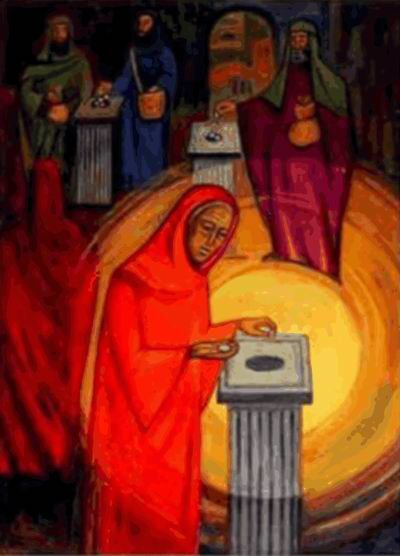
And in our gospel today, when Jesus sees a poor widow putting into the Temple treasury two small coins, which is all she has and her whole livelihood, what does he do? He does not try to stop her. He does not criticize her for being foolish. He calls his disciples to himself, he points her out to them, and he glorifies her trust in God in having given more than all the others. Her deed is still remembered to this day. Would it have been better if she had not given her gift?

I do not have a one-size-fits-all answer for how much poor widows should give. The Catechism teaches that the Church’s precept, “’You shall help to provide for the needs of the Church,’ means that the faithful are obliged to assist with the material needs of the Church, each according to his own ability,” so there’s recognition that some people have greater or lesser ability than others to materially assist the Church’s mission in this world. But if even poor widows are sometimes called to give, to trust in the Lord and give him the chance to prove himself their faithful provider, how much more so are the rest of us called to be generous?

We live in the wealthiest country in all of human history, and yet most of us only give a tiny fraction of our income to church and charity to support the good works they do. What accounts for this? Some of it is from the love of money and some of it is from fear. The Book of Ecclesiastes says, “He who loves money is never satisfied by money, and he who loves wealth is never satisfied by income.” Some are slaves to their greed, and some are shackled to their anxiety.

As an early teen, I felt reluctance at giving any money away for anything. I thought, “Who knows what my future holds? What if I need that money later? Every dollar I give away now is another dollar I’m exposed to future, unseen danger.” My mindset wasn’t informed by the Gospel, but when I finally read the Gospels myself I encountered Jesus’ teaching there. He says: “Do not worry and say, ‘What are we to eat?’ or ‘What are we to drink?’ or ‘What are we to wear?’ All these things the pagans seek. Your heavenly Father knows that you need them all. But seek first the Kingdom of God and his righteousness, and all these things will be given you besides. … Give and gifts will be given to you; a good measure, packed together, shaken down, and overflowing, will be poured into your lap.” The Lord was calling me beyond my comfort zone and into a deeper relationship with him.

I remember standing in St. Paul, Minnesota’s awe-inspiring cathedral. It was my first time there and I saw near the south exit a donation box labeled “For The Poor.” The largest bill in my wallet was a ten or a twenty, and I both wanted and very much did not want to give it, yet I knew what I should do. Once I had done it, I walked out smiling. It was a small donation, but even then I knew it was a big moment, and it changed the rest of my life.

I recall the story of one married couple. They used to pay their bills and then give to God if there was something left —and sometime there was nothing left. But God put it on their hearts to tithe consistently, so they began setting aside their gift to him first before paying their bills. And when they approached their giving in this way they discovered there was providentially always enough for both God and the bills.

God commands, “You shall not put the Lord, your God, to the test,” yet in his Old Testament Book of Malachi he says to test him in this: “Bring the whole tithe into the storehouse, that there may be food in my house. Put me to the test, says the Lord of hosts, and see if I do not open the floodgates of heaven for you, and pour down upon you blessing without measure!

And so, without embarrassment, I ask you to be generous in giving, not only so that our church may put your gifts to good use, but for the sake of deepening your personal relationship with our good and faithful God.

Associated Priests

October 30, 2021

31st Sunday in Ordinary Time

For the past four weeks, our second reading has come from the Letter to the Hebrews. This New Testament book shows Jesus Christ as our great, faithful, and merciful high priest: holy, innocent, and undefiled, yet patient and compassionate. He is able to personally sympathize with us in our weaknesses because, though sinless, he shares in our humanity and struggle. Jesus Christ is a priest forever offering his one perfect sacrifice to God the Father in a priesthood which does not pass away.

As the Catechism teaches, the redemptive sacrifice of Christ is unique, accomplished once for all; but this sacrifice is made present for us at Mass. The same is true of the one priesthood of Christ; Jesus’ priesthood is unique, but it is made present for us through the ministerial priesthood which he founded at the Last Supper. Jesus commands his apostles, “Do this in memory of me,” ordaining them priests of his New Covenant. Yet only Christ is the true priest, while they are merely his ministers.

Besides the unique priesthood of Jesus Christ and the ministerial priesthood of his ordained bishops and priests, there is the common priesthood (that is to say, an equally-shared priesthood) of all the faithful, which is ours through baptism. Sharing in Christ’s identity as priest, prophet, and king, each of us have holy sacrifices to offer, each of us have holy truth to proclaim, and each of us have holy power to wield. The Second Vatican Council noted, pastors “know that they themselves were not meant by Christ to shoulder alone the entire saving mission of the Church toward the world.” The ministerial priesthood is at the service of your priesthood, so that you — sanctified, strengthened, enlightened, and formed — can be as Jesus Christ and his saints for this place and time.

The scribe in today’s gospel approaches Jesus and asks: “Which is the first of all the commandments?” Jesus answers that the first in importance is this: “You shall love the Lord your God with all your heart, with all your soul, with all your mind, and with all your strength.” And the second is this: “‘You shall love your neighbor as yourself.’ There is no other commandment greater than these.” We must be entirely devoted to God, lovingly serving his kingdom according to our personal gifts and callings. And yet, even when we’re giving our all, we remain limited creatures. For instance, time spent doing one thing cannot be spent doing something else. And we are not pure, angelic spirits but physically embodied creatures, beset by weakness and fatigue.

I have experienced this these past four years as your pastor, having two parishes and a school, celebrating thirteen or fourteen Masses a week, with usually five Masses to offer on the weekends. Plus there’s confessions, funerals, anointings, and weddings; school activities and CCD; answering correspondence and completing paperwork; writing for the bulletins and the Sunday homily; and meetings or appointments on most weeknights. I mention this not to brag or complain, but to show why this is grinding and draining and why I do not do more — there is only one of me. I would like to do more than these things I do, but I feel I can’t – not without some help or relief. That’s why I have been working with our parish councils for several months seeking a good solution.

Today, I can announce good news: St. Paul’s and St. John the Baptist’s parishes will soon have an additional priest. This associate priest will assist me, your pastor, in serving you. His name is Fr. Chinnappan, a priest from India, who presently happens to be Fr. John Potaczek’s associate in Mauston. Fr. Potaczek will have a new associate, but Fr. Chinnappan will officially begin ministry here with us, with lodging at St. John’s rectory, on December 1st of this year.

This means that our current weekend Mass schedule will not need to change next year. We’ll have more flexibility in scheduling funerals and more opportunities for confession. Weekday Masses will become Communion Services much less often than before. And visiting priests will no longer be needed for helpouts. Fr. Chinnappan is excited to teach a religion class at St. Paul’s School next semester, and now there will typically be at least one priest around at both parishes for each night of CCD.

I look forward to the unique gifts and perspective Fr. Chinnappan will bring to St. Paul’s and St. John the Baptist’s. I trust that you will make him welcome, and be patient with us who serve you. For myself, I am most excited to have more opportunities to engage, teach, and evangelize, drawing souls more closely and profoundly to Christ here at our church and school. I have some new ideas in mind, and I want to hear your ideas and any offers to help. Jesus wills for you and I to be one hundred percent devoted, with all our heart and mind, soul and strength. Let us serve Jesus Christ, our priest and king, as saints for this parish according to our own unique gifts and callings.

What do you Wish?

October 23, 2021

30th Sunday in Ordinary Time

John the Baptist was once with two of his disciples and as he watched Jesus walk by he declared, “Behold, the Lamb of God!” Hearing this, the two disciples began tailing Jesus. Jesus turned, saw them, and asked them a question: “What are you looking for?” Last week, we heard how James and John, the sons of Zebedee, approached Jesus saying, “Teacher, we want you to do for us whatever we ask of you.” Jesus began by asking them a question: “What do you wish me to do for you?” This Sunday, a blind beggar, Bartimaeus the son of Timaeus, calls out to Jesus from the roadside. Jesus summons the man and once he comes near Jesus asks him a question: “What do you want me to do for you?

Why does Jesus pose these questions? Surely he already knows the answers. “Jesus immediately knew in his mind what they were thinking to themselves,” either from his divinity, or by reading their souls (as some saints have been known to do), or through his profound knowledge of human nature. Jesus “did not need anyone to testify about human nature. He himself understood it well.” So why does Jesus ask, “What are you looking for, what do you wish, what do you want me to do for you?

Jesus knows us through and through but how well do we know ourselves? To answer Jesus’ questions we must consider and articulate what we truly desire: “What do I really want? How could life be better?” Forming the answers helps us know ourselves. Sometimes we neglect or avoid such self-reflection. We assume or despair that the unsatisfying status quo is the best we can expect. But to name our wishes and longings and present these to Jesus is an act of faith, and hope, and trust in him.

When Jesus turned on the two disciples of John the Baptist (one of whom was St. Andrew) and asked “What are you looking for?” they answered, “Rabbi (Teacher), where are you staying?” And Jesus said to them, “Come, and you will see.” What they desired was to know Jesus better, and Jesus gave them what they asked for. Last week, James and John said what they wanted was to sit at Jesus’ right and left in his glory. What they desired was not chairs but a greater share in Christ’s glory, and Jesus gave them what they asked for. Today, Jesus asks Bartimaeus, “What do you want me to do for you?” The blind man answers, “Master, I want to see.” What he desires is deliverance, for his blindness has kept him a beggar, and Jesus gives him what he asks for.

Today, you have come before Jesus and approach him here. What are you looking for? What do you want him to do for you? What do you wish for him to do? In St. Matthew’s Gospel, Jesus says, “Whatever you ask for in prayer with faith, you will receive.” Jesus says, “Ask and you shall receive.” So I dare you to take courage, discern your desires, and present your requests to Jesus with faith, that he may give you what you ask for.

The Cup Jesus Drank

October 17, 2021

29th Sunday in Ordinary Time

James and John, the sons of Zebedee, approach Jesus asking for a favor: “Grant that in your glory we may sit one at your right and the other at your left.” Jesus says to them, “You do not know what you are asking. Can you drink the cup that I drink…?” They respond, “We can!” Jesus answers them, “The cup that I drink, you will drink… but to sit at my right or at my left is not mine to give but is for those for whom it has been prepared.

Jesus told James and John, “You do not know what you are asking,” but how well do we understand what Jesus is saying here? What was the cup that Jesus would drink? How would Jesus be enthroned in glory? And who got those places at his right and his left? The answers are found in the gospel accounts of the Passion.

Jesus, the night before he died, prayed in the Garden of Gethsemane: “My Father, if it is possible, let this cup pass from me; yet, not as I will, but as you will.” And again, “My Father, if it is not possible that this cup pass without my drinking it, your will be done!” Earlier that same evening, at the Last Supper, Jesus told his disciples, “from this time on I shall not drink of the fruit of the vine until the kingdom of God comes. … Amen, I say to you, I shall not drink again the fruit of the vine until the day when I drink it new in the kingdom of God.” So when is the next time we see Jesus drink “the fruit of the vine”? All four gospels record that Jesus was given wine on his Cross. In his suffering, Jesus said, “I thirst.” Someone soaked a sponge in a vessel filled with sour wine and put it up to his mouth. Once Jesus had taken the wine, he said, “It is finished,” and then he died.

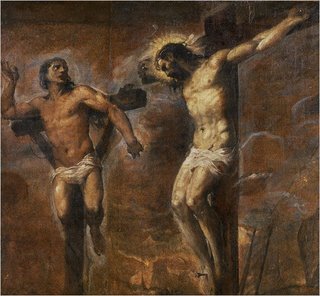
Alongside the cross of Jesus a pair of guilty criminals were also crucified; one on his right and the other on his left. Both of them had mocked Jesus at first, but then one of them repented. Acknowledging Christ’s innocence and lordship, he asked: “Jesus, remember me when you come into your kingdom.” And Jesus replied to him, “Amen, I say to you, today you will be with me in Paradise.

So what is the cup which Jesus drank? His cup is a cup of suffering. When and where was Jesus first enthroned in the kingdom of God? He is enthroned in glory upon his Cross. And who received the places at his right and left? Those places close to Jesus went first to two crucified criminals. Indeed, James and John in today’s gospel did not know what they were asking. Yet these apostles would go on to be glorified through their own shares in Christ’s sufferings: including martyrdom for St. James and exile for St. John “the Beloved Disciple.”

Many people struggle to reconcile the reality of suffering with the power and love of God. Some Christians even mistakenly preach a “Prosperity Gospel,” saying that if you believe in God and love him, he will bless you so that bad things never happen to you. But this view is incomplete. There are true blessings which flow from following Jesus Christ and his Gospel, but the worldview of the “Prosperity Gospel” sets believers up for a fall. When painful hardship or tragedy eventually come, those Christians will either blame themselves for not having had enough faith or blame God for seeming to fail them. This latter group wonders, “If God is not dependable, why should I keep faith in him?” And then, feeling wounded, confused, and abandoned, they abandon God.

We do not completely understand the mystery of evils in our world; why a devastating earthquake happens to some particular city, why a particular healthy adult gets cancer, or why a particular young person perishes in a car wreck. We do know that God’s thoughts are higher than our thoughts, that his plans see farther than our sight. And we know that God, who is the highest good, would not permit evils to exist unless his omnipotence and goodness were such as to bring good even out of evil. In Jesus Christ we see that God intimately knows and deeply cares about all the things we suffer. So what is the Lord up to?

It’s no coincidence that all four gospels mention how Jesus is crucified between two criminals, one on his right and the other on his left, with one who repents and one who appears not to repent. All of humanity is similarly suffering as a result of our original or personal sin. We too begin as guilty rebels condemned. But on the Cross, Jesus Christ the Son of God, though divine and innocent, joins us in our suffering.

The Letter to the Hebrews observes that in him “we do not have a high priest who is unable to sympathize with our weaknesses, but one who has similarly been tested in every way…” This divine plan for Christ to be a suffering servant was foretold through the Prophet Isaiah centuries before: “If he gives his life as an offering for sin… the will of the Lord shall be accomplished through him. …Through his suffering, my servant shall justify many, and their guilt he shall bear.

This Good Shepherd intimately understands the sufferings of the flock. He comes down from his high mountain into our dark valley and calls us to himself. We can respond to him with faith, acknowledging his goodness and lordship as sheep on his right. Or we can remain as faithless goats on his left, unrepentant for our sins and rejecting Christ forever. Realize that Jesus Christ desires not merely to forgive our sins, but that you and I would become children of God the Father just like himself.

Why do evils and sufferings continue to afflict those who follow Christ? As I said before, we do not know the answer to every painful question. (I believe we will understand God’s plan and purposes far better in heaven when he ‘wipes away every tear from our eyes.’) But we do know that Jesus Christ wants us to share in his own greatness and glory.

In today’s gospel, Jesus tries to help his disciples see that the path to true greatness and glory are not what they imagine. “Those who are recognized as rulers over the Gentiles,” Jesus notes, “lord it over them, and their great ones make their authority over them felt. But it shall not be so among you. Rather, whoever wishes to be great among you will be your servant; whoever wishes to be first among you will be the slave of all. For the Son of Man did not come to be served but to serve and to give his life as a ransom for many.

In our loving service and in our faithful suffering, we become more like Jesus. With Jesus, our sacrifices and sufferings are redemptive, helping to make us saints while helping to save the world. This is the precious, challenging, saving cup our Lord offers us. But can we drink it? With the grace and love of Jesus Christ strengthening us, we can!

Mentors & the Gift of Wisdom

October 9, 2021

28th Sunday in Ordinary Time
By Deacon Dick Kostner

What makes me successful, what wealth can I take with me into the next life? Bottom line: What will make me happy both in this life and in the next? Where can I acquire the knowledge to answer these very important questions? The answer lies within this weekend’s Scripture readings. The Father and Jesus share with us the answers to these very important life questions.

Very shortly after I had passed the Bar Exam I sat down one day and drew up what I thought would be my plan for success and happiness. The answer I had was to make my Fathers Law firm increase its profits by and through my participation and thus I would make my Father and my family proud of me. Feeling very proud of my great plan I sat down one day with my Father to share my plans of success and happiness for not only myself but for the firm by earning more money and wealth.

Much to my dismay, and after pouring me a cup of coffee and sitting down with me, his response to what I thought was a great plan, was: “Why do you want to waste your life on making more money all at the expense of happiness and enjoyment of family and friends in this life? Make enough money to care for your family and then enjoy life!” What he was saying to me was that money will not make me successful and happy and will only waste what little time I have here on earth to accomplish real wealth that I will be able to not only enjoy now but also take with me into the next life.

Dad loved to help others. He enjoyed people and spent his time here on earth making their lives easier. I remember many Friday evenings he would spend time with some of my sister’s high school friends playing Sheepshead into the early morning and then moving on to helping them with understanding and completing calculus assignments for their school classes. Dad did not let money control his life but rather used the money he made to help others enjoy their life. I remember one of those young people he played cards with coming up to me at his funeral and telling me that if it were not for my dad he and his wife would not have been able to purchase their home as they were unable to get a loan at the bank and dad loaned them the money to purchase it.

Our First Reading from the Book of Wisdom instructs us to seek mentors who will gift us with Wisdom. With this gift we are told, “Yet all good things together came to me in her company, and countless riches at her hands.” Jesus the ultimate Mentor tells us in our Gospel that the wealth we should seek is not money but rather the wealth and happiness we acquire by serving God and our neighbor.

Wisdom is not intelligence per say, it is rather a gift of understanding that can only come from our Creator. Jesus tells us to seek out those who have been gifted with wisdom for they know truth and they will lead us to the Father’s house. I have had many mentors during my life all of whom I spent much time with listening to their instructions on how to live a happy life. Many I would not have encountered if I would not have listened to my dad’s wisdom lessons.

I will share with you one more mentor story about a person many of you knew. His name was Ed Hassemer better known as “Gabby” Hassemer. He was a sheet metal worker by trade but he was also gifted with much wisdom. He had earned a living and spent his time not so much for himself but rather for his family, friends and even strangers. He owned several rental properties in Bloomer. His typical tenants were marginal people with limited resources but were able to find good housing that they could afford because of this person. He had a big heart and helped out many who just needed some help. I watched and listened to his wisdom and Barb and I followed his lead in acquiring rentals to supplement our income and provide housing for others.

Gabby was always helping out others. He heated his basement with a wood stove and would spend time during the summer cutting and splitting wood to burn in the stove for winter. One day while we were heading out to the woods to go hunting he was shaking his head and I asked him what was wrong. He said that one of his friends had come over to his house and said he was in trouble because he had no wood to burn and could not acquire any for a month or so. I suspected this was not true, as I knew his friend and I suspected he was just trying to take advantage of his friendship to save some money. In any case Gabby gave him the wood he had cut for the winter on the promise that before it got real cold, the friend would supply and pay him back for the wood he was gifted with. This never happened and Gab went without wood for most of that winter. I offered to go after his so-called friend but his response was “No, he needed it more than I did.”

Gabby had a lot of wealth but it was not something he earned by working but rather by giving of himself for others. He had the kind of wealth that he could take with him into the next life. About a year before he died he gifted me with wisdom I had heard before. He said, “Kostner, some day soon you will be standing over me looking at me lying in a casket. You will hear people talking about me and how I lived my life. But one thing you won’t hear them say about me is: #1, That man worked himself to death; and #2, He never took the time to go fishing!

Today’s Scripture readings tell us that happiness cannot be purchased—it is a gift from God for living out and obeying His two greatest commandments to love God and neighbor as ourselves. Next month I will try and explain to you what I think God would like to see you do with the gifts you have left over after your death.. I have an assignment for you folks. I would ask that sometime you sit down and make a list of events in your life that gave you the most happiness. I did this and I found out that my happiest times in life were when I was conversing with God and helping others either celebrating their life or helping them get through tough times. I believe this was not by chance. Our Catechism teaches us that we were created to know, love, and serve God. To know love and serve God is to be of service to God and our neighbor as Jesus lived out His life. This is not by chance but rather part of our very being. This is how God wired us at our creation. This will gift us with happiness because it makes us whole.

Our Gospel this week has Jesus, our mentor, instructing us that wealth is not bad and will bring us happiness and eternal life, if we but share it with God, family, and our neighbors.

Repairing Shoes & Souls — Funeral Homily for Gerald “Casey” Franz, 92

October 4, 2021

Sixty-eight years ago, Gerald married Wanda here in St. Paul’s Catholic Church. On Sundays, they brought their children here to see Jesus and worship. In their later years, Gerald and his wife became daily Mass-goers. Even when confined to home, he would watch Mass on TV, and during his days at Dove Nursing Home he was delighted to attend its celebration. Today, we gather here once more to offer our greatest prayer to God, the Holy Mass, for Gerald’s soul and for the good of all who love him. Gerald’s past occupations are not nearly as important as his faith, family, or friends, but Gerald’s all-time favorite job stands out for being rather rare.

Alongside Wanda, and then up until the end of last year, Gerald worked as one of our modern world’s last cobblers; not an apple, peach, or cherry cobbler, but a cobbler who works with shoes. Shoes are our lowest article of clothing, walking upon the earth. We see them everywhere we go; covering our lowly, vulnerable, and sometimes embarrassing feet. Some people say they “love shoes” but how much are we really willing to sacrifice for them? In this era of cheap mass production and consumerism, when a pair of shoes is somehow flawed or broken people typically toss them in the trash. But working out of his home shop, Gerald’s affordable rates and friendly face kept customers coming to his door.

I’m told that Gerald’s sharp and witty mind seemed to know every person’s face and name in Bloomer and Tilden; along with the names of their parents and siblings, whom they married and where they lived. Gerald would fix what was broken, patch what was torn, and through orthopedics enable people to walk. What might be considered worthless garbage to some, he restored. In this, Gerald bears a likeness to another.

Today, there are more people upon the surface of the earth than ever before. We human beings are lowly, vulnerable, and sometimes embarrassing. And when we are flawed or broken, this utilitarian world would often discard us. Some people say they “love humanity” but how much are they really willing to sacrifice for others? In our modern, consumeristic age some doubt whether God and his Church are needed anymore. But Christ and our Catholic faith are not antiquated professions, we need them now as much as ever.

Jesus Christ knows your name. He knows your face and your story. Our loving Lord knows absolutely everything about you. He who enabled the crippled to walk would fix what is broken in you and patch what was torn about you. The sacrifice of the Mass you are about to behold is Jesus’ sign of love for you. The Eucharist which Gerald has so loved is Jesus’ gift of love to you. I am confident that Gerald will be grateful for your prayers today, but I believe that the greatest wish of this cobbler of shoes is that you would always walk with the healer of souls.

Marriage is for Life

October 3, 2021

27th Sunday in Ordinary Time


In “the beginning of creation, God made them male and female. For this reason a man shall leave his father and mother and be joined to his wife, and the two shall become one flesh.” They are no longer two but one flesh. “Therefore,” Jesus says, “what God has joined together, no human being must separate.” Jesus teaches, “Whoever divorces his wife and marries another commits adultery against her; and if she divorces her husband and marries another, she commits adultery.

Now Christ’s Church does believe and teach that there can be situations where it is prudent and right for a person to physically or legally separate from their spouse. Perhaps there’s physical or emotional abuse in the marriage; destructive, unchecked addictions; or obstinate infidelity. And after the marriage falls apart the Church can investigate whether something essential to that marriage being a binding, sacramental bond before God was missing from the start.

It is possible for Catholic brides and grooms to fail to marry sacramentally in many ways. For instance, the couple might get invalidly married outside the Church; inside a courtroom, on a beach, or in a barn. The bride might feel forced to marry such that her consent is not free. The groom might lack the psychological or physical capacity for marriage. Or one of them might say the vows without not really meaning them. There are many ways a marriage can be sacramentally invalid and non-binding. And where the Church finds sufficient proof for this she will grant an annulment, permitting the man or woman to remarry. So as I said before, being divorced is not necessarily a sin; it does not automatically bar you from receiving Communion. However, to abandon one’s spouse without cause, or to remarry when you are not free to remarry, are sins that require repentance.

What God has joined together, no human being must separate.” Jesus said this in response to a question about divorce, but what other things of human sexuality has God joined from the beginning which no human being should separate? God joined sexual relations to the covenant of marriage. He joined love-making to the possibility of life-making. And he joined one’s biological sex to one’s identity. God created them male and female, one man and one woman, not identical sexes—but physically and spiritually complimentary mates, and made God them man and wife in a covenant for life.

God’s first commandment in the Garden was “be fruitful and multiply,” and today we hear Jesus tell us “Let the children come to me.” His wish is to bring “many children to glory,” as our second reading says. God’s Word in the Bible celebrates having many children as a blessing, not a curse. Today’s psalm proclaims this blessing

Your wife shall be like a fruitful vine
  in the recesses of your home;
  your children like olive plants around your table…
  May you see your children’s children.

Indeed, being surrounded by the love of many offspring is among the greatest blessings for the aged. But human beings separating sexuality from an openness to life distorts God’s plan and the society around us.

Contraception is not something new. It existed in ancient times. Genesis relates how a man named Onan repeatedly “wasted his seed on the ground” during intercourse to avoid conceiving children. “What he did greatly offended the Lord, and the Lord took his life…” Egyptian scrolls dating to 1850 B.C. describe other methods and the pagans practiced contraceptive techniques in the Roman Empire in the days of Christ and the Early Church. The Church Fathers, such as St. Clement of Alexandria, St. Augustine, and St. John Chrysostom condemned acts of contraception or sterilization. Even the first Protestants denounced contraception, too. Martin Luther the founder of Lutheranism, John Calvin the founder of Calvinism, and John Wesley the co-founder of Methodism all wrote against it.

All Christian groups were agreed on this less than a century ago. That is until the Anglicans in 1930 became the first Protestants to officially approve artificial contraception use for hard cases. (Thirteen years before, in 1917, the same group had declared contraception “demoralizing to character and hostile to national welfare.”) As is the way of such errors, the exception became the norm and the Protestant denominations changed their teachings. By 1961, the National Council of Churches could pronounce that “most of the Protestant churches hold contraception… to be morally right when the motives are right.” The Catholic Church, however, stood firm and stood alone against the spirit of the age.

At the end of 1930 and again in 1968, the popes wrote encyclical letters reaffirming the constant teaching of Christ’s Church about the nature, purpose, and goodness of marriage and the marital act; and repeating the consistent and ancient rejection of all directly-willed acts of contraception, sterilization, and abortion. In 1968, St. Pope Paul VI predicted in his encyclical Humanae Vitae that the widespread use of contraception would broadly lower morality, increase marital infidelity, lessen respect towards women, be coercively imposed by governments, and promote the self-harming belief that we have unlimited dominion over our bodies and human life in general.

According to its advocates, contraception was supposed to strengthen marriages, prevent unplanned pregnancies, improve women’s happiness, and reduce abortions. After decades of cheap and widespread contraceptive use, half of all pregnancies are unplanned, half of all marriages end in divorce, women report lower and lower levels of happiness throughout the decades since the 1970’s, and about one-in-five U.S. pregnancies end in abortion, with more than 60 million killed since Roe vs. Wade in 1973. When persons and societies decouple and oppose human sexuality to its life-creating purpose, many harmful errors follow. You can trace the path of one error leading to the next. We are now to the point that many people cannot even define what a woman or a man is.

I would be remiss here if I did not mention that the Church teaches that there can be holy reasons and virtuous means to avoid conceiving more children. Natural Family Planning (also known as NFP) uses signs from a woman’s body to identify the days in her cycle when she can conceive. Equipped with this knowledge, for serious reasons a couple may virtuously abstain from the marital embrace to avoid a pregnancy, while respecting God’s design and the dual meaning of the marital act.

Couples who practice NFP report growing in communication, self-control, and intimacy. They are more open to discerning and embracing God’s plan for their families and are statistically less likely to divorce. Not only is NFP completely natural, the information it tracks about a woman’s body commonly leads to the diagnosis, treatment, and cure of health disorders, from infertility to life-threatening illnesses. Unlike common chemical contraceptives, NFP does not cause increased risks for breast, liver, or cervical cancer; nausea, vomiting, stomach problems, or diarrhea; depression, mood swings, or lowered libido; and it does not cause spontaneous abortions (by preventing implantation of newly conceived children into the uterine wall).

Realize that NFP is not the Rhythm Method. The old Rhythm Method simply counted how many days had passed since the woman’s last cycle and was a moral but rather ineffective approach. Faithfully-followed NFP techniques have a 99% effectiveness rate, comparable to illicit methods of artificial contraception. If you would like to learn more about NFP, visit the Diocese of La Crosse’s website and search for “NFP”. There you can investigate NFP techniques, their science and their benefits, and register for on-line courses.

Whether or not you are married, whether or not you are past the age for children, I hope that you will recognize that in the chaotic, constantly-changing, errant stream of human history, is our stable rock for truth is Christ’s Church. The Bride of Christ, our mother the Church, calls us to follow her teachings from Christ as faithful, trusting, loyal sons and daughters. Jesus says, “Amen, I say to you, whoever does not accept the kingdom of God like a child will not enter it.” Do not miss out on blessedness, in this life or the next.