Archive for the ‘Homily’ Category

Three Temptations — 1st Sunday in Lent—Year C

February 23, 2010

In today’s gospel Jesus is led into the desert by the Holy Spirit for forty days of prayer, penance, and preparation and there He is tempted by the devil.  We have been led to this season of Lent and we also find ourselves being tempted. This morning I would like to talk about how the devil’s three temptations present themselves to us and to let you know about an allowance in Lent that you will be happy to hear.

Most of us here have chosen to take on a penance during Lent.  You have probably resolved to abstain from something good, like cookies, candies, ice cream, TV or the internet, to grow in disciple and virtue, and to offer some sacrifice to God. The devil first said to Jesus, “command this stone to become bread,” and we will probably be tempted in a similar way; “Put down the rock of your penance for awhile and let it nourish you.” It is the way of demons to first entice and then condemn. The rationalization, “Go ahead, it’s just a little cookie,” will afterwards become the accusation, “You couldn’t even sacrifice one cookie for God.” Let us preserve in our Lenten penances, for the joy of having carried a cross for the Lord is far preferable to the discouragement of a moment’s compromise.

As a second temptation, the devil, in a vision, showed Jesus all the kingdoms of the world in a single instant and said, “I shall give to you all this power and glory; for it has been handed over to me, and I may give it to whomever I wish. All this will be yours, if you worship me.” Scripture calls Satan the Father of Lies, so we ought to be skeptical about whether he really had this authority over the nations, and even if he did we should disbelieve that he would give Jesus the world if He were to worship him. Instead, I suspect that the devil would have simply laughed and left Jesus with nothing for having fallen into sin.

We human beings are creatures of habit. The same sins which you have struggled with in the past are probably the same ones that challenge you today. When we are tempted by sins they promise us the world, great peace and satisfaction. Yet we can look back at our own experiences and see that these are lies. Our past sins show us that they only lead to disappointment and dissatisfaction. We should stop swallowing the bait. We should stop accepting the lie. This Lent is a perfect time for us to commit to crushing the habitual sins in our lives, for our sins will not make us happy, even if they promise us the world.
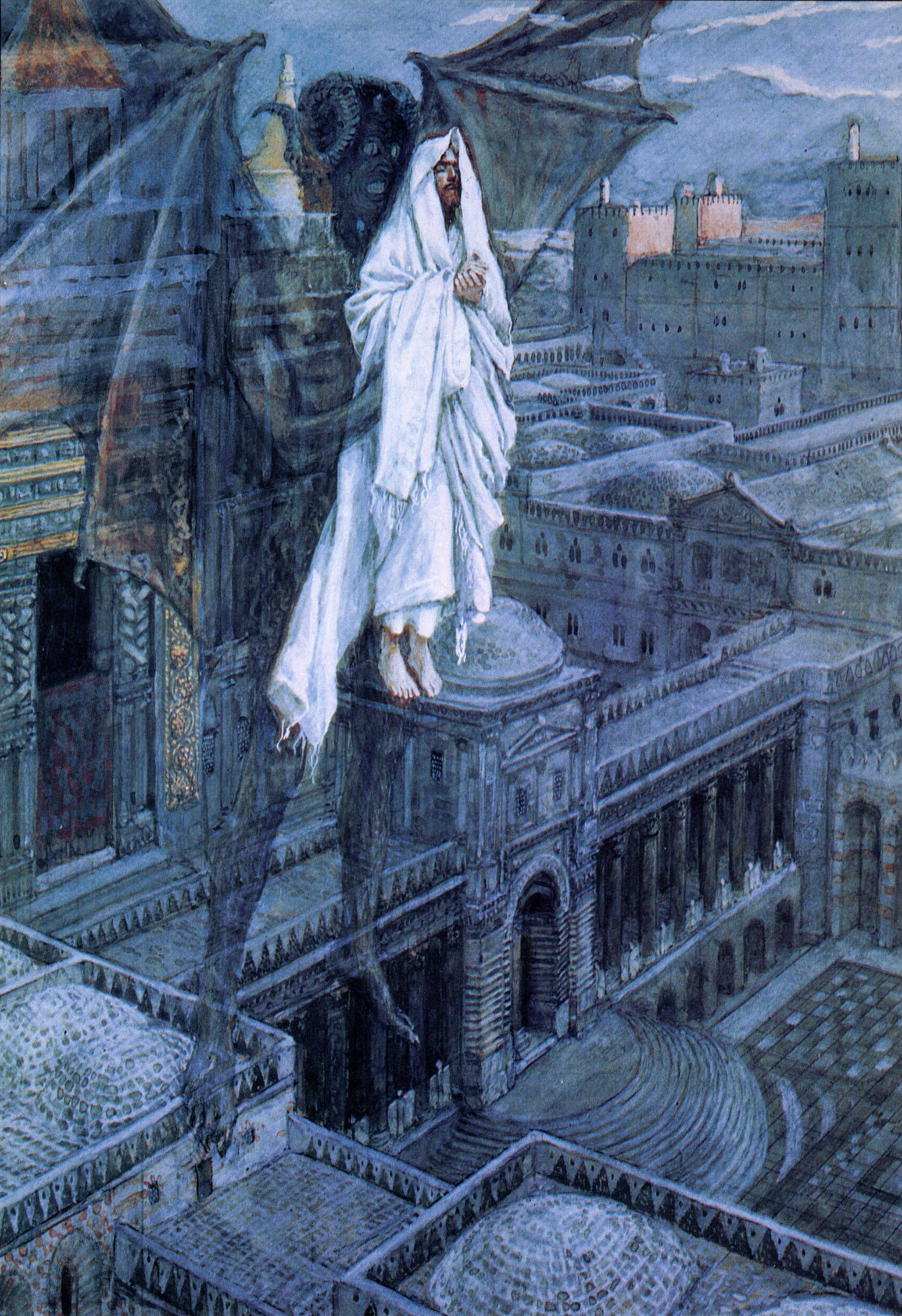
As a third temptation, the devil took Jesus up (in a vision or in the body we do not know) to the top of the temple in Jerusalem. He said to Him, “If you are the Son of God, throw yourself down from here, for it is written: He will command his angels concerning you, to guard you, and: With their hands they will support you, lest you dash your foot against a stone.” The temptation addressed to us sounds differently. “You are not the Son of God, you’re not even close to being saint! You should throw yourself down in shame for your sins and not dare to pray or present yourself to God!” On the contrary, as we heard in the second reading, “No one who believes in him will be put to shame.” Lent calls us to sorrow and conversion for our sins, not to shame and aversion from God.

We see the one-two combo of enticement and shame modeled in the case of Adam and Eve.  When they heard the sound of the Lord God moving about the garden they hid themselves among the trees, for they realized that they were naked before Him, and they were ashamed and afraid. Much later, in the case of Judas Iscariot, the devil led him to betray Jesus, one of the worst sins ever, and then after regretting it he was led to kill himself. If Judas had gone from the temple to Calvary, instead of to his tragic tree, Jesus would have forgiven him, because Jesus wanted to forgive him.

Jesus loves us. He doesn’t just love us because He’s God and He “has to” love everybody. Jesus loves us and He actually likes us for all the good things that we are and for all the good things He sees we can become. This is why He created us and died for us, because He loves us. So we should not be ashamed to come to Christ in the sacraments; in confession with our big sins, or at communion with our small ones. As Jesus told St. Faustina, the greater our sins the more entitled we are to his mercy. When it comes to God’s forgiveness, only we ourselves can get in His way.

Finally, I mentioned that there is an allowance during Lent which is a cause for consolation amidst our Lenten struggles. But first, did you know that there are more than forty days in Lent?  The season is longer than forty days because we don’t count the Sundays.  There are 40 days of penance, but every Sundays (from Saturday evening to Sunday night) we are released from our penances. At Sunday Mass the priest still wears the Lenten season’s purple, we might do less singing, and we don’t say the Gloria or say the “A”-word before the gospel, but we are freed from penances that day, for every Sunday is a “little Easter. ”

In the first reading, we heard how Moses commanded the Hebrews that once they came into the Promised Land they should come before God to present their first fruits and recount the story of how God had delivered them from slavery, brought them into the Promised Land, and filled them with blessings. Each Sunday we come before God and recall how His Son, Jesus Christ, delivered us from our slavery, brought us into His kingdom, and has filled us with His blessings, especially the gift of Himself in the Eucharist. Each Sunday gives us consolation, and this release from our penances encourages us to offer still more penance to God in the week ahead, for it is an easier thing abstain for just six days than to do it for forty in a row.

So in conclusion, be faithful to your penances, your faithfulness will have its reward. Commit to crushing your habitual sins, for sins cannot make us happy, even if they promise the world. Shame and fear are the devil’s traps, so whenever you sin, come to the Lord with trust and sorrow. And know that you are released from penances on Sundays in Lent.  May this gift be a cause for thanksgiving and joy and inspire us to make a still greater gift of ourselves to Christ in this Lenten season.
Romantic Christianity — Friday after Ash Wednesday

February 21, 2010

In the gospel disciples of John ask Jesus, “Why do we and the Pharisees fast much, but your disciples do not fast?” Jesus answered them, “Can the wedding guests mourn as long as the bridegroom is with them?” Of all the images in the Bible to depict the relationship between God and His people, perhaps the most common is that of bridegroom and bride.

As we begin this Lent we should understand that the saints became holy and made their great sacrifices not by relying upon their own “iron-wills,” but by falling passionately in love.

If we strive after holiness as a personal achievement our exertions will make us discouraged and resentful, like the people in the first reading who complain, “Why do we fast, and you do not see it? Afflict ourselves, and you take no note of it?”

But what sort of person can make incredible sacrifices for another, without counting the cost, and feel intoxicating happiness as they do so? A person who can do this is a person who’s in love.

What if Christianity is not supposed to be so hard as you’re making it out to be? What if it is supposed to be as easy as falling in love? Perhaps you are being called to a new approach.

The Two Ways — Thursday, 6th Week in Ordinary Time—Year II

February 21, 2010

In the first reading Moses sets before the people ‘the two ways’: life and prosperity, or death and doom. In the gospel Jesus tells us to deny ourselves, take up our cross and to follow Him. From this we might think that one could choose to bypass the cross, to never take it up, and to avoid the burden of the cross, but the cross is unavoidable.

Jesus was crucified along with two others, one on His left and one on His right; one who rejected Him, and one who accepted Him. These two people represent us. We are all crucified with Christ, and He is crucified with us. The question is how we will respond to Him.

In life there is no avoiding the cross, but in which way will we respond to it?  Will we rage and despair, or embrace it and follow Christ? Today I have set before you life and prosperity, death and doom. Let us follow the Lord, ‘for whoever wishes to save their life will lose it, but whoever loses their life for Christ’s sake will save it.’

Christian and Unashamed — Ash Wednesday at the Parish

February 17, 2010

In today’s Gospel, Jesus warns us against giving so that others see us giving, against praying so that others see us praying, and against fasting so that others see us fasting. Yet, I don’t think that showy religiosity is where the danger lies for us.

In Jesus’ day, the popular culture proudly believed in God and respected religious piety. Hence, those people were tempted to publically flaunt their acts of prayer, fasting, and almsgiving and thereby gain the respect and praise of others. But today, in our secularized culture, the temptation is to do the opposite, and to do something far worse. We are tempted to deny our faith in Jesus and teachings before others because we’re afraid of what they might think of us.

The hypocrites Jesus spoke of, who pray to be seen by others, merely limit their prayers’ reward, but if we deny Christ before others we lose our rewards entirely. For Jesus tells us:

“Whoever is ashamed of me and of my words, the Son of Man will be ashamed of when he comes in his glory and in the glory of the Father and of the holy angels.” “Everyone who acknowledges me before others I will acknowledge before my heavenly Father. But whoever denies me before others, I will deny before my heavenly Father.”

This is why the early Christians went to the lions rather than to deny Christ, and it was their courageous witness to Him that conquered the pagan culture which surrounded them.

This Lent, let us begin to practice putting the Lord before men. For instance, are you someone who will be so embarrassed by having an smudge of ash on your forehead that you’ll want to wash it off the first chance you get? If so, then you should leave it there until it wipes away on its own.

Are you are someone who sees good deeds that just call out to be done but pass them by because of your peers would see you doing them? Then you need to bite the bullet and start doing those hard-good-deeds anyways.

Are you someone who is self-conscious about other people seeing you pray, here at Church, at work, or when your family goes out to a restaurant? Then you need to make it a point to pray, and when you do, do not ask that God would make you invisible; ask Him that other people would become invisible to you and then pray to Him as from your heart.

Now, these are not examples of performing righteous deeds so that others may see you. This is about doing the right thing even if others might happen to see you do it. This Lent, let us begin to love and serve our eternal Lord amidst a world which is destined to become dust.

You are called to be the light of the world. People do not light a candle and then put a bucket over it; it is set it high up, where it can give light for everyone. Just so, your light must shine before others, that they may see your good deeds and glorify your heavenly Father. This Lent, let’s begin to shine.

Unashamably Christian — Ash Wednesday at the School

February 17, 2010

In today’s Gospel, Jesus warns us against giving so that others see us giving, against praying so that others see us praying, and against fasting so that others see us fasting. Yet, I don’t think that showy religiosity is where the danger lies for us.

In Jesus’ day, the popular culture proudly believed in God and respected religious piety. Hence, those people were tempted to publically flaunt their acts of prayer, fasting, and almsgiving and thereby gain the respect and praise of others. But today, in our secularized culture, the temptation is to do the opposite, and to do something far worse. We are tempted to deny our faith in Jesus Christ and His teachings before others because we’re afraid of what they might think of us.

The hypocrites who pray to be seen by others limit their rewards, but if we deny Christ lose our rewards entirely. I’ve touched on this topic twice before from this ambo, as recently as three weeks ago, but I feel that it is important for me to emphasize it, and that it’s important for you to hear it. For Jesus tells us:

“Whoever is ashamed of me and of my words, the Son of Man will be ashamed of when he comes in his glory and in the glory of the Father and of the holy angels.” “Everyone who acknowledges me before others I will acknowledge before my heavenly Father. But whoever denies me before others, I will deny before my heavenly Father.”

This Lent, let us begin to put God first; in our prayers, in our penances, and in our personal relationships.

Are you someone who will be so embarrassed by having an smudge of ash on your forehead that you’ll want to wash it off the first chance you get? Well then, you’re someone who needs to leave it there until it wipes away on its own.

Are you are someone who sees good deeds that call out to be done but pass them by because of the people who would see you doing it?  Then you need to bite the bullet and start doing those hard-good-deeds anyways.

Are you someone who will have more to say in gratitude to God after Mass this morning than is allowed by the eight seconds before your pew starts clearing-out? Well, then you need to stay in your pew to say what your heart wants to say as long as you need to say it (without, of course, being late to class.)

Now, these are not examples of performing righteous deeds so that others may see you.  This is doing the right thing even if others might happen to see you doing it.

If you’re self-conscious about other people seeing your devotion to the Lord (for instance at Mass) do not pray that you would be invisible to them; ask that they would invisible to you and continue as you would.

You are called to be the light of the world. People do not light a candle and then put a bucket over it; it is set on a lampstand, where it gives light for everyone. Just so, your light must shine before others, that they may see your good deeds and glorify your heavenly Father.

This Lent let us begin to love and serve the Lord in the world. This Lent, let’s begin to shine.

Single-Minded Faith — Monday, 6th Week in Ordinary Time—Year II

February 15, 2010

From the letter of St. James we hear that ‘God gives to all generously and ungrudgingly,’ yet in the Gospel the Pharisees asked Jesus for a sign and received nothing. The Lord told them, “no sign will be given to this generation.”

Why didn’t the skeptical Pharisees receive what they asked for? As St. James says, they were men of two minds: “Yeah, we believe in the messiah and that he’s coming, but we’re certain that he’s not you!” Are we people of two minds in our lives of faith?

“Yeah, I hope for a renewal, a new springtime in the Church, but I don’t think much will change here in the United States.”

“Sure I want unity in our parish, but with the people we have to deal with it’s not very likely.”

“I really want my children to know Christ and to fall in love with the faith, but I can’t teach them very much.”

“Of course I’d like to be a saint, but I know the limits to my holiness and God ought to know and accept those limits too.”

Let us not be people of two minds. Let us pray and act with a single-minded faith, so that we may see, in this generation, the signs of Christ’s power.

Mary and Pilate — 6th Sunday in Ordinary Time—Year C

February 14, 2010

In a few moments, after this homily, we will recite our creed, the summary of our faith. Every Sunday, we profess, in union with the Christians who came before us, our belief in these truths and our resolve to live our lives according to them. This morning we will look at just one rich aspect of our creed and consider its implications for our lives.

Have you ever noticed that in the entire creed, only two non-divine persons are mentioned by name? These are the Virgin Mary and Pontius Pilate.

“By the power of the Holy Spirit, He was born of the Virgin Mary and became man. For our sake He was crucified under Pontius Pilate; He suffered, died and was buried.”

Now many other figures from the Old and New Testaments could have justifiably been included in our creed; such as Adam and Eve, Abraham, Moses, David, Mary Magdalene, Peter, Paul, and many others. Yet, only Mary and Pilate get mentioned. So why is this? There seems to be two very good reasons. The first of these reasons I will give now—and the second I will save for the end.

The first reason why Mary and Pilate receive special mention is that they ground Jesus’ life, death, and resurrection in our real history. Jesus was ‘born of the Virgin Mary, suffered and died under Pontius Pilate, and on the third day, He rose again.’ Now other pre-Christian religions sometimes had stories about dying gods who came to life again, but those stories were always said to have happened ‘once upon a time,’ in some remote and mythic past. But with Jesus Christ, this ancient intuition and longing of humanity is actually realized. The inclusion of Mary and Pilate in the creed witness to this: that God became man, died, and rose for us, in this world and in real history.

Some people try to be too sophisticated by saying it doesn’t really matter if Jesus rose from the dead, or even if He lived at all, because His teachings are what’s important. But St. Paul blows this idea out of the water. “If Christ has not been raised, your faith is vain; you are still in your sins. Then those who have fallen asleep in Christ have perished” and “we are the most pitiable people of all.” Without Jesus Christ and His resurrection there is no Gospel, there is no Good News.

Just like Jesus Christ, Mary His Mother and Pontius Pilate His executioner are not fictional characters made up for some story. They are real people, from a time not that much different from our own. Our styles and technologies may have changed, but human beings themselves remain much the same. When we look at Mary and Pilate we can see ourselves in these two people whom Christ encountered twenty centuries ago.

Pilate is the secular Man of the World.
Mary is the devoted Disciple of Christ.

Pilate seeks the glory of men.
Mary seeks the glory of God.

Pilate knows worldly wisdom, he is clever and cunning.
But Mary knows God’s wisdom, and she is truly wise.

Pilate thinks he knows how the world works and the pragmatic way to get things done. For Pilate, our world is totally shaped by of power, money, and influence, with some blind luck thrown into the mix. When Jesus stands silent before him, Pilate says, “Do you not speak to me? Do you not know that I have the power to release you and I have the power to crucify you?” Jesus replies, “You would have no power over me if it had not been given you from above.”

Pilate is a very post-modern man.  He’s a moral relativist. When he asks Jesus, “What is truth,” he doesn’t bother to wait for an answer from Truth Himself. That’s because Pilate thinks that the ‘truth’ cannot be known except for the ‘truths’ which we choose for ourselves or impose upon others.

The Gospels show that Pilate knows Jesus is innocent, or at least that he poses no real threat to society, yet Pilate is willing to have this innocent man whipped and even crucified when that becomes the most expedient thing to do. The crowd threatens Pilate, “If you release him, you are not a friend of Caesar,” and he quickly caves and hands Jesus over.

Pilate washes his hands of responsibility, and extends Christ’s arms on the cross. Mary had extended her arms declaring, “Let it be done to me according to your word,” and lovingly held the infant savior in her hands.

Pilate, despite all his power, is ruled by fear.
Mary, despite her weaknesses, is freed from it.

Governor Pilate is rich in wealth and power and yet he has no peace.
Mary, the poor widow, has peace and everything she needs from God.

Pilate has no faith in the God of Israel. He says, “I am not Jew, am I?” But for Mary, God is her rock and this makes all the difference in the world. Mary is defined by her faith, hope and love.

Mary never attends an academy, but she is profoundly wise because she reflects in her heart on the words and deeds of God and because she lives by her own advice: “Do whatever he tells you.” She knows that we do not manufacture the truth for ourselves, we receive it, ultimately from God. We love it, we defend it, and we share it with others. “Blessed [is she],” as Elizabeth said, “who believed that what was spoken to [her] by the Lord would be fulfilled.” Mary trusted and believed, for she saw the evidence through history that God “has mercy on those who fear Him in every generation,” that “He scatters the proud in their pride, and casts down the mighty from their throwns, but He lifts up the lowly.”

Mary’s life was full, but was not free from trials. When Mary consents to be found with child through the Holy Spirit she is uncertain of what will happen to her, but she trusts in God. She does not know how she and her husband will get by as poor immigrants in foreign country, but she continues to trust. Mary’s response to every trial in life, even to the death of her son, is to trust in God. Despite men’s sins, she trusts in God as the Lord of history, that He casts down the proud and mighty from their throwns and raises up the lowly.

Pilate is indifferent to Christ, and he consents to sending Him to the cross, but Mary is wholly devoted to Christ, and she consents to share in His Passion. Pilate’s heart is hardened despite Christ’s Passion, while Mary’s heart is pierced by it.

Governor Pilate was once the most powerful man in Judea, but where is he now? Mary, the poor widow, is now our glorious queen, the most beautiful and powerful woman in heaven or earth, and through her reign she draws millions to Christ our king.

She is the one who wept and now laughs.
He is the one who laughed and now weeps.

He was rich in the world and now he is poor.
She was poor in the world and now the kingdom is hers.

He took root in the desert, he was barren and uprooted.
But she was planted beside the flowing waters, she endured and bore much fruit.

So what do all of these reflections about Mary and Pilate have to do with us? I promised you at the beginning a second good reason why Mary and Pilate are mentioned in the creed; and here it is: Mary and Pilate represent us. They stand as archetypes, models or patterns, for every person.

The faithful one and the faithless one.

The one who serves God and the one who serves himself.

The one who gives Christ life and the one who puts him to death.

We live our daily lives as either Mary or Pilate, with shades of the other thrown in. As we come to the season of Lent, let us examine and discern who we are. “How am I Pilate, and how am I Mary?” And at this Eucharist, let us ask Jesus to exchange in us the ways of Pilate for the ways of Mary, for hers is the way of Christ.

Approaching God — 5th Sunday in Ordinary Time—Year C

February 11, 2010

In today’s first reading the prophet Isaiah hears the angels praising God at the temple with words like those we proclaim at every Mass: “Holy, holy, holy is the LORD of hosts! All the earth is filled with his glory!”

What do these words mean?  First, the Jews did not have adverbs for “very,” “most,” or “infinitely” in Hebrew, so if they wanted to say something was very heavy they would call it “heavy, heavy.”  If they wanted to say something was most heavy or (if it were possible) infinitely heavy they would call it “heavy, heavy, heavy.”  So when Isaiah hears the angels call God “holy, holy, holy,” they are praising His perfection, transcendence, and goodness to the highest degree.

Why is God called “the LORD of hosts?” A host is an army, or a large group of persons. In this case, God’s army of angelic  persons is referred to. Our God is holy and wields unsurpassed power. The earth is filled with his glory.

Isaiah behold this sight and becomes very afraid. “Woe is me, I am doomed! For I am a man of unclean lips, living among a people of unclean lips; yet my eyes have seen the King, the Lord of hosts!” In the Old Testament people thought that no human being could look upon God and live.

Then an angel, one of the seraphim, fly down, takes an ember with tongs from the altar (for the Jews sacrificed animals as burnt-offerings at the temple) and touches Isaiah’s mouth. “See,” the angel says, “now that this has touched your lips, your wickedness is removed, your sin purged.” God asks whom He can send to be His prophet, and now Isaiah has the courage to say “Here I am, send me!”

Imagine if, at communion time, people would line up and come before the priest to have a red hot coal touched to their lips or tongue? Priest: “The holiness of God.” Communicant: “Amen… Ou!” I imagine the communion line would be much shorter.

This is the bread that we will be offering at this Mass to become the real body, blood, soul, and divinity of Jesus Christ. It’s flat because it unleavened, just like the bread at the Jewish Passover meal and as at Jesus’ Last Supper.  Leaven, or yeast, is bacteria which grows and makes our bread fluffy. The Jews were to keep leaven, which symbolized sin, out of their Passover bread.

Like all of the other sacraments, the Lord’s choice to use bread has symbolic meaning.  Take baptism, for example: water cleanses us and gives us life.  Similarly, bread gives us life and becomes one with us. No wonder Jesus chose it to be his symbol for the Eucharist. The very use of bread invites us to receive him.  The symbol of bread speaks, “Come, do not be afraid. I am here to be received by you and to become one with you.” We tend to forget what an unprecedented privilege this is.

In the Old Covenant, Jews could always pray to God, for ‘all the earth was filled with his glory,’ but they you wanted to go where the Lord was most present on earth they had to go to one place, the temple in Jerusalem.  And even when they got there they did not enter in where the Lord was most present, the Holy of Holies, where only the high priest would go, and only once a year at that. The faithful would worship in the courts outside the temple.  It would be like us coming to church today to stand and pray from the parking lot. Instead, we have the privilege to stand and worship the Lord here in His sanctuary, and not only do we see the Most Holy Lord with our own eyes, but we actually receive Him in the Most Holy Sacrament.

The wonder and the privilege and the awe of this new intimacy with God at the Eucharist could not have been lost upon the early Christians, who were converts from Judaism. Do we approach the Lord with a healthy fear of the Lord, which is called the beginning to wisdom? This fear is not terror, which would cause us to hide ourselves from the Lord. It is a reverence which honors the Giver who is the Gift.

We all sin from week to week, but if our sins are minor, or venial, then Jesus wants us to approach Him in the Eucharist. Receiving this sacrament with contrition forgives our venial sins. On the other hand, if we are aware of serious, or grave sins on our souls, then Jesus wants us to approach Him in another sacrament first, the sacrament of confession, or reconciliation.

In the second reading we heard St. Paul’s words to the church at Corinth, reminding them of what he ‘handed on to them as of first importance as he had also received it.’ Later in the letter he reminds them of something else in a similar way:

For I received from the Lord what I also handed on to you, that the Lord Jesus, on the night he was handed over, took bread, and, after he had given thanks, broke it and said, “This is my body that is for you. Do this in remembrance of me.” In the same way also the cup, after supper, saying, “This cup is the new covenant in my blood. Do this, as often as you drink it, in remembrance of me.” For as often as you eat this bread and drink the cup, you proclaim the death of the Lord until he comes. Therefore whoever eats the bread or drinks the cup of the Lord unworthily will have to answer for the body and blood of the Lord. A person should examine himself, and so eat the bread and drink the cup. For anyone who eats and drinks without discerning the body, eats and drinks judgment on himself. That is why many among you are ill and infirm, and a considerable number are dying. If we discerned ourselves, we would not be under judgment…”

Before we approach the Eucharist let us examine ourselves first, and if we have serious unconfessed sins, from even years ago, let us present ourselves for Jesus’ needed forgiveness in confession first. Ask yourself, do I care more about others’ opinions of me, or about the opinion of the Lord (who sees all things)?

Whenever we come to Christ in the Eucharist let us approach Him as the earliest Christians did, with wonder, awe, and holy fear. Let us have that reverence which honors the Giver who gives Himself as a Gift to us.

Holy Reading — Wednesday, 5th Week in Ordinary Time—Year II

February 11, 2010

If a saint, like St. Scholastica or St. Benedict, were coming to speak at our parish tonight, would you come out to listen to what they had to say? The queen of Sheba (thought to be present day Ethiopia) traveled hundreds of miles just to hear the wisdom of King Solomon. What would you be willing to offer in time and treasure to listen to the wisdom of a saint today? In truth, we can encounter their wisdom today and at fraction of the queen’s effort.

The saints of both modern times and centuries long past wrote their wisdom in books, which are easily assessable for us today. Jesus observes that food which comes from outside and passes through us cannot defile. The saints’ holy books, however, can sanctify us, if we hold on to their words with a receptive heart.

As it is written: “One does not live by bread alone, but by every word that comes forth from the mouth of God.” Spiritual reading is important for the growth of the Christian disciple, so commit yourself to beginning some holy reading that interests you.

The Fool’s Blindness — Tuesday, 5th Week in Ordinary Time—Year II

February 9, 2010

Some priests like to begin their homilies with jokes. Today I’m going begin by telling you a few jokes—some very, very old jokes. In fact, they come from the oldest joke book in the world, a collection of 265 jokes from the 4th century A.D. entitled The Philogelos, or (in English) The Laugh-Addict.

One day an intellectual bumped into a friend and said to him, “I heard you were dead.” “Well,” said the friend, “As you can see, I am very much alive.” “Yes,” [replied the other,] “but the person who told me you were dead is much more reliable than you.”

[On another occasion,] A doctor stole the lamp of a man whom he was treating for inflammation of the eyes. A few days later, the doctor asked the patient how his eyes were. “It’s a funny thing, [Doctor,] ever since you treated them I haven’t been able to see my lamp.”

[And finally,] An intellectual was [once] on a sea voyage when a big storm blew up, causing his slaves to weep in terror. ‘Don’t cry,’ he consoled them, ‘I have freed you all in my will.’”

Now these three jokes have something in common, besides being very old. They all share the have comedic device: a foolish person who focuses on the wrong thing, like the patient who mistrusts his eyes more than his doctor. This is called majoring in the minors, or as Jesus would say, “straining the gnat and swallowing the camel.” In the Gospel today, Jesus really takes it to the scribes and Pharisees for doing this sort of thing: “You disregard God’s commandment but cling to human tradition. … This people honors me with their lips, but their hearts are far from me…”

So do we focus on small details of our faith and neglect what’s really important? For instance, next Wednesday is Ash Wednesday, the beginning of Lent, and during Lent we usually give up something we enjoy as a form of penance until the joyful celebration of Easter. Now keeping a Lenten penance is a good tradition, because penance helps us to shed old sins and to grow in our ability to do good and to be happy. But… if we give up pop, cookies, candy, or ice cream, while we neglect to go to Sunday Mass, we are keeping a human tradition while we neglect God’s command: keep holy the Lord’s day. Instead of doing neither this Lent, please do both.  Take a penance and go to Mass every weekend for the love of God.

Maybe your family doesn’t go to Mass on weekends, but that doesn’t mean that you can’t. If you love God enough to ask your parents’ permission to go by yourself or with a friend this Sunday, I doubt you will need to go alone a second time. For you will provide your parents with a needed reminder about God’s important in our lives, and I bet you that at least one of them, if not the whole family, will come with you every week after.

So let us keep first things first, and not be stupid, like the man who was swimming when it started to rain; and dove to the bottom, to keep from getting wet. This Lent, let us keep the Lord’s Day, every Lord’s Day, holy. The reason the Lord calls you out is to call you to Himself.

Then and Now — Funeral for Fabian “John” Wingert, 80

February 5, 2010

John did not know when the day would come, but he knew it was coming, and so he was proactive in making preparations. It was 1952, and our country was at war on the Korean peninsula. John knew that his army draft number was low and that he going to be called up for service any day. John was proactive, and he heeded the advice of his father, who said, “Join the navy. It’s better to have a bed than to sleep on the ground.” John enlisted in the navy two days before his army draft number came up.

Later, when it came time for him to ship out, John took the initiative again. John had met Beverly two years before. He would later say they met at a dance in Rozellville. She insists that it happened earlier at an ice rink. But in the week before he was to ship out they were in perfect agreement about what they wanted to do. They were wedded in Los Angeles at St. Michael’s Catholic Church, beginning 57 years of marriage. They enjoyed the sweetness of their too short honeymoon together, and then he left, as he had been called to do by higher-ups.

Beverly tells me that this time without him was lonely, and that she would worry about him, too. They wrote to each other every day, though the mysterious mechanisms of the mail service made the letters arrive in clumps. Finally, John came home, and he and Beverly began raising children and living happily, together.

Today we gather to mourn and pray for John, who suffered his last days’ passion in Christ’s likeness, and whom we trust will be raised up in Christ’s likeness. John has been called up for service by the Higher-Ups of heaven.

There’s a sadness in this separation, but there is no need for fear. It is you who sit here who remain in the war, while John is heading home. We need not fear for him, for unlike the mail, he cannot be lost now, but we pray for him while experiences the mysterious mechanisms that perfect souls until they reach their final address.

And if you have anything you wish you could tell him, you can, for like our connection to the love of Christ, nothing can separate our spiritual connection with John in Christ.  If you would like to talk to him, just pray. You might even sense him speaking back.

This life has the happiness and incompleteness of a too short honeymoon. But if we proactively respond to God’s grace, in not too long, we will all be joyfully reunited. And we will live happily, together, forever.

Asking and Receiving — Friday, 4th Week in Ordinary Time—Year II

February 5, 2010

King Herod said to his daughter, “Ask of me whatever you wish and I will grant it to you.” He even swore many things to her, “I will grant you whatever you ask of me, even to half of my kingdom.” If Herod, who was wicked, could be moved to give his daughter gifts, how much more will our heavenly Father give us good things if we ask Him. Praying for good things is something Jesus commands us to do.

While many Christians fall into the mistake of only praying when they want something from God, there are other Christians, who pray every day, who make an opposite mistake. These Christians pray for good things for others, but they never ask anything for themselves, fearing that this would be a selfish prayer. But the danger in this, in never requesting and never expecting God’s gifts and consolations, is that we’ll become discouraged and gradually embittered.

If we never ask for a share in the Father’s gifts we risk becoming like the older brother in Luke’s parable of the prodigal son. Eventually we’ll say to God, “Look, all these years I served you and not once did I disobey your orders; yet you never even gave me something to feast on with my friends.” But our generous and forgiving Father would say to us, “My child, you are here with me always; everything I have is yours for the asking.”

Jesus said, “Whatever you ask in my name, I will do, so that the Father may be glorified in the Son.” So ask God to give you gifts—this is not a selfish prayer, for it will strengthen you in holiness and glorify God. I suggest that you try out a little experiment. Pray, “Lord, please treat me to something special today,” and then watch for his gift to come.

Staying Until Leaving — Thursday, 4th Week in Ordinary Time—Year II

February 4, 2010

Jesus provided the Twelve with their message to preach, their authority to cast out demons, and their power to cure the sick. However, Jesus withheld from the Twelve some basic provisions: no food, no bags, no spending cash, no second tunics for warmth in the cold night. On the other hand, Jesus instructs them carry walking sticks and wear sandals. What is Jesus thinking?

Jesus wants His disciples to be mobile, so that they can quickly travel to distant towns, but Jesus doesn’t want His disciples to be self-sufficient once they get there. Their lack of food, of money and of a place to sleep, forces them to become fully present to others. It necessitates the personal encounter.

Jesus told the Twelve to enter the lives of others, to enter their homes and to stay there until they leave. But what does it mean for them to stay until they leave? (How could someone leave before they’ve left?) Jesus is commanding them not trade up from house to house, as better accommodations are offered, thereby alienating and dishonoring their first hosts.

What does this gospel mean for us today? First of all, that our most important work, whatever our state in life, is our personal ministry to the people to whom Christ is sending us. We’re all busy, but we must not be too busy for what’s most important. Our professional careers will end, but our personal relationships will last, literally, forever.

Sometimes when we encounter other people we neglect Jesus’ advice to stay until we leave. Someone is speaking to us and we mentally check-out to green pastures. Sometime we fail to encounter the other person at all, brushing them off like dust on our feet.

I’ve heard it said that something which often struck people who met Pope John Paul the Great was how totally present He was to them, with his eyes and his mind, as if they were for him—in that moment—the most important person in the entire world. Can we imagine a personal encounter with Jesus Christ being any different? John Paul was a very busy man with a world of concerns on his shoulders, just like Jesus Christ, but they both had the time for what was most important.

I want to live more like that.  Don’t you?

By the Throat — February 3 — St. Blaise

February 3, 2010

I began going to daily Mass in the fall semester of 2001. In college I had always gone to Sunday Mass, but after September 11th I felt that if the world was going to change for the better, it would require that people present themselves to God and offer Him more opportunity to work His grace in them. And so, two years later and seven years ago today, I was at daily Mass on the feast day of St. Blaise for the first time in my life.

At the end of Mass, Father Mark offered an opportunity for a special blessing of throats by means of two crossed candles and the intercession of St. Blaise. A line formed of the faithful, but I stayed in my pew. I felt a tug of conscience to go up there too, but I was really embarrassed by the oddness of it. “Who gets ailments of the throat anyways,” I justified to myself, and headed out the door.

With noon Mass behind me, I walked to the dining hall for lunch. I remember that I was passing an empty salad bar on my left when I got stopped in my tracks. It was like my throat suddenly got completely dry. I recognized I wasn’t choking, so I wasn’t frightened, but it took me a good minute or two get right again.

Now my best natural explanation for what happened to me is that I inhaled dust kicked up by some unseen kitchen sweeper which got blown in by a fan through the open door on my right. But it didn’t take me long to remember St. Blaise and to recognize in this providential incident God’s gentle correction.  The message: “Don’t refuse a holy blessing.”

We Catholics should not feel ashamed of our traditional blessings and sacramentals. Things like holy water, miraculous medals, and house blessings make a difference; for with these things we make an act of presenting ourselves to God and offer Him more opportunity to work His grace in us.

Our World’s Salvation — February 2 — Presentation of the Lord

February 2, 2010

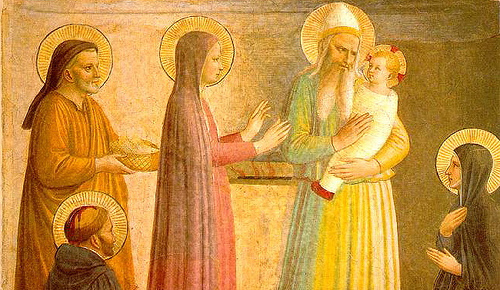
Simeon’s eyes looked upon a baby and foresaw our salvation in Him. When we look back today, at the centuries past, we can see that Jesus Christ has indeed been a light for all the nations.

Even if one were to look at Jesus of Nazareth without the eyes of faith, any fair assessment of history must name Him and the Church that He founded as the greatest cause for good in human history. Jesus Christ came and was the light for a darkened world.

For example, in the ancient world, women’s status ranked near that of slaves, but Jesus showed a reverence towards all women, even intimately involving them in His ministry. Christianity noted His example and began to acknowledge women’s dignity and equality as persons.

While the ancient world wielded total dominance over slaves, Christianity professed slaves’ equality as persons before Christ. (In fact, several early popes were former slaves themselves.) Christianity told masters that they would be held accountable at the Judgment for the good or bad treatment of their slaves, for Jesus had said, “Whatever you do to the least of my brothers you do to me.” The abolishment of slavery came gradually, but it finally came as the result of Christians’ efforts in light of Christ.

Infanticide was common in the ancient world. Sometimes the unwanted little one was physically disabled, or female, or merely inconvenient. But Jesus treasured all children, and He said, “Whoever receives one child such as this in my name receives me.” So Christianity renounced infanticide and would later establish orphanages and promote child adoption.

Jesus showed concern for sick persons and healed them. Jesus also feed hungry crowds. So Christianity has established hospitals and soup kitchens. Today, as throughout the centuries, the Catholic Church is the largest charitable organization on earth.

An eye for an eye was the ancient law, and hating one’s enemies comes naturally, but Jesus did not seek revenge.  Jesus said, “Love your enemies,” and He prayed for His enemies from the cross. Many Christians have followed His example, promoting peace and reconciliation.

Jesus taught his wisdom to great crowds of men and women, the poor and rich, the young and old, so Christianity established schools and universities. Today the Catholic Church educates more children than any other scholarly or religious institution and you are a part of this number.

Our Marshfield area Catholic schools exist today because of Jesus Christ, the greatest person who has ever lived. The public schools have Jesus to thank for their schools, too, but they are not allowed to speak His name. But we can speak His name, and we can thank Him like Simeon here today, for coming into our darkened world and shining His saving light.

(Recommended viewing:  “Epic” produced by Catholics Come Home )