Archive for the ‘School Homilies’ Category

He Came To Us — Wednesday, 1st Week in Ordinary Time—Year I

January 12, 2011

In today’s Gospel, “everyone” was looking for Jesus but only a few disciples could find Him. Jesus told them, “Let us go on to the nearby villages that I may preach there also. For this purpose have I come.”

Since the beginning, humanity has been searching for its completeness in God, but only a few could find Him. This is why He came to us as one of us. As the Letter to the Hebrews said, “Since the children share in blood and flesh, Jesus likewise shared in them.” He approached us as one of us, grasped our hands and helped us up, because everyone had been looking for Him, but only a few could find Him.

Recognizing God’s Child — Monday Before Epiphany

January 3, 2011

If you saw Jesus clean-shaven, in slacks and a shirt, would you recognize Him? Probably not — John the Baptist only knew Him as God’s Son after he saw the Holy Spirit descend upon Him at His Baptism. The world did not recognize Jesus as God’s Son, nor does it recognize us as God’s children, yet so we are! Sometimes we treat others as if they were obstacles, distractions, or not even there. Instead, let us think of how Jesus would treat us if He anonymously encountered you or I, and then follow His example.

The New Eve — December 8 — Immaculate Conception

December 8, 2010

In the beginning, when our first parents fell, they lost a great deal, but they were not deprived of hope, for God spoke in their hearing a prophesy to the deceiving serpent, the devil. God said, “I will put enmity between you and the woman, and between your offspring and hers; he will strike at your head, while you strike at his heel.” Who is this offspring, who strikes back at the devil? He is Jesus the Christ, the New Adam, the Son of God. And who is this woman, who is Satan’s enemy? She is Mary of Nazareth, the New Eve, the Immaculate Conception.

After their Fall, when Adam and Eve heard God approaching in the garden, they became afraid, they fled and hid, so God called out, “Where are you?” When God drew near to Mary, she also was afraid, but she did not hide or flee. She declared, “Behold, I am the handmaid of the Lord. May it be done to me according to your word.” And, because she did, her Holy Offspring could go on to say in His garden of testing, “Father… not my will but yours be done.”

The first man, Adam, called the first woman Eve, because she became the mother of all the living. Now, Mary is the New and Second Eve, for she is the mother of all the living, and she loves each one of us personally as her very own children.

She is the icon of the Church, and as she is, we are called to be: holy and without blemish before God, as the second reading from Ephesians says. But how can we do this? Unlike Mary, at times we have been allies of Satan by our sins. To cleanse us, God gives us the sacrament of reconciliation, and to strengthen us He gives us the fruit from the new tree of life; that tree is the cross, and its fruit is the Eucharistic Christ.

If it has been a long time since you have been to confession, come that you may be purified as pure as Mary. And if you receive our Lord in the Eucharist tonight, consider that the Son of God Incarnate has come to dwell in you, just as truly as He dwelt in Mary.

7 Superpowers — Tuesday, 1st Week of Advent

November 30, 2010

Back when I was in seminary, we would sometimes joke around with a game we called Superpower/Super-weakness. One of us would imagine a superpower for himself, and then we would try to come up with a super-weakness, or vulnerability, to go with it.

So let’s say that you’re able to fly; then, your super-weakness is that you can only fly to Iowa. Imagine you have the ability to change anything into food; however, that food is always celery and you don’t have any teeth. Or perhaps you can talk with animals, but they only want to talk to you about lawnmowers, trees, and how things smell.

Today, I have a challenge for you. I am going to describe to you seven superpowers, seven more-than-human abilities, though none of these will have built-in drawbacks. Your challenge is to choose which superpower you want for yourself. Here we go:

The first is the power to always recognize what is truly important. With this power, you always keep the big picture in mind. With this power, trifles never distract you and you always spend your time and money well. Let’s call this, Wisdom.

Or, would you rather have the ability to power to penetrate deeply into any topic and grasp it thoroughly. With this power, you could become an expert in any chosen field. If you were to study the dynamics of the stock market, or the weather, or even your female classmates, you would soon understand them thoroughly. Let’s call this power, Understanding.

Or, would you prefer the power to sense the best course of action to take in the middle of any situation? With this power, you would always get reliable hunches in uncertain moments. Let’s call this power, Counsel. (Possessing superhuman intuition would be useful, but even if you always knew the best choice to make, you wouldn’t necessarily always have the strength or courage to follow it through.)

Would you rather have the power to be free from all unreasonable fears and to be able to ignore any sufferings? With this ability, you are be perfectly brave and an overwhelming force. Let’s call this power, Fortitude.

Or, would you want the ability to detect when someone is speaking truth or a falsehood? With this power, you are more than a human lie-detector, you are able to see through subtle and false arguments which other people accept as true. Let’s call this power, Knowledge.

Or, would you prefer to have the innate ability that you would always intensely desire to do what you know to be right? People often know the right thing to do but they still don’t do it. With this power, you are irresistibly drawn to do what’s good. Let’s call this power, Piety.

Or, lastly, would you rather have total protection from ever doing anything stupid? With this ability, you are spared from making the mistakes and errors which are committed by many other people. Let’s call this power, Holy Fear.

So, how many here would choose Wisdom; the ability to always recognize what is truly important and to keep first things first in life?

Who here would choose Understanding; to penetrate deeply into great mysteries?

How many would choose Counsel; an uncanny intuition for choosing the best course of action?

How many here would choose Fortitude; the power to be freed from fears and endure all sufferings?

Who would choose Knowledge; the ability to recognize truth or falsehood whenever you hear it?

How many would choose Piety; the ability to intensely desire to do whatever you know to be right?

And how many would choose Holy Fear, or the Fear of the Lord, to be protected from doing foolish things?

These seven superpowers, these seven more-than-human abilities, are the seven gifts of the Holy Spirit. Their names come from today’s first reading, Isaiah 11:1-10. The good news for us is that God freely gives these gifts to the childlike who ask Him for them, and He does not limit us to just one. At this Mass, pray for all seven gifts of the Holy Spirit, but especially for the power which you desire the most.

The Sound of Heaven — Monday, 34th Week in Ordinary Time—Year II

November 22, 2010

What do you think Heaven sounds like? In the first reading, St. John describes it for us. “I heard a sound from Heaven like the sound of rushing water or a loud peal of thunder. The sound I heard was like that of harpists playing their harps.”

The sound of Heaven that John describes is powerful and beautiful. It is like the onslaught of a tidal wave or a thunder burst, yet it has the harmony, clarity, proportion and perfection of supreme beauty. What John is hearing is the sound of worship in Heaven.

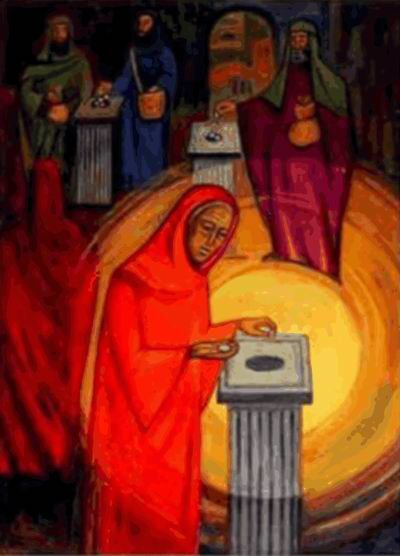
In the Gospel, we hear another sound, neither great nor gorgeous in itself: the quiet chinking of two small coins. Yet, this simple sound has echoed for two-thousand years and millions have been drawn to it. When Jesus Himself heard the sound of the faithful, poor widow’s generous gift, He was moved to speak words in praise. Despite its subtlety, it reminded Jesus of a sound He knew well; it reminded Him of the sound of Heaven.

In our own simple ways, with unending joy, let us echo on earth the song of the angels in Heaven as they praise God’s glory for ever.

Laodicean Christians — Tuesday, 33rd Week in Ordinary Time—Year II

November 16, 2010

The Christians of Laodicea lived in what is now southwestern Turkey. Today, their city is merely ruins, but in those days it was a modern, rich, commercial center of banking, industry, and entertainment. The Christians there were well-off and contented, but Jesus knew them and their city well and he was not content with them. In the Book of Revelation He rebukes them, “You say, ‘I am rich and affluent and have no need of anything,’ and yet do not realize that you are wretched, pitiable, poor, blind, and naked.”

A few decades before, in 60 AD, an earthquake ravaged their city and the Roman emperor offered to send them money to aid in their recovery, but within a year, the wealthy Laodiceans had finished rebuilding using only their own resources. To a people too rich and proud to accept a king’s aid, Jesus says, ‘I advise you to buy from me gold, (good works) refined by fire, so that you may be (truly) rich.’

Laodicea was home to the Marshfield Clinic of its day in the field of eye medicine. There they produced of an ointment for the eye which was used throughout the Roman empire. But Jesus urges the Chrisitians, ‘buy (true) ointment to smear on your eyes so that you may see (the truth).’

Laodicea was also known for its fine, soft, black cloth, made from the wool of the region’s excellent dark sheep. But Jesus sees the Christians’ immorality and warns, ‘put on white garments, so that your shameful nakedness may not be exposed.’

Laodicea had an aqueduct which carried water to the city from hot springs some five miles away, but by the time this water would get to them, it would be merely lukewarm; neither cold enough to cool in hot weather, nor hot enough to warm-up in cold weather. Jesus likens the Laodicean Christians to their water supply. “I know that you are neither cold nor hot. I wish you were either cold or hot. So, because you are lukewarm, neither hot nor cold, I will spit you out of my mouth.”

Jesus Christ, being divine, knows the Christians of Laodicea perfectly well. By their values, words, and actions, He sees them living not much different than any other Laodiceans. And because He loves them, he corrects them, and warns them that they need to repent and to start getting serious about living true, Christian lives.

Do we live in a Christian nation? Compared to the secularized countries of Europe, or to the Asian or African countries where Christianity is the minority religion, the United States is a very Christian nation. On the other hand, only about one in four Americans went to Church last weekend. [source] Only one in four Americans offered up an hour to God, to thank Him, worship Him, and to fulfill the commandment, “You shall keep holy the Lord’s day.” Of course, being a Christian is about more than just going to Church, but this gives us some indication of our society’s commitment to Christ.

To think of our country as a Christian nation at a 25% level, or to a 25% degree, is both discouraging and encouraging. It is discouraging that our devotion is not greater, but there is encouragement to be found in this: if our society’s half-hearted, or even quarter-hearted commitment to Christ and His Gospel can do as much good as we see now, imagine what things would be like if we were whole-heartedly His disciples.

As G.K. Chesterton said, “Christianity has not been tried and found wanting; it has been found difficult and not tried.” The Gospel is supposed to be radical. It’s supposed to change the world. If there is nothing very counter-cultural about your life as a Christian, then you are not yet living out the Gospel like Christ calls you to do. If you are living the same way as everyone else in our present-day Laodicea, then Jesus Christ’s wake-up call from the Book of Revelation through the centuries is addressed to you.

Jesus is looking for people who will go out on a limb for Him, people like Zacchaeus, people who will risk the mockery and judgment of others, people who would give half of their possessions to the poor if that is what Christ wills, people who will rise and open the door for Christ when they hear Him knocking. Jesus is looking for disciples who seek the riches of being a true and whole-hearted Christian. With a person like that, Jesus can change the world.

Go to church every weekend, pray every day, and do not merely learn about our faith but act on it in your life. Jesus Christ pleads to you, through me and your teachers who have witnessed their faith to you, please: go out on the limb for Him.

True Christian Soldiers — November 11 — St. Martin of Tours — Veterans Day

November 11, 2010

This morning I would like to tell you two stories. The first is the story of a cavalry officer who was sent to serve in France. He grew up in a military family and got enlisted when he was still only a teenager. Interestingly, his parents were not Christians, but this young man was studying in preparation to become a one himself. He was what we call a catechumen.

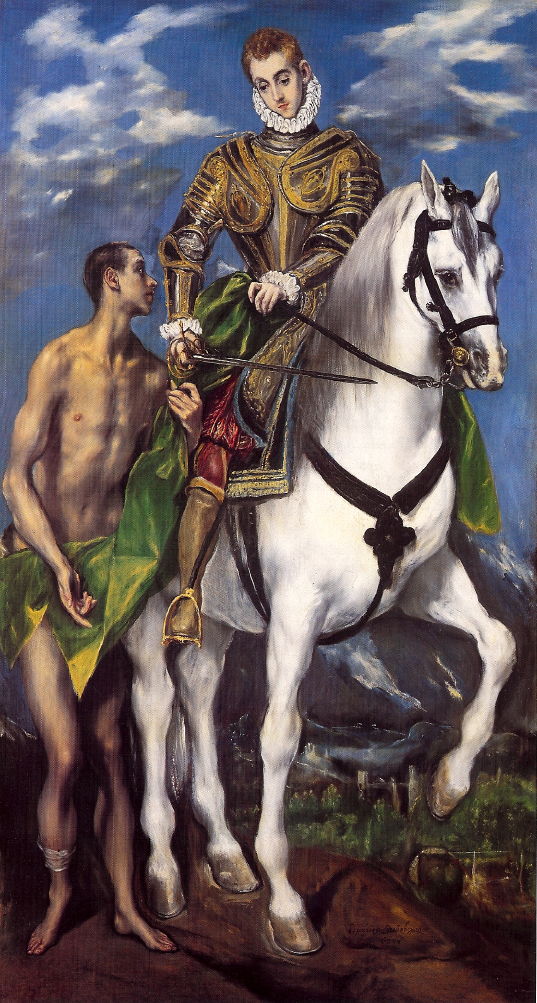
One cold winter day, at the gates of the French city of Amiens (A-mi-en), he encountered a shivering, half-naked beggar. This miserable sight disturbed the young soldier and he drew his sword from its scabbard. Because he had nothing else to give the poor man, the soldier took his own cloak, cut it in two pieces, and reaching down from his horse handed one half to the beggar. Giving away half of his cloak was no small gift, considering that the soldier himself needed to keep warm, too. In this act, he had loved his neighbor, the beggar, as himself.

That night, the soldier had a dream in which he saw Jesus Christ, surrounded by angels, and dressed in half a cloak. He heard a voice say to look at the garment and say whether he recognized it. He then heard Jesus say to the angels, “Martin, as yet only a catechumen, has covered me with his cloak.” Very soon after that dream, Martin, the 18-year-old Roman soldier, was baptized. He would go on to become a monk, a priest, and a bishop. Today we call him as St. Martin of Tours, and celebrate him as the patron saint of soldiers.

My second story comes from more recent times. A great and horrible war was raging, as it had for more than four years, killing every day. Many people could see no end in sight. But then, ninety-two years ago today, the wonderful order came announcing an end to all armed conflict at the 11th hour, of the 11th day, of the 11th month, of the year 1918. This was the end of the First World War and it came to pass on the ancient feast day of St. Martin of Tours, the 11th of November.

Do you think that St. Martin in Heaven may have prayed for his beloved France and for their enemies, too? Do you think that he interceded before God for peace on Earth? Of course he did, for he was a true Christian soldier. No true Christian soldier loves war, or even hates his enemy. He fights not because he hates who is in front of him, but because he so loves what is behind him. The Christian soldier trains for war because he loves peace.

Today we thank and honor our veterans for they have served to defend our nation and freedom-loving people around the world. Through the intercession of St. Martin of Tours, let us pray that our country, history’s most benevolent superpower, may be served by Christian soldiers like them for many peaceful generations to come.

Prepare Yourself—Wednesday, 30th Week in Ordinary Time—Year II

October 20, 2010

If you knew for a fact that you were going to die, or that Jesus was coming again,  one month from today, how would you begin living your life differently?

  • Would you pray more? 
  • Would you work harder to do good deeds?
  • Would you resolve to crush lingering vices?
  • Would you forgive enemies?
  • Would you show greater love toward people in your life?

Jesus said to his disciples:

“Be sure of this: if the master of the house had known the hour when the thief was coming, he would not have let his house be broken into. You also must be prepared, for at an hour you do not expect, the Son of Man will come.”

This is much is certain: someday we will die, or we shall live to see Jesus return ‘at an unexpected hour.’ So, let us commit ourselves by the grace of God  to living in such a way now that if someone were to ask us what we would do differently if the end of the world or the end of our lives were near, we could honestly answer, “Nothing. Nothing at all.”

The Author of Life — Tuesday, 27th Week in Ordinary Time—Year II

October 5, 2010

If you took our Catholic faith and boiled it down to its most central and fundamental truths what would you have? I think you would end up with these four foundations:

First, that God is three divine persons who are one in being, a union we call the Trinity. Second, that Jesus Christ is both God and Man, a reality we call the Incarnation. Third, that Jesus Christ, to save us from sin and death, suffered, died, resurrected and ascended, an event we call the Pascal Mystery, and from which Jesus empowers His Church’s sacraments. And fourth, that every, single, human being has inherent worth and surpassing value, a truth we call the dignity of the human person. It is this fourth fundamental truth of our Catholic Faith that I will focus upon today.

The psalmist says to God:

“Truly you have formed my inmost being;
you knit me in my mother’s womb.
I give you thanks that I am fearfully, wonderfully made”

From the womb, God fashioned your inmost being, giving you an intellect to know, a freewill to act, and a desire for loving communion with others. Made in God’s own image and likeness, made for a purpose and made for love, every human life is precious from conception to natural death.

Sadly, laws sometimes disregard this dignity, and even Christians can forget it too. Martha looked down on her sister because she thought Mary was not being useful enough or productive enough. Martha only saw Mary as causing a burden to herself, yet Mary was exactly where the Lord willed her to be.

As Mrs. Eichstadt said before, God has a providential plan for each one of you. Like St. Paul, the Lord has set you apart from your mother’s womb for a great story which He has in mind. But anyone who would presume to cut short an innocent life would deprive God of a masterpiece.

Assisted suicide or euthanasia rips out the crucial final chapters. Suicide, murder, or neglect of our neighbor unto death, would end a story halfway. And abortion prevents the story from ever being told. Jesus is the author of our lives and He is to be the one who decides when our lives end. Maybe you will always remember the homily when Father tore up a book, but remember this too: every human life is precious and worth more than many, many books.

Job’s Desolation — Tuesday, 26th Week in Ordinary Time—Year II

September 28, 2010


The sadness of Job is like a heavy stone hanging from his neck.

In his pain, he seems to forget that he is surrounded by people who care about him very much. When Job’s friends learn of his misfortune they come to him. For days and nights they sit with Job, listening, not saying a word, yet saying a great deal by just being there. He is not alone.

In his despair, Job imagines that his life will never get better. Yet he cannot see the future. The Lord is going to bless Job and happiness will return to him.

In his darkness, Job wishes he were dead. He asks, “Why did I not perish at birth?” Yet death is not the way. When the Samaritans rejected Jesus, James and John asked to rain down fire, but Jesus rebuked them for it. As long as there is life, there is hope, for the Samaritans, and for us.

How wrong it is if we mistake death for the way of peace, for that is not Christ’s answer. How wrong it is if we imagine that we will never be happy again, for sun’s light shines beyond our horizon or behind the clouds, even if we cannot see it. And how wrong it is if we forget that people care about us, for each of us here is loved more than we know.

The Scandalous Cross — September 14 — Exultation of the Holy Cross

September 14, 2010

Jesus died on a cross. But what if Jesus had died differently? Then, instead of crosses, Christians might wear little nooses. Under different circumstances, we might be celebrating the Feast of the Holy Electric Chair, or the Exultation of the Lethal-Injection Syringe. These images unsettle us, but we are comfortable with the idea of Jesus’ cross. However, whenever we find ourselves complaining, we are feeling the scandal of the cross.

We will naturally dislike it when life is hard on us, but “do not forget the works of the Lord.” Jesus’ crucifixion, despite its pain, injustice, and seeming futility, was the means for His glory and for our salvation. With Christ we become invincible, because even our suffering profits us. So when unavoidable crosses come, patiently bear them and use them as a powerful offering to God.

The Child Mary — September 8 – Nativity of Mary

September 8, 2010

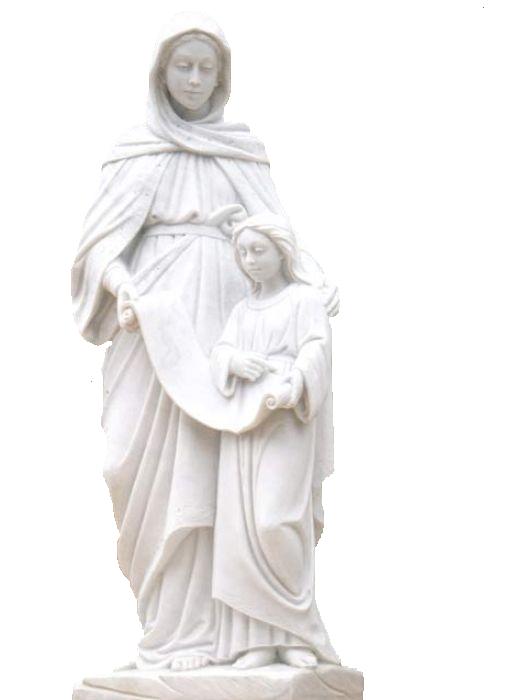
Nine months ago we celebrated Mary’s Immaculate Conception. Today we celebrate her birthday. By my estimation, Mary is now about two thousand, twenty-five years old, but if you saw her I’m sure she wouldn’t show her age. How old does Mary seem when you picture her in your mind? I’d bet that you think of her as fully-grown up; like your mom or your teachers. But today’s feast reminds us that she was once your age too.

Mary was little once too, and just because Mary lived a life without sin doesn’t mean that her childhood was a bed of roses. I think adults sometimes forget how hard and stressful things can be when you’re little, but Mary remembers everything perfectly well.

She remembers what it was like to be little like many of you. How she got scared when Nazareth’s big, neighborhood dogs would bark at her. How loud cracks of thunder frightened her at night and made her hide under the covers. She remembers how other girls made fun of her, for being different or weird, and she remembers how she cried. But even when she got sad or scared, Mary knew that she was loved and not alone. Not only did her parents love her, but she was convinced of God’s love, too, and understood that He was never far from her. This consoled Mary and reassured her that everything would be alright.

After our resurrection, when we get glorified bodies like Mary has now, we will have some new abilities. We will be able to go anywhere we want in an instant. And our glorified bodies should allow us to be more than one place at once. (It only makes sense that if saints on earth can bi-locate, then the  saints in Heaven should be able to as well.) And I also suspect that we will be able to change ourselves back and forth to whatever age we choose.

All this is to say that if at any moment you want Mary to be with you for consolation and support, you only need to ask her. Knowing her abundant love, I can’t imagine she would refuse. And when you think of her with you feel free to picture her at your age, even if you’re little. She understands you, loves you, and can relate to your situations more than you know. Like her Son, Mary is always with us, especially when we ask her be.

Preparing for Tests — Friday, 8th Week of Easter

May 31, 2010

Today were heard from the first encyclical of the first pope. Today’s first reading came from the First Letter of St. Peter. And what he said applies to you: “The end of all things is at hand.” Originally, St. Peter meant that Christians should always be ready for the end of their lives or the end of the world (whichever comes first.) But this morning I think we can hear the Holy Spirit speaking to us about the coming end of this school year.

At Columbus, the end of all things is at hand: that means finals week, with all of its due dates, studying, and exams. Don’t be surprised that this trial by fire is occurring among you, as if something strange were happening to you. Finals week happens every year. I know that finals time is a challenge and that it takes some hard work, but why should this trial overwhelm us or make us behave ugly towards each other? If we have Jesus Christ in our lives we should face difficulties differently than the world does. The beauty of a soul at peace in Christ, is seen through the person’s  graceful actions.

So how should we face our finals? First of all, have faith in God, and remain at peace, confident that no matter what, everything is going to be ok.  Second, be serious and sober-minded. You’ve worked for the whole semester. Now keep going just one more week to maintain or even improve those grades you’ve worked for all semester. And third, above all and through it all, let your love for one another be intense, be hospitable to one another without complaining, and as each of you has received gifts. Use them to help one another.

At this Mass, prepare yourself. Ask Jesus for constant peace, for steady focus, and for generous love throughout finals week so that you may perform at your best in every respect. It’s nice to get good grades in school, but that’s not the most important thing. The most important thing is to be prepared for the final exam which awaits us all.

Farewell, and Farewell — Friday, 7th Week of Easter

May 23, 2010

When you were younger, your parents dressed you, and you were often led where you did not want to go. But now that you are older, you dress yourselves and more than ever you go where you wish.

As this school year ends, you take another step into the maturity of your youth. Soon you will be leaving school. Some of you will be leaving for the freedom of summer. You seniors will be leaving to begin the rest of your lives.

Your new freedom calls on you to make important choices about Christ. Now the question comes to you: Do you love Him? Do you want to respond like Simon Peter in the high priest’s courtyard, with a non-committed shrug as you walk away? Or will you choose to respond like St. Peter the Rock, who said, “Yes Lord, you know that I love you,” and then lived a life which proved that love.

Jesus asks you, “Do you love me?”  How are you going to answer Him?  Jesus asks you to do at least these things: to pray every day, to attend Mass every week, and strive to do His will every day.

Freely give your freedom to Jesus. He has given you everything good that you are. He has given you everything good that you have. Give it all to Him and stand in His will. His love and His grace are more than you know. He wants to give you more than you can ask. Jesus asks you, “Do you love me?” Follow Him.

God’s Favorite Instrument — Tuesday, 6th Week of Easter

May 11, 2010

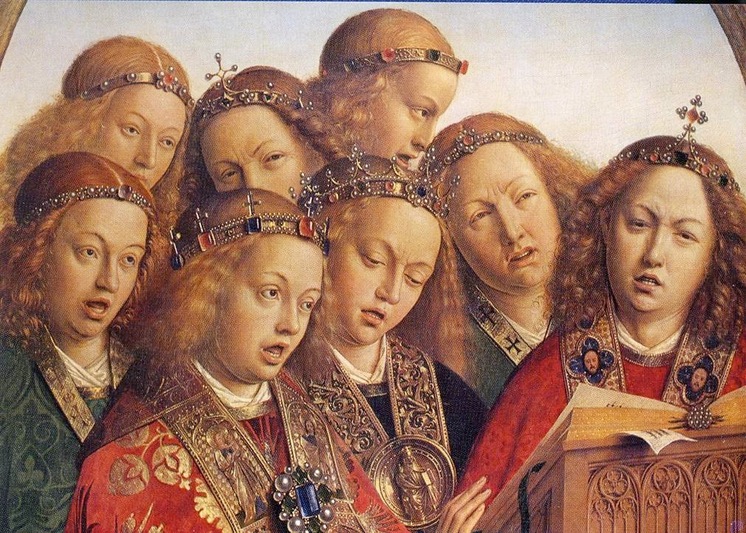
What is God’s favorite musical instrument? Harps? Organs? Bongos? I believe it is the instrument He created Himself, the one which He loved so much that He gave one to each of us for free–the human voice.

God is pleased when we sing for Him. St. Augustine said, “The person who sings prays twice.” Some people say this is because singing adds melody to our words of prayer. But it could be that a person sings twice because singing enlists the heart to join in the prayer of the mind. Singing lifts up our hearts to the Lord.

In today’s first reading, the missionaries St. Paul and Silas get beaten and stripped. They are locked in prison with their ankles placed in stocks. Things are at their darkest and most difficult time, but the night finds them not only praying, but singing hymns. This lifts their spirits, shakes loose their bonds, and pours out grace on that place. Singing makes a difference.

Maybe you feel like coming to our weekly school Masses is like being led somewhere in shackles. But if you must be here either way, why not make the most of it? Singing at Mass (and I mean really singing) is liberating, and a gift to God. 

If God has blessed you with a beautiful voice, sing strongly, as if to say to God, “You gave me this gift, and I offer it back to you.” If He has not blessed you with a good voice, you should still sing boldly, as though to say, “You gave me this voice, and I’m going to let you have it.” Your voice is God’s favorite instrument. So at this Mass and at every Mass, let Him hear it.