Archive for the ‘School Homilies’ Category

3 What If’s — Tuesday, 5th Week of Easter

May 4, 2010

Before today’s Mass, I would like you to imagine three “what if” scenarios. How would you respond in the three situations I’m about to describe?

First:  Imagine, what if, at this morning’s school Mass, the great apostle St. Paul was going to preach to you? How interested are you in whatever he has to tell you?

A second scenario: What if there were a book out entitled, Actual Prayers of Jesus and Mary, and what if there was strong archeological evidence to support that these really were prayers which Jesus and Mary prayed frequently during their lives on earth? How interested are you in discovering these prayers? How powerful would it be for you to pray their prayers?

The third and final scenario: What if I were to tell you, calmly and with firm conviction, that I had received a message for you, a revelation, from Jesus Christ, which He wanted you to hear through me at this Mass? How interested and open are you to receiving such a message?

Of these three scenarios, which one would you most desire to be true?Now listen closely…. All three of these scenarios will be realized, will be true, at this Mass.

The first scenario will be realized: St. Paul will indeed preach to you–in this morning’s first reading. Perhaps St. Paul did not realize it when he first spoke these words, nor perhaps did the sacred author who wrote them down in the Book of Acts, but the Holy Spirit was inspiring, was guiding these words.

And the Holy Spirit did not only have the first-century Christians of Lystra, Iconium, and to Antioch in mind when He prompted these words. St. Paul’s inspired message is meant for us today just as much as they. So this morning, St. Paul will preach a message (though only one sentence long) which is truly intended for you.

As to the second scenario, where is this book containing Actual Prayers of Jesus and Mary? We read from it at almost every Mass, as we will today. This book is the Book of Psalms. In the day of Jesus and Mary, all devout Jews prayed these 150 psalms and they usually knew them by heart. Jesus and Mary prayed the Psalms too. These prayers were inspired by the Holy Spirit to be prayed by all God’s people, including us today, but one could say that the Psalms find their fullest voice through Jesus and Mary. In today’s responsorial psalm, we will join Jesus and Mary in one of their powerful prayers in praise of the Lord.

The third scenario will also be true at this Mass: I have indeed received a message from Jesus Christ which He wants you to hear through me this morning. You will hear His message addressed to you in the proclaimation of the Gospel. At the Last Supper, Jesus was not only speaking to the disciples seated around Him. With His divine sight, Jesus saw all of us here then, and He speaks intending His words for us this morning just as much as they. How much will you allow Jesus’ message to you to affect and change you?

We believe that, “When the Scriptures are read in the Church, God himself is speaking to his people and Christ, present in his own word, is proclaiming the Gospel.” At this and at every Mass, let us come to the Scriptures expecting much, so that we may find much, and receive in from them in abundance.

The Miraculous Pool — Tuesday, 4th Week of Easter

April 28, 2010

Once upon a time, in a certain forest clearing, there was a miraculous (and strange) pool of water. The pool’s waters’ were miraculous, having unique healing and life-giving properties, but something else made this pool strange. When travelers would come upon it, the pool would appear differently depending on how the person approached it.

For those who expected to find something remarkable, the pool was large and deep, and drinking its waters was powerful. But for those who came expecting little or nothing (and there were many such people,) the pool had the appearance of a small, cloudy puddle, and they would not drink from it.


Why did so many come expecting so little, and walk away unchanged? Maybe they had passed by that clearing a hundred times before; and, never expecting much, never had found very much. Maybe they dismissed the whole idea as superstition, as an old myth. Maybe they had never seen evidence that this pool was any better than any other because the people whose lives had been changed by its waters were too timid to give a strong witness to its power and reality.

Now we come to the point of this parable of mine. Encountering our Catholic Faith, the Mass, and the Scriptures is a lot like encountering this miraculous pool. When we expect much, we find much, and receive a great deal. And when we expect to get nothing from them, the usually meet our expectations.

I believe our Catholic Faith is a miraculous pool with the power to change everything. Walking in Christian faithfulness is hard for everyone at times, but I have seen too much, firsthand and from others’ experiences, ever to walk away from Christ and His Church. I have forsaken all other paths for my one life because I am convinced that our Faith, the Mass, and the Scriptures are true, and powerful, and good. Yet even I often need to remind myself not to settle, but to go more deeply and prayerfully into these dangerously familiar things. And when I do, I receive more. I think we all need to receive more. So, in the weeks ahead, I’m going to teach, through pre-Mass talks like this one, or through homilies during Mass, about ways to drink from the miraculous pool to our greater benefit.

For this morning’s Mass, I have four suggestions:

1.  Pray to the Holy Spirit for a more expectant and receptive heart.
2. Form a Mass intention to pray for during the Eucharistic prayer.
3. During the psalm, try to find the Virgin Mary or the Church in it.
4. Listen to Jesus speak to you in the Gospel for He will be speaking to you through His word.

 Let us approach this miraculous pool expectantly.

The Apostles’ Charge — Thursday, 2nd Week of Easter

April 16, 2010

 The high priest Caiaphas had once remarked to the Sanhedrin during the time of Jesus’ ministry:

“You know nothing, nor do you consider that it is better for you that one man should die instead of the people, so that the whole nation may not perish.” He did not say this on his own, but since he was high priest for that year, he prophesied that Jesus was going to die for the nation, and not only for the nation, but also to gather into one the dispersed children of God. (John 11:49-52)

The high priest, whom many Jews believed possessed the gift of prophesy, here spoke words truer than he realized. A similar episode happens in today’s first reading:

When the court officers had brought the Apostles in and made them stand before the Sanhedrin, the high priest questioned them, “We gave you strict orders did we not, to stop teaching in that name. Yet you have filled Jerusalem with your teaching and want to bring this man’s blood upon us.”

With their teaching, the apostles have indeed filled Jerusalem, the true and heavenly Jerusalem, with the souls of the saints. And the apostles did want to bring Jesus’ blood upon those who questioned them, for the blood of Christ cleanses us from sin. In his revelation, St. John “saw the holy city, a new Jerusalem, coming down out of heaven from God, prepared as a bride adorned for her husband.” (Rev 21:2) “They have washed their robes and made them white in the blood of the Lamb.” (Rev 7:14)

The Sanhedrin commanded the apostles to stop proclaiming Jesus, but the apostles replied, “We must obey God rather than men,” for as John’s Gospel says, “whoever disobeys the Son will not see life.” The Gospel teaches, “Whoever believes in the Son has eternal life, but whoever disobeys the Son will not see life, but the wrath of God remains upon him.” But who truly believes and shall be saved?  Who disobeys and shall be condemned? Thankfully, this final judgment is not ours to decide, but our mission from Jesus is clear. Like the apostles, with Jesus’ teachings we are to fill the heavenly Jerusalem  and bring Christ’s saving blood upon all people.

11 Absent Students — March 25 — Annunciation

March 28, 2010

You have probably wondered why our school chapel’s icon, statues, and crucifixes are veiled with purple cloth. Covering of religious images is a tradition for the last two weeks of Lent, a period we call Passiontide. So why do we have this tradition?

One explanation recalls that Jesus’, when His enemies sought to kill Him, hid Himself prior to His final days: “Jesus left and hid from them.” (John 12:36) Others see in this veiling a symbol for how Jesus’ divinity was veiled within His humble and vulnerable humanity. He was God incarnate, but none of the rulers of His age knew, “for if they had known it, they would not have crucified the Lord of glory.” (1 Corinthians 2:8) But behind all of this I think there is a very human reason for why we veil the holy images of Jesus and the saints at Passiontide. “Absence makes the heart grow fonder.”

During Lent we deprive ourselves of luxuries and pleasures for our personal conversion and growth in holiness, but we also do this so that we can celebrate the Christ’ Easter triumph with an even greater feeling of joy. This is why we normally don’t sing as much (or say the Gloria or the “A”-word before the Gospel) during Lent—so that we can enjoy pulling out all the stops at Easter.

Veiling our statues of Mary and Joseph, our wall icon of Elizabeth Ann Seton, and our crucifixes causes a little pain of separation within us. But what if this chapel had never been furnished? What if our chapel had always been bare of religious art? Then their absence would not affect us at all because we would not know that we were missing them.

There are not as many students here today as there should be. Now I’m not saying that this should have been a whole school Mass, and I’m not begrudging anyone who may have stayed in study hall this hour to work on homework.  This is a great turn out and every seat is filled. But still, there are not as many students here as should be here today.

In the early nineties, when most of you were born, for every three live births in our country there was one boy or girl who was intentionally killed. (CDC) I counted roughly 33 students here today. That means we are missing 11 of your classmates who were not allowed to be born.

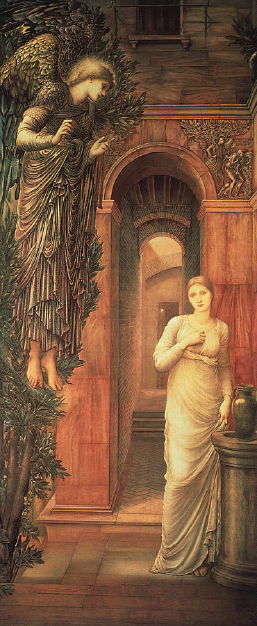
Today we recall the Annunciation, which some people call “Pro-Life Christmas,” for even though Jesus will be born nine months from now, today is the day of the Incarnation, when God became a human being like us in the womb of the Virgin Mary. After the angel Gabriel departed, Mary went in haste to see her relative. Elizabeth exclaimed, “Who am I that the mother of my Lord should come to me,” and John the Baptist leapt for joy in his mother’s womb in the presence of our microscopic Savior, Jesus Christ. (Luke 1:43-44)

Imagine if 11 of your classmates were to die in a bus accident. You would you feel terrible from the loss, and our whole school would be in mourning. But we have never known the 11 who are missing here today, so we do not feel our loss.

At this Mass and henceforth, let us keep the following things in mind regarding the past, present, and future. As to the past, remember these absent classmates and pray for them. They never received a name, they never had a funeral, and few people have ever prayed for them. Pray for their parents, too. 

In the present, perhaps you honestly find yourself not feeling much emotion one way or the other towards the reality of one million innocents being murdered in our country every year. If so, then ask God to give us His heart and His sight to love what He loves and to hate what He hates. God loves us all, but He hates our sins. He hates our sins because they are bad for us, and the worse they are for us the more He hates them. His love for us and His hatred for our sins are two sides of the same coin. Blessed Mother Teresa of Calcutta said “the greatest destroyer of peace today is abortion.” The Lord’s heart is certainly not indifferent to this evil, and neither should ours be.

And finally, for the future, keep hope that this evil of abortion will come to an end in our time. We can have this hope, for as the angel Gabriel said to Mary, “nothing will be impossible for God.”

One Catholic Church — Tuesday, 3rd Week of Lent

March 9, 2010

In the first reading we hear the ardent prayer of an Old Testament Jew named Azariah who finds himself in a pretty hot spot. He fervently prays, “… O Lord, do not deliver us up forever, or make void your covenant. [Save us for] the sake of Abraham, your beloved… to whom you promised to multiply … offspring like the stars of heaven, or the sand on the shore of the sea.”

This was God’s covenant promise to Abraham, and God has indeed made Abraham’s spiritual offspring vast and numerous. Today, half of the people on earth claim Abraham as their father in faith—these are Christians, Muslims and Jews who all seek to worship the God of Abraham.

Yet Jesus prayed that all people would be one in Him, as one holy family of God—a diversity of persons sharing one perfect unity. To achieve this goal Jesus established one, holy, catholic, and apostolic Church, so that all may be one, as He and the Father are one. Our Church was established by Jesus, Himself, who said to Peter, our first pope, “You are rock, and upon this rock I will build My Church.”

Our Catholic family is made up of every race and reaches to every nation. To illustrate this, I would ask all high school students; freshmen, sophomores, juniors, and seniors, to stand up now. Imagine that these 146, or so, young men and women represent the world’s nearly 1.2 billion Catholics. Each one represents about eight million of our  Catholic brothers and sisters.

In the United States we have 68 million Catholics, but this is only 5.7% of all the Catholics in the world. I would now ask the male freshmen to remain standing and for everyone else to sit down. These guys represent the Catholics of the United States, plus the rest of North America and the Caribbean—just 9% of Catholics worldwide.

The freshmen can sit down and I would ask the male sophmores to stand up. This is Asia, Australia, and the Pacific Islands, totaling 11% of all Catholics.

You can sit and I’ll ask the senior males to stand. This is Africa’s Catholics, 12% of the Catholics in the world.

You can sit and we’ll have the male juniors and the female seniors rise. This is Europe, 27% of all Catholics.  (The pope is in there somewhere.)

You can sit and we’ll have our largest region of all, represented by the female juniors and the full sophomore class, please stand. This is Central and South America, where 39% of all Catholics live.

So, as you can see our Catholic family is far more diverse than you might have imagined. We are young and old, men and women, rich and poor, sinners and saints.

Our Catholic family not only spans the globe, it also spans the centuries. This is reflected in the ancient prayers we sing today, such as the Latin Sanctus and Agnus Dei, the Kyrie which is ancient Greek, and the Amen which is Hebrew.

Let me put this another way: Could I have one high school student please stand up. This one person represents about 13½ years, which is about how long you have had to explore and get to know about your faith. Now could all of the high schoolers please stand up. You represents all the years that the Church has been on earth, since 33 AD. Our Church has been around a lot longer than we have. You may be seated.

Roman Catholics make up the largest religious denomination in the United States.  However, it is said that the second largest denomination in our country would be former Catholics. Tragically, many Catholics leave the Church. Oftentimes, they experience one or two parishes and a couple of priests, in one region, of one country, over a handful of years, and they imagine that they have exhausted the riches of the 2,000 year-old worldwide Church and Faith of Jesus Christ. But in reality, you can explore the mysteries of Catholic beauty and truth for a lifetime and never exhaust them.

My message for you, with all passionate the urging of Jesus Christ, is this: always remain in the Church that Jesus Christ founded. Never walk away from the fullness of God’s family, but dwell in the household of God.

Sources:
Distribution of Catholic Population, by Region: 2000
USCCB: The Catholic Church in the United States At A Glance

The Our Father — Tuesday, 1st Week of Lent

February 23, 2010

When the apostles asked Jesus how they should pray, Jesus taught them what is called the perfect prayer, the “Our Father.” It is a concise prayer, with just seven petitions (a perfect number for the Scriptures,) yet there is great depth beneath its simplicity.  This morning I show you three insights into this prayer which I hope will come to your mind from time to time as you pray this prayer for the rest of your lives.

First, Jesus teaches us that we are to pray to “Our Father.”  This is a far more wonderful thing than we realize.  To see its greatness, just imagine if the prayer were different. We do not pray, “Our tyrant, who art our ruler, before thee we grovel.” Nor, “Our master, we art thy slaves, for thee we must toil.” And we do not say, “Unknowable one, whom none can name, unapproachable be thy being.” We pray, “Our Father who art in heaven,” hallowed be His name.  We have the privilege to call God our Father on account of our faith in His Son, Jesus Christ. Jesus is God’s Son by His nature, (God from God, light from light,) but we are made God’s children by adoption through Christ. One way to see why this is such a big deal is to imagine if God were everyone’s heavenly Father, except for you. Whatever applies to a good father’s relationship with his natural children, also goes (with limited exceptions) for the perfect Father’s relationship towards us, His spiritual children. Keep in mind how privileged we are when you pray to “Our Father.”

The second insight this prayer yields is the proper attitude we should have towards prayer. Perhaps you’ve heard some people say, “Well, if you like to pray that’s fine—I mean, if that helps you to motivate yourself that’s great,” as if the only power of prayer was to change one’s personal attitude. This is something said by people who don’t pray, and if we thought as they did then we wouldn’t pray either, for who would bother to ask someone else to receive what is already in one’s own hands (i.e., the choice of one’s own attitude.) A second motivation among people who do not pray is more faithful, but also misguided. These say, “I can’t change God’s mind, so why should I bother to pray? Whatever He wills will be, whether I pray to Him or not.”

The first three petitions of the “Our Father” are worded carefully. They do not say, “Our Father, who art in heaven, make your name holy among us, make your kingdom come upon us, and make your will be done among us.” This would put everything on God. Nor do the opening lines read, “Our Father, who art in heaven, we will glorify your name, we will make your kingdom come, and we will make your will be done, on earth as it is in heaven.” This would put everything in our own hands.

The prayer which Jesus gives us does not put everything on God, or put everything on us. Jesus presents the middle and true way of faith. We are not called to an independent activism, nor to a vacant passivity, but to an active receptivity in relationship with God. Like the Virgin Mary, we are to stand before our Father, with a spirit of active receptivity, and pray, “Behold, I am yours, may your will be done, in and through me, and on earth as it is in heaven.”

There are some things which are simply beyond my human ability.  For instance, I can no more forgive my own sins than I can pull up on my belt loops and hold myself up in midair. However, that does not mean I can do nothing to help my situation. I can first forgive others as I wish to be forgiven. I can pray, go to confession, and tell God that I’m sorry. God calls us to do our part and to cooperate in His work.

Maybe this explains why Jesus could not work great miracles where people were lacking faith. It was not that such things were beyond God’s omnipotent power, it is that God insists upon doing His works in relationship with us, rather than entirely apart from us. (This is His purpose in establishing the Church—to do His saving work with and through us.) Like St. Augustine said, ‘The God who created us without us, will not save us without us.’

The third and final insight into the Lord’s Prayer regards the meaning of the petition for “our daily bread.” We say, “Give us this day our daily bread.” We can pray for this “bread” in three senses; literal, spiritual, and Eucharistic.

First, there is the literal sense, praying that God would provide for our material needs in life; such as housing, clothing, and food. We take these things for granted—your daily bread already waits for you in the cafeteria or in your kitchen at home—but there are many people around the world, who are much less well-off than we are, who pray these words from their hearts every day. Occasionally we should call these brothers and sisters of ours to mind and pray these words as intercession on their behalf before our Father.

Second, there is the spiritual sense, asking for the graces and helps that money can’t buy; such as peace and virtue, faith, hope, and love. Without these things, even a rich man remains impoverished, for man is not meant to live on material bread alone.

Third and finally, there is the Eucharistic sense, which asks for the bread from this altar which is God’s Son. Whenever we receive Jesus in the Eucharist He remains with us and in us until we receive Him again (unless we should disinvite and evict Him by committing grave sin.) In this way, Jesus persists as our “Daily Bread.”

So when you pray the “Our Father” realize your privilege in being His child through Jesus Christ. Consider that the coming of the Kingdom is a joint effort of God with man, in which our prayers play an important part. And pray for all your daily bread; literal, spiritual, and Eucharistic. May you remember these insights for all of your life and may the words of Christ’s perfect prayer make you a fruitful child of our Father.

Romantic Christianity — Friday after Ash Wednesday

February 21, 2010

In the gospel disciples of John ask Jesus, “Why do we and the Pharisees fast much, but your disciples do not fast?” Jesus answered them, “Can the wedding guests mourn as long as the bridegroom is with them?” Of all the images in the Bible to depict the relationship between God and His people, perhaps the most common is that of bridegroom and bride.

As we begin this Lent we should understand that the saints became holy and made their great sacrifices not by relying upon their own “iron-wills,” but by falling passionately in love.

If we strive after holiness as a personal achievement our exertions will make us discouraged and resentful, like the people in the first reading who complain, “Why do we fast, and you do not see it? Afflict ourselves, and you take no note of it?”

But what sort of person can make incredible sacrifices for another, without counting the cost, and feel intoxicating happiness as they do so? A person who can do this is a person who’s in love.

What if Christianity is not supposed to be so hard as you’re making it out to be? What if it is supposed to be as easy as falling in love? Perhaps you are being called to a new approach.

Unashamably Christian — Ash Wednesday at the School

February 17, 2010

In today’s Gospel, Jesus warns us against giving so that others see us giving, against praying so that others see us praying, and against fasting so that others see us fasting. Yet, I don’t think that showy religiosity is where the danger lies for us.

In Jesus’ day, the popular culture proudly believed in God and respected religious piety. Hence, those people were tempted to publically flaunt their acts of prayer, fasting, and almsgiving and thereby gain the respect and praise of others. But today, in our secularized culture, the temptation is to do the opposite, and to do something far worse. We are tempted to deny our faith in Jesus Christ and His teachings before others because we’re afraid of what they might think of us.

The hypocrites who pray to be seen by others limit their rewards, but if we deny Christ lose our rewards entirely. I’ve touched on this topic twice before from this ambo, as recently as three weeks ago, but I feel that it is important for me to emphasize it, and that it’s important for you to hear it. For Jesus tells us:

“Whoever is ashamed of me and of my words, the Son of Man will be ashamed of when he comes in his glory and in the glory of the Father and of the holy angels.” “Everyone who acknowledges me before others I will acknowledge before my heavenly Father. But whoever denies me before others, I will deny before my heavenly Father.”

This Lent, let us begin to put God first; in our prayers, in our penances, and in our personal relationships.

Are you someone who will be so embarrassed by having an smudge of ash on your forehead that you’ll want to wash it off the first chance you get? Well then, you’re someone who needs to leave it there until it wipes away on its own.

Are you are someone who sees good deeds that call out to be done but pass them by because of the people who would see you doing it?  Then you need to bite the bullet and start doing those hard-good-deeds anyways.

Are you someone who will have more to say in gratitude to God after Mass this morning than is allowed by the eight seconds before your pew starts clearing-out? Well, then you need to stay in your pew to say what your heart wants to say as long as you need to say it (without, of course, being late to class.)

Now, these are not examples of performing righteous deeds so that others may see you.  This is doing the right thing even if others might happen to see you doing it.

If you’re self-conscious about other people seeing your devotion to the Lord (for instance at Mass) do not pray that you would be invisible to them; ask that they would invisible to you and continue as you would.

You are called to be the light of the world. People do not light a candle and then put a bucket over it; it is set on a lampstand, where it gives light for everyone. Just so, your light must shine before others, that they may see your good deeds and glorify your heavenly Father.

This Lent let us begin to love and serve the Lord in the world. This Lent, let’s begin to shine.

The Fool’s Blindness — Tuesday, 5th Week in Ordinary Time—Year II

February 9, 2010

Some priests like to begin their homilies with jokes. Today I’m going begin by telling you a few jokes—some very, very old jokes. In fact, they come from the oldest joke book in the world, a collection of 265 jokes from the 4th century A.D. entitled The Philogelos, or (in English) The Laugh-Addict.

One day an intellectual bumped into a friend and said to him, “I heard you were dead.” “Well,” said the friend, “As you can see, I am very much alive.” “Yes,” [replied the other,] “but the person who told me you were dead is much more reliable than you.”

[On another occasion,] A doctor stole the lamp of a man whom he was treating for inflammation of the eyes. A few days later, the doctor asked the patient how his eyes were. “It’s a funny thing, [Doctor,] ever since you treated them I haven’t been able to see my lamp.”

[And finally,] An intellectual was [once] on a sea voyage when a big storm blew up, causing his slaves to weep in terror. ‘Don’t cry,’ he consoled them, ‘I have freed you all in my will.’”

Now these three jokes have something in common, besides being very old. They all share the have comedic device: a foolish person who focuses on the wrong thing, like the patient who mistrusts his eyes more than his doctor. This is called majoring in the minors, or as Jesus would say, “straining the gnat and swallowing the camel.” In the Gospel today, Jesus really takes it to the scribes and Pharisees for doing this sort of thing: “You disregard God’s commandment but cling to human tradition. … This people honors me with their lips, but their hearts are far from me…”

So do we focus on small details of our faith and neglect what’s really important? For instance, next Wednesday is Ash Wednesday, the beginning of Lent, and during Lent we usually give up something we enjoy as a form of penance until the joyful celebration of Easter. Now keeping a Lenten penance is a good tradition, because penance helps us to shed old sins and to grow in our ability to do good and to be happy. But… if we give up pop, cookies, candy, or ice cream, while we neglect to go to Sunday Mass, we are keeping a human tradition while we neglect God’s command: keep holy the Lord’s day. Instead of doing neither this Lent, please do both.  Take a penance and go to Mass every weekend for the love of God.

Maybe your family doesn’t go to Mass on weekends, but that doesn’t mean that you can’t. If you love God enough to ask your parents’ permission to go by yourself or with a friend this Sunday, I doubt you will need to go alone a second time. For you will provide your parents with a needed reminder about God’s important in our lives, and I bet you that at least one of them, if not the whole family, will come with you every week after.

So let us keep first things first, and not be stupid, like the man who was swimming when it started to rain; and dove to the bottom, to keep from getting wet. This Lent, let us keep the Lord’s Day, every Lord’s Day, holy. The reason the Lord calls you out is to call you to Himself.

Our World’s Salvation — February 2 — Presentation of the Lord

February 2, 2010

Simeon’s eyes looked upon a baby and foresaw our salvation in Him. When we look back today, at the centuries past, we can see that Jesus Christ has indeed been a light for all the nations.

Even if one were to look at Jesus of Nazareth without the eyes of faith, any fair assessment of history must name Him and the Church that He founded as the greatest cause for good in human history. Jesus Christ came and was the light for a darkened world.

For example, in the ancient world, women’s status ranked near that of slaves, but Jesus showed a reverence towards all women, even intimately involving them in His ministry. Christianity noted His example and began to acknowledge women’s dignity and equality as persons.

While the ancient world wielded total dominance over slaves, Christianity professed slaves’ equality as persons before Christ. (In fact, several early popes were former slaves themselves.) Christianity told masters that they would be held accountable at the Judgment for the good or bad treatment of their slaves, for Jesus had said, “Whatever you do to the least of my brothers you do to me.” The abolishment of slavery came gradually, but it finally came as the result of Christians’ efforts in light of Christ.

Infanticide was common in the ancient world. Sometimes the unwanted little one was physically disabled, or female, or merely inconvenient. But Jesus treasured all children, and He said, “Whoever receives one child such as this in my name receives me.” So Christianity renounced infanticide and would later establish orphanages and promote child adoption.

Jesus showed concern for sick persons and healed them. Jesus also feed hungry crowds. So Christianity has established hospitals and soup kitchens. Today, as throughout the centuries, the Catholic Church is the largest charitable organization on earth.

An eye for an eye was the ancient law, and hating one’s enemies comes naturally, but Jesus did not seek revenge.  Jesus said, “Love your enemies,” and He prayed for His enemies from the cross. Many Christians have followed His example, promoting peace and reconciliation.

Jesus taught his wisdom to great crowds of men and women, the poor and rich, the young and old, so Christianity established schools and universities. Today the Catholic Church educates more children than any other scholarly or religious institution and you are a part of this number.

Our Marshfield area Catholic schools exist today because of Jesus Christ, the greatest person who has ever lived. The public schools have Jesus to thank for their schools, too, but they are not allowed to speak His name. But we can speak His name, and we can thank Him like Simeon here today, for coming into our darkened world and shining His saving light.

(Recommended viewing:  “Epic” produced by Catholics Come Home )

A Weird Passage — Wednesday, 3rd Week in Ordinary Time—Year II

January 28, 2010

“Focus on the weird.”  That’s advice I heard that a homiletics professor once gave. “Focusing on the weird part of the readings in preparing one’s homily leads to the unlocking of mysteries. Besides, it’s what the people are most likely to be distracted thinking about during your homily anyways.” (This is a good rule of thumb for one’s personal Bible studies too.) So what’s the weird part about today’s readings? It comes in Jesus’ private answer to the disciples about His parables:

“The mystery of the Kingdom of God has been granted to you. But to those outside everything comes in parables, so that they may look and see but not perceive, and hear and listen but not understand, in order that they may not be converted and be forgiven.”

Does Jesus really teach in parables so that the crowd will not understand?  Why teach them if you don’t want them to learn? And why would Jesus want to be misunderstood by people “in order that they may not be converted and be forgiven”? Doesn’t He want all to be saved?

Jesus spoke in parables because it allowed those with open minds and hearts to understand Him, while serving as a defense against his hostile critics (who had appeared in Mark’s Gospel just before this scene.) Those who were open to the truth would patiently ponder His imagery and come to understand.  Those who chose to be closed off to Jesus would dismissively discard His stories without comprehending. Jesus did not want to be too clear too soon with His enemies, for if He had spoken to them plainly about Himself and His mission they might have moved to kill Him too early for God’s plan to unfold fully.

Did Jesus speak in parables with His enemies “in order that they may not be converted and be forgiven.” Surely not, for Jesus wills the salvation of all. The choice not to be converted and forgiven lays at their own feet. They themselves choose not to be open, not to understand, “in order that they may not be converted and be forgiven.”

Are we open to Jesus’ message and will for us? We sometimes say that we wish that Jesus would be more clear about His will for our lives. Could it be that the reason Jesus doesn’t lay out His will for us plainly is that He knows we would simply answer “No” to His wishes? If we want to understand and respond to Jesus’ will for us in big things, we need to practice responding to His will for us in small, everyday things.

We need to turn off the TV or internet when He tells us we’re wasting our time. We need to respond to His invitations to prayer. We need to show patience and kindness with all the people He has placed in our day-to-day lives. If we are faithful in small matters then He will trust us to be faithful in big ones; we will hear His words, receive them with joy, and bear fruit thirty and sixty and a hundredfold.

Speaking Up — January 26 — Sts. Timothy and Titus

January 26, 2010

Think back.  When was the last time that the name of Jesus passed your lips? For comparison, do you speak about Jesus Christ less often than, say, Brett Favre, or President Obama? But isn’t Jesus Christ far more important than professional athletes or politicians? Our culture teaches us to keep our faith in Jesus unspoken and hidden, but this is a habit we need to unlearn. Our Christian faith is supposed to be personal, but it’s not supposed to be secret.

Today’s first reading comes from a letter from St. Paul to a young Christian named Timothy. Timothy grew up in a Christian family, but as we see in the Gospel, family ties are not what make a person close to Christ. What makes one close to Christ is the choice to do God’s will. Paul understood that Timothy’s youth might cause him to be too timid about expressing his faith in Jesus Christ. So Paul told Timothy, as I say to you, “stir into flame the gift of God that you have…. For God did not give us a spirit of cowardice but rather of power and love and self-control. So do not be ashamed of your testimony to our Lord….”

Never deny or be ashamed of Jesus because of the people who happen to be around you. Often, people are more receptive about Christ than you might think, and witnessing to your faith can change lives. Besides, if the people you’re with would mock our savior then the opinion they have about you doesn’t matter much anyways. Still, they may well may mock you one day, and respect you for your convictions the next.

Don’t be too timid lead prayers out loud to Jesus. Nobody expects you to be a poet. Just speak simply from your heart and your words will have a powerful effect. Listening to another’s struggle can help, but sharing prayer to Christ with them can really heal.

Be unafraid to talk about Jesus. Everyone needs Him and what He has to teach us, even if we’ve been Christians all of our lives. John Paul the Great said that Jesus Christ reveals humanity to itself. Jesus provides the answer; to why we’re here, where we’re going, how we should live, and how we are loved. He is the most worthy of topics for conversation.

As our psalm says,

“Announce [Christ’s] salvation, day after day.
Tell his glory among the nations;
[and] among all peoples, his wondrous deeds.”

So be unashamed of Jesus no matter who happens to be around you. Lead prayers aloud to Jesus for the benefit of your neighbors. And be not afraid to let the name of Jesus past your lips.

Persons are Mysteries — Tuesday, 1st Week in Ordinary Time—Year II

January 12, 2010

Persons are always a mystery to each other. You could be lifelong friends with someone, and never exhaust their mystery. Husbands and wives can be married for fifty or sixty and still surprise each other.  Persons are always remain a mystery because our thoughts and minds, our motives and hearts, are hidden from each other. Realizing this, we should be very careful about the conclusions we arrive at about others.

For example, in the first reading, Hannah comes to the temple with a great longing in her heart. She wants a child and she asks for this from God at length, from her heart, with tears. 

Eli [the priest,] thinking her drunk, said to her, “How long will you make a drunken show of yourself? Sober up from your wine!”

She is pouring out her heart as a saint before him, but Eli thinks she is a drunk. (This is not one of the greatest moments in history for priestly pastoral ministry.) It’s wrong to get drunk, and it would be o.k. for Eli to tell her so if she were, but she’s not. Eli doesn’t understand  her. He doesn’t even understand what’s happening right in front of him. Oftentimes, we’re just like Him.  Another example of arriving at false conclusions in seen in the Gospel:

In their synagogue was a man with an unclean spirit; he cried out, “What have you to do with us, Jesus of Nazareth? Have you come to destroy us?

The demon doesn’t understand Jesus’ motives.  The demon looks at things in terms of power, control, and domination, not love. The demon thinks that no one can be better than himself. Thus, Jesus is a threat that must be knocked down.

It’s not our style to accuse and criticize people so directly.  We’re too timid for that. When someone commits a fault or offense, how likely are we to go to them face to face about it? How much more likely are we to complain to someone else about it out of their presence?

What’s wrong with speaking negatively about others?  For starters, what we think we know is often false, like we saw with Eli. And even if the report is true we judge uncharitably, like the demon.  Speaking negatively about others is also unhelpful.  Jesus says in the Gospel. “If your brother sins against you, go to him in private.” This can clear up many misunderstandings and result in a solution. Instead, we may talk to everyone in the world about our burden besides the one person we actually need to. Finally, speaking negatively about others, even in private, wounds unity.  Even if your criticisms never find their way back to the person which they are about, harm is still done.  The person you are speaking with will wonder to themselves, “Does this person talk about me behind my back to others? How small of a fault on my part would that take?”

At times you will be misunderstood and people will speak ill of you, especially if you are faithful in following Jesus Christ.  But as for your part, never speak a bad word about anyone, unless it is really necessary. Live in this way and people will respect & love you for it. People will notice, as they did with Jesus, and say, “This person does not speak like the others. They speak like Jesus Christ.”

Ordinary Time — Monday, 1st Week in Ordinary Time—Year II

January 12, 2010

Do you notice something different at Mass today? I’m wearing green, because today is the first day of Ordinary Time. This season is not considered that special compared to other Church seasons,  like Lent and Easter, or Advent and Christmas. But Ordinary Time is not so-named because it’s plain. The counting numbers (1, 2, 3, 4…)  are called the ordinal numbers.  Likewise, Ordinary Time counts the weeks of the year.

Green is the liturgical  color of this season.  It symbolizes life and growth. Even if we regard other seasons as more special, we must not close ourselves off to the opportunities for spiritual life and growth in this one.  It was an ordinary day when Jesus encountered Simon and Andrew, James and John working in their boats, but they answered a call that changed their lives. It was another sad, childless trip to Jerusalem for Hannah, but this ordinary time she would receive a special gift from God.

So let us learn from their experience, and be attentive and receptive to the Lord in this ordinary time.

Decoding the Ritual — Friday After Epiphany

January 9, 2010

Jesus stretched out his hand, touched the leper before Him, and said, “Be made clean.” The leprosy left him immediately and Jesus ordered Him, “Go, show yourself to the priest and offer for your cleansing what Moses prescribed…” What was Jesus asking this man to do? In the Book of Leviticus it says:

This is the law for the victim of leprosy at the time of his purification. He shall be brought to the priest, who is to go outside the camp to examine him. If the priest finds that the sore of leprosy has healed in the leper, he shall order the man who is to be purified, to get two live, clean birds, as well as some cedar wood, scarlet yarn, and hyssop. The priest shall then order him to slay one of the birds over an earthen vessel with spring water in it. Taking the living bird with the cedar wood, the scarlet yarn and the hyssop, the priest shall dip them all in the blood of the bird that was slain over the spring water, and then sprinkle seven times the man to be purified from his leprosy. When he has thus purified him, he shall let the living bird fly away over the countryside.  (Leviticus 14:2-7)

Hidden within this strange Old Covenant ritual, Jesus Christ is concealed. And through Jesus’ death for us on the cross the true symbolism of this ritual is revealed.

The scarlet, the wood and the hyssop all have their place in Christ’s Passion.  The scarlet yarn points to the robe they placed upon Him; the wood to the cross on which they nailed Him; and the hyssop to the branch they used to offer Him drink. One bird is slain and the other is spared, dipped in the water and the blood of its brother. This water points to the water of Christian baptism, which receives its grace through the blood of Jesus’ cross. In the ritual the priest would take all of these things and sprinkle the man to be purified seven (the perfect number of) times from his leprosy. In His Passion Jesus took all these things and used them to purify us from the leprosy of our sins.

In our wonder at these signs, let us make our faith in God firmer, and give Him our thanks.