Archive for the ‘St. John the Baptist Parish’ Category

Evil: Unholy Holes — Tuesday, 5th Week of Ordinary Time—Year I

February 8, 2011

“God looked at everything he had made, and he found it very good.” Everything that God has made, everything that has being, contains God’s goodness. What then is this thing called evil?

Think of a hole in the ground. What is the hole made of? Nothing really. If not for the good earth surrounding it you would not even know that a hole was there. Evil is like that hole, it’s an absence, a deprivation, a negation of something good. Evil can only be present within something good, as a corruption. Even though evil is essentially nothingness, that doesn’t mean that it can’t still hurt you, like falling into a deep, gaping hole.

Let no one think that evil is necessary for there to be good. No one should think of evil as the Ying to God’s Yang. God created a universe which was entirely good. It has been the free choices of the demons and of us to rebel in sin which have brought evils upon us.

Because of the goodness that remains in them, God shall love and preserve the Devil, the demons, and the damned forever. They shall not be destroyed, but they shall no longer do harm. They shall be as the wounds in Jesus’ hands, feet and side, which are as they are due to evil, but which cause no more pain, only glory.

Fear of Death — Friday, 3rd Week of Ordinary Time—Year I

January 28, 2011

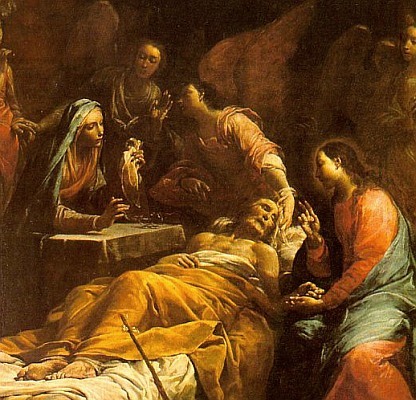
God permits us to feel a natural aversion to death. This is healthy and for our good. (Imagine what the world would be like if everyone were completely indifferent as to whether they lived or died.) However, for faithful Christians, there is no reason to be terrorized by a fear of death.

If you remain close to the sacraments and rooted in daily prayer you have no reason to be afraid. Maybe you feel ill-prepared to die, but like the seed that grows without the farmer understanding how, God is preparing you for the unending life of Heaven in ways you don’t even perceive. Like the mustard seed, we may go into the ground as seemingly small and weak human beings, but we will rise with a greatness and power that even delights and blesses the angels of Heaven.

A natural aversion to death is healthy, but for Christians a fear of death is out of place. For, as the Letter to the Hebrews says, “We are not among those who draw back and perish, but among those who have faith and will possess life.”

Multiplying Our Gifts — Tuesday After Epiphany

January 5, 2011

When the crowd gets hungry, Jesus takes the five loaves and two fish that his disciples offer to Him and uses these to feed everybody. Now if Jesus had wanted to, He could have used just one loaf and one fish. Or, He could have transformed a single piece of bread into more loaves, more fish, or whatever He chose. In fact, Jesus could have forgone the bread and fish business entirely and created a meal from absolutely nothing (ex nihilo) if He had wished. Yet, Jesus takes everything that the disciples offer to Him, blesses it, and uses it to a greater effect than any of them could imagine. Let us remember this when we consider offering our gifts to God.

God’s Icon, The Family — Feast of the Holy Family

January 5, 2011

Our Catholic Faith is full of mysteries, but what is a “mystery?” In the world, or in a novel, a mystery can be completely solved once important clues are found. “It was Cornel Mustard, in the Library, with the Candle Stick”–case closed. But in the Church, a mystery is something rather different. Is not something that one more clue could solve, nor something so dark and impenitrable that we can know nothing for certain about it. We can know many things with certainty about Christian mysteries, but they are parts of our Faith which are so rich that we will never completely exhaust them. The Trinity is perhaps the greatest of these mysteries, but by God’s revelation (through words and deeds and created things) truths about the Trinity have been revealed to us. Invisible realities can be known through the things that God has made. One great window into the mystery of the Trinity is the human family.

In the beginning, the Lord God said: “It is not good for the man to be alone. I will make a suitable partner for him.” So the Lord God cast a deep sleep on the man, took out one of his ribs, and built it into a woman.  When he brought her to the man, the man said: “This one, at last, is bone of my bones and flesh of my flesh” The two came together, and brought forth new life.

In the Trinity, the Son is of the Father; “God from God, light from light, true God from true God.” The Son is “begotten, not made,” He is a person from a person; not a lesser, created thing. From the everlasting, mutual self-gift of love shared between the Father and the Son, God the Holy Spirit proceeds.

The human family is an icon of the Trinity, like the icon of Mary and Jesus on our Marian altar. An icon can teach us about, and actually connect us to, the events and holy people they depict; however, it is also possible to misunderstand their metaphor. Gazing and meditating upon the Holy Mother and Child can help us to know them and relate to them better, but it would be foolish to think that they are made of wood and paint like the icon. Not everything found in a human family applies equally to the Trinity, but the family is perhaps the greatest icon of the Trinity, sharing many of its realities.

The Trinity is one; three persons sharing the same divine nature. Jesus said, “The Father and I are one,” and, “Whoever has seen me has seen the Father.” Likewise, in the family, husband and wife are one flesh and their children are their very flesh and blood. No matter what, your biological parents and siblings will be related forever, for there is a special oneness to your nature.

There is equality in the Trinity. Jesus accepted peoples’ worship, something only God can justly receive, and the Holy Spirit does the same: “With the Father and the Son, He is worshiped and glorified.” Likewise, there is equality (or at least there should be) between husband and wife in marriage. Though there are natural differences between them, the two are equal in dignity.

Though there is equality among the persons of the Trinity, there is also an order among them. Jesus said, “I do nothing on my own, but I say only what the Father taught me…. The Father who sent me commanded me what to say and speak.” Though equal in dignity, the Son follows the Father’s lead.

Notice in the Gospel how three angelic messages come to Joseph in three separate dreams: first, to flee to Egypt; second, to return to Israel; and third, to settle in Nazareth. Now God could have chosen to send His angel to Mary. He had done it before, Mary would have certainly obeyed God’s command, and Joseph (following her miraculous pregnancy) would have believed her, but that’s not what God did. God wanted Joseph to lead his family, and when Joseph woke his wife up in the middle of the night and said, “Mary, I had a dream–we need to leave, right now.” Mary said, “Ok,” because she knew that he loved her and trusted him. As Mary was to be the heart of their home, Joseph was to be the head of their family.

Mothers and fathers, in sometimes different but complementary ways,  reflect the divine attributes of God. Our moms and dads were distant likenesses of God, but through them we first came to conceptualize about God. Through them we first experience beauty and strength, the firmness of justice and the tenderness of mercy, the immanent love that braces what we are and the transcendent love that calls us to be more.  Parents are icons of God. That is why bad parents can be such a scandal to a life of faith. If our own parents were poor, let us recognize that it is the ideal they failed to live up to, not their behavior, which is the actual likeness of God.

We are all called to marriage, either natural or spiritual. We are all called to raise up biological or spiritual children for God. We are all called to be icons of God. Let us pray for the grace for our own married and parental love to be a worthy icon of the Trinity. That may seem intimidating, but don’t be afraid. You were made for this.

Seen and Unseen — December 28 — St. John the Evangelist

December 27, 2010

Today’s Gospel says that when John the Apostle went into the tomb on Easter morning “he saw and believed.” What did he see that led him to believe? Was it how the burial cloth which had wrapped Jesus’ body wasn’t taken away or tossed in a mess on the floor,  but left behind (perhaps deflated) in its place? Or was the cloth which had covered the Lord’s head rolled up in a familiar way, such that John recognized Jesus’ hand behind it. Or perhaps, if the Shroud of Turin is truly the burial shroud of Christ, John believed through beholding its testimony to the resurrection.

On the other hand, maybe it wasn’t something John saw that led him to believe, but something he didn’t see. Perhaps it was from the fact that Jesus wasn’t there that he infered the truth. “Dead bodies don’t just disappear for no reason at all. I didn’t do this. None of us did this. And what motive would our enemies have to take Him? This is the work of God.”

Just as John may have inferred the resurrection of Jesus from the empty tomb, so we can infer the truth of God from the presence of the universe: “Things don’t just appear for no reason at all. I didn’t make this. None of us made this. And how could an enemy have to create beauty, life, and love? This is the work of God.”

Tradition says that after Jesus entrusted the care of His mother into the care of John the Apostle, they went to live in what is modern-day Turkey.  What if we had gone to visit them in their home at Ephesus and asked them how someone can believe in the God of the universe, or the Lord Jesus Christ, when their reality can sometimes seem so distant.

I can imagine Mary or John replying, “Beloved, the One who was from the beginning, whom we have heard, whom we have seen with our eyes, whom we looked upon and touched with our hands, the Word of God, the Word of Life, the Lord Jesus Christ——we have seen Him, and testify to Him, and proclaim to you His eternal life.” The Christian faith is firmly founded, upon the unseen things we can infer and the things which we  have seen.

Their First Christmas — Christmas Mass at Midnight

December 27, 2010

Christmas can be a hard time of year for a lot of people. Despite the pious, peaceful, and nostalgic scenes we see on the Christmas cards (like the one on the right,) many peoples’ Christmases are less than picture perfect. Today I would like to tell you the true story of two friends of mine, newlyweds whose first Christmas together was far from idyllic. (I’ll call them Chuck and Sue, though that’s not their real names.)  

In fact, Chuck and Sue’s first year together had been a rocky road. Chuck has always been a good and faithful man, but at one point in the beginning, he seriously thought about getting a divorce. He says that it was only by the grace of God that the serious tensions and misunderstandings between them were resolved and their marriage was saved.

After they tied the knot, the two picked-up and moved away from their closest family and friends to a small town down south where they had some distant relatives. Chuck worked hard as a blue-collar laborer, but after this transition, he found himself unemployed. And unfortunately, all of those distant relatives proved too distant to care about helping-out a struggling young couple in need. Their first Christmas together, Chuck and Sue were out of work, pregnant, and homeless.

How do you think Sue must have felt? Do you think she felt concerned about their circumstances and their family’s future? And how do you think Chuck must have felt when through no fault of his own he wasn’t able to provide better for his wife and child on the way? Had it not been for their deep faith in God and the consolation of their prayers, they would have been overcome by darkness, resentment, fear, and despair. But instead, their first Christmas together was the brightest and most joyful in history. You know Chuck and Sue’s story well, for theirs is the Christmas story. Chuck’s real name is Joseph and Sue’s real name is Mary.

Remember, the Christmas story is not a fairy tale from far, far away. It’s a real story in the real world, and for the real world. Our lives still have difficulties, but Jesus Christ has come, and that makes all the difference in the world. No matter what we’re going through, because of Christmas, we all have good reason to be merry.

And in closing, let me say one final word: I’m always pleased by how full the church is at Christmas. Please come back. Jesus Christ calls you back. He knows our world well and He knows how much you and those you love need His grace to get through it. The shepherds were called to find Jesus in a feed trough. Jesus invites you to find Him here.

Of A Great Lineage — Friday, 3rd Week of Advent

December 17, 2010

Among the four Gospels, three of them contain genealogies of Jesus Christ. Matthew traces His origin from Abraham, for salvation is from the Jews. Luke traces His origin back to Adam, for Jesus is the savior of all. And John traces His origin from the Eternal Father, for Jesus is the Son of God.

In today’s gospel, we heard the names of all sorts of Old Testament people who became ancestors to Jesus Christ. They were all connected to each other, by faith and by blood, yet they little understood the amazing plan that God was accomplishing through them; namely, the Incarnation of Jesus Christ, the Son of God and Savior of the world. I believe that Jesus is accomplishing great things with all of us. We might not see it now, but in Heaven we will see what great things He is doing through us.

Close At Hand — 3rd Sunday of Advent—Year A

December 14, 2010

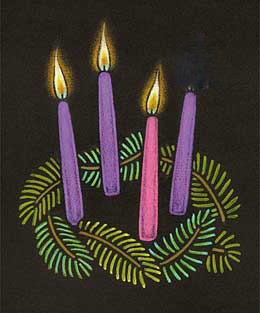
Today, the third Sunday of Advent, we light the pink or rose-colored candle because today is Gaudete Sunday. “Gaudete” means “rejoice” in Latin and we hear this call in the opening antiphon: “Rejoice in the Lord always; again I say, rejoice! The Lord is near.” Now that we are about halfway through this purple, penitential season, the Church is reminding us that Advent is also a time for joy. Though we await Him, “the Lord is near.”

This Guadete Sunday, we have extra cause for joy. As you may have heard, this week, a shrine in Champion, Wisconsin, 10 miles northeast of Green Bay, is now our country’s first Church-approved Marian apparition site. On the Feast of the Immaculate Conception, this happy news was announced by Bishop David Ricken of Green Bay:

“I declare with moral certainty and in accord with the norms of the Church that the events, apparitions and locutions given to Adele Brise in October of 1859 do exhibit the substance of supernatural character, and I do hereby approve these apparitions as worthy of belief (although not obligatory) by the Christian faithful.”

151 years ago, a lady clothed in dazzling white, with a yellow sash around her waist and a crown of stars around her head appeared to a 28-year-old lay woman named Adele. Adele asked the lady who she was and what she wanted, and the lady answered, “I am the Queen of Heaven who prays for the conversion of sinners, and I wish you to do the same. You received Holy Communion this morning and that is well. But you must do more. Make a general confession and offer Communion for the conversion of sinners… Gather the children in this wild country and teach them what they should know for salvation….”

That was the core of Mary’s message: the need for sinners to be converted and for children to be taught the faith. But Adele hesitated, and asked Mary how she was to teach the young when she knew so little herself. Mary replied, “Teach them their catechism, how to sign themselves with the sign of the Cross, and how to approach the sacraments; that is what I wish you to do. Go and fear nothing, I will help you.” After that encounter, Adele’s father built a small chapel on the site and Adele went about fulfilling her mission from Mary for the rest of her life.

The Bride of Christ, the Church, teaches that parents are the primary educators of their children. This means that even if your children go to Catholic or public school, you are their first and foremost teacher in the important lessons of life. But how often do our parents talk to their children about Jesus or Mary, or teach their children about what they should know for salvation? I suspect that many parents are intimidated because, like Adele Brise, they feel like they know too little. But Mary reassures us that we can all teach our children simple but important lessons in the faith that will remain with them and bless them forever.

Like Mary said, teach them the sign of the cross and how to approach the sacraments. At Mass, whisper in their ears, “Look, Father is holding up Jesus,” and on the way home in the car, ask them what they learned from the homily. Have interesting conversations with your children about the faith. Ask them, for example, if they think that Jesus likes sports, ask them what they think Mary’s favorite prayer is, or ask them what they think Heaven is like, and then share your answers with each other. And, perhaps most importantly, teach your children how to pray, by praying with them daily.

Though you know enough already to teach your children a great deal, you must always keep learning yourself. As your children mature in age, you must also mature in your understanding of the faith. Explore why we as Catholics do what we do, and learn why the Bride of Christ, our Mother, teaches as she does. For example, why do we make the sign of the cross? We do it at the open and close of our prayers and you’ve done it since you were little, but now consider more deeply what it means.

Its words and gestures encapsulate our faith’s most central mysteries. It confesses the Trinity and trances our redemption through the cross of Jesus Christ. We pray not “in the names,” but the “in the name of the Father, and of the Son, and of the Holy Spirit,” for God is three persons who are one in nature. [†] From the Father descends the Son, and the Holy Spirit proceeds from the love between them. Tracing the cross on ourselves, [†] we recall how the Father sent the Son to save us, and how the Holy Spirit now acts through our lives with power.

To pray this prayer, for it is a prayer, calls upon God to be powerfully with us. It is to say: “Father, Son and Holy Spirit, I ask you to be near me, here and now.” In the face of temptation or evil, this sign declares, “I belong to neither to the Devil nor the world, I belong to Jesus Christ.” So much is contained in this simple prayer and gesture. It can be taught to a child, yet meditated upon for a lifetime. And this is just one element of our faith. There is always more to explore.

Let us rejoice today, for the apparition of Our Lady of Champion reminds us, that even in Wisconsin, the Lord is near,  and [†] we can call upon Him at any time. Let us teach the faith to our children, so that they will remain near to Him and call upon His name.

The New Eve — December 8 — Immaculate Conception

December 8, 2010

In the beginning, when our first parents fell, they lost a great deal, but they were not deprived of hope, for God spoke in their hearing a prophesy to the deceiving serpent, the devil. God said, “I will put enmity between you and the woman, and between your offspring and hers; he will strike at your head, while you strike at his heel.” Who is this offspring, who strikes back at the devil? He is Jesus the Christ, the New Adam, the Son of God. And who is this woman, who is Satan’s enemy? She is Mary of Nazareth, the New Eve, the Immaculate Conception.

After their Fall, when Adam and Eve heard God approaching in the garden, they became afraid, they fled and hid, so God called out, “Where are you?” When God drew near to Mary, she also was afraid, but she did not hide or flee. She declared, “Behold, I am the handmaid of the Lord. May it be done to me according to your word.” And, because she did, her Holy Offspring could go on to say in His garden of testing, “Father… not my will but yours be done.”

The first man, Adam, called the first woman Eve, because she became the mother of all the living. Now, Mary is the New and Second Eve, for she is the mother of all the living, and she loves each one of us personally as her very own children.

She is the icon of the Church, and as she is, we are called to be: holy and without blemish before God, as the second reading from Ephesians says. But how can we do this? Unlike Mary, at times we have been allies of Satan by our sins. To cleanse us, God gives us the sacrament of reconciliation, and to strengthen us He gives us the fruit from the new tree of life; that tree is the cross, and its fruit is the Eucharistic Christ.

If it has been a long time since you have been to confession, come that you may be purified as pure as Mary. And if you receive our Lord in the Eucharist tonight, consider that the Son of God Incarnate has come to dwell in you, just as truly as He dwelt in Mary.

Willing, Yet Unwilling — 1st Sunday of Advent—Year A

November 28, 2010

This morning, I’m going to tell you the true story of a friend of mine, a person whom I respect, who was once addicted to sensual sins. As he tells the story, when he was 32 years old, he found himself in an intense spiritual struggle; my friend found himself willing, and yet unwilling, to change his life for Christ.

When he would turn and honestly look at himself, at the things he was doing and the way he was living, what he saw was ugly, sordid, and ulcerous. He desired life with Christ. He knew that holiness should mean more to him than all bodily pleasures, but he could not seem to detach himself from his sins. He hesitated to die to death and to live to life. Old enticements tugged at him and softly whispered: “Are you going to part with us?” Doubts kept nagging him, “Do you really think you can live without these pleasures, forever?”

But together with these temptations, other thoughts beckoned to him. He could envision a smiling multitude of saintly men and women of every age, who had lived both chastely and happily. A voice seemed to say to him, ‘You can also do what these men and women did, but none of them did it by themselves. The Lord their God gave it to them. Why do you try to stand by your own strength, only to fall over and over again? Cast yourself on Christ; don’t be afraid. He will not flinch and you will not fall. Cast yourself on him without fear, for he will accept and heal you.’

My friend was both willing and unwilling, attracted to both and repulsed by both. There were times when he would even pray, Lord, give me chastity, but not yet.” One day, these struggles came to a head for him, as he happened to be sitting in a garden outside of his house. Like Adam and Jesus in their gardens, he had come to a crucial moment of agonizing decision. With tears, he cried, ‘Why do I keep delaying to until tomorrow? Why not now? Why not end my uncleanness this very hour?’ Yet he could not find the strength to do it.

As he was saying these things, he heard the voice of child coming from the house next door, chanting over and again, “Pick it up and read it; pick it up and read it.” Thinking this a rather strange thing for a child to say at play, he took it a divine command to open his Bible and to read the first thing his eyes should fall upon. I took his Bible, opened it, and read these words in silence, words from today’s second reading: “Let us conduct ourselves properly as in the day, not in orgies and drunkenness, not in promiscuity and licentiousness, not in rivalry and jealousy. But put on the Lord Jesus Christ, and make no provision for the desires of the flesh.”

That moment changed my friend’s life for as instantly as he finished reading those words he says that his heart was infused with something like the light of full certainty and all the gloom of doubt vanished away. By this God-given grace, his life began to change, and he went on to become a saint. Actually, you know my friend too, because he’s a friend of yours as well. We call him Saint Augustine of Hippo, and he tells us his own story in Western history’s first autobiography, The Confessions by St. Augustine. [see Book 8, Chapter 11]

All of us here are recovering sinners, and we all struggle with personal addictions to sins large or small. Maybe we find ourselves committing and confessing the same sins over and over again. Maybe we are tempted to doubt that we can really change our lives for Christ. If we try to exert ever-greater efforts of personal will power, and find ourselves failing and falling again, perhaps a new approach is needed.

Instead of making promises and firmly resolving, that this time, somehow, I will amend my life and sin no more, try praying in this way: “Lord Jesus, I want to sin no more, but I have proven again and again, to myself and to You, that I can’t do it. I can’t do it, but You can. Please, give me the gift of your grace. Show me your power working in me. Jesus, live your life through me. I can’t do it, but You can.” Humble yourself and accept the gift of grace. Rely on Christ, for apart from Him we can do nothing. Pray everyday and confess your poverty, and Christ will provide what you need. If we neglect to pray or to humble ourselves, we are showing the pride of a branch that thinks it can produce fruit without the vine. If we do that, we should know that our next fall is near.

This season of Advent is for us to prepare for the Christmas coming of Christ. This year, He is asking us for only one thing; the gift of ourselves. Let us ask for the gift of His grace, so that we may present ourselves to Him, holy, pure, and whole.

[A similiar homily about St. Augustine’s mother, St. Monica.]

Demonic Delay — 33rd Sunday in Ordinary Time—Year C

November 14, 2010

Once upon a time, an uncertain number of years ago, there was an important meeting of demons in Hell. In the midst of their fires and shadows, with a foul and terrible stink in the air, the top of Hell’s hierarchy was planning a long-term strategy for how to mislead humanity.

Why do they scheme against us? Because on the day when Jesus comes again to judge and rule the world with justice, the demons do not want us to experience His healing rays; they want us to burn with fire, like themselves. Since they cannot hurt God directly, they lash out by trying to make us share in their misery.

As they met, brainstorming for ideas, one demon suggested, “How about we try telling them that there is no such thing as evil?” The chairman said, “You stupid worm, you pathetic disgrace, the humans will never believe that! Do you think that we can pit a person against a person, a nation against a nation, or a soul against our Enemy above, without the humans noticing the sadnesses, sufferings, impurities, jealousies, envies, rivalries, resentments, hatreds, injustices, cruelties, or murders that follow? They see evidence of evil on the front page of every newspaper and in every gossip’s tale! Humans are reminded that something’s wrong with their world whenever their alarm clocks ring, whenever their toes get stubbed, or whenever someone they know dies! You’ll have to do better than that!”

A little while later, another demon suggested, “What if we told them that there is no such thing as goodness?” The chairman said, “You worthless slime, you ugly idiot, the humans will never believe that! Our Enemy above has littered their world with beauties and gifts to many to count, and everything that the humans do is in the pursuit of what they think is good! They have this irresistible desire to be happy that our Enemy has built into them! Tell me, how would we tempt them to sin without promising them something which attracts them, something which is at least seemingly good? Is there anyone here who is not a useless fool?”

But then, one of the chairman’s most cunning underlings suggested another approach, an approach which was immediately welcomed by the others with cruel smiles and restrained applause (for a demon resists praising anyone but himself.) This insightful demon said, “Let us convince the humans… that there’s no need to hurry.”

In every generation, there have been Christians who belived that their generation would be the last. But personally, I don’t expect the second coming of Jesus Christ to happen in the very near future for the simple fact that it remains legal to be a Christian throughout North and South America. There are great evils in our world, even within our own country, but the final attack of evil against Christ’s Church in the last days should be far worse than this. [For more from the Catechism of the Catholic Church on “The Church’s Ultimate Trial,” see CCC 675-677 ]

I do not expect Christ to come in the immediate future to us, but we must always be preparing ourselves to be ready to go to Him, for we never know when we will die. Never be anxious and never be afraid, but prepare yourself for what is certainly coming. Instead of being busybodies, distracted by many unimportant things, let’s get busy making the most important things the most important things.

If you knew for a fact that you were going to die six months from today how would you begin to live your life differently? Would you pray more each day? Would you go to confession and to Mass more often? Would you work harder at doing good works? Would you crush your lingering vices? Would you forgive your enemies? Would you show more love to the people in your daily life?

Seriously thinking about what you would you do different if you knew you were going to die will give you a good place to start in living more intentionally for Christ, with your eternal goal in mind. Do not believe the demon’s whispered lie that ‘there is no need to hurry,’ for your last day is closer than it was yesterday, and it may be much closer than you think.

Uniquely Different — October 28 — Sts. Simon and Jude

November 3, 2010

[Jesus] called his disciples to himself,
and from them he chose Twelve,
whom he also named Apostles:
Simon, whom he named Peter…
Simon who was called a Zealot,
and Judas the son of James,
and Judas Iscariot, who became a traitor.

In the early days of their ministry, whenever Jesus called out for ‘Simon’ or ‘Judas,’ more than one head may have turned. Among Jesus’ apostles there were two Simon’s and two Judas’. There was Simon Peter and Simon the Zealot, and Judas (or Jude) the son of James and Judas Iscariot the betrayer. Though these pairs shared the same names and the same calling to be apostles, they were different in important ways.

Simon Peter was called to be the Rock, the leader of the apostles and of the nascent Church. Simon the Zealot may have shared his zeal, but he was not meant to have the same role as Peter. Each saint’s apostleship was unique to him.

Sometimes Christians who eagerly desire to be saints themselves strive to impersonate their favorite holy heroes. We do well to learn from the lived examples of the saints, for St. Paul did say, “Be imitators of me, as I imitate Christ,” but there can truly be only one St. Paul, one St. Francis, or one St. Therese of Lisieux. Every saint in history has been unique, and every future saint will be, too.

The two Judas’ teach us a lesson, too. Even after years of preaching the Gospel, I can imagine some people felt an initial uncertainty towards Judas the son of James. Intellectually, Christians would know that this apostle could not possibly be Judas the betrayer (because he one took his own life,) yet they might feel wary about this “Judas” in their midst.

Sometimes our feelings toward other people are influenced by who they remind us of. For instance, if you meet someone whose face resembles a person who has hurt you in the past, you may be involuntarily uncomfortable around them. In psychology, this shift of emotions from one person or thing to another is called transference. This is the stuff that prejudice is made of, and the good apostle, Judas, caught some of its unjust, negative effect.

Though the apostles shared names and a common calling, they were unique individuals. The two Simons teach us that each is called to live out their own, unique, holy life. The two Judas’ teach us that we must always receive others in their own personal uniqueness.

Catholic Medical Ethics—30th Sunday in Ordinary Time—Year C

October 27, 2010

In today’s second reading we hear from St. Paul, a prisoner in Rome on account of Christ and the Gospel.  Paul senses that the end of his life on earth is near. He writes:

“I am already being poured out like a libation,
and the time of my departure is at hand.”

The emperor will soon order Paul to be executed by beheading, sending him to Christ’s eternal reward. Yet this is not to the emperor’s glory, for the blood of St. Paul’s murder will be on his hands.

By God’s grace, Paul was not left all alone in this difficult, final season of his life. Elsewhere in this chapter from 2nd Timothy, he writes, “Luke is the only one with me.”  (This is St. Luke the evangelist, whose Gospel we are reading this liturgical year.) In another letter, Paul calls Luke his “beloved physician.”

Now what if Luke, seeing Paul’s burdens and what trials awaited him, were to procure some hemlock with which to end his friend’s life? Would Paul be pleased with him? Would he not rather be angry that Luke would presume to thwart God’s purposes for him on earth?

The Lord, the author of our lives, is the one to decide when someone’s life story is complete. God has joined our souls to our bodies and what God has joined together, no human being must separate; for it is always and everywhere wrong to intentionally kill the innocent. God sent Luke to Paul not to kill him, but to strengthen, console and support him in this last season of his life.
Healthcare and end of life issues touch all our lives, and people of good will have many questions in this area. Like, “What is wrong with euthanasia or assisted suicide?” “What does Christ’s Church teach about living wills, ventilators, feeding tubes, and palliative care?” And, “What kind medical care is morally required, and what sorts of care are optional?”

The Church calls care and treatments which are morally required “ordinary care.” Treatments which are optional called “extraordinary care.” Each of us has an obligation to respect our lives and bodies as precious gifts from God.  This means that we must always receive, and provide to others, “ordinary care.” However, circumstances can arise where various treatments become “extraordinary” and may be omitted. Treatments which involve great pain, or extreme cost, or little likelihood of doing much good can be deemed extraordinary care.  Burden, cost, and futility can make a treatment morally optional.

Yet, every treatment must be put into context. Sometimes the same procedure, which is ordinary in some cases, will be extraordinary in others. Sometimes a ventilator can be an extraordinary treatment, making it acceptable for people to refuse or discontinue its use. However, imagine if an otherwise healthy person should come to the hospital with a routinely curable lung condition which requires surgery and the short-term use of a ventilator.  In this case, the ventilator—which can be costly and burdensome—is not extraordinary because its benefits far outweigh its burdens.

This is a danger with living wills and advance directives.  Making medical decisions about treatments, in the abstract, in advance, and out of context, can easily lead to wrong decisions. Consider the use of feeding tubes. A person can check a box on a living will that says they never want one, but feeding tubes are quite often ordinary care; however, in some cases, they become extraordinary care.

Sometimes, in the process of dying, a person may no longer be able to digest food. In such an instance, use of a feeding tube would be futile, painful, extraordinary, and rightly omitted. But if someone is not dying, to deprive them of food or water is like preventing a diabetic from taking their insulin. That is not allowing nature to take its course—it is homicide. Pope John Paul II taught that ‘a sick person in a vegetative state, awaiting recovery or a natural end to their life, still has the right to basic health care (such as nutrition, hydration, cleanliness, warmth, and the like), and to the prevention of complications related to his or her confinement to bed. … Causing someone’s death by starvation or dehydration, if done knowingly and willingly, is truly euthanasia by omission.’

We condemn euthanasia and assisted suicide because they are about killing the person rather than killing the disease, and we can never intentionally kill the innocent. It is wrong to kill the sick, but it is good to alleviate their pain and discomfort while they live. This kind of treatment, aimed at increasing a person’s comfort, is called palliative care and it is a great good. The work of Hospice and others is to provide palliative care in the final stages of life.

Would it be wrong to overdose a person with morphine to end their life?  Yes, for it is wrong to intentionally kill the innocent. But what about a case where treating someone’s pain with pain-killers (in the normal doses) might have the unintended side-effect of shortening their remaining days? Would it be wrong to request or administer such a treatment?  No because the aim is not to kill the sick person, but to relieve their pains. Sometimes, people with cancer choose to forgo chemotherapy and its burdens even though treatment might help them live longer than they would without it. Are these people choosing death? No, they are choosing a different way to live. The burdens of chemotherapy can make it an extraordinary treatment, and we are free to forego extraordinary treatments, even if it may shorten our lives.

The three principles I have tried to present today are these: first, that it is always and everywhere wrong to intentionally kill the innocent.  Second, that we must receive, and provide to others, ordinary care. And third, that treatment which entails great pain, or extreme cost, or little likelihood of doing much good can be deemed extraordinary care, and is morally optional.

I hope you now have a clearer understanding of some points of Catholic medical ethics, but these can be complicated issues. If you are facing difficult treatment decisions, for yourself or someone you love, seek out counsel of those who know the Church’s teachings on this subject. Holy Mother Church’s wisdom on healthcare issues is the natural and logical extension of her dedication to human dignity. As Roman Catholics in a culture of death, we must we stand for the dignity of every human life, from conception to natural death, and we need to vote for it, too.

  • An article on “ordinary” and “extraordinary” care.

The Rot Inside — Tuesday, 28th Week in Ordinary Time—Year II

October 13, 2010

St. Paul says in the first reading that “the works of the flesh are obvious.”  If so, then why does Jesus have to point out the sins of the scribes and Pharisees, whose sinfulness “are like unseen graves over which people unknowingly walk”? It’s not that Jesus is pronouncing “woe” upon people unaware that they have sins, the problem is these people think that their hidden sins are no big deal because of their outward practices and appearances.

As long as we are at ease with “immorality, impurity, licentiousness, idolatry, sorcery, hatreds, rivalry, jealousy, outbursts of fury, acts of selfishness, dissensions, factions, occasions of envy, drinking bouts, orgies, and the like,” in our lives we will not enter the Kingdom of God. Even if we do not end up in Hell because of them, we will certainly have to wait on the doorstep to Heaven in Purgatory until these sins are rooted out. Let us crush these sins in our lives like the cancers that they are.

The Great Marriage — The Nick and Laurel White Wedding

October 9, 2010

In the Gospel we just heard Jesus say that “from the beginning of creation, God made them male and female,” and “for this reason a man shall leave his father and mother and be joined to his wife, and the two shall become one flesh.” Jesus is quoting here from Genesis, but something about these words has always struck me as a little strange. Why did Jesus and Genesis mention that ‘a man shall leave his father and mother to be joined to his wife?”

We tend to think of the bride as leaving her family to join her husband. Traditionally, as we saw today, her father walks her down the aisle to give her away, and the bride changes her name to match her husband’s. Perhaps it was put this way (“a man shall leave his father and mother”) because for the man must go out in pursuit of his bride. If a woman in a relationship found out that her man was leaving it to her to pursue him she would be very disappointed.

There is, I think, another important reason for the choice of these words: these words speak of Christ. Jesus left His eternal Father’s house in Heaven to become a man, and then He departed His perfect mother’s house to begin His ministry, all in pursuit of winning a bride, His bride the Church. Jesus is the man who left His father and His mother to be joined to his wife.

From the beginning of creation, God had made us male and female. So when the Lord sought to be perfectly united with us, Christ became a human being. Jesus became one flesh with our humanity, so that we could become one with His divinity. He came as a man because a man, like God, pursues his beloved. He comes to us as a man in love, not out of lust, not to dominate us or for His own selfish pleasure, but for a noble purpose. Jesus comes to propose to us and to enter into a marriage between Heaven and Earth, between God and man, between Himself and His bride, the Church.

Nick and Laurel, the sacrament you are about to enter, the sacrament of marriage, connects you to this union between Christ and the Church. Don’t try to rely on you own resources alone, but connect to the power of your sacrament. Nick, ask Jesus to let you share the love He has for His bride. Then, empowered by this love, you will lay down your life for your bride, and cherish her and bless her as long as you both shall live. Laurel, ask Mary and the saints, to let you share the love they have for the Bridegroom. Then, empowered by this love, you will rejoice in your husband, and honor him and follow him as long as you both shall live. Remember, this sacrament you are about to enter is not merely a symbol the of love between Christ and His bride. It makes that love truly present in you.