Archive for the ‘St. John the Baptist Parish’ Category

Pushing Boulders — 13th Sunday in Ordinary Time—Year C

July 1, 2010

Once upon a time, there was a hermit who lived in a cabin in the woods.  Each day, he would spend a good deal of time in prayer. One day at prayer he quieted himself, opened himself receptively to God, and heard Jesus speak to him. It’s wasn’t that he heard Jesus externally, speaking from across the room, but within his own thoughts. The hermit knew from experience that the Lord sometimes sends us an image, a memory, a song, or words in times of prayer to communicate with us.

The Lord said, “Go outside to the large boulder in your yard.” The man got up and went. Then the Lord said, “I want you to push this boulder for at least 30 minutes every day.” The man went about pushing the boulder every day, exerting his body in every way, but even months later he could not discern having moved the stone a single inch.

The man thought to himself, “Am I doing something wrong? Am I failing because of my sins or my lack of faith? The Gospels say that if I had faith the size of a mustard seed I could move mountains, but I can’t even move this stupid boulder.  Am I failing because this isn’t really God’s will? Did the Lord really tell me to do this, or did I just imagine it myself? No I heard Him, as surely as the other times when I heard Him speak. But why does He give me a task that He knows I can’t do? Does He want me to fail?” At this the man became very angry and (wisely) took his frustration to God. 

The man heard the Lord speak to Him, “Do you have reason to be angry? I told you to push the boulder, but I never told you to move it. Look at your arms, look at your legs, you have become strong because of your faithfulness and now you are ready for my next mission for you. You thought you were failing, but you succeeded in doing my will.”

In today’s gospel, Jesus turns resolutely toward His final journey to Jerusalem. He sends out advance teams to visit the towns ahead of Him and prepare His way. One of these villages is a Samaritan town and when they learn that Jesus’ destination is Jerusalem they refuse to welcome Him. James and John see this and ask, “Lord, do you want us to call down fire from heaven to consume them, like Elijah did back in the day?” Jesus turns and rebukes them; the fire of the Holy Spirit is meant for the salvation of people, not their destruction.

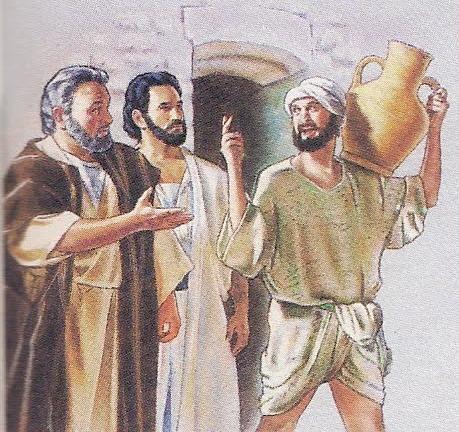
Why did Jesus send His disciples to that Samaritan town, instead of just instructing them to pass it by? Jesus knew what was going to happen when they went to that village–He knew by His divine insight that they wouldn’t accept Him. Remember when Jesus needed a donkey to ride on into Jerusalem? He sends two disciples to find and untie a donkey who had never been ridden before and He tells them what to say if anyone asks what they are doing. They go into the city and find everything as Jesus had described. Remember when Jesus needed a place to celebrate the Last Supper? He tells Peter and John to go into the city and to follow a man they will see carrying a jar of water, when they come to the house he leads them to, they are to ask if there is a place for the master to celebrate the Passover. They go and find everything a Jesus described, including an upper room already prepared for a Passover. Jesus knew that the Samaritan town would not welcome Him, so why did He send disciples there?
The mission may have seemed like a failure, but Jesus’ plan succeeded. Jesus knew that His Apostles would soon be preaching the Gospel to the whole world and He knew that not everyone would welcome them or their message. Jesus wanted to give them some experience in rejection to teach them how to respond; not with anger and violence, but with patience and peace. James and John learn a lesson about divine mercy. They may have thought their mission to the Samaritan town was a total failure, but the Lord was successfully achieving His goals in them.

So what does all this have to do with us? In our lives we often experience weakness, setbacks and apparent failures. In response, we often blame ourselves, even when we are innocent, or we conclude that we must not have been doing God’s will, or we get angry with God for frustrating or not helping our efforts. Yet, as long as we are faithfully following Christ, nothing we attempt is ever truly a failure.

The only true failure in the Christian life is sin, but if we repent of our past sins even these can be used to benefit God’s great plan. Scripture says, “God works all things for the good of those who love Him,” this even includes our repented sins. We are obsessed with success, but as Blessed Mother Teresa reminds us, “God does not ask us to be successful; He asks us to be faithful.”

Sometimes you will feel like you are failing, or that your efforts have been useless, but by your faithfulness you will be succeeding in doing God’s will. Let us remember that at the center of our faith is a man nailed to a cross; an appearent failure who was actually succeeding in saving the world. Jesus rolls away stones in ways we wouldn’t expect.
Christ in the Sacraments — 11th Sunday in Ordinary Time—Year C

June 15, 2010

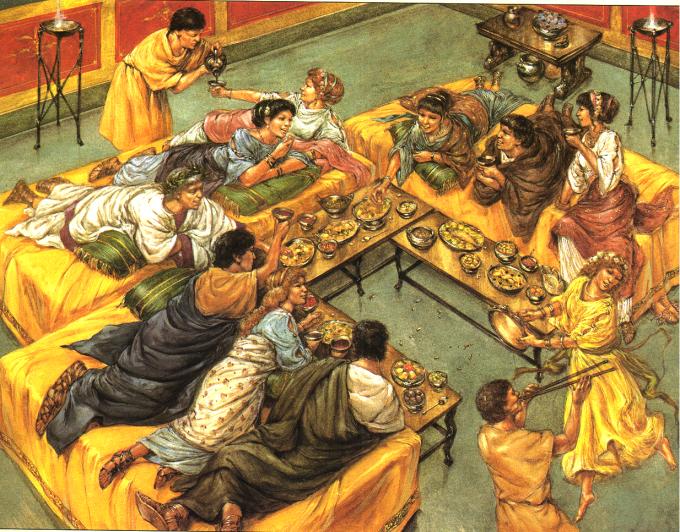
To understand today’s gospel, it helps to know a little about the Jewish culture of Jesus’ day.  For example, when the Jews would sit down to eat dinner they would not sit at all–they “reclined at table,” on beds that came up the edge of the table. You would have a cushion under your chest or under your side, as you ate with your free hand, with your legs laid out behind you. This clarifies how the beautiful, penitent woman was able to access to Jesus’ feet. This also explains how John was able to lay his head upon Jesus’ chest at the Last Supper to ask Him who would betray Him. The Beloved Disciple was not a contortionist–he was laying beside Jesus at table.

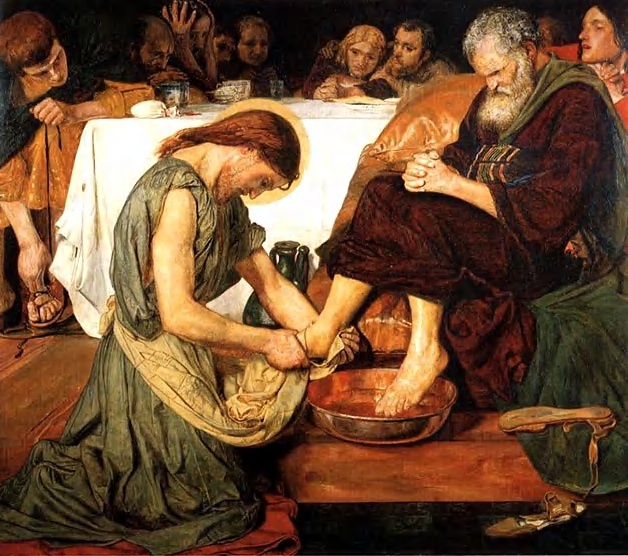
A second important thing to know about the Jewish culture of Jesus’ day to appreciate this gospel is to understand how they felt about feet. The Jews considered feet to be among the dirtiest, humblest, and lowliest parts of the human body. This is why our parish’s patron, St. John the Baptist, said, “[There is] one who is coming after me, whose sandal strap I am not worthy to untie.” In that Jewish culture, servants could not be commanded to wash the feet of others; it was considered even beneigth the dignity of a slave. Now we can understand the significance of the woman washing Jesus’ feet, and how much it means that Jesus later washed His disciples’ feet at the Last Supper.

But what was this woman thinking? Had she forgotten to bring a towel and a bowl of water at home? Was she so dumbstruck that her lips were unable to form the simple words, “I’m sorry and I want to return to God?” No, she knew what she was doing when she used her tears to cleanse, her hair to wipe, and her lips to kiss Jesus’ feet. When she heard that Jesus was going to be eating at the house of Simon the Pharisee I doubt she was holding that alabaster jar of ointment in her hands. No, she had to go and get it, and as she did she thought about exactly how she was going to approach Jesus.

What was Simon the Pharisee thinking? Had he forgotten about the customary curtesies in welcoming guests to one’s house in that culture: water for washing their own feet, oil for anointing one’s head against the harshness of the desert, a kiss in greeting at the door? Maybe he thought these were just optional, dispensible rituals. Regardless, Jesus put his finger on one major contributing factor: Simon the Pharisee loved Jesus little, while the beautiful penient woman loved Him greatly.

Simon gave Jesus an external gift, a meal in his home, but in addition to her ointment, the woman gave a gift of her very self; her tears, her hair, her kisses. As she had sinned with her body, she now sought to honor God though her body.

How does all of this apply to us? When we consider this beautiful, penitant woman and Simon the Pharisee relate to Jesus, we see two approaches the sacraments. For some, in the manner of Simon the Pharisee, the sacraments are just rituals, traditional customs, liturgical hoops the Church has us jump through. But for others, those with the heart of the woman who loved much, every sacrament is a personal encounter with Jesus Christ. If you onlt remember one thing from this homily, remember this: every sacrament is a personal encounter with Jesus Christ.

Consider the sacrament of marriage. Today, some people say, “As long as we love each other, what difference does a ceremony in a church and a piece of paper make?” But these people do not realize that the sacrament of marriage actually makes present the love between Christ and his Church. The love between husband and wife not only resembles the love between Christ and his Church–like all the sacraments, marriage actually makes present. If your marriage is sacramental, and you and your spouse do not put up obstacles in the way, you can experience firsthand to love with which Jesus loves His bride, the Church, and how the bride receives her Lord. You experience the intimacy between the two and you can tap and draw on their love and the power in your marriage. marriage is a personal encounter with Jesus Christ.

Today, some people say, “I don’t really have any sins, but if I did, why should I have to go tell my sins to a priest to have my sins forgiven? God can hears my prayers. Won’t he’ll forgive me anyway.” Imagine if the penitent woman had stayed away from Simon’s dinner party that night in the gospel and prayed to God at home. Would she have been forgiven? Perhaps, but she would not have had her life-transforming encounter with Jesus Christ. When you go to confession, you are personally encountering Jesus through the priest. If the priest does not put up obstacles in the way you will hear the words of Christ to you. And even if the priest does get in the way, you will hear that words that Jesus wants you to hear, just as He had said to the beautiful penitent woman: “Your sins are forgiven, go in peace.” The sacrament of reconciliation is a personal encounter with Jesus Christ.

These days some people say, “There’s a lot of Sundays in the summertime and a lot of things to enjoy on the weekend. Is it really that important that we come to Mass every Sunday?” To ask this about the most Blessed Sacrament is to be like Simon the Pharisee. Had Jesus not come as his guest that night, Simon would not have missed Him much; Simon would not have been that disappointed. And even after receiving Jesus under his roof, I can imagine Simon being left unchanged. But the beautiful penitent woman, who took Jesus’ flesh to her lips, was forgiven her sins and was filled with grace by the encounter.

In the celebration of this sacrament, and at every sacrament, let us appraoch Jesus with her humility, reverence, and love.

Rejoice, Daughter Zion! — The Visitation

June 2, 2010

The Blessed Virgin Mary is the Icon of Israel and the Icon of the Church. Mary is the bridge between the Old and New Testaments and we can discover her in both. Whenever we encounter positive descriptions of “Jerusalem,” “Zion,” “Daughter Zion,” or “Israel” in the Old Testament, or praises of “Mother Church” today, these words often apply quite fittingly to Mary as well. Today’s first reading is a great example of this. But before returning there, let me share with you this interesting detail. Even though we traditionally pray, “Hail Mary, Full of Grace,” the Archangel Gabriel’s greeting to Mary at the Annunciation [“Chaire” in Greek] literally means , “Rejoice… Full of Grace!” Now hear again the words from the Book of Zephaniah:

Shout for joy, O daughter Zion!
Sing joyfully, O Israel!
Be glad and exult with all your heart,
O daughter Jerusalem!

In today’s Gospel, Mary fulfills these words, glad and exulting with all her heart:

My soul proclaims the greatness of the Lord
My spirit rejoices in God my savior

Zephaniah says:

The LORD has removed the judgment against you,
he has turned away your enemies;
The King of Israel, the LORD, is in your midst,
you have no further misfortune to fear.

And Mary agrees:

He has mercy on those who fear Him
In every generation.
He has shown the strength of his arm,
he has scattered the proud in their conceit.

Earlier, at the Annunciation, when the angel Gabriel came to Mary, He said to her:

“Hail, [Rejoice,] full of grace! The Lord is with you.” But she was greatly troubled at what was said and pondered what sort of greeting this might be.

As Zephaniah foretells,

On that day, it shall be said to Jerusalem:
Fear not, O Zion, be not discouraged!
The LORD, your God, is in your midst,
a mighty savior;

And the angel says to her, “Do not be afraid, Mary, for you have found favor with God. Behold, you will conceive in your womb and bear a son, and you shall name him Jesus,” a name which means, “God saves.”

Zephaniah foretold of the Lord’s pleasure in Mary,

He will rejoice over you with gladness,
and renew you in his love,
He will sing joyfully because of you,
as one sings at festivals.

The Lord rejoices over Mary, and Mary in her Lord. Let us always remember, that the Lord rejoices over us as well. Despite our sins and failings, we are the Church, the new Israel, and whatever one can say of Mary usually applies quite fittingly to us as well. Mary is the icon of the Church, the sign of who we are, and who we are called to be with Christ.

Relating to God Personally — Pentecost Sunday

May 23, 2010

In the Old Testament, the truth that God is a unity of three persons, that God is triune, that God is a Trinity, was only obscurely presented. The knowledge that God consists Father, Son, and Holy Spirit, only became clear to us through Jesus Christ. Our one true God has always been three persons: the Father, the Son, and the Holy Spirit.

Now the Father is not Jesus Christ. Jesus is not the Holy Spirit. And the Spirit is not our Father. They are distinct persons. Yet, at the same time, each possesses the fullness of divinity: perfect goodness, perfect beauty, perfect knowledge, and perfect power, perfect mercy, and perfect love. We do not worship three gods, but three eternal persons who comprise one God. There is no God apart from these divine persons.

Sometimes we say we are “praying to God,” and that is well and good. But when we are “praying to God” we should not imagine that we are speaking to some fourth person, to some divine abstraction above or beyond the three. If you don’t know which divine person you have been praying to at such times, you have been praying to the Father, through the Son, in the Holy Spirit. (Notice how the prayers in the Mass are always addressed to particular divine persons; usually the Father, but sometimes the Son.)

If you have been a Christian who has always directed your prayers some abstract Christian divinity, who is neither Father, Son, nor Spirit, I trust that your prayers have still been heard within the Trinity. And if you have never related to the Holy Spirit as a real person who knows and wills and loves, but only as some abstract force, I am confident that He has blessed you with His gifts and produced His fruits in you even without your asking. But Christianity is all about loving communion with  persons. Not forces, not abstractions, but persons: persons human, angelic, and divine.

Do you have a personal relationship with each of the persons of the Trinity; with Jesus Christ, with our heavenly Father, and with the Holy Spirit? If not, then it’s important that you begin to cultivate these relationships in prayer, for we are called to love God, and only persons can be truly loved.

On this Pentecost Sunday, we recall the gift of the person of the Holy Spirit to the Church. The Holy Spirit does not begrudge it when we ask Him for good things, for ourselves and for others; no, He is pleased when we ask and pleased to give. Gift is who the Holy Spirit is. But today and henceforth let us always speak to Him and the other divine persons in a personal way with a great personal love.

Grandparents’ Day Children’s Mass

May 23, 2010

How long have your grandparents been your grandparents? My grandpa’s and grandma’s have been mine for as long as I can remember.  In fact, your grandparents were around before you even existed (and even before your parents existed!)

When your grandma’s and grandpa’s heard the news of your birth, they rejoiced that you were in the world. They know you. They understand what your life is like now and they are wise about the things that lie ahead of you–they have gone through it all themselves already . Your grandparents love you. If there was ever something that you needed, or something you wanted and that it would be good for you to have, they would want to give it to you.

Your grandparents are a lot like Jesus.  He existed before any of us, and He rejoiced when we came to into the world.  He knows you, and he understands what lies ahead of you, because He’s gone through it all Himself. If there is ever something that you really need, or something that you want and that it would be good for you to have, ask Him and He will give it to you.

Our grandpa’s and grandma’s bear a likeness to Jesus Christ. And all of you adults out there–you possess an insight into how Jesus relates to us, through your relationships with these young ones.

Mother’s Day Homily

May 9, 2010

This Sunday our country celebrates our mothers—and rightly so. For the care and love which our mothers have given us is beyond price or measure. Of course, our earthly parents are not perfect. Sometimes they’re quite far from perfect. But any love we’ve known from them is a likeness of the love God has for us.  A religious icon is made of mere wood and paint, but it can be a window to heavenly realities.  In the same way, we can see through our parents’ love a glimpse to God Himself.

Most of us have more memories about our mothers than we could possibly count, but today I would like to take you back to a time and place about which you have no clear memories—to the time in your mother’s womb.

In the Bible, the number forty denotes times of waiting and preparation: For instance, Noah spent 40 days and nights in the ark. The Hebrews wandered with Moses for 40 years in the desert. Before His ministry, Jesus fasted 40 days in the wilderness, and after His death, He rested 40 hours in the tomb. Similarly, you remained 40 weeks, more or less, within your mother’s womb, being prepared for a new life.

Attached to your mother’s vine you grew into the mature fruit of her womb. You were nourished and matured within her. You were never far from her heart or mind. You existed in within her, connected to her at the center of your being. She fed you with her very self. She provided for all your needs. Apart from her, you could do nothing. You remained in her and found rest within her.

In the womb, at the earliest stages of our lives, our minds did not comprehend very much, but what if you could have understood everything that your mother was doing for you at the time? Surely you would have directed your thoughts to her often.  And certainly, from time to time, you would have turned to her with the eyes of your heart to bask in her love for you.

What if you could have talked with your mom from the womb? Would you not have taken the opportunity to speak with her every day? Would you not have thanked her daily out of a deep gratitude? Would you not have let her know each day how much you love her? Whoever would refuse or neglect to express such love and thanks would continue to live, at least functionally or biologically, but they would not be fully alive without this relationship with their mother.

As you and your mother would continue to talk, as the days and months of pregnancy passed by, she would eventually present you with a most-frightening prospect: She might put it this way, “My child, soon, in a little while, you are going to begin a new stage of your life. You will be departing from the life you know, and then you’ll experience a whole world of people and things you have never known before.”

You might say, “I’m scared! I don’t want to go—not now, not ever!” But she would answer, “I realize this concept is scary for you, but trust me when I say that it is better that you go. In fact, someday soon you’ll look back and think it a silly thought to be again as you are now. This transition is going to hurt a little bit… trust me, I know… but when the appointed time comes, I’ll be right here with you. Don’t be afraid. It’s going to be O.K.”

This morning we reflect on this time in the womb because our life in our mothers is like our life in Christ. As it was with our mothers, so it is, in our life with Christ. You are attached to Him as to a vine you mature as a child of God. You are nourished and grow within Him. You are never far from His heart or mind. You exist within Him, connected to Him at the center of your being. He feeds you with His very self. He provides for all your needs. Apart from Him, you can do nothing. You remain in Him and find rest in Him.

Knowing and believing this, shouldn’t we direct our thoughts to Him often? Shouldn’t we, from time to time, turn to Him with the eyes of our hearts to bask in His love for us. We have the ability to talk with Jesus Christ, in prayer, whenever we wish. Who would not take the opportunity to speak with Him every day? Who would not thank Him daily out of deepest gratitude? And who would not let Him know each day how much we love Him? Whoever would refuse or neglect to speak with Him, would continue to live, at least functionally or biologically, but they will not be fully alive without this relationship with Christ. We need to pray every day if we want to remain in Him and bear much fruit.

We don’t want to die and that’s perfectly natural. But Jesus says to us, “Soon, in a little while, you are going to begin a new stage of life. You will be departing from the life you know, and then you’ll experience a whole world of people and things you have never known before. I realize this concept is scary for you, but trust me when I say that it is better that you go. In fact, someday soon you’ll look back and think it a silly thought to be as you are now again. This transition is going to hurt a little bit… trust me, I know… but when the appointed time comes, I’ll be right there with you. Don’t be afraid. It’s going to be O.K.”

Today, let us thank God for the life, love, and tender care we have received from our mothers and through Jesus Christ. God bless our mothers and praised be Jesus Christ.

Clearing Heaven’s Haziness — 4th Sunday in Easter—Year C

April 25, 2010

Today, St. John has a vision of a great multitude, which no one could count, from every nation, race, people, and language. They wear white robes and hold palm branches in their hands. They stand before the throne and before the Lamb (who is Jesus Christ,) and in His temple they worship Him day and night. St. John is glimpsing the worship in Heaven.

Heaven should be one of our great consolations in difficult times and we should really be excited about going there someday. But I think that we often have faulty ideas about Heaven that can get in the way of us being excited or consoled. For instance, maybe you heard the first reading today and thought, “The idea of standing night and day and holding a palm branch doesn’t seem that awesome to me; and going to Mass for an hour is well and good, but I don’t know how I could enjoy going to church forever in Heaven.” Concerns like these would understandably make us weary of Heaven.

We need to recognize that the Book of Revelation is symbolic.  Not everything we see in John’s vision is not literally what we’ll get in Heaven. For instance, St. John sees Jesus as a lamb who was slain and having seven horns and seven eyes. That’s one odd looking lamb, but this is symbolism. The image of the lamb recalls Jesus’ sacrifice, His horns imply perfect power and His eyes imply perfect wisdom. Likewise, the multitude’s white robes point to their dignity, their palms signify their victory, and they are standing because that is the traditional posture for worshiping God. The God who created the universe, and all of the good things we enjoy in it, surely has more to offer us than just palm branches, white robes, and boredom in Heaven.

You have heard it said that we will enjoy the “beatific vision” in Heaven, but you maybe wonder, “How could I enjoy staring at God forever?” But the phrase “beatific vision,” is also metaphor and the experience means more than mere gazing. The “beatific vision” is the immediate knowledge of God enjoyed by the angels and saints in Heaven. We call it “vision” because it is an experience of God which is direct, not mediated, and in the fullest depth and detail which our souls can receive. We call this vision “beatific” because intimately experiencing God, what the prophets call beholding Him “face to face,” gives perfect happiness.

The saints in heaven experience this beatific vision now, even though, (except for the Virgin Mary, and perhaps Enoch, Moses, and Elijah,) none of the saints have their bodies yet. Their flesh is still on earth awaiting the resurrection. But this raises the question of how can we experience anything without having our bodies?

Think of it this way: When I am asleep I see nothing with my eyes (for they are closed.) And in the silence, I’m not hearing anything with my ears. There’s nothing to taste nor smell, and even if I’m feeling the bed sheets they do not have my attention. Yet sometimes when I sleep, even as I’m dead to my senses, my soul can be alive and alert while I dream. If dreams of mere fantasies can be made vividly realistic to our souls, then I’m confident that God can engage our souls with the higher realities of truth and love, even as our bodies sleep in death.

Sometimes people ask, “Will my experience of Heaven only be between God and me? I mean will I be so overwhelmed by God that I won’t notice or care about the multitude around me?  Will I even remember the people that I knew on earth?” I would answer in this way: how could coming closer to the God who is Love make our love toward others colder, or how could being in the presence of Truth Himself make us stupider? In Heaven, we will never forget that our parents were our parents, or that our friends were our friends, or that our spouses were our spouses and we will remember the love we shared. And the fact that miracles have occurred through praying to the saints for their intercession before God shows that the holy dead are still aware of us and care about us still on earth.

So what exactly is heaven like now, and what will it be like after the resurrection when this entire universe is remade into a new heaven and new earth? We don’t exactly know. Like in the book of Revelation, Scripture speaks of it in images: life, light, peace, a wedding feast, wine of the kingdom, the Father’s house, the heavenly Jerusalem, and paradise. Though we don’t exactly know what Heaven will be like, we shouldn’t fear that it will disappoint us. When, by God’s grace, we all get arrive there we will look at everything that He has prepared for us and find it very good.  

Until we get there, let us realize and remember that every Mass gives us a foretaste of Heaven. Here we bring with us everything that has happened in our lives. We come here before the throne of the Lamb who was slain, and we praise Him. And here He gives us Himself along with every heavenly blessing which we are ready to receive. Though a veil remains, every Mass bring Heaven to earth.

Hearing Him — Friday, 3rd Week of Easter

April 23, 2010

Jesus says, “Whoever eats my Flesh and drinks my Blood,” as we are about to do in at this Mass, “remains in me and I in him.” After we receive Him, He remains with us and we with Him.  And He stays with us, provided we do not cast Him out through committing serious sin, until we receive Him again.

Jesus remains close to us throughout our day. Wouldn’t it make sense, that time to time, He would occasionally have something to tell us? Maybe we don’t hear Him because He knows we would refuse to listen. Perhaps He knows we would dismiss hearing Him speak to us out of hand, or maybe He knows we don’t trust Him enough to go out on a limb. For example, if you got the feeling that the Lord wanted you to relay to a message, a message you didn’t really understand, to particular person what would you do?

In the first reading, the Lord speaks to Ananias and Ananias answers, “Here I am.” Then the Lord gives Him an entirely wholesome, but very counter-intuitive task: lay your hands on Saul and heal him. Ananias hesitates a little. Ananias might be wondering if this is really coming from the Lord, or maybe he’s not sure he wants to risk this much for the Lord. But in the end, Ananias listens, and because of it, Saul became St. Paul.

If we would like the Lord to do such things with us let us be faithful in little things, faithful to the commands of our consciences and to the gentle nudges of the Holy Spirit throughout our daily lives. If we are willing to trust Him, Jesus will ask us to be His chosen instrument in greater matters too. So let’s listen, let’s be docile, and see what He does with us.

Peter’s New Season — 3rd Sunday of Easter

April 20, 2010

Once, when Jesus was preaching as he stood on the shore of the Sea of Galilee, a large and eager crowd was pressing in on Him.  So Jesus got into a fisherman’s boat and asked him to put out aways so that He could sit and teach the crowds. The tired fisherman complied. And after Jesus had finished speaking, He said to this fisherman, “Put out into deep water and lower your nets for a catch.” The fisherman said, “We have worked hard all night and have caught nothing, but at your command I will lower the nets.” When they had done this, they caught an incredible number of fish such that their nets were tearing. And Jesus said to the startled man, “Do not be afraid. From now on you will be catching men.” As you probably remember, the fisherman was Simon Peter, and from that day on his life entered a new season. For the next few years Simon Peter would follow Jesus and evangelize towns on His behalf.

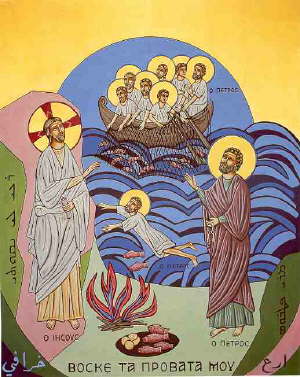
In today’s gospel, from the days after the resurrection, Peter is fishing again. And once again, Jesus is there on the shore. They have caught nothing, but Jesus says to try once more, and they catch an incredible number of fish. When Simon Peter realizes it is Jesus he eagerly comes to Him as fast as he can. He finds Jesus beside a charcoal fire. This should be familiar to Peter, too, calling to mind  another charcoal fire in the dark courtyard of the high priest.

After sharing a meal, Jesus says, “Simon, son of John, do you love me more than these? Do you love me?  Do you love me?” Simon Peter says, “Yes, Lord, you know that I love you. Yes, Lord, you know that I love you. Lord, you know everything; you know that I love you.” Jesus has given Peter the opportunity to undo his triple denial of Jesus with a triple confession of his love. And after each time, Jesus speaks of a new season for Peter’s life: “Feed my lambs. Tend my sheep. Feed my sheep.”

Now it is one thing to catch fish, but it is another thing to shepherd a flock. Up to now, Peter has been following Jesus and bringing others to Him. But now Jesus is asking Peter to do something new, to shepherd His flock for Him. Do you think Peter nervous? Is he concerned about whether he is up to the task? Is he worried about being led where he doesn’t want to go? I bet he is, but Jesus would have him ‘not be afraid,’ for he won’t be doing it alone. Jesus says to Peter, “Follow me.”

Our lives are often entering new seasons. Maybe you’re moving into a new town or a new school. Maybe you’re transitioning from engagement to marriage, welcoming new children, or living for the first time without children in the house. Maybe you have a new job, or don’t have a job for the first time. But whatever season of our life Jesus calls us into, His calling and our mission remain the same. Jesus said, ‘”I give you a new commandment; love one another as I have loved you,” and ” “There is no greater love than this, than to lay down your life for a friend.” Every new season of life offers us the unique opportunity to deepen our love for Christ and each other more than ever before.

Maybe you feel nervous? Maybe you’re concerned about whether you are up to the task? Maybe you’re worried about being led where you don’t want to go? But remember Simon Peter and don’t be afraid.  Jesus gives lots of second chances and He does not expect us to do it alone.

Rabbi Gamaliel’s Wisdom — Friday, 2nd Week of Easter

April 16, 2010

The apostles were brought before the Sanhedrin, the Jewish High Council, to be questioned for why they continued to teach in “that name.” At hearing the apostles’ answers, the Jewish leaders “became infuriated and wanted to put them to death,” but a Pharisee in the Sanhedrin stood up and had the apostles put outside. This was Gamaliel, a great teacher of the law who was respected by all the people. (It was at this rabbi’s feet that St. Paul received his Pharisaical training.)

Gamaliel said, “Fellow children of Israel, be careful what you are about to do to these men.” Now his form of address here is interesting and revealing. He could have addressed his peers in the Sanhedrin in many different ways, but by calling them “fellow children of Israel” he recalls Jacob (whose name God changed to Israel) and his twelve sons.

Now of all those sons, Joseph was Jacob’s favorite. This made the others so jealous that they sold Joseph into slavery. But through suffering this dishonor Joseph would go on to become the instrument of their salvation. Even though they meant to destroy him, they failed. God intended this for good, to achieve the salvation of many.

Gamaliel concluded his speech to the Sanhedrin wisely observing, “If this endeavor or this activity is of human origin, it will destroy itself. But if it comes from God, you will not be able to destroy them…”

Evil endeavors or activities are destroyed in time. But what is of God endures, even if it is sometimes setback by evil and sins. In these beleaguering times, for our country, for our Church, and for our pope, this lesson from Rabbi Gamaliel gives us good reason for hope.

Faithful Despite Doubts — Divine Mercy Sunday—2nd Sunday in Easter—Year C

April 11, 2010

Thomas, called Didymus, one of the Twelve, was not with them when Jesus came. So the other disciples said to him, “We have seen the Lord.” But he said to them, “Unless I see the mark of the nails in his hands and put my finger into the nailmarks and put my hand into his side, I will not believe.”

Why is “Doubting” Thomas so slow to believe. Why is Thomas so reluctant to trust? A clue might be found in the gospel’s interesting inclusion of Thomas’ Greek nickname: Didymus. Didymus means “twin,” but in relation to whom was Thomas a twin? Some speculate that Thomas the Apostle bore a striking resemblance to Jesus Himself. This tradition is sometimes reflected in iconography where Thomas is the apostle who looks a lot like Jesus.

If this is why Thomas was the apostle called “the twin” then we can understand his rational skepticism. How many times during Jesus’ ministry had people come up to Thomas and said, “O Jesus, we’re so happy to see you! We’ve walked for miles to see you again!” Then, with some annoyance, Thomas might have answered, “We’ll you’ll have to walk a little bit further. Jesus is over there.” So now, when the other disciples come up to Thomas after Easter and say, “We have seen the Lord,” Thomas replies, ‘I’ll need more evidence than that.’

Thomas’ resistance to believing the good news about Jesus might not only be coming from his mind, but also from his heart. Jesus was Thomas’ hero, his teacher, and his close, beloved friend. Thomas thought that Jesus was going to be the savior and messianic king of Israel. But their close relationship and all of Thomas’ great hopes were destroyed for him at the crucifixion. Imagine how Thomas might have prayed then: “My God, why have you let this happen? How could you let Him be taken instead of me? Jesus was so good! He was completely innocent, and you let Him be die! Why?”

The unexpected death of Jesus broke Thomas’ heart, and having been so hurt once, Thomas was resolved not to let his heart be taken in again: “Unless I see the mark of the nails in his hands and put my finger into the nailmarks and put my hand into his side, I will not believe.”

Yet, though he doubts, notice where Thomas is one week after Easter. He is with the other apostles in the upper room in Jerusalem, gathered behind locked doors for fear of the authorities who killed Jesus. Now there are lots of other places Thomas could have chosen to be. There were safer places he could have gone, like back to his hometown and to the extended family and friends he had left behind to follow Jesus a few years before. Though Thomas doubts, he does not leave this house of faith. He struggles with his faith, but does not abandon it. He seeks within this house of faith, this Church, and because of it, Thomas finds sufficient evidence for his mind and healing for his heart.

The risen Lord appears in the upper room and how does Jesus respond to Thomas’ resistant unbelief? Not with anger.  Not with condemnation.  But with the divine mercy we celebrate today. Jesus appears in their midst and says, “Peace be with you.” Then he says to Thomas, “Put your finger here and see my hands, and bring your hand and put it into my side, and do not be unbelieving, but believe.”

In our lives we too will struggle with our faith and our doubts, with our emotions and with our thoughts, in our hearts and in our minds. Jesus does not condemn our honest struggles. But Jesus wants us to sincerely seek within this house of faith; this, His apostles’ Church, where the truth and healing is found by all those who seek Him.

Easter Endures — Easter Friday—Year C

April 11, 2010

For the rest of the world, today is the second friday of April. For us, today is Easter. The rest of the world has gone back to life as before, but we in the Church continues to remember and celebrate Easter.

In the Gospel we see Peter and some of the disciples going back to their old ways, back fishing in Galilee. And in the first reading we see the Jewish leaders, elders, and scribes operating just the same as before. But they all get reminded that Easter has changed everything.

So let’s not forget the graces we received this Triduum. And let us remember that in these “last days” every day is Easter and that our lives and our world will never be the same as before.

A Premature Passion? — Palm Sunday—Year C

March 28, 2010

So why did we just proclaim the Passion?  Isn’t the Passion a bit premature? It’s Palm Sunday, not Holy Thursday or Good Friday. Aren’t we jumping the gun? No, like the two disciples Jesus instructed in our opening Gospel, we’re being told what we are going to see. The Church has us recount the Passion on Palm Sunday to prepare us; to prepare us for encountering Christ’s Passover through the special ceremonies and symbols of this Holy Week.

Now the celebration of the Eucharist actually makes the events of the Pascal mystery present for us every time we come to Mass. Jesus’ Last Supper, His Passion and Death, His Resurrection and Ascension into glory, are all truly presented to us at each and every Mass; but during Holy Week, we unpack and encounter these events in unique and special ways.

Today you have waved palms, an ancient symbol of victory, to Christ, welcoming Him into our city. On Holy Thursday, you can go where the Blessed Sacrament is reserved and give company to Christ in his lonely solitude, with Him in His agony before His arrest and with Him as He spends the night awaiting His trial. On Good Friday, you can reverence the crucifix; you can kiss the wood of Jesus’ cross and kiss His body hanging upon it, as He dies for us. And at the Easter Vigil, you can see the sign of the light of Jesus Christ resurrecting out of darkness and death.

And so I invite you to encounter Jesus’ Pascal mystery, at this Mass, at every Mass, and through the special signs and ceremonies of this Holy Week.

The Prodigal Son — 4th Sunday in Lent—Year C

March 14, 2010

If today happens to be your first time coming back to church in a long time, then take today’s gospel as a sign. God our Father is incredibly merciful and He welcomes you home with a loving embrace.

But most of us here, I suspect, came to Mass last week, and the week before that, because you always come every week. If so, then you probably hear this familiar parable of the Prodigal (that is, squandering) Son and wonder where you fit into the story. When you look at yourself I bet you can honestly say that you’re not living a life of great dissipation like the younger son, and the idea of a sinner being reconciled with God makes you genuinely happy, not bitter, like the older son or the Pharisees. So what does this story have to teach those of us who are doing a lot more right than we’re doing wrong?

First, let’s look at the younger, prodigal son. He goes to his father and says, “Father, give me the share of your estate that should come to me.” Here, he is asking for his inheritance while his father is still alive. He is basically saying, “I don’t want to share my life with you,” and then he demonstrates it a few days later by setting off to a distant country. There he squanders his inheritance on a life of dissipation, but after he has freely spent everything, he finds himself in dire need. What he thought would make him happy left him disappointed in the end.

Sure, we’re not professional, all-star sinners like the prodigal son, but we act like him in many little ways in our daily lives. The prodigal son asked his father for something which was not his and which he had no right to take (while his father is still alive.) Whenever we live as if our lives were our own, as if our lives did not come from God and do not belong to God, our Father, we say to Him, “I don’t want to share my life with you.”

Though our small and venial sins only hinder or wound our relationship with God, in every sin we turn our backs and set off for awhile to a distant country. Whenever we insist upon it, God permits us to freely spend our lives in squandering ways, in ways which we think will make us happy but which disappointing us in the end. When we return to our Father, He forgives our sins and welcomes us back, but you and I must learn to stop trying to live our lives without sharing them completely with God.

Why are we afraid of the idea of doing what God wants us to do every moment of our day? I think we are afraid that doing God’s will won’t really make us happy. Maybe we imagine that doing God’s will means we will have to pray ten hours a day at church or walk around wearing a burlap outfit. Of course that’s crazy. God probably wants you to live the same life you are living now, but with some minor adjustments, and more closely to Him.

Maybe we are afraid to give ourselves completely to God because we are a lot like the other, older, more faithful son in the parable. We have served our Father for years without ever asking or expecting much for ourselves. But working hard for God without ever experiencing His good gifts and joys does not make us holy; over time it makes us angry and embittered, like the older son who never asked for anything. We start to think of our Father, not as our father, but as a slave master. But our Father says to us today, “My child, you are here with me always; everything I have is yours.”

“Taste and see the goodness of the Lord,” as our psalm said. Do not let your face blush with shame at asking for good things for you and your friends to enjoy. When we are poor and call out the Lord hears us, and He will save us from all our distress. So look to God, and be radiant with joy.

We’ve learned important lessons from both of the sons in this parable, and I hope we will put them into practice.

From the faithful but disgruntled son, we learned the importance of asking for good things from God. So today, at this Mass, ask our Father to surprise you today with some good gift that you’ll enjoy. Then watch to see what He does for you.

From the prodigal son we learned the importance of living with and for God every day of our lives. So tomorrow morning, when you wake up and you’re lying in bed, make the sign of the cross and entrust yourself to God for that day, that you may live your life that day always with Him and for Him. Ask you guardian angel to remind you and I bet you will remember.  Try it, and I think you’ll be pleasantly surprised by the difference it makes in your day.

The Scales Myth — Friday, 1st Week of Lent

February 26, 2010

In ancient myths and modern imagination, the judgement of our lives will be done with a pair of scales, with our good deeds one one side and our bad on the other.  If our good deeds outwiegh the bad ones (so the story goes) then we’re in good shape.  If not, we’re toast. However, our first reading from the prophet Ezekiel shows that this not how God judges things.

If the wicked man turns away from all the sins he committed, if he keeps all my statutes and does what is right and just, he shall surely live, he shall not die. None of the crimes he committed shall be remembered against him; he shall live because of the virtue he has practiced.

And if the virtuous man turns from the path of virtue to do evil, the same kind of abominable things that the wicked man does, can he do this and still live? None of his virtuous deeds shall be remembered, because he has broken faith and committed sin; because of this, he shall die.

God is more interested in where we’re headed than where we’ve been. This is encouraging good news for the long-time sinner who needs to repent and it is a warning to us who have done well in the past.  It’s not what we’ve done in the past that matters, because each of us can make a definitive turn toward or away from the Lord today.

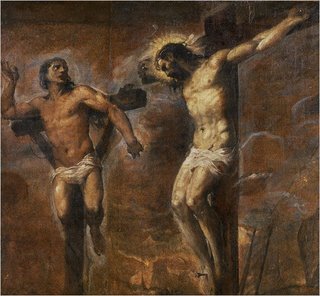
What advantage then do we who are faithful to the Lord have over those who have deathbed conversions, over those steal heaven like the good thief on his cross next to Jesus? Very much indeed, for our lives’ holiness and good deeds will be weighed and our personal degree of heavenly glory and reward will be measured out accordingly. In heaven we shall all be filled and satisfied, but those who love most in this life shall enjoy the most love in the next.

So whether you are far from God or serving Him faithfully, heed these holy words: “If today you hear His voice, harden not your hearts.”