Archive for the ‘St. John the Baptist Parish’ Category

Christian and Unashamed — Ash Wednesday at the Parish

February 17, 2010

In today’s Gospel, Jesus warns us against giving so that others see us giving, against praying so that others see us praying, and against fasting so that others see us fasting. Yet, I don’t think that showy religiosity is where the danger lies for us.

In Jesus’ day, the popular culture proudly believed in God and respected religious piety. Hence, those people were tempted to publically flaunt their acts of prayer, fasting, and almsgiving and thereby gain the respect and praise of others. But today, in our secularized culture, the temptation is to do the opposite, and to do something far worse. We are tempted to deny our faith in Jesus and teachings before others because we’re afraid of what they might think of us.

The hypocrites Jesus spoke of, who pray to be seen by others, merely limit their prayers’ reward, but if we deny Christ before others we lose our rewards entirely. For Jesus tells us:

“Whoever is ashamed of me and of my words, the Son of Man will be ashamed of when he comes in his glory and in the glory of the Father and of the holy angels.” “Everyone who acknowledges me before others I will acknowledge before my heavenly Father. But whoever denies me before others, I will deny before my heavenly Father.”

This is why the early Christians went to the lions rather than to deny Christ, and it was their courageous witness to Him that conquered the pagan culture which surrounded them.

This Lent, let us begin to practice putting the Lord before men. For instance, are you someone who will be so embarrassed by having an smudge of ash on your forehead that you’ll want to wash it off the first chance you get? If so, then you should leave it there until it wipes away on its own.

Are you are someone who sees good deeds that just call out to be done but pass them by because of your peers would see you doing them? Then you need to bite the bullet and start doing those hard-good-deeds anyways.

Are you someone who is self-conscious about other people seeing you pray, here at Church, at work, or when your family goes out to a restaurant? Then you need to make it a point to pray, and when you do, do not ask that God would make you invisible; ask Him that other people would become invisible to you and then pray to Him as from your heart.

Now, these are not examples of performing righteous deeds so that others may see you. This is about doing the right thing even if others might happen to see you do it. This Lent, let us begin to love and serve our eternal Lord amidst a world which is destined to become dust.

You are called to be the light of the world. People do not light a candle and then put a bucket over it; it is set it high up, where it can give light for everyone. Just so, your light must shine before others, that they may see your good deeds and glorify your heavenly Father. This Lent, let’s begin to shine.

Mary and Pilate — 6th Sunday in Ordinary Time—Year C

February 14, 2010

In a few moments, after this homily, we will recite our creed, the summary of our faith. Every Sunday, we profess, in union with the Christians who came before us, our belief in these truths and our resolve to live our lives according to them. This morning we will look at just one rich aspect of our creed and consider its implications for our lives.

Have you ever noticed that in the entire creed, only two non-divine persons are mentioned by name? These are the Virgin Mary and Pontius Pilate.

“By the power of the Holy Spirit, He was born of the Virgin Mary and became man. For our sake He was crucified under Pontius Pilate; He suffered, died and was buried.”

Now many other figures from the Old and New Testaments could have justifiably been included in our creed; such as Adam and Eve, Abraham, Moses, David, Mary Magdalene, Peter, Paul, and many others. Yet, only Mary and Pilate get mentioned. So why is this? There seems to be two very good reasons. The first of these reasons I will give now—and the second I will save for the end.

The first reason why Mary and Pilate receive special mention is that they ground Jesus’ life, death, and resurrection in our real history. Jesus was ‘born of the Virgin Mary, suffered and died under Pontius Pilate, and on the third day, He rose again.’ Now other pre-Christian religions sometimes had stories about dying gods who came to life again, but those stories were always said to have happened ‘once upon a time,’ in some remote and mythic past. But with Jesus Christ, this ancient intuition and longing of humanity is actually realized. The inclusion of Mary and Pilate in the creed witness to this: that God became man, died, and rose for us, in this world and in real history.

Some people try to be too sophisticated by saying it doesn’t really matter if Jesus rose from the dead, or even if He lived at all, because His teachings are what’s important. But St. Paul blows this idea out of the water. “If Christ has not been raised, your faith is vain; you are still in your sins. Then those who have fallen asleep in Christ have perished” and “we are the most pitiable people of all.” Without Jesus Christ and His resurrection there is no Gospel, there is no Good News.

Just like Jesus Christ, Mary His Mother and Pontius Pilate His executioner are not fictional characters made up for some story. They are real people, from a time not that much different from our own. Our styles and technologies may have changed, but human beings themselves remain much the same. When we look at Mary and Pilate we can see ourselves in these two people whom Christ encountered twenty centuries ago.

Pilate is the secular Man of the World.
Mary is the devoted Disciple of Christ.

Pilate seeks the glory of men.
Mary seeks the glory of God.

Pilate knows worldly wisdom, he is clever and cunning.
But Mary knows God’s wisdom, and she is truly wise.

Pilate thinks he knows how the world works and the pragmatic way to get things done. For Pilate, our world is totally shaped by of power, money, and influence, with some blind luck thrown into the mix. When Jesus stands silent before him, Pilate says, “Do you not speak to me? Do you not know that I have the power to release you and I have the power to crucify you?” Jesus replies, “You would have no power over me if it had not been given you from above.”

Pilate is a very post-modern man.  He’s a moral relativist. When he asks Jesus, “What is truth,” he doesn’t bother to wait for an answer from Truth Himself. That’s because Pilate thinks that the ‘truth’ cannot be known except for the ‘truths’ which we choose for ourselves or impose upon others.

The Gospels show that Pilate knows Jesus is innocent, or at least that he poses no real threat to society, yet Pilate is willing to have this innocent man whipped and even crucified when that becomes the most expedient thing to do. The crowd threatens Pilate, “If you release him, you are not a friend of Caesar,” and he quickly caves and hands Jesus over.
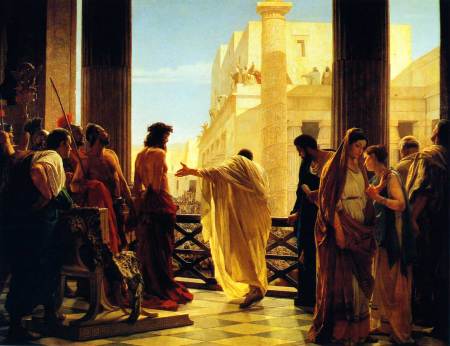
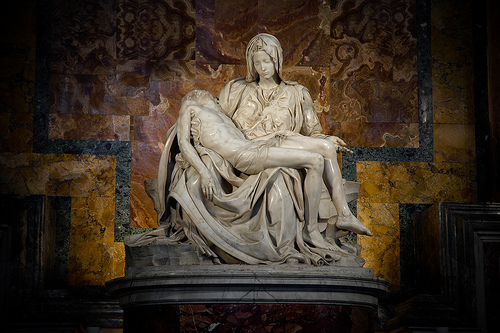
Pilate washes his hands of responsibility, and extends Christ’s arms on the cross. Mary had extended her arms declaring, “Let it be done to me according to your word,” and lovingly held the infant savior in her hands.

Pilate, despite all his power, is ruled by fear.
Mary, despite her weaknesses, is freed from it.

Governor Pilate is rich in wealth and power and yet he has no peace.
Mary, the poor widow, has peace and everything she needs from God.

Pilate has no faith in the God of Israel. He says, “I am not Jew, am I?” But for Mary, God is her rock and this makes all the difference in the world. Mary is defined by her faith, hope and love.

Mary never attends an academy, but she is profoundly wise because she reflects in her heart on the words and deeds of God and because she lives by her own advice: “Do whatever he tells you.” She knows that we do not manufacture the truth for ourselves, we receive it, ultimately from God. We love it, we defend it, and we share it with others. “Blessed [is she],” as Elizabeth said, “who believed that what was spoken to [her] by the Lord would be fulfilled.” Mary trusted and believed, for she saw the evidence through history that God “has mercy on those who fear Him in every generation,” that “He scatters the proud in their pride, and casts down the mighty from their throwns, but He lifts up the lowly.”

Mary’s life was full, but was not free from trials. When Mary consents to be found with child through the Holy Spirit she is uncertain of what will happen to her, but she trusts in God. She does not know how she and her husband will get by as poor immigrants in foreign country, but she continues to trust. Mary’s response to every trial in life, even to the death of her son, is to trust in God. Despite men’s sins, she trusts in God as the Lord of history, that He casts down the proud and mighty from their throwns and raises up the lowly.

Pilate is indifferent to Christ, and he consents to sending Him to the cross, but Mary is wholly devoted to Christ, and she consents to share in His Passion. Pilate’s heart is hardened despite Christ’s Passion, while Mary’s heart is pierced by it.

Governor Pilate was once the most powerful man in Judea, but where is he now? Mary, the poor widow, is now our glorious queen, the most beautiful and powerful woman in heaven or earth, and through her reign she draws millions to Christ our king.

She is the one who wept and now laughs.
He is the one who laughed and now weeps.

He was rich in the world and now he is poor.
She was poor in the world and now the kingdom is hers.

He took root in the desert, he was barren and uprooted.
But she was planted beside the flowing waters, she endured and bore much fruit.

So what do all of these reflections about Mary and Pilate have to do with us? I promised you at the beginning a second good reason why Mary and Pilate are mentioned in the creed; and here it is: Mary and Pilate represent us. They stand as archetypes, models or patterns, for every person.

The faithful one and the faithless one.

The one who serves God and the one who serves himself.

The one who gives Christ life and the one who puts him to death.

We live our daily lives as either Mary or Pilate, with shades of the other thrown in. As we come to the season of Lent, let us examine and discern who we are. “How am I Pilate, and how am I Mary?” And at this Eucharist, let us ask Jesus to exchange in us the ways of Pilate for the ways of Mary, for hers is the way of Christ.

Asking and Receiving — Friday, 4th Week in Ordinary Time—Year II

February 5, 2010

King Herod said to his daughter, “Ask of me whatever you wish and I will grant it to you.” He even swore many things to her, “I will grant you whatever you ask of me, even to half of my kingdom.” If Herod, who was wicked, could be moved to give his daughter gifts, how much more will our heavenly Father give us good things if we ask Him. Praying for good things is something Jesus commands us to do.

While many Christians fall into the mistake of only praying when they want something from God, there are other Christians, who pray every day, who make an opposite mistake. These Christians pray for good things for others, but they never ask anything for themselves, fearing that this would be a selfish prayer. But the danger in this, in never requesting and never expecting God’s gifts and consolations, is that we’ll become discouraged and gradually embittered.

If we never ask for a share in the Father’s gifts we risk becoming like the older brother in Luke’s parable of the prodigal son. Eventually we’ll say to God, “Look, all these years I served you and not once did I disobey your orders; yet you never even gave me something to feast on with my friends.” But our generous and forgiving Father would say to us, “My child, you are here with me always; everything I have is yours for the asking.”

Jesus said, “Whatever you ask in my name, I will do, so that the Father may be glorified in the Son.” So ask God to give you gifts—this is not a selfish prayer, for it will strengthen you in holiness and glorify God. I suggest that you try out a little experiment. Pray, “Lord, please treat me to something special today,” and then watch for his gift to come.

Staying Until Leaving — Thursday, 4th Week in Ordinary Time—Year II

February 4, 2010

Jesus provided the Twelve with their message to preach, their authority to cast out demons, and their power to cure the sick. However, Jesus withheld from the Twelve some basic provisions: no food, no bags, no spending cash, no second tunics for warmth in the cold night. On the other hand, Jesus instructs them carry walking sticks and wear sandals. What is Jesus thinking?

Jesus wants His disciples to be mobile, so that they can quickly travel to distant towns, but Jesus doesn’t want His disciples to be self-sufficient once they get there. Their lack of food, of money and of a place to sleep, forces them to become fully present to others. It necessitates the personal encounter.

Jesus told the Twelve to enter the lives of others, to enter their homes and to stay there until they leave. But what does it mean for them to stay until they leave? (How could someone leave before they’ve left?) Jesus is commanding them not trade up from house to house, as better accommodations are offered, thereby alienating and dishonoring their first hosts.

What does this gospel mean for us today? First of all, that our most important work, whatever our state in life, is our personal ministry to the people to whom Christ is sending us. We’re all busy, but we must not be too busy for what’s most important. Our professional careers will end, but our personal relationships will last, literally, forever.

Sometimes when we encounter other people we neglect Jesus’ advice to stay until we leave. Someone is speaking to us and we mentally check-out to green pastures. Sometime we fail to encounter the other person at all, brushing them off like dust on our feet.

I’ve heard it said that something which often struck people who met Pope John Paul the Great was how totally present He was to them, with his eyes and his mind, as if they were for him—in that moment—the most important person in the entire world. Can we imagine a personal encounter with Jesus Christ being any different? John Paul was a very busy man with a world of concerns on his shoulders, just like Jesus Christ, but they both had the time for what was most important.

I want to live more like that.  Don’t you?

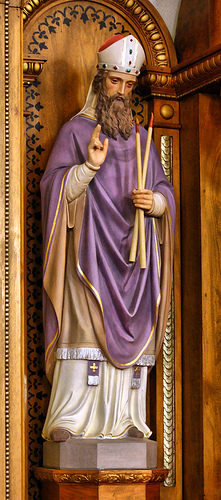
By the Throat — February 3 — St. Blaise

February 3, 2010

I began going to daily Mass in the fall semester of 2001. In college I had always gone to Sunday Mass, but after September 11th I felt that if the world was going to change for the better, it would require that people present themselves to God and offer Him more opportunity to work His grace in them. And so, two years later and seven years ago today, I was at daily Mass on the feast day of St. Blaise for the first time in my life.

At the end of Mass, Father Mark offered an opportunity for a special blessing of throats by means of two crossed candles and the intercession of St. Blaise. A line formed of the faithful, but I stayed in my pew. I felt a tug of conscience to go up there too, but I was really embarrassed by the oddness of it. “Who gets ailments of the throat anyways,” I justified to myself, and headed out the door.

With noon Mass behind me, I walked to the dining hall for lunch. I remember that I was passing an empty salad bar on my left when I got stopped in my tracks. It was like my throat suddenly got completely dry. I recognized I wasn’t choking, so I wasn’t frightened, but it took me a good minute or two get right again.

Now my best natural explanation for what happened to me is that I inhaled dust kicked up by some unseen kitchen sweeper which got blown in by a fan through the open door on my right. But it didn’t take me long to remember St. Blaise and to recognize in this providential incident God’s gentle correction.  The message: “Don’t refuse a holy blessing.”

We Catholics should not feel ashamed of our traditional blessings and sacramentals. Things like holy water, miraculous medals, and house blessings make a difference; for with these things we make an act of presenting ourselves to God and offer Him more opportunity to work His grace in us.

Absalom and Satan — Monday, 4th Week in Ordinary Time—Year II

February 1, 2010

Absalom was one of David’s very own, but Absalom would betray him. Absalom’s name means “Father of Peace,” but he far closer resembles the “Father of Lies.”

In almost our earliest story about him, Absalom arranged his brother’s murder. He’s a murderer from the beginning.

We read that Absalom, like Satan, had a radiant beauty. “In all Israel there was not a man who could so be praised for his beauty as Absalom, who was without blemish from the sole of his foot to the crown of his head.”

Like the devil, Absalom’s glory was equaled by his vanity. At the end of every year, when his long hair grew too heavy, he would have it shaved and weighed it according to the royal standard.

Absalom was willing do havoc to attract another’s attention, as when he set fire to the field of a person ignoring him.

Like the serpent, Absalom was cunning and he would readily lie to serve his purposes. Absalom would sit at the city gates, listen to peoples’ (legal) grievances, and assure each one that they were right and entitled. Then he would manipulatively muse on how much better their lives would be if only he had the power.

Finally, Absalom sought to overthrow and kill his king. Absalom’s best advisor would counsel him, ‘Please let me choose twelve thousand men, and be off in pursuit of David tonight. When all the people with him flee, I shall strike down the king alone. It is the death of only one man you are seeking; then all the people will be at peace.’ This plan was agreeable to Absalom and to all the elders of Israel.

In our first reading we see David weeping on the Mount of Olives as he flees from Absalom. 1,000 years later, a descendant of David would be troubled in spirit on that same hill overlooking Jerusalem. Unlike David, Jesus did not flee His pursuers and was dead within a day. Jesus and the Sanhedrin agreed on this: it was better that one man should die, so that the whole nation may not perish.

David would flee and survive, but Absalom would die, thrust through with spears, hanging from a tree, entangled by his long, glorious hair.  But after this comes an episode which is a window into God’s incredible love for us. When news of the villainous betrayer’s death reaches King David, he mourns inconsolably at the loss of his beloved.

Likewise, and amazingly, despite Satan’s great and intractable wickedness; his betrayals, violence, and lies; the Lord still loves him. As the Book of Wisdom affirms, “[Lord,] you love all things that are and loathe nothing that you have made; for what you hated, you would not have fashioned. And how could a thing remain, unless you willed it; or be preserved, had it not been called forth by you?

There is a great encouragement in this for each one of us. If the Lord loves Satan, like David loved Absalom, then how could we ever doubt that the Lord will always love us, or imagine that He rejects us whenever we turn to Him?

Man’s Mission — Friday, 3rd Week in Ordinary Time—Year II

January 29, 2010

In the beginning, the Lord God settled the man in the garden of Eden, to cultivate and care for it. Then the Lord made the man a partner suitable for himself. Each day had seen God make greater and greater creations and on this last day, God makes His final, ultimate creation: woman.

The man beholds her with joy. He authors her name, which points to his authority, yet this authority is not meant for dominance but service, like the authority exercised by Christ. The man is meant to work to nuture and guard the garden and to nurture and guard his wife.

Before the Fall, all work was free from toil. Work carried with it no pains, no exhaustion, no boredom or strain—only feelings of satisfaction, creative accomplishment, and pleasure like those which we still sometimes enjoy from doing a job well done.

The man was placed in the garden with an important job to do, to nurture and protect, but he neglected his duty, and this led to the Fall. For where was he when the cunning serpent was out of place and out of line enticing his wife towards death? Maybe he was off sleeping on the job, taking an afternoon nap somewhere, like David in the first reading:

‘At the turn of the year, when kings go out on campaign, David, however, remained in Jerusalem. One evening David rose from his siesta and strolled about on the roof of the palace (for he had nothing else to do) and from the roof he saw a woman bathing, who was very beautiful.’

David forgets about his kingly work and duty, to fight the good fight, and from this comes his fall. He exploits the power of his authority and sins against a woman he should to honor and defend.

Our lives are meant to more than just our work, but faithfulness to some form of work before God is meant to be a part of our lives. Our work helps us to be good and to do good for others. Maybe you’re retired now, but if you’re still here on earth then the Lord must still have some important work for you.

What work has the Lord entrusted to you? Be as faithful to it as you ought so that Christ, the new Adam, may grow His virtues in you and harvest good works in you.

Holy Reminders — Friday, 1st Week in Ordinary Time—Year II

January 16, 2010

Jesus said to the paralytic, “I say to you, rise, pick up your mat, and go home.”But why did Jesus send the man home with his mat? Why say anything more than, “I say to you, be healed and rise”? Why send the man home and have him take his mat with him?

Was it that Jesus was annoyed with the intrusion of this man and his amateur skylight instillation crew? That’s not it, for throughout the Gospels Jesus is always pleased by seeing displays of faith, and it says here that Jesus “saw their faith.” Rather, it is those who obstinately hold on to their faithlessness against all positive evidence who elicit Jesus’ annoyance in the Gospels. Recall when He said elsewhere:

“Woe to you, Chorazin! Woe to you, Bethsaida! For if the mighty deeds done in your midst had been done in Tyre and Sidon, they would long ago have repented in sackcloth and ashes.”

So why did Jesus send the cured man away with his mat? In setting the scene, the Gospel says that when “it became known that [Jesus] was at home… many gathered together so that there was no longer room for them, not even around the door, and [Jesus] preached the word to them.” Jesus preaches the word to the crowd so that they may be prepared to receive the Gospel about Himself. It seems that Jesus sends the cured man home because in his short time with Jesus he has been brought fully up to speed. Jesus sends the man home because, for now, the man knows everything he needs to know. Jesus forgives the man’s sins and cures him. From this the man understands why Jesus has come: for the forgiveness of sins and the healing of persons.

And why does Jesus send him home with his mat? I bet that the man would have gladly left it behind, happy to be rid of it, without a second thought. I think there are two reasons he’s told to take the mat: First, so that he may preach to others about Jesus. The mat will be conversation starter (“Hey, what’s with the mat?”) and it will also serve as “exhibit A” when the man gives his testimony about Jesus. The second reason for having him keep the mat is so that the man will always remember what Jesus did for him and what it meant. What good would it be for Jesus to teach the man everything he needed to know, if he were to quickly forget everything he had learned?

Perhaps we have need for such concrete reminders for ourselves in our life of faith. Maybe we don’t have souvenirs laying around from times that Jesus helped you, but I bet we all have access to Post-It Notes. If you think you would benefit from being reminded of Jesus’ past goodness shown to you, then write down titles for a few of these great moments.  Post them up on your wall, your mirror, your computer monitor, or wherever you will see them. This will help keep you mindful of Christ, what He did for you and what it means. And maybe, someday, someone will ask you, “Hey, what’s with the Post-it Note?”

Encountering Jesus in Prayer — Baptism of the Lord—Year C

January 11, 2010

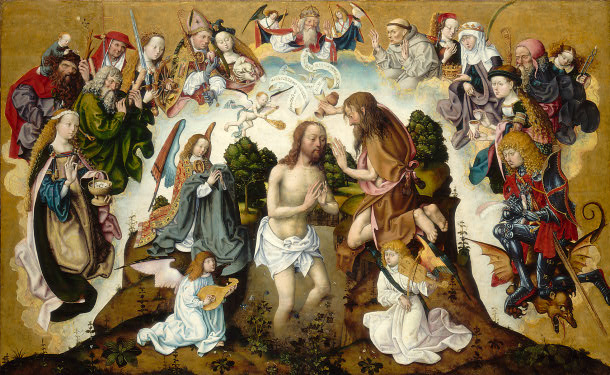
At Jesus’ baptism, the Father spoke to Him from heaven, “You are my beloved Son; with you I am well pleased.” Today, our Father wants you to hear Him say to you, “You are my beloved child and with you I am well pleased.”

This may be hard for us to hear. Maybe we think to ourselves, “I’m certainly not Jesus.   How could God be well pleased with me? Our past and present sins of come to mind and we feel pained by guilt. In times of prayer and in our daily life we are burdened by the thought that we are not the person God wants us to be. We think, “If only I were better, if only I could be perfect, then I could live and pray like the saints and God would love me.” If we think like this, our thinking has it backwards.

It’s not that God decides to love the saints, or us, only after we have achieved holiness by our own incredible feats of strength, endurance and personal sacrifice. Here’s the secret to the saints: the knowledge of God’s love and pleasure toward them came to them first, the saints’ great holiness only followed. Saints are not self-made men and women. It is by accepting God’s embracing love for us that we’re empowered to live incredible lives of love. We live like saints if we live in the truth that God loves us already.

To bear this point out, I would like you to try a thought experiment.  (You may close your eyes if you think it will help.) Imagine if you were a completely perfect person, totally free from sin, and free from guilt and fear before Him. Now pray to the Father in heaven imagining you’re this perfect version of yourself.

If you’re like me, imagining this makes it much easier to approach Him, to love Him, to praise Him, to thank Him and to feel His love for you.

And now, still imagining you’re this perfect person, consider the day or the week ahead of you.  What kind of attitude do you feel towards your life?

Again, if you’re like me, you find it much easier to see the future not so much as a burden, but with a certain eager calm. You view your life as an great opportunity to serve and to love from out of the abundance of love that you feel.

It’s not just your imagination that makes you feel this way.  It is the Holy Spirit confirming a truth in you. And the truth is that when the Father looks at you He doesn’t see the unlovable wretch of your fears, He sees something much closer to this perfect person.  By our baptism into Christ, we are loved as God’s daughters and sons, but maybe we not living like the saints we so admire because we’re tripped up by fear and self-doubts, thinking that for us intimacy with God remains a thousand miles away. The Father wants you to be confident, peaceful, and joyful in His love for you. In this way of His, He will lead you out of sins which history proves that your own efforts alone cannot conquer. Compared to the self-imposed yoke of our own anxious strivings to holy, the way of accepting God’s love for us is easy and light, and it actually works. We will live like saints when we accept the truth that God loves us already.

The saints became saints by overflowing with God’s love for them, by receiving His acceptance, approval and pleasure. These are gifts which He always wanted to give them, and He would do the same for us, if only we would let Him. So when you pray the Our Father today do it as the Father’s beloved son or daughter. And whenever you pray, or in whatever you do, do it in the liberating and empowering truth: “You are my beloved child; with you I am well pleased.”

Decoding the Ritual — Friday After Epiphany

January 9, 2010

Jesus stretched out his hand, touched the leper before Him, and said, “Be made clean.” The leprosy left him immediately and Jesus ordered Him, “Go, show yourself to the priest and offer for your cleansing what Moses prescribed…” What was Jesus asking this man to do? In the Book of Leviticus it says:

This is the law for the victim of leprosy at the time of his purification. He shall be brought to the priest, who is to go outside the camp to examine him. If the priest finds that the sore of leprosy has healed in the leper, he shall order the man who is to be purified, to get two live, clean birds, as well as some cedar wood, scarlet yarn, and hyssop. The priest shall then order him to slay one of the birds over an earthen vessel with spring water in it. Taking the living bird with the cedar wood, the scarlet yarn and the hyssop, the priest shall dip them all in the blood of the bird that was slain over the spring water, and then sprinkle seven times the man to be purified from his leprosy. When he has thus purified him, he shall let the living bird fly away over the countryside.  (Leviticus 14:2-7)

Hidden within this strange Old Covenant ritual, Jesus Christ is concealed. And through Jesus’ death for us on the cross the true symbolism of this ritual is revealed.

The scarlet, the wood and the hyssop all have their place in Christ’s Passion.  The scarlet yarn points to the robe they placed upon Him; the wood to the cross on which they nailed Him; and the hyssop to the branch they used to offer Him drink. One bird is slain and the other is spared, dipped in the water and the blood of its brother. This water points to the water of Christian baptism, which receives its grace through the blood of Jesus’ cross. In the ritual the priest would take all of these things and sprinkle the man to be purified seven (the perfect number of) times from his leprosy. In His Passion Jesus took all these things and used them to purify us from the leprosy of our sins.

In our wonder at these signs, let us make our faith in God firmer, and give Him our thanks.

Strengthening Your Family — Holy Family

December 29, 2009

Today we are going to try something unique. Close your eyes and let the Holy Spirit guide your imagination to show you what family life was like in the home of Joseph, Mary, and the boy Jesus…

Theirs is a small dwelling and you can see all of them there…

How old is Jesus as you see Him? What is He doing?

What are His parents up to? What are Joseph and Mary like as you see them interact with each other?

It comes to time to eat. What do you see the Holy Family doing?

As they relate to one other, what do you see expressed in their faces? It is now later in the evening and time for prayer. What do you see the members of the Holy Family doing?

You can return in your imagination to visit this house any time you wish, but now, let’s open our eyes and review our mediation.

What did you see as Joseph and Mary interacted with each other? Were they not tender and reverent towards each other? I bet you could see their great mutual love reflected in their smiles.

What happened in their house when it was time to eat? Who would imagine them not coming together to share their meal in each others’ company?

And later, when it was time for prayer, did the Holy Family do? Did you see them go off to their own corners, or did they come together, to pray as one family?

Did you see the Holy Family’s intimacy, their happiness, and their love for each other? Do you want your family to share a bond like theirs? Then take the Holy Family as your model: share your love, share your meals, and share your prayers.

First, on sharing your love. Let your spouse and children know every day that you love them. You can say it, you can show it, or you can do both. For instance, kids never tire of being hugged and told their loved each day.

As for married couples, don’t make the mistake of thinking that intimacy and love are only expressed physically. For St. Joseph had all sorts of simple, little ways to let Mary know that she was loved, and vice-versa. Be like the Holy Family in sharing your love.

A second way to model the Holy Family is to share your meals. The research of social scientists indicates that having frequent family meals together contributes many goods for one’s family: For starters, everyone eats healthier meals, and so kids are less likely to become overweight or obese. And kids who eat family meals are less likely to start smoking, to drink alcohol, or to try or to be addicted to drugs. These kids’ grades are better at school, and there is less stress in their homes. These things probably stem from the fact that families which eat together are bound to talk more, provided the TV is off.

These parents are more likely to know about their children’s lives and struggles and, just as importantly, their kids are more likely to know that their parents are proud of them and love them.

Jesus Christ thinks that the shared family meal is so important for us that He has instituted one for His Church and expects His entire family to be there; for to share in the Eucharist is to share in the life and communion of His family.

A third way to make your family more like the Holy Family is to share your prayers. Apart from dinner prayers or going to Church, most Catholic families do not pray together. I think that maybe we see the priest praying the Church’s prayers and think that we are not equipped to lead prayers of our own at home.

But it’s not true.  As fathers and mothers you have a spiritual authority within your families, what John Paul the Great called “the domestic Church.” Your spouse and your children need you to pray, not only for them, but with them. Right after the family meal might be the perfect time for this ritual of family prayer.

Now you may be thinking to yourself, “But we’ve never done this as a family before.” Remember this: as parents, you create what’s normal for you children. If you want it to be normal for your children to eat meals with you, then make it normal for them.

If you want it to be normal for your children to pray to God with you, then do it normally. As parents, you create what is normal for your children and through your gift of these traditions to them you can bless them for a lifetime.

Finally, husbands and wives, if you do not pray one-on-one with each other, then you do not yet share a perfect intimacy together.  It is in prayer that our most intimate selves are laid bare and we ask another person to help us with our heartfelt needs and concerns.

Maybe you’ve never prayed with your spouse before. Then perhaps you can begin like this:  hold each others’ hands, close you eyes, and pray to God for each other, for a little while, even if for just ten seconds, say, before you go out the door. 

Once this becomes comfortable you can begin to telling each other what you want to be prayed for. And, after this is comfortable, you can begin to pray for each other aloud.  Begin the process of praying like this and it will transform your intimacy together.

Perhaps you gave many gifts to your family members yesterday for Christmas, but the greatest gift you can give to each other is yourselves. So follow the way of the Holy Family: share your love, share your meals, and share your prayers.

Treasure the Gift — Christmas Mass at Midnight

December 26, 2009

It’s Christmas, and today we hear one of the most familiar passages in the Gospel, the nativity scene in Bethlehem.  Is there anything that we can learn out of such a familiar text?  Yes, very much indeed. For example, have you ever wondered: what are swaddling clothes anyways?  ‘Mary wrapped her Son in swaddling clothes and laid him in a manger.’

When I was young I thought swaddling clothes were just dirty pajamas, but in fact swaddling refers to an ancient custom. They would use tightly bound cloths to wrap-in an infants’ arms and legs to their bodies (they thought this was important for promoting proper posture.) This practice was called “swaddling.” Was it cruel to confine the babies like this? No, the babies liked this. It reminded them of their many months, warm and snug, within their mothers’ wombs. Another thing I’ve learned since the time I was a kid was what a manger really was.  A manger is not a stable. It’s a feeding trough.  Mary wrapped Jesus up in swaddling clothes and laid him in a feeding trough.

Even if you knew all that stuff before, there remains the question of why St. Luke included these details in his Gospel. Why is it important?  Not only does it show the poverty and humility of the Christ, it also points to Jesus’ future. This is not the last time that His mother would wrap Him in tight cloths and lay His body down. And baby Jesus is laid in a feeding trough because when He is grown He will say to His disciples, as you will her Him say to you here, “Take this, all of you, and eat it. This is my body which will be given up for you.” The swaddling cloths point to Jesus burial cloth, and laying in the manger points to His Eucharist, where which He offers us His whole self, His body, blood, soul, and divinity as food.

So you see, whether we are a talking about the Sacred Scriptures, prayer, the sacraments, the teachings of Christ’s Bride (our Mother, the Church,)  our Catholic faith is not a half-cut orange whose richness you can drain out with one or two squeezes and then toss away. A lifetime of discovery will not exhaust what all that our Catholic Faith contains.

When I was a kid I might have looked at this manger scene and though that some people were missing.  “Where are the Magi, the wise men (or astrologers) from the East?”  They’re over there, hiding among the poinsettias. Maybe they are journeying through the forests, or maybe they haven’t even left home yet, but one thing we do know is that they were not there on Christmas night.  When they arrive in Jerusalem they ask King Herod, “Where is the newborn king of the Jews?” Days, weeks, or even months have passed since Christmas, and when they do arrive in Bethlehem they do not find Jesus, Mary and Joseph living in a stable or a cave, but in a house.

So who was there that first Christmas night? The shepherds were there. The angel said to them in the fields, ‘I declare to you news of great joy! A savior who is Christ and Lord is born for you in Bethlehem.  You will find Him wrapped in swaddling clothes and lying in a manger.” The shepherds look at each other and say, “Hey, we’ve gotta check this out.” Who wouldn’t turn out for that first Christmas after an angelic invitation like that?

The shepherds came to the stable and find the infant Christ just as the angel described. From there, Luke’s Gospel says, they returned rejoicing and spread the word about what had happened to all. The shepherds probably knew everybody from Bethlehem, since they were locals (“from that region”) and within walking distance from the stable.

Yet there is a question which I would like us to consider, a question which the Gospels do not answer, and it is this: After that first Christmas, did the shepherds ever come back to visit the Holy Family again? I doubt you could find two people more friendly and welcoming than Joseph and Mary, so I sure that any guest was welcome in their home, but did the shepherds ever take the opportunity to visit them again? The Magi had to travel hundreds of miles just to see Jesus once, but the shepherds were only a short distance away. 

Did the shepherds ever get to know Mary and Joseph better, these two holy saints of God? Did they ever take time come back to adore Jesus, to consider what the birth of this Child meant for their lives, and to praise and thank God for all the blessings they had received? If they had merely spent a single hour each week in the Christ child’s presence, imagine what difference it would have made for their relationships, their work, and their lives in general? We don’t know whether the shepherds ever came back again after that first Christmas, but if they didn’t, then they were foolish and they really missed out.

This Christmas Jesus Christ invites you come back and see Him again, to visit this house of Joseph and Mary, where He is always present to be adored. He wants to bless you through His saints, His teachings, His sacraments, and His Real Presence here, the whole year round. You may be receiving many gifts this Christmas, but make sure that you do not return this one.

3rd Sunday of Advent—Year C

December 14, 2009

Advent is a season for penance and conversion, for the confession of sins and the changing of lives, but this Sunday of Advent reminds us that it is also time for joy. Today we celebrate Gaudete Sunday, a name which comes from the Latin command “rejoice!” This command is heard from St. Paul in today’s second reading:

“Rejoice in the Lord always.
I shall say it again:  rejoice!”

But is it that why do we need to be reminded, even commanded, to rejoice? Why are we not a people of constant joy and peace, even though we have great reason to be? I think it is because our hearts and minds give in to fear.

God is near, but when we give in to fear we do not trust that He really cares about us and really provides for us. In fear we become anxious about our future. In our fear we feel too stressed-out to be thankful. And in fear we forget or refuse to pray. St. Paul seems to have realized all this, that may be why he followed his command to rejoice with these words, words that it would do a lifetime of good to know by heart:

“The Lord is near.
Have no anxiety at all,
but in everything,
by prayer and petition,
with thanksgiving,
make your requests known to God.
Then the peace of God
that surpasses all understanding
will guard your hearts and minds in Christ Jesus.”

Today I would like to share with you a true story about two friends of mine who had every seeming reason to afraid, but who kept God’s peace. Let’s call them Andrew and Christi. I have changed their names to conceal their identities, but I know they wouldn’t mind me sharing with you their story because it can teach us all a lot.

To say my friends had a difficult first year of marriage would be to understate it. Andrew, a hard-working man with rough hands and a good heart, became afraid that marrying Christi had been a mistake and he seriously considered getting a divorce. Christi, a beautiful woman inside and out, prayed fervently to God, for both Andrew and herself. She honestly did not know how God would provide for her, but God gave her a peace that surpassed her limited understanding of His plans. Then, as Andrew tells it, God intervened, giving him a sign that this marriage was indeed His will and that Andrew should not be afraid. This divine reassurance strengthened Andrew and he resolved to remain faithfully at Christi’s side no matter what.

A few months later, forces beyond their control forced Andrew and Christi to leave their hometown, away from all their family and friends, and to move down south to a town where Andrew had some distant relatives. But, once they got down there, all of these relatives proved to be too distant or too busy to care enough to lend this vulnerable couple a hand. Their first Advent season together, Andrew and Christi were jobless, homeless, and with child.

It would have been so easy for them to give in to despair that first Christmas Eve, for Andrew to feel like he had failed his wife as a husband, or for Christi to feel anxious and afraid about their future as a family. Yet, Andrew and Christi trusted that the Lord was near. They would pray together as a couple, and gain courage and strength, peace and even joy through their prayers.

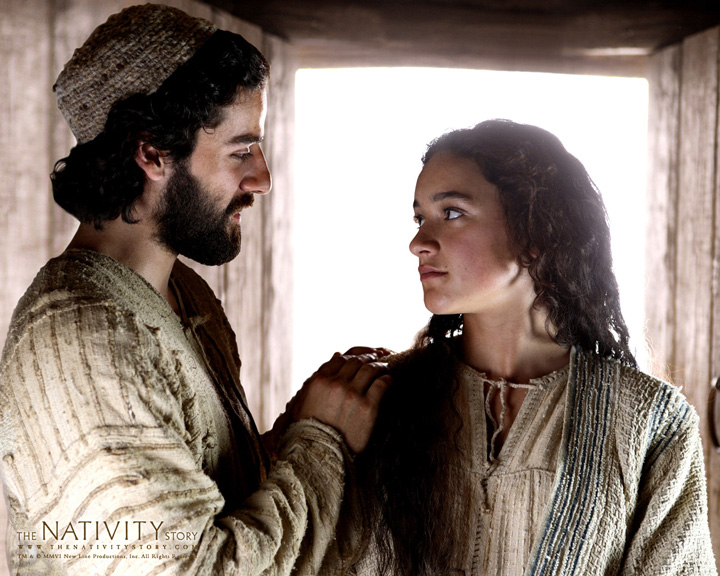
Indeed the Lord was near them, through it all, and their first Christmas together turned out to be was the brightest and the most joyful that they, or the world, had ever seen. As I said, this is the true story of two friends of mine, but they’re also friends of yours and you knew their story even before I told it to you today. For Andrew’s real name is St. Joseph and Christi’s real name is St. Mary.

Today we rightly call them saints, not because they lived in a world free from difficulties, an imaginary world different from our own. Joseph and Mary are saints because they knew and practiced how to live in this world well; with joy, kindness, prayer, thanksgiving, and peace. And so brothers and sisters:

Rejoice in the Lord always.
I shall say it again:  rejoice!
Your kindness should be known to all.
The Lord is near.
Have no anxiety at all,
but in everything,
by prayer and petition,
with thanksgiving,
make your requests known to God.
Then the peace of God
that surpasses all understanding
will guard your hearts and minds in Christ Jesus.

Wednesday, 34th Week in Ordinary Time—Year I

November 25, 2009

Today’s responsorial psalm is not actually one of the 150 Psalms.  It comes from Daniel 3, where 3 men (none of whom are Daniel) are thrown into a fiery furnace for refusing to worship a golden  statue of King Nebuchadnezzar. (Isn’t it always so that all of history’s oppressive states and rulers have insisted that everyone fall down and worship gilded images of themselves or else be thrown to the fire?) Anyway, these three men are heaved into the flames, but God sends to them an “angel of the Lord,” or literally, a messenger, to preserve them from all harm. The trio sings a hymn of praise, part of which we heard today as our responsorial psalm.

Sun and moon, bless the Lord…
Stars of heaven, bless the Lord…
Every shower and dew, bless the Lord…
All you winds, bless the Lord…
Fire and heat, bless the Lord…
Cold and chill, bless the Lord;
praise and exalt him above all forever.

King Nebuchadnezzar rose in haste and asked his nobles, “Did we not cast three men bound into the fire?” “Assuredly, O king,” they answered. “But,” he replied, “I see four men unfettered and unhurt, walking in the fire, and the fourth looks like a son of God.”

Could this “son of God” amidst the flames actually be the Second Person of the Trinity, God the Father’s greatest messenger, or is it merely one of God’s many angelic spirits? In either case, this heaven-sent deliverer for God’s faithful ones at least symbolically points to Jesus Christ. We should not be surprised to find signs of Christ in the Old Testament.  Nor should we be surprised to see symbols of Him built into God’s creation all around us.

Consider the sun in the sky, which gives light to the world. It comes to earth, dies, and is buried, but then it rises again for us.

Consider the moon in the night, which resembles the Eucharistic host. We admire it held on high. We see it broken before us. Though consumed, it is renewed again for us.

Consider the stars, which resemble Christ’s numerous and glorious saints shining in heaven.

Consider the showers and dews, which resemble Him who humbly comes down from heaven to earth to give life to the world.

Consider the winds, which resembles Christ’s Spirit, mysteriously moving and active across the whole world.

Fire and heat, bless the Lord. Cold and chill, bless the Lord. For even in the extremes and in-between’s of life, God is to be found. Let us praise and exalt him above all forever.

34th Sunday in Ordinary Time—Year B

November 23, 2009

Today we celebrate the Solemnity of Christ the King. Jesus Christ is our king, now and forever. Yet, the idea of monarchy doesn’t really resonate with us. And it’s not just because we don’t have an earthly king ruling our country. It’s that we’re not big fans of authority. We are wary of anyone having too much power. This is because power is often abused.

Those with any degree of power, be it over entire people or a single employee, can abuse that power. We can fall into thinking only of themselves and our own advantages and be blind and deaf to the legitimate concerns and genuine needs of others. Sometimes those with power hold on to it jealously and will stomp out any real or perceived threats to that power without regard to the truth. This is how the Roman Governor Pontius Pilate responds to Christ. When Pilate asks Jesus, “Are you the King of the Jews,” he is not searching for the Jewish messiah, or even the truth.  He is probing for a political threat to himself.

The true purpose of power and authority is for serving the good of others. This goes for the Church and for all government, for our workplaces and our homes. The reason that our all-powerful God shares some of His power and authority with us, His creatures, is not so that we may be self-serving. It is so that we may serve others, give them life and bless them, and in this way resemble God Himself. God has given of Himself, given us life, and blessed all creation.

As Jesus said to His apostles, “You know that the rulers of the Gentiles lord it over them, and the great ones make their authority over them felt. But it shall not be so among you. Rather, whoever wishes to be great among you shall be your servant; whoever wishes to be first among you shall be your slave.”

Jesus showed his perfect love for us by becoming a slave and dying for us on the cross. For this reason, we do not fear the idea of Him being the first among us, reigning as our king. The Church, His bride, welcomes its royal bridegroom. And as it is for the bride of Christ as a whole, so it is for every Christian soul in relationship with Christ.

Every bride yearns to be fought for, to be pursued and to be a priority to someone. Christ has made us His priority.  He came down from heaven in pursuit of us. He has fought for and died for us, and now in heaven He still fights for us.

Every bride also wants an adventure to share. She doesn’t want to be the adventure; she wants to be caught up in something greater than herself. When we are living for ourselves we are alone, without purpose, and empty. Each of us is meant to live a life about more than just ourselves.  A life in Christ. We each have a vocation, a calling from God, a unique part to play in an epic adventure, a significant part to play in His great story.

Every bride wants to have a beauty to unveil. And it’s not just an exterior beauty. It’s a deep desire to truly BE the beauty and to be delighted in by the bridegroom. Christ is the lover of our souls and all of us wish to have beautiful souls. Each person desires to be approved and uniquely enjoyed by Christ. For us males, this is a desire for his approval and regard.  To be one who He is unashamed to call us His brother, a member on his team; a man in His platoon

Why bring up how Christ our King is the perfect bridegroom for His bride, the Church? Gentlemen, take note. Imitate Christ for your brides with Christian chivalry, love your wives as Christ loves the Church, and you will be like our king for your queen. Fight battles on Christ’s side for your beautiful bride. Lay down your life for her each day. Be Christ the king’s shining knight for her—honor, serve, and defend your bride and lead her on an adventure. The power you have is for her and you family.

For any of us, with any power and authority comes responsibility. And the power each of us has gives us a great opportunity. For by serving Christ our King and by caring for those He has entrusted to our care, we win the only glory and happiness worth having, that of Christ our king—the glory and happiness with the power to last forever.