Archive for the ‘St. John the Baptist Parish’ Category

August 6 – The Transfiguration

August 17, 2009

Today, Peter, James and John see Jesus in a new light. The light they see does not shine on their teacher from another source. This light originates from within the person of Jesus Himself. At the Transfiguration, these apostles come closer to realizing Jesus’ full glory and dignity; that He is more than a teacher, more than a miracle worker, and more than the messiah. He is divine, the Son of the Ancient One.

We are human, not divine, but Christ wants to divinize us. He wants to make us more like God. Coming to appreciate who Jesus really was changed how the apostles related to Him. In the same way, knowing that everyone you meet will someday be transformed should influence how you relate to them.

My closing words come from C.S. Lewis and his book, The Weight of Glory:

“It is a serious thing to live in a society of possible gods and goddesses, to remember that the dullest and most uninteresting person you can talk to may one day be a creature which, if you saw it now, you would be strongly tempted to worship, or else a horror and a corruption such as you now meet, if at all, only in a nightmare.

All day long we are, in some degree, helping each other to one or other of these destinations. It is in the light of these overwhelming possibilities, it is with the awe and the circumspection proper to them, that we should conduct all our dealings with one another, all friendships, all loves, all play, all politics.

There are no ordinary people. You have never talked to a mere mortal. Nations, cultures, arts, civilization—these are mortal, and their life is to ours as the life of a gnat. But it is immortals whom we joke with, work with, marry, snub, and exploit—immortal horrors or everlasting splendors.”
Tuesday, 19th Week in Ordinary Time—Year I

August 17, 2009

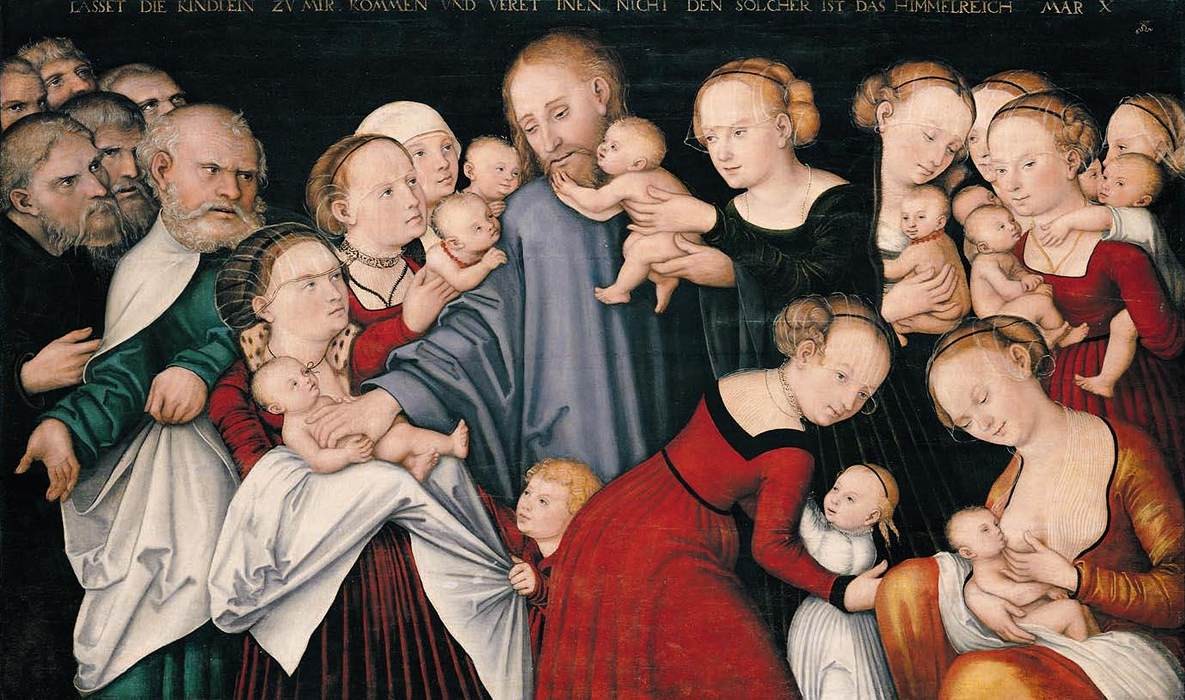
The disciples ask, “Who is the greatest in the kingdom of heaven?” Jesus says, “Whoever becomes humble like this child is the greatest in the Kingdom of heaven.” In fact, Jesus teaches us, becoming humble is essential to entering into His kingdom.

So what is humility?

“Now humility is nothing but truth,” says St. Vincent de Paul, “while pride is nothing but lying.” He says, “The reason why God is so great a lover of humility,  is because he is the great lover of truth.”

Now humility is not about believing we are garbage. It’s a lie to say we’re of little worth. Even the seemingly least person among us is attended to by angels and bears a likeness to the God whom those angels ceaselessly worship. We are of great worth, but to be humble we need to know where our true treasure is.

We must abandon over-confidence in our own faulty and limited powers and trust in our reliable Rock—“how faultless are his deeds, how right all his ways.” In Christ, our Rock, we are secure; and as G.K. Chesterton notes, “It is always the secure who are humble.”

To strip away our illusions and to know our true treasure let’s pray today for the two gifts which it is said God always promptly gives whenever we prayer for them: Humility and Faith.

We can be leery of praying for humility, because when you pray for humility, humility shows up. I myself cannot recall a time when my prayer for humility was not answered by the end of the next day. But let’s have courage, and not allow our entry into Christ’s Kingdom be delayed by our disordered self-love or timidity.

What Moses said before the Israelites on the edge of the Promised Land is just as true for us: “It is the Lord who marches before you; he will be with you and will never fail you.  So do not fear or be dismayed.”

Thursday, 19th Week in Ordinary Time—Year I

August 17, 2009

Today we heard the parable of the debt-ridden servant. You and I, of course, are the first servant with the unpayable debt. The debt of our sins. And the Lord, our King, has taken the loss, upon Himself, to gratuitously forgive our debt. But, at our judgment, He will receive important testimony about how we have treated those who have owed us much lesser personal debts.

This is why some Christians pray, “forgive us our debts and we forgive our debtors,” while we pray, “forgive us our trespasses, as we forgive those who trespass against us.”

Who is it that you’re not sure you’ve forgiven?

Remember this:  To forgive another’s sin is not to say that the wrong wasn’t wrong, and it is not trying convince yourself that the hurt doesn’t hurt. If you can pray for the good of your offenders, you have a forgiving heart.

Wednesday, 18th Week in Ordinary Time—Year I

August 17, 2009

St. Therese of Lisieux says, “We obtain from [God] as much as we hope for.” Today’s readings show this to be true.

On the very edge of Canaan, the Promised Land, the Hebrews lose all hope, and thereby they lose the land that the Lord wanted to give them. The Lord wanted to fight along their side, but they became so discouraged that they were unwilling to even go to the battle. They obtained from God as much as they hoped for, and died in the desert. They gave Lord nothing to work with, and there was nothing for the Lord to do but to let others to take their place.

The Canaanite woman in the Gospel is another story. She hopes against hope, and wins from our seemingly reluctant Lord her daughter’s healing. St. John of the Cross says: “The more the soul hopes, the more it attains.”

So let’s be bold.  Let’s hope and strive for bigger things than we do already. And let’s see how much the Lord can do with what we offer Him.

Thursday, 17th Week in Ordinary Time—Year I

August 17, 2009

In the daytime, the Hebrews saw the cloud of the Lord over the meeting tent. But at night, fire was seen in the cloud. In the daytime, the cloud above the meeting tent seemed to invite communion. But at night, the cloud seemed to threaten.

Was there always fire in the cloud, night and day? I suspect that there was, even though it could only be seen in the night, for God appeared to Moses in the burning bush as fire, and as the letter to the Hebrews says, “our God is a consuming fire.” The cloud itself did not change. The difference was one of perspective, whether you looked at the presence of God from within the light, or in darkness.

The same thing may apply for vastly different experiences of heaven and hell. In the parable about the end of this age, Jesus describes how the good and bad fish will be sorted out, as Wisconsin fishermen separate carp from bass, muskie, & trout. The bad will be separated from the good.  In this way, after the judgment, the wicked will no long be able to cause harm to the saints. The good will be gathered together. The bad will be widely scattered.

For the saints, God’s presence will be as the welcoming, mysterious cloud; but for the condemned, even the outermost reaches of God’s presence will be a fiery furnace. There will be no escaping Him, for nowhere in the universe is there a perfect hiding place from God. Our God is a consuming fire of goodness, truth, justice, and love.

Forever frustrated and angry, the wicked will long to be farther and farther from Him, for this movement away from Him has defined their lives on Earth. But for the saints, the goodness, truth, justice, and love belonging to God will be like home. For in their lives, the saints, like the psalmist, prefer the house of God to dwelling in the tents of the wicked.

So Christian disciples, yearn and pine for the courts of the Lord. Continue to follow the cloud of His presence, and He will lead to your promised home.

Tuesday, 16th Week in Ordinary Time—Year I

August 16, 2009

The book of Exodus says,

“In the night watch just before dawn the Lord cast upon the Egyptian force through the column of the fiery cloud a glance that threw them into a panic; and he so clogged their chariot wheels that they could hardly drive.”

Israel would soon see those Egyptians lying dead on the seashore.

During another night watch, many, many years later, as one Sunday was dawning on a tomb outside the walls of Jerusalem, an angel of the Lord descended from heaven. As the Gospel of Matthew describes it,

“His appearance was like lightning and his clothing was white as snow. The guards [there] were shaken with fear of him and became like dead men.”

When Pharaoh’s Egyptians saw the glance the Lord cast through the column of the fiery cloud they sounded the retreat before Israel, because the Lord was fighting for them against the Egyptians.

Since the resurrection of Jesus, the spirits of evil have been on a retreat, because the Lord is fighting for us against them. Their uneven retreat continues today, but we shall witness their total defeat. Then, the book of Revelation says, we who followed the Lord shall sing among the angels the “song of Moses,” or something like it.  And, in the presence of God our Father, Christ our brother, Mary our Mother, with the saints and one another as brothers and sisters, with the Holy Spirit as our bond, we will rejoice at the Lord’s victory for us.