Archive for the ‘Sunday Homilies’ Category

How They All Went Wrong

May 3, 2020

4th Sunday of Easter—Year A

Why did Satan rebel against God?
Why did Judas betray Jesus?
Why did Peter deny the Lord three times?
The underlying answer is important for our present lives.

Why did the Devil rebel? Though mysterious, it seems that this angel proudly desired a greater “glory” than was found in God’s hierarchy. To be God without God. This was his suggestion in tempting our first parents; “you will be like gods”. Satan, being the most powerful of the demons, rules a fallen kingdom apart from goodness, truth, and God.

Why did Judas Iscariot betray Jesus? It might have been for the money; thirty pieces of silver was about five weeks of wages and St. John the Apostle reports that Judas “was a thief and held the [apostles’] moneybag and used to steal the contributions.” Yet St. Matthew writes that when Judas saw Jesus condemned he deeply regretted what he had done and returned the money to the chief priests and elders saying, “I have sinned in betraying innocent blood.” Perhaps Judas never intended the Lord to die but had hoped that Jesus, with his back against the wall, would finally wield his mighty, miraculous powers to claim David’s earthly kingdom (and hand Judas himself a privileged place within it.) Yet Judas’ dishonest and disloyal scheming left him with nothing.

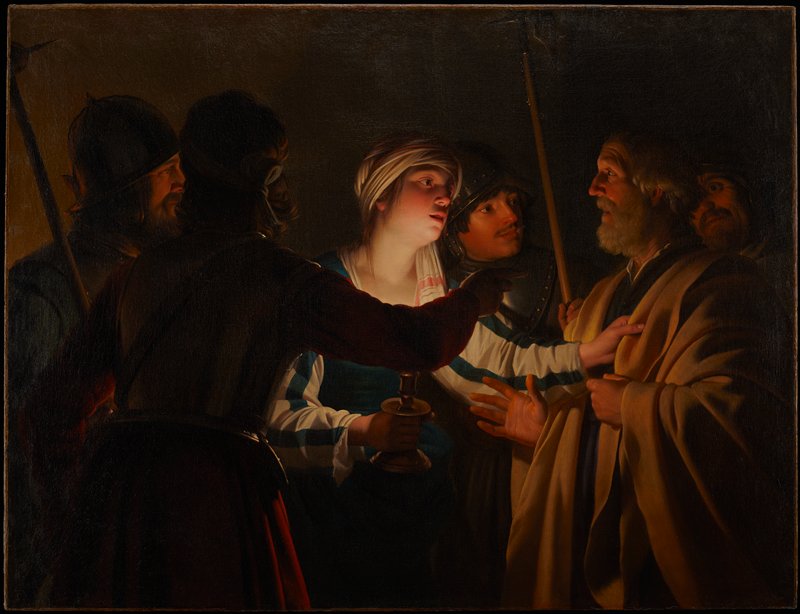
Why did Simon Peter deny the Lord three times during the Passion? St. John’s Gospel suggests he lied about having any connection to Jesus first to gain entry into the courtyard of the high priest, then to keep from being tossed out, and finally to avoid being physically assaulted by a relative of the man whose ear he had severed with a sword earlier that evening in the garden. St. Luke tells us that Peter, when he then heard a rooster crow, “went out and began to weep bitterly” over what he had done.

Satan, Judas, and Peter chose sin because they thought wrongdoing was the way to good things they would not otherwise have. But this is not Jesus’ way. In our second reading St. Peter writes of the Lord, “He committed no sin, and no deceit was found in his mouth.” He was “leaving you an example that you should follow in his footsteps.” In our Gospel, Jesus declares:

Amen, amen, I say to you, whoever does not enter a sheepfold through the gate but climbs over elsewhere is a thief and a robber. But whoever enters through the gate is the shepherd of the sheep. The gatekeeper opens it for him, and the sheep hear his voice, as the shepherd calls his own sheep by name and leads them out. When he has driven out all his own, he walks ahead of them, and the sheep follow him, because they recognize his voice. But they will not follow a stranger; they will run away from him, because they do not recognize the voice of strangers. … Amen, amen, I say to you, I am the gate for the sheep.

Jesus is our gate. He is “the way, the truth, and the life.” Always come and go through this narrow gate, for many prefer to bypass it like thieves and robbers. “How narrow the gate and constricted the road that leads to life. And those who find it are few.” Jesus’ sheep know his voice and are called to uncompromisingly follow it. Before Pontius Pilate, Jesus said, “Everyone who belongs to the truth listens to my voice.”

The words of a Jewish proverb pray to God:

Two things I ask of you,
do not deny them to me before I die:
Put falsehood and lying far from me,
give me neither poverty nor riches;
provide me only with the food I need;
Lest, being full, I deny you,
saying, “Who is the Lord?”
Or, being in want, I steal,
and profane the name of my God.

In our present season of trial, the complacency of riches has withdrawn but other temptations draw near. This is a time of testing. Will I tell lies? Will I steal? Will I sin to possess or enjoy good things I might not otherwise have? Do not give in, do not compromise, do not capitulate to evil. This is Christ’s will for you. Remember and be resolved: “The Lord is my shepherd; there is nothing I shall want.”

But what if you do go on to fall, or what if you have already sinned? What then should you do? Due to their nature, the demons will never adjust their wills towards repentance. Judas deeply regretted what he had done but he despaired of forgiveness and forfeited his life. St. Peter however returned, repented, and renewed his devotion to his Savior. (“Simon, son of John, do you love me?” He said to him, “Yes, Lord, you know that I love you.”) St. John assures us about Christ, “If we acknowledge our sins, he is faithful and just and will forgive our sins and cleanse us from every wrongdoing.”

The commandments of Christ flow from his own divine nature — total truth, pure goodness, perfect love — and these must not be spurned. Yet realize that the essence of Christianity is not rules or laws but a personal relationship: “If you love me, you will keep my commandments. … I will not reject anyone who comes to me.” Follow the Good Shepherd faithfully and goodness and kindness will follow all the days of your life and you shall dwell in the house of the Lord forever.

The Face of a Friend

April 25, 2020

3rd Sunday of Easter—Year A
By Deacon Dick Kostner

Our world tells us that death is the end of life. Jesus has parabled us into a new direction. Death is but the birth of a new and perfected life. I believe that our readings this Third Sunday of Easter tell us two important lessons to be learned. The first is that we are living at this moment in trying times, and that is anxiety, fear and confusion not only causes us to be disoriented but it also distracts us from seeing the cure for our affliction. The second lesson is that Jesus has, through our baptism, commissioned us to be the body of Christ in this very confused world. We no longer bear the face we were born with, but rather we are no longer recognized by our face but rather we are recognized by our heart and our actions.

We learn through our scripture readings that because of earthly death and the anxiety that follows we all will be confused and disoriented. This anxiety blinds us to the reality of the Easter Proclamation: “The light of Christ!” The disciples who knew Jesus well were so filled with the emotion of death that they failed to recognize their friend as they walked the road to Emmaus. This friend of theirs who could walk on water and still storms died and was buried. The fact that Jesus had taught them that death was not the end and that he would rise, blew right over the top of their heads because of their fear of death.

Isn’t it a “coincidence” that our whole world is experiencing, firsthand, the fear of death and the confusion that developed during this Holy Season? The same confusion that disciples of Jesus felt two thousand years ago is still with us on this Third Sunday of Easter. Like the disciples in our readings we are so filled with anxiety that we fail to recognize Jesus walking with us on that road to Emmaus. We fail to see his face in the nurses and doctors who treat us, and the clerks and people who serve us. We fail to hear his voice and feel his presence in the waive we see from our family and friends we no longer can touch. We fail to hear his wisdom and words proclaimed by His ordained ministers every day through cyberspace.

Jesus has many faces and I believe his disciples were unable to recognize him because Jesus wants to be recognized not by his facial features or color of skin but rather by and through his actions and words. It was not until he preached to his disciples and broke bread with them making them a part of him, that their eyes moved from his face to his heart and they could see their friend as the risen Christ.

We are commissioned to be the body of Christ. It is through our behavior driven by the heart not the brain that the face of Jesus will be recognized as we walk the road to Emmaus with Jesus at our side. May the peace of the risen Lord and the grace he gifts us with, be always with you!

Divinely Merciful

April 18, 2020

Divine Mercy Sunday

The Cenacle, the Upper Room in Jerusalem,
site of the Last Supper and Pentecost

Imagine an event as it did not happen…

On Easter evening, when the disciples were gathered behind locked doors in the Upper Room, Jesus came and appeared in their midst and said to them, “I condemn you. Each of you. All of you abandoned me.” And when he had said this, he showed the wounds in his hands and feet and side and said, “I suffered these because of your sins.”

If Jesus would have declared such things to his apostles his charges would not have been untrue. But this is thankfully not what Jesus did. Instead, he came and stood in their midst and said to them, “Peace be with you,” a phrase he says three times in this Sunday’s gospel. Christ’s Passion, death, and Resurrection are not for our condemnation. Jesus comes in mercy for his apostles and for us. “Blessed be the God and Father of our Lord Jesus Christ,” St. Peter writes, “who in his great mercy gave us a new birth to a living hope through the resurrection of Jesus Christ from the dead.”

After assuring them of his friendship and the reality of his Resurrection, the next most important item on Jesus’ Easter list is to entrust his Church with his mission of mercy: “As the Father has sent me, so I send you.” And when he had said this, he breathed on them and said to them, “Receive the Holy Spirit. Whose sins you forgive are forgiven them, and whose sins you retain are retained.”

In this season of pandemic, public Masses are suspended; first Communions, Confirmations, and weddings are being postponed; but the Sacrament of Reconciliation continues to be offered. Did you get to Confession this Lent? Jesus has peace to give you in this great sacrament. So, where and when you can, make it a top item on your list to experience his Divine Mercy there.

The Questions & Answers of Easter Vigil

April 11, 2020

Easter Vigil

Tonight’s Easter Vigil Mass features many readings and accompanying psalms. The Church says the celebrant may chose to skip some of these readings, but tonight we are doing them all; seven from the Old Testament and two from the New, a journey from Genesis to the Gospel. But how does one preach about nine readings in one homily? As I pondered that question, I wondered, “What questions are asked in the readings themselves?

In the beginning in Genesis, when God created the heavens and the earth, there are no questions, only God’s declaring word. Thus the heavens and the earth and all their array were completed. God looked at everything he had made and they were very good. From the beginning, God knows his plan.

By the time of our next reading from Genesis, sin has entered our history. Humanity’s rejection of God, reflected in every sin, not only leads to death but creates injustices which must be rectified, hearts which must be converted, relationships which must be reconciled, and evils which must be undone, through sacrifice. “Father!” Isaac says, “Here are the fire and the wood, but where is the sheep for the holocaust?” “Son,” Abraham answers, “God himself will provide the sheep for the holocaust.

Isaac was spared but would God always provide? Generations later, Moses and the Hebrews are alarmed on the shores of the Red Sea when Pharaoh’s army threatens them. The Lord says to Moses, “Why are you crying out to me? Tell the Israelites to go forward. And you, lift up your staff and, with hand outstretched over the sea, split the sea in two, that the Israelites may pass through it on dry land.” God delivers his people, destroys their enemy, and leads them to his Promised Land.

How great is God’s love for his people? Isaiah proclaims that the Lord loves and desires Israel as a man does his bride: “The One who has become your husband is your Maker; his name is the Lord of hosts.” Yet Israel would often stray from him. Elsewhere Isaiah asks her, “Why spend your money for what is not bread, your wages for what fails to satisfy?” Later the Prophet Baruch asks, “How is it, Israel, that you are in the land of your foes, grown old in a foreign land, defiled with the dead, accounted with those destined for the netherworld? You have forsaken the fountain of wisdom!” Baruch asks “who has found the place of wisdom, who has entered into her treasuries? The One who knows all things knows her; he has probed her by his knowledge—the One who established the earth….

Through the Prophet Ezekiel, the Lord promises to bring his people to their true home, to wisdom, to holiness, to communion with himself: “I will take you away from among the nations, gather you from all the foreign lands, and bring you back to your own land. I will sprinkle clean water upon you to cleanse you from all your impurities, and from all your idols I will cleanse you. I will give you a new heart and place a new spirit within you, taking from your bodies your stony hearts and giving you natural hearts. I will put my spirit within you and make you live by my statutes, careful to observe my decrees. You shall live in the land I gave your fathers; you shall be my people, and I will be your God.”

How is all this to come about? Through Jesus Christ. St. Paul asks the Romans, “Are you unaware that we who were baptized into Christ Jesus were baptized into his death? We were indeed buried with him through baptism into death, so that, just as Christ was raised from the dead by the glory of the Father, we too might live in newness of life.

When Jesus Christ was so shockingly, so horrifically, so unjustly murdered, his heartbroken disciples were full of questions. Is there no reward for the just man? Is there no victory for righteousness? Is evil more powerful than goodness? Is God indifferent to our suffering? Does he not care? Is there no deliverance from sin? Do we have any reason to hope? God answers with Christ’s empty tomb.

Do not be afraid,” the angel says. “I know that you are seeking Jesus the crucified. He is not here, for he has been raised just as he said.” The women, fearful yet overjoyed, run to share this good news when they encounter Jesus on the way. They approach, embrace his feet, and do him homage. Then Jesus says to them, “Do not be afraid. Go tell my brothers to go to Galilee, and there they will see me.”

This was God’s plan from the beginning. That sin would be conquered through self-offering. That all would trust in God’s providence and love the perfect Bridegroom. Why spend yourself on what does not satisfy? Why live any longer away from the Lord in foolishness? You have access to a new and transforming Holy Spirit through your baptism, a baptism which has its power from the death and resurrection of Jesus. Jesus is God’s answer to our greatest questions. How will you respond to him? Answer with your faith and love.

Why Jesus Wept

March 28, 2020

5th Sunday of Lent—Year A

When Mary came to where Jesus was and saw him, she fell at his feet and said to him, “Lord, if you had been here, my brother would not have died!” When Jesus saw her weeping and the Jews who had come with her weeping, he became perturbed and deeply troubled, and said, “Where have you laid him?” They said to him, “Sir, come and see.” And Jesus wept.

Why did Jesus weep on his way to Lazarus’ tomb? Was it because he had only just learned of his dear friend Lazarus’ death? No, for Jesus had known long before he reached the village. He had already told his disciples, “Lazarus has died. And I am glad for you that I was not there, that you may believe.” Did Jesus weep because he had not planned to immediately resurrect Lazarus until sorrow changed his mind? No, for when the news of Lazarus’ sickness first arrived he told his disciples, “This illness is not to end in death,” and two days later he added, “Our friend Lazarus is asleep, but I am going to awaken him.” Were Jesus’ tears in fact not shed for Lazarus at all?

Here’s a thought experiment. Imagine if I informed you of two facts (about which, let’s suppose, you would have zero doubts): first, that someone you love had recently died — but also, that twenty minutes from now, this same person would be completely alive and healthy, living among us again. How long and profoundly would you mourn for this person? I do not weep over my friends and family going to sleep at night because I believe they will be fully awake again in the morning. Why would Jesus cry for someone he was about to resurrect? But if Jesus was not grieving over the very-soon-to-be-resurrected Lazarus, then why did Jesus weep?

When Mary ran to Jesus and fell at his feet crying, was there a hurt reproach in her voice when she said, “Lord, if you had been here, my brother would not have died”? (‘We sent you a message days ago that our brother was very ill. Why didn’t you save him?‘) Some of the Jews who came to comfort Martha and Mary seemed to doubt Jesus’ care or power. “Could not the one who opened the eyes of the blind man have done something so that this man would not have died?” When Jesus saw Mary weeping and the Jews who had come with her weeping, he became perturbed and deeply troubled. Jesus beholds grave anguish, doubt, and despair amidst the faith-testing scandal of death. And because of this, Jesus wept.

On Friday, in the midst of our worldwide pandemic, Pope Francis preached a message of hope in a rainy, dark, and empty St. Peter’s Square. He reflected on another gospel story where facing death challenged peoples’ faith in the love and power of the Lord: Jesus is asleep in the boat during a storm on the Sea of Galilee and his disciples wake him up and ask him, “Teacher, do you not care that we are perishing?!” In the words of Pope Francis:

It is easy to recognize ourselves in this story. What is harder to understand is Jesus’ attitude. While his disciples are quite naturally alarmed and desperate, he [is] in the stern, in the part of the boat that sinks first. And what does he do? In spite of the tempest, he sleeps on soundly, trusting in the Father; this is the only time in the Gospels we see Jesus sleeping. When he wakes up, after calming the wind and the waters, he turns to the disciples in a reproaching voice: “Why are you afraid? Have you no faith?

Let us try to understand. In what does the lack of the disciples’ faith consist, as contrasted with Jesus’ trust? They had not stopped believing in him; in fact, they called on him. But we see how they call on him: “Teacher, do you not care if we perish?” Do you not care: they think that Jesus is not interested in them, does not care about them. One of the things that hurts us and our families most when we hear it said is: “Do you not care about me?” It is a phrase that wounds and unleashes storms in our hearts. It would have shaken Jesus too. Because he, more than anyone, cares about us. (…)

Why are you afraid? Have you no faith?” Faith begins when we realize we are in need of salvation. We are not self-sufficient; by ourselves we founder: we need the Lord, like ancient navigators needed the stars. Let us invite Jesus into the boats of our lives. Let us hand over our fears to him so that he can conquer them. Like the disciples, we will experience that with him on board there will be no shipwreck. Because this is God’s strength: turning to the good everything that happens to us, even the bad things. He brings serenity into our storms, because with God life never dies.

This is His Body Given up to Save Many

March 21, 2020

Laetare Sunday — 4th Sunday of Lent—Year A

This past Wednesday evening, I saw this image online with the caption: “Darkness has fallen: every single U.S. diocese has suspended public celebrations of the Mass.”

Our Laetare Sunday rejoicing is more subdued this Lent. The sad but necessary suspension of public Masses by our nation’s bishops is a painful loss. And for many of the faithful, the greater their love for the Lord the greater the pain they feel. They are like the woman at Simon the Pharisee’s house who could bathe Jesus’ feet with dripping tears ‘because she loved much.’ (Luke 7:47) However, darkness has not overcome us.

Brothers and sisters,” today’s second reading tells us, “you were once darkness, but now you are light in the Lord.” God is still God, Christ is still Lord, and we are still His. Though public liturgies have ended the Holy Mass continues to be privately offered in most every Catholic church. The graces of Jesus’ sacrifice pour forth from these altars into Christian souls throughout the world, for our good and the good of all his holy Church. Priests are celebrating these Masses in obedience to the command of Christ recalled at every Consecration, “Do this in memory of me.” Yet each of us, ordained and lay people alike, is called to keep this commandment of Christ in a deeper way; by personally imitating Jesus in his loving self-sacrifice for others.

Today, and in the critical weeks and months ahead, all of us are called to sacrifice in ways that will seriously limit our activities and impact our finances. Why are we doing this? To stop the spread of a deadly disease not merely to ourselves but to our many neighbors around us. From my research into this grave topic, it appears that hundreds of thousands—potentially millions—of American lives depend upon the extent of our collective and individual actions now. So please respond with a firm resolve from a Christian love for others.

When you ache today because you can neither gather for Mass nor physically receive our Lord, take heart in the reason for your sacrifice. This is his Body given up to save many; we do this in memory of Him. And soon, when you are asked to help people in the community meet their material needs, sacrifice for them knowing whom you are also serving. For whatever you do for the least of your brethren, you do it for Him. Invite Jesus now to enter into your heart and be with you, to console and strengthen you, today and in the trials ahead of us.

Finding Jesus in our Isolation — 3rd Sunday of Lent—Year A

March 16, 2020

Today’s Gospel story contains a valuable lesson for us in our present situation.

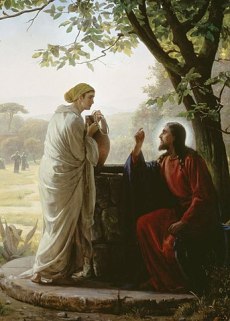
Jesus, tired from his journey, sat down there
at [Jacob’s] well. It was about noon.
A woman of Samaria came to draw water.
Jesus said to her, “Give me a drink.”

There is a weird detail contained in these passages: the woman is going to the well to draw water at noon. It’s hot at noon in the Middle East, so Jesus and the woman are the only ones there. Why didn’t she come in the morning or the evening when the heavy job of hauling water would not have the added burden of the midday sun and heat? It’s because she didn’t want to be there when the other women would be around. Jesus reveals that the woman has no true husband and that she has had five different mates through the years. Jesus knows this supernaturally but her neighbors know something of these facts naturally, through local gossip. This woman has a reputation and if she were to go to that well at the same time as the other women they would make her feel unwelcome, through their words or their silence, with their eyes and their body language. They have quarantined themselves from her and she has socially distanced her heart from them.

In the middle of her day,
in the uncertainties of her life,
amid the stress of her tasks,
in her personal isolation,
she is surprised to encounter Jesus there.

He says to her:

“If you knew the gift of God and who is saying to you, ‘Give me a drink,’ you would have asked him and he would have given you living water. … Whoever drinks the water I shall give will never thirst; the water I shall give will become in him a spring of water welling up to eternal life.”

Jesus wins over the woman’s soul, she leaves her water jar behind and joyfully proclaims her great discovery. Meanwhile, the returned disciples urge Jesus, ‘Rabbi, Teacher, eat something!’ But he says to them, “I have food to eat of which you do not know. … My food is to do the will of the one who sent me and to finish his work.” Of course Jesus is hungry—physical realities are real—but he has nourishment in his soul, from his relationship with God his Father and his deepening relationship with those he has come to save, like this woman at the well.

Now in likening the woman at the well to one quarantined from others, I am not advising you to take unnecessary or imprudent risks amidst this current Coronavirus pandemic. In these months ahead, some of us will be called to acts of particular courage; nurses and doctors come first to mind. But we should not blithely, unnecessarily place ourselves in foreseeable natural dangers expecting God to perform miracles to protect us. Recall how Satan tempted, “If you are the Son of God, throw yourself down from here. For it is written: ‘He will command his angels concerning you’ and ‘with their hands they will support you, lest you dash your foot against a stone.” Jesus answers, “You shall not put the Lord, your God, to the test.” We must not act presumptuously.

The reason I mention the woman finding Jesus in her isolation is because, whatever our health may be, we need to encounter him there as well. Public Masses continue in our diocese, but it is very probable that these will be suspended in the future, just as Catholic Churches suspended public Masses a century ago during the Spanish Flu pandemic. I will personally be very surprised if we are having Mass here together two weeks from today. [Post-Script: On the evening of March 17th, Bishop William Callahan directed his priests to abide by Wisconsin’s statewide ban on all gatherings of more than 10 people announced earlier in the day. As a result, we are cancelling all remaining public Masses at my parishes.] Yet even in times when public Masses are readily available, most hours of our week and not spent inside of a church.

In the middle of your day,
in the uncertainties of your life,
amid the stress of your tasks,
in your personal isolation,
you can encounter Jesus there.

He is with you and within you, so you are never really alone.
Jesus says:

“Let anyone who thirsts come to me and drink.
Whoever believes in me, as scripture says:
‘Rivers of living water will flow from within him.’”

Wherever you are, find him there, and draw on his graces.

I seem to recall a story about St. Faustina Kowaska, the Polish nun and visionary most closely associated with the Divine Mercy devotion. When she was confined to her convent infirmary, suffering from the tuberculosis which would eventually take her life, she lamented that for one or more days in a row she had been unable to receive Holy Communion. In a vision, Jesus reassured her, saying, ‘Whenever you receive me in the Eucharist, I remain within you until you receive me again, unless you cast me out through mortal sin.’ Similarly, in the sixth chapter of John, Jesus famously declares:

“I am the bread of life; whoever comes to me will never hunger, and whoever believes in me will never thirst. … Whoever eats my flesh and drinks my blood remains in me and I in him.”

Christ’s Church encourages frequent, even daily, reception of Holy Communion as a helpful devotion toward holiness, but whether your next communion is one week or three months from now, know that Jesus is with you to provide his sufficient graces for your life. If public Masses are suspended in our diocese, realize that I and other Catholic priests, even if standing alone in our churches, will still be offering the Holy Mass daily for you and the whole world. And we will be bringing Confession, Holy Anointing, and Viaticum to the sick, as is our calling and duty, for as long as we are able. This Wuhan Coronavirus pandemic is rightfully concerning. (I urge you to read my bulletin article this weekend.) But whatever comes we need not fear, for “we know that all things work for good for those who love God,” and “whether we live or die, we are the Lord’s.” As Jesus would very often say, “Be not afraid.

Moses & the Rock — 2nd Sunday of Lent—Year A

March 8, 2020

You’re familiar with the story of Moses: his being saved from the waters of the Nile as a baby, his growing up in the household of Pharaoh, his flight as a fugitive after killing an Egyptian taskmaster, his years shepherding in the Sinai Desert until God called him from the Burning Bush, how God used Moses to free the Hebrews from Egyptian slavery with great plagues and awesome miracles, how God through Moses gave his people the Law of the Old Covenant. Moses shared an incredible intimacy with God.

In the Book of Numbers, God said:

“If there are prophets among you,
in visions I reveal myself to them,
in dreams I speak to them;
Not so with my servant Moses!
Throughout my house he is worthy of trust:
face to face I speak to him,
plainly and not in riddles.
The likeness of the Lord he beholds.”

The Book of Deuteronomy declares: “Since [that time] no prophet has arisen in Israel like Moses, whom the Lord knew face to face.” So one would imagine, one would think, that Moses saw God’s face. The Book of Exodus says: “The Lord used to speak to Moses face to face, as a person speaks to a friend.” However, following soon after in that same chapter from Exodus, Moses asks the Lord, “Please let me see your glory!” And the Lord answers: “I will make all my goodness pass before you, and I will proclaim my name, ‘Lord,’ before you … But you cannot see my face, for no one can see me and live. Here is a place near me where you shall station yourself on the rock. When my glory passes I will set you in the cleft of the rock and will cover you with my hand until I have passed by. Then I will remove my hand, so that you may see my back; but my face may not be seen.” So Moses met with God in intimate conversation as one friend speaks to another, in his holy presence, yet it is not clear that Moses, during his lifetime, ever beheld God’s face. Similarly, God gave Moses the mission of leading his people from Egypt to the Promised Land, the land promised to Abraham and his descendants, yet Moses during his lifetime never entered the Promised Land himself.

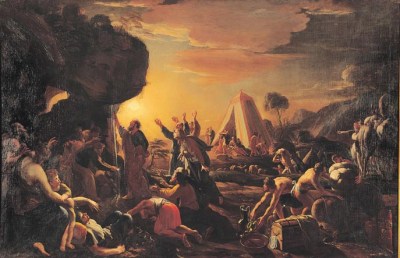
Why was that the case? Early in their desert wanderings, the Hebrews complained against Moses because of their lack of water. Moses cried out to the Lord, “What shall I do with this people? A little more and they will stone me!” And the Lord answered Moses: “Go on ahead of the people, and take along with you some of the elders of Israel, holding in your hand, as you go, the staff with which you struck the Nile. I will be standing there in front of you on the rock in Horeb. Strike the rock, and the water will flow from it for the people to drink.” Moses did this in the sight of the elders of Israel and the crisis was adverted.

However, on a later occasion, when the community again lacked water, they held an assembly against Moses and Aaron. The people quarreled with Moses, exclaiming, “Why have you brought us out of Egypt, only to bring us to this wretched place [to die]? It is not a place for grain nor figs nor vines nor pomegranates! And there is no water to drink!” The Lord said to Moses: “Take the staff and assemble the community, you and Aaron your brother, and in their presence command the rock to yield its waters. Thereby you will bring forth water from the rock for them, and supply the community and their livestock with water.

So Moses took the staff from its place before the Lord, as he was commanded. Then Moses and Aaron gathered the assembly in front of the rock, where he said to them, “Just listen, you rebels! Are we to produce water for you out of this rock?” Then, raising his hand, Moses struck the rock twice with his staff, and water came out in abundance, and the community and their livestock drank. But the Lord said to Moses and Aaron: “Because you did not have confidence in me, to acknowledge my holiness before the Israelites, therefore you shall not lead this assembly into the land I have given them.

Years later, at the edge of the Promised Land, the Lord told Moses: “Ascend this mountain [Mount Nebo] and view the land … which I am giving to the Israelites as a possession. Then you shall die on the mountain you are about to ascend, and shall be gathered to your people, [because] you broke faith with me among the Israelites at the waters of Meribath-kadesh in the wilderness of Zin: you did not manifest my holiness among the Israelites. You may indeed see the land from a distance, but you shall not enter that land which I am giving to the Israelites.” And there, Moses the servant of the Lord died as the Lord had foretold. Moses was one hundred and twenty years old when he died, yet his eyes were undimmed and his vigor unabated.

What was behind this punishment from God? Moses had been disobedient to the Lord, striking the rock twice instead of speaking to the rock as instructed; and this was more than just some desert rock—the rock carried spiritual, symbolic, prophetic significance. In his First Letter to the Corinthians, St. Paul saw the Church and her sacraments prefigured in the story of the Hebrews and the Exodus. St. Paul writes: “Our ancestors were all under the cloud and all passed through the sea, and all of them were baptized into Moses in the cloud and in the sea. All ate the same spiritual food, and all drank the same spiritual drink, for they drank from a spiritual rock that followed them, and the rock was the Christ.

So the rock in the desert symbolized Jesus Christ. The first time, God told Moses to strike the rock, and it poured forth from its side saving water for God’s people. But the second time, when God told Moses to speak to the rock, Moses disobeyed and struck it twice. Jesus Christ has already been struck, beaten, and suffered violence once, for you and me in his Passion. We are no longer to keep striking him, again and again, through our sinful disobedience. Rather than choosing sin, we are to speak to Christ, asking him to pour forth his saving gifts. Jesus says, “Let anyone who thirsts come to me and drink. … To the thirsty I will give a gift from the spring of life-giving water.

I fear that sometimes we might think, “I can keep on sinning, it’s no big deal, because if I keep on going to Confession and have my sins forgiven it’s like they never happened—they don’t really matter.” Yet every sin is a lost opportunity to do God’s will. Every sin refuses God’s “Plan A.” And sins, even after they are forgiven, can bear earthly consequences which remain for the rest of our lives. Moses sinned, and repented, and remained God’s friend, but he was refused entry into the earthly Holy Land to his own great disappointment. Even convicted murderers can be forgiven by God, but they still remain behind prison bars and their victims bodies remain buried underground. Let’s not be complacent about our sins, for every sin is a lost opportunity to follow God’s better plan and, even if forgiven, sins can have irreparable consequences in this world for the rest of our lives. But, thanks be to God, our Christian hopes are not for this lifetime alone. Moses died and was buried, but that is not the end of his story.

Jesus took Peter, James, and John his brother, and led them up a high mountain by themselves. And he was transfigured before them; his face shone like the sun and his clothes became white as light. And behold, Moses and Elijah appeared to them, conversing with him.” St. Luke’s telling of today’s Gospel story notes Moses and Elijah “appeared in glory and spoke of [Jesus’] exodus that he was going to accomplish in Jerusalem.

Sometimes people ask how the apostles knew it was Moses and Elijah. Most likely they either introduced themselves, or Jesus introduced them. Some people have the notion that the dead forget who they were, forget all their memories, and care nothing about the events on earth. But Moses can only introduce himself if he knows who he is. And if Jesus said, “This is the prophet Moses,” there’s no indication that Moses replied, “I am? Where am I? What is happening?” Moses and Elijah can converse with Jesus about the exodus he is going to accomplish in Jerusalem (that is, about his coming Passion, death, and resurrection) because they know who they are, remember their lives, and are concerned about events among the living.

At the Transfiguration, we see the not quite fully-satisfied aspects of Moses’ life reaching their fulfillment. Moses never entered the Promised Land in his lifetime, but here he stands in Israel upon Mount Tabor with Jesus. Moses seems to have never seen God’s face, but now he speaks face to face with Christ. Consider how privileged we are to stand in this holy place and have such intimacy with Jesus Christ in his Holy Eucharist. It is good that we are here.

God greatly desires that we not sin. And if we have sinned, the Lord desires that we promptly repent and sin no more. Now, this season of Lent is an excellent time for repentance—especially while we’re still healthy. This world is scarred by sins, some forgiven and many not; and these painful wounds grieve us and prevent our full satisfaction in life. Yet the full story of Moses shows that our hopes are not merely limited to this life. Our hope extends beyond death, and St. Paul says, “God works all things for the good of those who love him.” And in the end, as St. Julian of Norwich says, “all shall be well, and all shall be well, and all manner of thing shall be well.

Satan’s Old Tricks — 1st Sunday of Lent—Year A

March 3, 2020

After his baptism in the Jordan, but before the start of his public ministry, Jesus was led by the Holy Spirit into the desert to be tempted by the devil. Did Satan realize at that time that Jesus was God? He says, “If you are the son of God… If you are the son of God.” But if Satan knew, it’s strange that he would attempt the impossible: to try tempting the all-holy God into sinning and doing evil. Old Testament prophesies allude to the promised Messiah, the awaited Anointed One, as being “Son of God.” God says in the 2nd Psalm:

“I myself have installed my king
on Zion, my holy mountain….
You are my son;
today I have begotten you.”

And in Psalm 89, God says:

“He shall cry to me, ‘You are my father,
my God, the Rock of my salvation!’
I myself make him the firstborn,
Most High over the kings of the earth.”

Old Testament Jews had been told their Messiah would at least figuratively be the Son of God; so, whether or not Satan knew Jesus was divine, he at very least suspected that this man from Nazareth was the Christ.

Jesus evidently went on to tell his apostles of the devil’s temptations in the desert—for how else would anyone know to write about them in the Gospels? There may have been additional temptations, but three are retold in Matthew and Luke’s Gospels. Jesus is on the verge of beginning his public ministry. What kind of Messiah will he be? The devil’s three temptations seek to corrupt his mission from the start. Satan seeks to lead the Christ off track so as to derail the plan of God. He did this first in the lush Garden of Eden, and here he seeks to do it again in the desert.

If you are the Son of God,” Satan says, “command that these stones become loaves of bread.” Jesus was hungry, but if he does this miracle the next question may be, “So you feed yourself, do you? How now can you refuse to give bread to everyone?” Satan wants Jesus to be a materialistic Messiah who must focus on nourishing bodies to the neglect of their souls. Jesus calls his disciples to practice material charity; today the Catholic Church is the largest charitable organization in the world; teaching, healing, clothing, housing, feeding, but this is all of secondary importance to its spiritual work. For what would it profit us to have all of our material needs fulfilled if our spiritual needs went unaddressed and we ultimately died separated from God? How do these things personally apply to us? Well, did the recent stock market drops ruin your week? Or are you too afraid or possessive to share, to tithe, to give to good causes? Or are you too busy working to pray? Jesus answers, “One does not live on bread alone, but on every word that comes forth from the mouth of God.

Next we hear how the devil takes Jesus to the roof edge atop the temple in Jerusalem and challenges him: “If you are the Son of God, throw yourself down. For it is written: ‘He will command his angels concerning you’ and ‘with their hands they will support you, lest you dash your foot against a stone.’” Satan is quoting Psalm 91. This goes to show—and serves as a warning—that not every Bible quote teaches what some people claim it does. True Scripture interpretation must be in union with the mind of Christ, and one with the Body of Christ, that is his Church.

God does not want Jesus to jump off buildings, but the devil wants the Messiah to demand that God protect him from all harm or hardship. Satan wants Jesus to be a Christ who is unwilling to suffer, who will refuse to drink any bitter chalice. The devil knows doing God’s will in this broken world will necessarily entail some sufferings for his faithful ones. If Jesus is unwilling to sacrifice then God’s people will never be saved. Are you trying to force your plans upon God? Are you pleased to serve God only so long as you experience no pain? Are you demanding that your salvation come without embracing your cross? Jesus answers, “You shall not put the Lord, your God, to the test.

Lastly, we hear the devil takes him up to a very high mountain, and shows him all the kingdoms of the world in their magnificence, and says, “All these I shall give to you, if you will prostrate yourself and worship me.” Satan wants Jesus to be a compromised Messiah who will pursue good things by doing, by serving, evil. The tempter says, “It’s only a little thing, just lay down, just say the words, just take a small bite, everything will be so much easier and better if you do.” Or else the tempter lies in the opposite extreme direction, “You have no choice – it’s a sin but there’s no other way – this must be done!” What sins do you still commit in hopes that good will result? Where do you bow down and side with Satan against the will of God? Jesus answers, “The Lord, your God, shall you worship and him alone shall you serve.

By God’s providence, the temptations of Jesus in the desert foreshadow Christ’s Passion to come. Jesus is not a materialist Messiah, changing stones to loaves of bread. But, beginning at the Last Supper, he feeds the world by changing bread into himself “for the life of the world.” Jesus is not a Christ who refuses to sacrifice. At the Temple he endures trail and condemnation by the Sanhedrin and accepts the bitter chalice of his Passion according to his Father’s saving will. And Jesus is not a compromised Messiah, committing sins for false and illusory gains. Christ becomes the magnificent, sinless king of all nations, atop Mount Calvary enthroned upon the Cross.

In this season of Lent, in these forty days of penance, we are in the desert with Jesus, learning from him, and being strengthened by him, so that we can stand straight and strong and not fall for the temptations and traps of the enemy, the same tricks he used against of Adam and Eve, that he attempted with Jesus Christ, and that he still uses in our day. This Lent, instead of falling for Satan’s same old tricks, let us grow closer to Jesus Christ in relationship and resemblance, closer in his friendship and closer to his holy likeness.

Strong Reactions — 5th Sunday in Ordinary Time—Year A

March 3, 2020

My childhood memories of summer include the Osseo City Pool. I remember having fun in the water with friends, the 80’s songs playing from the lifeguards’ boombox, and the big brown door with red letters, warning something like: “Danger, Deadly Chlorine Gas, Staff Only!” As you might imagine, I never ventured into that room. Another memorable experience from my youth involving chemicals happened some years later. My science teacher, Mr. Hall, placed a bucket of water into the snow outside of our high school. Then, using tongs, he carefully dropped into it a chunk of pure sodium, and quickly backed away. The water steamed and bubbled and exploded a couple of times. It was intimidating and awesome. Two potent chemicals: chlorine and sodium. What happens when you combine them? You get sodium chloride. Today, this compound is present in the environment and inside of our homes. It’s in the oceans, on our streets, and even in the food we eat. Sodium Chloride may sound dangerous, but you know this common compound by another name: it’s salt.

Sodium Chloride (a.k.a. Salt)

Salt preserves, salt disinfects, and salt also adds flavor. Salt can preserve food from spoiling. In the days of sailing ships, unrefridgerated salted-pork could safely feed a crew for three months at sea. Salt has been used as a disinfectant and cleaning product since ancient times. The Egyptians, Greeks, and Romans employed salt water to treat cuts, wounds, and mouth sores. Even in 2010, a study from the Mayo Clinic found that gargling warm salt water reduces cold symptoms, including sore throat pain and mucus. And you know firsthand from a lifetime of eating that the addition of salt can make an otherwise bland dish taste much better.

Today, Jesus tells his disciples: “You are the salt of the earth.” Like salt, Christianity is found all over the world, preserving its good, purifying its evil, and adding flavor to what would otherwise be bland, meaningless life. And yet, like Sodium Chloride, Christianity is irrationally feared. This is nothing new. Listen to this second century Letter to Diognetus describing how Christians are present throughout the world, both helpful and good, and yet feared and opposed:

“Christians are indistinguishable from other men either by nationality, language or customs. They do not inhabit separate cities of their own, or speak a strange dialect, or follow some outlandish way of life. … With regard to dress, food and manner of life in general, they follow the customs of whatever city they happen to be living in, whether it is Greek or foreign. And yet there is something extraordinary about their lives. They live in their own countries as though they were only passing through. They play their full role as citizens, but labor under all the disabilities of aliens. Any country can be their homeland, but for them their homeland, wherever it may be, is a foreign country. Like others, they marry and have children, but they do not expose [their children to death]. They share their meals, but not their wives. They live in the flesh, but they are not governed by the desires of the flesh.”

“They pass their days upon earth, but they are citizens of Heaven. Obedient to the laws, they yet live on a level that transcends the law. Christians love all men, but all men persecute them. Condemned because they are not understood, they are put to death, but raised to life again. They live in poverty, but enrich many; they are totally destitute, but possess an abundance of everything. They suffer dishonor, but that is their glory. They are defamed, but vindicated. A blessing is their answer to abuse, deference their response to insult. For the good they do they receive the punishment of malefactors, but even then they rejoice, as though receiving the gift of life. They are attacked by the Jews as aliens, they are persecuted by the Greeks, yet no one can explain the reason for this hatred.”

Why does the world oppose devout Christianity? One reason is they imagine believing Christians behave like sodium in water, boiling hot with hatred and intolerance and violent in their reactions. Yet Christians’ allegiance to Jesus and his teachings on mercy, love, and the value of every human person are the best antidotes to mankind’s natural hatred and indifference toward others. Who is more responsible for sharing bread with the hungry, sheltering the oppressed and the homeless, and clothing the naked in world history than Christians in general and the Catholic Church in particular?

Another reason why worldly people oppose Christianity is that they think our faith is lethal to life’s pleasures; they fear that embracing Christianity would asphyxiate their happiness, like breathing chlorine gas. This too is nothing new. In Roman times, Christians were charged with “hatred of humanity” because the Romans believed ‘a lover of man should love what men love.’ The Early Christians would not partake of common sins for passing pleasures while, at the same time, living joyful lives. Joyful even at their martyrdom. As Diognetus’ pen-pal observed in the second century: “The world hates the Christians, not because they have done it any wrong, but because [Christians] are opposed to its enjoyments.” And so it is today. When we tell the world some things it loves are false roads to happiness the world hates us for it.

Jesus said, “If the world hates you, realize that it hated me first. If you belonged to the world, the world would love its own; but because you do not belong to the world, and I have chosen you out of the world, the world hates you. If they persecuted me, they will also persecute you. … In the world you will have trouble, but take courage, I have conquered the world.” So what are we to do? First, realize that the modern animosity to Christianity is nothing new. Don’t wait for that cultural hostility to pass; it won’t pass in our lifetimes. Next, never accept or act like your faith is a shameful thing. Jesus declares: “You are the light of the world. Your light must shine before others, that they may see your good deeds and glorify your heavenly Father.” If you are a Christian, Jesus wants the people around you to see something different in you and wonder, “What’s your secret.” Be unafraid to tell them the truth, “It’s my personal relationship to Jesus Christ and his Holy Church.” Cooperating with Christ to live like this saves souls and transforms our world.

There is another, more literal translation of Jesus’ words in our gospel: “You are the salt of the earth… You are the light of the world”: “You are the salt of the ground… You are the light of the cosmos.” Through your life, and every Christian life however humble, Jesus would reveal his divine light to the world, the glory and love that sustain the cosmos.

Shepherds & Fishermen — 3rd Sunday in Ordinary Time—Year A

March 3, 2020

What did the twelve apostles do for a living before Jesus called them to follow him? For six of the first apostles, that is half of the original twelve, we have no words from Scripture concerning their previous jobs. We are told that St. Matthew was a tax collector for the Roman government. We also hear of St. Simon the Zealot, who was either especially zealous in his personal religious devotion, or had ties to the Jewish Zealot movement is Israel. The Zealot movement sought, through politics and insurrection, to overthrow the Roman government in the Promised Land. If Matthew and Simon did indeed come from opposite sides of that era’s political spectrum, it suggests that every political party or faction has important things to learn from Jesus Christ.

In today’s Gospel, we learn the shared profession of four other apostles: Simon Peter, Andrew, James, and John; they were commercial fishermen. Now the Lord choosing men from the fishing industry was something new in salvation history. In the Old Testament, God often employs shepherds in his holy service. Among the patriarchs there is Abraham, Jacob-Israel, and his twelve sons – shepherds all. Later there’s the prophet Moses, King David, and Amos the prophet, each of whom tended flocks for some time before receiving their higher calling from God. As far as I can tell, there are no fishermen of particular note in the Bible before these four to whom Jesus says, “Come after me, and I will make you fishers of men.” Jesus, in calling fishermen, is doing something new. Now if the fishing background of these four apostles were irrelevant, I doubt the Holy Spirit would have inspired the inclusion of this fact into the Gospels. So what is the significance of this detail?

The work of a shepherd is different from that of fisherman. A shepherd tends his flock. He knows his sheep and his sheep know him. Some new lambs are born while other, older sheep go off to market or return to the earth, but the size of the sheepfold tends to remain rather stable. A fisherman, on the other hand, through his practiced skills and God’s providence, seeks and finds new fish every day. The fish are living in their own dark, watery world until the fisherman gathers them to himself. A shepherd maintains his numbers, but a fisherman goes out to seek more and more. Jesus chose his apostles not only to shepherd his people Israel, but to go forth to fish for people from all nations. Jesus made Peter not only a “fisher of men” but commanded him to ‘”feed my lambs… tend my sheep… feed my sheep.

Today we primarily think of water as a symbol of life, because nothing lives without water. Yet in the ancient world, water was often seen as a symbol of death. It’s possible even on a calm day to drown in a river, lake, or sea, but the volatile, deadly nature of large bodies of water is the subject of stories, poems, and songs even up to our day. For example:

The legend lives on from the Chippewa on down
Of the big lake they called Gitche Gumee
Superior, they said, never gives up her dead
When the gales of November come early

Fish live with this realm of death, a dark, watery world. The fisherman brings fish into the light, to a higher realm, a world they had previously ignored or never imagined. In our semi-post-Christian world today, is Jesus calling you and I to be shepherds or fishermen? Are we meant to maintain our flock, or to endeavor for more unnetted souls? There is need for both missions. In fact, we are called to do both. Many around us are baptized and still identify as Christians, yet how deep does their faithful devotion really go? Peter and Andrew left their careers for Jesus. James and John left their family for Jesus. Yet how few people today even come to church for him. True devotion and divine relationship is ignored or never imagined. Jesus calls you to be a missionary; not on the far side of the earth so much as in our own community. Be able to give witness to him. When I was a kid, when we were driving home from Sunday Mass, my family would often talk about what we heard in the homily. Today you your drive home from church I encourage you to ask each other: Why did you come to church today? What difference does it make for your life? We need to practice sharing why our faith is a gift with one another so that we can invite others to share this treasure.

In our first reading from St. Paul’s first letter to the Corinthians, we learn that the Christians in Corinth were choosing favorites and forming factions: ‘I belong to Paul. I belong to Apollos. I belong to Cephas.‘ St. Paul writes to remind them, you belong to Christ! Do not allow another person to get in way of Jesus for you. Pastors are important and Jesus has ordained it so, since without clear leadership how could St. Paul’s prayer and Christ’s desire, ‘that all of us agree in what we say, that there be no divisions among us, that we be united in the same mind and in the same purpose‘ ever be achieved? The need for human leadership of Jesus’ Church in this broken world, however, makes grave sin and scandal possible. This is a terrible thing, wherever and whenever it occurs. But please, please, do not separate from Peter on account of another apostle’s sin. You need Jesus, I need Jesus, and everyone else needs Jesus, too. Let us be good shepherds and fishers of men, caring for and seeking out everyone in our midst, as Jesus calls us to do.

The Holy Stream — Baptism of the Lord—Year A

January 13, 2020

When you think of the River Jordan, maybe you imagine something broad, vast, and impressive, like the mighty Mississippi or even the Chippewa River. But the Jordan River is a lot more like Duncan Creek. Ever heard of Duncan Creek? It’s not far from here. Duncan Creek flows out of the south end of Lake Como in Bloomer. You know the bridge between Dairy Queen and the post office? That bridge crosses over Duncan Creek. In terms of size and color, the Jordan River is much like Duncan Creek; small and muddy with shrubs and trees growing along its banks. But unlike the rivers around here in Wisconsin, which are numerous and flow though green and lush countryside, the Jordan is among the few rivers passing through its region’s mostly arid lands. This is the body of water Jesus chose to be baptized in. A humble river of life flowing through a desert. Joshua led God’s Old Covenant people into the earthly Promised Land through this river. And Jesus, the new Joshua, leads God’s New Covenant people to the true Promised Land through holy baptism.

Jesus did not need John’s baptism for himself. John the Baptist sensed this and tried to prevent him, saying, “I need to be baptized by you, and yet you are coming to me?” Jesus insists, so John relents, but what is the purpose of his baptism? Jesus is baptized not to be made holy by the water, but to make the water holy, so that this most plentiful substance on the face of the earth could serve as the material for Christ’s gateway sacrament all throughout the world.

Jesus is baptized to allow us, through baptism, to be united to himself. His baptism foreshadows what comes in Christian baptism, what happened for you and me when we were baptized. The water, the decent of the Spirit, and the voice of the Father all signify effects of our first sacrament. Through baptism our souls were cleansed, the grace of the Holy Spirit was imparted to us, and we were acknowledged as a beloved children of God. We might take these things for granted: that sins can be forgiven, that the divine can dwell with us, that we can be more than mere servants, or slaves, or distant acquaintances to the transcendent God of the universe. That we can be treasured sons and daughters of God our Father. We need to remember and appreciate these things, for what goes unappreciated can be neglected to our loss.

The Jordan River flows about one hundred and fifty miles on the eastern border of Israel, south from the Sea of Galilee into the Dead Sea. These physical bodies of water contain a spiritual allegory. The Sea of Galilee is a large lake. Its fresh water, full of fish, pours out as the Jordan River. And this river, flowing through the arid desert, blesses its shores with life. But once these waters descent seven hundred vertical feet down into the Dead Sea, to the lowest place on earth, the water has no place else to go. So there the water sits, evaporating away in the heat, leaving its trace amounts of salt behind, causing the Dead Sea today to be an intensely salty sea in which no plants, nor fish, nor any other visible life lives.

The pure waters from above, received from the holy stream, bear no life in this recipient. Likewise, the sacraments offer grace from Heaven above, through Jesus Christ the stream of living water, but in the unrepentant soul they bear no life. Even a priest, baptized, confirmed, and ordained, saying the Mass every day, can be spiritually dead, causing spiritual harm to many, if he does not turn away from mortal sin. If you are in mortal sin, for God’s sake, for your sake, and for the sake of those around you, repent and be reconciled to God through his Sacrament of Confession. Jesus desires us to flow with his graces as a great blessing to others in this spiritually-arid world.

The words of Isaiah in our first reading point to Jesus, but because of your baptism you are in Christ. So Isaiah’s inspired words are spoken to every soul in a state of grace:

Thus says the Lord:
“You are my servant whom I uphold, my chosen one with whom I am pleased, upon whom I have put my spirit;
I, the LORD, have called you for the victory of justice, I have grasped you by the hand; I formed you… a light for the nations, to open the eyes of the blind, to bring out prisoners from confinement [and darkness.]”

You might not be called to cry out or shout, making your voice heard in the streets, breaking this and crushing that. But Jesus wants to use you as his powerful instrument to do transforming good in this world. Jesus is still quietly saving souls through his faithful ones, who receive his graces and pour them forth for others. Let this be you, for Him, and for many.

A Life for Christ — 2nd Sunday of Advent—Year C

December 8, 2019


This weekend the Catholic Church Jesus Christ established joyfully celebrates and remembers one of her martyrs. Moved by the Holy Spirit, he answered God’s calling. He renounced his possessions, left his home and family behind, and lived in a different land. He lived differently, he dressed differently, and lived a celibate life for the love of God and the service of God’s people. His life was a prophetic sign for others, pointing them to Christ and his Kingdom. He was humble but brave in doing what was right. And for this faithfulness, the wicked had him killed. Today we celebrate him as one of those blessed in the Kingdom of Heaven. This description sounds a lot like St. John the Baptist, featured in today’s Gospel, but I speak of another: Brother James Miller, born in our diocese, a native son of Stevens Point, who became a Christian Brother and a missionary. He was martyred in Guatemala and, in a Mass celebrated there yesterday (December 7, 2019) was beatified by the Catholic Church, that is, declared one of the blessed in Heaven.

James Miller was born in Stevens Point in 1944, grew up on a dairy farm, and graduated from Pacelli High School. Discerning his religious vocation, he entered the novitiate of the Christian Brothers in 1962, and taught for them in St. Paul, Minnesota. In addition to teaching religion, Brother James taught English and Spanish, coached football, and worked in the maintenance of the school building. In fact, his skill and pleasure in doing such repairs would win him the nickname “Brother Fix-it.” After taking final vows in 1969, Brother James was sent abroad. He worked as a teacher, an administrator, and even a builder of schools in both Nicaragua and Guatemala, serving the poor with Christ’s love.

It was a time of great violence in Latin America, of war and terrorism between the region’s dictatorial governments and communist rebels. In these conflicts, Catholic priests and religious could be marked for death by either side. The Sandinista rebels put Brother James on a list of people to be “dealt with,” viewing him as an ally of the Nicaraguan government, but it may have been his religious community’s resistance to the Guatemalan government’s wrongdoing which led to his martyrdom.

Despite the students at Brother James’ school in Guatemala being exempt from being drafted, four men abducted a local youth from the city marketplace and forced him into military service. The Christian Brothers went to the authorities objecting to this breach and demanding their young man’s release. Soon after, on February 13, 1982, the 37-years-old Brother James Miller was up on a ladder outside, repairing a wall of the school building. There, he was shot, point-blank, multiple times, by three still-unknown gunmen. It is suggested that Brother James died before his body hit the ground.

When I read the story of St. John the Baptist’s martyrdom — of how his objection to the king’s sin landed him in a prison, of how the dancing of Herod’s daughter, the rash vows of the king, and the scheming of his vengeful queen, resulted in an executioner being dispatched to the dungeon with orders to bring back John’s head on a platter — I wonder if John the Baptist knew what was coming. Did he have any awareness of the events at the party leading to his death? I think quite likely not. I can easily imagine the sword-bearing henchman entering John’s dark cell, giving a curt command for him to bend down, and ending his holy life without any warning or explanation.

This reflection comes to mind because when Brother James was getting into the car to depart for dangerous Guatemala and, though they did not know it, he would never return, his biological brother Ralph told him to “be careful.” Brother James replied, “I’m no martyr.” And yet Brother James Miller and John the Baptist did become martyrs. They may not have expected the day or hour, but they had already made the decision to live for Christ and even die for Christ years before. Whether to love and serve Christ the King is a decision, a resolution, we each have to make and constantly renew. There is no hedging – not making the choice is making a choice; and everything follows from the choice we make.

St. Ignatius of Loyola, in his Spiritual Exercises, has a famous prayer reflection: “The Meditation on Two Standards.” (The word “Standard” in this case means a military or ceremonial flag carried on a pole.) St. Ignatius asks us to imagine a great field near Jerusalem, the holy city, where the supreme commander-in-chief of the good is Christ our Lord; and another field in the region of Babylon, the city of sin, where the chief of the enemy is Lucifer.

Imagine that chief of all the enemy seated in that field of Babylon in a great throne of fire and smoke, horrible and terrifying in shape. Consider how he issues a summons to innumerable demons and how he scatters them, some to one city and others to another, and so through all the world not one province, place, state, nor particular person is omitted. Consider how he instructs them to cast out nets and chains; to tempt human beings to a longing for riches, to a desire for the vain honor of this world, and to vast pride, thereby leading them to all other sins besides.

And then, on the contrary, imagine the supreme and true captain, who is Christ our Lord. Consider how Christ our Lord puts himself in a great field near Jerusalem, in a humble place, beautiful and welcoming. Consider how the Lord of all the world chooses so many persons – apostles, disciples, and others – and sends them through all the world spreading his holy teaching to people of all conditions and states of life. Consider the discourse which Christ our Lord gives to all His servants and friends whom He sends on this expedition, counseling them to poverty rather than riches; to contempt for worldly honor, and to humility against pride, leading them to all other virtues besides.

Whose side, whose standard will you rally to today? John the Baptist appears in our Gospel crying out to us: “Repent, for the Kingdom of Heaven is at hand!” Blessed James Miller and St. John the Baptist gloriously rejoice today with their Lord, Jesus Christ the King. Now, which side do you choose? With whom and for whom will you live and die?

What Happens When You Die — 32nd Sunday of Ordinary Time—Year C

November 9, 2019

Our days are growing shorter and shorter. In the fall, it’s impossible not to notice the dark night encroaching. The trees are being drained of the color of life, their foliage is falling dead to the ground, turning the trees into bare skeletons. The farmer’s field has yielded its harvest; the once-living crops have been cut down. This changing of nature chills us in our flesh. During this season of dying, we are reminded in the world and in the Church, of our own mortality. This is a topic personally relevant to us all. Unless Jesus comes back first, each of us is going to die. What happens next is what I’ll preach about today.

Human nature is a unity of body and soul. At death, our body and soul will separate. Our mortal remains, our dead bodies, will decay according to natural processes. Sometimes God works a miracle, causing a saint’s corpse to remain incorruptible in part or in whole, but ordinarily our dead bodies return to the dust from which we were made. Our immortal souls, however, will not go into the grave with our bodies; at death; the who that is you behind your senses, your soul, will appear for the judgment of your Creator. As the Letter to the Hebrews says, “it is appointed that human beings die once, and after this the judgment.”

In the words of the Catechism of the Catholic Church: “Death puts an end to human life as the time open to either accepting or rejecting the divine grace manifested in Christ… each will be rewarded immediately after death in accordance with his works and faith. … Each man receives his eternal retribution in his immortal soul at the very moment of his death, in a particular judgment that refers his life to Christ: either entrance into the blessedness of Heaven—through a purification or immediately,—or immediate and everlasting damnation.”

Those who die in God’s grace and friendship and are perfectly purified live for ever with Christ. This perfect life with the Most Holy Trinity – this communion of life and love with the Trinity, with the Virgin Mary, the angels and all the blessed – is called ‘Heaven.’ Heaven is the ultimate end and fulfillment of the deepest human longings, the state of supreme, definitive happiness. … [Jesus] makes partners in his heavenly glorification those who have believed in him and remained faithful to his will.

But what if we die spurning his friendship? We cannot be united with God unless we freely choose to love him. But we cannot love God if we sin gravely against him, against our neighbor or against ourselves. To die in mortal sin without repenting and accepting God’s merciful love means remaining separated from him for ever by our own free choice. This state of definitive self-exclusion from communion with God and the blessed is called “Hell.” Jesus speaks repeatedly of Hell in the Gospels, so we cannot dismiss its reality. The numerous rebel angels, the demons, experience Hell, and it seems that many human beings will experience it forever as well. It’s a terrible thing, but recall C.S. Lewis’ words: “The gates of Hell are locked from the inside. … There are only two kinds of people in the end: those who say to God, ‘Thy will be done,’ and those to whom God says, in the end, ‘Thy will be done.’ All that are in Hell, choose it. Without that self-choice there could be no Hell.

What if I die as a friend of God but I’m still not yet perfect? What if I sincerely love God and my neighbor but I still retain a fondness for my sins. The Book of Revelation says of God’s Heavenly city “nothing unclean will enter it,” so how can I be cleansed to enter in? The Catechism teaches: “All who die in God’s grace and friendship, but still imperfectly purified, are indeed assured of their eternal salvation; but after death they undergo purification, so as to achieve the holiness necessary to enter the joy of Heaven. The Church gives the name ‘Purgatory’ to this final purification of the elect, which is entirely different from the punishment of the damned.

On earth we know that personal conversion and change of lifestyle can be difficult. Private revelation suggests that the purifying process of Purgatory is both painful and joyful at the same time. It’s like a soldier returning victorious from a war overseas, traveling to his wife and family. His long trip home may be exhausting, but his great love for those who await him sweetens his journey and focuses his efforts to join them.

We should pray for one another on earth and we should pray for the dead as well. From her beginning, the Church has honored the memory of the dead and offered prayers for them, above all at Christ’s great sacrifice, the Mass, so that, thus purified, they may attain the beatific vision of God. The Church also commends us, especially in the month of November, to almsgiving, indulgences, and works of penance on behalf of the dead to help them on their way to the fully-unveiled presence of God. The saints in Heaven now behold the divine essence with an intuitive vision, without the mediation of any creature. The Blessed Virgin Mary, and possibly Elijah, Moses, and Enoch, already have their bodies there, but the reunited bodies and souls of all the dead, of both the just and the unjust, will rise again one day.

The resurrection of the dead, which in today’s Gospel the Sadducees denied and Jesus affirms, will precede the Last Judgment. This will be “the hour when all who are in the tombs will hear [the Son of man’s] voice and come forth, those who have done good, to the resurrection of life, and those who have done evil, to the resurrection of judgment.” Then Christ will come “in his glory, and all the angels with him… Before him will be gathered all the nations, and he will separate them one from another as a shepherd separates the sheep from the goats, and he will place the sheep at his right hand, but the goats at the left… And they will go away into eternal punishment, but the righteous into eternal life.” This Last Judgment will reveal even to its furthest consequences the good each of us has done or failed to do during our earthly life.

After this last and universal judgment, the universe itself will be renewed into what Scripture calls “a new Heavens and a new Earth.” Recall how Jesus’ resurrected body is the body that was pierced (for he still bears some wounds as trophies,) and it is the body that was buried (for the Easter tomb is empty,) but Jesus’ resurrected body is now gloriously transformed. The same body, but renewed Likewise, our resurrected bodies and this material universe will be renewed and transformed as well. Then the righteous will reign with Christ, glorified in body and soul, in a new heavens and new earth, forever.

From these reflections on the last things, I offer you these three takeaways. First: care for your soul. Be committed to prayer and the sacraments (particularly confession for the forgiveness of your sins.) Second: pray for the dead. They will appreciate it forever and pray for you too. Third and finally: remember that our time on earth is short. And forever is a very long time. You have just one life, so live and love heroically in Christ.

Obstacles to Jesus — 31st Sunday of Ordinary Time—Year C

November 6, 2019

Last week, Jesus told us a parable about a penitential tax collector. This Sunday, St. Luke recounts for us a true story about real one. Jesus came to Jericho and a man there named Zacchaeus, a chief tax collector and a wealthy man, was seeking to see him. You just heard the ending of that story; Zacchaeus joyfully succeeds in to beholding and encountering Jesus, and Jesus happily succeeds in finding and saving Zacchaeus. But Zacchaeus’ story would have ended differently if he had allowed any earthly obstacle or any human excuse to stop him. What sort of things could have gotten in Zacchaeus’s way of seeing and encountering Jesus? Many of the same things that can get in our way.

For starters, Zacchaeus could have believed or claimed that he was too busy to devote time for Jesus. Zacchaeus was a chief tax collector, a busy man, and this appears to have been a working business day. Faithful Jews did not walk long distances on the Sabbath day of rest. The rabbinic tradition set the limit for Saturday travel at 2,000 cubits or about ¾ of a mile. (That’s not very far.) But Jesus walked to Jericho and had intended to pass through the town, suggesting that tolls and taxes from toilers and traders and travelers were there for the tax man’s taking. But Zacchaeus made time for Jesus in his busy day.

Are we busy? I’d bet that most people would say that they are, but busy with what? Last year, the average American adult spent 3 hours and 44 minutes a day watching television; that’s more than 28 hours per week, that’s a full 56 days in a year! Maybe you don’t watch TV at home (I don’t) but how much time do we expend with games and social media and entertainments online? Whether we have time or not for something is really a question of priorities.

We just celebrated All Saints’ Day’s. Have you ever considered, if you get canonized as a saint someday, what you would like to become the patron saint of? If I get canonized I’d like to be the patron saint of packing. I have a number of reasons for desiring this niche but needed patronage, but it all goes back to a lesson from my father. One time, for an Illinois trip, he taught me how to pack a car trunk. He said, “Put the big things in first, and then fit the smaller things in around them.” So it is with life; put the big things in first. Make time for weekly Mass, daily prayer, spiritual study, and spiritual growth. Make them your priority.

Another reality that could have made Zacchaeus give up on Jesus when they got in his way was other people. “Zacchaeus was seeking to see who Jesus was; but he could not see him because of the crowd, for he was short in stature.” (In other words, Zacchaeus wasn’t tall.) The crowd was not only an imposing physical barrier, but a hostile obstacle as well. They all knew him by sight and despised him as a sinner. Because of Zacchaeus’s small size, they could easily and effectively block him out or even push him away from Jesus.

On this occasion, the short of statue Zacchaeus was one of the “little ones” whom Jesus warns us not to despise: “It is not the will of your heavenly Father that one of these little ones be lost.” And Jesus warns of great woe for anyone who causes his little ones spiritual harm: “Whoever causes one of these little ones who believe in me to sin, it would be better for him to have a great millstone hung around his neck and to be drowned in the depths of the sea.” It is gravely wrong to push people away from Jesus through sin, but it is also a great error for us to allow others to push us away from Jesus. Jesus’ Church is holy but it’s the home of sinners, too. Do not let Judas’s betrayals or Peter’s denials, as horrible as these scandals are, keep you away from meeting Jesus here.

Zacchaeus did not let the obstacle of other people thwart him. When he was unable to penetrate the crowd, “he ran ahead and climbed a sycamore tree in order to see Jesus, who was about to pass that way.” It is debated within scripture commentaries whether is was considered undignified for a first century Jewish man to run apart from an emergency. But another embarrassing aspect of this story remains recognizable for us today. When was the last time you saw a grown man climb a tree for any reason other than to cut down a branch? Climbing trees is something kids do. When people saw Zacchaeus, the rich man, sitting in a tree on Main Street they probably pointed and laughed at him. But Zacchaeus ignored their gossip and mockery to do this for Jesus, and that made the difference for his soul.

Jesus expects us to be different from the world sometimes, both in the things we do and the things we don’t or refuse to do. And people will not always respect us or like us because of it. There are various reasons for this hostility, but a major one was noted in the second century by a Christian who wrote: “the world hates the Christians not because they have done it any wrong, but because they are opposed to its enjoyments.” Jesus tells his disciples at the Last Supper before his death: “If the world hates you, realize that it hated me first. If you belonged to the world, the world would love its own; but because you do not belong to the world, and I have chosen you out of the world, the world hates you.”

Do you sometimes avoid doing good things because you’re afraid of looking too pious or of being thought of as a goody-two-shoes? Do pray before meals to give thanks to God and ask him to bless your food at home but never at restaurants? Do you avoid receiving Jesus’ absolution in sacramental confession because you’re afraid of what the priest or others might think? When and where was the last time you mentioned the name of Jesus outside of church or apart from prayer? We need to be unashamed to be Christians, unashamed to be Catholics, not cowed by peer pressure but bold in doing what Jesus desires of us.

Let’s make a quick review of the things that might have prevented Zacchaeus, or might prevent us, from seeking and encountering Jesus: believing or saying we’re too busy; obstacles from other people, their sinfulness or peer pressure; and finally, our own resistance to full or true conversion.

When Jesus reached the tree he saw a fruit hanging in it for his harvest. Jesus looked up and said, “Zacchaeus, come down quickly, for today I must stay at your house.” And Zacchaeus came down quickly and received him with joy. Jesus was not content to simply exchange pleasantries and then go their separate ways. Jesus says, “I must stay at your house.” This more than merely a historical detail–this is a profound utterance; the Lord desires to dwell with Zacchaeus for all his days.

In encountering Jesus Christ, Zacchaeus realizes he must change the way he lives. He can’t play host to Jesus one day and then behave like it never happened. Well, he could, that’s the temptation. He can keep clinging to his sins, but his sins haven’t made him happy. If Zacchaeus had been content with his life he would not have been trying so hard to see Jesus. Now, Zacchaeus is free to change his life with Christ, and he’s excited by the new hope set before him. Zacchaeus declares: “Behold, half of my possessions, Lord, I shall give to the poor, and if I have extorted anything from anyone I shall repay it four times over.” The focus of Zacchaeus’ life has changed. No more defrauding. No more hoarding. Now, the Lord dwells in Zacchaeus’ house as his honored guest. And giving away one-half of all his wealth suggests his heart’s intention to love his neighbor as himself. And Jesus says to him, “Today salvation has come to this house.

The name Zacchaeus is a Hebrew name. It means “clean” or “pure.” While Zacchaeus was still imperfect, still unclean, still impure, Jesus called out to him by name and said “today I must stay at your house.” And Zacchaeus, by finding and knowing Jesus, became true to his name, realized his true identity, became his true self. The Lord desires the same for each of us. So allow nothing to get in your way of seeing and encountering Jesus.