Archive for the ‘Sunday Homilies’ Category

The Gift of the Holy Spirit

June 11, 2019

If you ask people what the Solemnity of Pentecost is about, most will say “the sending of the Holy Spirit.” But Pentecost was not the first time the Holy Spirit had been active in human history.

On Easter Sunday evening, Jesus appeared the Apostles in the Upper Room – although the doors were locked. He said, “Peace be with you,” and showed them his hands and his side. Then Jesus breathed on them and said, “Receive the Holy Spirit…” Earlier in the Gospels, at the Annunciation, Mary asked the archangel how the Messiah, the Christ, would be conceived in her; and Gabriel replied it would be a miraculous work of the Holy Spirit. And then soon after, at the Visitation, her relative Elizabeth, with the little John the Baptist within her, was “filled with the Holy Spirit,” moving Elizabeth to joyfully exclaim the hidden knowledge: “Most blessed are you among women, and blessed is the fruit of your womb!” And the Holy Spirit worked in more than just the time of the Gospels. The Nicene Creed says the Holy Spirit “has spoken through the prophets.” He inspired all the books of both the Old and New Testaments.

So what was different about Pentecost? Before answering that, let’s review what happened. On that day, the Holy Spirit descended to the sound of strong, driving wind and in the appearance of flames, which separated and came to rest upon each of the gathered disciples without doing them any harm.

They were moved to voice ecstatic praises glorifying God and the Holy Spirit gave them the power to speak in different languages they did not naturally know to address Jews visiting from many lands of the then-known world. These devout Jews were gathered in Jerusalem to celebrate the annual Jewish feast of Pentecost, their feast of first fruits celebrating the new harvest from the earth. Similarly, the first Christian Pentecost was the disciples’ first abundant harvest of souls into Christ’s Kingdom.

The Holy Spirit not only gave the disciples the capacity to speak but embed them with courage to bear witness to Christ. Previously, they had hidden behind locked doors. Now they spoke openly in the streets. Peter, who during the Passion had denied Jesus three times out of fear, is inspired this day to begin preaching the Gospel to total strangers. “Those who accepted his message were baptized, and about 3,000 persons were added that day.”

On Pentecost, the curse of Babel is reversed. In the Genesis story of Babel, people tried to reach Heaven by building a towering city apart from God. God confused their language as a kindness, to limit the evil they could do. But at Pentecost, the Holy Spirit is building and populating the city of God, the Church, gathering them to God with this miracle of all languages united as one. Indeed his Church is catholic, that is universal, for every land and people, tribe and tongue.

So, returning to the previous question, what is different about Pentecost? Notice that these gifts of the Holy Spirit were given to each of the disciples gathered in the house; not only the Blessed Virgin full of grace, not just the Apostles—the first leaders of the Church, but each and every one of the roughly one hundred and twenty Christians gathered together there. The Holy Spirit was not acting in the world for the first time at Pentecost; nor was his presence and gifts meant for only for the most famous saints in the Early Church. The Holy Spirit’s activity continues in the Church today, not only within a favored few but in all of us in Christ.

As St. Augustine preached: “What the soul is to the human body, the Holy Spirit is to the Body of Christ, which is the Church.” In a living human body, all the parts of the body are joined to each other and joined to their supremely important head. Without the head, the body dies. Without the soul, the body is lifeless. We are the Body of Christ, Jesus is our exalted Head, and the Holy Spirit—the Soul of the Church—animates the body and every living part of it.

You and I first received the Holy Spirit at our baptisms, probably at an age earlier than we can remember. (I wish I had the time and opportunity to ask people baptized as adults to describe the difference having the Holy Spirit in their life has had.) We were more deeply configured to the Holy Spirit at our confirmations. (After my confirmation at Zorn Arena in Eau Claire, as my family and I were driving to a restaurant, I remember feeling particularly happy and wondering why. Then I remembered, “Oh yeah, the Holy Spirit.” Joy is one of his fruits.) The Holy Spirit was not new at Pentecost but he outpoured amazing gifts into all the Christians. Likewise, the Holy Spirit is not new in you, but he desires to outpour himself to you with his gifts anew.

How can this happen for us? Simply by asking and inviting him. Jesus tells us, “Everyone who asks, receives; and the one who seeks, finds; and to the one who knocks, the door will be opened.” In those days, a round, baked, loaf of bread could resemble a brown stone, so Jesus adds, “Which one of you would hand his son a stone when he asks for a loaf of bread? If you, who are wicked (who are sinful), know how to give good gifts to your children, how much more will the Father in Heaven give the Holy Spirit to those who ask him?” Ask for the Holy Spirit to empower you.

Try some experiments with the Holy Spirit. For instance, invite him into your prayer times. Anyone committed to regular prayer will have times of dryness, listlessness, lack of direction. St. Paul writes to the Romans that the Holy Spirit “comes to the aid of our weakness; for we do not know how to pray as we ought, but the Spirit intercedes…” At dry times in prayer, when I remember to ask the Holy Spirit for help, my prayer immediately becomes easier.

Invite the Holy Spirit to inspire your work. Though I care a great deal about writing good homilies, most Friday nights I don’t know what I will be preaching on Saturday afternoon. I think the Lord does this to improve my trust. After ten years of priesthood, he has never left me high and dry without anything to preach for Sunday.

And ask for the Holy Spirit’s aid in your interactions with others. I ask for his help in confessions or before challenging conversations. Now I share these examples because they are examples from my life, but don’t think that the Holy Spirit only comes to our air with church-y things. He wants to be present, to share his gifts in your everyday life, because this is where souls are lost and won for the Kingdom of God.

About a dozen years ago, I was lying on my bed one afternoon praying to the Holy Spirit rather apologetically. I said, ‘Holy Spirit, you are like the forgotten and ignored third Person of the Trinity. You’re just as much God as the Father and the Son, but we address many more prayers to them than you; and when we do pray to you it’s because we want something, but you’re more than just some divine vending machine.” Then I heard in my mind these words: “I am gift.”

Now whenever you receive a word in prayer it’s good to verify it against the truths that you know. So I thought, “Let’s see if this checks out.” From all eternity, God the Father gives all that he is to God the Son, and the Son gives himself back as a total gift to the Father. From this exchange of self-gift and love, God the Holy Spirit eternally proceeds. The Father and the Son send the Holy Spirit to earth as a gift to sanctify and transform us so we can join the life of the Trinity. The Holy Spirit rejoices to be gift. It is who he is. And when we ask for his gifts we are implicitly welcoming for his presence; for how could his gifts be manifested where he is not?

So conduct some experiments with the Holy Spirit. Invite him, and ask that his gifts be manifested in you. He is happy to give.

Jesus’ Mediated Miracles

May 30, 2019

Icon of the Wedding Feast of Cana
Most miracles in the Gospel of John share a common trait: Jesus works great deeds but in a somewhat withdrawn manner. There’s usually some degree of distance between the Lord and his miracles in John’s Gospel. Let me show you what I mean with several examples:

  • In the second chapter of John, at the wedding feast of Cana, Jesus does not fetch water from the well or hold his hands over the water jars to change their water into wine. Jesus instructs the servers what to do and his miracle is accomplished through their cooperating efforts.
  • Later at Cana, in John chapter four, a royal official whose son is gravely ill begs the Lord to come to Capernaum some twenty miles away and heal him: “Sir, come down before my child dies.” After a dialogue Jesus replies, “You may go; your son will live.” The father believes him and leaves. The next day, on his way home, the royal official’s servants meet him and share good news about his son: “The fever left him yesterday, about one in the afternoon.” And the father realizes that was the hour that Jesus had said “your son will live,” curing him at a distance.
  • In the next chapter, at the pool called Bethesda in Jerusalem, Jesus meets a man who has been ill for thirty-eight years. Jesus says to him, “Rise, take up your mat, and walk.” The Lord makes no physical contact with him, he simply says the word. And immediately the man becomes well, takes up his mat, and walks.
  • In John’s ninth chapter, Jesus encounters a man blind from birth. Jesus bends down, makes a paste of dirt and spittle, and smears it on the blind man’s eyes. The blind man is touched by Jesus but does not immediately see. Jesus tells him, “Go wash in the Pool of Siloam.” The man goes there and washes his eyes, but Jesus is not present when the man sees for the first time.
  • In John eleven, Jesus’ beloved friend Lazarus dies and the Lord journeys to the tomb. He tells others to roll away the stone and does not go inside. Instead, Jesus commands, “Lazarus, come out!” And Lazarus comes out by himself, wrapped head to foot in burial cloths. Then Jesus directs others to “untie him and let him go.”
  • Finally, in the last chapter of John, Jesus works a post-Resurrection miracle from a distance for seven disciples fishing on the sea of Galilee. Jesus is on the shore, about a hundred yards away from Peter, John, and the others in the boat. He asks, “Children, have you caught anything to eat?” They answer, “No.” He tells them, “Cast the net over the right side of the boat and you will find something.” So they cast the net and are not able to pull it back in because of the great number of fish they catch. Jesus was not in the boat with them, but he guides his disciples’ efforts and make them miraculously fruitful.

Why do the miracles of John’s Gospel share this theme of Jesus working once removed? (John observes in closing, “There are also many other things that Jesus did, but if these were to be described individually, I do not think the whole world would contain the books that would be written.” So this Gospel’s miracles have been curated, chosen over others.) Of the four Gospels, John’s was written last. By this stage in the late first century, the majority of Christian believers had never seen Jesus walking the earth and St. John was likely the last of the living Apostles. Perhaps they sensed that John too would soon pass on, which would lead to Christians questioning in their hearts, “What is our remaining connection to Christ?” John’s Gospel reassures its readers (then and now) that though Jesus is visibly removed from our eyes his power remains active among us.

In his Last Supper Discourse, Jesus says, “I am going away and I will come back to you.” (This speaks to Jesus’ death and Resurrection but also his Ascension and Second Coming.) “If you loved me, you would rejoice that I am going to the Father…. I tell you the truth, it is better for you that I go. For if I do not go, the Advocate will not come to you. But if I go, I will send him to you. …Amen, amen, I say to you, whoever believes in me will do the works that I do, and will do greater ones than these, because I am going to the Father.

Why didn’t Jesus stay? Surely he can do what his saints can do and numerous saints have manifested the power of bi-location (being at two places at the same time.) In the twentieth century, St. Padre Pio is reported to have bi-located repeatedly; to celebrate Mass, hear confessions, visit a deathbed, and other things. The seventeenth century nun Venerable Mary of Ágreda is well-documented as having evangelized Native Americans in the American Southwest without leaving her Spanish convent. She instructed Jumano tribe members where to travel to find Franciscan missionaries for sacraments, affirmed under oath to Church investigators in Spain that she was bi-locating, and possessed inexplicable first-hand knowledge of the New World. If his saints can bi-locate, why couldn’t Jesus multi-locate on earth? He already does this in a veiled way in the Holy Eucharist; he is truly present (Body and Blood, Soul and Divinity) living in every tabernacle in every Catholic Church. So why not be visibly present in this world throughout the centuries? Jesus could be the pastor of every parish, the teacher in every classroom, the doctor in every hospital, and the leader for every country. Wouldn’t he do a better job than us?

This is why it was better for us for Jesus to ascend. We are called to be children of God; daughter or sons of the Father, and brothers or sisters of Christ. We must be childlike to enter the Kingdom but we are not to be childish. We must rely on the Lord, for apart from him we can do nothing, but he desires us to become reliable as well. If everything of importance were solely Jesus’ job how would we grow out of immaturity. How would we mature into the full likeness of Jesus Christ? Jesus desires to work through us, and with us, and in us so that we may share fully in his glory. This is the work of love for God and neighbor and it is vitally important; it’s important for your soul, it’s important for the salvation of others, and important to God.

The Church Father, St. Jerome, living in the late 300’s A.D., leaves us this extra-biblical story about St. John the Apostle:

The blessed John the Evangelist lived in Ephesus until extreme old age. His disciples could barely carry him to church and he could not muster the voice to speak many words. During individual gatherings he usually said nothing but, “Little children, love one another.” The disciples and brothers in attendance, annoyed because they always heard the same words, finally said, “Teacher, why do you always say this?” He replied with a line worthy of John: “Because it is the Lord’s commandment and if it alone is kept, it is sufficient.”

This work of love in Christ is important for our souls and the salvation of others; it is the mission entrusted to us by the Lord so that we may share fully in his glory.

Stories of Glory

May 22, 2019

Readings for the 6th Sunday of Easter – Year C

Liberty Films was an independent motion picture production company founded in 1945. They only produced two films before dissolving six years later. Their first film, released in 1946, was the story of a depressed loan officer in upstate New York who is contemplating ending his own life. The critical reviews to the movie were mixed. It had good stars and did rather well at the box office, but not well enough to recoup its production costs and show a profit. It won no Academy Awards except for one in Technical Achievement; for developing a better way to simulate falling snow on a movie set. The co-founder of the company and director of the picture would go on to consider this his favorite film, screening it towards the end of every year for his family. However, he said that creating Liberty Films had proven virtually fatal to his professional career.

After Liberty Films folded up, the ownership of rights to the film changed hands from one media company to the next. I suspect the movie would have been largely forgotten today, if not for a providential oversight. You see the Copyright Act of 1909 granted copyright protection to original creative works for twenty-eight years. This copyright protection could be renewed for an additional twenty-eight years by filing out some paperwork and paying a nominal fee. However, the new owners of the film neglected to renew its 1946 copyright, so the film automatically entered the public domain. As a result, from 1974 until 1993 (when other laws came into play) anyone and everyone was free to copy, sell, or broadcast the film without paying any royalties to anyone. TV stations showed it repeatedly during the Christmas season, more than one hundred distributors sold it on tapes, and the film became immensely popular. I would bet you’ve seen this wonderful film yourself. Today it is considered one of the greatest movies ever made, and rightly so. The name of its main character, the loan officer in upstate New York, who is persuaded by an angel not to end his own life, is George Bailey, and the film is Frank Capra’s “It’s a Wonderful Life.”

In our Gospel, Jesus says: “I give you a new commandment: love one another. As I have loved you, so you also should love one another.” And throughout “It’s a Wonderful Life,” we see George Bailey denying himself out of love for others. He gives up his dreams of going to college, of becoming a rich and famous architect, in order to keep his late father’s Savings & Loan open. He gives up his around-the-world honeymoon vacation to save Bedford Falls’ Savings & Loan again to protect the community from the wicked Mr. Potter. He is willing to suffer in place of another when old Uncle Billy loses track of the Savings & Loan’s $8,000 cash deposit. George, the good man, goes through many trials. As Paul and Barnabas tell us in our first reading: “It is necessary for us to undergo many hardships to enter the kingdom of God.”

In our Gospel, when Judas had left the the Upper Room and the Last Supper to go and arrange Jesus’ arrest, our Lord said, “Now is the Son of Man glorified, and God is glorified in him. If God is glorified in him, God will also glorify him in himself, and God will glorify him at once.” Remember: Jesus was about to suffer crucifixion and death, but also be raised again. Similarly, in “It’s a Wonderful Life” we find George Bailey at his lowest point; he’s worse than sick, he’s discouraged, on the edge of abandoning all hope. But Clarence the angel shows him all the positive difference that his life has meant, and the dark despair surrounding George is lifted. As our second reading tells us, one day God “will wipe every tear from [our] eyes, and there shall be no more death or mourning, wailing or pain, for the old order [will have] passed away.” After glimpsing a world in which he was never born, George realizes how very blessed he is. He still thinks he’ll be going to prison, but he’s overjoyed to have his life, his wife, and his children back. “Behold,” says the Lord, “I make all things new.” When George’s many friends come to his house and come to his aid – donating to cancel out his debt – the long-suffering Mr. Bailey realizes that he’s actually the richest man in town.

Our psalm says, “Let all your works give you thanks, O Lord, and let your faithful ones bless you. Let them discourse of the glory of your kingdom and speak of your might.” This is what I have been discussing, for God’s might and glory in his Kingdom are manifested in ways we might not expect. The Roman Catholic Frank Capra was inspired to make “It’s a Wonderful Life,” and it was his subsequent business failure which allowed this work to become recognized and celebrated as one of the most beautiful stories on film. The character George Bailey’s darkest night led him, with heavenly help, to more clearly see the light. Jesus’ Passion and death proved to be the means of Our Lord’s glory. And so it is our life’s trials. What we give and endure for love of God and others, which will prove to be the means of our greatest glory as well.

The Mercies of Two Adams

February 24, 2019

In our second reading this Sunday, St. Paul compares the First Man to the Last Adam. In our Gospel, that Second Adam (Jesus Christ) shares teachings on forgiveness which have reshaped the world. Catholic spiritual tradition holds that when Jesus descended to the Abode of the Dead on Holy Saturday he found Adam and announced that the gates of Heaven were now open to him and all the Old Testament’s friends of God. If Adam went to Heaven we know he practiced forgiveness himself because Jesus says “if you do not forgive others, neither will your Father forgive your transgressions.” I’d like to begin by reflecting on three people from Adam’s life whom he had to forgive; and each one has a practical lesson for us touching on forgiveness.

One person Adam had to forgive was his wife, Eve. “She saw that the [forbidden] tree was good for food and pleasing to the eyes, and the tree was desirable for gaining wisdom. So she took some of its fruit and ate it; and she also gave some to her husband, who was with her, and he ate it.” Adam had to forgive her for doing this, but he also had to seek her forgiveness. He had been charged by God with protecting her and the garden. He was with her as the Serpent spoke, and he failed in his duty. Adam and Eve had to forgive each other.

Now a foolish person insists that other people are completely at fault one hundred percent of the time. After a conflict, even if I didn’t sin (even if I did nothing intentionally that I knew to be wrong at the time) I can still reflect upon how I could have expressed myself or handled the situation better. Mistakes are not sins—we can only sin on purpose—but we should learn from our mistakes.

Another person Adam had to forgive was his son, Cain. Because he felt snubbed, Cain was filled with jealous anger towards his brother. “Cain said to his brother Abel, ‘Let us go out in the field.’ When they were in the field, Cain attacked his brother Abel and killed him.” This was the first recorded murder, and Adam had to forgive his son for it.

In 1981, Mehmet Ali Ağca shot the pope in St. Peter’s Square at the Vatican. St. Pope John Paul the Great nearly died, but two years later after he had recovered he went to visit his would-be assassin in prison. I remember being amazed as a kid in CCD class to learn that the pope sat at an arm’s length from the unshackled man who almost killed him in order to personally forgive him. Significantly, the pope did not ask Italy’s leader or government to release Ağca at that time. Ağca served twenty-nine years in prison until his release in 2010. Similarly, God showed his mercy and did not destroy Cain the murderer, but God did place punishments on him.

Sometimes withholding punishment is not kindness because we need discipline, to experience just consequences for our actions, for our own good. As the Letter to the Hebrews says, “whom the Lord loves, he disciplines; he chastises every son he acknowledges. … At the time, all discipline seems a cause not for joy but for pain, yet later it brings the peaceful fruit of righteousness to those who are trained by it.” Mercy and forgiveness do not rule out experiencing any consequences.

A third person Adam had to forgive is one you might not expect: Adam had to forgive the Serpent. Was the wicked Serpent sorry for what he had done? No, but Adam had to forgive for Adam’s own sake. Unforgiveness is a bitter poison we drink in hopes of hurting someone else. Renouncing our claims to vengeance against another actually sets us free.

Jesus said we must forgive to be forgiven ourselves, but some people think they can’t forgive because they think forgiveness means something it doesn’t. Forgiveness is not to say that the sin wasn’t wrong, or that it’s no big deal, or that it doesn’t hurt anymore, or that it never really happened, or everything can go back to how it was before. Forgiveness means loving someone despite their sins, even if prudence may require us to keep a healthy distance from them (as with the Devil.)

Does God hate that ancient serpent, the Devil, the father of lies and a murderer from the beginning? Amazingly, no. As the Book of Wisdom says, “you [Lord] love all things that are and loathe nothing that you have made; for you would not fashion what you hate. [And] how could a thing remain, unless you willed it; or be preserved, had it not been called forth by you? But you spare all things, because they are yours…” God hates what Satan does, but loves him still. God hates the sin, but loves the sinner. In the end, the wicked will not be annihilated, made to no longer exist, but given the disassociation and space away from God they desire forever. God hates no one and neither should we.

In several places in the New Testaments, St. Paul draws parallels between Adam and Jesus. St. Paul wrote the Romans: “just as through the disobedience of one person the many were made sinners, so through the obedience of one the many will be made righteous.” The First Adam gave life to all his descendants, and the Last Adam gives life to all who follow him. The Old Adam, by his selfish sin, condemned the world; but the New Adam, by his holy self-sacrifice, redeems us. The First Adam, as we have seen, practiced forgiveness, but Jesus Christ is personified Mercy.

Consider how autobiographical Jesus’ Gospel teaching on forgiveness is. Jesus says, “To the person who strikes you on one cheek, offer the other one as well.” During the Passion, at his Jewish trial before the Sanhedrin, “they spat in [Jesus’] face and struck him, while some slapped him, saying, ‘Prophesy for us, Messiah: who is it that struck you?’

Jesus says, “From the person who takes your cloak, do not withhold even your tunic.” “When the [Roman] soldiers had crucified Jesus, they took his clothes and divided them into four shares, a share for each soldier. They also took his tunic, but the tunic was seamless, woven in one piece from the top down. So they said to one another, ‘Let’s not tear it, but cast lots for it to see whose it will be…’

Jesus says, “Love your enemies, do good to those who hate you, bless those who curse you, pray for those who mistreat you.” The religious leaders sneered at Jesus as he hung on the Cross. Even the soldiers jeered at him. But Jesus prayed for them saying, “Father, forgive them, they know not what they do.”

Jesus says, “If you love those who love you, what credit is that to you? Even sinners love those who love them. And if you do good to those who do good to you,what credit is that to you? Even sinners do the same.” St. Paul wrote to the Christians at Rome, “God proves his love for us in that while we were still sinners Christ died for us.

Jesus says, “If you lend money to those from whom you expect repayment, what credit is that to you? Even sinners lend to sinners, and get back the same amount. But rather, love your enemies and do good to them, and lend expecting nothing back; then your reward will be great and you will be children of the Most High…” Jesus gave of himself knowing that many would give him nothing in return, he loves sinners knowing that many will not love him back. But Jesus is his Father’s Son, merciful as he is merciful, loving as he is loving, good as he is good, and generous as he is generous. And Jesus invites us to also be children of the Most High like himself.

So let’s be generous in every way towards Jesus, who gives us mercy, our every blessing in life, and his very self in the Eucharist. Jesus’ teaching at the close of today’s Gospel is true not only for financial giving but for every gift to God, for God is never outdone in generosity: “Give, and gifts will be given to you; a good measure, packed together, shaken down, and overflowing, will be poured into your lap. For the measure with which you measure will in return be measured out to you.” Let us be merciful and generous like Jesus is towards us.

The Seventh Jar

January 22, 2019

Anyone who has done the chore of carrying milk gallons from the store to the car, and from the car into the house, knows they are not feather light. “Now there were six stone water jars (at Cana) for Jewish ceremonial washings, each holding 20 to 30 gallons.” Perhaps the servants did not have to lug those stone jars around, but they had to move the water from the local well or cistern to where the party was held. Have you ever considered how much those 120 to 180 gallons of water weighed? One gallon of water weights a little more than eight pounds. So six stone jars holding 20 to 30 gallons each is a weight of water somewhere between 1,000 and 1,500 pounds.

Mary said to the servers, “Do whatever he tells you.”
Jesus told them, ‘Fill the jars with water.’
So they filled them to the brim.”

It wasn’t easy work. At the time it did not seem that important or glorious. But those servants obediently and generously served Christ at that marriage, filling the jars to the very brim, and what they did will be remembered and celebrated forever.

In various times and places, different numbers can carry symbolic meanings. For example, if I asked you for a lucky number, you would probably say “seven.” And if I asked you for an unlucky number, you would probably quote me “thirteen.” The Jewish culture of the Bible has its own symbolic associations with numbers. For instance, for Jews the number six meant imperfection. (This is partly why, in the Book of Revelation, the number of the Beast is “666,” because great evil is profoundly imperfect.) And for Jews the number seven meant completeness. (In the beginning, when God had finished Creation, he rested on the seventh day because his work was complete.)

“Now there were six stone water jars there for Jewish ceremonial washings.” These six jars of water which Jesus turns into wine point to how his New Covenant fulfills and improves upon the imperfect Old Covenant. The water for the purification rites was good, but the wine for the wedding is best. Along with those six stone jars, John’s Gospel goes on to notice one more jar:

“[On the Cross,] aware that everything was now finished, in order that the scripture might be fulfilled, Jesus said, ‘I thirst.’ There was a jar filled with sour wine. So they put a sponge soaked in wine on a sprig of hyssop and put it up to his mouth. When Jesus had taken the wine, he said, ‘It is finished (fulfilled / complete / consummated)’ And bowing his head, he handed over the spirit.”

All four gospels mention this sour wine Jesus received on the Cross, fulfilling the Psalm which said, “for my thirst they gave me vinegar to drink.” Vinegar is made from wine which grows old and sour. This jar of sour vinegar wine at the Cross is the seventh jar which completes the six jars from Cana. The public ministry of Our Lord began with the joy of a wedding. And public ministry led him to sacrificing himself for his spouse, the Church. Every marriage should have its share of joy and sacrifice.

Marriages are often said to go through a “honeymoon” period. When the relationship is fresh and new, life feels like water changed into wine and joy flows easily. But as the relationship continues and grows older, the wine sometimes turns into vinegar. And then people ask themselves, “Did I make a mistake? Did I marry the wrong person? Did I choose the wrong vocation?” And many people give up too hastily. But these challenging times are a call to purifying love.

When someone says, “I love coffee” or “I love pizza,” they’re really saying “I love how these foods make me feel. I love what they do for me.” But this is not how we are called to love God and one another. We are to love others for their own sake. And in this the Cross of Christ is unavoidable. If mere personal happiness were the meaning of life, then suffering would be meaningless. That’s not what we believe. The Cross grows us into Christ. God does not want us to be endlessly miserable, but if we think the journey of our lives will always be on mountain tops, and never in dark valleys, then we will not journey well through the highs and lows and plains of life.

What if I’m saying to myself, “I have no wine.” What should I do? As Jesus’ Mother said to the servers, “Do whatever he tells you.” This means obedience to Jesus Christ. What if I think I lack the strength to do what Christ asks, or despair that things can really change? The Virgin Mary may not have known it at the time, but in saying “Do whatever he tells you” she was echoing this passage from Genesis:

“When the seven years of abundance enjoyed by the land of Egypt came to an end, the seven years of famine set in, just as Joseph had foretold. Although there was famine in all the other countries, food was available throughout the land of Egypt. When all the land of Egypt became hungry and the people cried to Pharaoh for food, Pharaoh said to all the Egyptians: ‘Go to Joseph and do whatever he tells you.’”

Joseph had been storing up surplus grain for seven years before and he proceeded to provide sufficient food for the entire Kingdom of Egypt and all the world who came to him and asked. When there is no wine where there ought to be (in your marriage, in your household, in your life) do your small part like the servants did at Cana, and invite, ask, and rely on Jesus to provide the rest.

The Christian life has highs and lows, but most of our days are lived in between, on the flat plains. Our lives matter greatly to God, so he has told us so and shown us so through Jesus Christ, but for the most part our lives feel ordinary. As our second reading from 1st Corinthians says, the Church of Christ has many members, with various gifts and roles for the Kingdom of God. Yet nobody feels they are particularly extraordinary because our lives are full of the ordinary.

Say you’re raising children, forming saints for Heaven, who produce piles of laundry and dirty dishes. So say you’re working outside of home, doing a regular job, which provides a service so beneficial and valuable that people pay you money to do it, money you then use to help others. Say you’re praying daily (as we’re called to do,) blessing others, near and far, the living and deceased, by your worship and intercessions before Almighty God, and repeatedly checking your watch. Even if you’re ordained priest, you can be celebrating the Holy Sacrifice of the Mass… fourteen times a week. So much of our lives filled with the ordinary that these ordinary things must matter much more than we might think.

Nothing is recorded in the gospels about most of the years of Jesus’ life. We hear about his early years and his later, few-year ministry, but not what happened in between. The span of time from the finding of twelve-year-old Jesus in the Temple to the start of his public ministry at about thirty years of age is called his “hidden years.” Jesus may not have worked any miracles in those years, but in Heaven we will see how he lived and worked and loved then in ordinary and yet far from insignificant ways.

A full Christian life is not easy work. At times what we do may not feel that important or glorious. But if we serve Jesus Christ, obediently and generously, then what we do here will be remembered and celebrated, by us and by all, with joy forever.

Lingering Wounds — Divine Mercy Sunday—2nd Sunday of Easter

April 15, 2018

Of all the apostles, it could be said that St. Thomas’ faith took him the farthest. Likely tradition says Thomas traveled more than 2,000 miles from Israel to evangelize India. From the seeds of his ministry and martyrdom there, tens of millions of Indians are Christians today. Yet, he’s not known as “Traveling Thomas” or “Faithful, Fruitful Thomas,” but famously as “Doubting Thomas” because of these passages:

Thomas, called Didymus, one of the Twelve, was not with them when Jesus came. So the other disciples said to him, “We have seen the Lord.” But he said to them, “Unless I see the mark of the nails in his hands and put my finger into the nailmarks and put my hand into his side, I will not believe.”

So why was Thomas so slow to believe? I would suggest three theories:

The first explanation would be that Thomas didn’t want it to be true. Many peoples’ lack of belief is due to an unwilling heart. They see no evidence for God because they have closed their eyes. If they were honest they would say, “I don’t want it to be true, because if it is then I’d have to change how I live my life.” Jesus says if we ask, we’ll receive; if we seek, we’ll find; and if we knock, the door will be opened to us. But this sort of person doesn’t ask because they don’t want good answers, they don’t seek because they’re afraid of what they’ll find, and they don’t knock because they don’t want to go in.

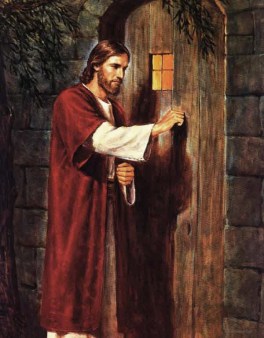
In the Book of Revelation, Jesus says, “Behold, I stand at the door and knock.” He knocks on the door of every human soul. But we can lock and block our door; with a big-screen TV of entertainment, or a bookshelf of learning, a trophy case of accomplishments, a heavy safe of accumulated wealth, or with several large-leafy plants so that a person may enjoy the beauty of creation while ignoring the Creator. If we insist upon self-centered ingratitude, the Lord will respect our freedom but we’ll be woefully unsatisfied forever.

But this is was not St. Thomas. He had sacrificed a lot to be Jesus’ apostle and had aspired to give him his all. On one occasion Jesus said, “Let us go back to Judea,” but the disciples replied, “Rabbi, the Jews were just trying to stone you, and you want to go back there?” When Jesus insisted on going, “Thomas, called Didymus, said to his fellow disciples, ‘Let us also go to die with him.’” At the Last Supper, when Jesus said, “Where I am going you know the way,” Thomas replied, “Master, we do not know where you are going; how can we know the way?” He was distressed because he loved Jesus and wanted to follow him anywhere. Thomas wanted the Resurrection to be true, but there was some other reason he wouldn’t or couldn’t believe.

A second theory for why Thomas was so slow to believe is that he was skeptically-minded. St. Thomas’ nickname, as you’ve heard it now a couple of times, was “Didymus.” In Greek, Didymus means “twin.” How was Thomas a twin? Scripture doesn’t say. Perhaps Thomas had a twin brother he had been mistaken for many times. In some icons of Jesus with his apostles, one of the apostles looks just like Jesus. Such art imagines that Thomas shared a twin likeness to the Lord. In either case, one could understand his initial skepticism about people seeing Jesus resurrected. “Nah. You guys saw somebody else.”

But Thomas has sufficient evidence to believe his friends. They are not claiming to have seen Jesus across the marketplace or walking through a field at dusk. (Neither Thomas nor we are expected to have blind faith, but to trust in trustworthy persons and things.) The other apostles are saying, “It’s true Thomas! He knew us, we saw his wounds!” Yet Thomas replies, “Unless I see the mark of the nails in his hands and put my finger into the nailmarks and put my hand into his side, I will not believe.” Why is Thomas so being obstinate?

The third (and I think most likely) explanation for why Thomas was so slow to believe in the Resurrection was that he hurt too much trust again. Who was Jesus to Thomas? He was Thomas’ hero, his admired teacher, his dearly beloved friend. Thomas thought Jesus would be the savior and messianic king of Israel, but Thomas’ great hope was murdered on Good Friday. Imagine Thomas’ prayer after experiencing that. “My God, how could you let this happen? He was innocent, he was so good! He was the best man I’ve ever known, and you let Him die! Why? How could do that to him? How could you do this to me?”

Jesus’ unexpected death broke Thomas’ heart, and perhaps having been so wounded once, he was resolved not to let his heart be taken-in again: ‘Unless I see the mark… put my finger in the nailmarks… put my hand in his side, I will not believe.’ Yet, though he doubts, notice where Thomas is one week after Easter. He’s with the other apostles in the upper room in Jerusalem, gathered behind locked doors for fear of those who killed Jesus. Now there are lots of other, safer places Thomas could have chosen to be. He could have returned to his hometown, back to the family and friends he left behind to follow Jesus a few years before. Though Thomas doubts, he does not leave this house of faith. He struggles with his questions, but he does not fully abandon Jesus. He seeks him here and because of it Thomas finds truth for his mind, healing for his heart, and peace for his soul.

The risen Lord appears in the upper room and how does Jesus respond to Thomas’ resistant unbelief? Not with anger. Not with condemnation. But with the same Divine Mercy we celebrate today. Jesus appears in their midst and says, “Peace be with you.” Then he says to Thomas, “Put your finger here and see my hands, and bring your hand and put it into my side, and do not be unbelieving, but believe.”

Curiously, Jesus still bears some of the wounds from his Passion: in his hands, feet and side. The cuts and swollen bruises are gone from his face, for the disciples respond to him with rejoicing rather than pity or horror, but he retains some marks from the evils that afflicted him. Jesus could heal or cover them—he’s God—but he choose not to. They are his trophies, the means of his glory, how he saved the world.

Our wounds, our losses, the sins and evils we suffer, they can scandalize us like Thomas was after the Passion. But through these things Jesus would glorify us, help to save others, and transform us into his more perfect twin. Jesus, having experienced wounds of his own, can relate and heal you.

Like St. Thomas, this Divine Mercy Sunday, you are gathered in this upper room with Jesus’ disciples. If there is any great wound or uncertainly in you, I invite you to be open to encounter Jesus anew like St. Thomas. Dare to ask, dare to seek, dare to knock. Jesus is not only your Lord and your God, he’s good and his love is everlasting.

The Holy Family and Yours

January 1, 2018

Every year, Holy Mother Church presents the Holy Family for our contemplation and imitation. Some imagine life in the home of Jesus, Mary, and Joseph in the soft, pastel colors of a Christmas card; so holy, so flawless, so unobtainable. We wonder, “Can the Holy Family and my family really relate to one another?” At least two out of the three members of the Holy Family never sinned in their entire lives together. We, meanwhile, could jokingly refer to the Feast of the Holy Family as “Elbow-Nudge Sunday.” Throughout the world this day, wives and husbands, parents and children, take turns gently nudging one another as they listen to God’s words about marriage and family life. The Holy Family was holy, but that doesn’t mean their lives were easy or smooth.

I’ve previously written about the stresses and difficulties of the holy couple leading up to the first Christmas: about Mary’s crisis pregnancy, about Joseph grappling with his wife telling him the child within her is the Son of God and Joseph contemplating a divorce, about their giving birth to that holy child in an animal stable. And their trials together continued after Jesus’ birth.

Imagine being Mary and hearing Simeon prophesy, “Behold, this child is destined … to be a sign that will be contradicted — and you yourself a sword will pierce…” How would that make you feel about the future for you and your child? Picture being Mary as her husband awakes and says “our boy is being hunted, we need to leave tonight.” Consider Joseph, the servant-leader of his family, having to pack-up quickly and leave so much behind to take his family into hiding in Egypt. Later, an angel tells Joseph to bring his family back into Israel. So Joseph returns with Jesus and Mary, but he’s afraid to resettle in the south because the son of Herod the Great now rules Judea. With the help of another dream, Joseph decides to resettle in the north, in Nazareth of Galilee.

I mention all this because St. Joseph, the just and holy man, feared an earthly king even as he trusted God. St. Mary at the Annunciation did not know all the details of her future, but she trusted in God by saying, “Let it be done to me according to your word.” Our Lord Jesus, sweating blood from stress the night before he died, trusted God to say, “Not my will but yours be done.” Their holy lives were often difficult, but God always rewarded their trust, bringing about good for them in the end.

In Genesis, Abram (whose name later got changed to Abraham) was promised a son by the Lord. But the childless Abraham looks at the old age of his wife and himself and asks, ‘Will my steward, Eliezer, be my heir?‘ God answers, ‘No, not him; your own flesh and blood son shall be your heir.’ Then the Lord took Abraham outside and said, “Look up at the sky and count the stars, if you can. Just so,” he added, “shall your descendants be.” And Abraham put his faith in the Lord.

When I first heard this story (and maybe when you heard it too) I assumed this event happened at night. But the message is even more powerful if God told him to “look up at the sky and count the stars, if you can,” during the daytime. Where do the stars go during the day? We know they’re still there, even though the Sun’s brightness the sky’s blueness prevent us from seeing them. Abraham trusted in the Lord’s unwavering goodwill towards him and beheld God’s word fulfilled in the birth of Isaac. Through that son, Abraham received glory and the whole world was blessed.

One of the things Jesus says in the Gospels more than anything else is, “Be not afraid.” Sacrifice your fears. Imagine taking those obsessive worrying thoughts from your mind, placing them upon the altar, and lighting them afire like a sacrifice of old to God. “Let the peace of Christ control your heart…” Trust that “God works all things for the good of those who love him” and then “the peace of God, which surpasses all understanding will guard your hearts and minds in Christ Jesus.”

God not only wants peace within us, but peace among us as well. In our homes there is always room for improvement. The household of the Holy Family may have been a sinless one, but mistakes and miscommunications surely happened. Joseph probably broke or misplaced tools. Mary probably burnt an occasional loaf of bread. From the Gospels we know they both thought they knew where their 12-year-old boy was as they left Jerusalem for home; several hours passed before they realized he was missing. Even when we deeply love one another, we must learn and practice how to love and serve each other better.

We love each other in many ways, and the best modes by which we experience love can vary from person to person. The book “The Five Love Languages” lays out five major ways that we give and receive love, namely:

Gift Giving
Acts of Service
Affectionate Touch
Words of Affirmation
Quality Time

What are your top-two love languages? Can you guess the preferred languages of your spouse and children? Sometimes we try to love others as ourselves by loving them exactly as ourselves and we unfortunately miss our mark. For example, imagine a spouse complaining, “Why don’t you let me know that you love me,” when they really mean “why don’t you get me surprises anymore” (gift giving) or “why don’t you tell me that I delight you and you’re pleased with me” (words of affirmation.) At this, their spouse might reply, “What do you mean? I’m loving you all the time,” when they’re really saying “I take care of the kids and do housework” (acts of service) and “We eat and sit in the living room together every evening” (quality time.) These two loving spouses are loving past each other.

Learn the preferred love languages of your family members, and don’t expect others read your mind, sabotaging our own happiness. Tell them how to delight you. They love you and they want to make you happy. Don’t attack and criticize (“You always this” or “You never that”) but invite them to bless you. And pray together, as a couple and a family. The Holy Family surely did and its one of the most valuable things I can recommend. Some married couples, who have shared a bed for years, have never revealed their personal prayer requests to each other. Pray together, and then even whenever frictions arise, you will remember that you are on the same team, together on the same side with God.

Your home will never be perfect – not even the Holy Family’s was perfect. Life’s circumstances will go awry, and there will be sins we have to apologize for and forgive one another. But with trust in God and a daily commitment to loving and serving each other better, you too can live in the peace and joy of the Holy Family.

“The Ten Virgins & Wedding Party Prudence” — 32nd Sunday of Ordinary Time—Year A

November 13, 2017

Learning about first century Jewish marriage customs helps us understand the Gospels better, including the Parable of The Wise and Foolish Virgins. In Jesus’ day, when a young man wished to marry a woman, he would journey from his father’s house to hers. He and her father would agree upon a dowry and once this dowry price was paid the marriage covenant was established. This event was called “betrothal” and the man and woman thereafter were considered husband and wife. The groom, however, would not then begin to live with his bride. He returned to his father’s house for twelve months, manifesting his respectful self-restraint and honorableness toward her. (Betrothal was the situation St. Matthew described: “When Mary… was betrothed to Joseph, but before they lived together, she was found with child through the Holy Spirit.” So Mary was never an unwed mother, but she knows the experience of having a crisis pregnancy.) During their year apart, the man and woman would prepare for their new life together. One of the groom’s most important tasks in this period was to prepare living accommodations for them at his father’s house.

Once their time of separation was over, the groom would return to his bride’s house with his groomsmen, usually at night with a torchlight procession. She would be expecting him but not know the exact hour of his arrival. That is why the groom’s second coming would be preceded by his messenger’s shout. Then the bride and her female attendants and the groom and his groomsmen would return to his Father’s house (their new home) for a wedding feast with their other gathered friends, family, and neighbors. There the husband and wife would consummate their marriage, and seven days of feasting and merriment would begin.

In the Gospels, Jesus is declared and calls himself “the bridegroom.” The New Testament names the Church his “bride.” The relationship between Christ and his Church parallels a Jewish marriage. For instance, in the Incarnation, God the Son left his Father’s house in Heaven to journey to our dwelling place on earth. Jesus paid our dowry price with his own blood. And after establishing his covenant, Jesus ascends to his Father’s house for a time until his second coming. This is why Jesus says at the Last Supper:

In my Father’s house there are many dwelling places. If there were not, would I have told you that I am going to prepare a place for you? And if I go and prepare a place for you, I will come back again and take you to myself, so that where I am you also may be.”

This Sunday’s second reading describes this return.  As St. Paul tells the Thessalonians, “The Lord himself, with a word of command, with the voice of an archangel and with the trumpet of God, will come down from heaven…” Notice how the Lord’s angelic messenger announces to the bride that her bridegroom is at hand. St. Paul continues, “And then the dead in Christ will rise first. Then we who are alive, who are left, will be caught up together with them in the clouds to meet the Lord in the air. Thus we shall always be with the Lord.”

In the Book of Revelation we see this nuptial union of Christ and his Church continues above. St. John hears Heaven sing:

Let us rejoice and be glad and give him glory. For the wedding day of the Lamb has come, his bride has made herself ready. She was allowed to wear a bright, clean linen garment.” (The linen represents the righteous deeds of the holy ones.) Then the angel said to me, ‘Write this: Blessed are those who have been called to the wedding feast of the Lamb.‘”

The virgin, young women in today’s parable are the bride’s attendants awaiting the bridegroom. Five are called wise and five are called foolish. The important distinction between them is not one of I.Q.—of being naturally intelligent or unintelligent—but in being thoughtful versus thoughtless. In the 1994 Best Picture Winning film, Forrest Gump is a man of below-average intelligence who, by his simple virtue, lives an admirable and remarkable life. A couple of times he’s asked, “Are you stupid or something?” and Forrest replies, “Stupid is as stupid does, sir.” I didn’t know what this meant when I was a kid, so I asked my dad. He explained that if you’re blessed with intelligence, but keep doing bad or foolish things, then you’re stupid. On the other hand, even if you’re not that bright but you make good and smart choices, then you are wise.

What is the meaning of the oil lamps that play such a significant role in Jesus’ story? The consensus of the Church Fathers is that they represent good works. Elsewhere in Matthew’s Gospel, Jesus likens lamps to good deeds:

No one lights a lamp and then put its under a bushel basket; it is set on a lampstand, where it gives light to all in the house. Just so, your light must shine before others, that they may see your good deeds and glorify your heavenly Father.

(But doesn’t Jesus warn us, just a few verses before in his Sermon on the Mount, “Take care not to perform righteous deeds in order that people may see them; otherwise, you will have no recompense from your heavenly Father”? What reconciles these two teachings The answer is in whose glory is being sought. If I pray, fast, and give alms for my own glory, then some people may think well of me for a little while until they forget, and I will have received my reward. But if I do good works for the glory of God, then he will be glorified and he will reward me and I will share in his glory.)

The two types of virgins in the parable represent two types of people awaiting Christ the bridegroom. All the virgins fall asleep. Likewise, all of us (unless Jesus comes again first) will experience the falling asleep of death. The virgins are roused from sleep. Likewise we will be roused from sleep in the Resurrection. All of the virgins have at least a little oil, some light. At the Judgment, I suspect everyone will have some good deeds to point to – even murderous dictators have loved their dogs. But is that love sufficient? Are those good deeds enough? For the thoughtless, foolish virgins, their little oil is not enough.

They say, “Give us some of your oil, for our lamps are going out.” But the wise ones reply, “No, for there may not be enough for us and you.” (Apparently, their oil and abundance is not something that can be shared or transferred between persons.) “Go instead to the merchants and buy some for yourselves.” That’s where the wise virgins would have bought their oil in preparation, but remember what time it is. The bridegroom’s arrival was announced at midnight. All the stores are closed. Where are the foolish virgins going to find a merchant to sell them oil? They won’t. It’s too late.

Who are these merchants that we must buy our oil from now, before it is too late? These merchants are your neighbors in their need. At the judgment of the world, the Lord Jesus will say the righteous, “Come, you who are blessed by my Father. Inherit the kingdom prepared for you from the foundation of the world. For I was hungry and you gave me food, I was thirsty and you gave me drink, a stranger and you welcomed me, naked & you clothed me, ill and you cared for me, in prison and you visited me.’ Then these righteous ones will wonder when this happened. And our king will say in reply, “Amen, I say to you, whatever you did for one of these least brothers of mine, you did for me.” And elsewhere, Jesus tells us, “Whoever gives only a cup of cold water to one of these little ones to drink because he is a disciple — amen, I say to you, he will surely not lose his reward.” Our neighbors, near and far, are the merchants from whom we obtain the oil of good works now for our lamps of glory later. We pay our neighbors with our time, our talents, and our treasure to purchase our good deeds.

This opportunity to do good on earth will not last forever. In Charles Dickens’ “A Christmas Carol,” old man Scrooge is visited by the ghost of his old business partner, Jacob Marley.

[Standing in his bed chamber, Scrooge] became sensible of confused noises in the air; incoherent sounds of lamentation and regret; wailings inexpressibly sorrowful and self-accusatory. The [ghost of Jacob Marley], after listening for a moment, joined in the mournful dirge; and floated out upon the bleak, dark night. Scrooge followed to the window: desperate in his curiosity. He looked out. The air was filled with phantoms, wandering hither and thither in restless haste, and moaning as they went. Every one of them wore chains like Marley’s Ghost; some few…were linked together; none were free. Many had been personally known to Scrooge in their lives. He had been quite familiar with one old ghost, in a white waistcoat, with a monstrous iron safe attached to its ankle, who cried piteously at being unable to assist a wretched woman with an infant, whom it saw below, upon a doorstep. The misery with them all was, clearly, that they sought to interfere, for good, in human matters, and had lost the power for ever.”

We know the souls in Heaven can help effect good on earth – that’s why we pray for their intercession. The souls in Purgatory may or may not be able to pray and intercede for us – that’s an open question in Catholic theology. The souls in Hell definitely do not help us, but both they and those in Purgatory regret and lament having failed to do more good on earth when they had their chance in life.

When the foolish virgins finally arrive late to the wedding feast they find the door is locked. They cry, “Lord, Lord, open the door for us!” But the bridegroom says in reply, “Amen, I say to you, I do not know you.” This echoes what Jesus teaches elsewhere:

Not everyone who says to me, ‘Lord, Lord,’ will enter the kingdom of heaven, but only the one who does the will of my Father in heaven. Many will say to me on that day, ‘Lord, Lord, did we not prophesy in your name? Did we not drive out demons in your name? Did we not do mighty deeds in your name?’ Then I will declare to them solemnly, ‘I never knew you. Depart from me, you evildoers.’”

Jesus is teaching us that we are not saved by faith alone, by the mere acknowledgment that he is “Lord, Lord.” Nor are we saved by the vast accumulation of good works, for one could even prophesy, drive out demons, or do mighty deeds without having a saving relationship with him. We are saved by Jesus’ love for us and our loving him in return; by both faith in him and good works in him.

So what was the foolish virgins’ great sin? Who hasn’t accidentally forgotten to pack something on occasion? It’s hard to imagine Jesus condemning people for a mere accident. I think the virgins’ oversight in this parable suggests a far more serious fault. These young women heard there was going to be a big party and that a lot of people were going. They jumped on the bandwagon but were just going along for the ride. They did not really know the bride or groom and didn’t really care about them. If they had loved the couple, they would have put more thought into being their good guests and true friends, they would have been more serious in their personal preparations, and that prudent diligence would have saved them from being locked out in the end.

I do not wish to unsettle you, but Jesus preached this parable to the crowds and ensured that it was included in Matthew’s Gospel because he wanted us to consider this question: am I loving the bridegroom and his bride, am I loving the Church and her Lord? Are you dedicating your time, talents, and treasure to God and your neighbor? Are you striving for the narrow path and the narrow door that Jesus tells us few attain? Or are you, like many, just going with the flow in comfortable complacency? Jesus’ final warning in today’s gospel is, “Stay awake, (be vigilant, be diligent,) for you know neither the day nor the hour.” The bridegroom and bride request the honor of your presence at their banquet. So let us wisely be diligent, doing good works in Christ, while this precious daylight remains.

Defending our Vineyard from our Enemy’s Servants

October 12, 2017

Today’s parable has a straight-forward interpretation: God is the landowner. He establishes his people Israel like a man who sets up a vineyard. God entrusted the care of his vineyard to the chief priests and elders of the people. They are the tenants. Then God sent his servants – the prophets – to obtain the good harvest. But the Jewish leaders resisted and persecuted the prophets; sometimes beating them, sometimes killing them, sometimes stoning them. Finally, God, in the crazy twist to our story, sends his own Son to them. The chief priests and the elders will go on to seize Jesus, condemn him, and see to it that he is taken outside the walls of Jerusalem and killed on a cross. “Therefore,” Jesus says to them, “the kingdom of God will be taken away from you and given to a people that will produce its fruit.” The authority of the Jewish leaders will be handed over to the Apostles and priests of Jesus’ New Covenant Church; a Church that will baptize and embrace Jews and Gentiles alike, forming a new people in Christ who will produce much fruit.

That is the straight-forward meaning of Jesus’ tale, but I would like to turn your attention back to those wicked tenants in the parable, because they, in a certain way, can serve as an example for us. Now I would not dare to suggest such a thing – I would fear it being scandalous to use the wicked as a Christian example – if Jesus himself had not once used a dishonest steward as someone we could learn from.

As you may recall, the dishonest steward, knowing that he would soon be losing his job, wrote off the debts of his boss’ debtors so that, once he got fired, these new friends of his would welcome him into their homes. Jesus used the shrewdness of this bad man as an example to teach his disciples to ‘make friends for yourselves with the wealth of this world, so that, when these passing things fail one day, you will be welcomed into eternal dwellings.’ Likewise, I believe we have something valuable to learn from the shrewdness of the vineyard’s wicked tenants in today’s parable.

What if, when the servants of the landowner had arrived at the vineyard, the tenants did not promptly beat them, kill them, or stone them? Imagine if the tenants, instead of turning them out, welcomed the servants’ arrival; giving them food to eat and somewhere to stay on the grounds. Now the wicked tenants’ prior plans to never deliver any of the harvest to the landowner would still be in place, but can you imagine what might happen to their resolve over time?

The good servants staying with the tenants would keep speaking with them so kindly and pleasantly and persuasively, encouraging them to do the right thing. The good servants would encourage the tenants to imagine their possible reward: “If you do what is just, our good master will be even more generous with you! If you will not give him the total amount, could you perhaps give him the least little bit? Surely that wouldn’t hurt and it wouldn’t cost you very much.” If allowed to stay, the servants may well convince the tenants to give up some or all of what they have. However, if the tenants wish to remain faithful to their original intentions, then when their enemy’s servants arrive they should be neither fed nor lodged, conversed with nor welcomed in any friendly manner, lest their persuasion change minds and hearts and plans.

There is a spiritual battle in our midst. You can hear about it on the news and see it in the headlines, hidden behind every divisive controversy and murderous atrocity. (For instance, if no demons played a role in the rise of ISIS, then the demons are not doing anything in our world these days.) But the spiritual battle in our midst is not only fought out there; it is fought within us.

How do temptations come into our minds? From our senses, what we see and hear; from our invisible spiritual enemies, the demons; from our own human brokenness; or any combination of these. However our temptations come, in whatever form they take, our response to them should be as unfriendly at their arrival as those wicked tenants were at the arrival of the landlord’s servants.

Do not welcome temptation when it arrives. Do not feed it. Do not give it a place to dwell and lodge within you. Do not converse with it. Do not fantasize at its suggestions. Do not compromise with it, not even a little. Do not allow it to change your mind, your heart, your plans. Do not befriend temptation, but violently turn it out as a servant of your enemy.

Now temptations may come in our direction even against will – sensations, sights, sounds, thoughts, feelings, memories – these can seem to pop up out of nowhere. Remember that an unwilled temptation, in and of itself, is not a sin. A saint is not someone who never experiences temptation. A saint is someone who chooses what is right and good and loving even amid temptation.

What should you do when temptation comes? First, pray. Pray now, and then again when temptation arrives. Prayer opens the door to Christ and lets him take the lead in our daily lives because he respects our freewill. Pray every day and call on the Lord in times of temptation. He is stronger than all the demons put together and mightier than your weaknesses.

A second helpful thing to do regarding temptation is to change your environment. Sometimes people in confession lament to me about always confessing the same sins. I try to encourage them by pointing out, “Well, thank goodness it’s not something totally different every time: ‘Father, last month I committed arson and this week I robbed a bank! I have no clue what I might do next!‘” Human beings, for better or worse, are creatures of habit, so we can learn a lot from our repeated failures. By changing your environment can do much to avoid temptation. For example, if you’re always gossiping with the same gathering of people, then perhaps avoid that group. If you are always unchaste using the same media, then block, limit, or cut out that technology. If you always get drunk at the same establishment, then stop going there. When you have traveled the same road many times you know well where that road leads. When you find yourself walking on that road, then stop and turn around or take another path. Changing your environment can lead you away from near occasions of sin.

A third and final thing to do amid temptation is to change your focus. The human mind is made to process ideas, to chew on thoughts; we cannot think about nothing. (If I were to tell you not to think about flying alligators, I bet you couldn’t do it for sixty seconds—you’d either be thinking about flying alligators or checking to see whether you’re thinking about them.) What should you think about instead when tempted? Whatever is true, honorable, just, pure, lovely, gracious, excellent, praiseworthy, think about those things, and you will persevere in doing what you have learned and received and heard and seen in Jesus Christ.

Some people only think of temptation as enticements to pleasurable things. But temptation can also be towards unpleasant things, like shame, despair, fear, and anxiety. The devil not only wants you to fall, but to stay down and not get back up. And if he cannot make you fall into sin, he wants you to be neutralized and paralyzed by fear and confusion. What is the antidote for such negative temptations? St. Paul offers this prescription for anxiety: “Brothers and sisters: Have no anxiety at all, but in everything, by prayer and petition, with thanksgiving, make your requests known to God. Then the peace of God that surpasses all understanding will guard your hearts and minds in Christ Jesus.” Let’s break that down.

Have no anxiety at all.” Concern is of good use. If you were not concerned about going to church you wouldn’t come. I were not concerned about my homily then I would have nothing to say. Concern is useful, but worry is worthless. Have no anxiety at all, “but in everything, by prayer and petition, with thanksgiving, make your requests known to God.” In everything, whether you are anxious or not, make your requests known to God; not because he doesn’t know, but because it opens you up to him and invites him to work. Pray prayers of praise for who he is, voice your petitions for what you need or want, and do so with thanksgiving – without which you feel impoverished and embittered despite your innumerable blessings. ‘Then the peace of God that surpasses all understanding

will guard your heart and mind in Christ Jesus.’ We do not have the big picture, long-term perspective of God to see how God will work all things for the good of those who love him, but by prayer comes a peace that surpasses our limited understanding. This peace will guard your mind and heart in Jesus Christ amid temptation.

God entrusted the Garden of Eden to Adam and Eve to tend and to protect. By the devil’s temptation, they lost their great treasure. Among the many treasures Jesus has given, he has entrusted to you the vineyard of your mind. Tend it and protect it. Do not fall to temptations but drive them out as your enemy’s servants. May your vineyard remain at peace and bear much fruit in Jesus Christ.

Transfiguring Our Perception of Others

August 6, 2017

Today, Jesus hikes with his three closest apostles, Peter, James, and John, to the top of Mount Tabor in Israel. And there, Jesus is transfigured before them. His face shines and his clothes become intensely white. Then they hear God the Father speaking from a bright cloud that envelops them, declaring: “This is my beloved Son.”

In the Incarnation, some two thousand and seventeen years ago, the Eternal Word became Flesh, the Second Person of the Holy Trinity became Man, and the divinity of the Son of God became veiled within a human nature. It has long been my sense that Jesus is not changed or transformed at the Transfiguration so much as his apostles are allowed to glimpse him more deeply as he really, truly is: God from God, Light from Light. This light shines from his face as radiantly as the sun and from his body such that the fabric of his clothing is brightly illuminated like a thin lampshade.

When the disciples become frightened after hearing the Father’s voice and fall prostrate on the ground, burying their faces, Jesus comes over and touches them: “Rise, and do not be afraid.” And when the disciples raise their eyes, they see Jesus once more the same way as they had always seen him, and yet they see him differently now.

If we saw Jesus tomorrow while buying bread and milk at the store, or if Jesus visited our place of work, or came to our front door, do you think we would recognize him? I tend to doubt it. Many of the Jews in Jesus’ day noticed nothing extra special about him. “Is he not the carpenter’s son?” The Prophet Isaiah foretold of the Messiah that ‘there would be in him no stately bearing to make us look at him, nor appearance that would attract us to him.’ Even Jesus’ close friends sometimes had a hard time recognizing him after his Resurrection. The most famous example of this was on the Road to Emmaus. But by the gift of God’s grace, with the Breaking of the Bread, the eyes of Jesus’ disciples were opened and they recognized him in their midst. The reason I doubt that many would recognize Jesus amid their everyday lives tomorrow is because so few of us recognize him among us today.

In the very early Church, a man named Saul had a murderous hatred for the first Christians. One day, was traveling to Damascus, Syria to arrest any Christians he might find there and bring them back to Jerusalem in chains. As he was nearing Damascus, a light from the sky suddenly flashed around him. He fell to the ground and heard a voice saying to him, “Saul, Saul, why are you persecuting me?” Saul asked, “Who are you, sir?” And the voice replied, “I am Jesus, whom you are persecuting.” This man went on to be converted to a Christian. We know him today as St. Paul.

Note how Jesus does not say, “Saul, Saul, why are you persecuting my Church,” nor “Why are you persecuting my people.” He says, “Why are you persecuting me?” Jesus identifies himself with his people and his Church because he is personally present within them. At the Last Supper, Jesus tells his disciples, “In a little while the world will no longer see me, but you will see me… You will realize that I am in my Father and you are in me and I in you.” Jesus speaks of his mystical presence within us our and neighbors at other times in the Gospels as well.

At the Last Judgment, Jesus tells us he will say to his saved sheep: ‘Whatever you did for one of the hungry, or thirsty, or naked, or sick, or imprisoned little brothers or sisters of mine, you did it for me.’ And then Jesus will turn and declare to the condemned goats: “Amen, I say to you, what you did not do for one of these least ones, you did not do for me.” These goats, Jesus tells us, will go off to eternal punishment, but the righteous sheep to eternal life.

And so you see, recognizing, loving, and serving Jesus in other people must be a top and serious priority for us. Yet how many people do we interact with each day with so much thoughtless indifference? We speed past other people like so many unnoticed trees and cars as we drive along our way of life. Sometimes we even take the people living in our own home for granted, treating our family members worse than our mere acquaintances. Many failed to recognize Jesus’ importance in his day; while we overlook the importance of people in our midst today. As C.S. Lewis wrote:

“It is a serious thing to live in a society of possible gods and goddesses, to remember that the dullest and most uninteresting person you can talk to may one day be a creature which, if you saw it now, you would be strongly tempted to worship, or else a horror and a corruption such as you now meet, if at all, only in a nightmare.

All day long we are, in some degree, helping each other to one or other of these destinations. It is in the light of these overwhelming possibilities, it is with the awe and the circumspection proper to them, that we should conduct all our dealings with one another, all friendships, all loves, all play, all politics.

There are no ordinary people. You have never talked to a mere mortal. Nations, cultures, arts, civilization — these are mortal, and their life is to ours as the life of a gnat. But it is immortals whom we joke with, work with, marry, snub, and exploit — immortal horrors or everlasting splendors.”

So how can we begin to behold and relate to other people in the manner we ought, as Christ would have us do? Jesus himself was open and loving towards everyone. I would suggest two steps: First, ask for the gift of God’s grace at this Breaking of the Bread on the Feast of the Transfiguration, that your eyes may be opened to truly see others. And second, begin a habit of praying for, say, five or ten people every day whom you’ve never thought to pray for before. For example, the cashier who gave you change yesterday, that politician whom you dislike, the suffering people of North Korea, your child’s best friend, your quiet co-worker, and the person whom you heard just died. And then, the next day, chose another new collection of people to pray for. This practice will reveal to you your inter-personal, spiritual blinders, and help you to begin tearing them down. Let us ask Jesus to transfigure our perception of others so that we may see them more in the way that he beholds them, with love.

“The 4 Types of Soil & How to Improve Our Own” — 15th Sunday of Ordinary Time—Year A

July 17, 2017

On that day, Jesus went out of the house and sat down by the sea. Such large crowds gathered around him that he got into a boat and sat down, and the whole crowd stood along the shore. And he spoke to them at length in parables, saying: “A sower went out to sow. And as he sowed, some seed fell on the path, and birds came and ate it up. Some fell on rocky ground, where it had little soil. It sprang up at once because the soil was not deep, and when the sun rose it was scorched, and it withered for lack of roots. Some seed fell among thorns, and the thorns grew up and choked it. But some seed fell on rich soil, and produced fruit, a hundred or sixty or thirtyfold. Whoever has ears ought to hear.”

Despite all the changes and developments over these past two thousand years, the parables of Jesus Christ still hold up. Not only is the imagery in his parables still relatable today, but the lessons of his parables remain true. In today’s Gospel, Jesus tells a parable about a sower who sows across four different types of ground. The Gospel’s authors, namely St. Matthew and the Holy Spirit, go on to make the interpretation of this parable easy by including Jesus’ own explanation.

Jesus says, “The seed sown on the path is the one who hears the Word of the Kingdom without understanding it, and the evil one comes and steals away what was sown in his heart. The seed sown on rocky ground is the one who hears the Word and receives it at once with joy.  But he has no root and lasts only for a time. When some tribulation or persecution comes because of the Word, he immediately falls away.  The seed sown among thorns is the one who hears the Word, but then worldly anxiety and the lure of riches choke the Word and it bears no fruit.  But the seed sown on rich soil is the one who hears the Word and understands it, who indeed bears fruit and yields a hundred or sixty or thirtyfold.”

And so, what is sown by the sower, so generously and so far and wide, is “the Word of the Kingdom.” And the four kinds of ground it touches denote four types of would-be disciples. What is this “Word of the Kingdom?” Jesus gives no precise definition for it in these passages, but I think it can be taken in various senses, all of them true: It is the Good News about the Kingdom of God Jesus was preaching. It is God’s Word revealed in both Sacred Scripture and Sacred Tradition through Christ’s Catholic Church. And the Word of the Kingdom is the Word of God made flesh, Jesus Christ himself, the fullest revelation of God the Father. When people encounter God’s word in these forms, they have four kinds of reactions:

The first (the path) are those who hear without understanding. They, like the footpath, are hardened against the message. Perhaps they do not want to understand it. Some people ask hard questions about our Faith in order to understand—and that is very good, for whoever asks, receives and whoever seeks, finds. However, many people ask religious questions only in order to criticize, mock, and comfortably continue in their unbelief. If you are ever in a religious conversation with a friend, relative, or co-worker and you sense that they are this latter sort, I recommend calling them on this attitude. “Are you asking so that can understand, or so that you can have an excuse not to listen?” This is important, because until their hardened will opens there is no crack for the seed to enter in, and they are easy pickings for the evil one.

The second (the rocky ground) are those who hear the Word and initially receive it with joy. But since they have no deep root they last only for a time and wither away. Some of this rocky ground are those who were raised Catholic but never developed a mature relationship with Jesus Christ and his Church. Those who attempt to weather this adult world of ours with only, say, a grade-schooler’s knowledge and practice of the Faith, will likely fail in the heat of temptation and trial. If you and your family are going to remain Catholic Christians these days we cannot stay shallow.

The third (the thorny soil) are those who hear the Word, and it begins to grow in them, but it does not grow alone: worldly anxiety and the lure of riches choke the Word and it bears no fruit. As Jesus said, ‘no one can serve to masters at the same time.’ You cannot say “Yes” to Jesus and “Yes” to your fears or “Yes” to your selfishness A “Yes” to Jesus demands a liberating “No” to many lesser things. Until we do that, we will not be truly fruitful as Christ wills us to be.

Finally, the fourth (the rich soil) hears the Word and understands it, says “Yes” to it and indeed bears fruit, yielding a many-fold return. It is a blessing to itself and others and a great joy to the Sower.

Jesus’ four varieties of ground describe four types of people. I suspect that in the end one of these will describe the prevailing theme of our lives. And yet, we know that soil types can change. You you grew up on a farm, you probably remember your father sending you out into the field to pick stones. This wasn’t just make-work; your father did this to make the rocky soil more fruitful. If you’re a gardener, you know what happens if good soil is left untended—you’ll soon be pulling weeds. Soil can change; sinners can convert into saints, and the righteous can fall.

We can change the sort of soil we are over our lifetime, but to a lesser extent we can also change throughout the hours of our day. In the same day, I can be hardened against God’s will, superficial towards God and other people, or dominated by fear or selfishness, and then turn to bear fruit in Christ. But how can I change the kind of soil we are throughout our lives and throughout our days? You can’t do it alone, but God won’t do it without you. God is all-powerful, but he respects our human freedom. Not even the most important event in God’s plan since Creation, the incarnation of his Son within the Virgin, was to occur without her consent. But once Mary said, “Let it be done to me according to your will,” God began working great new things within her. Despite his omnipotence, God cannot force anyone to freely give him their “Yes.”

In the Book of Revelation, Jesus says, “Behold, I stand at the door and knock. If anyone hears my voice and opens the door, then I will enter his house and dine with him, and he with me.” You may have seen paintings of this, with Jesus knocking at a cottage door. Oftentimes, the door is depicted as having no outside door-handle. This is because the cottage represents your soul, and the door to your soul can only be opened from the inside. Daily prayer opens the door to Christ.

One of the best ways to prayerfully invite Jesus into your day is through the “Morning Offering.” There are various forms of this prayer, but they usually begin like this: “O Jesus, through the Immaculate Heart of Mary, I offer you my prayers, works, joys, and sufferings of this day for all the intentions of your Sacred Heart…” The exact words you use are not so important as the intention, the decision, the act of the will to offer yourself to Christ. If you don’t think that you’ll remember to do this first thing in the morning, then you can put your guardian angel on the job. Then, as soon as you open your eyes and see your bedroom ceiling, the thought of offering this prayer will occur to your mind. Daily prayer is key for growing in a life of holiness. You can do it anywhere, but visiting Our Lord at church, before his Eucharistic Presence in the tabernacle, is particularly powerful and precious to him.

Remember last week, when Jesus said, “Take my yoke upon you and learn from me, for I am meek and humble of heart“? Yokes are braces that go on an animals’ shoulders for pulling plows or wagons, and there are single-animal yokes, but I think Jesus has a double-yoke in mind. When there is an older, more experienced animal, it can be paired beside a younger, inexperienced one in order to train it and to bear the load together. And, when you look at a double-yoke from above, it forms a cross. What Jesus calls you to, you can’t do alone. He does not expect you to do it alone, but he’s waiting for your “Yes.” Give him your “Yes,” become good soil, and then watch him grow great things in you.

“Being Childlike Towards Jesus and Our Mother” — 14th Sunday of Ordinary Time—Year A

July 9, 2017

In the 1944 Best Picture Winning film, “Going My Way,” Bing Crosby’s character, Fr. Chuck O’Malley, shares this quip: “You know, when I was 18, I thought my father was pretty dumb. After a while, when I got to be 21, I was amazed to find out how much he’d learned in three years.” Of course, the joke is that the dad didn’t get much wiser in three years. The son’s lived experience revealed to him, “You know, my dad actually does know what he’s talking about.” What if your mother were about thirty lifespans old, alive with the same beauty, liveliness, and fruitfulness that she possessed in her youth? Would you listen to her, learn from her, and heed your wise mother’s words? God our Father has given us such a mother in the Holy Catholic Church.

In our first reading from the Old Testament, the prophet Zechariah writes: “Shout for joy, O daughter Jerusalem! See, your king shall come to you;a just savior is he, meek, and riding on an ass.” This is a prophesy about the coming of the Messiah, the Christ. It was fulfilled about five centuries later with Jesus’ entry into Jerusalem on Palm Sunday. Jesus does not enter in as a conqueror, upon a warhorse with sword; but meekly, humbly, on a donkey. All the people are free to welcome him and follow him, and everyone is also free to ignore him and reject him. Jesus is not forcing them to do anything in response to him, much like his Church, which for a quite long time now hasn’t forced anyone anywhere to do anything. In this life, our personal response to Jesus Christ and his Church is completely voluntary, but that decision is not at all trivial.

In our second reading from the Letter to the Romans, St. Paul says: “Brothers and sisters, we are not debtors to the flesh, to live according to the flesh. For if you live according to the flesh, you will die, but if by the Spirit you put to death the deeds of the body, you will live.” Now when St. Paul opposes “the Flesh” and “the Spirit” he is not saying that the material world and our bodies are evil or bad. At Creation, God saw that these were good, and as Christians we profess that “the Word became flesh and dwelt among us.” St. Paul is using “the Flesh” as shorthand for those aspects of ourselves that are not properly ordered to “the Spirit” of God. Jesus has raised up a fallen world but aspects of our brokenness still remain. This brokenness is seen in both our bodies and minds: in our appetites desiring what is bad for us, and in our intellects rationalizing our wrong ideas. Imagine how much better this world would be if everyone knew and practiced what the Catholic Church teaches. To echo G.K. Chesterton: “The Catholic Faith has not been tried and found wanting; it has been found challenging and left untried.

Someone might raise the objection: “What about all the bad things Catholic clergy have done? How can sinners be guardians of God’s truth?” There have certainly been bad priests, bad bishops, and even bad popes whose personal sins have done great harm to many. They are a scandal and a sacrilege. But amazingly, even when the most unworthy men have been pope, none of them formally promulgated heresies over the Church. Jesus told his apostles: “Whoever hears you hears me,” knowing fully that Judas Iscariot, his betrayer, was among their number. None of the apostles were sinless men, but Jesus chose them and their successors to preach his message, cast out demons, cure the sick, and administer his sacraments. How tragic it would be if an innocent harmed or scandalized by Judas the Betrayer wanted nothing more to do with Jesus Christ’s Church. Jesus loves his little ones and does not want any to be hurt or estranged from his Church.

In today’s Gospel, Jesus praises his Father saying “you have hidden these things from the wise and the learned but revealed them to little ones,”  In saying this, Jesus is not rejecting higher education or those who possess it. However, even if you have some degrees on your wall and initials after your name, these are not enough in themselves to receive the teaching of Christ and his Church. We all must be childlike. Childlike, not childish. A childish person is selfish, immature, willful, rebellious, and you can’t teach them anything.  But a childlike person is open, humble, loyal, devoted, and teachable. As Jesus declares on another occasion: “Amen, I say to you, whoever does not accept the kingdom of God like a child will not enter it.”

Pope Paul VI observed, “Modern man listens more willingly to witnesses than to teachers, and if he does listen to teachers, it is because they are witnesses.” With than in mind I’d like to witness to a time when, despite my initial hesitancy, responding to Jesus’ teaching blessed me in surprising ways.

When I was in college, my schoolwork was a grind. I always looked forward to our vacations, but they were always weeks or months away, on the other side of my papers’ due dates and final exams. At that time, I realized that although I had always gone to Mass I had never kept Sunday as a special day of rest. The Catechism of the Catholic Church says: “On Sundays and other holy days of obligation, the faithful are to refrain from engaging in work or activities that hinder the worship owed to God, (that hinder) the joy proper to the Lord’s Day, (that hinder) the performance of the works of mercy, (or that hinder) the appropriate relaxation of mind and body.” It then adds, “Family needs or important social service can legitimately excuse from the obligation of Sunday rest. (However,) the faithful should see to it that legitimate excuses do not lead to habits prejudicial to religion, family life, and health.

I didn’t want to reach the end of my days wondering what would have happened if I had been faithful to Christ in this area, so decided to stop doing my homework or studies on Sundays. There were some very late Saturday nights, but I kept faithfully to this rule. And, after a while, I noticed two surprising things. First, my Sunday rest never burned me. I don’t recall ever bombing a test, failing to meet a deadline, or doing worse on any of my assignments because of not having worked on Sunday. The second surprise was that I began to look forward to every Sunday as a one-day vacation. In addition to going to church, it was a day for taking a map, going out to eat, watching a movie, or just hanging out with my friends. I gave a gift of myself to the Lord and he gave me an even greater gift in return.

Perhaps you are afraid to let the teachings of Jesus Christ in his Church to impact your time or your money, your sexuality or your marriage, your politics or your addictions, but I urge you to be brave and wise. Just last week, we heard Jesus tell his apostles: “Whoever receives you receives me, and whoever receives me receives the one who sent me.” Jesus was not merely referring to receiving the apostles in their persons but the message that they preached.

We resist change because we fear the limitation of our freedom. We fear what the change might cost us. We fear a heavy yoke being locked around our neck and weighing upon our shoulders. But do not be afraid. Jesus offers you a better way. He says: “Come to me, all you who labor and are burdened, and I will give you rest. Take my yoke upon you and learn from me, for I am meek and humble of heart; and you will find rest for yourselves. For my yoke is easy, and my burden light.” Please trust in Jesus, learn from him, and sacrifice your will to his. And do not be afraid, for God will not be outdone in generosity.

Why Did Jesus Go Incognito?

April 30, 2017

There are three episodes in the Gospels where the resurrected Christ appears to his disciples but initially goes unrecognized: at the tomb, to Mary Magdalene; in the appearance we hear about today, to a pair of travelers on the road to Emmaus; and lastly, to seven of his disciples fishing the Sea of Galilee.

Let us briefly review each encounter:

First, on Easter morning, Mary is weeping outside the tomb. She turns around and sees Jesus there, but she does not know it’s Jesus. He says to her, “Woman, why are you weeping? Whom are you looking for?” She thinks he’s the gardener and says to him, “Sir, if you carried him away, tell me where you laid him, and I will take him.” Jesus says to her, “Mary!” She turns, and says to him in Hebrew, “Rabbouni,” which means Teacher. Perhaps Mary Magdalene’s tear-filled eyes and anguished mind simply could not make out Jesus’ face in morning’s early light, but after one more word she recognizes him. (John 20)

Today, Jesus draws near to Cleopas and another unnamed disciple as they walk to Emmaus, but their eyes are prevented from recognizing him, for he appears to them in another form. Later, when all three of them are dining together, Jesus takes bread, says the blessing, breaks it, and gives it to them. With that their eyes are opened and they recognize him. He is revealed to them in the breaking of the bread, but then vanishes from their sight. (Luke 24, Mark 16:12)

Third and finally, after a night of completely unsuccessful fishing, Jesus appears to the Apostles Peter, Thomas, Nathanael, James, and John, and two other unnamed disciples. They’re in a boat and he’s on the shore, but they do not immediately realize it’s Jesus. He says to them, “Children, have you caught anything to eat?” They answer, “No.” So he says, “Cast the net over the right side of the boat and you will find something.” And they proceed to miraculously catch 153 large fish without tearing their nets. (The Biny fish, which is common to the Sea of Galilee today, has a weight at maturity of 13 to 15 pounds. A catch of 153 of these fish would weigh more than a ton.) Jesus then invites them, “Come, have breakfast.” And, St. John’s Gospel notes, none of the disciples dares to ask him, “Who are you?” because they realize it is the Lord. (John 21)

One might argue that Jesus’ looks were not in any way disguised on the shore, that the disciples simply failed to recognize him at first because he was about a hundred yards away and the light of dawn was still dim. But if that were the case, there would be no thought of asking him “Who are you” over breakfast around that charcoal fire; this question only arises if his identity remains somewhat concealed. Some have suggested that Jesus appeared elderly to the disciples at the Sea of Galilee, for he says, “Children, have you caught anything to eat?” On the other hand, Jesus had previously referred to the Apostles as his children at the Last Supper, “My children, I will be with you only a little while longer.”

Jesus has no difficulty being immediately recognizable when he wants to be. On Divine Mercy Sunday, when Jesus appears before St. Thomas for the first time, we perceive no hesitation in the former doubter’s declaration, “My Lord and my God!” So why then did Jesus allow himself to go unrecognized, at times even becoming physically unrecognizable to his disciples? Perhaps Jesus had thousands of good reasons for this, but I would offer these four:

Reason #1: To add proof that these resurrection accounts are true

Imagine if Jesus’ bodily resurrection were a lie and you were making up stories to bolster others’ belief in it. Would you invent and insert the odd detail that Jesus’ closest disciples couldn’t always recognize him when they saw him? What reason would there be to weave such a confounding wrinkle into your resurrection accounts — unless it were the truth?

Reason #2: To demonstrate how people can believe in Jesus without directly seeing him 

The disciples in Emmaus said to each other, “Were not our hearts burning within us while he spoke to us on the way and opened the Scriptures to us?” They came to faith in the resurrection by recognizing the fulfillment of prophesy, even before Jesus had opened their eyes to see himself. At the Sea of Galilee, when the Beloved Disciple saw the incredible catch of fish, he said to Peter, “It is the Lord.” The miraculous sign revealed to them the truth about a person they could not see. We today may not see Jesus’ unveiled presence among us, but he provides sufficient evidence to point to himself in every generation.

Reason #3: To show how Jesus would continue to be with us

In the forty days between Easter and his Ascension, Jesus was not visibly present to his Apostles twenty-four hours a day. Yet at the Great Commission, Jesus reassures, “[B]ehold, I am with you always, until the end of the age.” What he’s saying is, ‘Even when you are alone, I will always be at your side.’ By revealing his resurrected self to his disciples “in a different form,” Jesus prepares them for how they will regularly encounter him through the Sacraments until he comes again; truly present, but veiled.

Reason #4: To reveal how Jesus is presented to us through others

Who is the manual laborer we bump into, like Mary Magdalene saw on Easter morning and addressed respectfully as “Sir” (even though she was having a horrible day and thought he might be a body snatcher)? Who is the traveler we pass on the road, like the Emmaus duo met, dialogued with, and invited to stay with them? Who is the older person that greets us, like the Galilean fishermen encountered and with whom they shared their food? Jesus would have us see himself in all of them and everyone. At the Last Judgment, Jesus will declare to both the saved sheep and the guilty goats, “Whatever you did for the least of my brethren, you did it for me.”

Jesus once asked St. Catherine of Siena, the 14th century Italian mystic, “My beloved, do you know why I love you?” In response to Catherine’s negative reply, Jesus said, “I will tell you. If I cease to love you, you will be nothing; you will be incapable of anything good. Now you see why I have to love you.” Catherine replied, “It is true,” and suddenly added, “I would like to love you like that.” But as soon as she had spoken, she realized what she had said was misplaced. Jesus smiled. Then, she complained, “But this is not fair. You can love me with great love, and I can only love you with small love.” At that moment, Jesus interrupted and said, “I have made it possible for you to love me with great love.” Surprised, she immediately asked him how. “I have placed your neighbor at your side. Whatever you do to him, I will consider it as being done to me.” St. Catherine went running to care for the sick in the hospital, rejoicing: “Now I can love Jesus with great love!”

After the resurrection, Jesus was sometimes unrecognized by his disciples, but he allowed this so that we might better recognize him; as the Savior truly risen, as the Christ evidenced by signs, as the Lord truly present in the Sacraments, and as the one concealed in our neighbor.

But It Was Not Enough For Him

April 16, 2017

At Passover, in Jesus’ day and in our own, the Jewish people remember and celebrate the great Exodus, how God delivered his people from slavery in Egypt and led them into the freedom of the Promised Land. Through Moses, God commanded his people to keep the Passover feast as an everlasting memorial. Jesus’ Last Supper was something of a transformed Passover meal, and his Passion, Death, and Resurrection are the mystery that the Passover foreshadowed and prefigured.

Jews today observe their annual Passover meal with an assortment of ancient traditions. Among these is singing or reciting an up-beat Hebrew song named “Dayenu” (Da-yea-nu.) Dayenu means “it would have been enough for us!” Here is an English translation of this more than one thousand year old song:

If [the Lord] had brought us out from Egypt, and had not carried out judgments against them
Dayenu, it would have been enough!

If He had carried out judgments against them, and not against their idols
Dayenu, it would have been enough!

If He had destroyed their idols, and had not struck their first-born
Dayenu, it would have been enough!

If He had struck their first-born, and had not given us their wealth
Dayenu, it would have been enough!

If He had given us their wealth, and had not split the sea for us
Dayenu, it would have been enough!

If He had split the sea for us, and had not taken us through it on dry land
Dayenu, it would have been enough!

If He had taken us through the sea on dry land, and had not drowned our oppressors in it
Dayenu, it would have been enough!

If He had drowned our oppressors in it, and had not supplied our needs in the desert for forty years
Dayenu, it would have been enough!

If He had supplied our needs in the desert for forty years, and had not fed us the Manna
Dayenu, it would have been enough!

If He had fed us the Manna, and had not given us the Sabbath
Dayenu, it would have been enough!

If He had given us the Sabbath, and had not brought us before Mount Sinai
Dayenu, it would have been enough!

If He had brought us before Mount Sinai, and had not given us the Law
Dayenu, it would have been enough!

If He had given us the Law, and had not brought us into the land of Israel
Dayenu, it would have been enough!

If He had brought us into the land of Israel, and not built for us the Holy Temple
Dayenu, it would have been enough!

It would have been enough for us,” for how could we demand more than what God had given? He created the universe out of nothing and every good thing is his gift. Apart from God’s promises (freely-imposed upon himself by His covenants) we could not rightfully insist upon anything more. As Job said at the onset of his trials, “Naked I came forth from my mother’s womb, and naked shall I go back there. The Lord gave and the Lord has taken away; blessed be the name of the Lord!” We could not demand more—but we would still desire more.

We would continue to desire life without end. We would still want deliverance from evils, outside us and within us. We would still desire unending delights, for as King Solomon observed, “The eye is not satisfied by seeing nor has the ear enough of hearing.” And would long for divine intimacy with the Holy Source of all good. All these desires are fulfilled for us through Jesus Christ.

We could not demand more, but we would still desire more, for the Lord has placed these desires within us. He did this that He might fulfill our desires and they reflected his own desires for us.

The Lord did all the great things that came before
— But this was not enough for Him!

He did all these great things, and then He became man for us
— But this was not enough for Him!

He became man for us, and then He taught us the New Law of Love
— But this was not enough for Him!

He taught us the New Law, and then He suffered and died to forgive us
— But this was not enough for Him!

He suffered and died to forgive us, and then He rose from the dead to save us from death
— But this was not enough for Him!

He rose from the dead to save us from death, and then He left us the Church
— But this was not enough for Him!

He left us the Church, and then He wedded and united himself to us through the Holy Sacraments

What God has given us, what Jesus has done for us, what we are given, what we are promised — this is enough for us. Let us rejoice in Him this day!

The Lazarus You Know — 26th Sunday of Ordinary Time—Year C

September 25, 2016

Sunday Readings

Lazarus at the Rich Man's Door

The Lord says though the prophet Amos, “Woe to the complacent,” to those warm and well-fed, comfortable on their couches without concern for others. Indeed, Scripture says, “whoever does not love a brother whom he has seen cannot love God whom he has not seen.” (1st John 4:20) You know of Jesus’ concern for the needy. Though he was rich, dwelling in the comfort of the Trinity, our Lord came to earth and became poor for your sake, so that by his poverty you might become rich. (2nd Corinthians 8:9) The rich man in Jesus’ parable could not have been unaware of the man lying at his door. Apparently, the rich man even knew his name: “Father Abraham…  Send Lazarus…” But the rich man came to deeply regret his indifference toward this neighbor.

You know a Lazarus as well. He’s not sleeping on your doorstep, but you probably know his name. He (or she) may be well-known to you or only an acquaintance. Maybe Lazarus goes to your church, or hasn’t come for years. Maybe Lazarus lives just down the street or in a nursing home far away. Your Lazarus is in great need, but probably not for food or shelter.

St. Teresa of Calcutta, who cared for many Lazaruses in India’s slums, said, “The spiritual poverty of the Western World is much greater than the physical poverty of our people.” The poorest of the poor are in our midst. Knowing this, I ask that you to earnestly pray to the Holy Spirit, that He may reveal your personal Lazarus to you, so that you may lovingly attend to that person as Jesus would have you do.