Archive for the ‘Sunday Homilies’ Category

“The Prince” or the Christ? — 18th Sunday of Ordinary Time—Year C

August 3, 2019

In the 6th century B.C., the Romans had a king named Tarquin the Proud who declared war on a city eleven miles east of Rome called Gabii. When the king was unable to take the city by force, he plotted to take it by deception. His son, Sextus, pretending to be ill-treated by his father and bearing fresh wounds from being flogged, fled to Gabii. The infatuated inhabitants entrusted him with the command of their troops, and when he had obtained the full confidence of the citizens, he sent a messenger to his father to learn what he should do next. The king, who was walking in his garden when the messenger arrived, spoke no words, but kept striking off the heads of the tallest poppy plants with his stick. His son understood the unspoken reply, and put to death or banished on false charges all the leading men of Gabii, after which he had no difficulty in compelling the city to submit to his father.

I was reminded of this story of political power and deceitful scheming this week while listening to Niccolò Machiavelli’s 16th century Italian book, “The Prince.” In this pragmatic, cynical treatise, Machiavelli discusses how a ruler can most effectively rule his realm. For example, upon conquering another king or noble’s territories, Machiavelli recommends exterminating that ruler’s family members to prevent future revolts. Machiavelli also encourages leaders to always appear merciful, faithful, humane, sincere, and religious to appear so but not always be so, because he holds that no ruler can be successful without, at times, deliberately doing evil as circumstances require.

Machiavelli provides numerous historical illustrations, like the story of an Italian ruler whose newly acquired territory was full of corruption, robbery, and violence. He appointed a cruel and efficient man as their governor, entrusting him with full authority to act. This governor quickly restored order with his iron fist, but then his lord had less use for him and saw him as a possible threat. Machiavelli writes that the ruler, “to clear himself [of guilt] in the minds of the people and make them entirely loyal to him, … desired to show that if any cruelty had been practiced it had not originated from him but came from the personal cruelty of the governor. Under this pretense [he arrested the governor] and one morning had him killed and left in [the city square] with the block and a bloody knife at his side. This terrible sight,” writes Machiavelli, “caused the people to be at the same time satisfied and worried.”

Listening to his stories, hearing his advice, I wondered what sort of person would ever want to be such a prince or ruler. Besides the iniquity, Machiavelli himself acknowledges that the prudent leader, when not fighting wars, should constantly focus on preparing for wars. But like King Solomon asks in our first reading, ‘what profit comes to [a ruler] from all the toil and anxiety of heart with which he has labored under the sun? Even at night his mind is not at rest. This is vanity.’ And furthermore, like Jesus says, ‘What does it profit a man to gain the whole world and lose his soul?’

Machiavelli’s advice and methods for maintaining power by any means might work in one sense here in this world, but in the long term all these things are futile. The rich fool says to himself, “Now as for you, you have so many good things stored up for many years, rest, eat, drink, be merry!” But God says to him, “You fool, this night your life will be demanded of you; and the things you have prepared, to whom will they belong?” Thus will it be for all who store up treasure for themselves but are not rich in what matters to God.

Jesus once asked, “What king marching into battle would not first sit down and decide whether with 10,000 troops he can successfully oppose another king advancing upon him with 20,000 troops? But if not, while he is still far away, he will send a delegation to ask for peace terms.” That’s simply basic strategy, yet how many people march towards the inevitable end of their lives — when they will approach the all-powerful King of kings and the Lord of hosts — without consideration of how ill-prepared they are to face him?

Who and what are we loving? And are we loving them as we should?

St. Paul is often quoted from his 1st Letter to Timothy as saying, “The love of money is the root of all evils, and some people in their desire for it have strayed from the faith and have pierced themselves with many pains.” But something about this passage never made sense to me. Does the root of all evil really reside in the love of money? For instance, does every act of adultery stem from a love of money? I don’t think so. But while studying Greek in seminary I discovered that this passage can be justifiably translated a different way: “The love of money is a root of all evils,” and that is very true.

Money, wealth, is a tool, like fire. It’s a neutral thing; good when used rightly but potentially destructive and deadly when mishandled. The love of money, that is to say greed, is rightly called “idolatry” by St. Paul in our second reading, because the greedy person serves and trusts in wealth as their god, their savior and source of blessings. While urging us never to worry, our Lord does call us work, to make material provision for ourselves and our households. St. Paul taught the Thessalonians that “if anyone was unwilling to work neither should that one eat.” And on another occasion he wrote, “whoever does not provide for relatives and especially family members [of his household] has denied the faith and is worse than an unbeliever.” Yet Jesus does not wish us to make work and wealth our idol: “Take care to guard against all greed, for though one may be rich, one’s life does not consist of possessions.”

One day, perhaps sooner than we imagine, our lives will be demanded of us and all the property and possessions we leave behind will be left to others. It is a good thing for us to have a will prepared for this foreseeable event, and I would ask you to remember St. Paul’s Parish and our endowment in your estate. But as praiseworthy as it is to prepare inheritances for that day, it is not as meritorious as giving during your lifetime. How much generosity is there in giving away what you cannot possibly take with you or keep? How generous is it to give away what is no longer of any use to you? Unavoidable giving is a small sacrifice and exercises small trust in God.

And so I recommend to you the practice of tithing, to the Church and to charities. Chose some percentage to tithe to the mission of Jesus Christ in our parish, for needs in our community, and to help people far beyond. In the Old Testament, God commanded his people to tithe 10% of everything, and they were much poorer than us. I urge you to prayerfully discern a number for yourself. Giving in this way practices trusting in the Lord and allows him to show you his providence and his power to provide. Though we do not believe in a “prosperity gospel” which claims believers will never experience trials, Jesus does promise a prize for our every given gift: “Give and gifts will be given to you; a good measure, packed together, shaken down, and overflowing, will be poured into your lap. For the measure with which you measure will in return be measured out to you. … And whoever gives only a cup of cold water to one of these little ones to drink because he is a disciple—amen, I say to you, he will surely not lose his reward.”

Our short life here on earth is an audition and a training ground for life in the Kingdom of Heaven. Through his gracious, saving work, Jesus Christ has extended an invitation to everyone to become a citizen of his Kingdom, now and in the age to come. Presently here on earth, his Kingdom, the City of God and her citizens, exist alongside and amidst the City of Man with its Machiavellian-minded members. But in the coming age, there will be no place for those sinners who live for themselves, and the virtuous meek who are generous to God and their neighbor shall inherit the earth. The choice before us all is for “The Prince” or for the Christ.

Asking for a Gift to Give — 17th Sunday of Ordinary Time—Year C

July 28, 2019

Remember last Sunday, when Abraham hosted three mysterious visitors from Heaven. Once they had agreed to Abraham’s offer to serve them a meal can you recall the first thing Abraham did? “Abraham hastened into the tent and told Sarah, ‘Quick, three measures of fine flour! Knead it and make rolls.'” How much were “three measures of flour” back then? Through a scripture commentary, I learned that this was about half a bushel, or like twenty pounds of flour. That’s enough to make about twelve of the loaves of bread we buy at the grocery store these days. So, Abraham served about a dozen loaves of bread to three guests. Now I’m as much a fan of unlimited breadstick deals as anybody, but when was the last time you ate four loaves-worth of bread in one sitting? Abraham knew these were extraordinary guests, so he set an extraordinary meal before them. And perhaps he intended to give them all the leftover loaves as a further gift to God.

I wondered about those “three measures of flour” because of Jesus’ parable today: Suppose you have a friend to whom you go at midnight and say, “Friend, lend me three loaves of bread, for a friend of mine has arrived at my house…” So we have a meal with three measures and a parable with three loaves. Three measures of flour for the Lord, and three loaves of bread for a friend. I perceive that these things are connected, but more on that later.

Immediately preceding this parable, Jesus teaches his disciples how to pray. You surely noticed that the Our Father prayer in Luke differs from Matthew’s more familiar version. This is providential. If the two texts were exactly the same, some Christians might mistake Jesus’ example as being our only permissible prayer. But Jesus does not give the Our Father as a magic formula or incantation, but as a model for our approach and attitude to prayer. In Matthew’s version, the prayer begins with “Our Father.” He is not mine, but ours, because he calls us to salvation together. Luke’s version simply begins with “Father”; not “Master,” as though we were merely his slaves; not “Ruler,” as though we were merely his subjects; but “Father,” because we are his children. The prayer’s petitions are direct requests, simple requests, profound requests. For example, consider: “Give us each day our daily bread.” It’s straight-forward, basic, yet deep when you contemplate “our daily bread” as a symbol for all of our constant bodily and spiritual needs. And notice something else that these petitions have in common: “hallowed be your name,” “your kingdom come,” “forgive us our sins.” Each is asking God for something that God already desires for us. They are each a part of his plan already.

Who are we supposed to be like in Jesus’ parable? Surely it’s the persistently asking and seeking door-knocker. Because Jesus says, immediately after this parable, “And I tell you, ask and you will receive; seek and you will find; knock and the door will be opened to you.”

And who is God represented by in this parable? Naturally, the man in the house whose gifts can be gained through asking. Indeed, God is on the other side of Heaven’s door. And even at midnight, in the darkest hour, we can call on him for help. His children inside, the saints and angels who rest peacefully in his house, join their voices to ours when we persistently ask for good things on earth. But God is surely not like this annoyed neighbor in saying, “Do not bother me… I cannot get up to give you anything.” Jesus’ mode of teaching here is from the lesser to the greater. If this annoyed neighbor can be persuaded to give, how much more can God who already desires to give. Likewise, Jesus says, “If you, who are wicked, know how to give good gifts to your children, how much more will the Father in heaven give the Holy Spirit to those who ask him?

The request for three loaves and Abraham’s request for three measures suggests another character like the Lord in this parable: “Lend me three loaves of bread, for a friend of mine has arrived at my house from a journey and I have nothing to offer him.” Mystically speaking, this visiting friend is the Lord. For Jesus says, “Amen, I say to you, whatever you did for one of these least brothers of mine, you did for me.” Jesus says, “Whoever receives one child such as this in my name receives me.” And Jesus says to the early Church’s persecutor, “Saul, Saul, why are you persecuting me?” Jesus is mystically present in every Christian and within in his Church. Thinking of God as represented in this parable by both the homeowner and the visiting friend reveals a dynamic that could change how you relate to prayer.

When you pray for some good thing, when you ask some worthy blessing for yourself, someone else, or even billions of people at once, are you not praying for the greater glory of God among us? What prayer would he, could he, possibly grant you that would not also glory him? Furthermore, what can we offer him that is entirely of ourselves? The man in the parable asks his neighbor for loaves for his friend because “I have nothing to offer him.” As St. Paul asked the Corinthians, “What do you possess that you have not received?” It’s been said that to truly make an apple pie from scratch, you have to recreate the universe. Like Abraham asking Sarah for loaves for his holy guests, like the man in the parable asking for a loan of bread, every good prayer—whatever it may be—is asking for a gift to be gifted to the Lord. It’s like asking your dad for money to buy him a gift for Father’s Day. It’s for his own glory, so you don’t have to persuade or coerce him, he loves you and already wants to give. Which raises a question: if God already wants to give, then why doesn’t God always give immediately in answer to our prayers?

Sometimes God waits for the right time to grant our requests. If you bought your mom the perfect Christmas gift, you might desperately want to give it to her right now, but you would realize that the very best time for her to open it comes later. Would you rather have you prayer answered right now or at the best and perfect moment?

Sometimes God is storing up the accumulated reservoir of your prayers so that once the floodgates are opened a torrent will be unleashed. St. Monica prayed for her sinful, wayward son for years, and when he finally converted he was not merely saved but went on to become the priest, bishop, and great doctor and father of the Church we know as St. Augustine of Hippo. Would you rather have your prayer answered in a small way now or in an overwhelmingly incredible way later?

Sometimes it we must pray persistently, rather than just asking once and setting the request aside, for the powerful influence of that continued offering. On one occasion in the gospels, there was a demon afflicting a boy that the disciples could not exorcise. After Jesus cast out the demon his disciples asked why they were unable. Jesus is written to have answered them, “This kind can only come out through prayer and fasting.” Last week we heard St. Paul tell the Colossians, “I rejoice in my sufferings for your sake, and in my flesh I am filling up what is lacking in the afflictions of Christ on behalf of his body, which is the Church”. It’s not that Jesus’ Passion is insufficient, but that God allows our offered sufferings and sacrifices to have a vital role in Christ’s work of saving souls. Patient, persistent prayer is a sacrifice we offer with him.

In conclusion, the Father, our Father, already wants to give, for the praise and glory of his name, for our good and the good of all his holy Church. So let us not hesitate, but let us persist, in asking good things from Him who loves us.

Meals with the Lord — 16th Sunday of Ordinary Time—Year C

July 21, 2019

Our first reading from Genesis recalls Abraham at a meal with the Lord. In the story immediately preceding this one, God had renewed his covenant with him. The Lord changed his name from Abram to Abraham, which means “father of a multitude,” and indeed, today more than two billion Christians around the world call Abraham our father in faith. A covenant bond is an alliance which transforms unrelated persons into family. In the ancient world, nations and peoples would form covenants, declaring themselves brothers. Today we rightly call marriage a covenant. And God has established many covenants between himself and members of the human race through salvation history. Something that family members do is eat together. Sharing a meal signifies communion and relationship with each other. Today, after renewing his covenant with Abraham, the Lord visits him for a meal.

Genesis says “the LORD appeared to Abraham,” but, “Looking up, Abraham saw three men standing nearby.” Like when God said at Creation, “Let US make man in OUR image,” Christians detect signs here of the presence of the Holy Trinity. There’s an interesting alternation of singulars and plurals in their dialogue. Abraham says, “Sir, if I may ask you (singular) this favor, please do not go on past your servant….” Abraham offers THEM a meal and THEY reply, “Very well, do as you have said.” Later THEY ask him, “Where is your wife Sarah,” and then ONE of them declares, “I will surely return to you about this time next year, and Sarah will then have a son.” Genesis does go on to call two of these three visitors “angels” but in Hebrew and Greek this word angel means “messenger or representative.” And who are the greatest representatives and messengers of God the Father but God the Son and God the Holy Spirit? Whatever the mystery that was actually at play here, Abraham serves a meal with the Lord and is blessed in the encounter.

In today’s Gospel, the Lord God visits Martha in the person of Jesus Christ. She welcomes him and sets about serving him with food and drink. Her sister, Mary, sits beside the feet of the Lord listening to him speak. And Martha, burdened with much serving, comes to him and says, “Lord, do you not care that my sister has left me by myself to do the serving? Tell her to help me.” “Martha, Martha,” Jesus replies, “you are anxious and worried about many things. There is need of only one thing.” Notice how Jesus repeats her name, something seen only a handful of times in the New Testament. Jesus laments over “Jerusalem, Jerusalem” before his Passion, he admonishes “Simon, Simon” at the Last Supper, he cries out “Eloi, Eloi / My God, My God” on the Cross, and he calls out to “Saul, Saul” on the road to Damascus. That’s some extraordinary company she shares. Clearly, Martha matters a great deal to Jesus.

So what was Martha doing wrong? Is it because she was working so hard to serve the Lord a meal? Well, Abraham hastened and hustled to serve too; he ran to pick out a choice steer, get curds and milk, and set these before his guests. Abraham even got others to help him work; telling his wife to make some bread rolls and directing his servant to prepare the meat. The problem wasn’t Martha’s work. It was her mindset, her outlook. “Martha, Martha, you are anxious and worried about many things.” Why was Martha anxious and worried? Anxiety and worry come from fear. What was she afraid of? Was she afraid of failing? Was she afraid of what others might think? Was she afraid of disappointing the Lord? What are you afraid of? What drives your anxiety and worries? Do you think Jesus will abandon you if things go wrong, if things are less than perfect?

Jesus says, “There is need of only one thing.” What is that one thing? Mary apparently had it sitting at his feet, listening to him teach. She was sharing personal communion with him and receiving from him. And later, when Mary got up to do whatever task came next, I bet that peace remained with her. “Mary has chosen the better part,” Jesus says, “and it will not be taken from her.” If you have gravely sinned, then return to Jesus, go back to confession, and come into the state of grace. And when in the state of grace stop letting yourself get in the way of connecting with Jesus and receiving and enjoying his good pleasure in you. Rest with him, rest in him, even as you work hard for him.

Fifty years ago this weekend, mankind took its first steps on the surface of the Moon. The astronauts journeyed from Earth more than 200,000 miles, through the extreme temperatures of an airless void, to achieve a modern marvel watched and celebrated around the world. But a still greater journey is made, a more incredible wonder is accomplished, when Jesus Christ comes from Heaven to this altar and invites you and me (who remain far from perfect) to share this covenant meal with him.

The Good Samaritan — 15th Sunday of Ordinary Time—Year C

July 14, 2019

Jesus’ Parable of the Good Samaritan is among his most famous and familiar. Yet, like Jesus Christ himself, it has still more to teach us. Today I will share contexts and symbolisms of this parable that you’ve probably never heard before.

Jesus’ story begins, “A man fell victim to robbers as he went down from Jerusalem to Jericho.” In Wisconsin, we talk about going up to Canada or going down to Madison; for us north is “up” and south is down. But in Israel, the city of Jericho lies fourteen miles east of Jerusalem. The man went down to Jericho because Jerusalem has a much higher elevation. Have you ever seen the Sears Tower (now called the Willis Tower) in Chicago? Picture its height from street-level to the top of its two antennas; now imagine stacking another Sears Tower standing on top of those antennas. From top to bottom, that’s how much a traveler descends when going from Jerusalem to Jericho.

Jerusalem was the Holy City, the place of God’s dwelling. But Jericho, as you may recall, was the city which Joshua at God’s command marched the Hebrews around in a circle for seven days, before blowing their horns and shouting, causing its walls to collapse. They conquered the city which symbolizes sin, human fallenness, and rebellion from God. Jericho, incidentally, is not far from the Dead Sea, the shore of which is the lowest dry land on the surface of the earth—the furthest you can be from heaven above.

The robbers stripped and beat the man and went off leaving him half-dead. A priest happened to be going down that road, but when he saw him, he passed by on the opposite side. In the same way, a Levite came to the place, and when he saw him, he passed by on the opposite side.” Who were these men? The Jewish priest would have offered sacrifices at the Temple while the Levite would have assisted there like a sacristan. Why did both men pass by ‘on the opposite side of the road’ as they walked in the direction of Jericho? Perhaps that they thought the motionless body on the shoulder of the road was already dead. Under the Law of Moses, touching a dead body made a person ritually unclean. Whether this was their reason, or they just did not care enough to be bothered, a third man comes along who is both willing and able to help.

A Samaritan traveler came upon him and was moved with compassion at the sight.” We know that Jews and Samaritans didn’t like each other, but why? Who were the Samaritans? Some five hundred years before the coming of Christ the Babylonians were the superpower of the ancient world. When the Jewish king decided he wasn’t going to pay tribute to Babylon anymore, the Babylonian king was not pleased. He sent his army, sieged Jerusalem, conquered it, and carried off the region’s inhabitants into what is called the Babylonian Exile. Not everyone was taken though; some of the poor laborers, the farmers and vine-dressers, were left behind. To ensure that this Jewish remnant did not rebel again, and to make sure the good land did not go idle, the Babylonians resettled the people of five pagan nations among them.

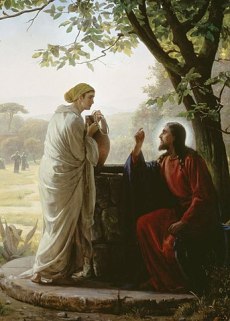
Seventy years after this catastrophe, after the Babylonians themselves were conquered by the Persian Empire, the king of Persia gave the Jews permission to return to their homeland. When they arrived they found that those who had been left behind had intermarried with the pagans and adopted some of their religious practices. The Jews looked down on these people, these Samaritans, as unfaithful to the Lord. It’s no mere coincidence that the Samaritan Woman at the Well with whom Jesus speaks in John’s Gospel has had five husbands—just like the five resettled pagan nations. This real woman symbolizes her people, with whom Jesus desires to be reconciled and whom he wants to save.

Jesus’ chosen hero for this parable, the Good Samaritan, “approached the victim, poured oil and wine over his wounds and bandaged them. Then he lifted him up on his own animal, took him to an inn and cared for him.” In today’s Gospel, Jesus tells the scholar of the law (and us) to be like “the one who treated him with mercy.” That’s a very important, famous, and familiar lesson, but there is symbolism within this parable which teaches even more.
The man who fell to the robbers represents our human race. Traveling from Jerusalem to Jericho, we were descending from the height of communion with God to the depths of sin. We fell to robbers, to evil spirits and wicked desire. They stripped us naked, depriving us of our previous glory. They beat us and left us half-dead; biologically we were still living, but spiritually we were dead. No one could or would help us. But then our Good Samaritan came – Jesus Christ.

He looked upon us and was moved with compassion. He approached us and poured His blood over us, like wine, to cleanse the wounds of sin. He poured the Holy Spirit on us, like oil, to strengthen us. He bandaged our members with his teachings; and though these disciplines bind us they are for the freedom of full health. He lifted us up on his beast of burden, his own flesh in the Passion, to bring us to the inn. This inn, where the robbers’ victim is cared for until he comes again, is the Church.

You and I are represented by the robbers’ victim brought into the inn for care. But you and I are also represented by the inn-keeper, for we are likewise called to care for others. The Good Samaritan provides two coins to the inn-keeper along with an instruction and a promise: “Take care of him. If you spend more than what I have given you, I shall repay you on my way back.” In the parable, these are two coins are Roman silver denarii, equal to two day’s wages. Jesus provides for our mission to serve him and our neighbor, for today and for tomorrow, and whatever we expend in time, talent, or treasure in his inn, the Church, will have his divine repayment.

In light of this great parable, ask Jesus to show you your neighbor, who he has entrusted to your care, then “Go and do likewise.” The command which he ‘enjoins on you today is not too mysterious and remote for you. …No, it is something very near to you, already in your mouths and in your hearts; you have only to carry it out.’ You shall love the Lord your God supremely, and love your neighbor as yourself.

Consoling the New Jerusalem — 14th Sunday of Ordinary Time—Year C

July 8, 2019

This word of the Lord regarding Jerusalem was spoken through the Prophet Isaiah in our first reading:

“Thus says the LORD: Rejoice with Jerusalem and be glad because of her, all you who love her; exult, exult with her, all you who were mourning over her! For thus says the LORD: Behold, I will spread prosperity over Jerusalem like a river. As a mother comforts her child, so will I comfort you; in Jerusalem you shall find your comfort. When you see this, your heart shall rejoice and your bodies flourish like the grass; the LORD’s power shall be known to his servants.”

When reading Old Testament prophesies, the tone can really widely vary. Depending upon the particular century, the Lord’s message directed towards Jerusalem or the Israelites can be consoling, encouraging, promising good things to come; or denouncing, woeful, declaring punishments to follow. I find it really difficult to place our country and our present time amongst these Old Testament messages. I can imagine the people of our land being pleasing the Lord in many respects and I can see us meriting his correcting chastisement for other reasons. So do the consoling words of Isaiah apply to us? Let me explain how I think that they can.

In Old Testament times, Jerusalem, the holy city, was the place of God’s temple, his dwelling place on earth. But in 70 A.D., the Romans sieged Jerusalem and destroyed the temple leaving not one stone upon another, as Jesus had proselytized and foretold. In New Testament times, Jesus is the Temple. In John’s Gospel, Jesus tells a crowd, “Destroy this temple and in three days I will raise it up,” and John notes Jesus “speaking about the temple of his body.” The Body of Christ is the New Temple. The Christian understanding of Jerusalem changes, too. In the Book of Revelation, St. John beholds “the holy city, a new Jerusalem, coming down out of heaven from God, prepared as a bride adorned for her husband.” John hears a loud voice from the throne say, “Behold, God’s dwelling is with the human race. He will dwell with them and they will be his people and God himself will always be with them as their God.” So the New Temple is the Body of Christ. And the New Jerusalem is the Bride of Christ. Where is the Body of Christ now and where is his Bride? As New Testament Scriptures tell us, they are present on earth and in Heaven, as his Holy Church.

There are wounds and sufferings in the Body of Christ. This was personally true for Jesus on earth, and it is true for his members. In our second reading, St. Paul writes: “From now on, let no one make troubles for me; for I bear the marks of Jesus on my body.” Paul composed his letter in Greek, and here the Greek word for “marks” is literally “stigmata.” In the ancient world, slaves and devotees of pagan deities were often branded by marks called “stigmata” to indicate to whom they belonged, who they served or who was their god. In a Christian context, “stigmata” has come to mean the miraculous sign or gift of receiving the wounds of Christ, in one’s hands, feet, or side. St. Francis of Assisi experienced the stigmata near the end of his life, and St. Padre Pio bore Christ’s wounds in his hands for fifty years. But what St. Paul is describing in this passage is not necessarily that. In 2nd Corinthians, he enumerates the sufferings he had endured: “Five times at the hands of the Jews I received forty lashes minus one. Three times I was beaten with rods, once I was stoned…” St. Paul greatly suffered in Christ, but many wounds are not physical.

I hate that wolves in sheep’s clothing have hurt and scarred members of the Body of Christ, the Church. I hate that the Bride of Christ I love is denounced as something evil. Perhaps it has never been easy to be a Catholic, but it is hard to be a Catholic today. How are we going to respond? In today’s gospel, Jesus says, “Beg the master of the harvest [that is, God his Father] to send laborers into his harvest.” In other words, we should ask God to raise up saints. In the worst and hardest times in Church history, God has supplied holy saints. And he still lifts up saints in our modern times as well.

In the year 2010, a baby boy was born in Illinois with neither breath nor pulse. The parents prayed for the intercession of another native son of Illinois. That man had grown up in El Paso, Illinois, become a priest and eventually an archbishop, was an excellent preacher and author, and even won an Emmy for his highly-rated, prime-time, national TV show called “Life is Worth Living.” Archbishop Fulton J. Sheen died in 1979, but after praying for his help in saving their son’s life, after sixty-one minutes of no signs of life, their boy began to breathe and show a pulse. Today, James Fulton Engstrom is a fully healthy eight-year-old, and yesterday the Vatican officially announced that his inexplicable healing was a miracle, which clears the way for Archbishop’s Sheen’s beatification in the near future.

Fulton Sheen was a twentieth century saint, but God desires to raise up twenty-first century saints as well. And not just among others elsewhere, but among we ourselves. You and I likely never be beatified or canonized, but we are all called to be saints because we are all called to Heaven, and to begin living the life of Heaven here and now.

Notice how in today’s gospel, Jesus does not send out his missionaries one-by-one but in pairs. He told them to stick together, “stay in the same house.” Why? He wanted them to be a help, encouragements to each other, to be faithful and fruitful. Likewise, we have the fellowship of one another to help us become saints. And we have holy friends who know and love us to help us, the saints in Heaven. And we have our greatest friend who provides the means for our sanctification in himself, Jesus Christ. Let us become saints together. Then the words of Isaiah will be fulfilled among us. All who were mourning over Jerusalem will exult and all who love her will rejoice. In holiness the Lord’s power shall be known to his servants. And we will be comforted and flourish, in the New Jerusalem here on earth and in Heaven without end.

Mass Apparitions of Our Lord

June 26, 2019

So there’s Our Lady of Guadalupe, Our Lady of Lourdes, Our Lady of Knock, Our Lady of Fatima, and Our Lady of lots of places. Our Lady of the Rosary, Our Lady of the Miraculous Medal, Our Lady of Good Counsel, Our Lady of Good Help, Our Lady of Sorrows, Our Lady of Victory, Our Lady of Grace, Our Lady of Peace, and Our Lady of lots of other good things, too. When I was a kid, I didn’t realize that all these ladies were the same lady. But eventually I figured out that these were all titles of the Blessed Virgin Mary. With that confusion cleared up, I went on to wonder why there seems to be so many apparitions of Mother Mary throughout Church history and so few of her Son, Jesus Christ.

Sure, there are famous exceptions. In the 18th century, Jesus appeared to St. Margaret Mary Alacoque to invite devotion to his Sacred Heart. The month of June is now dedicated to the Sacred Heart of Jesus. And in the 20th century, St. Faustina Kowalska had visions of Jesus encouraging devotion to his Divine Mercy. As a result, the first Sunday after Easter is celebrated as Divine Mercy Sunday. But it’s usually Mary who we hear about appearing here or there around the world, encouraging people to repent, to listen to her Son’s words, and be saved.

So I wondered, “Why aren’t there more apparitions of Jesus in the world?” Eventually I figured out the reason: there’s an apparition of Jesus Christ at every Holy Mass. At every Mass, Jesus’ words are proclaimed. At every Mass, he works a miracle for us. At every Mass, his Real Presence come to us by the Eucharist. Compared to how frequently Jesus appears before us at Mass, Marian apparitions are the rarity.

In today’s Gospel, Jesus multiplies five loaves and two fish to feed more than five thousand people (and that’s just counting the men.) He has them sit in groups of about fifty, blesses and breaks the food, and hands it to his disciples to serve the people. They all eat and are satisfied, and the leftovers are more than Jesus had started with. The day after this amazing event (a miracle recounted by all four Gospels) St. John tells us that Jesus was in Capernaum, teaching in the synagogue about the Bread of Life:

I am the bread of life,” he said, “whoever eats this bread will live forever; and the bread that I will give is my flesh for the life of the world.” At this the Jews quarreled among themselves, saying, “How can this man give us his flesh to eat?” And Jesus replied, “Amen, amen, I say to you, unless you eat the flesh of the Son of Man and drink his blood, you do not have life within you. Whoever eats my flesh and drinks my blood has eternal life, and I will raise him on the last day. …My flesh is true food, and my blood is true drink. Whoever eats my flesh and drinks my blood remains in me and I in him. …The one who feeds on me will have life because of me. …Whoever eats this bread will live forever.

The crowds were perplexed by this teaching and St. John notes that after this many of Jesus disciples left and no longer followed him. But Jesus doesn’t chase them down saying, “Come back, you misunderstood, I was only using a figure of speech.” Instead, he turns to his apostles and asks, “Do you also want to leave?” St. Peter, not understanding but trusting, replies, “Master, to whom shall we go? You have the words of eternal life.” After the Last Supper, recounted by St. Paul in today’s second reading, the Early Church understood Jesus’ teaching. Multiplying five loaves into enough bread to feed thousands is a miracle, but Jesus’ far greater miracle is feeding the world with bread transformed into himself.

If someone asked you, “Are you an object? Are you a thing?” how would you answer? If someone asked me if I was an object, I’d say that I do have many qualities and traits of an object; I have size, and shape, and color, and weight. But an object or a thing can be bought or sold, used and discarded, held cheaply and treated cheaply. You and I are not merely objects or things, but persons; persons meant to be loved and to recognized as worthy of love. So much about our devotion is set right when we recognize that the Holy Eucharist is not merely an object but a person.

When we dress up for Sunday Mass, we dress up for him. When we sing as Mass, we’re singing for him. Unlike Judas, who took the morsel and left the Last Supper before it was over, we remain until the end of Mass because he is here. Sunday Mass in not merely an obligation, but an opportunity for encounter with him. And when we visit him (on Sundays, or at a weekday Mass, or just stopping by the church) he is please that we are here. In love, Jesus offers us a communion with himself through the Eucharist more intimate and profound than that shared by spouses. Our Eucharistic Lord wants us to behold him, recognize him, and rejoice to receive him. So, if a Christian ever asks you, “Have you personally received Jesus?” you can answer, “Yes, in my hand, on my tongue, into my body and blood, in my soul and in my heart, through the Most Holy Eucharist, which is his very self.

Princess Grace (née Kelly) of Monaco receives
the Holy Eucharist at her 1956 nuptial Mass


The Good Father

June 26, 2019

How do we know about the Most Holy Trinity? Humanity learned of the it late in history, but the Trinity existed before the universe began. In retrospect, Christians can read the Old Testament and see the truth of the one true God being one God in three Divine Persons hinted at, but this eternal reality was only clearly revealed to us through Jesus Christ.

Some people, past and present, have claimed that Jesus was not divine – that he was just a man, or an angel, or something else more exulted than us but less than God. But this is not what the Early Church believed. Prologue of St. John’s Gospel proclaims: “the Word was with God, and the Word was God… And the Word became flesh.” (That’s Jesus Christ.) And when St. Thomas sees Jesus resurrected and exclaims: “My Lord and my God!” Jesus does not correct him for idolatry, because Jesus is truly God.

Others, past and present, have held that the Father, Son, and Holy Spirit are just one person, God, who manifests himself in different modes, like an actor who puts on masks to play different parts. But in the Garden of Gethsemane, Jesus prays: “My Father, if it is possible, let this cup pass from me; yet, not as I will, but as you will.” If Jesus and the Father are the same person, then who is Jesus talking to? The Father and the Son are distinct persons who know and love each other.

Others people have said, simplifying the mystery, that the three persons of the Trinity are three Gods. But God had instilled Monotheism, the belief that there is only one God, deeply into his Jewish people: “Hear, O Israel! The Lord is our God, the Lord is one!” And the earliest Christians, all of them Jews, believed this as well. For example, in his New Testament letter, St. James writes, “You believe that God is one. You do well. Even the demons believe that and tremble.” The oneness of God is treated as a given, while at the same time the Church confessed that “Jesus Christ (the Son of God) is Lord.” Jesus said, “I and the Father are one,” and “whoever has seen me has seen the Father.”

This year, Holy Trinity Sunday lands upon Father’s Day weekend. God the Father is the origin and paragon of fatherhood. So let’s explore what Jesus reveals to us about God the Father and what fathers are called to be.

The Good Father has Authority, but is he not Unapproachable
In the Garden, Jesus prayed, “Abba, Father, all things are possible to you. Take this cup away from me, but not what I will but what you will.” Jesus submits to his “Abba, Father’s” plan. And his use of the word “Abba” is a big deal. As St. John Paul the Great observed, “An Israelite would not have used [“Abba” to address God] even in prayer. Only one who regarded himself as Son of God in the proper sense of the word could have spoken thus of him and to him as Father – Abba, or my Father, Daddy, Papa!” We are encouraged by Scripture and the Holy Spirit to be this familiar with the Father as well, calling God our “Abba” too.

The Good Father Listens
Outside the tomb of Lazarus, Jesus said, “Father, I thank you for hearing me. I know that you always hear me…” God always hears our words to him; be they words of Adoration, Contrition, Thanksgiving, or Supplication, or just our telling him about our day.

The Good Father Cares and Provides
Jesus said, “The Father loves the Son and has given everything over to him.” “Ask and it will be given to you; seek and you will find; knock and the door will be opened to you.” Though when we ask for something he may answer with a “not yet,” or by fulfilling our longing in a better way than we had thought of, the Father always cares, listens, and provides.

The Good Father Encourages
At Jesus’ baptism in the Jordan River, the Father declared from Heaven, “You are my beloved Son, in whom I am well pleased.” And on Mt. Tabor, at Jesus’ Transfiguration, the Father spoke from the cloud, “This is my beloved Son, listen to him.” Imagine how it must have felt for Jesus to hear his Father profess his love for him and pleasure in him. Our words are powerful for one another. Let us strive, with the Holy Spirit’s help, to make our compliments and praises outnumber our criticisms and complaints.

The Good Father Teaches through his Word and Example
Jesus said, “the word you hear is not mine but that of the Father who sent me.” “Amen, amen, I say to you, a son cannot do anything on his own, but only what he sees his father doing; for what he does, his son will also do.” The influence a father can have is reflected by a large, 1990’s Swiss study which found that the religious practice of a father is what most determines the future attendance of his children at church. It found that if a father is non-practicing and the mother is a regular churchgoer, only 2% of their children will go on to become regular worshipers while over 60% of such children will be lost completely to the church. However, if the father is a regular churchgoer while the mother is non-practicing, 44% of these children grow up to become regular churchgoers too – more than twenty-fold impact! Such is the importance and influence of a father’s example.

And finally, the Good Father Loves his Child’s Mother
At the Visitation, filled with the Holy Spirit, Elizabeth declared to Mary, “Most blessed are you among women,” and Mary rejoiced, “From this day all generations will call me blessed. The Almighty has done great things for me, and holy is his name.” It has been rightly said that the best way for a father to love his children is to dearly love their mother.

Some of us have had very good dad, while for some of us our fathers were very far from perfect. There is a cultural crisis with fatherhood today; we see its effects in our country’s schools and in our country’s prisons. Gentlemen, take our heavenly Father as your model. And if you’re ever unsure of how to resemble our Father, look at His son, for St. Paul calls him “the image of the invisible God.” May God bless all our fathers, living or passed on, and may God help all of us here who are fathers to become better ones.

The Gift of the Holy Spirit

June 11, 2019

If you ask people what the Solemnity of Pentecost is about, most will say “the sending of the Holy Spirit.” But Pentecost was not the first time the Holy Spirit had been active in human history.

On Easter Sunday evening, Jesus appeared the Apostles in the Upper Room – although the doors were locked. He said, “Peace be with you,” and showed them his hands and his side. Then Jesus breathed on them and said, “Receive the Holy Spirit…” Earlier in the Gospels, at the Annunciation, Mary asked the archangel how the Messiah, the Christ, would be conceived in her; and Gabriel replied it would be a miraculous work of the Holy Spirit. And then soon after, at the Visitation, her relative Elizabeth, with the little John the Baptist within her, was “filled with the Holy Spirit,” moving Elizabeth to joyfully exclaim the hidden knowledge: “Most blessed are you among women, and blessed is the fruit of your womb!” And the Holy Spirit worked in more than just the time of the Gospels. The Nicene Creed says the Holy Spirit “has spoken through the prophets.” He inspired all the books of both the Old and New Testaments.

So what was different about Pentecost? Before answering that, let’s review what happened. On that day, the Holy Spirit descended to the sound of strong, driving wind and in the appearance of flames, which separated and came to rest upon each of the gathered disciples without doing them any harm.

They were moved to voice ecstatic praises glorifying God and the Holy Spirit gave them the power to speak in different languages they did not naturally know to address Jews visiting from many lands of the then-known world. These devout Jews were gathered in Jerusalem to celebrate the annual Jewish feast of Pentecost, their feast of first fruits celebrating the new harvest from the earth. Similarly, the first Christian Pentecost was the disciples’ first abundant harvest of souls into Christ’s Kingdom.

The Holy Spirit not only gave the disciples the capacity to speak but embed them with courage to bear witness to Christ. Previously, they had hidden behind locked doors. Now they spoke openly in the streets. Peter, who during the Passion had denied Jesus three times out of fear, is inspired this day to begin preaching the Gospel to total strangers. “Those who accepted his message were baptized, and about 3,000 persons were added that day.”

On Pentecost, the curse of Babel is reversed. In the Genesis story of Babel, people tried to reach Heaven by building a towering city apart from God. God confused their language as a kindness, to limit the evil they could do. But at Pentecost, the Holy Spirit is building and populating the city of God, the Church, gathering them to God with this miracle of all languages united as one. Indeed his Church is catholic, that is universal, for every land and people, tribe and tongue.

So, returning to the previous question, what is different about Pentecost? Notice that these gifts of the Holy Spirit were given to each of the disciples gathered in the house; not only the Blessed Virgin full of grace, not just the Apostles—the first leaders of the Church, but each and every one of the roughly one hundred and twenty Christians gathered together there. The Holy Spirit was not acting in the world for the first time at Pentecost; nor was his presence and gifts meant for only for the most famous saints in the Early Church. The Holy Spirit’s activity continues in the Church today, not only within a favored few but in all of us in Christ.

As St. Augustine preached: “What the soul is to the human body, the Holy Spirit is to the Body of Christ, which is the Church.” In a living human body, all the parts of the body are joined to each other and joined to their supremely important head. Without the head, the body dies. Without the soul, the body is lifeless. We are the Body of Christ, Jesus is our exalted Head, and the Holy Spirit—the Soul of the Church—animates the body and every living part of it.

You and I first received the Holy Spirit at our baptisms, probably at an age earlier than we can remember. (I wish I had the time and opportunity to ask people baptized as adults to describe the difference having the Holy Spirit in their life has had.) We were more deeply configured to the Holy Spirit at our confirmations. (After my confirmation at Zorn Arena in Eau Claire, as my family and I were driving to a restaurant, I remember feeling particularly happy and wondering why. Then I remembered, “Oh yeah, the Holy Spirit.” Joy is one of his fruits.) The Holy Spirit was not new at Pentecost but he outpoured amazing gifts into all the Christians. Likewise, the Holy Spirit is not new in you, but he desires to outpour himself to you with his gifts anew.

How can this happen for us? Simply by asking and inviting him. Jesus tells us, “Everyone who asks, receives; and the one who seeks, finds; and to the one who knocks, the door will be opened.” In those days, a round, baked, loaf of bread could resemble a brown stone, so Jesus adds, “Which one of you would hand his son a stone when he asks for a loaf of bread? If you, who are wicked (who are sinful), know how to give good gifts to your children, how much more will the Father in Heaven give the Holy Spirit to those who ask him?” Ask for the Holy Spirit to empower you.

Try some experiments with the Holy Spirit. For instance, invite him into your prayer times. Anyone committed to regular prayer will have times of dryness, listlessness, lack of direction. St. Paul writes to the Romans that the Holy Spirit “comes to the aid of our weakness; for we do not know how to pray as we ought, but the Spirit intercedes…” At dry times in prayer, when I remember to ask the Holy Spirit for help, my prayer immediately becomes easier.

Invite the Holy Spirit to inspire your work. Though I care a great deal about writing good homilies, most Friday nights I don’t know what I will be preaching on Saturday afternoon. I think the Lord does this to improve my trust. After ten years of priesthood, he has never left me high and dry without anything to preach for Sunday.

And ask for the Holy Spirit’s aid in your interactions with others. I ask for his help in confessions or before challenging conversations. Now I share these examples because they are examples from my life, but don’t think that the Holy Spirit only comes to our air with church-y things. He wants to be present, to share his gifts in your everyday life, because this is where souls are lost and won for the Kingdom of God.

About a dozen years ago, I was lying on my bed one afternoon praying to the Holy Spirit rather apologetically. I said, ‘Holy Spirit, you are like the forgotten and ignored third Person of the Trinity. You’re just as much God as the Father and the Son, but we address many more prayers to them than you; and when we do pray to you it’s because we want something, but you’re more than just some divine vending machine.” Then I heard in my mind these words: “I am gift.”

Now whenever you receive a word in prayer it’s good to verify it against the truths that you know. So I thought, “Let’s see if this checks out.” From all eternity, God the Father gives all that he is to God the Son, and the Son gives himself back as a total gift to the Father. From this exchange of self-gift and love, God the Holy Spirit eternally proceeds. The Father and the Son send the Holy Spirit to earth as a gift to sanctify and transform us so we can join the life of the Trinity. The Holy Spirit rejoices to be gift. It is who he is. And when we ask for his gifts we are implicitly welcoming for his presence; for how could his gifts be manifested where he is not?

So conduct some experiments with the Holy Spirit. Invite him, and ask that his gifts be manifested in you. He is happy to give.

Jesus’ Mediated Miracles

May 30, 2019

Icon of the Wedding Feast of Cana
Most miracles in the Gospel of John share a common trait: Jesus works great deeds but in a somewhat withdrawn manner. There’s usually some degree of distance between the Lord and his miracles in John’s Gospel. Let me show you what I mean with several examples:

  • In the second chapter of John, at the wedding feast of Cana, Jesus does not fetch water from the well or hold his hands over the water jars to change their water into wine. Jesus instructs the servers what to do and his miracle is accomplished through their cooperating efforts.
  • Later at Cana, in John chapter four, a royal official whose son is gravely ill begs the Lord to come to Capernaum some twenty miles away and heal him: “Sir, come down before my child dies.” After a dialogue Jesus replies, “You may go; your son will live.” The father believes him and leaves. The next day, on his way home, the royal official’s servants meet him and share good news about his son: “The fever left him yesterday, about one in the afternoon.” And the father realizes that was the hour that Jesus had said “your son will live,” curing him at a distance.
  • In the next chapter, at the pool called Bethesda in Jerusalem, Jesus meets a man who has been ill for thirty-eight years. Jesus says to him, “Rise, take up your mat, and walk.” The Lord makes no physical contact with him, he simply says the word. And immediately the man becomes well, takes up his mat, and walks.
  • In John’s ninth chapter, Jesus encounters a man blind from birth. Jesus bends down, makes a paste of dirt and spittle, and smears it on the blind man’s eyes. The blind man is touched by Jesus but does not immediately see. Jesus tells him, “Go wash in the Pool of Siloam.” The man goes there and washes his eyes, but Jesus is not present when the man sees for the first time.
  • In John eleven, Jesus’ beloved friend Lazarus dies and the Lord journeys to the tomb. He tells others to roll away the stone and does not go inside. Instead, Jesus commands, “Lazarus, come out!” And Lazarus comes out by himself, wrapped head to foot in burial cloths. Then Jesus directs others to “untie him and let him go.”
  • Finally, in the last chapter of John, Jesus works a post-Resurrection miracle from a distance for seven disciples fishing on the sea of Galilee. Jesus is on the shore, about a hundred yards away from Peter, John, and the others in the boat. He asks, “Children, have you caught anything to eat?” They answer, “No.” He tells them, “Cast the net over the right side of the boat and you will find something.” So they cast the net and are not able to pull it back in because of the great number of fish they catch. Jesus was not in the boat with them, but he guides his disciples’ efforts and make them miraculously fruitful.

Why do the miracles of John’s Gospel share this theme of Jesus working once removed? (John observes in closing, “There are also many other things that Jesus did, but if these were to be described individually, I do not think the whole world would contain the books that would be written.” So this Gospel’s miracles have been curated, chosen over others.) Of the four Gospels, John’s was written last. By this stage in the late first century, the majority of Christian believers had never seen Jesus walking the earth and St. John was likely the last of the living Apostles. Perhaps they sensed that John too would soon pass on, which would lead to Christians questioning in their hearts, “What is our remaining connection to Christ?” John’s Gospel reassures its readers (then and now) that though Jesus is visibly removed from our eyes his power remains active among us.

In his Last Supper Discourse, Jesus says, “I am going away and I will come back to you.” (This speaks to Jesus’ death and Resurrection but also his Ascension and Second Coming.) “If you loved me, you would rejoice that I am going to the Father…. I tell you the truth, it is better for you that I go. For if I do not go, the Advocate will not come to you. But if I go, I will send him to you. …Amen, amen, I say to you, whoever believes in me will do the works that I do, and will do greater ones than these, because I am going to the Father.

Why didn’t Jesus stay? Surely he can do what his saints can do and numerous saints have manifested the power of bi-location (being at two places at the same time.) In the twentieth century, St. Padre Pio is reported to have bi-located repeatedly; to celebrate Mass, hear confessions, visit a deathbed, and other things. The seventeenth century nun Venerable Mary of Ágreda is well-documented as having evangelized Native Americans in the American Southwest without leaving her Spanish convent. She instructed Jumano tribe members where to travel to find Franciscan missionaries for sacraments, affirmed under oath to Church investigators in Spain that she was bi-locating, and possessed inexplicable first-hand knowledge of the New World. If his saints can bi-locate, why couldn’t Jesus multi-locate on earth? He already does this in a veiled way in the Holy Eucharist; he is truly present (Body and Blood, Soul and Divinity) living in every tabernacle in every Catholic Church. So why not be visibly present in this world throughout the centuries? Jesus could be the pastor of every parish, the teacher in every classroom, the doctor in every hospital, and the leader for every country. Wouldn’t he do a better job than us?

This is why it was better for us for Jesus to ascend. We are called to be children of God; daughter or sons of the Father, and brothers or sisters of Christ. We must be childlike to enter the Kingdom but we are not to be childish. We must rely on the Lord, for apart from him we can do nothing, but he desires us to become reliable as well. If everything of importance were solely Jesus’ job how would we grow out of immaturity. How would we mature into the full likeness of Jesus Christ? Jesus desires to work through us, and with us, and in us so that we may share fully in his glory. This is the work of love for God and neighbor and it is vitally important; it’s important for your soul, it’s important for the salvation of others, and important to God.

The Church Father, St. Jerome, living in the late 300’s A.D., leaves us this extra-biblical story about St. John the Apostle:

The blessed John the Evangelist lived in Ephesus until extreme old age. His disciples could barely carry him to church and he could not muster the voice to speak many words. During individual gatherings he usually said nothing but, “Little children, love one another.” The disciples and brothers in attendance, annoyed because they always heard the same words, finally said, “Teacher, why do you always say this?” He replied with a line worthy of John: “Because it is the Lord’s commandment and if it alone is kept, it is sufficient.”

This work of love in Christ is important for our souls and the salvation of others; it is the mission entrusted to us by the Lord so that we may share fully in his glory.

Stories of Glory

May 22, 2019

Readings for the 6th Sunday of Easter – Year C

Liberty Films was an independent motion picture production company founded in 1945. They only produced two films before dissolving six years later. Their first film, released in 1946, was the story of a depressed loan officer in upstate New York who is contemplating ending his own life. The critical reviews to the movie were mixed. It had good stars and did rather well at the box office, but not well enough to recoup its production costs and show a profit. It won no Academy Awards except for one in Technical Achievement; for developing a better way to simulate falling snow on a movie set. The co-founder of the company and director of the picture would go on to consider this his favorite film, screening it towards the end of every year for his family. However, he said that creating Liberty Films had proven virtually fatal to his professional career.

After Liberty Films folded up, the ownership of rights to the film changed hands from one media company to the next. I suspect the movie would have been largely forgotten today, if not for a providential oversight. You see the Copyright Act of 1909 granted copyright protection to original creative works for twenty-eight years. This copyright protection could be renewed for an additional twenty-eight years by filing out some paperwork and paying a nominal fee. However, the new owners of the film neglected to renew its 1946 copyright, so the film automatically entered the public domain. As a result, from 1974 until 1993 (when other laws came into play) anyone and everyone was free to copy, sell, or broadcast the film without paying any royalties to anyone. TV stations showed it repeatedly during the Christmas season, more than one hundred distributors sold it on tapes, and the film became immensely popular. I would bet you’ve seen this wonderful film yourself. Today it is considered one of the greatest movies ever made, and rightly so. The name of its main character, the loan officer in upstate New York, who is persuaded by an angel not to end his own life, is George Bailey, and the film is Frank Capra’s “It’s a Wonderful Life.”

In our Gospel, Jesus says: “I give you a new commandment: love one another. As I have loved you, so you also should love one another.” And throughout “It’s a Wonderful Life,” we see George Bailey denying himself out of love for others. He gives up his dreams of going to college, of becoming a rich and famous architect, in order to keep his late father’s Savings & Loan open. He gives up his around-the-world honeymoon vacation to save Bedford Falls’ Savings & Loan again to protect the community from the wicked Mr. Potter. He is willing to suffer in place of another when old Uncle Billy loses track of the Savings & Loan’s $8,000 cash deposit. George, the good man, goes through many trials. As Paul and Barnabas tell us in our first reading: “It is necessary for us to undergo many hardships to enter the kingdom of God.”

In our Gospel, when Judas had left the the Upper Room and the Last Supper to go and arrange Jesus’ arrest, our Lord said, “Now is the Son of Man glorified, and God is glorified in him. If God is glorified in him, God will also glorify him in himself, and God will glorify him at once.” Remember: Jesus was about to suffer crucifixion and death, but also be raised again. Similarly, in “It’s a Wonderful Life” we find George Bailey at his lowest point; he’s worse than sick, he’s discouraged, on the edge of abandoning all hope. But Clarence the angel shows him all the positive difference that his life has meant, and the dark despair surrounding George is lifted. As our second reading tells us, one day God “will wipe every tear from [our] eyes, and there shall be no more death or mourning, wailing or pain, for the old order [will have] passed away.” After glimpsing a world in which he was never born, George realizes how very blessed he is. He still thinks he’ll be going to prison, but he’s overjoyed to have his life, his wife, and his children back. “Behold,” says the Lord, “I make all things new.” When George’s many friends come to his house and come to his aid – donating to cancel out his debt – the long-suffering Mr. Bailey realizes that he’s actually the richest man in town.

Our psalm says, “Let all your works give you thanks, O Lord, and let your faithful ones bless you. Let them discourse of the glory of your kingdom and speak of your might.” This is what I have been discussing, for God’s might and glory in his Kingdom are manifested in ways we might not expect. The Roman Catholic Frank Capra was inspired to make “It’s a Wonderful Life,” and it was his subsequent business failure which allowed this work to become recognized and celebrated as one of the most beautiful stories on film. The character George Bailey’s darkest night led him, with heavenly help, to more clearly see the light. Jesus’ Passion and death proved to be the means of Our Lord’s glory. And so it is our life’s trials. What we give and endure for love of God and others, which will prove to be the means of our greatest glory as well.

The Mercies of Two Adams

February 24, 2019

In our second reading this Sunday, St. Paul compares the First Man to the Last Adam. In our Gospel, that Second Adam (Jesus Christ) shares teachings on forgiveness which have reshaped the world. Catholic spiritual tradition holds that when Jesus descended to the Abode of the Dead on Holy Saturday he found Adam and announced that the gates of Heaven were now open to him and all the Old Testament’s friends of God. If Adam went to Heaven we know he practiced forgiveness himself because Jesus says “if you do not forgive others, neither will your Father forgive your transgressions.” I’d like to begin by reflecting on three people from Adam’s life whom he had to forgive; and each one has a practical lesson for us touching on forgiveness.

One person Adam had to forgive was his wife, Eve. “She saw that the [forbidden] tree was good for food and pleasing to the eyes, and the tree was desirable for gaining wisdom. So she took some of its fruit and ate it; and she also gave some to her husband, who was with her, and he ate it.” Adam had to forgive her for doing this, but he also had to seek her forgiveness. He had been charged by God with protecting her and the garden. He was with her as the Serpent spoke, and he failed in his duty. Adam and Eve had to forgive each other.

Now a foolish person insists that other people are completely at fault one hundred percent of the time. After a conflict, even if I didn’t sin (even if I did nothing intentionally that I knew to be wrong at the time) I can still reflect upon how I could have expressed myself or handled the situation better. Mistakes are not sins—we can only sin on purpose—but we should learn from our mistakes.

Another person Adam had to forgive was his son, Cain. Because he felt snubbed, Cain was filled with jealous anger towards his brother. “Cain said to his brother Abel, ‘Let us go out in the field.’ When they were in the field, Cain attacked his brother Abel and killed him.” This was the first recorded murder, and Adam had to forgive his son for it.

In 1981, Mehmet Ali Ağca shot the pope in St. Peter’s Square at the Vatican. St. Pope John Paul the Great nearly died, but two years later after he had recovered he went to visit his would-be assassin in prison. I remember being amazed as a kid in CCD class to learn that the pope sat at an arm’s length from the unshackled man who almost killed him in order to personally forgive him. Significantly, the pope did not ask Italy’s leader or government to release Ağca at that time. Ağca served twenty-nine years in prison until his release in 2010. Similarly, God showed his mercy and did not destroy Cain the murderer, but God did place punishments on him.

Sometimes withholding punishment is not kindness because we need discipline, to experience just consequences for our actions, for our own good. As the Letter to the Hebrews says, “whom the Lord loves, he disciplines; he chastises every son he acknowledges. … At the time, all discipline seems a cause not for joy but for pain, yet later it brings the peaceful fruit of righteousness to those who are trained by it.” Mercy and forgiveness do not rule out experiencing any consequences.

A third person Adam had to forgive is one you might not expect: Adam had to forgive the Serpent. Was the wicked Serpent sorry for what he had done? No, but Adam had to forgive for Adam’s own sake. Unforgiveness is a bitter poison we drink in hopes of hurting someone else. Renouncing our claims to vengeance against another actually sets us free.

Jesus said we must forgive to be forgiven ourselves, but some people think they can’t forgive because they think forgiveness means something it doesn’t. Forgiveness is not to say that the sin wasn’t wrong, or that it’s no big deal, or that it doesn’t hurt anymore, or that it never really happened, or everything can go back to how it was before. Forgiveness means loving someone despite their sins, even if prudence may require us to keep a healthy distance from them (as with the Devil.)

Does God hate that ancient serpent, the Devil, the father of lies and a murderer from the beginning? Amazingly, no. As the Book of Wisdom says, “you [Lord] love all things that are and loathe nothing that you have made; for you would not fashion what you hate. [And] how could a thing remain, unless you willed it; or be preserved, had it not been called forth by you? But you spare all things, because they are yours…” God hates what Satan does, but loves him still. God hates the sin, but loves the sinner. In the end, the wicked will not be annihilated, made to no longer exist, but given the disassociation and space away from God they desire forever. God hates no one and neither should we.

In several places in the New Testaments, St. Paul draws parallels between Adam and Jesus. St. Paul wrote the Romans: “just as through the disobedience of one person the many were made sinners, so through the obedience of one the many will be made righteous.” The First Adam gave life to all his descendants, and the Last Adam gives life to all who follow him. The Old Adam, by his selfish sin, condemned the world; but the New Adam, by his holy self-sacrifice, redeems us. The First Adam, as we have seen, practiced forgiveness, but Jesus Christ is personified Mercy.

Consider how autobiographical Jesus’ Gospel teaching on forgiveness is. Jesus says, “To the person who strikes you on one cheek, offer the other one as well.” During the Passion, at his Jewish trial before the Sanhedrin, “they spat in [Jesus’] face and struck him, while some slapped him, saying, ‘Prophesy for us, Messiah: who is it that struck you?’

Jesus says, “From the person who takes your cloak, do not withhold even your tunic.” “When the [Roman] soldiers had crucified Jesus, they took his clothes and divided them into four shares, a share for each soldier. They also took his tunic, but the tunic was seamless, woven in one piece from the top down. So they said to one another, ‘Let’s not tear it, but cast lots for it to see whose it will be…’

Jesus says, “Love your enemies, do good to those who hate you, bless those who curse you, pray for those who mistreat you.” The religious leaders sneered at Jesus as he hung on the Cross. Even the soldiers jeered at him. But Jesus prayed for them saying, “Father, forgive them, they know not what they do.”

Jesus says, “If you love those who love you, what credit is that to you? Even sinners love those who love them. And if you do good to those who do good to you,what credit is that to you? Even sinners do the same.” St. Paul wrote to the Christians at Rome, “God proves his love for us in that while we were still sinners Christ died for us.

Jesus says, “If you lend money to those from whom you expect repayment, what credit is that to you? Even sinners lend to sinners, and get back the same amount. But rather, love your enemies and do good to them, and lend expecting nothing back; then your reward will be great and you will be children of the Most High…” Jesus gave of himself knowing that many would give him nothing in return, he loves sinners knowing that many will not love him back. But Jesus is his Father’s Son, merciful as he is merciful, loving as he is loving, good as he is good, and generous as he is generous. And Jesus invites us to also be children of the Most High like himself.

So let’s be generous in every way towards Jesus, who gives us mercy, our every blessing in life, and his very self in the Eucharist. Jesus’ teaching at the close of today’s Gospel is true not only for financial giving but for every gift to God, for God is never outdone in generosity: “Give, and gifts will be given to you; a good measure, packed together, shaken down, and overflowing, will be poured into your lap. For the measure with which you measure will in return be measured out to you.” Let us be merciful and generous like Jesus is towards us.

The Seventh Jar

January 22, 2019

Anyone who has done the chore of carrying milk gallons from the store to the car, and from the car into the house, knows they are not feather light. “Now there were six stone water jars (at Cana) for Jewish ceremonial washings, each holding 20 to 30 gallons.” Perhaps the servants did not have to lug those stone jars around, but they had to move the water from the local well or cistern to where the party was held. Have you ever considered how much those 120 to 180 gallons of water weighed? One gallon of water weights a little more than eight pounds. So six stone jars holding 20 to 30 gallons each is a weight of water somewhere between 1,000 and 1,500 pounds.

Mary said to the servers, “Do whatever he tells you.”
Jesus told them, ‘Fill the jars with water.’
So they filled them to the brim.”

It wasn’t easy work. At the time it did not seem that important or glorious. But those servants obediently and generously served Christ at that marriage, filling the jars to the very brim, and what they did will be remembered and celebrated forever.

In various times and places, different numbers can carry symbolic meanings. For example, if I asked you for a lucky number, you would probably say “seven.” And if I asked you for an unlucky number, you would probably quote me “thirteen.” The Jewish culture of the Bible has its own symbolic associations with numbers. For instance, for Jews the number six meant imperfection. (This is partly why, in the Book of Revelation, the number of the Beast is “666,” because great evil is profoundly imperfect.) And for Jews the number seven meant completeness. (In the beginning, when God had finished Creation, he rested on the seventh day because his work was complete.)

“Now there were six stone water jars there for Jewish ceremonial washings.” These six jars of water which Jesus turns into wine point to how his New Covenant fulfills and improves upon the imperfect Old Covenant. The water for the purification rites was good, but the wine for the wedding is best. Along with those six stone jars, John’s Gospel goes on to notice one more jar:

“[On the Cross,] aware that everything was now finished, in order that the scripture might be fulfilled, Jesus said, ‘I thirst.’ There was a jar filled with sour wine. So they put a sponge soaked in wine on a sprig of hyssop and put it up to his mouth. When Jesus had taken the wine, he said, ‘It is finished (fulfilled / complete / consummated)’ And bowing his head, he handed over the spirit.”

All four gospels mention this sour wine Jesus received on the Cross, fulfilling the Psalm which said, “for my thirst they gave me vinegar to drink.” Vinegar is made from wine which grows old and sour. This jar of sour vinegar wine at the Cross is the seventh jar which completes the six jars from Cana. The public ministry of Our Lord began with the joy of a wedding. And public ministry led him to sacrificing himself for his spouse, the Church. Every marriage should have its share of joy and sacrifice.

Marriages are often said to go through a “honeymoon” period. When the relationship is fresh and new, life feels like water changed into wine and joy flows easily. But as the relationship continues and grows older, the wine sometimes turns into vinegar. And then people ask themselves, “Did I make a mistake? Did I marry the wrong person? Did I choose the wrong vocation?” And many people give up too hastily. But these challenging times are a call to purifying love.

When someone says, “I love coffee” or “I love pizza,” they’re really saying “I love how these foods make me feel. I love what they do for me.” But this is not how we are called to love God and one another. We are to love others for their own sake. And in this the Cross of Christ is unavoidable. If mere personal happiness were the meaning of life, then suffering would be meaningless. That’s not what we believe. The Cross grows us into Christ. God does not want us to be endlessly miserable, but if we think the journey of our lives will always be on mountain tops, and never in dark valleys, then we will not journey well through the highs and lows and plains of life.

What if I’m saying to myself, “I have no wine.” What should I do? As Jesus’ Mother said to the servers, “Do whatever he tells you.” This means obedience to Jesus Christ. What if I think I lack the strength to do what Christ asks, or despair that things can really change? The Virgin Mary may not have known it at the time, but in saying “Do whatever he tells you” she was echoing this passage from Genesis:

“When the seven years of abundance enjoyed by the land of Egypt came to an end, the seven years of famine set in, just as Joseph had foretold. Although there was famine in all the other countries, food was available throughout the land of Egypt. When all the land of Egypt became hungry and the people cried to Pharaoh for food, Pharaoh said to all the Egyptians: ‘Go to Joseph and do whatever he tells you.’”

Joseph had been storing up surplus grain for seven years before and he proceeded to provide sufficient food for the entire Kingdom of Egypt and all the world who came to him and asked. When there is no wine where there ought to be (in your marriage, in your household, in your life) do your small part like the servants did at Cana, and invite, ask, and rely on Jesus to provide the rest.

The Christian life has highs and lows, but most of our days are lived in between, on the flat plains. Our lives matter greatly to God, so he has told us so and shown us so through Jesus Christ, but for the most part our lives feel ordinary. As our second reading from 1st Corinthians says, the Church of Christ has many members, with various gifts and roles for the Kingdom of God. Yet nobody feels they are particularly extraordinary because our lives are full of the ordinary.

Say you’re raising children, forming saints for Heaven, who produce piles of laundry and dirty dishes. So say you’re working outside of home, doing a regular job, which provides a service so beneficial and valuable that people pay you money to do it, money you then use to help others. Say you’re praying daily (as we’re called to do,) blessing others, near and far, the living and deceased, by your worship and intercessions before Almighty God, and repeatedly checking your watch. Even if you’re ordained priest, you can be celebrating the Holy Sacrifice of the Mass… fourteen times a week. So much of our lives filled with the ordinary that these ordinary things must matter much more than we might think.

Nothing is recorded in the gospels about most of the years of Jesus’ life. We hear about his early years and his later, few-year ministry, but not what happened in between. The span of time from the finding of twelve-year-old Jesus in the Temple to the start of his public ministry at about thirty years of age is called his “hidden years.” Jesus may not have worked any miracles in those years, but in Heaven we will see how he lived and worked and loved then in ordinary and yet far from insignificant ways.

A full Christian life is not easy work. At times what we do may not feel that important or glorious. But if we serve Jesus Christ, obediently and generously, then what we do here will be remembered and celebrated, by us and by all, with joy forever.

Lingering Wounds — Divine Mercy Sunday—2nd Sunday of Easter

April 15, 2018

Of all the apostles, it could be said that St. Thomas’ faith took him the farthest. Likely tradition says Thomas traveled more than 2,000 miles from Israel to evangelize India. From the seeds of his ministry and martyrdom there, tens of millions of Indians are Christians today. Yet, he’s not known as “Traveling Thomas” or “Faithful, Fruitful Thomas,” but famously as “Doubting Thomas” because of these passages:

Thomas, called Didymus, one of the Twelve, was not with them when Jesus came. So the other disciples said to him, “We have seen the Lord.” But he said to them, “Unless I see the mark of the nails in his hands and put my finger into the nailmarks and put my hand into his side, I will not believe.”

So why was Thomas so slow to believe? I would suggest three theories:

The first explanation would be that Thomas didn’t want it to be true. Many peoples’ lack of belief is due to an unwilling heart. They see no evidence for God because they have closed their eyes. If they were honest they would say, “I don’t want it to be true, because if it is then I’d have to change how I live my life.” Jesus says if we ask, we’ll receive; if we seek, we’ll find; and if we knock, the door will be opened to us. But this sort of person doesn’t ask because they don’t want good answers, they don’t seek because they’re afraid of what they’ll find, and they don’t knock because they don’t want to go in.

In the Book of Revelation, Jesus says, “Behold, I stand at the door and knock.” He knocks on the door of every human soul. But we can lock and block our door; with a big-screen TV of entertainment, or a bookshelf of learning, a trophy case of accomplishments, a heavy safe of accumulated wealth, or with several large-leafy plants so that a person may enjoy the beauty of creation while ignoring the Creator. If we insist upon self-centered ingratitude, the Lord will respect our freedom but we’ll be woefully unsatisfied forever.

But this is was not St. Thomas. He had sacrificed a lot to be Jesus’ apostle and had aspired to give him his all. On one occasion Jesus said, “Let us go back to Judea,” but the disciples replied, “Rabbi, the Jews were just trying to stone you, and you want to go back there?” When Jesus insisted on going, “Thomas, called Didymus, said to his fellow disciples, ‘Let us also go to die with him.’” At the Last Supper, when Jesus said, “Where I am going you know the way,” Thomas replied, “Master, we do not know where you are going; how can we know the way?” He was distressed because he loved Jesus and wanted to follow him anywhere. Thomas wanted the Resurrection to be true, but there was some other reason he wouldn’t or couldn’t believe.

A second theory for why Thomas was so slow to believe is that he was skeptically-minded. St. Thomas’ nickname, as you’ve heard it now a couple of times, was “Didymus.” In Greek, Didymus means “twin.” How was Thomas a twin? Scripture doesn’t say. Perhaps Thomas had a twin brother he had been mistaken for many times. In some icons of Jesus with his apostles, one of the apostles looks just like Jesus. Such art imagines that Thomas shared a twin likeness to the Lord. In either case, one could understand his initial skepticism about people seeing Jesus resurrected. “Nah. You guys saw somebody else.”

But Thomas has sufficient evidence to believe his friends. They are not claiming to have seen Jesus across the marketplace or walking through a field at dusk. (Neither Thomas nor we are expected to have blind faith, but to trust in trustworthy persons and things.) The other apostles are saying, “It’s true Thomas! He knew us, we saw his wounds!” Yet Thomas replies, “Unless I see the mark of the nails in his hands and put my finger into the nailmarks and put my hand into his side, I will not believe.” Why is Thomas so being obstinate?

The third (and I think most likely) explanation for why Thomas was so slow to believe in the Resurrection was that he hurt too much trust again. Who was Jesus to Thomas? He was Thomas’ hero, his admired teacher, his dearly beloved friend. Thomas thought Jesus would be the savior and messianic king of Israel, but Thomas’ great hope was murdered on Good Friday. Imagine Thomas’ prayer after experiencing that. “My God, how could you let this happen? He was innocent, he was so good! He was the best man I’ve ever known, and you let Him die! Why? How could do that to him? How could you do this to me?”

Jesus’ unexpected death broke Thomas’ heart, and perhaps having been so wounded once, he was resolved not to let his heart be taken-in again: ‘Unless I see the mark… put my finger in the nailmarks… put my hand in his side, I will not believe.’ Yet, though he doubts, notice where Thomas is one week after Easter. He’s with the other apostles in the upper room in Jerusalem, gathered behind locked doors for fear of those who killed Jesus. Now there are lots of other, safer places Thomas could have chosen to be. He could have returned to his hometown, back to the family and friends he left behind to follow Jesus a few years before. Though Thomas doubts, he does not leave this house of faith. He struggles with his questions, but he does not fully abandon Jesus. He seeks him here and because of it Thomas finds truth for his mind, healing for his heart, and peace for his soul.

The risen Lord appears in the upper room and how does Jesus respond to Thomas’ resistant unbelief? Not with anger. Not with condemnation. But with the same Divine Mercy we celebrate today. Jesus appears in their midst and says, “Peace be with you.” Then he says to Thomas, “Put your finger here and see my hands, and bring your hand and put it into my side, and do not be unbelieving, but believe.”

Curiously, Jesus still bears some of the wounds from his Passion: in his hands, feet and side. The cuts and swollen bruises are gone from his face, for the disciples respond to him with rejoicing rather than pity or horror, but he retains some marks from the evils that afflicted him. Jesus could heal or cover them—he’s God—but he choose not to. They are his trophies, the means of his glory, how he saved the world.

Our wounds, our losses, the sins and evils we suffer, they can scandalize us like Thomas was after the Passion. But through these things Jesus would glorify us, help to save others, and transform us into his more perfect twin. Jesus, having experienced wounds of his own, can relate and heal you.

Like St. Thomas, this Divine Mercy Sunday, you are gathered in this upper room with Jesus’ disciples. If there is any great wound or uncertainly in you, I invite you to be open to encounter Jesus anew like St. Thomas. Dare to ask, dare to seek, dare to knock. Jesus is not only your Lord and your God, he’s good and his love is everlasting.

The Holy Family and Yours

January 1, 2018

Every year, Holy Mother Church presents the Holy Family for our contemplation and imitation. Some imagine life in the home of Jesus, Mary, and Joseph in the soft, pastel colors of a Christmas card; so holy, so flawless, so unobtainable. We wonder, “Can the Holy Family and my family really relate to one another?” At least two out of the three members of the Holy Family never sinned in their entire lives together. We, meanwhile, could jokingly refer to the Feast of the Holy Family as “Elbow-Nudge Sunday.” Throughout the world this day, wives and husbands, parents and children, take turns gently nudging one another as they listen to God’s words about marriage and family life. The Holy Family was holy, but that doesn’t mean their lives were easy or smooth.

I’ve previously written about the stresses and difficulties of the holy couple leading up to the first Christmas: about Mary’s crisis pregnancy, about Joseph grappling with his wife telling him the child within her is the Son of God and Joseph contemplating a divorce, about their giving birth to that holy child in an animal stable. And their trials together continued after Jesus’ birth.

Imagine being Mary and hearing Simeon prophesy, “Behold, this child is destined … to be a sign that will be contradicted — and you yourself a sword will pierce…” How would that make you feel about the future for you and your child? Picture being Mary as her husband awakes and says “our boy is being hunted, we need to leave tonight.” Consider Joseph, the servant-leader of his family, having to pack-up quickly and leave so much behind to take his family into hiding in Egypt. Later, an angel tells Joseph to bring his family back into Israel. So Joseph returns with Jesus and Mary, but he’s afraid to resettle in the south because the son of Herod the Great now rules Judea. With the help of another dream, Joseph decides to resettle in the north, in Nazareth of Galilee.

I mention all this because St. Joseph, the just and holy man, feared an earthly king even as he trusted God. St. Mary at the Annunciation did not know all the details of her future, but she trusted in God by saying, “Let it be done to me according to your word.” Our Lord Jesus, sweating blood from stress the night before he died, trusted God to say, “Not my will but yours be done.” Their holy lives were often difficult, but God always rewarded their trust, bringing about good for them in the end.

In Genesis, Abram (whose name later got changed to Abraham) was promised a son by the Lord. But the childless Abraham looks at the old age of his wife and himself and asks, ‘Will my steward, Eliezer, be my heir?‘ God answers, ‘No, not him; your own flesh and blood son shall be your heir.’ Then the Lord took Abraham outside and said, “Look up at the sky and count the stars, if you can. Just so,” he added, “shall your descendants be.” And Abraham put his faith in the Lord.

When I first heard this story (and maybe when you heard it too) I assumed this event happened at night. But the message is even more powerful if God told him to “look up at the sky and count the stars, if you can,” during the daytime. Where do the stars go during the day? We know they’re still there, even though the Sun’s brightness the sky’s blueness prevent us from seeing them. Abraham trusted in the Lord’s unwavering goodwill towards him and beheld God’s word fulfilled in the birth of Isaac. Through that son, Abraham received glory and the whole world was blessed.

One of the things Jesus says in the Gospels more than anything else is, “Be not afraid.” Sacrifice your fears. Imagine taking those obsessive worrying thoughts from your mind, placing them upon the altar, and lighting them afire like a sacrifice of old to God. “Let the peace of Christ control your heart…” Trust that “God works all things for the good of those who love him” and then “the peace of God, which surpasses all understanding will guard your hearts and minds in Christ Jesus.”

God not only wants peace within us, but peace among us as well. In our homes there is always room for improvement. The household of the Holy Family may have been a sinless one, but mistakes and miscommunications surely happened. Joseph probably broke or misplaced tools. Mary probably burnt an occasional loaf of bread. From the Gospels we know they both thought they knew where their 12-year-old boy was as they left Jerusalem for home; several hours passed before they realized he was missing. Even when we deeply love one another, we must learn and practice how to love and serve each other better.

We love each other in many ways, and the best modes by which we experience love can vary from person to person. The book “The Five Love Languages” lays out five major ways that we give and receive love, namely:

Gift Giving
Acts of Service
Affectionate Touch
Words of Affirmation
Quality Time

What are your top-two love languages? Can you guess the preferred languages of your spouse and children? Sometimes we try to love others as ourselves by loving them exactly as ourselves and we unfortunately miss our mark. For example, imagine a spouse complaining, “Why don’t you let me know that you love me,” when they really mean “why don’t you get me surprises anymore” (gift giving) or “why don’t you tell me that I delight you and you’re pleased with me” (words of affirmation.) At this, their spouse might reply, “What do you mean? I’m loving you all the time,” when they’re really saying “I take care of the kids and do housework” (acts of service) and “We eat and sit in the living room together every evening” (quality time.) These two loving spouses are loving past each other.

Learn the preferred love languages of your family members, and don’t expect others read your mind, sabotaging our own happiness. Tell them how to delight you. They love you and they want to make you happy. Don’t attack and criticize (“You always this” or “You never that”) but invite them to bless you. And pray together, as a couple and a family. The Holy Family surely did and its one of the most valuable things I can recommend. Some married couples, who have shared a bed for years, have never revealed their personal prayer requests to each other. Pray together, and then even whenever frictions arise, you will remember that you are on the same team, together on the same side with God.

Your home will never be perfect – not even the Holy Family’s was perfect. Life’s circumstances will go awry, and there will be sins we have to apologize for and forgive one another. But with trust in God and a daily commitment to loving and serving each other better, you too can live in the peace and joy of the Holy Family.

“The Ten Virgins & Wedding Party Prudence” — 32nd Sunday of Ordinary Time—Year A

November 13, 2017

Learning about first century Jewish marriage customs helps us understand the Gospels better, including the Parable of The Wise and Foolish Virgins. In Jesus’ day, when a young man wished to marry a woman, he would journey from his father’s house to hers. He and her father would agree upon a dowry and once this dowry price was paid the marriage covenant was established. This event was called “betrothal” and the man and woman thereafter were considered husband and wife. The groom, however, would not then begin to live with his bride. He returned to his father’s house for twelve months, manifesting his respectful self-restraint and honorableness toward her. (Betrothal was the situation St. Matthew described: “When Mary… was betrothed to Joseph, but before they lived together, she was found with child through the Holy Spirit.” So Mary was never an unwed mother, but she knows the experience of having a crisis pregnancy.) During their year apart, the man and woman would prepare for their new life together. One of the groom’s most important tasks in this period was to prepare living accommodations for them at his father’s house.

Once their time of separation was over, the groom would return to his bride’s house with his groomsmen, usually at night with a torchlight procession. She would be expecting him but not know the exact hour of his arrival. That is why the groom’s second coming would be preceded by his messenger’s shout. Then the bride and her female attendants and the groom and his groomsmen would return to his Father’s house (their new home) for a wedding feast with their other gathered friends, family, and neighbors. There the husband and wife would consummate their marriage, and seven days of feasting and merriment would begin.

In the Gospels, Jesus is declared and calls himself “the bridegroom.” The New Testament names the Church his “bride.” The relationship between Christ and his Church parallels a Jewish marriage. For instance, in the Incarnation, God the Son left his Father’s house in Heaven to journey to our dwelling place on earth. Jesus paid our dowry price with his own blood. And after establishing his covenant, Jesus ascends to his Father’s house for a time until his second coming. This is why Jesus says at the Last Supper:

In my Father’s house there are many dwelling places. If there were not, would I have told you that I am going to prepare a place for you? And if I go and prepare a place for you, I will come back again and take you to myself, so that where I am you also may be.”

This Sunday’s second reading describes this return.  As St. Paul tells the Thessalonians, “The Lord himself, with a word of command, with the voice of an archangel and with the trumpet of God, will come down from heaven…” Notice how the Lord’s angelic messenger announces to the bride that her bridegroom is at hand. St. Paul continues, “And then the dead in Christ will rise first. Then we who are alive, who are left, will be caught up together with them in the clouds to meet the Lord in the air. Thus we shall always be with the Lord.”

In the Book of Revelation we see this nuptial union of Christ and his Church continues above. St. John hears Heaven sing:

Let us rejoice and be glad and give him glory. For the wedding day of the Lamb has come, his bride has made herself ready. She was allowed to wear a bright, clean linen garment.” (The linen represents the righteous deeds of the holy ones.) Then the angel said to me, ‘Write this: Blessed are those who have been called to the wedding feast of the Lamb.‘”

The virgin, young women in today’s parable are the bride’s attendants awaiting the bridegroom. Five are called wise and five are called foolish. The important distinction between them is not one of I.Q.—of being naturally intelligent or unintelligent—but in being thoughtful versus thoughtless. In the 1994 Best Picture Winning film, Forrest Gump is a man of below-average intelligence who, by his simple virtue, lives an admirable and remarkable life. A couple of times he’s asked, “Are you stupid or something?” and Forrest replies, “Stupid is as stupid does, sir.” I didn’t know what this meant when I was a kid, so I asked my dad. He explained that if you’re blessed with intelligence, but keep doing bad or foolish things, then you’re stupid. On the other hand, even if you’re not that bright but you make good and smart choices, then you are wise.

What is the meaning of the oil lamps that play such a significant role in Jesus’ story? The consensus of the Church Fathers is that they represent good works. Elsewhere in Matthew’s Gospel, Jesus likens lamps to good deeds:

No one lights a lamp and then put its under a bushel basket; it is set on a lampstand, where it gives light to all in the house. Just so, your light must shine before others, that they may see your good deeds and glorify your heavenly Father.

(But doesn’t Jesus warn us, just a few verses before in his Sermon on the Mount, “Take care not to perform righteous deeds in order that people may see them; otherwise, you will have no recompense from your heavenly Father”? What reconciles these two teachings The answer is in whose glory is being sought. If I pray, fast, and give alms for my own glory, then some people may think well of me for a little while until they forget, and I will have received my reward. But if I do good works for the glory of God, then he will be glorified and he will reward me and I will share in his glory.)

The two types of virgins in the parable represent two types of people awaiting Christ the bridegroom. All the virgins fall asleep. Likewise, all of us (unless Jesus comes again first) will experience the falling asleep of death. The virgins are roused from sleep. Likewise we will be roused from sleep in the Resurrection. All of the virgins have at least a little oil, some light. At the Judgment, I suspect everyone will have some good deeds to point to – even murderous dictators have loved their dogs. But is that love sufficient? Are those good deeds enough? For the thoughtless, foolish virgins, their little oil is not enough.

They say, “Give us some of your oil, for our lamps are going out.” But the wise ones reply, “No, for there may not be enough for us and you.” (Apparently, their oil and abundance is not something that can be shared or transferred between persons.) “Go instead to the merchants and buy some for yourselves.” That’s where the wise virgins would have bought their oil in preparation, but remember what time it is. The bridegroom’s arrival was announced at midnight. All the stores are closed. Where are the foolish virgins going to find a merchant to sell them oil? They won’t. It’s too late.

Who are these merchants that we must buy our oil from now, before it is too late? These merchants are your neighbors in their need. At the judgment of the world, the Lord Jesus will say the righteous, “Come, you who are blessed by my Father. Inherit the kingdom prepared for you from the foundation of the world. For I was hungry and you gave me food, I was thirsty and you gave me drink, a stranger and you welcomed me, naked & you clothed me, ill and you cared for me, in prison and you visited me.’ Then these righteous ones will wonder when this happened. And our king will say in reply, “Amen, I say to you, whatever you did for one of these least brothers of mine, you did for me.” And elsewhere, Jesus tells us, “Whoever gives only a cup of cold water to one of these little ones to drink because he is a disciple — amen, I say to you, he will surely not lose his reward.” Our neighbors, near and far, are the merchants from whom we obtain the oil of good works now for our lamps of glory later. We pay our neighbors with our time, our talents, and our treasure to purchase our good deeds.

This opportunity to do good on earth will not last forever. In Charles Dickens’ “A Christmas Carol,” old man Scrooge is visited by the ghost of his old business partner, Jacob Marley.

[Standing in his bed chamber, Scrooge] became sensible of confused noises in the air; incoherent sounds of lamentation and regret; wailings inexpressibly sorrowful and self-accusatory. The [ghost of Jacob Marley], after listening for a moment, joined in the mournful dirge; and floated out upon the bleak, dark night. Scrooge followed to the window: desperate in his curiosity. He looked out. The air was filled with phantoms, wandering hither and thither in restless haste, and moaning as they went. Every one of them wore chains like Marley’s Ghost; some few…were linked together; none were free. Many had been personally known to Scrooge in their lives. He had been quite familiar with one old ghost, in a white waistcoat, with a monstrous iron safe attached to its ankle, who cried piteously at being unable to assist a wretched woman with an infant, whom it saw below, upon a doorstep. The misery with them all was, clearly, that they sought to interfere, for good, in human matters, and had lost the power for ever.”

We know the souls in Heaven can help effect good on earth – that’s why we pray for their intercession. The souls in Purgatory may or may not be able to pray and intercede for us – that’s an open question in Catholic theology. The souls in Hell definitely do not help us, but both they and those in Purgatory regret and lament having failed to do more good on earth when they had their chance in life.

When the foolish virgins finally arrive late to the wedding feast they find the door is locked. They cry, “Lord, Lord, open the door for us!” But the bridegroom says in reply, “Amen, I say to you, I do not know you.” This echoes what Jesus teaches elsewhere:

Not everyone who says to me, ‘Lord, Lord,’ will enter the kingdom of heaven, but only the one who does the will of my Father in heaven. Many will say to me on that day, ‘Lord, Lord, did we not prophesy in your name? Did we not drive out demons in your name? Did we not do mighty deeds in your name?’ Then I will declare to them solemnly, ‘I never knew you. Depart from me, you evildoers.’”

Jesus is teaching us that we are not saved by faith alone, by the mere acknowledgment that he is “Lord, Lord.” Nor are we saved by the vast accumulation of good works, for one could even prophesy, drive out demons, or do mighty deeds without having a saving relationship with him. We are saved by Jesus’ love for us and our loving him in return; by both faith in him and good works in him.

So what was the foolish virgins’ great sin? Who hasn’t accidentally forgotten to pack something on occasion? It’s hard to imagine Jesus condemning people for a mere accident. I think the virgins’ oversight in this parable suggests a far more serious fault. These young women heard there was going to be a big party and that a lot of people were going. They jumped on the bandwagon but were just going along for the ride. They did not really know the bride or groom and didn’t really care about them. If they had loved the couple, they would have put more thought into being their good guests and true friends, they would have been more serious in their personal preparations, and that prudent diligence would have saved them from being locked out in the end.

I do not wish to unsettle you, but Jesus preached this parable to the crowds and ensured that it was included in Matthew’s Gospel because he wanted us to consider this question: am I loving the bridegroom and his bride, am I loving the Church and her Lord? Are you dedicating your time, talents, and treasure to God and your neighbor? Are you striving for the narrow path and the narrow door that Jesus tells us few attain? Or are you, like many, just going with the flow in comfortable complacency? Jesus’ final warning in today’s gospel is, “Stay awake, (be vigilant, be diligent,) for you know neither the day nor the hour.” The bridegroom and bride request the honor of your presence at their banquet. So let us wisely be diligent, doing good works in Christ, while this precious daylight remains.