Archive for the ‘Sunday Homilies’ Category

The Way, Truth, & Life — 5th Sunday in Easter—Year A

May 22, 2011

Jesus said, “I am the way and the truth and the life. No one comes to the Father except through me.”

The Mass is an encounter with Jesus Christ, leading us to God the Father. Like Jesus Himself, the Mass contains the Way, the Truth, and the Life of Jesus. First, we journey on the Way to Jesus, then we come to the Truth of Jesus, finally we join in the Life of Jesus.

The Mass begins with the sign of the cross, for God is the beginning and end of everything. Next, we confess our unworthiness to approach the Lord, asking mercy for our sins, so that we may dare to take this journey to God. The, from the Holy Scriptures, we hear of God’s words and deeds among the Old Testament peoples and within the New Testament Church. In this, we learn of the providential way that God has prepared throughout time for us to encounter Jesus Christ today. Just as the journey on this Way through history leads to Jesus Christ, so the liturgy of the Word leads to the Gospel. Certainly, Jesus Christ the Word of God is present throughout the entire Word of God which is Sacred Scripture, but for the reading of the Gospel, we all stand up for Him and sing “Alleluia,” “Praise the Lord,” because we have come to Jesus Christ and He is more fully present among us in the proclamation of the Gospel.

The Gospel reading proclaims Jesus, who is the Truth. The homily that follows proclaims that the Truth matters for us here and now and demands our personal response. To this call, we answer with the Creed, proclaiming our faith in who God is and what He has done for us. In the Creed, we proclaim our acceptance of Jesus, the Truth. In the prayers of the faithful, we petition the Lord for our needs and concerns, saying in so many words, “Lord, let your kingdom come, on earth as it is in Heaven! Let us share you life! Give us your life!” At Mass, the Way leads to the Truth, and from the Truth we long for God’s Life. At Mass, the Liturgy of the Word leads to the Liturgy of the Eucharist.

The presentation of the gifts is not merely about moving around cash and bread and water and wine. The presentation of the gifts is about the presentation of everything that we have, and everything that we are, to God. We lift up our hearts to be one with our sacrifice. Amidst praises to the Father, the one life-giving sacrifice of the Last Supper, of the cross, and of Heaven becomes present here to us. We join in offering this sacrifice through Jesus, with Jesus, and in Jesus, in union with the Holy Spirit, to God the Father in Heaven.

Through this offered sacrifice, we join in God’s Life. We pray “Our Father,” because uniting with the paschal mystery, the great Easter deeds of Jesus, gives us life as the Father’s sons and daughters. Then we share with one another the sign of peace, the loving peace that is possessed by God’s holy ones. Finally, at the climax, we partake of Jesus Christ, Life Himself, most truly present in the Holy Eucharist.

Sometimes people say, “I just don’t get anything out of going to Mass. Father, I know that you say all this important and wonderful stuff is going on, but I don’t see it and I don’t feel it. The Mass is boring for me.” I understand. When I was a boy, I made a point of going to the bathroom (sometimes twice) during every Mass, just to break up the monotony. When I would see the priest cleaning the dishes at the altar—that was a good sign, because it meant that the Mass was almost done. I didn’t really know what was happening at Mass, so I really didn’t believe in what was happening at Mass. But as I grew older I began to learn what was happening, and as I grew in faith I began to believe in what was happening, and my experience of the Mass was transformed.

People who say that the Mass is boring resemble St. Phillip in something he said to Jesus at the first Eucharist, the Last Supper: “Master, (we don’t see or feel the presence of God the Father,) show us the Father, and that will be enough for us.” And Jesus said to him, “Have I been with you for so long a time and you still do not know me, Philip? Whoever has seen me has seen the Father. (Whoever has been to Mass has encountered my mysteries.) How can you say, ‘Show us the Father’? (How can you say, ‘The Mass is boring?’)” The awesome mystical realities of the Mass are true, and real, and present and active at every Mass we attend, whether we see them, or feel them, or believe in them, or not.

Jesus Christ and the Holy Mass contain the Way, the Truth, and the Life, and we shall receive from them according to our faith. Let us pray, that at this Mass and every Mass, we may be as fully present to Jesus Christ and His mysteries as they are to us at every Mass.
The Emmaus Travelers — 3rd Sunday in Easter—Year A

May 7, 2011

Let’s start off with a riddle… Once, a father and his son were driving along in the country together when they got into a terrible car crash. They were both seriously injured and ambulances rushed them to two different hospitals. But when the boy was brought into the Emergency Room, the surgeon on duty saw him and declared, “I can’t operate on him. He’s my son.” How can this be…? The trick of the riddle is that we tend to assume that surgeons will be male. The answer is that the surgeon is the boy’s mother.

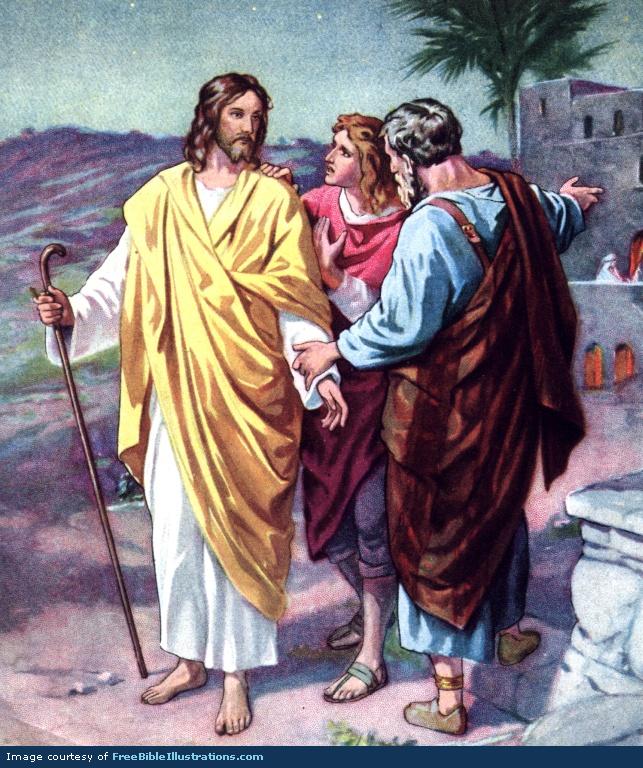
There is a similar trick of the mind at work when we hear the story of the two travelers on the road to Emmaus; we always assume that they were two men. It’s not wonder, since virtually every painting of the encounter on the road to Emmaus will show Jesus with two men. For example, look at the relief on the front of our altar. Many people assume that this is a depiction of the Last Supper (but that there are only two apostles shown because we had to crop it down to size.) Actually, this scene is from after His Passion—you can see crosses on the hill in the distance and there are wound marks in Jesus’ hands. What we have here is to two men at the house in Emmaus, shocked to recognize Jesus in the breaking of the bread.

The artistic depictions always show two men [the picture on the right being the only possible exception I could find], however the original Greek does not call them “two men,” or even “two disciples.” It only says there were “two of them” and that one of them was a man named Cleopas. As to the name and gender of the other traveler, the gospel text is silent. Perhaps the second person’s identity is left as a mystery so as to invite any of us to imagine ourselves in their place in this story. This may be the extent of what we can know for certain, but there is an interesting clue from another Gospel that suggests more detail.

In Gospel of John, it says that “standing by the cross of Jesus were his mother and his mother’s sister, Mary the wife of Clopas….” (John 19:25) So we have a Clopas and Cleopas both associated with Jesus. Perhaps these similar names are merely a coincidence, but perhaps Clopas and Cleopas are variations of the same person’s name. If Clopas and Cleopas are one in the same person, then the other traveler on the road was probably his wife, Mary. This Mary was most likely either Jesus’ aunt and the sister of St. Joseph, or one of the cousins of the Blessed Virgin Mary. What we do know for certain is that this Mary stood with Jesus’ mother at the foot of the cross.

Admittedly, it is speculation to say the other traveler was Cleopas’ wife, but if it was, then this Resurrection episode has a much greater poetry. In the Garden of Eden, a husband and wife ate from a tree. “Then the eyes of both of them were opened, and they realized that they were naked.” They felt ashamed and afraid. But in the house at Emmaus, a husband and wife ate the Eucharist, the fruit of the tree of the cross. “With that their eyes were opened and they recognized Him.” They felt joyful and unafraid. In Eden, God moved about the garden with the man and the woman. After the resurrection, Jesus walks with us, both men and women, along our road.

But whether that second traveler on the road was a woman or not, it would be a remain mistake to think that only men were important in the early Church. That would be at least as mistaken as thinking that every surgeon is a male. Jesus Christ chose some men to be the Church’s leaders, and much is said about them in the Scriptures, but He chose to spread the good news about Himself through the witness of women as well.

Though we sing of the “Faith of Our Fathers,” the faith of our mothers has been just as important, if not more, through time. Today,  it is oftentimes mom who takes the forefront in fostering faith in the family, in leading her children to Christ and His Church; through bedtime prayers and Bible stories, by bringing them to Mass and to CCD, in seeing to it that they receive the graces of the sacraments. If you feel like you’re alone in witnessing to the faith in your family, I commend you, and Jesus is proud of you.

There is another trick of the mind when it comes to celebrating Mother’s Day. On Mother’s Day we remember our mothers, who gave us birth and nurtured us, who raised us and put up with us, but we tend to forget about the greatest gift, the gift of our faith. At the Easter vigil the Exultet asks: “What good would life have been to us, had Christ not come as our redeemer?” Indeed, what good would life be to us if after our births we had not also been brought to Christ through the witness of holy women. Who were these holy women in your life? At this Mother’s Day Mass, let us remember and pray not only for our mothers in the natural order, but for each of our spiritual mothers as well.

A Man In Jesus’ Image — Divine Mercy Sunday—Year A

May 1, 2011

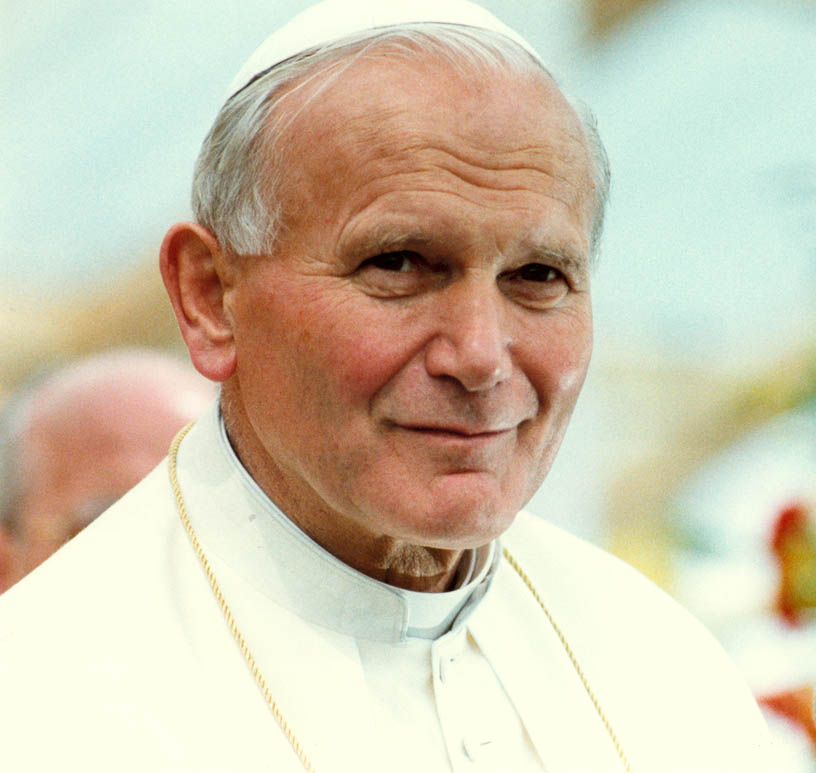
This Divine Mercy Sunday, our Catholic Church throughout the world celebrates and glorifies two men together in a special way. The first is our Savior, our Lord and our God, Jesus Christ; and the second is the great pope John Paul the Second, who is being beatified today in Rome. John Paul the Great, born Karol Wojtyla, is a man who lived in the image and likeness of Jesus Christ.

Both chose the Blessed Virgin Mary to be their mother. One chose her after the loss of his earthly mother as a boy. The other chose her from all eternity. Growing up, both of their beloved homelands were occupied and oppressed by foreign empires. For one it was the Romans. For the other it was the Nazis and then the Soviet Union. As young men, they both worked as manual laborers, in lives hidden from the world. When people encountered their ministries for the first time, many said, “Who is this man, and where does he come from?”

Both men transformed this world, not by leading violent revolutions, not by amassing incredible fortunes, but by speaking the truth, and living the truth, and leading others in doing the same for God. They preached God’s message, and their words gave hope and courage to many, but their words were not accepted by all. Both men had enemies who sought to destroy them, but they forgave, face to face, those who sought their lives.

At the end of their lives, both men were afflicted with great physical sufferings, but neither laid down their crosses. Some onlookers mocked or dismissed them in their afflictions, but those with spiritual insight beheld them to be offering a sacrifice to the Father for the salvation of the world.

St. John tells us that Jesus has done many other signs in the presence of his disciples that are not written in his Gospel. As St. John writes elsewhere, “There are many other things that Jesus did, but if these were to be described individually, I do not think the whole world would contain the books that would be written.”

Among these signs are the lives of the saints throughout the centuries, saints like Pope John Paul the Great. His life was a sign worked by Jesus Christ in our midst so that we would come to believe more deeply that Jesus is the Christ, the Son of God, and that through this belief we may have life in his name.

Why did people love Pope John Paul II so much? Catholics of every country and of all ages loved and flocked to him. Even non-Catholics and non-Christians were drawn to him. What explains this phenomenon? I think the answer is simple. People saw in him a reflection of Jesus Christ’s love for them. John Paul the Second was an icon of Christ and his love.

Every time you saw Pope John Paul, he was smiling. He traveled the nations, and embraced everyone warmly. When you encountered him, you felt loved, even if you were one person in a crowd of thousands. This was the Holy Spirit at work. Although you did not see Jesus you loved him in Pope John Paul; even though you did not see Jesus you believed in him all the more because of him, and rejoiced with an indescribable and glorious joy.

This morning we celebrate a feast day which Pope John Paul II established, Divine Mercy Sunday. What is divine mercy like? What does Jesus’ unfathomable love, which enfolds every one of us here and every person God has made, look like? Through the life of Pope John the Great we saw a partial glimpse of the divine mercy and love of Jesus Christ.

They Ran For Him — Easter Morning

April 24, 2011

When Mary Magdalene came to the tomb early Easter morning, she found the stone removed and the body of Jesus gone. She ran to Peter and John, because her love demanded that something must be done. “They have taken the Lord from the tomb,” she said, “and we don’t know where they put him!” So Peter and John went out and ran to the tomb. They both ran, but John ran faster and arrived at the tomb first; not because he loved Jesus more, but because he was younger than Peter.

Some adults run for exercise, but they are the odd exception. Generally, grown-ups just don’t run; except under special circumstances. For instance, my mother doesn’t jog, but she’ll sprint to answer a ringing phone. She loves her friends and doesn’t want to leave them hanging on the line. So, love can make a grown person run.

One time, when I was a boy, I saw my mother run outside in her nightgown and dive into our swimming pool. My mother saved the life of my younger sister, who was floating there facedown.

In all my life, I can only remember ever seeing my father run once. A few years later, during a family walk around a camping resort in my hometown, where we had never walked before, we came upon a tragic emergency. While Mom did CPR, Dad and I ran for the phone at the front office to call for an ambulance. I ran as hard as I could, but Dad was much faster than my ten-year-old legs. I remember seeing his back, his arms rapidly pumping, and thinking to myself, ‘I had no idea he could move that fast.’ And so, from my youth, I’ve known that for the love of another, or in matters of life and death, adults will run. If something is important to them, they’ll run for it.

Mary Magdalene, Peter and John ran to and from an empty tomb out of concern for a dead man’s corpse. So great was their love for Jesus, so great was their admiration for Him, that they ran for Him, even though they thought He had nothing more to offer them. But we are here this morning because Jesus wasn’t dead. He is risen and still active in peoples’ lives today. (To the latter, I am an eyewitness.) He has much to offer to us, our families, our children. But do we run to Him? Do we run to His Church, His sacraments, worship and teachings; or do we run from them? Whether we run is a question of love, and in a world subverted by sin and temptation in so many ways, it’s a matter of life and death. Jesus is risen. So let’s run to Him.

Our Triduum Crowd — Palm Sunday—Year A

April 20, 2011

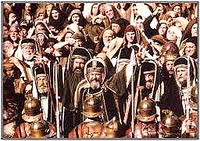
On Palm Sunday, the crowds welcomed Jesus into Jerusalem as a hero.  On Good Friday, the crowds will clamor for His death. How do we explain this dramatic switch from love to hate? It might be that the mob had become infatuated with Jesus, thinking that He was going to be the earthly messiah of their dreams, the one who would force the hated Romans out of their land and reign as a new and greater King David. Perhaps the crowd realized that this wasn’t Jesus’ plan, and then angrily turned on Him like a lover spurned, hating Him for disappointing their high hopes.

Another possibility is that we are seeing two different crowds, made up almost entirely of different people. Perhaps the chief priests and the Pharisees had assembled a mob around them of those they knew they could easily manipulate. They had arrested Jesus late in the night and brought Him to Pilate early the next morning. Perhaps many of Jesus’ the Palm Sunday supporters had no idea what was happening until Jesus was already in the tomb. Perhaps the next day many of them said, “I wish I had known! I would have been there for Jesus!” Or perhaps they did hear about what was afoot, but had already disowned Jesus for disappointing their messianic dreams. Maybe some people said, “Jesus of Nazareth? I’m too busy to be bothered with Him anymore. I’ll keep my distance, and see how this thing plays out in the end.” Whatever the reason, the crowd that turned-up for Jesus’ trial was short on those who loved Him.

The liturgy of Holy Thursday, Good Friday, and Easter Vigil (what we call the Easter Triduum) is our greatest celebration in the Church. It’s bigger than Christmas and Jesus invites you to be there. Jesus invites you to attend his last meal and to keep watch with Him Thursday night, to accompany Him through His Passion and to reverence Him on the cross, and to keep vigil at His tomb Saturday night and to be the first witnesses to His resurrection. If you truly cannot make it, Jesus understands, but if you would come here to join this crowd accompanying Jesus throughout these holy days, it would please Him, very much.

3 Mountains / 3 Montañas — 2nd Sunday in Lent—Year A

March 20, 2011
In the life of Jesus, he climbs three significant mountains; The mountain of the sermon on the mount, the mountain of Transfiguration (in today’s reading) and the mountain of the crucifixion. In the Christian life, we must also visit these three mountains. 
 
The three mountains are united. The wisdom of the sermon on the mount, on the first mountain, brings the pleasures and pains of the other mountains. The life of the Gospel brings the joys of the light and the suffering of the cross. Wisdom, glory and sacrifice; the three are a trio here on this earth. Our glories without sacrifice pass quickly. Our sacrifices without wisdom we regret quickly. And our wisdom will be without glory forever if we do not follow Christ in sacrifice. Which mountain should visit more this season of Lent?
 
Do you lack wisdom? Do you not know well that Jesus and his Church teaches? Go to the first mountain to learn, like the disciples at the Sermon on the Mount, with the Bible, or the Catechism or many popular resources available in audio or visual forms.
 
Do you need consolation? Do you not feel well that Jesus is your beloved friend? Go to the second mountain, to feel like Jesus and his disciples at the Transfiguration, through time in a quiet place with God.
 
Do you need perfection in your love? Do you not carry the cross well? Go to the last mountain to practice it, like Jesus at the crucifixion, through good works for others.
 
Jesus climbed the mountains of wisdom, glory and sacrifice. To be with him, we must climb these also.
 

En la vida de Jesús, él sube tres montañas notables. La montaña del sermón del monte, la montaña de la transfiguración (en la lectura de hoy) y la montaña de la crucifixión. En la vida cristiana, debemos visitar estas tres montañas también.

Las tres montañas están unidas. La sabiduría del sermón del monte, de la primera montaña, trae los placeres y dolores de las otras montañas. La vida del Evangelio trae las alegrías de la luz y los sufrimientos de la cruz.  Sabiduría, gloria y sacrificio; los tres son un trío unido en esta tierra.

Nuestras glorias sin sacrificio pasan rápidamente. Nuestros sacrificios sin sabiduría lamentamos rápidamente. Y nuestra sabiduría será sin gloria para siempre si no nos siga a Cristo en sacrificio. ¿Qué montaña deben visitar más esta temporada de Cuaresma?

¿Faltas de sabiduría? ¿No sabes bien lo que Jesús y su Iglesia enseñan? Vaya a la primera montaña para aprender como los discípulos al sermón del monte, con la Biblia, o el catecismo o muchos recursos populares disponibles en formularios visuales o de audio.

¿Necesitas consuelo? ¿No te sientes bien que Jesús es tu amigo amado? Vaya a la segunda montaña para sentirlo como Jesús y sus discípulos a la transfiguración, con tiempo con Dios en un lugar tranquilo.

¿Necesitas perfección en tu amor? ¿No llevas bien la cruz? Vaya a la última montaña para practicarlo como Jesús a la crucifixión, con buenas obras para otros.

Jesús subió las montañas de sabiduría, de gloria y de sacrificio. Para estar con él, debemos subir estas también.

The Passion of Lent — 1st Sunday in Lent—Year A

March 14, 2011


Today Satan approaches Jesus in the desert at the end of His forty days of prayer and fasting and attempts to divert Him from the Father’s plan.   The ancient serpent employs the same tactics he used on Eve in the garden, twisting God’s words and playing on human desires. So how much did Satan know about what Jesus intended to do in the years ahead? St. Matthew suggests the Devil knew something of this, because the three temptations Satan puts to Jesus foreshadow His future Passion.

First, Satan comes and says to Jesus, “If you are the Son of God, command that these stones become loaves of bread.” Is it a coincidence that at the Last Supper Jesus will command bread to transformation into His very Self? It is as if the Devil were saying, “Why not simply give everyone bread. Why give yourself into their hands?” Jesus answers, “Man does not live on bread alone, but on every word that comes forth from the mouth of God.”

Jesus knows that a lifetime supply of bread would not save us. To live forever the Bread of Life must nourish us. Jesus is the Bread of Life. We do not live by bread alone, with whatever this world can offer, but by the Word that comes forth from the mouth of God. The Word of God is Jesus Christ.

This first temptation and Jesus’ answer point to the importance of prayer and the Eucharist. Prayer lifts our minds above having worldly thoughts alone. The Eucharist empowers our hearts to live for God. Do you pray every day? Prayer must be a top priority in Lent. Do you frequently receive Jesus in the Eucharist? In Lent, try coming to weekday Masses. Those who do so find it so powerful and precious that they often wonder how they ever used to make it a full seven days without receiving Jesus in between.

For his next temptation, Satan takes Jesus to the very top of the temple in Jerusalem. About three years later, not far from that place, the hostile Sanhedrin will gather and put Jesus on trial, questioning Him, demanding to know, ‘Are you the Son of God?’ and they’re not going to like His answer. The Devil says, “If you are the Son of God, throw yourself down.  [God’s angels will protect you.]” It is as if the Devil were saying, “Since you are a child of God He will be with you to save you no matter what, so why not do your own will and decline to give difficult witness?” But Jesus answers, “You shall not put the Lord, your God, to the test.”

You and I are also children of God and He is always with us,  but this must not lead us to presumption. We need to seek His will and give witness in the world by our words and deeds. If we sin, God always offers forgiveness, but we must take Him up on the offer. God always welcomes sinners, but we must turn to Him. To keep sinning without any words or actions of repentance is to put God to the test.

This second temptation and Jesus’ response point to the importance of confession and conversion. This Lent, turn from sin, come to confession at least once, and put some serious thought into planning how you will “sin no more and to avoid the near occasions of sin.”

For the third temptation, the Devil takes Jesus up to a very high mountain and shows him all the kingdoms of the world in their magnificence. He says, “All these I shall give to you, if you will prostrate yourself and worship me.” Jesus plans to claim His universal kingdom by climbing another mountain by Himself, Mount Calvary, and by taking his throne on the cross. (This is why Jesus tells James and John that they do not know that they are asking when they request to sit ‘one at His right hand and one at His left when He enters His kingdom and glory.’) Here it is as if the Devil were saying, “If you simply give up you won’t have to sacrifice, you won’t have to suffer. Lay down your cross and lay down before me.” But Jesus rebukes the devil, (much like he will later rebuke St. Peter for saying, ‘God forbid such a thing should ever happen to you): “Get away, Satan! The Lord, your God, shall you worship and him alone shall you serve.”

This third temptation and Jesus’ answer point to the importance spiritual sacrifices and patiently bearing our burdens. We have taken on Lenten penances, let us not give them up; and when unforeseen trials come to us, let us trust that Jesus knows what He’s doing; for it is through crosses like these that God makes us holy.

Prayer and the Eucharist, confession and conversion, spiritual sacrifices and patiently bearing our burdens. Let these things be in your response as you are tested these forty days.

3 Myths / 3 Mitos — 9th Sunday in Ordinary Time—Year A

March 6, 2011

Many today assume three modern myths: One, that we get into Heaven based on whether our good works out-weigh our sins. Two, that as long as we claim Jesus Christ as our personal Lord and Savior we are assured Heaven. And three, that one Christian church is just as good as another. Let us consider these common myths one by one, and come to understand the truth about Christianity.

If you ask people whether they think they’ll go to Heaven, many say something like this, “I’m a pretty good person. I mean I’ve never robbed any banks or killed anybody. I’ve done good things, so yeah, I think I’ll go to Heaven.” In their minds, such people seem to envision the Last Judgment as a giant scale, with their good deeds on one side and their sins on the other.

The truth is, we cannot earn our own salvation. God is all good and deserving of all our love. When we do good we are just giving Him what He deserves. But when we sin, we disfigure ourselves and our relationship with God in ways that only He can repair. “…All have sinned and are deprived of the glory of God.” But thanks be to God, we “are justified freely by his grace through the redemption in Christ Jesus…. What occasion is there then for boasting?” asks St. Paul. “It is ruled out.” We do not save ourselves. We are saved only through Jesus Christ.

Many Christians like to ask, “Have you accepted Jesus Christ as your personal lord and savior?” Do not hesitate to answer “Yes,” for every time you receive Him worthily in the Eucharist you are accepting Him as your Savior and Lord. Evangelical Christians also like to ask, “Are you saved?” They say this because they think whoever professes faith in Christ is assured of their salvation. However, according to Jesus, “Not everyone who says to me, ‘Lord, Lord,’ will enter the kingdom of heaven, but only the one who does the will of my Father in heaven.”

Think of it this way: the demons recognize that Christ is Christ, but that does not save them. They are not saved because they do not love Him, and love is about more than just words. As Jesus told His Apostles, “If you love me, you will keep my commandments. … This is my commandment: love one another as I love you.” (Jn 14:15, 15:12)

Consider the New Testament words of St. James, “What good is it, my brothers, if someone says he has faith but does not have works? Can that faith save him? If a brother or sister has nothing to wear and has no food for the day, and one of you says to them, ‘Go in peace, keep warm, and eat well,’ but you do not give them the necessities of the body, what good is it? So also faith of itself, if it does not have works, is dead.” (James 2:14) As St. Paul observes, “If I have all faith so as to move mountains but do not have love, I am nothing.” Our salvation in Christ requires faith and love in action.

We know that more than a few Catholics have wandered away from the Church. Some have been drawn away, after being told the Catholic Church does not know the Bible. Others have simply left, thinking that one Christian church is just as good as another. Do not be misled by myths.

In truth, Jesus Christ has built only one house, one Church. And, being a wise man, he built the house on a rock, St. Peter, our first Pope. However, men have built other houses. These Christian denominations have many good characteristics from the one Church of Christ: like Scripture, prayer, the Apostles’ Creed, baptism, marriage, and Christian morals. However, in time, the rains fall, the floods come, and the winds blow and buffet their houses and they collapse ruined. Those houses separate from the truth and separate from within into new houses. Therefore, never abandon the beliefs and the sacraments of the Catholic Church. There is one true house of Jesus Christ. Do not be misled by myths.

Muchos hoy aceptan tres mitos modernos: Uno, que entramos en el cielo si nuestras buenas obras son más que de nuestros pecados. Dos, si nos declararía Jesucristo como nuestro Señor personal y Salvador estamos seguros de entrar en el cielo. Y tres, que una iglesia Cristiana es tan buena como la otra. Consideremos estos mitos populares uno por uno y comprender la verdad acerca del cristianismo.

Si se pregunta a las personas si piensan que van a ir al cielo, muchos dicen algo como esto, “Soy una persona buena bastante. Yo nunca he robado al banco ni matado a nadie. He hecho cosas buenas, entonces sí, creo que voy a ir al cielo.” Estas personas imaginan el juicio final para ser una escala gigante, con sus buenas acciones en un lado y sus pecados en el otro.

La verdad es que no podemos ganar nuestra propia salvación personal. Dios es el sumo bien y digno de ser amado sobre todas las cosas. Cuando hacemos bueno sólo damos lo que se merece Dios. Pero cuando pecamos, nos hacemos daño a nosotros mismos sino a nuestra relación con Dios in maneras que solo Dios puede reparar. “Como todos pecaron, todos están privados de la presencia salvadora de Dios; pero todos son justificados gratuitamente por su gracia, en virtud de la redención llevada a cabo por medio de Cristo Jesús… por medio de la fe.” “¿Dónde, pues, quede el orgullo del hombre ante Dios,” pregunta de San Paulo. “Queda eliminado!” Nosotros no ganamos nuestra salvación por nosotros mismos. Somos salvados sólo a través de Jesucristo.

A veces otros cristianos nos preguntan, “Has aceptado a Jesucristo como tu Señor personal y Salvador?” No duden en responder “Sí”, porque cada vez que le reciban dignamente en la Eucaristía  lo aceptan como su Salvador y Señor.  Nuestros amigos cristianos evangélicos también quieren preguntar, “¿Eres salvado?” Dicen porque piensan que la person que profesa la fe en Cristo se asegura su salvación. Sin embargo, según Jesús, “No todo el que me diga ‘Señor, Señor!’, entrará en el Reino de los cielos, sino el que cumpla la voluntad de mi Padre, que está en los cielos.”

Consideren esto: los demonios reconocen que Cristo es Cristo, pero no los salva. No se salva porque ellos no lo aman, y amor es más que decir palabras. Como Jesús les dijo a sus apóstoles, “Si ustedes me aman, obedecerán mis mandamientos. … Mi mandamiento es este: Que se amen unos a otros como yo los he amado a ustedes.”

Consideren las palabras del Nuevo Testamento de San Santiago, “Hermanos míos, ¿de qué le sirve a uno decir que tiene fe, si sus hechos no lo demuestran? ¿Podrá acaso salvarlo esa fe? Supongamos que a un hermano o a una hermana les falta la ropa y la comida necesarias para el día; si uno de ustedes les dice: ‘Que les vaya bien; abríguense y coman todo lo que quieran’, pero no les da lo que su cuerpo necesita, ¿de qué les sirve? Así pasa con la fe: por sí sola, es decir, si no se demuestra con hechos, es una cosa muerta.” Como San Pablo observa, “Si tengo la fe necesaria para mover montañas, pero no tengo amor, no soy nada.” Nuestra salvación en Cristo requiere fe y amor en acción.

Sabemos que más que unos católicos pocos han vagado de la Iglesia Católica. Algunos son atraídos, oyen falsamente que la Iglesia Católica no conoce la Biblia. Otros simplemente dejaron, piensan falsamente que una iglesia cristiana es tan buena como la otra. No se engañen por mitos.

En verdad, Jesucristo ha construido sólo una casa, una iglesia. Y, siendo un hombre sabio, construyó la casa sobre una roca, San Pedro, nuestro primer Papa. Pero, hombres han construido otras casas. Estas denominaciones cristianas tienen muchas características buenas de la única casa de Cristo: como escritura, oración, el credo de los apóstoles, bautismo, matrimonio, las morales cristianas. Pero, en tiempo, viene la lluvia, bajan las crecientes, se desatan los vientos, contra esas casas y las arras an.  Esas casas sparan de las verdad y sparan desde los interiors en las casas nuevas. Por lo tanto, nunca abandonen las creencias y los sacramentos de la Iglesia Católica. Es la única casa de Jesucristo. No se engañen por mitos.

Be Not Afraid — 8th Sunday in Ordinary Time—Year A

February 28, 2011

This morning, I would like to recall events from the life of a great man. When he is eight years old his mother dies. When he is twelve years old, his older brother (a physician) also dies, having contracted scarlet fever from a patient. At nineteen years old, the Nazis invade his homeland and inflict much suffering on those he loves. With his father’s death, he becomes the last survivor of his immediate family, at only twenty years of age. After five years of war and occupation, the Nazis are driven out, but the Soviet communists replace them. They will later try to murder him, but they will (just barely) not succeed. At age seventy-three, he is diagnosed with an incurable disease that will slowly weaken him and kill him, and eleven difficult years later, he dies.

These are events from the life of a great man, a man the Church will declare “blessed” this May 1st. He is Karol Wojtyla, better known as Pope John Paul II. Throughout his papacy, over and over again, he repeated this message: “Do not be afraid.” He is well-known for saying this, but these words were not originally his. They come from another man, also a man of suffering—accustomed to infirmity, who knew both poverty and exile, one who experienced the deaths of loved ones, a man who was also targeted for death himself. This man is Jesus Christ, who first said, “Do not be afraid. Be not afraid.” In fact, in the Gospels, Jesus says this more than just about anything else.

I recall the trials of John Paul the Great and the sufferings of Jesus Christ lest anyone think their words come from naivety about life and the world, or that their Gospel is not grounded in reality. Jesus knows what he is talking about when teaches us, when He commands us, “Do not worry about your life, what you will eat or drink, or about your body, what you will wear. …Seek first the kingdom of God and his righteousness, and all these things will be given you besides. Do not worry about tomorrow; tomorrow will take care of itself. Sufficient for a day is its own evil.” Jesus never denies that evils exist in this world, but tells us that none of them should make us fear. This is why the Church asks God the Father at every Mass, “Deliver us Lord from every evil and grant us peace in our day, in your mercy keep us free from sin and protect us from all anxiety….” We really mean it when we pray this, that we may be free from all anxiety. Christians should care about many things, but not one of these things should make us anxious.

Of what should we be afraid? Poverty? Jesus lived it. Suffering? He experienced that, too. Sin? Jesus has conquered it, and He offers us restoration. Death? Jesus has defeated it, and He promises us resurrection. With Jesus Christ, we can have the peace that, in the end, everything will be ok. Yet, many people feel crushed by their worries, about matters large and small. How are we to overcome these anxieties and experience the peace Christ wants for our lives? We conquer anxiety with these two things: prayer, and confidence in God’s love for us.

As Saint Paul wrote the Philippians, “The Lord is near. Have no anxiety at all, but in everything, by prayer and petition, with thanksgiving, make your requests known to God. Then the peace of God that surpasses all understanding will guard your hearts and minds in Christ Jesus.” Jesus will never forsake us, and He will never forget us. Even if a mother should forget her infant, or be without tenderness for the child of her womb, Jesus will never forget you. So, “Do not be afraid.” The next time you feel worry, the fruit of fear, remove it from your mind and place it on an altar before the Lord. Make a sacrifice of it, a burnt-offering before God, and say, “Jesus, I trust in you. I’ll show up and do my part, but I’m relying on you to take care of this. I sacrifice my fears to you.” It is a high compliment to Him when we trust in Him to be our God, and opens us up to receive His peace.

Always be confident in Jesus Christ’s love for you. The next time you feel worry coming on, this is your cue to pray. Do not be afraid. With Jesus Christ, we can have the peace that everything will be ok.

Set To Heaven — 6th Sunday in Ordinary Time—Year A

February 13, 2011

This morning, consider this important question: Are you a thermometer or a thermostat? In this life, we can live like either thermometers or thermostats. A thermometer (as you know) accepts whatever temperature, hot or cold, that happens to surround it. A thermometer acts passively to the world’s influence. A thermostat, on the other hand, does not submit to the world around it. A thermostat is set to an ideal temperature and strives to attaint its goal.  As Christians, we should be as thermostats, and we should all be set on Heaven.

Do you think about Heaven much? Do you ever meditate on what it will be like? I think many of us get so drawn in by the here and now that we fail to give Heaven much thought. Yet, I think we would all be strengthened by meditating on it more; on what it promises and what it requires.

The next life is a mystery about which we can know a great deal. As Saint Paul says, “What God has prepared for those who love him, this God has revealed to us through the Spirit.” For example, we know that there will be no suffering or death in Heaven. The Book of Revelation says God ‘will wipe every tear from our eyes, and there shall be no more death or mourning, wailing or pain, for the old order (the way of this world) will have passed away.’

There shall also be no hatred in Heaven. No one with hatred in his or her heart will be able to enter. The Book of Wisdom teaches that God hates none of the persons he has made. He does not always like all the things that they do, but it is His love for each one that continues to hold them in being, and will hold them in existence forever. In order to see God in Heaven, we must become like Him. This is why Jesus forbids not only murder, but hatred in the heart as well. Consider how wonderful it will be to live in Heaven at peace with everyone.

After the resurrection, when our dead bodies are reconstructed from the dust, those who are just will be remade, stronger, handsomer, more incredibly beautiful, than they have ever looked before. Will their perfect bodies have any flaws? If glorified bodies do have “flaws,” they shall be as the wounds that remain in Jesus’ hands and side, beautiful and glorious forever. In this life, the beauty of one’s soul has little relationship to the beauty of one’s flesh; but in Heaven, the holiness of the saints shines out for all to see. 

In Heaven, in this midst of this overwhelming beauty, no one shall lust and none shall exploit another. Lust and exploitation go hand in hand. There is a good reason for the expression “to lust for power,” for lust is about manipulating another for one’s pleasure. Instead of lust, everyone in Heaven shall desire the true good of one another from their hearts.

In this life, temptations will come whether we want them or not, but remember that temptations in themselves are not sins—it is only when we say “yes” to temptation, when we choose to sin as temptations suggest, that we can be guilty of a sin such as lust. Until we can refuse temptation’s invitations, until all lust is driven from our hearts, we are not yet ready for Heaven. This is why Jesus teaches not only against adultery, but against lust in the heart as well. How wonderful it will be to full of love for all, purely, from our hearts, and to receive that same overflowing love in return.

Our lives on earth we are full of questions. But in Heaven, every question which has answer will be answered for us. As St. Paul told the Corinthians, “At present we see indistinctly, as in a [cloudy] mirror, but then face to face. At present I know partially; then I shall know fully, as I am fully known.” Heaven is a place of transparent truth. There, the barriers to communication disappear. In Heaven, we shall know others fully, and be fully known ourselves. No lies nor concealments are possible there, “for there is nothing hidden that will not become visible, and nothing secret that will not be known and come to light.” Until we are free of lies, until we are people whose ‘Yes’ means ‘Yes,’ and whose ‘No’ mean ‘No,’ we are not yet ready to live in Heaven.

If we die in God’s grace and friendship, we may still have some attachments to sin, and be unprepared for Heaven. But, thanks be to God, there is Purgatory, to clean us up and make us perfect, so that we may enter the Father’s house and join the feast of Heaven. Though there is Purgatory, we must always aim for Heaven. If you shoot a bow and arrow and aim carefully for the bull’s-eye, you will probably miss but still hit the target. If you shoot only aiming at the target in general, you will probably miss and hit the ground. So aim for Heaven, lest any of us miss entirely.

Jesus said to his disciples, “I tell you, unless your righteousness surpasses that of the scribes and Pharisees, you will not enter the kingdom of heaven. So let us not default to world’s standards. Do not be a thermometer. Set your thermostat to the perfection of Heaven. Meditate on it and strive for it, and you will experience the joys and blessings of Heaven beginning in this life.

Sodium Chloride Reaction — 5th Sunday in Ordinary Time—Year A

February 8, 2011

Let me tell you two stories about chemicals that produced quite a reaction in me. In summers when I was a kid, I liked to go to the Osseo city pool. They had there a brown door with red letters warning something to the effect of: “Danger, Deadly Chlorine Gas, Staff Only!” I needed no further persuading. Years later, my high school science teacher put a bucket in the snow, and in the bucket he put some water, and in the water he put in a chunk of pure sodium, using tongs. The water steamed and bubbled and exploded a couple of time. It was awesome, but also rather threatening.

What do you get if you put these two dangerous elements together? You get sodium chloride. I warn you that this compound is now found in our environment and in our homes. The oceans are full of it. It’s on our city streets. It’s even in the food we eat and feed to our children. Sodium chloride sounds rather threatening, but you know this benign compound by another name: Salt.

Like salt, Christianity is pervasive, it’s everywhere. Like salt, people can fear and oppose Christianity, thinking it’s harmful for people and bad for our world. But in truth, Christianity, like salt, is necessary for life. Christians, to the extent that they are truly Christians, are the salt of the earth.

The world’s irrational fear and opposition to our faith is nothing new. Listen to this anonymous letter written to a man named Diognetus that dates from the second century. Listen for how Christians resemble the salt of the world, ubiquitous, helpful and good, and feared and opposed:

“Christians are indistinguishable from other men either by nationality, language or customs. They do not inhabit separate cities of their own, or speak a strange dialect, or follow some outlandish way of life. … With regard to dress, food and manner of life in general, they follow the customs of whatever city they happen to be living in, whether it is Greek or foreign. And yet there is something extraordinary about their lives. They live in their own countries as though they were only passing through. They play their full role as citizens, but labor under all the disabilities of aliens. Any country can be their homeland, but for them their homeland, wherever it may be, is a foreign country. Like others, they marry and have children, but they do not expose them. They share their meals, but not their wives.  They live in the flesh, but they are not governed by the desires of the flesh.

They pass their days upon earth, but they are citizens of heaven. Obedient to the laws, they yet live on a level that transcends the law. Christians love all men, but all men persecute them. Condemned because they are not understood, they are put to death, but raised to life again. They live in poverty, but enrich many; they are totally destitute, but possess an abundance of everything. They suffer dishonor, but that is their glory. They are defamed, but vindicated. A blessing is their answer to abuse, deference their response to insult. For the good they do they receive the punishment of malefactors, but even then they, rejoice, as though receiving the gift of life. They are attacked by the Jews as aliens, they are persecuted by the Greeks, yet no one can explain the reason for this hatred.

Why does the world oppose devout Christianity, now as then? One reason is that the Christian dedicates himself exclusively to Jesus Christ, in a way that worldly people think is disproportionate and dangerous. They imagine the believing Christian behaves like sodium in water, hot with intolerance and hatred, violent in their reactions. In fact, a Christian’s total commitment to Jesus Christ is what leads Him to have mercy for all and extend love toward all. Who is more responsible for ‘sharing bread with the hungry, sheltering the oppressed and the homeless, and clothing the naked’ in history of the world than Christians in general and the Catholic Church in particular?

Another reason why the world hates Christianity is that worldly people think it lethal to the joys of life. Like inhaling chlorine gas, they fear that Christianity stands to afixiate their happiness. This too is nothing new. In Roman times Christians were charged with “hatred of humanity” for it was thought, “whoever loves man will love what man loves.” As the writer to Diognetus observed in the second century, “The world hates the Christians, not because they have done it any wrong, but because [Chritians] are opposed to its enjoyments.” It is still so today. It is as Jesus said: He calls us the light of the world, and elsewhere notes, “Everyone who does wicked things hates the light and does not come toward the light, so that his works might not be exposed.” We tell the world that some things that it loves are false roads to happiness, and it hates us for it.

So what are we to do? First, realize that the modern world’s hostility to Christianity is nothing new. Don’t wait for the world’s hostility to pass, it won’t. And don’t think your faith is a shameful thing, it’s not. Instead, do as Jesus teaches, “your light must shine before others, that they may see your good deeds and glorify your heavenly Father.” If you are a Christian, people who know you should see something different in you and ask, “What’s your secret.” And when they do you should say, “It’s because of my relationship to Jesus Christ and His Church.” Pray for this grace. Pray that you may be a witness to Christ in both your words and deeds. Then, as the psalmist said, you will be “a light in darkness” and you will help to save many souls in the world.

5 Things / 5 Cosas — 5th Sunday in Ordinary Time—Year A

February 5, 2011

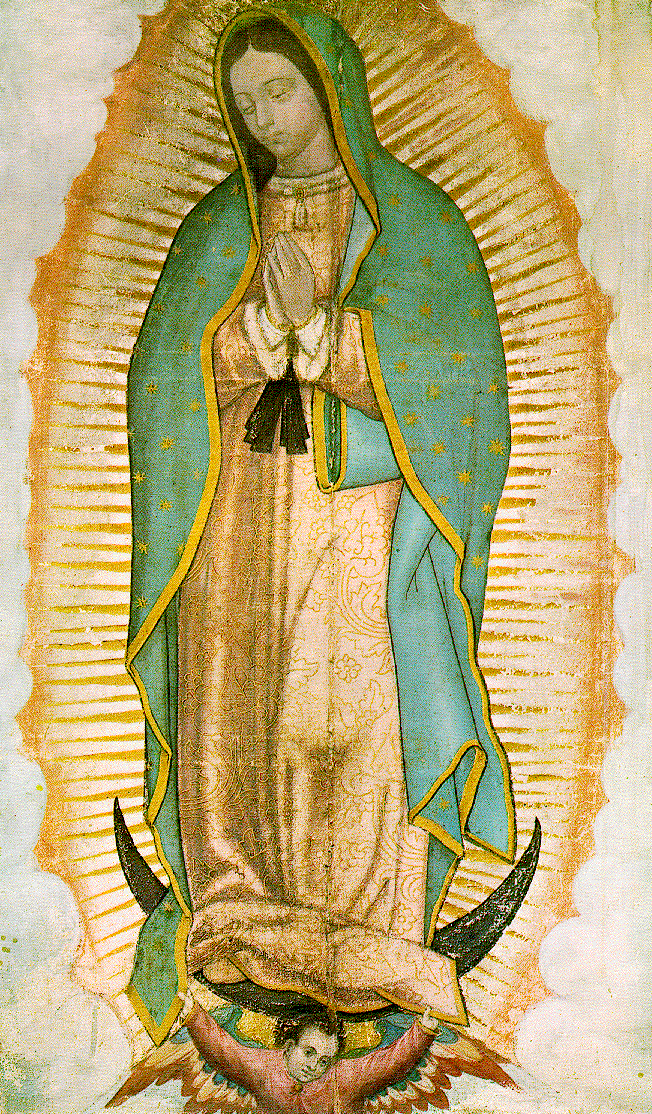
The Blessed Virgin Mary, our Lady of Guadalupe, comes to Saint Juan Diego dressed in the sun. She is clothed in light. Her light comes from God. In 1531, she does simple things. She says few words. She asks for one thing. She gives one gift. And as a few, small grains of salt can flavor a meal for many, Mary’s few, simple actions transformed a people, a culture, and a land forever.

You are called to be the light of the world, but remember that the light never begins you—the light only comes from Christ and shines through you. How can you be clothed in the sun of His grace? You need to pray every day, you need to receive the sacraments frequently, you need to fight against sin, you need holy community, and one of these friends must be Jesus.

By the light of Christ, you may be led to ‘share your bread with the hungry, open your house to the homeless, and clothe the naked’ in new ways. However, Jesus does not want you to do one thousand more things, He wants you to do the one thousand simple things that comprise your life differently, with peace and power. ‘The just man shines like a light in the darkness, and firm and without fear in his heart.’

With Jesus, you can become the best possible you. The best possible you is who you desire to be. This best possible you may still do few and small things, but the effect of these deeds will be powerful around you, as the salt of the earth transforms a bland meal.

Prayer, sacraments, conversion, community, intimacy with Christ. The light of Jesus comes through these. In which of these do you most need to grow? What are you going to do about it? Jesus and Mary await your reply.

La Virgen María, nuestra Señora de Guadalupe, llega a San Juan Diego, vestido con el sol. Ella está revestida en luz. Su luz viene de Dios. En 1531, ella hace cosas sencillas. Ella dice algunas palabras. Ella pide por una cosa. Ella da un regalo. Y como pocos, pequeños granos de sal pueden sabor a una comida para muchos, las acciones pocos y simples de María transformen un pueblo, una cultura y una tierra para siempre.

Usted está llamado a ser la luz del mundo, Pero, recuerde que la luz nunca empieza desde usted: la luz sólo viene de Cristo y brilla a través de usted. ¿Cómo puede usted ser revestido en el sol de la gracia de Christo? Es necesario orar cada día, es necesario recibir los sacramentos con frecuencia, es necesario luchar contra el pecado, es necesario formar parte de una comunidad santa, y uno de sus grandes amigos debe ser Jesús.

Por la luz de Cristo, es posible compartir su pan con el hambriento, abrir su casa al pobre sin techo, y vistir al desnudo de otra manera. Sin embargo, Jesús no quiere que haga mil cosas más, él quiere que haga las mil cosas simples que hace todos los dias pero de una manera diferente, con paz y poder. ‘La persona justo brilla como una luz en las tinieblas, y firme está y sin temor en su corazón.’

Con Jesús, usted puede convertirse en alguien mejor. Usted quiere ser major persona y eso es lo que Jesús tambien desea. Siendo una major persona usted puede todavía hacer pequeñas cosas, pero el efecto de estos hechos serán poderosos alrededor suyo, como la sal de la tierra transforma una comida ordinaria.

Oración, sacramentos, conversión, comunidad, y intimidad con Cristo. La luz de Jesús viene a través de estos. ¿En cuál de estos necesita mejorar al máximo? ¿Qué hará usted acerca de él? Jesús y María esperan su respuesta.

The Beatitudes Incarnate — 4th Sunday in Ordinary Time—Year A

January 30, 2011

If you want to know what the beatitudes mean, look at Jesus Christ. And if you want a window into Christ, consider the beatitudes. Let us consider how Jesus embodies the beatitudes and choose to imitate Him.

Jesus is poor in spirit. Sometimes we get can proud and adore ourselves as if we were complete and self-sufficient. But Jesus, even though He was divine, never worshiped Himself. Jesus prayed every day. He depended on His Father, like a humble child, because He was poor in spirit. Do we pray every day like Him?

Jesus is a person who mourns. But what does He mourn? He mourns the sins of others and how badly lost they are. His lament is for many when He says, “Jerusalem, Jerusalem, you who kill the prophets and stone those sent to you, how many times I yearned to gather your children together as a hen gathers her brood under her wings, but you were unwilling!” Another time, He said through tears, “If… you only knew what makes for peace…” Do we know people who are far from God? When we mourn and pray for people far from God, our hearts are like the heart of Jesus.

Jesus is meek. He says so Himself, “Take my yoke upon you and learn from me, for I am meek and humble of heart.” As Zechariah prophesized about Him, Jesus did not enter to Jerusalem on a war horse or chariot, but meekly, on a donkey. Jesus doesn’t carry a sword, but a cross-shaped yoke. He comes not as the destroyer of nations, but as the planter of a harvest. In this way, Jesus conquered the world. Why do we think that own petty battles over matters of pride even need to be fought?

Jesus hungers and thirsts for what is right. He feels it from his gut when He says, “I have come to set the earth on fire, and how I wish it were already blazing!” When we see what is objectively wrong we should feel a hunger to fix it, and this hunger for righteousness should move us to action, to pray or petition, to volunteer or vote, to donate or give our witness to the truth. What wrongs do you hunger and thirst and work to have changed?

Jesus is merciful and He seeks to make peace. Jesus, as men were murdering Him in a crime that cried out for justice, pleaded to Heaven for mercy, “Father, forgive them, they know not what they do.” Jesus says that if we show mercy, we will be shown mercy. Only if we are peacemakers, we will know peace. Do we pray for those who hate us or are not at peace with us?

Jesus is clean of heart. This means more than just being chaste. He is clean of heart because His heart is full of goodness. Jesus teaches that “from the fullness of the heart the mouth speaks. A good person brings forth good out of a store of goodness, but an evil person brings forth evil out of a store of evil.” What impurities need to be scrubbed out from our hearts before we shall see God face to face?

Jesus was persecuted for the sake of righteousness, and He tells us our reward will be great if others insult us and persecute us and utter evils against us falsely because of Him. Has this ever happened to us? If not, why not? Are we too timid in bearing witness to Christ before others.

Living the beatitudes conforms us to Jesus Christ. My hope is that you will take even one thing from this homily and put it into practice in your life, for those who practice Christ’s beatitudes are promised to share His rewards.

Novo Anno Domini — Januray 1 — Mary, Mother of God / Epiphany

January 16, 2011

This new year begins us an interesting conjunction of dates. Today, a day typically thought of as a secular holiday comes right alongside an acknowledged Christian holy day. I speak of New Year’s and the Feast of the Epiphany.

People tend to celebrate New Year’s in a rather worldly way. They drink, usually more than they should, and frequently gather to watch something drop at midnight: in New York it’s a ball; in Miami it’s an Orange; in Bangor, Maine it’s a sardine. There are many such examples. When the new year arrives people traditionally look for someone to kiss, while others propose marriage.  The new year is felt to offer new hope and people make resolutions to change their lives. We tend to think of New Year’s as a secular holiday, but it actually marks a Christian milestone.

On the eighth day from His birth, Mary and Joseph had Jesus circumcised according to the law God had given His people through Moses. On this day, Jesus entered into the covenant of the Jews. One could argue that this eighth day from December 25th, January 1st, is the day that Jesus became the king of the Jews.

In the ancient world, events were often dated according to the reigns of the kings in power. For instance, the Romans would have once referred to 20 B.C. as “the eighth year of the reign of Emperor Augustus.” [One Gospel records that John the Baptist’s preaching began “in the fifteenth year of the reign of Tiberius Caesar.” – Luke 3:1] Today, we date our years according to the reign of our king, Jesus Christ, the King of kings.

The abbreviation “B.C.” means Before Christ.  “A.D.” doesn’t mean After Death, as some people suppose. (If it did, where would be the other 30 years of Jesus’ life?) “A.D.” is a Latin phrase, Anno Domini, which means In the Year of Our Lord. We call this new year of ours 2011 A.D., or the 2011th year of our Lord’s reign.

Whether they know it or not, when the world celebrates New Year’s they are really anticipating and celebrating the reign of a King who has already come. They raise their eyes up to see something descend — they look for the One who descended from Heaven. They long for an passionate love and an unending intoxication — the Bridegroom has come with the Holy Spirit of joy. They resolve to change into better people — the Christ who calls us to change and empowers us to do it has already come.

Two thousand years ago, the world did not realize that the Christ had been born, but the Magi, the “Great Ones,” knew. With devotion like the Magi, let us journey and draw near to Jesus. In your prayer, let the infant Jesus grab your finger and watch Him smile at you. In finding Jesus’ parents, the Magi found the Lord. Draw closer to Mary and Joseph, for they are already your friends and they lead whoever comes closer to them to their Son. In this 2011th year of his reign, let us rejoice in our King, Jesus Christ, and resolve to love Him more deeply.

The Lamb of God — 2nd Sunday in Ordinary Time—Year A

January 16, 2011

When John the Baptist sees Jesus coming toward him he declares, “Behold, the Lamb of God, who takes away the sin of the world!” Why does John say that? How is Jesus like a lamb? Under the Old Covenant, animal sacrifices were offered for the forgiveness of sins.  The symbolism was that the animal, typically an unblemished lamb, was dying in place of the sinner who offered it. Jesus, like an obedient sheep that follows its master’s voice, does His Father’s will and takes our place in the sacrifice that truly forgives our sins. This is why Jesus is the Lamb of God who takes away the sins of the world.

John the Baptist goes on to say, “He is the one of whom I said, ‘A man is coming after me who ranks ahead of me because he existed before me.’” Indeed, Jesus existed before the universe itself. Through Him, all things were made, and all things that were made to point to Christ. For this reason, it is not so much that Jesus resembles the lambs of Old Covenant sacrifices. Instead, God established the ritual of sacrificing lambs for the forgiveness of sins in order to point to Christ.

Jesus is born in the age of the New Testament, but throughout the entire Old Testament the Holy Spirit has spoken through the prophets about Him. For example, our first reading from the book of Isaiah, written several centuries before Christ, is just one of hundreds and hundreds of passages pointing to Him. But, before we look at it again, a little background: Jacob was Abraham’s grandson. Jacob was renamed “Israel” by God and fathered twelve sons. From these twelve sons descended the twelve tribes of Israel. This is why the names “Jacob” and “Israel” can be interchangeable, and can refer to one person or many.

In Isaiah, the prophet writes, “The Lord said to me: You are my servant, Israel, through whom I show my glory.” To whom is God speaking here? Who is the servant whom God formed in the womb; the prophet himself, God’s faithful people, or Jesus Christ? There is truth to each of these interpretations, but Jesus shines especially through. Isaiah continues:

“It is too little, the Lord says, for you to be my servant, to raise up the tribes of Jacob, and restore the survivors of Israel; I will make you a light to the nations, that my salvation may reach to the ends of the earth.”

Jesus is the one who brings salvation and the resurrection not only to the descendants of Abraham, Isaac and Jacob, but for all the nations on earth, bringing His light to Gentiles like you and I.  For another example, consider today’s psalm, written by King David 1,000 years before Christ. Hear these words again as coming from Jesus’ own lips:

Sacrifice or offering you wished not,
but ears open to obedience you gave me.
Holocausts or sin-offerings you sought not;
then said I, “Behold I come.”

“In the written scroll it is prescribed for me,
to do your will, O my God, is my delight,
and your law is within my heart!”

I announced your justice in the vast assembly;
I did not restrain my lips, as you, O Lord, know.

I have waited, waited for the Lord,
and he stooped toward me and heard my cry.
And he put a new song into my mouth,
a hymn to our God.

I suspect that these words had a personal meaning to David when he composed them, and the fortieth psalm has been prayed in a personal way by God’s faithful people ever since, but these words apply especially to the person and life of Christ. After preaching God’s word before crowds of thousands in the time of His ministry and obediently coming to the cross at its end, after crying out for His Father to save Him and waiting three days in the tomb, the resurrection has put a new song in Jesus’ mouth, a new hymn of praise to our Father.

The point is this: the Old Testament is not a dead letter, or a merely historical book. The passages of the Old Testament meant something historically to the people who wrote them, but those men were not the only authors—the Holy Spirit was writing, too. The Spirit was writing for all generations of God’s faithful people, including you and I today. The Spirit was also revealing and prophetically pointing to the person and life of Jesus Christ.

St. Jerome said, “Ignorance of the Scriptures is ignorance of Christ.” So when you hear the Old Testament proclaimed at Mass, and read the Bible on your own, look for the meaning it had in its historical context, look for the spiritual meaning it has for us today, and look for Jesus, because you can find Him there, and get to know Him better.