Archive for the ‘Sunday Homilies’ Category

A Veiled Beauty — The Assumption

September 2, 2010

Consider this reflection by the servant of God, Bishop Fulton Sheen:

“Just suppose that you could have pre-existed your own mother, in much the same way that an artist pre-exists his painting. Furthermore, suppose that you had the infinite power to make your mother anything that you pleased, just as a great artist like Raphael has the power of realizing his artistic ideas. Suppose you had this double power, what kind of mother would you have made for yourself?

Would you have made her of such a type that would make you blush because of her unwomanly and un-mother-like actions? Would you have made her exteriorly and interiorly of such a character as to make you ashamed of her? Or would you have made her, so far as human beauty goes; the most beautiful woman in the world; and so far as beauty of the soul goes, one who would radiate every virtue, every manner of kindness and charity and loveliness; one who by the purity of her life and her mind and her heart would be an inspiration not only to you but even to your fellow men, so that all would look up to her as the very incarnation of what is best in motherhood?”

Now if you who are an imperfect being and who have not the most delicate conception of all that is fine in life would have wished for the loveliest of mothers, do you think that our Blessed Lord, who not only pre-existed His own mother but who had an infinite power to make her just what He chose, would in virtue of all the infinite delicacy of His spirit make her any less pure and loving and beautiful than you would have made your own mother? If you who hate selfishness would have made her selfless and you who hate ugliness would have made her beautiful, do you not think that the Son of God, who hates sin, would have made His own mother sinless and He who hates moral ugliness would have made her immaculately beautiful?”

Fulton Sheen thought that Mary was, in every respect, the most beautiful woman who had ever lived. However, if we had been travelers walking through the small town of Nazareth during the reign of Emperor Tiberius, I’m not sure that we would have recognized God’s greatest creature as we passed by her. I imagine that her face may have looked quite ordinary, apart from her beautifully, loving smile. Her Son, was the all-beautiful God become man, yet it seems that Jesus was not the most handsome man alive. As the prophet Isaiah says of Him, “There was in him no stately bearing to make us look at him, nor appearance that would attract us to him.” (Is 53) Perhaps Jesus and Mary had ordinary physical features on earth because having extraordinary appearances would have impeded their missions.

Yet now, invested with heavenly glory, Jesus and Mary possess a beauty greater than anyone in history. The perfection of love, goodness, purity and virtue within them shines through their exterior in a way that captivates those who behold them. Jesus told St. Faustina to commission a painting of how He appeared to her. When Faustina saw the artist’s quality work she dissappointedly lamented, “[Jesus,] Who will paint You as beautiful as You are?” The young visionaries at Fatima and Lourdes we struck by how very beautiful the mysterious lady was. And when St. Bernadette visited the grotto for the last time she remarked, “I have never seen her so beautiful before.” There is more to a beauty of this kind than natural appearance.

Why does the Church celebrate Mary’s Assumption? Because this solemnity not only celebrates her, but points to Church’s future. Virgin Mary is the icon, the image, of our Church. Jesus Christ’s Church is Marian. What she did, we are called to do; and where she has gone, we are called to follow. What Christ has done for Mary, He shall do for His Church on the last day. My previous reflections on the ordinary, appearances of Jesus and Mary probably had on earth only goes to show that external appearances can veil the true reality of things. 

Men judge by appearances, and they often misjudge. Many will drive past this building this hour without realizing the wondrous beauty of what is happening here inside. Many fail to see the beauty of Christ’s one, Catholic Church, for which this world was made and through which this world is saved. Many people see the beauty of exterior flesh, but not the beauty of the soul. Yet after the Last Judgment, everyone will see the most homely saint become radiant with beauty, and the most attractive sinner become repellant.

Mary is the first and greatest member of Jesus Christ’s Church. At the end of her unassuming life on earth Jesus lifted up her up body and soul into Heaven and gave her a beauty unmatched in history. He will do the same thing for His Church someday, and He desires to do the same for each of us. You and I are called to follow Mary in following Christ; to imitate their love, goodness, purity and virtue. Despite any appearances to the contrary, in this veiling and deceptive world, we are called to share in a beauty and glory like theirs.

The Rich Fool — 18th Sunday in Ordinary Time—Year C

August 12, 2010

I regret to inform you that you are going to die. Perhaps not today, but someday, and it could be very soon. We should ask ourselves, “Am I ready? How can I prepare?”

The Gospel relates the story of a man who was not ready, a man God calls a “fool.” Jesus offers Him as an anti-role model; a person whose example we should learn from, but not imitate. Yes, he is a fool for hoarding his possessions. The old saying is true, “You can’t take it with you.” But there are more subtle lessons we can learn from his bad example. This morning I would like to present three things this rich man has to teach us:

The first lesson comes from what he does when his land produces a bountiful harvest. He asks himself, “What shall I do?” There is nothing wrong with this question in itself, but he is a fool in the way he asks it. The rich man asks himself, and only himself, “What shall I do?” He does not consult with God, in either his conscience or in prayer, to learn what His will is.

What is the lesson here for us?  Let us remember to listen to the Lord as He speaks in our conscience, through prayer, the Scriptures, and the people He has placed in our lives. We should listen for God’s direction every day, and throughout each day.

A second cautionary lesson is found in the rich man’s plan for solving his storage problem. He says, “This is what I shall do: I shall tear down my barns and build larger ones.” What was wrong with the older barns? They were not large enough to hold everything, but why tear them down? The rich man has plenty of land. Why did he want to replace his perfectly good barns?

Vanity of vanities, he wanted his storehouses to be the newest, the biggest, and the best. Though the rich man was not very concerned about other people, he was very concerned about their high opinion of him. Even in those days, people were tempted to consumerism.

Consumerism seems to consist in two phantom promises: that having just a little more will truly give me lasting happiness, and that others will regard, accept, and love me when they notice the things that I have. These are phantom promises, for as soon as one reaches to grasp them they prove empty, illusory, receding further out of reach.

The fact is that the people who are happiest in life are not the wealthiest. (By that measure, pretty much every American should be among the happiest people in the world.) The happiest people tend to be those who share the most or give the most away. The person who recognizes they have enough, that life does not consist in possessions, is content and secure enough to share. Some people try to get the most out of life as possible, but what we appreciate most in our lives is the ways in which we have given of ourselves for others.

Our third cautionary lesson is heard in God’s rebuke of the man: “You fool, this night your life will be demanded of you; and the things you have prepared, to whom will they belong?” When we think of the things the rich man has prepared, we think of his harvest and goods.  One of the things he has ill-prepared… is his soul, which this night will be demanded of him. And now, to whom will it belong?

The lesson here for us?  As focused as we are upon our possessions, we must be more attentive to our souls. Someday, we are going to die. In the meantime, then, let us put to death, the parts of you that are earthly, as St. Paul said: immorality, impurity, passion, evil desire, and the greed that is idolatry.

What lessons does the rich man teach us? Reject the false promises of the consumer cult, for life does not consist in possessions. (Self-gift is the meaning of life) Turn your heart to your spiritual well-being, for your life and this world shall pass away.  And to frequently ask Jesus, everyday, “What shall I do?” Let us begin today, before it is too late for us to begin living wisely.

We’re in a Hurry — 16th Sunday in Ordinary Time—Year C

July 18, 2010

The other day I was thinking about this homily when I heard the words of some modern poets on my radio. They said:

I’m in a hurry to get things done,
Oh, I rush and rush until life’s no fun.
All I really gotta do is live and die,
But, I’m in a hurry and don’t know why.

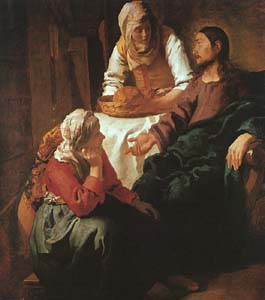
This goes to show that we still have a Martha problem today. The group Alabama said that they didn’t know why we get in a hurry, even though we’re not having fun, but I think I know the answer. The reason is that our loves and good desires are mixed with fears. If we would take that fear away, we would find peace.

Martha loved the Lord and wanted to serve Him well, but she had fears mixed in. She was the one who invited Him to the house and He probably had His apostles and other disciples with Him. She was busy serving them all, perhaps making the biggest meal she had ever made, and she was full of worries. “What if I’m a poor host and Jesus is disappointed with me? What if there’s not enough food for everyone to eat?”

We are often the same way. We fear that our lives are on the edge of disaster if our own plans and efforts should fail. We worry about bad things happening to ourselves and the people we love. We are anxiety about how Jesus feels about us.

Martha had a great desire to do good, but Martha’s fear tempted her to do harm. Her sister, Mary, was sitting at Jesus’ feet, listening to His words. (The Greek word for disciple actually means “one who sits at the feet of.”) Martha tries to take Jesus’ disciple away from Him.

Similiar thing can happen in our live on account of fear mixed with love. A husband and father can obsess about his work, out of a love for his family and a desire to provide, but his family can be left feeling like they come second in his life. A wife and mother can be so concerned that her loved ones will be safe and happy that she tries to control everything, making her family less happy because of it. Martha’s problem and ours is not that we work–work is a part of life–but in how we go about it.

Jesus says to Martha, and to us, “Martha, Martha, you are anxious and worried about many things. There is need of only one thing.” What is this one thing we need? We need the peace of Christ. What is the peace of Christ? It is several things.

It is the awareness that God is near and guiding us. In the first reading, three heavenly visitors approach outside of Abraham’s tent. Now, the Holy Spirit dwells within our tents, Jesus is at our side, and we have a Father above. We are never left on our own.

With the peace of Christ we recognize that whatever may happen to us or those we love, it is for our good. As St. Paul observes in the second reading, even his sufferings are a cause for rejoicing for they advance the salvation of the whole Church with Christ.

With the peace of Christ we recognize that misery is not just around the corner, nor is happiness out of reach. Happiness is at head, in the knowledge that Jesus loves us, likes us, cares about us, and cares for us. Living in the peace of Christ means there is no reason for us to be unhappy.

Let us continue to do works of love for God, ourselves, and others, but let us do them always in the peace of Christ.

We’re Inn-Keepers — 15th Sunday in Ordinary Time—Year C

July 18, 2010

The “Good Samaritan” is a very familiar parable, but there remains much for us to learn from it. Today I will present the history, the context, behind it; the symbolic meaning contained within it; and the challenge to ourselves that comes out of it.

Jesus’ story begins, “A man fell victim to robbers as he went down from Jerusalem to Jericho.” From this we might think that Jericho is south of Jerusalem because we put the South at the bottom of our maps. Yet, Jericho is actually some twenty miles to northeast of Jerusalem. The reason why the man went down from Jerusalem is that Jerusalem is situated 2,550 feet above sea level, while Jericho is about 1,200 feet below sea level, near the Dead Sea, which is the lowest place on the surface of the earth.

Jerusalem was the city of the temple, the place of God’s dwelling. Jericho, you may remember, was the city which Joshua and the Hebrews marched around for seven days, before blowing their horns and shouting, causing the walls to fall down. They conquered the city because it was in rebellion with God.

“The [robbers] stripped and beat [the man] and went off leaving him half-dead. A priest happened to be going down that road,
but when he saw him, he passed by on the opposite side. Likewise a Levite came to the place, and when he saw him, he passed by on the opposite side.”

You know what a priest is. He is one who offers sacrifice. What is a Levite? They were like acolytes or altar servers; they helped the priest offer the sacrifices at the temple. Why did they both pass by ‘on the opposite side?’ Maybe that they thought the man was already dead and wanted to avoid ritual impurity. The Mosaic Law taught that contact with a dead body made one ritually impure and ritual purity was necessary to worship at the temple. Whether this was their reason, or whether they just did not care enough to be bothered, another comes along who is both willing and able to help.

“…A Samaritan traveler who came upon him and was moved with compassion at the sight.” Who are these Samaritans? We hear about them in the Gospels and we know they didn’t get along with the Jews. For instance, the woman at the well that Jesus meets in John was a Samaritan. Where do they come from?

Some five hundred years before the coming of Christ the Babylonians were the superpower of the ancient world. When the king in Jerusalem decided he was not going to pay tribute to Babylon anymore, the king of Babylon was not pleased. He sieged Jerusalem, conquered it, and carried the region’s inhabitants into what is called the Babylonian Exile. Not everyone was taken though; some of the poor, the farmers and the vine-dressers, were left behind. To ensure that the people did not rebel again, and to make sure that the land did not go to waste, the Babylonians settled five pagan nations in the land.

Seventy years later, after the Babylonians had been conquered by the Persians, the new king gave the Jews permission to return to their homeland. When they got there they found that the people who had remained behind had intermarried with the pagans, in both their families and religion. The Jews regarded these people, these Samaritans, as unfaithful to the Lord. It is no coincidence that the Samaritan woman at the well had had five husbands.

Jesus chooses a Samaritan as the protagonist, the hero, of his story. He does this to show us an example we are to follow. The Samaritan was not Jewish victim’s neighbor geography, for he was only a traveler to the region, nor was he related to him by blood, nor by prior friendship. In the same way, our neighbors are not to be only those who are close to us in distance, are in our family, or who have shown kindness to us. Everyone is to be our neighbor. Such is the meaning of the parable in its historical context, but contained within this story there is Christian symbolism, as well.

The man who fell to the robbers is you and I, this man represents all mankind. Traveling from Jerusalem to Jericho, we were descending from the height of communion with God to the depths of rebellion. We fell to robbers, to evil spirits and evil desire. These stripped us naked, depriving of our original honor and glory. They beat us and left us half-dead; biologically we still lived, but spiritually we were dead. No one could or would help us. But then the Good Samaritan came. This man is Jesus Christ.

He looked upon us and was moved with compassion. Jesus approached to us and poured His blood on us, like wine, to cleanse the wounds of our sin. He poured the Holy Spirit on us like oil to make us strong again. Jesus gave us his teachings and commandments as bandages for our wounds. These disciplines bind us, yet they free us through the health they provide. Jesus lifted us up on his own animal.  This beast of burden was his own flesh. He took us to the inn, which is the Church, and here He continues to care and provide for us in it until the time of His return.

Even though the man who fell to the robbers is meant to symbolize each one of us, I don’t think he is the character in this story with whom we can most identify ourselves. The character I have in mind is one everyone overlooks. I don’t mean the Good Samaritan, nor the priest or the Levite. The character I’m thinking of is the inn-keeper, who is only mentioned in passing.

Here’s all that Jesus tells us about the inn-keeper: “The next day [the Good Samaritan] took out two silver coins and gave them to the innkeeper with the instruction, ‘Take care of him. If you spend more than what I have given you, I shall repay you on my way back.’”

Most of us here entered into the Catholic Church when we were baptized as infants. So we don’t remember being brought into the Church, half-dead.  For us, it feels like this inn has always been our home. This is where we have lived and worked for as long as we can remember. So I think we may identify more with the inn-keeper, more then the victim who has been gratefully saved. With this comes a challenge for our lives.

We are like the inn-keeper.  We are comfortably at home, and business is good. The Samaritan brings in this guy like a sack of potatoes, buys a room and takes care of him. That’s fine with us, but this Samaritan guy comes along and instructs us to take care of this friend of His. Now he is shifting that job onto us. Sure he’s given us some coin for doing it, two silver denarii, the sum of two day’s wages, and he says that if we spend more than what he has given he will repay us on his way back, but do I really want this hassle?

Besides, is that Samaritan fellow really coming back?  If not, then the more I give caring for this invalid the less I’ll have left for myself. If I’m stuck with the bill for this guy and his friend, them I’ll feel like a fool. On the other hand, if I just toss the guy out of my inn, or just ignore him while he’s here, that’s two day’s profit for me guaranteed. If I just pretend that I never heard that Samaritan’s instructions, if I can just quiet my conscience, I’ll get along just fine.

I’m busy enough as it is already. Is playing nurse to this crime statistic really worth my time? Do I trust that Samaritan? Do I believe he is he truly good?  Do I believe he is really coming back? Jesus is the Good Samaritan, and he brings many people to our lives and asks us to take care of them in our inn. Are you living as though Jesus is really coming back to repay each of us according to our deeds, or are you just minding your own business?

Everything you have comes from Jesus, and everything you have belongs to Him.  He is entitled to your time, talents, and treasure and He wants you to share them with your neighbors. Do not fear, don’t be afraid. The truth is that you can never spend more than what He has given you. Act with confidence that He will repay you an amount far greater than you give, not only at the end of your life, but even by the end of the day.

Jesus Christ’s command which He “enjoin[s] on you today is not too mysterious and remote for you. …No, it is something very near to you, already in your mouths and in your hearts; you have only to carry it out.” You shall love your neighbor as yourself.

Pushing Boulders — 13th Sunday in Ordinary Time—Year C

July 1, 2010

Once upon a time, there was a hermit who lived in a cabin in the woods.  Each day, he would spend a good deal of time in prayer. One day at prayer he quieted himself, opened himself receptively to God, and heard Jesus speak to him. It’s wasn’t that he heard Jesus externally, speaking from across the room, but within his own thoughts. The hermit knew from experience that the Lord sometimes sends us an image, a memory, a song, or words in times of prayer to communicate with us.

The Lord said, “Go outside to the large boulder in your yard.” The man got up and went. Then the Lord said, “I want you to push this boulder for at least 30 minutes every day.” The man went about pushing the boulder every day, exerting his body in every way, but even months later he could not discern having moved the stone a single inch.

The man thought to himself, “Am I doing something wrong? Am I failing because of my sins or my lack of faith? The Gospels say that if I had faith the size of a mustard seed I could move mountains, but I can’t even move this stupid boulder.  Am I failing because this isn’t really God’s will? Did the Lord really tell me to do this, or did I just imagine it myself? No I heard Him, as surely as the other times when I heard Him speak. But why does He give me a task that He knows I can’t do? Does He want me to fail?” At this the man became very angry and (wisely) took his frustration to God. 

The man heard the Lord speak to Him, “Do you have reason to be angry? I told you to push the boulder, but I never told you to move it. Look at your arms, look at your legs, you have become strong because of your faithfulness and now you are ready for my next mission for you. You thought you were failing, but you succeeded in doing my will.”

In today’s gospel, Jesus turns resolutely toward His final journey to Jerusalem. He sends out advance teams to visit the towns ahead of Him and prepare His way. One of these villages is a Samaritan town and when they learn that Jesus’ destination is Jerusalem they refuse to welcome Him. James and John see this and ask, “Lord, do you want us to call down fire from heaven to consume them, like Elijah did back in the day?” Jesus turns and rebukes them; the fire of the Holy Spirit is meant for the salvation of people, not their destruction.

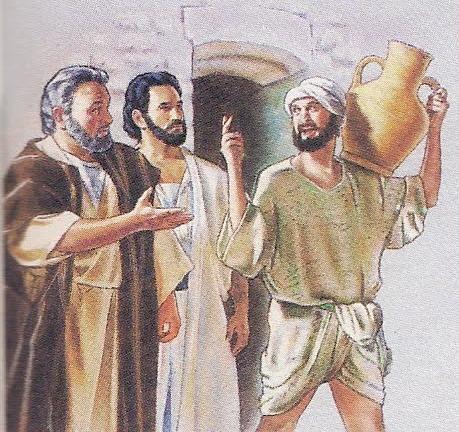
Why did Jesus send His disciples to that Samaritan town, instead of just instructing them to pass it by? Jesus knew what was going to happen when they went to that village–He knew by His divine insight that they wouldn’t accept Him. Remember when Jesus needed a donkey to ride on into Jerusalem? He sends two disciples to find and untie a donkey who had never been ridden before and He tells them what to say if anyone asks what they are doing. They go into the city and find everything as Jesus had described. Remember when Jesus needed a place to celebrate the Last Supper? He tells Peter and John to go into the city and to follow a man they will see carrying a jar of water, when they come to the house he leads them to, they are to ask if there is a place for the master to celebrate the Passover. They go and find everything a Jesus described, including an upper room already prepared for a Passover. Jesus knew that the Samaritan town would not welcome Him, so why did He send disciples there?

The mission may have seemed like a failure, but Jesus’ plan succeeded. Jesus knew that His Apostles would soon be preaching the Gospel to the whole world and He knew that not everyone would welcome them or their message. Jesus wanted to give them some experience in rejection to teach them how to respond; not with anger and violence, but with patience and peace. James and John learn a lesson about divine mercy. They may have thought their mission to the Samaritan town was a total failure, but the Lord was successfully achieving His goals in them.

So what does all this have to do with us? In our lives we often experience weakness, setbacks and apparent failures. In response, we often blame ourselves, even when we are innocent, or we conclude that we must not have been doing God’s will, or we get angry with God for frustrating or not helping our efforts. Yet, as long as we are faithfully following Christ, nothing we attempt is ever truly a failure.

The only true failure in the Christian life is sin, but if we repent of our past sins even these can be used to benefit God’s great plan. Scripture says, “God works all things for the good of those who love Him,” this even includes our repented sins. We are obsessed with success, but as Blessed Mother Teresa reminds us, “God does not ask us to be successful; He asks us to be faithful.”

Sometimes you will feel like you are failing, or that your efforts have been useless, but by your faithfulness you will be succeeding in doing God’s will. Let us remember that at the center of our faith is a man nailed to a cross; an appearent failure who was actually succeeding in saving the world. Jesus rolls away stones in ways we wouldn’t expect.

Father’s Day Homily

June 19, 2010

“See what love the Father has bestowed on us that we may be called the children of God. Yet so we are.” (1 John 3:1) As St. Paul says in the second reading, “Through faith [and baptism] you are all children of God in Christ Jesus.” (Galatians 3:26-27) God is our Father who lives and reigns in Heaven. What is the fatherhood of God the Father like? What can we say about His fatherhood. I offer these insights:

The Father’s love begets life.
We see this in His Son, who is eternally begotten from the Father. And begetting is not a merely an action which the Father had done and then walked away from. The Son is eternally begotten from the Father in love.  And, as the Prologue of John’s Gospel says, “All things came to be through [this Son], and …. what came to be through him was life…” The Father’s love begets life.

The Father labors in love.
God the Father labors to fashion and sustain creation; heaven and earth and every creature, seen and unseen. He makes them in love and preserves them in love. As the prophet in the book of Wisdom observes, “[Lord,] you love all things that are and loathe nothing that you have made; for what you hated, you would not have fashioned. And how could a thing remain, unless you willed it; or be preserved, had it not been called forth by you? But you spare all things, because they are yours, O LORD and lover of souls, for your imperishable spirit is in all things!” (Wisdom 11:24-12:1)  The Father labors in love.

The Father guides His family.
The world became dark though sin, so the Father enlightened it. The people became lost without Him, so the Father guided them. The Father enlightens and guides His children by speaking His word to them. Jesus Christ is the Father’s word. The Father guides His family.

The Father is easily pleased by those who are His own, yet He calls them ever higher.
At Jesus’ baptism, the Father spoke from the heavens, “You are my beloved Son; with you I am well pleased.” Yet, as today’s gospel recalls, the Father also called His beloved Son to take up the cross. Four days before His Passion, Jesus said, “I am troubled now. Yet what should I say? ‘Father, save me from this hour’? But it was for this purpose that I came to this hour. Father, glorify your name.” Then a voice came from heaven, “I have glorified it and will glorify it again.” (John 12:27-28) On the cross, Jesus was not just lifted up, but exalted. The Father is easily pleased by those who are His own, yet He calls them ever higher.

The Father is just like the Son.
Some people find it difficult to relate to the Father, but the Father is just like His Son. At the Last Supper, Philip said to Jesus, “Master, show us the Father, and that will be enough for us.” Jesus said to him, “Have I been with you for so long a time and you still do not know me, Philip? Whoever has seen me has seen the Father. How can you say, ‘Show us the Father’?  Do you not believe that I am in the Father and the Father is in me? The words that I speak to you I do not speak on my own. The Father who dwells in me is doing his works.” (John 14:8-10)  The Father is just like the Son.

The Father transcends human fatherhood, but He is the origin and standard of all fatherhood.
God transcends the human distinction between the sexes. The Father is neither man nor woman: He is God. Although the Father is the origin of all fatherhood, He transcends human fatherhood. No one is father as God is Father. Yet, we who are earthly fathers, who have natural or spiritual families and children of our own, must take our Father in Heaven as our standard and model. Each of the insights I have given for God the Father have application for our fatherhood.

Your fatherhood should beget life.
Now the begetting of life is not merely biological, if it were then priests would not be fathers. There are some biological fathers who beget life and leave. These men fall very far short being true fathers. True fathers give life and nurture that life forever, like God the Father who begets His Son eternally. If you are a mother or father, even if even if your children should die, even if you should die, you are a mother or father forever.

Your natural fatherhood should be fruitful. More than just biologically, but biologically, too. What would you think of a priest who was both capable and called to work to beget more spiritual children by sharing the gospel, but who refused to do so for self-centered reasons. What if he were to say, “I’m happy with the number of parishioners I have already.” Your fatherhood should beget life.

Your fatherhood should be a labor in love.
Always remember whom you are working for and work for love of them. Beware of an ambitious careerism, which is all about you. What would you think of a priest whose primary ambition was to become a cardinal, instead of those entrusted to him. 

At home or at the workplace, labor in love for your family. And take time to rest and enjoy them. Even God the Father rested after His labors to enjoy how “very good” it was.

Your fatherhood should guide your family.
You are called to be a leader, guide, and teacher for your family. Your wife will not begrudge your lead if you love her and lead her as Jesus loves and leads the Church. Remember, Jesus died for His family and bride.

As parents, you are the primary educators of your children. Sometimes we think of education as only what happens at school. But the most important lessons in life are not taught in the schools, but in the home. The home is the domestic Church and the school of love.

In your fatherhood, let your children know your pleasure in them and always call them ever higher, to all they can be.
Always show them your pleasure, that with them you are well-pleased. But like God, love them too much to let us remain as we are.  Grow them to their full potential.

In your fatherhood, take the Father in heaven as your standard and model.
If you’re ever unsure of how to image the Father, look at His son, for Jesus is the perfect image of the Father. The Father is just like the Son.

May God bless all our Fathers, living or dead, and may help we who are fathers to be better ones.

Christ in the Sacraments — 11th Sunday in Ordinary Time—Year C

June 15, 2010

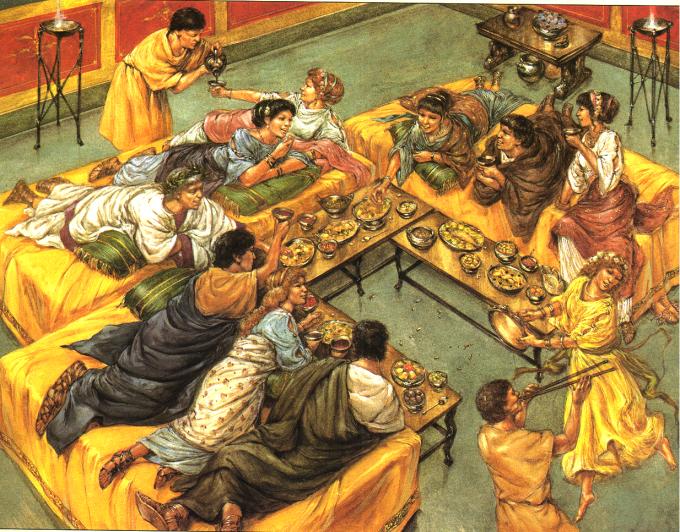
To understand today’s gospel, it helps to know a little about the Jewish culture of Jesus’ day.  For example, when the Jews would sit down to eat dinner they would not sit at all–they “reclined at table,” on beds that came up the edge of the table. You would have a cushion under your chest or under your side, as you ate with your free hand, with your legs laid out behind you. This clarifies how the beautiful, penitent woman was able to access to Jesus’ feet. This also explains how John was able to lay his head upon Jesus’ chest at the Last Supper to ask Him who would betray Him. The Beloved Disciple was not a contortionist–he was laying beside Jesus at table.

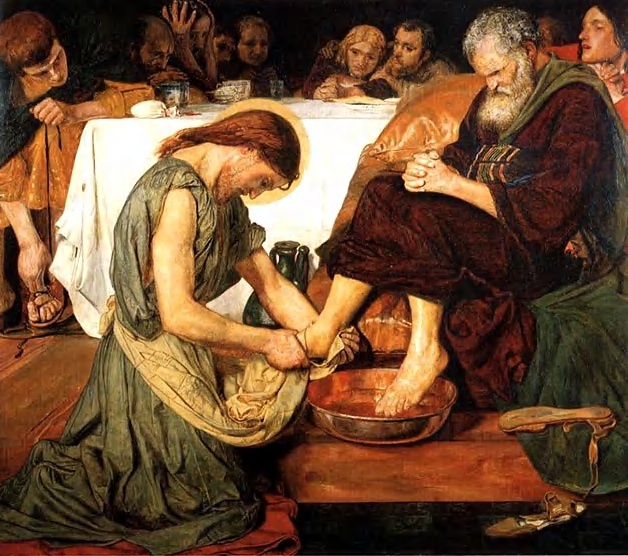
A second important thing to know about the Jewish culture of Jesus’ day to appreciate this gospel is to understand how they felt about feet. The Jews considered feet to be among the dirtiest, humblest, and lowliest parts of the human body. This is why our parish’s patron, St. John the Baptist, said, “[There is] one who is coming after me, whose sandal strap I am not worthy to untie.” In that Jewish culture, servants could not be commanded to wash the feet of others; it was considered even beneigth the dignity of a slave. Now we can understand the significance of the woman washing Jesus’ feet, and how much it means that Jesus later washed His disciples’ feet at the Last Supper.

But what was this woman thinking? Had she forgotten to bring a towel and a bowl of water at home? Was she so dumbstruck that her lips were unable to form the simple words, “I’m sorry and I want to return to God?” No, she knew what she was doing when she used her tears to cleanse, her hair to wipe, and her lips to kiss Jesus’ feet. When she heard that Jesus was going to be eating at the house of Simon the Pharisee I doubt she was holding that alabaster jar of ointment in her hands. No, she had to go and get it, and as she did she thought about exactly how she was going to approach Jesus.

What was Simon the Pharisee thinking? Had he forgotten about the customary curtesies in welcoming guests to one’s house in that culture: water for washing their own feet, oil for anointing one’s head against the harshness of the desert, a kiss in greeting at the door? Maybe he thought these were just optional, dispensible rituals. Regardless, Jesus put his finger on one major contributing factor: Simon the Pharisee loved Jesus little, while the beautiful penient woman loved Him greatly.

Simon gave Jesus an external gift, a meal in his home, but in addition to her ointment, the woman gave a gift of her very self; her tears, her hair, her kisses. As she had sinned with her body, she now sought to honor God though her body.

How does all of this apply to us? When we consider this beautiful, penitant woman and Simon the Pharisee relate to Jesus, we see two approaches the sacraments. For some, in the manner of Simon the Pharisee, the sacraments are just rituals, traditional customs, liturgical hoops the Church has us jump through. But for others, those with the heart of the woman who loved much, every sacrament is a personal encounter with Jesus Christ. If you onlt remember one thing from this homily, remember this: every sacrament is a personal encounter with Jesus Christ.

Consider the sacrament of marriage. Today, some people say, “As long as we love each other, what difference does a ceremony in a church and a piece of paper make?” But these people do not realize that the sacrament of marriage actually makes present the love between Christ and his Church. The love between husband and wife not only resembles the love between Christ and his Church–like all the sacraments, marriage actually makes present. If your marriage is sacramental, and you and your spouse do not put up obstacles in the way, you can experience firsthand to love with which Jesus loves His bride, the Church, and how the bride receives her Lord. You experience the intimacy between the two and you can tap and draw on their love and the power in your marriage. marriage is a personal encounter with Jesus Christ.

Today, some people say, “I don’t really have any sins, but if I did, why should I have to go tell my sins to a priest to have my sins forgiven? God can hears my prayers. Won’t he’ll forgive me anyway.” Imagine if the penitent woman had stayed away from Simon’s dinner party that night in the gospel and prayed to God at home. Would she have been forgiven? Perhaps, but she would not have had her life-transforming encounter with Jesus Christ. When you go to confession, you are personally encountering Jesus through the priest. If the priest does not put up obstacles in the way you will hear the words of Christ to you. And even if the priest does get in the way, you will hear that words that Jesus wants you to hear, just as He had said to the beautiful penitent woman: “Your sins are forgiven, go in peace.” The sacrament of reconciliation is a personal encounter with Jesus Christ.

These days some people say, “There’s a lot of Sundays in the summertime and a lot of things to enjoy on the weekend. Is it really that important that we come to Mass every Sunday?” To ask this about the most Blessed Sacrament is to be like Simon the Pharisee. Had Jesus not come as his guest that night, Simon would not have missed Him much; Simon would not have been that disappointed. And even after receiving Jesus under his roof, I can imagine Simon being left unchanged. But the beautiful penitent woman, who took Jesus’ flesh to her lips, was forgiven her sins and was filled with grace by the encounter.

In the celebration of this sacrament, and at every sacrament, let us appraoch Jesus with her humility, reverence, and love.

Real Presence — Corpus Christi

June 7, 2010

I once came across a story on the internet that went something like this: A Catholic man is giving his Muslim friend a tour of his Catholic Church. He shows him the holy water at the door and how we bless ourselves with it. He points out the stained glass windows and the stations of the cross, explaining how these present the majore events of Jesus’ life, death, and resurrection. He shows him the statues and the crucifix and finally the tabernacle.

“That’s the tabernacle. Inside that box is the Eucharist. It looks like flat, white bread, but it is truly the Body, Blood, Soul and Divinity of Jesus Christ, our Savior and God.”

The Muslim man looks at the tabernacle, pauses in thought, looks at his friend, and says, “If I believed that God was really present in that box, I wouldn’t let my face come off of the floor.”

Whose approach towards God is the right one: the Catholic’s or the Muslim’s? When we come up to receive communion we do not crawl up on our faces, but should we?

Christians relate to God as we do because of the way Jesus Christ related to us. With the incarnation, God came to us on our level, as one of us. Jesus did not want his disciples to regard him with terror. He invited them to be His friends, and to relate to Him as their Brother. He taught us to call His Father “our Father,” and he made us temples the Holy Spirit. Jesus gives us unprecedented intimacy with God and we are “free to worship Him without fear.”

Yet, there is some truth in the saying that familiarity breeds contempt. When we come to Mass and receive the Eucharist, how well do we prepare ourselves to receive Him? How much do we do to appreciate this priceless gift? This morning I would like to give some ways we can do this better.

Before we even leave home there is a way for us to prepare ourselves. Think of it this way: if you were going to be on TV and seen by a millions, what would you wear? If the president of the United States (whoever he happened to be) were coming to your town, and you were chosen to officially welcome him, how would you dress? At Mass we are not seen by millions, but by billions of angels and saints, and we more than just the president of the greatest country in the world, we meet the King of the universe. When we come to Mass we should wear our Sunday best.

When you arrive at church before Mass begins resist the temptation to just wait out the time until the priest comes out. Take the opportunity to prepare yourself with prayer. At the beginning of the liturgy there are some things we do to tune us into the liturgy, such as the penitential rite and the opening prayer, but if you have not prepared yourself before the Mass begins these will probably just flash by you.

When you get to your pew, say to Jesus, “Lord, I’m sorry for my sins. Please have mercy on me. Please help me to be as fully present as you are present. Help me to receive everything you want me give me in this Mass. I raise up my intention for this Mass you along with all I love and everything I am. Thank you for calling me to know you, and for everything.”

During the Mass, especially when Jesus is on the altar, his throne, we should give Him our full attention. Religious devotion is about more than mere appearances, but shouldn’t we expect a fervent devotion inside to be reflected on the outside?

When I was growing up and beginning to look at my faith more critically, I wondered if we really believed in the Real Presence. I mean, the symbolic understanding, that’s easy—like how the flag reminds us of America, but do we really, really think that’s Him? My CCD teachers insisted that’s what we believed and I found scriptural and historical evidence that Christians had always believed it.  Yet, when I looked around at other people at Mass it didn’t seem like they believed they were in the presence of God. Then an important thing happened. A new pastor came to our parish and when he celebrated the Mass you could tell that he believed he held something (Someone) precious in his hands. That priest was Father Paul Gitter, whom you know well.

During the Mass, give God your whole self. Express your devotion. Whenever you sing, don’t just do it because that’s what everyone else is doing—make it an offering, a gift, a prayer. When you are praying to the Father, raise you eyes to Him. When you are speaking to Jesus, turn you eyes to Him. Smile at Him in the cup and on the paten. Celebrate every Mass as if it were your first, your last, and your only.

After you receive Jesus in the Eucharist, open yourself to receive everything that He wants to offer you. In His private revelations to St. Faustina Kowaska (through whom we received the Divine Mercy devotion celebrated throughout the Church) Jesus said many people receive Him and then forget about Him. “My great delight is to unite Myself with souls,” He said. “When I come to a human heart in Holy Communion, My hands are full of all kinds of graces which I want to give to the soul. But souls do not even pay any attention to Me; they leave Me to Myself and busy themselves with other things. Oh, how sad I am that souls do not recognize Love! They treat Me as a dead object” (Diary of St. Faustina, #1385) After you receive Him, and kneel down in the pew, ask that you would receive from Him every grace He wants to give you with Himself. And remember to tell Him, “Thank you,” and, “I love you.” It’s the least that we can do.

When we leave church after Mass, let us not think that we have left Gift we have received behind us. Jesus also told St. Faustina that when we receive the Eucharist He remains in our souls until we receive Him again, provided that we do not cast Him out through serious, grave sin. He remains with us and provides what we need to serve Him.  We only have to remain open and mindful towards Him.

Jesus feeds us His Body and Blood because He wants us to be extensions of Himself. We the Body of Christ. We are His arms, His hands, and His eyes, ears, and mouth in the world. First, He transforms the bread and wine. Next, He transforms us. And then, He transforms the world. When ‘the Mass is ended,’ that’s just the beginning.

In a few moments we are going to receive the Body, Blood, Soul and Divinity of Jesus Christ in the Eucharist. Let us prepare ourselves and open ourselves to receive this most incredible Gift.

A Mystery Revealed — Trinity Sunday

June 2, 2010

You may recall my mention of one of my favorite professors at seminary, Dr.  Perry Cahall. And I remember him telling us one day in class, “If, someday when you’re a priest, I hear that you got into the pulpit on Trinity Sunday and tell the people, ‘You know, the Trinity is a mystery, and so there’s really nothing we can know or say about it…’ I will hunt you down like the dogs you are.” This is my first homily on Trinity Sunday, and I’m going to make sure I give Dr. Cahall no reason to come after me.

The Trinity is a mystery, but that doesn’t men we know nothing or can say nothing about this central mystery of our Faith. In Catholic theology, a “mystery” is not something which is unknowable to us, it is just something which our human reason could not have discovered on its own.

Imagine if you came upon a sophisticated and well-written mystery novel. It’s so good that you can’t put it down. But as you get towards the end, you discover that the last couple chapters of the book are missing. You noticed some clues as the story unfolded, but without those last pages you can’t figure out the identity of the one “who did it.” You might try to find the ending in another copy of the book, but what if no other copies existed and no one had ever read the ending before? Your only hope would be to speak with the author. The author could tell you the rest of the story. The author could unveil the mystery for you and reveal the identity of the one “who did it.” Like that in sophisticated mystery novel, our God has placed clues throughout creation and His Old Testament interactions with His People. Yet, it was not until the coming of Jesus that the “who done it” was plainly revealed: God, the Author of the universe, is Father, Son and Holy Spirit.

Today I would like to talk about some common questions people have about the Trinity. For instance, how is God both one and three, and then what difference does the Trinity make?

Some people have trouble with the concept of the Trinity because they think it is the claim that “one equals three” in God. However, this is not what we believe about the Trinity. The number one does not equal the number three, not in God or anywhere else, and not even the omnipotent power of God can make a logical contradiction true.

We believe one God, comprised of three divine persons: the Father, the Son, and the Holy Spirit. God is one What, as three Who’s. There is one divine nature, but three divine knowers, three divine willers, and three divine actors. We do not believe in three anonymous forces, but three loving persons. There is no God apart from or beyond these three persons.

Now the Father is not Jesus Christ. Jesus is not the Holy Spirit. And the Spirit is not our Father. They are distinct persons. Yet, at the same time, each possesses the fullness of the divinity: perfect goodness, infinite beauty, perfect knowledge, infinite power, perfect mercy, and infinite love. We do not worship three gods, but three eternal persons who comprise one God.

The belief in the oneness of God was firmly instilled into the Jewish people. This conviction helped to keep Israel from falling into the worship of false gods and experiencing all of the evils that brings. For instance, Israel’s Canaanite neighbors were idolaters, who worshiped mere objects as gods that could make them happy. They practiced child sacrifice, killing their own children in hopes of receiving greater blessings in this life from the gods. And they had temple prostitution, in which promiscuous sexuality was as hailed as sacred.

Notice how our society has become more and more like those pagans as it has drifted from belief in the one true God. Our worship of objects which we think can make us happy is called materialism, or consumerism. Our human sacrifice, done in hopes of greater blessings in this life, is called abortion. And some have raised up sexual promiscuity as the way of greatest freedom and happiness.

The Jews were spared all of these evils so long as they clung to their conviction that “All gods are not the same, and we are to worship only one.” The God of Abraham, Isaac, and Jacob. Even to this day, observant Jews pray a prayer twice daily called the “Shema Yisrael,” from a passage in Deuteronomy:

“Hear, O Israel! The LORD is our God, the LORD is one!  Therefore, you shall love the LORD, your God, with all your heart, and with all your soul, and with all your strength.”

Jews remain Jews today because they do not believe that Jesus is the promised messiah, or the Christ, the one for whom they have been waiting. Sometimes they criticize Christians saying we are not really monotheists, but polytheists, who believe in three gods: “The LORD is our God, the LORD is one!”

Yet, revealingly, the word that God inspired in this Old Testament passage (“The Lord is one”) is not one of the words in Hebrew which always means numerical and solitary oneness (such as “yachid” or “bad”.)  Instead, the Holy Spirit selected a word which usually means a unified oneness: “echad.” This word (“echad”) is the same word used in Genesis, where God says of man and woman, “the two shall become one flesh.” In their union, the persons are as one being. And recall, God had said, “Let us make man in our image , after our likeness. …[And] God created man in his image; in the divine image he created him; male and female he created them.” When husband and wife become a unified one, as one couple, in time, they are in the image and likeness of the Father, Son, and Spirit, who have are a unified one, as one God, eternally.

So what difference does the reality of the Trinity make for our lives? The Trinity shows us that God is not a solitary individual, isolated and alone. God is a loving communion of persons. This is the reality we come from, and this is the reality we are called to, in this life and the next.

In our post-modern age, some people talk about “the meaning of life” as if it were some kind of joke, or an unsolvable mystery beyond our capacity to discover or know. But we Christians believe we know the meaning of life, for it has been revealed to us. The meaning of life is the loving communion of persons. The loving communion of persons is what gives our lives meaning and it will be our primary delight forever in Heaven. Love is the reality we come from, and the reality we are called to.

‘Hear, O Church of God! The LORD is our God, the LORD is a unified one!  Therefore, you shall love the LORD, your God, with all your heart, and with all your soul, and with all your strength.’ Love the Lord your God, who is Father, Son, and Spirit, and become like the God you love.

Relating to God Personally — Pentecost Sunday

May 23, 2010

In the Old Testament, the truth that God is a unity of three persons, that God is triune, that God is a Trinity, was only obscurely presented. The knowledge that God consists Father, Son, and Holy Spirit, only became clear to us through Jesus Christ. Our one true God has always been three persons: the Father, the Son, and the Holy Spirit.

Now the Father is not Jesus Christ. Jesus is not the Holy Spirit. And the Spirit is not our Father. They are distinct persons. Yet, at the same time, each possesses the fullness of divinity: perfect goodness, perfect beauty, perfect knowledge, and perfect power, perfect mercy, and perfect love. We do not worship three gods, but three eternal persons who comprise one God. There is no God apart from these divine persons.

Sometimes we say we are “praying to God,” and that is well and good. But when we are “praying to God” we should not imagine that we are speaking to some fourth person, to some divine abstraction above or beyond the three. If you don’t know which divine person you have been praying to at such times, you have been praying to the Father, through the Son, in the Holy Spirit. (Notice how the prayers in the Mass are always addressed to particular divine persons; usually the Father, but sometimes the Son.)

If you have been a Christian who has always directed your prayers some abstract Christian divinity, who is neither Father, Son, nor Spirit, I trust that your prayers have still been heard within the Trinity. And if you have never related to the Holy Spirit as a real person who knows and wills and loves, but only as some abstract force, I am confident that He has blessed you with His gifts and produced His fruits in you even without your asking. But Christianity is all about loving communion with  persons. Not forces, not abstractions, but persons: persons human, angelic, and divine.

Do you have a personal relationship with each of the persons of the Trinity; with Jesus Christ, with our heavenly Father, and with the Holy Spirit? If not, then it’s important that you begin to cultivate these relationships in prayer, for we are called to love God, and only persons can be truly loved.

On this Pentecost Sunday, we recall the gift of the person of the Holy Spirit to the Church. The Holy Spirit does not begrudge it when we ask Him for good things, for ourselves and for others; no, He is pleased when we ask and pleased to give. Gift is who the Holy Spirit is. But today and henceforth let us always speak to Him and the other divine persons in a personal way with a great personal love.

Mother’s Day Homily

May 9, 2010

This Sunday our country celebrates our mothers—and rightly so. For the care and love which our mothers have given us is beyond price or measure. Of course, our earthly parents are not perfect. Sometimes they’re quite far from perfect. But any love we’ve known from them is a likeness of the love God has for us.  A religious icon is made of mere wood and paint, but it can be a window to heavenly realities.  In the same way, we can see through our parents’ love a glimpse to God Himself.

Most of us have more memories about our mothers than we could possibly count, but today I would like to take you back to a time and place about which you have no clear memories—to the time in your mother’s womb.

In the Bible, the number forty denotes times of waiting and preparation: For instance, Noah spent 40 days and nights in the ark. The Hebrews wandered with Moses for 40 years in the desert. Before His ministry, Jesus fasted 40 days in the wilderness, and after His death, He rested 40 hours in the tomb. Similarly, you remained 40 weeks, more or less, within your mother’s womb, being prepared for a new life.

Attached to your mother’s vine you grew into the mature fruit of her womb. You were nourished and matured within her. You were never far from her heart or mind. You existed in within her, connected to her at the center of your being. She fed you with her very self. She provided for all your needs. Apart from her, you could do nothing. You remained in her and found rest within her.

In the womb, at the earliest stages of our lives, our minds did not comprehend very much, but what if you could have understood everything that your mother was doing for you at the time? Surely you would have directed your thoughts to her often.  And certainly, from time to time, you would have turned to her with the eyes of your heart to bask in her love for you.

What if you could have talked with your mom from the womb? Would you not have taken the opportunity to speak with her every day? Would you not have thanked her daily out of a deep gratitude? Would you not have let her know each day how much you love her? Whoever would refuse or neglect to express such love and thanks would continue to live, at least functionally or biologically, but they would not be fully alive without this relationship with their mother.

As you and your mother would continue to talk, as the days and months of pregnancy passed by, she would eventually present you with a most-frightening prospect: She might put it this way, “My child, soon, in a little while, you are going to begin a new stage of your life. You will be departing from the life you know, and then you’ll experience a whole world of people and things you have never known before.”

You might say, “I’m scared! I don’t want to go—not now, not ever!” But she would answer, “I realize this concept is scary for you, but trust me when I say that it is better that you go. In fact, someday soon you’ll look back and think it a silly thought to be again as you are now. This transition is going to hurt a little bit… trust me, I know… but when the appointed time comes, I’ll be right here with you. Don’t be afraid. It’s going to be O.K.”

This morning we reflect on this time in the womb because our life in our mothers is like our life in Christ. As it was with our mothers, so it is, in our life with Christ. You are attached to Him as to a vine you mature as a child of God. You are nourished and grow within Him. You are never far from His heart or mind. You exist within Him, connected to Him at the center of your being. He feeds you with His very self. He provides for all your needs. Apart from Him, you can do nothing. You remain in Him and find rest in Him.

Knowing and believing this, shouldn’t we direct our thoughts to Him often? Shouldn’t we, from time to time, turn to Him with the eyes of our hearts to bask in His love for us. We have the ability to talk with Jesus Christ, in prayer, whenever we wish. Who would not take the opportunity to speak with Him every day? Who would not thank Him daily out of deepest gratitude? And who would not let Him know each day how much we love Him? Whoever would refuse or neglect to speak with Him, would continue to live, at least functionally or biologically, but they will not be fully alive without this relationship with Christ. We need to pray every day if we want to remain in Him and bear much fruit.

We don’t want to die and that’s perfectly natural. But Jesus says to us, “Soon, in a little while, you are going to begin a new stage of life. You will be departing from the life you know, and then you’ll experience a whole world of people and things you have never known before. I realize this concept is scary for you, but trust me when I say that it is better that you go. In fact, someday soon you’ll look back and think it a silly thought to be as you are now again. This transition is going to hurt a little bit… trust me, I know… but when the appointed time comes, I’ll be right there with you. Don’t be afraid. It’s going to be O.K.”

Today, let us thank God for the life, love, and tender care we have received from our mothers and through Jesus Christ. God bless our mothers and praised be Jesus Christ.

Gift of Self — 5th Sunday in Easter—Year C

May 2, 2010

I would like to begin today by telling the beautiful story of a gorgeous young woman named Leah Darrow. Leah grew up in a strong Catholic family in Oklahoma, but when she was in high school she says that her Catholicism started to get “fuzzy.”  By the time she was in college Leah says she had become a “Catholic But.” She would say, “I’m Catholic, but I don’t agree with the Church’s teaching on cohabitation,” or, “I’m Catholic but I don’t see the problem with a couple who love each sleeping together before their marriage… I think the Church is behind the times.”

One evening at college she saw a reality TV show called “Americas’s Next Top Model,” with Tyra Banks and thought to herself, “I’m pretty cute, maybe I could be on that show.” She tried out and got on, but lost the competition, yet she was resolved not to let her TV elimination mean the end of her modeling career. And she was rather successful.  She still recalls her excitement at receiving her first paycheck with a comma (a comma!) in it.

Leah eventually found herself at a photo-shoot high above 5th Avenue in New York that would change her life forever. She came to pose for an international magazine which wanted to help her develop a more risque image. They brought out a number of itsy-bitzy outfits for her to wear.  She picked one out and shooting began. Now Leah says that every model knows not to look at the flash when the photos are being taken (and she insists that she didn’t look at the flash) yet while she was posing, a vision flashed in her mind, three images in the span of perhaps a second or two. This is what she saw:

She saw herself standing in a large white space in the immodest outfit she was wearing. In this scene she wasn’t in pain, but she had the sense that she had died. In the second image Leah was looking up, holding out her open hands at her waist, with the knowledge that she was in the presence of God. In the third and final image, another white flash hit her eyes and Leah saw herself holding her hands all the way up, offering to God all that she had, but in that moment she realized that she was offering Him nothing. For her entire life up to that point, with all of the blessings, talents, and gifts that God had given her, she had wasted them all on herself. If she had died at that moment, Leah knew that she would have nothing to offer Christ.

She came back to reality when the photographer said, “Leah, Leah, are you OK?” She shook her head and said, “No, I can’t.” He said, “Ok, we can go over here.” And she said, “No, I can’t .”  She ran back to the makeup counter, changed back into her own clothes, and ran down 5th Avenue, balling her eyes out, afraid that she might be losing her mind.

She called her dad and said, “Dad, if you don’t come get me I am going to lose my soul.” Dad drove across the country to New York, and when he arrived she wanted to leave town, but he said he couldn’t wait to see the sights; Central Park, the Empire State Building, the Carnegie Deli, “But first we go to confession.” She made a good, tearful confession spanning the ten commandments like she was ordering off the dollar menu: ‘Two number ones, four number twos…’ She came out like a new woman, healed.  Today she goes around telling her story and supporting an organization that promotes modesty in young lades’ dress.

Leah says she was living a very selfish life before her conversion. Perhaps she was confused, as many in our culture, about the nature of true love. In English we use the word love in a broad and ambiguous way.  We say, “I love that TV show. I love the Packers. I love my children. I love my wife. I love God. I love my dog.” But all of these loves are different in kind and degree. When we say, “I love pizza,” or, “I love wine,” it is not really pizza and wine that we love so much as  ourselves.  I love myself, and that’s why I consume pizza or wine. Yet, not all love is easy, warm, and fuzzy. True love is a sacrifice, and often feels that way.

As St. Paul tells us in the first reading, “It is necessary for us to undergo many hardships to enter the kingdom of God.” And Jesus says in the gospel, “I give you a new commandment: love one another.” Love how? “As I have loved you, so you also should love one another.” How did Jesus love us? Through a total gift of self.

Now we know from the Gospels that Jesus’ self-giving wasn’t always a ordeal. It was often joyful. Jesus enjoyed going to weddings, dinner parties, and spending time with His friends. But Jesus’ acts of love were the most powerful and manifest when they were hard, as when He was on the cross.

Self-gifting love powerfully good. Someone can live a life of great fame and wealth, but without self-gift their life will account for nothing.  This is the world of difference we see between George Bailey and Mr. Potter in It’s a Wonderful Life.

Difficult self-gifting love is also the most powerful witness. Some theologians have speculated that Jesus could have redeemed in other ways besides the cross. (Perhaps a single cry from the infant God-Man would have been enough if that had been the divine plan.) But Jesus dying for us on the cross communicates a powerful message about His love for us. Jesus said, “This is how all will know that you are my disciples, if you have love for one another.” The way we love should be a witness, it should make us stand out.

Earth is a training ground. Our life here on Earth is training for Heaven. In Heaven, self-gifting is the rule and the norm. If that’s not the sort of thing we are interested in, there will be no place for us to be at home in heaven–and there is only one other place for us to go forever. In today’s second reading, Heaven is seen “coming down out of heaven from God, prepared as a bride adorned for her husband.” It is a revealing description, for spousal relationship prepares us for the life of Heaven.

We are all called to marriage and parenthood, either natural or spiritual. Some are called to live single lives, to enter religious life, or be ordained, in a fruitful spousal relationship with Christ and/or His Church. Others are called to natural marriage and to fruitfulness seen in their spousal love and its natural or spirital children.

Self-gift is the life of marriage. What if there is a priest who does not pray, who does not serve, but who seeks only his own comfort? Such a priest will eventually leave his priesthood. So it is with a natural marriage. If one spouse seeks just their own pleasure, their marriage will seem empty. But if both spouses seek to make a self-gift to the other, they will both be satisfied. Jesus said, “Seek first the kingdom of God, and His righteousness, and all thing will be added on to you.” If we go for self-gratification, even that escapes us, but if we focus on self-gift, satisfaction comes as well. This is the reason for the Catholic tradition of a crucifix hanging over a husband and wife’s bed.

Jesus has given us a new commandment: love one another. As He has loved us we should love one another. Such love is powerful. It should make us stand out as disciples of Christ. And it prepares us for the life of Heaven, where self-gift is rule.

Leah Darrow Interview on the Drew Mariani Catholic radio show (4/30/10)

Leah Darrow Talk to a Boston Catholic Women’s Conference (2/27/10)

Clearing Heaven’s Haziness — 4th Sunday in Easter—Year C

April 25, 2010

Today, St. John has a vision of a great multitude, which no one could count, from every nation, race, people, and language. They wear white robes and hold palm branches in their hands. They stand before the throne and before the Lamb (who is Jesus Christ,) and in His temple they worship Him day and night. St. John is glimpsing the worship in Heaven.

Heaven should be one of our great consolations in difficult times and we should really be excited about going there someday. But I think that we often have faulty ideas about Heaven that can get in the way of us being excited or consoled. For instance, maybe you heard the first reading today and thought, “The idea of standing night and day and holding a palm branch doesn’t seem that awesome to me; and going to Mass for an hour is well and good, but I don’t know how I could enjoy going to church forever in Heaven.” Concerns like these would understandably make us weary of Heaven.

We need to recognize that the Book of Revelation is symbolic.  Not everything we see in John’s vision is not literally what we’ll get in Heaven. For instance, St. John sees Jesus as a lamb who was slain and having seven horns and seven eyes. That’s one odd looking lamb, but this is symbolism. The image of the lamb recalls Jesus’ sacrifice, His horns imply perfect power and His eyes imply perfect wisdom. Likewise, the multitude’s white robes point to their dignity, their palms signify their victory, and they are standing because that is the traditional posture for worshiping God. The God who created the universe, and all of the good things we enjoy in it, surely has more to offer us than just palm branches, white robes, and boredom in Heaven.

You have heard it said that we will enjoy the “beatific vision” in Heaven, but you maybe wonder, “How could I enjoy staring at God forever?” But the phrase “beatific vision,” is also metaphor and the experience means more than mere gazing. The “beatific vision” is the immediate knowledge of God enjoyed by the angels and saints in Heaven. We call it “vision” because it is an experience of God which is direct, not mediated, and in the fullest depth and detail which our souls can receive. We call this vision “beatific” because intimately experiencing God, what the prophets call beholding Him “face to face,” gives perfect happiness.

The saints in heaven experience this beatific vision now, even though, (except for the Virgin Mary, and perhaps Enoch, Moses, and Elijah,) none of the saints have their bodies yet. Their flesh is still on earth awaiting the resurrection. But this raises the question of how can we experience anything without having our bodies?

Think of it this way: When I am asleep I see nothing with my eyes (for they are closed.) And in the silence, I’m not hearing anything with my ears. There’s nothing to taste nor smell, and even if I’m feeling the bed sheets they do not have my attention. Yet sometimes when I sleep, even as I’m dead to my senses, my soul can be alive and alert while I dream. If dreams of mere fantasies can be made vividly realistic to our souls, then I’m confident that God can engage our souls with the higher realities of truth and love, even as our bodies sleep in death.

Sometimes people ask, “Will my experience of Heaven only be between God and me? I mean will I be so overwhelmed by God that I won’t notice or care about the multitude around me?  Will I even remember the people that I knew on earth?” I would answer in this way: how could coming closer to the God who is Love make our love toward others colder, or how could being in the presence of Truth Himself make us stupider? In Heaven, we will never forget that our parents were our parents, or that our friends were our friends, or that our spouses were our spouses and we will remember the love we shared. And the fact that miracles have occurred through praying to the saints for their intercession before God shows that the holy dead are still aware of us and care about us still on earth.

So what exactly is heaven like now, and what will it be like after the resurrection when this entire universe is remade into a new heaven and new earth? We don’t exactly know. Like in the book of Revelation, Scripture speaks of it in images: life, light, peace, a wedding feast, wine of the kingdom, the Father’s house, the heavenly Jerusalem, and paradise. Though we don’t exactly know what Heaven will be like, we shouldn’t fear that it will disappoint us. When, by God’s grace, we all get arrive there we will look at everything that He has prepared for us and find it very good.  

Until we get there, let us realize and remember that every Mass gives us a foretaste of Heaven. Here we bring with us everything that has happened in our lives. We come here before the throne of the Lamb who was slain, and we praise Him. And here He gives us Himself along with every heavenly blessing which we are ready to receive. Though a veil remains, every Mass bring Heaven to earth.

Peter’s New Season — 3rd Sunday of Easter

April 20, 2010

Once, when Jesus was preaching as he stood on the shore of the Sea of Galilee, a large and eager crowd was pressing in on Him.  So Jesus got into a fisherman’s boat and asked him to put out aways so that He could sit and teach the crowds. The tired fisherman complied. And after Jesus had finished speaking, He said to this fisherman, “Put out into deep water and lower your nets for a catch.” The fisherman said, “We have worked hard all night and have caught nothing, but at your command I will lower the nets.” When they had done this, they caught an incredible number of fish such that their nets were tearing. And Jesus said to the startled man, “Do not be afraid. From now on you will be catching men.” As you probably remember, the fisherman was Simon Peter, and from that day on his life entered a new season. For the next few years Simon Peter would follow Jesus and evangelize towns on His behalf.

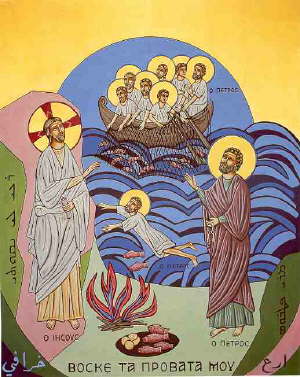
In today’s gospel, from the days after the resurrection, Peter is fishing again. And once again, Jesus is there on the shore. They have caught nothing, but Jesus says to try once more, and they catch an incredible number of fish. When Simon Peter realizes it is Jesus he eagerly comes to Him as fast as he can. He finds Jesus beside a charcoal fire. This should be familiar to Peter, too, calling to mind  another charcoal fire in the dark courtyard of the high priest.

After sharing a meal, Jesus says, “Simon, son of John, do you love me more than these? Do you love me?  Do you love me?” Simon Peter says, “Yes, Lord, you know that I love you. Yes, Lord, you know that I love you. Lord, you know everything; you know that I love you.” Jesus has given Peter the opportunity to undo his triple denial of Jesus with a triple confession of his love. And after each time, Jesus speaks of a new season for Peter’s life: “Feed my lambs. Tend my sheep. Feed my sheep.”

Now it is one thing to catch fish, but it is another thing to shepherd a flock. Up to now, Peter has been following Jesus and bringing others to Him. But now Jesus is asking Peter to do something new, to shepherd His flock for Him. Do you think Peter nervous? Is he concerned about whether he is up to the task? Is he worried about being led where he doesn’t want to go? I bet he is, but Jesus would have him ‘not be afraid,’ for he won’t be doing it alone. Jesus says to Peter, “Follow me.”

Our lives are often entering new seasons. Maybe you’re moving into a new town or a new school. Maybe you’re transitioning from engagement to marriage, welcoming new children, or living for the first time without children in the house. Maybe you have a new job, or don’t have a job for the first time. But whatever season of our life Jesus calls us into, His calling and our mission remain the same. Jesus said, ‘”I give you a new commandment; love one another as I have loved you,” and ” “There is no greater love than this, than to lay down your life for a friend.” Every new season of life offers us the unique opportunity to deepen our love for Christ and each other more than ever before.

Maybe you feel nervous? Maybe you’re concerned about whether you are up to the task? Maybe you’re worried about being led where you don’t want to go? But remember Simon Peter and don’t be afraid.  Jesus gives lots of second chances and He does not expect us to do it alone.

Faithful Despite Doubts — Divine Mercy Sunday—2nd Sunday in Easter—Year C

April 11, 2010

Thomas, called Didymus, one of the Twelve, was not with them when Jesus came. So the other disciples said to him, “We have seen the Lord.” But he said to them, “Unless I see the mark of the nails in his hands and put my finger into the nailmarks and put my hand into his side, I will not believe.”

Why is “Doubting” Thomas so slow to believe. Why is Thomas so reluctant to trust? A clue might be found in the gospel’s interesting inclusion of Thomas’ Greek nickname: Didymus. Didymus means “twin,” but in relation to whom was Thomas a twin? Some speculate that Thomas the Apostle bore a striking resemblance to Jesus Himself. This tradition is sometimes reflected in iconography where Thomas is the apostle who looks a lot like Jesus.

If this is why Thomas was the apostle called “the twin” then we can understand his rational skepticism. How many times during Jesus’ ministry had people come up to Thomas and said, “O Jesus, we’re so happy to see you! We’ve walked for miles to see you again!” Then, with some annoyance, Thomas might have answered, “We’ll you’ll have to walk a little bit further. Jesus is over there.” So now, when the other disciples come up to Thomas after Easter and say, “We have seen the Lord,” Thomas replies, ‘I’ll need more evidence than that.’

Thomas’ resistance to believing the good news about Jesus might not only be coming from his mind, but also from his heart. Jesus was Thomas’ hero, his teacher, and his close, beloved friend. Thomas thought that Jesus was going to be the savior and messianic king of Israel. But their close relationship and all of Thomas’ great hopes were destroyed for him at the crucifixion. Imagine how Thomas might have prayed then: “My God, why have you let this happen? How could you let Him be taken instead of me? Jesus was so good! He was completely innocent, and you let Him be die! Why?”

The unexpected death of Jesus broke Thomas’ heart, and having been so hurt once, Thomas was resolved not to let his heart be taken in again: “Unless I see the mark of the nails in his hands and put my finger into the nailmarks and put my hand into his side, I will not believe.”

Yet, though he doubts, notice where Thomas is one week after Easter. He is with the other apostles in the upper room in Jerusalem, gathered behind locked doors for fear of the authorities who killed Jesus. Now there are lots of other places Thomas could have chosen to be. There were safer places he could have gone, like back to his hometown and to the extended family and friends he had left behind to follow Jesus a few years before. Though Thomas doubts, he does not leave this house of faith. He struggles with his faith, but does not abandon it. He seeks within this house of faith, this Church, and because of it, Thomas finds sufficient evidence for his mind and healing for his heart.

The risen Lord appears in the upper room and how does Jesus respond to Thomas’ resistant unbelief? Not with anger.  Not with condemnation.  But with the divine mercy we celebrate today. Jesus appears in their midst and says, “Peace be with you.” Then he says to Thomas, “Put your finger here and see my hands, and bring your hand and put it into my side, and do not be unbelieving, but believe.”

In our lives we too will struggle with our faith and our doubts, with our emotions and with our thoughts, in our hearts and in our minds. Jesus does not condemn our honest struggles. But Jesus wants us to sincerely seek within this house of faith; this, His apostles’ Church, where the truth and healing is found by all those who seek Him.