Archive for the ‘Sunday Homilies’ Category

Jesus’ Resurrected Body — Easter

April 7, 2010


On Holy Thursday, we meditated on the disciples’ feet. On Good Friday, our Saviour’s hands.  Today, let us consider Jesus’ resurrected body.

Jesus’ resurrected body is the very same that died and was buried, but it is a very different body, too. The tomb was empty on Easter morning, not because Jesus’ body was vaporized, but because it was raised.

Jesus’ resurrected body has wounds, in his hands and feet and side, showing that this is the same body that suffered on the cross. It seems that the cuts and bruises on Jesus’ face and the lashes on His back are healed, but these five wounds remain. Why? These wounds are trophies and jewels.  They no longer cause Him pain, but they testify to Jesus’ greatness and love and He will have them forever.

So Jesus’ resurrected body is the very same body that died on the cross and was buried in the tomb, but it is a very different body. For instance, Jesus in His glorified body can cause others to see but not recognize Him, as He did on Easter evening with two disciples on the road to Emmaus. Only later, in the breaking of the bread, did they recognize Him. Then Jesus displayed another new power, disappearing from their sight. In His glorified body Jesus can move at the speed of thought and the walls and locked doors of the upper room do not prevent Him from appearing in the midst of the apostles.

In this there is a sign for the future of humanity. People often speak of “the end of the world” and imagine Heaven in strictly spiritual terms, but just as Jesus’ body was not annihilated but transformed, so our bodies and this universe will be remade. A glimpse into the future of the righteous is reflected in the resurrection of Christ.

Jesus’ body is not discarded, but gloriously transformed. In this there is a lesson for us. In (just about) every  life, there is a line that we have drawn in our relationship with God. It is a self-imposed limit on our trust, commitment, and self-gift towards Christ. “Lord, I will walk with you that far, (but no farther.)”

Perhaps we are unwilling to cross that line with us because we are too attached to the sins and mediocrity we have settled for, maybe we are afraid that we will lose who we are and become something that we are not, or maybe we are afraid that a total self-gift to God won’t truly make us happy. The devil likes this arbitrary line. He would like you to reach the end of your life and have to wonder with regret, “What would my life been if I had gone all-in for God?” The devil would have you fearful and repulsed of “the cross, the cross!” but the cross is not the end of our story.  Remember, as in Christ, God does not want to destroy you, but to transform you into who you truly are.

Do you believe Jesus suffered and died for you? Then He surely loves you. If He loves you, then how could He not desire your greatest happiness? Do you believe Jesus is divine and all-knowing? The surely He knows what will lead to your greatest good. Do you believe Jesus is all-powerful? Then surely He has the power the lead you to that good. Then what is standing in His way? There is only one thing standing in the way of His omnipotent power, preventing Him from transforming us into who (deep down) we truly want to be. That obstacle is our own freewill, the arbitrary line we draw in our relationship with Christ.

This Easter, let us be resolved to follow Christ without compromise. Let us entrust our whole selves to Him who has given us everything. Jesus does not want to destroy you, but to gloriously transform you into who you truly are.

A Premature Passion? — Palm Sunday—Year C

March 28, 2010

So why did we just proclaim the Passion?  Isn’t the Passion a bit premature? It’s Palm Sunday, not Holy Thursday or Good Friday. Aren’t we jumping the gun? No, like the two disciples Jesus instructed in our opening Gospel, we’re being told what we are going to see. The Church has us recount the Passion on Palm Sunday to prepare us; to prepare us for encountering Christ’s Passover through the special ceremonies and symbols of this Holy Week.

Now the celebration of the Eucharist actually makes the events of the Pascal mystery present for us every time we come to Mass. Jesus’ Last Supper, His Passion and Death, His Resurrection and Ascension into glory, are all truly presented to us at each and every Mass; but during Holy Week, we unpack and encounter these events in unique and special ways.

Today you have waved palms, an ancient symbol of victory, to Christ, welcoming Him into our city. On Holy Thursday, you can go where the Blessed Sacrament is reserved and give company to Christ in his lonely solitude, with Him in His agony before His arrest and with Him as He spends the night awaiting His trial. On Good Friday, you can reverence the crucifix; you can kiss the wood of Jesus’ cross and kiss His body hanging upon it, as He dies for us. And at the Easter Vigil, you can see the sign of the light of Jesus Christ resurrecting out of darkness and death.

And so I invite you to encounter Jesus’ Pascal mystery, at this Mass, at every Mass, and through the special signs and ceremonies of this Holy Week.

Sin Means Death — 5th Sunday in Lent—Year C

March 21, 2010

The scribes and the Pharisees were jealous of Jesus. When He came to the temple all the people gathered round Him to listen to Him teach. His words were compelling; the truths of God taught with gentle mercy. All the people were flocking to Jesus and this made the scribes and the Pharisees deeply jealous. We ourselves must beware of jealousy, for it can lead us to hate the good and condemn the innocent.

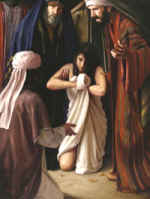
The scribes and the Pharisees bring before Jesus an adulterous woman and say to him, “Teacher, this woman was caught in the very act of committing adultery. Now in the law, Moses commanded us to stone such women. So what do you say?”

This scene raises some questions. For instance, how did Jesus’ enemies know where to find an adulteress when they needed one? It’s unlikely this affair was discovered just that morning. It must have been known from days, weeks, months, or even years before.

This prompts another question: if this affair had occurred much earlier, then why had the Jews not executed judgment on this woman before now. There seems to be two reasons for this. First of all, under Roman rule, the Jews had no authority to impose the death penalty on anyone. We will see this come into play in the Passion, where the Jewish leaders must convince Pilate that Jesus is an enemy of the state if they are going to do away with this “blasphemer.”

But there is another reason, too. Even though the Law of Moses had commanded death for certain sins, based upon what I’ve read the actual use of capital punishment for sins was very, very rare among the people of Israel, even before the Romans came along. And, as we can see in this scene, not even the scribes and the Pharisees are really serious about applying the law in strict and absolute terms. If they had been, they would have brought along the adulterous man for judgment too. Where is he? He was just as guilty as her, if not more (considering their culture.)

So the penalty of death was very rarely employed for punishing sinners, but then why were these severe punishments in the Old Covenant at all?  It seems that the point of those rarely applied laws was to teach an important lesson, a lesson repeated over and over again in countless ways throughout the Old Testament, a lesson for the Jews and a lesson for us today:

Sin is serious stuff, because sin leads to death.
Sin brings us death in our bodies and our souls.
Sin means death.

The scribes and the Pharisees round up a known adulteress and set their trap against Jesus (which is the only thing this is really about for them.) Jesus’ enemies will try pitting justice against Jesus’ mercy. They’re thinking to themselves, “Surely he’s not going to tell us to stone her, that’s not his way. He says he ‘has come not to destroy, but to seek and to save what is lost.’ So when he tells us not to stone her, then we’ve got him. He’ll be telling us to disobey the Law of Moses, and then we’ll have a charge to bring against him.”

“So Jesus… what do you say?” Jesus says nothing. He stoops down and writes with His finger on the ground the only thing we have record of Him writing in the entire Gospels. What did Jesus write? We don’t know. The Greek verb used indicates that Jesus was writing letters or words, and not drawing disinterested doodles or drawing a line between the accused and her accusers.

A common explanation is that Jesus’ finger was writing on the ground the names of sins, sins which those in the crowd had committed, sins which the finger of God had written of long before, on the stones of the commandments atop Mount Sinai. Perhaps Jesus wrote the words: “Sacrilege, Rebellion, Adultery, Theft, Deception, Coveting.”

The accusers continue harassing Jesus, but He rises again, and gives his well-known reply. The crowd of evil doers slowly scatters, and Jesus is left there alone with the woman. The threatening mob is gone, and you think that the woman would flee, but the woman does not run away. She knows she has sinned. She knows that she cannot run away from her sins or from God. She stays there before Jesus.

Jesus rises again and says to her, “Woman, where are they? Has no one condemned you?”
She replies, “No one, sir.”
Jesus says, “Neither do I condemn you. Go, and from now on do not sin any more.”

Jesus condemns the sin, but not the sinner. Jesus is merciful, but He is not indifferent to the prospect of her continuing in sin, nor is he indifferent to us continuing in our old sins. He does not say, “Go, and live as you will: presume on my deliverance: for however great your sins may be, it doesn’t really matter one way or the other.”

Jesus does not say this, for sin means death, and Jesus died to free us from sin and death. So let us come before Jesus to receive His pardon, but then let us go forth seriously and, from now on, sin no more.

The Prodigal Son — 4th Sunday in Lent—Year C

March 14, 2010

If today happens to be your first time coming back to church in a long time, then take today’s gospel as a sign. God our Father is incredibly merciful and He welcomes you home with a loving embrace.

But most of us here, I suspect, came to Mass last week, and the week before that, because you always come every week. If so, then you probably hear this familiar parable of the Prodigal (that is, squandering) Son and wonder where you fit into the story. When you look at yourself I bet you can honestly say that you’re not living a life of great dissipation like the younger son, and the idea of a sinner being reconciled with God makes you genuinely happy, not bitter, like the older son or the Pharisees. So what does this story have to teach those of us who are doing a lot more right than we’re doing wrong?

First, let’s look at the younger, prodigal son. He goes to his father and says, “Father, give me the share of your estate that should come to me.” Here, he is asking for his inheritance while his father is still alive. He is basically saying, “I don’t want to share my life with you,” and then he demonstrates it a few days later by setting off to a distant country. There he squanders his inheritance on a life of dissipation, but after he has freely spent everything, he finds himself in dire need. What he thought would make him happy left him disappointed in the end.

Sure, we’re not professional, all-star sinners like the prodigal son, but we act like him in many little ways in our daily lives. The prodigal son asked his father for something which was not his and which he had no right to take (while his father is still alive.) Whenever we live as if our lives were our own, as if our lives did not come from God and do not belong to God, our Father, we say to Him, “I don’t want to share my life with you.”

Though our small and venial sins only hinder or wound our relationship with God, in every sin we turn our backs and set off for awhile to a distant country. Whenever we insist upon it, God permits us to freely spend our lives in squandering ways, in ways which we think will make us happy but which disappointing us in the end. When we return to our Father, He forgives our sins and welcomes us back, but you and I must learn to stop trying to live our lives without sharing them completely with God.

Why are we afraid of the idea of doing what God wants us to do every moment of our day? I think we are afraid that doing God’s will won’t really make us happy. Maybe we imagine that doing God’s will means we will have to pray ten hours a day at church or walk around wearing a burlap outfit. Of course that’s crazy. God probably wants you to live the same life you are living now, but with some minor adjustments, and more closely to Him.

Maybe we are afraid to give ourselves completely to God because we are a lot like the other, older, more faithful son in the parable. We have served our Father for years without ever asking or expecting much for ourselves. But working hard for God without ever experiencing His good gifts and joys does not make us holy; over time it makes us angry and embittered, like the older son who never asked for anything. We start to think of our Father, not as our father, but as a slave master. But our Father says to us today, “My child, you are here with me always; everything I have is yours.”

“Taste and see the goodness of the Lord,” as our psalm said. Do not let your face blush with shame at asking for good things for you and your friends to enjoy. When we are poor and call out the Lord hears us, and He will save us from all our distress. So look to God, and be radiant with joy.

We’ve learned important lessons from both of the sons in this parable, and I hope we will put them into practice.

From the faithful but disgruntled son, we learned the importance of asking for good things from God. So today, at this Mass, ask our Father to surprise you today with some good gift that you’ll enjoy. Then watch to see what He does for you.

From the prodigal son we learned the importance of living with and for God every day of our lives. So tomorrow morning, when you wake up and you’re lying in bed, make the sign of the cross and entrust yourself to God for that day, that you may live your life that day always with Him and for Him. Ask you guardian angel to remind you and I bet you will remember.  Try it, and I think you’ll be pleasantly surprised by the difference it makes in your day.

When Towers Fall — 3rd Sunday in Lent—Year C

March 7, 2010

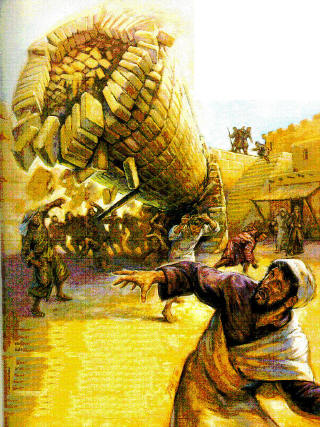
When disasters happen, like the recent earthquakes in Haiti and Chile, some Christian observers respond according to two opposite extremes. One reaction says that a truly just God would never let the innocent die along side the guilty; therefore, all of the victims must have been punished for their sins and got what they had coming to them. The opposite reaction says that a truly loving God would never punish our sins; therefore, all of the victims must have been innocent.

The truth is more complicated than either of these simple and pat explanations. Our God is both perfectly loving and perfectly just. In this world the wheat grows side by side with the weeds. At harvest time, the two are uprooted together, but their eternal fates are not the same. We see that the truth is more complex than some assume by looking at the gospels.

One day Jesus and His disciples observed a man blind from birth. The disciples asked Jesus, “Rabbi, who sinned, this man or his parents, that he was born blind?” Jesus answered, “Neither he nor his parents sinned; it is so that the works of God might be made visible through him.” Jesus smeared clay in man’s eyes and told him to wash in the Pool of Siloam. The innocent man washed and returned able to see.

Yet, on another occasion (in the same Gospel of John) Jesus saw a man lying on the ground who had been ill for thirty-eight years. Jesus miraculously cured this man too, but finding him later Jesus said to the man, “Look, you are well; do not sin any more, so that nothing worse may happen to you.” In this case, it appears that the man’s sin was connected to the cause of his sufferings.

We need to remember that people who suffer and die are not always guilty. On the other hand, people are not always innocent either. Discerning the truth behind why this or that evil befell this or that person or place usually lies well beyond our own limited vision.

For instance, the friends of Job insisted with all confidence that Job’s sufferings must be due to some great sin he had committed.  However, Job stood firm on his innocence, and he truly was as righteousness he claimed. Great sufferings and even violent death are no certain indication of a person’s sinfulness, that “they had it coming.” Just look at our holy and beloved saints:

  • St. John the Baptist was murdered in his 30’s, and St. Paul in his 60’s—they were both beheaded.
  • St. Peter was murdered too, crucified upside down, and of all the apostles, only St. John died of old age.
  • St. Joan of Arc, age 19, was murdered with fire.
  • St. Therese of Lisieux and St. Faustina Kowalska both died of tuberculosis, at ages 24 and 33.
  • St. Maximilian Kolbe and St. Edith Stein were murdered by the Nazi’s in the Auschwitz concentration camp.
  • More recently, before our eyes, John Paul the Great suffered greatly and died of Parkinson’s disease.
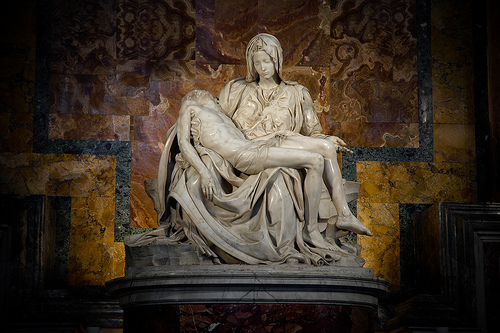
  • Even the Blessed Virgin Mary, as perfectly innocent as she was, shared as a mystic and a mother in suffering the passion and death of her Son.

The innocent who suffer live and die in the likeness of Jesus Christ are promised a heavenly reward like His.

So from where do earthquakes and other natural disasters come? In the beginning of time, some of the angels and all of humanity rebelled against God and we rejected our proper places within His creation. This Fall introduced disharmony into our (now) mortal bodies and into the entire natural world. Since that time, Christ has come and in perfect obedience to our Father, died, rose, and has enabled us to be reconciled with God. However, the disharmony of nature remains and we remain free to choose to rebel against our God.

If rebel in sin, we should not be surprised if bad things happen as a result. Usually in this world, we are punished through our sins, more so than for them. For example, someone who neglects prayer and Sunday worship should expect that they will feel disconnected from God. Someone who abuses drugs or alcohol, will see the harmful consequences it brings to their relationships and at school or at work. Someone who covets their neighbors’ spouse and possessions will become sickly green with lust and envy. Add up the sum total of an entire peoples’ sins and you can easily see how an empire or a great nation can decline and decay over time.

God hates our sins, but not merely because they “break His rules.” God hates our sins in proportion to how harmful they are to us. If sins were not bad for us, then God would not command us not to do these things. God hates our sins because He loves us; these are two sides of the same coin.

So what should we do when we witness disaster strike half a world away or in our own community? We should pray for the dead and give our aid to those who live on. Christ calls us to give our compassion, love, spiritual support, and material aid to those who need it. And as for ourselves, such disasters should lead us to convert and reform our lives. Death can come suddenly to any of us. A car crash or a heart attack could take any of us tomorrow placing us unexpected before the judgment seat of God. Let us take such opportunities to prepare ourselves for that day which will come to us all.

What if is not instant death, but a more prolonged evil that comes to me? For instance, what if I go to the doctor and receive a terrible diagnosis?  When such a day comes for me, I hope that I may remember the tree from today’s Gospel, which the gardener worked and fertilized in hopes that it would bear much fruit. If I, like that tree, will humbly accept the manure that comes to me, then it will be a source of great fruitfulness to me.

Could an evil such as this be a correction or a chastisement from God on account of my sins? Possibly, but if I’m not aware of any serious unconfessed sins on my conscience, then probably not. More likely, Jesus is giving me the opportunity to following in His footsteps, to have a share in His cross like the holy saints who came before me. If we accept our crosses with humility, then they can become the means of our sanctification in the likeness of Christ and a source for spiritual fruitfulness for ourselves and the entire world.

Three Temptations — 1st Sunday in Lent—Year C

February 23, 2010

In today’s gospel Jesus is led into the desert by the Holy Spirit for forty days of prayer, penance, and preparation and there He is tempted by the devil.  We have been led to this season of Lent and we also find ourselves being tempted. This morning I would like to talk about how the devil’s three temptations present themselves to us and to let you know about an allowance in Lent that you will be happy to hear.

Most of us here have chosen to take on a penance during Lent.  You have probably resolved to abstain from something good, like cookies, candies, ice cream, TV or the internet, to grow in disciple and virtue, and to offer some sacrifice to God. The devil first said to Jesus, “command this stone to become bread,” and we will probably be tempted in a similar way; “Put down the rock of your penance for awhile and let it nourish you.” It is the way of demons to first entice and then condemn. The rationalization, “Go ahead, it’s just a little cookie,” will afterwards become the accusation, “You couldn’t even sacrifice one cookie for God.” Let us preserve in our Lenten penances, for the joy of having carried a cross for the Lord is far preferable to the discouragement of a moment’s compromise.

As a second temptation, the devil, in a vision, showed Jesus all the kingdoms of the world in a single instant and said, “I shall give to you all this power and glory; for it has been handed over to me, and I may give it to whomever I wish. All this will be yours, if you worship me.” Scripture calls Satan the Father of Lies, so we ought to be skeptical about whether he really had this authority over the nations, and even if he did we should disbelieve that he would give Jesus the world if He were to worship him. Instead, I suspect that the devil would have simply laughed and left Jesus with nothing for having fallen into sin.

We human beings are creatures of habit. The same sins which you have struggled with in the past are probably the same ones that challenge you today. When we are tempted by sins they promise us the world, great peace and satisfaction. Yet we can look back at our own experiences and see that these are lies. Our past sins show us that they only lead to disappointment and dissatisfaction. We should stop swallowing the bait. We should stop accepting the lie. This Lent is a perfect time for us to commit to crushing the habitual sins in our lives, for our sins will not make us happy, even if they promise us the world.

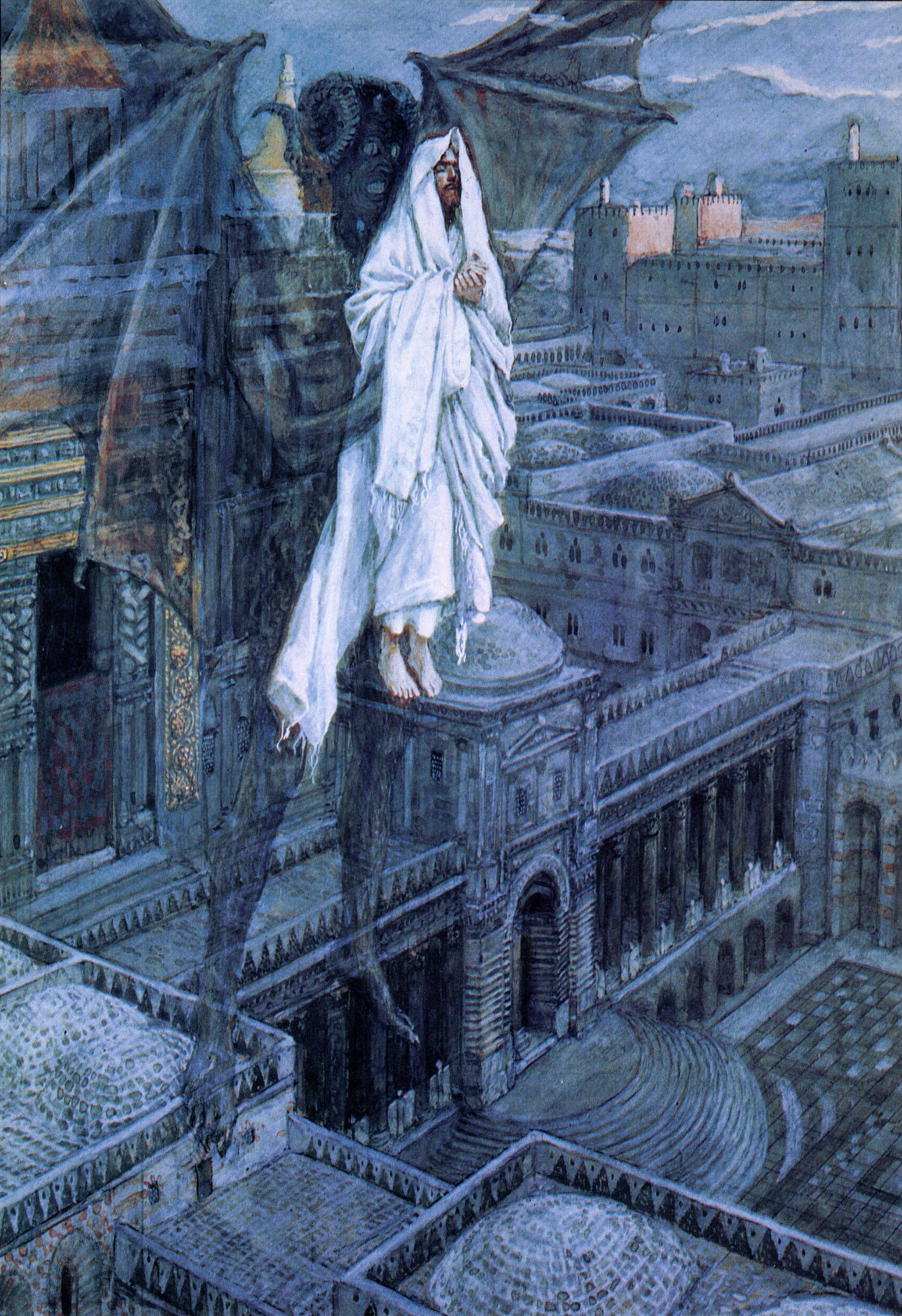
As a third temptation, the devil took Jesus up (in a vision or in the body we do not know) to the top of the temple in Jerusalem. He said to Him, “If you are the Son of God, throw yourself down from here, for it is written: He will command his angels concerning you, to guard you, and: With their hands they will support you, lest you dash your foot against a stone.” The temptation addressed to us sounds differently. “You are not the Son of God, you’re not even close to being saint! You should throw yourself down in shame for your sins and not dare to pray or present yourself to God!” On the contrary, as we heard in the second reading, “No one who believes in him will be put to shame.” Lent calls us to sorrow and conversion for our sins, not to shame and aversion from God.

We see the one-two combo of enticement and shame modeled in the case of Adam and Eve.  When they heard the sound of the Lord God moving about the garden they hid themselves among the trees, for they realized that they were naked before Him, and they were ashamed and afraid. Much later, in the case of Judas Iscariot, the devil led him to betray Jesus, one of the worst sins ever, and then after regretting it he was led to kill himself. If Judas had gone from the temple to Calvary, instead of to his tragic tree, Jesus would have forgiven him, because Jesus wanted to forgive him.

Jesus loves us. He doesn’t just love us because He’s God and He “has to” love everybody. Jesus loves us and He actually likes us for all the good things that we are and for all the good things He sees we can become. This is why He created us and died for us, because He loves us. So we should not be ashamed to come to Christ in the sacraments; in confession with our big sins, or at communion with our small ones. As Jesus told St. Faustina, the greater our sins the more entitled we are to his mercy. When it comes to God’s forgiveness, only we ourselves can get in His way.

Finally, I mentioned that there is an allowance during Lent which is a cause for consolation amidst our Lenten struggles. But first, did you know that there are more than forty days in Lent?  The season is longer than forty days because we don’t count the Sundays.  There are 40 days of penance, but every Sundays (from Saturday evening to Sunday night) we are released from our penances. At Sunday Mass the priest still wears the Lenten season’s purple, we might do less singing, and we don’t say the Gloria or say the “A”-word before the gospel, but we are freed from penances that day, for every Sunday is a “little Easter. ”

In the first reading, we heard how Moses commanded the Hebrews that once they came into the Promised Land they should come before God to present their first fruits and recount the story of how God had delivered them from slavery, brought them into the Promised Land, and filled them with blessings. Each Sunday we come before God and recall how His Son, Jesus Christ, delivered us from our slavery, brought us into His kingdom, and has filled us with His blessings, especially the gift of Himself in the Eucharist. Each Sunday gives us consolation, and this release from our penances encourages us to offer still more penance to God in the week ahead, for it is an easier thing abstain for just six days than to do it for forty in a row.

So in conclusion, be faithful to your penances, your faithfulness will have its reward. Commit to crushing your habitual sins, for sins cannot make us happy, even if they promise the world. Shame and fear are the devil’s traps, so whenever you sin, come to the Lord with trust and sorrow. And know that you are released from penances on Sundays in Lent.  May this gift be a cause for thanksgiving and joy and inspire us to make a still greater gift of ourselves to Christ in this Lenten season.

Mary and Pilate — 6th Sunday in Ordinary Time—Year C

February 14, 2010

In a few moments, after this homily, we will recite our creed, the summary of our faith. Every Sunday, we profess, in union with the Christians who came before us, our belief in these truths and our resolve to live our lives according to them. This morning we will look at just one rich aspect of our creed and consider its implications for our lives.

Have you ever noticed that in the entire creed, only two non-divine persons are mentioned by name? These are the Virgin Mary and Pontius Pilate.

“By the power of the Holy Spirit, He was born of the Virgin Mary and became man. For our sake He was crucified under Pontius Pilate; He suffered, died and was buried.”

Now many other figures from the Old and New Testaments could have justifiably been included in our creed; such as Adam and Eve, Abraham, Moses, David, Mary Magdalene, Peter, Paul, and many others. Yet, only Mary and Pilate get mentioned. So why is this? There seems to be two very good reasons. The first of these reasons I will give now—and the second I will save for the end.

The first reason why Mary and Pilate receive special mention is that they ground Jesus’ life, death, and resurrection in our real history. Jesus was ‘born of the Virgin Mary, suffered and died under Pontius Pilate, and on the third day, He rose again.’ Now other pre-Christian religions sometimes had stories about dying gods who came to life again, but those stories were always said to have happened ‘once upon a time,’ in some remote and mythic past. But with Jesus Christ, this ancient intuition and longing of humanity is actually realized. The inclusion of Mary and Pilate in the creed witness to this: that God became man, died, and rose for us, in this world and in real history.

Some people try to be too sophisticated by saying it doesn’t really matter if Jesus rose from the dead, or even if He lived at all, because His teachings are what’s important. But St. Paul blows this idea out of the water. “If Christ has not been raised, your faith is vain; you are still in your sins. Then those who have fallen asleep in Christ have perished” and “we are the most pitiable people of all.” Without Jesus Christ and His resurrection there is no Gospel, there is no Good News.

Just like Jesus Christ, Mary His Mother and Pontius Pilate His executioner are not fictional characters made up for some story. They are real people, from a time not that much different from our own. Our styles and technologies may have changed, but human beings themselves remain much the same. When we look at Mary and Pilate we can see ourselves in these two people whom Christ encountered twenty centuries ago.

Pilate is the secular Man of the World.
Mary is the devoted Disciple of Christ.

Pilate seeks the glory of men.
Mary seeks the glory of God.

Pilate knows worldly wisdom, he is clever and cunning.
But Mary knows God’s wisdom, and she is truly wise.

Pilate thinks he knows how the world works and the pragmatic way to get things done. For Pilate, our world is totally shaped by of power, money, and influence, with some blind luck thrown into the mix. When Jesus stands silent before him, Pilate says, “Do you not speak to me? Do you not know that I have the power to release you and I have the power to crucify you?” Jesus replies, “You would have no power over me if it had not been given you from above.”

Pilate is a very post-modern man.  He’s a moral relativist. When he asks Jesus, “What is truth,” he doesn’t bother to wait for an answer from Truth Himself. That’s because Pilate thinks that the ‘truth’ cannot be known except for the ‘truths’ which we choose for ourselves or impose upon others.

The Gospels show that Pilate knows Jesus is innocent, or at least that he poses no real threat to society, yet Pilate is willing to have this innocent man whipped and even crucified when that becomes the most expedient thing to do. The crowd threatens Pilate, “If you release him, you are not a friend of Caesar,” and he quickly caves and hands Jesus over.
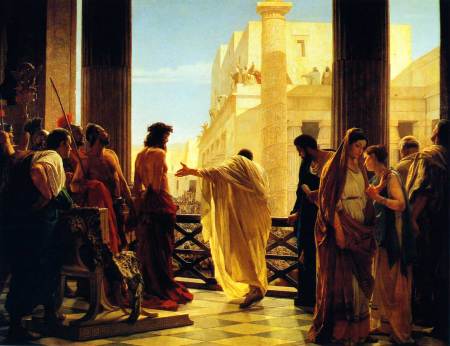
Pilate washes his hands of responsibility, and extends Christ’s arms on the cross. Mary had extended her arms declaring, “Let it be done to me according to your word,” and lovingly held the infant savior in her hands.

Pilate, despite all his power, is ruled by fear.
Mary, despite her weaknesses, is freed from it.

Governor Pilate is rich in wealth and power and yet he has no peace.
Mary, the poor widow, has peace and everything she needs from God.

Pilate has no faith in the God of Israel. He says, “I am not Jew, am I?” But for Mary, God is her rock and this makes all the difference in the world. Mary is defined by her faith, hope and love.

Mary never attends an academy, but she is profoundly wise because she reflects in her heart on the words and deeds of God and because she lives by her own advice: “Do whatever he tells you.” She knows that we do not manufacture the truth for ourselves, we receive it, ultimately from God. We love it, we defend it, and we share it with others. “Blessed [is she],” as Elizabeth said, “who believed that what was spoken to [her] by the Lord would be fulfilled.” Mary trusted and believed, for she saw the evidence through history that God “has mercy on those who fear Him in every generation,” that “He scatters the proud in their pride, and casts down the mighty from their throwns, but He lifts up the lowly.”

Mary’s life was full, but was not free from trials. When Mary consents to be found with child through the Holy Spirit she is uncertain of what will happen to her, but she trusts in God. She does not know how she and her husband will get by as poor immigrants in foreign country, but she continues to trust. Mary’s response to every trial in life, even to the death of her son, is to trust in God. Despite men’s sins, she trusts in God as the Lord of history, that He casts down the proud and mighty from their throwns and raises up the lowly.

Pilate is indifferent to Christ, and he consents to sending Him to the cross, but Mary is wholly devoted to Christ, and she consents to share in His Passion. Pilate’s heart is hardened despite Christ’s Passion, while Mary’s heart is pierced by it.

Governor Pilate was once the most powerful man in Judea, but where is he now? Mary, the poor widow, is now our glorious queen, the most beautiful and powerful woman in heaven or earth, and through her reign she draws millions to Christ our king.

She is the one who wept and now laughs.
He is the one who laughed and now weeps.

He was rich in the world and now he is poor.
She was poor in the world and now the kingdom is hers.

He took root in the desert, he was barren and uprooted.
But she was planted beside the flowing waters, she endured and bore much fruit.

So what do all of these reflections about Mary and Pilate have to do with us? I promised you at the beginning a second good reason why Mary and Pilate are mentioned in the creed; and here it is: Mary and Pilate represent us. They stand as archetypes, models or patterns, for every person.

The faithful one and the faithless one.

The one who serves God and the one who serves himself.

The one who gives Christ life and the one who puts him to death.

We live our daily lives as either Mary or Pilate, with shades of the other thrown in. As we come to the season of Lent, let us examine and discern who we are. “How am I Pilate, and how am I Mary?” And at this Eucharist, let us ask Jesus to exchange in us the ways of Pilate for the ways of Mary, for hers is the way of Christ.

Approaching God — 5th Sunday in Ordinary Time—Year C

February 11, 2010

In today’s first reading the prophet Isaiah hears the angels praising God at the temple with words like those we proclaim at every Mass: “Holy, holy, holy is the LORD of hosts! All the earth is filled with his glory!”

What do these words mean?  First, the Jews did not have adverbs for “very,” “most,” or “infinitely” in Hebrew, so if they wanted to say something was very heavy they would call it “heavy, heavy.”  If they wanted to say something was most heavy or (if it were possible) infinitely heavy they would call it “heavy, heavy, heavy.”  So when Isaiah hears the angels call God “holy, holy, holy,” they are praising His perfection, transcendence, and goodness to the highest degree.

Why is God called “the LORD of hosts?” A host is an army, or a large group of persons. In this case, God’s army of angelic  persons is referred to. Our God is holy and wields unsurpassed power. The earth is filled with his glory.

Isaiah behold this sight and becomes very afraid. “Woe is me, I am doomed! For I am a man of unclean lips, living among a people of unclean lips; yet my eyes have seen the King, the Lord of hosts!” In the Old Testament people thought that no human being could look upon God and live.

Then an angel, one of the seraphim, fly down, takes an ember with tongs from the altar (for the Jews sacrificed animals as burnt-offerings at the temple) and touches Isaiah’s mouth. “See,” the angel says, “now that this has touched your lips, your wickedness is removed, your sin purged.” God asks whom He can send to be His prophet, and now Isaiah has the courage to say “Here I am, send me!”

Imagine if, at communion time, people would line up and come before the priest to have a red hot coal touched to their lips or tongue? Priest: “The holiness of God.” Communicant: “Amen… Ou!” I imagine the communion line would be much shorter.

This is the bread that we will be offering at this Mass to become the real body, blood, soul, and divinity of Jesus Christ. It’s flat because it unleavened, just like the bread at the Jewish Passover meal and as at Jesus’ Last Supper.  Leaven, or yeast, is bacteria which grows and makes our bread fluffy. The Jews were to keep leaven, which symbolized sin, out of their Passover bread.

Like all of the other sacraments, the Lord’s choice to use bread has symbolic meaning.  Take baptism, for example: water cleanses us and gives us life.  Similarly, bread gives us life and becomes one with us. No wonder Jesus chose it to be his symbol for the Eucharist. The very use of bread invites us to receive him.  The symbol of bread speaks, “Come, do not be afraid. I am here to be received by you and to become one with you.” We tend to forget what an unprecedented privilege this is.

In the Old Covenant, Jews could always pray to God, for ‘all the earth was filled with his glory,’ but they you wanted to go where the Lord was most present on earth they had to go to one place, the temple in Jerusalem.  And even when they got there they did not enter in where the Lord was most present, the Holy of Holies, where only the high priest would go, and only once a year at that. The faithful would worship in the courts outside the temple.  It would be like us coming to church today to stand and pray from the parking lot. Instead, we have the privilege to stand and worship the Lord here in His sanctuary, and not only do we see the Most Holy Lord with our own eyes, but we actually receive Him in the Most Holy Sacrament.

The wonder and the privilege and the awe of this new intimacy with God at the Eucharist could not have been lost upon the early Christians, who were converts from Judaism. Do we approach the Lord with a healthy fear of the Lord, which is called the beginning to wisdom? This fear is not terror, which would cause us to hide ourselves from the Lord. It is a reverence which honors the Giver who is the Gift.

We all sin from week to week, but if our sins are minor, or venial, then Jesus wants us to approach Him in the Eucharist. Receiving this sacrament with contrition forgives our venial sins. On the other hand, if we are aware of serious, or grave sins on our souls, then Jesus wants us to approach Him in another sacrament first, the sacrament of confession, or reconciliation.

In the second reading we heard St. Paul’s words to the church at Corinth, reminding them of what he ‘handed on to them as of first importance as he had also received it.’ Later in the letter he reminds them of something else in a similar way:

For I received from the Lord what I also handed on to you, that the Lord Jesus, on the night he was handed over, took bread, and, after he had given thanks, broke it and said, “This is my body that is for you. Do this in remembrance of me.” In the same way also the cup, after supper, saying, “This cup is the new covenant in my blood. Do this, as often as you drink it, in remembrance of me.” For as often as you eat this bread and drink the cup, you proclaim the death of the Lord until he comes. Therefore whoever eats the bread or drinks the cup of the Lord unworthily will have to answer for the body and blood of the Lord. A person should examine himself, and so eat the bread and drink the cup. For anyone who eats and drinks without discerning the body, eats and drinks judgment on himself. That is why many among you are ill and infirm, and a considerable number are dying. If we discerned ourselves, we would not be under judgment…”

Before we approach the Eucharist let us examine ourselves first, and if we have serious unconfessed sins, from even years ago, let us present ourselves for Jesus’ needed forgiveness in confession first. Ask yourself, do I care more about others’ opinions of me, or about the opinion of the Lord (who sees all things)?

Whenever we come to Christ in the Eucharist let us approach Him as the earliest Christians did, with wonder, awe, and holy fear. Let us have that reverence which honors the Giver who gives Himself as a Gift to us.

Jesus is Love — 4th Sunday in Ordinary Time—Year C

January 30, 2010

Today’s second reading from St. Paul is perhaps his most known and most loved. You’ve probably heard it at weddings—perhaps you remember hearing it at your own, but most people don’t realize that St. Paul wrote these words to a community in disunity.

The Christian church in Corinth, Greece was divided. Various factions insisted that they were right, that they had “wisdom,” even as they bitterly quarreled with each other. St. Paul acknowledged what the Corinthians possessed in gifts and knowledge, and they had both, but he shined light upon how incomplete they were. “Strive eagerly for the greatest spiritual gifts,” he says, “But I shall show you a still more excellent way.” And then he teaches them about love.

Love is easy when it’s warm and fuzzy, and no one needs a lesson on doing what comes naturally. But how are we to behave when personalities conflict and there are serious disagreements and old resentments within our families, at work, or in our parish? During these times of tension, let us think of Christ and embrace Him as our model for action.

Jesus is patient.  Jesus is kind. In a way, Jesus is jealous, He’s jealous for our souls, but Jesus never manipulates others. He is not pompous. He is not inflated. He is not rude. Jesus is humble. He does not seek His own interests. He is not quick-tempered. He does not brood over injuries, no matter how unjust. He does not rejoice over wrongdoing but rejoices with the truth. Jesus bears all things and endures all things. Look at how He responded in Nazareth when His own acquaintances, whom He had known almost all of His life, turned against Him:

“They were all filled with fury. They rose up, drove him out of the town, and led him to the brow of the hill on which their town had been built, to hurl him down headlong.  But Jesus passed through the midst of them and went away.”

Jesus knew exactly what they were up to as they led Him towards the plummeting edge of town, and He could have turned and walked out on them whenever He chose, so why did He give even them the time of day? Jesus was patient, he was humble, and He endured this trial in hopes that He might lead them from their wrong way and restore personal communion with them. When they were just about to throw Him down, Jesus walked away, for the time had not yet come for Him to lay down His life for love of them.

God assures us through St. Paul that “love never fails.” The love of Jesus Christ never fails, even if we can’t see how, even if His victory, as for the souls for the community of Nazareth, takes more than a single day to accomplish. “Love never fails,” so follow Christ in this most excellent way; at home, at work, and in our church, and the promise of this Scripture passage, that “love never fails,” will be fulfilled in us.

Carrying Water — 2nd Sunday in Ordinary Time—Year C

January 20, 2010

Today’s Gospel, the miracle at the wedding fest of Cana, is a scene rich in symbolism and has many preachable parts. For example, the water of Old Covenant law is changed into New Covenant wine. It is the seventh day in John’s Gospel, according to the narration, pointing to a new Creation and rest. And the New Adam and the New Eve are at a wedding feast together, foreshadowing the marriage of Christ and His Church. But this morning, I would like to bring your attention to an extraordinary part of this Gospel which we disregard as being ordinary. I’m referring to the six stone water jars and the servers who carried them.

“Now there were six stone water jars there for Jewish ceremonial washings, each holding twenty to thirty gallons. Jesus told them, ‘Fill the jars with water.’ So they filled them to the brim.”

You’ve carried a gallon of milk before.   Imagine carrying 25 gallons of milk. I doubt you could do it all at once. Not only would they be too bulky, they would be awfully heavy too. Maybe you could put them on a pole and carry them with a partner. Maybe that’s what the servers in the Gospel had to do, or maybe they were doing laps between the well of Cana and the stone jars at the party. In either case, they we’re hauling an awful lot of water and weight.

Now a gallon of water weighs a little more than eight pounds. If each jar in the Gospel was at least 40 pounds of stone and held 20 to 30 gallons, then we are talking about six filled jars weighing 200 to 300 pounds apiece. And we know they were completely filled, for Mary had told them, “Do whatever he tells you,” and Jesus had told them, “Fill the jars with water.” “So they filled them to the brim.”

The saying “To carry water for (someone)” means to do a menial or difficult task for others.  That’s what these servers were doing and they definitely felt the burden.  Did they have any idea, as they carried those 1,500 pounds of stone and water, that they were a part of something remarkable? Did they know that they were playing an intimate role in one of Jesus’ most memorable miracles? No, they had no idea, not until later, and this reflects a encouraging truth for us to hold onto this week. We often don’t realize the extraordinary impact of our ordinary sacrifices.

You may feel burdened in your life, like your just scrapping or limping along; at work, at school, or at home; with your peers, your friends, or your family. But you do more good than you know. Sometimes we catch glimpses of this, like when someone takes your hand and says, “Thank you sooo much,” or when someone shares with you that they have always looked up to you, or when a child grows to realize and thank you for everything you did for them. After this life, one of our joys in heaven will be seeing how our ordinary sacrifices have touched and changed the lives of thousands, even millions, of people.

Like the servers with their six stone jars, we disregard our efforts as ordinary and do not realize their extraordinary impact. Maybe you don’t see it now, but your ordinary sacrifices do more good than you know. Let us be encouraged by recalling this truth in our daily lives, for if you’re carrying water for Jesus, you’re going to have a part in His miracles. So, “do whatever He tells you,” no matter how ordinary it may seem.

Encountering Jesus in Prayer — Baptism of the Lord—Year C

January 11, 2010

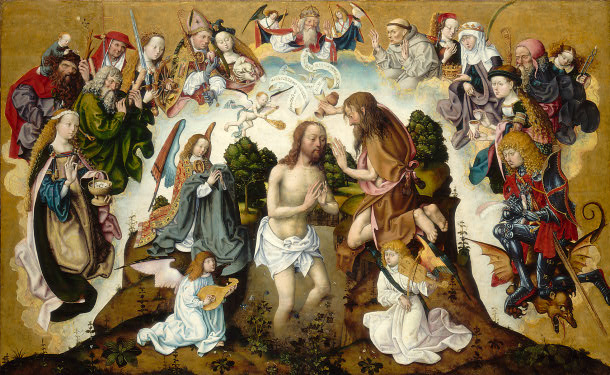
At Jesus’ baptism, the Father spoke to Him from heaven, “You are my beloved Son; with you I am well pleased.” Today, our Father wants you to hear Him say to you, “You are my beloved child and with you I am well pleased.”

This may be hard for us to hear. Maybe we think to ourselves, “I’m certainly not Jesus.   How could God be well pleased with me? Our past and present sins of come to mind and we feel pained by guilt. In times of prayer and in our daily life we are burdened by the thought that we are not the person God wants us to be. We think, “If only I were better, if only I could be perfect, then I could live and pray like the saints and God would love me.” If we think like this, our thinking has it backwards.

It’s not that God decides to love the saints, or us, only after we have achieved holiness by our own incredible feats of strength, endurance and personal sacrifice. Here’s the secret to the saints: the knowledge of God’s love and pleasure toward them came to them first, the saints’ great holiness only followed. Saints are not self-made men and women. It is by accepting God’s embracing love for us that we’re empowered to live incredible lives of love. We live like saints if we live in the truth that God loves us already.

To bear this point out, I would like you to try a thought experiment.  (You may close your eyes if you think it will help.) Imagine if you were a completely perfect person, totally free from sin, and free from guilt and fear before Him. Now pray to the Father in heaven imagining you’re this perfect version of yourself.

If you’re like me, imagining this makes it much easier to approach Him, to love Him, to praise Him, to thank Him and to feel His love for you.

And now, still imagining you’re this perfect person, consider the day or the week ahead of you.  What kind of attitude do you feel towards your life?

Again, if you’re like me, you find it much easier to see the future not so much as a burden, but with a certain eager calm. You view your life as an great opportunity to serve and to love from out of the abundance of love that you feel.

It’s not just your imagination that makes you feel this way.  It is the Holy Spirit confirming a truth in you. And the truth is that when the Father looks at you He doesn’t see the unlovable wretch of your fears, He sees something much closer to this perfect person.  By our baptism into Christ, we are loved as God’s daughters and sons, but maybe we not living like the saints we so admire because we’re tripped up by fear and self-doubts, thinking that for us intimacy with God remains a thousand miles away. The Father wants you to be confident, peaceful, and joyful in His love for you. In this way of His, He will lead you out of sins which history proves that your own efforts alone cannot conquer. Compared to the self-imposed yoke of our own anxious strivings to holy, the way of accepting God’s love for us is easy and light, and it actually works. We will live like saints when we accept the truth that God loves us already.

The saints became saints by overflowing with God’s love for them, by receiving His acceptance, approval and pleasure. These are gifts which He always wanted to give them, and He would do the same for us, if only we would let Him. So when you pray the Our Father today do it as the Father’s beloved son or daughter. And whenever you pray, or in whatever you do, do it in the liberating and empowering truth: “You are my beloved child; with you I am well pleased.”

Traveling to God — Epiphany of the Lord

January 3, 2010

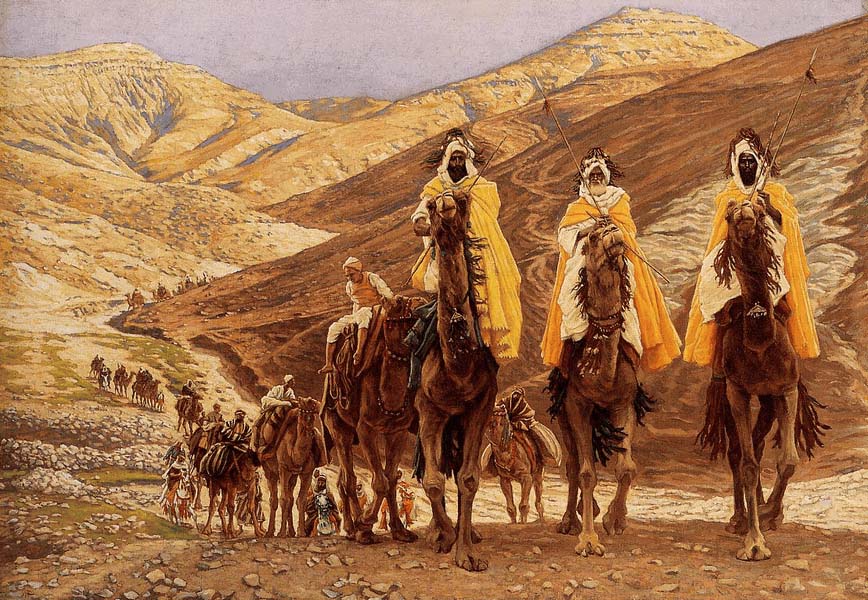
Today the nations come to Christ, to bring Him their gifts and to worship Him. We see it in the gospel, where great, wise ones called Magi travel afar to Bethlehem of Judea. And we see it in our world today, wherever those honored to be called Christians gather in Christ’s Church throughout the world. Every Sunday is a little Epiphany where, like the Magi, all the nations come to worship the One whom all the world ought not to be able to contain.

Our responsorial psalm prayed, “Lord, every nation on earth will adore you.” In another psalm, Psalm 87, the Lord foretells that every nation on earth would adore Him. The Lord says,

“Babylon and Egypt I will count among those who know me; Philistia, Tyre, Ethiopia, these will be her children and Zion shall be called ‘Mother’ for all shall be her children.”

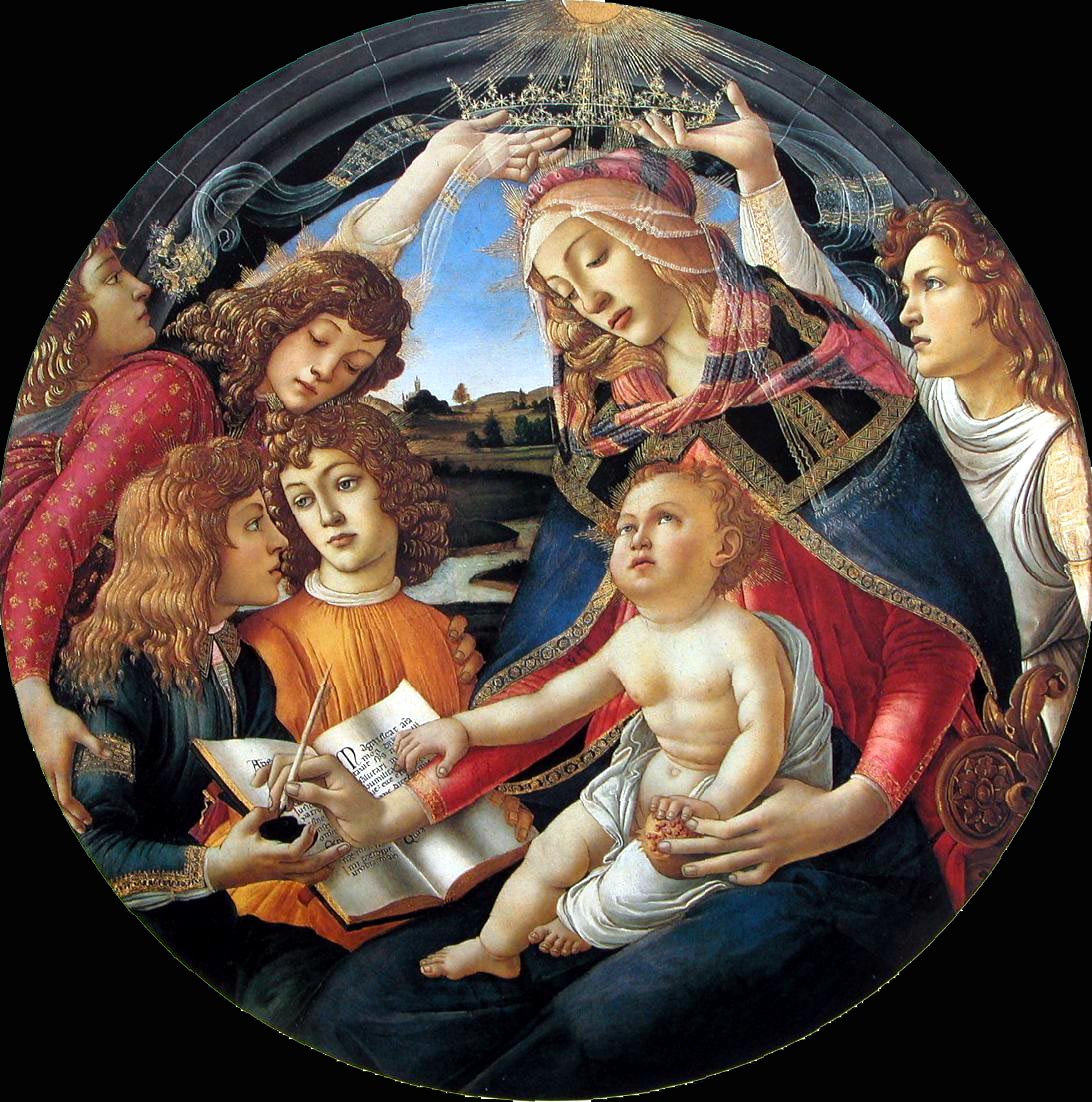
Today there are Christians in all of these places: in Egypt and Iraq, in the Holy Land and Africa.  In fact Christians span entire continents about which the ancients never knew. There are Christians all nations who have entered the Lord’s house and found Jesus with Mary, who is the symbol of Mother Church. She is rightly called mother, for all nations are her children.

In many lands Christians suffer harsh persecution, as in China, where a red dragon like that of Revelation still seeks to destroy the Christ Child and the God-bearing mother. How fortunate we are to be able to safely gather here, to be free to practice our faith without fear, to come to Christ’s house easily and often, not in hiding or in secret, and without having to travel for months across desert expanses like the Magi.

Yet, in our ease, we can take our religion for granted. In our routine, we can be blind to how we are blessed. And in our closeness to Christ, we can overlook Him. So, from time to time, it is important for our faith to be renewed. One way we can do this is to imitate what the Magi did. At least once every year we should make a pilgrimage to Christ and stay to retreat some days with Him.

After spending precious time with Jesus in the heart of their pilgrimage the gospel says the Magi “departed for their country by another way.” Their physical journey changed (for they had been warned in a dream not to return to Herod,) but their spiritual way changed as well. The Magi were believers even before they came, but after adoring Jesus and giving their gifts, they went away spiritually richer. We too would be spiritually richer if we were to give Christ some gift of our time and treasure to pilgrimage and retreat with Him.

As busy as priests are, the Church requires all of them to go on several days of retreat each year, for she knows how important this is for spiritual renewal and intimacy with Christ. Imagine what difference a pilgrimage to a shrine and a quiet, prayerful weekend on retreat center would have for you.

You must love and care for your children, so show them by your own example the importance of seeking after Christ. Give your spouse the opportunity to spend two days alone with the Lord, or take the whole family along for a trip to a holy shrine. For instance, there is a new, magnificent shire to Our Lady of Guadalupe which everyone should make it a priority to see. If you are looking for destinations or ideas, I’m more than happy to help.

In this year of our Lord, 2010, 51 weekends remain. Let us act now to prepare even just one of those many weekends for a gift-bearing journey. Pilgrimages and retreats are a gift to Christ and a gift to ourselves. Let us follow the Magi and come, let us adore Him this year, with days of pilgrimage and retreat.

Strengthening Your Family — Holy Family

December 29, 2009

Today we are going to try something unique. Close your eyes and let the Holy Spirit guide your imagination to show you what family life was like in the home of Joseph, Mary, and the boy Jesus…

Theirs is a small dwelling and you can see all of them there…

How old is Jesus as you see Him? What is He doing?

What are His parents up to? What are Joseph and Mary like as you see them interact with each other?

It comes to time to eat. What do you see the Holy Family doing?

As they relate to one other, what do you see expressed in their faces? It is now later in the evening and time for prayer. What do you see the members of the Holy Family doing?

You can return in your imagination to visit this house any time you wish, but now, let’s open our eyes and review our mediation.

What did you see as Joseph and Mary interacted with each other? Were they not tender and reverent towards each other? I bet you could see their great mutual love reflected in their smiles.

What happened in their house when it was time to eat? Who would imagine them not coming together to share their meal in each others’ company?

And later, when it was time for prayer, did the Holy Family do? Did you see them go off to their own corners, or did they come together, to pray as one family?

Did you see the Holy Family’s intimacy, their happiness, and their love for each other? Do you want your family to share a bond like theirs? Then take the Holy Family as your model: share your love, share your meals, and share your prayers.

First, on sharing your love. Let your spouse and children know every day that you love them. You can say it, you can show it, or you can do both. For instance, kids never tire of being hugged and told their loved each day.

As for married couples, don’t make the mistake of thinking that intimacy and love are only expressed physically. For St. Joseph had all sorts of simple, little ways to let Mary know that she was loved, and vice-versa. Be like the Holy Family in sharing your love.

A second way to model the Holy Family is to share your meals. The research of social scientists indicates that having frequent family meals together contributes many goods for one’s family: For starters, everyone eats healthier meals, and so kids are less likely to become overweight or obese. And kids who eat family meals are less likely to start smoking, to drink alcohol, or to try or to be addicted to drugs. These kids’ grades are better at school, and there is less stress in their homes. These things probably stem from the fact that families which eat together are bound to talk more, provided the TV is off.

These parents are more likely to know about their children’s lives and struggles and, just as importantly, their kids are more likely to know that their parents are proud of them and love them.

Jesus Christ thinks that the shared family meal is so important for us that He has instituted one for His Church and expects His entire family to be there; for to share in the Eucharist is to share in the life and communion of His family.

A third way to make your family more like the Holy Family is to share your prayers. Apart from dinner prayers or going to Church, most Catholic families do not pray together. I think that maybe we see the priest praying the Church’s prayers and think that we are not equipped to lead prayers of our own at home.

But it’s not true.  As fathers and mothers you have a spiritual authority within your families, what John Paul the Great called “the domestic Church.” Your spouse and your children need you to pray, not only for them, but with them. Right after the family meal might be the perfect time for this ritual of family prayer.

Now you may be thinking to yourself, “But we’ve never done this as a family before.” Remember this: as parents, you create what’s normal for you children. If you want it to be normal for your children to eat meals with you, then make it normal for them.

If you want it to be normal for your children to pray to God with you, then do it normally. As parents, you create what is normal for your children and through your gift of these traditions to them you can bless them for a lifetime.

Finally, husbands and wives, if you do not pray one-on-one with each other, then you do not yet share a perfect intimacy together.  It is in prayer that our most intimate selves are laid bare and we ask another person to help us with our heartfelt needs and concerns.

Maybe you’ve never prayed with your spouse before. Then perhaps you can begin like this:  hold each others’ hands, close you eyes, and pray to God for each other, for a little while, even if for just ten seconds, say, before you go out the door. 

Once this becomes comfortable you can begin to telling each other what you want to be prayed for. And, after this is comfortable, you can begin to pray for each other aloud.  Begin the process of praying like this and it will transform your intimacy together.

Perhaps you gave many gifts to your family members yesterday for Christmas, but the greatest gift you can give to each other is yourselves. So follow the way of the Holy Family: share your love, share your meals, and share your prayers.

4th Sunday of Advent—Year C

December 20, 2009

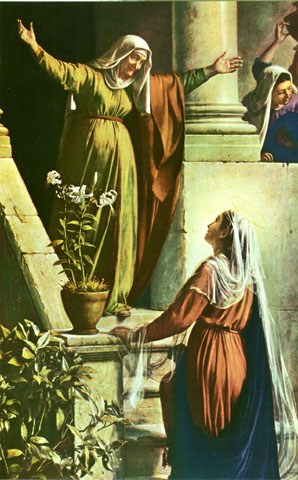
When Elizabeth heard Mary’s greeting, she cried out in a loud voice and said, “How does this happen to me, that the mother of my Lord should come to me?” Who am I that the Lord would come to me? Who are we that the Lord God would become one of us?

Lord, in the words of the psalm, when we see the heavens, the work of your hands, the moon and the stars which you arranged, what is mankind that you should keep us in mind, mortal man that you care for us? Yet you have made us little less than gods; with glory and honor you crowned us when, for us men and for our salvation, your Son came down from heaven, and by the power of the Holy Spirit He was born of the Virgin Mary and became man.

We tend to think of the idea of God becoming a human being as the most natural thing in the world, but the event of the divine and eternal Second Person of the Trinity taking on human flesh (what we call the Incarnation) is probably the most remarkable thing that has ever happened; even more remarkable than our creation or redemption. That is why we bow profoundly when we recall the wonder of the Incarnation in our profession of faith each Sunday. “For us men and for our salvation, He came down from heaven. By the power of the Holy Spirit, He was born of the Virgin Mary, and became man.”

Who are we that the Lord God would become one of us? Who am I that the Lord would come to me? Who we are and why Christ came to us can be summed up in this: we are sinful, limited, loved and good. This sums up human nature in four words. We are sinful, we are limited, we are loved by Him and we are good.

We need Christ as our savior because we are sinful. Even though we know what is right we freely and frequently choose what is wrong. Our sin hurts us, one another, and our relationship with God. He has come for us because we cannot save ourselves.

We are limited, finite creatures. We can forget this or deny this, but it only leads to our own frustration and failure. We are not God, and God doesn’t expect us to be—that’s His job. We must remember that we are limited, in need of His help and help from one another.

When are we are human beings most fully alive?  Not as isolated loaners, but in communion with others. Even the hermit in his desert hut needs spiritual communion with the Lord and His Church if he is to be a complete and happy person. Remember the Unabomber? He lived in a remote shack too, but without this essential communion with God and neighbor.

Though we are sinful and limited, we are also loved and good; for God has lovingly made us good, in own His image and likeness. When we prefer ourselves to God, denying our dependence on Him and scorning Him by our sins, this goodness may be wounded and obscured, but it is never abolished. Jesus Christ always sees this good in us, and He always loves us for it. He loves you for who you are now and for the person He knows that you can become with His help. You are sinful and limited, but never forget, that no matter what, you are loved by Him and good.

We are sinful, limited, loved and good. Knowing this makes us Christians the salt of the earth and shows us how to pray. In fact, the word “salt,” S-A-L-T, sums up the four varieties of Christian prayer: Sorrow, Asking, Loving, and Thanks

We pray in sorrow for our sins.
We pray in asking for our needs.
We pray in love for God loves us.
And we pray in thanks for all He gives us.

I am sinful, so I say “I’m sorry”
I am limited, so I say, “Please.”
I am loved, so I say, “I love you.”
And I am good, and richly blessed, so I say, “Thank you.” 

Who are we that the Lord God would become one of us? Who am I that the Lord would come to me? We are sinful, limited, loved and good. So let us prayerfully prepare for the imminent coming of the Lord, Jesus Christ, our God made flesh this Christmas, with sorrow, asking, love, and thanks.

3rd Sunday of Advent—Year C

December 14, 2009

Advent is a season for penance and conversion, for the confession of sins and the changing of lives, but this Sunday of Advent reminds us that it is also time for joy. Today we celebrate Gaudete Sunday, a name which comes from the Latin command “rejoice!” This command is heard from St. Paul in today’s second reading:

“Rejoice in the Lord always.
I shall say it again:  rejoice!”

But is it that why do we need to be reminded, even commanded, to rejoice? Why are we not a people of constant joy and peace, even though we have great reason to be? I think it is because our hearts and minds give in to fear.

God is near, but when we give in to fear we do not trust that He really cares about us and really provides for us. In fear we become anxious about our future. In our fear we feel too stressed-out to be thankful. And in fear we forget or refuse to pray. St. Paul seems to have realized all this, that may be why he followed his command to rejoice with these words, words that it would do a lifetime of good to know by heart:

“The Lord is near.
Have no anxiety at all,
but in everything,
by prayer and petition,
with thanksgiving,
make your requests known to God.
Then the peace of God
that surpasses all understanding
will guard your hearts and minds in Christ Jesus.”

Today I would like to share with you a true story about two friends of mine who had every seeming reason to afraid, but who kept God’s peace. Let’s call them Andrew and Christi. I have changed their names to conceal their identities, but I know they wouldn’t mind me sharing with you their story because it can teach us all a lot.

To say my friends had a difficult first year of marriage would be to understate it. Andrew, a hard-working man with rough hands and a good heart, became afraid that marrying Christi had been a mistake and he seriously considered getting a divorce. Christi, a beautiful woman inside and out, prayed fervently to God, for both Andrew and herself. She honestly did not know how God would provide for her, but God gave her a peace that surpassed her limited understanding of His plans. Then, as Andrew tells it, God intervened, giving him a sign that this marriage was indeed His will and that Andrew should not be afraid. This divine reassurance strengthened Andrew and he resolved to remain faithfully at Christi’s side no matter what.

A few months later, forces beyond their control forced Andrew and Christi to leave their hometown, away from all their family and friends, and to move down south to a town where Andrew had some distant relatives. But, once they got down there, all of these relatives proved to be too distant or too busy to care enough to lend this vulnerable couple a hand. Their first Advent season together, Andrew and Christi were jobless, homeless, and with child.

It would have been so easy for them to give in to despair that first Christmas Eve, for Andrew to feel like he had failed his wife as a husband, or for Christi to feel anxious and afraid about their future as a family. Yet, Andrew and Christi trusted that the Lord was near. They would pray together as a couple, and gain courage and strength, peace and even joy through their prayers.

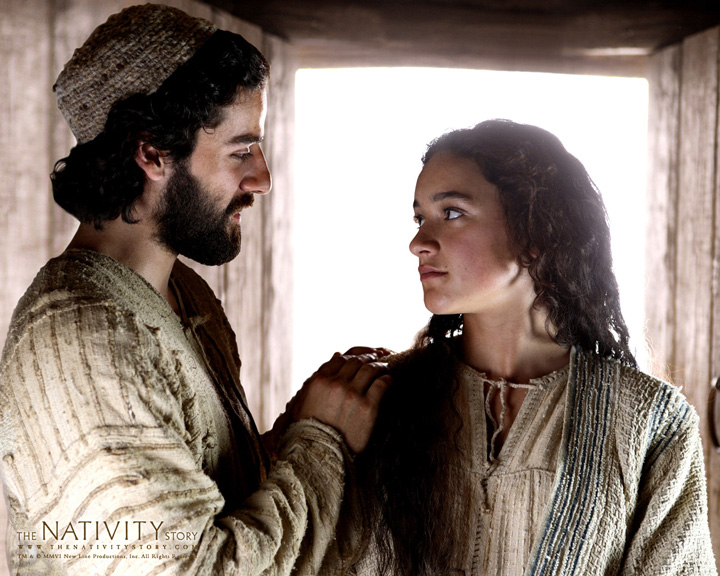
Indeed the Lord was near them, through it all, and their first Christmas together turned out to be was the brightest and the most joyful that they, or the world, had ever seen. As I said, this is the true story of two friends of mine, but they’re also friends of yours and you knew their story even before I told it to you today. For Andrew’s real name is St. Joseph and Christi’s real name is St. Mary.

Today we rightly call them saints, not because they lived in a world free from difficulties, an imaginary world different from our own. Joseph and Mary are saints because they knew and practiced how to live in this world well; with joy, kindness, prayer, thanksgiving, and peace. And so brothers and sisters:

Rejoice in the Lord always.
I shall say it again:  rejoice!
Your kindness should be known to all.
The Lord is near.
Have no anxiety at all,
but in everything,
by prayer and petition,
with thanksgiving,
make your requests known to God.
Then the peace of God
that surpasses all understanding
will guard your hearts and minds in Christ Jesus.