Archive for the ‘Sunday Homilies’ Category

The Vision of Christian Marriage

January 18, 2025

2nd Sunday in Ordinary Time
By Fr. Victor Feltes

God created mankind in his image; in the image of God he created them; male and female he created them.” When God’s Old Covenant people only knew of God’s oneness, they may have assumed we only share in God’s image by our freewill, our intellect, and our rule over creation. But Jesus reveals to his New Covenant people that God’s oneness is not mere solitude but a unity of persons sharing one divine nature – the Holy Trinity. The Father eternally begets the Son, while the Son eternally gifts himself back to the Father, and from their love the Holy Spirit eternally proceeds. And in the beginning in the Garden of Eden, from Adam’s side close to his heart, Eve is fashioned — the woman of his dreams, his equal in dignity, sharing one human nature. And from their self-gift to each other, another person (children) can proceed. A family or loving community reflects a fuller image of God than an individual alone.

The human body speaks a language. In the one-flesh union, a man and woman’s bodies express a total gift of self to each other, open to enduring love and open to new life. This embrace says, “I give myself to you freely and completely for the rest of our lives. In the sight of God and neighbor I pledge my love for you and promise to will the very best for you.” When an occasion of this act does not match what the language of the body is saying, it is a lie, a sin, and often feels impure. But when what is being said matches the reality, then it is true, pure, and holy. Indeed, for Christian couples it seals or renews their covenant in the Sacrament of Marriage.

God made marriage before the Fall and created it good, but after the Fall the relationships between men and women have been impacted by sin. Since then, their unity has been threatened by discord, spirits of domination, selfishness, infidelity, jealousy, and conflict which can even escalate to hatred and separation. To prevail over sin, man and woman need the help of God’s grace which in his infinite mercy he never refuses them. The Sacrament of Marriage connects couples to Christ’s grace to create new holy families. Indeed, Christ the Bridegroom’s earthly mission was a courtship leading to a marriage with children.

Jesus’ first recorded miracle was performed at the wedding feast of Cana. “There were six stone water jars there for Jewish ceremonial washings,” and his public ministry began by transforming those Old Covenant waters into wine. In Sacred Scripture, six is a number of imperfection and incompletion while seven is a number of completion and perfection. And there is a seventh jar in the Gospel of John: “[On the Cross,] aware that everything was now finished, in order that the Scripture might be fulfilled, Jesus said, ‘I thirst.’ There was a jar filled with sour wine. So they put a sponge soaked in wine on a sprig of hyssop and put it up to his mouth. When Jesus had taken the wine, he said, ‘It is finished (or fulfilled, complete, consummated)’ And bowing his head, he handed over the Spirit.

Jesus is the New or Second Adam who, naked at a tree with the New Eve, proves faithful to God. Jesus enters the deep sleep of death, and from his side, from his heart, water and blood pour forth, the water for baptism and Blood for the Eucharist from which the Bride of Christ is fashioned. This bride, the Church, is fruitful in bearing, nurturing, and forming her children. The Old Testament foreshadowed this, like in our first reading from Isaiah: “As a young man marries a virgin, your builder shall marry you; and as a bridegroom rejoices in his bride, so shall your God rejoice in you.” And at the end of Scripture in the Book of Revelation it is declared in heaven: “Blessed are those who have been called to the wedding feast of the Lamb.”

The Sacrament of Marriage taps into the mystery and power of this loving union of Christ and his Church. In Ephesians 5, St. Paul writes how husbands and wives should love each other, with wives respecting their husbands’ leadership and husbands serving their brides like Jesus loves us. And Paul says in conclusion, “This is a great mystery, but I speak in reference to Christ and the Church.” Twenty years ago this year, when I was still a seminarian I attended my cousin’s wedding. Around the time when the bride and groom exchanged their vows, they were gazing in each other’s eyes, holding hands, and smiling. Then, without anything visibly changing, my perception shifted, and for several seconds I saw in them Jesus Christ marrying the Church. Now I hesitate to share this story because it might be like when someone talks about an “awesome” dream they had which fails to impress or translate for others. Yet I mention it all the same in hopes that, in addition to seeing the importance of being sacramentally married in the Church and being open to God’s will in bearing and raising children, you may have the vision to see your marriage in a new, real, more spiritual and mystical way.

The Great Gift of Baptism

January 11, 2025

Feast of the Baptism of the Lord
By Fr. Victor Feltes

As with the Jewish boys who received the rite of circumcision on their eighth day to enter the Old Covenant, the early Church gave the rite of baptism as a free gift for even newborns to enter the New Covenant. Unlike those of us who were baptized as babies, my friend Elena remembers her baptism from when she was nineteen years old.

She says, “Right up to the night (of that Easter Vigil in 2007), I was still partially afraid that God would strike me down when the baptismal waters touched me. I wanted so much to belong to him but half-thought that maybe he didn’t want me. I thought, ‘If he wanted me in the Church, why didn’t he have me born in a Catholic family?’” Full Christian initiation is accomplished through three sacraments: first, Baptism which is the beginning of new life; Confirmation which is its strengthening; and Holy Eucharist which nourishes the disciple with Jesus’ Body and Blood for transformation in Christ. Elena received all three sacraments that night, “and then after,” she says, “I could hear him in a whole new way (not like a voice but like thoughts that you know come from him). And I knew I was his and that he wanted me.

Through baptism, by being buried and rising again from the waters, we mystically enter the death and resurrection of Jesus. We are united with him as a member of his Church, members of his Body, members of his Bride. Through water and the Holy Spirit, we are “born from above” and “born again.” We become adopted children of God the Father and new temples of the Holy Spirit. Baptism forgives all our sins, indelibly changes our souls, bestows us graces enabling close relationship with God, and makes us sharers in the mission of his Church as priests, prophets, and kings in Christ. Jesus commands us to “go… and make disciples of all nations, baptizing them in the name of the Father and of the Son and of the Holy Spirit, teaching them to observe all that [he has] commanded [us].” Baptism opens the door to the other sacraments. It is the gateway into God’s Kingdom for salvation.

Jesus says, “Whoever believes and is baptized will be saved; whoever does not believe will be condemned.” Baptism is necessary for salvation for those to whom the Gospel has been proclaimed and who have had the opportunity to ask for this sacrament. God has bound salvation to his sacraments, yet he himself is not limited by his sacraments. His Church teaches that unbaptized martyrs, catechumens seeking baptism, and those who are ignorant of the Gospel of Christ and his Church but who seek the truth and do the will of God in accordance with their understanding of it can be saved through a baptism by blood or desire instead of water. How many are saved through these baptisms of desire? We don’t know. We do know that our clear salvific mission is the Great Commission Jesus gives us.

As St. Peter preached at Pentecost: “Repent and be baptized, every one of you, in the name of Jesus Christ for the forgiveness of your sins; and you shall receive the gift of the Holy Spirit!” Ordinarily, only deacons, priests, or bishops should baptize people by pouring, sprinkling, or immersion while invoking the Holy Trinity. However, in an emergency situation, anyone can baptize; simply intend to do what the Church does when it baptizes and pour water on the recipient’s head while saying “I baptize you in the name of the Father, and of the Son, and of the Holy Spirit.

This Sunday, we celebrate the Baptism of Jesus. Though sinless, he voluntarily submits himself to John’s baptism intended for sinners in order “to fulfill all righteousness.” By his own baptism, Christ connects himself with the baptized so the baptized can be united to Christ. Once Jesus was baptized, while he was praying, heaven opened and the Holy Spirit descended upon him in visible form like a dove. And the voice of God the Father came from heaven: “You are my beloved Son; with you I am well pleased.

My friend Elena recalls that after her baptism, “I had this almost euphoric joy for almost a whole year that nothing could touch. I remember some religious sisters I’d met just after my baptism warning me that would fade. I didn’t believe them, but they were right. Hard times came and it got more difficult to hold onto that joy. But I think that joy is what we’ll experience in heaven and I hold onto that hope now.” Our own baptisms may have been many years ago and perhaps we have no memories of that day at all. But the effects of baptism do not depend on our feelings. Remember who you are in Christ. The voice of the Father calls out from heaven for you to hear him: “You are my beloved one, my beloved child, and in you I delight.”

The Gift of Anointing

January 4, 2025

Feast of the Epiphany
By Fr. Victor Feltes

With Father Aro away in India for his annual vacation and spiritual retreat until February 12th I plan to celebrate all of our Masses for several weeks to come. This gives me a rare opportunity to preach with an ongoing theme. So over the next month and a half I will preach about the seven sensible signs instituted by Christ to give us his grace. These effective rituals entrusted to his Catholic Church through which we receive divine life are called the Sacraments. It is important for us to learn about these holy gifts of God so that we may benefit from them to the fullest. This Sunday, we begin with the final sacrament that many Catholics receive.

The Magi, upon entering the house of the Holy Family in Bethlehem, “saw the child with Mary his mother. They prostrated themselves and did him homage. Then they opened their treasures and offered him gifts of gold, frankincense, and myrrh.” These gifts pointed ahead to Christ’s Passion. Gold, for Christ is King. Frankincense, for he would offer God a pleasing sacrifice of himself. And myrrh, for his body would be anointed with this substance for his burial. The Holy Family was being hunted by King Herod, but God provided these gifts for his holy ones so they could escape the dangers of death and be saved. (That gold and those tradable goods were assets for the Holy Family in Egypt.) Through the Sacrament of the Anointing of the Sick, God provides for his holy ones as they face the threat of death. You are more precious to God than gold. Your sufferings can be united to Christ’s and offered up to heaven as a redemptive sacrifice. And the anointing of your body can better prepare you for either your recovery or your passing.

St. Mark records in his Gospel how the apostles “anointed with oil many who were sick and cured them.” And St. James instructs the 1st century Church in the New Testament letter which bears his name: “Are there any who are sick among you? Let them send for the priests of the Church, and let the priests pray over them, anointing them with oil in the name of the Lord.” James writes that “the prayer of faith will save the sick persons, and the Lord will raise them up. And if they have committed any sins, their sins will be forgiven them.” Whenever you begin to be in danger of death from illness, or from the frailty of old age, or because of an upcoming major surgery, the time for Holy Anointing has certainly already arrived. Call your priest, because he is unlikely to learn of your need unless you tell him. The hospital will not automatically contact us and only a priest can anoint you.

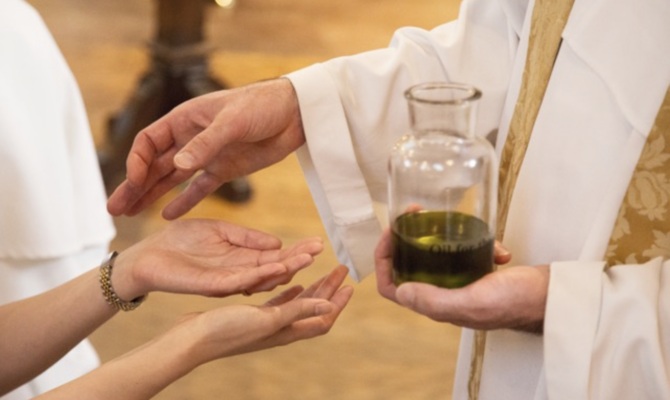
The priest will come and pray for you, silently laying his hands on your head. Then he will take some blessed oil and apply it in the shape of a cross on your forehead, saying “Through this holy anointing may the Lord in his love and mercy help you with the grace of the Holy Spirit.” Then he will anoint the palms of your hands in the same way, saying “May the Lord who frees you from sin save you and raise you up.” You can receive this anointing again either if your condition greatly worsens or if you recover and become seriously ill again later. When a priest believes it is likely to be the last time you’ll be anointed he will also give The Apostolic Pardon, Viaticum (or Holy Communion), The Litany of the Saints, and the Final Commendation as additional “Last Rites.

This sacrament gives strength, courage, and peace. It forgives your sins, if you were unable to obtain it through the Sacrament of Confession. And it unites you to Christ’s Passion to participate in his saving work, helping you offer redemptive sufferings like St. Paul describes to the Colossians: “I rejoice in my sufferings for your sake, and in my flesh I am filling up what is lacking in the afflictions of Christ on behalf of his body, which is the Church.” Sometimes this sacrament helps restore you to health, otherwise it prepares your soul to pass over to the next life.

Do not refuse or put off this sacrament. God is not an enemy like King Herod whom you should flee and hide from. Do not deprive yourself or loved ones by waiting too long to request holy anointing. Like gold given to an important person, like frankincense for offering holy sacrifice to God, or like myrrh to prepare us for the end of life, the Anointing of the Sick is a precious holy gift.

Life Lessons From A Holy Family

December 29, 2024

Feast of the Holy Family
By Fr. Victor Feltes

The Holy Family went up to Jerusalem each year for the feast of Passover. Once, when Jesus was twelve years old, as they were leaving the city at the end of the festival, the Boy Jesus stayed behind without his parents knowing it. Whole communities would pilgrimage to and from these feasts together, so Joseph and Mary had assumed Jesus was walking with others in the caravan during that first day journeying on the road back to Nazareth. But then, perhaps when it was time to share a meal or set up camp for the evening, his parents could not find him. They would have asked all of their relatives and neighbors about the last place they had seen the boy and realized that he had not been with them for hours. Joseph and Mary would soon return to Jerusalem and find Jesus alive and well on the third day. In this difficult episode for the Holy Family, there are lessons for us today.

Jesus had the best parents in all of human history. His adoptive father was a great saint and his mother was filled with grace. And yet, one time, they lost track of their only child for three days. This shows us that sometimes we can try our hardest and things will still go wrong (at least in our own eyes). We can always choose to put forth our best effort, but we cannot control every outcome. Remember: Just because something goes wrong, even painfully wrong, does not necessarily mean that we have sinned. The Blessed Mother was sinless and yet she lost her Son.

When we are little, our parents might seem perfect. As we grow up, we are disappointed to see their imperfections. But as we advance in wisdom and age becoming adults ourselves, we better understand human weakness and limitations. This does not erase people’s flaws and sometimes grave faults, but it can help us have more mercy for people, including forgiving our parents and ourselves.

After three days, Joseph and Mary found Jesus in the temple, “sitting in the midst of the teachers, listening to them and asking them questions.” Jesus shows us that we can learn things even from imperfect people. Jesus’ parents were astonished when they found him, and his mother said to him, “Son, why have you done this to us? Your father and I have been looking for you with great anxiety.” Like holy figures in the Old Testament before her, Mary questions the Lord about the things she does not understand.

Being twelve years old, Jesus was years beyond the age of reason. He must have known his parents would be concerned after he concealed his plans from them. But the Sinless One does not offer an apology. Instead, he asks them, “Why were you looking for me? Did you not know that I must be in my Father’s house?” It is a mystery why it was God’s will for Jesus to remain in Jerusalem. Even after his reply, his parents did not understand what he said to them. But he returned home with them to Nazareth and was obedient to them as he advanced in wisdom and age and favor before God and man. Blessed Mother Mary kept this episode in her memory, remembering its stressful beginning and joyful end, and pondering its meaning in her heart.

The things which happen in our lives, like the circumstances of our upbringing or the crises that come our way, will not always make sense to us. But we can learn and grow from all these things, and become more holy families because of them, for “God works all things for the good of those who love him.”

Imitate The Visitation

December 21, 2024

4th Sunday of Advent
By Fr. Victor Feltes

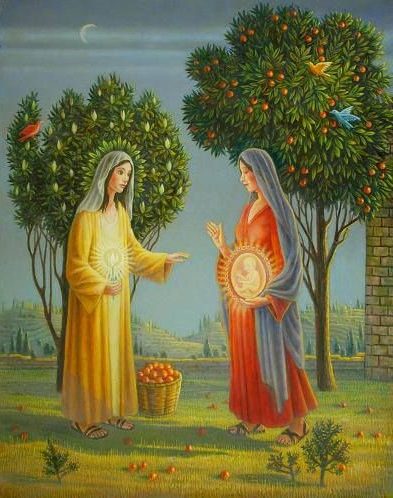
When Archangel Gabriel informed the Virgin Mary that she would conceive the Son of God, the last recorded thing he told her was: “[B]ehold, Elizabeth, your relative, has also conceived a son in her old age, and this is the sixth month for her who was called barren; for nothing will be impossible for God.” Notice how the angel does not tell Mary what to do with this final bit of news. Yet soon after in response, likely encouraged by the Holy Spirit, “Mary set out and traveled to the hill country in haste to a town of Judah, where she entered the house of Zechariah and greeted Elizabeth.”

St. Luke records that “Mary remained with her about three months and then returned to her home.” Luke’s Gospel contains details about the Annunciation, the Visitation, the Nativity, and Jesus’ early years which are not told in the other Gospels, including things upon which Mary “pondered in her heart.” Now how would you know what someone pondered in their heart unless they told you? This suggests that the original source for the stories in the first chapters of Luke was the Blessed Virgin Mary herself.

At the Visitation, at least four persons are brought together: Elizabeth, with John the Baptist at least twenty weeks along, and Mary her kinswoman, with Jesus who was perhaps only days old within her. Although Mary believed in what was spoken to her by the angel, she may not have known how far his words had been fulfilled. If that is the case, then the first person on earth to recognize and herald the presence of Christ Incarnate was another unborn child.

The angel never commanded Mary to make the journey, but she wanted to be there for Elizabeth. For about three months, apparently until the circumcision and naming of John eight days after his birth, Mary was there to help and support Elizabeth around the house and through her first delivery. Elizabeth, in turn, was an encouragement and help to Mary, sharing Spirit-inspired words, like “blessed are you among women and blessed is the fruit of your womb,” and offering wise advice, such as whether and how Mary should reveal the news of her pregnancy to Joseph. Unborn Jesus and unborn John depended upon their mothers for life itself, yet even these little ones were helpful as well. John’s tiny leaping kicks confirmed to Elizabeth what the Holy Spirit was revealing to her, while the grace of the Son of God was mystically supporting them all. They were called to community and to help and accept help from each other. We are called to help and accept help from one another sharing community in this parish as well.

When I was in seminary, we would gather for meals at round tables in the refectory (or cafeteria). We ate from plates and bowls on top of dinner trays. Sometimes at the end of meals, my fellow seminarians would offer to take up others’ trays to the dishwasher racks. I would gladly accept the offer and thank them for it. However, occasionally when I would offer to take up other seminarians’ trays, someone might adamantly refuse. So I would ask, “How come it’s okay for you to take up my tray but not okay for me to take up yours? Come on, allow me to merit with God from doing some good deeds too!” Mary and Jesus, Elizabeth and John, were all together and helpful to each other. Christians are called not only to serve but to be humble enough to accept and even seek out kindness and help from others.

The providence and grace of God led to the beautiful mystery of the Visitation. This week, God will draw many people to our church for the first time in a long time. Joyfully greet our guests, like Elizabeth welcomed Mary. Like little John the Baptist, express excitement that they are here. Invite them to be with us and be present yourself, at Sunday Mass, as part of our Parish Council of Catholic Women or our Knights of Columbus, in the That Man Is You men’s group, at parish meals or at activities, like my next Trivia Night this January. You have nothing to lose from this, while others have much to gain. And please prayerfully consider creating community events for our parish yourself. Would you like to start a Bible study, or a Catholic video series, or a book or movie club, or host an after-Mass social? Talk to me about whatever you have in mind because I desire your rewarding work to bear much good fruit. Blessed are you who believe that the Lord could do great things through you.

Rejoice, The Lord Is Near – Have No Anxiety At All

December 14, 2024

3rd Sunday of Advent
By Fr. Victor Feltes

A story is told of an old American Indian speaking to his young grandchild seated at his feet. “Inside of me there are two wolves,” the grandfather explains. “One of these wolves is virtuous: patient, kind, chaste, generous, forgiving, and loving. But the other wolf is vicious: angry, cruel, lustful, greedy, unforgiving, and hateful. These wolves are battling within me in a fight to the death.” The child asks, “Which wolf is gonna win, Grandpa?” The grandfather replies, “The one that I feed.”

One bit of encouragement I often give in the confessional concerns the ideas, feelings, memories, or temptations which enter people’s minds. When people confess to having had bad thoughts or temptations, I ask, “Did you will them? Did you choose them? Did you welcome them? Did you say ‘Yes’ to them, or did you resist them?” Unhelpful thoughts and feelings can come to us against our will. We only sin or merit when we engage our will to accept or reject them. A saint is not someone who never feels temptation but someone who, even when tempted, choses what is good and true and loving. If we do not realize this, we will believe every temptation we think or feel is a sinful defeat when it is merely a call to battle.

Some people think temptations only attract us to pleasures, to set us up for a fall. However, some temptations draw us downwards, to grumbling, bitterness, unhappiness, and despair. In today’s second reading from the Letter to the Philippians, St. Paul presents an antidote. He says, “Rejoice in the Lord always. I shall say it again: rejoice!” A person rejoices when they have gratitude for the present and the past and have hope for the future.

Our days may be very challenging but even amidst our sufferings we have much to be grateful for. We can always find a reason to complain. (Somebody with nothing to complain about could even choose to complain about that!) But most of our complaints are completely unnecessary. Instead, count your blessings—perhaps literally on your ten fingers—especially in hard times, and remember that you have great cause for hope in good things to come. When I replace pointless complaining with rejoicing my blessing cup is no longer empty but full enough to overflow for others. Because of this, St. Paul says, “Your kindness should be known to all.”

Another of our common unpleasant temptations is to anxiety. One of the things Jesus says most in the Gospels is “be not afraid!” Realize that worry (which is the natural fruit of fear) is worthless; concern is enough. If I were totally unconcerned about this homily then I would have prepared nothing to say. But if I had been worried about this homily there would still be just as much work to do but with added stress besides. What can you do when you are showing proper concern and you are doing your part but still feel the burden of anxiety? St. Paul provides this prescription: Remember that “The Lord is near.” So “have no anxiety at all, but in everything, by prayer and petition, with thanksgiving, make your requests known to God. Then the peace of God that surpasses all understanding will guard your hearts and minds in Christ Jesus.

We are called to zero anxiety, “to have no anxiety at all.” When you’ve done what you can, you can refer the rest to God. Lift up your prayers and petitions with a thankful heart. And then, even if nothing visibly changes in the situation immediately, the peace of God which surpasses our understanding will guard and protect your heart and mind from pointless worry. The Lord is near. Give thanks and rejoice. Have no anxiety at all. For the Lord is with you, fighting on your side in the battle.

Our Advent Traditions

November 30, 2024

1st Sunday of Advent
By Fr. Victor Feltes

Jesus Christ’s Church has “Big T” Traditions and “small t” traditions. The first kind (“Big T” Traditions) are Sacred Traditions which come to us directly from Jesus and his Apostles. They belong to the unchanging Deposit of Faith entrusted once-for-all to Christ’s Church. The second sort (“small t” traditions) are the Church’s customs. For instance, how we celebrate the Advent season along with our Advent wreath are among those “small t” traditions.

The Bible details the historical events of Christmas and Easter, but it is interesting to note that the New Testament never explicitly teaches we must commemorate Christmas or Easter on specific days each year. And that is OK. Jesus Christ’s Church was never meant to be a strictly “Bible alone” Church; she existed even before the New Testament was compiled. The Holy Spirit dwells in her, preserving her from denying the Deposit of Faith and guiding her ways (as the Book of Acts says) as it ‘seems good to the Holy Spirit and to us.’ Let’s consider the customs and traditions of this new Advent season and its Advent wreath.

Over the next month, our predominant liturgical color is purple or violet. Old, black, Roman vestments used to gradually fade towards purple because of the inferior dyes they used. And so, over time, purple became a customary penitential color for the Church. Though less intensely than in Lent, we spiritually discipline ourselves during Advent preparing for the coming of Christ – both at Christmas and at his return in glory. It is fitting what we prepare for our King’s arrival with purple cloth, for purple in the ancient world was the most expensive color to dye, it was the color of cloths worn by kings. This season, we are preparing for the coming of the King of Kings.

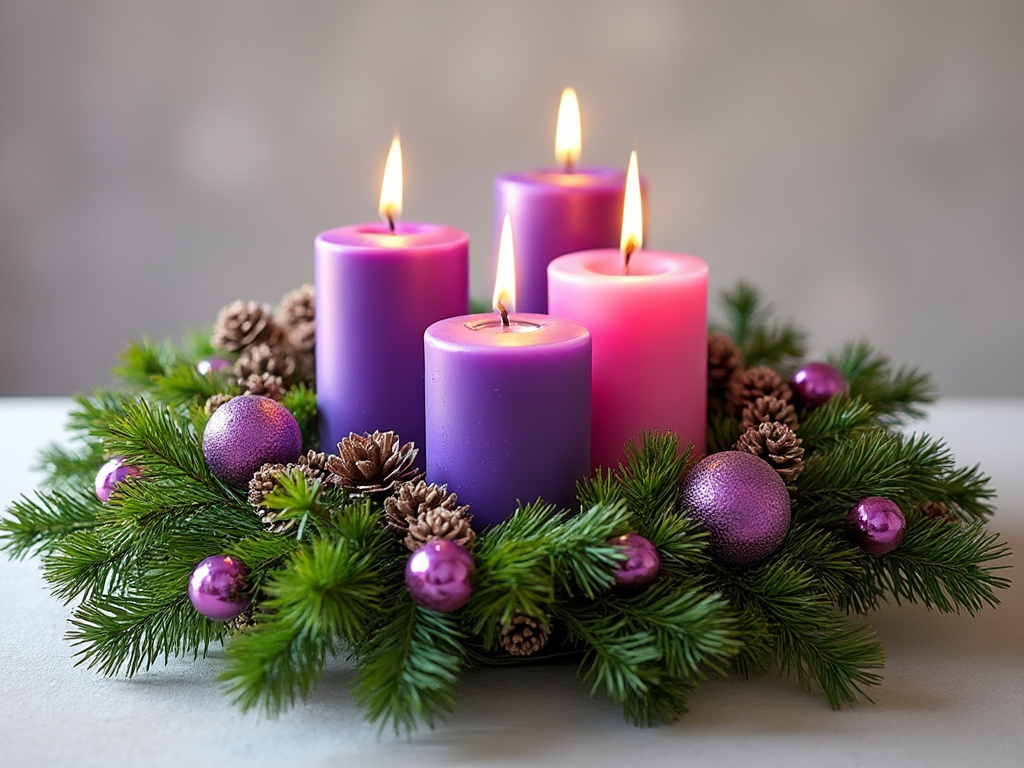
We mark this season’s Sundays with our Advent wreath: four candles amidst a circle of evergreen branches. These evergreen branches, still green during the dead of winter, symbolize eternal life. The circle symbolizes recurrence and eternity. And though we celebrate Advent and Christmas each year, these four candles remind us we look forward to definite end, a final fulfillment – not only December 25th, but the Last Day.

This world will not just be the same unsatisfying stuff forever. Christmas, Jesus’ birth at the center of history, changes our hopes. We light an additional candle each Sunday because Christ is coming. As the winter world darkens around us, we add these lights. They shine in the darkness and the darkness does not overcome them. We light these candles because we know the true Light which enlightens all men, the Word become flesh, has come and is coming into the world.

Beware,” Jesus says in our Gospel reading, “that your hearts do not become drowsy from carousing and drunkenness and the anxieties of daily life, and that day catch you by surprise.” Advent is our time for preparation for the coming of Christ. As St. Paul writes to the Thessalonians, “May the Lord make you increase and abound in love for one another and for all… so as to strengthen your hearts, to be blameless in holiness before our God and Father at the coming of our Lord Jesus.”

Jesus Christ Is King

November 24, 2024

Solemnity of Christ the King
By Fr. Victor Feltes

Today’s psalm says: “The Lord is King, in splendor robed… Your throne stands firm from of old… Your decrees are worthy of trust indeed…” The Old Testament prophets agreed. Isaiah said “the Lord is our King, it is he who will save us.” Jeremiah said our God “is the living God, the eternal King.” And Zephaniah said “the King of Israel, the Lord, is in your midst.” At the center of human history, when Jesus Christ is born among us, he comes as King as well.

Behold, magi from the east arrived in Jerusalem, saying, ‘Where is the newborn king of the Jews?’” And when Jesus rode into Jerusalem, the crowd cried out, “Hosanna! Blessed is he who comes in the name of the Lord, even the king of Israel!” Pontius Pilate unknowing proclaimed this truth when he had a sign placed above Christ’s head on the Cross: “This is Jesus the Nazorean, the King of the Jews.” This Sunday, we celebrate that our Lord Jesus Christ is King of the universe now.

After his Resurrection, when Jesus appeared to his apostles on a mountain in Galilee, he told them, “All power in heaven and on earth has been given to me” and he gave his Church our Great Commission to spread his Kingdom, reassuring us, “Behold, I am with you always, until the end of the age.” This raises a challenging question for us: why is Jesus not visibly doing more now? All power in heaven and on earth has been given to him, so why is he not making more things happen?

His disciples wondered about this, too. Before the Risen Jesus ascended into Heaven, they asked him, “Lord, are you at this time going to restore the Kingdom to Israel?” He answered, “It is not for you to know the times or seasons that the Father has established by his own authority. But you will receive power when the Holy Spirit comes upon you, and you will be my witnesses in Jerusalem, throughout Judea and Samaria, and to the ends of the earth.” The Kingdom of God is among us, and Jesus calls us to work with him to spread it and deepen it, everywhere in everyone.

But why doesn’t Jesus just force everything to be better? As God, he is omnipotent. He has the power to do all possible things. But one thing he cannot do is to force someone’s free “No” into a free “Yes.” When Jesus returns in unveiled glory, coming upon the clouds and flanked by his angels in full-force, humanity’s time for decision will be over. That day will bring the Last Judgment and sin will no longer be given any quarter. After that, there will be only God’s Kingdom and the outer darkness. Now is the time for freely choosing.

Do we desire God’s Kingdom? Around 1000 B.C., the elders of Israel came to the Prophet Samuel asking, “Appoint a king over us to rule us like other nations.” Samuel was displeased they said, “Give us a king to rule us,” but he brought the matter to the Lord in prayer. And the Lord replied: “Listen to whatever the people say. You are not the one they are rejecting. They are rejecting me as their king.” And during Christ’s Passion, Pilate asked the crowd, “Shall I crucify your king?” The chief priests answered for the mob, “We have no king but Caesar.” They were rejecting the Lord as their King. When we pray “thy Kingdom come, thy will be done, on earth as it is in Heaven,” do we really mean what we are saying?

When Pilate asked Jesus if he was a king, Jesus answered, “You say I am a king. For this I was born and for this I came into the world, to testify to the truth. Everyone who belongs to the truth listens to my voice.” Pilate then responds with a line which today’s Gospel reading cuts off. Pilate dismissively replies, “What is truth,” and then turns his back on Truth himself, and walks away. If you desire Jesus as your Savior, you must let him be your Lord.

Advent begins next Sunday—our annual season of preparation for the coming of the Lord. Here are three wise steps for a better Advent. First, his decrees are worthy of trust. Which of his words will you neglect no more but specifically begin putting into practice? Make yourself a short list. Second, make an Advent Confession, for a fresh beginning, a new infusion of grace. And third, pray every day, for you cannot thrive without him. The saints worked wonders in this world by following Christ and doing his will. So can you. The Lord is in your midst. He is the living God, our eternal King. And if we will let him, it is he who will save us.

Do Not Fear The Ending

November 16, 2024

33rd Sunday in Ordinary Time
By Fr. Victor Feltes

The Prophet Daniel says of the end of days, “It shall be a time unsurpassed in distress…” And Jesus foretells, “In those days after that tribulation the sun will be darkened, and the moon will not give its light, and the stars will be falling from the sky, and the powers in the heavens will be shaken.” Many Christians today regard the end times with aversion and dread. Many fear Jesus Christ as judge, as if he were coming to destroy us. And yet, at the conclusion of the Book of Revelation, in response to the One who declares, “Yes, I am coming soon,” God’s people cry out in answer, “Amen! Come, Lord Jesus!

The early Christians saw the arrival of God’s Kingdom for us—either when we die or at Christ’s Second Coming—as Good News. St. Paul the Apostle wrote, “For me, life is Christ and death is gain!” “Jesus Christ is the same yesterday, today, and forever,” and he tells us over and over, “Do not be afraid.” There will be trials before the end, in our own individual lifetimes and in the earthly pilgrimage of the Church, but what comes after this will be much, much better.

Out of fear of escapism, we fail to reflect upon Heaven enough. Great hope comes from having something great you’re looking forward to. Imagine Heaven, where sin will be no more; no shame or temptation; no guilt or condemnation; no ugliness, decay, or corruption; no sickness or suffering; no fear or tears; no pain or death; no more crime or injustice; no more separation from God and his saints. And remember not only what evils are absent in Heaven, but also what supreme goods are found there. In Heaven, there is peace and blessings; praise and rewards; knowledge and wonders; perfection and joys; beauty, delights, and unending love; reunion with loved ones; fellowship with the saints; and complete union with God.

The Prophet Daniel foretold about the Day of Resurrection: “At that time, [God’s] people shall escape, everyone who is found written in the book. Many of those who sleep in the dust of the earth shall awake; some to everlasting life, others to reproach and everlasting disgrace.” Sometimes Christians worry whether or not they are in that Book of Life. I do believe more of us need to be praying, going to Confession, and attending Holy Mass, but I like to reassure people by asking them this: First, what is your greatest desire? Next, what do you think is the greatest desire of a saint? If your answers are similar, then you have the desires of a saint—and that’s a very good sign.

Imagine another person just like you in every way; the same past, all the same strengths and weaknesses as you. What would you think of that person? Could you be friends with them? Do not treat yourself worse than you treat others, but love yourself like your neighbor. Be not afraid and remember that the Lord is preparing you for Heaven because God loves you.

The Widow’s Gift Was Love

November 9, 2024

32nd Sunday in Ordinary Time
By Fr. Victor Feltes

Jesus sat down opposite the temple treasury and watched how people gave money at God’s house. There were thirteen donation trumpets attached to sturdy chests into which people were dropping their contributions. Many rich people were donating large sums, causing loud commotions. But one poor widow’s two small coins went in quietly; a little click-click. Why did Jesus highlight her gift above everyone else’s that day?

Our Father in heaven is rich. He created the universe out of nothing. All things belong to him. Being the Almighty, he does not strictly need anything from us. In the 50th Psalm, God tells his people that he does not rebuke them for their animal sacrifices—he had commanded them to make them—but he notes “every animal of the forest is mine, beasts by the thousands on my mountains. I know every bird in the heights; whatever moves in the wild is mine. Were I hungry, I would not tell you, for mine is the world and all that fills it.” And yet, God insists upon our sacrifices for him.

God places us in a material world in which what we do matters. Whether and how we work and pray, learn and teach, plant and harvest, build and repair, save and donate, visit and invite, feed and clothe and care and love, these things really matter—for good or evil—for ourselves and others. It is true Almighty God could do everything all by himself, entrusting us with no mission and zero responsibility. But then, how would we ever mature and grow as glorious saints? Instead, God chooses to work through us, and with us, and in us. Our holy gifts and sacrifices, inspired and empowered by grace, advance God’s Kingdom while transforming us in Christ. Though, strictly speaking, God has no need of our gifts or praises, he insists upon them for our own good.

When Jesus saw that poor widow give God’s house just two coins worth only a few cents, he called his disciples to himself and said, “Amen, I say to you, this poor widow put in more than all the other contributors to the treasury; for they have all contributed from their surplus wealth, but she, from her poverty, has contributed all she had, her whole livelihood.”

Jesus condemns those who “devour the houses of widows,” but he celebrates this woman’s evident trusting, love for God. Jesus says to beware the scribes who love the robes, the titles, the honored seats at synagogues and feasts, who recite lengthy prayers in order to be seen by men. “They will receive a very severe condemnation,” Jesus says, because their focus is not on love of God and neighbor. That poor, loving widow, however, receives the praise of God. “The last shall be first, and the first shall be last.

As I preached in a homily three weeks ago, hierarchies are normal and natural, though some are better than others. The secular world has hierarchies according to power, wealth, or status. Christ establishes a hierarchy for his Church on earth according to sacramental holy orders. But amongst the Church in heaven, a hierarchy exists according to love. In heaven, God reigns supreme and God is love pouring out for all. There is no money to be had there, the sacraments are no longer needed, and there is perfect, perpetual peace. Greatness above is according to one’s capacity to give and receive love. So whoever wishes to be great in God’s Kingdom must imitate the faithful, self-gifting love Jesus highlights in that widow and which we see modeled for us by Jesus Christ himself.

How you love and what you do matters. In the words of St. Paul, “Let us not become weary in doing good, for at the proper time we will reap a harvest if we do not give up.” “Whatever you do, do it with all your heart as for the Lord … knowing that you will receive an inheritance from the Lord as a reward.” For when Christ comes “he will bring to light what is hidden in darkness and will manifest the motives of our hearts, and then everyone will receive praise from God.”

The Saints Come Marching In

November 3, 2024

31st Sunday in Ordinary Time
Deacon Dick Kostner

Today’s Gospel instructs us of how great a gift God has given us by and through His Commandments the divine rules for us to live a fulfilling life that gifts us with happiness even when we are carrying the crosses of life. Sometimes we think of laws and rules as a restriction on our lives but to our ancestors living during the time of Moses, the Commandments were a blessing for God gave them a road map to the place we call heaven. A way for them to live a life of happiness even during trying times, a life of fulfillment and worth, a true treasure.

Today’s Gospel has Jesus condensing for us God’s directives for us to live full lives of grace through just two great Commandments, two priorities containing for us, all we need to remember and practice during our lives. The First is to love God with all of our being knowing that the Creator designed us before we were even born, to display and represent His body, through a little but powerful directive he desires of His children and that is “Love”. The Second great Commandment, further defines how we are to show our love for God and that is to love our neighbor as we love ourselves.

As I pondered the two Great Commandments given us by the Father, I realized that Jesus during his earthly life, did not stop there. Rather he gave to his followers, to us, the tools necessary to carry out and obey the Commandment to Love God and neighbor, He gave us the Sacraments to allow all of His children the ability to become Saints. They are the building blocks, the steps leading to the House where Jesus and His saints live. Lets look at those tools.

The Sacraments come to us under three headings: Sacraments of Initiation; Sacraments of Healing; and Sacraments of Vocation. The Sacraments of Initiation are Baptism, Confirmation and Holy Communion. It is through celebration of these Sacraments that we are able to form a relationship with God. We become a member of the Holy Family; We mature in Spirituality and are invited to be fed by and become an active body member and spokes person of Gods Family. These Sacraments allow us to trust and learn to love God fulfilling the First Great Commandment. Remember, one cannot love without first gaining knowledge and trust in someone.

That brings us to the Sacraments of healing. As humans we will experience illness and disease God gifts us with the tool to overcome the fear of death and sickness of body through the Sacrament of Anointing of the Sick. It is a Sacrament through which we can be healed of worry and know that Jesus will provide us with strength to overcome the fear of sickness and find peace in knowing that we can be still, and know that God is with us as he was present for Jesus. Sometimes we lack faith and fail to listen or request help from God. A separation of Spirit occurs because of human weakness. Jesus gives to us the Sacrament of Reconciliation to reprogram ourselves and ask for God to forgive us. Through forgiveness and reconciliation, this Sacrament heals our division and we once again are in union with the Holy Spirit and are at peace and learn to form a strong spiritual relationship with God.

Knowing how important it is for us to form relationships with God Jesus gifts us with the Sacraments of Vocation. These Sacraments move us to follow the Second Greatest Commandment and that is to love not only God himself but also all of his Children as we love ourselves. This Commandment requires us to not be served but rather to serve others. For many of us the vocation of Marriage awakens within us the desire and reward that follows to find that we are made in the image and likeness of God and are called to love and serve others more than love of self. Others become more important in our lives than just caring for our selves. Through the Sacrament of Marriage we offer to our spouse and children, our life for them to enjoy and find happiness. We are learning to do what Jesus did for us in offering his human life so that we may find happiness and peace for all eternity.

The Sacrament of Holy Orders is Jesus hand picking a few humans and asking them to give their lives up for the privilege of mentoring his children on how to travel the road to Sainthood by and through the practice of loving and serving the body of Christ as Gods representative. I can remember a few years ago telling Jesus that I would not mind becoming a saint. That is what Jesus calls all of us to be. What we need to remember is sainthood does not bear the requirement of being perfect it only requires love.

Jesus tells us that we need to become as children to enter his kingdom. We need to follow His advice and as our school kids show us this weekend how, “The Saints come marching in!

Blessed are the Clean of Heart

November 3, 2024

31st Sunday in Ordinary Time
By Fr. Victor Feltes

On November 1st, Christ’s Church celebrated all the saints in Heaven. The Gospel reading for that solemnity was Jesus’ beatitudes from his Sermon on the Mount. The beatitudes describe God’s saints, and they describe Jesus Christ himself as well. We are made in God’s image and our Lord grows us into his likeness. This Sunday, I would like to highlight one of those beatitudes: “Blessed are the clean of heart…” Most Bible translations render this: “Blessed are the pure in heart…” What is purity of heart?

Our first thoughts perhaps may go to purity in regards to chastity. Obscene materials and obscene acts are commonly called the opposite of “clean.” Yet human sexuality can be a means of sanctity. The marital embrace is even a constitutive part of one of the seven sacraments Christ gave us. Rightly-ordered chastity is a source of joy and life and holiness. Chastity is part of being clean of heart, but it’s not the whole or deepest sense of this beatitude.

When one of the scribes came to Jesus and asked him, “Which is the first of all the commandments,” Jesus answered with words from Deuteronomy: “Hear, O Israel! The Lord our God is Lord alone! You shall love the Lord your God with all your heart, with all your soul, with all your mind, and with all your strength.” A pure heart does not contain the sludge of sin. It does not willfully coddle an affection for evil. A clean heart is receptive to receive and return holy love.

I believe the Venerable Bishop Fulton Sheen once noted that the Archangel Gabriel addressing and declaring the Virgin Mary “full of grace” points to her Immaculate Conception. For if there were sin present in Mary, like inches of mud in the bottom a bucket, she would not be full of grace. But she was clean of heart and full of grace and loved God with her whole self, because our loving God is good and the source of every good.

Now to prevent people from drawing the wrong conclusions, Jesus immediately follows up sharing the greatest commandment with another command from Leviticus. He declares the second greatest commandment is this: “You shall love your neighbor as yourself.” If Jesus had not cited this second commandment, some people would have misunderstood and thought loving God with all our heart, mind, soul, and strength prohibits the love of anyone else. (After all, Jesus said, “No man can serve two masters.”) Instead, we are to love our neighbor as ourselves (and by implication, love ourselves as our neighbors) even as we love God with our whole selves. When our loves are rightly ordered, in loving God fully we will love who and what he loves like he loves them. Contrary to what some might expect, we will love ourselves and other people best by first and fully loving God.

So renew your love for God, choose him first and fully, opposed to your sins or selfish lesser loves, like those saints who lived and died before us who are now in Heaven. Blessed are the clean of heart, for they will see God.

Called To See

October 27, 2024

30th Sunday in Ordinary Time
By Fr. Victor Feltes

Jesus cured many people during his public ministry but very few of their names are recorded in the Gospels. Jesus raised Lazarus of Bethany from the tomb, cast out seven demons from Mary Magdalene, and restored the ear of Malchus in the Garden of Gethsemane. But beyond that, no recipients of Christ’s healings are named except for the blind man Bartimaeus, the son of Timaeus. The first three Gospels all recount this event, but the name of Bartimaeus the son of Timaeus appears only in today’s Gospel.

St. Mark wrote, “As Jesus was leaving Jericho with his disciples and a sizable crowd, Bartimaeus, a blind man, the son of Timaeus, sat by the roadside begging.” In Aramaic, the prefix Bar- means “Son of,” so Bartimaeus means “Son of Timaeus.” Why do St. Mark and the Holy Spirit doubly-emphasize the name of Bartimaeus the son of Timaeus, and what does Timaeus mean?

An Aramaic interpretation of the name Timaeus suggests “uncleanness,” but in Greek the name means “highly prized” or “honored.” This Bartimaeus sat begging on the ground alongside a road near Jericho—an extremely ancient city which symbolized the sinful world. He was blind, impoverished, ignored, despised, called a son of uncleanness, and he was unclean, yet our Lord considered him precious.

Bartimaeus had heard about Jesus’ healings and had faith in him. He shouts, “Jesus, son of David, have pity on me,” because he believes Jesus is the Christ (or the Messiah), the prophesized descendant of King David, and he believes Jesus possesses the power to heal him.

At first, many disciples rebuked the beggar, telling him to be silent, while he kept calling out all the more. Then Jesus stopped and said, “Call him.” So people in the crowd told the blind man, “Take courage; get up, Jesus is calling you!” The man sprang up from the dust and came closer to Christ, guided by Jesus’ disciples.

We are also journeying in a large crowd of Jesus’ disciples today, walking with him in his Church. Are we ignoring people who are not here with us, as the crowd at first ignored Bartimaeus? Jesus commands us to call them and help lead them to himself.

Before Bartimaeus could see, he had heard what other people were saying about Jesus. Are we sharing our stories, our cause for hope, with others? Are we mentioning the miracles that we have witnessed? Are we telling them the difference our Catholic Faith makes? Are we encouraging them to join us here?

Bartimaeus had faith due to what he heard and from God’s grace already active within him, for God is calling everyone. Bartimaeus called out to Jesus and, being called, threw aside his dirty, smelly cloak, lest it restrict his movement or cause offense. We, likewise, must cast off our sinful habits, lest they offend the Lord and impede our progress toward him.

When Bartimaeus reached Jesus, our Lord asked him: “What do you want me to do for you?” Christ could read the hearts of men, so why did he ask the blind man what he wanted? St. Augustine wrote that God wills us to ask him for things not because he doesn’t know (for he cannot fail to know) but “to exercise our desire through our prayers so that we may be able to receive what he is preparing to give us.” For “the deeper our faith, the stronger our hope, the greater our desire, the larger our capacity to receive will be…” Praying for our requests also helps us remember how much we need God and deepens our relationship. St. Teresa of Avila said, “You pay God a great compliment by asking great things of him.”

Jesus asks, “What do you want me to do for you?” How will we answer him? The blind man answered boldly, “Master, I want to see.” And Jesus told him, “Go your way; your faith has saved you.” Bartimaeus immediately received his sight and followed Jesus on the way. May this famous story of Blind Bartimaeus help us to see in new ways too.

The Last Shall Be First

October 19, 2024

29th Sunday in Ordinary Time
By Fr. Victor Feltes

In today’s Gospel, James and John shoot their shot to move higher up in Christ’s Kingdom. They say, “Teacher, we want you to do for us whatever we ask of you. … Grant that in your glory we may sit, one at your right and the other at your left.” Jesus replies, “You do not know what you are asking.” The two brothers jump at the chance to drink from Jesus’ cup and be baptized in his baptism because they don’t realize these things mean sharing in Christ’s suffering. Jesus assures them, ‘You will drink of my cup and experience my baptism, but to sit at my right and my left is for those for whom it has been prepared.’ Where were the places at Christ’s sides at his glorious royal enthronement? St. Mark’s Gospel tells us: “With him they crucified two revolutionaries, one on his right and one on his left. … [And] the inscription of the charge against him read, ‘The King of the Jews.’”

James and John did not realize what they were asking. They sought places closer to Jesus in order to live earthly lives in a palace on Easy Street. They imagined reigning over a kingdom with Christ where they would be served like the rulers of the nations who made their dominance over other people felt. But Jesus gathered his disciples and said, “It shall not be so among you. Rather, whoever wishes to be great among you will be your servant; whoever wishes to be first among you will be the slave of all. For the Son of Man did not come to be served but to serve and to give his life as a ransom for many.”

Hierarchies are normal and natural, though some are better than others. The secular world has hierarchies according to power, wealth, or status. Christ establishes a hierarchy for his Church on earth according to sacramental holy orders. But amongst the Church in heaven, a hierarchy exists according to love. In heaven, God reigns supreme and God is love—pouring out for all. There is no money to be had, the sacraments are no longer needed, and there is perfect, perpetual peace. Greatness above is according to one’s capacity to give and receive love. So whoever wishes to be great in God’s Kingdom must practice the self-gifting, servant love modeled for us by Jesus Christ.

We can expect to see many surprises after this life. Reality will look very differently in the light of eternity. Some things which we once thought were valuable—even necessary—will be seen as nothing. And things once rejected as useless will be recognized for their true value—especially in people. Many unknown people will become recognized as great, while many rich, powerful, and popular people will be humbled. “Thus,” Jesus says, “the last shall be first, and the first shall be last.” So let us begin living life with more of that eternal vision now: by seeing with the eyes of Christ, by thinking with the mind of Christ, and by loving with the heart of Christ.

What Must We Do?

October 13, 2024

28th Sunday in Ordinary Time
By Fr. Victor Feltes

A man runs up to Jesus, kneels down, and earnestly asks him, “What must I do to inherit eternal life?” Jesus quotes to him commandments about loving our neighbors: “You shall not kill; you shall not commit adultery; you shall not steal; you shall not bear false witness; you shall not defraud; honor your father and your mother.” Why did Jesus add “you shall not defraud” after saying “you shall not steal [and] you shall not bear false witness?” What distinction is being made? In the Greek, “steal” here denotes taking, while “defraud” suggests withholding or keeping back what belongs to another. Both the street mugger (by unjustly taking) and the business owner (by unjustly holding back) can deprive someone of what is rightfully theirs. It is possible to sin by clinging on to what we should give.

Upon hearing Jesus’ list of commandments, the man replies, “Teacher, all of these I have observed from my youth.” The man is seeking something more from Jesus. Jesus had just cited several of the Ten Commandments but notice which commandments Jesus left out. The first three commandments are conspicuously absent, the ones specifically about our relationship with God. Jesus, looking at the man and loving him, desires to reveal how he is to love the Lord. He tells him, “You are lacking in one thing. Go, sell what you have, and give to the poor and you will have treasure in heaven; then come, follow me.” But at hearing these words, the man’s face fell because he had many possessions, and he went away sad. Did that man ever go on to have a change of heart before the end? We don’t know. Matthew, Mark, and Luke all record this encounter in their Gospels but none of them mention his name. Perhaps (unlike with Jairus, Zacchaeus, or Bartimaeus) the early Christians were unfamiliar with this man because he never joined their community.

The Book of Acts describes Jerusalem’s earliest Christian community as being “of one heart and mind” and generous towards one another. “There was no needy person among them, for those who owned property or houses would sell them, bring the proceeds of the sale, and put them at the feet of the apostles, and they were distributed to each according to need.” However, that sharing was not obligatory. Christians still owned property, they were free to decide whether to sell it or not, and they were free to share the sale proceeds or not. So it is not necessarily wrong to own things, but wealth can be an obstacle to heaven.

Jesus remarked to his disciples, “How hard it is for those who have wealth to enter the Kingdom of God!” The disciples were amazed at his words, because they held the idea that having great wealth was a strong sign of God’s approval. So Jesus again said to them in reply, “Children, how hard it is to enter the Kingdom of God! It is easier for a camel to pass through the eye of a needle than for one who is rich to enter the Kingdom of God.” So who among us qualifies as rich?

Compared to our immediate neighbors, our wealth is probably pretty average. Or at least most of us have less money than the richest folks in town. But how materially wealthy are we compared to those in other countries? Compared to the world, everyone here is rich. For instance, a two person household with an annual after-tax income of $40,000 makes more than about nine-out-of-ten people on earth. Even someone who lives alone with a post-tax income of $10,000 a year makes more than eight-tenths of the world. We are rich. So what must we do?

Again, not all Christians must give away all of their wealth, but our Lord insisted upon it for that man who came to him because Jesus knew he loved his riches more than God. The things we own are not absolutely ours to do with however we please, for we and what we have belong to God. We are his trusted servants, the stewards of his goods. That is why Jesus says that anyone “who does not renounce all of his possessions cannot be my disciple.” Even when it is his will for us to have possessions, we must do so with a healthy detachment, by being frugal and generous and truly open to doing God’s will.

One of the most memorable scenes from the 1993’s Best Picture winning film “Schindler’s List” comes at the end. Oscar Schindler, a German industrialist, has protected the lives of more than 1,100 Jews during the Second World War by listing them as his “essential workers” while producing defective ammunition for the Nazis. He looks at the people he has saved and reflects: ‘If only I’d made more money. I threw away so much money, you have no idea. … I didn’t do enough. This car. Why did I keep the car? Ten people right there, ten more people. This gold pin… two more people. At least one. One more person, for this. I could have got one more person, and I didn’t.’ It is Ok to have what we need and it can be Ok to buy things we want, but someday we all will have to stand before the Lord “to whom we must render an account” of our Christian stewardship.

There is a world of needs around us, needs abroad and needs nearby, material needs and spiritual needs. Though they all have importance, our local spiritual mission has a special claim on our care. To aid the success of Christ’s mission for the salvation of souls among us, in the words of St. Paul, “Each person must give as he has decided in his heart, not reluctantly or under compulsion [but freely], for God loves a cheerful giver.” And our Lord promises rewards for our sacrifices for him. Jesus declares, “Amen, I say to you, there is no one who has given up house or brothers or sisters or mother or father or children or lands for my sake and for the sake of the Gospel who will not receive a hundred times more now in this present age… and eternal life in the age to come.” So let us be generous, for God will not be outdone in generosity.