Archive for the ‘Weekday Homilies’ Category

The Old New Pattern — Thursday After Epiphany

January 8, 2010

In his first letter to his brothers and sisters in Christ, St. John says that the commandment he writes to them is not new, and yet new. (1 John 2) The commandment he is referring had been given to them years before, by Jesus Christ at His Last Supper. He told His disciples, “I give you a new commandment: love one another. As I have loved you, so you also should love one another.” (John 13:34)  Love sums up the moral law, and we know how to love from Christ.

Once when Jesus’ opponents were trying to trip Him up they asked Him what was the greatest commandment. He answered, “You shall love the Lord, your God, with all your heart, with all your soul, and with all your mind. This is the greatest and the first commandment.”  Then He added, “The second (commandment) is like it: You shall love your neighbor as yourself. The whole law and the prophets depend on these two commandments.” (Matt 22) Or, as St. Paul would later put it, “Love is the fulfillment of the law.” (Rom 13:10) Love sums up the moral law, and we know how to love through Christ.

It is intuitive for people to understand that we should do good and avoid evil, that we should love good and hate what is evil. Yet that does not mean that everyone agrees as to how we should live this out. Often we see the truths which Christians present in love angrily dismissed by the world as hate. (Frequently the throwing of this charge allows people to dismiss opposing viewpoints without ever giving them serious thought.) Even those in a post-Christian secular culture will agree that somehow “love is the answer,” but how exactly are we to love one another?

Jesus shows us how to love.  He says, “As I have loved you, so you also should love one another.” We can learn from His example especially here, as we witness His Passion, death, resurrection, and ascension in the Mass, but we can also learn from the entire life He lived.

Sometimes it can be hard understand example, or difficult to relate Jesus’ life to the particulars of our own. To help us He gives us the example of His saints, through whom He has continued to live His one, salvific way of life through thousands of different human expressions. The Spirit of the Lord was upon Jesus; He was anointed to bring glad tidings to the poor, to proclaim liberty to captives, to restore sight to the blind, to free the oppressed, and to proclaim a year acceptable to the Lord. Today this Scripture passage is still being fulfilled by Him through the lives of His saints.

“The love of God is this, that we keep his commandments.”  So let us learn what love is through the example of Jesus and His saints, for love sums up the law, and we know how to love through Christ.

‘Tis Better to Give — Tuesday After Epiphany

January 5, 2010

(The Micro Machines Aircraft Carrier – Not the Summum Bonum)

When I was a kid, in preparation for Christmas, I remember how my sisters and I would explore those big Sears and J.C. Pennies catalogues and circle the things we really wanted. I also remember the intensity of my excitement when I would open my presents to discover the toys that I had dreamed about. But over the years, I saw a pattern develop that maybe you’ve begun to start noticing for yourself.

Christmas after Christmas, I would play with all my toys, but I discovered that I would never get as much happiness from as I had imagined they would give me when they were still in their boxes. No Christmas toy ever delivered the supreme happiness I had hoped for from them. I was blessed through these experiences to learn a very valuable lesson. I learned that that getting stuff would not and could not complete me—it couldn’t make me truly happy.

Stuff won’t make you truly happy, but there are lots of people who don’t know this. Why do you think it is that TV and advertisers are always going after that “target demographic” of 18 to 34 year-olds, especially that younger segment of 18 to 24 year-olds? It’s because these consumers have significant amounts of disposable income, perhaps for the first time in their lives. And, since they do not have the wisdom of years, many of them can still be fooled into thinking that this or that product will really make them as happy as advertised.

Don’t let yourself be fooled into taking that bait. Keep in mind the words Jesus who said, “It is more blessed to give than to receive” (Acts 2:35). It’s really about giving that I want to speak to you today. There are many ways that we can give of ourselves, of our time, talent and treasure, but this morning I want to address the importance and blessedness of giving from our incredible wealth.

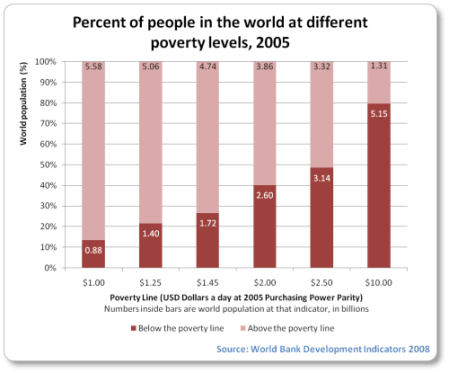
Now I doubt that you would describe yourself as a rich person. In terms of our society, you’re probably not. But realize, that when compared to the rest of the world, you are a very wealthy individual. Did you know that about half of the people in the world live on less than $2.50 a day?

From our great material blessedness comes the great responsibility to share. Yet, the fact that we are far richer than many other people is really beside the point. Even if we were poor compared to everyone else, Jesus would still ask us to share of what we have. For whenever we give out of love, and a desire to spread and advance God’s kingdom, we imitate Jesus Himself, who gave of Himself to us first.

Maybe you feel like you have nothing much to give. The disciples thought they had next to nothing to give too, and they were right. They had just five loaves of bread and two fishes, but Jesus said to them, ‘Give the crowd some food yourselves.’ The disciples wondered what good so little could do for so many, but in Jesus’ hands their small gifts multiplied.  Their deed first feed thousands, and then, through its retelling in the Gospel, it feed untold millions.

It would be hubris, or foolish pride, for us to think that if only we had a million dollars, a billion dollars, a trillion dollars, or any sum, that we by ourselves could save the world. Yet, when we place what little we have into Christ’s hands, giving where and when the Holy Spirit prompts us, Jesus blesses it and our deed does more good within His kingdom than we realize.

Though you never fully see all of the good your giving causes on earth, you can immediately feel some of its goodness inside yourself. Part of the blessedness of charitable giving is in the joy you feel in always knowing that you have done a good deed. When you consume something you may enjoy it for a moment, but when you give something away in love you can enjoy that act forever. If fact, when we get to heaven, we should find ourselves made the instant friends of many strangers when it is revealed to us how our lives were profoundly connected through the smallest gifts.

To help in put our faith into practice, to love our neighbors and advance the Kingdom, we are going to begin taking more regular collections at our weekly school Masses in support various causes. We will be starting by helping a number of area organizations suggested by the Student Senate. And, once our Liturgy & Campus Ministry Committee is up and running, about which Mr. Zimmerman will be speaking to you about at the end of Mass, the selection of worthy charitable causes will one of the important tasks that will fall to them.

Today our collection will be going, in its entirety, to support the Hope Lodge here in Marshfield. The Hope Lodge provides temporary accommodations for patients and their family members while they are receiving cancer treatments at the Marshfield Clinic. Please give as generously as the Holy Spirit may prompt you and know that you will certainly be blessed.

Luke’s Source — January 1 — Mary the Mother of God

January 1, 2010

Have you ever wondered how it is that Luke the Gospel writer knows the stuff he’s telling us? For instance, he wasn’t present at the Annunciation to take down notes.  Only Mary and the Archangel Gabriel were there. And in today’s Gospel, after the shepherds visit, it says, “Mary kept all these things, reflecting on them in her heart.” Now how does Luke know what Mary was thinking? Who could know something like that besides Mary herself?

Now I suppose the Holy Spirit could have directly infused the knowledge of these things into him, but that’s probably not what has happened here. Luke probably learned of these details in the most natural and human way; by being told about them, first or second-hand, by people who knew. Luke begins his Gospel by saying that his narrative of events is composed from what “those who were eyewitnesses from the beginning and ministers of the word have handed … down to us.”

But there is only one person who could have been the original source for many of Luke’s details, and that is Mary herself. In fact, some call the beginning chapters of the Gospel of Luke “the Memoirs of Mary.” Perhaps Luke heard of these details from Mary’s very own lips and took them all to heart.  Then later, knowing these things by heart, committed them to writing.

And so we do know something today of what was going on inside of Mary in those early days, “Mary kept all these things, reflecting on them in her heart.” And some years later, upon finding Jesus in the temple, Luke reports that Mary and Joseph did not understand what their boy when said to them, but “his mother kept all these things in her heart.” In this there is a lesson for us to discover through Mary, a lesson that is particularly applicable for us this New Year’s [Eve/Day].

In her life, Mary knew some important aspects of God the Father’s plan, but there was always a great deal about which she did not know. She knew that her Son was messiah, savior, and Lord, but his future, and hers, remained largely a mystery. Perhaps Mary wondered, as we often wonder when faced with evils and obstacles, “How can this be, Lord?  How will your promises be fulfilled despite this?”  Yet through it all, Mary firmly trusted that the Lord was with her, and we should do the same.

What does the new year ahead hold for each of us? Like Mary, we do not know, yet Mary shows us that we do not have to know.  We do not have to fully know our future to be able to do great things for God and to be richly blessed by Him. We do not need to know our future for the Almighty to do great things for us.

In the year ahead, may the Lord bless you and keep you, as He did the Virgin Mary.

May the Lord let his face shine upon you, and be gracious to you, as He did for Mary through Jesus’ infant face.

And may the Lord look upon you kindly and give you peace, a peace like that which Mary always kept with her Son, Jesus the Christ.

Treasure the Gift — Christmas Mass at Midnight

December 26, 2009

It’s Christmas, and today we hear one of the most familiar passages in the Gospel, the nativity scene in Bethlehem.  Is there anything that we can learn out of such a familiar text?  Yes, very much indeed. For example, have you ever wondered: what are swaddling clothes anyways?  ‘Mary wrapped her Son in swaddling clothes and laid him in a manger.’

When I was young I thought swaddling clothes were just dirty pajamas, but in fact swaddling refers to an ancient custom. They would use tightly bound cloths to wrap-in an infants’ arms and legs to their bodies (they thought this was important for promoting proper posture.) This practice was called “swaddling.” Was it cruel to confine the babies like this? No, the babies liked this. It reminded them of their many months, warm and snug, within their mothers’ wombs. Another thing I’ve learned since the time I was a kid was what a manger really was.  A manger is not a stable. It’s a feeding trough.  Mary wrapped Jesus up in swaddling clothes and laid him in a feeding trough.

Even if you knew all that stuff before, there remains the question of why St. Luke included these details in his Gospel. Why is it important?  Not only does it show the poverty and humility of the Christ, it also points to Jesus’ future. This is not the last time that His mother would wrap Him in tight cloths and lay His body down. And baby Jesus is laid in a feeding trough because when He is grown He will say to His disciples, as you will her Him say to you here, “Take this, all of you, and eat it. This is my body which will be given up for you.” The swaddling cloths point to Jesus burial cloth, and laying in the manger points to His Eucharist, where which He offers us His whole self, His body, blood, soul, and divinity as food.

So you see, whether we are a talking about the Sacred Scriptures, prayer, the sacraments, the teachings of Christ’s Bride (our Mother, the Church,)  our Catholic faith is not a half-cut orange whose richness you can drain out with one or two squeezes and then toss away. A lifetime of discovery will not exhaust what all that our Catholic Faith contains.

When I was a kid I might have looked at this manger scene and though that some people were missing.  “Where are the Magi, the wise men (or astrologers) from the East?”  They’re over there, hiding among the poinsettias. Maybe they are journeying through the forests, or maybe they haven’t even left home yet, but one thing we do know is that they were not there on Christmas night.  When they arrive in Jerusalem they ask King Herod, “Where is the newborn king of the Jews?” Days, weeks, or even months have passed since Christmas, and when they do arrive in Bethlehem they do not find Jesus, Mary and Joseph living in a stable or a cave, but in a house.

So who was there that first Christmas night? The shepherds were there. The angel said to them in the fields, ‘I declare to you news of great joy! A savior who is Christ and Lord is born for you in Bethlehem.  You will find Him wrapped in swaddling clothes and lying in a manger.” The shepherds look at each other and say, “Hey, we’ve gotta check this out.” Who wouldn’t turn out for that first Christmas after an angelic invitation like that?

The shepherds came to the stable and find the infant Christ just as the angel described. From there, Luke’s Gospel says, they returned rejoicing and spread the word about what had happened to all. The shepherds probably knew everybody from Bethlehem, since they were locals (“from that region”) and within walking distance from the stable.

Yet there is a question which I would like us to consider, a question which the Gospels do not answer, and it is this: After that first Christmas, did the shepherds ever come back to visit the Holy Family again? I doubt you could find two people more friendly and welcoming than Joseph and Mary, so I sure that any guest was welcome in their home, but did the shepherds ever take the opportunity to visit them again? The Magi had to travel hundreds of miles just to see Jesus once, but the shepherds were only a short distance away. 

Did the shepherds ever get to know Mary and Joseph better, these two holy saints of God? Did they ever take time come back to adore Jesus, to consider what the birth of this Child meant for their lives, and to praise and thank God for all the blessings they had received? If they had merely spent a single hour each week in the Christ child’s presence, imagine what difference it would have made for their relationships, their work, and their lives in general? We don’t know whether the shepherds ever came back again after that first Christmas, but if they didn’t, then they were foolish and they really missed out.

This Christmas Jesus Christ invites you come back and see Him again, to visit this house of Joseph and Mary, where He is always present to be adored. He wants to bless you through His saints, His teachings, His sacraments, and His Real Presence here, the whole year round. You may be receiving many gifts this Christmas, but make sure that you do not return this one.

Saying Amen — Golden Mass

December 26, 2009

Can you guess what word I’m thinking of? It’s a Hebrew word… it’s four letters long… and you’ll say it seven times in this (weekday) Mass. Have you got it?  I’ll give you one more hint… It starts with “A” and ends with “Men.” That’s right… “Amen.”

What do we mean when we say “amen”? Sometimes we say “amen” as a declaration of our faith. In this case our “amen” translates to us saying, “I believe it; this is true.” The sign of the cross, the Gloria, and the Creed all end with “amen’s” by which we declare, “This is true.”

At other times, we say “amen” to entrust our prayers (and ourselves) to God. Whenever we come to the end of our prayers, whether we’re alone or in a group, we always conclude by saying “amen.” With this “amen” we are saying, “Please, Lord, let this be done for us.”

What do we mean when we say “amen”? We’re saying “This is true,” as a confident profession of our faith, or we’re entrusting our prayers to God, saying, “Let this be done for us, Lord, according to your will.” That is what we’re saying when we say “Amen.”

Now here’s another riddle… Who was the first Christian, by which I mean, the first person to believe in Jesus Christ? You might be thinking it was John the Baptist, or one of Jesus’ apostles, but it wasn’t. Mary was the first Christian; she was the first person to believe in Jesus Christ. (Adam and Eve believed in the Redeemer, but they did not know His name.)

The angel announced to Mary, ‘Behold, you will conceive in your womb and bear a son, and you shall name him Jesus. …and He will be called the Son of the Most High.’ And Mary said, “Behold, I am the handmaid of the Lord. May it be done to me according to your word.”

In a word, Mary said “Amen,” in both senses, to the angel’s message: “I believe it, Lord; let this be done.” With this word, the Second Person of the Trinity took on flesh within her. Jesus the Christ was small within her, but truly present as God and man. Imagine the joy Mary must have experienced as she thought of His presence within her.

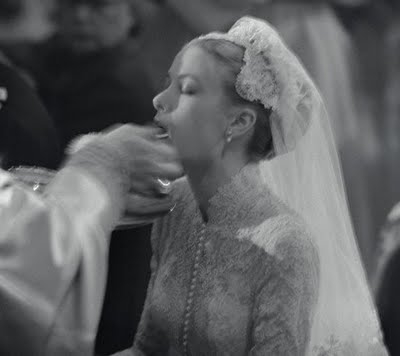
Just minutes from now, you will stand before a Eucharistic minister who will say to you, “The Body of Christ.” And you will answer “Amen,” like Mary answered the angel. “Amen, Lord, I believe you that are truly present in the Eucharist,” and, “Amen, Lord, let this be done to me, let me become your body; your presence in the world.”

With this word, you will receive the Christ; small within you, but truly present as God and man. When you return to your pew today consider Jesus’ presence within you and ask Mary that you be given a taste of her joy from the day the Lord first dwelt in her.

Tuesday, 3rd Week of Advent

December 16, 2009

Is it more important to say the right thing, or to do the right thing? As people like to say “Talk is cheap,” but “Actions speak louder than words.”

Some Christians say that if we merely confess Jesus Christ as our personal Lord and Savior then we are assuredly saved. But Jesus Himself says that ‘not everyone who says to me, ‘Lord, Lord,’ will enter the kingdom of heaven, but only the one who does the will of my Father in heaven.

It is easy to feel righteous like the chief priests and the elders if we subscribe to the right and enlightened opinions, but we should be humbled by the fact that scandalous sinners have turned to Christ and today harvest more fruit in the vineyard than we do.

We have to do more than talk a good game, we have to show up on the court. For example, you say you oppose the killing of the unborn? Good! But what are you doing to end it? Do you pray for mothers and their babies? Do you march for life?

You say that hatred between peoples should end. Absolutely! But is there someone here that you cannot bring yourself to pray for, or say “hello” to in the hallway?

You say that we must care for people in need. Indeed, and Jesus says the same. But do you give of your time, talent and spending cash until it hurts a bit, like an actual sacrifice?

If I were to end this homily here and now with an exhortation that you should go out into your world and to work hard for good in that vineyard, you might decide to listen and your life might change a little bit for a little while. But I would not expect your life change a great deal, unless you also respond to another calling; the calling from our Father that you work in another vineyard first. This vineyard is within you, it is an inner-vineyard. You work it alongside Christ in prayer and what you harvest from it is intimacy with God.  Of this encounter, St. Augustine wrote:

“Late have I loved you, O Beauty ever ancient, ever new, late have I loved you!  You were within me, but I was outside, and it was there that I searched for you.  In my unloveliness I plunged into the lovely things which you created.  You were with me, but I was not with you.  Created things kept me from you; yet if they had not been in you they would not have been at all. You called, you shouted, and you broke through my deafness.  You flashed, you shone, and you dispelled my blindness.  You breathed your fragrance on me; I drew in breath and now I pant for you.  I have tasted you, now I hunger and thirst for more.  You touched me, and I burned for your peace.”

In the labor of prayer (and it does take a daily effort) you encounter God. He surprises you with gifts of consolation and peace, and you overflow with His love. This overflow is what makes the saints the saints. It is what makes their holy lives possible. The saints are not self-made men and women. Their cups runneth over within them, and it is from out of this abundance that they love the vineyard of the world and work in it for the better.

You say that you believe in God, and in Jesus Christ as your Lord and Savior. So come to the work of prayer each day, or your devotion and service to God will remain forever little more than lip-service.

Advent Penance Service

December 1, 2009

 The psalm says, ‘On the holy mountain is [Jerusalem], his city, cherished by the Lord. The Lord prefers the gates of Zion to all Israel’s dwellings. Of you are told glorious things, O city of God, [Jerusalem].’  (Psalm 87) The Lord God loved Jerusalem and lived within its walls. God dwelt there in a special way in His temple on Mount Zion.

The people of Jerusalem felt pretty special about having such close access to God, but this pride was often their greatest weakness. You see the people of Jerusalem imagined they had this holiness thing in the bag, being so close to the Lord and all. Imagine their shock when a prophet would come along to tell them that they were not so perfect as they thought. When God sent them the prophet Jeremiah, he told them:

“Thus says the Lord of hosts, the God of Israel: Reform your ways and your deeds, so that I may remain with you in this place. Put not your trust in the deceitful words: “This is the temple of the LORD! The temple of the LORD! The temple of the LORD!” Only if you thoroughly reform your ways and your deeds; if each of you deals justly with his neighbor; if you no longer oppress the stranger, the orphan, and the widow; if you no longer shed innocent blood in this place, or follow strange gods to your own harm, will I remain with you in this place…”

Time and again, God sent prophets to Jerusalem to call them to conversion, but Jerusalem would persecute, imprison and kill them. But they did not convert.  And, in the lifetime of Jeremiah, their enemies (the Babylonians) conquered  the city of Jerusalem and destroyed the temple of God within it. We hear God’s feelings about all this through words of Jesus:

“Jerusalem… Jerusalem… you who kill the prophets and stone those sent to you, how many times I yearned to gather your children together, as a hen gathers her young under her wings, but you were unwilling! Behold, your house will be abandoned, desolate. I tell you, you will not see me again until you say, ‘Blessed is he who comes in the name of the Lord.’”

Jesus’ words matter for us today too, because Jerusalem symbolizes our souls. At our baptism, God began to dwell in our souls as His temple, as His new Jerusalem. The psalm is speaking about your soul and mine when it says:

O praise the Lord, Jerusalem! 
Zion, praise your God!
He has strengthened the bars of your gates,
He has blessed the children within you.
He established peace on your borders,
He feeds you with finest wheat.   (Psalm 147)

Indeed, God has strengthened the bars of our gates, our defenses against evil. He has blessed the children, everything that is good and loveable, within us. He establishes peace on our borders, in our relationships with others. And He feeds us with the finest of wheat in the Eucharist. We should feel pretty special about having such close access to God, but we should not make the same mistakes as the old Jerusalem.

You and I can persecute God’s prophets too. We do it whenever we choose to rebel and sin against the good God wills for us. We do it whenever we kill the voice of conscience within us. We do it whenever we imprison the Holy Spirit’s movements within us to the confines of a tiny cell. We do it whenever ignore or refuse to listen to the teachers Christ has given for His Church.

When we are persecuting God’s prophets, we can even evict God’s presence from our souls through freely and knowingly committing a grave or serious sin. We are conquered by our enemy and the temple inside us is destroyed. And ‘behold, our house is abandoned, desolate; and we do not see Him again until we say, ‘Blessed is he who comes in the name of the Lord.’ What can do to help prevent this horrible estrangement from occurring?  And if it does occur, how can we ask the Lord God to return?

In the sacrament of reconciliation, we acknowledge that Jesus Christ is the Blessed One who comes in the name of the Lord. When we acknowledge this, He forgives our sins, and God joyfully dwells in His cherished city. Today, Jesus Christ calls your city to repentance and the conversion of your soul.

Wednesday, 34th Week in Ordinary Time—Year I

November 25, 2009

Today’s responsorial psalm is not actually one of the 150 Psalms.  It comes from Daniel 3, where 3 men (none of whom are Daniel) are thrown into a fiery furnace for refusing to worship a golden  statue of King Nebuchadnezzar. (Isn’t it always so that all of history’s oppressive states and rulers have insisted that everyone fall down and worship gilded images of themselves or else be thrown to the fire?) Anyway, these three men are heaved into the flames, but God sends to them an “angel of the Lord,” or literally, a messenger, to preserve them from all harm. The trio sings a hymn of praise, part of which we heard today as our responsorial psalm.

Sun and moon, bless the Lord…
Stars of heaven, bless the Lord…
Every shower and dew, bless the Lord…
All you winds, bless the Lord…
Fire and heat, bless the Lord…
Cold and chill, bless the Lord;
praise and exalt him above all forever.

King Nebuchadnezzar rose in haste and asked his nobles, “Did we not cast three men bound into the fire?” “Assuredly, O king,” they answered. “But,” he replied, “I see four men unfettered and unhurt, walking in the fire, and the fourth looks like a son of God.”

Could this “son of God” amidst the flames actually be the Second Person of the Trinity, God the Father’s greatest messenger, or is it merely one of God’s many angelic spirits? In either case, this heaven-sent deliverer for God’s faithful ones at least symbolically points to Jesus Christ. We should not be surprised to find signs of Christ in the Old Testament.  Nor should we be surprised to see symbols of Him built into God’s creation all around us.

Consider the sun in the sky, which gives light to the world. It comes to earth, dies, and is buried, but then it rises again for us.

Consider the moon in the night, which resembles the Eucharistic host. We admire it held on high. We see it broken before us. Though consumed, it is renewed again for us.

Consider the stars, which resemble Christ’s numerous and glorious saints shining in heaven.

Consider the showers and dews, which resemble Him who humbly comes down from heaven to earth to give life to the world.

Consider the winds, which resembles Christ’s Spirit, mysteriously moving and active across the whole world.

Fire and heat, bless the Lord. Cold and chill, bless the Lord. For even in the extremes and in-between’s of life, God is to be found. Let us praise and exalt him above all forever.

Tuesday, 34th Week in Ordinary Time—Year I

November 25, 2009

The prophets go beyond what is seen, to reveal what is hidden. Their purpose is to lead people to God.

In the first reading, Daniel reveals what was seen in the king’s dream. In the Gospel, Jesus reveals what will be seen in Jerusalem and at the end of this world as it no stands. In this homily, I will reveal to you three prayers hidden within the Mass which are always present there, but which you may have never heard before.

The first of these hidden prayers comes after the presentation of the gifts. A few of the faithful bring forth the bread and wine to the altar. It is no empty chore. This symbolizes the offering of all your gifts and of your whole lives to God.

I receive the gifts and then I say a prayer of praise to the God of all creation for this bread which we have to offer. Yet before I go on to a similar prayer with the cup of wine you may have noticed something unusual. The priest takes the water and pours a little into the cup of wine. It’s only a few drops, and the wine appears unchanged, but the water and wine have become inseparably one. As he pours, the priests silently prays this:

“By the mystery of this water and wine may we come to share in the divinity of Christ, who humbled himself to share in our humanity.”

You and I will always be God’s finite creatures, but, by the Incarnation, Jesus has made Himself inseparably one with our humanity. It is Jesus’ desire to make us more and more like His divine self through our personal union with Him.

What is the lesson for us here at Mass? We should come to each Mass with high expectations. Do you believe that your whole-hearted participation in this sacrament can make you a better, more beautiful, or more admirable person, and do powerful things for our world? Approach this sacrifice with high expectations. On this point St. John of the Cross and St. Therese of Lisieux agree: “We receive from God as much as we hope for.”

After these prayers for the bread and wine, you will see me bow at the altar. At this moment comes the second hidden prayer. The priest prays:

“Lord God, we ask you to receive us and be pleased with the sacrifice we offer you with humble and contrite hearts.”

What is the lesson for us here at Mass? We should strive to be fully-present at every Mass. Pray the Mass and sing the songs with your whole heart. Offer God this sacrifice with humility, contrition, gratitude and love.

After this comes the washing of the hands and a third silent prayer. The priest prays:

“Lord, wash me of my iniquity; cleanse me from my sin.”

I pray this prayer from particularly from the heart because I do not want my offering and partaking of this most holy sacrament to be the cause of my condemnation and death on account of my sins. (If you think of it, pray for your priest as he washes his hands, that He may offer this sacrifice well for you.) Approaching our all-holy God is serious stuff.

What is the lesson for us here at Mass? If you are aware of serious sins on your soul, come to  confession, the sacrament of reconciliation. Come and be cleansed. Lighten your burden. Do it today.

The prophets go beyond what is seen, to reveal what is hidden. Their purpose is to lead people to God. Through the revealing of these holy prayers I pray you be led to closer to our Lord Jesus Christ at this very Mass.

Friday, 33rd Week in Ordinary Time—Year I

November 23, 2009

In the year 167 before Christ, the empire dominating the Jews, in attempt to unify their peoples, forbid the Jewish sacrifices, banned observance of the Sabbath and feasts, and outlawed circumcision. Altars to Zeus and other Greek gods were set up in the temple, and unclean animals, like pigs, were sacrificed upon them. In response, Mattathias Maccabeus and his sons led a Jewish revolt against their oppressors. Two years later, they had crushed their enemies and went up to purify the temple and to rededicate it for proper worship.

Two hundred years later, another zealous lover of God’s law went up to the temple to cleanse it and rededicate for true worship. Jesus entered the temple area and proceeded to drive out those who were selling things, saying to them, “It is written, My house shall be a house of prayer, but you have made it a den of thieves.”

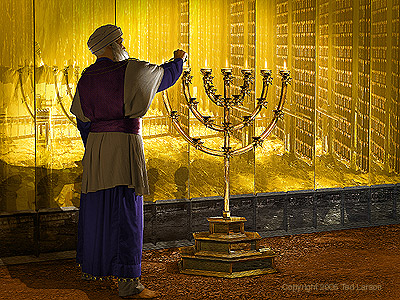
After the Maccabees had rededicated the temple they celebrated for eight days.  When they relit the seven wicks of the menorah in the sanctuary they only had enough olive oil on hand to keep it burning for one day.  But, by a miracle, it is said that the lamp kept burning for eight days, long enough to press, prepare and consecrate more fresh oil. The rededication of the temple and this miracle are still commemorated in our time as a Jewish holy day.  From the Hebrew word for “dedication” or “consecration”, the Jews call this celebration “Hanukkah.”

Christ has dedicated and consecrated us as the new temple and house of God. How are we to keep our temple lamps lit? How are we to obtain oil for our souls? We are not to do it by grasping, by stealing things from the world, in a vain effort to fill ourselves. The Lord’s house is not to be a den of thieves. Instead, we must pray, asking for the grace we need to remain burning brightly. As Jesus said, “My house shall be a house of prayer.”

Tuesday, 33rd Week in Ordinary Time—Year I

November 17, 2009

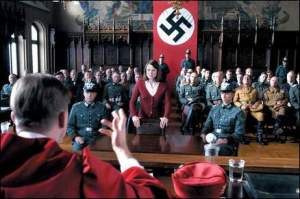
Imagine if the United States of America, with all its freedoms and rights, were not the United States of America, and on your way to school today, you were stopped along roadside by the secret police. They ask you for your name. You cooperate give it. Then they order you to put your hands on the hood of the squad car. They handcuff you and place you under arrest.

You ask them, “What’s going on? What have I done?” They reply, “You’re under arrest for the charge that you are a believing Catholic Christian.” You didn’t realize it, but the police have had you under intense surveillance for the past several weeks, wire-tapping your phone, monitoring your computer, searching your personal belongs, and watching all your movements and activities.

Imagine yourself in this situation. This is the question I pose to you: At your trial, when all of the evidence they have gathered is presented against you, will there be enough to convict you? Would there be sufficient evidence to find you guilty of being a believing Catholic Christian? What would they have on you?

Would they have testimony from informants that you observe every Friday as a day of penance, that you keep every Sunday as a special, day of rest, and faithfully go to Mass and frequent the sacrament of reconciliation? Could anyone testify against you that they heard you saying positive things about Jesus Christ, or that you spoke up for the Catholic faith when it was mocked or criticized in your presence? Could they put into evidence a rosary, or a Bible, or some other Catholic book, marked with fresh traces of DNA from your fingertips? Would they have hidden camera footage of you praying before meals at school or at restaurants? Would they have grainy night-vision footage of you praying before going to bed, or praying the first thing in the morning, making the tell-tale sign of the cross.

A few hours after your arrest you find yourself in a courtroom (because the “people’s” authoritarian government believes in speedy trials.) The intimidating judge looks down at you from the bench, “It says here that you were picked up on your way to the Columbus school. We have evidence of illegal Christian propaganda being taught there and we also have reliable reports that various Catholic rituals are done there, superstitions which are offensive to reason and the spirit of our times. Now I imagine that you went to that school because that’s where your parents sent you. And I’m sure that your parents would be shocked to discover that such repugnant activities as these are happening at your school.”
The judge continues, “The punishment for being found guilty of being a believing Catholic Christian is a grave one. But… if you were simply mixed-up in these activities, unthinkingly, by accident—if you were just doing them because that’s what everyone else around you was doing—well then that would be a different story. Spies and traders may come to our government rallies, but that doesn’t make them loyal citizens now does it? So just going through the motions doesn’t make you a believing Catholic at all, am I right?”

“So I can completely understand how this regretable misunderstanding has occurred. You didn’t really understand what you were doing did you? Now if you would simply formally renounce any and all belief in these silly superstitions, you may go on your way. Just sign your name here on this piece of paper testifying to that effect, and you’re free to go.”

What would you do? What do you wish you would have the courage to do? Would we have the courage to refuse to sign, just as Eleazar refused to eat? The eating of a little meat, like the movement of a pen, is a small act, but Eleazar refused and accepted an unjust death because to do otherwise would mean a rejection of the Lord, the one true God, the King of all other kings.

Now it is very unlikely that you or I will ever have to lay down our lives as red, or bloody martyrs for our faith in Christ. But, like Zacchaeus, there will be certainly times when we will have to go out on a limb for Christ. The crowd laughed to see the rich man Zacchaeus up in that tree, but what did Zacchaeus care about? His focus was totally fixed upon his connection with Jesus Christ.

Be like Eleazar, and don’t swallow whatever the world sets before you, because a lot of it is not good and can alienate you from God. Be like Zacchaeus, with the courage to go out on a limb regardless of what other people might think or say, for the sake of your relationship with Christ.

[The images for this post come from the movie Sophie Scholl–The Final Days. If you liked A Man for All Seasons, you’ll like this one too (but I’ll warn you up front that it ends the same way.)]

Thursday, 29th Week in Ordinary Time—Year I

October 28, 2009

G.K. Chesterton

G.K. Chesterton, the British Catholic writer, lived one hundred years ago, but his writings are still witty, insightful, and relevant today. Once he wrote in answer to the question, “Why I am a Catholic.”  Chesterton explained, “The difficulty of explaining ‘why I am a Catholic’ is that there are ten thousand reasons all amounting to one reason: that Catholicism is true. I could fill all my space with separate sentences each beginning with the words, ‘It is the only thing that…’”  One of the examples of this he gave was that Catholicism “is the only thing that frees a man from the degrading slavery of being a child of his age.”

Why is it that after so many centuries we remain divided, three against two and two against three, on so many important matters?  We may be far more technologically advanced than they were in Jesus’ time, but every generation seems to repeat falling into the same, or slightly differing, forms of foolishness.  While science and technology is cumulative, part of every generation thinks they have to rediscover wisdom from scratch.  That’s why we still have ethical debates about questions that Jesus has settled.

Can we do evil in the hopes that good will come of it? [This is Ethics 101.  St. Paul teaches about this to the Romans, “And why not say—as we are accused and as some claim we say—that we should do evil that good may come of it? Their penalty is what they deserve.”] What if we’re [almost] certain that really good things will come from the evil we do? [Even if the evil does result in some good, what does freely-choosing evil make us?] Should we let the progress of science be bogged down by questions of morality? Should morality and private conscience have a place in politics and public life? [If not, then what will science, public life and policy be guided by beyond base desires and power?] Is it really always wrong to intentionally kill the innocent? What if intentionally killing 100,000 civilians will end a war?

If this is how things are when the wood is green in our country, then what will it be like when the wood is brown, dry, and dead, as it may well be in years ahead? What is the Christian to do?  Remain closely rooted to Christ, the source of our wisdom and waters of life. To borrow the words from the psalmist today:

The Christian “is like a tree
planted near running water,
That yields its fruit in due season,
and whose leaves never fade.
Whatever he does, prospers.”

Even if he is martyred, whatever the faithful Christian does prospers; for he is not a child and a slave of his age, but a child of the age to come.

October 28 – Sts. Simon and Jude

October 28, 2009

Cowardly Lion

Today we celebrate the Sts. Simon and Jude, apostles and martyrs for Christ. Simon was known as “the Zealot,” and Jude, or Judas the son of James, was nicknamed “Thaddeus,” which means “Courageous” in Greek. In the Gospel today the apostles are listed, with Simon and Jude coming towards the end, right before Judas Iscariot, the one who betrayed Jesus.

When Jesus sent out His disciples with the power and authority to heal the sick, cast out demons, and preach the Gospel, He sent them out two-by-two.  One could infer (though this is by no means certain) that this Gospel passage lists the apostles according to those old missionary pairings: Simon Peter with his brother, Andrew; James with his brother, John; and so on, ending with the Judas called “Courageous” and the other Judas who became a traitor.

So here we would have two Judas’, side-by-side, in discipleship and ministry. Yet, only one of them earned a nickname for being courageous. To grow in holiness requires our courage, a virtue that Judas Iscariot tragically lacked.

John’s Gospel tells us that this Judas held the money purse, and sometimes stole from it for himself. That’s because he lacked the courage to acknowledge his faults and to grow in the virtues.

Judas may have betrayed Jesus because he thought this would kick-start Jesus, the weak messiah, into real, revolutionary action. Judas did not have the courage to trust that the providence of God working through Jesus Christ was really the best way to bring about the Kingdom on earth.

And after he had sinned, Judas lacked the courage to seek forgiveness, choosing suicide instead, which is called “the coward’s death.” Simon Peter denied Jesus, but he had the courage to confess his sin and to seek reconciliation. That was Peter’s salvation.

If we are going to grow in holiness to sainthood, it’s going to require our courage; the courage to acknowledge our faults and grow virtue, the courage to trust in God’s will and providential plan for our lives, and, when we fall, the courage to confess our sins and to seek reconciliation with Christ.

Monday, 30th Week in Ordinary Time—Year I

October 26, 2009

Christians Martyrs and the Lions

Remember Jesus’ story about the two men who went up to the temple area to pray, the self-righteous Pharisee and the repentant tax-collector? “The tax collector stood off at a distance and would not even raise his eyes to heaven…”

In today’s gospel, at the synagogue where Jesus is teaching, there is a hunched-over woman who has not raised her eyes to heaven for a very long time. Jesus calls her, lays His hands on her, and at once, she stands erect, for the first time eighteen years. I have to imagine that her very first act was to raise her eyes and hands up to heaven, to speak praises and to glorify God. Imagine how she must have felt to be deprived of such worship for so long, and then, how she must have felt for it to be so suddenly and wonderfully restored to her.

Seeing this, the authorities, the Pharisees, object that Jesus should not do healings during the Sabbath rest. But Jesus rebukes them, to their great humiliation. Who are they to say that this woman should not be free to worship God this day? Her freedom to worship comes from God Himself.

We, this morning, are free to gather here, free to raise our eyes up to heaven and offer worship. We are free from fears that authorities or angry crowds will storm through those doors and drag us off to our imprisonment or death. In the past, not all Christians have been so privileged. Still today, around the world, not all Christians are so privileged.

Let us celebrate this Mass, and every Mass, with a deeper reverence and gratitude, for the freedom we have to raise our eyes to heaven and to offer our worship to God. Let us pray for persecuted Christians around the world and celebrate this Mass, and every Mass, as if it were our first, our last and our only.

October 17 — St. Margret Mary Alacoque

October 18, 2009

Sacred Heart by Margherita. Vatican

Today we celebrate St. Margret Mary Alacoque of France who lived in the latter half of the 1600’s. Throughout her life, Jesus would appear to her and converse with her, but this did not surprise Margret or seem strange to her. She assumed that other people experienced the same sort of things all the time. After she become a nun, Jesus gave her a  mission: to establish devotion to His Sacred Heart.

You’ve seen images of the Sacred Heart before; a red heart, crowned with thorns, pierced along its side, with a cross and flames emerging from its top. If this devotion seems strange to us, its because we do not understand what it means.

Sacred Heart of Jesus

When I was in seminary I heard a story about the Sacred Heart that I not been able to confirm with the internet, but I share it with you as a great illustration, even if it might only be a legend. The story goes that after St. Margret Mary Alacoque died, devotion to Jesus’ Sacred Heart was spread by the Jesuits, a Catholic religious order, in their missionary work. In one mission territory (it might have been Papua New Guinea) the priests introduced this devotion to the people, but it wasn’t resonating with them.  The people just didn’t seem to get it. As they missionaries learned more about the native culture, they learned that these people did not look at the heart as the organ that symbolizes love and emotion.  For them, some other abdominal organ, the liver I think, was the seat of human love and emotions. In response, these missionaries replaced the Sacred Heart devotion with another, a devotion to the Sacred Liver. The natives people got it, and responded enthusiastically.

When we consider the Sacred Heart today, we can be a lot like the natives in this (possibly fictional) story. We today tend to be a people of science, materiality, and literal interpretations, who look at a heart and see an organ for pumping blood. But the Church in the 1600’s saw the world differently, in a much more poetic way—they saw the Sacred Heart and understood its message.

Jesus’ Heart is aflame with fire, because His love for you is intense and passionate. His Heart is pierced, crowned with thorns, and holding up a cross, because Jesus suffered for you out of love. Jesus presents this devotion to us, because He wants us to remember that He is a human being like us and that He loves us with a human heart. The Sacred Heart is a symbol of His love for us, that He loves us deeply, with a human heart.

Since modern-day Catholics understand and resonate with the Sacred Heart less easily than we used to, Jesus seems to have given the Catholic Church another sacred image to convey very similar message. In the 1930’s, Jesus appeared to another nun and gave a mission to promote a new devotional image. That nun was St. Faustina Kowalska of Poland, and the devotion she was to spread was the Divine Mercy. The two devotions are very much alike. For example, both devotions emphasize Jesus’ humanity.  Both are accompanied by popular prayers devotions.  And both show that Jesus’ abundant loves and mercy for all.  The question is not which devotion is better, the question is which devotion resonates or connects with you in communicating Jesus’ love for you.

Sacred Heart PaintingDivine Mercy

And now I come to my final, and most important point. I’m sure all of you know the right answer to the questions, “Does God love everyone,” and “Does Jesus love you?” None of you would get these wrong on a test. But I suspect that for most of you the concept that God loves you remains just an idea. Have you experienced this truth as a reality? Do you know that Jesus Christ likes you, that He enjoys you, that He is pleased with you? If you’re uncertain about this, then you have not yet experienced His love for you as profoundly as He desires. Personally knowing Christ’s love for you, rather than just knowing about it, makes all the difference in the world.

So here is your assignment… Ask Jesus Christ to reveal to you today, or in the very near future, some palpable sign of how, and how much, He loves you. Then, keep your eyes open. Jesus is clever and powerful, and knows how to reach you. He doesn’t want His love for you to be a secret.